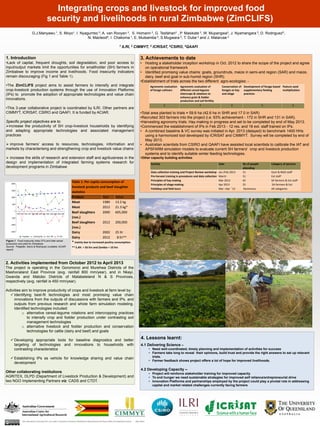
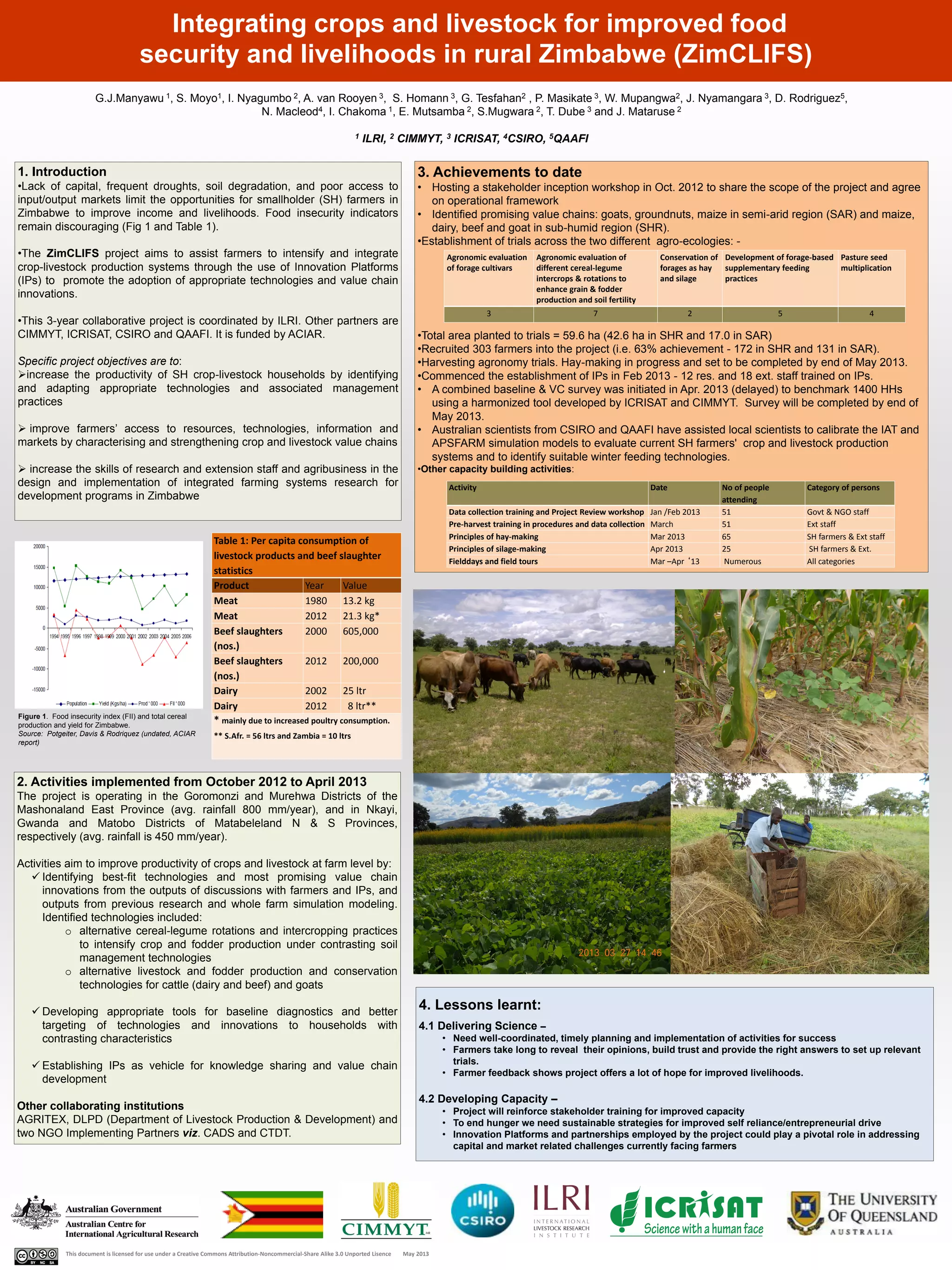
Integrating crops and livestock for improved food
security and livelihoods in rural Zimbabwe (ZimCLIFS)
1. Introduction
•Lack of capital, frequent droughts, soil degradation, and poor access to
input/output markets limit the opportunities for smallholder (SH) farmers in
Zimbabwe to improve income and livelihoods. Food insecurity indicators
remain discouraging (Fig 1 and Table 1).
•The ZimCLIFS project aims to assist farmers to intensify and integrate
crop-livestock production systems through the use of Innovation Platforms
(IPs) to promote the adoption of appropriate technologies and value chain
innovations.
•This 3-year collaborative project is coordinated by ILRI. Other partners are
CIMMYT, ICRISAT, CSIRO and QAAFI. It is funded by ACIAR.
Specific project objectives are to:
increase the productivity of SH crop-livestock households by identifying
and adapting appropriate technologies and associated management
practices
 improve farmers’ access to resources, technologies, information and
markets by characterising and strengthening crop and livestock value chains
 increase the skills of research and extension staff and agribusiness in the
design and implementation of integrated farming systems research for
development programs in Zimbabwe
2. Activities implemented from October 2012 to April 2013
The project is operating in the Goromonzi and Murehwa Districts of the
Mashonaland East Province (avg. rainfall 800 mm/year), and in Nkayi,
Gwanda and Matobo Districts of Matabeleland N & S Provinces,
respectively (avg. rainfall is 450 mm/year).
Activities aim to improve productivity of crops and livestock at farm level by:
 Identifying best-fit technologies and most promising value chain
innovations from the outputs of discussions with farmers and IPs, and
outputs from previous research and whole farm simulation modeling.
Identified technologies included:
o alternative cereal-legume rotations and intercropping practices
to intensify crop and fodder production under contrasting soil
management technologies
o alternative livestock and fodder production and conservation
technologies for cattle (dairy and beef) and goats
 Developing appropriate tools for baseline diagnostics and better
targeting of technologies and innovations to households with
contrasting characteristics
 Establishing IPs as vehicle for knowledge sharing and value chain
development
Other collaborating institutions
AGRITEX, DLPD (Department of Livestock Production & Development) and
two NGO Implementing Partners viz. CADS and CTDT.
3. Achievements to date
• Hosting a stakeholder inception workshop in Oct. 2012 to share the scope of the project and agree
on operational framework
• Identified promising value chains: goats, groundnuts, maize in semi-arid region (SAR) and maize,
dairy, beef and goat in sub-humid region (SHR).
•Establishment of trials across the two different agro-ecologies: -
•Total area planted to trials = 59.6 ha (42.6 ha in SHR and 17.0 in SAR)
•Recruited 303 farmers into the project (i.e. 63% achievement - 172 in SHR and 131 in SAR).
•Harvesting agronomy trials. Hay-making in progress and set to be completed by end of May 2013.
•Commenced the establishment of IPs in Feb 2013 - 12 res. and 18 ext. staff trained on IPs.
• A combined baseline & VC survey was initiated in Apr. 2013 (delayed) to benchmark 1400 HHs
using a harmonized tool developed by ICRISAT and CIMMYT. Survey will be completed by end of
May 2013.
• Australian scientists from CSIRO and QAAFI have assisted local scientists to calibrate the IAT and
APSFARM simulation models to evaluate current SH farmers' crop and livestock production
systems and to identify suitable winter feeding technologies.
•Other capacity building activities:
4. Lessons learnt:
4.1 Delivering Science –
• Need well-coordinated, timely planning and implementation of activities for success
• Farmers take long to reveal their opinions, build trust and provide the right answers to set up relevant
trials.
• Farmer feedback shows project offers a lot of hope for improved livelihoods.
4.2 Developing Capacity –
• Project will reinforce stakeholder training for improved capacity
• To end hunger we need sustainable strategies for improved self reliance/entrepreneurial drive
• Innovation Platforms and partnerships employed by the project could play a pivotal role in addressing
capital and market related challenges currently facing farmers
Agronomic evaluation
of forage cultivars
Agronomic evaluation of
different cereal-legume
intercrops & rotations to
enhance grain & fodder
production and soil fertility
Conservation of
forages as hay
and silage
Development of forage-based
supplementary feeding
practices
Pasture seed
multiplication
3 7 2 5 4
Figure 1. Food insecurity index (FII) and total cereal
production and yield for Zimbabwe.
Source: Potgeiter, Davis & Rodriquez (undated, ACIAR
report)
Activity Date No of people
attending
Category of persons
Data collection training and Project Review workshop Jan /Feb 2013 51 Govt & NGO staff
Pre-harvest training in procedures and data collection March 51 Ext staff
Principles of hay-making Mar 2013 65 SH farmers & Ext staff
Principles of silage-making Apr 2013 25 SH farmers & Ext.
Fielddays and field tours Mar –Apr ‘13 Numerous All categories
G.J.Manyawu 1, S. Moyo1, I. Nyagumbo 2, A. van Rooyen 3, S. Homann 3, G. Tesfahan2 , P. Masikate 3, W. Mupangwa2, J. Nyamangara 3, D. Rodriguez5,
N. Macleod4, I. Chakoma 1, E. Mutsamba 2, S.Mugwara 2, T. Dube 3 and J. Mataruse 2
1 ILRI, 2 CIMMYT, 3 ICRISAT, 4CSIRO, 5QAAFI
Table 1: Per capita consumption of
livestock products and beef slaughter
statistics
Product Year Value
Meat 1980 13.2 kg
Meat 2012 21.3 kg*
Beef slaughters
(nos.)
2000 605,000
Beef slaughters
(nos.)
2012 200,000
Dairy 2002 25 ltr
Dairy 2012 8 ltr**
* mainly due to increased poultry consumption.
** S.Afr. = 56 ltrs and Zambia = 10 ltrs
This document is licensed for use under a Creative Commons Attribution-Noncommercial-Share Alike 3.0 Unported Lisence May 2013

Integrating crops and livestock for improved food security and livelihoods in rural Zimbabwe (ZimCLIFS))

  • 1.
    Integrating crops andlivestock for improved food security and livelihoods in rural Zimbabwe (ZimCLIFS) 1. Introduction •Lack of capital, frequent droughts, soil degradation, and poor access to input/output markets limit the opportunities for smallholder (SH) farmers in Zimbabwe to improve income and livelihoods. Food insecurity indicators remain discouraging (Fig 1 and Table 1). •The ZimCLIFS project aims to assist farmers to intensify and integrate crop-livestock production systems through the use of Innovation Platforms (IPs) to promote the adoption of appropriate technologies and value chain innovations. •This 3-year collaborative project is coordinated by ILRI. Other partners are CIMMYT, ICRISAT, CSIRO and QAAFI. It is funded by ACIAR. Specific project objectives are to: increase the productivity of SH crop-livestock households by identifying and adapting appropriate technologies and associated management practices  improve farmers’ access to resources, technologies, information and markets by characterising and strengthening crop and livestock value chains  increase the skills of research and extension staff and agribusiness in the design and implementation of integrated farming systems research for development programs in Zimbabwe 2. Activities implemented from October 2012 to April 2013 The project is operating in the Goromonzi and Murehwa Districts of the Mashonaland East Province (avg. rainfall 800 mm/year), and in Nkayi, Gwanda and Matobo Districts of Matabeleland N & S Provinces, respectively (avg. rainfall is 450 mm/year). Activities aim to improve productivity of crops and livestock at farm level by:  Identifying best-fit technologies and most promising value chain innovations from the outputs of discussions with farmers and IPs, and outputs from previous research and whole farm simulation modeling. Identified technologies included: o alternative cereal-legume rotations and intercropping practices to intensify crop and fodder production under contrasting soil management technologies o alternative livestock and fodder production and conservation technologies for cattle (dairy and beef) and goats  Developing appropriate tools for baseline diagnostics and better targeting of technologies and innovations to households with contrasting characteristics  Establishing IPs as vehicle for knowledge sharing and value chain development Other collaborating institutions AGRITEX, DLPD (Department of Livestock Production & Development) and two NGO Implementing Partners viz. CADS and CTDT. 3. Achievements to date • Hosting a stakeholder inception workshop in Oct. 2012 to share the scope of the project and agree on operational framework • Identified promising value chains: goats, groundnuts, maize in semi-arid region (SAR) and maize, dairy, beef and goat in sub-humid region (SHR). •Establishment of trials across the two different agro-ecologies: - •Total area planted to trials = 59.6 ha (42.6 ha in SHR and 17.0 in SAR) •Recruited 303 farmers into the project (i.e. 63% achievement - 172 in SHR and 131 in SAR). •Harvesting agronomy trials. Hay-making in progress and set to be completed by end of May 2013. •Commenced the establishment of IPs in Feb 2013 - 12 res. and 18 ext. staff trained on IPs. • A combined baseline & VC survey was initiated in Apr. 2013 (delayed) to benchmark 1400 HHs using a harmonized tool developed by ICRISAT and CIMMYT. Survey will be completed by end of May 2013. • Australian scientists from CSIRO and QAAFI have assisted local scientists to calibrate the IAT and APSFARM simulation models to evaluate current SH farmers' crop and livestock production systems and to identify suitable winter feeding technologies. •Other capacity building activities: 4. Lessons learnt: 4.1 Delivering Science – • Need well-coordinated, timely planning and implementation of activities for success • Farmers take long to reveal their opinions, build trust and provide the right answers to set up relevant trials. • Farmer feedback shows project offers a lot of hope for improved livelihoods. 4.2 Developing Capacity – • Project will reinforce stakeholder training for improved capacity • To end hunger we need sustainable strategies for improved self reliance/entrepreneurial drive • Innovation Platforms and partnerships employed by the project could play a pivotal role in addressing capital and market related challenges currently facing farmers Agronomic evaluation of forage cultivars Agronomic evaluation of different cereal-legume intercrops & rotations to enhance grain & fodder production and soil fertility Conservation of forages as hay and silage Development of forage-based supplementary feeding practices Pasture seed multiplication 3 7 2 5 4 Figure 1. Food insecurity index (FII) and total cereal production and yield for Zimbabwe. Source: Potgeiter, Davis & Rodriquez (undated, ACIAR report) Activity Date No of people attending Category of persons Data collection training and Project Review workshop Jan /Feb 2013 51 Govt & NGO staff Pre-harvest training in procedures and data collection March 51 Ext staff Principles of hay-making Mar 2013 65 SH farmers & Ext staff Principles of silage-making Apr 2013 25 SH farmers & Ext. Fielddays and field tours Mar –Apr ‘13 Numerous All categories G.J.Manyawu 1, S. Moyo1, I. Nyagumbo 2, A. van Rooyen 3, S. Homann 3, G. Tesfahan2 , P. Masikate 3, W. Mupangwa2, J. Nyamangara 3, D. Rodriguez5, N. Macleod4, I. Chakoma 1, E. Mutsamba 2, S.Mugwara 2, T. Dube 3 and J. Mataruse 2 1 ILRI, 2 CIMMYT, 3 ICRISAT, 4CSIRO, 5QAAFI Table 1: Per capita consumption of livestock products and beef slaughter statistics Product Year Value Meat 1980 13.2 kg Meat 2012 21.3 kg* Beef slaughters (nos.) 2000 605,000 Beef slaughters (nos.) 2012 200,000 Dairy 2002 25 ltr Dairy 2012 8 ltr** * mainly due to increased poultry consumption. ** S.Afr. = 56 ltrs and Zambia = 10 ltrs This document is licensed for use under a Creative Commons Attribution-Noncommercial-Share Alike 3.0 Unported Lisence May 2013