Dr. Amal Fathy Kaddah
Professor of Prosthodontics,
Faculty Dentistry,
Cairo University
May you have
enough happiness to make
you sweet and satisfied,
enough trials to make you
strong and human,
enough hope to make you
happy and pleased.
The first step in a successful partial
denture is to design and plan the
case very carefully.
The more time taken with this
important step, the more secure
and functional the resulting partial.
The prosthesis must be designed
following the most favorable
biomechanical principles, as the
simple and proper design helps in
reducing the harmful effects on
the supporting structures
Objectives and
Functions of RPD
Preservation
of the
remaining
structures
Simplicity
and rigidity
Restore
masticatory
efficiency
Restore
Appearance
and speech
Preservation of the remaining tissues
without injury of the remaining oral
structures.
Restore the form and function
Enhance psychological comfort
Removable Partial Denture Design
FACTORS
PRINCIPLES
Removable Partial Denture Design
Dr. Mohamed Farouk
Factors that affect RPD design
Are conditions and forces found
in the patients mouth, that affect
the partial denture design.
Removable Partial Denture Design
FACTORS
FORCES
RIDGE
PATIENT
RABUTMENT
Retention
Reciprocation
Support
Indirect Retention
RPD REQUIREMENTS
Bracing and Stabilization
A properly constructed partial denture must
All should be within the physiological limits of the tissues
involved
Principles of RPD design
Are certain rules placed by the
dentist to cope with the oral factors
and achieve the biomechanical
consideration of the design.
Removable Partial Denture Design
Principles of
RPD design
Biological
principles
Mechanical
principles
* Mechanical principles >>> related to
resistance of forces and its application to object
>> looseness of teeth, bon resorption……etc
Biomechanical principles of RPD design
* Bio >>> biological principles pertaining
to living systems >>> inflammation,
Caries, bone resorption….etc
Removable Partial Denture Design
Biomechanical
principles of
design
SUPPORT
RETENTION
BRACING RECOPRICATION
Stability
DESIGN OF
EACH
COMPONENT
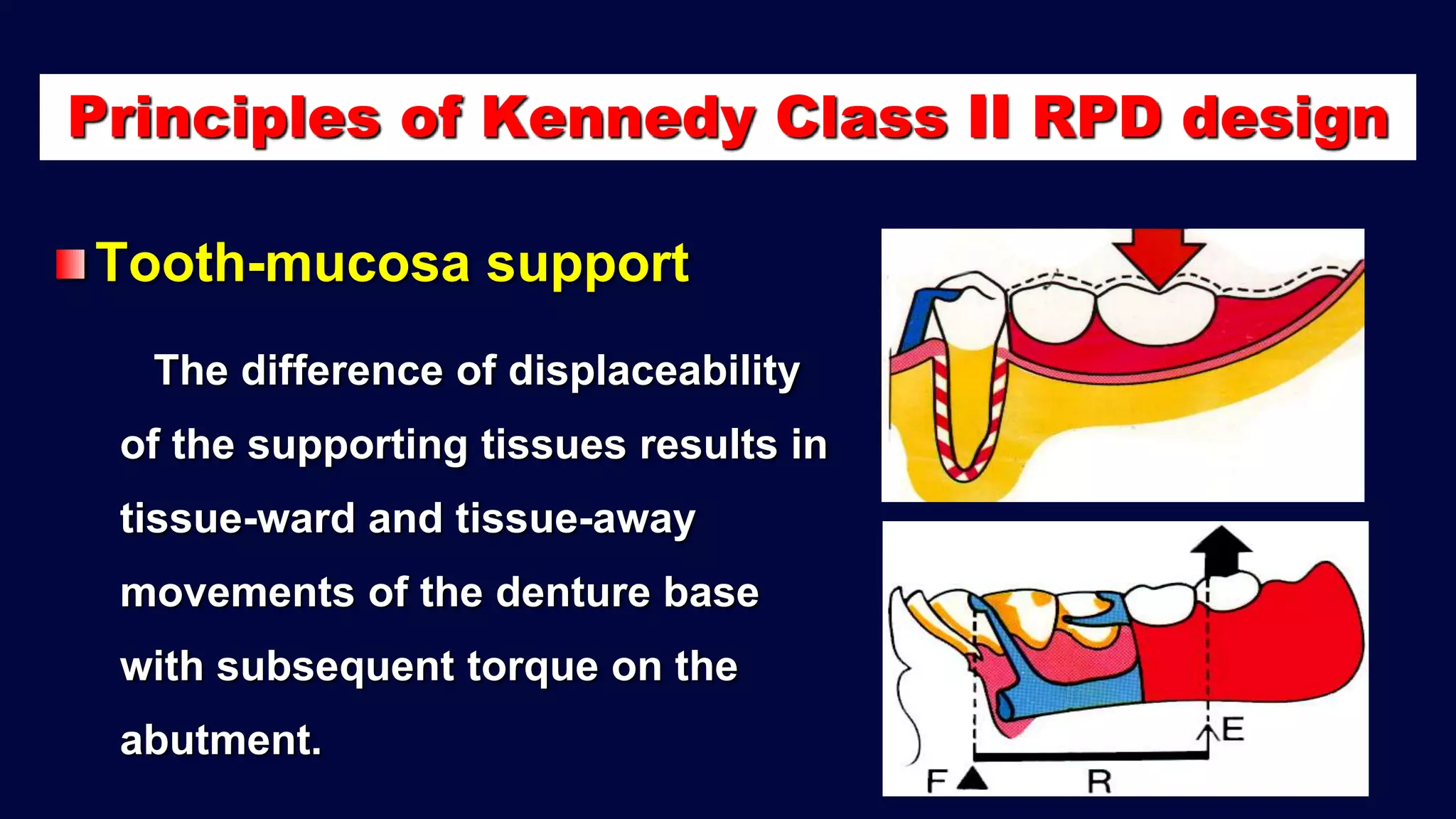
Principles of Kennedy Class II RPD design
Tooth-mucosa support
The difference of displaceability
of the supporting tissues results in
tissue-ward and tissue-away
movements of the denture base
with subsequent torque on the
abutment.
Problems of support associated with free-end
saddles is due to:
1. Lack of posterior abutment
2. Support is derived from both the residual ridge and
abutment teeth
3.Major support is obtained from the residual ridge
4.If resorption occurs and relining of the denture is neglected
further bone resorption occurs with subsequent torque
acting on the abutments.
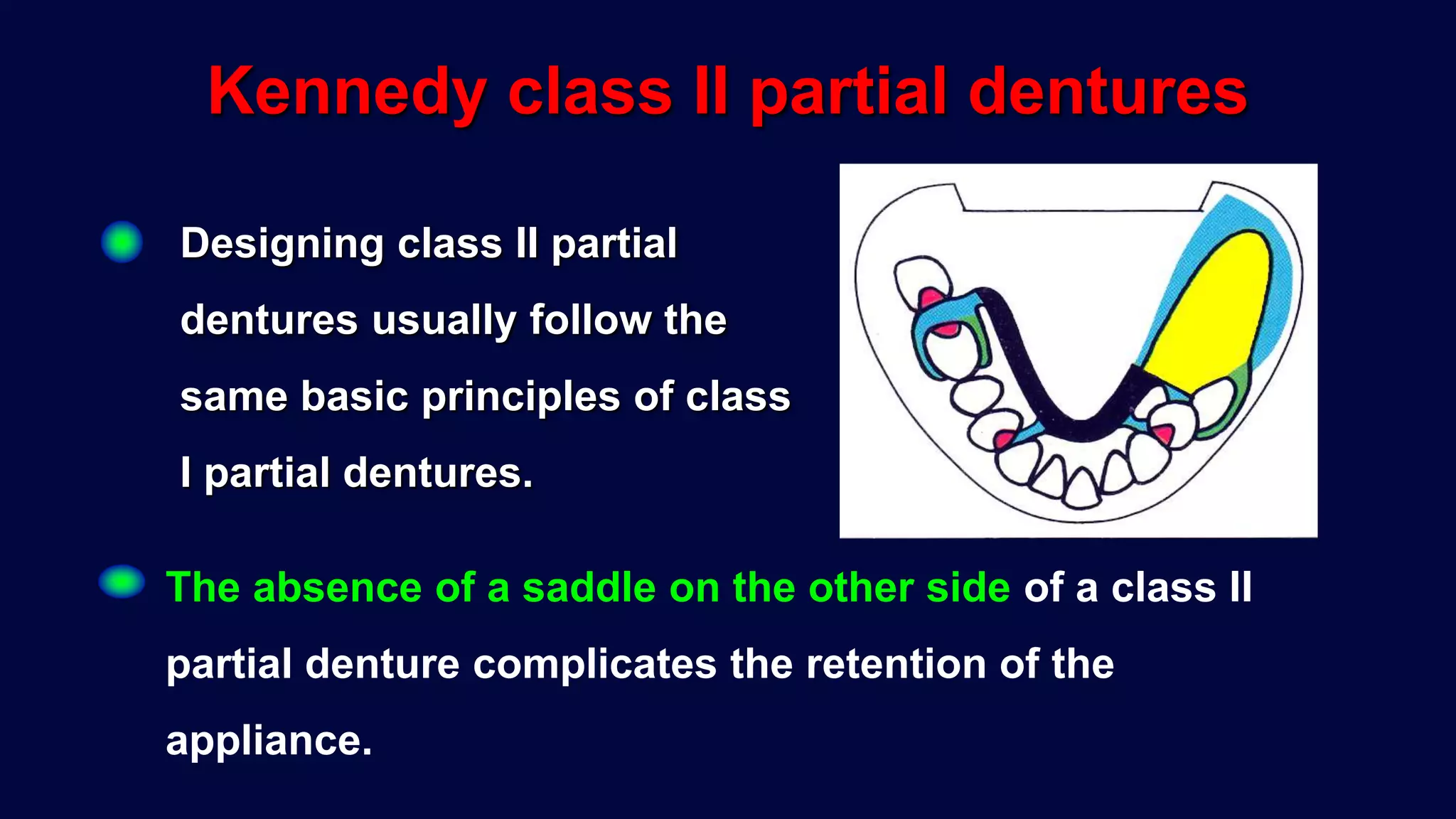
Kennedy class II partial dentures
Designing class II partial
dentures usually follow the
same basic principles of class
I partial dentures.
The absence of a saddle on the other side of a class II
partial denture complicates the retention of the
appliance.
Thus, in class II RPD there are problems
of:
• Support
• Retention
• Bracing and reciprocation
• Stabilization (tipping and rotational movements)
Factors influencing the effectiveness of tissue
support of a distal extension base
1. Contour and quality of the residual ridge (nature of the
mucoperiosteun).
2. The Extent of area coverage by the denture base.
3. Accuracy and fitness of the denture base.
4. The accuracy and type of impression registration (anatomical or
functional).
5. The Design characteristics of the components parts of the partial
denture Framework.
6. Total occlusal load applied.
Problems of unilateral distal extension bases can be reduced by:
A- Load reduction and distribution.
B- Addition retention must be provided on the side where
the arch is complete. The clasp line should divide the
denture into two equal halves.
C- Using indirect retainer in case of class II without
modification, to reduce lateral loading and rotational
movement of the denture base.
? ? ? ?
10
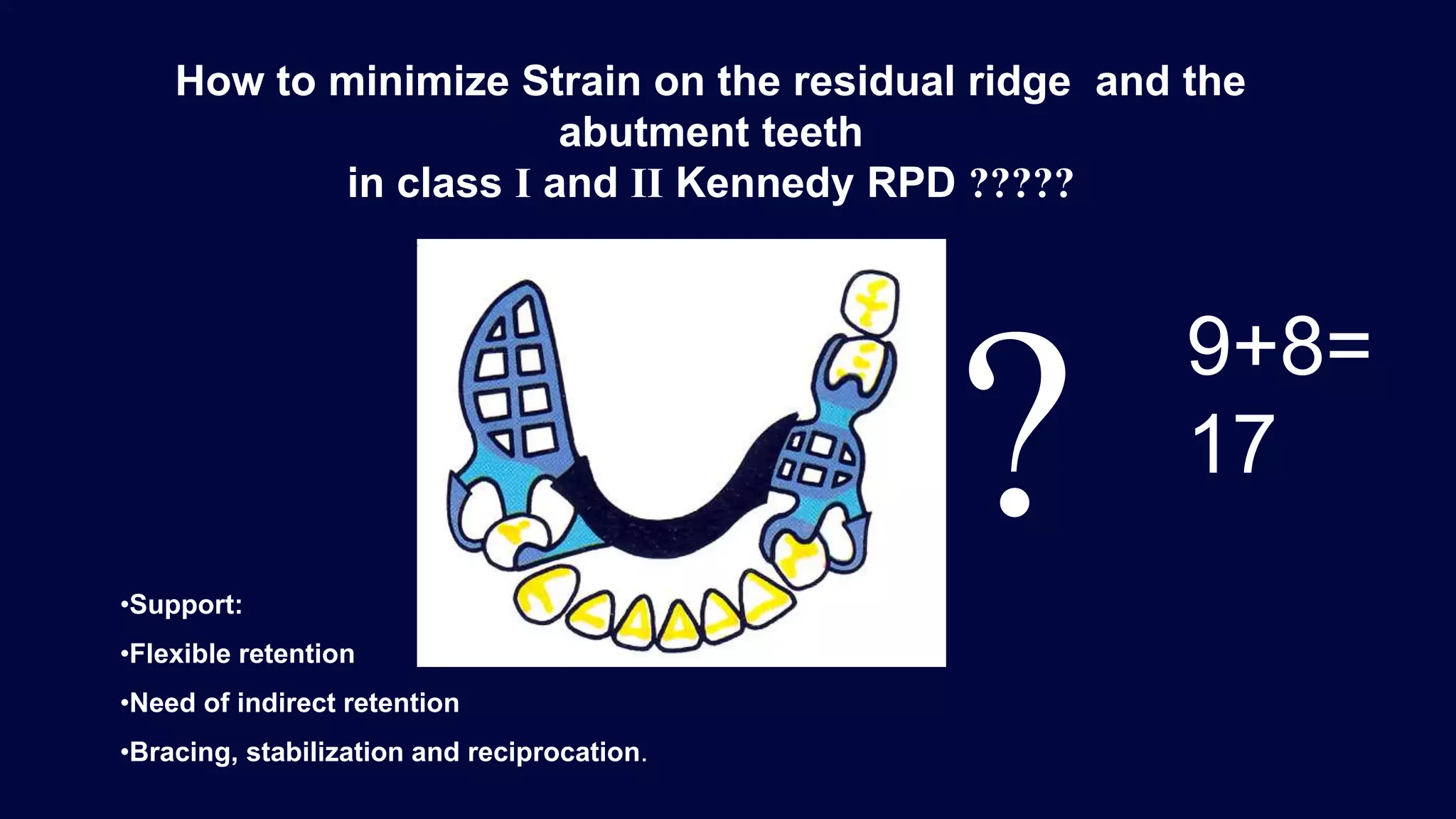
How to minimize Strain on the residual ridge and the
abutment teeth
in class I and II Kennedy RPD ?????
?
9+8=
17
•Support:
•Flexible retention
•Need of indirect retention
•Bracing, stabilization and reciprocation.
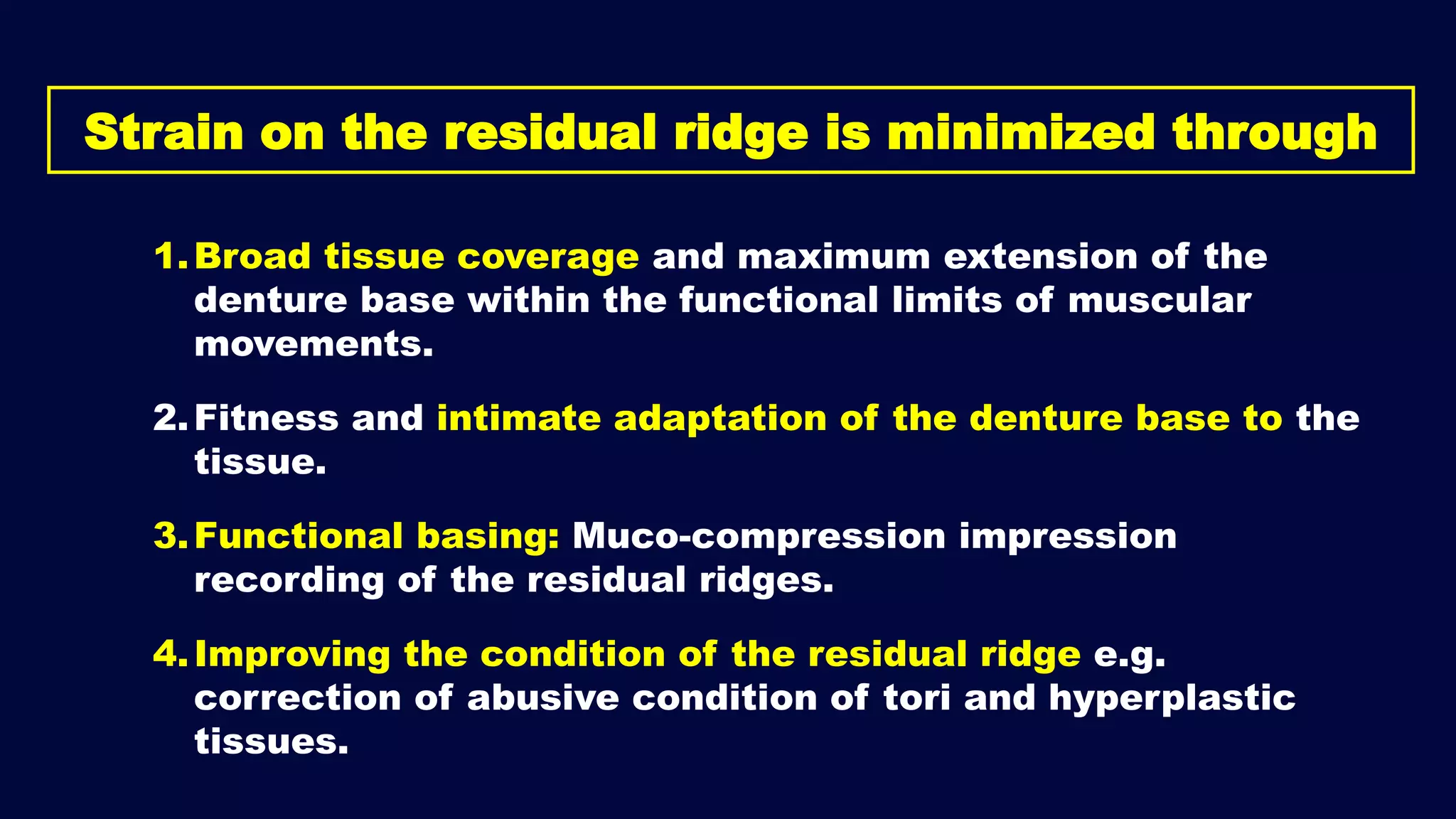
Strain on the residual ridge is minimized through
1.Broad tissue coverage and maximum extension of the
denture base within the functional limits of muscular
movements.
2.Fitness and intimate adaptation of the denture base to the
tissue.
3.Functional basing: Muco-compression impression
recording of the residual ridges.
4.Improving the condition of the residual ridge e.g.
correction of abusive condition of tori and hyperplastic
tissues.
4. Use of small and narrow teeth to increase the masticatory efficiency
and reduce the masticatory load.
5. Harmonious occlusion and reducing the cusp angle of art. teeth.
6. Leaving a tooth off the saddle.
7. Placing the artificial teeth on the anterior two-thirds of the base (no 3rd
molar).
8. Placement of occlusal rests away from the saddle.
9. Providing Posterior Abutments
A- Using an implant at the distal part of the ridge.
B- Salvaging a hopeless badly decayed tooth
(an overdenture abutments)
1.Correct choice of the abut. Tooth with sufficient alveolar
bone support and crown and root morphology
2.Placement of occlusal rests away from the saddle
(6 benefits ????).
3.Correct choice of direct retainer (flexible clasping).
4.Using stress equalizing design.
Strain on the abutment teeth is minimized through
5. Wide distribution of the load over the teeth:
Strain on the abutment teeth is minimized through
a- By placing additional rests, or
b- by a splinting of one or more teeth, either by fixed
partial dentures or by soldering two or more
individual restoration together.
6- Using a Kennedy bar to distribute the lateral load on
multiple teeth. XXXX
7. Preparation and restoration of the abutment teeth to
accommodate the most ideal design of PD this include
a- Proper form of occ. rest seats
b- Tooth prep. and modification to withstand the
functional stresses ( guiding planes, ………..)
8. Providing Posterior Abutments
a- Using an implant at the distal part of the ridge.
b- Salvaging a hopeless badly decayed tooth, an
overdenture abutment
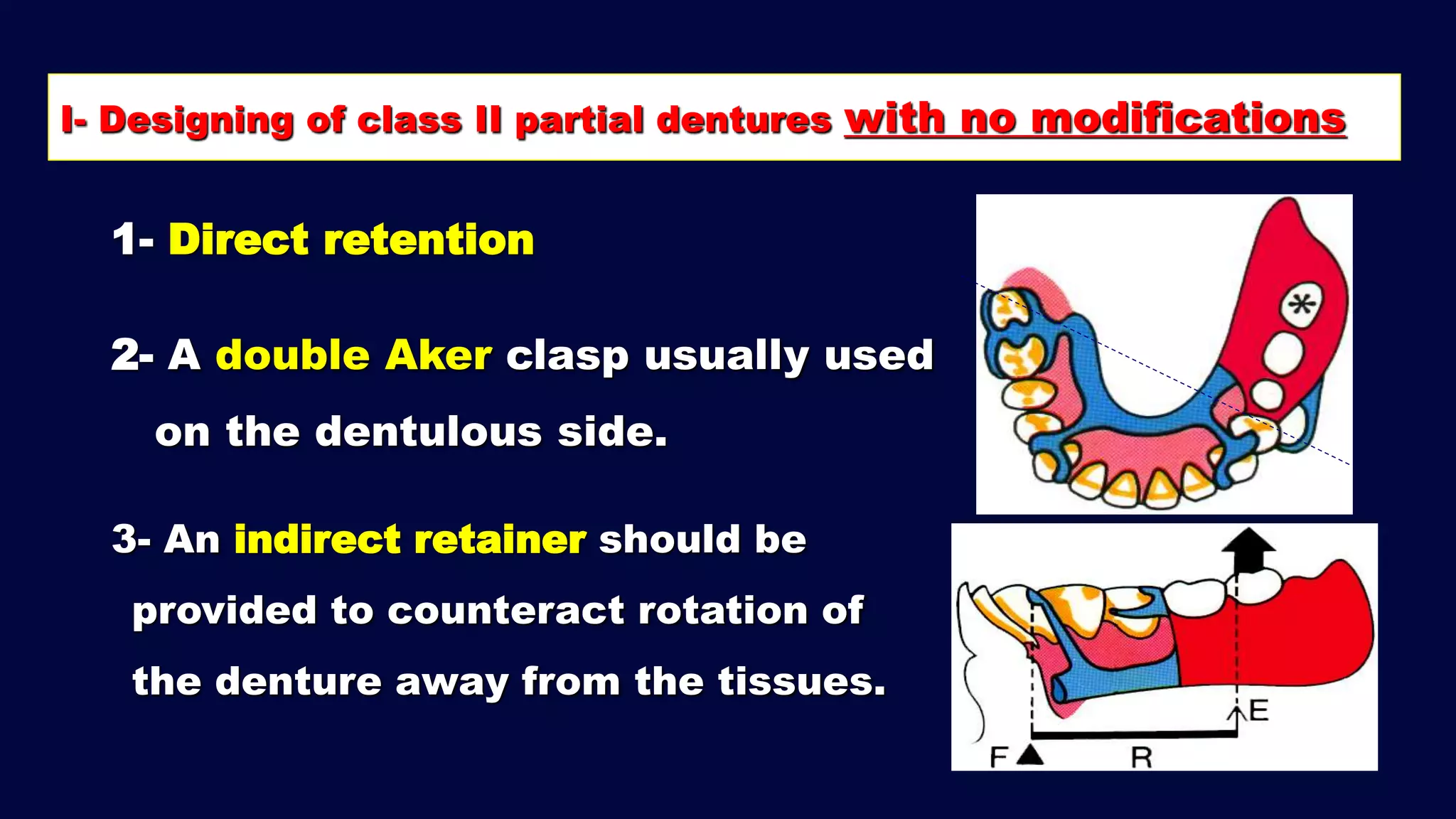
1- Direct retention
2- A double Aker clasp usually used
on the dentulous side.
3- An indirect retainer should be
provided to counteract rotation of
the denture away from the tissues.
I- Designing of class II partial dentures with no modifications
Direct retention is obtained either by:
1- Rigid clasping and rigid connection between the saddle
and the retainer, In case of:
 Short edentulous span bounded
by a strong abutment with healthy
periodontium, and well formed
edentulous ridge covered with
firm mucosa of normal thickness.
I- Designing of class II partial dentures with no modifications
 This design is applied in
long class II cases.
?
?
I- Designing of class II partial dentures with no modifications
Or Direct retention is obtained by:
2- Designs applying stress equalizing principles in long class II
cases.
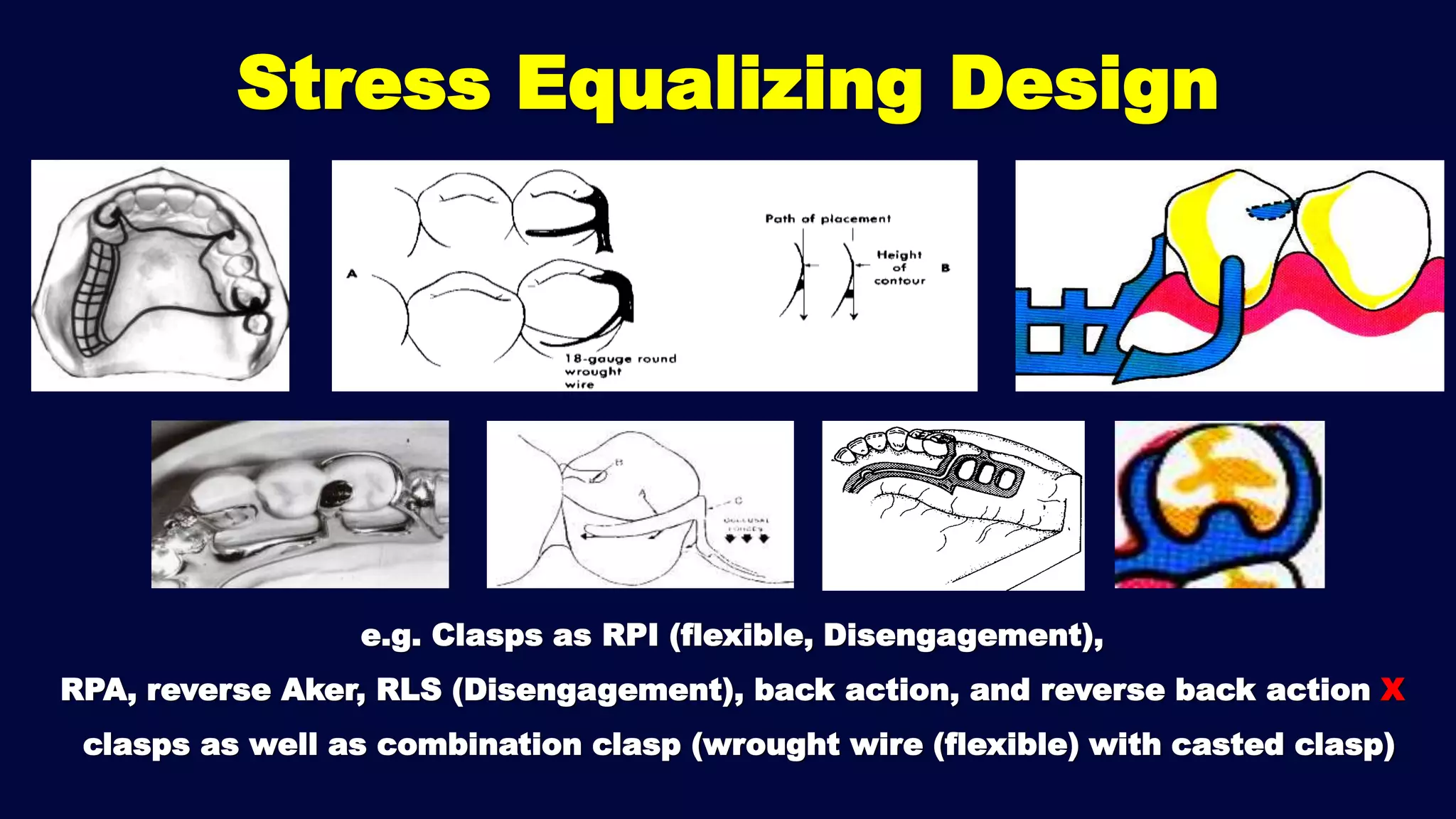
Stress Equalizing Design
e.g. Clasps as RPI (flexible, Disengagement),
RPA, reverse Aker, RLS (Disengagement), back action, and reverse back action X
clasps as well as combination clasp (wrought wire (flexible) with casted clasp)
The clasps on
abutments bounding
the modification area
provide retention, bracing and reciprocation
together with indirect retention
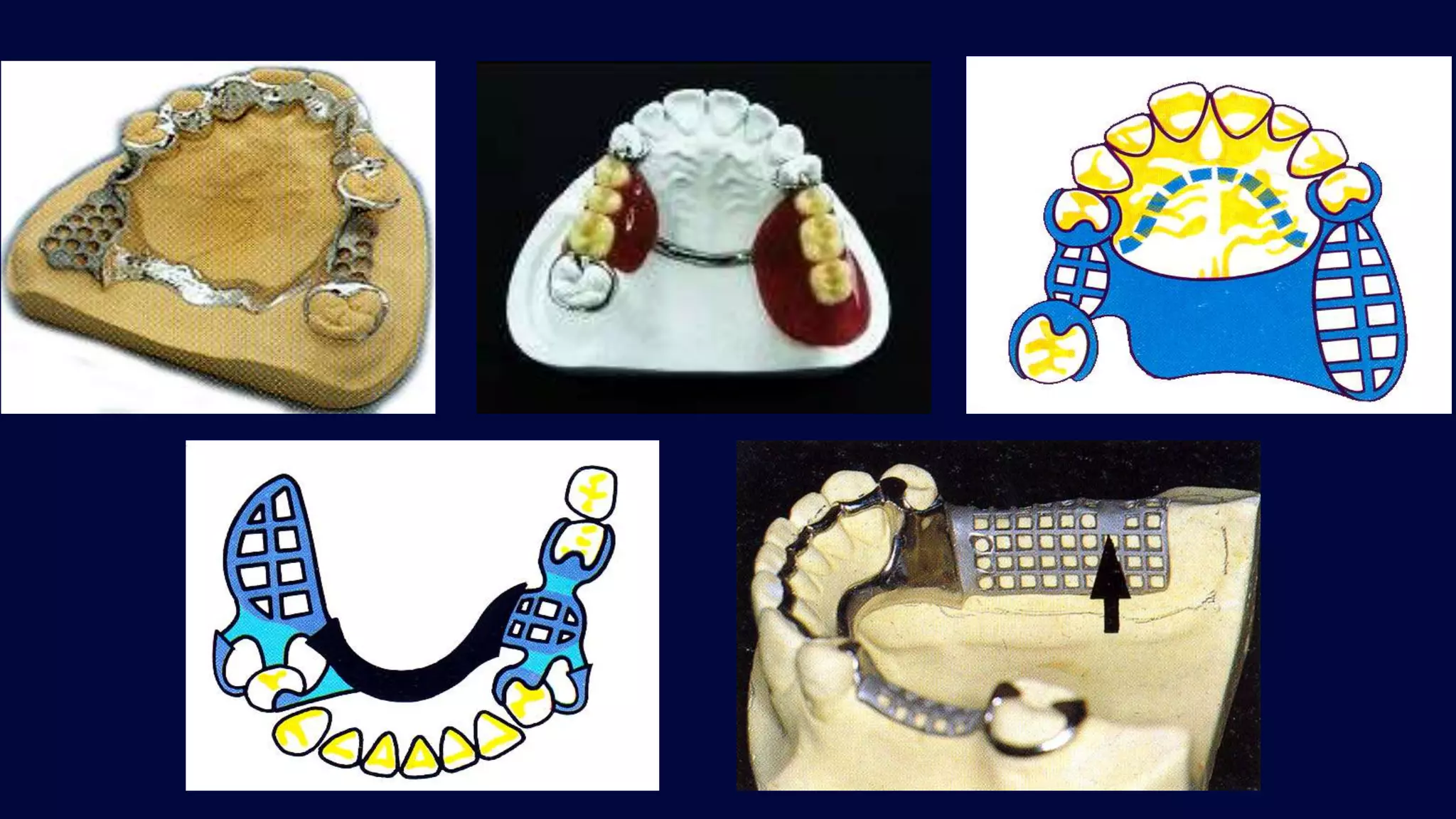
I- Designing of class II partial dentures with modifications
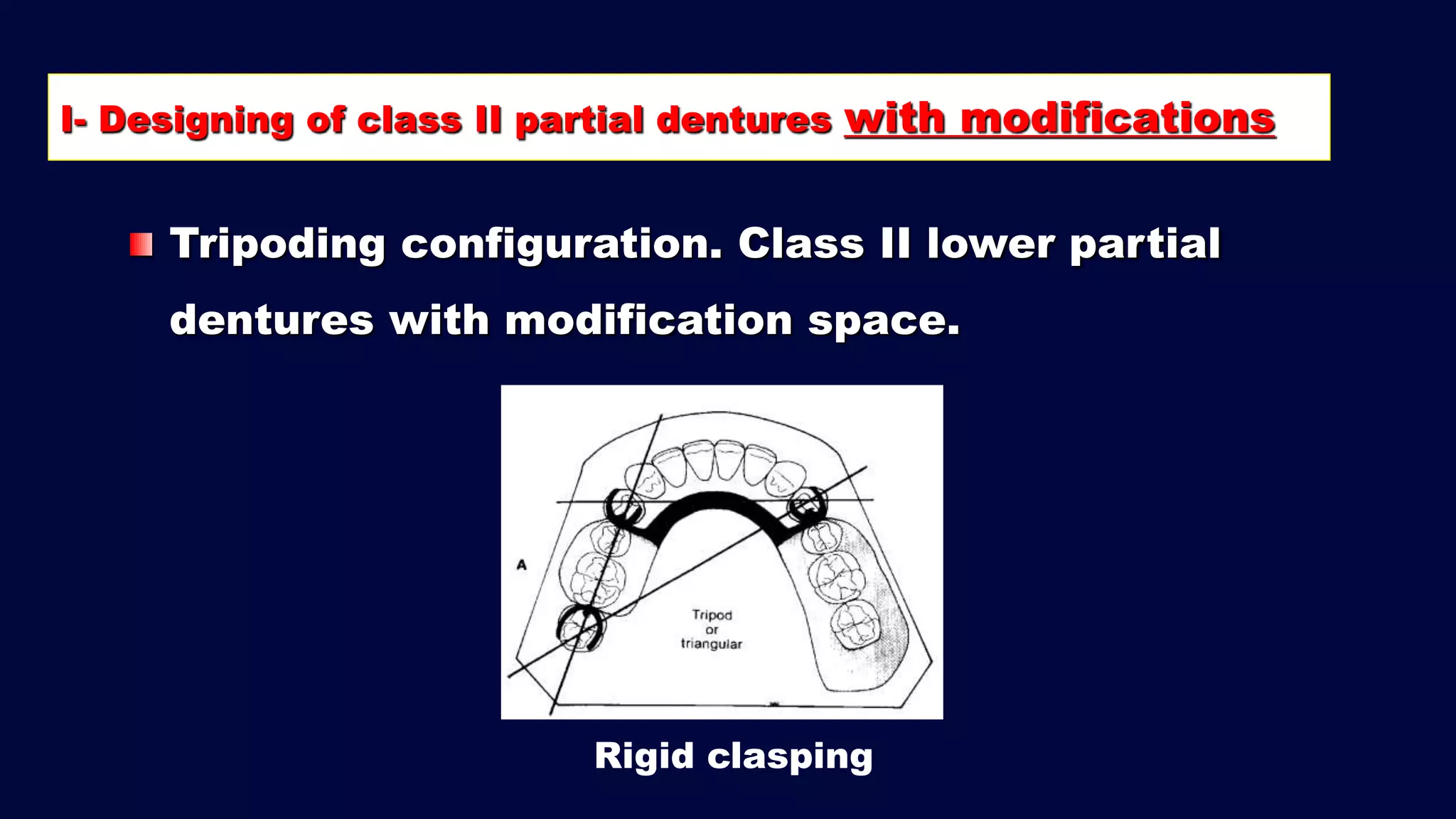
Tripoding configuration. Class II lower partial
dentures with modification space.
Rigid clasping
I- Designing of class II partial dentures with modifications
Selecting Components for Designing Free Extension Removable
Partial Dentures
1. Denture base (Acrylic)
2. Small and narrow teeth .
3. Centric occlusion of teeth should coincide with centric
relation
4. Proximal Plate Contact approximately 1 mm of the gingival
portion of the guiding plane in distal extension cases
5. Occlusal Rest: Mesially placed ,Saucer-shaped, fit , strong not
raise the vertical dimension of occlusion, the floor of the rest
seat should inclined apically.
6. Direct retention (Flexibility, disengagement).
7. Indirect Retention, resist rotational movement of the base away from the
saddle.
Restoration of the unmodified class III
1. Fixed Bridges are usually the
treatment of choice for short
span bounded edentulous areas
when abutments are strong and
healthy and minimum bone loss
exists.
2. Bilateral Partial Dentures.
3. Unilateral Partial Dentures.
Principles of Kennedy Class III RPD design
A bilateral unmodified
class Ill partial denture
A unilateral class Ill
partial denture XXXX
I don’t recommend it.
1- Denture base: Metallic denture base is designed to fit the static rather
than the functional form of the ridge
2- Rests: rests are usually placed on the near zone of the abutment teeth
to provide adequate support. Rest seats can be prepared in either a
box-shaped or saucer-shaped configuration depending on the condition
of the abutment teeth.
3-Clasps: Rigid clasping is usually required for class III cases bounded by
strong abutments. The clasps are located on abutments bounding the
edentulous span. A third clasp, which may either be an embrasure or a
multiple clasp is used on the intact (dentulous) side.
4.Major connectors: A lingual bar for mandibular dentures.
A palatal bar or palatal strap for maxillary major connector are usually used.
I- Designing of class III partial dentures with no modifications
The tripod clasp configuration for
class III partial denture
Restoration of modified class III
Principles of Kennedy Class III RPD design
The quadrilateral clasp configuration
for class III partial denture
Class III cases having long edentulous spans and having modification
are usually considered tooth-tissue supported dentures
These cases could also be restored by an Every denture
which is a totally mucosa-borne denture.
For unilateral removable partial denture to be successful
The buccal and lingual surfaces of
the abutment tooth must be
parallel to resist tipping forces.
The clinical crown of abutment tooth
must be long enough to resist
rotational forces.
Inhaled
Should be used with caution
Swallowed
1. Usually follow the same basic
principles of class I partial
dentures, and are considered
as free-end partial dentures.
As the edentulous area that
crossing the midline lies
anterior to the abutments.
Principles of Kennedy Class VI RPD design
2. Fixed partial denture is the treatment of choice but
removable restoration is preferred in children.
3. The line of treatment of anterior edentulous areas differ
depending on the age of the patient.
4. Young patients are usually treated with a temporary
appliance until a stable mouth condition is reached.
5. Frequent inspections are necessary to detect the need for
relining or rebasing the dentures.
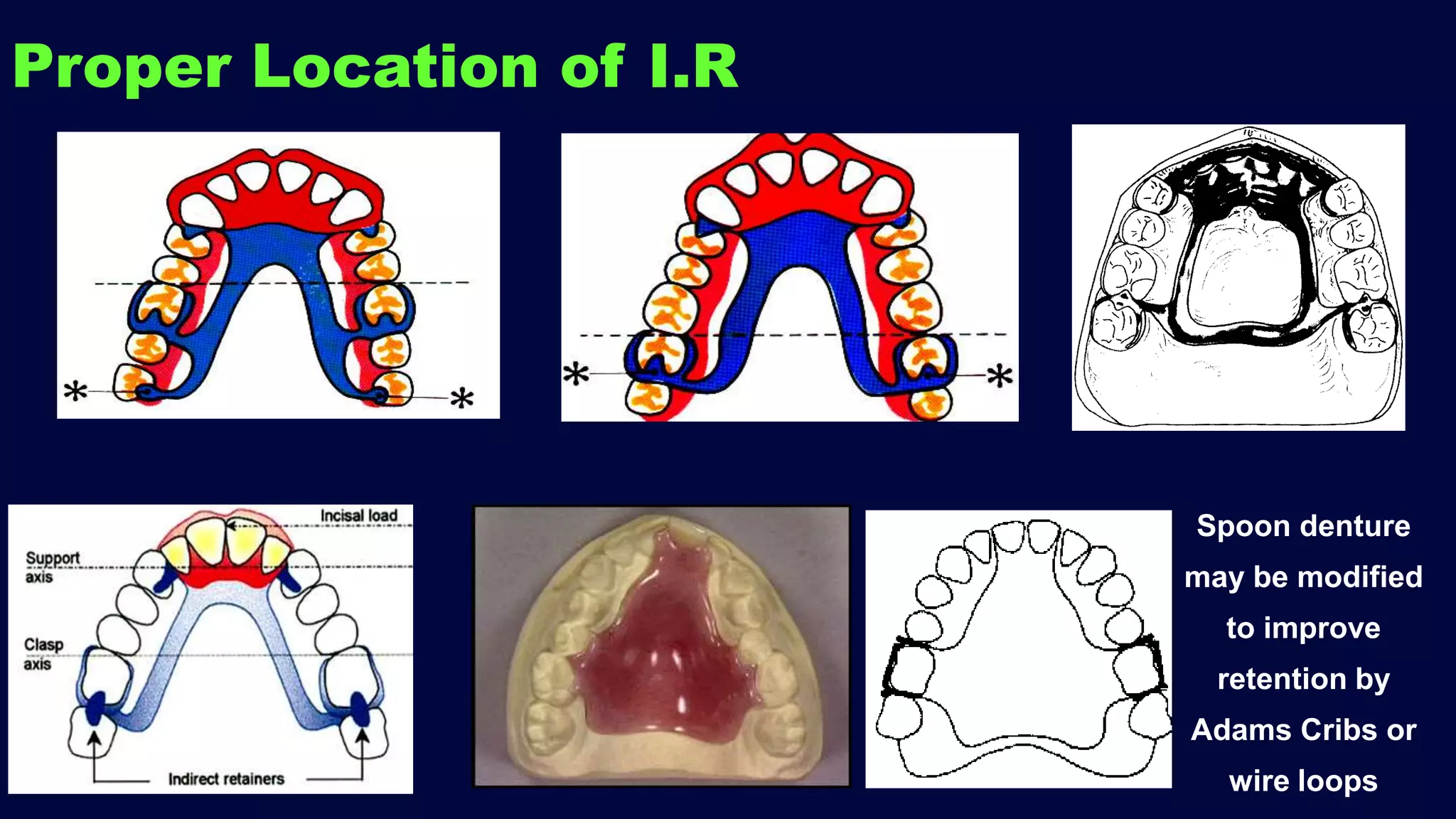
Proper Location of I.R
Spoon denture
may be modified
to improve
retention by
Adams Cribs or
wire loops
Strain on the abutment teeth and the residual ridge is minimized through
1. Broad tissue coverage and maximum extension of the denture base within the
functional limits of muscular movements.
2. Functional basing. Muco-compressive impression recording of the residual ridges.
3. Improving the condition of the residual ridge e.g. correction of abusive condition of
tori and hyperplastic tissues.
5. Use of narrow teeth and harmonious occlusion.
6. Leaving a tooth off the saddle.
7. Placing the artificial teeth on the anterior two-thirds of the base.
8. Correct choice of direct retainer.
9. Using stress equalizing design.
10.Using a Kennedy bar to distribute the lateral load on multiple teeth. XXXXX
In Summary
If you see
someone
without a smile,
give them one of
yours!
2- b. Basic principles for designing Kennedy class II, III and IV RPD - Copy.pptx

2- b. Basic principles for designing Kennedy class II, III and IV RPD - Copy.pptx

  • 3.
    Dr. Amal FathyKaddah Professor of Prosthodontics, Faculty Dentistry, Cairo University
  • 4.
    May you have enoughhappiness to make you sweet and satisfied, enough trials to make you strong and human, enough hope to make you happy and pleased.
  • 6.
    The first stepin a successful partial denture is to design and plan the case very carefully. The more time taken with this important step, the more secure and functional the resulting partial.
  • 7.
    The prosthesis mustbe designed following the most favorable biomechanical principles, as the simple and proper design helps in reducing the harmful effects on the supporting structures
  • 8.
    Objectives and Functions ofRPD Preservation of the remaining structures Simplicity and rigidity Restore masticatory efficiency Restore Appearance and speech
  • 9.
    Preservation of theremaining tissues without injury of the remaining oral structures. Restore the form and function Enhance psychological comfort Removable Partial Denture Design
  • 10.
  • 11.
    Factors that affectRPD design Are conditions and forces found in the patients mouth, that affect the partial denture design. Removable Partial Denture Design
  • 12.
  • 13.
    Retention Reciprocation Support Indirect Retention RPD REQUIREMENTS Bracingand Stabilization A properly constructed partial denture must All should be within the physiological limits of the tissues involved
  • 14.
    Principles of RPDdesign Are certain rules placed by the dentist to cope with the oral factors and achieve the biomechanical consideration of the design. Removable Partial Denture Design
  • 15.
  • 16.
    * Mechanical principles>>> related to resistance of forces and its application to object >> looseness of teeth, bon resorption……etc Biomechanical principles of RPD design * Bio >>> biological principles pertaining to living systems >>> inflammation, Caries, bone resorption….etc Removable Partial Denture Design
  • 17.
  • 18.
    Principles of KennedyClass II RPD design Tooth-mucosa support The difference of displaceability of the supporting tissues results in tissue-ward and tissue-away movements of the denture base with subsequent torque on the abutment.
  • 19.
    Problems of supportassociated with free-end saddles is due to: 1. Lack of posterior abutment 2. Support is derived from both the residual ridge and abutment teeth 3.Major support is obtained from the residual ridge 4.If resorption occurs and relining of the denture is neglected further bone resorption occurs with subsequent torque acting on the abutments.
  • 20.
    Kennedy class IIpartial dentures Designing class II partial dentures usually follow the same basic principles of class I partial dentures. The absence of a saddle on the other side of a class II partial denture complicates the retention of the appliance.
  • 21.
    Thus, in classII RPD there are problems of: • Support • Retention • Bracing and reciprocation • Stabilization (tipping and rotational movements)
  • 22.
    Factors influencing theeffectiveness of tissue support of a distal extension base 1. Contour and quality of the residual ridge (nature of the mucoperiosteun). 2. The Extent of area coverage by the denture base. 3. Accuracy and fitness of the denture base. 4. The accuracy and type of impression registration (anatomical or functional). 5. The Design characteristics of the components parts of the partial denture Framework. 6. Total occlusal load applied.
  • 23.
    Problems of unilateraldistal extension bases can be reduced by: A- Load reduction and distribution. B- Addition retention must be provided on the side where the arch is complete. The clasp line should divide the denture into two equal halves. C- Using indirect retainer in case of class II without modification, to reduce lateral loading and rotational movement of the denture base. ? ? ? ? 10
  • 24.
    How to minimizeStrain on the residual ridge and the abutment teeth in class I and II Kennedy RPD ????? ? 9+8= 17 •Support: •Flexible retention •Need of indirect retention •Bracing, stabilization and reciprocation.
  • 25.
    Strain on theresidual ridge is minimized through 1.Broad tissue coverage and maximum extension of the denture base within the functional limits of muscular movements. 2.Fitness and intimate adaptation of the denture base to the tissue. 3.Functional basing: Muco-compression impression recording of the residual ridges. 4.Improving the condition of the residual ridge e.g. correction of abusive condition of tori and hyperplastic tissues.
  • 26.
    4. Use ofsmall and narrow teeth to increase the masticatory efficiency and reduce the masticatory load. 5. Harmonious occlusion and reducing the cusp angle of art. teeth. 6. Leaving a tooth off the saddle. 7. Placing the artificial teeth on the anterior two-thirds of the base (no 3rd molar). 8. Placement of occlusal rests away from the saddle. 9. Providing Posterior Abutments A- Using an implant at the distal part of the ridge. B- Salvaging a hopeless badly decayed tooth (an overdenture abutments)
  • 27.
    1.Correct choice ofthe abut. Tooth with sufficient alveolar bone support and crown and root morphology 2.Placement of occlusal rests away from the saddle (6 benefits ????). 3.Correct choice of direct retainer (flexible clasping). 4.Using stress equalizing design. Strain on the abutment teeth is minimized through
  • 28.
    5. Wide distributionof the load over the teeth: Strain on the abutment teeth is minimized through a- By placing additional rests, or b- by a splinting of one or more teeth, either by fixed partial dentures or by soldering two or more individual restoration together. 6- Using a Kennedy bar to distribute the lateral load on multiple teeth. XXXX
  • 29.
    7. Preparation andrestoration of the abutment teeth to accommodate the most ideal design of PD this include a- Proper form of occ. rest seats b- Tooth prep. and modification to withstand the functional stresses ( guiding planes, ………..) 8. Providing Posterior Abutments a- Using an implant at the distal part of the ridge. b- Salvaging a hopeless badly decayed tooth, an overdenture abutment
  • 30.
    1- Direct retention 2-A double Aker clasp usually used on the dentulous side. 3- An indirect retainer should be provided to counteract rotation of the denture away from the tissues. I- Designing of class II partial dentures with no modifications
  • 31.
    Direct retention isobtained either by: 1- Rigid clasping and rigid connection between the saddle and the retainer, In case of:  Short edentulous span bounded by a strong abutment with healthy periodontium, and well formed edentulous ridge covered with firm mucosa of normal thickness. I- Designing of class II partial dentures with no modifications
  • 32.
     This designis applied in long class II cases. ? ? I- Designing of class II partial dentures with no modifications Or Direct retention is obtained by: 2- Designs applying stress equalizing principles in long class II cases.
  • 33.
    Stress Equalizing Design e.g.Clasps as RPI (flexible, Disengagement), RPA, reverse Aker, RLS (Disengagement), back action, and reverse back action X clasps as well as combination clasp (wrought wire (flexible) with casted clasp)
  • 34.
    The clasps on abutmentsbounding the modification area provide retention, bracing and reciprocation together with indirect retention I- Designing of class II partial dentures with modifications
  • 36.
    Tripoding configuration. ClassII lower partial dentures with modification space. Rigid clasping I- Designing of class II partial dentures with modifications
  • 37.
    Selecting Components forDesigning Free Extension Removable Partial Dentures 1. Denture base (Acrylic) 2. Small and narrow teeth . 3. Centric occlusion of teeth should coincide with centric relation 4. Proximal Plate Contact approximately 1 mm of the gingival portion of the guiding plane in distal extension cases 5. Occlusal Rest: Mesially placed ,Saucer-shaped, fit , strong not raise the vertical dimension of occlusion, the floor of the rest seat should inclined apically. 6. Direct retention (Flexibility, disengagement). 7. Indirect Retention, resist rotational movement of the base away from the saddle.
  • 39.
    Restoration of theunmodified class III 1. Fixed Bridges are usually the treatment of choice for short span bounded edentulous areas when abutments are strong and healthy and minimum bone loss exists. 2. Bilateral Partial Dentures. 3. Unilateral Partial Dentures. Principles of Kennedy Class III RPD design
  • 40.
    A bilateral unmodified classIll partial denture A unilateral class Ill partial denture XXXX I don’t recommend it.
  • 41.
    1- Denture base:Metallic denture base is designed to fit the static rather than the functional form of the ridge 2- Rests: rests are usually placed on the near zone of the abutment teeth to provide adequate support. Rest seats can be prepared in either a box-shaped or saucer-shaped configuration depending on the condition of the abutment teeth. 3-Clasps: Rigid clasping is usually required for class III cases bounded by strong abutments. The clasps are located on abutments bounding the edentulous span. A third clasp, which may either be an embrasure or a multiple clasp is used on the intact (dentulous) side. 4.Major connectors: A lingual bar for mandibular dentures. A palatal bar or palatal strap for maxillary major connector are usually used. I- Designing of class III partial dentures with no modifications
  • 42.
    The tripod claspconfiguration for class III partial denture Restoration of modified class III Principles of Kennedy Class III RPD design The quadrilateral clasp configuration for class III partial denture Class III cases having long edentulous spans and having modification are usually considered tooth-tissue supported dentures
  • 43.
    These cases couldalso be restored by an Every denture which is a totally mucosa-borne denture.
  • 44.
    For unilateral removablepartial denture to be successful The buccal and lingual surfaces of the abutment tooth must be parallel to resist tipping forces. The clinical crown of abutment tooth must be long enough to resist rotational forces. Inhaled Should be used with caution Swallowed
  • 45.
    1. Usually followthe same basic principles of class I partial dentures, and are considered as free-end partial dentures. As the edentulous area that crossing the midline lies anterior to the abutments. Principles of Kennedy Class VI RPD design
  • 46.
    2. Fixed partialdenture is the treatment of choice but removable restoration is preferred in children. 3. The line of treatment of anterior edentulous areas differ depending on the age of the patient. 4. Young patients are usually treated with a temporary appliance until a stable mouth condition is reached. 5. Frequent inspections are necessary to detect the need for relining or rebasing the dentures.
  • 47.
    Proper Location ofI.R Spoon denture may be modified to improve retention by Adams Cribs or wire loops
  • 48.
    Strain on theabutment teeth and the residual ridge is minimized through 1. Broad tissue coverage and maximum extension of the denture base within the functional limits of muscular movements. 2. Functional basing. Muco-compressive impression recording of the residual ridges. 3. Improving the condition of the residual ridge e.g. correction of abusive condition of tori and hyperplastic tissues. 5. Use of narrow teeth and harmonious occlusion. 6. Leaving a tooth off the saddle. 7. Placing the artificial teeth on the anterior two-thirds of the base. 8. Correct choice of direct retainer. 9. Using stress equalizing design. 10.Using a Kennedy bar to distribute the lateral load on multiple teeth. XXXXX In Summary
  • 49.
    If you see someone withouta smile, give them one of yours!