When you realize you've made a mistake,
take immediate steps to correct it.
. Inspection of the finished denture
. Clinical evaluation of the denture
• Refinement of the occlusion.
• Post-Insertion Instruction.
• Post-Insertion care.
Aspects of try- in
1.Check the case on articulator ( When ????)
2.Trying the trial denture in the mouth
3. Fabrication of Remount Jig ( Occlusal index for clinical remounting)
After the dentures have been processed and before its separation from the cast,
adjustment of processing error is done through:
1. Laboratory remounting.
2. Selective grinding.
Pre-insertion preparation
Fabrication of Remount Jig
(Occlusal index for clinical remounting)
At the end of the try in stage where the
dentist and patient are both satisfied.
This is a time save procedure for you
because you do not have to make a new
facebow record at the time of delivery.
Place the Facebow remount jig on the lower member of the
articulator. Verify that the incisal guide pin is set at zero.
Allow plaster index to completely set. Verify that the
maxillary teeth can be repositioned into the indentations.
Do I need New Face bow
RECORD?????????
Remount upper denture
using remounting jig
For Clinical Remounting Procedure
Pre-Insertion Preparation
After the dentures have been processed and before its
separation from the cast, adjustment of processing error
is done through:
1. Laboratory remounting.
2. Selective grinding.
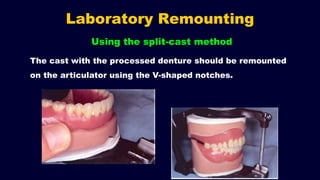
Laboratory Remounting
Using the split-cast method
The cast with the processed denture should be remounted
on the articulator using the V-shaped notches.
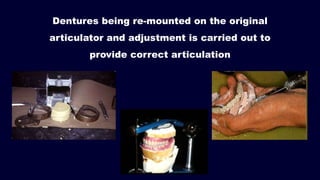
Dentures being re-mounted on the original
articulator and adjustment is carried out to
provide correct articulation
The incisal guide pin not contact the incisal
guide table
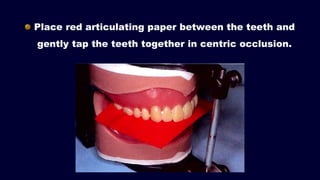
Place red articulating paper between the teeth and
gently tap the teeth together in centric occlusion.
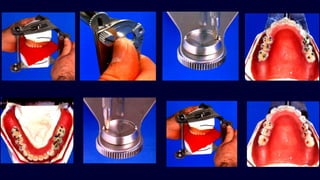
The adjustment in eccentric occlusal positions
The adjustment in eccentric occlusal positions should be stopped when
widespread Contacts are produced and the incisal guide pin usually stays
in contact with the incisal guide table.
Finishing and Polishing
. Inspection of the finished denture
. Clinical evaluation of the denture
 Checking the border extension.
 Checking the support.
 Checking the stability.
 Checking the retention.
 Checking the occlusion.
•Refinement of the occlusion.
•Post-Insertion Instruction.
•Post-Insertion care.
I. Inspection of the finished denture
A- The polished surface must be concave
o The fitting surface must show no irregularities
o The entire periphery should be rounded and highly
polished
o The edges of the relief area should be rounded
B- The finished surface must be concave
II. Clinical evaluation of the denture
 Checking the border extension.
 Checking the support.
 Checking the stability.
 Checking the retention.
 Checking the occlusion.
 Checking the border extension and position of teeth.
 Checking the support, Pressure areas
 Checking the retention ??
 Checking the stability ??
Applying a pulling force
vertically and downward to
the anterior incisors to test for
the retention and the
peripheral seal of the anterior
labial part
Applying an upward and
outward pressure to the
cingulae of the upper anterior
incisors to test for the
posterior palatal seal
Test for retention
Applying a tipping force
to the anterior incisors
to break the seal
Apply upward & outward pressure on
the canine to test the seal at post
dam/ retrozygomal and tuberosity
area at the opposite side.
Test for retention
 It is tested by applying pressure in a tissue
ward direction with the ball of the index finger
in the premolar and molar regions on each side
alternately.
 This pressure must be directed at right angles
to the occlusal surface where displacement
does occur.
Test for stability
Test for stability
 Causes of instability / Denture Looseness
 Poor Retention
 Warpage of the denture base.
 Unrelieved area in the midline e.g. Median
palatine raphe and torus palatinus.
 Posterior teeth set buccal to the underlying
alveolar ridge
 Poor anatomy
 Denture base (fit & contour)
 Occlusion
 Poor anatomy
 Causes of instability / Denture Looseness
III. Refinement of the occlusion
 Intra-orally
Clinical remount
Dentures should be remounted with new records
obtained from the patients
Mount the upper cast according to a face-bow
record or occlusal index and mount the lower
cast according to a new centric relation record.
III. Refinement of the occlusion
Fabrication of Remount casts at the
time of delivery
Block out undercut areas in the tissue
surfaces before pouring the plaster
Try in??????
CLINICAL REMOUNT AND
OCCLUSAL REFINEMENTS
with new centric relation
Remounting the Maxillary Denture
Do I need New Face
bow RECORD?????????
Mounting the lower
cast with new CJRR
IV. Post-Insertion Instruction
1) Wearing dentures (Adhesives ???)
2) Mastication
3) Speaking
4) Oral and denture hygiene
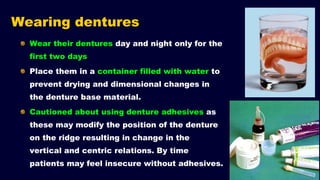
Wearing dentures
Wear their dentures day and night only for the
first two days
Place them in a container filled with water to
prevent drying and dimensional changes in
the denture base material.
Cautioned about using denture adhesives as
these may modify the position of the denture
on the ridge resulting in change in the
vertical and centric relations. By time
patients may feel insecure without adhesives.
Mastication
Patients should be advised to:
 Start eating experience with soft food.
 Food should be cut into small pieces and only a little should be placed in
the mouth at a time.
 Cut food with fork and knife rather than incise with anterior denture teeth.
 Incision should be rather done near the corners of the mouth.
 Bilateral rather than unilateral chewing is advised to prevent tipping of the
denture.
 Sticky and fibrous food should be avoided in the early period.
Speaking
Patients should be informed that speaking normally
with dentures requires a short practice period.
The tongue becomes conscious of the reduction of
space resulting from the presence of dentures
causing difficulty in speech.
This condition usually resolves after adaptation of
the tongue to the new condition.
Oral and denture hygiene
Patient should be instructed to
rinse his denture and mouth
after meals.
Recommended method for
holding a lower denture during
cleaning.
Whenever dentures are removed they should be
thoroughly cleaned and then placed in water
Leaving the denture in a cleansing agent once
a day for 30 minutes.
Dentures should be brushed with a soft tooth
brush
Tooth paste and solutions containing phenol
should be avoided to prevent abrasion and
crazing of the denture.
Oral and denture hygiene
V- Post Insertion care
1 . First appointment within 48 hours of delivery.
2 . Second appointment within 3 days
3 . Third appointment within 1 week of 2nd visit.
CASE COMPLETION
1 . Patient able to masticate food.
2 . Patient should present a normal individual
appearance.
3 . Patient should be able to speak distinctly.
4 . Patient should experience oral comfort.
5 . Patient should be educated as to the need for periodic
examination.
RECALL
Pre-Insertion Preparation
After the dentures have been processed and before its separation
from the cast, adjustment of processing error is done through:
1. Laboratory remounting.
2. Selective grinding.
Complete denture insertion
. Inspection of the finished denture
. Clinical evaluation of the denture
• Refinement of the occlusion.
• Post-Insertion Instruction.
• Post-Insertion care.
In Summary
Welcome to my page on Facebook
Prof. Amal Kaddah Scientific Forum
References:
1. Boucher, C. O., Hieckey, J. C. and Zarb, G. A.: Prosthodontic treatment for edentulous patients. 2nd ed., C. V. Mosby Co. St.Louis, 2000.
2. Eissman, M.R.: Dental laboratory procedures, complete denture, C.V. Mosby company, St. Louis, Toronto, London, 2000.
3. El Mahdy, A. S.: Complete Denture Prosthesis. Anglo-Egyptian book shop, Cairo, Egypt. 1968.
4. Hassaballa, M. A.: Clinical complete denture prosthodontics. 1st edition. Academic Publishing and Press, Riyadh, Saudi Arabia, 2004.
5. Iwao Hayakawa: Principles and Practices of Complete Dentures creating the mental image of a denture, Tokyo Medical and Dental University, Tokyo,
Japan. Quintessence Publishing Co., Ltd. 1999.
6. Iwao Hayakawa: research profile on BiomedExperts,The Journal of prosthetic dentistry 2007;98(2):141-9. 2007.
7. Iwao Hayakawa: Principles and practices of complete dentures: creating the mental image of a denture, rapidshare.com, 27 Dec 2009.
8. Kaddah, A. F.: OCCLUSION IN PROSTHODONTICS, Varieties, Aberrations & Management. Dar El-Etehad. First Co. First ed. Cairo Egypt. 98/7071, 1998.
9. Tamer El-Gendy: Introduction to complete denture, Didactic and Laboratory Manual, Course Director: Tamer El-Gendy BDS, MS. Assistant Professor.
COLLEGE OF DENTISTRY, THE OHIO STATE UNIVERSITY.2000.
10. Winkler, S.: Essentials of complete denture prosthodontics. 2nd ed., PSG Publishing. Co. Inc., 2005.
11. Zarb, G. A., Bolender, C. L., Hickey, J.C. and Carlsson G. E.: Boucher’s Prosthodontic Treatment for Edentulous Patients, ed. 12th . St. Louis Mosby, 2000.
Internet Sites:
- Full denture relining using Tokuso Rebase, By Dr. David J. Sultanov, DMD, Pittsburgh, PA. Information provided by J. Morita USA. The British Dental Journal
is published by Nature Publishing Group for the British Dental Association.© 2002 British Dental Association
- http://www.dentistry.bham.ac.uk/ecourse/pros/casetreat_w3.asp
- http://www.tpub.com/content/medical/14274/css/14274.
- The School of Dentistry, Birmingham UK
- Treatment options for edentulous spaces. Dr David C. Attrill d.c.attrill@bham.ac.uk
Lectures and PowerPoint® presentation slides:
- Full denture relining using Tokuso Rebase By Dr. David J. Sultanov, DMD, Pittsburgh, PA. Information provided by J. Morita USA
- Lectures Posted by dental products .net. Originally published in the April 2001 Dental Products Report. Copyright 1999-2005 Advanstar Dental
Communications.
- Lectures Produced in the United States of America. ISBN 0-7216-9770-4
- Related Links: About Tokuso® Rebase; Rationale for relining; Tips for success.
Next lectures
Occlusal Correction
Post- insertion care and patient complaints
I . PROBLEMS RELATED TO SOFT TISSUE
II . PROBLEMS RELATED TO FUNCTION
III. PROBLEMS RELATED TO ESTHETICS
1. PROBLEMS RELATED TO PHONETICS
2. PROBLEMS RELATED TO MASTICATION
Next lectures
8- Complete denture insertion (Delivery).pptx

8- Complete denture insertion (Delivery).pptx

  • 3.
    When you realizeyou've made a mistake, take immediate steps to correct it.
  • 4.
    . Inspection ofthe finished denture . Clinical evaluation of the denture • Refinement of the occlusion. • Post-Insertion Instruction. • Post-Insertion care. Aspects of try- in 1.Check the case on articulator ( When ????) 2.Trying the trial denture in the mouth 3. Fabrication of Remount Jig ( Occlusal index for clinical remounting) After the dentures have been processed and before its separation from the cast, adjustment of processing error is done through: 1. Laboratory remounting. 2. Selective grinding. Pre-insertion preparation
  • 5.
    Fabrication of RemountJig (Occlusal index for clinical remounting) At the end of the try in stage where the dentist and patient are both satisfied. This is a time save procedure for you because you do not have to make a new facebow record at the time of delivery.
  • 6.
    Place the Facebowremount jig on the lower member of the articulator. Verify that the incisal guide pin is set at zero. Allow plaster index to completely set. Verify that the maxillary teeth can be repositioned into the indentations.
  • 8.
    Do I needNew Face bow RECORD????????? Remount upper denture using remounting jig For Clinical Remounting Procedure
  • 9.
    Pre-Insertion Preparation After thedentures have been processed and before its separation from the cast, adjustment of processing error is done through: 1. Laboratory remounting. 2. Selective grinding.
  • 11.
    Laboratory Remounting Using thesplit-cast method The cast with the processed denture should be remounted on the articulator using the V-shaped notches.
  • 12.
    Dentures being re-mountedon the original articulator and adjustment is carried out to provide correct articulation
  • 14.
    The incisal guidepin not contact the incisal guide table
  • 15.
    Place red articulatingpaper between the teeth and gently tap the teeth together in centric occlusion.
  • 18.
    The adjustment ineccentric occlusal positions
  • 19.
    The adjustment ineccentric occlusal positions should be stopped when widespread Contacts are produced and the incisal guide pin usually stays in contact with the incisal guide table.
  • 22.
  • 23.
  • 24.
    . Inspection ofthe finished denture . Clinical evaluation of the denture  Checking the border extension.  Checking the support.  Checking the stability.  Checking the retention.  Checking the occlusion. •Refinement of the occlusion. •Post-Insertion Instruction. •Post-Insertion care.
  • 25.
    I. Inspection ofthe finished denture A- The polished surface must be concave
  • 26.
    o The fittingsurface must show no irregularities o The entire periphery should be rounded and highly polished o The edges of the relief area should be rounded B- The finished surface must be concave
  • 27.
    II. Clinical evaluationof the denture  Checking the border extension.  Checking the support.  Checking the stability.  Checking the retention.  Checking the occlusion.
  • 28.
     Checking theborder extension and position of teeth.
  • 30.
     Checking thesupport, Pressure areas
  • 31.
     Checking theretention ??  Checking the stability ??
  • 32.
    Applying a pullingforce vertically and downward to the anterior incisors to test for the retention and the peripheral seal of the anterior labial part Applying an upward and outward pressure to the cingulae of the upper anterior incisors to test for the posterior palatal seal Test for retention
  • 33.
    Applying a tippingforce to the anterior incisors to break the seal Apply upward & outward pressure on the canine to test the seal at post dam/ retrozygomal and tuberosity area at the opposite side. Test for retention
  • 34.
     It istested by applying pressure in a tissue ward direction with the ball of the index finger in the premolar and molar regions on each side alternately.  This pressure must be directed at right angles to the occlusal surface where displacement does occur. Test for stability
  • 35.
  • 36.
     Causes ofinstability / Denture Looseness  Poor Retention  Warpage of the denture base.  Unrelieved area in the midline e.g. Median palatine raphe and torus palatinus.  Posterior teeth set buccal to the underlying alveolar ridge  Poor anatomy
  • 37.
     Denture base(fit & contour)  Occlusion  Poor anatomy  Causes of instability / Denture Looseness
  • 38.
    III. Refinement ofthe occlusion
  • 39.
    III. Refinement ofthe occlusion  Intra-orally
  • 40.
    Clinical remount Dentures shouldbe remounted with new records obtained from the patients Mount the upper cast according to a face-bow record or occlusal index and mount the lower cast according to a new centric relation record. III. Refinement of the occlusion
  • 41.
    Fabrication of Remountcasts at the time of delivery Block out undercut areas in the tissue surfaces before pouring the plaster
  • 42.
  • 43.
    CLINICAL REMOUNT AND OCCLUSALREFINEMENTS with new centric relation Remounting the Maxillary Denture Do I need New Face bow RECORD?????????
  • 44.
  • 45.
    IV. Post-Insertion Instruction 1)Wearing dentures (Adhesives ???) 2) Mastication 3) Speaking 4) Oral and denture hygiene
  • 46.
    Wearing dentures Wear theirdentures day and night only for the first two days Place them in a container filled with water to prevent drying and dimensional changes in the denture base material. Cautioned about using denture adhesives as these may modify the position of the denture on the ridge resulting in change in the vertical and centric relations. By time patients may feel insecure without adhesives.
  • 47.
    Mastication Patients should beadvised to:  Start eating experience with soft food.  Food should be cut into small pieces and only a little should be placed in the mouth at a time.  Cut food with fork and knife rather than incise with anterior denture teeth.  Incision should be rather done near the corners of the mouth.  Bilateral rather than unilateral chewing is advised to prevent tipping of the denture.  Sticky and fibrous food should be avoided in the early period.
  • 48.
    Speaking Patients should beinformed that speaking normally with dentures requires a short practice period. The tongue becomes conscious of the reduction of space resulting from the presence of dentures causing difficulty in speech. This condition usually resolves after adaptation of the tongue to the new condition.
  • 49.
    Oral and denturehygiene Patient should be instructed to rinse his denture and mouth after meals. Recommended method for holding a lower denture during cleaning.
  • 50.
    Whenever dentures areremoved they should be thoroughly cleaned and then placed in water Leaving the denture in a cleansing agent once a day for 30 minutes. Dentures should be brushed with a soft tooth brush Tooth paste and solutions containing phenol should be avoided to prevent abrasion and crazing of the denture. Oral and denture hygiene
  • 51.
    V- Post Insertioncare 1 . First appointment within 48 hours of delivery. 2 . Second appointment within 3 days 3 . Third appointment within 1 week of 2nd visit.
  • 53.
    CASE COMPLETION 1 .Patient able to masticate food. 2 . Patient should present a normal individual appearance. 3 . Patient should be able to speak distinctly. 4 . Patient should experience oral comfort. 5 . Patient should be educated as to the need for periodic examination. RECALL
  • 54.
    Pre-Insertion Preparation After thedentures have been processed and before its separation from the cast, adjustment of processing error is done through: 1. Laboratory remounting. 2. Selective grinding. Complete denture insertion . Inspection of the finished denture . Clinical evaluation of the denture • Refinement of the occlusion. • Post-Insertion Instruction. • Post-Insertion care. In Summary
  • 55.
    Welcome to mypage on Facebook Prof. Amal Kaddah Scientific Forum
  • 56.
    References: 1. Boucher, C.O., Hieckey, J. C. and Zarb, G. A.: Prosthodontic treatment for edentulous patients. 2nd ed., C. V. Mosby Co. St.Louis, 2000. 2. Eissman, M.R.: Dental laboratory procedures, complete denture, C.V. Mosby company, St. Louis, Toronto, London, 2000. 3. El Mahdy, A. S.: Complete Denture Prosthesis. Anglo-Egyptian book shop, Cairo, Egypt. 1968. 4. Hassaballa, M. A.: Clinical complete denture prosthodontics. 1st edition. Academic Publishing and Press, Riyadh, Saudi Arabia, 2004. 5. Iwao Hayakawa: Principles and Practices of Complete Dentures creating the mental image of a denture, Tokyo Medical and Dental University, Tokyo, Japan. Quintessence Publishing Co., Ltd. 1999. 6. Iwao Hayakawa: research profile on BiomedExperts,The Journal of prosthetic dentistry 2007;98(2):141-9. 2007. 7. Iwao Hayakawa: Principles and practices of complete dentures: creating the mental image of a denture, rapidshare.com, 27 Dec 2009. 8. Kaddah, A. F.: OCCLUSION IN PROSTHODONTICS, Varieties, Aberrations & Management. Dar El-Etehad. First Co. First ed. Cairo Egypt. 98/7071, 1998. 9. Tamer El-Gendy: Introduction to complete denture, Didactic and Laboratory Manual, Course Director: Tamer El-Gendy BDS, MS. Assistant Professor. COLLEGE OF DENTISTRY, THE OHIO STATE UNIVERSITY.2000. 10. Winkler, S.: Essentials of complete denture prosthodontics. 2nd ed., PSG Publishing. Co. Inc., 2005. 11. Zarb, G. A., Bolender, C. L., Hickey, J.C. and Carlsson G. E.: Boucher’s Prosthodontic Treatment for Edentulous Patients, ed. 12th . St. Louis Mosby, 2000. Internet Sites: - Full denture relining using Tokuso Rebase, By Dr. David J. Sultanov, DMD, Pittsburgh, PA. Information provided by J. Morita USA. The British Dental Journal is published by Nature Publishing Group for the British Dental Association.© 2002 British Dental Association - http://www.dentistry.bham.ac.uk/ecourse/pros/casetreat_w3.asp - http://www.tpub.com/content/medical/14274/css/14274. - The School of Dentistry, Birmingham UK - Treatment options for edentulous spaces. Dr David C. Attrill d.c.attrill@bham.ac.uk Lectures and PowerPoint® presentation slides: - Full denture relining using Tokuso Rebase By Dr. David J. Sultanov, DMD, Pittsburgh, PA. Information provided by J. Morita USA - Lectures Posted by dental products .net. Originally published in the April 2001 Dental Products Report. Copyright 1999-2005 Advanstar Dental Communications. - Lectures Produced in the United States of America. ISBN 0-7216-9770-4 - Related Links: About Tokuso® Rebase; Rationale for relining; Tips for success.
  • 57.
  • 58.
    Post- insertion careand patient complaints I . PROBLEMS RELATED TO SOFT TISSUE II . PROBLEMS RELATED TO FUNCTION III. PROBLEMS RELATED TO ESTHETICS 1. PROBLEMS RELATED TO PHONETICS 2. PROBLEMS RELATED TO MASTICATION Next lectures