 It is a distressing, uncomfortable,
nuisance and unpleasant sensory
feeling often
Definition
 It can be steady, throbbing, stabbing, aching, pinching,
or described in many other ways.
caused by intense or damaging stimuli.
 Pain is the most COMMON
reason clients seek medical
advice.
 Pain is a protective mechanism or a warning
of potential or actual injury to prevent further
injury.
ACTUAL AND NOT PSYCHOLOGICAL, contrary
to the belief of most clinicians.
Most of the complaints
associated with complete
dentures are
location Aetiology
Duration Intensity
Nociceptive
Acute Chronic Neuropathic
Central
Peripheral
Mild
Moderate
severe
Diffuse
Localized
Generalized
Course
Continuous
Intermittent
Incident
irruptive
Location
1. Localized Pain: Pain in a specific region of the supportive tissues:
a. Pain in the Mucosa and alveolar ridge
b. Pain resulting from biting the lips and cheeks
c. Pain in the tongue
d. Pain that occurs at the TMJ
2. Generalized pain: Pain involving a major part of the supportive
tissues
3. Diffuse pain: Pain involving all the supportive tissues.
Aetiology (Cause)
1. Nociceptive pain: Pain associated with actual or potential
tissue damage or tissue injury. Process through which
peripheral pain receptors transmit information about
current (or potential) tissue damage centrally as pain
2. Neuropathic pain: arises from damage to the nervous
system itself, central or peripheral. it’s more likely to lead
to chronic pain: nerves don’t heal well.
3. Mixed between tissue damage and damage of nerves.
4. Idiopathic.
5. Psychogenic.
1.Acute pain: Usually comes on suddenly and is
caused by something specific such as burns or
cuts, infection and dental work.
2.Chronic pain: is pain that lasts longer than 3
months. It is also called persistent pain or long-
term pain.
Duration
The pain sensation produced in
some part of the body is felt in
other structures away from the
place of development.
The deep pain and some visceral pain are referred to
other areas. But superficial pain is not referred.
Stimulus of skin receptors
Sensory receptor (= transducer)
Afferent sensory neurons
CNS
CNS Integration, perception
Thalamus
Post
central
gyrus
Stimulus of skin receptors
Sensory receptor (= transducer)
Spinothalamic tract
(spinal cord or medulla)
Thalamus
Cerebral cortex
(Post central gyrus).
Thalamus
Post
central
gyrus
Diagram showing the pathway of pain
Transduction
Transmission
Central perception of pain
Modulation of pain
Thalamus
Post
central
gurus
Pain stimuli is converted to
electrical energy.
This electrical energy sends
an impulse across a
peripheral nerve fiber
(nociceptor).
Thalamus
Post
central
gyrus
Thalamus
Post
central
gyrus
The pain impulse is transmitted:
from the site of transduction along
the nociceptor fibres to the dorsal
horn in the spinal cord; from the
spinal cord to the brain stem;
through connections between the
thalamus, cortex and higher levels
of the brain.
A delta fibers (myelinated) send
sharp, localized and distinct
sensations.
C fibers (unmyelinated) relay
impulses that are poorly
localized, burning and persistent
pain. Pain stimuli travel-
spinothalamic tracts.
Thalamus
Post
central
gyrus
Person is aware of pain –
somatosensory cortex
identifies the location and
intensity of pain.
Person unfolds a complex
reaction, Physiological and
behavioral responses is perceived.
Thalamus
Post
central
gyrus
Refers to the process by which the
body alters a pain signal as it is
transmitted along the pain
pathway, Inhibitory
neurotransmitters like endogenous
opioids work to hinder the pain
transmission. ( Endorphins are
released by the hypothalamus and
pituitary gland in response to pain
or stress).
Thalamus
This explains, why individual
responds to the same painful
stimulus sometimes in
different way. This inhibition
of the pain impulse is known
as modulation.
Endorphins Primarily helps one
deal with stress and reduce feelings of pain.
Post
central
gyrus
Endorphins are released by
the hypothalamus and
pituitary gland in response to
pain or stress, this group
of peptide hormones both
relieves pain and creates a
general feeling of well-being.
The name of these hormones
comes from the term
"Endogenous morphine."
"Endogenous" because they're produced in our bodies.
Inform patient of possible problems.
Un-informed patient:
Sense of pain.
Sense of loss (waste of time and money).
Sense of deceit.
Diagnosis Causes Treatment
Managed by
Listen, examine & treat
Visual and digital examination of oral cavity.
Adjustment to eliminate any problem.
Within
3 to 7 days
3 to 4 months for
difficult patients 12
month interval for most
Examination to detect potential problems.
Patient should point to problem.
Corrected in early stage.
Eliminate pain or discomfort.
Patients should be
checked within 24 hours
Causes are attributed to
Patient's
dissatisfaction
Denture
settling
Most of the complaints associated with complete dentures
are actual and not psychological, contrary to the belief of
most clinicians.
Denture errors
Patient's dissatisfaction are attributed to
Denture problems
Types of patient
Indifferent
Philosophical Hysterical
Exacting
Philosophical: Rational, sensible, organized and overcomes
conflicts (Expectations are real).
Exacting: Methodical, precise and accurate; places severe
demands (Must reach an understanding before starting
treatment).
Indifferent: Apathetic, uninterested, uncooperative and lacks
motivation; blames dentist for poor health; pays no
attention to instructions (Unfavorable prognosis).
Hysterical: Emotionally unstable, excitable, apprehensive
(Psychiatric help may be required).
Denture problems
Old denture
Loose fit
New denture
Over extension Over closure
(Low VD)
The majority of the patients with new
denture may face one or more of the
following problems (Common complaints):
Pain Poor
appearance
Poor
masticatory
efficiency
Speech
difficulties
Poor
denture fit
Nausea
and
gagging
Clattering
or noisy
teeth
Cheek, lip
and tongue
biting
Food under
the denture
Mucosal
irritation
Discomfort
Uncommon
complaints
Pain
Peculiar
taste
Halitosis
Burning
Sensation
Ear ache
Dry
mouth
Drooling at
the corner of
the mouth
Saliva and
food under
the dentures
Dull
teeth
Excessive
bulk
Tingling
of the
lower lip
Loss of
taste
sensation
Inability
to keep the
denture clean
Whistling
Inability to
chew with
equal vigor on
both side.
Deafness
Uncommon complaints:
According to Sharry
Sharry.J.J Complete denture Prosthodontics, 3rd edition, chapter 17, p. 358
Clinical faults
Laboratory Faults
Chemical irritation
High occlusal
forces
Patient experience
Reduced tolerance
Localized Fact. e.g.
roots, bony spicules
Systemic Factors
Psychogenic
Reduced denture
bearing area
Function and
para-function
Low pain threshold
Xerostomia
Occlusal Errors
1. Improper extension of the
periphery
2. Severe Undercuts
3. Insufficient relief
4. Incorrect occlusion, and
teeth off the ridge
5. Poor fit
6. Irregular and knife edge
ridge.
7. Rough fitting surface
8. Difficulty in swallowing and
Sore throat
9. Retained roots, unerupted
tooth or sharp bony spicules
10.Denture Stomatitis
• Infection with Candida Albicans
• Papillary Hyperplasia
11.Allergy
Site .. Where is the pain?
. Is the pain in a specific area or widespread?
Onset.. When did it start?
• How long has the pain been continuing,
• Does the pain disappear after the removal of the
dentures?
• Is there continuous pain during the wearing of
the dentures, or is the pain increasing only at
certain times, for example, while eating?
Character.. Can you describe the pain?
Chewing only
Occlusion
Gets worse
throughout day
Occlusion
When first
insert dentures
Denture Base
Pressure on
first molars
Denture
Base
 Undercut areas.
 Irregularities on the tissue surface.
 Overextensions.
 Pressure areas.
 Errors in occlusion.
1. If pain upon pressing firmly on 1st molars, adjust
denture base first until no pain.
2. Use finger pressure, Do NOT use occlusion to apply
pressure >> Occlusion could introduce tipping
forces.
3. Chew Test: Denture dislodges or shifts when patient
occludes (tilting, twisting, tipping, sliding).
What are the Methods of Detecting Occlusal Errors?
Chew Test:
 Chew on cotton ball on both side.
 Identify teeth that cause problem when chewing.
 Use articulating paper in excursions on those
teeth to remove tipping contacts:
 Heavy contacts
 Contacts buccal to the ridge.
 Contacts on inclines.
Never adjust without
locating exact position
of the problem,
Use P. I. paste
Ridge VD
Denture
Borders
•Over-extension
Basal Seat
Uneven
pressure
Occlusion
Cuspal
interference
Poor fit
Mental Foramen
Pressure area
Improper impression
Warpage of denture base
Improper cast
CO#CR
Teeth off ridge
Roughness
Allergy DD Patch test
Remaining
Root
undercut
•Under-extension
(disto- lingual area)
•Rough border.
•Sharp border
Incorrect Occlusion
VD CO # CR Uneven
Pressure and
Cuspal
interference
Improper tooth Position
White sore area
on the site of
pressure
VD
(Neurological
pain)
VD
(white
patch)
Contacts on
inclined portion
of ridge
Heavy anterior
interferences
Teeth off ridge
Incorrect Occlusion due to improper
tooth Position
Teeth off ridge
Cramped
tongue
Contacts on
inclined portion
of ridge
Heavy anterior
interferences
Upper buccal
sulcus of
working side
Tight lip
Vertical height
of mandibular
posterior Teeth.
1.Localized pain—pain in a specific region of the
supportive tissues.
2.Generalized pain—pain involving a major part of the
supportive tissues.
3.Diffuse pain—pain involving all the supportive tissues.
4.Pain resulting from biting the lips and cheeks.
5.Pain in the tongue.
6.Pain that occurs at the TMJ ad ear ache.
1.Incorrect vertical dimension
 Low vertical dimension or High vertical dimension
2. Incorrect Tooth Position
Heavy anterior interferences
Teeth off the ridge.
Labially placed mandibular anterior teeth.
Setting of upper posterior teeth far buccally.
Setting of lower posterior teeth too far lingually.
Avoid Contacts on inclined portion of ridge.
Vertical height of mandibular posterior Teeth.
3. Occlusal discrepancies
• Wrong anteroposterior relationship (Incorrect centric occlusion)
• Uneven pressure or Severe disclusion of posterior teeth in excursions
(lack of balance).
• Cuspal Interference.
High vertical dimension
Low vertical dimension
Solutions ???
oError during registration
stage. Or,
oIncomplete closure of the
denture flasks.
Obliterated free-way space
 Poor laboratory technique
can result in the
movement of individual
teeth or in an increase in
occlusal vertical
dimension of the denture.
• Failure to close the flasks completely during
processing (Incomplete closure of flask causes
tooth movement).
• Too much pressure in closing flasks
• Shrinking of acrylic, processing changes
 There are more than one reason for this type of pain:
1.Increased vertical dimension.
2. Patient’s allergy to the
denture base material.
3. Incompatible CO. and CR.
 Pain gets worse during day.
 Muscle/joint pain.
 Small white patches + painful areas.
 Pain returns within few days of
immediate relief over patches.
 Pain on crest of lower ridge.
 Dentures “click”, clatter, and
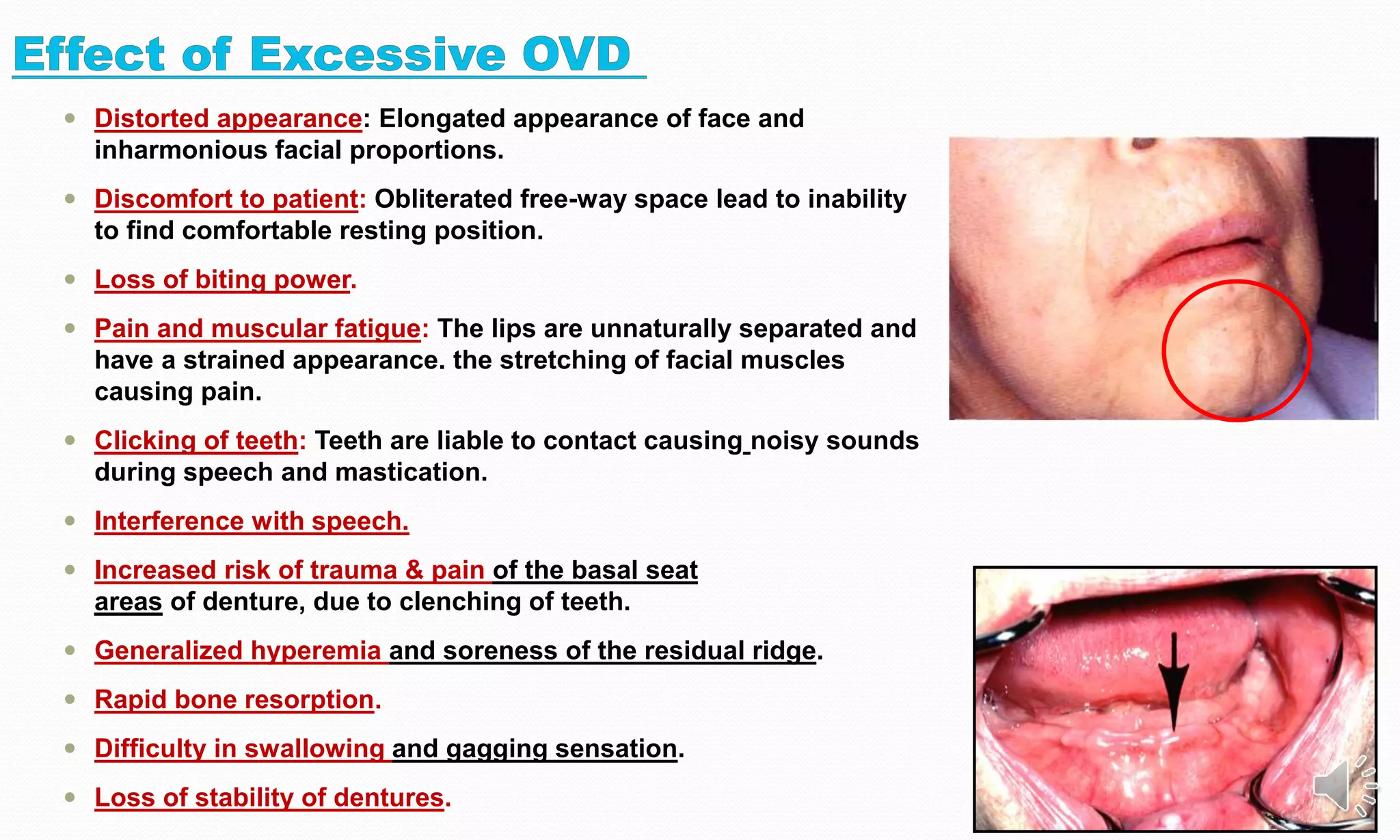
Distorted appearance. Obliterated free-way space
 Distorted appearance: Elongated appearance of face and
inharmonious facial proportions.
 Discomfort to patient: Obliterated free-way space lead to inability
to find comfortable resting position.
 Loss of biting power.
 Pain and muscular fatigue: The lips are unnaturally separated and
have a strained appearance. the stretching of facial muscles
causing pain.
 Clicking of teeth: Teeth are liable to contact causing noisy sounds
during speech and mastication.
 Interference with speech.
 Increased risk of trauma & pain of the basal seat
areas of denture, due to clenching of teeth.
 Generalized hyperemia and soreness of the residual ridge.
 Rapid bone resorption.
 Difficulty in swallowing and gagging sensation.
 Loss of stability of dentures.
Treatment:
 The vertical dimension should be
reduced by grinding.
 If upper occlusal plane is acceptable,
replace teeth on lower denture or make a
new lower denture.
 Otherwise remake upper and lower
denture with a correctly determined
vertical dimension.
High Vertical Dimension
Flabby Tissue
Establishing the occlusal vertical dimension in
centric:
Occlusal VD is maintained by
occlusion of palatal upper
cusp and buccal lower cusp
(in normal occlusion).
( Supporting cusps)
 Minor reduction of the
supporting cusps
without causing anterior
interferences.
Establishing the occlusal vertical dimension in
centric:
Cheek Biting
 Either results from wrong jaw
relation records.
 Or from the alveolar ridge resorption
and/or acrylic teeth attrition.
 This condition is often a delayed not
immediate.
 Indefinite location of pain.
 May be associated with
temporomandibular joint dysfunction.
Angular Chelitis
 Indefinite pain location
 Lack of chewing power
 Angular (commissural) Chelitis
 Esthetic complaints:
 Chin prominent
 Poor lip support
 Cheek biting/ tongue biting/ lip biting
 Pain in temporomandibular joint and
sore muscles.
 Costen’s syndrome.
Cheek Biting
Cheek Biting
Angular Chelitis
 Inflammation of the angles of mouth.
 Attributed to excessive interocclusal
distance.
 It usually develops when occlusal
plane of the lower teeth is too high.
 This prevents the regular action of the cheek from eliminating the
saliva from the lower buccal vestibule, so saliva will exit through
the corners of mouth indicating spread of infection to the angles of
mouth.
 Advisable to construct new dentures.
Described by james. B. Costen in 1934.
He claimed that the symptoms forming his
syndrome were produced by over-closure of
the mandible >> Retruded condyles press on
the tympanic nerve, and that "opening the
bite" would clear up these symptoms.
The symptoms can be summarized as follows:
Otological symptoms: Tinnitus. Otalgia (ear pain),Hearing loss, Ear fullness or
stuffiness in the ear, Noises in the ear: Humming, ringing, crackling sounds,
Vertigo and Dizziness.
Facial pain.
Headache and neck pain: e.g. pain in the occipital region (the back of the head), or
the forehead or other types of facial pain including migraine, tension headache
or myofascial pain. Pain typical of "sinus disease."
Burning sensations and pain in the tongue (glossodynia), throat and side of the nose
and eye, as well as a metallic taste. (Burning mouth syndromes)
TMJ symptoms and pain: Tenderness and pain to palpation of the temporomandibular
joint and the muscles of mastication. Limited range of mandibular
movement, which may cause difficulty in eating, Noises from the joint during
mandibular movement, Joint noises may be described as clicking popping, or
crepitus (grating).
 Prolonged over closure
 Mild Deafness, tinnitus, blurring of vision
 Tenderness over the TMJ
 Dryness of mouth
 Neuralgic symptoms – burning sensation
of tongue, throat, nose and headache.
These symptoms may be resulted from
…………………………….??????
A. Chorda Tympani
B. Nerve to Mylohyoid
C. Inferior Alveolar Nerve
D. Lingual Nerve
E. Mandibular Nerve
These symptoms may be resulted from
pressure of the retruded condyle on
the auriculo-tympanic nerve (A)
Treatment:
1. Use of occlusal pivots to stabilize the occlusion,
followed by
2. Add tooth coloured self curing resin on the posterior
occlusal surfaces of the mandibular denture to
increase VDO gradually,
Treatment:
When the patients closes the mouth with the mandible
guided to the centric relation position, the occlusal
surfaces of maxillary posterior teeth are recorded in the
resin. Trim the resin to reestablish the contours of the
teeth.
1.Incorrect vertical dimension
 Low vertical dimension or High vertical dimension
2. Incorrect Tooth Position
Heavy anterior interferences
Teeth off the ridge.
Labially placed mandibular anterior teeth.
Setting of upper posterior teeth far buccally.
Setting of lower posterior teeth too far lingually.
Avoid Contacts on inclined portion of ridge.
Vertical height of mandibular posterior Teeth.
3. Occlusal discrepancies
• Wrong anteroposterior relationship (Incorrect centric occlusion)
• Uneven pressure or Severe disclusion of posterior teeth in excursions
(lack of balance).
• Cuspal Interference.
Heavy anterior interferences
Teeth off the ridge.
 Labially placed mandibular anterior teeth.
 Setting of upper posterior teeth far buccally.
 Setting of lower posterior teeth too far lingually.
Setting of Teeth on inclined portion of ridge.
Vertical height of mandibular posterior Teeth.
REMEMBER >> RULES
Whatever the concept
Try-in ???
 The horizontal overlap between upper and lower
anterior teeth is automatically decided by the
relation between the upper and lower residual ridges.
The horizontal overlap should be consistent throughout the
anterior region. At this stage it should be about 1.5 mm.
Flabby ridge(mobile or extremely resilient
alveolar ridge):
Is due replacement of bone by fibrous tissue.
Seen in anterior part of maxilla, as a sequelae of
excessive load of residual ridge and unstable
occlusal conditions.
Perpetually Loose Maxillary Denture
• Can cause loosening at posterior.
• Tuberosity mucosa grows into space.
• Space develops under midline of
denture base.
Tuberosity
Tilting Growth Loss of retention
Inclined
Residual Ridge
Lip
 Incisors placed too far labially
 Denture displaces lingually.
 Inclined ridge provides no resistance.
a. Labially placed mandibular anterior teeth.
Placement of upper and lower incisors excessively
labially
The stability of the denture is disturbed.
For the new denture, the lower anterior teeth should
be arranged as their position before the extraction of
the teeth.
Excessive labial placing of the lower anterior teeth,
to provide a normal overjet for patients with skeletal
class II, leads to the movement of lower denture
when the patient opens his/her mouth or laughs.
 Pain in upper buccal sulci and
tuberosities.
 Upper teeth are often too far
buccally (to meet occlusion in
cases of skeletal class III).
b. Setting of upper post. teeth far buccally
 During function, upper denture will tilt, digging the
periphery into the mucosa on the working side, and
pulling it down the tuberosity on the opposite side.
 Occlusal contact not centered
over ridge
 Tilting forces cause
displacement, abrasion,
ulceration.
 Worse if xerostomia,
malnourished, debilitated or
poor adaptability.
With Clinical Exam:
Patient demonstrates
problem by biting
where pain occurs
•Ulcer or sore spots on sides of ridges
Clinical Examination
Pain Upper buccal sulci and maxillary tuberosities.
Treatment:
Remove the last four posterior
teeth and reset and reduce the
bulk of acryl over the tuberosities
and reset.
New dentures
• Cramped tongue
• Instable denture
• Pain and discomfort
• Inefficient mastication
c. Setting of lower post. teeth too far lingually
Tilting/jiggling
• No teeth set over ascending portion of
ramus>> lateral forces>> instable denture.
• Avoids ascending portion of ridge.
• Drop 2nd premolar if necessary.
• Ensures adequate occlusal table (maintains 2
molars).
2/3 of
Retromolar
pad
1.Incorrect vertical dimension
 Low vertical dimension
 High vertical dimension
2. Incorrect Tooth Position
 Heavy anterior interferences
 Teeth off the ridge.
Labially placed mandibular anterior teeth.
Setting of upper posterior teeth far buccally.
Setting of lower posterior teeth too far lingually.
 Avoid Contacts on inclined portion of ridge.
 Vertical height of mandibular posterior Teeth.
3. Occlusal discrepancies
• Wrong anteroposterior relationship (Incorrect centric occlusion)
• Uneven pressure
• Severe disclusion of posterior teeth in excursions (lack of balance).
• Cuspal Interference.
 Check centric position
(articulating paper)
Even, stable contacts
both sides.
Stop patient upon initial
contact.
CO#CR
Traumatic
occlusion
a
b
Mismatch of ICP and RCP.
 Interdigitation of teeth locks the dentures together,
while the patient will not feel comfortable in that
situation
 Trials to Retrude the mandible will rub the denture
against the mucosa. This will cause pain and
looseness.
Incompatible centric
occlusion and centric
relation, lower denture moves
forward (anteriorly) and
irritation areas occur on the
anterior lingual part of the
lower jaw.
It is a relatively flat area having a length of 0.5-1mm,
created between centric relation and maximum
intercuspal position on the occlusal surfaces of the teeth,
gives the mandible freedom to close in Centric or slightly
anterior to it without any interference.
Freedom of centric (Long centric)
“LONG” CENTRIC No Anterior Contacts
The coincidence of Centric Occlusion & Centric Relation (CO = CR),
when there is freedom for the mandible to move slightly forwards from
that occlusion in the same sagittal and horizontal plane (Freedom in
Centric Occlusion). No anterior Interference, no change in VDO.
Nonequivalent contacts due to inadequate centric
occlusion. View of the dentures inside the mouth and
outside the mouth.
 Moderately wide, hyperemic (red), diffuse
and painful area.
Mild error: chair side occlusal spot
grinding.
Moderate errors: Clinical remount
and Selective grinding of teeth.
Gross errors either replace posterior
teeth or remake denture.
Error in setting artificial teeth, or / Lack of occlusal
balance. resulting in the tilting of dentures.
a) Inaccurate centric occlusion (early contacts on the
right side) >> Irritation area over the right crest.
b) Correction of inadequate occlusion according to the
severity of the case.
1.Localized Pain: Pain is confined to the crest of
the ridge on one side.
Traumatic ulcer or sore spots
as a result of unbalanced
occlusion
2. Localized Pain: Pain is related to buccal aspect of the
ridge on one side and lingual aspect of the ridge on the
other side as the problem causes tilting of the denture (it
is mainly the lower).
• Lesser degrees of errors can be detected by a
celluloid strip or articulating paper on either side
with the patient closing just to hold it without
reaching the tilting point of the denture bases
• If more it is detected with a wax knife.
Diagnosis:
Treatment:
 Slight error: chair side occlusal grinding.
 Moderate errors: clinical remount.
 Severe errors: remake denture or replace
posterior teeth.
The presence of premature contacts on the occlusion
cause an increase of the forces over the crests in certain
areas. Inflammatory changes can be easily noted visually
and are observed in these areas. Correction of inadequate
occlusion by: grinding in centric relation
After
Before.
Re-establishment of C.O.
A Dragging action will be exerted on both dentures during
lateral and protrusive movements with teeth in contact if
cusped posterior teeth are used or if excessive incisal
guidance angle has been used.
Dragging will cause pain
With Well Fitting Retentive Dentures Or
Instability with poorly retained dentures.
Pain is widely distributed, and only experienced on eating.
Sore areas on buccal or lingual surfaces of the ridges or on
the ridge crest.
(a) Existence of premature
contact in the premolar
region.
(b) Irritation or
hyperemic areas on
the ridge crests.
1. Pain in the Premolar Region
a. Overextended flanges in
the anterior area of the
denture.
2. Pain at the Peripheral Regions of the Denture
Pain in the anterior lingual margin of the lower jaw.
There are two reasons for pain in the lingual margin
of the lower jaw:
The denture flange areas
should be shortened
b. The presence of premature contact in the posterior region
. As a result of the premature contact, the lower denture
comes forward, causing pain in the lingual margin.
Grinding is made, thereby determining the premature
contact areas.
(a) A posterior premature contact, resulting in forward
movement of the lower denture (dotted arrow), produces
inflammation of the mucosa on the lingual aspect of the
alveolar ridge in the anterior region.
(b) Lateral displacement of the lower denture produces inflammation
of the mucosa in areas closely related to the occlusal error.
 This is mostly seen in the lower jaw, which has less
supportive area.
 After being determined, the premature contacts arising from
the occlusion are grinded until they are balanced.
3. Moderately wide, red, and painful diffuse area
Irritation of the Crest of the Ridge
Localized Lesion Generalized Lesion Hyperkeratotic Ridge
Occlusal Prematurity Lesion –same side as error
 Severe disclusion of posterior teeth in
excursions (lack of balance).
a. Three-point contact in lateral movement.
b. Three-point contact in protrusive movement
(a) Lack of balance on the posterior teeth in
protrusive movement.
(b, c) Providing balance on the posterior region
in protrusive movement.
Mild: Chair side grinding or clinical remount.
Gross: New dentures with balanced occlusion.
Treatment
The sequence of steps should be as follows
Restore the vertical dimension
Re-establishment of C.O.
Correction of working side occlusal errors.
Correction of balancing side errors.
Correction of protrusive relation.
p
B
a. If the cusp is high in centric and eccentric relation,
reduce cusp.
b. If the cusp is high in centric but not eccentric,
deepen fossa.
Re-establishment of Centric occlusion:
 Correction of occlusion done by reducing buccal incline of upper
Lingual cusp and Lingual incline of lower buccal cusp or deepening
their corresponding fossae.
p
B
Re-establishment of Centric occlusion:
 Do not grind the cusp tips unless it is high in every excursion, but rather
reduce the fossa or inclined plane of the cusp.
DO NOT Reduce maxillary lingual cusps.
DO NOT Reduce mandibular buccal cusps.
These cusps are essential to maintain the
recorded vertical dimension
DO NOT Deepen the fossae.
“LUBL rule on the
balancing side
"Bull rule on the
working side "
Correction of
protrusive
interferences
Re-establishment of eccentric occlusion:
Briefly
 Occlusal VD is maintained by occlusion of palatal upper cusp and
buccal lower cusp (in normal occlusion).
 Reduce cusps: If the cusp is high in centric and eccentric relation.
 Deepen fossa: If the cusp is high in centric but not eccentric.
Re-establishment of C.O.
BULL rule in:
 Working side interferences.
LUBL rule in:
 Non-working side interferences.
DUML rule in:
 Protrusive interferences.
Cheek and lip biting could be due to:
1. Lack of horizontal overlap: Premolar and molar teeth
that occlude edge to edge… grinding the buccal cusps
of the mandibular posterior teeth.
2. Reduced VDO, cheeks tend to
collapse into the occlusal area
3. Incorrectly positioned occlusal plane.
4. Monoplane teeth.
 Monoplane.
 Heavy Bite.
 No Horizontal Overlap.
a. Insufficient horizontal overlap
on the posterior region.
b. Irritation area on the cheek
The horizontal overlap prevents
biting of cheek & lips.
Horizontal overlap
Beumer J, DDS, MS and Michael Hamada DDS: 16. Occlusal Schemes - Lingualized
Occlusion Division of Advanced Prosthodontics, Biomaterials and Hospital Dentistry
UCLA School of Dentistry.
a. Lack of horizontal overlap on
the left posterior region of the
lower denture.
b. Existence of cheek biting.
c. Providing adequate horizontal
overlap in the posterior area by
changing the position of teeth.
(a) Low vertical dimension.
(b) Patient bites cheek even
though there is sufficient
overjet on posterior
teeth.
(c, d) Chronic cheek biting
a.Inadequate teeth arrangement, cheeks are supported by
the denture base.
b.Cheeks go between the teeth in cross bite.
c.The solution is to make the upper denture base thicker.
Tongue biting could be due to:
1. Reduced VDO.
2. Arrangement of teeth lingually
limits the tongue space > Cramped
tongue.
3. Too low occlusal plane.
4. Irregular areas on the teeth or the
lingual surfaces of the dentures
base.
a. Arrangement of teeth lingually limits the tongue space.
b. Irritation area on the tongue caused by insufficient tongue space.
If the area of the tongue is restricted, there might be pain related
to cramps, and if the teeth are placed excessively to the lingual,
the tongue could be bitten. There is intense burning sensation on
the tongue.
 The joints are complex
structures consisting of
tendons, muscles, and
bone.
• Injury to any part of these structures can cause
the symptoms associated with TMJ disorders.
1. Low VDO: Costen’s syndrome.
2. High VDO: Insufficient interocclusal distance.
Due to inaccurate jaw relation records.
3. Incompatibility of centric occlusion and centric relation
and Occlusal discrepancies.
4. Poor fitting complete dentures > > can lead to jaw disc
displacement, which can increase the risk of TMJ
disorders.
TMJ pain is generally caused by
 Clicking or Popping when moving the jaw.
 Problems moving the jaw or inability to move the
jaw normally.
 Pain in the jaw that can occur with motion or rest
 Headaches and neck pain.
 Ringing in the ears, dizziness, vertigo, or ear pain.
The most common symptoms include:
TMJ can be difficult to diagnose
Because these symptoms can be vague and some
of them, such as headaches or problems with the
ears, may seem unrelated to the jaw or denture.
Even dentures that are perfectly made can
lead to problems if not worn at night, or if
they are not replaced as needed.
Just like ill-fitting shoes, poorly fitted
dentures aren’t going to become more
comfortable over time.
Blood dyscrasia Thin wiry ridge
1. Dentures may place stress on some of the muscles or tissues of
the mouth (Incisive papilla, Thin wiry ridge).
2. Inadequate tongue space.
3. None acceptable vertical and/or horizontal relation.
4. Presence of candidal infection.
5. Allergy to denture material.
Incisive papilla
7. None acceptable retention and/or stability.
8. Inadequate denture extension.
 Common sites are tongue and upper denture
bearing tissues.
 Less common sites are the lips and lower
denture bearing tissues.
Inflammation of the angles of mouth.
 Attributed to excessive
interocclusal distance.
 Too high occlusal plane of the
lower teeth.
This prevents the regular action of the
cheek from eliminating the saliva from
the lower buccal vestibule, so saliva will
exit through the corners of mouth
indicating spread of infection to the
angles of mouth. Advisable to construct
new dentures.
 Looseness of dentures or poor fit usually
results due to lack of stability and/or
retention of the denture.
 Denture movement over the mucosa will
cause pain and areas of inflammation might
be present.
Denture base (fit, contour & periphery)
Occlusion
Poor anatomy
Poor denture fit
1. PPS is not successfully made.
2. Lingually placed mandibular molar teeth
3. Labially placed mandibular anterior teeth.
4. Premature contacts and Occusal discrepancies.
5. Lack of interocclusal distance.
6. Higher occlusal plane than normal (tongue).
7. Freedom in Centric.
8. Use of cusped teeth on the atrophic crest
The reasons of stability loss (Rocking, tilting dentures during
function) are:
9. Faults in the polished surfaces
10.Dryness of mouth.
11.Inaccurate impression making.
12.Use of cusped teeth on the atrophic crest
13.Improper relief of hard structures.
14.Nodules of acrylic on the fitting surface
15.Poor processing techniques.
The reasons of stability loss are:
Principle
Always have the patient
demonstrate how a denture loosens
Typical History
Loose/discomfort
immediately on insertion
Typical History
Adequate stability initially
Gets worse with time
Treatment:
 According to the cause.
 Relining using tissue conditioner of old
denture or
 Construct a new denture.
 Pain on eating, gets worse with time.
 Pain / Ulceration lingual to lower anterior ridge.
 Pain / ulceration labial aspect of lower ridge and incisive
papilla on upper ridge.
 Pain / Excessive vertical dimension.
 Prolonged over-closure, Costen’s syndrome.
 Cheek / lip biting / or Tongue biting.
 Pain in TMJ. And ear ache
 Burning sensation.
Discomfort and pain
Related to Occlusal Surface
• Patients can have multiple problems.
Examples:
• Denture base with sharp edge that doesn’t cause
problems until occlusion causes tiling of denture.
• OVD problem with an occlusal interference – makes
symptoms worse.
• Use history and exam to identify etiology.
Bruxism Increased
V.D.
CO#CR
Oral
hygiene
Allergy Xerostomia
With ill fitting
denture base
Eccentric
occlusal
interference
Incompatible centric
occlusion and centric
relation, lower denture
moves forward
Denture shifting
anteriorly
Increased VD
CO#CR
No contact on the
other side
Eccentric occlusal
interference
Clicking of teeth
Another
denture
Grinding
Grinding
Occlusion
• Occlusal
interferences
•Over extension
Border
• Ridge
• Spicules
& remaining roots.
• Denture Pressure (PIP)
Basal Seat
•Unpolished
• Tooth off ridge
Single irritation point on the alveolar crest
 Malocclusion on the related area
 Ill-fitting denture base
 Acrylic pearls inside the denture base.
Why is it difficult to detect occlusal errors in the
mouth?
 Negative attitude (assume an error exists and try to find
it)
What is the ideal occlusal contact?
At first contact, even maximum intercuspation at CR
without denture shifting or instability & without pain.
Adjustment of Occlusion Intraorally
• Contact on inclines can cause
denture movement.
• May cause pain, or reflex.
• May make interference difficult to
mark.
Adjusting Occlusion
 Reduces adjustment time.
 Saves time removing & replacing dentures.
Remount denture on an articulator
 Eliminates denture movements.
 Can visualize interferences easily.
 Centric relation & protrusive records.
 Mark centric & excursive contacts, adjust.
Mounting the lower cast with
new CJRR.
Make sure the denture bases
are not contacting posteriorly.
Clinical Remounting Procedure
1. Barnes L (2009). Surgical pathology of the head and neck, vol. 1 (3rd ed.). New York: Informa Healthcare. pp. 220–221. ISBN978-0849390234
2. Cawson RA, Odell EW (2002). Cawson's essentials of oral pathology and oral medicine (7. ed.). Edinburgh: Churchill Livingstone. pp. 275–
276. ISBN 978-0443071065.
3. de Arruda Paes-Junior, Tarcisio José; Cavalcanti, Sâmia Carolina Mota; Nascimento, D. F.; Saavedra Gde, S.; Kimpara, E. T.; Borges, A. L.;
Niccoli-Filho, W.; Komori, P. C. (1 January 2011). "CO2 Laser Surgery and Prosthetic Management for the Treatment of Epulis Fissuratum". ISRN
Dentistry. 2011: 282361. doi:10.5402/2011/282361. PMC 3170081. PMID 21991461.
4. Dorfman J, The Center for Special Dentistry. http://www.nycdentist.com/dental-photo-detail/2446/215/Oral-Pathology-Dental-Medicine-diagnosis-
treatment-cyst
5. James, William D.; Berger, Timothy G. (2006). Andrews' Diseases of the Skin: Clinical Dermatology. Saunders Elsevier. ISBN 978-0-7216-2921-6.
6. Kahn, Michael A. Basic Oral and Maxillofacial Pathology. Volume 1. 2001.
7. Laskaris, George (2003). Colour Atlas of Oral Diseases. Theme. p. 216. ISBN 9781588901385.
8. Naderi, NJ; Eshghyar, N; Esfehanian, H (May 2012). "Reactive lesions of the oral cavity: A retrospective study on 2068 cases". Dental Research
Journal. 9 (3): 251–5. PMC 3469888. PMID 23087727.
9. Neville BW, Damm DD, Allen CA, Bouquot JE (2002). Oral & maxillofacial pathology (2. ed.). Philadelphia: W.B. Saunders. pp. 440–
442. ISBN 978-0721690032.
10.Pocket Dentistry: Recall Procedures, Fastest Clinical Dentistry Insight Engine, WordPress theme by UFO themes, Jan 19, 2015 | Posted
by mrzezo in Prosthodontics.
11.Scully C (2008). Oral and maxillofacial medicine : the basis of diagnosis and treatment (2nd ed.). Edinburgh: Churchill Livingstone.
p. 352. ISBN 9780443068188.
12.Thomas, GA (1993). "Denture-induced fibrous inflammatory hyperplasia (epulis fissuratum): research aspects". Australian Prosthodontic Journal. 7:
49–53. PMID 8695194.
13.Yasemin K .Özkan: Complete Denture Prosthodontics, Post Insertion Problems in Complete Dentures, pp 145: 195.
References
‫يبلى‬ ‫ال‬ ‫البر‬
..
‫ينسى‬ ‫ال‬ ‫الذنب‬ ‫و‬
..
‫يموت‬ ‫ال‬ ‫الديان‬ ‫و‬
...
‫شئت‬ ‫ما‬ ‫فاعمل‬
...
‫تدين‬ ‫كما‬
‫تدان‬
Pain induced from occlusal errors of removable prosthesis

Pain induced from occlusal errors of removable prosthesis

  • 3.
     It isa distressing, uncomfortable, nuisance and unpleasant sensory feeling often Definition  It can be steady, throbbing, stabbing, aching, pinching, or described in many other ways. caused by intense or damaging stimuli.
  • 4.
     Pain isthe most COMMON reason clients seek medical advice.  Pain is a protective mechanism or a warning of potential or actual injury to prevent further injury.
  • 5.
    ACTUAL AND NOTPSYCHOLOGICAL, contrary to the belief of most clinicians. Most of the complaints associated with complete dentures are
  • 6.
    location Aetiology Duration Intensity Nociceptive AcuteChronic Neuropathic Central Peripheral Mild Moderate severe Diffuse Localized Generalized Course Continuous Intermittent Incident irruptive
  • 7.
    Location 1. Localized Pain:Pain in a specific region of the supportive tissues: a. Pain in the Mucosa and alveolar ridge b. Pain resulting from biting the lips and cheeks c. Pain in the tongue d. Pain that occurs at the TMJ 2. Generalized pain: Pain involving a major part of the supportive tissues 3. Diffuse pain: Pain involving all the supportive tissues.
  • 8.
    Aetiology (Cause) 1. Nociceptivepain: Pain associated with actual or potential tissue damage or tissue injury. Process through which peripheral pain receptors transmit information about current (or potential) tissue damage centrally as pain 2. Neuropathic pain: arises from damage to the nervous system itself, central or peripheral. it’s more likely to lead to chronic pain: nerves don’t heal well. 3. Mixed between tissue damage and damage of nerves. 4. Idiopathic. 5. Psychogenic.
  • 9.
    1.Acute pain: Usuallycomes on suddenly and is caused by something specific such as burns or cuts, infection and dental work. 2.Chronic pain: is pain that lasts longer than 3 months. It is also called persistent pain or long- term pain. Duration
  • 10.
    The pain sensationproduced in some part of the body is felt in other structures away from the place of development. The deep pain and some visceral pain are referred to other areas. But superficial pain is not referred.
  • 11.
    Stimulus of skinreceptors Sensory receptor (= transducer) Afferent sensory neurons CNS CNS Integration, perception Thalamus Post central gyrus
  • 12.
    Stimulus of skinreceptors Sensory receptor (= transducer) Spinothalamic tract (spinal cord or medulla) Thalamus Cerebral cortex (Post central gyrus). Thalamus Post central gyrus
  • 13.
    Diagram showing thepathway of pain Transduction Transmission Central perception of pain Modulation of pain Thalamus Post central gurus
  • 14.
    Pain stimuli isconverted to electrical energy. This electrical energy sends an impulse across a peripheral nerve fiber (nociceptor). Thalamus Post central gyrus
  • 15.
    Thalamus Post central gyrus The pain impulseis transmitted: from the site of transduction along the nociceptor fibres to the dorsal horn in the spinal cord; from the spinal cord to the brain stem; through connections between the thalamus, cortex and higher levels of the brain.
  • 16.
    A delta fibers(myelinated) send sharp, localized and distinct sensations. C fibers (unmyelinated) relay impulses that are poorly localized, burning and persistent pain. Pain stimuli travel- spinothalamic tracts.
  • 17.
    Thalamus Post central gyrus Person is awareof pain – somatosensory cortex identifies the location and intensity of pain. Person unfolds a complex reaction, Physiological and behavioral responses is perceived.
  • 18.
    Thalamus Post central gyrus Refers to theprocess by which the body alters a pain signal as it is transmitted along the pain pathway, Inhibitory neurotransmitters like endogenous opioids work to hinder the pain transmission. ( Endorphins are released by the hypothalamus and pituitary gland in response to pain or stress).
  • 19.
    Thalamus This explains, whyindividual responds to the same painful stimulus sometimes in different way. This inhibition of the pain impulse is known as modulation. Endorphins Primarily helps one deal with stress and reduce feelings of pain. Post central gyrus
  • 20.
    Endorphins are releasedby the hypothalamus and pituitary gland in response to pain or stress, this group of peptide hormones both relieves pain and creates a general feeling of well-being. The name of these hormones comes from the term "Endogenous morphine." "Endogenous" because they're produced in our bodies.
  • 21.
    Inform patient ofpossible problems. Un-informed patient: Sense of pain. Sense of loss (waste of time and money). Sense of deceit.
  • 22.
    Diagnosis Causes Treatment Managedby Listen, examine & treat Visual and digital examination of oral cavity. Adjustment to eliminate any problem.
  • 23.
    Within 3 to 7days 3 to 4 months for difficult patients 12 month interval for most Examination to detect potential problems. Patient should point to problem. Corrected in early stage. Eliminate pain or discomfort. Patients should be checked within 24 hours
  • 24.
    Causes are attributedto Patient's dissatisfaction Denture settling Most of the complaints associated with complete dentures are actual and not psychological, contrary to the belief of most clinicians. Denture errors
  • 25.
    Patient's dissatisfaction areattributed to Denture problems Types of patient Indifferent Philosophical Hysterical Exacting
  • 26.
    Philosophical: Rational, sensible,organized and overcomes conflicts (Expectations are real). Exacting: Methodical, precise and accurate; places severe demands (Must reach an understanding before starting treatment). Indifferent: Apathetic, uninterested, uncooperative and lacks motivation; blames dentist for poor health; pays no attention to instructions (Unfavorable prognosis). Hysterical: Emotionally unstable, excitable, apprehensive (Psychiatric help may be required).
  • 27.
    Denture problems Old denture Loosefit New denture Over extension Over closure (Low VD)
  • 28.
    The majority ofthe patients with new denture may face one or more of the following problems (Common complaints): Pain Poor appearance Poor masticatory efficiency Speech difficulties Poor denture fit Nausea and gagging Clattering or noisy teeth Cheek, lip and tongue biting Food under the denture Mucosal irritation Discomfort Uncommon complaints Pain
  • 29.
    Peculiar taste Halitosis Burning Sensation Ear ache Dry mouth Drooling at thecorner of the mouth Saliva and food under the dentures Dull teeth Excessive bulk Tingling of the lower lip Loss of taste sensation Inability to keep the denture clean Whistling Inability to chew with equal vigor on both side. Deafness Uncommon complaints: According to Sharry Sharry.J.J Complete denture Prosthodontics, 3rd edition, chapter 17, p. 358
  • 30.
    Clinical faults Laboratory Faults Chemicalirritation High occlusal forces Patient experience Reduced tolerance Localized Fact. e.g. roots, bony spicules Systemic Factors Psychogenic Reduced denture bearing area Function and para-function Low pain threshold Xerostomia Occlusal Errors
  • 31.
    1. Improper extensionof the periphery 2. Severe Undercuts 3. Insufficient relief 4. Incorrect occlusion, and teeth off the ridge 5. Poor fit 6. Irregular and knife edge ridge. 7. Rough fitting surface 8. Difficulty in swallowing and Sore throat 9. Retained roots, unerupted tooth or sharp bony spicules 10.Denture Stomatitis • Infection with Candida Albicans • Papillary Hyperplasia 11.Allergy
  • 32.
    Site .. Whereis the pain? . Is the pain in a specific area or widespread? Onset.. When did it start? • How long has the pain been continuing, • Does the pain disappear after the removal of the dentures? • Is there continuous pain during the wearing of the dentures, or is the pain increasing only at certain times, for example, while eating? Character.. Can you describe the pain?
  • 33.
    Chewing only Occlusion Gets worse throughoutday Occlusion When first insert dentures Denture Base Pressure on first molars Denture Base
  • 34.
     Undercut areas. Irregularities on the tissue surface.  Overextensions.  Pressure areas.  Errors in occlusion.
  • 35.
    1. If painupon pressing firmly on 1st molars, adjust denture base first until no pain. 2. Use finger pressure, Do NOT use occlusion to apply pressure >> Occlusion could introduce tipping forces. 3. Chew Test: Denture dislodges or shifts when patient occludes (tilting, twisting, tipping, sliding). What are the Methods of Detecting Occlusal Errors?
  • 36.
    Chew Test:  Chewon cotton ball on both side.  Identify teeth that cause problem when chewing.  Use articulating paper in excursions on those teeth to remove tipping contacts:  Heavy contacts  Contacts buccal to the ridge.  Contacts on inclines.
  • 37.
    Never adjust without locatingexact position of the problem, Use P. I. paste
  • 38.
    Ridge VD Denture Borders •Over-extension Basal Seat Uneven pressure Occlusion Cuspal interference Poorfit Mental Foramen Pressure area Improper impression Warpage of denture base Improper cast CO#CR Teeth off ridge Roughness Allergy DD Patch test Remaining Root undercut •Under-extension (disto- lingual area) •Rough border. •Sharp border
  • 39.
    Incorrect Occlusion VD CO# CR Uneven Pressure and Cuspal interference Improper tooth Position White sore area on the site of pressure VD (Neurological pain) VD (white patch) Contacts on inclined portion of ridge Heavy anterior interferences Teeth off ridge
  • 40.
    Incorrect Occlusion dueto improper tooth Position Teeth off ridge Cramped tongue Contacts on inclined portion of ridge Heavy anterior interferences Upper buccal sulcus of working side Tight lip Vertical height of mandibular posterior Teeth.
  • 41.
    1.Localized pain—pain ina specific region of the supportive tissues. 2.Generalized pain—pain involving a major part of the supportive tissues. 3.Diffuse pain—pain involving all the supportive tissues. 4.Pain resulting from biting the lips and cheeks. 5.Pain in the tongue. 6.Pain that occurs at the TMJ ad ear ache.
  • 42.
    1.Incorrect vertical dimension Low vertical dimension or High vertical dimension 2. Incorrect Tooth Position Heavy anterior interferences Teeth off the ridge. Labially placed mandibular anterior teeth. Setting of upper posterior teeth far buccally. Setting of lower posterior teeth too far lingually. Avoid Contacts on inclined portion of ridge. Vertical height of mandibular posterior Teeth. 3. Occlusal discrepancies • Wrong anteroposterior relationship (Incorrect centric occlusion) • Uneven pressure or Severe disclusion of posterior teeth in excursions (lack of balance). • Cuspal Interference.
  • 43.
    High vertical dimension Lowvertical dimension Solutions ???
  • 44.
    oError during registration stage.Or, oIncomplete closure of the denture flasks. Obliterated free-way space
  • 45.
     Poor laboratorytechnique can result in the movement of individual teeth or in an increase in occlusal vertical dimension of the denture.
  • 46.
    • Failure toclose the flasks completely during processing (Incomplete closure of flask causes tooth movement). • Too much pressure in closing flasks • Shrinking of acrylic, processing changes
  • 47.
     There aremore than one reason for this type of pain: 1.Increased vertical dimension. 2. Patient’s allergy to the denture base material. 3. Incompatible CO. and CR.
  • 48.
     Pain getsworse during day.  Muscle/joint pain.  Small white patches + painful areas.  Pain returns within few days of immediate relief over patches.  Pain on crest of lower ridge.  Dentures “click”, clatter, and Distorted appearance. Obliterated free-way space
  • 49.
     Distorted appearance:Elongated appearance of face and inharmonious facial proportions.  Discomfort to patient: Obliterated free-way space lead to inability to find comfortable resting position.  Loss of biting power.  Pain and muscular fatigue: The lips are unnaturally separated and have a strained appearance. the stretching of facial muscles causing pain.  Clicking of teeth: Teeth are liable to contact causing noisy sounds during speech and mastication.  Interference with speech.  Increased risk of trauma & pain of the basal seat areas of denture, due to clenching of teeth.  Generalized hyperemia and soreness of the residual ridge.  Rapid bone resorption.  Difficulty in swallowing and gagging sensation.  Loss of stability of dentures.
  • 50.
    Treatment:  The verticaldimension should be reduced by grinding.  If upper occlusal plane is acceptable, replace teeth on lower denture or make a new lower denture.  Otherwise remake upper and lower denture with a correctly determined vertical dimension. High Vertical Dimension Flabby Tissue
  • 51.
    Establishing the occlusalvertical dimension in centric: Occlusal VD is maintained by occlusion of palatal upper cusp and buccal lower cusp (in normal occlusion). ( Supporting cusps)
  • 52.
     Minor reductionof the supporting cusps without causing anterior interferences. Establishing the occlusal vertical dimension in centric:
  • 53.
    Cheek Biting  Eitherresults from wrong jaw relation records.  Or from the alveolar ridge resorption and/or acrylic teeth attrition.  This condition is often a delayed not immediate.  Indefinite location of pain.  May be associated with temporomandibular joint dysfunction. Angular Chelitis
  • 54.
     Indefinite painlocation  Lack of chewing power  Angular (commissural) Chelitis  Esthetic complaints:  Chin prominent  Poor lip support  Cheek biting/ tongue biting/ lip biting  Pain in temporomandibular joint and sore muscles.  Costen’s syndrome. Cheek Biting Cheek Biting Angular Chelitis
  • 55.
     Inflammation ofthe angles of mouth.  Attributed to excessive interocclusal distance.  It usually develops when occlusal plane of the lower teeth is too high.  This prevents the regular action of the cheek from eliminating the saliva from the lower buccal vestibule, so saliva will exit through the corners of mouth indicating spread of infection to the angles of mouth.  Advisable to construct new dentures.
  • 56.
    Described by james.B. Costen in 1934. He claimed that the symptoms forming his syndrome were produced by over-closure of the mandible >> Retruded condyles press on the tympanic nerve, and that "opening the bite" would clear up these symptoms.
  • 57.
    The symptoms canbe summarized as follows: Otological symptoms: Tinnitus. Otalgia (ear pain),Hearing loss, Ear fullness or stuffiness in the ear, Noises in the ear: Humming, ringing, crackling sounds, Vertigo and Dizziness. Facial pain. Headache and neck pain: e.g. pain in the occipital region (the back of the head), or the forehead or other types of facial pain including migraine, tension headache or myofascial pain. Pain typical of "sinus disease." Burning sensations and pain in the tongue (glossodynia), throat and side of the nose and eye, as well as a metallic taste. (Burning mouth syndromes) TMJ symptoms and pain: Tenderness and pain to palpation of the temporomandibular joint and the muscles of mastication. Limited range of mandibular movement, which may cause difficulty in eating, Noises from the joint during mandibular movement, Joint noises may be described as clicking popping, or crepitus (grating).
  • 58.
     Prolonged overclosure  Mild Deafness, tinnitus, blurring of vision  Tenderness over the TMJ  Dryness of mouth  Neuralgic symptoms – burning sensation of tongue, throat, nose and headache. These symptoms may be resulted from …………………………….??????
  • 59.
    A. Chorda Tympani B.Nerve to Mylohyoid C. Inferior Alveolar Nerve D. Lingual Nerve E. Mandibular Nerve These symptoms may be resulted from pressure of the retruded condyle on the auriculo-tympanic nerve (A)
  • 60.
    Treatment: 1. Use ofocclusal pivots to stabilize the occlusion, followed by 2. Add tooth coloured self curing resin on the posterior occlusal surfaces of the mandibular denture to increase VDO gradually,
  • 61.
    Treatment: When the patientscloses the mouth with the mandible guided to the centric relation position, the occlusal surfaces of maxillary posterior teeth are recorded in the resin. Trim the resin to reestablish the contours of the teeth.
  • 62.
    1.Incorrect vertical dimension Low vertical dimension or High vertical dimension 2. Incorrect Tooth Position Heavy anterior interferences Teeth off the ridge. Labially placed mandibular anterior teeth. Setting of upper posterior teeth far buccally. Setting of lower posterior teeth too far lingually. Avoid Contacts on inclined portion of ridge. Vertical height of mandibular posterior Teeth. 3. Occlusal discrepancies • Wrong anteroposterior relationship (Incorrect centric occlusion) • Uneven pressure or Severe disclusion of posterior teeth in excursions (lack of balance). • Cuspal Interference.
  • 63.
    Heavy anterior interferences Teethoff the ridge.  Labially placed mandibular anterior teeth.  Setting of upper posterior teeth far buccally.  Setting of lower posterior teeth too far lingually. Setting of Teeth on inclined portion of ridge. Vertical height of mandibular posterior Teeth.
  • 64.
    REMEMBER >> RULES Whateverthe concept Try-in ???
  • 65.
     The horizontaloverlap between upper and lower anterior teeth is automatically decided by the relation between the upper and lower residual ridges. The horizontal overlap should be consistent throughout the anterior region. At this stage it should be about 1.5 mm.
  • 66.
    Flabby ridge(mobile orextremely resilient alveolar ridge): Is due replacement of bone by fibrous tissue. Seen in anterior part of maxilla, as a sequelae of excessive load of residual ridge and unstable occlusal conditions.
  • 67.
    Perpetually Loose MaxillaryDenture • Can cause loosening at posterior. • Tuberosity mucosa grows into space. • Space develops under midline of denture base.
  • 68.
  • 69.
    Inclined Residual Ridge Lip  Incisorsplaced too far labially  Denture displaces lingually.  Inclined ridge provides no resistance. a. Labially placed mandibular anterior teeth.
  • 70.
    Placement of upperand lower incisors excessively labially The stability of the denture is disturbed. For the new denture, the lower anterior teeth should be arranged as their position before the extraction of the teeth. Excessive labial placing of the lower anterior teeth, to provide a normal overjet for patients with skeletal class II, leads to the movement of lower denture when the patient opens his/her mouth or laughs.
  • 71.
     Pain inupper buccal sulci and tuberosities.  Upper teeth are often too far buccally (to meet occlusion in cases of skeletal class III). b. Setting of upper post. teeth far buccally  During function, upper denture will tilt, digging the periphery into the mucosa on the working side, and pulling it down the tuberosity on the opposite side.
  • 72.
     Occlusal contactnot centered over ridge  Tilting forces cause displacement, abrasion, ulceration.  Worse if xerostomia, malnourished, debilitated or poor adaptability. With Clinical Exam:
  • 73.
    Patient demonstrates problem bybiting where pain occurs •Ulcer or sore spots on sides of ridges Clinical Examination Pain Upper buccal sulci and maxillary tuberosities.
  • 74.
    Treatment: Remove the lastfour posterior teeth and reset and reduce the bulk of acryl over the tuberosities and reset. New dentures
  • 75.
    • Cramped tongue •Instable denture • Pain and discomfort • Inefficient mastication c. Setting of lower post. teeth too far lingually
  • 76.
    Tilting/jiggling • No teethset over ascending portion of ramus>> lateral forces>> instable denture.
  • 77.
    • Avoids ascendingportion of ridge. • Drop 2nd premolar if necessary. • Ensures adequate occlusal table (maintains 2 molars).
  • 78.
  • 79.
    1.Incorrect vertical dimension Low vertical dimension  High vertical dimension 2. Incorrect Tooth Position  Heavy anterior interferences  Teeth off the ridge. Labially placed mandibular anterior teeth. Setting of upper posterior teeth far buccally. Setting of lower posterior teeth too far lingually.  Avoid Contacts on inclined portion of ridge.  Vertical height of mandibular posterior Teeth. 3. Occlusal discrepancies • Wrong anteroposterior relationship (Incorrect centric occlusion) • Uneven pressure • Severe disclusion of posterior teeth in excursions (lack of balance). • Cuspal Interference.
  • 80.
     Check centricposition (articulating paper) Even, stable contacts both sides. Stop patient upon initial contact.
  • 81.
  • 82.
    Mismatch of ICPand RCP.  Interdigitation of teeth locks the dentures together, while the patient will not feel comfortable in that situation  Trials to Retrude the mandible will rub the denture against the mucosa. This will cause pain and looseness.
  • 83.
    Incompatible centric occlusion andcentric relation, lower denture moves forward (anteriorly) and irritation areas occur on the anterior lingual part of the lower jaw.
  • 84.
    It is arelatively flat area having a length of 0.5-1mm, created between centric relation and maximum intercuspal position on the occlusal surfaces of the teeth, gives the mandible freedom to close in Centric or slightly anterior to it without any interference. Freedom of centric (Long centric)
  • 85.
    “LONG” CENTRIC NoAnterior Contacts The coincidence of Centric Occlusion & Centric Relation (CO = CR), when there is freedom for the mandible to move slightly forwards from that occlusion in the same sagittal and horizontal plane (Freedom in Centric Occlusion). No anterior Interference, no change in VDO.
  • 86.
    Nonequivalent contacts dueto inadequate centric occlusion. View of the dentures inside the mouth and outside the mouth.  Moderately wide, hyperemic (red), diffuse and painful area.
  • 87.
    Mild error: chairside occlusal spot grinding. Moderate errors: Clinical remount and Selective grinding of teeth. Gross errors either replace posterior teeth or remake denture.
  • 88.
    Error in settingartificial teeth, or / Lack of occlusal balance. resulting in the tilting of dentures.
  • 89.
    a) Inaccurate centricocclusion (early contacts on the right side) >> Irritation area over the right crest. b) Correction of inadequate occlusion according to the severity of the case. 1.Localized Pain: Pain is confined to the crest of the ridge on one side.
  • 90.
    Traumatic ulcer orsore spots as a result of unbalanced occlusion 2. Localized Pain: Pain is related to buccal aspect of the ridge on one side and lingual aspect of the ridge on the other side as the problem causes tilting of the denture (it is mainly the lower).
  • 91.
    • Lesser degreesof errors can be detected by a celluloid strip or articulating paper on either side with the patient closing just to hold it without reaching the tilting point of the denture bases • If more it is detected with a wax knife. Diagnosis:
  • 92.
    Treatment:  Slight error:chair side occlusal grinding.  Moderate errors: clinical remount.  Severe errors: remake denture or replace posterior teeth.
  • 94.
    The presence ofpremature contacts on the occlusion cause an increase of the forces over the crests in certain areas. Inflammatory changes can be easily noted visually and are observed in these areas. Correction of inadequate occlusion by: grinding in centric relation After Before. Re-establishment of C.O.
  • 95.
    A Dragging actionwill be exerted on both dentures during lateral and protrusive movements with teeth in contact if cusped posterior teeth are used or if excessive incisal guidance angle has been used. Dragging will cause pain With Well Fitting Retentive Dentures Or Instability with poorly retained dentures. Pain is widely distributed, and only experienced on eating. Sore areas on buccal or lingual surfaces of the ridges or on the ridge crest.
  • 96.
    (a) Existence ofpremature contact in the premolar region. (b) Irritation or hyperemic areas on the ridge crests. 1. Pain in the Premolar Region
  • 97.
    a. Overextended flangesin the anterior area of the denture. 2. Pain at the Peripheral Regions of the Denture Pain in the anterior lingual margin of the lower jaw. There are two reasons for pain in the lingual margin of the lower jaw: The denture flange areas should be shortened
  • 98.
    b. The presenceof premature contact in the posterior region . As a result of the premature contact, the lower denture comes forward, causing pain in the lingual margin. Grinding is made, thereby determining the premature contact areas.
  • 99.
    (a) A posteriorpremature contact, resulting in forward movement of the lower denture (dotted arrow), produces inflammation of the mucosa on the lingual aspect of the alveolar ridge in the anterior region. (b) Lateral displacement of the lower denture produces inflammation of the mucosa in areas closely related to the occlusal error.
  • 100.
     This ismostly seen in the lower jaw, which has less supportive area.  After being determined, the premature contacts arising from the occlusion are grinded until they are balanced. 3. Moderately wide, red, and painful diffuse area
  • 101.
    Irritation of theCrest of the Ridge Localized Lesion Generalized Lesion Hyperkeratotic Ridge Occlusal Prematurity Lesion –same side as error
  • 102.
     Severe disclusionof posterior teeth in excursions (lack of balance).
  • 103.
    a. Three-point contactin lateral movement. b. Three-point contact in protrusive movement
  • 104.
    (a) Lack ofbalance on the posterior teeth in protrusive movement. (b, c) Providing balance on the posterior region in protrusive movement.
  • 105.
    Mild: Chair sidegrinding or clinical remount. Gross: New dentures with balanced occlusion. Treatment
  • 106.
    The sequence ofsteps should be as follows Restore the vertical dimension Re-establishment of C.O. Correction of working side occlusal errors. Correction of balancing side errors. Correction of protrusive relation.
  • 107.
    p B a. If thecusp is high in centric and eccentric relation, reduce cusp. b. If the cusp is high in centric but not eccentric, deepen fossa. Re-establishment of Centric occlusion:
  • 108.
     Correction ofocclusion done by reducing buccal incline of upper Lingual cusp and Lingual incline of lower buccal cusp or deepening their corresponding fossae. p B Re-establishment of Centric occlusion:  Do not grind the cusp tips unless it is high in every excursion, but rather reduce the fossa or inclined plane of the cusp.
  • 109.
    DO NOT Reducemaxillary lingual cusps. DO NOT Reduce mandibular buccal cusps. These cusps are essential to maintain the recorded vertical dimension DO NOT Deepen the fossae.
  • 110.
    “LUBL rule onthe balancing side "Bull rule on the working side " Correction of protrusive interferences Re-establishment of eccentric occlusion:
  • 111.
    Briefly  Occlusal VDis maintained by occlusion of palatal upper cusp and buccal lower cusp (in normal occlusion).  Reduce cusps: If the cusp is high in centric and eccentric relation.  Deepen fossa: If the cusp is high in centric but not eccentric. Re-establishment of C.O. BULL rule in:  Working side interferences. LUBL rule in:  Non-working side interferences. DUML rule in:  Protrusive interferences.
  • 112.
    Cheek and lipbiting could be due to: 1. Lack of horizontal overlap: Premolar and molar teeth that occlude edge to edge… grinding the buccal cusps of the mandibular posterior teeth. 2. Reduced VDO, cheeks tend to collapse into the occlusal area 3. Incorrectly positioned occlusal plane. 4. Monoplane teeth.
  • 113.
     Monoplane.  HeavyBite.  No Horizontal Overlap.
  • 114.
    a. Insufficient horizontaloverlap on the posterior region. b. Irritation area on the cheek
  • 115.
    The horizontal overlapprevents biting of cheek & lips. Horizontal overlap Beumer J, DDS, MS and Michael Hamada DDS: 16. Occlusal Schemes - Lingualized Occlusion Division of Advanced Prosthodontics, Biomaterials and Hospital Dentistry UCLA School of Dentistry.
  • 116.
    a. Lack ofhorizontal overlap on the left posterior region of the lower denture. b. Existence of cheek biting. c. Providing adequate horizontal overlap in the posterior area by changing the position of teeth.
  • 117.
    (a) Low verticaldimension. (b) Patient bites cheek even though there is sufficient overjet on posterior teeth. (c, d) Chronic cheek biting
  • 118.
    a.Inadequate teeth arrangement,cheeks are supported by the denture base. b.Cheeks go between the teeth in cross bite. c.The solution is to make the upper denture base thicker.
  • 119.
    Tongue biting couldbe due to: 1. Reduced VDO. 2. Arrangement of teeth lingually limits the tongue space > Cramped tongue. 3. Too low occlusal plane. 4. Irregular areas on the teeth or the lingual surfaces of the dentures base.
  • 120.
    a. Arrangement ofteeth lingually limits the tongue space. b. Irritation area on the tongue caused by insufficient tongue space. If the area of the tongue is restricted, there might be pain related to cramps, and if the teeth are placed excessively to the lingual, the tongue could be bitten. There is intense burning sensation on the tongue.
  • 121.
     The jointsare complex structures consisting of tendons, muscles, and bone. • Injury to any part of these structures can cause the symptoms associated with TMJ disorders.
  • 122.
    1. Low VDO:Costen’s syndrome. 2. High VDO: Insufficient interocclusal distance. Due to inaccurate jaw relation records. 3. Incompatibility of centric occlusion and centric relation and Occlusal discrepancies. 4. Poor fitting complete dentures > > can lead to jaw disc displacement, which can increase the risk of TMJ disorders. TMJ pain is generally caused by
  • 123.
     Clicking orPopping when moving the jaw.  Problems moving the jaw or inability to move the jaw normally.  Pain in the jaw that can occur with motion or rest  Headaches and neck pain.  Ringing in the ears, dizziness, vertigo, or ear pain. The most common symptoms include:
  • 124.
    TMJ can bedifficult to diagnose Because these symptoms can be vague and some of them, such as headaches or problems with the ears, may seem unrelated to the jaw or denture.
  • 125.
    Even dentures thatare perfectly made can lead to problems if not worn at night, or if they are not replaced as needed. Just like ill-fitting shoes, poorly fitted dentures aren’t going to become more comfortable over time.
  • 126.
    Blood dyscrasia Thinwiry ridge 1. Dentures may place stress on some of the muscles or tissues of the mouth (Incisive papilla, Thin wiry ridge). 2. Inadequate tongue space. 3. None acceptable vertical and/or horizontal relation. 4. Presence of candidal infection. 5. Allergy to denture material. Incisive papilla
  • 127.
    7. None acceptableretention and/or stability. 8. Inadequate denture extension.  Common sites are tongue and upper denture bearing tissues.  Less common sites are the lips and lower denture bearing tissues.
  • 128.
    Inflammation of theangles of mouth.  Attributed to excessive interocclusal distance.  Too high occlusal plane of the lower teeth.
  • 129.
    This prevents theregular action of the cheek from eliminating the saliva from the lower buccal vestibule, so saliva will exit through the corners of mouth indicating spread of infection to the angles of mouth. Advisable to construct new dentures.
  • 130.
     Looseness ofdentures or poor fit usually results due to lack of stability and/or retention of the denture.  Denture movement over the mucosa will cause pain and areas of inflammation might be present.
  • 131.
    Denture base (fit,contour & periphery) Occlusion Poor anatomy Poor denture fit
  • 132.
    1. PPS isnot successfully made. 2. Lingually placed mandibular molar teeth 3. Labially placed mandibular anterior teeth. 4. Premature contacts and Occusal discrepancies. 5. Lack of interocclusal distance. 6. Higher occlusal plane than normal (tongue). 7. Freedom in Centric. 8. Use of cusped teeth on the atrophic crest The reasons of stability loss (Rocking, tilting dentures during function) are:
  • 133.
    9. Faults inthe polished surfaces 10.Dryness of mouth. 11.Inaccurate impression making. 12.Use of cusped teeth on the atrophic crest 13.Improper relief of hard structures. 14.Nodules of acrylic on the fitting surface 15.Poor processing techniques. The reasons of stability loss are:
  • 134.
    Principle Always have thepatient demonstrate how a denture loosens
  • 135.
  • 136.
    Typical History Adequate stabilityinitially Gets worse with time
  • 137.
    Treatment:  According tothe cause.  Relining using tissue conditioner of old denture or  Construct a new denture.
  • 139.
     Pain oneating, gets worse with time.  Pain / Ulceration lingual to lower anterior ridge.  Pain / ulceration labial aspect of lower ridge and incisive papilla on upper ridge.  Pain / Excessive vertical dimension.  Prolonged over-closure, Costen’s syndrome.  Cheek / lip biting / or Tongue biting.  Pain in TMJ. And ear ache  Burning sensation. Discomfort and pain Related to Occlusal Surface
  • 140.
    • Patients canhave multiple problems. Examples: • Denture base with sharp edge that doesn’t cause problems until occlusion causes tiling of denture. • OVD problem with an occlusal interference – makes symptoms worse. • Use history and exam to identify etiology.
  • 141.
    Bruxism Increased V.D. CO#CR Oral hygiene Allergy Xerostomia Withill fitting denture base Eccentric occlusal interference Incompatible centric occlusion and centric relation, lower denture moves forward
  • 142.
    Denture shifting anteriorly Increased VD CO#CR Nocontact on the other side Eccentric occlusal interference Clicking of teeth Another denture Grinding Grinding
  • 143.
    Occlusion • Occlusal interferences •Over extension Border •Ridge • Spicules & remaining roots. • Denture Pressure (PIP) Basal Seat •Unpolished • Tooth off ridge
  • 144.
    Single irritation pointon the alveolar crest  Malocclusion on the related area  Ill-fitting denture base  Acrylic pearls inside the denture base.
  • 145.
    Why is itdifficult to detect occlusal errors in the mouth?  Negative attitude (assume an error exists and try to find it) What is the ideal occlusal contact? At first contact, even maximum intercuspation at CR without denture shifting or instability & without pain.
  • 146.
    Adjustment of OcclusionIntraorally • Contact on inclines can cause denture movement. • May cause pain, or reflex. • May make interference difficult to mark.
  • 147.
    Adjusting Occlusion  Reducesadjustment time.  Saves time removing & replacing dentures. Remount denture on an articulator  Eliminates denture movements.  Can visualize interferences easily.  Centric relation & protrusive records.  Mark centric & excursive contacts, adjust.
  • 148.
    Mounting the lowercast with new CJRR. Make sure the denture bases are not contacting posteriorly. Clinical Remounting Procedure
  • 149.
    1. Barnes L(2009). Surgical pathology of the head and neck, vol. 1 (3rd ed.). New York: Informa Healthcare. pp. 220–221. ISBN978-0849390234 2. Cawson RA, Odell EW (2002). Cawson's essentials of oral pathology and oral medicine (7. ed.). Edinburgh: Churchill Livingstone. pp. 275– 276. ISBN 978-0443071065. 3. de Arruda Paes-Junior, Tarcisio José; Cavalcanti, Sâmia Carolina Mota; Nascimento, D. F.; Saavedra Gde, S.; Kimpara, E. T.; Borges, A. L.; Niccoli-Filho, W.; Komori, P. C. (1 January 2011). "CO2 Laser Surgery and Prosthetic Management for the Treatment of Epulis Fissuratum". ISRN Dentistry. 2011: 282361. doi:10.5402/2011/282361. PMC 3170081. PMID 21991461. 4. Dorfman J, The Center for Special Dentistry. http://www.nycdentist.com/dental-photo-detail/2446/215/Oral-Pathology-Dental-Medicine-diagnosis- treatment-cyst 5. James, William D.; Berger, Timothy G. (2006). Andrews' Diseases of the Skin: Clinical Dermatology. Saunders Elsevier. ISBN 978-0-7216-2921-6. 6. Kahn, Michael A. Basic Oral and Maxillofacial Pathology. Volume 1. 2001. 7. Laskaris, George (2003). Colour Atlas of Oral Diseases. Theme. p. 216. ISBN 9781588901385. 8. Naderi, NJ; Eshghyar, N; Esfehanian, H (May 2012). "Reactive lesions of the oral cavity: A retrospective study on 2068 cases". Dental Research Journal. 9 (3): 251–5. PMC 3469888. PMID 23087727. 9. Neville BW, Damm DD, Allen CA, Bouquot JE (2002). Oral & maxillofacial pathology (2. ed.). Philadelphia: W.B. Saunders. pp. 440– 442. ISBN 978-0721690032. 10.Pocket Dentistry: Recall Procedures, Fastest Clinical Dentistry Insight Engine, WordPress theme by UFO themes, Jan 19, 2015 | Posted by mrzezo in Prosthodontics. 11.Scully C (2008). Oral and maxillofacial medicine : the basis of diagnosis and treatment (2nd ed.). Edinburgh: Churchill Livingstone. p. 352. ISBN 9780443068188. 12.Thomas, GA (1993). "Denture-induced fibrous inflammatory hyperplasia (epulis fissuratum): research aspects". Australian Prosthodontic Journal. 7: 49–53. PMID 8695194. 13.Yasemin K .Özkan: Complete Denture Prosthodontics, Post Insertion Problems in Complete Dentures, pp 145: 195. References
  • 150.
    ‫يبلى‬ ‫ال‬ ‫البر‬ .. ‫ينسى‬‫ال‬ ‫الذنب‬ ‫و‬ .. ‫يموت‬ ‫ال‬ ‫الديان‬ ‫و‬ ... ‫شئت‬ ‫ما‬ ‫فاعمل‬ ... ‫تدين‬ ‫كما‬ ‫تدان‬