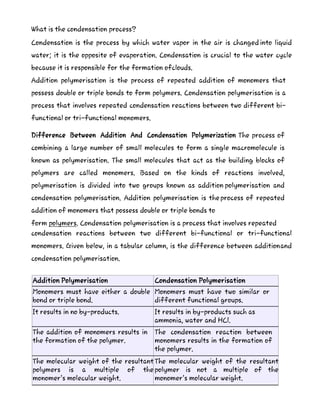
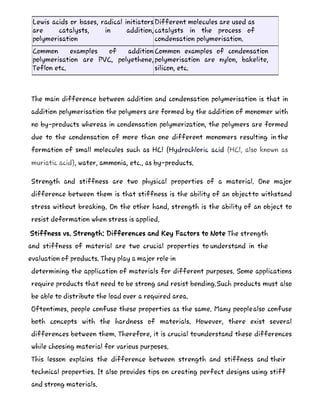
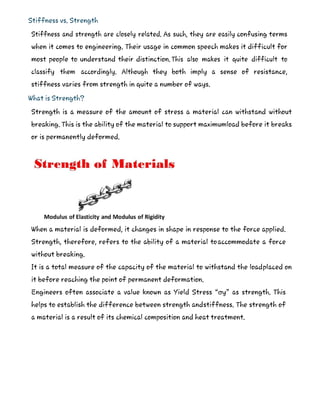
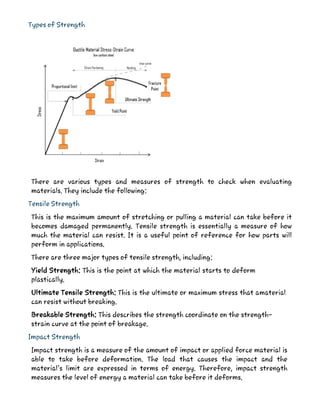
`PROPERTIES OF MATERIALS FOR ENGINEERING APPLICATION (UNIT 517)
Learning Outcome 1
The atomic theory of the structure of engineering materials.
An element is defined as a substance which cannot be decomposed into other
substances. The smaller particle of an element which takes part in chemical
reaction is known as an Atom.
The atomic theory provides a fundamental framework for understanding the
structure of engineering materials. This theory put forward as a fact that all
matter is composed of indivisible particles called atoms. In the context of
engineering materials, such as metals, ceramics, and polymers, the arrangement
and behavior of atoms play a crucial role in determining the material's properties
and performance.
What is an atom?
An atom is a particle of matter that uniquely defines a chemical element. An atom
consists of a central nucleus that is surrounded by oneor more negatively charged
electrons. The nucleus is positively charged and contains one or more relatively
heavy particles known as protons and neutrons.
Atoms are the basic building blocks of matter. Anything that takes up space and
anything with mass is made up of atoms.
What are protons and neutrons?
Protons and neutrons are subatomic particles that make up the center ofthe atom,
or its atomic nucleus.
A proton is positively charged. The number of protons in the nucleus ofan atom is
the atomic number for the chemical element. Different elements' atomic numbers
are found in the period table of elements. For example, sodium has 11 protons, and its
atomic number is 11.
A proton has a rest mass, denoted mp, of approximately 1.673 x 10⁻²⁷ kilogram
(kg).
A neutron is electrically neutral and has a rest mass, denoted mn, of approximately
1.675 x 10⁻²⁷.
The mass of a proton or neutron increases when the particle attainsextreme speed,
for example in a cyclotron or linear accelerator.
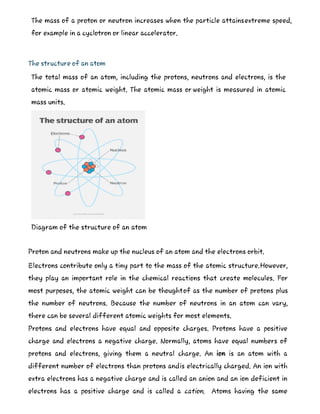
The structure of an atom
The total mass of an atom, including the protons, neutrons and electrons, is the
atomic mass or atomic weight. The atomic mass or weight is measured in atomic
mass units.
Diagram of the structure of an atom
Proton and neutrons make up the nucleus of an atom and the electrons orbit.
Electrons contribute only a tiny part to the mass of the atomic structure.However,
they play an important role in the chemical reactions that create molecules. For
most purposes, the atomic weight can be thoughtof as the number of protons plus
the number of neutrons. Because the number of neutrons in an atom can vary,
there can be several different atomic weights for most elements.
Protons and electrons have equal and opposite charges. Protons have a positive
charge and electrons a negative charge. Normally, atoms have equal numbers of
protons and electrons, giving them a neutral charge. An ion is an atom with a
different number of electrons than protons andis electrically charged. An ion with
extra electrons has a negative charge and is called an anion and an ion deficient in
electrons has a positive charge and is called a cation. Atoms having the same
number of protons but different numbers of neutrons represent the same element
and are known as isotopes of thatelement. An isotope for an element is specified by
the sum of the number of protons and neutrons. For example, the following are two
isotopes of the carbon atom:
Carbon 12 is the most common, non-radioactive isotope of carbon.Carbon 14 is a
less common, radioactive carbon isotope.
The only neutral atom with no neutrons is the hydrogen atom. It has oneelectron and
one proton.
Atoms and Elements:
An atom is the basic building block of matter and consists of a nucleus(protons and
neutrons) surrounded by electrons.
Each element is characterized by a unique number of protons in itsnucleus,
defining its atomic number.
Bonding:
Atoms can form bonds with each other to create molecules or structures.Different
types of bonding include covalent, ionic, and metallic bonds, and the type of bonding
significantly influences material properties.
Crystal Structure:
Many engineering materials exhibit a crystalline structure, where atoms are
arranged in a repeating pattern called a crystal lattice.
Crystal structures contribute to the material's mechanical, thermal, andelectrical
properties.
Grain Structure:
In polycrystalline materials, numerous crystalline regions or grains arepresent.
Grain boundaries, where different grains meet, can influence the material's
strength, ductility, and corrosion resistance.
Defects:
Imperfections or defects in the crystal lattice, such as vacancies,
interstitials, and dislocations, can affect mechanical properties. So, control
and understanding of defects are crucial for optimizing material
performance.
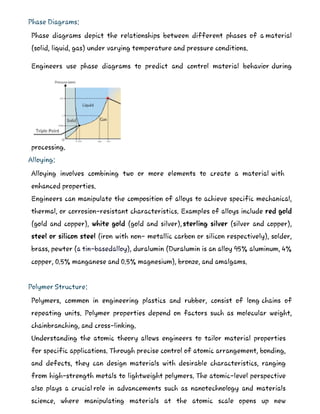
Phase Diagrams:
Phase diagrams depict the relationships between different phases of a material
(solid, liquid, gas) under varying temperature and pressure conditions.
Engineers use phase diagrams to predict and control material behavior during
processing.
Alloying:
Alloying involves combining two or more elements to create a material with
enhanced properties.
Engineers can manipulate the composition of alloys to achieve specific mechanical,
thermal, or corrosion-resistant characteristics. Examples of alloys include red gold
(gold and copper), white gold (gold and silver),sterling silver (silver and copper),
steel or silicon steel (iron with non- metallic carbon or silicon respectively), solder,
brass, pewter (a tin-basedalloy), duralumin (Duralumin is an alloy 95% aluminum, 4%
copper, 0.5% manganese and 0.5% magnesium), bronze, and amalgams.
Polymer Structure:
Polymers, common in engineering plastics and rubber, consist of long chains of
repeating units. Polymer properties depend on factors such as molecular weight,
chainbranching, and cross-linking.
Understanding the atomic theory allows engineers to tailor material properties
for specific applications. Through precise control of atomic arrangement, bonding,
and defects, they can design materials with desirable characteristics, ranging
from high-strength metals to lightweight polymers. The atomic-level perspective
also plays a crucial role in advancements such as nanotechnology and materials
science, where manipulating materials at the atomic scale opens up new
possibilities for innovative applications.
Atomic bonding plays a crucial role in determining the properties of engineering
materials. The type of bonding between atoms directly affects various material
characteristics, including mechanical, thermal,electrical, and optical properties.
The three main types of atomic bonding are ionic, covalent, and metallic.
Ionic Bonding:
Description: In ionic bonding, electrons are transferred from one atom to another,
resulting in the formation of positively charged ions (cations) and negatively
charged ions (anions). These oppositely charged ions are held together by
electrostatic forces.
Influence on Properties:
High melting and boiling points: Ionic compounds tend to have high melting and
boiling points due to the strong electrostatic forces betweenions. Brittle behavior:
The arrangement of ions in a crystal lattice makes ioniccompounds brittle because
the layers of ions can slide past each other only to a limited extent before repulsive
forces cause fracture.
Good electrical conductivity in molten or dissolved state: In the moltenor dissolved
state, ions are free to move, allowing for electrical conductivity.
Covalent Bonding:
Description: In covalent bonding, atoms share electrons to achieve a stable
electron configuration. This results in the formation of molecules or extended
networks of atoms.
Influence on Properties:
High hardness and strength: Covalent materials often have high hardness and
strength due to the strong directional bonds betweenatoms.
High melting and boiling points: Covalent compounds may exhibit highmelting and
boiling points because of the strong covalent bonds that need to be broken.
Poor electrical conductivity: Most covalent materials are poor conductors of
electricity because electrons are tightly bound withincovalent bonds.
Metallic Bonding:
Description: Metallic bonding involves a "sea of electrons" shared among
positively charged metal ions. The electrons are delocalized and move freely
throughout the structure.
Influence on Properties:
High electrical conductivity: The presence of delocalized electronsallows metals to
conduct electricity effectively.
Ductility and malleability: Metallic bonding allows for the easy movement of
atoms layers, making metals ductile and malleable. Good thermal
conductivity: The free movement of electrons also contributes to good
thermal conductivity in metals.
Luster and opacity: Metallic materials often exhibit a shiny appearance (luster)
and are typically opaque due to the way they interact with light.The influence of
atomic bonding on the properties of engineering materials is significant because it
dictates how atoms are held together and how they respond to external forces and
stimuli. Engineers leverage this understanding to design materials with specific
bonding characteristics to meet the requirements of various applications.
Additionally, the combination of different types of bonding in alloys andcomposite
materials allows for tailoring properties to achieve desired performance
characteristics.
Learning Outcome 1.1
Explain the influence of atomic bonding on the properties ofengineering materials.
Atomic bonding significantly influences the properties of engineering materials, as
it determines the arrangement of atoms and the forces thathold them together.
There are three main types of atomic bonding:
metallic, covalent, and ionic. Each type has distinct effects on the
mechanical, thermal, electrical, and optical properties of materials.Metallic
Bonding:
Properties: Materials with metallic bonding, such as metals and alloys, tend to have
good electrical conductivity, high thermal conductivity, andhigh ductility.
Explanation: In metallic bonding, electrons are delocalized and move freely
throughout the structure. This allows for the efficient transfer of heat and
electricity. The mobility of electrons also contributes to the malleability and
ductility of metals.
Covalent Bonding:
Properties: Materials with strong covalent bonds, such as ceramics andsome polymers,
exhibit high hardness, high melting points, and are generally brittle.
Explanation: Covalent bonds involve the sharing of electrons between adjacent
atoms. This strong bond results in materials with high meltingpoints and hardness.
However, the lack of mobility of electrons can make these materials brittle.
Ionic Bonding:
Properties: Ionic compounds, like salts, have high melting points, are brittle, and
often exhibit good electrical insulating properties in the solidstate.
Explanation: Ionic bonds form between positively and negatively charged ions. The
electrostatic forces holding these ions together are strong, leading to high
melting points. However, the lack of electron mobility results in poor electrical
conductivity.
Hydrogen Bonding:
Properties: Materials with hydrogen bonding, such as water and certain organic
compounds, often have higher boiling points and unique properties like surface
tension.
Explanation: Hydrogen bonding occurs between hydrogen atoms and highly
electronegative atoms like oxygen, nitrogen, or fluorine. This type of bonding
contributes to the unique properties of water and someorganic molecules.
Understanding the type of atomic bonding in a material helps engineerstailor its
properties for specific applications. For instance, choosing materials with metallic
bonding for electrical conductors, covalent bonding for high-strength components,
or ionic bonding for insulating materials, allows for the optimization of
engineering designs based on the desired performance characteristics. Additionally,
combinations of different types of bonding can be engineered to achieve specific
property profiles in composite materials.
Learning Outcome 1.2
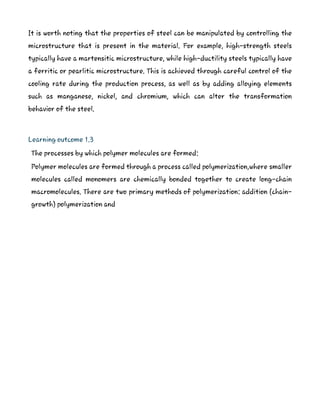
The effect of temperature change on the microstructure of plain carbon steels.
The microstructure of plain carbon steels is strongly influenced by changes in
temperature, particularly during the heat treatment process. The microstructure of
steel primarily consists of ferrite, pearlite, cementite, and sometimes other phases,
depending on the composition and heat treatment.
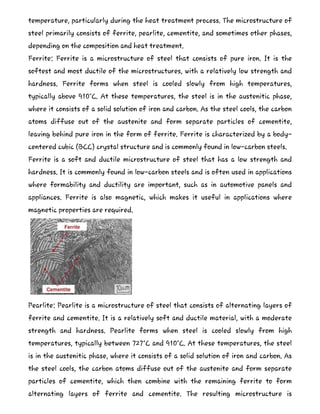
Ferrite: Ferrite is a microstructure of steel that consists of pure iron. It is the
softest and most ductile of the microstructures, with a relatively low strength and
hardness. Ferrite forms when steel is cooled slowly from high temperatures,
typically above 910°C. At these temperatures, the steel is in the austenitic phase,
where it consists of a solid solution of iron and carbon. As the steel cools, the carbon
atoms diffuse out of the austenite and form separate particles of cementite,
leaving behind pure iron in the form of ferrite. Ferrite is characterized by a body-
centered cubic (BCC) crystal structure and is commonly found in low-carbon steels.
Ferrite is a soft and ductile microstructure of steel that has a low strength and
hardness. It is commonly found in low-carbon steels and is often used in applications
where formability and ductility are important, such as in automotive panels and
appliances. Ferrite is also magnetic, which makes it useful in applications where
magnetic properties are required.
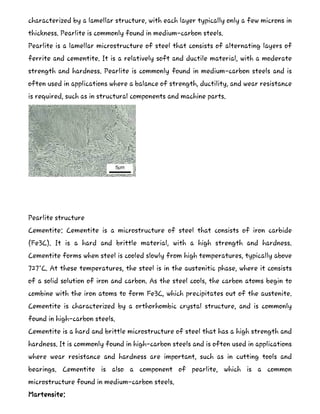
Pearlite: Pearlite is a microstructure of steel that consists of alternating layers of
ferrite and cementite. It is a relatively soft and ductile material, with a moderate
strength and hardness. Pearlite forms when steel is cooled slowly from high
temperatures, typically between 727°C and 910°C. At these temperatures, the steel
is in the austenitic phase, where it consists of a solid solution of iron and carbon. As
the steel cools, the carbon atoms diffuse out of the austenite and form separate
particles of cementite, which then combine with the remaining ferrite to form
alternating layers of ferrite and cementite. The resulting microstructure is
characterized by a lamellar structure, with each layer typically only a few microns in
thickness. Pearlite is commonly found in medium-carbon steels.
Pearlite is a lamellar microstructure of steel that consists of alternating layers of
ferrite and cementite. It is a relatively soft and ductile material, with a moderate
strength and hardness. Pearlite is commonly found in medium-carbon steels and is
often used in applications where a balance of strength, ductility, and wear resistance
is required, such as in structural components and machine parts.
Pearlite structure
Cementite: Cementite is a microstructure of steel that consists of iron carbide
(Fe3C). It is a hard and brittle material, with a high strength and hardness.
Cementite forms when steel is cooled slowly from high temperatures, typically above
727°C. At these temperatures, the steel is in the austenitic phase, where it consists
of a solid solution of iron and carbon. As the steel cools, the carbon atoms begin to
combine with the iron atoms to form Fe3C, which precipitates out of the austenite.
Cementite is characterized by a orthorhombic crystal structure, and is commonly
found in high-carbon steels.
Cementite is a hard and brittle microstructure of steel that has a high strength and
hardness. It is commonly found in high-carbon steels and is often used in applications
where wear resistance and hardness are important, such as in cutting tools and
bearings. Cementite is also a component of pearlite, which is a common
microstructure found in medium-carbon steels.
Martensite:
Martensite is a microstructure of steel that consists of a supersaturated solid
solution of carbon in iron. It is a very hard and brittle material, with a high strength
and hardness. Martensite forms when steel is cooled rapidly from high temperatures,
typically above 200°C per second. This rapid cooling, known as quenching, does not
allow the carbon atoms to diffuse out of the austenite and form separate particles
of cementite. Instead, the carbon atoms remain in solid solution in the iron, creating
a highly strained and unstable microstructure. Martensite is characterized by a body
-centered tetragonal (BCT) crystal structure and is commonly found in high-carbon
steels.
Martensite is a very hard and brittle microstructure of steel that has a high
strength and hardness. It is commonly found in high-carbon steels and is often used
in applications where high strength and hardness are required, such as in tool steels
and springs. Martensite is also a key component of heat-treated steels, where it is
formed by quenching from high temperatures to create a hardened surface layer.
Austenite:
Austenite is a microstructure of steel that consists of a solid solution of iron and
carbon. It is a relatively soft and ductile material, with a low strength and hardness.
Austenite forms when steel is heated to high temperatures, typically above 910°C. At
these temperatures, the steel is in the austenitic phase, where it consists of a
homogeneous mixture of iron and carbon. Austenite has a face-centered cubic (FCC)
crystal structure, which allows carbon atoms to diffuse freely throughout the
material. This makes austenite very ductile and malleable, and it is often used as a
starting point for producing other microstructures by controlled cooling or heating.
Austenite is a homogeneous microstructure of steel that is relatively soft and
ductile, with a low strength and hardness. It is commonly used as a starting point for
producing other microstructures by controlled cooling or heating. Austenite is often
found in low-carbon and stainless steels, where it provides good formability and
corrosion resistance.
Normalizing: Similar to annealing, but the steel is air-cooled. This produces a finer
pearlite and improved mechanical properties compared to annealing.
Quenching: Rapidly cooling the steel by immersing it in a quenching medium (such as
water or oil) after heating above the critical temperature. This produces a hard,
brittle microstructure, often martensite. Subsequent tempering is usually done to
reduce brittleness.
Tempering: Reheating quenched steel to a temperature below the critical
temperature and then cooling it. This reduces the hardness and brittleness of
martensite, resulting in a microstructure with a combination of tempered martensite,
ferrite, and pearlite.
In summary, temperature changes during heat treatment have a significant impact
on the microstructure of plain carbon steels, influencing their mechanical properties
such as hardness, strength, and ductility. The specific heat treatment process chosen
determines the resulting microstructure and, consequently, the properties of the
steel for its intended application.
It is worth noting that the properties of steel can be manipulated by controlling the
microstructure that is present in the material. For example, high-strength steels
typically have a martensitic microstructure, while high-ductility steels typically have
a ferritic or pearlitic microstructure. This is achieved through careful control of the
cooling rate during the production process, as well as by adding alloying elements
such as manganese, nickel, and chromium, which can alter the transformation
behavior of the steel.
Learning outcome 1.3
The processes by which polymer molecules are formed:
Polymer molecules are formed through a process called polymerization,where smaller
molecules called monomers are chemically bonded together to create long-chain
macromolecules. There are two primary methods of polymerization: addition (chain-
growth) polymerization and
condensation (step-growth) polymerization. Let's delve into eachprocess:
Addition (Chain-Growth) Polymerization:
Initiation: The process starts with the initiation step, where an initiator (which can
be a chemical compound or a physical agent like heat or light) generates reactive
species such as free radicals, cations, or anions.Propagation: The reactive species
then react with monomers, causing them to link together and form a polymer chain.
This process repeats, with each addition elongating the polymer chain until the
monomers areconsumed or the chain is terminated.
Termination: Termination occurs when two reactive species combine or when a
reactive species reacts with a terminator molecule. This results in the end of the
polymerization process.
Examples: Polyethylene and polystyrene are examples of polymersformed through
addition polymerization.
Condensation (Step-Growth) Polymerization:
Initiation: Condensation polymerization involves monomers with different
functional groups. The process begins with the initiation of thereaction between
two different functional groups, often accompanied by the release of a small
molecule such as water or alcohol.
Propagation: The reactive functional groups on the monomers react witheach other,
forming covalent bonds and releasing small molecules as byproducts. This process
continues, with the polymer chain growing as monomers react in pairs.
Termination: The termination of condensation polymerization occurs when all the
reactive functional groups are consumed, and the desired polymer chain length is
achieved. The small molecules generated duringpropagation are often removed from
the reaction mixture.
Examples: Nylon and polyester are examples of polymers formed through
condensation polymerization.
Both addition and condensation polymerizations can be influenced by factors such
as temperature, pressure, and the presence of catalysts. Thechoice between the
two methods depends on the specific monomers involved and the desired
properties of the polymer product. The resulting polymers can have different
structures, properties, and applications based on the polymerization process used.
Learning Outcome 1.4
The influence of crosslinking on the mechanical properties of polymers What is
Crosslinking?
Crosslinking is a process in polymer chemistry where adjacent polymerchains are
chemically bonded together, creating a three-dimensional network within the
polymer structure. This bonding, known as crosslinks, plays a significant role in
influencing the mechanical properties of polymers. The degree of crosslinking
affects properties such as strength, elasticity, hardness, and thermal stability.
Here's how crosslinking influences the mechanical properties of polymers:
Increased Strength:
Crosslinking enhances the strength of polymers by physically linking polymer
chains. This interconnected network distributes stress more evenly throughout the
material, preventing the propagation of cracks and improving the overall
structural integrity.
The higher the degree of crosslinking, the stronger the polymer becomes. This is
particularly beneficial in applications where mechanical strength is crucial, such as
in engineering plastics orstructural components.
Enhanced Elasticity and Toughness:
Crosslinked polymers often exhibit improved elasticity and toughness compared to
non-crosslinked counterparts. The crosslinks act as "restraints," limiting the
movement of polymer chains and providing resistance to deformation.
This increased elasticity is particularly useful in elastomers and rubberymaterials,
where the ability to stretch and recover is essential.
Reduced Solubility and Swelling:
Crosslinked polymers are generally less soluble in solvents and less prone to
swelling when exposed to liquids. The interconnected networkof crosslinks restricts
the movement of polymer chains, making it more difficult for solvents to
penetrate the material.
This property is advantageous in applications where resistance to environmental
factors, such as exposure to chemicals or liquids, isimportant.
Improved Thermal Stability:
Crosslinked polymers often have higher thermal stability due to the three-
dimensional network structure. The presence of crosslinks helps prevent the
material from softening or deforming at elevated temperatures.
This enhanced thermal stability is valuable in applications where the polymer
needs to withstand high temperatures, such as in automotive components or
electronic devices.
Hardness and Rigidity:
Crosslinking can increase the hardness and rigidity of polymers, making them
suitable for applications requiring dimensional stability and resistance to
deformation.
Crosslinked polymers are commonly used in thermosetting plastics, where the
material undergoes irreversible crosslinking during the curingprocess.
Dimensional Stability:
Crosslinked polymers tend to have better dimensional stability, maintaining their
shape and size under various conditions. This property is particularly important in
applications where precision and consistencyare critical.
It's important to note that while crosslinking can impart several positivemechanical
properties to polymers, excessive crosslinking may result in increased brittleness.
The balance between crosslinking and maintaining flexibility is often a key
consideration in the design and synthesis of polymers for specific applications.
Learning Outcome 1.5
Compare the cell structure of wood with a long chain polymer.
Wood and long-chain polymers have distinct structures, yet they share some
similarities in their composition. Let's compare the cell structure of wood,
specifically from a plant's perspective, with the structure of a long-chain
polymer.
Wood Cell Structure:
1. Cellulose Fibers:
Wood is primarily composed of cellulose fibers, which are long chains of glucose
molecules linked by β-1,4-glycosidic bonds. These fibers provide strength and
rigidity to the wood.
2. Hemicellulose and Lignin:
Besides cellulose, wood contains hemicellulose and lignin. Hemicellulose is a
branched polymer made up of various sugar monomers, contributing to the overall
structure. Lignin is a complex, irregular polymer that provides additional strength
and acts as a bindingmaterial.
3. Cellular Structure:
Wood has a cellular structure with distinct cell types. The basic buildingblocks are
elongated cells called fibers, which provide the primary structural support. Other
cell types include vessels, tracheids, and parenchyma cells.
4. Hydrophilic Nature:
Wood is hydrophilic, meaning it has a natural affinity for water. The hydroxyl
groups in cellulose and hemicellulose make wood capable ofabsorbing and releasing
water, influencing its dimensional stability.
Long-Chain Polymer:
1. Homogeneous Structure:
Long-chain polymers are typically synthesized from monomers through
polymerization reactions. The resulting polymer is a long, repeating chain of
identical or similar monomeric units, leading to a more homogeneous structure
compared to the heterogeneous composition of wood.
2. Chemical Composition:
Long-chain polymers can vary widely in their chemical composition, depending on
the monomers used in their synthesis. Common examples include polyethylene,
polypropylene, and polyvinyl chloride (PVC).
3. Mechanical Properties:
The mechanical properties of long-chain polymers depend on factors like molecular
weight, branching, and crosslinking. They can exhibit properties such as flexibility,
toughness, and elasticity, depending on thespecific polymer.
4. Amorphous or Crystalline Regions:
Long-chain polymers can have amorphous or crystalline regions.
Crystallinity can affect the material's stiffness and strength, while
amorphous regions contribute to flexibility.
5. Processing and Molding:
Long-chain polymers can be processed and molded into various shapes using
techniques such as extrusion, injection molding, or blow molding.This versatility in
processing makes them suitable for a wide range of applications.
Common Features:
1. Polymeric Nature:
Both wood and long-chain polymers are polymeric materials, meaning they consist
of long chains of repeating units. In wood, cellulose, hemicellulose, and lignin are the
primary polymers, while in synthetic polymers, the structure is engineered during
the manufacturing process.
2. Structural Function:
Both wood and long-chain polymers provide structural support. Wood is a natural
structural material in plants, while synthetic polymers are engineered for various
structural applications.
In summary, while wood and long-chain polymers share a polymeric nature and
provide structural support, their specific structures, compositions, and properties
differ significantly due to their distinctorigins and manufacturing processes.
Learning Outcome 1.6
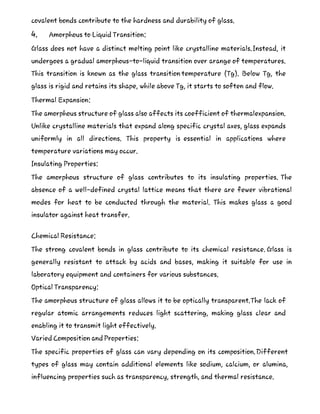
Explain how the molecular structure of glass affects its properties: The
molecular structure of glass plays a crucial role in determining its properties.
Unlike crystalline materials, glass does not have a well- defined repeating
atomic or molecular arrangement. Instead, it has an
amorphous structure, where the arrangement of atoms lacks long-range order. The
properties of glass are influenced by this disordered structure, and several key
factors contribute to its behavior:
1. Amorphous Structure:
The absence of a regular, repeating structure in glass results in an amorphous
arrangement of atoms. This lack of long-range order gives glass its transparency
and the ability to transmit light without scattering,as there are no regular crystal
planes to interfere with the passage of light.
2. Random Packing of Atoms:
In glass, atoms are randomly packed rather than forming a crystal lattice. This
leads to a lack of cleavage planes, making glass a brittle material. Unlike
crystalline materials that can cleave along specific planes, glass fractures
randomly when subjected to stress.
3. High Covalent Bonding:
Glass is primarily composed of covalently bonded network structures, typically
involving oxygen atoms bridging other elements like silicon or boron. These strong
covalent bonds contribute to the hardness and durability of glass.
4. Amorphous to Liquid Transition:
Glass does not have a distinct melting point like crystalline materials.Instead, it
undergoes a gradual amorphous-to-liquid transition over arange of temperatures.
This transition is known as the glass transition temperature (Tg). Below Tg, the
glass is rigid and retains its shape, while above Tg, it starts to soften and flow.
Thermal Expansion:
The amorphous structure of glass also affects its coefficient of thermalexpansion.
Unlike crystalline materials that expand along specific crystal axes, glass expands
uniformly in all directions. This property is essential in applications where
temperature variations may occur.
Insulating Properties:
The amorphous structure of glass contributes to its insulating properties. The
absence of a well-defined crystal lattice means that there are fewer vibrational
modes for heat to be conducted through the material. This makes glass a good
insulator against heat transfer.
Chemical Resistance:
The strong covalent bonds in glass contribute to its chemical resistance. Glass is
generally resistant to attack by acids and bases, making it suitable for use in
laboratory equipment and containers for various substances.
Optical Transparency:
The amorphous structure of glass allows it to be optically transparent.The lack of
regular atomic arrangements reduces light scattering, making glass clear and
enabling it to transmit light effectively.
Varied Composition and Properties:
The specific properties of glass can vary depending on its composition.Different
types of glass may contain additional elements like sodium, calcium, or alumina,
influencing properties such as transparency, strength, and thermal resistance.
In summary, the amorphous molecular structure of glass, characterized by random
packing of atoms and strong covalent bonding, is responsible for its unique
combination of properties, including transparency, hardness, brittleness, thermal
stability, and chemical resistance. These properties make glass a versatile material
with a wide range of applications in various industries.
Conclusion
It is important to understand the individual roles of strength and stiffness of
material in foundational decision-making. They are highly essential factors in the
production of high-end products. This is because the production depends on the
materials’ response to applied force or load.
2.1 The effect of thermo-mechanical treatments on the microstructure of
plain carbon steels
These are thermo-mechanical treatments on plain carbon steels.
The surface hardening of steels
Carburising, casehardening, nitriding
Metal components often require a combination of mechanical properties, such as
hardness and ductility, for their strength and durability. For instance, bearing
metals need to be both hard and ductile, while steel components like cams and
gears need to be strong, shock-resistant, and hard and wear-resistant. These
properties are only found in materials with different carbon content. To overcome
this, two methods can be employed: employing a tough low-carbon steel and
altering its surface composition through case-hardening or nitriding, or using a
uniformly composed steel with at least 0.4 percent carbon and heat-treating the
surface differently from the core. The hardening material is localized in the first
case, while the heat-treatment is localized in the second.
Carburizing
Carburizing, is a heat-treating process used to increase the carbon content of the
surface of low-carbon steels. The process involves heating the metal in a carbon-
rich environment, typically in the presence of a carbonaceous material such as
charcoal, carbon monoxide, or methane.
During carburizing, the carbon atoms diffuse into the surface layer of the steel,
forming a high-carbon layer while maintaining a low-carbon core. This creates a
hardened surface that is resistant to wear and abrasion, while the core retains its
toughness and ductility.
Carburizing is commonly used in the manufacturing of gears, bearings, and other
components that require a combination of hardness and toughness. It is often
followed by quenching and tempering processes to further refine the properties of
the steel.
1. Case Hardening: Case hardening, also known as surface hardening, is a
heat treatment process that involves adding a thin layer of hard material
to the surface of a softer metal object. This is typically achieved by
diffusing carbon or nitrogen into the surface layer of the material,
creating a hardened outer "case" while maintaining a softer core. Examples
include:
 Carburizing steel gears to increase their surface hardness and
wearresistance.
 Nitriding the surface of a crankshaft to improve its fatigue strength.
These hardening processes are commonly used in various industries to enhancethe
mechanical properties of metals and alloys for specific applications.
Nitriding
Nitriding and case-hardening have one factor in common – both processes involve
heating the steel for a considerable time in the hardening-medium, but,whilst in
case-hardening the medium contains carbon, in nitriding it contains gaseous
nitrogen. Special steels - 'Nitralloy' steels - are necessary for the
nitriding process, since hardening depends upon the formation of very hard
compounds of nitrogen and such metals as aluminium, chromium and vanadium
present in the steel. Ordinary plain-carbon steels cannot be nitrided,
since any compounds of iron and nitrogen which form will diffuse intothe
core, so that the increase in hardness of the surface is lost. The hard
compounds formed by aluminium, chromium and vanadium, however,
remain near to the surface and so provide an extremely hard skin.
Nitriding is a surface-hardening process commonly used to improve the
mechanical properties of steel, including hardness, wear resistance, and fatigue
strength. Nitriding is particularly effective with certain types of steels, such as
nitralloy steels, which are specifically formulated to enhance nitriding
characteristics.
The process of nitriding typically involves exposing the steel to an atmosphere of
ammonia gas at elevated temperatures, usually between 500°C and 600°C (932°Fto
1112°F), for an extended period, which can range from several hours to a few days,
depending on the desired case depth and hardness. During nitriding, nitrogen
atoms from the ammonia gas diffuse into the surface of the steel and form hard
nitride compounds with the iron and alloying elements present in the steel. These
compounds, such as iron nitride (Fe3N) and chromium nitride (CrN),are extremely
hard and contribute to the increased hardness of the surface layer.
Other heat treatment methods:
1. Work Hardening: Also known as strain hardening or cold working, it
involves the strengthening of a metal through plastic deformation. This is
achieved by subjecting the material to mechanical stresses such as bending,
hammering, or rolling. As the metal is deformed, dislocations within its crystal
structure increase, making it harder and stronger. Examples include:
 Hammering a piece of copper to make it harder.
 Rolling steel sheets to increase their strength.
2. Quenching: Quenching is a heat treatment process where a material, usually
a metal or alloy, is heated to a specific temperature and then rapidly cooled
by immersion in a quenching medium, such as water, oil, or air. This rapid
cooling alters the microstructure of the material, resulting in increased
hardness. Examples include:
 Heating a steel knife blade to critical temperature and then
quenchingit in oil to harden it.
 Quenching molten glass to create tempered glass.
3. Flame Hardening: Flame hardening, also known as flame heating or flame
induction hardening, is a surface hardening technique where the surface of
a metal workpiece is heated using a high-temperature flame followed by
rapid cooling. This process increases the hardness and wear resistance of the
surface while maintaining the toughness of the core. Examples include:
 Heating the surface of a gear with an oxy-acetylene flame and
thenquenching it with water to increase its wear resistance.
 Flame hardening the surface of a camshaft to improve its durability.
4. Induction Hardening: Induction hardening is a surface hardening process
that uses electromagnetic induction to heat the surface layer of a metal
workpiece quickly, followed by quenching. The rapid heating and cooling
create a hardened surface layer while preserving the toughness of the core.
Examples include:
 Induction hardening the teeth of a gear to increase their
wearresistance.
 Hardening the surface of a shaft using induction heating to improve
its durability.
Cast Iron
Cast iron is a type of iron-carbon alloy with a carbon content greater than 2%. It
is known for its excellent heat retention, durability, and ability to distribute heat
evenly. Cast iron has been used for centuries in various applications, including
cookware, industrial machinery, and architectural elements.
The following features make cast iron an important material:
 It is a cheap metallurgical substance, since it is produced by simple
adjustments to the composition of ordinary pig iron.
 Mechanical rigidity and strength under compression are good.
 It machines with ease when a suitable composition is selected.
 Good fluidity in the molten state leads to the production of good casting-
impressions.
 High-duty cast irons can be produced by further treatment of irons
of suitable composition, e. g. spheroidal-graphite irons are strong,
whilstmalleable irons are tough.
Composition of cast irons
Ordinary cast irons contain the following elements, carbon 3.0-4.0%, silicon
1.0-3.0%, manganese 0.5-1.0%, sulphur up to 0.1%, phosphorus up to 1.0%.
Let us discuss these elements one after the other:
1. Carbon: Carbon may be present in the structure either as flakes of
graphiteor as a network of hard, brittle, iron carbide (or cementite). If a
cast iron contains much of this brittle cementite, its mechanical properties
will be poor, and for most engineering purposes it is desirable for the
carbon to bepresent as small flakes of graphite.
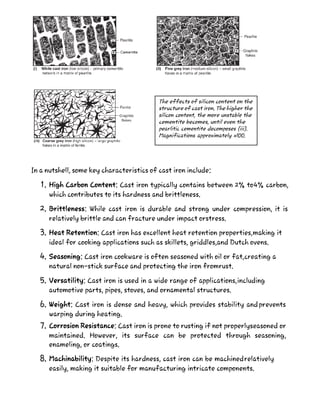
2. Silicon: Silicon to some extent governs the form in which carbon is present in
cast iron. It causes the cementite to be unstable, so that it decomposes, thus
releasing free graphite. Therefore, a high-silicon iron tends to be a greyiron,
while a low-silicon iron tends to be a white iron.
3. Sulphur: Sulphur has the opposite effect on the structure to that given by
silicon; that is, it tends to stabilise cementite, and so helps to produce a white
iron. However, sulphur causes excessive brittleness in cast iron (as it does in
steel), and it is therefore always kept to the minimum amount which is
economically possible.
4. Manganese: Manganese toughens and strengthens an iron, partly because it
neutralises much of the unwelcome sulphur by forming a slag with it, and
partly because some of the manganese dissolves in the ferrite.
5. Phosphorus: Phosphorus forms a brittle compound with some of the iron; it is
therefore kept to a minimum amount in most engineering cast irons. However,
like silicon, it increases fluidity, and considerably improves the casting
qualities of irons which are to be cast in thin sections, assuming that
components are involved in which mechanical properties are unimportant.
Thus, cast-iron water pipes contained up to 0.8 per cent phosphorus, whilst
many of the ornamental castings contained up to 1.0 per cent of the element.
In a nutshell, some key characteristics of cast iron include:
1. High Carbon Content: Cast iron typically contains between 2% to4% carbon,
which contributes to its hardness and brittleness.
2. Brittleness: While cast iron is durable and strong under compression, it is
relatively brittle and can fracture under impact orstress.
3. Heat Retention: Cast iron has excellent heat retention properties,making it
ideal for cooking applications such as skillets, griddles,and Dutch ovens.
4. Seasoning: Cast iron cookware is often seasoned with oil or fat,creating a
natural non-stick surface and protecting the iron fromrust.
5. Versatility: Cast iron is used in a wide range of applications,including
automotive parts, pipes, stoves, and ornamental structures.
6. Weight: Cast iron is dense and heavy, which provides stability andprevents
warping during heating.
7. Corrosion Resistance: Cast iron is prone to rusting if not properlyseasoned or
maintained. However, its surface can be protected through seasoning,
enameling, or coatings.
8. Machinability: Despite its hardness, cast iron can be machinedrelatively
easily, making it suitable for manufacturing intricate components.
The effects of silicon content on the
structure of cast iron. The higher the
silicon content, the more unstable the
cementite becomes, until even the
pearlitic cementite decomposes (iii).
Magnifications approximately xlOO.
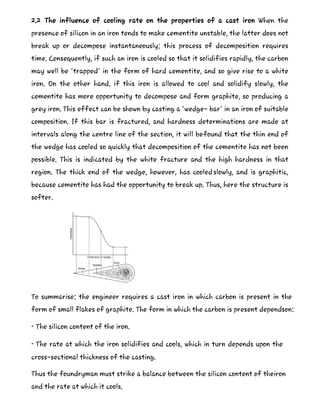
2.2 The influence of cooling rate on the properties of a cast iron When the
presence of silicon in an iron tends to make cementite unstable, the latter does not
break up or decompose instantaneously; this process of decomposition requires
time. Consequently, if such an iron is cooled so that it solidifies rapidly, the carbon
may well be 'trapped' in the form of hard cementite, and so give rise to a white
iron. On the other hand, if this iron is allowed to cool and solidify slowly, the
cementite has more opportunity to decompose and form graphite, so producing a
grey iron. This effect can be shown by casting a 'wedge- bar' in an iron of suitable
composition. If this bar is fractured, and hardness determinations are made at
intervals along the centre line of the section, it will befound that the thin end of
the wedge has cooled so quickly that decomposition of the cementite has not been
possible. This is indicated by the white fracture and the high hardness in that
region. The thick end of the wedge, however, has cooled slowly, and is graphitic,
because cementite has had the opportunity to break up. Thus, here the structure is
softer.
To summarise: the engineer requires a cast iron in which carbon is present in the
form of small flakes of graphite. The form in which the carbon is present dependson:
• The silicon content of the iron.
• The rate at which the iron solidifies and cools, which in turn depends upon the
cross-sectional thickness of the casting.
Thus the foundryman must strike a balance between the silicon content of theiron
and the rate at which it cools.
Sometimes it is necessary to have a hard-wearing surface of white iron at some
point in a casting which otherwise requires a tough grey iron structure. This can be
achieved by incorporating 'chills' at appropriate points in the sand mould. The'chill'
usually consists of a metal block, which will cause the molten iron in that region to
cool so quickly that a layer of hard cementite is retained adjacent to thechill.
The use of 'chills' in iron-founding.
Different types of cast iron
1. Malleable cast irons: These are irons of such a composition as will give, in the
ordinary cast form, a white (cementite) structure. However, they
subsequently receive heat-treatment, the object of which is either to
convert the cementite into small spherical particles of carbon (the 'black-
heart' process), or, alternatively, to remove the carbon completely from the
structure (the 'white-heart' process)
In either process, the silicon content of the iron is usually less than 1.0 per
cent, in order that the iron shall be 'white' in the cast condition. When the
cementite has either been replaced by carbon or removed completely, a
product which is both malleable and ductile is the result.
2. Alloy cast irons: Generally speaking, the effects which alloying elements
have on the properties of cast iron are similar to the effects which the
sameelements have on steel. Alloying elements used are:
a. Nickel - Nickel, like silicon, has a graphitising effect on cementite, and so
tends to produce a grey iron. At the same time, nickel has a grainrefining
effect, which helps to prevent the formation of coarse grain in those
heavy sections which cool slowly. It also toughens thin sections,which might
otherwise be liable to crack.
b. Chromium - Chromium is a carbide stabiliser and forms chromium
carbide, which is harder than ordinary cementite. It is therefore used in
wearresistant irons. Since chromium forms very stable carbides, irons
which contain chromium are less susceptible to 'growth'.
c. Molybdenum - Molybdenum increases the hardness of thick sections, and
also improves toughness.
d. Vanadium - Vanadium increases both strength and hardness; but, more
important still, promotes heat-resistance in cast irons by stabilising
carbides so that they do not decompose on heating.
e. Copper - Copper dissolves in iron in only very small amounts and has
little effect on mechanical properties. It is added mainly to improve
resistance to rusting.
In a nutshell, alloying elements can therefore be used to improve the mechanical
properties of an iron, by:
• Refining the grain size.
• Stabilising hard carbides.
• In some cases, producing cast irons with a martensitic or austenitic structure.
Stainless steel
Stainless steel, also known as corrosion-resistant steel (CRES) and rustless steel,
is an alloy of iron that is resistant to rusting and corrosion. It contains at least
10.5% chromium and usually nickel, as well as 0.2 to 2.11% carbon. Stainless steel's
resistance to corrosion results from the chromium, which forms a passive film
that can protect the material and self-heal in the presence of oxygen.
Stainless steel is a versatile and widely used material known for its durability,
corrosion resistance, and aesthetic appeal. It's a type of alloy composed primarily
of iron, with varying amounts of chromium, nickel, molybdenum, manganese, and
other elements. The presence of chromium is what gives stainless steel its
corrosion-resistant properties by forming a thin oxide layer on its surface, which
protects it from rust and staining.
The alloy's properties, such as luster and resistance to corrosion, are useful in
many applications. Stainless steel can be rolled into sheets, plates, bars, wire, and
tubing. These can be used in cookware, cutlery, surgical instruments, major
appliances, vehicles, construction material in large buildings, industrial equipment
(e.g., in paper mills, chemical plants, water treatment), and storage tanks and
tankers for chemicals and food products.
The biological cleanability of stainless steel is superior to both aluminum and
copper, and comparable to glass. Its cleanability, strength, and corrosion
resistance have prompted the use of stainless steel in pharmaceutical and food
processing plants.
Here's a detailed discussion on various aspects of stainless steel:
1. Composition:
 Stainless steel typically contains at least 10.5% chromium, which is
essential for its corrosion resistance.
 Nickel is often added to enhance the corrosion resistance and strength
of stainless steel.
 Other elements like molybdenum, manganese, nitrogen, and titanium
may also be added to impart specific properties such as improved
resistance to pitting corrosion, increased strength, or better
formability.
2. Types of Stainless Steel:
 Austenitic Stainless Steel: These are the most common type and are
non-magnetic. They offer good corrosion resistance, high ductility,
and excellent formability. Examples include 304 and 316 stainless
steel.
 Ferritic Stainless Steel: These contain higher chromium but no nickel.
They are magnetic and offer good corrosion resistance in specific
environments.
 Martensitic Stainless Steel: These are heat-treatable and have
highstrength but lower corrosion resistance compared to austenitic
andferritic types.
 Duplex Stainless Steel: Combines the properties of austenitic and
ferritic stainless steels, offering high strength and improved
resistanceto corrosion, particularly in chloride environments.
3. Properties:
 Corrosion Resistance: Stainless steel's resistance to corrosion is one of
its most significant advantages, making it suitable for various
applications in harsh environments.
 Strength: Depending on the grade and treatment, stainless steel
canexhibit high tensile strength, making it suitable for structural
applications.
 Hygiene: Stainless steel is non-porous and easy to clean, making it
ideal for applications in the food and pharmaceutical industries where
cleanliness is paramount.
 Aesthetic Appeal: Stainless steel's shiny finish and versatility in terms
of surface treatments make it a popular choice for architectural,
decorative, and consumer products.
 Temperature Resistance: Stainless steel retains its mechanical
properties at both high and low temperatures, making it suitable for
applications in extreme environments.
4. Applications:
 Construction: Stainless steel is widely used in construction for
structural elements, facades, roofing, and cladding due to its
strength,corrosion resistance, and aesthetic appeal.
 Transportation: It's used in automotive, aerospace, and marine
applications due to its strength-to-weight ratio and resistance
tocorrosion in saltwater environments.
 Kitchenware and Appliances: Stainless steel appliances, cookware, and
utensils are popular due to their durability, hygiene, and aesthetic
qualities.
 Medical and Pharmaceutical: Stainless steel is used in medical
instruments, implants, and pharmaceutical equipment due to its
biocompatibility and ease of sterilization.
 Oil and Gas Industry: Stainless steel pipes, valves, and storage tanks
are used in the oil and gas industry due to their corrosion resistance in
harsh environments.
5. Fabrication and Finishing:
 Stainless steel can be fabricated using various methods, including
welding, machining, forming, and forging.
 It can be finished in different ways to achieve specific
appearancesand properties, including brushed, polished, satin, and
textured finishes.
6. Sustainability:
 Stainless steel is highly recyclable, with scrap being collected and
reused in the production of new stainless steel products. This
recyclability contributes to its sustainability and reduces the
demandfor virgin materials.
In conclusion, stainless steel is a versatile material with a wide range of applications
across various industries due to its corrosion resistance, strength,
hygiene, and aesthetic appeal. Its composition, properties, and fabrication
techniques make it a preferred choice for numerous applications where durability
and reliability are paramount.
2.8 Explain how processing of stainless steel affects its properties
The processing of stainless steel involves various manufacturing techniques that
significantly impact its properties. Stainless steel is an alloy primarily composed
of iron, chromium, nickel, and other elements depending on the specific grade.
The processing methods can include casting, forging, rolling, machining, heat
treatment, and surface finishing. Here's how these processes affect the
propertiesof stainless steel:
1. Composition Control: The composition of stainless steel is carefully
controlled during manufacturing to achieve desired properties such as
corrosion resistance, strength, and ductility. Adjusting the levels of
chromium, nickel, and other alloying elements can enhance specific
properties.
2. Heat Treatment: Heat treatment processes like annealing, quenching, and
tempering can alter the microstructure of stainless steel, influencing its
mechanical properties. For example, annealing can relieve internal stresses,
improve ductility, and soften the material, while quenching and tempering
can increase hardness and strength.
3. Cold Working: Processes like cold rolling or cold forging can deform the
stainless steel at room temperature, leading to strain hardening. Cold
working increases strength and hardness while reducing ductility. However,
excessive cold working can lead to cracking and decreased corrosion
resistance.
4. Hot Working: Hot working processes such as hot rolling or forging are
performed at elevated temperatures, making the material more malleable.
Hot working can refine the grain structure, improve mechanical properties,
and reduce residual stresses.
5. Surface Finishing: Techniques like grinding, polishing, and passivation can
enhance the surface properties of stainless steel. Passivation removes
surface contaminants and enhances corrosion resistance by promoting the
formation of a passive oxide layer.
6. Welding: Welding is a common joining process for stainless steel
components. However, it can introduce localized changes in the
microstructure, affecting properties like corrosion resistance and
mechanical strength. Post-weld heat treatment may be required to
restoreproperties in the heat-affected zone.
7. Grain Size Control: Grain size plays a crucial role in determining the
mechanical properties of stainless steel. Processes such as grain refinement
during solidification or controlled cooling rates can influence the grain size,
impacting properties like strength, toughness, and corrosion resistance.
Overall, the processing of stainless steel involves a delicate balance between
various techniques to achieve the desired combination of mechanical, physical, and
chemical properties required for specific applications. Each processing stepmust
be carefully controlled to ensure the final product meets the desired
specifications and performance requirements.
Unit 2.9 Weld-decay
During welding, some regions of the metal near to the weld will be maintained
between 650 and 800°C long enough for chromium carbide to precipitate there.
Subsequently, corrosion will occur in this area near to the weld. The fault may be
largely overcome by adding about 1 per cent of either titanium or niobium. These
metals have a great affinity for carbon, which therefore combines with them in
preference to chromium. Thus chromium is not drawn out of the structure, which,as
a result, remains uniform.
Weld decay, in a nutshell, also known as sensitization, is a phenomenon that occurs in
certain types of stainless steel after exposure to elevated temperatures, typically
in the range of 450°C to 850°C (842°F to 1562°F). This process primarily affects
austenitic stainless steels, such as the 300 series (e.g., 304, 316), which contain
significant amounts of chromium and nickel.
Here's how weld decay typically occurs:
1. Chromium Depletion: Austenitic stainless steels owe their corrosion
resistance to the formation of a chromium-rich oxide layer on the surface,
known as the passive layer. When these steels are heated within the
sensitization temperature range, chromium carbides (Cr23C6) can form at
the grain boundaries. This causes chromium depletion in the surrounding
areas, leaving them susceptible to corrosion.
2. Corrosion Susceptibility: The chromium-depleted regions adjacent to the
grain boundaries become prone to preferential corrosion, typically in the
form of intergranular corrosion (IGC). IGC occurs along the boundaries
between the individual grains of the metal, where the chromium content is
low due to carbide precipitation.
3. Reduced Corrosion Resistance: As a result of sensitization, the corrosion
resistance of the stainless steel is significantly reduced in the affected
areas. This compromises the material's ability to withstand corrosive
environments, leading to premature failure in certain applications.
Preventing weld decay involves several strategies:
1. Controlled Welding Parameters: Proper control of welding parameters,
such as heat input and interpass temperature, can minimize the extent of
sensitization during welding.
2. Post-Weld Heat Treatment (PWHT): Austenitic stainless steels can be
subjected to post-weld heat treatment processes such as solution annealing
or sensitization annealing to restore the material's microstructure and
alleviate sensitization.
3. Low Carbon Content: Using stainless steel with a low carbon content can
reduce the formation of chromium carbides and mitigate sensitization.
4. Stabilized Grades: Stabilized grades of stainless steel, such as types
containing titanium or niobium, are less prone to sensitization due to the
formation of more stable carbides.
5. Corrosion Testing: Regular corrosion testing, such as ASTM (American
Society for Testing and Materials) A262 practice, can help detect
sensitization and assess the effectiveness of preventive measures.
Learning outcome 3.
The application of non-ferrous metals and their alloys
Non-ferrous metals and their alloys find widespread application across various
industries due to their unique properties, which often include high conductivity,
resistance to corrosion, lightweight, and non-magnetic characteristics.
Understanding their applications can provide insights into their importance in
modern technology and manufacturing. Here's a breakdown of some common
non-ferrous metals and their applications:
1. Copper (Cu):
 Electrical Wiring and Electronics: Copper's high electrical
conductivity makes it ideal for electrical wiring, power cables, and
electronic components.
 Plumbing and HVAC systems: Due to its corrosion resistance and
antimicrobial properties, copper is commonly used in plumbing pipesand
HVAC systems.
 Architecture and Construction: Copper is used in roofing, gutters,
and architectural elements due to its aesthetic appeal and durability.
 Industrial Machinery: Copper alloys are utilized in various industrial
machinery parts due to their high strength and resistance towear and
tear.
2. Aluminum (Al):
 Aerospace and Automotive Industries: Aluminum's lightweight
nature makes it an essential material for aircraft, automotive
parts, and transportation structures, contributing to fuel
efficiency and performance.
 Packaging: Aluminum foil and cans are widely used in packagingdue
to their lightweight, barrier properties, and recyclability.
 Construction: Aluminum is used in the construction of structures,
windows, doors, and façades due to its corrosion resistance and
malleability.
 Electrical Transmission: Aluminum conductors are used in electrical
transmission lines due to their high conductivity-to-weight ratio.
3. Lead (Pb):
 Batteries: Lead-acid batteries are commonly used in automobiles,
uninterruptible power supplies (UPS), and emergency lighting
systems.
 Radiation Shielding: Lead's high density and ability to absorb
radiation make it suitable for shielding in medical, nuclear, and
industrial applications.
 Roofing and Flashing: Lead sheets are used in roofing, flashing, and
waterproofing applications due to their malleability and durability.
4. Zinc (Zn):
 Galvanization: Zinc coatings are applied to steel to protect against
corrosion in applications such as construction, automotive, and
infrastructure.
 Alloys: Zinc alloys, such as brass and bronze, are used in various
applications including bearings, fittings, and musical instruments.
 Batteries: Zinc-air batteries are utilized in hearing aids and
othersmall electronic devices due to their high energy density.
5. Titanium (Ti):
 Aerospace and Defense: Titanium's high strength-to-weight ratio and
corrosion resistance make it suitable for aircraft components, missiles,
and armor plating.
 Medical Devices: Titanium is used in orthopedic implants, dental
implants, and surgical instruments due to its biocompatibility and
corrosion resistance.
 Sporting Goods: Titanium is utilized in bicycle frames, golf clubs,
and tennis rackets due to its lightweight and durability.
6. Nickel (Ni):
 Stainless Steel: Nickel is a crucial component of stainless steel,
which is widely used in construction, transportation, and household
appliances due to its corrosion resistance and strength.
 Electronics: Nickel alloys are used in electronic components,
connectors, and batteries due to their conductivity and resistance
tocorrosion.
 Chemical Processing: Nickel alloys are used in chemical processing
equipment due to their resistance to corrosion and high temperatures.
Understanding the applications of non-ferrous metals and their alloys
underscores their significance in various industries and their role in shaping
modern technology and manufacturing processes.
3.1 Evaluate different methods of metallic protective coatings
Protective coatings for metals play a crucial role in preventing corrosion,
enhancing durability, and providing aesthetic appeal. Several methods are used to
apply metallic protective coatings, each with its advantages and limitations. Here
are some common methods:
1. Electroplating: Electroplating involves depositing a metallic coating onto a
substrate through electrolysis. The substrate acts as the cathode, and a
metal salt solution serves as the electrolyte. A direct current is passed
through the system, causing metal ions to migrate and deposit onto the
substrate surface. Electroplating offers excellent adhesion and uniformity
of coating
thickness. It is widely used for decorative finishes and corrosion protection.
However, it can be expensive, and the process may involve toxic chemicals.
2. Hot-Dip Galvanizing: In hot-dip galvanizing, steel or iron parts are
immersed in a bath of molten zinc. The high temperature causes a
metallurgical reaction between the zinc and the substrate, forming a zinc-
iron alloy layer (galvanizing) on the surface. This process provides
excellent corrosion protection, even in harsh environments. Hot-dip
galvanizing is cost-effective and suitable for large and irregularly shaped
objects. However, it may not be suitable for thin or intricately designed
components.
3. Physical Vapor Deposition (PVD): PVD involves depositing thin films of metal
onto a substrate through physical vapor deposition techniques such as
sputtering or evaporation in a vacuum environment. PVD coatings offer
excellent adhesion, hardness, and wear resistance. They can be deposited at
low temperatures, making them suitable for temperature-sensitive
materials. PVD coatings are commonly used for decorative finishes, as wellas
providing corrosion and wear resistance in various industries. However, the
equipment and process can be expensive, and the coating thickness maybe
limited.
4. Chemical Vapor Deposition (CVD): CVD is a process where a chemical
reaction occurs on the substrate surface to produce a coating material.
Precursor gases are introduced into a chamber, where they react and deposit
a thin film onto the substrate. CVD coatings offer excellent conformity,
even on complex geometries, and can provide high purity and uniformity.
They are used for various applications, including cutting tools, wear-
resistant coatings, and semiconductor manufacturing. However, CVD
requires high temperatures and controlled environments, making it more
complex and expensive than some other methods.
5. Powder Coating: Powder coating involves applying a dry powder to a metal
substrate, which is then heated to melt and fuse the powder into a
continuous film. The process can be applied electrostatically or by fluidized
bed dipping. Powder coatings offer excellent durability, corrosion resistance,
and flexibility in color and texture options. They are environmentally
friendly, as they contain no solvents and produce minimal waste. However,
achieving thin coatings and uniform thickness can be challenging, and the
process may require specialized equipment.
6. Spray Coating (Thermal Spraying): Thermal spraying involves projecting
molten or semi-molten materials onto a substrate to form a coating. Common
methods include flame spraying, plasma spraying, and high-velocity oxy-fuel
(HVOF) spraying. Thermal spray coatings provide excellent adhesion,
hardness, and resistance to wear, corrosion, and thermal cycling. They are
suitable for large components, irregular shapes, and repairing worn or
damaged surfaces. However, surface preparation is critical for adhesion,
and the process can be noisy and generate overspray.
Each method of metallic protective coating has its strengths and weaknesses, and
the choice depends on factors such as the specific application, desired properties
of the coating, budget constraints, and environmental considerations.
between the individual grains of the metal, where the chromium content islow
due to carbide precipitation.
3. Reduced Corrosion Resistance: As a result of sensitization, the corrosion
resistance of the stainless steel is significantly reduced in the affected
areas. This compromises the material's ability to withstand corrosive
environments, leading to premature failure in certain applications.
Preventing weld decay involves several strategies:
1. Controlled Welding Parameters: Proper control of welding parameters,
such as heat input and interpass temperature, can minimize the extent of
sensitization during welding.
2. Post-Weld Heat Treatment (PWHT): Austenitic stainless steels can be
subjected to post-weld heat treatment processes such as solution annealing
or sensitization annealing to restore the material's microstructure and
alleviate sensitization.
3. Low Carbon Content: Using stainless steel with a low carbon content can
reduce the formation of chromium carbides and mitigate sensitization.
4. Stabilized Grades: Stabilized grades of stainless steel, such as types
containing titanium or niobium, are less prone to sensitization due to the
formation of more stable carbides.
5. Corrosion Testing: Regular corrosion testing, such as ASTM (American
Society for Testing and Materials) A262 practice, can help detect
sensitization and assess the effectiveness of preventive measures.
Learning outcome 3.
Evaluate different methods of metallic protective coatings
Metallic protective coatings play a vital role in preserving the integrity and
longevity of various metal surfaces, protecting them from corrosion, abrasion,and
other forms of deterioration. Here's an evaluation of different methods of
metallic protective coatings:
1. Galvanization:
 Description: Galvanization involves applying a protective layer of zinc
to a metal surface through hot-dip galvanizing or electroplating.
 Pros:
 Excellent corrosion resistance due to the sacrificial protection
provided by zinc.
 Long-lasting protection, particularly in harsh environments.
 Relatively low cost compared to other methods.
 Cons:
 Limited aesthetics, as the coating typically has a dull gray
appearance.
 Thickness control can be challenging, leading to uneven
coatings.
 Environmental concerns associated with the production and
disposal of zinc.
2. Anodizing:
 Description: Anodizing creates a protective oxide layer on the surface
of aluminum or other reactive metals through an electrolytic process.
 Pros:
 Enhanced corrosion resistance and durability.
 Improved aesthetic options through dyeing or sealing processes.
 Good for enhancing surface hardness and wear resistance.
 Cons:
 Limited to reactive metals like aluminum.
 Requires careful process control to achieve desired results.
 Initial setup costs can be relatively high.
3. Metal Plating:
 Description: Metal plating involves depositing a layer of metal onto a
substrate through electroplating or electroless plating.
 Pros:
 Versatile, allowing for the deposition of various metals like
chromium, nickel, and copper.
 Provides excellent corrosion protection and can improve surface
properties like hardness and conductivity.
 Can achieve decorative finishes.
 Cons:
 Environmental concerns related to the chemicals used in the
plating process.
 Surface preparation is critical for adhesion and quality of
thecoating.
 Thickness uniformity can be challenging to maintain.
4. Powder Coating:
 Description: Powder coating involves applying a dry powder to a
metal surface, then curing it under heat to form a protective
layer.
 Pros:
 Wide range of colors and finishes available.
 Excellent corrosion resistance and durability.
 Environmentally friendly compared to traditional liquid
coatings.
 Cons:
 Initial setup costs for equipment and curing ovens can be high.
 Limited to heat-resistant substrates.
 Thickness control can be challenging, leading to potential
coating defects.
5. Metallic Paints:
 Description: Metallic paints contain metallic flakes or particles
suspended in a binder, providing both decorative and protective
properties.
 Pros:
 Versatile in terms of color and finish options.
 Relatively low cost and easy application compared to other
methods.
 Can provide some level of corrosion protection.
 Cons:
 Generally less durable and corrosion-resistant compared to other
methods.
 Surface preparation is crucial for adhesion and longevity.
 May require frequent maintenance and recoating in harsh
environments.
Each method has its own advantages and limitations, and the selection of the
appropriate coating depends on factors such as the intended application,
environmental conditions, desired aesthetics, and budget constraints.
The application of non-ferrous metals and their alloys
Non-ferrous metals and their alloys find widespread application across various
industries due to their unique properties, which often include high conductivity,
resistance to corrosion, lightweight, and non-magnetic characteristics.
Understanding their applications can provide insights into their importance in
modern technology and manufacturing. Here's a breakdown of some common
non-ferrous metals and their applications:
1. Copper (Cu):
 Electrical Wiring and Electronics: Copper's high electrical
conductivity makes it ideal for electrical wiring, power cables, and
electronic components.
 Plumbing and HVAC systems: Due to its corrosion resistance and
antimicrobial properties, copper is commonly used in plumbing pipesand
HVAC systems.
 Architecture and Construction: Copper is used in roofing, gutters,
and architectural elements due to its aesthetic appeal and durability.
 Industrial Machinery: Copper alloys are utilized in various industrial
machinery parts due to their high strength and resistance towear and
tear.
2. Aluminum (Al):
 Aerospace and Automotive Industries: Aluminum's lightweight
nature makes it an essential material for aircraft, automotive
parts, and transportation structures, contributing to fuel
efficiency and performance.
 Packaging: Aluminum foil and cans are widely used in packagingdue
to their lightweight, barrier properties, and recyclability.
 Construction: Aluminum is used in the construction of structures,
windows, doors, and façades due to its corrosion resistance and
malleability.
 Electrical Transmission: Aluminum conductors are used in electrical
transmission lines due to their high conductivity-to-weight ratio.
3. Lead (Pb):
 Batteries: Lead-acid batteries are commonly used in automobiles,
uninterruptible power supplies (UPS), and emergency lighting
systems.
 Radiation Shielding: Lead's high density and ability to absorb
radiation make it suitable for shielding in medical, nuclear, and
industrial applications.
 Roofing and Flashing: Lead sheets are used in roofing, flashing, and
waterproofing applications due to their malleability and durability.
4. Zinc (Zn):
 Galvanization: Zinc coatings are applied to steel to protect against
corrosion in applications such as construction, automotive, and
infrastructure.
 Alloys: Zinc alloys, such as brass and bronze, are used in various
applications including bearings, fittings, and musical instruments.
 Batteries: Zinc-air batteries are utilized in hearing aids and
othersmall electronic devices due to their high energy density.
5. Titanium (Ti):
 Aerospace and Defense: Titanium's high strength-to-weight ratio and
corrosion resistance make it suitable for aircraft components, missiles,
and armor plating.
 Medical Devices: Titanium is used in orthopedic implants, dental
implants, and surgical instruments due to its biocompatibility and
corrosion resistance.
 Sporting Goods: Titanium is utilized in bicycle frames, golf clubs,
and tennis rackets due to its lightweight and durability.
6. Nickel (Ni):
 Stainless Steel: Nickel is a crucial component of stainless steel,
which is widely used in construction, transportation, and household
appliances due to its corrosion resistance and strength.
 Electronics: Nickel alloys are used in electronic components,
connectors, and batteries due to their conductivity and resistance
tocorrosion.
 Chemical Processing: Nickel alloys are used in chemical processing
equipment due to their resistance to corrosion and high temperatures.
3.1 Evaluate different methods of metallic protective coatings
Protective coatings for metals play a crucial role in preventing corrosion,
enhancing durability, and providing aesthetic appeal. Several methods are used to
apply metallic protective coatings, each with its advantages and limitations. Here
are some common methods:
1. Electroplating: Electroplating involves depositing a metallic coating onto a
substrate through electrolysis. The substrate acts as the cathode, and a
metal salt solution serves as the electrolyte. A direct current is passed
through the system, causing metal ions to migrate and deposit onto the
substrate surface. Electroplating offers excellent adhesion and uniformity
of coating thickness. It is widely used for decorative finishes and corrosion
protection. However, it can be expensive, and the process may involve toxic
chemicals.
2. Hot-Dip Galvanizing: In hot-dip galvanizing, steel or iron parts are
immersed in a bath of molten zinc. The high temperature causes a
metallurgical reaction between the zinc and the substrate, forming a zinc-
iron alloy layer (galvanizing) on the surface. This process provides
excellent corrosion protection, even in harsh environments. Hot-dip
galvanizing is cost-effective and suitable for large and irregularly shaped
objects. However, it may not be suitable for thin or intricately designed
components.
3. Physical Vapor Deposition (PVD): PVD involves depositing thin films of metal
onto a substrate through physical vapor deposition techniques such as
sputtering or evaporation in a vacuum environment. PVD coatings offer
excellent adhesion, hardness, and wear resistance. They can be deposited at
low temperatures, making them suitable for temperature-sensitive
materials. PVD coatings are commonly used for decorative finishes, as wellas
providing corrosion and wear resistance in various industries. However, the
equipment and process can be expensive, and the coating thickness maybe
limited.
4. Chemical Vapor Deposition (CVD): CVD is a process where a chemical
reaction occurs on the substrate surface to produce a coating material.
Precursor gases are introduced into a chamber, where they react and deposit
a thin film onto the substrate. CVD coatings offer excellent conformity,
even on complex geometries, and can provide high purity and uniformity.
They are used for various applications, including cutting tools, wear-
resistant coatings, and semiconductor manufacturing. However, CVD
requires high temperatures and controlled environments, making it more
complex and expensive than some other methods.
5. Powder Coating: Powder coating involves applying a dry powder to a metal
substrate, which is then heated to melt and fuse the powder into a
continuous film. The process can be applied electrostatically or by fluidized
bed dipping. Powder coatings offer excellent durability, corrosion resistance,
and flexibility in color and texture options. They are environmentally
friendly, as they contain no solvents and produce minimal waste. However,
achieving thin coatings and uniform thickness can be challenging, and the
process may require specialized equipment.
6. Spray Coating (Thermal Spraying): Thermal spraying involves projecting
molten or semi-molten materials onto a substrate to form a coating.
Common methods include flame spraying, plasma spraying, and high-
velocity oxy-fuel (HVOF) spraying. Thermal spray coatings provide
excellent adhesion, hardness, and resistance to wear, corrosion, and thermal
cycling. They are suitable for large components, irregular shapes, and
repairing worn or damaged surfaces. However, surface preparation is critical
for adhesion, and the process can be noisy and generate overspray.
Each method of metallic protective coating has its strengths and weaknesses, and
the choice depends on factors such as the specific application, desired properties
of the coating, budget constraints, and environmental considerations.
1. Electrochemical Scale: This method involves the formation of a protective
layer on the metal surface through controlled electrochemical reactions.
This layer acts as a barrier against further corrosion. An example is the
formation of a passivation layer on stainless steel, which protects it from
rusting.
2. Electrolytic Corrosion: Also known as galvanic corrosion, this occurs when two
dissimilar metals are in contact in the presence of an electrolyte. One metal
becomes the anode and corrodes faster, while the other becomesthe cathode
and is protected. This process can be controlled by isolating the metals or
using sacrificial anodes.
3. Sacrificial Anode: This method involves attaching a more reactive metal
(sacrificial anode) to the metal to be protected. The sacrificial anode
corrodes instead of the protected metal, thereby providing cathodic
protection. Common sacrificial anodes are made of zinc, aluminum, or
magnesium.
4. Cathode Protection: This method involves connecting the metal to be
protected to a direct current (DC) power source, making it the cathode in an
electrochemical cell. This prevents the metal from corroding by forcing it to
become the cathode, where reduction reactions occur instead of oxidation.
5. Anodizing: Anodizing is an electrolytic process that forms a thick oxide
layer on the surface of metals like aluminum and titanium. This layer
enhances corrosion resistance, provides better adhesion for paint primers,
and can be colored for decorative purposes.
6. Electroplating: Electroplating involves depositing a thin layer of one metal
onto the surface of another metal using electrolysis. This can improve
corrosion resistance, enhance appearance, or provide other functional
properties. Common metals used for electroplating include chromium, nickel,
and copper.
7. Phosphating: Phosphating is a chemical conversion coating process that
deposits a layer of phosphate on a metal surface. This layer improves
corrosion resistance, enhances paint adhesion, and provides better
lubrication properties.
8. Surface Hardness: Increasing the hardness of a metal surface can improve
its resistance to wear and abrasion. This can be achieved through various
methods such as heat treatment, carburizing, nitriding, or applying hard
coatings like ceramic or diamond-like carbon (DLC) coatings.
9. Corrosion Resistance: Various methods mentioned above contribute to
enhancing corrosion resistance by forming protective layers, isolating
metals, or providing sacrificial protection. Corrosion-resistant alloys can
also be used to mitigate corrosion in aggressive environments.
In summary, each method of metallic protective coating offers unique advantages
and is chosen based on the specific requirements of the application, considering
factors such as the environment, desired properties, and cost-effectiveness.
3.2 Non-Ferrous Metals
1. Copper
Copper is extracted almost entirely from ores based on copper pyrites (a mineral
in which copper is chemically combined with iron and sulphur).
The metallurgy of the process is rather complex, but is essentially as follows:
1. The ore is 'concentrated'; that is, it is treated by 'wet' processes to
removeas much as possible of the earthy waste, or 'gangue'.
2. The concentrate is then heated in a current of air, to burn away much of the
sulphur. At the same time, other impurities, such as iron and silicon, oxidiseto
form a slag which floats on top of the purified molten copper sulphide (called
'matte').
3. The molten matte is separated from the slag, and treated in a Pierce-
Smithconverter, the operation of which resembles to some extent that of
the furnace used in steel-making by the 'oxygen process. Some of the
copper sulphide is oxidised, and the copper oxide thus formed reacts
chemically with the remainder of the sulphide, producing crude copper.
The crude copper is then refined by either:
• Remelting it in a furnace, so that the impurities are oxidized, and are lost as a
slag, or:
• Electrolysis, in which an ingot of impure copper is used as the anode, whilst a
thin sheet of pure copper serves as the cathode.
During electrolysis, the anode gradually dissolves, and high-purity copper is
deposited on the cathode. 'Cathode copper' so formed is 99.97 per cent pure.
Copper pyrites
Properties of copper:
1. High electrical conductivity.
2. Thermal conductivity
3. Good corrosion resistance
4. High ductility
5. Light in weight.
Copper Alloys and their engineering applications:
Copper alloys are metal mixtures where copper is the principal component. These
alloys are created by combining copper with one or more other elements, such as
zinc, tin, nickel, aluminum, or silicon, to improve specific properties like strength,
corrosion resistance, machinability, and electrical conductivity. Copper alloys are
widely used in various industries, including electrical engineering, construction,
marine applications, and manufacturing.
Some common copper alloys include:
1. Brass: Brass is a copper-zinc alloy, typically containing between 5% to 45%
zinc. It is known for its yellowish-gold color and is commonly used inplumbing
fixtures, musical instruments, decorative items, bearings, and ammunition
casings.
2. Bronze: Bronze is an alloy of copper and tin, although other elements like
aluminum, silicon, and phosphorus may also be added. Bronze is valued forits
strength and corrosion resistance and is frequently used in sculptures,
bearings, gears, and marine applications.
3. Cupronickel: Cupronickel alloys contain copper and nickel, often with small
amounts of other elements like iron and manganese. They are used
extensively in marine engineering for piping systems, heat exchangers, and
condensers due to their excellent resistance to seawater corrosion.
4. Aluminum Bronze: This alloy combines copper with aluminum, sometimes
along with other elements like iron, nickel, or manganese. Aluminum bronzes
are valued for their high strength, corrosion resistance,and wear resistance,
making them suitable for applications such as marine hardware, bearings,
and valves.
5. Beryllium Copper: Beryllium copper alloys contain small amounts of
beryllium, which impart high strength, hardness, and electrical conductivity
to the alloy. They are utilized in applications requiring precise spring
properties, such as electrical connectors and switches, as well as in tools and
molds where high strength and thermal conductivity are essential.
6. Nickel Silver: Despite its name, nickel silver contains no silver but is
instead a copper-nickel-zinc alloy. It is valued for its silvery appearance,
corrosion resistance, and malleability, making it suitable for items such as
musical instruments, cutlery, and decorative objects.
These are just a few examples, and there are many other copper alloys tailored to
specific industrial needs, each with its own unique combination of properties and
applications.
Further Engineering applications of copper and its alloys
Copper and its alloys have a wide range of engineering applications due to their
unique properties. Here are some key engineering applications:
1. Electrical Wiring and Electronics: Copper is an excellent conductor of
electricity, making it ideal for electrical wiring in residential, commercial,
and industrial buildings. Its high conductivity and corrosion resistance also
make it suitable for use in electronic components such as printed circuit
boards (PCBs) and connectors.
2. Plumbing and Piping: Copper's corrosion resistance, malleability, and ability
to form tight seals make it a popular choice for plumbing and pipingsystems
in buildings and infrastructure. Copper pipes are commonly used for
supplying hot and cold water, as well as for gas distribution.
3. Heat Exchangers and Cooling Systems: Copper's high thermal
conductivity makes it ideal for heat exchangers and cooling systems in
various applications, including HVAC (heating, ventilation, and air
conditioning) systems, refrigeration units, and automotive radiators.
4. Architecture and Construction: Copper and its alloys are valued for their
aesthetic appeal and durability, making them popular materials for
architectural applications such as roofing, cladding, gutters, and decorative
elements. Copper's natural ability to develop a protective patina over time
also enhances its longevity in outdoor environments.
5. Industrial Machinery and Equipment: Copper alloys such as brass
(copper-zinc alloy) and bronze (copper-tin alloy) offer excellent
machinability, wear resistance, and corrosion resistance, making them suitable
for various industrial machinery and equipment components like gears,
bearings, valves, and bushings.
6. Marine Applications: Copper-nickel alloys, known for their excellent
resistance to corrosion in seawater, are commonly used in marine
applications such as shipbuilding, offshore structures, and desalination
plants.
7. Medical Devices and Equipment: Copper and its alloys possess antimicrobial
properties, which make them suitable for medical applications such as
surgical instruments, implants, and medical equipmentwhere preventing the
spread of bacteria is crucial.
8. Automotive Industry: Copper and copper alloys find applications in
various automotive components, including radiators, heat exchangers,
electrical wiring, connectors, and brake systems, owing to their thermal
conductivity, electrical conductivity, and corrosion resistance.
9. Aerospace and Defense: Copper alloys are used in aerospace and defense
applications due to their combination of strength, corrosion resistance, and
electrical conductivity. They are used in components such as aircraft parts,
electronic connectors, and ammunition casings.
Overall, the engineering applications of copper and its alloys span a wide rangeof
industries and sectors, owing to their unique combination of properties including
conductivity, corrosion resistance, malleability, durability, and antimicrobial
properties.
It's important to note that while crosslinking can impart several positivemechanical
properties to polymers, excessive crosslinking may result in increased brittleness.
The balance between crosslinking and maintaining flexibility is often a key
consideration in the design and synthesis of polymers for specific applications.
Learning Outcome 1.5
Compare the cell structure of wood with a long chain polymer.
Wood and long-chain polymers have distinct structures, yet they share some
similarities in their composition. Let's compare the cell structure of wood,
specifically from a plant's perspective, with the structure of a long-chain
polymer.
Wood Cell Structure:
1. Cellulose Fibers:
Wood is primarily composed of cellulose fibers, which are long chains of glucose
molecules linked by β-1, 4-glycosidic bonds. These fibers provide strength and
rigidity to the wood.
2. Hemicellulose and Lignin:
Besides cellulose, wood contains hemicellulose and lignin. Hemicellulose is a
branched polymer made up of various sugar monomers, contributing to the overall
structure. Lignin is a complex, irregular polymer that provides additional strength
and acts as a bindingmaterial.
3. Cellular Structure:
Wood has a cellular structure with distinct cell types. The basic buildingblocks are
elongated cells called fibers, which provide the primary structural support. Other
cell types include vessels, tracheid’s, and parenchyma cells.
4. Hydrophilic Nature:
Wood is hydrophilic, meaning it has a natural affinity for water. The hydroxyl
groups in cellulose and hemicellulose make wood capable ofabsorbing and releasing
water, influencing its dimensional stability.
Long-Chain Polymer:
1. Homogeneous Structure:
Long-chain polymers are typically synthesized from monomers through
polymerization reactions. The resulting polymer is a long, repeating chain of
identical or similar monomeric units, leading to a more
homogeneous structure compared to the heterogeneous composition ofwood.
2. Chemical Composition:
Long-chain polymers can vary widely in their chemical composition, depending on
the monomers used in their synthesis. Common examples include polyethylene,
polypropylene, and polyvinyl chloride (PVC).
3. Mechanical Properties:
The mechanical properties of long-chain polymers depend on factors like molecular
weight, branching, and crosslinking. They can exhibit properties such as flexibility,
toughness, and elasticity, depending on thespecific polymer.
4. Amorphous or Crystalline Regions:
Long-chain polymers can have amorphous or crystalline regions.
Crystallinity can affect the material's stiffness and strength, while
amorphous regions contribute to flexibility.
5. Processing and Molding:
Long-chain polymers can be processed and molded into various shapes using
techniques such as extrusion, injection molding, or blow molding.This versatility in
processing makes them suitable for a wide range of applications.
Common Features:
1. Polymeric Nature:
Both wood and long-chain polymers are polymeric materials, meaningthey consist of
long chains of repeating units. In wood, cellulose, hemicellulose, and lignin are the
primary polymers, while in synthetic polymers, the structure is engineered during
the manufacturing process.
2. Structural Function:
Both wood and long-chain polymers provide structural support. Wood is a natural
structural material in plants, while synthetic polymers are engineered for various
structural applications.
In summary, while wood and long-chain polymers share a polymeric nature and
provide structural support, their specific structures, compositions, and properties
differ significantly due to their distinctorigins and manufacturing processes.
Learning Outcome 1.6
Explain how the molecular structure of glass affects its properties:
The amorphous structure of glass makes it brittle. Because glass doesn'tcontain
planes of atoms that can slip past each other, there is no way torelieve stress.
Excessive stress therefore forms a crack that starts at a point where there is a
surface flaw. Particles on the surface of the crackbecome separated.
The molecular structure of glass plays a crucial role in determining its properties.
Unlike crystalline materials, glass does not have a well- defined repeating atomic or
molecular arrangement. Instead, it has an amorphous structure, where the
arrangement of atoms lacks long-range order. The properties of glass are
influenced by this disordered structure,and several key factors contribute to its
behavior:
1. Amorphous Structure: The absence of a regular, repeating structure in glass
results in an amorphous arrangement of atoms. This lack of long-range order
gives glass its transparency and the ability to transmit light without
scattering, as there are no regular crystal planes to interfere with the
passage of light.
2. Random Packing of Atoms:
In glass, atoms are randomly packed rather than forming a crystal lattice. This
leads to a lack of cleavage planes, making glass a brittle material. Unlike
crystalline materials that can cleave along specific planes, glass fractures
randomly when subjected to stress.
3. High Covalent Bonding:
Glass is primarily composed of covalently bonded network structures, typically
involving oxygen atoms bridging other elements like silicon or boron. These strong
covalent bonds contribute to the hardness and durability of glass.
4. Amorphous to Liquid Transition:
Glass does not have a distinct melting point like crystalline materials.Instead, it
undergoes a gradual amorphous-to-liquid transition over arange of temperatures.
This transition is known as the glass transition temperature (Tg). Below Tg, the
glass is rigid and retains its shape, while above Tg, it starts to soften and flow.
Thermal Expansion:
The amorphous structure of glass also affects its coefficient of thermalexpansion.
Unlike crystalline materials that expand along specific crystal axes, glass expands
uniformly in all directions. This property is essential in applications where
temperature variations may occur.
Insulating Properties:
The amorphous structure of glass contributes to its insulating properties. The
absence of a well-defined crystal lattice means that there are fewer vibrational
modes for heat to be conducted through the material. This makes glass a good
insulator against heat transfer.
Chemical Resistance:
The strong covalent bonds in glass contribute to its chemical resistance. Glass is
generally resistant to attack by acids and bases, making it suitable for use in
laboratory equipment and containers for various substances.
Optical Transparency:
The amorphous structure of glass allows it to be optically transparent.The lack of
regular atomic arrangements reduces light scattering, making glass clear and
enabling it to transmit light effectively.
Varied Composition and Properties:
The specific properties of glass can vary depending on its composition.Different
types of glass may contain additional elements like sodium, calcium, or alumina,
influencing properties such as transparency, strength, and thermal resistance.
What is the condensation process?
Condensation is the process by which water vapor in the air is changed into liquid
water; it is the opposite of evaporation. Condensation is crucial to the water cycle
because it is responsible for the formation ofclouds.
Addition polymerisation is the process of repeated addition of monomers that
possess double or triple bonds to form polymers. Condensation polymerisation is a
process that involves repeated condensation reactions between two different bi-
functional or tri-functional monomers.
Difference Between Addition And Condensation Polymerization The process of
combining a large number of small molecules to form a single macromolecule is
known as polymerisation. The small molecules that act as the building blocks of
polymers are called monomers. Based on the kinds of reactions involved,
polymerisation is divided into two groups known as addition polymerisation and
condensation polymerisation. Addition polymerisation is theprocess of repeated
addition of monomers that possess double or triple bonds to
form polymers. Condensation polymerisation is a process that involves repeated
condensation reactions between two different bi-functional or tri-functional
monomers. Given below, in a tabular column, is the difference between additionand
condensation polymerisation.
Addition Polymerisation Condensation Polymerisation
Monomers must have either a double
bond or triple bond.
Monomers must have two similar or
different functional groups.
It results in no by-products. It results in by-products such as
ammonia, water and HCl.
The addition of monomers results in
the formation of the polymer.
The condensation reaction between
monomers results in the formation of
the polymer.
The molecular weight of the resultant
polymers is a multiple of the
monomer’s molecular weight.
The molecular weight of the resultant
polymer is not a multiple of the
monomer’s molecular weight.
Lewis acids or bases, radical initiators
are catalysts, in addition,
polymerisation
Different molecules are used as
catalysts in the process of
condensation polymerisation.
Common examples of addition
polymerisation are PVC, polyethene,
Teflon etc.
Common examples of condensation
polymerisation are nylon, bakelite,
silicon, etc.
The main difference between addition and condensation polymerisation is that in
addition polymerisation the polymers are formed by the addition of monomer with
no by-products whereas in condensation polymerization, the polymers are formed
due to the condensation of more than one different monomers resulting in the
formation of small molecules such as HCl (Hydrochloric acid (HCl, also known as
muriatic acid), water, ammonia, etc., as by-products.
Strength and stiffness are two physical properties of a material. One major
difference between them is that stiffness is the ability of an objectto withstand
stress without breaking. On the other hand, strength is the ability of an object to
resist deformation when stress is applied.
Stiffness vs. Strength: Differences and Key Factors to Note The strength
and stiffness of material are two crucial properties to understand in the
evaluation of products. They play a major role in
determining the application of materials for different purposes. Some applications
require products that need to be strong and resist bending.Such products must also
be able to distribute the load over a required area.
Oftentimes, people confuse these properties as the same. Many peoplealso confuse
both concepts with the hardness of materials. However, there exist several
differences between them. Therefore, it is crucial tounderstand these differences
while choosing material for various purposes.
This lesson explains the difference between strength and stiffness and their
technical properties. It also provides tips on creating perfect designs using stiff
and strong materials.
Stiffness vs. Strength
Stiffness and strength are closely related. As such, they are easily confusing terms
when it comes to engineering. Their usage in common speech makes it difficult for
most people to understand their distinction.This also makes it quite difficult to
classify them accordingly. Although they both imply a sense of resistance,
stiffness varies from strength in quite a number of ways.
What is Strength?
Strength is a measure of the amount of stress a material can withstand without
breaking. This is the ability of the material to support maximumload before it breaks
or is permanently deformed.
When a material is deformed, it changes in shape in response to the force applied.
Strength, therefore, refers to the ability of a material toaccommodate a force
without breaking.
It is a total measure of the capacity of the material to withstand the loadplaced on
it before reaching the point of permanent deformation.
Engineers often associate a value known as Yield Stress “σy” as strength. This
helps to establish the difference between strength andstiffness. The strength of
a material is a result of its chemical composition and heat treatment.
Types of Strength
There are various types and measures of strength to check when evaluating
materials. They include the following:
Tensile Strength
This is the maximum amount of stretching or pulling a material can take before it
becomes damaged permanently. Tensile strength is essentially a measure of how
much the material can resist. It is a useful point of reference for how parts will
perform in applications.
There are three major types of tensile strength, including:
Yield Strength: This is the point at which the material starts to deform
plastically.
Ultimate Tensile Strength: This is the ultimate or maximum stress that amaterial
can resist without breaking.
Breakable Strength: This describes the strength coordinate on the strength-
strain curve at the point of breakage.
Impact Strength
Impact strength is a measure of the amount of impact or applied force material is
able to take before deformation. The load that causes the impact and the
material’s limit are expressed in terms of energy. Therefore, impact strength
measures the level of energy a material can take before it deforms.
Compressive Strength
As implied by the name, compressive strength is the maximum level of
compression or pressure a material can withstand. It is measured using a universal
testing machine. This machine applies a high amount of load to thematerial.
Yield Strength vs Ultimate Strength
As the name implies, yield strength is the maximum amount of load a material can
take before it begins to yield and permanently deform. At this point, the material
deforms when there is an exertion of the highest force to reach the yieldpoint.
On the other hand, ultimate tensile strength refers to the maximum amount of
stress a material can withstand while being stretched. The ultimate tensile
strength is the highest resistance of the material to the exerted force. It often
results in the permanent elongation or stretching of the material.
However, both yield strength and ultimate tensile strength are indicators of a
material’s ability to resist deformation.
What is Stiffness of Material?
Stiffness of material is the measure of a material’s ability to return to its original
form after being acted on by an external force. It refers to the material’s ability
toresist external forces and still return to its original form.
These forces include bending, stretching, and other forms of strain. It can also be
referred to as the rigidity of a material. This is its ability to resist deformation.
Stiffness is closely related to elastic or flexible materials. The more flexible a
material is, the lesser the stiffness.
In general, stiffness is the total measure of the amount of deflection caused by
theload on the material. Engineers often associate a value known as Young Modulus
“E” for Stiffness. Knowing the properties of materials is important for your part
design.
Relationship Between Stiffness and Strength
When it comes to stiffness vs. strength, it is easy to confuse things. It often
appears to logic that if a material is stiff, it is strong enough to withstand force
and support load without breaking. However, this is not the case as “stronger”does
not necessarily mean “stiffer.”
A material’s strength and its stiffness properties are not directly related. This is
evident when these materials of varying stiffness and strength properties are
exposed to external forces. The properties of the stiff material may allow it to
return to its original shape after taking on several forms to take on the force.
On the other hand, a strong material does not change its form. It either resists the
force, or it deforms permanently if the force is greater than its tensile strength.
This can be confusing to mere logic because resistance to physical deformation isa
key part of defining both strength and stiffness. However, the material can
break easily if it has low strength. If it has low stiffness, it can deflect a high
load.
What Is the Difference Between Strength and Stiffness of Material?
Strength and stiffness are two physical properties of a material. One major
difference between them is that stiffness is the ability of an object to withstand
stress without breaking. On the other hand, strength is the ability of an object to
resist deformation when stress is applied.
Strength measures the stress or force applied to a material before it breaks
(tensile strength) or permanently deforms (yield strength). However, stiffness of
material defines how a material bends to resist exerted force while returning to
itsoriginal form upon removing the force.
A strong material with less stiffness will break if the exerted force exceeds its
tensile strength. The strong material does not change its form. If the exerted force
exceeds its strength, it simply breaks, completely losing its original shape.
However, stiff material with less strength will deflect. The deflection helps it to
accommodate the force exerted on it. Therefore, it can return to its original shape
once the force is removed.
Best Practices in Designing for Strength and Stiffness
Stiffness vs. strength presents an important topic for consideration in
manufacturing. Here are four best practices to keep in check before and
throughout a design process.
1. Calculate the Expected Stress on Each Material
To ascertain where setbacks may arise, you must determine the expected force tobe
exerted on each material. It is important to know how to test the stiffness of
material. You can do this by measuring how the intended design responds to varying
forces. To examine this, you may employ instrumentation techniques to predict the
model behavior and analyze the resultant data. Furthermore, you mustnote creep
and fatigue variables in alternate systems affiliated to the environment the
material would be exposed to.
2. Run Tests on A Range of Materials Before Selection
Materials with known mechanical properties should be employed to test for strength
or stiffness with the external force. Materials like ceramics are brittle. They do not
exhibit any deformation before fracture. Upon the exertion of force,
they break rapidly and become deformed permanently. Metals, on the other hand,
possess ductile and brittle properties. If ductile, they exhibit plastic deformation
before fracture. The brittle alternatives become permanently deformed upon the
exertion of force beyond its yield point.
3. Identify Important Factors as You Begin Your Design
It is important to identify factors and components that would be most important
to your design. These factors may include uniform and impact loading as well as
constant and concentrated loads. This is especially crucial at the beginning stage
of your design when developing your design with CAD software. This will help you
create graphical representations of those components using block diagram
modeling and bond graphs. Therefore, you will have a hint of the stiffness and
strength required.
4. Confirm the Design’s Functionality Before Prototyping
You can consult with engineers to review your design. They will help you provide
technical analysis of your design and provide reviews where necessary. Take
advantage of FEA analysis to optimize the geometry of your design. Then,ensure
that the numerical results are in sync before prototyping.
Conclusion
It is important to understand the individual roles of strength and stiffness of
material in foundational decision-making. They are highly essential factors in the
production of high-end products. This is because the production depends on the
materials’ response to applied force or load.
3.3 Aluminum and its alloys
The modern electrolytic process for extracting aluminium was introduced 1886. The
only important ore of aluminium is bauxite, which contains aluminium oxide (AI2O3).
Crude pig iron can be purified (turned into steel) by blowing oxygen over it, to burn
out the impurities, but this would not be possible in the case of aluminium, since the
metal would burn away first, and leave us with the impurities. Instead the crude
bauxite ore is first purified by means of a chemical process, and the pure aluminium
oxide is then decomposed by electrolysis. Since aluminium oxide has a very high
melting-point, it is mixed with another aluminium mineral, cryolite, to form an
electrolyte which will melt at a lower temperature.
Properties of aluminum
1. High electrical conductivity
2. High heat conductivity
3. Good resistance to corrosion
4. Highly ductile
5. Light in weight
Evaluate the engineering applications of aluminum and its alloys in different forms
Aluminium and its alloys find extensive applications in engineering due to their
advantageous properties such as lightweight, high strength-to-weight ratio,
corrosion resistance, electrical and thermal conductivity, and recyclability. Here are
some common engineering applications of aluminium and its alloys in various forms:
1. Structural Components: Aluminium alloys are widely used in aerospace and
automotive industries for structural components like fuselages, wings, body panels,
and chassis due to their lightweight and high strength-to- weight ratio. In civil
engineering, aluminium alloys are utilized in structures such as bridges, roofs, and
facades, where lightweight materials can reduce overall structural loads.
2. Transportation: Aluminium and its alloys are extensively used in the
transportation sector, including automobiles, trains, ships, and aircraft, due to their
low density, which helps reduce fuel consumption and improve efficiency.
Aluminium alloys are commonly used in automotive parts such as engine blocks,
wheels, and body panels to reduce vehicle weight and improve fuel efficiency.
3. Electrical Conductors: Aluminium is widely used in electrical transmission lines
and conductors due to its excellent conductivity and lightweight nature. It offers
cost advantages over copper for long-distance power transmission.
• Aluminium wiring is also used in residential and commercial buildings for
electrical distribution due to its cost-effectiveness.
4. Packaging: Aluminium is extensively used in packaging applications due to its
excellent barrier properties, which protect food and beverages from light, moisture,
and oxygen. Common forms include foil, cans, and containers.
5. Heat Exchangers:
• Aluminium and its alloys are used in heat exchangers, such as radiators and air
conditioning systems, due to their high thermal conductivity and corrosion
resistance.
6. Marine Applications:
• Aluminium alloys are used in marine applications due to their corrosion
resistance in marine environments. They are used in boat hulls, decks, and other
structural components.
7. Consumer Products:
• Aluminium and its alloys are used in various consumer products such as kitchen
utensils, appliances, sporting goods, and electronic casings due to their lightweight,
corrosion resistance, and aesthetic appeal.
8. Additive Manufacturing:
• Aluminium alloys are increasingly being used in additive manufacturing (3D
printing) processes, enabling the production of complex geometries and lightweight
structures for aerospace, automotive, and other engineering applications.
9. Machined Components:
• Aluminium alloys are easily machined, making them suitable for a wide range
of components in machinery, equipment, and tooling where lightweight and corrosion
resistance are advantageous.
Overall, the versatility of aluminium and its alloys, along with their combination of
properties, makes them indispensable materials in various engineering applications
across different industries and forms.
3.4 Evaluate the application of wrought and cast processes on aluminium alloys
Wrought and cast processes are two primary methods for shaping aluminum alloys,
each with its own advantages and applications. Here's an evaluation of their
application:
1. Wrought Processes:
• Extrusion: In extrusion, aluminum alloys are forced through a die to create
complex cross-sectional shapes. It's highly versatile and cost- effective for
producing long, uniform parts such as rods, bars, tubes, and profiles.
• Rolling: Aluminum sheets and foils are produced through rolling processes,
which involve passing the metal between rollers to reduce thickness. This method is
suitable for creating thin sheets used in various applications like packaging,
automotive panels, and construction materials.
• Forging: Forging involves shaping heated aluminum billets under high pressure
using dies. It produces parts with superior mechanical properties, strength, and
durability. It's commonly used for high- strength components in aerospace,
automotive, and marine industries.
Advantages of Wrought Processes:
• Superior mechanical properties: Wrought aluminum products typically have
better mechanical properties compared to cast counterparts, including higher
strength and ductility.
• Enhanced surface finish: Wrought processes often result in smoother surface
finishes, making them suitable for applications requiring aesthetic appeal.
• Precise dimensional control: Wrought processes offer better control over
dimensions, making them suitable for producing parts with tight tolerances.
Applications:
• Aerospace structural components
• Automotive body panels
• Architectural extrusions
• Precision components in electronics
2. Cast Processes:
• Sand Casting: Sand casting involves pouring molten aluminum into a sand mold
to produce complex shapes. It's a cost-effective method for producing large,
intricate parts in low to medium volumes.
• Die Casting: Die casting uses metal molds (dies) into which molten aluminum is
injected under high pressure. It's suitable for high- volume production of parts with
intricate details and tight tolerances.
• Permanent Mold Casting: In permanent mold casting, reusable metal molds are
used to produce near-net-shape parts with improved surface finish and dimensional
accuracy compared to sand casting.
Advantages of Cast Processes:
• Cost-effective for large production runs: Cast processes are efficient for
producing large quantities of parts economically, especially die casting.
• Complex geometries: Cast processes can easily produce parts with intricate
shapes and features that may be challenging or costly with wrought methods.
• Rapid production: Cast processes generally have shorter lead times compared
to wrought processes.
Applications:
• Automotive engine components (e.g., cylinder heads, pistons)
• Household appliances
• Structural components in construction
• Marine components
In summary, both wrought and cast processes have their unique advantages and
applications in shaping aluminum alloys. Wrought processes are favored for their
superior mechanical properties and precise dimensional control, making them
suitable for high-performance applications. On the other hand, cast processes offer
cost-effective production of complex parts in large volumes with shorter lead times,
making them ideal for mass-produced components where intricate shapes are
required. The choice between the two depends on factors such as desired properties,
production volume, part complexity, and cost considerations.
3.5 Explain the British Standards classification of aluminium alloys
The British Standards (BS) classification system for aluminum alloys categorizes
alloys based on their composition and properties. The BS EN (British Standards
European Norm) system is commonly used for this purpose. The classification
typically consists of a four-digit number preceded by the letters 'EN' to denote
compliance with European standards. Here's a breakdown of how it works:
1. First Digit (Alloy Series): The first digit indicates the primary alloying
element or group of elements used in the alloy. For example:
• 1xxx series: Pure aluminum (99% or more aluminum content)
• 2xxx series: Copper as the primary alloying element
• 3xxx series: Manganese as the primary alloying element
• 4xxx series: Silicon as the primary alloying element
• 5xxx series: Magnesium as the primary alloying element
• 6xxx series: Magnesium and silicon together
• 7xxx series: Zinc as the primary alloying element
• 8xxx series: Other elements not covered by the above series
2. Second Digit (Modifications): The second digit provides information about any
modifications made to the alloy. For instance, it may indicate the addition of
secondary alloying elements or specific treatments. It ranges from 0 to 9.
3. Last Two Digits (Specific Alloy):
• The last two digits denote the specific alloy within the series.
• Different alloys within the same series may have varying properties due to
differences in composition and treatment.
For example, let's consider the aluminum alloy EN AW-6061:
• "EN" indicates that it complies with European standards.
• "6xxx" indicates that the primary alloying elements are magnesium and silicon.
• "0" doesn't signify any modifications.
• "61" denotes the specific alloy within the 6xxx series.
This alloy, EN AW-6061, is widely used in various applications, including structural
components in buildings, vehicles, and machinery, due to its excellent strength-to-
weight ratio, corrosion resistance, and weldability.
In summary, the BS classification system provides a structured way to identify and
differentiate aluminum alloys based on their composition, allowing manufacturers
and users to select the most suitable alloy for their specific requirements.
3.7. Analyze the effect on tensile strength of the precipitation treatment of a
duralumin-type aluminum alloy.
Duralumin-type aluminum alloys, commonly known as duralumin, are a class of
aluminum alloys that typically contain copper, magnesium, and manganese as
primary alloying elements. Precipitation hardening, also known as age hardening or
precipitation treatment, is a common process used to increase the strength of these
alloys.
During precipitation treatment, the alloy is heated to a specific temperature to
dissolve soluble alloying elements into the aluminum matrix, followed by a quenching
process to rapidly cool the material. This step forms a supersaturated solid solution.
Subsequently, the alloy is aged at a lower temperature to allow the formation of
fine precipitates within the matrix. These precipitates hinder the movement of
dislocations within the crystal lattice, thereby increasing the strength of the
material.
The effect of precipitation treatment on the tensile strength of a duralumin-type
aluminum alloy can be analyzed as follows:
1. Strengthening Mechanism: Precipitation treatment primarily strengthens the
alloy through the formation of fine precipitates. These precipitates act as obstacles
to the movement of dislocations, impeding their motion and effectively increasing
the material's resistance to deformation under tensile loading.
2. Yield Strength: Precipitation hardening typically increases the yield strength
of the alloy. Yield strength is the stress at which a material begins to deform
plastically. The formation of precipitates impedes dislocation movement, requiring a
higher stress to initiate plastic deformation.
3. Ultimate Tensile Strength (UTS): The ultimate tensile strength represents the
maximum stress that the material can withstand before failure. Precipitation
treatment often leads to an increase in UTS due to the presence of finely dispersed
precipitates, which effectively resist the propagation of cracks and enhance the
material's ability to bear load.
4. Work Hardening: Precipitation treatment can also enhance the work hardening
behavior of the alloy. As the material undergoes plastic deformation during tensile
loading, the presence of precipitates can lead to increased strain hardening,
further contributing to the overall strength of the material.
5. Aging Conditions: The specific aging conditions, including temperature and
duration, significantly influence the effectiveness of precipitation treatment.
Optimal aging conditions must be carefully controlled to achieve the desired
balance between strength and other mechanical properties.
In summary, precipitation treatment of duralumin-type aluminum alloys typically
results in a significant improvement in tensile strength due to the formation of
fine precipitates, which impede dislocation movement and enhance the material's
resistance to deformation. However, the precise effect on tensile strength can vary
depending on factors such as alloy composition, precipitation treatment parameters,
and subsequent processing steps.
4.1 Explain the difference in ultimate tensile strength of a single glass fibre
produced in different conditions
The ultimate tensile strength (UTS) of a single glass fiber can vary significantly
depending on several factors, including the manufacturing process, composition of
the glass, and any post-processing treatments applied. Here's an explanation of how
different conditions can affect the UTS:
1. Glass Composition: The type of glass used in the fiber production greatly
influences its strength. Different compositions have varying molecular structures
and bonding arrangements, leading to differences in mechanical properties. For
example, borosilicate glass is known for its high strength compared to soda-lime
glass.
2. Manufacturing Process: The method used to form the glass fiber plays a
crucial role in determining its strength. Processes like melt spinning, chemical vapor
deposition, and drawing can result in different levels of fiber alignment,
crystallinity, and defect density, all of which impact UTS.
3. Drawing Temperature and Rate: During the drawing process, where the fiber is
pulled from a heated glass preform, the temperature and pulling rate can affect
the alignment of glass molecules and the presence of defects like voids or
impurities. Higher drawing temperatures and slower rates can sometimes result in
stronger fibers by allowing more time for molecular alignment.
4. Surface Treatment: Some fibers undergo surface treatments like sizing or
coating to enhance their properties or compatibility with specific applications. These
treatments can affect the fiber's surface energy, adhesion properties, and
resistance to environmental factors, potentially influencing its UTS.
5. Annealing: Annealing, a heat treatment process applied to glass fibers after
forming, can relieve internal stresses and improve uniformity in structure, which
may enhance the UTS by reducing the likelihood of brittle failure.
6. Fiber Diameter and Cross-Sectional Shape: Thinner fibers tend to have higher
UTS due to fewer defects and a more uniform structure. Additionally, certain cross
-sectional shapes, like circular or elliptical, may distribute stress more effectively
than irregular shapes, impacting UTS.
7. Environmental Factors: The environment in which the glass fiber operates or is
tested can also influence its UTS. Factors like temperature, humidity, chemical
exposure, and mechanical loading conditions can all affect the fiber's strength over
time.
4.2 Analyze the role of the glass fibres in glass reinforced products
Glass fibers play a crucial role in glass-reinforced products, providing strength,
stiffness, and durability to the composite material. When incorporated into a matrix
material, such as epoxy resin, polyester resin, or thermoplastic, glass fibers act as
reinforcement, enhancing the mechanical properties of the composite.
Here's an analysis of the role of glass fibers in glass-reinforced products,
considering a uniaxial (single-directional) orientation:
1. Strength and Stiffness: Glass fibers are known for their high tensile strength
and stiffness. When aligned in a uniaxial direction within the matrix, they provide
exceptional strength along that axis. This reinforcement is especially valuable in
applications where high strength-to- weight ratio materials are needed, such as in
aerospace components or sporting goods like tennis rackets and bicycle frames.
2. Improved Impact Resistance: Glass fibers can improve the impact resistance
of the composite material. When a force is applied perpendicular to the direction of
the fibers, they can distribute the load across a larger area, reducing the likelihood
of catastrophic failure. This property is essential in applications where the material
may experience sudden impacts or dynamic loading conditions.
3. Dimensional Stability: Glass fibers contribute to the dimensional stability of
the composite by minimizing deformation under load. Their inherent stiffness helps
prevent the material from flexing or warping, maintaining its shape and integrity
over time. This characteristic is crucial in precision engineering applications where
dimensional accuracy is critical.
4. Fatigue Resistance: Glass fibers enhance the fatigue resistance of the
composite, allowing it to withstand repeated loading cycles without failure. This
property is particularly important in applications subjected to cyclic loading or
vibration, such as automotive components, marine structures, and wind turbine
blades.
5. Corrosion and Chemical Resistance: Glass fibers exhibit excellent resistance to
corrosion and many chemicals, making them suitable for use in harsh environments
where exposure to moisture, acids, or alkalis is a concern. This property extends the
lifespan of the composite material and broadens its range of potential applications.
6. Temperature Resistance: Glass fibers offer good thermal stability, retaining
their mechanical properties at elevated temperatures. This characteristic makes
glass-reinforced products suitable for use in high- temperature environments, such
as automotive engine components, industrial equipment, and aerospace structures.
4.3 Evaluate the mechanical properties of different types of glass from design
tables
Glass is a versatile material known for its transparency, hardness, and various other
mechanical properties. The mechanical properties of glass can vary significantly
depending on its composition, manufacturing process, and intended use. Here, we'll
discuss the ultimate tensile strength, compressive strength, and density of
different types of glass.
1. Ultimate Tensile Strength: Ultimate tensile strength (UTS) refers to the
maximum stress a material can withstand without breaking under tension. Glass
typically has low tensile strength compared to its compressive strength. This means
it is more prone to failure when subjected to tensile forces.
• Soda-lime glass, which is the most common type of glass used in windows,
bottles, and glassware, typically has a tensile strength in the range of 30-60 MPa
(megapascals).
• Borosilicate glass, known for its resistance to thermal shock, has a higher
tensile strength compared to soda-lime glass, typically ranging from 40-100 MPa.
Borosilicate glass is commonly used in laboratory glassware, cookware, and high-
quality lighting applications.
• Specialty glasses, such as tempered glass and laminated glass, are engineered
to have enhanced tensile strength. Tempered glass, which undergoes a process of
rapid cooling to increase its strength, can have tensile strength ranging from 50-
120 MPa or even higher.
2. Compressive Strength:
• Compressive strength is the ability of a material to withstand loads that tend
to reduce its size. Glass exhibits high compressive strength compared to its tensile
strength, making it well-suited for applications where it is subjected to compressive
forces.
• Soda-lime glass typically has a compressive strength in the range of 1000-
1200 MPa. This high compressive strength makes it suitable for architectural
applications such as glass facades and windows.
• Borosilicate glass also has a high compressive strength, typically ranging from
600-700 MPa. This, combined with its low coefficient of thermal expansion, makes it
suitable for applications involving rapid temperature changes, such as laboratory
glassware.
• ATempered glass has significantly higher compressive strength compared to
annealed glass of the same composition. Compressive strength for tempered glass
can range from 700-1100 MPa or higher, depending on the manufacturing process.
3. Density:
• Density refers to the mass of a material per unit volume. Glass typically has a
density ranging from 2.2 to 2.8 grams per cubic centimeter (g/cm³), depending on
its composition and manufacturing process.
• Soda-lime glass has a density of around 2.5 g/cm³, making it relatively
lightweight compared to some other materials like metals.
• Borosilicate glass has a slightly higher density compared to soda-lime glass,
typically ranging from 2.2 to 2.3 g/cm³.
• Specialty glasses may have different densities depending on their composition
and intended use. For example, lead glass, which contains lead oxide, has a higher
density ranging from 3.1 to 6.0 g/cm³.
In summary, the mechanical properties of glass, including ultimate tensile strength,
compressive strength, and density, vary depending on factors such as composition,
manufacturing process, and intended application. Understanding these properties is
crucial for selecting the appropriate type of glass for specific engineering or
architectural requirements.
Types of glass
E glass, R glass, D glass, C glass, S glass
Each of the types of the glass - E glass, R glass, D glass, C glass, and S glass -
represent specific compositions and characteristics tailored for different
applications. Let's delve into each type in detail:
1. E Glass:
• E Glass, or electrical glass, is a type of fiberglass characterized by its high
electrical resistance. It's commonly used in electronics and electrical applications
where electrical insulation is crucial.
• E Glass is known for its excellent thermal properties, chemical resistance, and
mechanical strength, making it suitable for applications like printed circuit boards
(PCBs), electrical insulation, and various industrial applications.
2. R Glass:
• R Glass, or alkali-resistant glass, is primarily used in reinforced concrete
applications. It's designed to resist the alkali present in concrete, which can cause
degradation of traditional glass fibers.
• This type of glass is often used in the production of glass fiber reinforced
concrete (GFRC) and other construction materials where strength and durability
are essential.
3. D Glass:
• D Glass, or dielectric glass, is engineered for its dielectric properties, meaning
its ability to insulate against electrical current. It's used in various electrical and
electronic applications where electrical insulation is necessary.
• Dielectric glass finds application in high-voltage insulators, capacitor
substrates, and other electrical components where reliable insulation is crucial to
prevent electrical breakdown.
4. C Glass:
• C Glass, or chemical glass, is designed to withstand harsh chemical
environments. It has excellent resistance to corrosion from acids, alkalis, and other
chemicals.
• This type of glass is commonly used in chemical processing industries,
laboratories, and manufacturing processes where exposure to corrosive substances
is a concern.
5. S Glass:
• S Glass, or high-strength glass, is characterized by its superior tensile
strength and modulus of elasticity compared to other types of glass fibers.
• S Glass is often used in applications where high strength and stiffness are
required, such as aerospace components, sporting goods like golf club shafts and
bicycle frames, and military armor systems.
In summary, each type of glass mentioned serves specific purposes and is
engineered with unique properties to meet the demands of various industries and
applications, ranging from electrical insulation to chemical resistance to structural
reinforcement. Understanding the characteristics of each type is essential for
selecting the most suitable material for a particular use case.
Composite materials
Those engineering materials loosely referred to as 'composites' include a wide range
of products, ranging from those used in high-strength aircraft components to road
-building tarmacadam and concrete.
Generally, composites are manufactured by mixing together two separate
components, one of which forms a continuous matrix whilst the other, present either
as particles or fibres, provides the strength or hardness required in the composite
material. Of these materials, fibre-reinforced composites are the most significant
in the modern engineering world.
1. Particle composites:
Particle composites can be divided into three groups:
• Particle-hardened composites containing particles of a very hard constituent
embedded in a tough, shock-resistant matrix, e.g. hard metallic carbide particles in
a tough metallic matrix, used for tool and die materials.
• Dispersion-hardened composites containing finely dispersed hard, but strong,
particles which will raise the strength of the parent material, e.g. A12O3 particles in
specially prepared metallic aluminium.
• 'Filler' composites containing particulate material of very low cost which has
been added as a 'filler' to 'bulk-up' the matrix material. Bakelite mouldings have
long been 'filled' with sawdust, wood flour or finely ground minerals such as sand of
limestone.
To achieve cohesion between the particles and the matrix, the following bonding
could be used:
• Mechanical bonding which will operate when the surface of the particle
material is rough or irregular in texture and the matrix is added as a liquid, e.g.
particles of aggregate in concrete.
• Physical bonding which depends upon the operation of van der Waals forces
acting between surface molecules in both materials.
• Chemical bonding at the interface between particle and matrix; sometimes this
can have a deleterious affect if the reaction product is in the form of a brittle film.
• Solid-solution bonding in which the particle may dissolve in the matrix to a
limited degree, forming a solid solution. Such a situation generally produces a
strong positive bond.
Particle-hardened composites
These are generally the products of powder metallurgy in which extremely hard
particles of a ceramic material are held in a tough ductile matrix of some metal.
Such materials are usually known as cermets and have been popular for many years
as cutting tools and die materials.
The most widely used cermets consist of particles of hard tungsten carbide held in
a tough matrix of cobalt. The two components, in the form of fine powders, are
thoroughly mixed and the mixture then compacted at high pressure in a die of the
required shape.
The application of high pressure causes the cobalt particles to slide over each other
so that a degree of cold-welding occurs between the particles and the resultant
compact is strong enough to permit handling. This stage of the process is followed
by 'sintering' - that is, heating the composite at some temperature high enough
above the recrystallisation temperature of the cobalt so that a continuous, tough
matrix of copper is formed. The heating process takes place in an atmosphere of
hydrogen to protect the compact from oxidation.
Fibre-reinforced composite materials
The concept of fibre-reinforced materials had its origin in nature in the structure
of wood. In metallic structures the building unit is the crystal whilst a polymer is an
agglomeration of large numbers of long thread-like molecules. A glass consists of a
mass of fairly large silicate units which are too sluggish in their movements to be
able to crystallise.
The strength of a piece of timber is 'along the grain', i.e. in the same direction as
the cellulose fibres, whilst 'across the grain' the timber is relatively weak and
brittle. Thus wood is a very anisotropic material.
Man-made fibre-reinforced composites
In general, man-made fibre-reinforced composites include:
• Matrix materials, such as thermosetting or thermoplastics polymers and some
low-melting point metals, reinforced with fibres of carbon, glass or organic polymer.
• Polymers, usually thermosetting, reinforced with fibres or laminates of woven
textile materials.
• Vehicle tyres in which vulcanised rubber is reinforced with woven textiles or
steel wire.
• Materials such as concrete reinforced with steel rods.
When the reinforcing fibres are unidirectional, as are the fibres in a tree trunk,
then maximum strength is also unidirectional.
In successful composites, there must be adequate bonding between fibre and matrix
and this bonding may be either physical or chemical. The main function of the
matrix material is to hold the fibres in the correct position so that they carry the
stress applied to the composite as well as to provide adequate rigidity.
The fibres should be long enough so that the bonding force between the surface of
the fibre and the surrounding matrix is greater than the force necessary to break
the fibre in tension.
Unidirectional composites
4.4. Compare the suitability of different fibres for composite material products.
When comparing the suitability of aramid fiber (such as Kevlar) and carbon fiber
for composite material products, several factors need to be considered:
1. Strength and Stiffness:
• Carbon Fiber: Carbon fiber is renowned for its exceptional strength and
stiffness-to-weight ratio. It offers high tensile strength and rigidity, making it
suitable for applications requiring structural integrity and lightweight properties.
• Aramid Fiber: Aramid fibers like Kevlar also exhibit high strength, particularly
in tension, and have good resistance to abrasion. While not as stiff as carbon fiber,
aramid fibers offer excellent impact resistance.
2. Weight:
• Carbon Fiber: Carbon fiber is extremely lightweight, making it ideal for
applications where weight reduction is critical, such as aerospace and automotive
industries.
• Aramid Fiber: Aramid fibers are also lightweight but are slightly denser
compared to carbon fiber. However, they still offer significant weight savings over
traditional materials like metals.
3. Durability:
• Carbon Fiber: Carbon fiber composites are highly durable and resistant to
fatigue, corrosion, and environmental degradation. They maintain their properties
over a wide range of temperatures.
• Aramid Fiber: Aramid fibers are known for their toughness and durability,
especially in applications where impact resistance is crucial. However, they may
degrade when exposed to prolonged UV radiation.
4. Cost:
• Carbon Fiber: Carbon fiber tends to be more expensive than aramid fiber. The
manufacturing process for carbon fiber is complex and costly, contributing to its
higher price.
• Aramid Fiber: Aramid fibers are generally more affordable compared to
carbon fiber, making them an attractive option for applications where cost is a
significant consideration.
5. Applications:
• Carbon Fiber: Carbon fiber is commonly used in high-performance applications
such as aerospace, automotive, sporting goods, and industrial equipment where
strength, stiffness, and lightweight properties are paramount.
• Aramid Fiber: Aramid fibers find applications in ballistic protection (e.g.,
bulletproof vests), aerospace (structural components), marine (boat hulls), and
sports equipment where impact resistance and toughness are crucial.
In summary, both aramid fiber (Kevlar) and carbon fiber have unique properties
that make them suitable for various composite material products. Carbon fiber
excels in strength, stiffness, and lightweight properties, while aramid fiber offers
excellent impact resistance and toughness at a more affordable cost. The choice
between the two depends on the specific requirements of the application, including
performance, cost, and environmental factors.

PROPERTIES OF MATERIALS FOR ENGINEERING APPLICATION 22.pdf

  • 1.
    `PROPERTIES OF MATERIALSFOR ENGINEERING APPLICATION (UNIT 517) Learning Outcome 1 The atomic theory of the structure of engineering materials. An element is defined as a substance which cannot be decomposed into other substances. The smaller particle of an element which takes part in chemical reaction is known as an Atom. The atomic theory provides a fundamental framework for understanding the structure of engineering materials. This theory put forward as a fact that all matter is composed of indivisible particles called atoms. In the context of engineering materials, such as metals, ceramics, and polymers, the arrangement and behavior of atoms play a crucial role in determining the material's properties and performance. What is an atom? An atom is a particle of matter that uniquely defines a chemical element. An atom consists of a central nucleus that is surrounded by oneor more negatively charged electrons. The nucleus is positively charged and contains one or more relatively heavy particles known as protons and neutrons. Atoms are the basic building blocks of matter. Anything that takes up space and anything with mass is made up of atoms. What are protons and neutrons? Protons and neutrons are subatomic particles that make up the center ofthe atom, or its atomic nucleus. A proton is positively charged. The number of protons in the nucleus ofan atom is the atomic number for the chemical element. Different elements' atomic numbers are found in the period table of elements. For example, sodium has 11 protons, and its atomic number is 11. A proton has a rest mass, denoted mp, of approximately 1.673 x 10⁻²⁷ kilogram (kg). A neutron is electrically neutral and has a rest mass, denoted mn, of approximately 1.675 x 10⁻²⁷.
  • 2.
    The mass ofa proton or neutron increases when the particle attainsextreme speed, for example in a cyclotron or linear accelerator. The structure of an atom The total mass of an atom, including the protons, neutrons and electrons, is the atomic mass or atomic weight. The atomic mass or weight is measured in atomic mass units. Diagram of the structure of an atom Proton and neutrons make up the nucleus of an atom and the electrons orbit. Electrons contribute only a tiny part to the mass of the atomic structure.However, they play an important role in the chemical reactions that create molecules. For most purposes, the atomic weight can be thoughtof as the number of protons plus the number of neutrons. Because the number of neutrons in an atom can vary, there can be several different atomic weights for most elements. Protons and electrons have equal and opposite charges. Protons have a positive charge and electrons a negative charge. Normally, atoms have equal numbers of protons and electrons, giving them a neutral charge. An ion is an atom with a different number of electrons than protons andis electrically charged. An ion with extra electrons has a negative charge and is called an anion and an ion deficient in electrons has a positive charge and is called a cation. Atoms having the same
  • 3.
    number of protonsbut different numbers of neutrons represent the same element and are known as isotopes of thatelement. An isotope for an element is specified by the sum of the number of protons and neutrons. For example, the following are two isotopes of the carbon atom: Carbon 12 is the most common, non-radioactive isotope of carbon.Carbon 14 is a less common, radioactive carbon isotope. The only neutral atom with no neutrons is the hydrogen atom. It has oneelectron and one proton. Atoms and Elements: An atom is the basic building block of matter and consists of a nucleus(protons and neutrons) surrounded by electrons. Each element is characterized by a unique number of protons in itsnucleus, defining its atomic number. Bonding: Atoms can form bonds with each other to create molecules or structures.Different types of bonding include covalent, ionic, and metallic bonds, and the type of bonding significantly influences material properties. Crystal Structure: Many engineering materials exhibit a crystalline structure, where atoms are arranged in a repeating pattern called a crystal lattice. Crystal structures contribute to the material's mechanical, thermal, andelectrical properties. Grain Structure: In polycrystalline materials, numerous crystalline regions or grains arepresent. Grain boundaries, where different grains meet, can influence the material's strength, ductility, and corrosion resistance. Defects: Imperfections or defects in the crystal lattice, such as vacancies, interstitials, and dislocations, can affect mechanical properties. So, control
  • 4.
    and understanding ofdefects are crucial for optimizing material performance.
  • 5.
    Phase Diagrams: Phase diagramsdepict the relationships between different phases of a material (solid, liquid, gas) under varying temperature and pressure conditions. Engineers use phase diagrams to predict and control material behavior during processing. Alloying: Alloying involves combining two or more elements to create a material with enhanced properties. Engineers can manipulate the composition of alloys to achieve specific mechanical, thermal, or corrosion-resistant characteristics. Examples of alloys include red gold (gold and copper), white gold (gold and silver),sterling silver (silver and copper), steel or silicon steel (iron with non- metallic carbon or silicon respectively), solder, brass, pewter (a tin-basedalloy), duralumin (Duralumin is an alloy 95% aluminum, 4% copper, 0.5% manganese and 0.5% magnesium), bronze, and amalgams. Polymer Structure: Polymers, common in engineering plastics and rubber, consist of long chains of repeating units. Polymer properties depend on factors such as molecular weight, chainbranching, and cross-linking. Understanding the atomic theory allows engineers to tailor material properties for specific applications. Through precise control of atomic arrangement, bonding, and defects, they can design materials with desirable characteristics, ranging from high-strength metals to lightweight polymers. The atomic-level perspective also plays a crucial role in advancements such as nanotechnology and materials science, where manipulating materials at the atomic scale opens up new
  • 6.
    possibilities for innovativeapplications. Atomic bonding plays a crucial role in determining the properties of engineering materials. The type of bonding between atoms directly affects various material characteristics, including mechanical, thermal,electrical, and optical properties. The three main types of atomic bonding are ionic, covalent, and metallic. Ionic Bonding: Description: In ionic bonding, electrons are transferred from one atom to another, resulting in the formation of positively charged ions (cations) and negatively charged ions (anions). These oppositely charged ions are held together by electrostatic forces. Influence on Properties: High melting and boiling points: Ionic compounds tend to have high melting and boiling points due to the strong electrostatic forces betweenions. Brittle behavior: The arrangement of ions in a crystal lattice makes ioniccompounds brittle because the layers of ions can slide past each other only to a limited extent before repulsive forces cause fracture. Good electrical conductivity in molten or dissolved state: In the moltenor dissolved state, ions are free to move, allowing for electrical conductivity. Covalent Bonding: Description: In covalent bonding, atoms share electrons to achieve a stable electron configuration. This results in the formation of molecules or extended networks of atoms. Influence on Properties: High hardness and strength: Covalent materials often have high hardness and strength due to the strong directional bonds betweenatoms. High melting and boiling points: Covalent compounds may exhibit highmelting and boiling points because of the strong covalent bonds that need to be broken. Poor electrical conductivity: Most covalent materials are poor conductors of electricity because electrons are tightly bound withincovalent bonds.
  • 7.
    Metallic Bonding: Description: Metallicbonding involves a "sea of electrons" shared among positively charged metal ions. The electrons are delocalized and move freely throughout the structure.
  • 8.
    Influence on Properties: Highelectrical conductivity: The presence of delocalized electronsallows metals to conduct electricity effectively. Ductility and malleability: Metallic bonding allows for the easy movement of atoms layers, making metals ductile and malleable. Good thermal conductivity: The free movement of electrons also contributes to good thermal conductivity in metals. Luster and opacity: Metallic materials often exhibit a shiny appearance (luster) and are typically opaque due to the way they interact with light.The influence of atomic bonding on the properties of engineering materials is significant because it dictates how atoms are held together and how they respond to external forces and stimuli. Engineers leverage this understanding to design materials with specific bonding characteristics to meet the requirements of various applications. Additionally, the combination of different types of bonding in alloys andcomposite materials allows for tailoring properties to achieve desired performance characteristics. Learning Outcome 1.1 Explain the influence of atomic bonding on the properties ofengineering materials. Atomic bonding significantly influences the properties of engineering materials, as it determines the arrangement of atoms and the forces thathold them together. There are three main types of atomic bonding: metallic, covalent, and ionic. Each type has distinct effects on the mechanical, thermal, electrical, and optical properties of materials.Metallic Bonding: Properties: Materials with metallic bonding, such as metals and alloys, tend to have good electrical conductivity, high thermal conductivity, andhigh ductility. Explanation: In metallic bonding, electrons are delocalized and move freely throughout the structure. This allows for the efficient transfer of heat and electricity. The mobility of electrons also contributes to the malleability and ductility of metals.
  • 9.
    Covalent Bonding: Properties: Materialswith strong covalent bonds, such as ceramics andsome polymers, exhibit high hardness, high melting points, and are generally brittle. Explanation: Covalent bonds involve the sharing of electrons between adjacent atoms. This strong bond results in materials with high meltingpoints and hardness. However, the lack of mobility of electrons can make these materials brittle. Ionic Bonding: Properties: Ionic compounds, like salts, have high melting points, are brittle, and often exhibit good electrical insulating properties in the solidstate. Explanation: Ionic bonds form between positively and negatively charged ions. The electrostatic forces holding these ions together are strong, leading to high melting points. However, the lack of electron mobility results in poor electrical conductivity. Hydrogen Bonding: Properties: Materials with hydrogen bonding, such as water and certain organic compounds, often have higher boiling points and unique properties like surface tension. Explanation: Hydrogen bonding occurs between hydrogen atoms and highly electronegative atoms like oxygen, nitrogen, or fluorine. This type of bonding contributes to the unique properties of water and someorganic molecules. Understanding the type of atomic bonding in a material helps engineerstailor its properties for specific applications. For instance, choosing materials with metallic bonding for electrical conductors, covalent bonding for high-strength components, or ionic bonding for insulating materials, allows for the optimization of engineering designs based on the desired performance characteristics. Additionally, combinations of different types of bonding can be engineered to achieve specific property profiles in composite materials. Learning Outcome 1.2 The effect of temperature change on the microstructure of plain carbon steels. The microstructure of plain carbon steels is strongly influenced by changes in
  • 10.
    temperature, particularly duringthe heat treatment process. The microstructure of steel primarily consists of ferrite, pearlite, cementite, and sometimes other phases, depending on the composition and heat treatment. Ferrite: Ferrite is a microstructure of steel that consists of pure iron. It is the softest and most ductile of the microstructures, with a relatively low strength and hardness. Ferrite forms when steel is cooled slowly from high temperatures, typically above 910°C. At these temperatures, the steel is in the austenitic phase, where it consists of a solid solution of iron and carbon. As the steel cools, the carbon atoms diffuse out of the austenite and form separate particles of cementite, leaving behind pure iron in the form of ferrite. Ferrite is characterized by a body- centered cubic (BCC) crystal structure and is commonly found in low-carbon steels. Ferrite is a soft and ductile microstructure of steel that has a low strength and hardness. It is commonly found in low-carbon steels and is often used in applications where formability and ductility are important, such as in automotive panels and appliances. Ferrite is also magnetic, which makes it useful in applications where magnetic properties are required. Pearlite: Pearlite is a microstructure of steel that consists of alternating layers of ferrite and cementite. It is a relatively soft and ductile material, with a moderate strength and hardness. Pearlite forms when steel is cooled slowly from high temperatures, typically between 727°C and 910°C. At these temperatures, the steel is in the austenitic phase, where it consists of a solid solution of iron and carbon. As the steel cools, the carbon atoms diffuse out of the austenite and form separate particles of cementite, which then combine with the remaining ferrite to form alternating layers of ferrite and cementite. The resulting microstructure is
  • 11.
    characterized by alamellar structure, with each layer typically only a few microns in thickness. Pearlite is commonly found in medium-carbon steels. Pearlite is a lamellar microstructure of steel that consists of alternating layers of ferrite and cementite. It is a relatively soft and ductile material, with a moderate strength and hardness. Pearlite is commonly found in medium-carbon steels and is often used in applications where a balance of strength, ductility, and wear resistance is required, such as in structural components and machine parts. Pearlite structure Cementite: Cementite is a microstructure of steel that consists of iron carbide (Fe3C). It is a hard and brittle material, with a high strength and hardness. Cementite forms when steel is cooled slowly from high temperatures, typically above 727°C. At these temperatures, the steel is in the austenitic phase, where it consists of a solid solution of iron and carbon. As the steel cools, the carbon atoms begin to combine with the iron atoms to form Fe3C, which precipitates out of the austenite. Cementite is characterized by a orthorhombic crystal structure, and is commonly found in high-carbon steels. Cementite is a hard and brittle microstructure of steel that has a high strength and hardness. It is commonly found in high-carbon steels and is often used in applications where wear resistance and hardness are important, such as in cutting tools and bearings. Cementite is also a component of pearlite, which is a common microstructure found in medium-carbon steels. Martensite:
  • 12.
    Martensite is amicrostructure of steel that consists of a supersaturated solid solution of carbon in iron. It is a very hard and brittle material, with a high strength and hardness. Martensite forms when steel is cooled rapidly from high temperatures, typically above 200°C per second. This rapid cooling, known as quenching, does not allow the carbon atoms to diffuse out of the austenite and form separate particles of cementite. Instead, the carbon atoms remain in solid solution in the iron, creating a highly strained and unstable microstructure. Martensite is characterized by a body -centered tetragonal (BCT) crystal structure and is commonly found in high-carbon steels. Martensite is a very hard and brittle microstructure of steel that has a high strength and hardness. It is commonly found in high-carbon steels and is often used in applications where high strength and hardness are required, such as in tool steels and springs. Martensite is also a key component of heat-treated steels, where it is formed by quenching from high temperatures to create a hardened surface layer. Austenite: Austenite is a microstructure of steel that consists of a solid solution of iron and carbon. It is a relatively soft and ductile material, with a low strength and hardness. Austenite forms when steel is heated to high temperatures, typically above 910°C. At these temperatures, the steel is in the austenitic phase, where it consists of a homogeneous mixture of iron and carbon. Austenite has a face-centered cubic (FCC) crystal structure, which allows carbon atoms to diffuse freely throughout the material. This makes austenite very ductile and malleable, and it is often used as a starting point for producing other microstructures by controlled cooling or heating. Austenite is a homogeneous microstructure of steel that is relatively soft and ductile, with a low strength and hardness. It is commonly used as a starting point for producing other microstructures by controlled cooling or heating. Austenite is often found in low-carbon and stainless steels, where it provides good formability and corrosion resistance. Normalizing: Similar to annealing, but the steel is air-cooled. This produces a finer pearlite and improved mechanical properties compared to annealing.
  • 13.
    Quenching: Rapidly coolingthe steel by immersing it in a quenching medium (such as water or oil) after heating above the critical temperature. This produces a hard, brittle microstructure, often martensite. Subsequent tempering is usually done to reduce brittleness. Tempering: Reheating quenched steel to a temperature below the critical temperature and then cooling it. This reduces the hardness and brittleness of martensite, resulting in a microstructure with a combination of tempered martensite, ferrite, and pearlite. In summary, temperature changes during heat treatment have a significant impact on the microstructure of plain carbon steels, influencing their mechanical properties such as hardness, strength, and ductility. The specific heat treatment process chosen determines the resulting microstructure and, consequently, the properties of the steel for its intended application.
  • 14.
    It is worthnoting that the properties of steel can be manipulated by controlling the microstructure that is present in the material. For example, high-strength steels typically have a martensitic microstructure, while high-ductility steels typically have a ferritic or pearlitic microstructure. This is achieved through careful control of the cooling rate during the production process, as well as by adding alloying elements such as manganese, nickel, and chromium, which can alter the transformation behavior of the steel. Learning outcome 1.3 The processes by which polymer molecules are formed: Polymer molecules are formed through a process called polymerization,where smaller molecules called monomers are chemically bonded together to create long-chain macromolecules. There are two primary methods of polymerization: addition (chain- growth) polymerization and
  • 15.
    condensation (step-growth) polymerization.Let's delve into eachprocess: Addition (Chain-Growth) Polymerization: Initiation: The process starts with the initiation step, where an initiator (which can be a chemical compound or a physical agent like heat or light) generates reactive species such as free radicals, cations, or anions.Propagation: The reactive species then react with monomers, causing them to link together and form a polymer chain. This process repeats, with each addition elongating the polymer chain until the monomers areconsumed or the chain is terminated. Termination: Termination occurs when two reactive species combine or when a reactive species reacts with a terminator molecule. This results in the end of the polymerization process. Examples: Polyethylene and polystyrene are examples of polymersformed through addition polymerization. Condensation (Step-Growth) Polymerization: Initiation: Condensation polymerization involves monomers with different functional groups. The process begins with the initiation of thereaction between two different functional groups, often accompanied by the release of a small molecule such as water or alcohol. Propagation: The reactive functional groups on the monomers react witheach other, forming covalent bonds and releasing small molecules as byproducts. This process continues, with the polymer chain growing as monomers react in pairs. Termination: The termination of condensation polymerization occurs when all the reactive functional groups are consumed, and the desired polymer chain length is achieved. The small molecules generated duringpropagation are often removed from the reaction mixture. Examples: Nylon and polyester are examples of polymers formed through condensation polymerization. Both addition and condensation polymerizations can be influenced by factors such as temperature, pressure, and the presence of catalysts. Thechoice between the two methods depends on the specific monomers involved and the desired properties of the polymer product. The resulting polymers can have different
  • 16.
    structures, properties, andapplications based on the polymerization process used. Learning Outcome 1.4 The influence of crosslinking on the mechanical properties of polymers What is Crosslinking? Crosslinking is a process in polymer chemistry where adjacent polymerchains are chemically bonded together, creating a three-dimensional network within the polymer structure. This bonding, known as crosslinks, plays a significant role in influencing the mechanical properties of polymers. The degree of crosslinking affects properties such as strength, elasticity, hardness, and thermal stability. Here's how crosslinking influences the mechanical properties of polymers: Increased Strength: Crosslinking enhances the strength of polymers by physically linking polymer chains. This interconnected network distributes stress more evenly throughout the material, preventing the propagation of cracks and improving the overall structural integrity. The higher the degree of crosslinking, the stronger the polymer becomes. This is particularly beneficial in applications where mechanical strength is crucial, such as in engineering plastics orstructural components. Enhanced Elasticity and Toughness: Crosslinked polymers often exhibit improved elasticity and toughness compared to non-crosslinked counterparts. The crosslinks act as "restraints," limiting the movement of polymer chains and providing resistance to deformation. This increased elasticity is particularly useful in elastomers and rubberymaterials, where the ability to stretch and recover is essential. Reduced Solubility and Swelling: Crosslinked polymers are generally less soluble in solvents and less prone to swelling when exposed to liquids. The interconnected networkof crosslinks restricts the movement of polymer chains, making it more difficult for solvents to penetrate the material.
  • 17.
    This property isadvantageous in applications where resistance to environmental factors, such as exposure to chemicals or liquids, isimportant. Improved Thermal Stability: Crosslinked polymers often have higher thermal stability due to the three- dimensional network structure. The presence of crosslinks helps prevent the material from softening or deforming at elevated temperatures. This enhanced thermal stability is valuable in applications where the polymer needs to withstand high temperatures, such as in automotive components or electronic devices. Hardness and Rigidity: Crosslinking can increase the hardness and rigidity of polymers, making them suitable for applications requiring dimensional stability and resistance to deformation. Crosslinked polymers are commonly used in thermosetting plastics, where the material undergoes irreversible crosslinking during the curingprocess. Dimensional Stability: Crosslinked polymers tend to have better dimensional stability, maintaining their shape and size under various conditions. This property is particularly important in applications where precision and consistencyare critical. It's important to note that while crosslinking can impart several positivemechanical properties to polymers, excessive crosslinking may result in increased brittleness. The balance between crosslinking and maintaining flexibility is often a key consideration in the design and synthesis of polymers for specific applications. Learning Outcome 1.5 Compare the cell structure of wood with a long chain polymer. Wood and long-chain polymers have distinct structures, yet they share some similarities in their composition. Let's compare the cell structure of wood, specifically from a plant's perspective, with the structure of a long-chain polymer.
  • 18.
    Wood Cell Structure: 1.Cellulose Fibers: Wood is primarily composed of cellulose fibers, which are long chains of glucose molecules linked by β-1,4-glycosidic bonds. These fibers provide strength and rigidity to the wood. 2. Hemicellulose and Lignin: Besides cellulose, wood contains hemicellulose and lignin. Hemicellulose is a branched polymer made up of various sugar monomers, contributing to the overall structure. Lignin is a complex, irregular polymer that provides additional strength and acts as a bindingmaterial. 3. Cellular Structure: Wood has a cellular structure with distinct cell types. The basic buildingblocks are elongated cells called fibers, which provide the primary structural support. Other cell types include vessels, tracheids, and parenchyma cells. 4. Hydrophilic Nature: Wood is hydrophilic, meaning it has a natural affinity for water. The hydroxyl groups in cellulose and hemicellulose make wood capable ofabsorbing and releasing water, influencing its dimensional stability. Long-Chain Polymer: 1. Homogeneous Structure: Long-chain polymers are typically synthesized from monomers through polymerization reactions. The resulting polymer is a long, repeating chain of identical or similar monomeric units, leading to a more homogeneous structure compared to the heterogeneous composition of wood. 2. Chemical Composition: Long-chain polymers can vary widely in their chemical composition, depending on the monomers used in their synthesis. Common examples include polyethylene, polypropylene, and polyvinyl chloride (PVC). 3. Mechanical Properties:
  • 19.
    The mechanical propertiesof long-chain polymers depend on factors like molecular weight, branching, and crosslinking. They can exhibit properties such as flexibility, toughness, and elasticity, depending on thespecific polymer. 4. Amorphous or Crystalline Regions: Long-chain polymers can have amorphous or crystalline regions. Crystallinity can affect the material's stiffness and strength, while amorphous regions contribute to flexibility. 5. Processing and Molding: Long-chain polymers can be processed and molded into various shapes using techniques such as extrusion, injection molding, or blow molding.This versatility in processing makes them suitable for a wide range of applications. Common Features: 1. Polymeric Nature: Both wood and long-chain polymers are polymeric materials, meaning they consist of long chains of repeating units. In wood, cellulose, hemicellulose, and lignin are the primary polymers, while in synthetic polymers, the structure is engineered during the manufacturing process. 2. Structural Function: Both wood and long-chain polymers provide structural support. Wood is a natural structural material in plants, while synthetic polymers are engineered for various structural applications. In summary, while wood and long-chain polymers share a polymeric nature and provide structural support, their specific structures, compositions, and properties differ significantly due to their distinctorigins and manufacturing processes. Learning Outcome 1.6 Explain how the molecular structure of glass affects its properties: The molecular structure of glass plays a crucial role in determining its properties. Unlike crystalline materials, glass does not have a well- defined repeating
  • 20.
    atomic or moleculararrangement. Instead, it has an
  • 21.
    amorphous structure, wherethe arrangement of atoms lacks long-range order. The properties of glass are influenced by this disordered structure, and several key factors contribute to its behavior: 1. Amorphous Structure: The absence of a regular, repeating structure in glass results in an amorphous arrangement of atoms. This lack of long-range order gives glass its transparency and the ability to transmit light without scattering,as there are no regular crystal planes to interfere with the passage of light. 2. Random Packing of Atoms: In glass, atoms are randomly packed rather than forming a crystal lattice. This leads to a lack of cleavage planes, making glass a brittle material. Unlike crystalline materials that can cleave along specific planes, glass fractures randomly when subjected to stress. 3. High Covalent Bonding: Glass is primarily composed of covalently bonded network structures, typically involving oxygen atoms bridging other elements like silicon or boron. These strong covalent bonds contribute to the hardness and durability of glass. 4. Amorphous to Liquid Transition: Glass does not have a distinct melting point like crystalline materials.Instead, it undergoes a gradual amorphous-to-liquid transition over arange of temperatures. This transition is known as the glass transition temperature (Tg). Below Tg, the glass is rigid and retains its shape, while above Tg, it starts to soften and flow. Thermal Expansion: The amorphous structure of glass also affects its coefficient of thermalexpansion. Unlike crystalline materials that expand along specific crystal axes, glass expands uniformly in all directions. This property is essential in applications where temperature variations may occur. Insulating Properties: The amorphous structure of glass contributes to its insulating properties. The absence of a well-defined crystal lattice means that there are fewer vibrational
  • 22.
    modes for heatto be conducted through the material. This makes glass a good insulator against heat transfer. Chemical Resistance: The strong covalent bonds in glass contribute to its chemical resistance. Glass is generally resistant to attack by acids and bases, making it suitable for use in laboratory equipment and containers for various substances. Optical Transparency: The amorphous structure of glass allows it to be optically transparent.The lack of regular atomic arrangements reduces light scattering, making glass clear and enabling it to transmit light effectively. Varied Composition and Properties: The specific properties of glass can vary depending on its composition.Different types of glass may contain additional elements like sodium, calcium, or alumina, influencing properties such as transparency, strength, and thermal resistance. In summary, the amorphous molecular structure of glass, characterized by random packing of atoms and strong covalent bonding, is responsible for its unique combination of properties, including transparency, hardness, brittleness, thermal stability, and chemical resistance. These properties make glass a versatile material with a wide range of applications in various industries. Conclusion It is important to understand the individual roles of strength and stiffness of material in foundational decision-making. They are highly essential factors in the production of high-end products. This is because the production depends on the materials’ response to applied force or load. 2.1 The effect of thermo-mechanical treatments on the microstructure of plain carbon steels These are thermo-mechanical treatments on plain carbon steels.
  • 23.
    The surface hardeningof steels Carburising, casehardening, nitriding Metal components often require a combination of mechanical properties, such as hardness and ductility, for their strength and durability. For instance, bearing metals need to be both hard and ductile, while steel components like cams and gears need to be strong, shock-resistant, and hard and wear-resistant. These properties are only found in materials with different carbon content. To overcome this, two methods can be employed: employing a tough low-carbon steel and altering its surface composition through case-hardening or nitriding, or using a uniformly composed steel with at least 0.4 percent carbon and heat-treating the surface differently from the core. The hardening material is localized in the first case, while the heat-treatment is localized in the second. Carburizing Carburizing, is a heat-treating process used to increase the carbon content of the surface of low-carbon steels. The process involves heating the metal in a carbon- rich environment, typically in the presence of a carbonaceous material such as charcoal, carbon monoxide, or methane. During carburizing, the carbon atoms diffuse into the surface layer of the steel, forming a high-carbon layer while maintaining a low-carbon core. This creates a hardened surface that is resistant to wear and abrasion, while the core retains its toughness and ductility. Carburizing is commonly used in the manufacturing of gears, bearings, and other components that require a combination of hardness and toughness. It is often followed by quenching and tempering processes to further refine the properties of the steel. 1. Case Hardening: Case hardening, also known as surface hardening, is a heat treatment process that involves adding a thin layer of hard material to the surface of a softer metal object. This is typically achieved by
  • 24.
    diffusing carbon ornitrogen into the surface layer of the material, creating a hardened outer "case" while maintaining a softer core. Examples include:  Carburizing steel gears to increase their surface hardness and wearresistance.  Nitriding the surface of a crankshaft to improve its fatigue strength. These hardening processes are commonly used in various industries to enhancethe mechanical properties of metals and alloys for specific applications. Nitriding Nitriding and case-hardening have one factor in common – both processes involve heating the steel for a considerable time in the hardening-medium, but,whilst in case-hardening the medium contains carbon, in nitriding it contains gaseous nitrogen. Special steels - 'Nitralloy' steels - are necessary for the nitriding process, since hardening depends upon the formation of very hard compounds of nitrogen and such metals as aluminium, chromium and vanadium present in the steel. Ordinary plain-carbon steels cannot be nitrided, since any compounds of iron and nitrogen which form will diffuse intothe core, so that the increase in hardness of the surface is lost. The hard compounds formed by aluminium, chromium and vanadium, however, remain near to the surface and so provide an extremely hard skin. Nitriding is a surface-hardening process commonly used to improve the mechanical properties of steel, including hardness, wear resistance, and fatigue strength. Nitriding is particularly effective with certain types of steels, such as nitralloy steels, which are specifically formulated to enhance nitriding characteristics. The process of nitriding typically involves exposing the steel to an atmosphere of ammonia gas at elevated temperatures, usually between 500°C and 600°C (932°Fto
  • 25.
    1112°F), for anextended period, which can range from several hours to a few days, depending on the desired case depth and hardness. During nitriding, nitrogen atoms from the ammonia gas diffuse into the surface of the steel and form hard nitride compounds with the iron and alloying elements present in the steel. These compounds, such as iron nitride (Fe3N) and chromium nitride (CrN),are extremely hard and contribute to the increased hardness of the surface layer. Other heat treatment methods: 1. Work Hardening: Also known as strain hardening or cold working, it involves the strengthening of a metal through plastic deformation. This is achieved by subjecting the material to mechanical stresses such as bending, hammering, or rolling. As the metal is deformed, dislocations within its crystal structure increase, making it harder and stronger. Examples include:  Hammering a piece of copper to make it harder.  Rolling steel sheets to increase their strength. 2. Quenching: Quenching is a heat treatment process where a material, usually a metal or alloy, is heated to a specific temperature and then rapidly cooled by immersion in a quenching medium, such as water, oil, or air. This rapid cooling alters the microstructure of the material, resulting in increased hardness. Examples include:  Heating a steel knife blade to critical temperature and then quenchingit in oil to harden it.  Quenching molten glass to create tempered glass. 3. Flame Hardening: Flame hardening, also known as flame heating or flame induction hardening, is a surface hardening technique where the surface of a metal workpiece is heated using a high-temperature flame followed by rapid cooling. This process increases the hardness and wear resistance of the surface while maintaining the toughness of the core. Examples include:
  • 26.
     Heating thesurface of a gear with an oxy-acetylene flame and thenquenching it with water to increase its wear resistance.  Flame hardening the surface of a camshaft to improve its durability. 4. Induction Hardening: Induction hardening is a surface hardening process that uses electromagnetic induction to heat the surface layer of a metal workpiece quickly, followed by quenching. The rapid heating and cooling create a hardened surface layer while preserving the toughness of the core. Examples include:  Induction hardening the teeth of a gear to increase their wearresistance.  Hardening the surface of a shaft using induction heating to improve its durability. Cast Iron Cast iron is a type of iron-carbon alloy with a carbon content greater than 2%. It is known for its excellent heat retention, durability, and ability to distribute heat evenly. Cast iron has been used for centuries in various applications, including cookware, industrial machinery, and architectural elements. The following features make cast iron an important material:  It is a cheap metallurgical substance, since it is produced by simple adjustments to the composition of ordinary pig iron.  Mechanical rigidity and strength under compression are good.  It machines with ease when a suitable composition is selected.  Good fluidity in the molten state leads to the production of good casting- impressions.  High-duty cast irons can be produced by further treatment of irons of suitable composition, e. g. spheroidal-graphite irons are strong,
  • 27.
    whilstmalleable irons aretough. Composition of cast irons Ordinary cast irons contain the following elements, carbon 3.0-4.0%, silicon 1.0-3.0%, manganese 0.5-1.0%, sulphur up to 0.1%, phosphorus up to 1.0%.
  • 28.
    Let us discussthese elements one after the other: 1. Carbon: Carbon may be present in the structure either as flakes of graphiteor as a network of hard, brittle, iron carbide (or cementite). If a cast iron contains much of this brittle cementite, its mechanical properties will be poor, and for most engineering purposes it is desirable for the carbon to bepresent as small flakes of graphite. 2. Silicon: Silicon to some extent governs the form in which carbon is present in cast iron. It causes the cementite to be unstable, so that it decomposes, thus releasing free graphite. Therefore, a high-silicon iron tends to be a greyiron, while a low-silicon iron tends to be a white iron. 3. Sulphur: Sulphur has the opposite effect on the structure to that given by silicon; that is, it tends to stabilise cementite, and so helps to produce a white iron. However, sulphur causes excessive brittleness in cast iron (as it does in steel), and it is therefore always kept to the minimum amount which is economically possible. 4. Manganese: Manganese toughens and strengthens an iron, partly because it neutralises much of the unwelcome sulphur by forming a slag with it, and partly because some of the manganese dissolves in the ferrite. 5. Phosphorus: Phosphorus forms a brittle compound with some of the iron; it is therefore kept to a minimum amount in most engineering cast irons. However, like silicon, it increases fluidity, and considerably improves the casting qualities of irons which are to be cast in thin sections, assuming that components are involved in which mechanical properties are unimportant. Thus, cast-iron water pipes contained up to 0.8 per cent phosphorus, whilst many of the ornamental castings contained up to 1.0 per cent of the element.
  • 29.
    In a nutshell,some key characteristics of cast iron include: 1. High Carbon Content: Cast iron typically contains between 2% to4% carbon, which contributes to its hardness and brittleness. 2. Brittleness: While cast iron is durable and strong under compression, it is relatively brittle and can fracture under impact orstress. 3. Heat Retention: Cast iron has excellent heat retention properties,making it ideal for cooking applications such as skillets, griddles,and Dutch ovens. 4. Seasoning: Cast iron cookware is often seasoned with oil or fat,creating a natural non-stick surface and protecting the iron fromrust. 5. Versatility: Cast iron is used in a wide range of applications,including automotive parts, pipes, stoves, and ornamental structures. 6. Weight: Cast iron is dense and heavy, which provides stability andprevents warping during heating. 7. Corrosion Resistance: Cast iron is prone to rusting if not properlyseasoned or maintained. However, its surface can be protected through seasoning, enameling, or coatings. 8. Machinability: Despite its hardness, cast iron can be machinedrelatively easily, making it suitable for manufacturing intricate components. The effects of silicon content on the structure of cast iron. The higher the silicon content, the more unstable the cementite becomes, until even the pearlitic cementite decomposes (iii). Magnifications approximately xlOO.
  • 30.
    2.2 The influenceof cooling rate on the properties of a cast iron When the presence of silicon in an iron tends to make cementite unstable, the latter does not break up or decompose instantaneously; this process of decomposition requires time. Consequently, if such an iron is cooled so that it solidifies rapidly, the carbon may well be 'trapped' in the form of hard cementite, and so give rise to a white iron. On the other hand, if this iron is allowed to cool and solidify slowly, the cementite has more opportunity to decompose and form graphite, so producing a grey iron. This effect can be shown by casting a 'wedge- bar' in an iron of suitable composition. If this bar is fractured, and hardness determinations are made at intervals along the centre line of the section, it will befound that the thin end of the wedge has cooled so quickly that decomposition of the cementite has not been possible. This is indicated by the white fracture and the high hardness in that region. The thick end of the wedge, however, has cooled slowly, and is graphitic, because cementite has had the opportunity to break up. Thus, here the structure is softer. To summarise: the engineer requires a cast iron in which carbon is present in the form of small flakes of graphite. The form in which the carbon is present dependson: • The silicon content of the iron. • The rate at which the iron solidifies and cools, which in turn depends upon the cross-sectional thickness of the casting. Thus the foundryman must strike a balance between the silicon content of theiron and the rate at which it cools.
  • 31.
    Sometimes it isnecessary to have a hard-wearing surface of white iron at some point in a casting which otherwise requires a tough grey iron structure. This can be achieved by incorporating 'chills' at appropriate points in the sand mould. The'chill' usually consists of a metal block, which will cause the molten iron in that region to cool so quickly that a layer of hard cementite is retained adjacent to thechill. The use of 'chills' in iron-founding. Different types of cast iron 1. Malleable cast irons: These are irons of such a composition as will give, in the ordinary cast form, a white (cementite) structure. However, they subsequently receive heat-treatment, the object of which is either to convert the cementite into small spherical particles of carbon (the 'black- heart' process), or, alternatively, to remove the carbon completely from the structure (the 'white-heart' process) In either process, the silicon content of the iron is usually less than 1.0 per cent, in order that the iron shall be 'white' in the cast condition. When the cementite has either been replaced by carbon or removed completely, a product which is both malleable and ductile is the result. 2. Alloy cast irons: Generally speaking, the effects which alloying elements have on the properties of cast iron are similar to the effects which the sameelements have on steel. Alloying elements used are: a. Nickel - Nickel, like silicon, has a graphitising effect on cementite, and so tends to produce a grey iron. At the same time, nickel has a grainrefining effect, which helps to prevent the formation of coarse grain in those
  • 32.
    heavy sections whichcool slowly. It also toughens thin sections,which might otherwise be liable to crack. b. Chromium - Chromium is a carbide stabiliser and forms chromium carbide, which is harder than ordinary cementite. It is therefore used in wearresistant irons. Since chromium forms very stable carbides, irons which contain chromium are less susceptible to 'growth'. c. Molybdenum - Molybdenum increases the hardness of thick sections, and also improves toughness. d. Vanadium - Vanadium increases both strength and hardness; but, more important still, promotes heat-resistance in cast irons by stabilising carbides so that they do not decompose on heating. e. Copper - Copper dissolves in iron in only very small amounts and has little effect on mechanical properties. It is added mainly to improve resistance to rusting. In a nutshell, alloying elements can therefore be used to improve the mechanical properties of an iron, by: • Refining the grain size. • Stabilising hard carbides. • In some cases, producing cast irons with a martensitic or austenitic structure. Stainless steel Stainless steel, also known as corrosion-resistant steel (CRES) and rustless steel, is an alloy of iron that is resistant to rusting and corrosion. It contains at least 10.5% chromium and usually nickel, as well as 0.2 to 2.11% carbon. Stainless steel's resistance to corrosion results from the chromium, which forms a passive film that can protect the material and self-heal in the presence of oxygen. Stainless steel is a versatile and widely used material known for its durability, corrosion resistance, and aesthetic appeal. It's a type of alloy composed primarily
  • 33.
    of iron, withvarying amounts of chromium, nickel, molybdenum, manganese, and other elements. The presence of chromium is what gives stainless steel its corrosion-resistant properties by forming a thin oxide layer on its surface, which protects it from rust and staining. The alloy's properties, such as luster and resistance to corrosion, are useful in many applications. Stainless steel can be rolled into sheets, plates, bars, wire, and tubing. These can be used in cookware, cutlery, surgical instruments, major appliances, vehicles, construction material in large buildings, industrial equipment (e.g., in paper mills, chemical plants, water treatment), and storage tanks and tankers for chemicals and food products. The biological cleanability of stainless steel is superior to both aluminum and copper, and comparable to glass. Its cleanability, strength, and corrosion resistance have prompted the use of stainless steel in pharmaceutical and food processing plants. Here's a detailed discussion on various aspects of stainless steel: 1. Composition:  Stainless steel typically contains at least 10.5% chromium, which is essential for its corrosion resistance.  Nickel is often added to enhance the corrosion resistance and strength of stainless steel.  Other elements like molybdenum, manganese, nitrogen, and titanium may also be added to impart specific properties such as improved resistance to pitting corrosion, increased strength, or better formability. 2. Types of Stainless Steel:  Austenitic Stainless Steel: These are the most common type and are non-magnetic. They offer good corrosion resistance, high ductility, and excellent formability. Examples include 304 and 316 stainless
  • 34.
    steel.  Ferritic StainlessSteel: These contain higher chromium but no nickel. They are magnetic and offer good corrosion resistance in specific environments.  Martensitic Stainless Steel: These are heat-treatable and have highstrength but lower corrosion resistance compared to austenitic andferritic types.
  • 35.
     Duplex StainlessSteel: Combines the properties of austenitic and ferritic stainless steels, offering high strength and improved resistanceto corrosion, particularly in chloride environments. 3. Properties:  Corrosion Resistance: Stainless steel's resistance to corrosion is one of its most significant advantages, making it suitable for various applications in harsh environments.  Strength: Depending on the grade and treatment, stainless steel canexhibit high tensile strength, making it suitable for structural applications.  Hygiene: Stainless steel is non-porous and easy to clean, making it ideal for applications in the food and pharmaceutical industries where cleanliness is paramount.  Aesthetic Appeal: Stainless steel's shiny finish and versatility in terms of surface treatments make it a popular choice for architectural, decorative, and consumer products.  Temperature Resistance: Stainless steel retains its mechanical properties at both high and low temperatures, making it suitable for applications in extreme environments. 4. Applications:  Construction: Stainless steel is widely used in construction for structural elements, facades, roofing, and cladding due to its strength,corrosion resistance, and aesthetic appeal.
  • 36.
     Transportation: It'sused in automotive, aerospace, and marine applications due to its strength-to-weight ratio and resistance tocorrosion in saltwater environments.  Kitchenware and Appliances: Stainless steel appliances, cookware, and utensils are popular due to their durability, hygiene, and aesthetic qualities.  Medical and Pharmaceutical: Stainless steel is used in medical instruments, implants, and pharmaceutical equipment due to its biocompatibility and ease of sterilization.  Oil and Gas Industry: Stainless steel pipes, valves, and storage tanks are used in the oil and gas industry due to their corrosion resistance in harsh environments. 5. Fabrication and Finishing:  Stainless steel can be fabricated using various methods, including welding, machining, forming, and forging.  It can be finished in different ways to achieve specific appearancesand properties, including brushed, polished, satin, and textured finishes. 6. Sustainability:  Stainless steel is highly recyclable, with scrap being collected and reused in the production of new stainless steel products. This recyclability contributes to its sustainability and reduces the demandfor virgin materials. In conclusion, stainless steel is a versatile material with a wide range of applications across various industries due to its corrosion resistance, strength,
  • 37.
    hygiene, and aestheticappeal. Its composition, properties, and fabrication techniques make it a preferred choice for numerous applications where durability and reliability are paramount. 2.8 Explain how processing of stainless steel affects its properties The processing of stainless steel involves various manufacturing techniques that significantly impact its properties. Stainless steel is an alloy primarily composed of iron, chromium, nickel, and other elements depending on the specific grade. The processing methods can include casting, forging, rolling, machining, heat treatment, and surface finishing. Here's how these processes affect the propertiesof stainless steel: 1. Composition Control: The composition of stainless steel is carefully controlled during manufacturing to achieve desired properties such as corrosion resistance, strength, and ductility. Adjusting the levels of chromium, nickel, and other alloying elements can enhance specific properties. 2. Heat Treatment: Heat treatment processes like annealing, quenching, and tempering can alter the microstructure of stainless steel, influencing its mechanical properties. For example, annealing can relieve internal stresses, improve ductility, and soften the material, while quenching and tempering can increase hardness and strength. 3. Cold Working: Processes like cold rolling or cold forging can deform the stainless steel at room temperature, leading to strain hardening. Cold working increases strength and hardness while reducing ductility. However, excessive cold working can lead to cracking and decreased corrosion resistance.
  • 38.
    4. Hot Working:Hot working processes such as hot rolling or forging are performed at elevated temperatures, making the material more malleable. Hot working can refine the grain structure, improve mechanical properties, and reduce residual stresses. 5. Surface Finishing: Techniques like grinding, polishing, and passivation can enhance the surface properties of stainless steel. Passivation removes surface contaminants and enhances corrosion resistance by promoting the formation of a passive oxide layer. 6. Welding: Welding is a common joining process for stainless steel components. However, it can introduce localized changes in the microstructure, affecting properties like corrosion resistance and mechanical strength. Post-weld heat treatment may be required to restoreproperties in the heat-affected zone. 7. Grain Size Control: Grain size plays a crucial role in determining the mechanical properties of stainless steel. Processes such as grain refinement during solidification or controlled cooling rates can influence the grain size, impacting properties like strength, toughness, and corrosion resistance. Overall, the processing of stainless steel involves a delicate balance between various techniques to achieve the desired combination of mechanical, physical, and chemical properties required for specific applications. Each processing stepmust be carefully controlled to ensure the final product meets the desired specifications and performance requirements. Unit 2.9 Weld-decay During welding, some regions of the metal near to the weld will be maintained between 650 and 800°C long enough for chromium carbide to precipitate there.
  • 39.
    Subsequently, corrosion willoccur in this area near to the weld. The fault may be largely overcome by adding about 1 per cent of either titanium or niobium. These metals have a great affinity for carbon, which therefore combines with them in preference to chromium. Thus chromium is not drawn out of the structure, which,as a result, remains uniform. Weld decay, in a nutshell, also known as sensitization, is a phenomenon that occurs in certain types of stainless steel after exposure to elevated temperatures, typically in the range of 450°C to 850°C (842°F to 1562°F). This process primarily affects austenitic stainless steels, such as the 300 series (e.g., 304, 316), which contain significant amounts of chromium and nickel. Here's how weld decay typically occurs: 1. Chromium Depletion: Austenitic stainless steels owe their corrosion resistance to the formation of a chromium-rich oxide layer on the surface, known as the passive layer. When these steels are heated within the sensitization temperature range, chromium carbides (Cr23C6) can form at the grain boundaries. This causes chromium depletion in the surrounding areas, leaving them susceptible to corrosion. 2. Corrosion Susceptibility: The chromium-depleted regions adjacent to the grain boundaries become prone to preferential corrosion, typically in the form of intergranular corrosion (IGC). IGC occurs along the boundaries between the individual grains of the metal, where the chromium content is low due to carbide precipitation. 3. Reduced Corrosion Resistance: As a result of sensitization, the corrosion resistance of the stainless steel is significantly reduced in the affected areas. This compromises the material's ability to withstand corrosive environments, leading to premature failure in certain applications.
  • 40.
    Preventing weld decayinvolves several strategies: 1. Controlled Welding Parameters: Proper control of welding parameters, such as heat input and interpass temperature, can minimize the extent of sensitization during welding. 2. Post-Weld Heat Treatment (PWHT): Austenitic stainless steels can be subjected to post-weld heat treatment processes such as solution annealing or sensitization annealing to restore the material's microstructure and alleviate sensitization. 3. Low Carbon Content: Using stainless steel with a low carbon content can reduce the formation of chromium carbides and mitigate sensitization. 4. Stabilized Grades: Stabilized grades of stainless steel, such as types containing titanium or niobium, are less prone to sensitization due to the formation of more stable carbides. 5. Corrosion Testing: Regular corrosion testing, such as ASTM (American Society for Testing and Materials) A262 practice, can help detect sensitization and assess the effectiveness of preventive measures. Learning outcome 3. The application of non-ferrous metals and their alloys Non-ferrous metals and their alloys find widespread application across various industries due to their unique properties, which often include high conductivity, resistance to corrosion, lightweight, and non-magnetic characteristics. Understanding their applications can provide insights into their importance in modern technology and manufacturing. Here's a breakdown of some common non-ferrous metals and their applications:
  • 41.
    1. Copper (Cu): Electrical Wiring and Electronics: Copper's high electrical conductivity makes it ideal for electrical wiring, power cables, and electronic components.  Plumbing and HVAC systems: Due to its corrosion resistance and antimicrobial properties, copper is commonly used in plumbing pipesand HVAC systems.  Architecture and Construction: Copper is used in roofing, gutters, and architectural elements due to its aesthetic appeal and durability.  Industrial Machinery: Copper alloys are utilized in various industrial machinery parts due to their high strength and resistance towear and tear. 2. Aluminum (Al):  Aerospace and Automotive Industries: Aluminum's lightweight nature makes it an essential material for aircraft, automotive parts, and transportation structures, contributing to fuel efficiency and performance.  Packaging: Aluminum foil and cans are widely used in packagingdue to their lightweight, barrier properties, and recyclability.  Construction: Aluminum is used in the construction of structures, windows, doors, and façades due to its corrosion resistance and malleability.  Electrical Transmission: Aluminum conductors are used in electrical transmission lines due to their high conductivity-to-weight ratio.
  • 42.
    3. Lead (Pb): Batteries: Lead-acid batteries are commonly used in automobiles, uninterruptible power supplies (UPS), and emergency lighting systems.  Radiation Shielding: Lead's high density and ability to absorb radiation make it suitable for shielding in medical, nuclear, and industrial applications.  Roofing and Flashing: Lead sheets are used in roofing, flashing, and waterproofing applications due to their malleability and durability. 4. Zinc (Zn):  Galvanization: Zinc coatings are applied to steel to protect against corrosion in applications such as construction, automotive, and infrastructure.  Alloys: Zinc alloys, such as brass and bronze, are used in various applications including bearings, fittings, and musical instruments.  Batteries: Zinc-air batteries are utilized in hearing aids and othersmall electronic devices due to their high energy density. 5. Titanium (Ti):  Aerospace and Defense: Titanium's high strength-to-weight ratio and corrosion resistance make it suitable for aircraft components, missiles, and armor plating.  Medical Devices: Titanium is used in orthopedic implants, dental implants, and surgical instruments due to its biocompatibility and corrosion resistance.
  • 43.
     Sporting Goods:Titanium is utilized in bicycle frames, golf clubs, and tennis rackets due to its lightweight and durability. 6. Nickel (Ni):  Stainless Steel: Nickel is a crucial component of stainless steel, which is widely used in construction, transportation, and household appliances due to its corrosion resistance and strength.  Electronics: Nickel alloys are used in electronic components, connectors, and batteries due to their conductivity and resistance tocorrosion.  Chemical Processing: Nickel alloys are used in chemical processing equipment due to their resistance to corrosion and high temperatures. Understanding the applications of non-ferrous metals and their alloys underscores their significance in various industries and their role in shaping modern technology and manufacturing processes. 3.1 Evaluate different methods of metallic protective coatings Protective coatings for metals play a crucial role in preventing corrosion, enhancing durability, and providing aesthetic appeal. Several methods are used to apply metallic protective coatings, each with its advantages and limitations. Here are some common methods: 1. Electroplating: Electroplating involves depositing a metallic coating onto a substrate through electrolysis. The substrate acts as the cathode, and a metal salt solution serves as the electrolyte. A direct current is passed through the system, causing metal ions to migrate and deposit onto the substrate surface. Electroplating offers excellent adhesion and uniformity of coating
  • 44.
    thickness. It iswidely used for decorative finishes and corrosion protection. However, it can be expensive, and the process may involve toxic chemicals. 2. Hot-Dip Galvanizing: In hot-dip galvanizing, steel or iron parts are immersed in a bath of molten zinc. The high temperature causes a metallurgical reaction between the zinc and the substrate, forming a zinc- iron alloy layer (galvanizing) on the surface. This process provides excellent corrosion protection, even in harsh environments. Hot-dip galvanizing is cost-effective and suitable for large and irregularly shaped objects. However, it may not be suitable for thin or intricately designed components. 3. Physical Vapor Deposition (PVD): PVD involves depositing thin films of metal onto a substrate through physical vapor deposition techniques such as sputtering or evaporation in a vacuum environment. PVD coatings offer excellent adhesion, hardness, and wear resistance. They can be deposited at low temperatures, making them suitable for temperature-sensitive materials. PVD coatings are commonly used for decorative finishes, as wellas providing corrosion and wear resistance in various industries. However, the equipment and process can be expensive, and the coating thickness maybe limited. 4. Chemical Vapor Deposition (CVD): CVD is a process where a chemical reaction occurs on the substrate surface to produce a coating material. Precursor gases are introduced into a chamber, where they react and deposit a thin film onto the substrate. CVD coatings offer excellent conformity, even on complex geometries, and can provide high purity and uniformity. They are used for various applications, including cutting tools, wear- resistant coatings, and semiconductor manufacturing. However, CVD
  • 45.
    requires high temperaturesand controlled environments, making it more complex and expensive than some other methods. 5. Powder Coating: Powder coating involves applying a dry powder to a metal substrate, which is then heated to melt and fuse the powder into a continuous film. The process can be applied electrostatically or by fluidized bed dipping. Powder coatings offer excellent durability, corrosion resistance, and flexibility in color and texture options. They are environmentally friendly, as they contain no solvents and produce minimal waste. However, achieving thin coatings and uniform thickness can be challenging, and the process may require specialized equipment. 6. Spray Coating (Thermal Spraying): Thermal spraying involves projecting molten or semi-molten materials onto a substrate to form a coating. Common methods include flame spraying, plasma spraying, and high-velocity oxy-fuel (HVOF) spraying. Thermal spray coatings provide excellent adhesion, hardness, and resistance to wear, corrosion, and thermal cycling. They are suitable for large components, irregular shapes, and repairing worn or damaged surfaces. However, surface preparation is critical for adhesion, and the process can be noisy and generate overspray. Each method of metallic protective coating has its strengths and weaknesses, and the choice depends on factors such as the specific application, desired properties of the coating, budget constraints, and environmental considerations.
  • 46.
    between the individualgrains of the metal, where the chromium content islow due to carbide precipitation. 3. Reduced Corrosion Resistance: As a result of sensitization, the corrosion resistance of the stainless steel is significantly reduced in the affected areas. This compromises the material's ability to withstand corrosive environments, leading to premature failure in certain applications. Preventing weld decay involves several strategies: 1. Controlled Welding Parameters: Proper control of welding parameters, such as heat input and interpass temperature, can minimize the extent of sensitization during welding. 2. Post-Weld Heat Treatment (PWHT): Austenitic stainless steels can be subjected to post-weld heat treatment processes such as solution annealing or sensitization annealing to restore the material's microstructure and alleviate sensitization. 3. Low Carbon Content: Using stainless steel with a low carbon content can reduce the formation of chromium carbides and mitigate sensitization. 4. Stabilized Grades: Stabilized grades of stainless steel, such as types containing titanium or niobium, are less prone to sensitization due to the formation of more stable carbides. 5. Corrosion Testing: Regular corrosion testing, such as ASTM (American Society for Testing and Materials) A262 practice, can help detect sensitization and assess the effectiveness of preventive measures.
  • 47.
    Learning outcome 3. Evaluatedifferent methods of metallic protective coatings Metallic protective coatings play a vital role in preserving the integrity and longevity of various metal surfaces, protecting them from corrosion, abrasion,and other forms of deterioration. Here's an evaluation of different methods of metallic protective coatings: 1. Galvanization:  Description: Galvanization involves applying a protective layer of zinc to a metal surface through hot-dip galvanizing or electroplating.  Pros:  Excellent corrosion resistance due to the sacrificial protection provided by zinc.  Long-lasting protection, particularly in harsh environments.  Relatively low cost compared to other methods.  Cons:  Limited aesthetics, as the coating typically has a dull gray appearance.  Thickness control can be challenging, leading to uneven coatings.  Environmental concerns associated with the production and disposal of zinc. 2. Anodizing:  Description: Anodizing creates a protective oxide layer on the surface of aluminum or other reactive metals through an electrolytic process.
  • 48.
     Pros:  Enhancedcorrosion resistance and durability.  Improved aesthetic options through dyeing or sealing processes.  Good for enhancing surface hardness and wear resistance.  Cons:  Limited to reactive metals like aluminum.  Requires careful process control to achieve desired results.  Initial setup costs can be relatively high. 3. Metal Plating:  Description: Metal plating involves depositing a layer of metal onto a substrate through electroplating or electroless plating.  Pros:  Versatile, allowing for the deposition of various metals like chromium, nickel, and copper.  Provides excellent corrosion protection and can improve surface properties like hardness and conductivity.  Can achieve decorative finishes.  Cons:  Environmental concerns related to the chemicals used in the plating process.  Surface preparation is critical for adhesion and quality of thecoating.  Thickness uniformity can be challenging to maintain.
  • 49.
    4. Powder Coating: Description: Powder coating involves applying a dry powder to a metal surface, then curing it under heat to form a protective layer.  Pros:  Wide range of colors and finishes available.  Excellent corrosion resistance and durability.  Environmentally friendly compared to traditional liquid coatings.  Cons:  Initial setup costs for equipment and curing ovens can be high.  Limited to heat-resistant substrates.  Thickness control can be challenging, leading to potential coating defects. 5. Metallic Paints:  Description: Metallic paints contain metallic flakes or particles suspended in a binder, providing both decorative and protective properties.  Pros:  Versatile in terms of color and finish options.  Relatively low cost and easy application compared to other methods.  Can provide some level of corrosion protection.  Cons:
  • 50.
     Generally lessdurable and corrosion-resistant compared to other methods.  Surface preparation is crucial for adhesion and longevity.  May require frequent maintenance and recoating in harsh environments. Each method has its own advantages and limitations, and the selection of the appropriate coating depends on factors such as the intended application, environmental conditions, desired aesthetics, and budget constraints. The application of non-ferrous metals and their alloys Non-ferrous metals and their alloys find widespread application across various industries due to their unique properties, which often include high conductivity, resistance to corrosion, lightweight, and non-magnetic characteristics. Understanding their applications can provide insights into their importance in modern technology and manufacturing. Here's a breakdown of some common non-ferrous metals and their applications: 1. Copper (Cu):  Electrical Wiring and Electronics: Copper's high electrical conductivity makes it ideal for electrical wiring, power cables, and electronic components.  Plumbing and HVAC systems: Due to its corrosion resistance and antimicrobial properties, copper is commonly used in plumbing pipesand HVAC systems.  Architecture and Construction: Copper is used in roofing, gutters, and architectural elements due to its aesthetic appeal and durability.
  • 51.
     Industrial Machinery:Copper alloys are utilized in various industrial machinery parts due to their high strength and resistance towear and tear. 2. Aluminum (Al):  Aerospace and Automotive Industries: Aluminum's lightweight nature makes it an essential material for aircraft, automotive parts, and transportation structures, contributing to fuel efficiency and performance.  Packaging: Aluminum foil and cans are widely used in packagingdue to their lightweight, barrier properties, and recyclability.  Construction: Aluminum is used in the construction of structures, windows, doors, and façades due to its corrosion resistance and malleability.  Electrical Transmission: Aluminum conductors are used in electrical transmission lines due to their high conductivity-to-weight ratio. 3. Lead (Pb):  Batteries: Lead-acid batteries are commonly used in automobiles, uninterruptible power supplies (UPS), and emergency lighting systems.  Radiation Shielding: Lead's high density and ability to absorb radiation make it suitable for shielding in medical, nuclear, and industrial applications.  Roofing and Flashing: Lead sheets are used in roofing, flashing, and waterproofing applications due to their malleability and durability.
  • 52.
    4. Zinc (Zn): Galvanization: Zinc coatings are applied to steel to protect against corrosion in applications such as construction, automotive, and infrastructure.  Alloys: Zinc alloys, such as brass and bronze, are used in various applications including bearings, fittings, and musical instruments.  Batteries: Zinc-air batteries are utilized in hearing aids and othersmall electronic devices due to their high energy density. 5. Titanium (Ti):  Aerospace and Defense: Titanium's high strength-to-weight ratio and corrosion resistance make it suitable for aircraft components, missiles, and armor plating.  Medical Devices: Titanium is used in orthopedic implants, dental implants, and surgical instruments due to its biocompatibility and corrosion resistance.  Sporting Goods: Titanium is utilized in bicycle frames, golf clubs, and tennis rackets due to its lightweight and durability. 6. Nickel (Ni):  Stainless Steel: Nickel is a crucial component of stainless steel, which is widely used in construction, transportation, and household appliances due to its corrosion resistance and strength.  Electronics: Nickel alloys are used in electronic components, connectors, and batteries due to their conductivity and resistance tocorrosion.
  • 53.
     Chemical Processing:Nickel alloys are used in chemical processing equipment due to their resistance to corrosion and high temperatures. 3.1 Evaluate different methods of metallic protective coatings Protective coatings for metals play a crucial role in preventing corrosion, enhancing durability, and providing aesthetic appeal. Several methods are used to apply metallic protective coatings, each with its advantages and limitations. Here are some common methods: 1. Electroplating: Electroplating involves depositing a metallic coating onto a substrate through electrolysis. The substrate acts as the cathode, and a metal salt solution serves as the electrolyte. A direct current is passed through the system, causing metal ions to migrate and deposit onto the substrate surface. Electroplating offers excellent adhesion and uniformity of coating thickness. It is widely used for decorative finishes and corrosion protection. However, it can be expensive, and the process may involve toxic chemicals. 2. Hot-Dip Galvanizing: In hot-dip galvanizing, steel or iron parts are immersed in a bath of molten zinc. The high temperature causes a metallurgical reaction between the zinc and the substrate, forming a zinc- iron alloy layer (galvanizing) on the surface. This process provides excellent corrosion protection, even in harsh environments. Hot-dip galvanizing is cost-effective and suitable for large and irregularly shaped objects. However, it may not be suitable for thin or intricately designed components. 3. Physical Vapor Deposition (PVD): PVD involves depositing thin films of metal onto a substrate through physical vapor deposition techniques such as sputtering or evaporation in a vacuum environment. PVD coatings offer
  • 54.
    excellent adhesion, hardness,and wear resistance. They can be deposited at low temperatures, making them suitable for temperature-sensitive materials. PVD coatings are commonly used for decorative finishes, as wellas providing corrosion and wear resistance in various industries. However, the equipment and process can be expensive, and the coating thickness maybe limited. 4. Chemical Vapor Deposition (CVD): CVD is a process where a chemical reaction occurs on the substrate surface to produce a coating material. Precursor gases are introduced into a chamber, where they react and deposit a thin film onto the substrate. CVD coatings offer excellent conformity, even on complex geometries, and can provide high purity and uniformity. They are used for various applications, including cutting tools, wear- resistant coatings, and semiconductor manufacturing. However, CVD requires high temperatures and controlled environments, making it more complex and expensive than some other methods. 5. Powder Coating: Powder coating involves applying a dry powder to a metal substrate, which is then heated to melt and fuse the powder into a continuous film. The process can be applied electrostatically or by fluidized bed dipping. Powder coatings offer excellent durability, corrosion resistance, and flexibility in color and texture options. They are environmentally friendly, as they contain no solvents and produce minimal waste. However, achieving thin coatings and uniform thickness can be challenging, and the process may require specialized equipment. 6. Spray Coating (Thermal Spraying): Thermal spraying involves projecting molten or semi-molten materials onto a substrate to form a coating. Common methods include flame spraying, plasma spraying, and high- velocity oxy-fuel (HVOF) spraying. Thermal spray coatings provide
  • 55.
    excellent adhesion, hardness,and resistance to wear, corrosion, and thermal cycling. They are suitable for large components, irregular shapes, and repairing worn or damaged surfaces. However, surface preparation is critical for adhesion, and the process can be noisy and generate overspray. Each method of metallic protective coating has its strengths and weaknesses, and the choice depends on factors such as the specific application, desired properties of the coating, budget constraints, and environmental considerations. 1. Electrochemical Scale: This method involves the formation of a protective layer on the metal surface through controlled electrochemical reactions. This layer acts as a barrier against further corrosion. An example is the formation of a passivation layer on stainless steel, which protects it from rusting. 2. Electrolytic Corrosion: Also known as galvanic corrosion, this occurs when two dissimilar metals are in contact in the presence of an electrolyte. One metal becomes the anode and corrodes faster, while the other becomesthe cathode and is protected. This process can be controlled by isolating the metals or using sacrificial anodes. 3. Sacrificial Anode: This method involves attaching a more reactive metal (sacrificial anode) to the metal to be protected. The sacrificial anode corrodes instead of the protected metal, thereby providing cathodic protection. Common sacrificial anodes are made of zinc, aluminum, or magnesium. 4. Cathode Protection: This method involves connecting the metal to be protected to a direct current (DC) power source, making it the cathode in an
  • 56.
    electrochemical cell. Thisprevents the metal from corroding by forcing it to become the cathode, where reduction reactions occur instead of oxidation. 5. Anodizing: Anodizing is an electrolytic process that forms a thick oxide layer on the surface of metals like aluminum and titanium. This layer enhances corrosion resistance, provides better adhesion for paint primers, and can be colored for decorative purposes. 6. Electroplating: Electroplating involves depositing a thin layer of one metal onto the surface of another metal using electrolysis. This can improve corrosion resistance, enhance appearance, or provide other functional properties. Common metals used for electroplating include chromium, nickel, and copper. 7. Phosphating: Phosphating is a chemical conversion coating process that deposits a layer of phosphate on a metal surface. This layer improves corrosion resistance, enhances paint adhesion, and provides better lubrication properties. 8. Surface Hardness: Increasing the hardness of a metal surface can improve its resistance to wear and abrasion. This can be achieved through various methods such as heat treatment, carburizing, nitriding, or applying hard coatings like ceramic or diamond-like carbon (DLC) coatings. 9. Corrosion Resistance: Various methods mentioned above contribute to enhancing corrosion resistance by forming protective layers, isolating metals, or providing sacrificial protection. Corrosion-resistant alloys can also be used to mitigate corrosion in aggressive environments. In summary, each method of metallic protective coating offers unique advantages and is chosen based on the specific requirements of the application, considering factors such as the environment, desired properties, and cost-effectiveness.
  • 57.
    3.2 Non-Ferrous Metals 1.Copper Copper is extracted almost entirely from ores based on copper pyrites (a mineral in which copper is chemically combined with iron and sulphur). The metallurgy of the process is rather complex, but is essentially as follows: 1. The ore is 'concentrated'; that is, it is treated by 'wet' processes to removeas much as possible of the earthy waste, or 'gangue'. 2. The concentrate is then heated in a current of air, to burn away much of the sulphur. At the same time, other impurities, such as iron and silicon, oxidiseto form a slag which floats on top of the purified molten copper sulphide (called 'matte'). 3. The molten matte is separated from the slag, and treated in a Pierce- Smithconverter, the operation of which resembles to some extent that of the furnace used in steel-making by the 'oxygen process. Some of the copper sulphide is oxidised, and the copper oxide thus formed reacts chemically with the remainder of the sulphide, producing crude copper. The crude copper is then refined by either: • Remelting it in a furnace, so that the impurities are oxidized, and are lost as a slag, or: • Electrolysis, in which an ingot of impure copper is used as the anode, whilst a thin sheet of pure copper serves as the cathode. During electrolysis, the anode gradually dissolves, and high-purity copper is deposited on the cathode. 'Cathode copper' so formed is 99.97 per cent pure.
  • 58.
    Copper pyrites Properties ofcopper: 1. High electrical conductivity. 2. Thermal conductivity 3. Good corrosion resistance 4. High ductility 5. Light in weight. Copper Alloys and their engineering applications: Copper alloys are metal mixtures where copper is the principal component. These alloys are created by combining copper with one or more other elements, such as zinc, tin, nickel, aluminum, or silicon, to improve specific properties like strength, corrosion resistance, machinability, and electrical conductivity. Copper alloys are widely used in various industries, including electrical engineering, construction, marine applications, and manufacturing. Some common copper alloys include:
  • 59.
    1. Brass: Brassis a copper-zinc alloy, typically containing between 5% to 45% zinc. It is known for its yellowish-gold color and is commonly used inplumbing fixtures, musical instruments, decorative items, bearings, and ammunition casings. 2. Bronze: Bronze is an alloy of copper and tin, although other elements like aluminum, silicon, and phosphorus may also be added. Bronze is valued forits strength and corrosion resistance and is frequently used in sculptures, bearings, gears, and marine applications. 3. Cupronickel: Cupronickel alloys contain copper and nickel, often with small amounts of other elements like iron and manganese. They are used extensively in marine engineering for piping systems, heat exchangers, and condensers due to their excellent resistance to seawater corrosion. 4. Aluminum Bronze: This alloy combines copper with aluminum, sometimes along with other elements like iron, nickel, or manganese. Aluminum bronzes are valued for their high strength, corrosion resistance,and wear resistance, making them suitable for applications such as marine hardware, bearings, and valves. 5. Beryllium Copper: Beryllium copper alloys contain small amounts of beryllium, which impart high strength, hardness, and electrical conductivity to the alloy. They are utilized in applications requiring precise spring properties, such as electrical connectors and switches, as well as in tools and molds where high strength and thermal conductivity are essential. 6. Nickel Silver: Despite its name, nickel silver contains no silver but is instead a copper-nickel-zinc alloy. It is valued for its silvery appearance, corrosion resistance, and malleability, making it suitable for items such as musical instruments, cutlery, and decorative objects.
  • 60.
    These are justa few examples, and there are many other copper alloys tailored to specific industrial needs, each with its own unique combination of properties and applications. Further Engineering applications of copper and its alloys Copper and its alloys have a wide range of engineering applications due to their unique properties. Here are some key engineering applications: 1. Electrical Wiring and Electronics: Copper is an excellent conductor of electricity, making it ideal for electrical wiring in residential, commercial, and industrial buildings. Its high conductivity and corrosion resistance also make it suitable for use in electronic components such as printed circuit boards (PCBs) and connectors. 2. Plumbing and Piping: Copper's corrosion resistance, malleability, and ability to form tight seals make it a popular choice for plumbing and pipingsystems in buildings and infrastructure. Copper pipes are commonly used for supplying hot and cold water, as well as for gas distribution. 3. Heat Exchangers and Cooling Systems: Copper's high thermal conductivity makes it ideal for heat exchangers and cooling systems in various applications, including HVAC (heating, ventilation, and air conditioning) systems, refrigeration units, and automotive radiators. 4. Architecture and Construction: Copper and its alloys are valued for their aesthetic appeal and durability, making them popular materials for architectural applications such as roofing, cladding, gutters, and decorative elements. Copper's natural ability to develop a protective patina over time also enhances its longevity in outdoor environments. 5. Industrial Machinery and Equipment: Copper alloys such as brass (copper-zinc alloy) and bronze (copper-tin alloy) offer excellent
  • 61.
    machinability, wear resistance,and corrosion resistance, making them suitable for various industrial machinery and equipment components like gears, bearings, valves, and bushings. 6. Marine Applications: Copper-nickel alloys, known for their excellent resistance to corrosion in seawater, are commonly used in marine applications such as shipbuilding, offshore structures, and desalination plants. 7. Medical Devices and Equipment: Copper and its alloys possess antimicrobial properties, which make them suitable for medical applications such as surgical instruments, implants, and medical equipmentwhere preventing the spread of bacteria is crucial. 8. Automotive Industry: Copper and copper alloys find applications in various automotive components, including radiators, heat exchangers, electrical wiring, connectors, and brake systems, owing to their thermal conductivity, electrical conductivity, and corrosion resistance. 9. Aerospace and Defense: Copper alloys are used in aerospace and defense applications due to their combination of strength, corrosion resistance, and electrical conductivity. They are used in components such as aircraft parts, electronic connectors, and ammunition casings. Overall, the engineering applications of copper and its alloys span a wide rangeof industries and sectors, owing to their unique combination of properties including conductivity, corrosion resistance, malleability, durability, and antimicrobial properties.
  • 62.
    It's important tonote that while crosslinking can impart several positivemechanical properties to polymers, excessive crosslinking may result in increased brittleness. The balance between crosslinking and maintaining flexibility is often a key consideration in the design and synthesis of polymers for specific applications. Learning Outcome 1.5 Compare the cell structure of wood with a long chain polymer. Wood and long-chain polymers have distinct structures, yet they share some similarities in their composition. Let's compare the cell structure of wood, specifically from a plant's perspective, with the structure of a long-chain polymer. Wood Cell Structure: 1. Cellulose Fibers: Wood is primarily composed of cellulose fibers, which are long chains of glucose molecules linked by β-1, 4-glycosidic bonds. These fibers provide strength and rigidity to the wood. 2. Hemicellulose and Lignin: Besides cellulose, wood contains hemicellulose and lignin. Hemicellulose is a branched polymer made up of various sugar monomers, contributing to the overall structure. Lignin is a complex, irregular polymer that provides additional strength and acts as a bindingmaterial.
  • 63.
    3. Cellular Structure: Woodhas a cellular structure with distinct cell types. The basic buildingblocks are elongated cells called fibers, which provide the primary structural support. Other cell types include vessels, tracheid’s, and parenchyma cells. 4. Hydrophilic Nature: Wood is hydrophilic, meaning it has a natural affinity for water. The hydroxyl groups in cellulose and hemicellulose make wood capable ofabsorbing and releasing water, influencing its dimensional stability. Long-Chain Polymer: 1. Homogeneous Structure: Long-chain polymers are typically synthesized from monomers through polymerization reactions. The resulting polymer is a long, repeating chain of identical or similar monomeric units, leading to a more
  • 64.
    homogeneous structure comparedto the heterogeneous composition ofwood. 2. Chemical Composition: Long-chain polymers can vary widely in their chemical composition, depending on the monomers used in their synthesis. Common examples include polyethylene, polypropylene, and polyvinyl chloride (PVC). 3. Mechanical Properties: The mechanical properties of long-chain polymers depend on factors like molecular weight, branching, and crosslinking. They can exhibit properties such as flexibility, toughness, and elasticity, depending on thespecific polymer. 4. Amorphous or Crystalline Regions: Long-chain polymers can have amorphous or crystalline regions. Crystallinity can affect the material's stiffness and strength, while amorphous regions contribute to flexibility. 5. Processing and Molding: Long-chain polymers can be processed and molded into various shapes using techniques such as extrusion, injection molding, or blow molding.This versatility in processing makes them suitable for a wide range of applications. Common Features: 1. Polymeric Nature: Both wood and long-chain polymers are polymeric materials, meaningthey consist of long chains of repeating units. In wood, cellulose, hemicellulose, and lignin are the primary polymers, while in synthetic polymers, the structure is engineered during the manufacturing process. 2. Structural Function: Both wood and long-chain polymers provide structural support. Wood is a natural structural material in plants, while synthetic polymers are engineered for various structural applications. In summary, while wood and long-chain polymers share a polymeric nature and
  • 65.
    provide structural support,their specific structures, compositions, and properties differ significantly due to their distinctorigins and manufacturing processes. Learning Outcome 1.6 Explain how the molecular structure of glass affects its properties: The amorphous structure of glass makes it brittle. Because glass doesn'tcontain planes of atoms that can slip past each other, there is no way torelieve stress. Excessive stress therefore forms a crack that starts at a point where there is a surface flaw. Particles on the surface of the crackbecome separated. The molecular structure of glass plays a crucial role in determining its properties. Unlike crystalline materials, glass does not have a well- defined repeating atomic or molecular arrangement. Instead, it has an amorphous structure, where the arrangement of atoms lacks long-range order. The properties of glass are influenced by this disordered structure,and several key factors contribute to its behavior: 1. Amorphous Structure: The absence of a regular, repeating structure in glass results in an amorphous arrangement of atoms. This lack of long-range order gives glass its transparency and the ability to transmit light without scattering, as there are no regular crystal planes to interfere with the passage of light. 2. Random Packing of Atoms: In glass, atoms are randomly packed rather than forming a crystal lattice. This leads to a lack of cleavage planes, making glass a brittle material. Unlike crystalline materials that can cleave along specific planes, glass fractures randomly when subjected to stress. 3. High Covalent Bonding: Glass is primarily composed of covalently bonded network structures, typically involving oxygen atoms bridging other elements like silicon or boron. These strong
  • 66.
    covalent bonds contributeto the hardness and durability of glass. 4. Amorphous to Liquid Transition: Glass does not have a distinct melting point like crystalline materials.Instead, it undergoes a gradual amorphous-to-liquid transition over arange of temperatures. This transition is known as the glass transition temperature (Tg). Below Tg, the glass is rigid and retains its shape, while above Tg, it starts to soften and flow. Thermal Expansion: The amorphous structure of glass also affects its coefficient of thermalexpansion. Unlike crystalline materials that expand along specific crystal axes, glass expands uniformly in all directions. This property is essential in applications where temperature variations may occur. Insulating Properties: The amorphous structure of glass contributes to its insulating properties. The absence of a well-defined crystal lattice means that there are fewer vibrational modes for heat to be conducted through the material. This makes glass a good insulator against heat transfer. Chemical Resistance: The strong covalent bonds in glass contribute to its chemical resistance. Glass is generally resistant to attack by acids and bases, making it suitable for use in laboratory equipment and containers for various substances. Optical Transparency: The amorphous structure of glass allows it to be optically transparent.The lack of regular atomic arrangements reduces light scattering, making glass clear and enabling it to transmit light effectively. Varied Composition and Properties: The specific properties of glass can vary depending on its composition.Different types of glass may contain additional elements like sodium, calcium, or alumina, influencing properties such as transparency, strength, and thermal resistance.
  • 67.
    What is thecondensation process? Condensation is the process by which water vapor in the air is changed into liquid water; it is the opposite of evaporation. Condensation is crucial to the water cycle because it is responsible for the formation ofclouds. Addition polymerisation is the process of repeated addition of monomers that possess double or triple bonds to form polymers. Condensation polymerisation is a process that involves repeated condensation reactions between two different bi- functional or tri-functional monomers. Difference Between Addition And Condensation Polymerization The process of combining a large number of small molecules to form a single macromolecule is known as polymerisation. The small molecules that act as the building blocks of polymers are called monomers. Based on the kinds of reactions involved, polymerisation is divided into two groups known as addition polymerisation and condensation polymerisation. Addition polymerisation is theprocess of repeated addition of monomers that possess double or triple bonds to form polymers. Condensation polymerisation is a process that involves repeated condensation reactions between two different bi-functional or tri-functional monomers. Given below, in a tabular column, is the difference between additionand condensation polymerisation. Addition Polymerisation Condensation Polymerisation Monomers must have either a double bond or triple bond. Monomers must have two similar or different functional groups. It results in no by-products. It results in by-products such as ammonia, water and HCl. The addition of monomers results in the formation of the polymer. The condensation reaction between monomers results in the formation of the polymer. The molecular weight of the resultant polymers is a multiple of the monomer’s molecular weight. The molecular weight of the resultant polymer is not a multiple of the monomer’s molecular weight.
  • 68.
    Lewis acids orbases, radical initiators are catalysts, in addition, polymerisation Different molecules are used as catalysts in the process of condensation polymerisation. Common examples of addition polymerisation are PVC, polyethene, Teflon etc. Common examples of condensation polymerisation are nylon, bakelite, silicon, etc. The main difference between addition and condensation polymerisation is that in addition polymerisation the polymers are formed by the addition of monomer with no by-products whereas in condensation polymerization, the polymers are formed due to the condensation of more than one different monomers resulting in the formation of small molecules such as HCl (Hydrochloric acid (HCl, also known as muriatic acid), water, ammonia, etc., as by-products. Strength and stiffness are two physical properties of a material. One major difference between them is that stiffness is the ability of an objectto withstand stress without breaking. On the other hand, strength is the ability of an object to resist deformation when stress is applied. Stiffness vs. Strength: Differences and Key Factors to Note The strength and stiffness of material are two crucial properties to understand in the evaluation of products. They play a major role in determining the application of materials for different purposes. Some applications require products that need to be strong and resist bending.Such products must also be able to distribute the load over a required area. Oftentimes, people confuse these properties as the same. Many peoplealso confuse both concepts with the hardness of materials. However, there exist several differences between them. Therefore, it is crucial tounderstand these differences while choosing material for various purposes. This lesson explains the difference between strength and stiffness and their technical properties. It also provides tips on creating perfect designs using stiff and strong materials.
  • 69.
    Stiffness vs. Strength Stiffnessand strength are closely related. As such, they are easily confusing terms when it comes to engineering. Their usage in common speech makes it difficult for most people to understand their distinction.This also makes it quite difficult to classify them accordingly. Although they both imply a sense of resistance, stiffness varies from strength in quite a number of ways. What is Strength? Strength is a measure of the amount of stress a material can withstand without breaking. This is the ability of the material to support maximumload before it breaks or is permanently deformed. When a material is deformed, it changes in shape in response to the force applied. Strength, therefore, refers to the ability of a material toaccommodate a force without breaking. It is a total measure of the capacity of the material to withstand the loadplaced on it before reaching the point of permanent deformation. Engineers often associate a value known as Yield Stress “σy” as strength. This helps to establish the difference between strength andstiffness. The strength of a material is a result of its chemical composition and heat treatment.
  • 70.
    Types of Strength Thereare various types and measures of strength to check when evaluating materials. They include the following: Tensile Strength This is the maximum amount of stretching or pulling a material can take before it becomes damaged permanently. Tensile strength is essentially a measure of how much the material can resist. It is a useful point of reference for how parts will perform in applications. There are three major types of tensile strength, including: Yield Strength: This is the point at which the material starts to deform plastically. Ultimate Tensile Strength: This is the ultimate or maximum stress that amaterial can resist without breaking. Breakable Strength: This describes the strength coordinate on the strength- strain curve at the point of breakage. Impact Strength Impact strength is a measure of the amount of impact or applied force material is able to take before deformation. The load that causes the impact and the material’s limit are expressed in terms of energy. Therefore, impact strength measures the level of energy a material can take before it deforms.
  • 71.
    Compressive Strength As impliedby the name, compressive strength is the maximum level of compression or pressure a material can withstand. It is measured using a universal testing machine. This machine applies a high amount of load to thematerial. Yield Strength vs Ultimate Strength As the name implies, yield strength is the maximum amount of load a material can take before it begins to yield and permanently deform. At this point, the material deforms when there is an exertion of the highest force to reach the yieldpoint. On the other hand, ultimate tensile strength refers to the maximum amount of stress a material can withstand while being stretched. The ultimate tensile strength is the highest resistance of the material to the exerted force. It often results in the permanent elongation or stretching of the material. However, both yield strength and ultimate tensile strength are indicators of a material’s ability to resist deformation. What is Stiffness of Material? Stiffness of material is the measure of a material’s ability to return to its original form after being acted on by an external force. It refers to the material’s ability toresist external forces and still return to its original form.
  • 72.
    These forces includebending, stretching, and other forms of strain. It can also be referred to as the rigidity of a material. This is its ability to resist deformation. Stiffness is closely related to elastic or flexible materials. The more flexible a material is, the lesser the stiffness. In general, stiffness is the total measure of the amount of deflection caused by theload on the material. Engineers often associate a value known as Young Modulus “E” for Stiffness. Knowing the properties of materials is important for your part design. Relationship Between Stiffness and Strength When it comes to stiffness vs. strength, it is easy to confuse things. It often appears to logic that if a material is stiff, it is strong enough to withstand force and support load without breaking. However, this is not the case as “stronger”does not necessarily mean “stiffer.” A material’s strength and its stiffness properties are not directly related. This is evident when these materials of varying stiffness and strength properties are exposed to external forces. The properties of the stiff material may allow it to return to its original shape after taking on several forms to take on the force. On the other hand, a strong material does not change its form. It either resists the force, or it deforms permanently if the force is greater than its tensile strength. This can be confusing to mere logic because resistance to physical deformation isa key part of defining both strength and stiffness. However, the material can
  • 73.
    break easily ifit has low strength. If it has low stiffness, it can deflect a high load. What Is the Difference Between Strength and Stiffness of Material? Strength and stiffness are two physical properties of a material. One major difference between them is that stiffness is the ability of an object to withstand stress without breaking. On the other hand, strength is the ability of an object to resist deformation when stress is applied. Strength measures the stress or force applied to a material before it breaks (tensile strength) or permanently deforms (yield strength). However, stiffness of material defines how a material bends to resist exerted force while returning to itsoriginal form upon removing the force. A strong material with less stiffness will break if the exerted force exceeds its tensile strength. The strong material does not change its form. If the exerted force exceeds its strength, it simply breaks, completely losing its original shape. However, stiff material with less strength will deflect. The deflection helps it to accommodate the force exerted on it. Therefore, it can return to its original shape once the force is removed. Best Practices in Designing for Strength and Stiffness Stiffness vs. strength presents an important topic for consideration in manufacturing. Here are four best practices to keep in check before and throughout a design process. 1. Calculate the Expected Stress on Each Material To ascertain where setbacks may arise, you must determine the expected force tobe exerted on each material. It is important to know how to test the stiffness of material. You can do this by measuring how the intended design responds to varying forces. To examine this, you may employ instrumentation techniques to predict the model behavior and analyze the resultant data. Furthermore, you mustnote creep and fatigue variables in alternate systems affiliated to the environment the material would be exposed to. 2. Run Tests on A Range of Materials Before Selection Materials with known mechanical properties should be employed to test for strength or stiffness with the external force. Materials like ceramics are brittle. They do not exhibit any deformation before fracture. Upon the exertion of force,
  • 74.
    they break rapidlyand become deformed permanently. Metals, on the other hand, possess ductile and brittle properties. If ductile, they exhibit plastic deformation before fracture. The brittle alternatives become permanently deformed upon the exertion of force beyond its yield point. 3. Identify Important Factors as You Begin Your Design It is important to identify factors and components that would be most important to your design. These factors may include uniform and impact loading as well as constant and concentrated loads. This is especially crucial at the beginning stage of your design when developing your design with CAD software. This will help you create graphical representations of those components using block diagram modeling and bond graphs. Therefore, you will have a hint of the stiffness and strength required. 4. Confirm the Design’s Functionality Before Prototyping You can consult with engineers to review your design. They will help you provide technical analysis of your design and provide reviews where necessary. Take advantage of FEA analysis to optimize the geometry of your design. Then,ensure that the numerical results are in sync before prototyping. Conclusion It is important to understand the individual roles of strength and stiffness of material in foundational decision-making. They are highly essential factors in the production of high-end products. This is because the production depends on the materials’ response to applied force or load. 3.3 Aluminum and its alloys The modern electrolytic process for extracting aluminium was introduced 1886. The only important ore of aluminium is bauxite, which contains aluminium oxide (AI2O3). Crude pig iron can be purified (turned into steel) by blowing oxygen over it, to burn out the impurities, but this would not be possible in the case of aluminium, since the metal would burn away first, and leave us with the impurities. Instead the crude bauxite ore is first purified by means of a chemical process, and the pure aluminium oxide is then decomposed by electrolysis. Since aluminium oxide has a very high melting-point, it is mixed with another aluminium mineral, cryolite, to form an electrolyte which will melt at a lower temperature. Properties of aluminum 1. High electrical conductivity 2. High heat conductivity
  • 75.
    3. Good resistanceto corrosion 4. Highly ductile 5. Light in weight Evaluate the engineering applications of aluminum and its alloys in different forms Aluminium and its alloys find extensive applications in engineering due to their advantageous properties such as lightweight, high strength-to-weight ratio, corrosion resistance, electrical and thermal conductivity, and recyclability. Here are some common engineering applications of aluminium and its alloys in various forms: 1. Structural Components: Aluminium alloys are widely used in aerospace and automotive industries for structural components like fuselages, wings, body panels, and chassis due to their lightweight and high strength-to- weight ratio. In civil engineering, aluminium alloys are utilized in structures such as bridges, roofs, and facades, where lightweight materials can reduce overall structural loads. 2. Transportation: Aluminium and its alloys are extensively used in the transportation sector, including automobiles, trains, ships, and aircraft, due to their low density, which helps reduce fuel consumption and improve efficiency. Aluminium alloys are commonly used in automotive parts such as engine blocks, wheels, and body panels to reduce vehicle weight and improve fuel efficiency. 3. Electrical Conductors: Aluminium is widely used in electrical transmission lines and conductors due to its excellent conductivity and lightweight nature. It offers cost advantages over copper for long-distance power transmission. • Aluminium wiring is also used in residential and commercial buildings for electrical distribution due to its cost-effectiveness. 4. Packaging: Aluminium is extensively used in packaging applications due to its excellent barrier properties, which protect food and beverages from light, moisture, and oxygen. Common forms include foil, cans, and containers. 5. Heat Exchangers: • Aluminium and its alloys are used in heat exchangers, such as radiators and air conditioning systems, due to their high thermal conductivity and corrosion resistance.
  • 76.
    6. Marine Applications: •Aluminium alloys are used in marine applications due to their corrosion resistance in marine environments. They are used in boat hulls, decks, and other structural components. 7. Consumer Products: • Aluminium and its alloys are used in various consumer products such as kitchen utensils, appliances, sporting goods, and electronic casings due to their lightweight, corrosion resistance, and aesthetic appeal. 8. Additive Manufacturing: • Aluminium alloys are increasingly being used in additive manufacturing (3D printing) processes, enabling the production of complex geometries and lightweight structures for aerospace, automotive, and other engineering applications. 9. Machined Components: • Aluminium alloys are easily machined, making them suitable for a wide range of components in machinery, equipment, and tooling where lightweight and corrosion resistance are advantageous. Overall, the versatility of aluminium and its alloys, along with their combination of properties, makes them indispensable materials in various engineering applications across different industries and forms. 3.4 Evaluate the application of wrought and cast processes on aluminium alloys Wrought and cast processes are two primary methods for shaping aluminum alloys, each with its own advantages and applications. Here's an evaluation of their application: 1. Wrought Processes: • Extrusion: In extrusion, aluminum alloys are forced through a die to create complex cross-sectional shapes. It's highly versatile and cost- effective for producing long, uniform parts such as rods, bars, tubes, and profiles. • Rolling: Aluminum sheets and foils are produced through rolling processes, which involve passing the metal between rollers to reduce thickness. This method is suitable for creating thin sheets used in various applications like packaging, automotive panels, and construction materials. • Forging: Forging involves shaping heated aluminum billets under high pressure
  • 77.
    using dies. Itproduces parts with superior mechanical properties, strength, and durability. It's commonly used for high- strength components in aerospace, automotive, and marine industries. Advantages of Wrought Processes: • Superior mechanical properties: Wrought aluminum products typically have better mechanical properties compared to cast counterparts, including higher strength and ductility. • Enhanced surface finish: Wrought processes often result in smoother surface finishes, making them suitable for applications requiring aesthetic appeal. • Precise dimensional control: Wrought processes offer better control over dimensions, making them suitable for producing parts with tight tolerances. Applications: • Aerospace structural components • Automotive body panels • Architectural extrusions • Precision components in electronics 2. Cast Processes: • Sand Casting: Sand casting involves pouring molten aluminum into a sand mold to produce complex shapes. It's a cost-effective method for producing large, intricate parts in low to medium volumes. • Die Casting: Die casting uses metal molds (dies) into which molten aluminum is injected under high pressure. It's suitable for high- volume production of parts with intricate details and tight tolerances. • Permanent Mold Casting: In permanent mold casting, reusable metal molds are used to produce near-net-shape parts with improved surface finish and dimensional accuracy compared to sand casting. Advantages of Cast Processes: • Cost-effective for large production runs: Cast processes are efficient for producing large quantities of parts economically, especially die casting. • Complex geometries: Cast processes can easily produce parts with intricate shapes and features that may be challenging or costly with wrought methods. • Rapid production: Cast processes generally have shorter lead times compared to wrought processes.
  • 78.
    Applications: • Automotive enginecomponents (e.g., cylinder heads, pistons) • Household appliances • Structural components in construction • Marine components In summary, both wrought and cast processes have their unique advantages and applications in shaping aluminum alloys. Wrought processes are favored for their superior mechanical properties and precise dimensional control, making them suitable for high-performance applications. On the other hand, cast processes offer cost-effective production of complex parts in large volumes with shorter lead times, making them ideal for mass-produced components where intricate shapes are required. The choice between the two depends on factors such as desired properties, production volume, part complexity, and cost considerations. 3.5 Explain the British Standards classification of aluminium alloys The British Standards (BS) classification system for aluminum alloys categorizes alloys based on their composition and properties. The BS EN (British Standards European Norm) system is commonly used for this purpose. The classification typically consists of a four-digit number preceded by the letters 'EN' to denote compliance with European standards. Here's a breakdown of how it works: 1. First Digit (Alloy Series): The first digit indicates the primary alloying element or group of elements used in the alloy. For example: • 1xxx series: Pure aluminum (99% or more aluminum content) • 2xxx series: Copper as the primary alloying element • 3xxx series: Manganese as the primary alloying element • 4xxx series: Silicon as the primary alloying element • 5xxx series: Magnesium as the primary alloying element • 6xxx series: Magnesium and silicon together • 7xxx series: Zinc as the primary alloying element
  • 79.
    • 8xxx series:Other elements not covered by the above series 2. Second Digit (Modifications): The second digit provides information about any modifications made to the alloy. For instance, it may indicate the addition of secondary alloying elements or specific treatments. It ranges from 0 to 9. 3. Last Two Digits (Specific Alloy): • The last two digits denote the specific alloy within the series. • Different alloys within the same series may have varying properties due to differences in composition and treatment. For example, let's consider the aluminum alloy EN AW-6061: • "EN" indicates that it complies with European standards. • "6xxx" indicates that the primary alloying elements are magnesium and silicon. • "0" doesn't signify any modifications. • "61" denotes the specific alloy within the 6xxx series. This alloy, EN AW-6061, is widely used in various applications, including structural components in buildings, vehicles, and machinery, due to its excellent strength-to- weight ratio, corrosion resistance, and weldability. In summary, the BS classification system provides a structured way to identify and differentiate aluminum alloys based on their composition, allowing manufacturers and users to select the most suitable alloy for their specific requirements. 3.7. Analyze the effect on tensile strength of the precipitation treatment of a duralumin-type aluminum alloy. Duralumin-type aluminum alloys, commonly known as duralumin, are a class of aluminum alloys that typically contain copper, magnesium, and manganese as primary alloying elements. Precipitation hardening, also known as age hardening or precipitation treatment, is a common process used to increase the strength of these alloys.
  • 80.
    During precipitation treatment,the alloy is heated to a specific temperature to dissolve soluble alloying elements into the aluminum matrix, followed by a quenching process to rapidly cool the material. This step forms a supersaturated solid solution. Subsequently, the alloy is aged at a lower temperature to allow the formation of fine precipitates within the matrix. These precipitates hinder the movement of dislocations within the crystal lattice, thereby increasing the strength of the material. The effect of precipitation treatment on the tensile strength of a duralumin-type aluminum alloy can be analyzed as follows: 1. Strengthening Mechanism: Precipitation treatment primarily strengthens the alloy through the formation of fine precipitates. These precipitates act as obstacles to the movement of dislocations, impeding their motion and effectively increasing the material's resistance to deformation under tensile loading. 2. Yield Strength: Precipitation hardening typically increases the yield strength of the alloy. Yield strength is the stress at which a material begins to deform plastically. The formation of precipitates impedes dislocation movement, requiring a higher stress to initiate plastic deformation. 3. Ultimate Tensile Strength (UTS): The ultimate tensile strength represents the maximum stress that the material can withstand before failure. Precipitation treatment often leads to an increase in UTS due to the presence of finely dispersed precipitates, which effectively resist the propagation of cracks and enhance the material's ability to bear load. 4. Work Hardening: Precipitation treatment can also enhance the work hardening behavior of the alloy. As the material undergoes plastic deformation during tensile loading, the presence of precipitates can lead to increased strain hardening, further contributing to the overall strength of the material. 5. Aging Conditions: The specific aging conditions, including temperature and duration, significantly influence the effectiveness of precipitation treatment. Optimal aging conditions must be carefully controlled to achieve the desired balance between strength and other mechanical properties. In summary, precipitation treatment of duralumin-type aluminum alloys typically results in a significant improvement in tensile strength due to the formation of fine precipitates, which impede dislocation movement and enhance the material's resistance to deformation. However, the precise effect on tensile strength can vary depending on factors such as alloy composition, precipitation treatment parameters, and subsequent processing steps. 4.1 Explain the difference in ultimate tensile strength of a single glass fibre produced in different conditions
  • 81.
    The ultimate tensilestrength (UTS) of a single glass fiber can vary significantly depending on several factors, including the manufacturing process, composition of the glass, and any post-processing treatments applied. Here's an explanation of how different conditions can affect the UTS: 1. Glass Composition: The type of glass used in the fiber production greatly influences its strength. Different compositions have varying molecular structures and bonding arrangements, leading to differences in mechanical properties. For example, borosilicate glass is known for its high strength compared to soda-lime glass. 2. Manufacturing Process: The method used to form the glass fiber plays a crucial role in determining its strength. Processes like melt spinning, chemical vapor deposition, and drawing can result in different levels of fiber alignment, crystallinity, and defect density, all of which impact UTS. 3. Drawing Temperature and Rate: During the drawing process, where the fiber is pulled from a heated glass preform, the temperature and pulling rate can affect the alignment of glass molecules and the presence of defects like voids or impurities. Higher drawing temperatures and slower rates can sometimes result in stronger fibers by allowing more time for molecular alignment. 4. Surface Treatment: Some fibers undergo surface treatments like sizing or coating to enhance their properties or compatibility with specific applications. These treatments can affect the fiber's surface energy, adhesion properties, and resistance to environmental factors, potentially influencing its UTS. 5. Annealing: Annealing, a heat treatment process applied to glass fibers after forming, can relieve internal stresses and improve uniformity in structure, which may enhance the UTS by reducing the likelihood of brittle failure. 6. Fiber Diameter and Cross-Sectional Shape: Thinner fibers tend to have higher UTS due to fewer defects and a more uniform structure. Additionally, certain cross -sectional shapes, like circular or elliptical, may distribute stress more effectively than irregular shapes, impacting UTS. 7. Environmental Factors: The environment in which the glass fiber operates or is tested can also influence its UTS. Factors like temperature, humidity, chemical exposure, and mechanical loading conditions can all affect the fiber's strength over time. 4.2 Analyze the role of the glass fibres in glass reinforced products Glass fibers play a crucial role in glass-reinforced products, providing strength, stiffness, and durability to the composite material. When incorporated into a matrix material, such as epoxy resin, polyester resin, or thermoplastic, glass fibers act as reinforcement, enhancing the mechanical properties of the composite.
  • 82.
    Here's an analysisof the role of glass fibers in glass-reinforced products, considering a uniaxial (single-directional) orientation: 1. Strength and Stiffness: Glass fibers are known for their high tensile strength and stiffness. When aligned in a uniaxial direction within the matrix, they provide exceptional strength along that axis. This reinforcement is especially valuable in applications where high strength-to- weight ratio materials are needed, such as in aerospace components or sporting goods like tennis rackets and bicycle frames. 2. Improved Impact Resistance: Glass fibers can improve the impact resistance of the composite material. When a force is applied perpendicular to the direction of the fibers, they can distribute the load across a larger area, reducing the likelihood of catastrophic failure. This property is essential in applications where the material may experience sudden impacts or dynamic loading conditions. 3. Dimensional Stability: Glass fibers contribute to the dimensional stability of the composite by minimizing deformation under load. Their inherent stiffness helps prevent the material from flexing or warping, maintaining its shape and integrity over time. This characteristic is crucial in precision engineering applications where dimensional accuracy is critical. 4. Fatigue Resistance: Glass fibers enhance the fatigue resistance of the composite, allowing it to withstand repeated loading cycles without failure. This property is particularly important in applications subjected to cyclic loading or vibration, such as automotive components, marine structures, and wind turbine blades. 5. Corrosion and Chemical Resistance: Glass fibers exhibit excellent resistance to corrosion and many chemicals, making them suitable for use in harsh environments where exposure to moisture, acids, or alkalis is a concern. This property extends the lifespan of the composite material and broadens its range of potential applications. 6. Temperature Resistance: Glass fibers offer good thermal stability, retaining their mechanical properties at elevated temperatures. This characteristic makes glass-reinforced products suitable for use in high- temperature environments, such as automotive engine components, industrial equipment, and aerospace structures. 4.3 Evaluate the mechanical properties of different types of glass from design tables Glass is a versatile material known for its transparency, hardness, and various other mechanical properties. The mechanical properties of glass can vary significantly depending on its composition, manufacturing process, and intended use. Here, we'll discuss the ultimate tensile strength, compressive strength, and density of different types of glass. 1. Ultimate Tensile Strength: Ultimate tensile strength (UTS) refers to the
  • 83.
    maximum stress amaterial can withstand without breaking under tension. Glass typically has low tensile strength compared to its compressive strength. This means it is more prone to failure when subjected to tensile forces. • Soda-lime glass, which is the most common type of glass used in windows, bottles, and glassware, typically has a tensile strength in the range of 30-60 MPa (megapascals). • Borosilicate glass, known for its resistance to thermal shock, has a higher tensile strength compared to soda-lime glass, typically ranging from 40-100 MPa. Borosilicate glass is commonly used in laboratory glassware, cookware, and high- quality lighting applications. • Specialty glasses, such as tempered glass and laminated glass, are engineered to have enhanced tensile strength. Tempered glass, which undergoes a process of rapid cooling to increase its strength, can have tensile strength ranging from 50- 120 MPa or even higher. 2. Compressive Strength: • Compressive strength is the ability of a material to withstand loads that tend to reduce its size. Glass exhibits high compressive strength compared to its tensile strength, making it well-suited for applications where it is subjected to compressive forces. • Soda-lime glass typically has a compressive strength in the range of 1000- 1200 MPa. This high compressive strength makes it suitable for architectural applications such as glass facades and windows. • Borosilicate glass also has a high compressive strength, typically ranging from 600-700 MPa. This, combined with its low coefficient of thermal expansion, makes it suitable for applications involving rapid temperature changes, such as laboratory glassware. • ATempered glass has significantly higher compressive strength compared to annealed glass of the same composition. Compressive strength for tempered glass can range from 700-1100 MPa or higher, depending on the manufacturing process. 3. Density: • Density refers to the mass of a material per unit volume. Glass typically has a density ranging from 2.2 to 2.8 grams per cubic centimeter (g/cm³), depending on its composition and manufacturing process. • Soda-lime glass has a density of around 2.5 g/cm³, making it relatively lightweight compared to some other materials like metals. • Borosilicate glass has a slightly higher density compared to soda-lime glass,
  • 84.
    typically ranging from2.2 to 2.3 g/cm³. • Specialty glasses may have different densities depending on their composition and intended use. For example, lead glass, which contains lead oxide, has a higher density ranging from 3.1 to 6.0 g/cm³. In summary, the mechanical properties of glass, including ultimate tensile strength, compressive strength, and density, vary depending on factors such as composition, manufacturing process, and intended application. Understanding these properties is crucial for selecting the appropriate type of glass for specific engineering or architectural requirements. Types of glass E glass, R glass, D glass, C glass, S glass Each of the types of the glass - E glass, R glass, D glass, C glass, and S glass - represent specific compositions and characteristics tailored for different applications. Let's delve into each type in detail: 1. E Glass: • E Glass, or electrical glass, is a type of fiberglass characterized by its high electrical resistance. It's commonly used in electronics and electrical applications where electrical insulation is crucial. • E Glass is known for its excellent thermal properties, chemical resistance, and mechanical strength, making it suitable for applications like printed circuit boards (PCBs), electrical insulation, and various industrial applications. 2. R Glass: • R Glass, or alkali-resistant glass, is primarily used in reinforced concrete applications. It's designed to resist the alkali present in concrete, which can cause degradation of traditional glass fibers. • This type of glass is often used in the production of glass fiber reinforced concrete (GFRC) and other construction materials where strength and durability are essential. 3. D Glass: • D Glass, or dielectric glass, is engineered for its dielectric properties, meaning its ability to insulate against electrical current. It's used in various electrical and electronic applications where electrical insulation is necessary.
  • 85.
    • Dielectric glassfinds application in high-voltage insulators, capacitor substrates, and other electrical components where reliable insulation is crucial to prevent electrical breakdown. 4. C Glass: • C Glass, or chemical glass, is designed to withstand harsh chemical environments. It has excellent resistance to corrosion from acids, alkalis, and other chemicals. • This type of glass is commonly used in chemical processing industries, laboratories, and manufacturing processes where exposure to corrosive substances is a concern. 5. S Glass: • S Glass, or high-strength glass, is characterized by its superior tensile strength and modulus of elasticity compared to other types of glass fibers. • S Glass is often used in applications where high strength and stiffness are required, such as aerospace components, sporting goods like golf club shafts and bicycle frames, and military armor systems. In summary, each type of glass mentioned serves specific purposes and is engineered with unique properties to meet the demands of various industries and applications, ranging from electrical insulation to chemical resistance to structural reinforcement. Understanding the characteristics of each type is essential for selecting the most suitable material for a particular use case. Composite materials Those engineering materials loosely referred to as 'composites' include a wide range of products, ranging from those used in high-strength aircraft components to road -building tarmacadam and concrete. Generally, composites are manufactured by mixing together two separate components, one of which forms a continuous matrix whilst the other, present either as particles or fibres, provides the strength or hardness required in the composite material. Of these materials, fibre-reinforced composites are the most significant in the modern engineering world. 1. Particle composites: Particle composites can be divided into three groups: • Particle-hardened composites containing particles of a very hard constituent embedded in a tough, shock-resistant matrix, e.g. hard metallic carbide particles in a tough metallic matrix, used for tool and die materials.
  • 86.
    • Dispersion-hardened compositescontaining finely dispersed hard, but strong, particles which will raise the strength of the parent material, e.g. A12O3 particles in specially prepared metallic aluminium. • 'Filler' composites containing particulate material of very low cost which has been added as a 'filler' to 'bulk-up' the matrix material. Bakelite mouldings have long been 'filled' with sawdust, wood flour or finely ground minerals such as sand of limestone. To achieve cohesion between the particles and the matrix, the following bonding could be used: • Mechanical bonding which will operate when the surface of the particle material is rough or irregular in texture and the matrix is added as a liquid, e.g. particles of aggregate in concrete. • Physical bonding which depends upon the operation of van der Waals forces acting between surface molecules in both materials. • Chemical bonding at the interface between particle and matrix; sometimes this can have a deleterious affect if the reaction product is in the form of a brittle film. • Solid-solution bonding in which the particle may dissolve in the matrix to a limited degree, forming a solid solution. Such a situation generally produces a strong positive bond. Particle-hardened composites These are generally the products of powder metallurgy in which extremely hard particles of a ceramic material are held in a tough ductile matrix of some metal. Such materials are usually known as cermets and have been popular for many years as cutting tools and die materials. The most widely used cermets consist of particles of hard tungsten carbide held in a tough matrix of cobalt. The two components, in the form of fine powders, are thoroughly mixed and the mixture then compacted at high pressure in a die of the required shape. The application of high pressure causes the cobalt particles to slide over each other so that a degree of cold-welding occurs between the particles and the resultant compact is strong enough to permit handling. This stage of the process is followed by 'sintering' - that is, heating the composite at some temperature high enough above the recrystallisation temperature of the cobalt so that a continuous, tough matrix of copper is formed. The heating process takes place in an atmosphere of hydrogen to protect the compact from oxidation. Fibre-reinforced composite materials
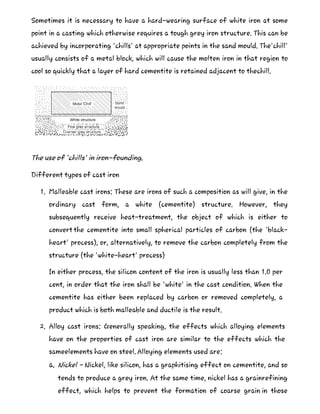

  • 87.
    The concept offibre-reinforced materials had its origin in nature in the structure of wood. In metallic structures the building unit is the crystal whilst a polymer is an agglomeration of large numbers of long thread-like molecules. A glass consists of a mass of fairly large silicate units which are too sluggish in their movements to be able to crystallise. The strength of a piece of timber is 'along the grain', i.e. in the same direction as the cellulose fibres, whilst 'across the grain' the timber is relatively weak and brittle. Thus wood is a very anisotropic material. Man-made fibre-reinforced composites In general, man-made fibre-reinforced composites include: • Matrix materials, such as thermosetting or thermoplastics polymers and some low-melting point metals, reinforced with fibres of carbon, glass or organic polymer. • Polymers, usually thermosetting, reinforced with fibres or laminates of woven textile materials. • Vehicle tyres in which vulcanised rubber is reinforced with woven textiles or steel wire. • Materials such as concrete reinforced with steel rods. When the reinforcing fibres are unidirectional, as are the fibres in a tree trunk, then maximum strength is also unidirectional. In successful composites, there must be adequate bonding between fibre and matrix and this bonding may be either physical or chemical. The main function of the matrix material is to hold the fibres in the correct position so that they carry the stress applied to the composite as well as to provide adequate rigidity. The fibres should be long enough so that the bonding force between the surface of the fibre and the surrounding matrix is greater than the force necessary to break the fibre in tension. Unidirectional composites 4.4. Compare the suitability of different fibres for composite material products. When comparing the suitability of aramid fiber (such as Kevlar) and carbon fiber for composite material products, several factors need to be considered:
  • 88.
    1. Strength andStiffness: • Carbon Fiber: Carbon fiber is renowned for its exceptional strength and stiffness-to-weight ratio. It offers high tensile strength and rigidity, making it suitable for applications requiring structural integrity and lightweight properties. • Aramid Fiber: Aramid fibers like Kevlar also exhibit high strength, particularly in tension, and have good resistance to abrasion. While not as stiff as carbon fiber, aramid fibers offer excellent impact resistance. 2. Weight: • Carbon Fiber: Carbon fiber is extremely lightweight, making it ideal for applications where weight reduction is critical, such as aerospace and automotive industries. • Aramid Fiber: Aramid fibers are also lightweight but are slightly denser compared to carbon fiber. However, they still offer significant weight savings over traditional materials like metals. 3. Durability: • Carbon Fiber: Carbon fiber composites are highly durable and resistant to fatigue, corrosion, and environmental degradation. They maintain their properties over a wide range of temperatures. • Aramid Fiber: Aramid fibers are known for their toughness and durability, especially in applications where impact resistance is crucial. However, they may degrade when exposed to prolonged UV radiation. 4. Cost: • Carbon Fiber: Carbon fiber tends to be more expensive than aramid fiber. The manufacturing process for carbon fiber is complex and costly, contributing to its higher price. • Aramid Fiber: Aramid fibers are generally more affordable compared to carbon fiber, making them an attractive option for applications where cost is a significant consideration. 5. Applications: • Carbon Fiber: Carbon fiber is commonly used in high-performance applications such as aerospace, automotive, sporting goods, and industrial equipment where strength, stiffness, and lightweight properties are paramount. • Aramid Fiber: Aramid fibers find applications in ballistic protection (e.g., bulletproof vests), aerospace (structural components), marine (boat hulls), and
  • 89.
    sports equipment whereimpact resistance and toughness are crucial. In summary, both aramid fiber (Kevlar) and carbon fiber have unique properties that make them suitable for various composite material products. Carbon fiber excels in strength, stiffness, and lightweight properties, while aramid fiber offers excellent impact resistance and toughness at a more affordable cost. The choice between the two depends on the specific requirements of the application, including performance, cost, and environmental factors.