TREATMENT
GUIDELINES
TUBERCULOSIS
Dr. Aswini Kumar Mohapatra
Professor and Head
Dept. of Pulmonary Medicine
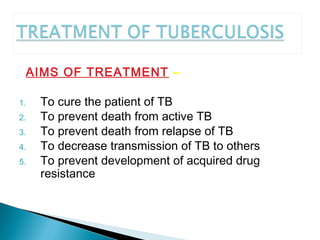
AIMS OF TREATMENT –
1. To cure the patient of TB
2. To prevent death from active TB
3. To prevent death from relapse of TB
4. To decrease transmission of TB to others
5. To prevent development of acquired drug
resistance
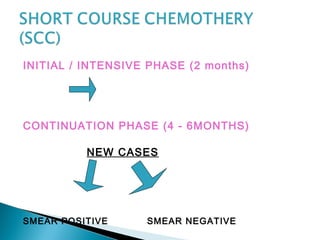
INITIAL / INTENSIVE PHASE (2 months)
CONTINUATION PHASE (4 - 6MONTHS)
NEW CASES
SMEAR POSITIVE SMEAR NEGATIVE
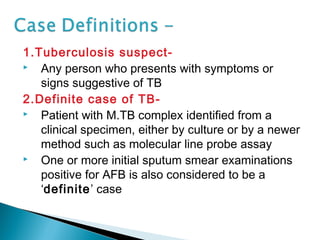
1.Tuberculosis suspect-
 Any person who presents with symptoms or
signs suggestive of TB
2.Definite case of TB-
 Patient with M.TB complex identified from a
clinical specimen, either by culture or by a newer
method such as molecular line probe assay
 One or more initial sputum smear examinations
positive for AFB is also considered to be a
‘definite’ case
3. Case of TB-
 A definite case of TB or one in which a health
worker has diagnosed TB and has decided to treat
the patient with a full course of TB treatment
 Cases of TB also classified according to the-
a. anatomical site of the disease
b. bacteriological results
c. history of previous treatment
d. HIV status of the patient
4. Smear negative PTB cases-
Smear negative PTB cases should either:
A. Sputum smear negative but culture positive for
M. tuberculosis
OR
B. meet the following diagnostic criteria :
 decision by a clinician to treat with a full course
of anti TB therapy; and
 radiographic abnormalities consistent with active
pulmonary TB and either:
-laboratory or strong clinical evidence of HIV
infection
or:
- if HIV negative and no improvement in response
to a course of broad spectrum antibiotics
A. FIRST LINE DRUGS:-
 Isoniazid (H)
 Rifampicin (R)
 Pyrazinamide (Z)
 Streptomycin (S)
 Ethambutol (E)
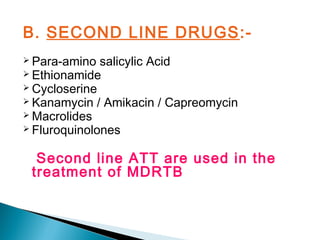
B. SECOND LINE DRUGS:-
 Para-amino salicylic Acid
 Ethionamide
 Cycloserine
 Kanamycin / Amikacin / Capreomycin
 Macrolides
 Fluroquinolones
Second line ATT are used in the
treatment of MDRTB
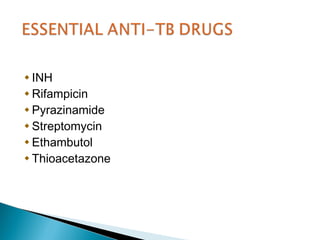
INH
Rifampicin
Pyrazinamide
Streptomycin
Ethambutol
Thioacetazone
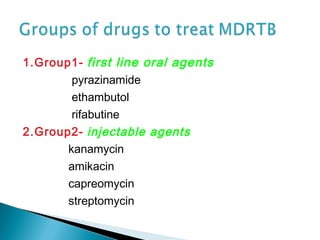
1.Group1- first line oral agents
pyrazinamide
ethambutol
rifabutine
2.Group2- injectable agents
kanamycin
amikacin
capreomycin
streptomycin
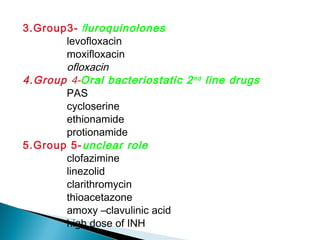
3.Group3- fluroquinolones
levofloxacin
moxifloxacin
ofloxacin
4.Group 4-Oral bacteriostatic 2nd
line drugs
PAS
cycloserine
ethionamide
protionamide
5.Group 5-unclear role
clofazimine
linezolid
clarithromycin
thioacetazone
amoxy –clavulinic acid
high dose of INH
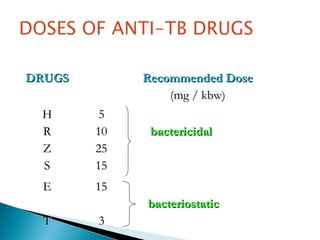
DRUGSDRUGS Recommended DoseRecommended Dose
(mg / kbw)(mg / kbw)
HH
RR
ZZ
SS
55
1010 bactericidalbactericidal
2525
1515
EE
TT
1515
bacteriostaticbacteriostatic
33
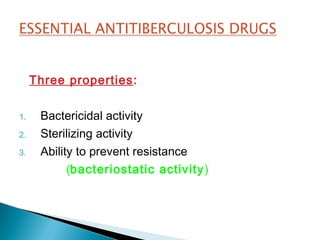
Three properties:
1. Bactericidal activity
2. Sterilizing activity
3. Ability to prevent resistance
(bacteriostatic activity)
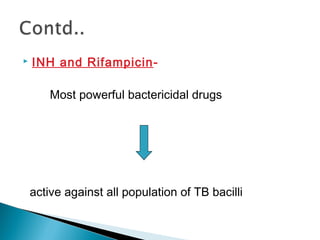
 INH and Rifampicin-
Most powerful bactericidal drugs
active against all population of TB bacilli
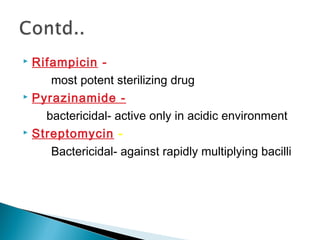
 Rifampicin -
most potent sterilizing drug
 Pyrazinamide -
bactericidal- active only in acidic environment
 Streptomycin -
Bactericidal- against rapidly multiplying bacilli
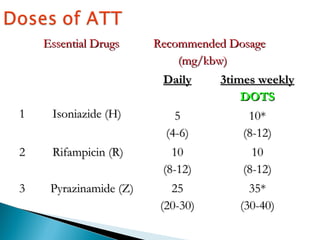
Essential DrugsEssential Drugs Recommended DosageRecommended Dosage
(mg/kbw)(mg/kbw)
11 Isoniazide (H)Isoniazide (H)
DailyDaily 3times weekly3times weekly
DOTSDOTS
55
(4-6)(4-6)
10*10*
(8-12)(8-12)
22 Rifampicin (R)Rifampicin (R) 1010
(8-12)(8-12)
1010
(8-12)(8-12)
33 Pyrazinamide (Z)Pyrazinamide (Z) 2525
(20-30)(20-30)
35*35*
(30-40)(30-40)
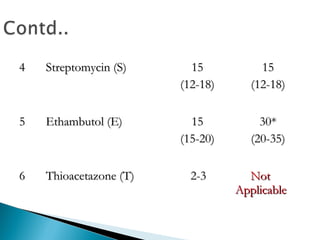
44 Streptomycin (S)Streptomycin (S) 1515
(12-18)(12-18)
1515
(12-18)(12-18)
55 Ethambutol (E)Ethambutol (E) 1515
(15-20)(15-20)
30*30*
(20-35)(20-35)
66 Thioacetazone (T)Thioacetazone (T) 2-32-3 NotNot
ApplicableApplicable
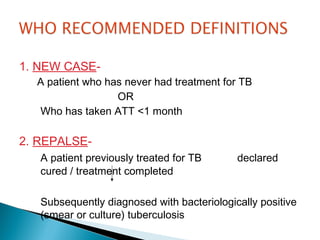
1. NEW CASE-
A patient who has never had treatment for TB
OR
Who has taken ATT <1 month
2. REPALSE-
A patient previously treated for TB declared
cured / treatment completed
Subsequently diagnosed with bacteriologically positive
(smear or culture) tuberculosis
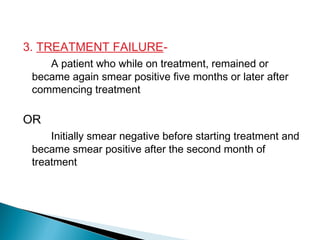
3. TREATMENT FAILURE-
A patient who while on treatment, remained or
became again smear positive five months or later after
commencing treatment
OR
Initially smear negative before starting treatment and
became smear positive after the second month of
treatment
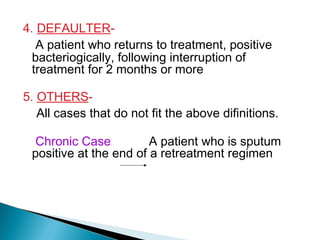
4. DEFAULTER-
A patient who returns to treatment, positive
bacteriogically, following interruption of
treatment for 2 months or more
5. OTHERS-
All cases that do not fit the above difinitions.
Chronic Case A patient who is sputum
positive at the end of a retreatment regimen
6. TRANSFER IN-
A patient who has been transferred from another
TB register to continue treatment
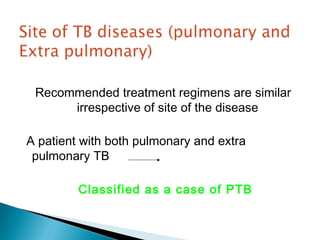
Recommended treatment regimens are similar
irrespective of site of the disease
A patient with both pulmonary and extra
pulmonary TB
Classified as a case of PTB
CAT- 1
CAT- 2
Chronic cases (CAT- 4)
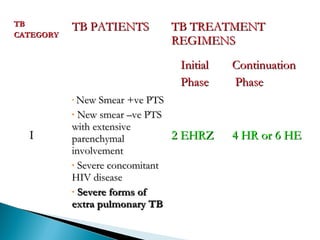
TBTB
CATEGORYCATEGORY
TB PATIENTSTB PATIENTS TB TREATMENTTB TREATMENT
REGIMENSREGIMENS
InitialInitial
PhasePhase
ContinuationContinuation
PhasePhase
II
• New Smear +ve PTSNew Smear +ve PTS
• New smear –ve PTSNew smear –ve PTS
with extensivewith extensive
parenchymalparenchymal
involvementinvolvement
• Severe concomitantSevere concomitant
HIV diseaseHIV disease
• Severe forms ofSevere forms of
extra pulmonary TBextra pulmonary TB
2 EHRZ2 EHRZ 4 HR or 6 HE4 HR or 6 HE
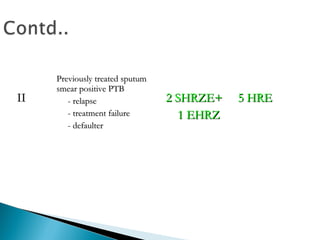
IIII
Previously treated sputumPreviously treated sputum
smear positive PTBsmear positive PTB
- relapse- relapse
- treatment failure- treatment failure
- defaulter- defaulter
2 SHRZE+2 SHRZE+
1 EHRZ1 EHRZ
5 HRE5 HRE
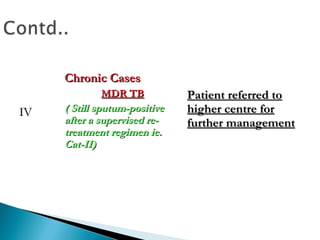
IVIV
Chronic CasesChronic Cases
MDR TBMDR TB
( Still sputum-positive( Still sputum-positive
after a supervised re-after a supervised re-
treatment regimen ie.treatment regimen ie.
Cat-II)Cat-II)
Patient referred toPatient referred to
higher centre forhigher centre for
further managementfurther management
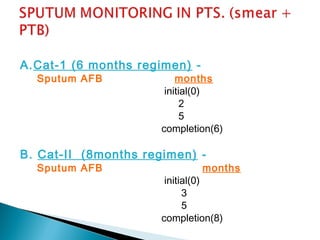
A.Cat-1 (6 months regimen) -
Sputum AFB months
initial(0)
2
5
completion(6)
B. Cat-II (8months regimen) -
Sputum AFB months
initial(0)
3
5
completion(8)
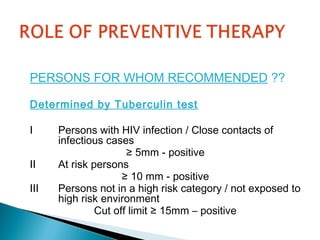
PERSONS FOR WHOM RECOMMENDED ??
Determined by Tuberculin test
I Persons with HIV infection / Close contacts of
infectious cases
≥ 5mm - positive
II At risk persons
≥ 10 mm - positive
III Persons not in a high risk category / not exposed to
high risk environment
Cut off limit ≥ 15mm – positive
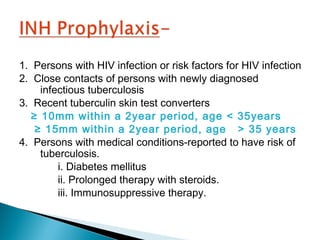
1. Persons with HIV infection or risk factors for HIV infection
2. Close contacts of persons with newly diagnosed
infectious tuberculosis
3. Recent tuberculin skin test converters
≥ 10mm within a 2year period, age < 35years
≥ 15mm within a 2year period, age > 35 years
4. Persons with medical conditions-reported to have risk of
tuberculosis.
i. Diabetes mellitus
ii. Prolonged therapy with steroids.
iii. Immunosuppressive therapy.
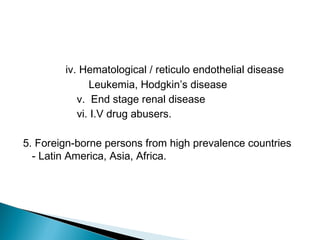
iv. Hematological / reticulo endothelial disease
Leukemia, Hodgkin’s disease
v. End stage renal disease
vi. I.V drug abusers.
5. Foreign-borne persons from high prevalence countries
- Latin America, Asia, Africa.
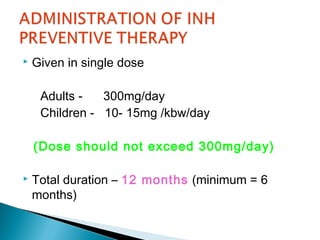
 Given in single dose
Adults - 300mg/day
Children - 10- 15mg /kbw/day
(Dose should not exceed 300mg/day)
 Total duration – 12 months (minimum = 6
months)

Tb treatment new

  • 1.
    TREATMENT GUIDELINES TUBERCULOSIS Dr. Aswini KumarMohapatra Professor and Head Dept. of Pulmonary Medicine
  • 2.
    AIMS OF TREATMENT– 1. To cure the patient of TB 2. To prevent death from active TB 3. To prevent death from relapse of TB 4. To decrease transmission of TB to others 5. To prevent development of acquired drug resistance
  • 3.
    INITIAL / INTENSIVEPHASE (2 months) CONTINUATION PHASE (4 - 6MONTHS) NEW CASES SMEAR POSITIVE SMEAR NEGATIVE
  • 4.
    1.Tuberculosis suspect-  Anyperson who presents with symptoms or signs suggestive of TB 2.Definite case of TB-  Patient with M.TB complex identified from a clinical specimen, either by culture or by a newer method such as molecular line probe assay  One or more initial sputum smear examinations positive for AFB is also considered to be a ‘definite’ case
  • 5.
    3. Case ofTB-  A definite case of TB or one in which a health worker has diagnosed TB and has decided to treat the patient with a full course of TB treatment  Cases of TB also classified according to the- a. anatomical site of the disease b. bacteriological results c. history of previous treatment d. HIV status of the patient
  • 6.
    4. Smear negativePTB cases- Smear negative PTB cases should either: A. Sputum smear negative but culture positive for M. tuberculosis OR B. meet the following diagnostic criteria :  decision by a clinician to treat with a full course of anti TB therapy; and
  • 7.
     radiographic abnormalitiesconsistent with active pulmonary TB and either: -laboratory or strong clinical evidence of HIV infection or: - if HIV negative and no improvement in response to a course of broad spectrum antibiotics
  • 8.
    A. FIRST LINEDRUGS:-  Isoniazid (H)  Rifampicin (R)  Pyrazinamide (Z)  Streptomycin (S)  Ethambutol (E)
  • 9.
    B. SECOND LINEDRUGS:-  Para-amino salicylic Acid  Ethionamide  Cycloserine  Kanamycin / Amikacin / Capreomycin  Macrolides  Fluroquinolones Second line ATT are used in the treatment of MDRTB
  • 10.
  • 11.
    1.Group1- first lineoral agents pyrazinamide ethambutol rifabutine 2.Group2- injectable agents kanamycin amikacin capreomycin streptomycin
  • 12.
    3.Group3- fluroquinolones levofloxacin moxifloxacin ofloxacin 4.Group 4-Oralbacteriostatic 2nd line drugs PAS cycloserine ethionamide protionamide 5.Group 5-unclear role clofazimine linezolid clarithromycin thioacetazone amoxy –clavulinic acid high dose of INH
  • 13.
    DRUGSDRUGS Recommended DoseRecommendedDose (mg / kbw)(mg / kbw) HH RR ZZ SS 55 1010 bactericidalbactericidal 2525 1515 EE TT 1515 bacteriostaticbacteriostatic 33
  • 14.
    Three properties: 1. Bactericidalactivity 2. Sterilizing activity 3. Ability to prevent resistance (bacteriostatic activity)
  • 15.
     INH andRifampicin- Most powerful bactericidal drugs active against all population of TB bacilli
  • 16.
     Rifampicin - mostpotent sterilizing drug  Pyrazinamide - bactericidal- active only in acidic environment  Streptomycin - Bactericidal- against rapidly multiplying bacilli
  • 17.
    Essential DrugsEssential DrugsRecommended DosageRecommended Dosage (mg/kbw)(mg/kbw) 11 Isoniazide (H)Isoniazide (H) DailyDaily 3times weekly3times weekly DOTSDOTS 55 (4-6)(4-6) 10*10* (8-12)(8-12) 22 Rifampicin (R)Rifampicin (R) 1010 (8-12)(8-12) 1010 (8-12)(8-12) 33 Pyrazinamide (Z)Pyrazinamide (Z) 2525 (20-30)(20-30) 35*35* (30-40)(30-40)
  • 18.
    44 Streptomycin (S)Streptomycin(S) 1515 (12-18)(12-18) 1515 (12-18)(12-18) 55 Ethambutol (E)Ethambutol (E) 1515 (15-20)(15-20) 30*30* (20-35)(20-35) 66 Thioacetazone (T)Thioacetazone (T) 2-32-3 NotNot ApplicableApplicable
  • 19.
    1. NEW CASE- Apatient who has never had treatment for TB OR Who has taken ATT <1 month 2. REPALSE- A patient previously treated for TB declared cured / treatment completed Subsequently diagnosed with bacteriologically positive (smear or culture) tuberculosis
  • 20.
    3. TREATMENT FAILURE- Apatient who while on treatment, remained or became again smear positive five months or later after commencing treatment OR Initially smear negative before starting treatment and became smear positive after the second month of treatment
  • 21.
    4. DEFAULTER- A patientwho returns to treatment, positive bacteriogically, following interruption of treatment for 2 months or more 5. OTHERS- All cases that do not fit the above difinitions. Chronic Case A patient who is sputum positive at the end of a retreatment regimen
  • 22.
    6. TRANSFER IN- Apatient who has been transferred from another TB register to continue treatment
  • 23.
    Recommended treatment regimensare similar irrespective of site of the disease A patient with both pulmonary and extra pulmonary TB Classified as a case of PTB
  • 24.
    CAT- 1 CAT- 2 Chroniccases (CAT- 4)
  • 25.
    TBTB CATEGORYCATEGORY TB PATIENTSTB PATIENTSTB TREATMENTTB TREATMENT REGIMENSREGIMENS InitialInitial PhasePhase ContinuationContinuation PhasePhase II • New Smear +ve PTSNew Smear +ve PTS • New smear –ve PTSNew smear –ve PTS with extensivewith extensive parenchymalparenchymal involvementinvolvement • Severe concomitantSevere concomitant HIV diseaseHIV disease • Severe forms ofSevere forms of extra pulmonary TBextra pulmonary TB 2 EHRZ2 EHRZ 4 HR or 6 HE4 HR or 6 HE
  • 26.
    IIII Previously treated sputumPreviouslytreated sputum smear positive PTBsmear positive PTB - relapse- relapse - treatment failure- treatment failure - defaulter- defaulter 2 SHRZE+2 SHRZE+ 1 EHRZ1 EHRZ 5 HRE5 HRE
  • 27.
    IVIV Chronic CasesChronic Cases MDRTBMDR TB ( Still sputum-positive( Still sputum-positive after a supervised re-after a supervised re- treatment regimen ie.treatment regimen ie. Cat-II)Cat-II) Patient referred toPatient referred to higher centre forhigher centre for further managementfurther management
  • 28.
    A.Cat-1 (6 monthsregimen) - Sputum AFB months initial(0) 2 5 completion(6) B. Cat-II (8months regimen) - Sputum AFB months initial(0) 3 5 completion(8)
  • 29.
    PERSONS FOR WHOMRECOMMENDED ?? Determined by Tuberculin test I Persons with HIV infection / Close contacts of infectious cases ≥ 5mm - positive II At risk persons ≥ 10 mm - positive III Persons not in a high risk category / not exposed to high risk environment Cut off limit ≥ 15mm – positive
  • 30.
    1. Persons withHIV infection or risk factors for HIV infection 2. Close contacts of persons with newly diagnosed infectious tuberculosis 3. Recent tuberculin skin test converters ≥ 10mm within a 2year period, age < 35years ≥ 15mm within a 2year period, age > 35 years 4. Persons with medical conditions-reported to have risk of tuberculosis. i. Diabetes mellitus ii. Prolonged therapy with steroids. iii. Immunosuppressive therapy.
  • 31.
    iv. Hematological /reticulo endothelial disease Leukemia, Hodgkin’s disease v. End stage renal disease vi. I.V drug abusers. 5. Foreign-borne persons from high prevalence countries - Latin America, Asia, Africa.
  • 32.
     Given insingle dose Adults - 300mg/day Children - 10- 15mg /kbw/day (Dose should not exceed 300mg/day)  Total duration – 12 months (minimum = 6 months)