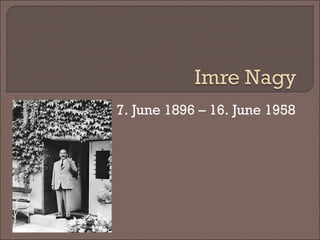
7. June 1896 – 16. June 1958
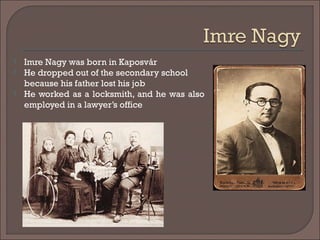
 Imre Nagy was born in Kaposvár
 He dropped out of the secondary school
because his father lost his job
 He worked as a locksmith, and he was also
employed in a lawyer’s office
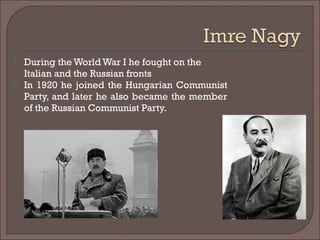
 During the World War I he fought on the
Italian and the Russian fronts
 In 1920 he joined the Hungarian Communist
Party, and later he also became the member
of the Russian Communist Party.
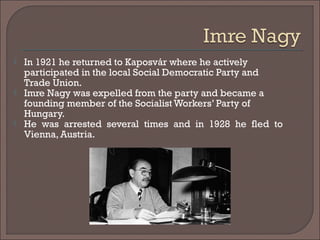
 In 1921 he returned to Kaposvár where he actively
participated in the local Social Democratic Party and
Trade Union.
 Imre Nagy was expelled from the party and became a
founding member of the Socialist Workers’ Party of
Hungary.
 He was arrested several times and in 1928 he fled to
Vienna, Austria.
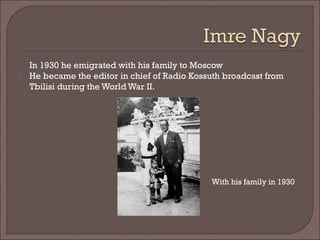
 In 1930 he emigrated with his family to Moscow
 He became the editor in chief of Radio Kossuth broadcast from
Tbilisi during the World War II.
With his family in 1930
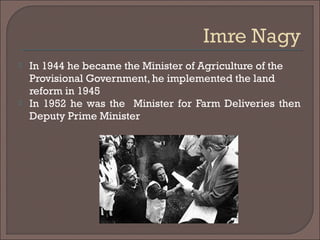
 In 1944 he became the Minister of Agriculture of the
Provisional Government, he implemented the land
reform in 1945
 In 1952 he was the Minister for Farm Deliveries then
Deputy Prime Minister
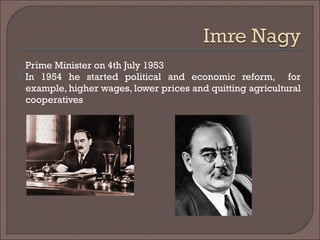
 Prime Minister on 4th July 1953
 In 1954 he started political and economic reform, for
example, higher wages, lower prices and quitting agricultural
cooperatives
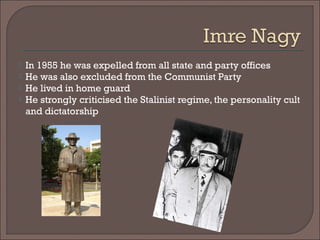
 In 1955 he was expelled from all state and party offices
 He was also excluded from the Communist Party
 He lived in home guard
 He strongly criticised the Stalinist regime, the personality cult
and dictatorship
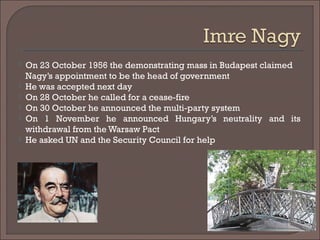
 On 23 October 1956 the demonstrating mass in Budapest claimed
Nagy’s appointment to be the head of government
 He was accepted next day
 On 28 October he called for a cease-fire
 On 30 October he announced the multi-party system
 On 1 November he announced Hungary’s neutrality and its
withdrawal from the Warsaw Pact
 He asked UN and the Security Council for help
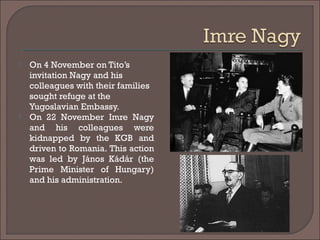
 On 4 November on Tito’s
invitation Nagy and his
colleagues with their families
sought refuge at the
Yugoslavian Embassy. 
 On 22 November Imre Nagy
and his colleagues were
kidnapped by the KGB and
driven to Romania. This action
was led by János Kádár (the
Prime Minister of Hungary)
and his administration.
 In April 1957 Imre Nagy and
his colleagues were arrested
and transported to a jail in
Budapest
 Their families remained in
Romania as hostages
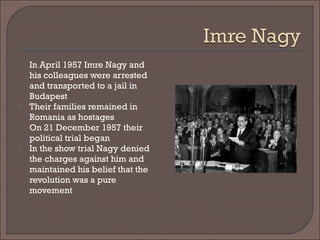
 On 21 December 1957 their
political trial began
 In the show trial Nagy denied
the charges against him and
maintained his belief that the
revolution was a pure
movement
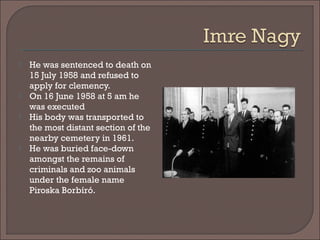
 He was sentenced to death on
15 July 1958 and refused to
apply for clemency.
 On 16 June 1958 at 5 am he
was executed
 His body was transported to
the most distant section of the
nearby cemetery in 1961. 
 He was buried face-down
amongst the remains of
criminals and zoo animals
under the female name
Piroska Borbíró. 
 In 1989 he and other martyrs
were exhumed, and a funeral
ceremony was held on the
Heroes’ Square in Budapest on
16 June
 The Supreme Court declared
him innocent, and in 1996 the
Parliament passed a law to
eternally engrave Imre Nagy’s
name on the nation’s mind.
 Imre Nagy remained faithful to
his beliefs and to the country
and the revolution until his
death.
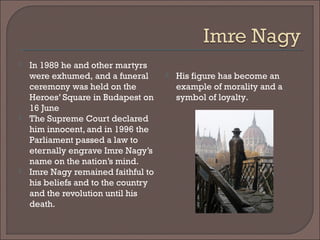
 His figure has become an
example of morality and a
symbol of loyalty.

Imre Nagy

  • 1.
    7. June 1896– 16. June 1958
  • 2.
     Imre Nagywas born in Kaposvár  He dropped out of the secondary school because his father lost his job  He worked as a locksmith, and he was also employed in a lawyer’s office
  • 3.
     During theWorld War I he fought on the Italian and the Russian fronts  In 1920 he joined the Hungarian Communist Party, and later he also became the member of the Russian Communist Party.
  • 4.
     In 1921he returned to Kaposvár where he actively participated in the local Social Democratic Party and Trade Union.  Imre Nagy was expelled from the party and became a founding member of the Socialist Workers’ Party of Hungary.  He was arrested several times and in 1928 he fled to Vienna, Austria.
  • 5.
     In 1930he emigrated with his family to Moscow  He became the editor in chief of Radio Kossuth broadcast from Tbilisi during the World War II. With his family in 1930
  • 6.
     In 1944he became the Minister of Agriculture of the Provisional Government, he implemented the land reform in 1945  In 1952 he was the Minister for Farm Deliveries then Deputy Prime Minister
  • 7.
     Prime Ministeron 4th July 1953  In 1954 he started political and economic reform, for example, higher wages, lower prices and quitting agricultural cooperatives
  • 8.
     In 1955he was expelled from all state and party offices  He was also excluded from the Communist Party  He lived in home guard  He strongly criticised the Stalinist regime, the personality cult and dictatorship
  • 9.
     On 23October 1956 the demonstrating mass in Budapest claimed Nagy’s appointment to be the head of government  He was accepted next day  On 28 October he called for a cease-fire  On 30 October he announced the multi-party system  On 1 November he announced Hungary’s neutrality and its withdrawal from the Warsaw Pact  He asked UN and the Security Council for help
  • 10.
     On 4November on Tito’s invitation Nagy and his colleagues with their families sought refuge at the Yugoslavian Embassy.   On 22 November Imre Nagy and his colleagues were kidnapped by the KGB and driven to Romania. This action was led by János Kádár (the Prime Minister of Hungary) and his administration.
  • 11.
     In April1957 Imre Nagy and his colleagues were arrested and transported to a jail in Budapest  Their families remained in Romania as hostages  On 21 December 1957 their political trial began  In the show trial Nagy denied the charges against him and maintained his belief that the revolution was a pure movement
  • 12.
     He wassentenced to death on 15 July 1958 and refused to apply for clemency.  On 16 June 1958 at 5 am he was executed  His body was transported to the most distant section of the nearby cemetery in 1961.   He was buried face-down amongst the remains of criminals and zoo animals under the female name Piroska Borbíró. 
  • 13.
     In 1989he and other martyrs were exhumed, and a funeral ceremony was held on the Heroes’ Square in Budapest on 16 June  The Supreme Court declared him innocent, and in 1996 the Parliament passed a law to eternally engrave Imre Nagy’s name on the nation’s mind.  Imre Nagy remained faithful to his beliefs and to the country and the revolution until his death.  His figure has become an example of morality and a symbol of loyalty.