The Khrushchev Era
De-Stalinization
• at the Twentieth Communist Party Congress in
1956, Khrushchev announced a new direction
for the USSR:
• he denounced Stalin's iron-fisted, repressive
methods
• he reiterated Lenin's contention that there are
“many roads to socialism” – unlike Stalin,
Khrushchev would permit some political
diversity in the USSR
• he announced his intention to support
developing countries as a way to peacefully
promote the growth of socialism
• 3rd world competition!
The Warsaw Pact
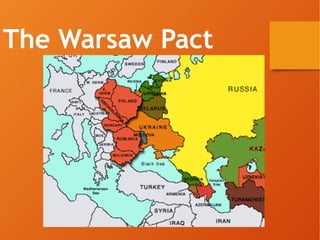
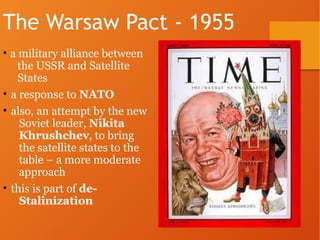
The Warsaw Pact - 1955
• a military alliance between
the USSR and Satellite
States
• a response to NATO
• also, an attempt by the new
Soviet leader, Nikita
Khrushchev, to bring
the satellite states to the
table – a more moderate
approach
• this is part of de-
Stalinization
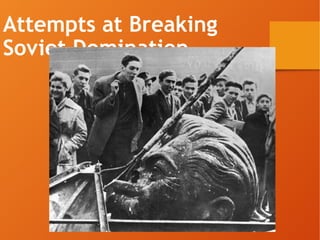
Attempts at Breaking
Soviet Domination
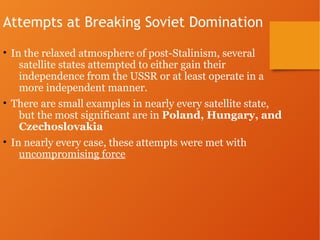
Attempts at Breaking Soviet Domination
• In the relaxed atmosphere of post-Stalinism, several
satellite states attempted to either gain their
independence from the USSR or at least operate in a
more independent manner.
• There are small examples in nearly every satellite state,
but the most significant are in Poland, Hungary, and
Czechoslovakia
• In nearly every case, these attempts were met with
uncompromising force
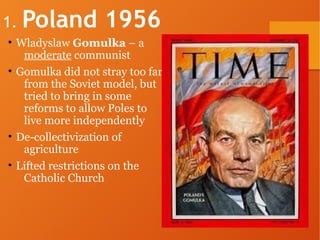
1. Poland 1956
• Wladyslaw Gomulka – a
moderate communist
• Gomulka did not stray too far
from the Soviet model, but
tried to bring in some
reforms to allow Poles to
live more independently
• De-collectivization of
agriculture
• Lifted restrictions on the
Catholic Church
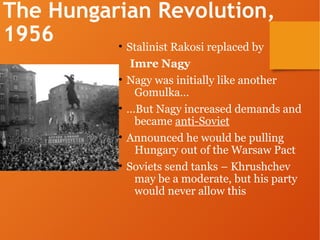
The Hungarian Revolution,
1956 • Stalinist Rakosi replaced by
Imre Nagy
• Nagy was initially like another
Gomulka…
• …But Nagy increased demands and
became anti-Soviet
• Announced he would be pulling
Hungary out of the Warsaw Pact
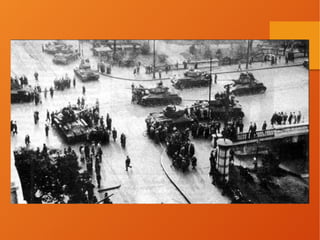
• Soviets send tanks – Khrushchev
may be a moderate, but his party
would never allow this
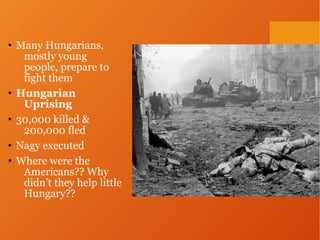
• Many Hungarians,
mostly young
people, prepare to
fight them
• Hungarian
Uprising
• 30,000 killed &
200,000 fled
• Nagy executed
• Where were the
Americans?? Why
didn’t they help little
Hungary??
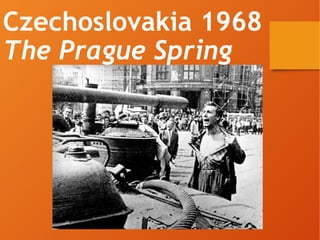
Czechoslovakia 1968
The Prague Spring
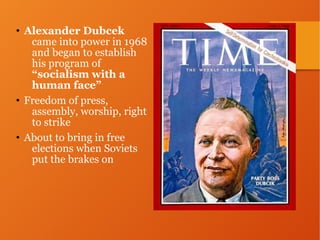
• Alexander Dubcek
came into power in 1968
and began to establish
his program of
“socialism with a
human face”
• Freedom of press,
assembly, worship, right
to strike
• About to bring in free
elections when Soviets
put the brakes on
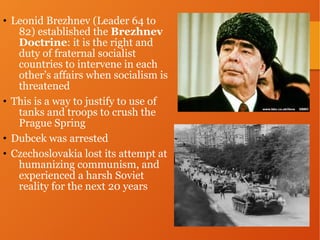
• Leonid Brezhnev (Leader 64 to
82) established the Brezhnev
Doctrine: it is the right and
duty of fraternal socialist
countries to intervene in each
other’s affairs when socialism is
threatened
• This is a way to justify to use of
tanks and troops to crush the
Prague Spring
• Dubcek was arrested
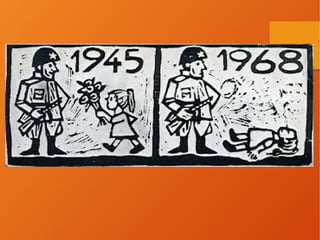
• Czechoslovakia lost its attempt at
humanizing communism, and
experienced a harsh Soviet
reality for the next 20 years
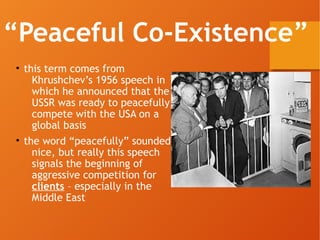
“Peaceful Co-Existence”
• this term comes from
Khrushchev’s 1956 speech in
which he announced that the
USSR was ready to peacefully
compete with the USA on a
global basis
• the word “peacefully” sounded
nice, but really this speech
signals the beginning of
aggressive competition for
clients – especially in the
Middle East
The New Berlin Crisis –
1959-60
• In 1959 Khrushchev proposed to the USA to make
Berlin a free city
• he suggested both Soviet and American troops
withdraw
• Americans suspected this was a ruse to initiate a
Soviet takeover of the entire city
• They were probably right
Summit Conference 1960
• talks broke down when Khrushchev walked out
• he was mad that the USA would not apologize for the
U2 incident
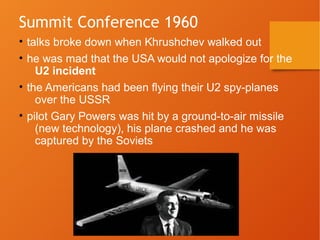
• the Americans had been flying their U2 spy-planes
over the USSR
• pilot Gary Powers was hit by a ground-to-air missile
(new technology), his plane crashed and he was
captured by the Soviets
The Berlin Wall
• in 1961 Khrushchev again pressured the Americans to
abandon Berlin
• The Soviets were embarrassed about the large number of
East Germans leaving to West Germany through Berlin
and its corridors to West Germany
• Most of these were skilled workers – the brain drain
• Kennedy increased American strength in Berlin
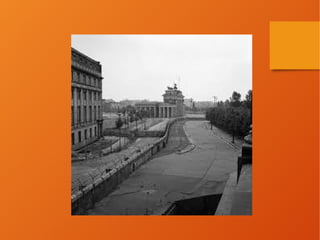
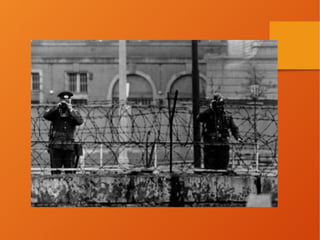
• Khrushchev answered back by building the Berlin Wall to
prevent this movement
• It began, simply, as a fence
• But became a concrete structure with armed “shoot to kill”
guards
• the wall became the central symbol of the Cold War
The khrushchev era
The khrushchev era

The khrushchev era

  • 1.
  • 2.
    De-Stalinization • at theTwentieth Communist Party Congress in 1956, Khrushchev announced a new direction for the USSR: • he denounced Stalin's iron-fisted, repressive methods • he reiterated Lenin's contention that there are “many roads to socialism” – unlike Stalin, Khrushchev would permit some political diversity in the USSR • he announced his intention to support developing countries as a way to peacefully promote the growth of socialism • 3rd world competition!
  • 3.
  • 4.
    The Warsaw Pact- 1955 • a military alliance between the USSR and Satellite States • a response to NATO • also, an attempt by the new Soviet leader, Nikita Khrushchev, to bring the satellite states to the table – a more moderate approach • this is part of de- Stalinization
  • 5.
  • 6.
    Attempts at BreakingSoviet Domination • In the relaxed atmosphere of post-Stalinism, several satellite states attempted to either gain their independence from the USSR or at least operate in a more independent manner. • There are small examples in nearly every satellite state, but the most significant are in Poland, Hungary, and Czechoslovakia • In nearly every case, these attempts were met with uncompromising force
  • 8.
    1. Poland 1956 •Wladyslaw Gomulka – a moderate communist • Gomulka did not stray too far from the Soviet model, but tried to bring in some reforms to allow Poles to live more independently • De-collectivization of agriculture • Lifted restrictions on the Catholic Church
  • 9.
    The Hungarian Revolution, 1956• Stalinist Rakosi replaced by Imre Nagy • Nagy was initially like another Gomulka… • …But Nagy increased demands and became anti-Soviet • Announced he would be pulling Hungary out of the Warsaw Pact • Soviets send tanks – Khrushchev may be a moderate, but his party would never allow this
  • 11.
    • Many Hungarians, mostlyyoung people, prepare to fight them • Hungarian Uprising • 30,000 killed & 200,000 fled • Nagy executed • Where were the Americans?? Why didn’t they help little Hungary??
  • 12.
  • 13.
    • Alexander Dubcek cameinto power in 1968 and began to establish his program of “socialism with a human face” • Freedom of press, assembly, worship, right to strike • About to bring in free elections when Soviets put the brakes on
  • 14.
    • Leonid Brezhnev(Leader 64 to 82) established the Brezhnev Doctrine: it is the right and duty of fraternal socialist countries to intervene in each other’s affairs when socialism is threatened • This is a way to justify to use of tanks and troops to crush the Prague Spring • Dubcek was arrested • Czechoslovakia lost its attempt at humanizing communism, and experienced a harsh Soviet reality for the next 20 years
  • 16.
    “Peaceful Co-Existence” • thisterm comes from Khrushchev’s 1956 speech in which he announced that the USSR was ready to peacefully compete with the USA on a global basis • the word “peacefully” sounded nice, but really this speech signals the beginning of aggressive competition for clients – especially in the Middle East
  • 17.
    The New BerlinCrisis – 1959-60 • In 1959 Khrushchev proposed to the USA to make Berlin a free city • he suggested both Soviet and American troops withdraw • Americans suspected this was a ruse to initiate a Soviet takeover of the entire city • They were probably right
  • 18.
    Summit Conference 1960 •talks broke down when Khrushchev walked out • he was mad that the USA would not apologize for the U2 incident • the Americans had been flying their U2 spy-planes over the USSR • pilot Gary Powers was hit by a ground-to-air missile (new technology), his plane crashed and he was captured by the Soviets
  • 19.
    The Berlin Wall •in 1961 Khrushchev again pressured the Americans to abandon Berlin • The Soviets were embarrassed about the large number of East Germans leaving to West Germany through Berlin and its corridors to West Germany • Most of these were skilled workers – the brain drain • Kennedy increased American strength in Berlin • Khrushchev answered back by building the Berlin Wall to prevent this movement • It began, simply, as a fence • But became a concrete structure with armed “shoot to kill” guards • the wall became the central symbol of the Cold War