Paris Peace
Settlement
1919

Sunday, 2 February 14
Syllabus

• the roles and differing goals of

Clemenceau, Lloyd George and
Wilson in creating the Treaty of
Versailles

Sunday, 2 February 14
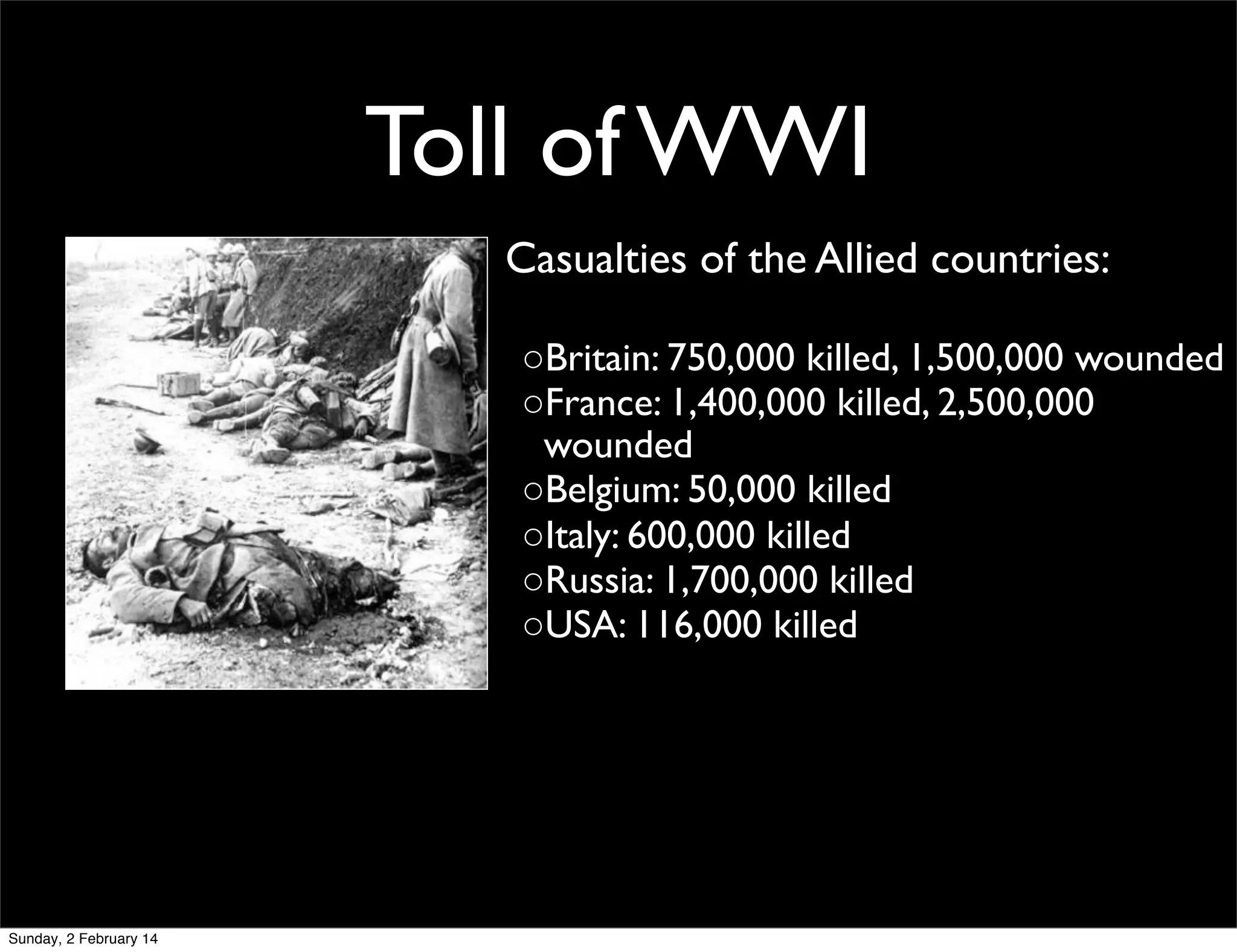
Toll of WWI
• “Total war”
• 65 million mobilised.
• Historians estimate that
up to 10 million men
died and around 21
million were wounded.

Sunday, 2 February 14
Toll of WWI

Sunday, 2 February 14
Toll of WWI
Casualties of the Allied countries:

Sunday, 2 February 14
Toll of WWI
Casualties of the Allied countries:
◦Britain: 750,000 killed, 1,500,000 wounded
◦France: 1,400,000 killed, 2,500,000
wounded
◦Belgium: 50,000 killed
◦Italy: 600,000 killed
◦Russia: 1,700,000 killed
◦USA: 116,000 killed

Sunday, 2 February 14
Toll of WWI
Casualties of the Central Powers

• Germany: 2,000,000 killed
• Austria-Hungary: 1,200,000
killed
• Turkey: 325,000 killed
• Bulgaria: 100,000 killed

Sunday, 2 February 14
Vast areas of north-eastern Europe were destroyed
• The homes of 750,000 French people were destroyed
along with infrastructure
• Roads, coal mines, telegraph poles had all been destroyed,
which hindered economic restoration
•

Sunday, 2 February 14
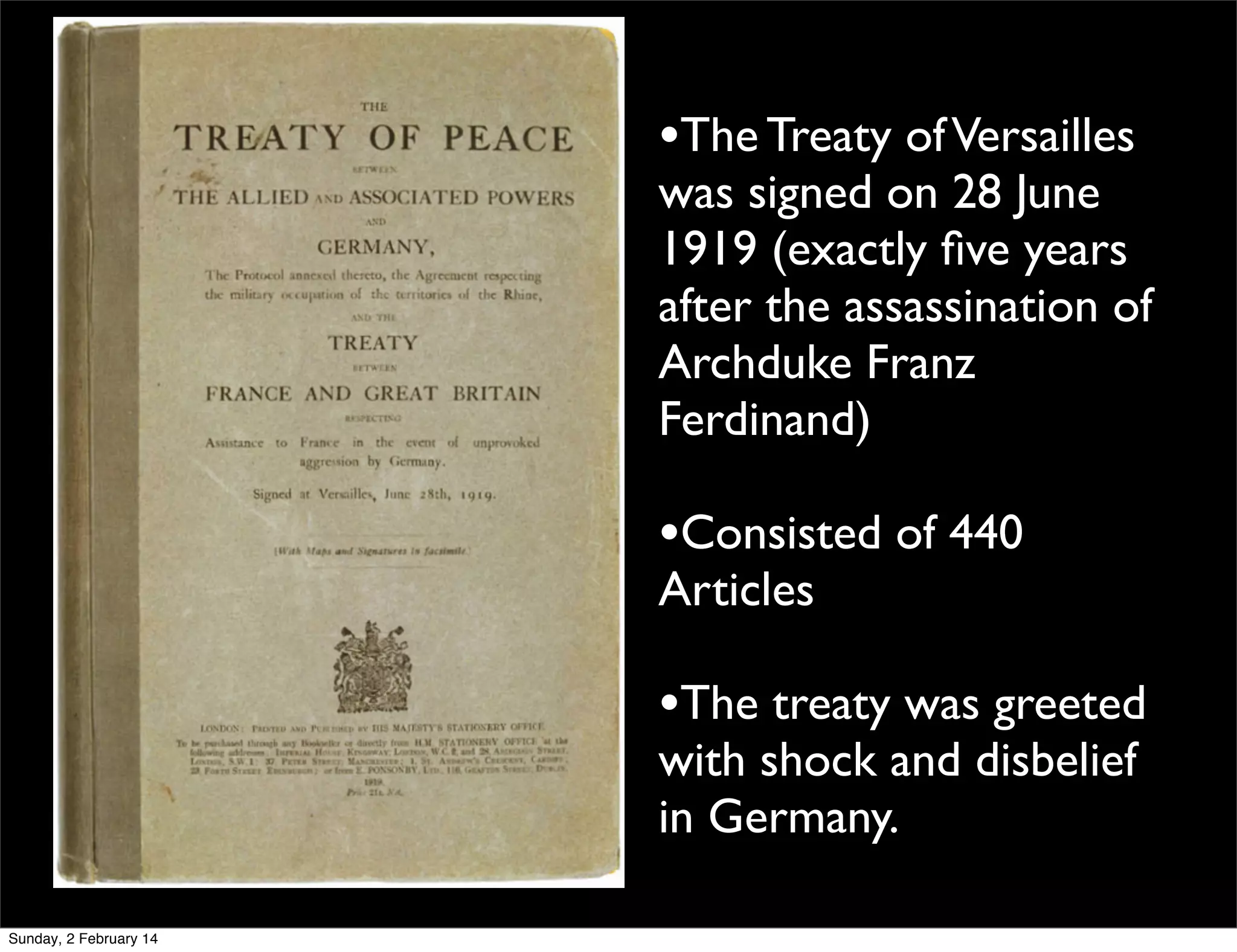
•The Treaty of Versailles

was signed on 28 June
1919 (exactly five years
after the assassination of
Archduke Franz
Ferdinand)

•Consisted of 440
Articles

•The treaty was greeted
with shock and disbelief
in Germany.
Sunday, 2 February 14
Versailles Conference
• Delegates from 32 countries

were invited to participate in
talks held at the Palace of
Versailles

• The conference was controlled
Allied delegates in the Hall of Mirrors at Versailles witness
the German delegation's acceptance of the terms of the
Treaty Of Versailles

Sunday, 2 February 14

by the “Big Three” and took
months of, often bitter,
negotiations
The “Big Three”

George	
  Clemenceau,	
  
France

-­‐	
  France	
  had	
  been	
  devastated	
  
and	
  2/3	
  soldiers	
  had	
  been	
  
injured	
  or	
  Killed
-­‐	
  Germany	
  should	
  be	
  harshly	
  
punished	
  and	
  pay	
  for	
  the	
  war

Sunday, 2 February 14

Woodrow	
  Wilson,	
  
USA

-­‐	
  	
  Believed	
  in	
  peaceful	
  
coopera?on	
  among	
  na?ons	
  
and	
  the	
  right	
  to	
  self-­‐
determina?on

David	
  Lloyd	
  George,	
  
Great	
  Britain

-­‐	
  Was	
  usually	
  in	
  the	
  middle	
  
ground	
  between	
  Clemenceau	
  
and	
  Wilson
-­‐	
  Germany	
  should	
  be	
  punished	
  
but	
  not	
  harshly	
  to	
  prevent	
  a	
  
new	
  war
The Tiger
•

Georges Clemenceau of France argued that
Germany should be split up and weakened to
the point that it could never start a war again.

•

Clemenceau insisted upon the complete humiliation
of Germany, requiring German disarmament and
severe reparations; France also won back AlsaceLorraine. He was unhappy with the final treaty and
believed it was not harsh enough

•

He believed that Woodrow Wilson was too idealistic

Sunday, 2 February 14

!
The Peacemaker
US President Woodrow Wilson (14 Points) he wanted a “just peace” that would ensure
war could not ever occur on this scale again
1) no more secret treaties
2) countries must seek to reduce their weapons and their armed
forces
3) national self-determination should allow people of the same
nationality to govern themselves and one nationality should not have
the power to govern another
4) all countries should belong to the League of Nations.
However, Wilson’s desire for the US to take a leading role
internationally was unpopular at home as most politicians supported
an isolationist position - US never ratified the treaty
Sunday, 2 February 14
The middle man
British PM, David Lloyd George, had two views
on how Germany should be treated.
His government was facing elections and Lloyd
George's public image reflected the punitive public
mood. "Hang the Kaiser" and "Make Germany Pay"
were common slogans and Lloyd George publicly
backed these views.
However, privately he was concerned about what the
effects of a harsh treaty would be. In the context of the
1917 Russian revolution, he feared the spread of
Bolshevism in Germany.

Sunday, 2 February 14
Germany is going to pay. We will get
everything you can squeeze out of a lemon,
and a bit more. The Germans should hand
over everything they own.
From a speech in 1918 by Sir Eric
Geddes, a British politician standing
for election as an MP.

Sunday, 2 February 14
ToV
• June 1919
• Treaty with Germany
• Was signed in the Palace of Versailles
• Germany not allowed to take part in negotiations presented with terms - became known as the
diktat or dictated peace
• Germany had to agree to accept full responsibility
for the outbreak of the First World War (the hated
Clause 231 or the “War Guilt Clause”)
Sunday, 2 February 14
Territorial Losses
•
•
•
•
•
•
•
•

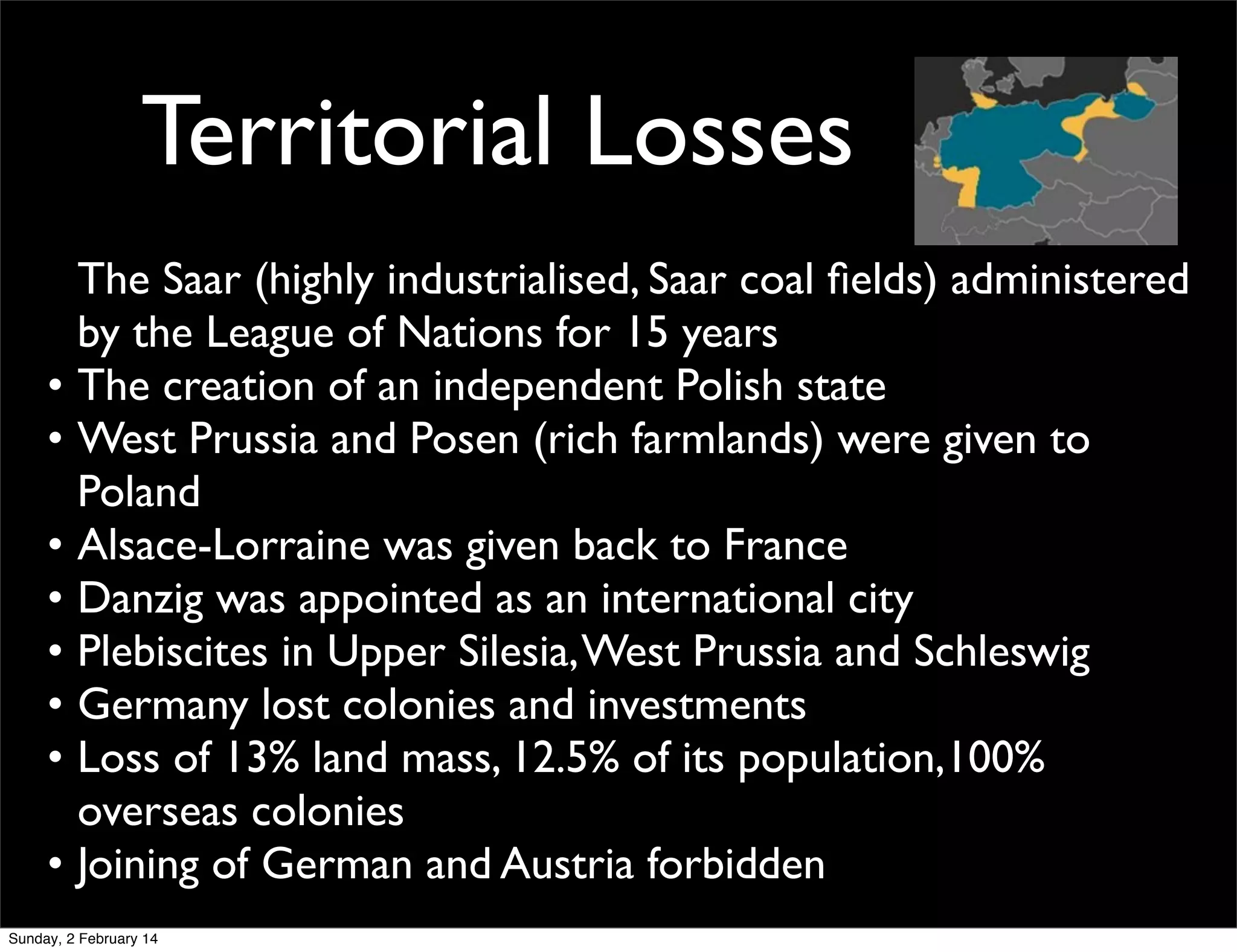
The Saar (highly industrialised, Saar coal fields) administered
by the League of Nations for 15 years
The creation of an independent Polish state
West Prussia and Posen (rich farmlands) were given to
Poland
Alsace-Lorraine was given back to France
Danzig was appointed as an international city
Plebiscites in Upper Silesia, West Prussia and Schleswig
Germany lost colonies and investments 
Loss of 13% land mass, 12.5% of its population,100%
overseas colonies
Joining of German and Austria forbidden

Sunday, 2 February 14
Territorial Losses

Sunday, 2 February 14
New map of Europe

Sunday, 2 February 14
Military
• Regular army limited to 100,000 military
personnel 
• No tanks or heavy artillery
• No airforce
• Navy restricted to six battleships, no
submarines (15,000 sailors)
• End of compulsory enlistment into the armed
forces
• Rhineland to be occupied for 15 years by the
allied military forces
Sunday, 2 February 14
Economic
•
•
•
•
•

Germany to pay £6,600 million (132 billion gold marks)
Reparations where to be paid in regular instalments,
some in gold and some in goods
The Allies struggled to get payments from Germany
from 1921 to 1923
Dawes Commission 1924
France occupied the Ruhr in 1923
Germany completed the reparations payments in 2010,
(£60 million)
60million

Sunday, 2 February 14
Political
• WWI ended the House of Hohenzollern with the
forced abdication of Kaiser Wilhelm II

• Economic burden of the treaty affected the new
government, led by the Social Democrats (SPD)

• Gave rise to the Dolchstosslegende (stab in the
back theory)

• The politicians who signed the treaty became
known as the “November Criminals”

Sunday, 2 February 14
A 1924 right-wing German political cartoon showing Philipp Scheidemann, the German
Social Democratic politician who proclaimed the Weimar Republic and was its second
Chancellor, and Matthias Erzberger, an anti-war politician from the Centre Party, who
ended WWI by signing the armistice with the Allies, as stabbing the German Army in the back
Sunday, 2 February 14
•

Controversial German historian Fritz Fischer wrote of the stab in
the back:

But even after the defeat of 1918, many Germans, and especially those who had
played leading parts in political and economic life up to 1918, preserved...a political
and historical image of themselves which was coloured by illusions. Because the
German army on the western front had held to the last hour an unbroken defensive
front outside the frontiers of the Reich, and had marched home in order, these
people failed to understand that Germany had been defeated.Thus the idea took
root and spread that the cause of the collapse of Germany was not her own policy
or exhaustion in the face of an enemy army made stronger than her own by active
American intervention, but a 'stab in the back' behind the front.The accusation was
[eventually] levelled . . . against the Weimar democracy which had been forced to
accept the 'dictated Treaty of Versailles' owing to 'treachery at home'.This view . . .
had been propagated by the German Army Council and the press...since November,
1918.TheEvangelische Kirchenzeitung, for example, wrote on October 20 -­ before
the November revolution: 'Collapse behind the front ­ not collapse of our heroic
front, that is the shattering phenomenon of these last days . . . .The home has not
held out.'
Sunday, 2 February 14
German Response
•

Germany had hoped for a treaty more in line with Wilson's
Fourteen Points
• Hated having to take responsibility for the start of the First
World War
• Resented that it was forced to sign the treaty without any
negotiations of the terms
• Disagreed with the reparations and especially the territorial
losses
• Angered by the exclusion from the principle of selfdetermination
• The German population was angered by the treaty and wanted
to see it revoked - Hitler used this to great effect
Sunday, 2 February 14
German magazine Simpliccimus on June 3, 1919.
The principal judges and executioners were (from left to right) the American
president Wilson, the French president Clemenceau and the British Prime Minister
Lloyd George

Sunday, 2 February 14
Historiography
Historian (British-Canadian) Martin Kitchen
argues that the impression the country was
crippled by the reparations was a myth. He
further states that, instead of a weak Germany,
the reverse was true; that Germany was strong
enough to win substantial concessions and a
reduced reparation amount.

Sunday, 2 February 14
A.J.P. Taylor, in The History of the First World
War, 1963:
Though the Germans accepted the treaty in the formal sense
of agreeing to sign it, none took the signature seriously. The
treaty seemed to them to be wicked, unfair, dictation, a slave
treaty. All Germans intended to repudiate it at some time in
the future, if it did not fall to pieces of its own absurdity.

Sunday, 2 February 14
Douglas Newton, in Germany 1914-1945, 1990:
Whether Germany was treated justly or unjustly by the
victors at the Peace Conference is not a question of fact
but of moral judgment. Some argue that, if the Versailles
Treaty was harsh, so too would have been any framed by a
victorious Germany, as in the case of Brest-Litovsk. Others
argue that any peace which fell short of the ideals of
reconciliation was unjust because of the high ideals for
which Allied statesmen had claimed to be fighting . . . What
is beyond question is that the process of peacemaking or
rather the absence of any genuine peace negotiations . . .
made all of Germany believe that the [Weimar] Republic
had been treated shabbily.
Sunday, 2 February 14
German historian Detlev Peukert
Opinions range from the traditional verdict that the national
budget and economy were intolerably squeezed to the opposite
view that the burden was scarcely larger than present-day aid to
developing countries. For once, the truth really seems to lie
somewhere between these positions. It is certainly true that the
flexibility of the German economy, already constrained by the low
post-war level of economic activity in any case, was further
restricted by the need to pay reparations. On the other hand, the
actual payments that had to made were perfectly manageable.
Reparations were not, therefore, an utterly intolerable burden,
especially since any clear-sighted politician could reckon that after
a few years of uninterrupted payment and reduced international
tension there was a reasonable chance that the overall size of the
debt would be cut down
Peukert argued that the reasons for German economic problems in the
early 1920s were not reparations, but rather the legacy of World War I
Sunday, 2 February 14
“The British economic historian Niall Ferguson in
his 1998 book The Pity of War argued that Germany
could have paid reparations had there been the
political will. Ferguson began his argument by noting
that all of the belligerent countries in World War I
had endured significant economic losses, not just
Germany, and that in 1920–21, German net national
product grew at 17%.”

Sunday, 2 February 14
Sources
http://net.lib.byu.edu/~rdh7//wwi/versailles.html
http://www.historylearningsite.co.uk/
treaty_of_versailles.htm
http://www.firstworldwar.com/bio/
clemenceau.htm
http://www.ushmm.org/outreach/en/
media_nm.php?MediaId=1620
http://ibguides.com/history/notes/terms-of-theparis-peace-treaties-1919-20-versailles-stgermain-trianon-neuilly-sevres-lausanne-1923
Sunday, 2 February 14

World War One: Paris Peace Settlement, Treaty of Versailles, 1919

  • 1.
  • 2.
    Syllabus • the rolesand differing goals of Clemenceau, Lloyd George and Wilson in creating the Treaty of Versailles Sunday, 2 February 14
  • 3.
    Toll of WWI •“Total war” • 65 million mobilised. • Historians estimate that up to 10 million men died and around 21 million were wounded. Sunday, 2 February 14
  • 4.
    Toll of WWI Sunday,2 February 14
  • 5.
    Toll of WWI Casualtiesof the Allied countries: Sunday, 2 February 14
  • 6.
    Toll of WWI Casualtiesof the Allied countries: ◦Britain: 750,000 killed, 1,500,000 wounded ◦France: 1,400,000 killed, 2,500,000 wounded ◦Belgium: 50,000 killed ◦Italy: 600,000 killed ◦Russia: 1,700,000 killed ◦USA: 116,000 killed Sunday, 2 February 14
  • 7.
    Toll of WWI Casualtiesof the Central Powers • Germany: 2,000,000 killed • Austria-Hungary: 1,200,000 killed • Turkey: 325,000 killed • Bulgaria: 100,000 killed Sunday, 2 February 14
  • 8.
    Vast areas ofnorth-eastern Europe were destroyed • The homes of 750,000 French people were destroyed along with infrastructure • Roads, coal mines, telegraph poles had all been destroyed, which hindered economic restoration • Sunday, 2 February 14
  • 9.
    •The Treaty ofVersailles was signed on 28 June 1919 (exactly five years after the assassination of Archduke Franz Ferdinand) •Consisted of 440 Articles •The treaty was greeted with shock and disbelief in Germany. Sunday, 2 February 14
  • 10.
    Versailles Conference • Delegatesfrom 32 countries were invited to participate in talks held at the Palace of Versailles • The conference was controlled Allied delegates in the Hall of Mirrors at Versailles witness the German delegation's acceptance of the terms of the Treaty Of Versailles Sunday, 2 February 14 by the “Big Three” and took months of, often bitter, negotiations
  • 11.
    The “Big Three” George  Clemenceau,   France -­‐  France  had  been  devastated   and  2/3  soldiers  had  been   injured  or  Killed -­‐  Germany  should  be  harshly   punished  and  pay  for  the  war Sunday, 2 February 14 Woodrow  Wilson,   USA -­‐    Believed  in  peaceful   coopera?on  among  na?ons   and  the  right  to  self-­‐ determina?on David  Lloyd  George,   Great  Britain -­‐  Was  usually  in  the  middle   ground  between  Clemenceau   and  Wilson -­‐  Germany  should  be  punished   but  not  harshly  to  prevent  a   new  war
  • 12.
    The Tiger • Georges Clemenceauof France argued that Germany should be split up and weakened to the point that it could never start a war again. • Clemenceau insisted upon the complete humiliation of Germany, requiring German disarmament and severe reparations; France also won back AlsaceLorraine. He was unhappy with the final treaty and believed it was not harsh enough • He believed that Woodrow Wilson was too idealistic Sunday, 2 February 14
  • 13.
  • 14.
    The Peacemaker US PresidentWoodrow Wilson (14 Points) he wanted a “just peace” that would ensure war could not ever occur on this scale again 1) no more secret treaties 2) countries must seek to reduce their weapons and their armed forces 3) national self-determination should allow people of the same nationality to govern themselves and one nationality should not have the power to govern another 4) all countries should belong to the League of Nations. However, Wilson’s desire for the US to take a leading role internationally was unpopular at home as most politicians supported an isolationist position - US never ratified the treaty Sunday, 2 February 14
  • 15.
    The middle man BritishPM, David Lloyd George, had two views on how Germany should be treated. His government was facing elections and Lloyd George's public image reflected the punitive public mood. "Hang the Kaiser" and "Make Germany Pay" were common slogans and Lloyd George publicly backed these views. However, privately he was concerned about what the effects of a harsh treaty would be. In the context of the 1917 Russian revolution, he feared the spread of Bolshevism in Germany. Sunday, 2 February 14
  • 16.
  • 17.
    Germany is goingto pay. We will get everything you can squeeze out of a lemon, and a bit more. The Germans should hand over everything they own. From a speech in 1918 by Sir Eric Geddes, a British politician standing for election as an MP. Sunday, 2 February 14
  • 18.
  • 19.
    ToV • June 1919 •Treaty with Germany • Was signed in the Palace of Versailles • Germany not allowed to take part in negotiations presented with terms - became known as the diktat or dictated peace • Germany had to agree to accept full responsibility for the outbreak of the First World War (the hated Clause 231 or the “War Guilt Clause”) Sunday, 2 February 14
  • 20.
    Territorial Losses • • • • • • • • The Saar(highly industrialised, Saar coal fields) administered by the League of Nations for 15 years The creation of an independent Polish state West Prussia and Posen (rich farmlands) were given to Poland Alsace-Lorraine was given back to France Danzig was appointed as an international city Plebiscites in Upper Silesia, West Prussia and Schleswig Germany lost colonies and investments  Loss of 13% land mass, 12.5% of its population,100% overseas colonies Joining of German and Austria forbidden Sunday, 2 February 14
  • 21.
  • 22.
    New map ofEurope Sunday, 2 February 14
  • 23.
    Military • Regular armylimited to 100,000 military personnel  • No tanks or heavy artillery • No airforce • Navy restricted to six battleships, no submarines (15,000 sailors) • End of compulsory enlistment into the armed forces • Rhineland to be occupied for 15 years by the allied military forces Sunday, 2 February 14
  • 24.
    Economic • • • • • Germany to pay£6,600 million (132 billion gold marks) Reparations where to be paid in regular instalments, some in gold and some in goods The Allies struggled to get payments from Germany from 1921 to 1923 Dawes Commission 1924 France occupied the Ruhr in 1923 Germany completed the reparations payments in 2010, (£60 million) 60million Sunday, 2 February 14
  • 25.
    Political • WWI endedthe House of Hohenzollern with the forced abdication of Kaiser Wilhelm II • Economic burden of the treaty affected the new government, led by the Social Democrats (SPD) • Gave rise to the Dolchstosslegende (stab in the back theory) • The politicians who signed the treaty became known as the “November Criminals” Sunday, 2 February 14
  • 26.
    A 1924 right-wing German politicalcartoon showing Philipp Scheidemann, the German Social Democratic politician who proclaimed the Weimar Republic and was its second Chancellor, and Matthias Erzberger, an anti-war politician from the Centre Party, who ended WWI by signing the armistice with the Allies, as stabbing the German Army in the back Sunday, 2 February 14
  • 27.
    • Controversial German historianFritz Fischer wrote of the stab in the back: But even after the defeat of 1918, many Germans, and especially those who had played leading parts in political and economic life up to 1918, preserved...a political and historical image of themselves which was coloured by illusions. Because the German army on the western front had held to the last hour an unbroken defensive front outside the frontiers of the Reich, and had marched home in order, these people failed to understand that Germany had been defeated.Thus the idea took root and spread that the cause of the collapse of Germany was not her own policy or exhaustion in the face of an enemy army made stronger than her own by active American intervention, but a 'stab in the back' behind the front.The accusation was [eventually] levelled . . . against the Weimar democracy which had been forced to accept the 'dictated Treaty of Versailles' owing to 'treachery at home'.This view . . . had been propagated by the German Army Council and the press...since November, 1918.TheEvangelische Kirchenzeitung, for example, wrote on October 20 -­ before the November revolution: 'Collapse behind the front ­ not collapse of our heroic front, that is the shattering phenomenon of these last days . . . .The home has not held out.' Sunday, 2 February 14
  • 28.
    German Response • Germany hadhoped for a treaty more in line with Wilson's Fourteen Points • Hated having to take responsibility for the start of the First World War • Resented that it was forced to sign the treaty without any negotiations of the terms • Disagreed with the reparations and especially the territorial losses • Angered by the exclusion from the principle of selfdetermination • The German population was angered by the treaty and wanted to see it revoked - Hitler used this to great effect Sunday, 2 February 14
  • 29.
    German magazine Simpliccimuson June 3, 1919. The principal judges and executioners were (from left to right) the American president Wilson, the French president Clemenceau and the British Prime Minister Lloyd George Sunday, 2 February 14
  • 30.
  • 31.
    Historiography Historian (British-Canadian) MartinKitchen argues that the impression the country was crippled by the reparations was a myth. He further states that, instead of a weak Germany, the reverse was true; that Germany was strong enough to win substantial concessions and a reduced reparation amount. Sunday, 2 February 14
  • 32.
    A.J.P. Taylor, inThe History of the First World War, 1963: Though the Germans accepted the treaty in the formal sense of agreeing to sign it, none took the signature seriously. The treaty seemed to them to be wicked, unfair, dictation, a slave treaty. All Germans intended to repudiate it at some time in the future, if it did not fall to pieces of its own absurdity. Sunday, 2 February 14
  • 33.
    Douglas Newton, inGermany 1914-1945, 1990: Whether Germany was treated justly or unjustly by the victors at the Peace Conference is not a question of fact but of moral judgment. Some argue that, if the Versailles Treaty was harsh, so too would have been any framed by a victorious Germany, as in the case of Brest-Litovsk. Others argue that any peace which fell short of the ideals of reconciliation was unjust because of the high ideals for which Allied statesmen had claimed to be fighting . . . What is beyond question is that the process of peacemaking or rather the absence of any genuine peace negotiations . . . made all of Germany believe that the [Weimar] Republic had been treated shabbily. Sunday, 2 February 14
  • 34.
    German historian DetlevPeukert Opinions range from the traditional verdict that the national budget and economy were intolerably squeezed to the opposite view that the burden was scarcely larger than present-day aid to developing countries. For once, the truth really seems to lie somewhere between these positions. It is certainly true that the flexibility of the German economy, already constrained by the low post-war level of economic activity in any case, was further restricted by the need to pay reparations. On the other hand, the actual payments that had to made were perfectly manageable. Reparations were not, therefore, an utterly intolerable burden, especially since any clear-sighted politician could reckon that after a few years of uninterrupted payment and reduced international tension there was a reasonable chance that the overall size of the debt would be cut down Peukert argued that the reasons for German economic problems in the early 1920s were not reparations, but rather the legacy of World War I Sunday, 2 February 14
  • 35.
    “The British economichistorian Niall Ferguson in his 1998 book The Pity of War argued that Germany could have paid reparations had there been the political will. Ferguson began his argument by noting that all of the belligerent countries in World War I had endured significant economic losses, not just Germany, and that in 1920–21, German net national product grew at 17%.” Sunday, 2 February 14
  • 36.