Outcome: Transition America
Transition America
1. After World War I, America saw many new changes or transitions
a. Transition from war to peace
i. Isolationist spirit was strong after WWI
1. U.S. rejected Treaty of Versailles fearing involvement in the
League of Nations would be another entangling alliance
2. U.S. led disarmament talks w/1921 Wash. Naval conference which
resulted in treaties that reduced the navies of several countries
3. Efforts were made to outlaw war itself (1928 Kellogg-Briand Pact)
4. U.S. attitude: “Leave Europe alone!”
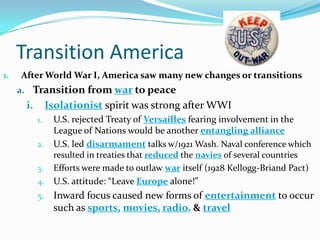
5. Inward focus caused new forms of entertainment to occur
such as sports, movies, radio, & travel
Transition America
i. Nationalism swept over the country following WWI
1. Xenophobia: a fear of immigrants and nativism intensified
2. New ideas were viewed as a threat to national security (paranoia?)
3. Fear of “Reds” or communists and anarchists (those against
government) created a national hysteria
4. Goal: to create a country of pure Americans
5. Solutions
a. Immigration quotas (favored N & W Europe)
b. Deportation of suspected Reds
c. Terror and threats (The new Ku Klux Klan emerged)
Transition America
a. Transition from rural to urban (51% lived in cities)
i. The 1920 Census showed a population shift
1. Farms changed: larger and fewer and more mechanized
2. Black migration North: filled factory jobs during WWI
3. Land shortage: frontier closed in 1890
4. Urban attractions: faster pace; entertainment; better jobs
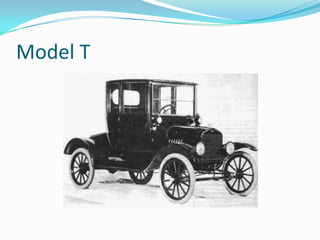
5. Automobile’s impact: expanded living & working
opportunities, liberated rural families, created jobs in related
industries
Model T
Rural vs. Urban
Transition America
ii. Values Clashed (Liberals and Conservatives)
1. Conservatives: those who did like change; those who
preferred the older or traditional ways
2. Conservatives tended to be more rural
3. Liberals: those who preferred newer, modern ways of life
4. Liberals tended to be more urban
Transition America
iii. Rural Conservatives vs. Urban Liberals
1. Role of women “Traditional” vs. “Flappers”
2. Prohibition (18th amend) “Drys” vs. “Wets”
3. The Economy: “Cash” vs. “Credit”
4. Individual rights: “All are not equal” vs. “Equality” for all humans
5. Man’s origin: “Fundamentalism” vs. “Evolutionary Theory”
6. The car and radio sped up this clash
Transition America
c. Transition from a cash economy to a credit economy
i. Attitude: “Be young, play, buy now, pay later”
1. Excessive advertising became big business
2. Installment Buying became all the rage
Transition America
ii. Industries prospered; Farmers suffered
1. Farmers had borrowed $ for machinery & land during the war
2. Farmers lost European markets when the war ended, resulting in
over production ----> surplus ----> falling crop prices
Transition America
iii. Stock Market Boomed
1. Brokers allowed investors to by stock “on margin” w/as little as
10% down; the remainder was borrowed from the broker (Margin loan)
2. Results:
a. A get rich quick fever caused demands for stock to rise
b. The Stock Market had become based on flimsy credit
Flappers
Transition America
d. Transition for women – 1920’s – 1st great “liberation” movement
i. A small minority expressed their independence by becoming flappers
ii. Many sought new employment opportunities
iii. Some began demanding greater equality in the marriage partnership

1920s transition america notes

  • 1.
  • 2.
    Transition America 1. AfterWorld War I, America saw many new changes or transitions a. Transition from war to peace i. Isolationist spirit was strong after WWI 1. U.S. rejected Treaty of Versailles fearing involvement in the League of Nations would be another entangling alliance 2. U.S. led disarmament talks w/1921 Wash. Naval conference which resulted in treaties that reduced the navies of several countries 3. Efforts were made to outlaw war itself (1928 Kellogg-Briand Pact) 4. U.S. attitude: “Leave Europe alone!” 5. Inward focus caused new forms of entertainment to occur such as sports, movies, radio, & travel
  • 3.
    Transition America i. Nationalismswept over the country following WWI 1. Xenophobia: a fear of immigrants and nativism intensified 2. New ideas were viewed as a threat to national security (paranoia?) 3. Fear of “Reds” or communists and anarchists (those against government) created a national hysteria 4. Goal: to create a country of pure Americans 5. Solutions a. Immigration quotas (favored N & W Europe) b. Deportation of suspected Reds c. Terror and threats (The new Ku Klux Klan emerged)
  • 4.
    Transition America a. Transitionfrom rural to urban (51% lived in cities) i. The 1920 Census showed a population shift 1. Farms changed: larger and fewer and more mechanized 2. Black migration North: filled factory jobs during WWI 3. Land shortage: frontier closed in 1890 4. Urban attractions: faster pace; entertainment; better jobs 5. Automobile’s impact: expanded living & working opportunities, liberated rural families, created jobs in related industries
  • 5.
  • 6.
  • 8.
    Transition America ii. ValuesClashed (Liberals and Conservatives) 1. Conservatives: those who did like change; those who preferred the older or traditional ways 2. Conservatives tended to be more rural 3. Liberals: those who preferred newer, modern ways of life 4. Liberals tended to be more urban
  • 9.
    Transition America iii. RuralConservatives vs. Urban Liberals 1. Role of women “Traditional” vs. “Flappers” 2. Prohibition (18th amend) “Drys” vs. “Wets” 3. The Economy: “Cash” vs. “Credit” 4. Individual rights: “All are not equal” vs. “Equality” for all humans 5. Man’s origin: “Fundamentalism” vs. “Evolutionary Theory” 6. The car and radio sped up this clash
  • 10.
    Transition America c. Transitionfrom a cash economy to a credit economy i. Attitude: “Be young, play, buy now, pay later” 1. Excessive advertising became big business 2. Installment Buying became all the rage
  • 11.
    Transition America ii. Industriesprospered; Farmers suffered 1. Farmers had borrowed $ for machinery & land during the war 2. Farmers lost European markets when the war ended, resulting in over production ----> surplus ----> falling crop prices
  • 12.
    Transition America iii. StockMarket Boomed 1. Brokers allowed investors to by stock “on margin” w/as little as 10% down; the remainder was borrowed from the broker (Margin loan) 2. Results: a. A get rich quick fever caused demands for stock to rise b. The Stock Market had become based on flimsy credit
  • 13.
  • 14.
    Transition America d. Transitionfor women – 1920’s – 1st great “liberation” movement i. A small minority expressed their independence by becoming flappers ii. Many sought new employment opportunities iii. Some began demanding greater equality in the marriage partnership