Introduction to  American Imperialism 1867-1898
What is imperialism? Imperialism  can be defined as “a policy by which stronger nations extend their economic, political, or military control over weaker territories” (p. 257) This policy is generally associated with the establishment of colonies, but can also apply to expanding economic/political influence over independent nations…
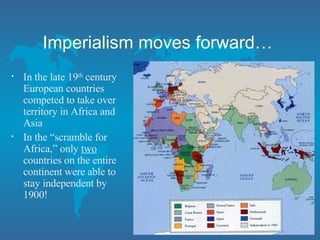
Imperialism moves forward…  In the late 19 th  century European countries competed to take over territory in Africa and Asia In the “scramble for Africa,” only  two  countries on the entire continent were able to stay independent by 1900!
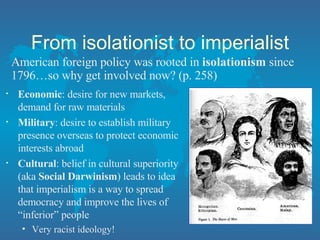
From isolationist to imperialist Economic : desire for new markets, demand for raw materials Military : desire to establish military presence overseas to protect economic interests abroad Cultural : belief in cultural superiority (aka  Social Darwinism ) leads to idea that imperialism is a way to spread democracy and improve the lives of “inferior” people Very racist ideology! American foreign policy was rooted in  isolationism  since 1796…so why get involved now? (p. 258)
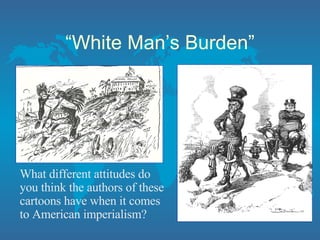
“White Man’s Burden” What different attitudes do you think the authors of these cartoons have when it comes to American imperialism?
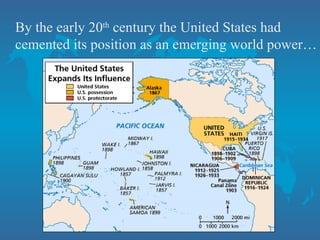
Early efforts at expansion After fulfilling the policy of  Manifest Destiny  and expanding from coast to coast, the United States started to look overseas… 1867 – Alaska (p. 258) and Midway Islands 1898 - Hawaii (p. 259) American planters staged a revolt (1893) and asked to be annexed by the United States…sound familiar? Controversial because Hawaii was an independent country -legality of annexation still contested by native Hawaiians today
“A splendid little war” Desire to protect business interests also led to increased involvement in the Caribbean  Support of Cuban independence led to involvement in the 1898  Spanish-American War  (Ch. 9 Section 2) United States wins after  sixteen weeks ! Territorial gains from the war include Guam, Puerto Rico, and the Philippines Cuba gets independence – but with strings attached Platt Amendment  gives USA the right to intervene in Cuban affairs anytime there is a threat to “life, property, and individual liberty” Cuba has to lease Guantanamo Bay to USA for naval base
By the early 20 th  century the United States had cemented its position as an emerging world power…

Intro To American Imperialism

  • 1.
    Introduction to American Imperialism 1867-1898
  • 2.
    What is imperialism?Imperialism can be defined as “a policy by which stronger nations extend their economic, political, or military control over weaker territories” (p. 257) This policy is generally associated with the establishment of colonies, but can also apply to expanding economic/political influence over independent nations…
  • 3.
    Imperialism moves forward… In the late 19 th century European countries competed to take over territory in Africa and Asia In the “scramble for Africa,” only two countries on the entire continent were able to stay independent by 1900!
  • 4.
    From isolationist toimperialist Economic : desire for new markets, demand for raw materials Military : desire to establish military presence overseas to protect economic interests abroad Cultural : belief in cultural superiority (aka Social Darwinism ) leads to idea that imperialism is a way to spread democracy and improve the lives of “inferior” people Very racist ideology! American foreign policy was rooted in isolationism since 1796…so why get involved now? (p. 258)
  • 5.
    “White Man’s Burden”What different attitudes do you think the authors of these cartoons have when it comes to American imperialism?
  • 6.
    Early efforts atexpansion After fulfilling the policy of Manifest Destiny and expanding from coast to coast, the United States started to look overseas… 1867 – Alaska (p. 258) and Midway Islands 1898 - Hawaii (p. 259) American planters staged a revolt (1893) and asked to be annexed by the United States…sound familiar? Controversial because Hawaii was an independent country -legality of annexation still contested by native Hawaiians today
  • 7.
    “A splendid littlewar” Desire to protect business interests also led to increased involvement in the Caribbean Support of Cuban independence led to involvement in the 1898 Spanish-American War (Ch. 9 Section 2) United States wins after sixteen weeks ! Territorial gains from the war include Guam, Puerto Rico, and the Philippines Cuba gets independence – but with strings attached Platt Amendment gives USA the right to intervene in Cuban affairs anytime there is a threat to “life, property, and individual liberty” Cuba has to lease Guantanamo Bay to USA for naval base
  • 8.
    By the early20 th century the United States had cemented its position as an emerging world power…