POLITICS OF THE
ROARING 20’S
SECTION 1: AMERICAN
POSTWAR ISSUES
• The American public
was exhausted from
World War I
• Public debate over the
League of Nations had
divided America
• An economic downturn
meant many faced
unemployment
• A wave of nativism
swept the nation
ISOLATIONISM
• Many Americans adopted a belief
in isolationism
• Isolationism meant pulling away
from involvement in world affairs
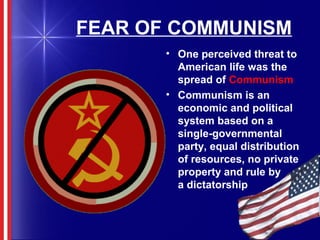
FEAR OF COMMUNISM
• One perceived threat to
American life was the
spread of Communism
• Communism is an
economic and political
system based on a
single-governmental
party, equal distribution
of resources, no private
property and rule by
a dictatorship
SOVIET UNION
COMMUNISM
• Russia was transformed
into the Soviet Union in
1917, a Communist state
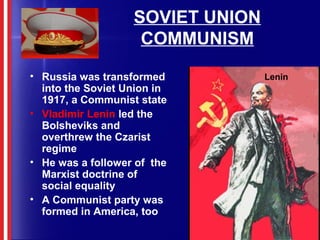
• Vladimir Lenin led the
Bolsheviks and
overthrew the Czarist
regime
• He was a follower of the
Marxist doctrine of
social equality
• A Communist party was
formed in America, too
Lenin
SACCO & VANZETTI
• The Red Scare fed
nativism in America
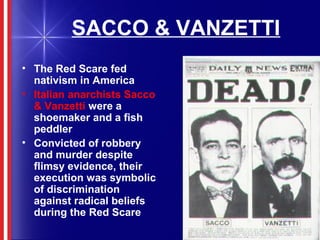
• Italian anarchists Sacco
& Vanzetti were a
shoemaker and a fish
peddler
• Convicted of robbery
and murder despite
flimsy evidence, their
execution was symbolic
of discrimination
against radical beliefs
during the Red Scare
THE KLAN RISES AGAIN
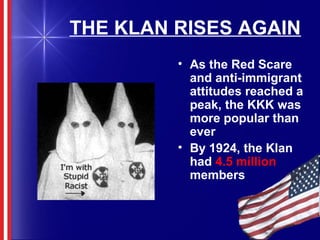
• As the Red Scare
and anti-immigrant
attitudes reached a
peak, the KKK was
more popular than
ever
• By 1924, the Klan
had 4.5 million
members
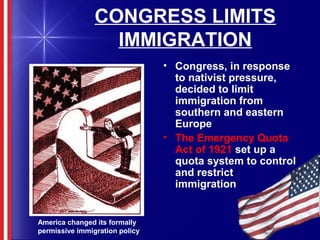
CONGRESS LIMITS
IMMIGRATION
• Congress, in response
to nativist pressure,
decided to limit
immigration from
southern and eastern
Europe
• The Emergency Quota
Act of 1921 set up a
quota system to control
and restrict
immigration
America changed its formally
permissive immigration policy
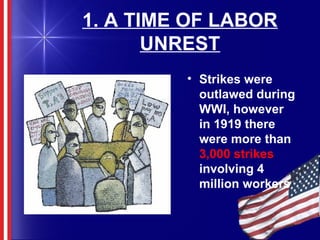
1. A TIME OF LABOR
UNREST
• Strikes were
outlawed during
WWI, however
in 1919 there
were more than
3,000 strikes
involving 4
million workers
2. BOSTON
POLICE STRIKE
• Boston police had
not received a raise
in years and were
denied the right to
unionize
• The National Guard
was called
• New cops
were
hired
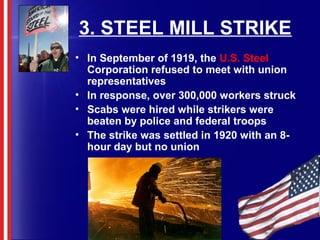
3. STEEL MILL STRIKE
• In September of 1919, the U.S. Steel
Corporation refused to meet with union
representatives
• In response, over 300,000 workers struck
• Scabs were hired while strikers were
beaten by police and federal troops
• The strike was settled in 1920 with an 8-
hour day but no union
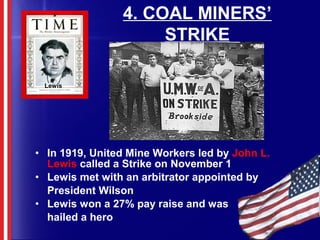
4. COAL MINERS’
STRIKE
• In 1919, United Mine Workers led by John L.
Lewis called a Strike on November 1
• Lewis met with an arbitrator appointed by
President Wilson
• Lewis won a 27% pay raise and was
hailed a hero
Lewis
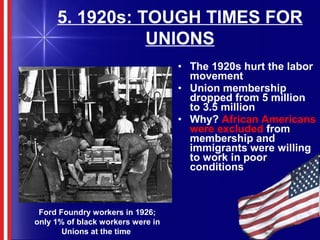
5. 1920s: TOUGH TIMES FOR
UNIONS
• The 1920s hurt the labor
movement
• Union membership
dropped from 5 million
to 3.5 million
• Why? African Americans
were excluded from
membership and
immigrants were willing
to work in poor
conditions
Ford Foundry workers in 1926;
only 1% of black workers were in
Unions at the time
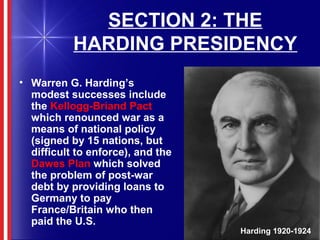
SECTION 2: THE
HARDING PRESIDENCY
• Warren G. Harding’s
modest successes include
the Kellogg-Briand Pact
which renounced war as a
means of national policy
(signed by 15 nations, but
difficult to enforce), and the
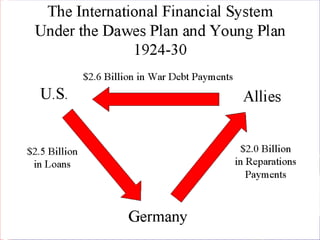
Dawes Plan which solved
the problem of post-war
debt by providing loans to
Germany to pay
France/Britain who then
paid the U.S.
Harding 1920-1924
SCANDAL HITS
HARDING
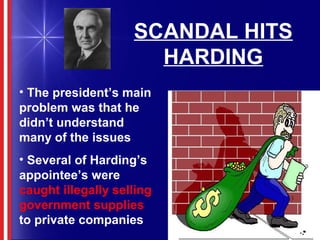
• The president’s main
problem was that he
didn’t understand
many of the issues
• Several of Harding’s
appointee’s were
caught illegally selling
government supplies
to private companies
TEAPOT DOME
SCANDAL
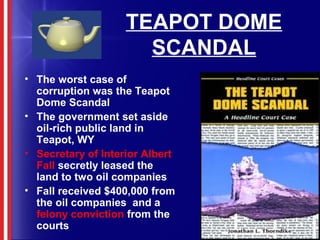
• The worst case of
corruption was the Teapot
Dome Scandal
• The government set aside
oil-rich public land in
Teapot, WY
• Secretary of Interior Albert
Fall secretly leased the
land to two oil companies
• Fall received $400,000 from
the oil companies and a
felony conviction from the
courts
6. SECTION 3: THE
BUSINESS OF AMERICA
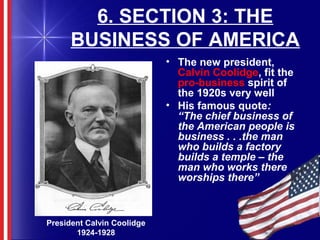
• The new president,
Calvin Coolidge, fit the
pro-business spirit of
the 1920s very well
• His famous quote:
“The chief business of
the American people is
business . . .the man
who builds a factory
builds a temple – the
man who works there
worships there”
President Calvin Coolidge
1924-1928
AMERICAN BUSINESS
FLOURISHES
• Both Coolidge and his
Republican successor
Herbert Hoover, favored
governmental policies
that kept taxes down and
business profits up
• Tariffs were high which
helped American
manufacturers
• Government interference
in business was minimal
• Wages were increasing
7. THE IMPACT OF THE
AUTO
• The auto was the
backbone of the
American economy
from 1920 through
the 1970s
• It also profoundly
altered the
American
landscape
and
society
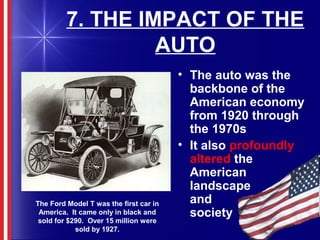
The Ford Model T was the first car in
America. It came only in black and
sold for $290. Over 15 million were
sold by 1927.
8. IMPACT OF THE
AUTO
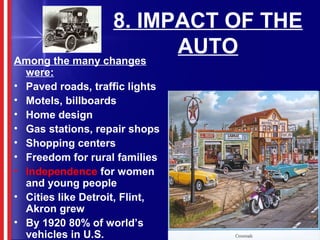
Among the many changes
were:
• Paved roads, traffic lights
• Motels, billboards
• Home design
• Gas stations, repair shops
• Shopping centers
• Freedom for rural families
• Independence for women
and young people
• Cities like Detroit, Flint,
Akron grew
• By 1920 80% of world’s
vehicles in U.S.
9. AIRLINE
TRANSPORT
BECOMES COMMON
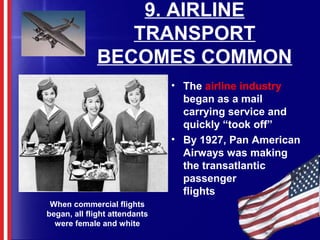
• The airline industry
began as a mail
carrying service and
quickly “took off”
• By 1927, Pan American
Airways was making
the transatlantic
passenger
flights
When commercial flights
began, all flight attendants
were female and white
10. AMERICAN
STANDARD OF LIVING
SOARS
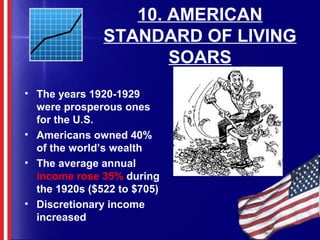
• The years 1920-1929
were prosperous ones
for the U.S.
• Americans owned 40%
of the world’s wealth
• The average annual
income rose 35% during
the 1920s ($522 to $705)
• Discretionary income
increased
ELECTRICAL
CONVENIENCES
• While gasoline
powered much of
the economic
boom of the
1920s, the use of
electricity also
transformed the
nation
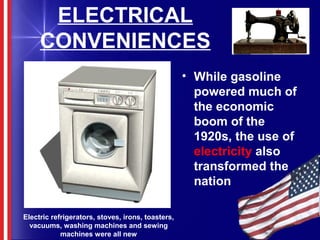
Electric refrigerators, stoves, irons, toasters,
vacuums, washing machines and sewing
machines were all new
MODERN ADVERTISING
EMERGES
• Ad agencies no longer
sought to merely
“inform” the public about
their products
• They hired psychologists
to study how best to
appeal to Americans’
desire for youthfulness,
beauty, health and wealth
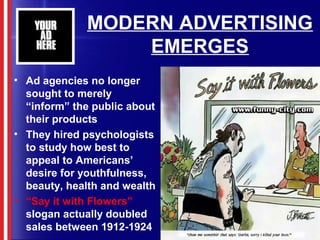
• “Say it with Flowers”
slogan actually doubled
sales between 1912-1924
A SUPERFICIAL
PROSPERITY
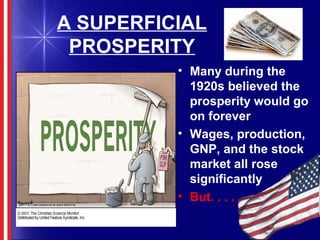
• Many during the
1920s believed the
prosperity would go
on forever
• Wages, production,
GNP, and the stock
market all rose
significantly
• But. . . .
PROBLEMS ON THE
HORIZON?
• Businesses
expanded
recklessly
• Iron & railroad
industries faded
• Farms nationwide
suffered losses due
to overproduction
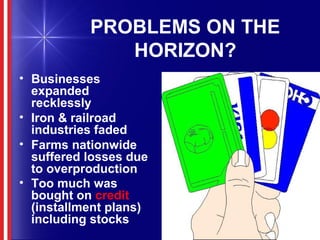
• Too much was
bought on credit
(installment plans)
including stocks

Chapter 12 powerpt

  • 1.
  • 2.
    SECTION 1: AMERICAN POSTWARISSUES • The American public was exhausted from World War I • Public debate over the League of Nations had divided America • An economic downturn meant many faced unemployment • A wave of nativism swept the nation
  • 3.
    ISOLATIONISM • Many Americansadopted a belief in isolationism • Isolationism meant pulling away from involvement in world affairs
  • 4.
    FEAR OF COMMUNISM •One perceived threat to American life was the spread of Communism • Communism is an economic and political system based on a single-governmental party, equal distribution of resources, no private property and rule by a dictatorship
  • 5.
    SOVIET UNION COMMUNISM • Russiawas transformed into the Soviet Union in 1917, a Communist state • Vladimir Lenin led the Bolsheviks and overthrew the Czarist regime • He was a follower of the Marxist doctrine of social equality • A Communist party was formed in America, too Lenin
  • 6.
    SACCO & VANZETTI •The Red Scare fed nativism in America • Italian anarchists Sacco & Vanzetti were a shoemaker and a fish peddler • Convicted of robbery and murder despite flimsy evidence, their execution was symbolic of discrimination against radical beliefs during the Red Scare
  • 7.
    THE KLAN RISESAGAIN • As the Red Scare and anti-immigrant attitudes reached a peak, the KKK was more popular than ever • By 1924, the Klan had 4.5 million members
  • 8.
    CONGRESS LIMITS IMMIGRATION • Congress,in response to nativist pressure, decided to limit immigration from southern and eastern Europe • The Emergency Quota Act of 1921 set up a quota system to control and restrict immigration America changed its formally permissive immigration policy
  • 9.
    1. A TIMEOF LABOR UNREST • Strikes were outlawed during WWI, however in 1919 there were more than 3,000 strikes involving 4 million workers
  • 10.
    2. BOSTON POLICE STRIKE •Boston police had not received a raise in years and were denied the right to unionize • The National Guard was called • New cops were hired
  • 11.
    3. STEEL MILLSTRIKE • In September of 1919, the U.S. Steel Corporation refused to meet with union representatives • In response, over 300,000 workers struck • Scabs were hired while strikers were beaten by police and federal troops • The strike was settled in 1920 with an 8- hour day but no union
  • 12.
    4. COAL MINERS’ STRIKE •In 1919, United Mine Workers led by John L. Lewis called a Strike on November 1 • Lewis met with an arbitrator appointed by President Wilson • Lewis won a 27% pay raise and was hailed a hero Lewis
  • 13.
    5. 1920s: TOUGHTIMES FOR UNIONS • The 1920s hurt the labor movement • Union membership dropped from 5 million to 3.5 million • Why? African Americans were excluded from membership and immigrants were willing to work in poor conditions Ford Foundry workers in 1926; only 1% of black workers were in Unions at the time
  • 14.
    SECTION 2: THE HARDINGPRESIDENCY • Warren G. Harding’s modest successes include the Kellogg-Briand Pact which renounced war as a means of national policy (signed by 15 nations, but difficult to enforce), and the Dawes Plan which solved the problem of post-war debt by providing loans to Germany to pay France/Britain who then paid the U.S. Harding 1920-1924
  • 16.
    SCANDAL HITS HARDING • Thepresident’s main problem was that he didn’t understand many of the issues • Several of Harding’s appointee’s were caught illegally selling government supplies to private companies
  • 17.
    TEAPOT DOME SCANDAL • Theworst case of corruption was the Teapot Dome Scandal • The government set aside oil-rich public land in Teapot, WY • Secretary of Interior Albert Fall secretly leased the land to two oil companies • Fall received $400,000 from the oil companies and a felony conviction from the courts
  • 18.
    6. SECTION 3:THE BUSINESS OF AMERICA • The new president, Calvin Coolidge, fit the pro-business spirit of the 1920s very well • His famous quote: “The chief business of the American people is business . . .the man who builds a factory builds a temple – the man who works there worships there” President Calvin Coolidge 1924-1928
  • 19.
    AMERICAN BUSINESS FLOURISHES • BothCoolidge and his Republican successor Herbert Hoover, favored governmental policies that kept taxes down and business profits up • Tariffs were high which helped American manufacturers • Government interference in business was minimal • Wages were increasing
  • 20.
    7. THE IMPACTOF THE AUTO • The auto was the backbone of the American economy from 1920 through the 1970s • It also profoundly altered the American landscape and society The Ford Model T was the first car in America. It came only in black and sold for $290. Over 15 million were sold by 1927.
  • 21.
    8. IMPACT OFTHE AUTO Among the many changes were: • Paved roads, traffic lights • Motels, billboards • Home design • Gas stations, repair shops • Shopping centers • Freedom for rural families • Independence for women and young people • Cities like Detroit, Flint, Akron grew • By 1920 80% of world’s vehicles in U.S.
  • 22.
    9. AIRLINE TRANSPORT BECOMES COMMON •The airline industry began as a mail carrying service and quickly “took off” • By 1927, Pan American Airways was making the transatlantic passenger flights When commercial flights began, all flight attendants were female and white
  • 23.
    10. AMERICAN STANDARD OFLIVING SOARS • The years 1920-1929 were prosperous ones for the U.S. • Americans owned 40% of the world’s wealth • The average annual income rose 35% during the 1920s ($522 to $705) • Discretionary income increased
  • 24.
    ELECTRICAL CONVENIENCES • While gasoline poweredmuch of the economic boom of the 1920s, the use of electricity also transformed the nation Electric refrigerators, stoves, irons, toasters, vacuums, washing machines and sewing machines were all new
  • 25.
    MODERN ADVERTISING EMERGES • Adagencies no longer sought to merely “inform” the public about their products • They hired psychologists to study how best to appeal to Americans’ desire for youthfulness, beauty, health and wealth • “Say it with Flowers” slogan actually doubled sales between 1912-1924
  • 26.
    A SUPERFICIAL PROSPERITY • Manyduring the 1920s believed the prosperity would go on forever • Wages, production, GNP, and the stock market all rose significantly • But. . . .
  • 27.
    PROBLEMS ON THE HORIZON? •Businesses expanded recklessly • Iron & railroad industries faded • Farms nationwide suffered losses due to overproduction • Too much was bought on credit (installment plans) including stocks