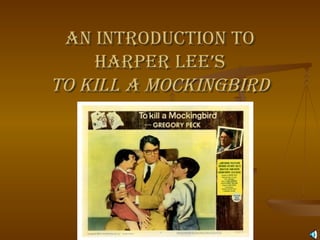
An Introduction to Harper Lee’s To Kill a Mockingbird
Harper Lee Born on April 28, 1926 in Monroeville, Alabama Youngest of four children 1957 – submitted manuscript for her novel; was urged to rewrite it Spent over two years reworking it 1960 –  To Kill a Mockingbird  (her only novel) published 1966 - was one of two persons named by President Johnson to the National Council of Arts
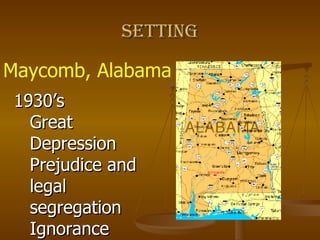
SETTING Maycomb, Alabama 1930’s Great Depression Prejudice and legal segregation Ignorance Southern United States
Point of View First person Story is told by Scout, a 10-year-old girl Harper Lee is actually a woman; Scout represents the author as a little girl although the story is not  strictly autobiographical
Main Characters Scout (Jean Louise Finch)  – six-year-old narrator of story Jem (Jeremy Finch)  – her older brother Atticus Finch  – Jem and Scout’s father, a prominent lawyer who defends a black man accused of raping a white woman Arthur (Boo) Radley  – a thirty-three-year-old recluse who lives next door Charles Baker (Dill) Harris  – Jem and Scout’s friend who comes to visit his aunt in Maycomb each summer Tom Robinson  – a respectable black man accused of raping a white woman Calpurnia  – the Finches’ black cook
Social Class in the Novel This is probably similar to how class structure existed during the 1930’ s  in the South.  The wealthy, although fewest in number, were most powerful.  The blacks, although great in number, were lowest on the class ladder, and thus, had the least privileges.  Examples of each social class: Wealthy -  Finches Country Folk -  Cunninghams “ White Trash” – Ewells Black Community – Tom Robinson
1930’s - Great Depression began when the stock market crashed in October, 1929 Businesses failed, factories closed People were out of work Even people with money suffered because nothing was being produced for sale. Poor people lost their homes, were forced to “live off the land.”
Racial prejudice was alive & well. Although slavery had ended in 1864,  old ideas were slow to change
Racial separation (segregation)
Gender Bias (Prejudice) Women were considered “weak” Women were generally not educated  for occupations outside the home In wealthy families, women were expected to oversee the  servants and entertain guests  Men not considered capable of nurturing children
Legal Issues of the 1930’s which impact the story Women given the vote in 1920 Juries were  MALE and WHITE  “ Fair trial”  did not include acceptance of a black man’s word against a white man’s
Prejudice in the novel Race Gender Handicaps Rich/Poor Age Religion
Reading the Novel Setting is all important –be aware of the  “ where” and “when” as you begin Point of View – the novel is shaped by the voice of a young girl who sees the story from a position of naïve acceptance “ Goodness vs. Ignorance (Evil)” is an important theme
Negro Neighborhood
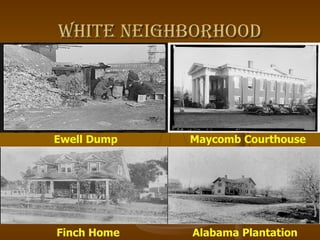
White Neighborhood Ewell Dump Maycomb Courthouse Finch Home Alabama Plantation
" Mockingbirds don't do one thing but make music for us to enjoy. They don't eat up people's gardens, don't nest in corncribs, they don't do one thing but sing their hearts out for us. That's why it's a sin to kill a mockingbird."
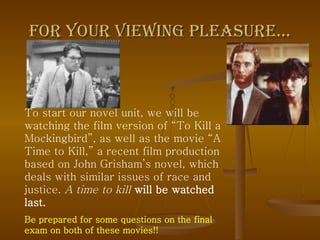
For your Viewing Pleasure… To  start  our novel unit, we will be watching the film version of “To Kill a Mockingbird”, as well as the movie “A Time to Kill,” a recent film production based on John Grisham’s novel, which deals with similar issues of race and justice.   A time to kill   will be watched last. Be prepared for some questions on the final exam on both of these movies!!
Trailer

Intro To Mockingbird Slideshow

  • 1.
    An Introduction toHarper Lee’s To Kill a Mockingbird
  • 2.
    Harper Lee Bornon April 28, 1926 in Monroeville, Alabama Youngest of four children 1957 – submitted manuscript for her novel; was urged to rewrite it Spent over two years reworking it 1960 – To Kill a Mockingbird (her only novel) published 1966 - was one of two persons named by President Johnson to the National Council of Arts
  • 3.
    SETTING Maycomb, Alabama1930’s Great Depression Prejudice and legal segregation Ignorance Southern United States
  • 4.
    Point of ViewFirst person Story is told by Scout, a 10-year-old girl Harper Lee is actually a woman; Scout represents the author as a little girl although the story is not strictly autobiographical
  • 5.
    Main Characters Scout(Jean Louise Finch) – six-year-old narrator of story Jem (Jeremy Finch) – her older brother Atticus Finch – Jem and Scout’s father, a prominent lawyer who defends a black man accused of raping a white woman Arthur (Boo) Radley – a thirty-three-year-old recluse who lives next door Charles Baker (Dill) Harris – Jem and Scout’s friend who comes to visit his aunt in Maycomb each summer Tom Robinson – a respectable black man accused of raping a white woman Calpurnia – the Finches’ black cook
  • 6.
    Social Class inthe Novel This is probably similar to how class structure existed during the 1930’ s in the South. The wealthy, although fewest in number, were most powerful. The blacks, although great in number, were lowest on the class ladder, and thus, had the least privileges. Examples of each social class: Wealthy - Finches Country Folk - Cunninghams “ White Trash” – Ewells Black Community – Tom Robinson
  • 7.
    1930’s - GreatDepression began when the stock market crashed in October, 1929 Businesses failed, factories closed People were out of work Even people with money suffered because nothing was being produced for sale. Poor people lost their homes, were forced to “live off the land.”
  • 8.
    Racial prejudice wasalive & well. Although slavery had ended in 1864, old ideas were slow to change
  • 9.
  • 10.
    Gender Bias (Prejudice)Women were considered “weak” Women were generally not educated for occupations outside the home In wealthy families, women were expected to oversee the servants and entertain guests Men not considered capable of nurturing children
  • 11.
    Legal Issues ofthe 1930’s which impact the story Women given the vote in 1920 Juries were MALE and WHITE “ Fair trial” did not include acceptance of a black man’s word against a white man’s
  • 12.
    Prejudice in thenovel Race Gender Handicaps Rich/Poor Age Religion
  • 13.
    Reading the NovelSetting is all important –be aware of the “ where” and “when” as you begin Point of View – the novel is shaped by the voice of a young girl who sees the story from a position of naïve acceptance “ Goodness vs. Ignorance (Evil)” is an important theme
  • 14.
  • 15.
    White Neighborhood EwellDump Maycomb Courthouse Finch Home Alabama Plantation
  • 16.
    " Mockingbirds don'tdo one thing but make music for us to enjoy. They don't eat up people's gardens, don't nest in corncribs, they don't do one thing but sing their hearts out for us. That's why it's a sin to kill a mockingbird."
  • 17.
    For your ViewingPleasure… To start our novel unit, we will be watching the film version of “To Kill a Mockingbird”, as well as the movie “A Time to Kill,” a recent film production based on John Grisham’s novel, which deals with similar issues of race and justice. A time to kill will be watched last. Be prepared for some questions on the final exam on both of these movies!!
  • 18.