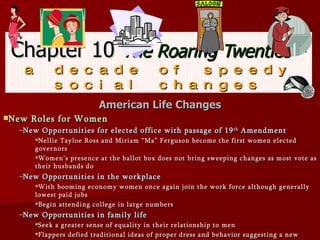
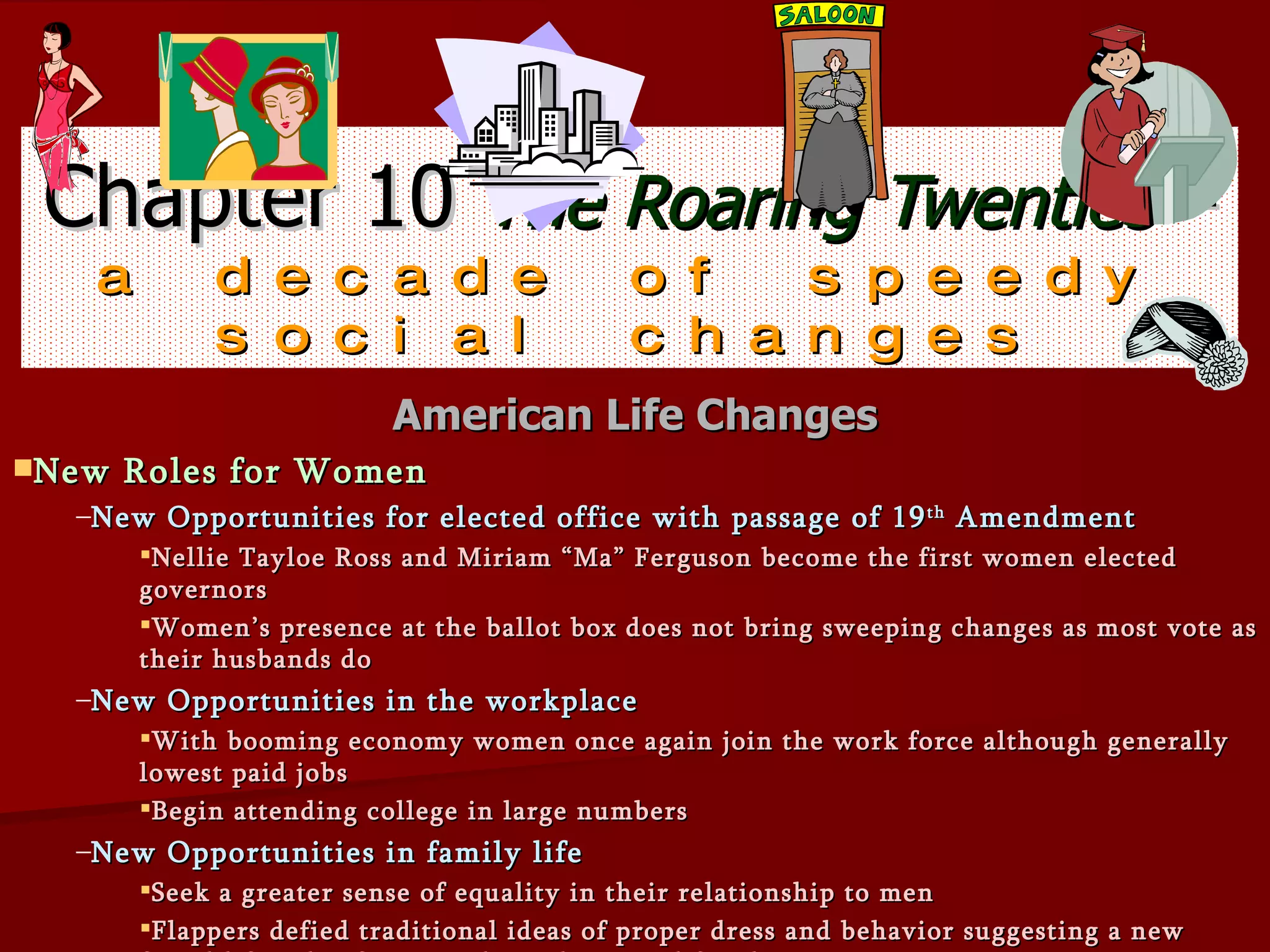
Chapter 10  The Roaring Twenties —  a decade of speedy social changes American Life Changes New Roles for Women New Opportunities for elected office with passage of 19 th  Amendment Nellie Tayloe Ross and Miriam “Ma” Ferguson become the first women elected governors Women’s presence at the ballot box does not bring sweeping changes as most vote as their husbands do New Opportunities in the workplace With booming economy women once again join the work force although generally lowest paid jobs Begin attending college in large numbers New Opportunities in family life Seek a greater sense of equality in their relationship to men Flappers defied traditional ideas of proper dress and behavior suggesting a new found lifestyle of great independence and freedom
American Life Changes Effects of Urbanization Great economic prosperity except for farmers who began to move to cities for jobs 1920 census showed urbanization for the first time in American history Rise of automobile helped shift the borders between rural and urban dwellers so that country people could visit cities more often and feel less isolated and became more urbane in their outlook and  attitudes More state laws requiring public school attendance force children out of factories and into classrooms and Americanizes immigrants Conflicts Over Values Rural America represented hard-working, self-reliant, religious, independent spirit country was founded on versus urban ideas that threatened these values Rise of Ku Klux Klan membership and violence in rural America as people there felt threatened by social changes Rise of fundamentalism  Scopes Trial as science clashed with religion Prohibition 18 th  Amendment and Volstead Act passed Gave rise to huge smuggling operations, homemade alcohol production, speakeasies, and foundation for huge criminal empires Became almost unenforceable law although Elliot Ness and the Untouchables tried
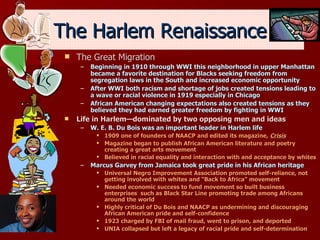
The Harlem Renaissance The Great Migration Beginning in 1910 through WWI this neighborhood in upper Manhattan became a favorite destination for Blacks seeking freedom from segregation laws in the South and increased economic opportunity After WWI both racism and shortage of jobs created tensions leading to a wave or racial violence in 1919 especially in Chicago African American changing expectations also created tensions as they believed they had earned greater freedom by fighting in WWI Life in Harlem—dominated by two opposing men and ideas W. E. B. Du Bois was an important leader in Harlem life 1909 one of founders of NAACP and edited its magazine,  Crisis Magazine began to publish African American literature and poetry creating a great arts movement Believed in racial equality and interaction with and acceptance by whites   Marcus Garvey from Jamaica took great pride in his African heritage Universal Negro Improvement Association promoted self-reliance, not getting involved with whites and “Back to Africa” movement Needed economic success to fund movement so built business enterprises  such as Black Star Line promoting trade among Africans around the world Highly critical of Du Bois and NAACP as undermining and discouraging African American pride and self-confidence 1923 charged by FBI of mail fraud, went to prison, and deported UNIA collapsed but left a legacy of racial pride and self-determination
A Renaissance in Harlem Harlem in the 1920s bristled with creative energy. Feeling a strong sense of racial pride and identity, this African –American spirit attracted a historic influx of talented writers, thinkers, musicians, and artists. The result was a flowering of African-American arts. A common theme among writers was defiance or resistance in the face of white prejudice Claude McKay Langston Hughes also wrote of hope James Weldon Johnson- NAACP work and  God’s Trombones , a book of poetry Artists won fame and recognition William H. Johnson, Aaron Douglas, and Jacob Lawrence; later Lois Mailou New Opportunities for stage performers Given more serious roles on stage  Paul Robeson played  Othello  winning nationwide acclaim 1921 musical  Shuffle Along  featuring all black cast including Josephine Baker A Vital Center for Jazz,  America’s only original musical genre Louis Armstrong, Cab Calloway, Duke Ellington, and Fats Waller, Bessie Smith Cotton Club and Savoy Ballroom
A New Popular Culture is Born Mass Entertainment of the 1920s Radio is one of the driving forces in the development of popular culture First commercial station is Westinghouse’s KDKA Quickly joined by hundreds of radio stations across USA Technical improvements such as vacuum tube and battery-powered units increased quality of sound and mobility Helped to break barriers between rural and urban dwellers Movies Pioneered by D. W. Griffith’s  The Birth of a Nation  establishing film as an art form Introduction of sound in  The Jazz Singer  in 1928  Walt Disney introduced cartoon characters with  Steamboat Willie An Era of Heroes Film stars become celebrities Charles A. Lindbergh “Lucky Lindy” becomes the first to try solo transAtlantic Amelia Earhart becomes the first woman to fly the Atlantic Sports Heroes
Arts in the 1920s Fabulous literature was produced in mainstream USA F. Scott Fitzgerald is most associated with the 1920s The Great Gatsby  explored the lives of the rich and critically examined the values of the wealthy Sinclair Lewis Criticized small towns’ lack of culture in  Main Street Underscored the cost of economic success in  Babbitt Edna St. Vincent Millay wrote beautiful poetry that ranged from celebration of youthful spirit to concern over leading social issues of the day Willa Cather and Edith Wharton produced some of the era’s most notable works of literature Lost Generation of Writers chose to live in Europe after WWI Ernest Hemingway was a WWI veteran writing powerfully about that experience in  A Farewell to Arms John Dos Passos also served in WWI wrote  Three Soldiers Bruce Barton published  The Man Nobody Knows  celebrating the booming business and popular culture of the times George Gershwin caught the spirit of the jazz age in his musical compositions like  Rhapsody in Blue  and popular songs

Chapter 10 the roaring twenties— a decade

  • 1.
    Chapter 10 The Roaring Twenties — a decade of speedy social changes American Life Changes New Roles for Women New Opportunities for elected office with passage of 19 th Amendment Nellie Tayloe Ross and Miriam “Ma” Ferguson become the first women elected governors Women’s presence at the ballot box does not bring sweeping changes as most vote as their husbands do New Opportunities in the workplace With booming economy women once again join the work force although generally lowest paid jobs Begin attending college in large numbers New Opportunities in family life Seek a greater sense of equality in their relationship to men Flappers defied traditional ideas of proper dress and behavior suggesting a new found lifestyle of great independence and freedom
  • 2.
    American Life ChangesEffects of Urbanization Great economic prosperity except for farmers who began to move to cities for jobs 1920 census showed urbanization for the first time in American history Rise of automobile helped shift the borders between rural and urban dwellers so that country people could visit cities more often and feel less isolated and became more urbane in their outlook and attitudes More state laws requiring public school attendance force children out of factories and into classrooms and Americanizes immigrants Conflicts Over Values Rural America represented hard-working, self-reliant, religious, independent spirit country was founded on versus urban ideas that threatened these values Rise of Ku Klux Klan membership and violence in rural America as people there felt threatened by social changes Rise of fundamentalism Scopes Trial as science clashed with religion Prohibition 18 th Amendment and Volstead Act passed Gave rise to huge smuggling operations, homemade alcohol production, speakeasies, and foundation for huge criminal empires Became almost unenforceable law although Elliot Ness and the Untouchables tried
  • 3.
    The Harlem RenaissanceThe Great Migration Beginning in 1910 through WWI this neighborhood in upper Manhattan became a favorite destination for Blacks seeking freedom from segregation laws in the South and increased economic opportunity After WWI both racism and shortage of jobs created tensions leading to a wave or racial violence in 1919 especially in Chicago African American changing expectations also created tensions as they believed they had earned greater freedom by fighting in WWI Life in Harlem—dominated by two opposing men and ideas W. E. B. Du Bois was an important leader in Harlem life 1909 one of founders of NAACP and edited its magazine, Crisis Magazine began to publish African American literature and poetry creating a great arts movement Believed in racial equality and interaction with and acceptance by whites Marcus Garvey from Jamaica took great pride in his African heritage Universal Negro Improvement Association promoted self-reliance, not getting involved with whites and “Back to Africa” movement Needed economic success to fund movement so built business enterprises such as Black Star Line promoting trade among Africans around the world Highly critical of Du Bois and NAACP as undermining and discouraging African American pride and self-confidence 1923 charged by FBI of mail fraud, went to prison, and deported UNIA collapsed but left a legacy of racial pride and self-determination
  • 4.
    A Renaissance inHarlem Harlem in the 1920s bristled with creative energy. Feeling a strong sense of racial pride and identity, this African –American spirit attracted a historic influx of talented writers, thinkers, musicians, and artists. The result was a flowering of African-American arts. A common theme among writers was defiance or resistance in the face of white prejudice Claude McKay Langston Hughes also wrote of hope James Weldon Johnson- NAACP work and God’s Trombones , a book of poetry Artists won fame and recognition William H. Johnson, Aaron Douglas, and Jacob Lawrence; later Lois Mailou New Opportunities for stage performers Given more serious roles on stage Paul Robeson played Othello winning nationwide acclaim 1921 musical Shuffle Along featuring all black cast including Josephine Baker A Vital Center for Jazz, America’s only original musical genre Louis Armstrong, Cab Calloway, Duke Ellington, and Fats Waller, Bessie Smith Cotton Club and Savoy Ballroom
  • 5.
    A New PopularCulture is Born Mass Entertainment of the 1920s Radio is one of the driving forces in the development of popular culture First commercial station is Westinghouse’s KDKA Quickly joined by hundreds of radio stations across USA Technical improvements such as vacuum tube and battery-powered units increased quality of sound and mobility Helped to break barriers between rural and urban dwellers Movies Pioneered by D. W. Griffith’s The Birth of a Nation establishing film as an art form Introduction of sound in The Jazz Singer in 1928 Walt Disney introduced cartoon characters with Steamboat Willie An Era of Heroes Film stars become celebrities Charles A. Lindbergh “Lucky Lindy” becomes the first to try solo transAtlantic Amelia Earhart becomes the first woman to fly the Atlantic Sports Heroes
  • 6.
    Arts in the1920s Fabulous literature was produced in mainstream USA F. Scott Fitzgerald is most associated with the 1920s The Great Gatsby explored the lives of the rich and critically examined the values of the wealthy Sinclair Lewis Criticized small towns’ lack of culture in Main Street Underscored the cost of economic success in Babbitt Edna St. Vincent Millay wrote beautiful poetry that ranged from celebration of youthful spirit to concern over leading social issues of the day Willa Cather and Edith Wharton produced some of the era’s most notable works of literature Lost Generation of Writers chose to live in Europe after WWI Ernest Hemingway was a WWI veteran writing powerfully about that experience in A Farewell to Arms John Dos Passos also served in WWI wrote Three Soldiers Bruce Barton published The Man Nobody Knows celebrating the booming business and popular culture of the times George Gershwin caught the spirit of the jazz age in his musical compositions like Rhapsody in Blue and popular songs