Booker T. Washington and W. E. B. DuBois Two Leaders’ Different  Schools of Thought
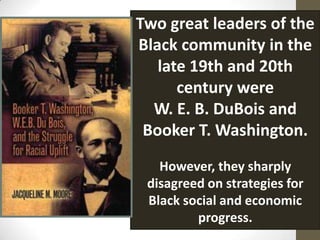
Two great leaders of the Black community in the late 19th and 20th century were W. E. B. DuBois and Booker T. Washington. However, they sharply disagreed on strategies for Black social and economic progress.
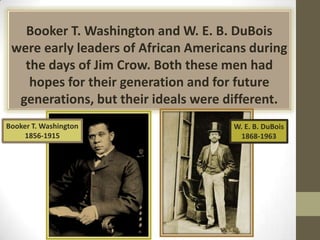
Booker T. Washington and W. E. B. DuBois were early leaders of African Americans during the days of Jim Crow. Both these men had hopes for their generation and for future generations, but their ideals were different.Booker T. Washington1856-1915W. E. B. DuBois1868-1963
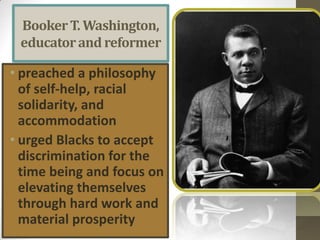
Booker T. Washington, educator and reformer preached a philosophy of self-help, racial solidarity, and accommodation urged Blacks to accept discrimination for the time being and focus on elevating themselves through hard work and material prosperity
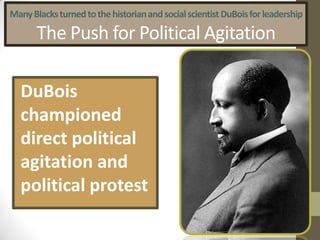
Many Blacks turned to the historian and social scientist DuBoisfor leadership The Push for Political AgitationDuBoischampioned direct political agitation and political protest
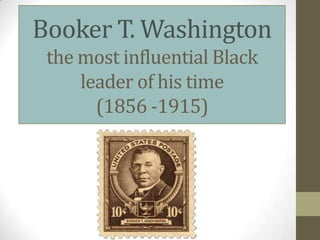
Booker T. Washingtonthe most influential Black leader of his time (1856 -1915)
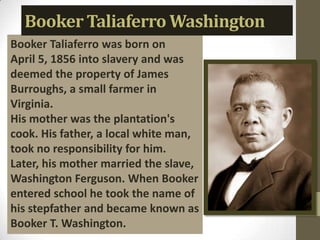
Booker Taliaferro WashingtonBooker Taliaferro was born on April 5, 1856 into slavery and was deemed the property of James Burroughs, a small farmer in Virginia.His mother was the plantation's cook. His father, a local white man, took no responsibility for him.Later, his mother married the slave, Washington Ferguson. When Booker entered school he took the name of his stepfather and became known as Booker T. Washington.
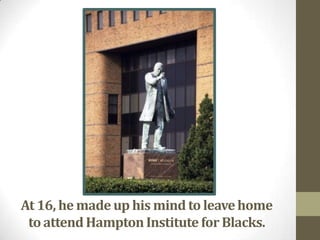
At 16, he made up his mind to leave home to attend Hampton Institute for Blacks.
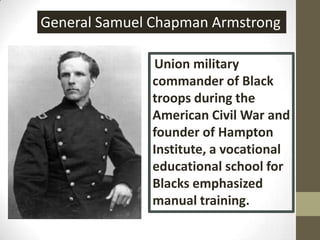
General Samuel Chapman ArmstrongUnion military commander of Black troops during the American Civil War and founder of Hampton Institute, a vocational educational school for Blacks emphasized manual training.
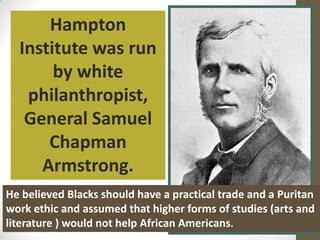
Hampton Institute was run by white philanthropist, General Samuel Chapman Armstrong.He believed Blacks should have a practical trade and a Puritan work ethic and assumed that higher forms of studies (arts and literature ) would not helpAfrican Americans.
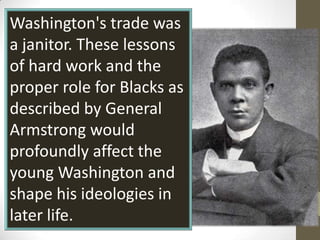
Washington's trade was  a janitor. These lessons of hard work and the proper role for Blacks as described by General Armstrong would profoundly affect the young Washington and shape his ideologies in later life.
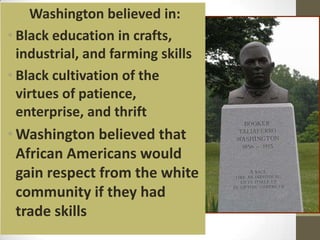
Washington believed in:Black education in crafts, industrial, and farming skills Black cultivation of the virtues of patience, enterprise, and thrift Washington believed that African Americans would gain respect from the white community if they had trade skills
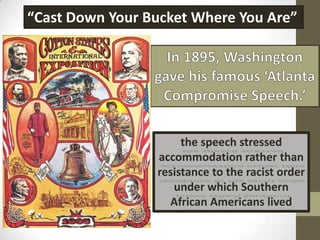
“Cast Down Your Bucket Where You Are”In 1895, Washington gave his famous ‘Atlanta Compromise Speech.’the speech stressed accommodation rather than resistance to the racist order under which Southern African Americans lived
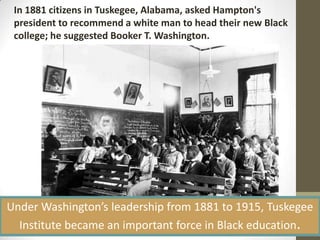
In 1881 citizens in Tuskegee, Alabama, asked Hampton's president to recommend a white man to head their new Black college; he suggested Booker T. Washington. Under Washington’s leadership from 1881 to 1915, Tuskegee Institute became an important force in Black education.
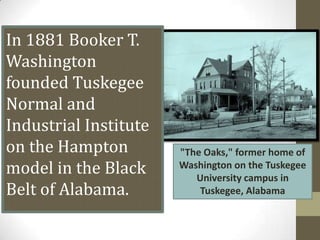
In 1881 Booker T. Washington founded Tuskegee Normal and Industrial Institute on the Hampton model in the Black Belt of Alabama. "The Oaks," former home of Washington on the Tuskegee University campus in Tuskegee, Alabama
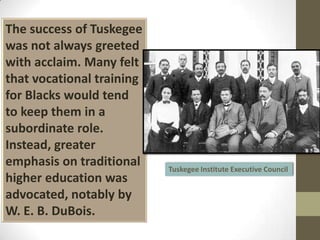
The success of Tuskegee was not always greeted with acclaim. Many felt that vocational training for Blacks would tend to keep them in a subordinate role. Instead, greater emphasis on traditional higher education was advocated, notably by W. E. B. DuBois.Tuskegee Institute Executive Council
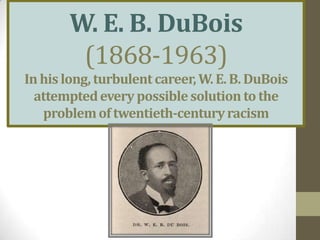
W. E. B. DuBois(1868-1963) In his long, turbulent career, W. E. B. DuBois attempted every possible solution to the problem of twentieth-century racism
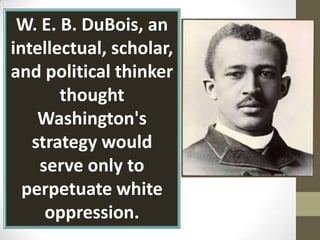
W. E. B. DuBois, an intellectual, scholar, and political thinker  thought Washington's strategy would serve only to perpetuate white oppression.
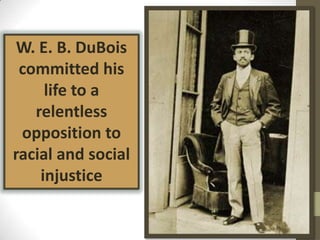
W. E. B. DuBoiscommitted his life to a relentless opposition to racial and social injustice
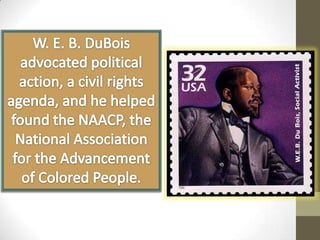
W. E. B. DuBois advocated political action, a civil rights agenda, and he helped found the NAACP, the National Association for the Advancement of Colored People.
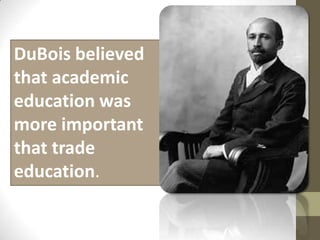
DuBois believed that academic education was more important that trade education.
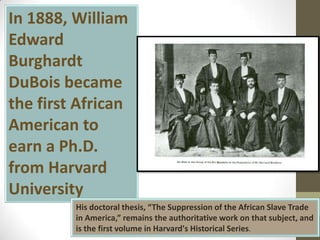
In 1888, William Edward BurghardtDuBois became  the first African American to earn a Ph.D. from Harvard UniversityHis doctoral thesis, “The Suppression of the African Slave Trade in America,” remains the authoritative work on that subject, and is the first volume in Harvard's Historical Series.
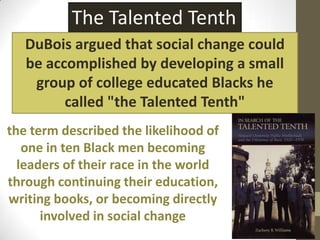
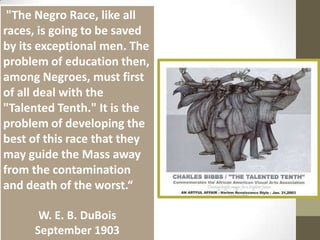
The Talented TenthDuBois argued that social change could be accomplished by developing a small group of college educated Blacks he called "the Talented Tenth"the term described the likelihood of one in ten Black men becoming leaders of their race in the world through continuing their education, writing books, or becoming directly involved in social change
 "The Negro Race, like all races, is going to be saved by its exceptional men. The problem of education then, among Negroes, must first of all deal with the "Talented Tenth." It is the problem of developing the best of this race that they may guide the Mass away from the contamination and death of the worst.“W. E. B. DuBoisSeptember 1903
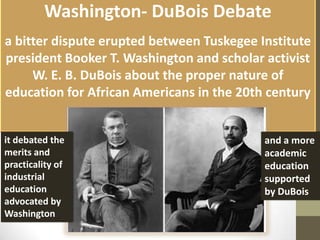
Washington- DuBois Debate  a bitter dispute erupted between Tuskegee Institute president Booker T. Washington and scholar activist W. E. B. DuBois about the proper nature of education for African Americans in the 20th century it debated the merits and practicality of industrial education advocated by Washington and a more academic education supported by DuBois
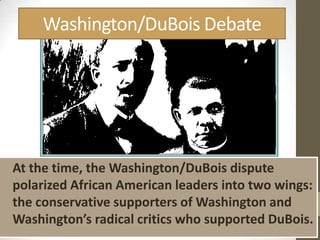
Washington/DuBois DebateAt the time, the Washington/DuBoisdispute polarized African American leaders into two wings: the conservative supporters of Washington and Washington’sradical critics who supported DuBois.
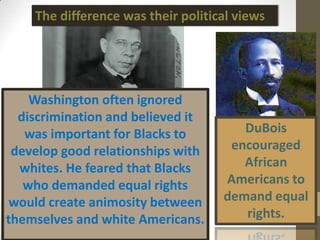
The difference was their political views Washington often ignored discriminationand believed it was important for Blacks to develop good relationships with whites. He feared that Blacks who demanded equal rights would create animosity between themselves and white Americans.DuBoisencouraged African Americans to demand equal rights.
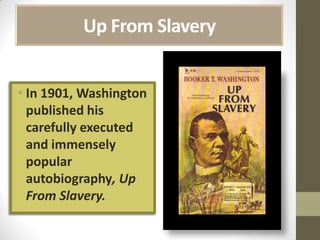
Up From SlaveryIn 1901, Washington published his carefully executed and immensely popular autobiography, Up From Slavery.
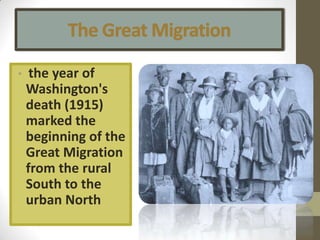
The Great Migrationthe year of Washington's death (1915) marked the beginning of the Great Migration from the rural South to the urban North
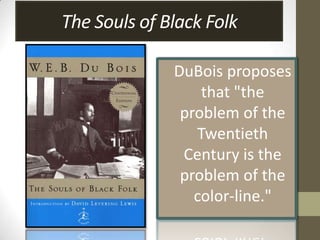
The Souls of Black FolkDuBoisproposes that "the problem of the Twentieth Century is the problem of the color-line."
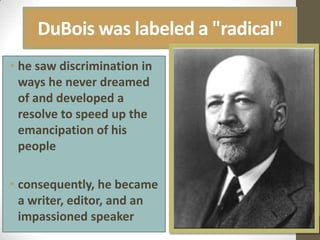
DuBois was labeled a "radical"he saw discrimination in ways he never dreamed of and developed a resolve to speed up the emancipation of his people consequently, he became a writer, editor, and an impassioned speaker
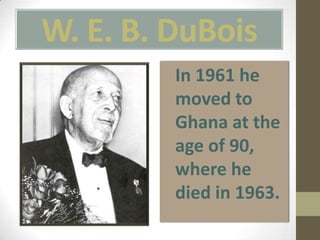
W. E. B. DuBoisIn 1961 he moved to Ghana at the age of 90, where he died in 1963.
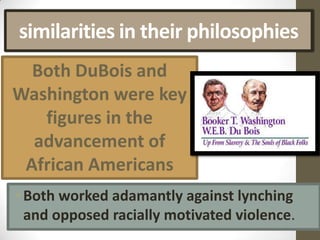
similarities in their philosophiesBoth DuBois and Washington were key figures in the advancement of African AmericansBoth worked adamantly against lynching and opposed racially motivated violence.
Booker T. Washington and W. E. B. DuBoisIn spite of their differences in approach toward equality for Blacks, the main thrust of each philosophy was first class citizenship for Black Americans.

W. e. b. du bois and washington

  • 1.
    Booker T. Washingtonand W. E. B. DuBois Two Leaders’ Different Schools of Thought
  • 2.
    Two great leadersof the Black community in the late 19th and 20th century were W. E. B. DuBois and Booker T. Washington. However, they sharply disagreed on strategies for Black social and economic progress.
  • 3.
    Booker T. Washingtonand W. E. B. DuBois were early leaders of African Americans during the days of Jim Crow. Both these men had hopes for their generation and for future generations, but their ideals were different.Booker T. Washington1856-1915W. E. B. DuBois1868-1963
  • 4.
    Booker T. Washington,educator and reformer preached a philosophy of self-help, racial solidarity, and accommodation urged Blacks to accept discrimination for the time being and focus on elevating themselves through hard work and material prosperity
  • 5.
    Many Blacks turnedto the historian and social scientist DuBoisfor leadership The Push for Political AgitationDuBoischampioned direct political agitation and political protest
  • 6.
    Booker T. Washingtonthemost influential Black leader of his time (1856 -1915)
  • 7.
    Booker Taliaferro WashingtonBookerTaliaferro was born on April 5, 1856 into slavery and was deemed the property of James Burroughs, a small farmer in Virginia.His mother was the plantation's cook. His father, a local white man, took no responsibility for him.Later, his mother married the slave, Washington Ferguson. When Booker entered school he took the name of his stepfather and became known as Booker T. Washington.
  • 8.
    At 16, hemade up his mind to leave home to attend Hampton Institute for Blacks.
  • 9.
    General Samuel ChapmanArmstrongUnion military commander of Black troops during the American Civil War and founder of Hampton Institute, a vocational educational school for Blacks emphasized manual training.
  • 10.
    Hampton Institute wasrun by white philanthropist, General Samuel Chapman Armstrong.He believed Blacks should have a practical trade and a Puritan work ethic and assumed that higher forms of studies (arts and literature ) would not helpAfrican Americans.
  • 11.
    Washington's trade was a janitor. These lessons of hard work and the proper role for Blacks as described by General Armstrong would profoundly affect the young Washington and shape his ideologies in later life.
  • 12.
    Washington believed in:Blackeducation in crafts, industrial, and farming skills Black cultivation of the virtues of patience, enterprise, and thrift Washington believed that African Americans would gain respect from the white community if they had trade skills
  • 13.
    “Cast Down YourBucket Where You Are”In 1895, Washington gave his famous ‘Atlanta Compromise Speech.’the speech stressed accommodation rather than resistance to the racist order under which Southern African Americans lived
  • 14.
    In 1881 citizensin Tuskegee, Alabama, asked Hampton's president to recommend a white man to head their new Black college; he suggested Booker T. Washington. Under Washington’s leadership from 1881 to 1915, Tuskegee Institute became an important force in Black education.
  • 15.
    In 1881 BookerT. Washington founded Tuskegee Normal and Industrial Institute on the Hampton model in the Black Belt of Alabama. "The Oaks," former home of Washington on the Tuskegee University campus in Tuskegee, Alabama
  • 16.
    The success ofTuskegee was not always greeted with acclaim. Many felt that vocational training for Blacks would tend to keep them in a subordinate role. Instead, greater emphasis on traditional higher education was advocated, notably by W. E. B. DuBois.Tuskegee Institute Executive Council
  • 17.
    W. E. B.DuBois(1868-1963) In his long, turbulent career, W. E. B. DuBois attempted every possible solution to the problem of twentieth-century racism
  • 18.
    W. E. B.DuBois, an intellectual, scholar, and political thinker thought Washington's strategy would serve only to perpetuate white oppression.
  • 19.
    W. E. B.DuBoiscommitted his life to a relentless opposition to racial and social injustice
  • 20.
    W. E. B.DuBois advocated political action, a civil rights agenda, and he helped found the NAACP, the National Association for the Advancement of Colored People.
  • 21.
    DuBois believed thatacademic education was more important that trade education.
  • 22.
    In 1888, WilliamEdward BurghardtDuBois became the first African American to earn a Ph.D. from Harvard UniversityHis doctoral thesis, “The Suppression of the African Slave Trade in America,” remains the authoritative work on that subject, and is the first volume in Harvard's Historical Series.
  • 23.
    The Talented TenthDuBoisargued that social change could be accomplished by developing a small group of college educated Blacks he called "the Talented Tenth"the term described the likelihood of one in ten Black men becoming leaders of their race in the world through continuing their education, writing books, or becoming directly involved in social change
  • 24.
    "The NegroRace, like all races, is going to be saved by its exceptional men. The problem of education then, among Negroes, must first of all deal with the "Talented Tenth." It is the problem of developing the best of this race that they may guide the Mass away from the contamination and death of the worst.“W. E. B. DuBoisSeptember 1903
  • 25.
    Washington- DuBois Debate a bitter dispute erupted between Tuskegee Institute president Booker T. Washington and scholar activist W. E. B. DuBois about the proper nature of education for African Americans in the 20th century it debated the merits and practicality of industrial education advocated by Washington and a more academic education supported by DuBois
  • 26.
    Washington/DuBois DebateAt thetime, the Washington/DuBoisdispute polarized African American leaders into two wings: the conservative supporters of Washington and Washington’sradical critics who supported DuBois.
  • 27.
    The difference wastheir political views Washington often ignored discriminationand believed it was important for Blacks to develop good relationships with whites. He feared that Blacks who demanded equal rights would create animosity between themselves and white Americans.DuBoisencouraged African Americans to demand equal rights.
  • 28.
    Up From SlaveryIn1901, Washington published his carefully executed and immensely popular autobiography, Up From Slavery.
  • 29.
    The Great Migrationtheyear of Washington's death (1915) marked the beginning of the Great Migration from the rural South to the urban North
  • 30.
    The Souls ofBlack FolkDuBoisproposes that "the problem of the Twentieth Century is the problem of the color-line."
  • 31.
    DuBois was labeleda "radical"he saw discrimination in ways he never dreamed of and developed a resolve to speed up the emancipation of his people consequently, he became a writer, editor, and an impassioned speaker
  • 32.
    W. E. B.DuBoisIn 1961 he moved to Ghana at the age of 90, where he died in 1963.
  • 33.
    similarities in theirphilosophiesBoth DuBois and Washington were key figures in the advancement of African AmericansBoth worked adamantly against lynching and opposed racially motivated violence.
  • 34.
    Booker T. Washingtonand W. E. B. DuBoisIn spite of their differences in approach toward equality for Blacks, the main thrust of each philosophy was first class citizenship for Black Americans.