Replace with manual graphic on slide master
Essentials of Fire Fighting
6th Edition
Firefighter I
Chapter 4 — Building
Construction
Describe the impact of fire on
common building materials.
Learning Objective 1
4–2
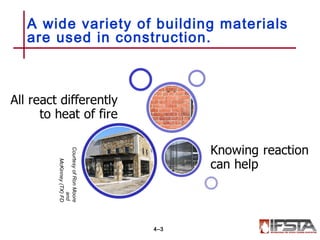
A wide variety of building materials
are used in construction.
4–3
CourtesyofRonMoore
and
McKinney(TX)FD
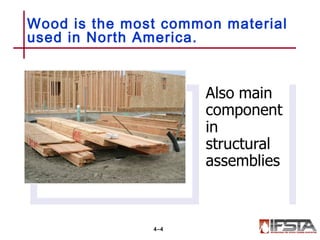
Wood is the most common material
used in North America.
4–4
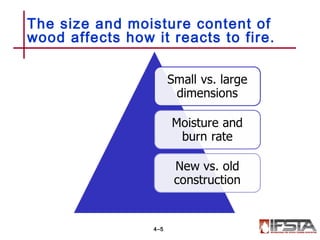
The size and moisture content of
wood affects how it reacts to fire.
4–5
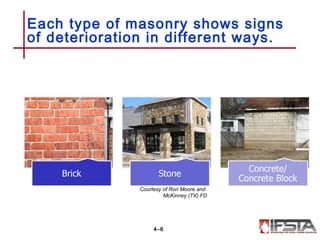
Each type of masonry shows signs
of deterioration in different ways.
4–6
Courtesy of Ron Moore and
McKinney (TX) FD
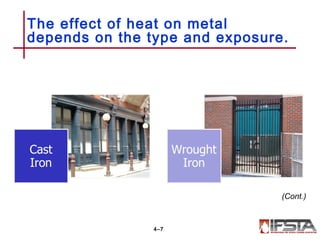
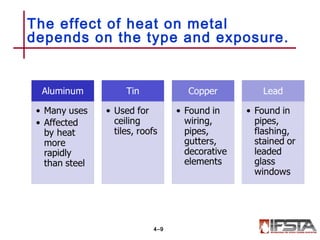
The effect of heat on metal
depends on the type and exposure.
4–7
(Cont.)
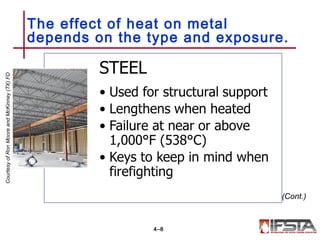
The effect of heat on metal
depends on the type and exposure.
4–8
(Cont.)
CourtesyofRonMooreandMcKinney(TX)FD
The effect of heat on metal
depends on the type and exposure.
4–9
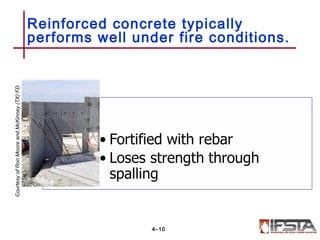
Reinforced concrete typically
performs well under fire conditions.
4–10
CourtesyofRonMooreandMcKinney(TX)FD
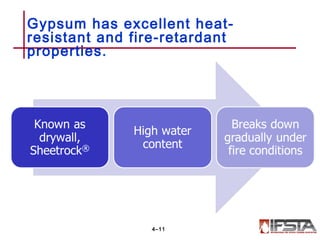
Gypsum has excellent heat-
resistant and fire-retardant
properties.
4–11
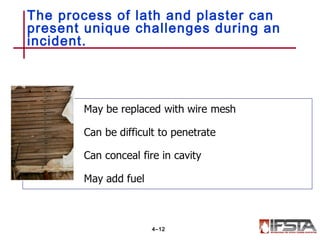
The process of lath and plaster can
present unique challenges during an
incident.
4–12
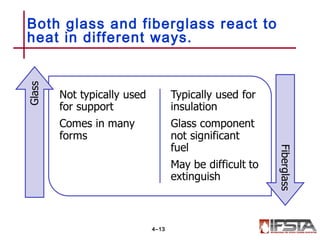
Both glass and fiberglass react to
heat in different ways.
4–13
DISCUSSION QUESTION
What types of insulation are commonly
found in your jurisdiction?
Why is this important to know?
4–14
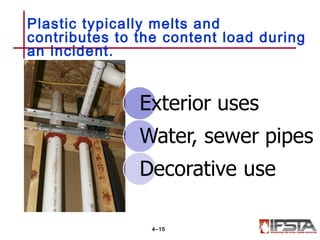
Plastic typically melts and
contributes to the content load during
an incident.
4–15
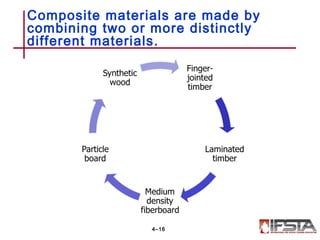
Composite materials are made by
combining two or more distinctly
different materials.
4–16
REVIEW QUESTION
What impact can fire have on
common building materials?
4–17
Explain the impact of fire on
construction classifications.
Learning Objective 2
4–18
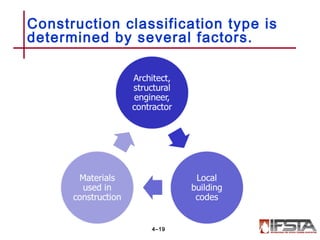
Construction classification type is
determined by several factors.
4–19
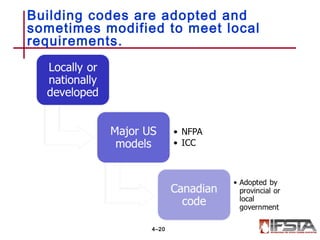
Building codes are adopted and
sometimes modified to meet local
requirements.
4–20
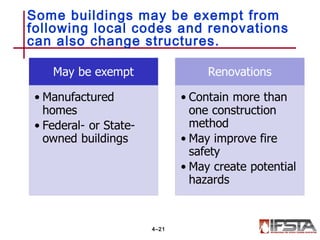
Some buildings may be exempt from
following local codes and renovations
can also change structures.
4–21
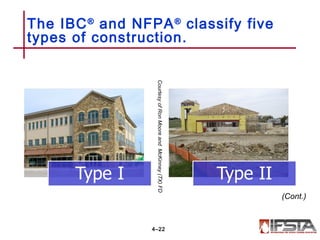
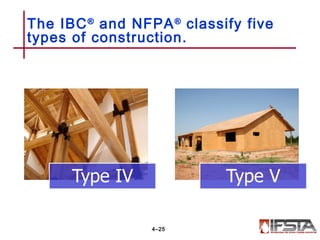
The IBC®
and NFPA®
classify five
types of construction.
4–22
(Cont.)
CourtesyofRonMooreandMcKinney(TX)FD
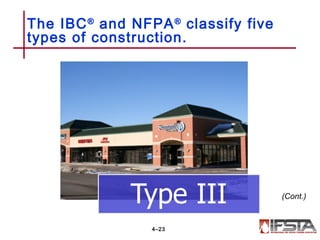
The IBC®
and NFPA®
classify five
types of construction.
4–23
(Cont.)
DISCUSSION QUESTION
What types of renovations are commonly
found in your jurisdiction?
How can firefighters monitor these?
4–24
The IBC®
and NFPA®
classify five
types of construction.
4–25
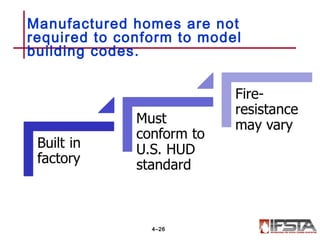
Manufactured homes are not
required to conform to model
building codes.
4–26
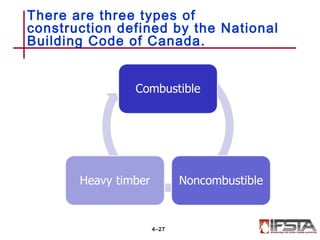
There are three types of
construction defined by the National
Building Code of Canada.
4–27
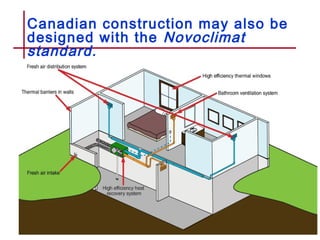
Canadian construction may also be
designed with the Novoclimat
standard.
4–28
REVIEW QUESTION
How are different construction
classifications affected by fire
suppression?
4–29
List the main types of occupancy
classifications.
Learning Objective 3
4–30
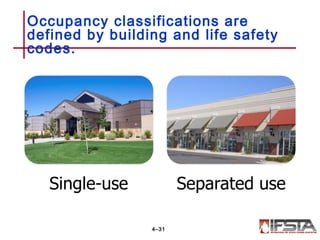
Occupancy classifications are
defined by building and life safety
codes.
4–31
REVIEW QUESTION
What are the main types of
occupancy classifications?
4–32
Describe the basic construction of
building components.
Learning Objective 4
4–33
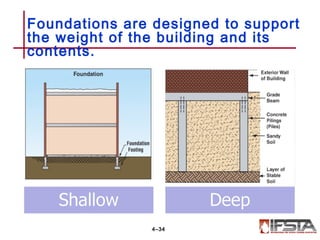
Foundations are designed to support
the weight of the building and its
contents.
4–34
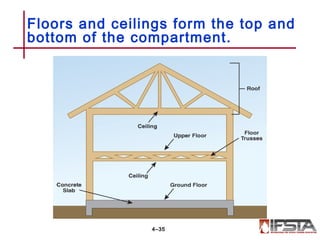
Floors and ceilings form the top and
bottom of the compartment.
4–35
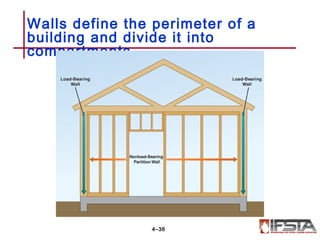
Walls define the perimeter of a
building and divide it into
compartments.
4–36
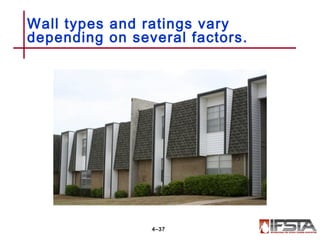
Wall types and ratings vary
depending on several factors.
4–37
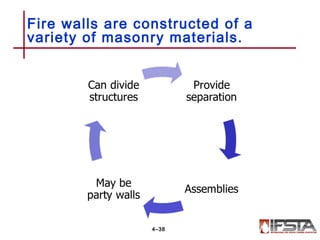
Fire walls are constructed of a
variety of masonry materials.
4–38
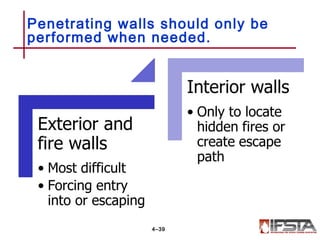
Penetrating walls should only be
performed when needed.
4–39
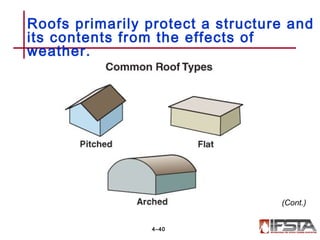
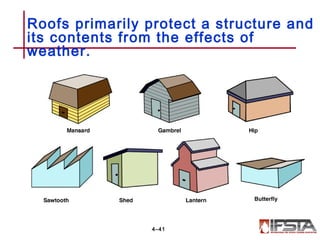
Roofs primarily protect a structure and
its contents from the effects of
weather.
4–40
(Cont.)
Roofs primarily protect a structure and
its contents from the effects of
weather.
4–41
DISCUSSION QUESTION
How does knowing that arched roofs
contribute to firefighter casualties impact
your need to understand building
construction?
What types of arched roofs are common
in your jurisdiction?
4–42
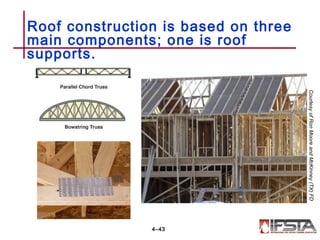
Roof construction is based on three
main components; one is roof
supports.
4–43
CourtesyofRonMooreandMcKinney(TX)FD
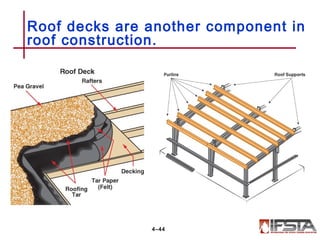
Roof decks are another component in
roof construction.
4–44
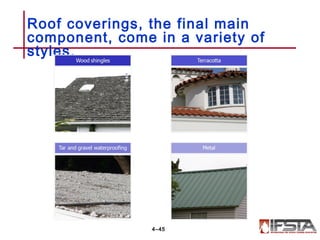
Roof coverings, the final main
component, come in a variety of
styles.
4–45
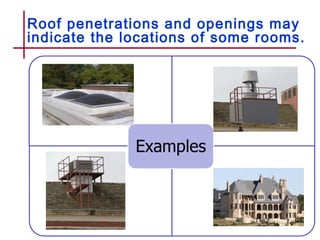
Roof penetrations and openings may
indicate the locations of some rooms.
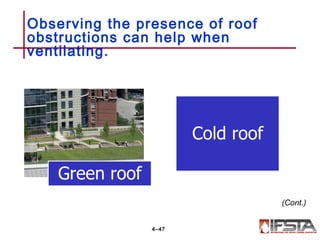
Observing the presence of roof
obstructions can help when
ventilating.
4–47
(Cont.)
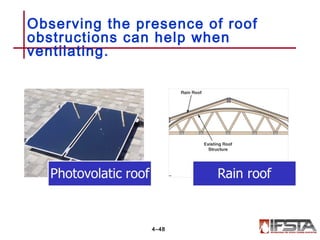
Observing the presence of roof
obstructions can help when
ventilating.
4–48
Security measures on roofs and other
areas can cause obstructions as well.
4–49
WARNING
Unauthorized security modifications
create extreme life safety hazards for
firefighters.
4–50
Structural modifications should, but
do not always, meet local building
codes.
4–51
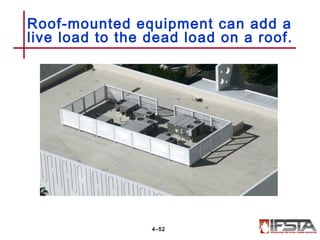
Roof-mounted equipment can add a
live load to the dead load on a roof.
4–52
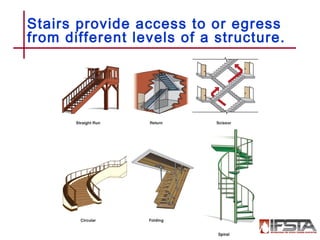
Stairs provide access to or egress
from different levels of a structure.
4–53
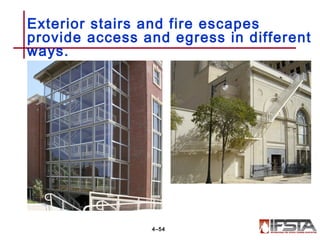
Exterior stairs and fire escapes
provide access and egress in different
ways.
4–54
DISCUSSION QUESTION
Why might fire escapes not be able to
support the weight of a firefighter?
4–55
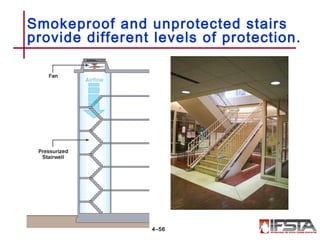
Smokeproof and unprotected stairs
provide different levels of protection.
4–56
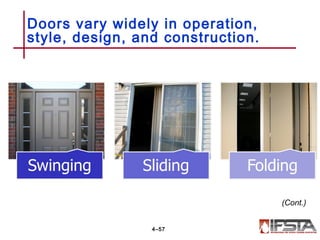
Doors vary widely in operation,
style, design, and construction.
4–57
(Cont.)
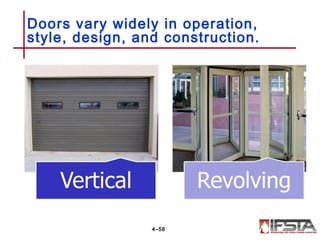
Doors vary widely in operation,
style, design, and construction.
4–58
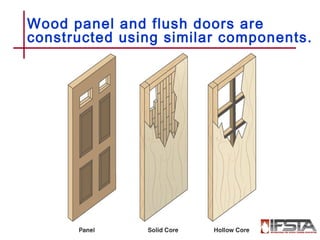
Wood panel and flush doors are
constructed using similar components.
4–59
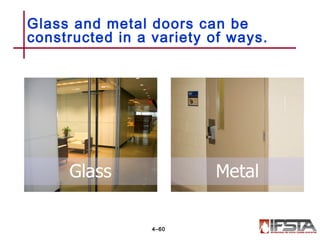
Glass and metal doors can be
constructed in a variety of ways.
4–60
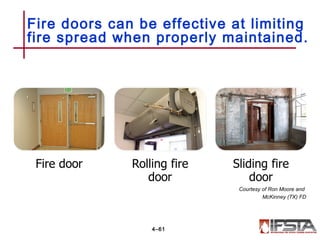
Fire doors can be effective at limiting
fire spread when properly maintained.
4–61
Courtesy of Ron Moore and
McKinney (TX) FD
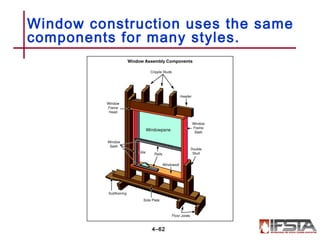
Window construction uses the same
components for many styles.
4–62
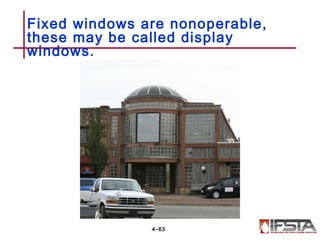
Fixed windows are nonoperable,
these may be called display
windows.
4–63
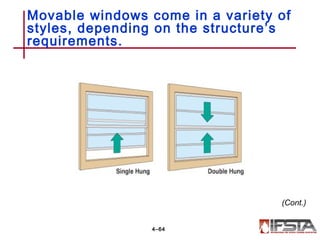
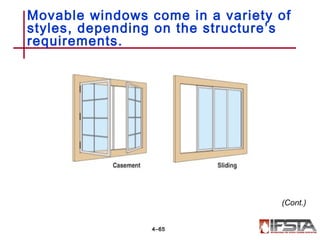
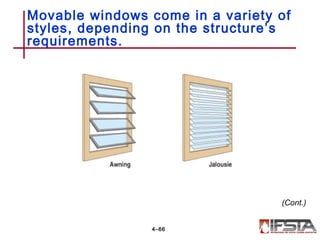
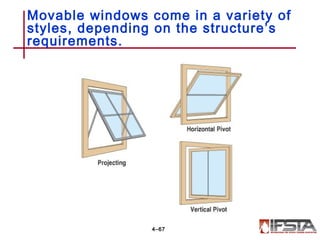
Movable windows come in a variety of
styles, depending on the structure’s
requirements.
4–64
(Cont.)
Movable windows come in a variety of
styles, depending on the structure’s
requirements.
4–65
(Cont.)
Movable windows come in a variety of
styles, depending on the structure’s
requirements.
4–66
(Cont.)
Movable windows come in a variety of
styles, depending on the structure’s
requirements.
4–67
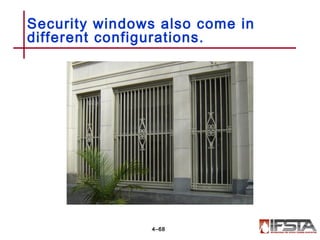
Security windows also come in
different configurations.
4–68
REVIEW QUESTION
In what ways can building
components impact fire suppression
efforts?
4–69
• Your safety when fighting fire depends
on your ability to know how the building
will contribute to and even control the
spread of fire.
• You must also understand the effect
fire and heat have on structural
components and materials to be able
to anticipate results.
Summary
4–70

4