1
ATMOSPHERE 2:
Weather
ppt. by Robin D. Seamon
2
How do we measure
Weather?
3
MEASURING AIR PRESSURE
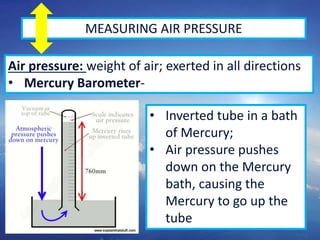
Air pressure: weight of air; exerted in all directions
• Mercury Barometer-
• Inverted tube in a bath
of Mercury;
• Air pressure pushes
down on the Mercury
bath, causing the
Mercury to go up the
tube
4
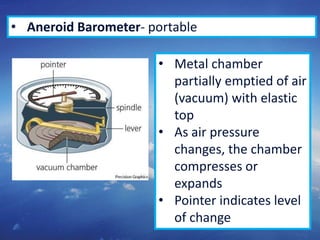
• Aneroid Barometer- portable
• Metal chamber
partially emptied of air
(vacuum) with elastic
top
• As air pressure
changes, the chamber
compresses or
expands
• Pointer indicates level
of change
5
• Electric Barometer- portable
1. Calibrate device: set barometer to local air
pressure setting (altitude) since factory settings
are at sea level
2. Place barometer- (Avoid AC rooms, sunlight,
drafty rooms)
3. Reference device: Set manual hand to current
reading
4. Check device for change in pressure
Daily changes: 0.02 – 0.10 inch
6
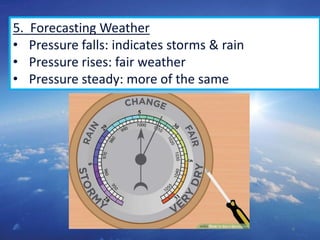
5. Forecasting Weather
• Pressure falls: indicates storms & rain
• Pressure rises: fair weather
• Pressure steady: more of the same
7
WIND
Wind: horizontal differences in air pressure; air
moves from areas of high pressure to areas of low
pressure
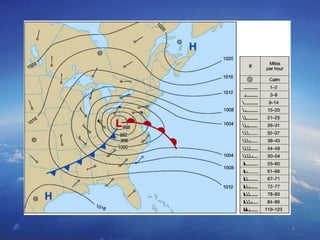
• pressure gradient- spacing of isobars show
amount of pressure change over a distance
• Isobars- closer spaced isobars = steep pressure
gradient/high winds
8
9
WIND :
1. Pressure difference: Solar radiation unevenly
heating atmosphere
2. Coriolis effect: Earth’s rotation affects movement
of objects; deflects objects to the right in N
Hemisphere
3. Friction: slows air masses near the surface
10
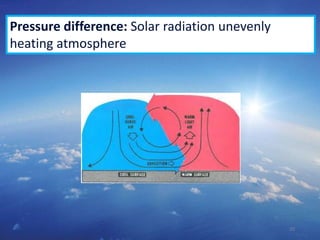
Pressure difference: Solar radiation unevenly
heating atmosphere
11
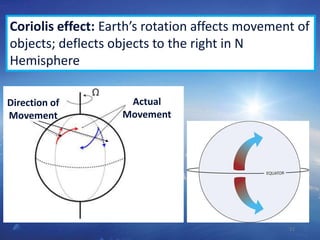
Coriolis effect: Earth’s rotation affects movement of
objects; deflects objects to the right in N
Hemisphere
Actual
Movement
Direction of
Movement
12
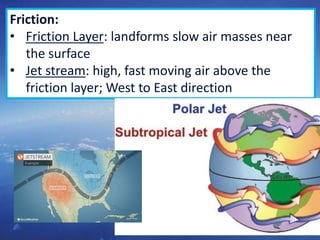
Friction:
• Friction Layer: landforms slow air masses near
the surface
• Jet stream: high, fast moving air above the
friction layer; West to East direction
13
HIGHS and LOWS
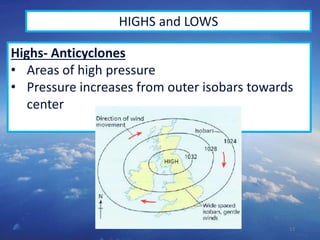
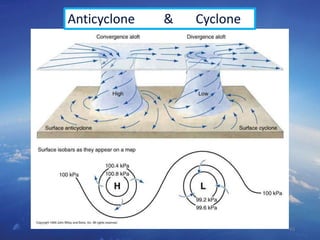
Highs- Anticyclones
• Areas of high pressure
• Pressure increases from outer isobars towards
center
14
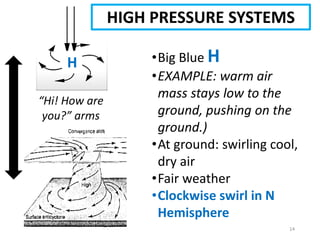
•Big Blue H
•EXAMPLE: warm air
mass stays low to the
ground, pushing on the
ground.)
•At ground: swirling cool,
dry air
•Fair weather
•Clockwise swirl in N
Hemisphere
“Hi! How are
you?” arms
HIGH PRESSURE SYSTEMS
H
15
HIGHS and LOWS
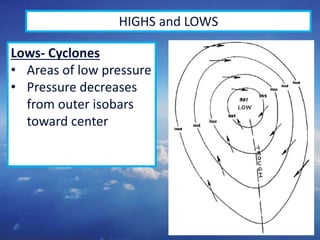
Lows- Cyclones
• Areas of low pressure
• Pressure decreases
from outer isobars
toward center
16
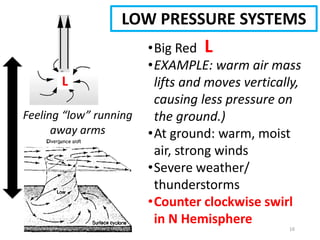
•Big Red L
•EXAMPLE: warm air mass
lifts and moves vertically,
causing less pressure on
the ground.)
•At ground: warm, moist
air, strong winds
•Severe weather/
thunderstorms
•Counter clockwise swirl
in N Hemisphere
Feeling “low” running
away arms
LOW PRESSURE SYSTEMS
L
L
17
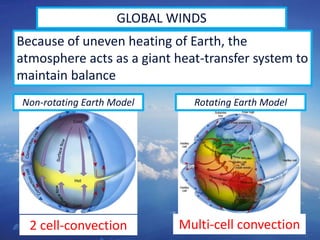
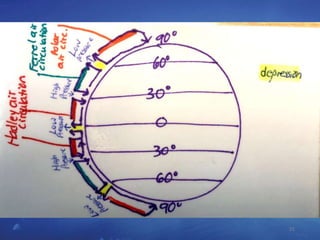
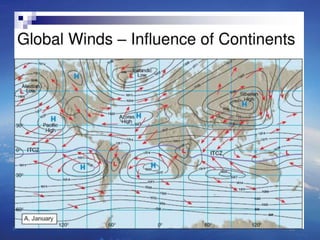
GLOBAL WINDS
Because of uneven heating of Earth, the
atmosphere acts as a giant heat-transfer system to
maintain balance
Non-rotating Earth Model Rotating Earth Model
2 cell-convection Multi-cell convection
18
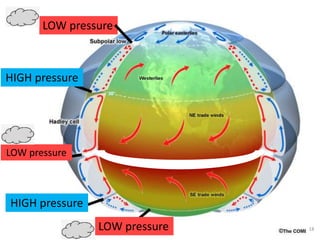
LOW pressure
LOW pressure
LOW pressure
HIGH pressure
HIGH pressure
19
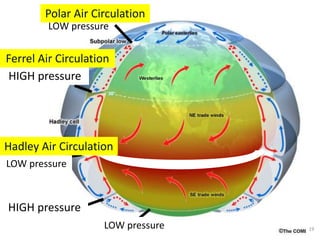
LOW pressure
LOW pressure
LOW pressure
HIGH pressure
HIGH pressure
Polar Air Circulation
Ferrel Air Circulation
Hadley Air Circulation
20
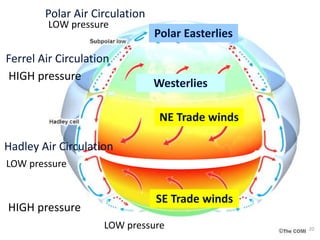
LOW pressure
LOW pressure
LOW pressure
HIGH pressure
HIGH pressure
Polar Air Circulation
Ferrel Air Circulation
Hadley Air Circulation
Polar Easterlies
Westerlies
NE Trade winds
SE Trade winds
21
22
23
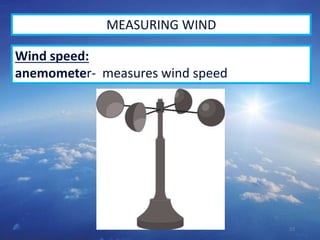
MEASURING WIND
Wind speed:
anemometer- measures wind speed
24
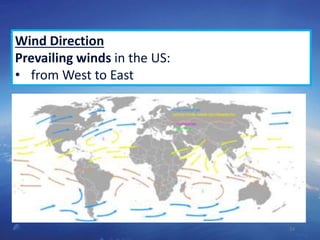
Wind Direction
Prevailing winds in the US:
• from West to East
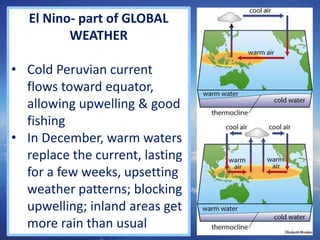
El Nino- part of GLOBAL
WEATHER
• Cold Peruvian current
flows toward equator,
allowing upwelling & good
fishing
• In December, warm waters
replace the current, lasting
for a few weeks, upsetting
weather patterns; blocking
upwelling; inland areas get
more rain than usual 25
26
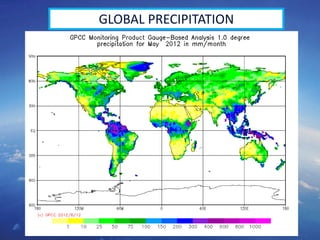
GLOBAL PRECIPITATION
27
Patterns
28
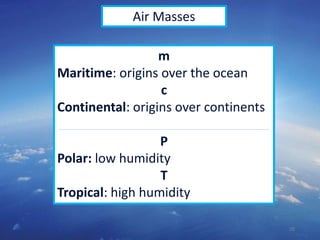
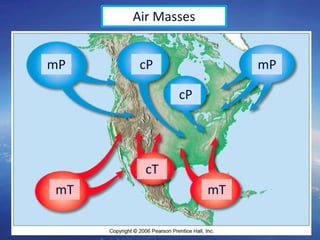
Air Masses
m
Maritime: origins over the ocean
c
Continental: origins over continents
P
Polar: low humidity
T
Tropical: high humidity
29
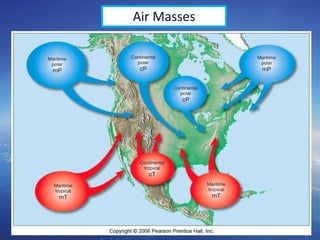
Air Masses
30
Air Masses
mP cP
cP
mP
cT
mT mT
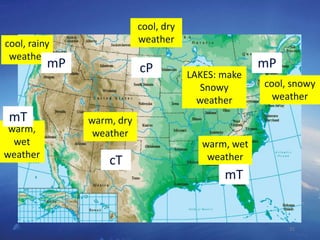
31
cool, rainy
weather
LAKES: make
Snowy
weather
warm, wet
weather
warm, dry
weatherwarm,
wet
weather
cool, snowy
weather
cool, dry
weather
mP cP mP
cT
mT
mT
32
Front:
boundary between two air masses
33
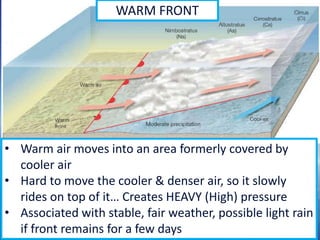
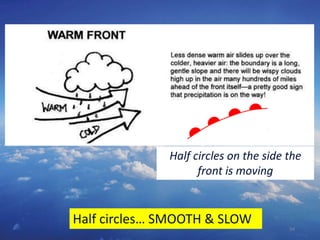
WARM FRONT
• Warm air moves into an area formerly covered by
cooler air
• Hard to move the cooler & denser air, so it slowly
rides on top of it… Creates HEAVY (High) pressure
• Associated with stable, fair weather, possible light rain
if front remains for a few days
34
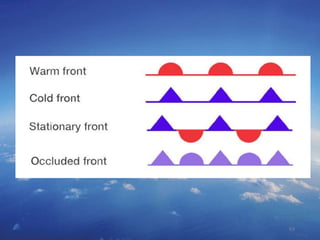
Half circles… SMOOTH & SLOW
Half circles on the side the
front is moving
35
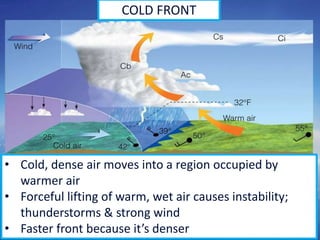
COLD FRONT
• Cold, dense air moves into a region occupied by
warmer air
• Forceful lifting of warm, wet air causes instability;
thunderstorms & strong wind
• Faster front because it’s denser
36
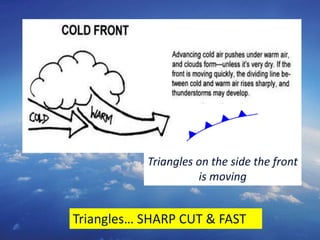
Faster b/c denser
Triangles on the side the front
is moving
Triangles… SHARP CUT & FAST
37
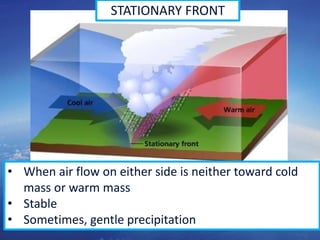
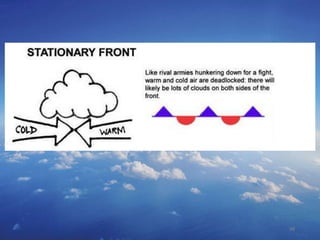
STATIONARY FRONT
• When air flow on either side is neither toward cold
mass or warm mass
• Stable
• Sometimes, gentle precipitation
38
39
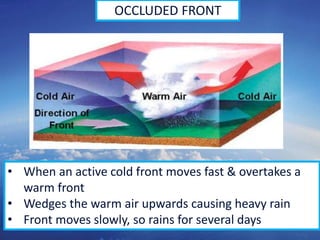
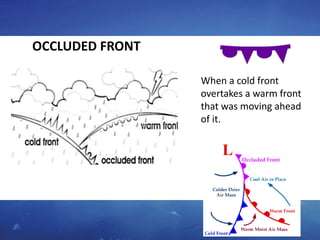
OCCLUDED FRONT
• When an active cold front moves fast & overtakes a
warm front
• Wedges the warm air upwards causing heavy rain
• Front moves slowly, so rains for several days
40
OCCLUDED FRONT
When a cold front
overtakes a warm front
that was moving ahead
of it.
41
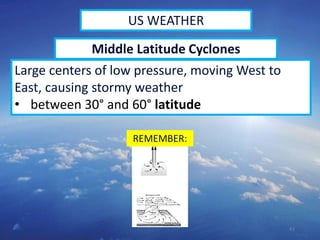
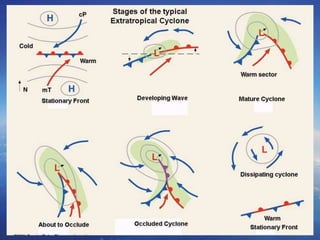
Middle Latitude Cyclones
Large centers of low pressure, moving West to
East, causing stormy weather
• between 30° and 60° latitude
US WEATHER
REMEMBER:
42
43
Anticyclone & Cyclone
44
STORMS
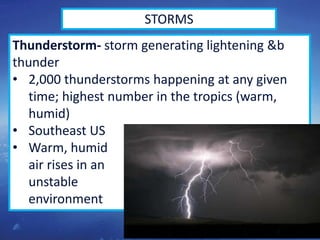
Thunderstorm- storm generating lightening &b
thunder
• 2,000 thunderstorms happening at any given
time; highest number in the tropics (warm,
humid)
• Southeast US
• Warm, humid
air rises in an
unstable
environment
45
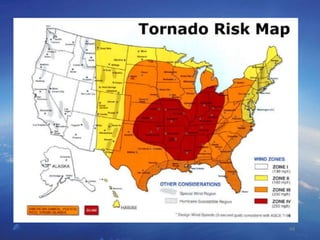
TORNADO
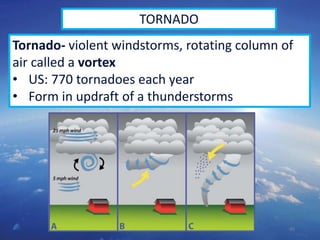
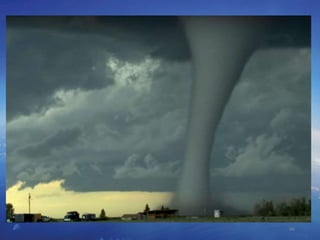
Tornado- violent windstorms, rotating column of
air called a vortex
• US: 770 tornadoes each year
• Form in updraft of a thunderstorms
46
47
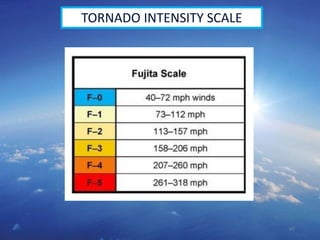
TORNADO INTENSITY SCALE
48
49
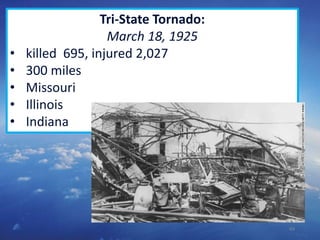
Tri-State Tornado:
March 18, 1925
• killed 695, injured 2,027
• 300 miles
• Missouri
• Illinois
• Indiana
50
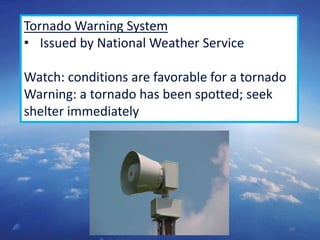
Tornado Warning System
• Issued by National Weather Service
Watch: conditions are favorable for a tornado
Warning: a tornado has been spotted; seek
shelter immediately
51
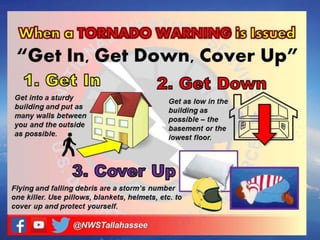
TORNADO SAFETY
• Go to low ground: basement, ditch
• Avoid windows
• Leave mobile home
• At school: follow the drill- interior hallway,
cover head
• Leave vehicle, find a low ditch, cover head
AFTER:
• Do NOT touch downed power lines or sharp
objects
• Stay out of heavily damaged buildings
52
53
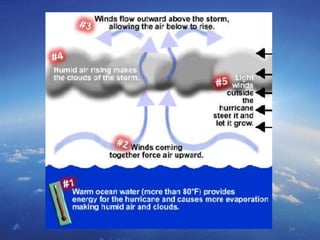
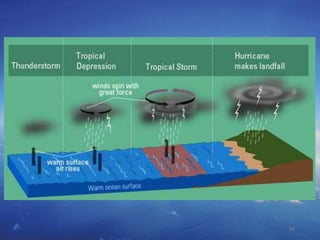
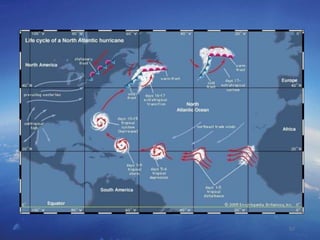
HURRICANE
Hurricane- whirling tropical cyclones producing
winds of at least 74 mph
• Name is regional:
• Hurricane
• Typhoon
• Cyclone
• Tropical cyclone
• Associated with storm surges and flooding
• Occurrences seem to be increasing with global
warming
54
55
56
57
58
59
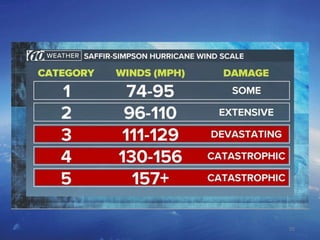
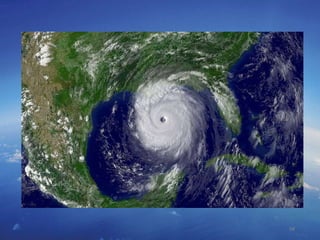
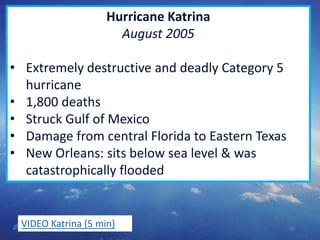
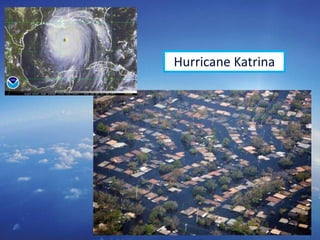
Hurricane Katrina
August 2005
• Extremely destructive and deadly Category 5
hurricane
• 1,800 deaths
• Struck Gulf of Mexico
• Damage from central Florida to Eastern Texas
• New Orleans: sits below sea level & was
catastrophically flooded
VIDEO Katrina (5 min)
60
Hurricane Katrina
61
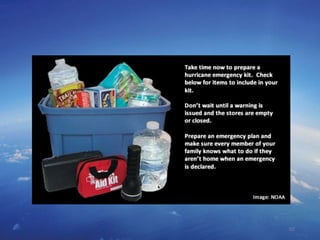
HURRICANE SAFETY
• Easily predicted, so pay attention to weather
forecasts
• Prepare: food, water, flashlight, first aid kit
• Stay indoors during hurricanes
• Heed local warnings; if an evacuation is
called, LEAVE before the hurricane
• Know evacuation routes
62
63

Atmosphere 2

  • 1.
  • 2.
    2 How do wemeasure Weather?
  • 3.
    3 MEASURING AIR PRESSURE Airpressure: weight of air; exerted in all directions • Mercury Barometer- • Inverted tube in a bath of Mercury; • Air pressure pushes down on the Mercury bath, causing the Mercury to go up the tube
  • 4.
    4 • Aneroid Barometer-portable • Metal chamber partially emptied of air (vacuum) with elastic top • As air pressure changes, the chamber compresses or expands • Pointer indicates level of change
  • 5.
    5 • Electric Barometer-portable 1. Calibrate device: set barometer to local air pressure setting (altitude) since factory settings are at sea level 2. Place barometer- (Avoid AC rooms, sunlight, drafty rooms) 3. Reference device: Set manual hand to current reading 4. Check device for change in pressure Daily changes: 0.02 – 0.10 inch
  • 6.
    6 5. Forecasting Weather •Pressure falls: indicates storms & rain • Pressure rises: fair weather • Pressure steady: more of the same
  • 7.
    7 WIND Wind: horizontal differencesin air pressure; air moves from areas of high pressure to areas of low pressure • pressure gradient- spacing of isobars show amount of pressure change over a distance • Isobars- closer spaced isobars = steep pressure gradient/high winds
  • 8.
  • 9.
    9 WIND : 1. Pressuredifference: Solar radiation unevenly heating atmosphere 2. Coriolis effect: Earth’s rotation affects movement of objects; deflects objects to the right in N Hemisphere 3. Friction: slows air masses near the surface
  • 10.
    10 Pressure difference: Solarradiation unevenly heating atmosphere
  • 11.
    11 Coriolis effect: Earth’srotation affects movement of objects; deflects objects to the right in N Hemisphere Actual Movement Direction of Movement
  • 12.
    12 Friction: • Friction Layer:landforms slow air masses near the surface • Jet stream: high, fast moving air above the friction layer; West to East direction
  • 13.
    13 HIGHS and LOWS Highs-Anticyclones • Areas of high pressure • Pressure increases from outer isobars towards center
  • 14.
    14 •Big Blue H •EXAMPLE:warm air mass stays low to the ground, pushing on the ground.) •At ground: swirling cool, dry air •Fair weather •Clockwise swirl in N Hemisphere “Hi! How are you?” arms HIGH PRESSURE SYSTEMS H
  • 15.
    15 HIGHS and LOWS Lows-Cyclones • Areas of low pressure • Pressure decreases from outer isobars toward center
  • 16.
    16 •Big Red L •EXAMPLE:warm air mass lifts and moves vertically, causing less pressure on the ground.) •At ground: warm, moist air, strong winds •Severe weather/ thunderstorms •Counter clockwise swirl in N Hemisphere Feeling “low” running away arms LOW PRESSURE SYSTEMS L L
  • 17.
    17 GLOBAL WINDS Because ofuneven heating of Earth, the atmosphere acts as a giant heat-transfer system to maintain balance Non-rotating Earth Model Rotating Earth Model 2 cell-convection Multi-cell convection
  • 18.
    18 LOW pressure LOW pressure LOWpressure HIGH pressure HIGH pressure
  • 19.
    19 LOW pressure LOW pressure LOWpressure HIGH pressure HIGH pressure Polar Air Circulation Ferrel Air Circulation Hadley Air Circulation
  • 20.
    20 LOW pressure LOW pressure LOWpressure HIGH pressure HIGH pressure Polar Air Circulation Ferrel Air Circulation Hadley Air Circulation Polar Easterlies Westerlies NE Trade winds SE Trade winds
  • 21.
  • 22.
  • 23.
  • 24.
    24 Wind Direction Prevailing windsin the US: • from West to East
  • 25.
    El Nino- partof GLOBAL WEATHER • Cold Peruvian current flows toward equator, allowing upwelling & good fishing • In December, warm waters replace the current, lasting for a few weeks, upsetting weather patterns; blocking upwelling; inland areas get more rain than usual 25
  • 26.
  • 27.
  • 28.
    28 Air Masses m Maritime: originsover the ocean c Continental: origins over continents P Polar: low humidity T Tropical: high humidity
  • 29.
  • 30.
  • 31.
    31 cool, rainy weather LAKES: make Snowy weather warm,wet weather warm, dry weatherwarm, wet weather cool, snowy weather cool, dry weather mP cP mP cT mT mT
  • 32.
  • 33.
    33 WARM FRONT • Warmair moves into an area formerly covered by cooler air • Hard to move the cooler & denser air, so it slowly rides on top of it… Creates HEAVY (High) pressure • Associated with stable, fair weather, possible light rain if front remains for a few days
  • 34.
    34 Half circles… SMOOTH& SLOW Half circles on the side the front is moving
  • 35.
    35 COLD FRONT • Cold,dense air moves into a region occupied by warmer air • Forceful lifting of warm, wet air causes instability; thunderstorms & strong wind • Faster front because it’s denser
  • 36.
    36 Faster b/c denser Triangleson the side the front is moving Triangles… SHARP CUT & FAST
  • 37.
    37 STATIONARY FRONT • Whenair flow on either side is neither toward cold mass or warm mass • Stable • Sometimes, gentle precipitation
  • 38.
  • 39.
    39 OCCLUDED FRONT • Whenan active cold front moves fast & overtakes a warm front • Wedges the warm air upwards causing heavy rain • Front moves slowly, so rains for several days
  • 40.
    40 OCCLUDED FRONT When acold front overtakes a warm front that was moving ahead of it.
  • 41.
    41 Middle Latitude Cyclones Largecenters of low pressure, moving West to East, causing stormy weather • between 30° and 60° latitude US WEATHER REMEMBER:
  • 42.
  • 43.
  • 44.
    44 STORMS Thunderstorm- storm generatinglightening &b thunder • 2,000 thunderstorms happening at any given time; highest number in the tropics (warm, humid) • Southeast US • Warm, humid air rises in an unstable environment
  • 45.
    45 TORNADO Tornado- violent windstorms,rotating column of air called a vortex • US: 770 tornadoes each year • Form in updraft of a thunderstorms
  • 46.
  • 47.
  • 48.
  • 49.
    49 Tri-State Tornado: March 18,1925 • killed 695, injured 2,027 • 300 miles • Missouri • Illinois • Indiana
  • 50.
    50 Tornado Warning System •Issued by National Weather Service Watch: conditions are favorable for a tornado Warning: a tornado has been spotted; seek shelter immediately
  • 51.
    51 TORNADO SAFETY • Goto low ground: basement, ditch • Avoid windows • Leave mobile home • At school: follow the drill- interior hallway, cover head • Leave vehicle, find a low ditch, cover head AFTER: • Do NOT touch downed power lines or sharp objects • Stay out of heavily damaged buildings
  • 52.
  • 53.
    53 HURRICANE Hurricane- whirling tropicalcyclones producing winds of at least 74 mph • Name is regional: • Hurricane • Typhoon • Cyclone • Tropical cyclone • Associated with storm surges and flooding • Occurrences seem to be increasing with global warming
  • 54.
  • 55.
  • 56.
  • 57.
  • 58.
  • 59.
    59 Hurricane Katrina August 2005 •Extremely destructive and deadly Category 5 hurricane • 1,800 deaths • Struck Gulf of Mexico • Damage from central Florida to Eastern Texas • New Orleans: sits below sea level & was catastrophically flooded VIDEO Katrina (5 min)
  • 60.
  • 61.
    61 HURRICANE SAFETY • Easilypredicted, so pay attention to weather forecasts • Prepare: food, water, flashlight, first aid kit • Stay indoors during hurricanes • Heed local warnings; if an evacuation is called, LEAVE before the hurricane • Know evacuation routes
  • 62.
  • 63.