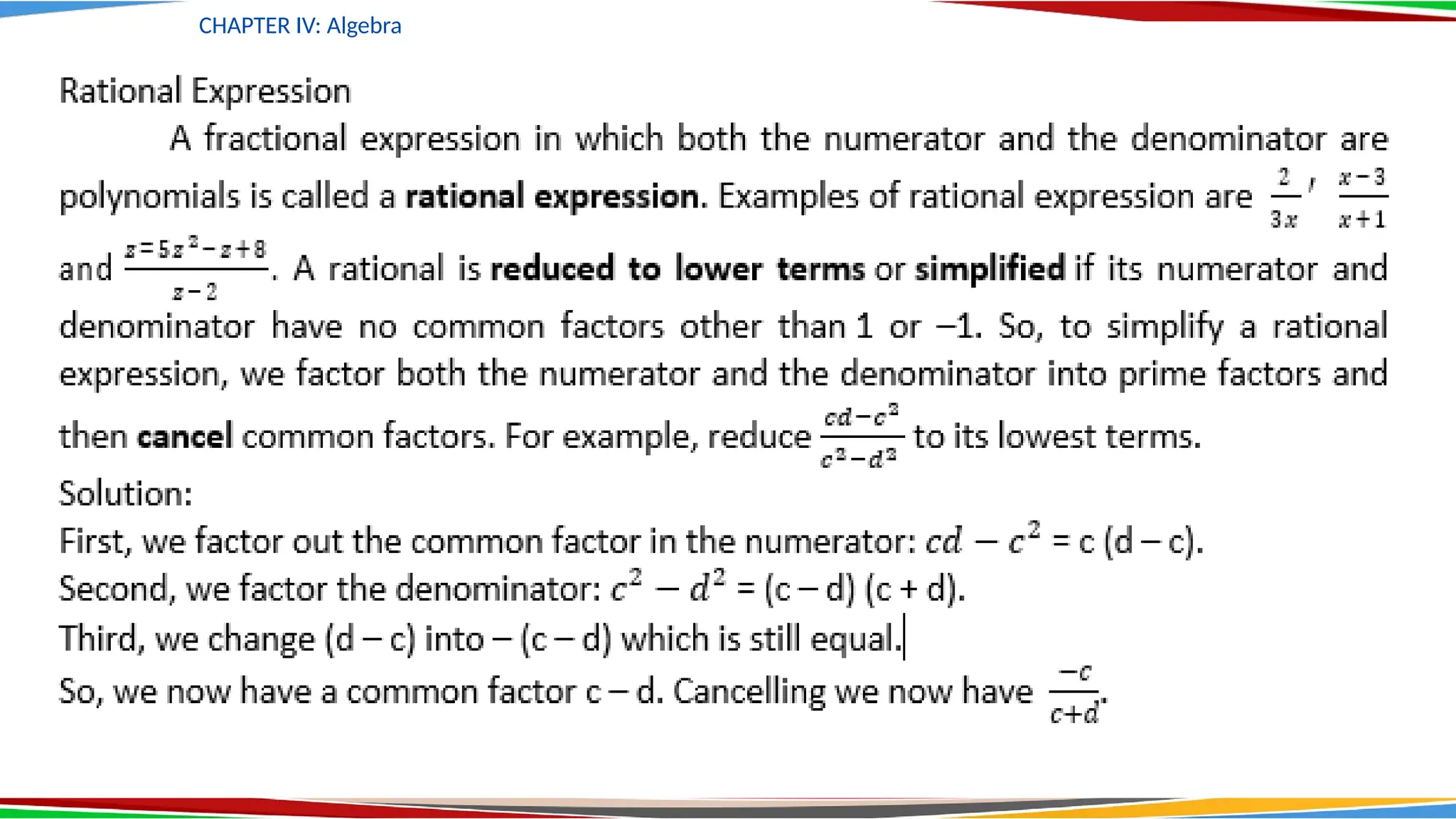
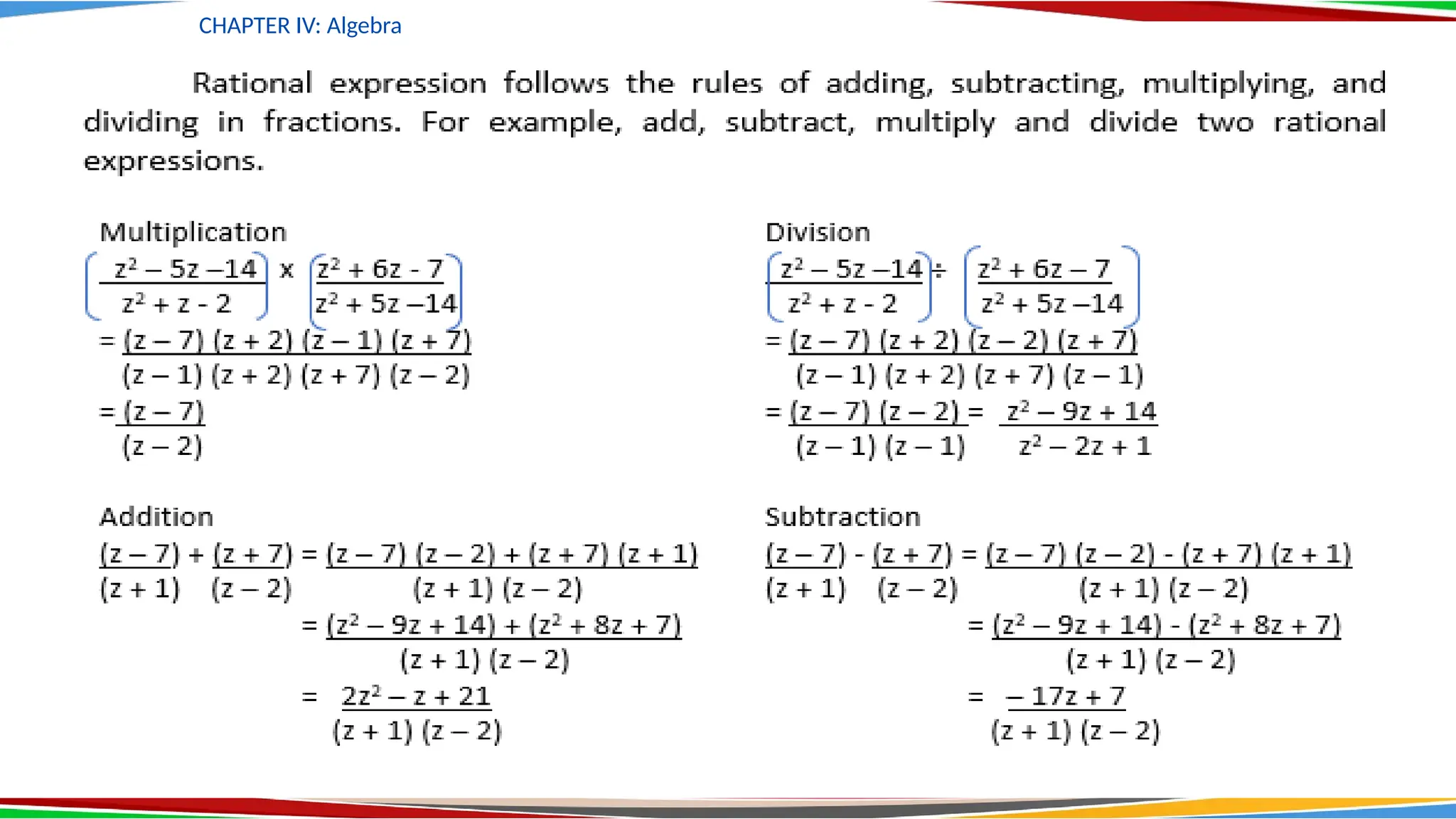
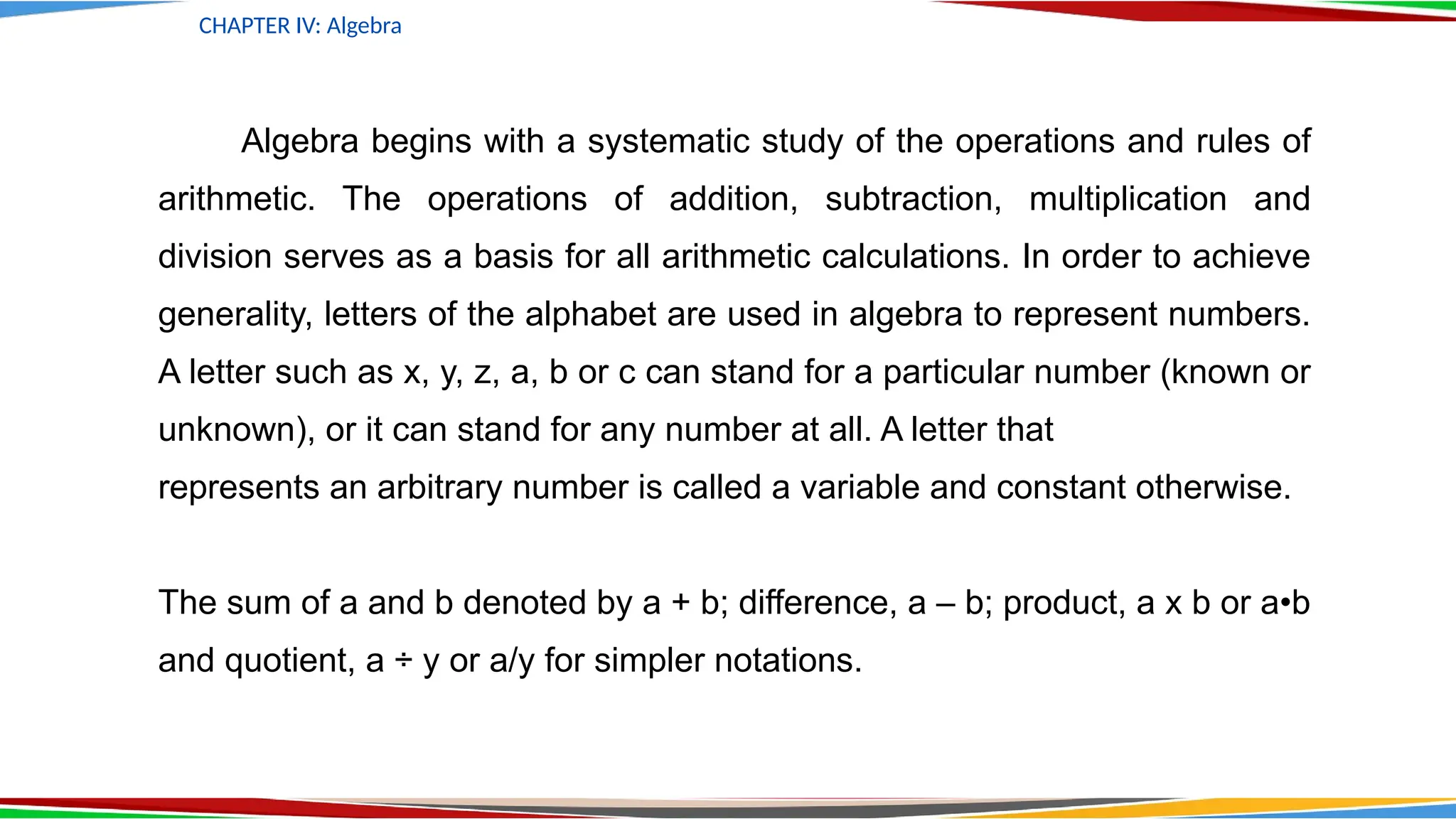
Algebra begins witha systematic study of the operations and rules of
arithmetic. The operations of addition, subtraction, multiplication and
division serves as a basis for all arithmetic calculations. In order to achieve
generality, letters of the alphabet are used in algebra to represent numbers.
A letter such as x, y, z, a, b or c can stand for a particular number (known or
unknown), or it can stand for any number at all. A letter that
represents an arbitrary number is called a variable and constant otherwise.
The sum of a and b denoted by a + b; difference, a – b; product, a x b or a•b
and quotient, a ÷ y or a/y for simpler notations.
CHAPTER IV: Algebra
6.
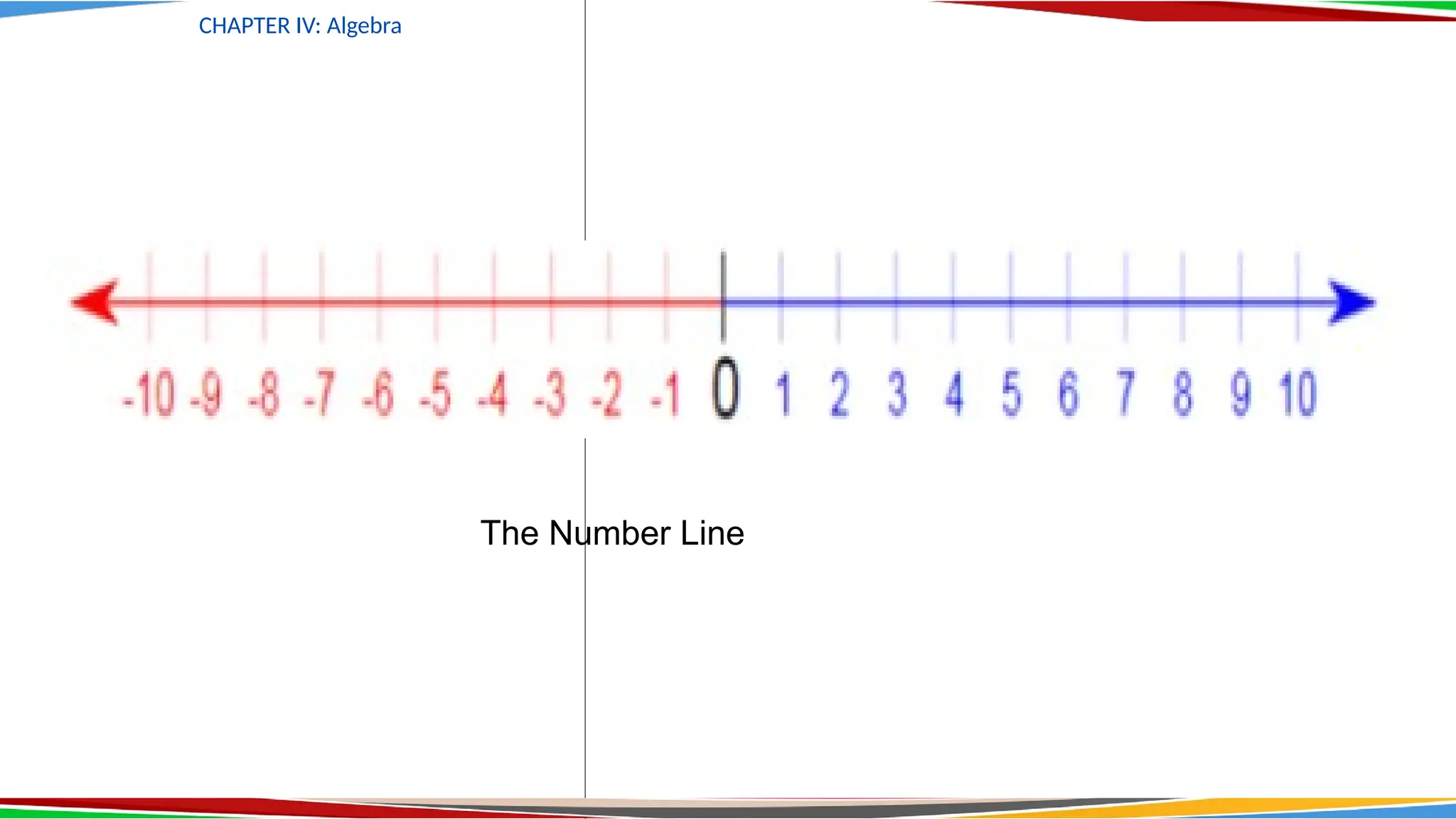
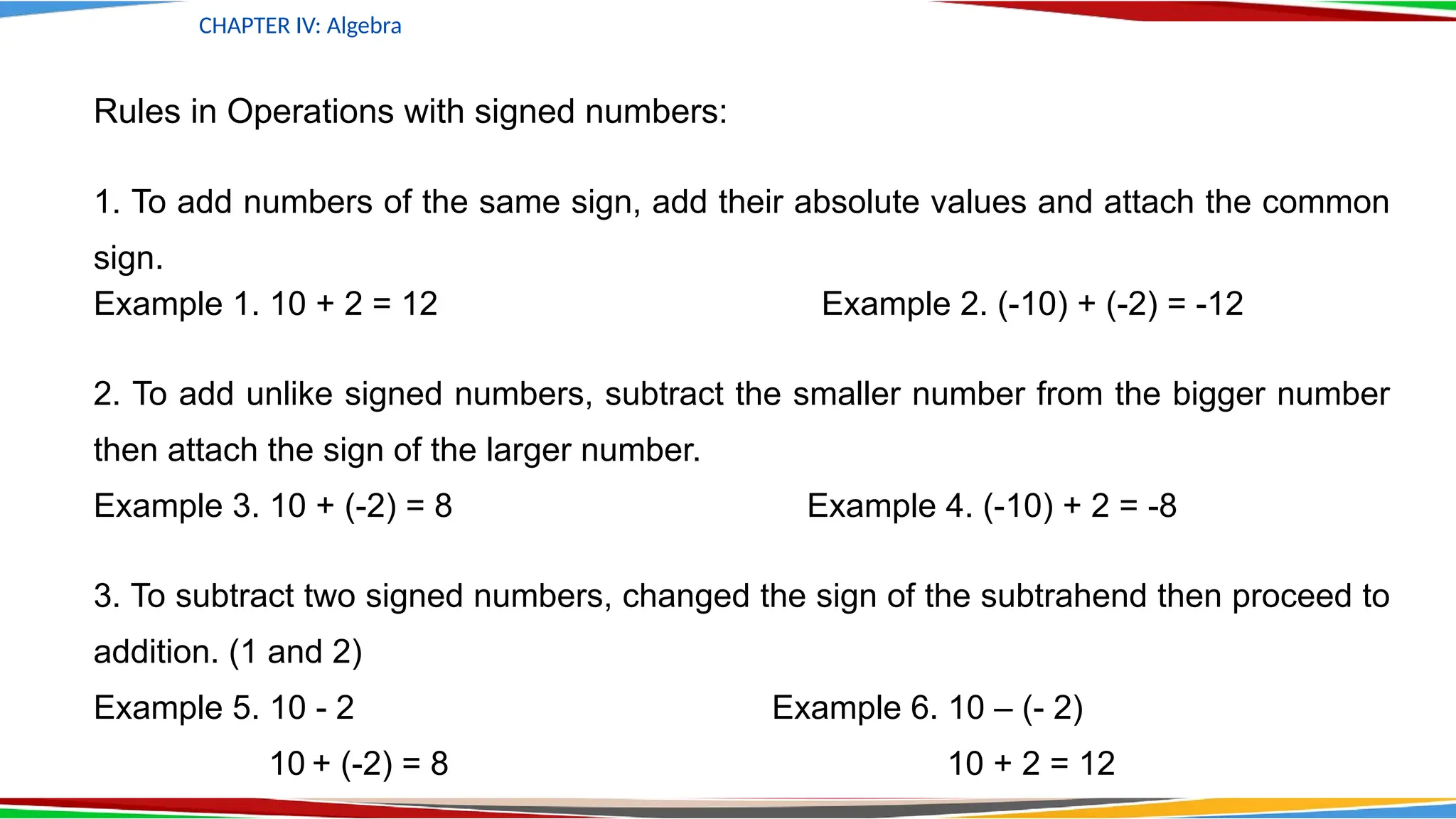
Rules in Operationswith signed numbers:
1. To add numbers of the same sign, add their absolute values and attach the common
sign.
Example 1. 10 + 2 = 12 Example 2. (-10) + (-2) = -12
2. To add unlike signed numbers, subtract the smaller number from the bigger number
then attach the sign of the larger number.
Example 3. 10 + (-2) = 8 Example 4. (-10) + 2 = -8
3. To subtract two signed numbers, changed the sign of the subtrahend then proceed to
addition. (1 and 2)
Example 5. 10 - 2 Example 6. 10 – (- 2)
10 + (-2) = 8 10 + 2 = 12
CHAPTER IV: Algebra
7.
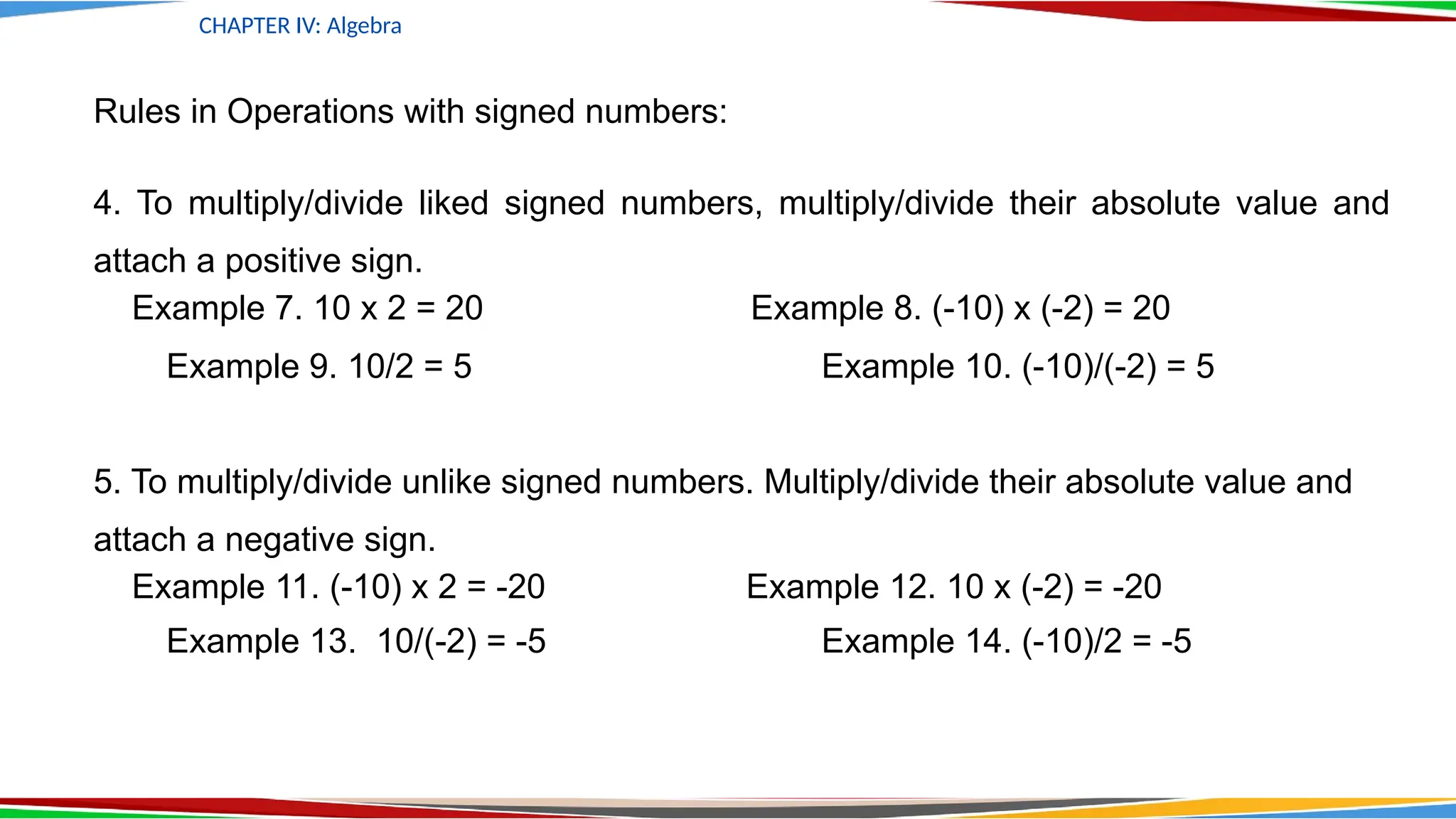
Rules in Operationswith signed numbers:
4. To multiply/divide liked signed numbers, multiply/divide their absolute value and
attach a positive sign.
Example 7. 10 x 2 = 20 Example 8. (-10) x (-2) = 20
Example 9. 10/2 = 5 Example 10. (-10)/(-2) = 5
5. To multiply/divide unlike signed numbers. Multiply/divide their absolute value and
attach a negative sign.
Example 11. (-10) x 2 = -20 Example 12. 10 x (-2) = -20
Example 13. 10/(-2) = -5 Example 14. (-10)/2 = -5
CHAPTER IV: Algebra
8.
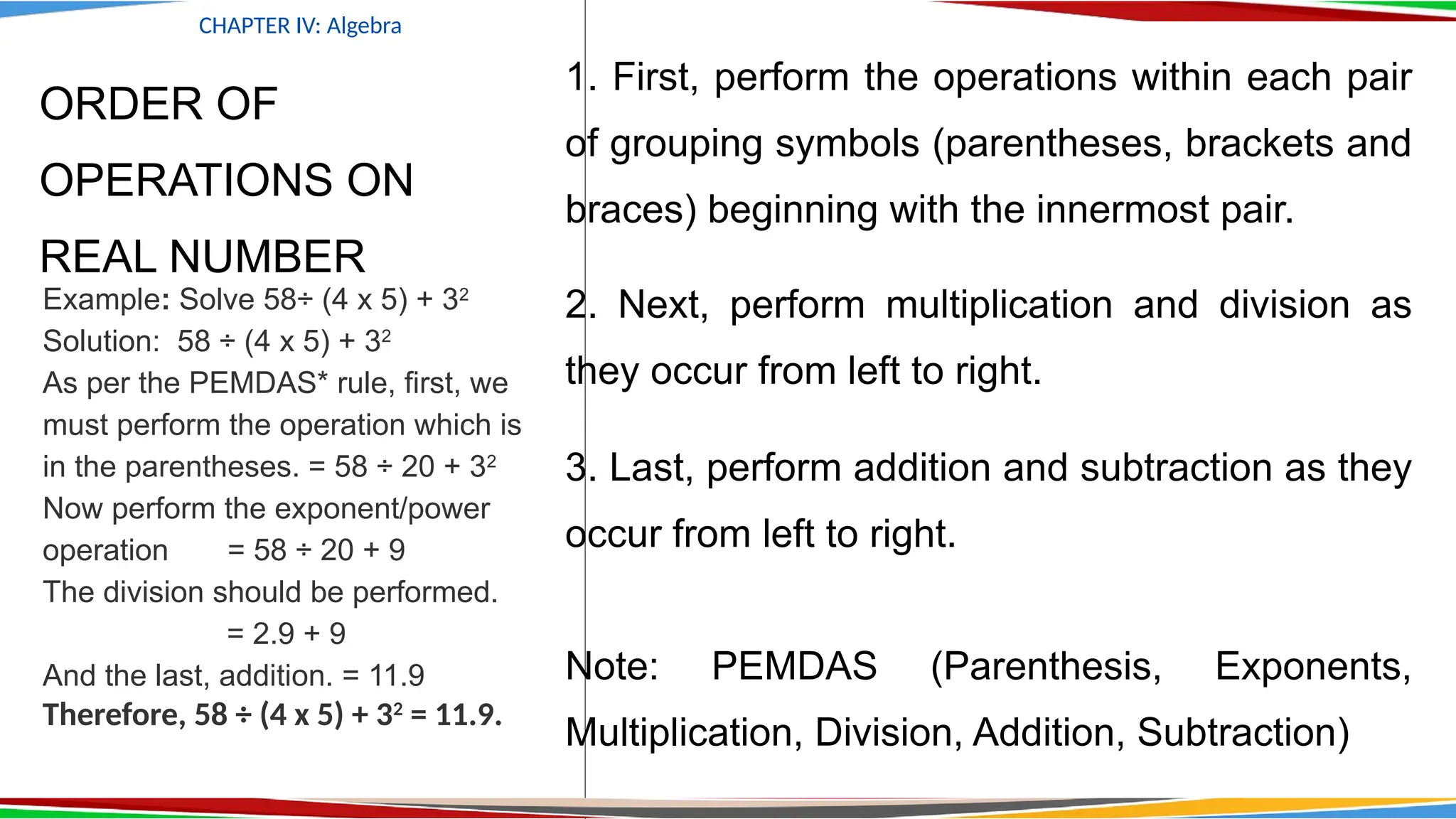
ORDER OF
OPERATIONS ON
REALNUMBER
1. First, perform the operations within each pair
of grouping symbols (parentheses, brackets and
braces) beginning with the innermost pair.
2. Next, perform multiplication and division as
they occur from left to right.
3. Last, perform addition and subtraction as they
occur from left to right.
Note: PEMDAS (Parenthesis, Exponents,
Multiplication, Division, Addition, Subtraction)
CHAPTER IV: Algebra
Example: Solve 58÷ (4 x 5) + 32
Solution: 58 ÷ (4 x 5) + 32
As per the PEMDAS* rule, first, we
must perform the operation which is
in the parentheses. = 58 ÷ 20 + 32
Now perform the exponent/power
operation = 58 ÷ 20 + 9
The division should be performed.
= 2.9 + 9
And the last, addition. = 11.9
Therefore, 58 ÷ (4 x 5) + 32
= 11.9.
9.
CHAPTER IV: Algebra
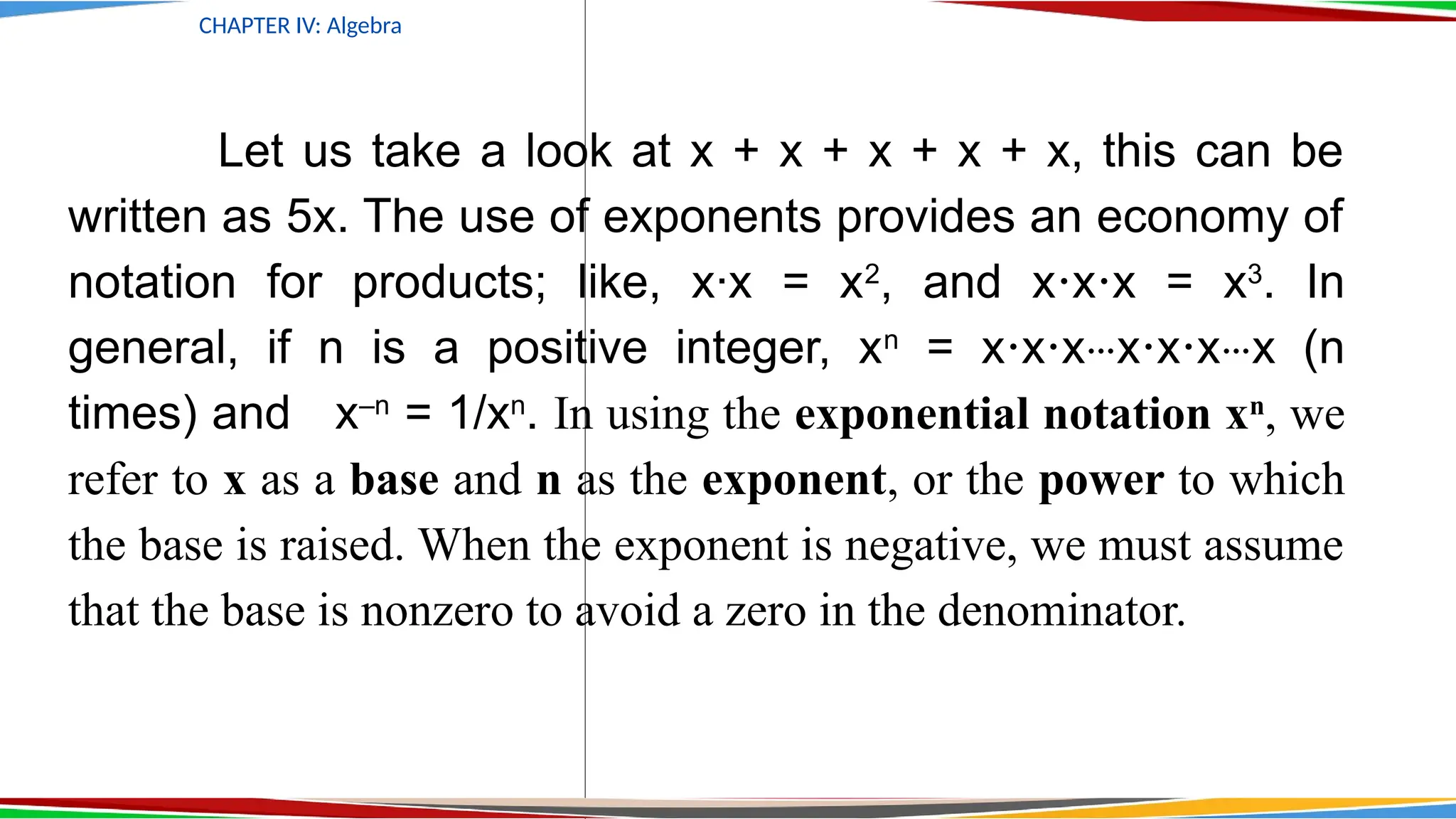
Letus take a look at x + x + x + x + x, this can be
written as 5x. The use of exponents provides an economy of
notation for products; like, x∙x = x2
, and x⋅x⋅x = x3
. In
general, if n is a positive integer, xn
= x⋅x⋅x⋯x⋅x⋅x⋯x (n
times) and x–n
= 1/xn
. In using the exponential notation xn
, we
refer to x as a base and n as the exponent, or the power to which
the base is raised. When the exponent is negative, we must assume
that the base is nonzero to avoid a zero in the denominator.
10.
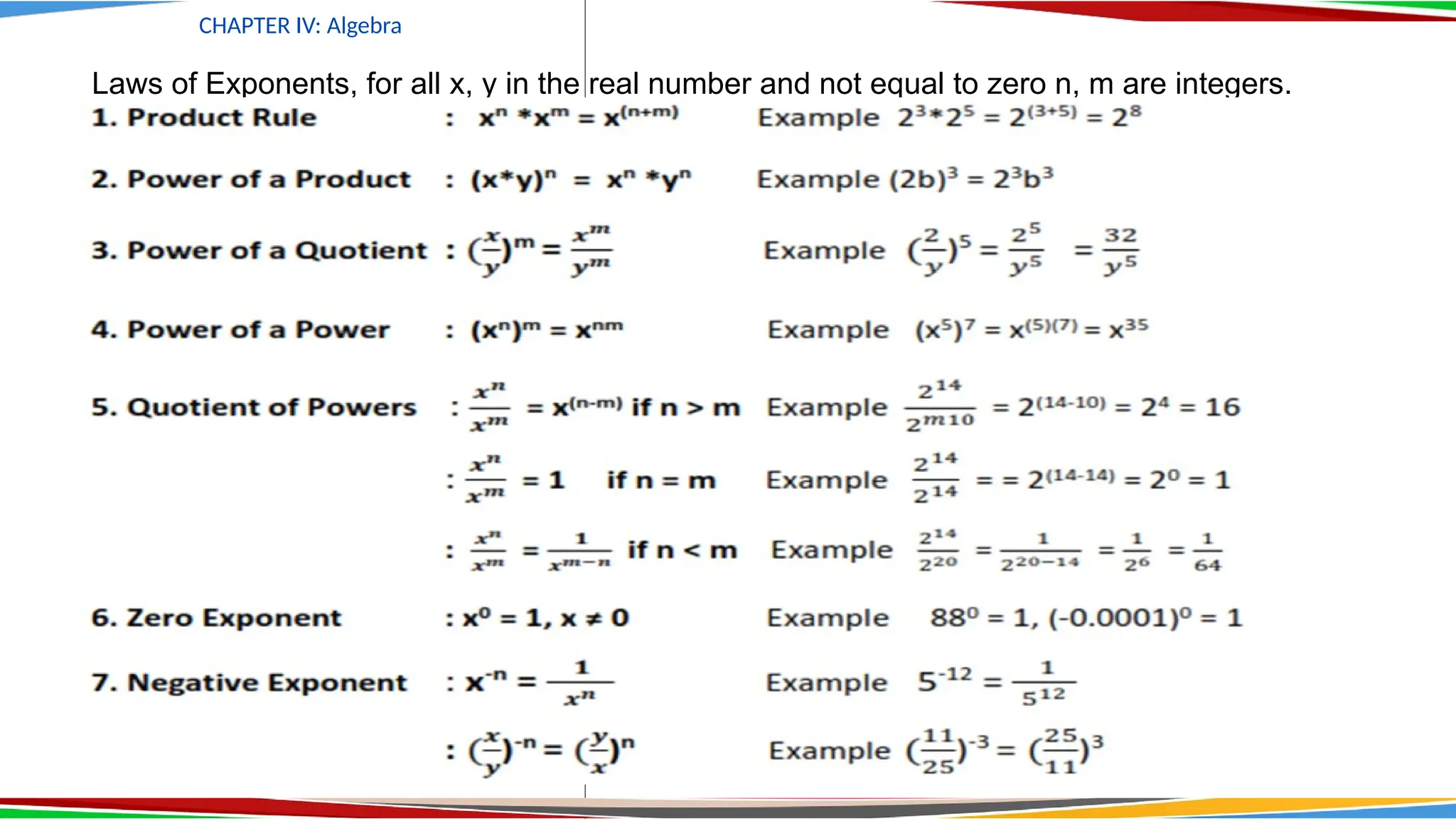
Laws of Exponents,for all x, y in the real number and not equal to zero n, m are integers.
CHAPTER IV: Algebra
11.
CHAPTER IV: Algebra
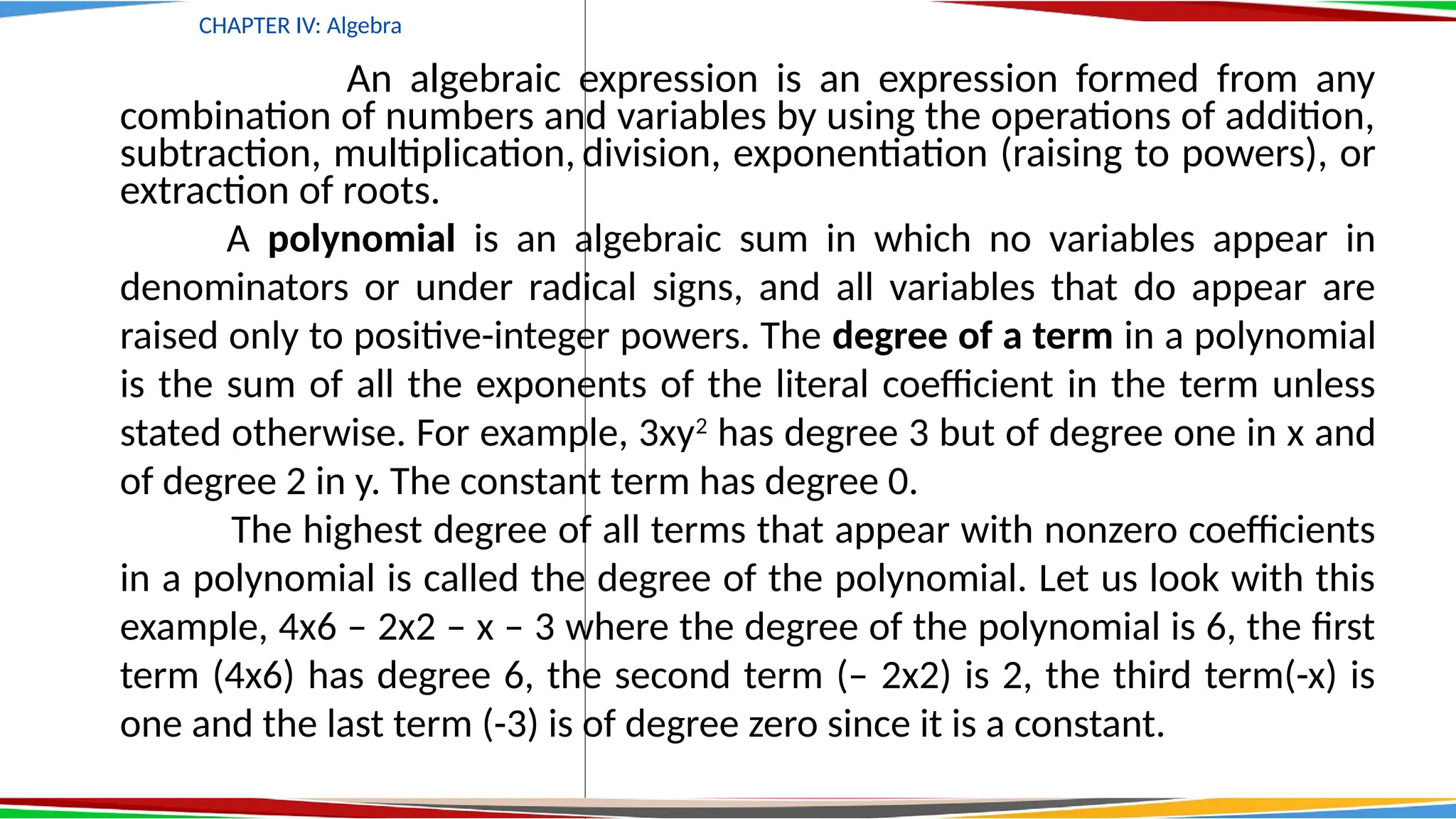
Analgebraic expression is an expression formed from any
combination of numbers and variables by using the operations of addition,
subtraction, multiplication, division, exponentiation (raising to powers), or
extraction of roots.
A polynomial is an algebraic sum in which no variables appear in
denominators or under radical signs, and all variables that do appear are
raised only to positive-integer powers. The degree of a term in a polynomial
is the sum of all the exponents of the literal coefficient in the term unless
stated otherwise. For example, 3xy2
has degree 3 but of degree one in x and
of degree 2 in y. The constant term has degree 0.
The highest degree of all terms that appear with nonzero coefficients
in a polynomial is called the degree of the polynomial. Let us look with this
example, 4x6 – 2x2 – x – 3 where the degree of the polynomial is 6, the first
term (4x6) has degree 6, the second term (– 2x2) is 2, the third term(-x) is
one and the last term (-3) is of degree zero since it is a constant.
12.
CHAPTER IV: Algebra
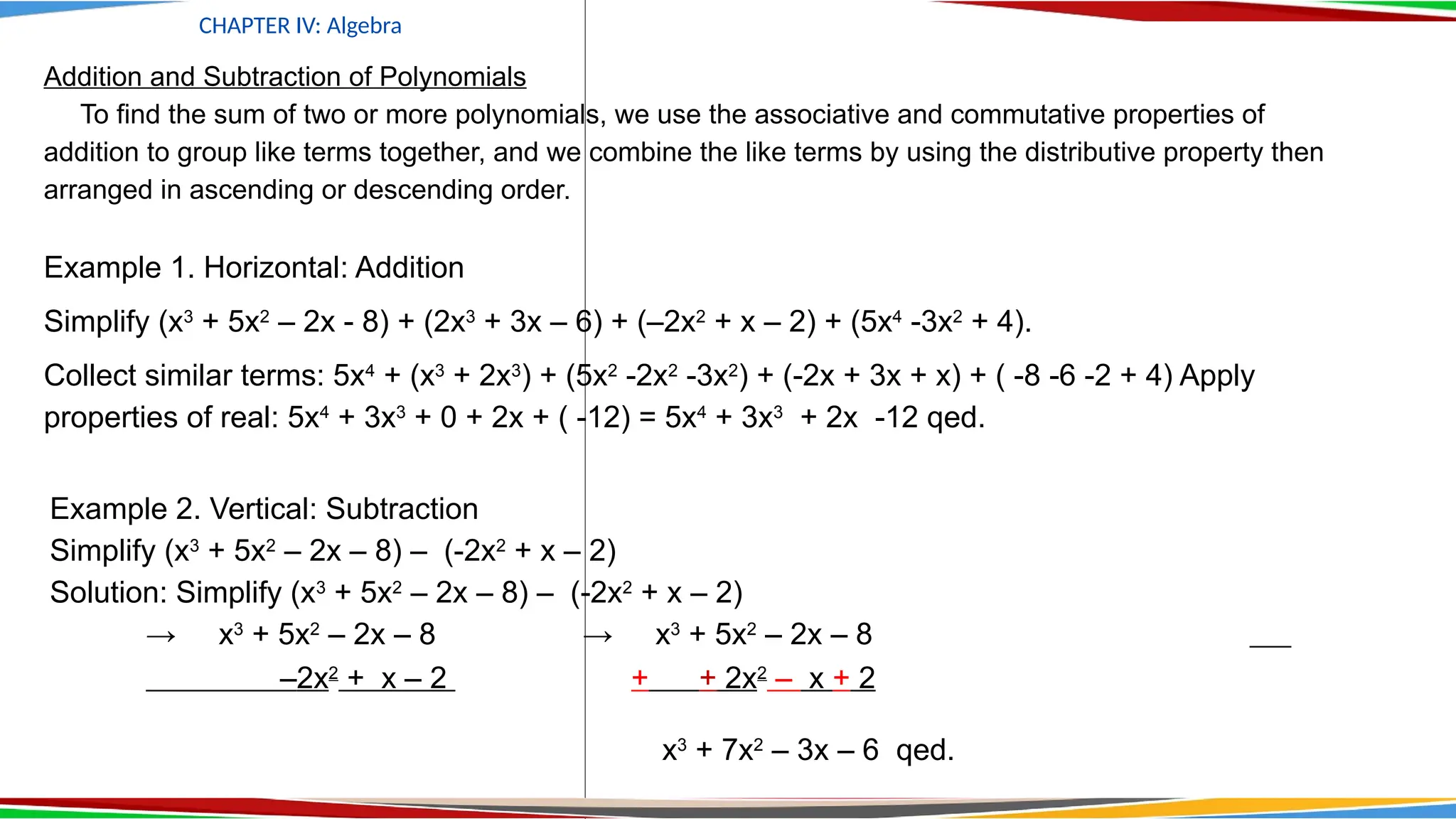
Additionand Subtraction of Polynomials
To find the sum of two or more polynomials, we use the associative and commutative properties of
addition to group like terms together, and we combine the like terms by using the distributive property then
arranged in ascending or descending order.
Example 1. Horizontal: Addition
Simplify (x3
+ 5x2
– 2x - 8) + (2x3
+ 3x – 6) + (–2x2
+ x – 2) + (5x4
-3x2
+ 4).
Collect similar terms: 5x4
+ (x3
+ 2x3
) + (5x2
-2x2
-3x2
) + (-2x + 3x + x) + ( -8 -6 -2 + 4) Apply
properties of real: 5x4
+ 3x3
+ 0 + 2x + ( -12) = 5x4
+ 3x3
+ 2x -12 qed.
Example 2. Vertical: Subtraction
Simplify (x3
+ 5x2
– 2x – 8) – (-2x2
+ x – 2)
Solution: Simplify (x3
+ 5x2
– 2x – 8) – (-2x2
+ x – 2)
→ x3
+ 5x2
– 2x – 8 → x3
+ 5x2
– 2x – 8
–2x2
+ x – 2 + + 2x2
– x + 2
x3
+ 7x2
– 3x – 6 qed.
13.
CHAPTER IV: Algebra
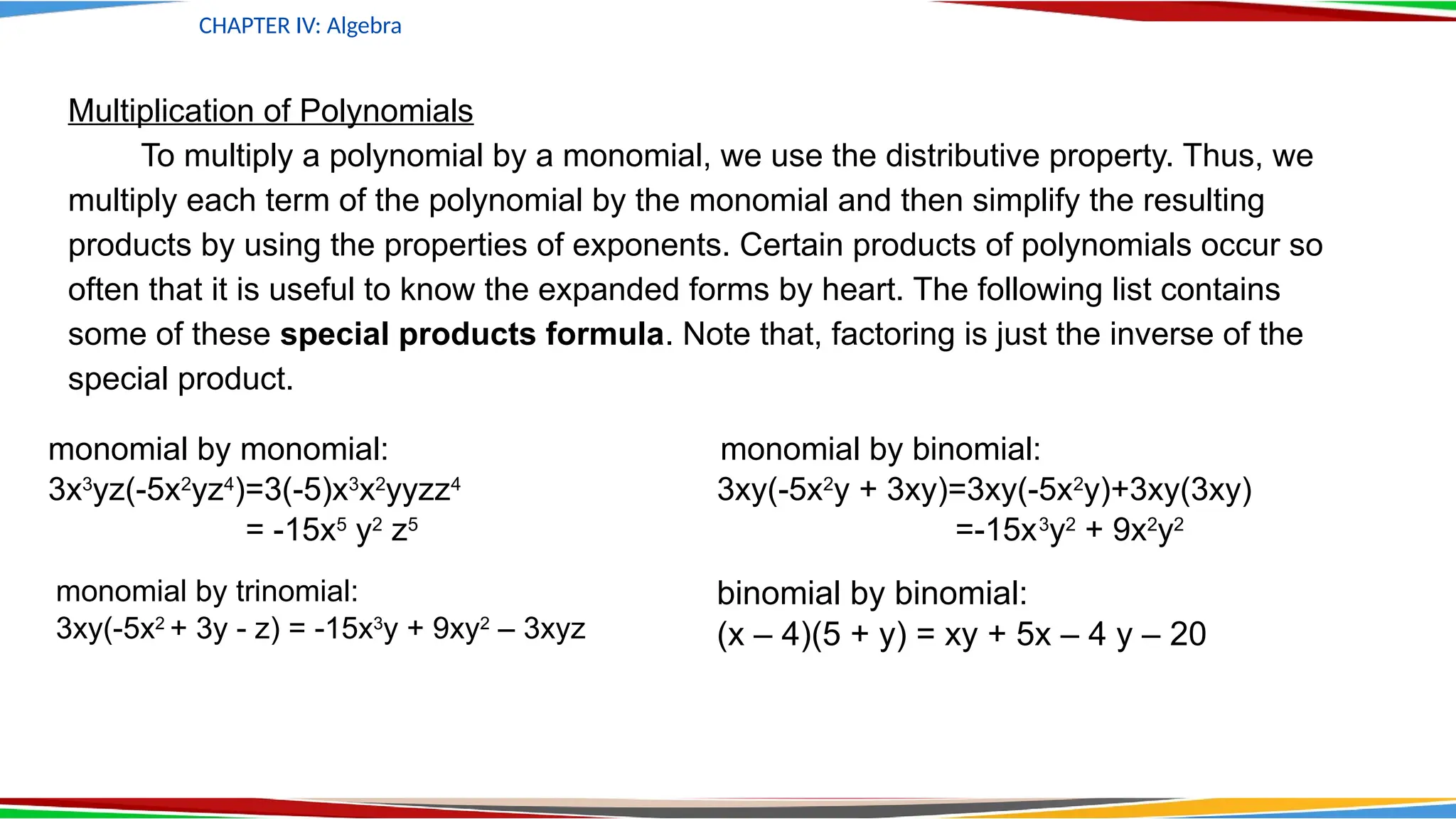
Multiplicationof Polynomials
To multiply a polynomial by a monomial, we use the distributive property. Thus, we
multiply each term of the polynomial by the monomial and then simplify the resulting
products by using the properties of exponents. Certain products of polynomials occur so
often that it is useful to know the expanded forms by heart. The following list contains
some of these special products formula. Note that, factoring is just the inverse of the
special product.
monomial by monomial: monomial by binomial:
3x3
yz(-5x2
yz4
)=3(-5)x3
x2
yyzz4
3xy(-5x2
y + 3xy)=3xy(-5x2
y)+3xy(3xy)
= -15x5
y2
z5
=-15x3
y2
+ 9x2
y2
monomial by trinomial:
3xy(-5x2
+ 3y - z) = -15x3
y + 9xy2
– 3xyz
binomial by binomial:
(x – 4)(5 + y) = xy + 5x – 4 y – 20
CHAPTER IV: Algebra
Divisionof Polynomials
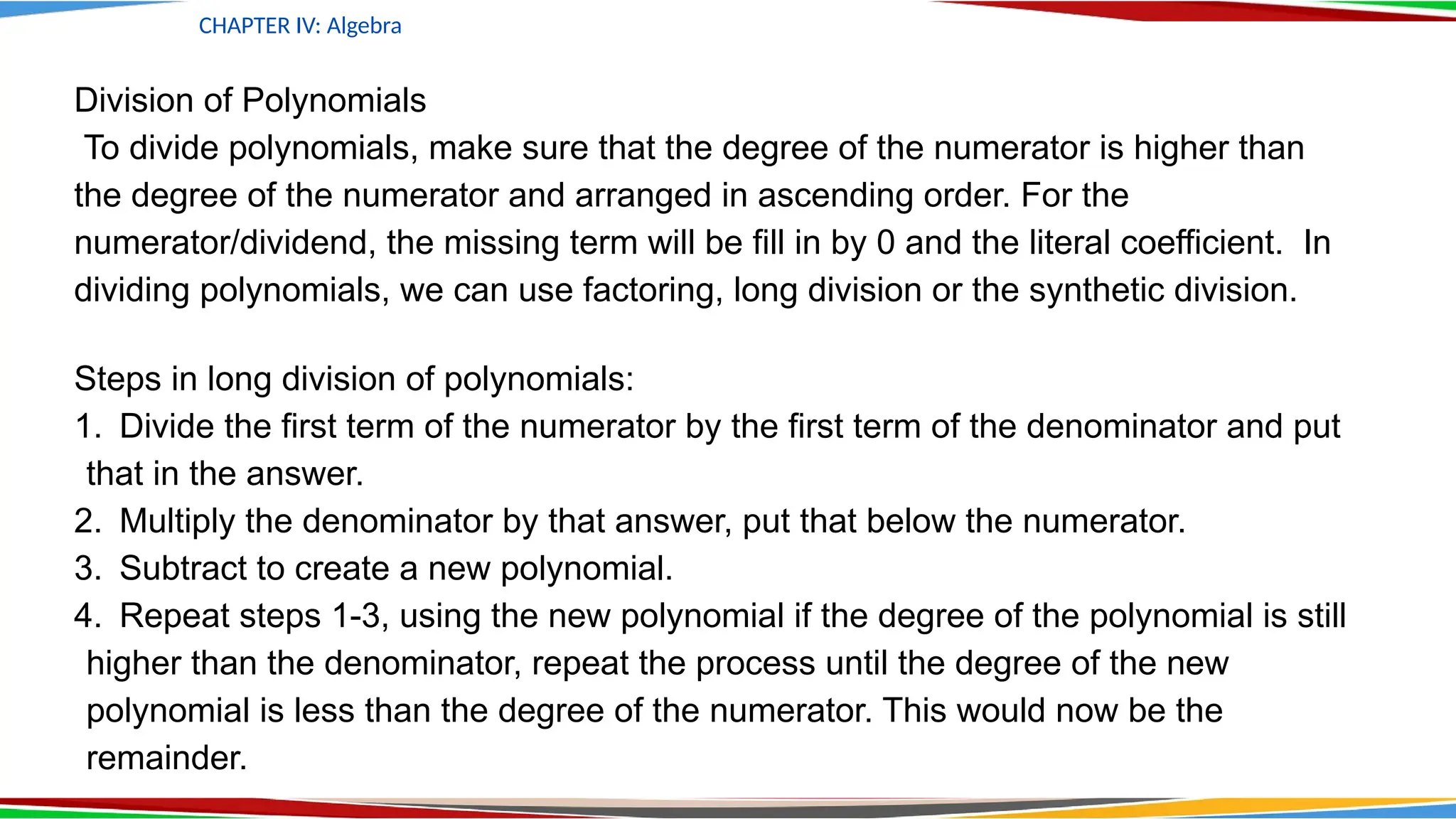
To divide polynomials, make sure that the degree of the numerator is higher than
the degree of the numerator and arranged in ascending order. For the
numerator/dividend, the missing term will be fill in by 0 and the literal coefficient. In
dividing polynomials, we can use factoring, long division or the synthetic division.
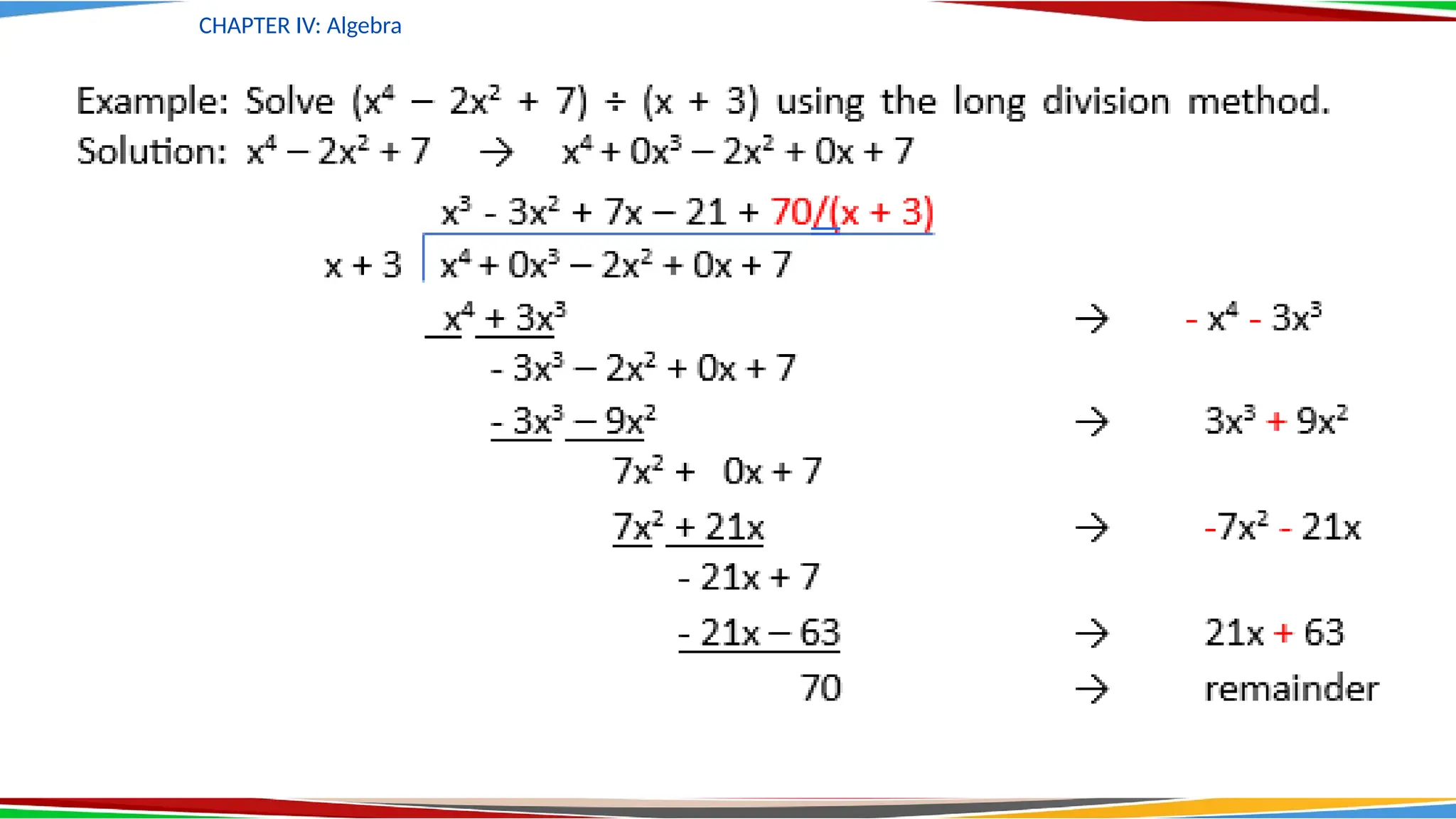
Steps in long division of polynomials:
1. Divide the first term of the numerator by the first term of the denominator and put
that in the answer.
2. Multiply the denominator by that answer, put that below the numerator.
3. Subtract to create a new polynomial.
4. Repeat steps 1-3, using the new polynomial if the degree of the polynomial is still
higher than the denominator, repeat the process until the degree of the new
polynomial is less than the degree of the numerator. This would now be the
remainder.
CHAPTER IV: Algebra
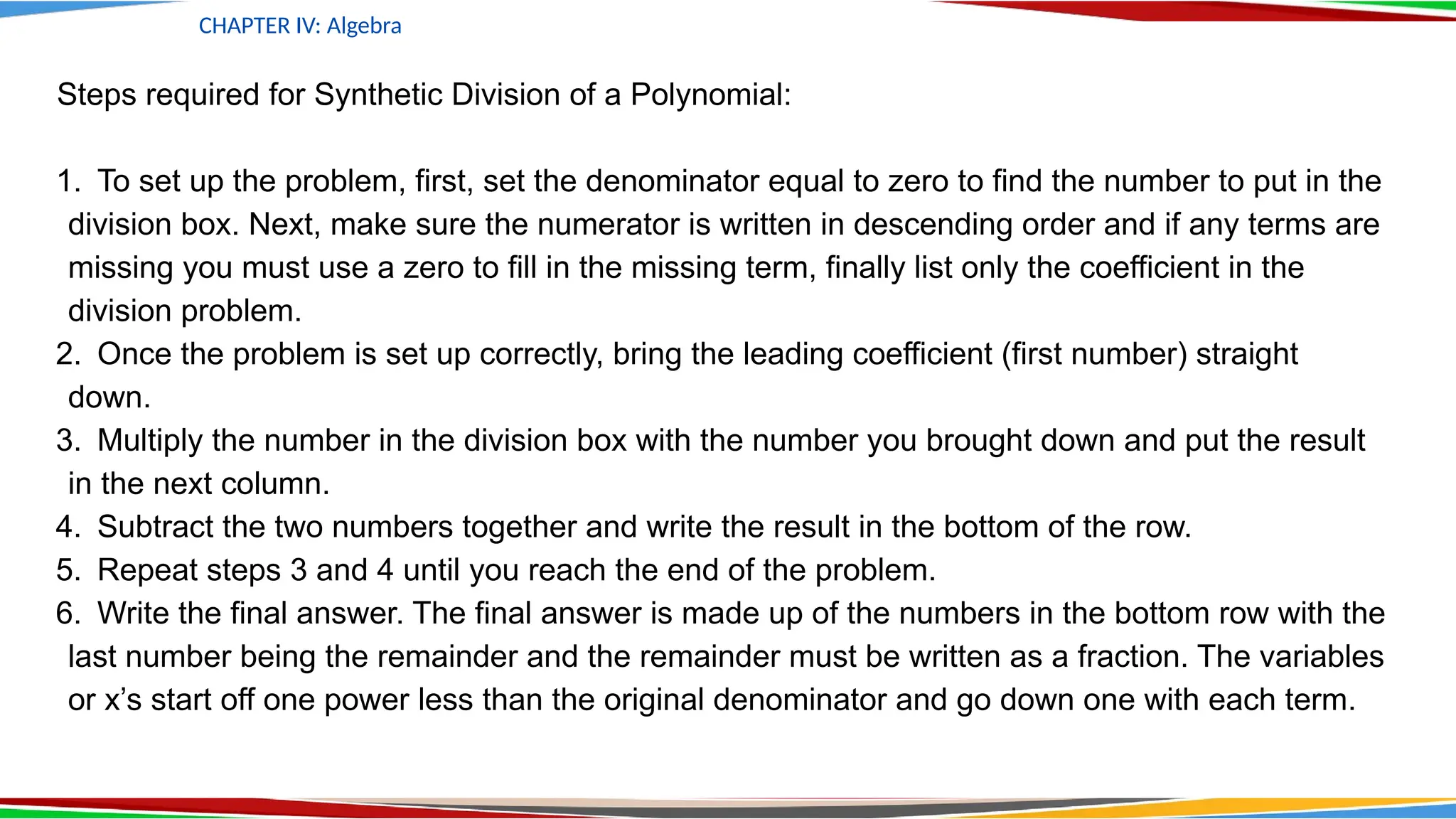
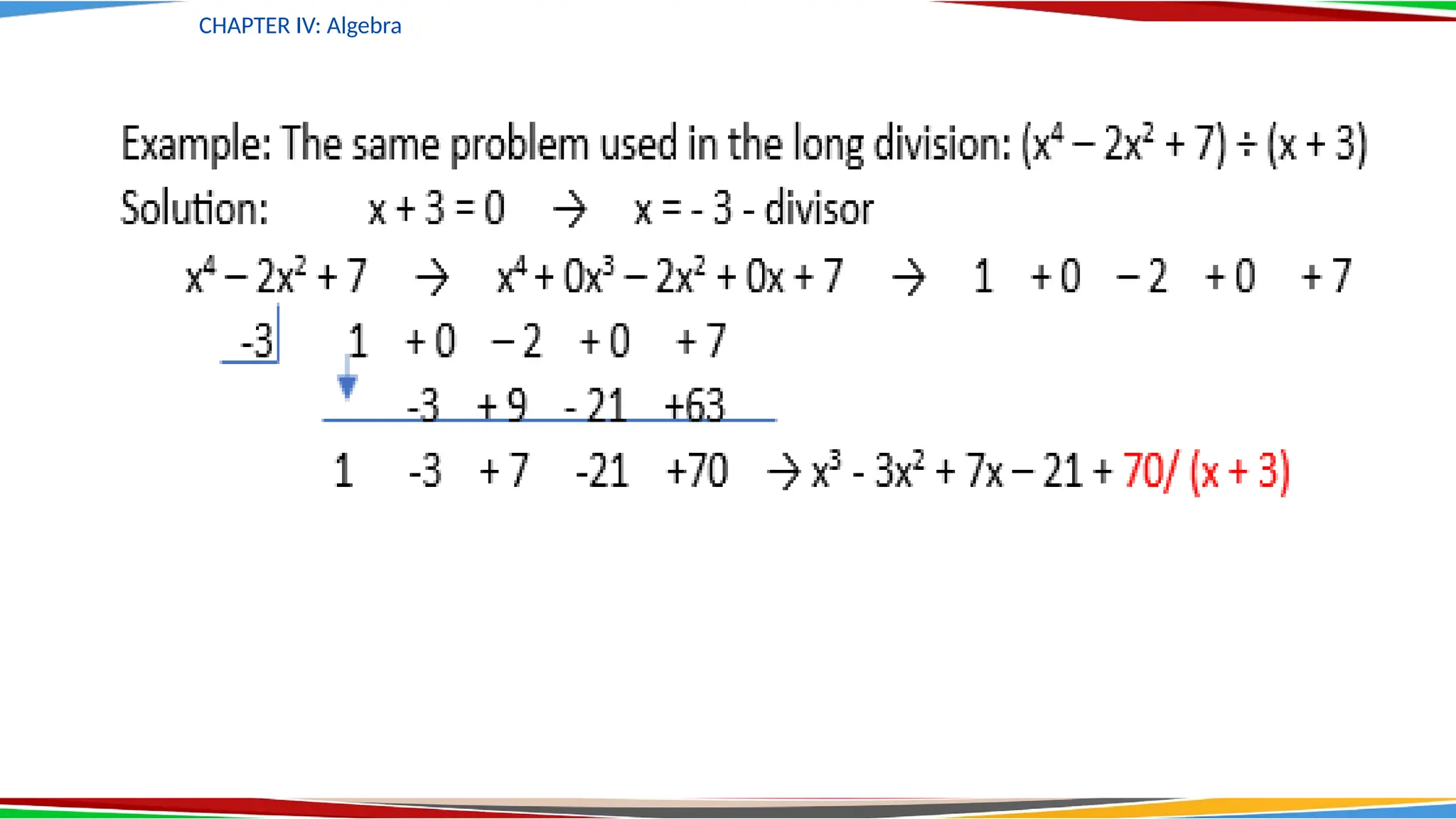
Stepsrequired for Synthetic Division of a Polynomial:
1. To set up the problem, first, set the denominator equal to zero to find the number to put in the
division box. Next, make sure the numerator is written in descending order and if any terms are
missing you must use a zero to fill in the missing term, finally list only the coefficient in the
division problem.
2. Once the problem is set up correctly, bring the leading coefficient (first number) straight
down.
3. Multiply the number in the division box with the number you brought down and put the result
in the next column.
4. Subtract the two numbers together and write the result in the bottom of the row.
5. Repeat steps 3 and 4 until you reach the end of the problem.
6. Write the final answer. The final answer is made up of the numbers in the bottom row with the
last number being the remainder and the remainder must be written as a fraction. The variables
or x’s start off one power less than the original denominator and go down one with each term.
CHAPTER IV: Algebra
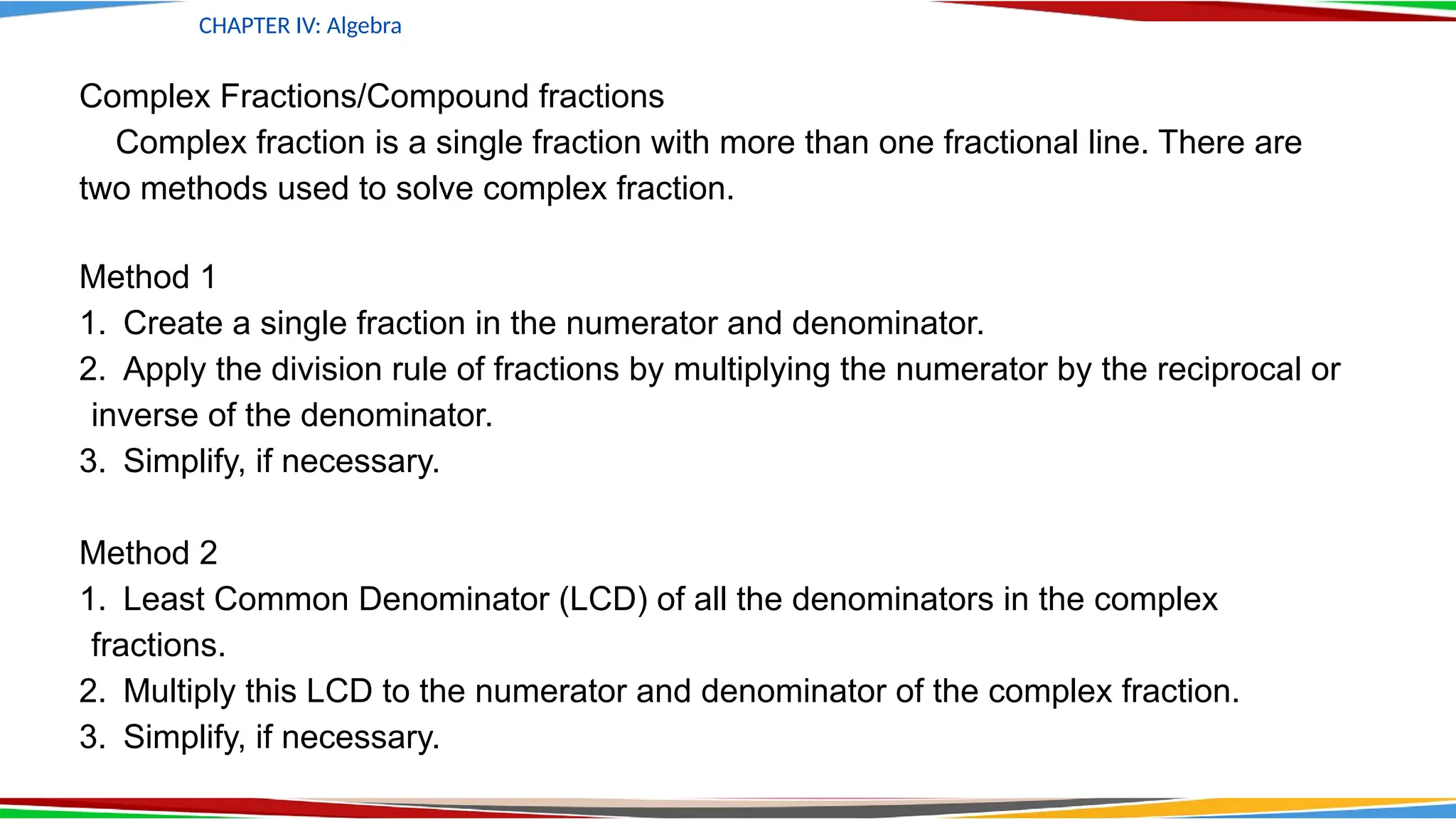
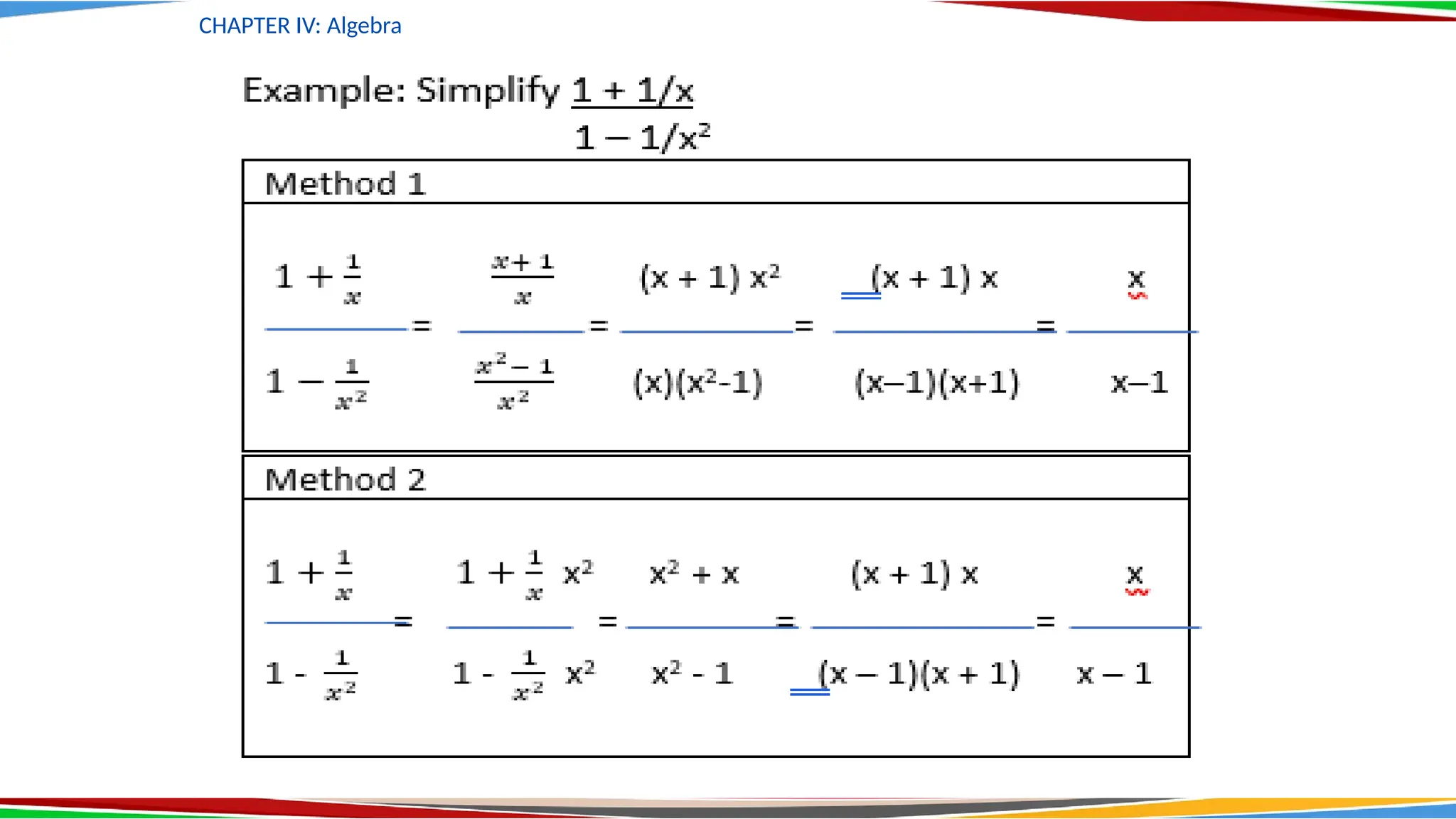
ComplexFractions/Compound fractions
Complex fraction is a single fraction with more than one fractional line. There are
two methods used to solve complex fraction.
Method 1
1. Create a single fraction in the numerator and denominator.
2. Apply the division rule of fractions by multiplying the numerator by the reciprocal or
inverse of the denominator.
3. Simplify, if necessary.
Method 2
1. Least Common Denominator (LCD) of all the denominators in the complex
fractions.
2. Multiply this LCD to the numerator and denominator of the complex fraction.
3. Simplify, if necessary.

![CHAPTER IV: Algebra
Special Products Formula, If a, b, c, d are constants, x, y, and z are variables then,
1. (x – y)(x + y) = x2
– y2
Ex. (2x – 3y)(2x + 3y) = (2x)2
– (3y)2
= 4x2
– 9y2
2. (x + y)2
= x2
+ 2xy + y2
Ex. (2x + 3y)2
= (2x)2
+ 2(2x)(3y) + (3y)2
= 4x2
+ 12xy +
9y2
3. (x – y)2
= x2
– 2xy + y2
Ex. (2x - 3y)2
= (2x)2
- 2(2x)(3y) + (3y)2
= 4x2
- 12xy + 9y2
4. (x + y)(x2
– xy + y2
) = x3
+ y3
Ex. (2x + 3y)(4x2
- 6xy + 9y2
) = (2x)3
+ (3y)3
= 8x3
+ 27y3
5. (x – y)(x2
+ xy + y2
) = x3
– y3
Ex. (2x - 3y)(4x2
+ 6xy + 9y2
) = (2x)3
- (3y)3
= 8x3
- 27y3
6. (x + y)3
= x3
+ 3x2
y + 3xy2
+ y3
Ex. (2x + 3y)3
= (2x)3
+ 3(2x)2
(3y) + 3(2x)(3y)2
+ (3y)3
= 8x3
+ 36x2
y + 54xy2
+ 27x3
7. (x – y)3
= x3
– 3x2
y + 3xy2
– y3
Ex. (2x - 3y)3
= (2x)3
- 3(2x)2
(3y) + 3(2x)(3y)2
- (3y)3
= 8x3
- 36x2
y + 54xy2
- 27x3
8. (x + y + z)2
= x2
+ y2
+ z2
+ 2(xy + xz + yz)
Ex. (2x - 3y + 4z)2
= (2x)2
+ (-3y)2
+ (4z)2
+ 2[(2x)(-3y) + (2x)(4z) –(3y)(4z)
= (2x)2
+ (-3y)2
+ (4z)2
+ 2(-6xy + 8xz – 12yz)
= 4x2
+ 9y2
+ 16z2
+ 2(-6xy + 8xz – 12yz)
9. (ax+by)(cx+dy)=acx2
+(ad+bc)xy+bdy2
Ex. (2x + 3y)( 4x - 5y), a = 2, b = 3, c = 4, d = -5
= (2)(4)x2
+[(2)(-5)+(3)(4)]xy + (3)(-5)y2
= 8x2
+ (-10 + 12)xy – 15y2
= 8x2
+ 2xy – 15y2](https://image.slidesharecdn.com/c4l1ppt-250308050036-5223c4b4/75/Chapter-4-Learning-Outcome-1_Mathematics-for-Technologists-14-2048.jpg)