Oliguria   In a Post-Operative Patient Alok Narayan Med VI
Urine Output Oliguria- Urine output <1 ml/kg/h  <400ml/day, but this is less accurate  Often reversible, but may be a sign of ARF Anuria- <100ml/day  Decreased UOP is usually not a concern unless ARF is also present.
What is ARF Significant (>50%) decrease in GFR with an associated accumulation of nitrogenous wastes (BUN & Creatinine) in the body (a.k.a. azotemia) Serum creatinine provides the most accurate and consistent estimation of GFR. ARF=Serum creatinine ↑ >0.5mg/dl (Normal=0.8-1.4) Early sign of ARF is oliguria. Only seen in 2/3 of ARF pts.
Etiology Prerenal - 70% and  COMMONEST CAUSE OF OLIGURIA Kidney hypoperfusion due to: Absolute decrease in blood volume (Dehydration, hemorrhage, GI losses, ↓ PO) Relative decrease in blood volume (sepsis, vasodilatory drugs, renal artery stenosis) Intrinsic Parenchymal injury due to: Acute Glomerulonephritis Interstitial Nephritis Acute Tubular Necrosis (ischemia, drugs, or toxins)  Postrenal Obstruction due to Calculi, Tumor, Obstructed Foley Catheter
Post-Op Oliguria Often a patient will have a diminished urine output after a major operation. This may be the result of fluid and blood loss and d/t response of the adrenal cortex to stress - there is an increase in aldosterone release (adrenal cortex) and ADH release (posterior pituitary) in the first 24 hours after surgery. This results in both salt and water retention.  The oliguria should be temporary and not last more than 24h. If there is a urine output of less than 400ml in the first 24 hours then this warrants investigation.
Assessing Oliguria Review patient immediately Assess need for urgent resuscitation - ABCs Immediate Questions 1) Does the patient have any symptoms or predisposing conditions that suggest hypovolemia? Diarrhoea, vomiting, GI bleeding, high fever, low intake (whether oral or IV) Positional dizziness suggests hypo-volaemia If post-op: bleeding, wound drainage, infection leading to septicemia 2) Previous symptoms to suggest bladder outlet obstruction from prostatic hypertrophy? Hesitancy, difficulty voiding, dribbling i.e. post renal obstruction 3) History of hematuria? Renal stones can lead to obstruction 4) Is the patient likely to be suffering from acute renal failure? Previous Hx Renal disease Nephrotoxic drugs (aminoglycoside AB’s and NSAIDs) Exposure to nephrotoxic agents (contrast, chemotherapy) 5) Any underlying diseases/procedures that could result in oliguria? Cardiac failure, cirrhosis, epidural infusion 6) Symptoms suggestive of uremia? Nausea, vomiting, anorexia, insomnia, mental status changes
Physical examination Vital signs - ABCs decrease in weight suggests volume depletion Hypertension (volume overload or if long standing can cause renal insufficiency) Check orthostatic BP Irregularly irregular pulse suggests atrial fibrillation (a common cause of emboli) Skin Decreased skin turgor, dry mucous membranes suggest hypovolemia Neck Flat neck veins while supine suggest volume depletion Raised JVP in volume overload Chest rales suggest CHF Abdomen ascites (cirrhosis) or distended bladder (outlet obstruction) Genitourinary PR for males’ prostate Pelvis for females (feel for masses) Extremities assess perfusion (colour, capillary refill, temp.)
Lab data Urinalysis high specific gravity suggests volume depletion large amounts of protein or red cell casts suggests glomerular disease significant hematuria (renal embolisation or stones) WBC casts (infection or sever inflammation) Frequent granular casts (acute tubular necrosis) Serum chemistries compare blood urea and creatinine  if ratio >10:1, prerenal cause is likely but could also be obstruction, GI bleeding, severe catabolic states  If ratio <10:1 renal cause is likely always note high/low sodium or high potassium which can complicate acute renal failure Urine electrolytes and creatinine Urinary sodium <15mmol/L suggests pre-renal…….. >20 suggests renal
Management of Oliguria Minimal acceptable output is 1 mL/kg/hr Take records of fluid intake and output Review meds and stop all nephrotoxic drugs (Aminoglycosides, NSAIDS, COX-2 inhibitors) Adjust doses of renally excreted drugs Address all the Septic Foci (ABx, surgical drainage, UTI)
Mx of Oliguria…. Pre-renal Volume challenge (i.e. 500mL NS for 30 mins) Monitor volume replacement to ensure circulatory adequacy (i.e. use arterial and R. heart catheters to measure CVP to be above 10mmHg) Follow hourly urine output (w a catheter in place) Consider additional measures (some doctors may disagree with this) Frusemide (but  usually reserved for fluid overload) Renal causes Consider frusemide and mannitol Emergency dialysis in the following: Severe hypovolemia unresponsive to diuretics Intractable acidosis Severe hyperkalemia Pericarditis secondary to uremia Severe uremic symptoms or encephalopathy Post Renal causes Place a catheter, if immediate flow starts then urethral obstruction is very likely If catheter already present, replace or irrigate it as it could be obstructed Consult a urologist
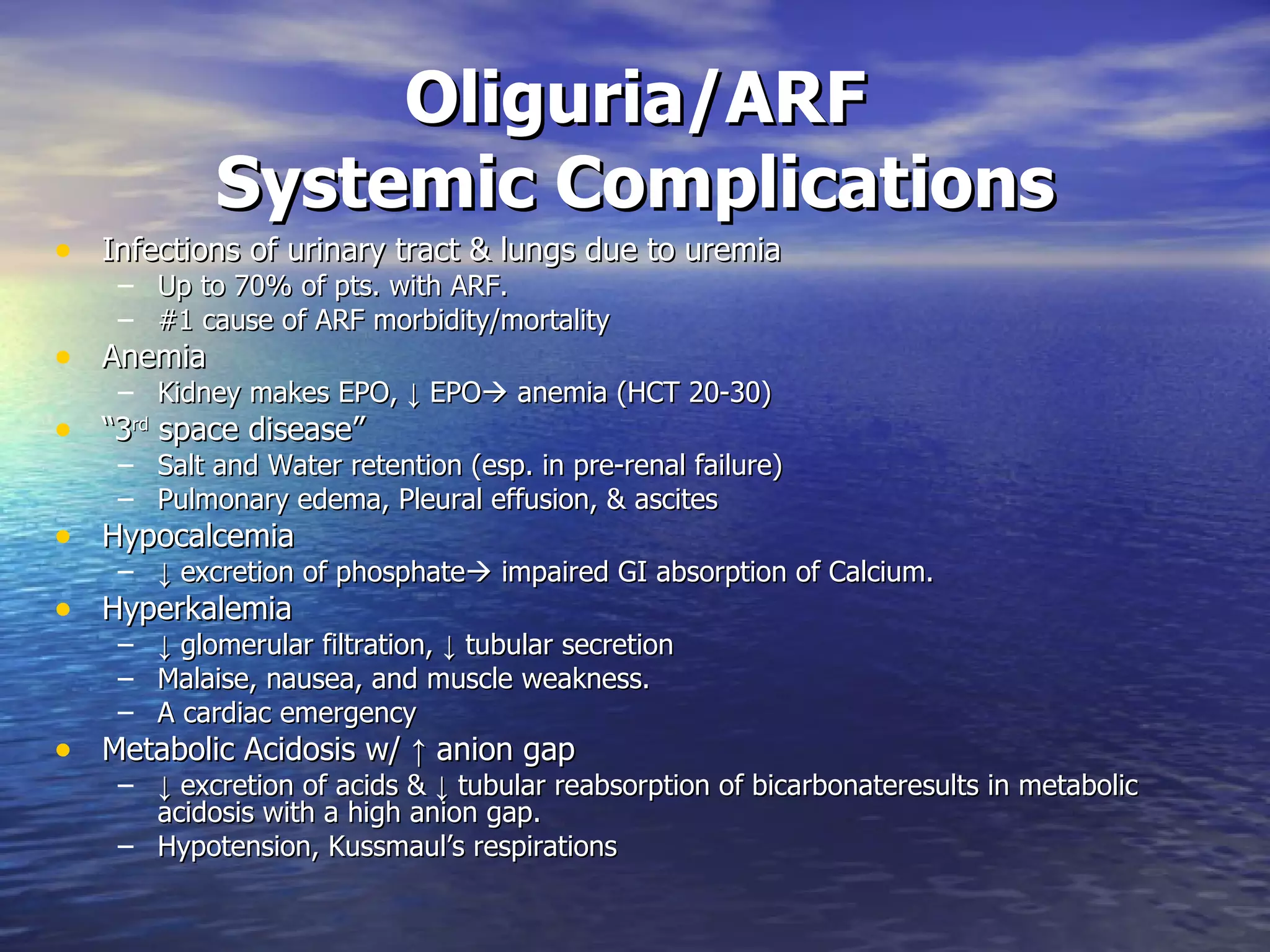
Oliguria/ARF Systemic Complications Infections of urinary tract & lungs due to uremia Up to 70% of pts. with ARF.  #1 cause of ARF morbidity/mortality Anemia Kidney makes EPO, ↓ EPO   anemia (HCT 20-30) “ 3 rd  space disease” Salt and Water retention (esp. in pre-renal failure) Pulmonary edema, Pleural effusion, & ascites  Hypocalcemia ↓  excretion of phosphate   impaired GI absorption of Calcium. Hyperkalemia ↓  glomerular filtration, ↓ tubular secretion  Malaise, nausea, and muscle weakness.  A cardiac emergency Metabolic Acidosis w/ ↑ anion gap ↓  excretion of acids & ↓ tubular reabsorption of bicarbonateresults in metabolic acidosis with a high anion gap. Hypotension, Kussmaul’s respirations
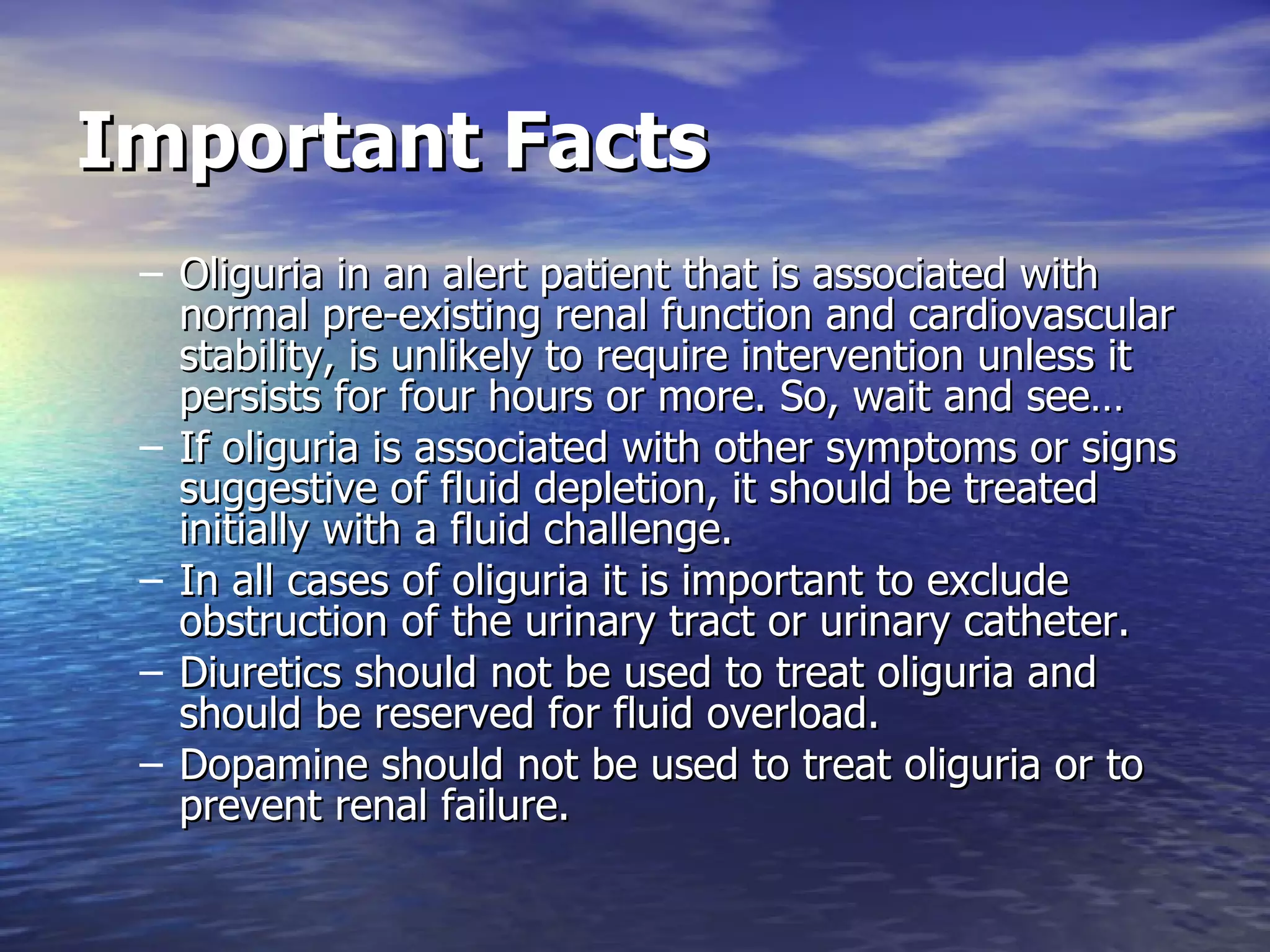
Important Facts Oliguria in an alert patient that is associated with normal pre-existing renal function and cardiovascular stability, is unlikely to require intervention unless it persists for four hours or more. So, wait and see… If oliguria is associated with other symptoms or signs suggestive of fluid depletion, it should be treated initially with a fluid challenge. In all cases of oliguria it is important to exclude obstruction of the urinary tract or urinary catheter. Diuretics should not be used to treat oliguria and should be reserved for fluid overload. Dopamine should not be used to treat oliguria or to prevent renal failure.

17. Oliguria In The Postoperative Patient

  • 1.
    Oliguria In a Post-Operative Patient Alok Narayan Med VI
  • 2.
    Urine Output Oliguria-Urine output <1 ml/kg/h <400ml/day, but this is less accurate Often reversible, but may be a sign of ARF Anuria- <100ml/day Decreased UOP is usually not a concern unless ARF is also present.
  • 3.
    What is ARFSignificant (>50%) decrease in GFR with an associated accumulation of nitrogenous wastes (BUN & Creatinine) in the body (a.k.a. azotemia) Serum creatinine provides the most accurate and consistent estimation of GFR. ARF=Serum creatinine ↑ >0.5mg/dl (Normal=0.8-1.4) Early sign of ARF is oliguria. Only seen in 2/3 of ARF pts.
  • 4.
    Etiology Prerenal -70% and COMMONEST CAUSE OF OLIGURIA Kidney hypoperfusion due to: Absolute decrease in blood volume (Dehydration, hemorrhage, GI losses, ↓ PO) Relative decrease in blood volume (sepsis, vasodilatory drugs, renal artery stenosis) Intrinsic Parenchymal injury due to: Acute Glomerulonephritis Interstitial Nephritis Acute Tubular Necrosis (ischemia, drugs, or toxins) Postrenal Obstruction due to Calculi, Tumor, Obstructed Foley Catheter
  • 5.
    Post-Op Oliguria Oftena patient will have a diminished urine output after a major operation. This may be the result of fluid and blood loss and d/t response of the adrenal cortex to stress - there is an increase in aldosterone release (adrenal cortex) and ADH release (posterior pituitary) in the first 24 hours after surgery. This results in both salt and water retention. The oliguria should be temporary and not last more than 24h. If there is a urine output of less than 400ml in the first 24 hours then this warrants investigation.
  • 6.
    Assessing Oliguria Reviewpatient immediately Assess need for urgent resuscitation - ABCs Immediate Questions 1) Does the patient have any symptoms or predisposing conditions that suggest hypovolemia? Diarrhoea, vomiting, GI bleeding, high fever, low intake (whether oral or IV) Positional dizziness suggests hypo-volaemia If post-op: bleeding, wound drainage, infection leading to septicemia 2) Previous symptoms to suggest bladder outlet obstruction from prostatic hypertrophy? Hesitancy, difficulty voiding, dribbling i.e. post renal obstruction 3) History of hematuria? Renal stones can lead to obstruction 4) Is the patient likely to be suffering from acute renal failure? Previous Hx Renal disease Nephrotoxic drugs (aminoglycoside AB’s and NSAIDs) Exposure to nephrotoxic agents (contrast, chemotherapy) 5) Any underlying diseases/procedures that could result in oliguria? Cardiac failure, cirrhosis, epidural infusion 6) Symptoms suggestive of uremia? Nausea, vomiting, anorexia, insomnia, mental status changes
  • 7.
    Physical examination Vitalsigns - ABCs decrease in weight suggests volume depletion Hypertension (volume overload or if long standing can cause renal insufficiency) Check orthostatic BP Irregularly irregular pulse suggests atrial fibrillation (a common cause of emboli) Skin Decreased skin turgor, dry mucous membranes suggest hypovolemia Neck Flat neck veins while supine suggest volume depletion Raised JVP in volume overload Chest rales suggest CHF Abdomen ascites (cirrhosis) or distended bladder (outlet obstruction) Genitourinary PR for males’ prostate Pelvis for females (feel for masses) Extremities assess perfusion (colour, capillary refill, temp.)
  • 8.
    Lab data Urinalysishigh specific gravity suggests volume depletion large amounts of protein or red cell casts suggests glomerular disease significant hematuria (renal embolisation or stones) WBC casts (infection or sever inflammation) Frequent granular casts (acute tubular necrosis) Serum chemistries compare blood urea and creatinine if ratio >10:1, prerenal cause is likely but could also be obstruction, GI bleeding, severe catabolic states If ratio <10:1 renal cause is likely always note high/low sodium or high potassium which can complicate acute renal failure Urine electrolytes and creatinine Urinary sodium <15mmol/L suggests pre-renal…….. >20 suggests renal
  • 9.
    Management of OliguriaMinimal acceptable output is 1 mL/kg/hr Take records of fluid intake and output Review meds and stop all nephrotoxic drugs (Aminoglycosides, NSAIDS, COX-2 inhibitors) Adjust doses of renally excreted drugs Address all the Septic Foci (ABx, surgical drainage, UTI)
  • 10.
    Mx of Oliguria….Pre-renal Volume challenge (i.e. 500mL NS for 30 mins) Monitor volume replacement to ensure circulatory adequacy (i.e. use arterial and R. heart catheters to measure CVP to be above 10mmHg) Follow hourly urine output (w a catheter in place) Consider additional measures (some doctors may disagree with this) Frusemide (but usually reserved for fluid overload) Renal causes Consider frusemide and mannitol Emergency dialysis in the following: Severe hypovolemia unresponsive to diuretics Intractable acidosis Severe hyperkalemia Pericarditis secondary to uremia Severe uremic symptoms or encephalopathy Post Renal causes Place a catheter, if immediate flow starts then urethral obstruction is very likely If catheter already present, replace or irrigate it as it could be obstructed Consult a urologist
  • 11.
    Oliguria/ARF Systemic ComplicationsInfections of urinary tract & lungs due to uremia Up to 70% of pts. with ARF. #1 cause of ARF morbidity/mortality Anemia Kidney makes EPO, ↓ EPO  anemia (HCT 20-30) “ 3 rd space disease” Salt and Water retention (esp. in pre-renal failure) Pulmonary edema, Pleural effusion, & ascites Hypocalcemia ↓ excretion of phosphate  impaired GI absorption of Calcium. Hyperkalemia ↓ glomerular filtration, ↓ tubular secretion Malaise, nausea, and muscle weakness. A cardiac emergency Metabolic Acidosis w/ ↑ anion gap ↓ excretion of acids & ↓ tubular reabsorption of bicarbonateresults in metabolic acidosis with a high anion gap. Hypotension, Kussmaul’s respirations
  • 12.
    Important Facts Oliguriain an alert patient that is associated with normal pre-existing renal function and cardiovascular stability, is unlikely to require intervention unless it persists for four hours or more. So, wait and see… If oliguria is associated with other symptoms or signs suggestive of fluid depletion, it should be treated initially with a fluid challenge. In all cases of oliguria it is important to exclude obstruction of the urinary tract or urinary catheter. Diuretics should not be used to treat oliguria and should be reserved for fluid overload. Dopamine should not be used to treat oliguria or to prevent renal failure.