MAXILLARY   II MOLAR SUBMITTED BYO.R.GANESAMURTHI1 YEAR M.Sc.D ENDODONTICS
INDEX EXTERNAL ANATOMY OF TOOTH MORPHOLOGY OF TOOTH INTERNAL ANATOMY OF TOOTH PULP CHAMPER           ROOT CANAL SYSTEM ANOMALIES OF TOOTH
 ENDODONTIC CORELATION
 CASE REPORT
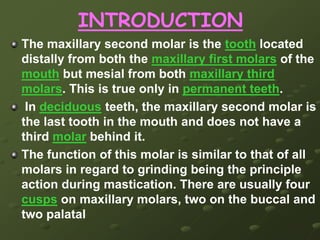
 REFERENCEINTRODUCTIONThe maxillary second molar is the tooth located distally from both the maxillary first molars of the mouth but mesial from both maxillary third molars. This is true only in permanent teeth. In deciduous teeth, the maxillary second molar is the last tooth in the mouth and does not have a third molar behind it. The function of this molar is similar to that of all molars in regard to grinding being the principle action during mastication. There are usually four cusps on maxillary molars, two on the buccal and two palatal
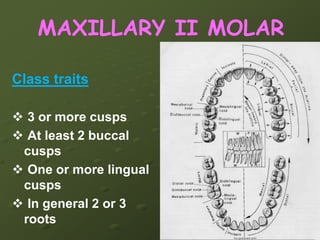
MAXILLARY II MOLARClass traits 3 or more cusps
 At least 2 buccal cusps
 One or more lingual cusps
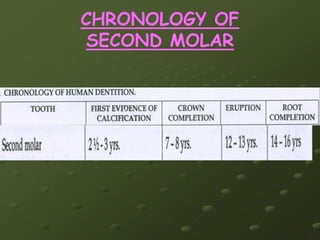
 In general 2 or 3 rootsCHRONOLOGY OF SECOND MOLAR  Average time of eruption       : 11 to 13            years
 Average age of calcification  : 14 to 16 years
          Average length               : 20.0 mmCHRONOLOGY OF SECOND MOLAR
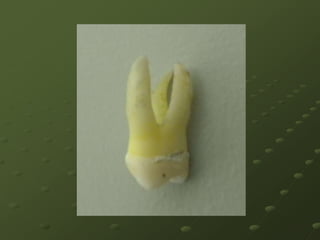
Arch traits    3 roots: 2 Buccal & 1 Palatal
   Crown: Buccolingual > MesioDistal
Cusps3 major cusps      MP, MB & DB      Arranged in a tricuspid-triangular patternLesser-sized DL cusp & sometimes missingOblique ridge: MP to DB cusp
Buccal cusps are of unequal size
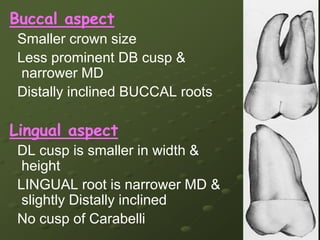
MP cusp is larger than DPBuccal aspect  Smaller crown size  Less prominent DB cusp & narrower MD  Distally inclined BUCCAL rootsLingual aspect  DL cusp is smaller in width & height  LINGUAL root is narrower MD & slightly Distally inclined  No cusp of Carabelli
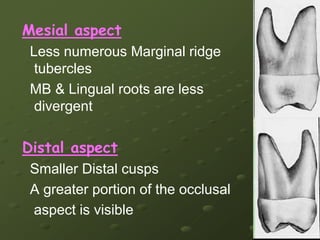
Mesial aspect  Less numerous Marginal ridge tubercles  MB & Lingual roots are less divergentDistal aspect  Smaller Distal cusps  A greater portion of the occlusal   aspect is visible
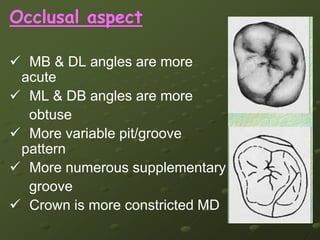
Occlusal aspect  MB & DL angles are more acute
  ML & DB angles are more       obtuse  More variable pit/groove pattern
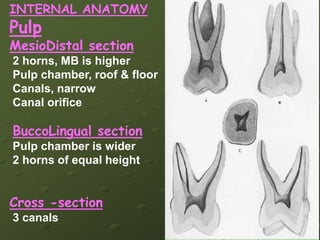
  More numerous supplementary          groove  Crown is more constricted MDINTERNAL ANATOMYPulpMesioDistal section 2 horns, MB is higher Pulp chamber, roof & floor Canals, narrow Canal orificeBuccoLingual section Pulp chamber is wider 2 horns of equal heightCross -section 3 canals
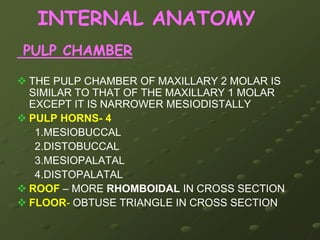
INTERNAL ANATOMY PULP CHAMBERTHE PULP CHAMBER OF MAXILLARY 2 MOLAR IS SIMILAR TO THAT OF THE MAXILLARY 1 MOLAR EXCEPT IT IS NARROWER MESIODISTALLY
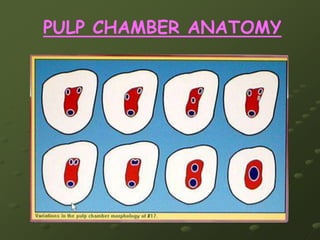
PULP HORNS- 4       1.MESIOBUCCAL      2.DISTOBUCCAL       3.MESIOPALATAL      4.DISTOPALATALROOF– MORE RHOMBOIDAL IN CROSS SECTION
FLOOR- OBTUSE TRIANGLE IN CROSS SECTIONPULP CHAMBER ANATOMY
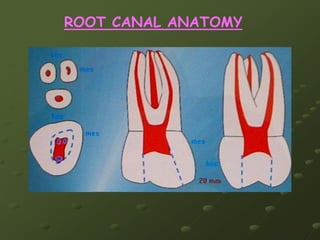
ROOT CANALSif 3 roots are present usually we can see 3 canals1. mesiobuccal    2. distobuccal    3. palatal if 4 canal is present   it is in mesiobuccal root but less frequently than in the 1 molar
ROOT CANAL ANATOMY
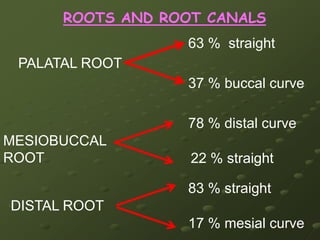
ROOTS AND ROOT CANALS63 %  straightPALATAL ROOT37 % buccal curve78 % distal curveMESIOBUCCAL ROOT22 % straight83 % straightDISTAL ROOT17 % mesial curve
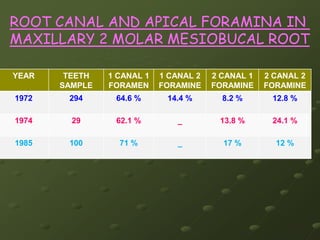
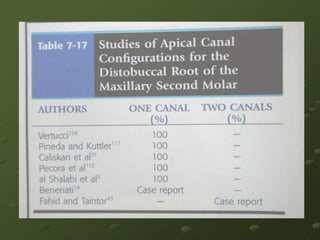
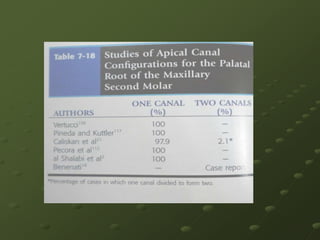
ROOT CANAL AND APICAL FORAMINA IN MAXILLARY 2 MOLAR MESIOBUCAL ROOT
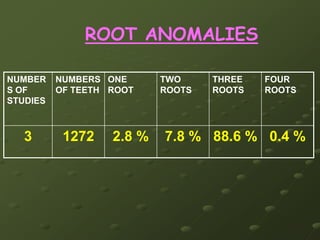
ROOT ANOMALIES
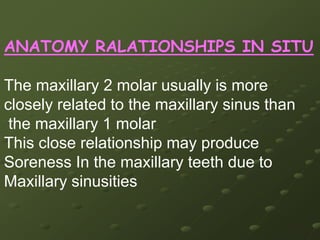
ANATOMY RALATIONSHIPS IN SITUThe maxillary 2 molar usually is more closely related to the maxillary sinus than the maxillary 1 molarThis close relationship may produce Soreness In the maxillary teeth due to Maxillary sinusities
ENDODONTICCORRELATION
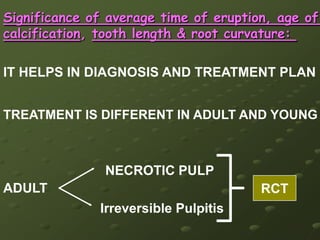
Significance of average time of eruption, age of calcification, tooth length & root curvature: IT HELPS IN DIAGNOSIS AND TREATMENT PLAN TREATMENT IS DIFFERENT IN ADULT AND YOUNGNECROTIC PULPRCTADULT Irreversible Pulpitis
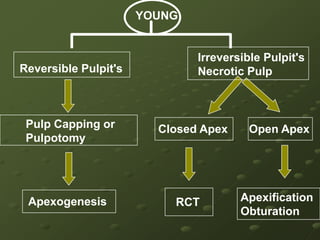
YOUNGIrreversible Pulpit's Necrotic PulpReversible Pulpit'sPulp Capping or PulpotomyClosed ApexOpen ApexApexification ObturationApexogenesisRCT
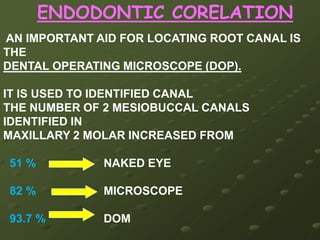
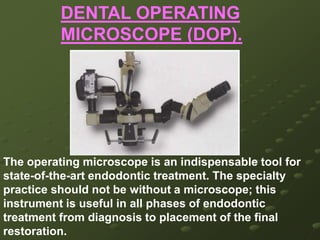
ENDODONTIC CORELATION AN IMPORTANT AID FOR LOCATING ROOT CANAL IS THE DENTAL OPERATING MICROSCOPE (DOP).IT IS USED TO IDENTIFIED CANAL THE NUMBER OF 2 MESIOBUCCAL CANALS IDENTIFIED IN   MAXILLARY 2 MOLAR INCREASED FROM   51 %  NAKED EYE82 %                     MICROSCOPE93.7 %DOM
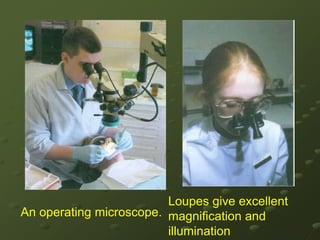
DENTAL OPERATING MICROSCOPE (DOP).The operating microscope is an indispensable tool for state-of-the-art endodontic treatment. The specialty practice should not be without a microscope; this instrument is useful in all phases of endodontic treatment from diagnosis to placement of the final restoration.
Loupes give excellent magnification and illuminationAn operating microscope.
ENDODONTIC CORELATION WITHPULP CHAMPER   DIAGNOSTIC MEASURES ARE IMPORTANT AIDS  IN THE LOCATION OF ROOT CANALS ORIFICES     THESE MEASURES  OBTAIN MULIPLE PRE TREATMENT         RADIOGRAPHS  EXAMINING THE CHAMBER WITH SHARP                  EXPLORER
3. TROUGHING GROOVES WITH          ULTRASONIC TIPS4. STAINING THE CHAMBER WITH 1 %METHYLENE BLUE DYE    CHAMPAGNE BUPPLE TEST5. VISUALIZING CANAL BLEEDING       POINT
PRE TREATMENT RADIOGRAPHS The palatal canal is centered between the mesiobuccal and distobuccal roots in maxillary molars. When a second mesiobuccal canal (MB 2 ) is suspected, a mesial radiograph is often required to identify it. However, as thehorizontal angulation increases, the clarity of the radicular anatomy decreases. A 20 degree mesial shift is sufficient to separate the canals while limiting distortion.
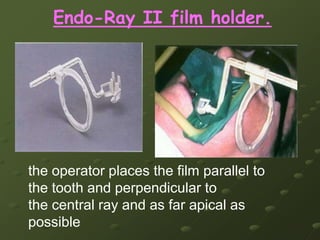
Endo-Ray II film holder.the operator places the film parallel to the tooth and perpendicular tothe central ray and as far apical as possible
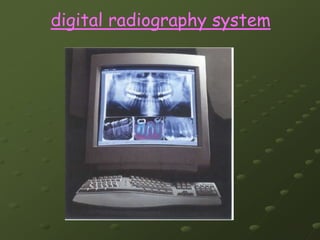
digital radiography system
CONVEX PULP CHAMBERFLOOR OF PULP CHAMBERMARKEDLY CONVEXCANAL ORIFICES  SLIGHT FUNNAL SHAPEIN THIS CASEREMOVAL OF A LIP OF DENTINCANAL CAN BE ENTERED MORE INA DIRECT LINE WITH THE AXIS
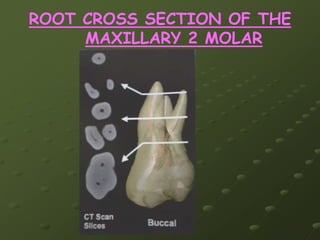
ROOT CROSS SECTION OF THE    MAXILLARY 2 MOLAR
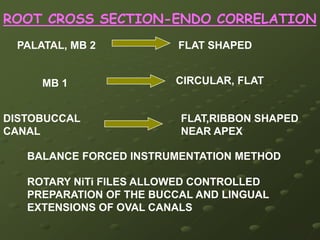
ROOT CROSS SECTION-ENDO CORRELATIONPALATAL, MB 2 FLAT SHAPEDCIRCULAR, FLATMB 1DISTOBUCCAL CANALFLAT,RIBBON SHAPEDNEAR APEX  BALANCE FORCED INSTRUMENTATION METHODROTARY NiTi FILES ALLOWED CONTROLLED PREPARATION OF THE BUCCAL AND LINGUALEXTENSIONS OF OVAL CANALS
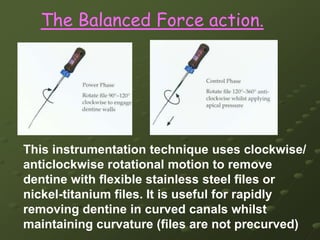
The Balanced Force action.This instrumentation technique uses clockwise/ anticlockwise rotational motion to remove dentine with flexible stainless steel files or nickel-titanium files. It is useful for rapidly removing dentine in curved canals whilst maintaining curvature (files are not precurved)
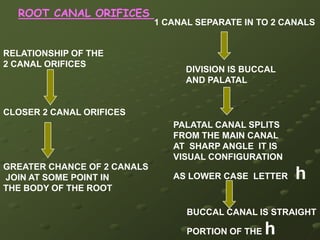
ROOT CANAL ORIFICES 1 CANAL SEPARATE IN TO 2 CANALSRELATIONSHIP OF THE 2 CANAL ORIFICESDIVISION IS BUCCAL AND PALATALCLOSER 2 CANAL ORIFICESPALATAL CANAL SPLITSFROM THE MAIN CANALAT  SHARP ANGLE  IT IS VISUAL CONFIGURATION AS LOWER CASE  LETTER   hGREATER CHANCE OF 2 CANALS JOIN AT SOME POINT IN THE BODY OF THE ROOTBUCCAL CANAL IS STRAIGHTPORTION OF THE h
Examination of pulp chamber floor can reveal clues to the location of orifices and to the type of canal system presentRotary NiTi files must be used cautiously with the type of anatomy because instrument separation can occur as the files traverses the sharp curvature in to the common part of canal
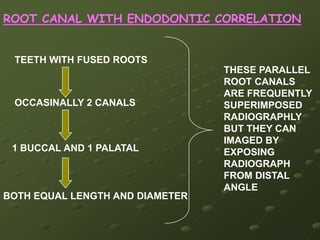
ROOT CANAL WITH ENDODONTIC CORRELATIONTEETH WITH FUSED ROOTSTHESE PARALLEL ROOT CANALS ARE FREQUENTLY SUPERIMPOSEDRADIOGRAPHLY BUT THEY CAN IMAGED BY EXPOSING RADIOGRAPHFROM DISTAL ANGLEOCCASINALLY 2 CANALS1 BUCCAL AND 1 PALATALBOTH EQUAL LENGTH AND DIAMETER
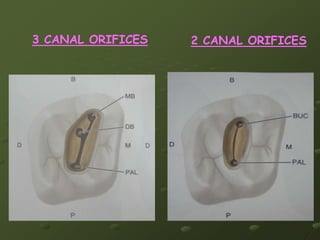
3 CANAL ORIFICES2 CANAL ORIFICES
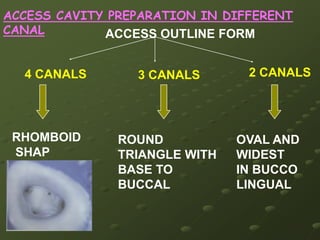
ACCESS CAVITY PREPARATION IN DIFFERENT CANALACCESS OUTLINE FORM2 CANALS4 CANALS 3 CANALSRHOMBOID SHAPROUND TRIANGLE WITH BASE TO BUCCALOVAL AND WIDESTIN BUCCOLINGUAL
WORKING LENGTH DETERMINATIONModern electronic apex locators are reliable instruments that can help the  clinician determine the working lengthSuccessful treatment depends on the anatomy of the  root canal system the dimension of the canal walls and the final size of enlarging instruments
J. Morita Root ZX electronic apex locator.
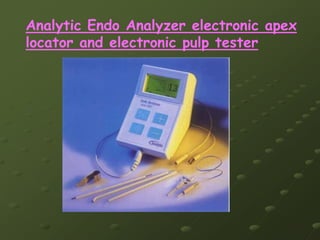
Analytic Endo Analyzer electronic apex locator and electronic pulp tester
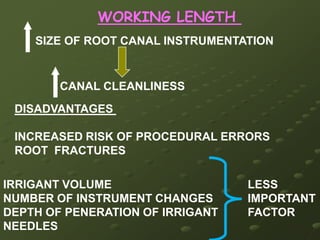
WORKING LENGTH  SIZE OF ROOT CANAL INSTRUMENTATIONCANAL CLEANLINESSDISADVANTAGES INCREASED RISK OF PROCEDURAL ERRORSROOT  FRACTURES IRRIGANT VOLUMENUMBER OF INSTRUMENT CHANGESDEPTH OF PENERATION OF IRRIGANTNEEDLES LESS IMPORTANT FACTOR
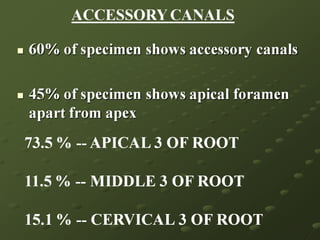
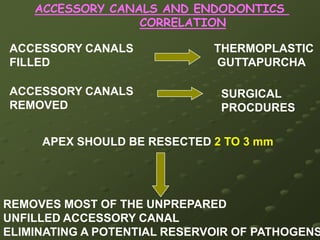
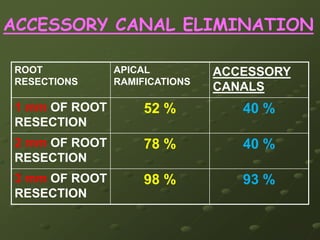
ACCESSORY CANALS AND ENDODONTICS CORRELATIONACCESSORY CANALS FILLEDTHERMOPLASTIC  GUTTAPURCHA ACCESSORY CANALS REMOVEDSURGICAL PROCDURESAPEX SHOULD BE RESECTED 2 TO 3 mm REMOVES MOST OF THE UNPREPAREDUNFILLED ACCESSORY CANALELIMINATING A POTENTIAL RESERVOIR OF PATHOGENS
ROOT RESECTION FOR REMOVALOF ACCESSORY CANALRoot end resection a bevel perpendicular to the long axis of a root exposes a small number of microtubules
root resection with 45-degree bevel exposes significantly grater number of tubules  increasing the chance of leakage into and out of the root canal to prevent this root end cavity  preparations should extend coronally to the height of the bevel
ACCESSORY CANAL ELIMINATION
TEETH WITH MINIMAL ORNO CLINICAL CROWN Short crown  may be developmental        defect Caries left untreated
 Fracture under heavily occlusal force
 External traumaBefore starting the procedure       clinician should study their root      angulations on  Preoperative        radiograph Examine the cervical crown        anatomy with an explorer Pulp chamber located at the        center   of the crown at  the level        Of the CEJ
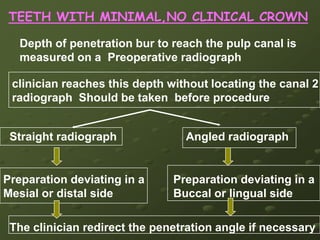
TEETH WITH MINIMAL,NO CLINICAL CROWNDepth of penetration bur to reach the pulp canal is measured on a  Preoperative radiograph clinician reaches this depth without locating the canal 2 radiograph  Should be taken  before procedure  Straight radiographAngled radiographPreparation deviating in a Mesial or distal sidePreparation deviating in a Buccal or lingual side The clinician redirect the penetration angle if necessary
Teeth with calcified canal  Endodontic correlationCauses of calcified tooth Caries
 Medications
 Occlusal trauma
agingManagement  of calcified tooth Use of magnification and       transillumination Search canal orifices after completely        preparing the pulp chamber And cleaning and drying its floor ( 70 %         denature ethanol ) Chamber floor is DARKER in color than       its wall
 Developmental grooves       connecting orifices are LIGHTER     in color Than the chamber floor Staining the pulp chamber floor         with1 % methylene blue dye      Performing the sodium          hypochlorite “CHAMPAGNE       BUPPLE “test Searching for canal bleeding pointManagement  of calcified tooth Dentin must slowly be removed     down the root Use long thin ultrasonic tips under       high magnification of a DOM to      avoid removing too much tooth      structure
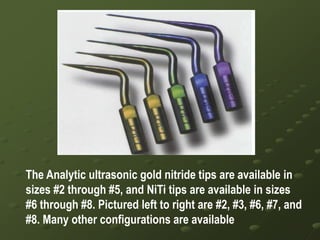
The Analytic ultrasonic gold nitride tips are available in sizes #2 through #5, and NiTi tips are available in sizes #6 through #8. Pictured left to right are #2, #3, #6, #7, and #8. Many other configurations are available
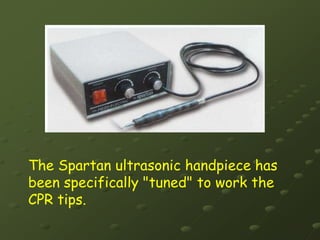
The Spartan ultrasonic handpiece has been specifically "tuned" to work the CPR tips.
ULTRASONICSThe CPR tips are available in nitride (gold-yellow) and NiTi (green, blue, and purple). The extremely fine tips coupled with the small handpiece allow unprecedented visibility  Ultrasonic tips can be used to remove pulp stones and to cut dentin while locating additional canals.
    As the search moves apically Two Radiographs must be taken         1. straight on direction          2. angled directionsVery small pieces of lead foil placed                  at the apical  extent of the penetration     Can provide a radiograph referencesUse first a small file K FILE ( #6, #8,  or #10 ) coated with a chelating agent
Management  of calcified toothCoated with a chelating agent should be introduced In to the canal to determine patencyThis file should be removed until canal enlargement It should be used in short up and down movement and In a selective circumferential filling motion with most of the Lateral pressure directed away from the furcationThis safely enlarge the coronal canal and moves it laterally To avoid the furcation
LIMITATIONSStop excavating dentin if a canal orifices cannot be found to avoid Weakening the tooth structureSerious error can arise from  inappropriate attempt canalsRoot wall or furcation perforations can occur
Rotated teethThis case altered crown root relationship Management of rotated teethRadiograph examination is crucial
 Initial outline form occasionally can       be created without dental dam
 Positioning of bur with long axis of    the tooth Bur penetration for  both depth and      angulations should be confirmed      Frequently with  radiographs
 CASE REPORTS
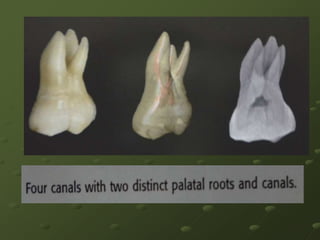
Endodontic Miscellany : Maxillary 2 molarwith two canals in the palatal rootDuring pre-clinical Endodontic on extracted teeth, a maxillary second molar was found to have a palatal root with two canals. While locating the canals, because of eccentric location of the instrument in the palatal canal, a second canal was suspected. Placement of another instrument easily verified the presence of the second canal..
The palatal root canal system was characterized by two canal orifices and two canals that appeared to unite in the apical third of the root. which constitute type II canal configuration according to Vertucci's classification 8  Most of the clinical literature on the fourth canal in maxillary molars reports an additional mesiobuccal canal (MB2)3,4,5. But an anomalous root morphology that occurs Infrequently
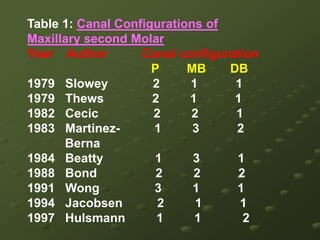
Table 1: Canal Configurations ofMaxillary second MolarYear    Author          Canal configuration                                    P        MB       DB1979   Slowey             2         1           1 1979   Thews              2         1           1 1982   Cecic                2         2           1 1983   Martinez-          1         3           2            Berna1984   Beatty               1         3           1 1988   Bond                 2         2           2 1991   Wong                3         1           1 1994   Jacobsen          2         1           1 1997   Hulsmann         1         1            2
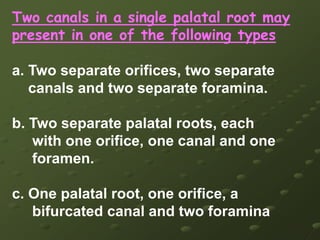
Two canals in a single palatal root maypresent in one of the following typesa. Two separate orifices, two separate         canals and two separate foramina.b. Two separate palatal roots, each         with one orifice, one canal and one       foramen.c. One palatal root, one orifice, a      bifurcated canal and two foramina
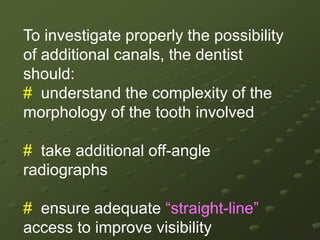
To investigate properly the possibility of additional canals, the dentist should: #  understand the complexity of the morphology of the tooth involved#  take additional off-angle   radiographs#  ensure adequate “straight-line” access to improve visibility
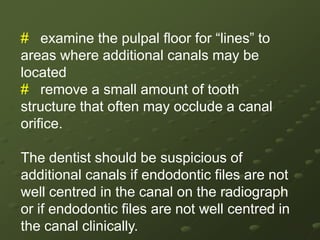
#   examine the pulpal floor for “lines” to   areas where additional canals may be located #   remove a small amount of tooth structure that often may occlude a canal orifice.The dentist should be suspicious of additional canals if endodontic files are not well centred in the canal on the radiograph or if endodontic files are not well centred in the canal clinically.
DiscussionHaving the information observed from theradiographs and knowing what combinations of internal anatomy are possible, the dentist should be able to determine what type of canal configuration is present.                                An examination of the floor of the pulp chamber offers clues to thetype of canal configuration present.
A Five-canal Maxillary Second Molar*May 2007, Volume 4, No.5  Journal of US -China Medical Science , ISSN1548-6648 USACASE REPORTThe patient was a 35 years old male who presented with a severe spontaneous pain in the maxillary right area which had been constant for one day. The medical status was unremarkable. Clinical examinations revealed that tooth-2 had deep mesio-occlusal caries without pulp exposure and was very sensitive to cold test.
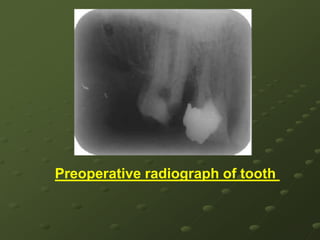
Radiographic examination disclosed an unusual anatomical configuration of the roots, suggesting that four roots might be present.A diagnosis of acute pulpitis was made for tooth-Following local anaesthesia an endodontic access opening was made and the pulp chamber was exposed clearly.
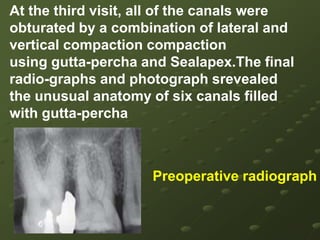
Preoperative radiograph of tooth
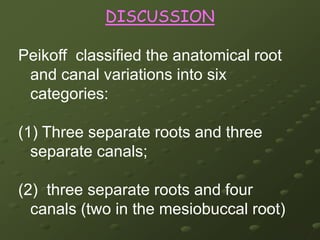
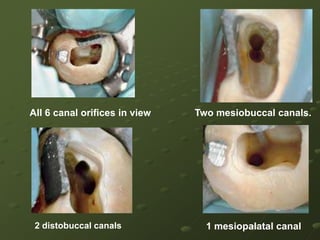
Examination of the chamber floor with an endodontic explorer (DG-16) revealed five canal orifices1.mesiobuccal canal (MB1),2.mesiobuccal 2nd canal (MB2),3.mesiopalatal canal (MP),4.distopalatal canal (DP)5.distobuccal canal (DB)
The orifice of the mesiopalatal canal was large, well formed, and located at the mesiopalatal corner of the pulp chamber.The distopalatal canal was also large and well developed and more distal to the chamber than a single palatal root would be expected. The MB2 orifice was found nearly on the imaginary line between the MBl and MP orifice, and about 1.5mm palatal to the MBl orifice
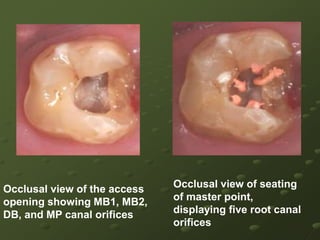
Occlusal view of seating of master point, displaying five root canal orificesOcclusal view of the access opening showing MB1, MB2, DB, and MP canal orifices
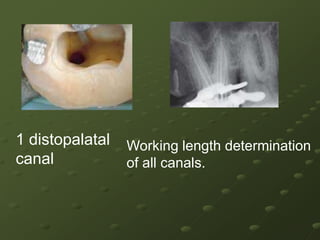
All canals were easily negotiated, and the working length was determined by using electronic apex locator Root ZXThe root canals were cleaned and shaped using K-type files and Gates Glidden drills #2, #3, and #4 with passive step-back technique.Apical preparations in the buccal canals were enlarged to a master file size of 30, and in the palatal canal to size of 45.
The root canals were copiously irrigated with 3% H2O2 solution.Then the canals were obturated with AH-Plus sealer and gutta-percha using a lateral compaction technique. A temporary restoration with IRM was placed and a permanent restoration was advised. At the 3 month recall examination, the tooth was asymptomatic with normal periapical
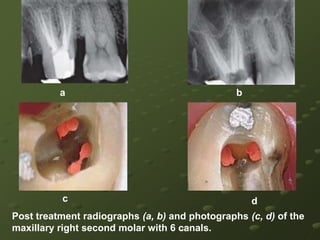
 Post obturation occlusal view of the pulp chamber floor showing all five root canal orificesPostobturation radiograph (RVG) displaying five root canals
DISCUSSIONPeikoff  classified the anatomical root and canal variations into six categories:  Three separate roots and three separate canals; (2)  three separate roots and four canals (two in the mesiobuccal root)
three roots and canals whose         mesiobuccal and distobuccal canals combine to form a common       buccal with a separate palataltwo separate roots with a single        canal in eachone main root and canalfour separate roots and four           separate canals including two palatal.
This study also revealed that occurrence of ‘standard' configuration, 3 roots with 3 or 4 canals, was the       most frequent (88.6%).In addition to Yang et al. result found that the maxillary second molars had a C-shaped root in 4.5% and C-shaped in Chinese population.

17

  • 1.
    MAXILLARY II MOLAR SUBMITTED BYO.R.GANESAMURTHI1 YEAR M.Sc.D ENDODONTICS
  • 3.
    INDEX EXTERNAL ANATOMYOF TOOTH MORPHOLOGY OF TOOTH INTERNAL ANATOMY OF TOOTH PULP CHAMPER ROOT CANAL SYSTEM ANOMALIES OF TOOTH
  • 4.
  • 5.
  • 6.
    REFERENCEINTRODUCTIONThe maxillarysecond molar is the tooth located distally from both the maxillary first molars of the mouth but mesial from both maxillary third molars. This is true only in permanent teeth. In deciduous teeth, the maxillary second molar is the last tooth in the mouth and does not have a third molar behind it. The function of this molar is similar to that of all molars in regard to grinding being the principle action during mastication. There are usually four cusps on maxillary molars, two on the buccal and two palatal
  • 7.
    MAXILLARY II MOLARClasstraits 3 or more cusps
  • 8.
    At least2 buccal cusps
  • 9.
    One ormore lingual cusps
  • 10.
    In general2 or 3 rootsCHRONOLOGY OF SECOND MOLAR Average time of eruption : 11 to 13 years
  • 11.
    Average ageof calcification : 14 to 16 years
  • 12.
    Average length : 20.0 mmCHRONOLOGY OF SECOND MOLAR
  • 13.
    Arch traits 3 roots: 2 Buccal & 1 Palatal
  • 14.
    Crown: Buccolingual > MesioDistal
  • 15.
    Cusps3 major cusps MP, MB & DB Arranged in a tricuspid-triangular patternLesser-sized DL cusp & sometimes missingOblique ridge: MP to DB cusp
  • 16.
    Buccal cusps areof unequal size
  • 17.
    MP cusp islarger than DPBuccal aspect Smaller crown size Less prominent DB cusp & narrower MD Distally inclined BUCCAL rootsLingual aspect DL cusp is smaller in width & height LINGUAL root is narrower MD & slightly Distally inclined No cusp of Carabelli
  • 18.
    Mesial aspect Less numerous Marginal ridge tubercles MB & Lingual roots are less divergentDistal aspect Smaller Distal cusps A greater portion of the occlusal aspect is visible
  • 19.
    Occlusal aspect MB & DL angles are more acute
  • 20.
    ML& DB angles are more obtuse More variable pit/groove pattern
  • 21.
    Morenumerous supplementary groove Crown is more constricted MDINTERNAL ANATOMYPulpMesioDistal section 2 horns, MB is higher Pulp chamber, roof & floor Canals, narrow Canal orificeBuccoLingual section Pulp chamber is wider 2 horns of equal heightCross -section 3 canals
  • 22.
    INTERNAL ANATOMY PULPCHAMBERTHE PULP CHAMBER OF MAXILLARY 2 MOLAR IS SIMILAR TO THAT OF THE MAXILLARY 1 MOLAR EXCEPT IT IS NARROWER MESIODISTALLY
  • 23.
    PULP HORNS- 4 1.MESIOBUCCAL 2.DISTOBUCCAL 3.MESIOPALATAL 4.DISTOPALATALROOF– MORE RHOMBOIDAL IN CROSS SECTION
  • 24.
    FLOOR- OBTUSE TRIANGLEIN CROSS SECTIONPULP CHAMBER ANATOMY
  • 25.
    ROOT CANALSif 3roots are present usually we can see 3 canals1. mesiobuccal 2. distobuccal 3. palatal if 4 canal is present it is in mesiobuccal root but less frequently than in the 1 molar
  • 26.
  • 27.
    ROOTS AND ROOTCANALS63 % straightPALATAL ROOT37 % buccal curve78 % distal curveMESIOBUCCAL ROOT22 % straight83 % straightDISTAL ROOT17 % mesial curve
  • 28.
    ROOT CANAL ANDAPICAL FORAMINA IN MAXILLARY 2 MOLAR MESIOBUCAL ROOT
  • 29.
  • 33.
    ANATOMY RALATIONSHIPS INSITUThe maxillary 2 molar usually is more closely related to the maxillary sinus than the maxillary 1 molarThis close relationship may produce Soreness In the maxillary teeth due to Maxillary sinusities
  • 34.
  • 35.
    Significance of averagetime of eruption, age of calcification, tooth length & root curvature: IT HELPS IN DIAGNOSIS AND TREATMENT PLAN TREATMENT IS DIFFERENT IN ADULT AND YOUNGNECROTIC PULPRCTADULT Irreversible Pulpitis
  • 36.
    YOUNGIrreversible Pulpit's NecroticPulpReversible Pulpit'sPulp Capping or PulpotomyClosed ApexOpen ApexApexification ObturationApexogenesisRCT
  • 37.
    ENDODONTIC CORELATION ANIMPORTANT AID FOR LOCATING ROOT CANAL IS THE DENTAL OPERATING MICROSCOPE (DOP).IT IS USED TO IDENTIFIED CANAL THE NUMBER OF 2 MESIOBUCCAL CANALS IDENTIFIED IN MAXILLARY 2 MOLAR INCREASED FROM 51 % NAKED EYE82 % MICROSCOPE93.7 %DOM
  • 38.
    DENTAL OPERATING MICROSCOPE(DOP).The operating microscope is an indispensable tool for state-of-the-art endodontic treatment. The specialty practice should not be without a microscope; this instrument is useful in all phases of endodontic treatment from diagnosis to placement of the final restoration.
  • 39.
    Loupes give excellentmagnification and illuminationAn operating microscope.
  • 40.
    ENDODONTIC CORELATION WITHPULPCHAMPER DIAGNOSTIC MEASURES ARE IMPORTANT AIDS IN THE LOCATION OF ROOT CANALS ORIFICES THESE MEASURES OBTAIN MULIPLE PRE TREATMENT RADIOGRAPHS EXAMINING THE CHAMBER WITH SHARP EXPLORER
  • 41.
    3. TROUGHING GROOVESWITH ULTRASONIC TIPS4. STAINING THE CHAMBER WITH 1 %METHYLENE BLUE DYE CHAMPAGNE BUPPLE TEST5. VISUALIZING CANAL BLEEDING POINT
  • 42.
    PRE TREATMENT RADIOGRAPHSThe palatal canal is centered between the mesiobuccal and distobuccal roots in maxillary molars. When a second mesiobuccal canal (MB 2 ) is suspected, a mesial radiograph is often required to identify it. However, as thehorizontal angulation increases, the clarity of the radicular anatomy decreases. A 20 degree mesial shift is sufficient to separate the canals while limiting distortion.
  • 43.
    Endo-Ray II filmholder.the operator places the film parallel to the tooth and perpendicular tothe central ray and as far apical as possible
  • 44.
  • 45.
    CONVEX PULP CHAMBERFLOOROF PULP CHAMBERMARKEDLY CONVEXCANAL ORIFICES SLIGHT FUNNAL SHAPEIN THIS CASEREMOVAL OF A LIP OF DENTINCANAL CAN BE ENTERED MORE INA DIRECT LINE WITH THE AXIS
  • 46.
    ROOT CROSS SECTIONOF THE MAXILLARY 2 MOLAR
  • 47.
    ROOT CROSS SECTION-ENDOCORRELATIONPALATAL, MB 2 FLAT SHAPEDCIRCULAR, FLATMB 1DISTOBUCCAL CANALFLAT,RIBBON SHAPEDNEAR APEX BALANCE FORCED INSTRUMENTATION METHODROTARY NiTi FILES ALLOWED CONTROLLED PREPARATION OF THE BUCCAL AND LINGUALEXTENSIONS OF OVAL CANALS
  • 48.
    The Balanced Forceaction.This instrumentation technique uses clockwise/ anticlockwise rotational motion to remove dentine with flexible stainless steel files or nickel-titanium files. It is useful for rapidly removing dentine in curved canals whilst maintaining curvature (files are not precurved)
  • 49.
    ROOT CANAL ORIFICES1 CANAL SEPARATE IN TO 2 CANALSRELATIONSHIP OF THE 2 CANAL ORIFICESDIVISION IS BUCCAL AND PALATALCLOSER 2 CANAL ORIFICESPALATAL CANAL SPLITSFROM THE MAIN CANALAT SHARP ANGLE IT IS VISUAL CONFIGURATION AS LOWER CASE LETTER hGREATER CHANCE OF 2 CANALS JOIN AT SOME POINT IN THE BODY OF THE ROOTBUCCAL CANAL IS STRAIGHTPORTION OF THE h
  • 50.
    Examination of pulpchamber floor can reveal clues to the location of orifices and to the type of canal system presentRotary NiTi files must be used cautiously with the type of anatomy because instrument separation can occur as the files traverses the sharp curvature in to the common part of canal
  • 52.
    ROOT CANAL WITHENDODONTIC CORRELATIONTEETH WITH FUSED ROOTSTHESE PARALLEL ROOT CANALS ARE FREQUENTLY SUPERIMPOSEDRADIOGRAPHLY BUT THEY CAN IMAGED BY EXPOSING RADIOGRAPHFROM DISTAL ANGLEOCCASINALLY 2 CANALS1 BUCCAL AND 1 PALATALBOTH EQUAL LENGTH AND DIAMETER
  • 53.
    3 CANAL ORIFICES2CANAL ORIFICES
  • 54.
    ACCESS CAVITY PREPARATIONIN DIFFERENT CANALACCESS OUTLINE FORM2 CANALS4 CANALS 3 CANALSRHOMBOID SHAPROUND TRIANGLE WITH BASE TO BUCCALOVAL AND WIDESTIN BUCCOLINGUAL
  • 55.
    WORKING LENGTH DETERMINATIONModernelectronic apex locators are reliable instruments that can help the clinician determine the working lengthSuccessful treatment depends on the anatomy of the root canal system the dimension of the canal walls and the final size of enlarging instruments
  • 56.
    J. Morita RootZX electronic apex locator.
  • 57.
    Analytic Endo Analyzerelectronic apex locator and electronic pulp tester
  • 58.
    WORKING LENGTH SIZE OF ROOT CANAL INSTRUMENTATIONCANAL CLEANLINESSDISADVANTAGES INCREASED RISK OF PROCEDURAL ERRORSROOT FRACTURES IRRIGANT VOLUMENUMBER OF INSTRUMENT CHANGESDEPTH OF PENERATION OF IRRIGANTNEEDLES LESS IMPORTANT FACTOR
  • 59.
    ACCESSORY CANALS ANDENDODONTICS CORRELATIONACCESSORY CANALS FILLEDTHERMOPLASTIC GUTTAPURCHA ACCESSORY CANALS REMOVEDSURGICAL PROCDURESAPEX SHOULD BE RESECTED 2 TO 3 mm REMOVES MOST OF THE UNPREPAREDUNFILLED ACCESSORY CANALELIMINATING A POTENTIAL RESERVOIR OF PATHOGENS
  • 60.
    ROOT RESECTION FORREMOVALOF ACCESSORY CANALRoot end resection a bevel perpendicular to the long axis of a root exposes a small number of microtubules
  • 61.
    root resection with45-degree bevel exposes significantly grater number of tubules increasing the chance of leakage into and out of the root canal to prevent this root end cavity preparations should extend coronally to the height of the bevel
  • 62.
  • 63.
    TEETH WITH MINIMALORNO CLINICAL CROWN Short crown may be developmental defect Caries left untreated
  • 64.
    Fracture underheavily occlusal force
  • 65.
    External traumaBeforestarting the procedure clinician should study their root angulations on Preoperative radiograph Examine the cervical crown anatomy with an explorer Pulp chamber located at the center of the crown at the level Of the CEJ
  • 66.
    TEETH WITH MINIMAL,NOCLINICAL CROWNDepth of penetration bur to reach the pulp canal is measured on a Preoperative radiograph clinician reaches this depth without locating the canal 2 radiograph Should be taken before procedure Straight radiographAngled radiographPreparation deviating in a Mesial or distal sidePreparation deviating in a Buccal or lingual side The clinician redirect the penetration angle if necessary
  • 67.
    Teeth with calcifiedcanal Endodontic correlationCauses of calcified tooth Caries
  • 68.
  • 69.
  • 70.
    agingManagement ofcalcified tooth Use of magnification and transillumination Search canal orifices after completely preparing the pulp chamber And cleaning and drying its floor ( 70 % denature ethanol ) Chamber floor is DARKER in color than its wall
  • 71.
    Developmental grooves connecting orifices are LIGHTER in color Than the chamber floor Staining the pulp chamber floor with1 % methylene blue dye Performing the sodium hypochlorite “CHAMPAGNE BUPPLE “test Searching for canal bleeding pointManagement of calcified tooth Dentin must slowly be removed down the root Use long thin ultrasonic tips under high magnification of a DOM to avoid removing too much tooth structure
  • 72.
    The Analytic ultrasonicgold nitride tips are available in sizes #2 through #5, and NiTi tips are available in sizes #6 through #8. Pictured left to right are #2, #3, #6, #7, and #8. Many other configurations are available
  • 73.
    The Spartan ultrasonichandpiece has been specifically "tuned" to work the CPR tips.
  • 74.
    ULTRASONICSThe CPR tipsare available in nitride (gold-yellow) and NiTi (green, blue, and purple). The extremely fine tips coupled with the small handpiece allow unprecedented visibility Ultrasonic tips can be used to remove pulp stones and to cut dentin while locating additional canals.
  • 75.
    As the search moves apically Two Radiographs must be taken 1. straight on direction 2. angled directionsVery small pieces of lead foil placed at the apical extent of the penetration Can provide a radiograph referencesUse first a small file K FILE ( #6, #8, or #10 ) coated with a chelating agent
  • 76.
    Management ofcalcified toothCoated with a chelating agent should be introduced In to the canal to determine patencyThis file should be removed until canal enlargement It should be used in short up and down movement and In a selective circumferential filling motion with most of the Lateral pressure directed away from the furcationThis safely enlarge the coronal canal and moves it laterally To avoid the furcation
  • 77.
    LIMITATIONSStop excavating dentinif a canal orifices cannot be found to avoid Weakening the tooth structureSerious error can arise from inappropriate attempt canalsRoot wall or furcation perforations can occur
  • 78.
    Rotated teethThis casealtered crown root relationship Management of rotated teethRadiograph examination is crucial
  • 79.
    Initial outlineform occasionally can be created without dental dam
  • 80.
    Positioning ofbur with long axis of the tooth Bur penetration for both depth and angulations should be confirmed Frequently with radiographs
  • 81.
  • 82.
    Endodontic Miscellany :Maxillary 2 molarwith two canals in the palatal rootDuring pre-clinical Endodontic on extracted teeth, a maxillary second molar was found to have a palatal root with two canals. While locating the canals, because of eccentric location of the instrument in the palatal canal, a second canal was suspected. Placement of another instrument easily verified the presence of the second canal..
  • 83.
    The palatal rootcanal system was characterized by two canal orifices and two canals that appeared to unite in the apical third of the root. which constitute type II canal configuration according to Vertucci's classification 8 Most of the clinical literature on the fourth canal in maxillary molars reports an additional mesiobuccal canal (MB2)3,4,5. But an anomalous root morphology that occurs Infrequently
  • 84.
    Table 1: CanalConfigurations ofMaxillary second MolarYear Author Canal configuration P MB DB1979 Slowey 2 1 1 1979 Thews 2 1 1 1982 Cecic 2 2 1 1983 Martinez- 1 3 2 Berna1984 Beatty 1 3 1 1988 Bond 2 2 2 1991 Wong 3 1 1 1994 Jacobsen 2 1 1 1997 Hulsmann 1 1 2
  • 85.
    Two canals ina single palatal root maypresent in one of the following typesa. Two separate orifices, two separate canals and two separate foramina.b. Two separate palatal roots, each with one orifice, one canal and one foramen.c. One palatal root, one orifice, a bifurcated canal and two foramina
  • 86.
    To investigate properlythe possibility of additional canals, the dentist should: # understand the complexity of the morphology of the tooth involved# take additional off-angle radiographs# ensure adequate “straight-line” access to improve visibility
  • 87.
    # examine the pulpal floor for “lines” to areas where additional canals may be located # remove a small amount of tooth structure that often may occlude a canal orifice.The dentist should be suspicious of additional canals if endodontic files are not well centred in the canal on the radiograph or if endodontic files are not well centred in the canal clinically.
  • 88.
    DiscussionHaving the informationobserved from theradiographs and knowing what combinations of internal anatomy are possible, the dentist should be able to determine what type of canal configuration is present. An examination of the floor of the pulp chamber offers clues to thetype of canal configuration present.
  • 89.
    A Five-canal MaxillarySecond Molar*May 2007, Volume 4, No.5 Journal of US -China Medical Science , ISSN1548-6648 USACASE REPORTThe patient was a 35 years old male who presented with a severe spontaneous pain in the maxillary right area which had been constant for one day. The medical status was unremarkable. Clinical examinations revealed that tooth-2 had deep mesio-occlusal caries without pulp exposure and was very sensitive to cold test.
  • 90.
    Radiographic examination disclosedan unusual anatomical configuration of the roots, suggesting that four roots might be present.A diagnosis of acute pulpitis was made for tooth-Following local anaesthesia an endodontic access opening was made and the pulp chamber was exposed clearly.
  • 91.
  • 92.
    Examination of thechamber floor with an endodontic explorer (DG-16) revealed five canal orifices1.mesiobuccal canal (MB1),2.mesiobuccal 2nd canal (MB2),3.mesiopalatal canal (MP),4.distopalatal canal (DP)5.distobuccal canal (DB)
  • 93.
    The orifice ofthe mesiopalatal canal was large, well formed, and located at the mesiopalatal corner of the pulp chamber.The distopalatal canal was also large and well developed and more distal to the chamber than a single palatal root would be expected. The MB2 orifice was found nearly on the imaginary line between the MBl and MP orifice, and about 1.5mm palatal to the MBl orifice
  • 94.
    Occlusal view ofseating of master point, displaying five root canal orificesOcclusal view of the access opening showing MB1, MB2, DB, and MP canal orifices
  • 95.
    All canals wereeasily negotiated, and the working length was determined by using electronic apex locator Root ZXThe root canals were cleaned and shaped using K-type files and Gates Glidden drills #2, #3, and #4 with passive step-back technique.Apical preparations in the buccal canals were enlarged to a master file size of 30, and in the palatal canal to size of 45.
  • 96.
    The root canalswere copiously irrigated with 3% H2O2 solution.Then the canals were obturated with AH-Plus sealer and gutta-percha using a lateral compaction technique. A temporary restoration with IRM was placed and a permanent restoration was advised. At the 3 month recall examination, the tooth was asymptomatic with normal periapical
  • 97.
    Post obturationocclusal view of the pulp chamber floor showing all five root canal orificesPostobturation radiograph (RVG) displaying five root canals
  • 98.
    DISCUSSIONPeikoff classifiedthe anatomical root and canal variations into six categories: Three separate roots and three separate canals; (2) three separate roots and four canals (two in the mesiobuccal root)
  • 99.
    three roots andcanals whose mesiobuccal and distobuccal canals combine to form a common buccal with a separate palataltwo separate roots with a single canal in eachone main root and canalfour separate roots and four separate canals including two palatal.
  • 100.
    This study alsorevealed that occurrence of ‘standard' configuration, 3 roots with 3 or 4 canals, was the most frequent (88.6%).In addition to Yang et al. result found that the maxillary second molars had a C-shaped root in 4.5% and C-shaped in Chinese population.