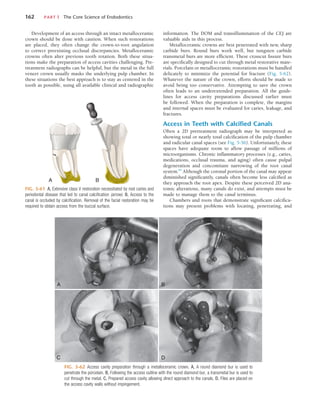
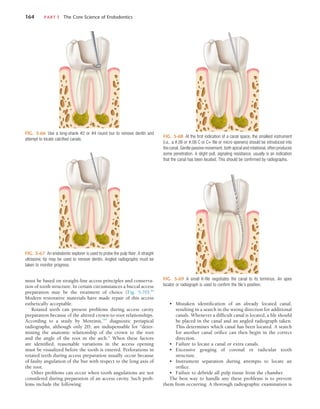
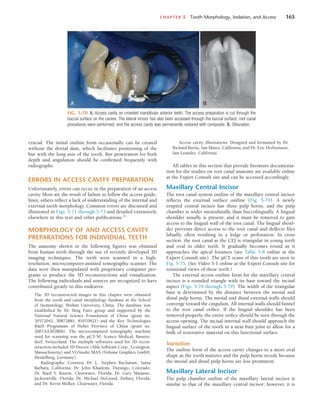
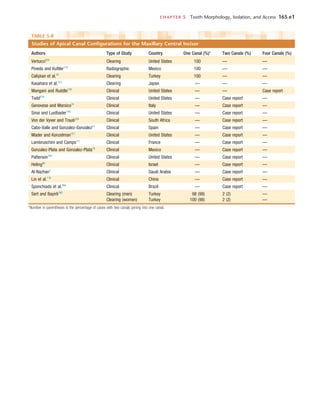
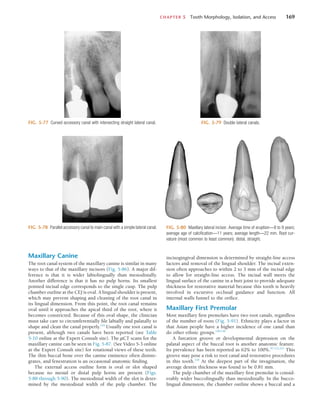
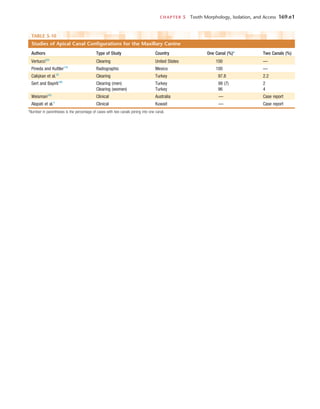
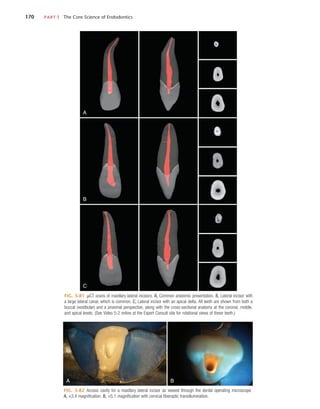
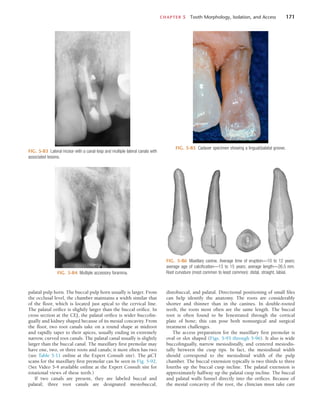
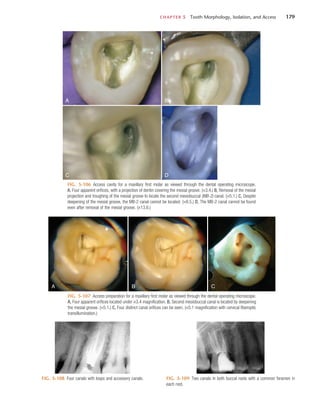
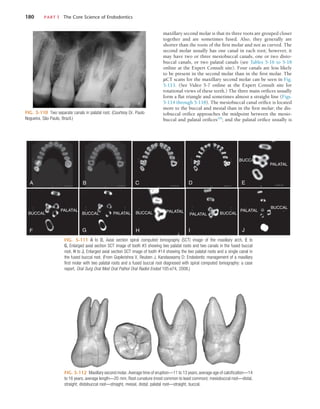
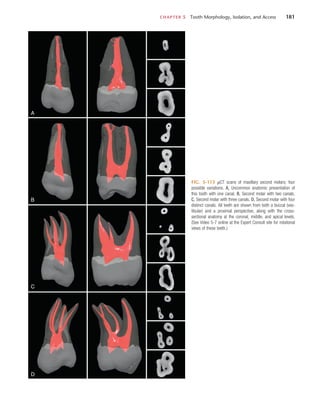
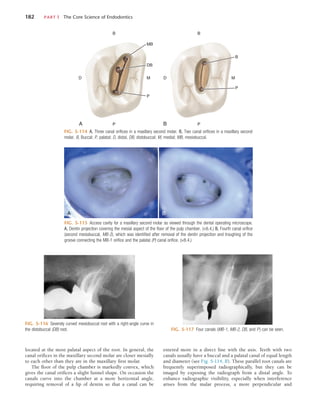
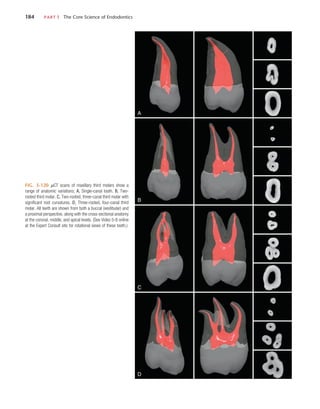
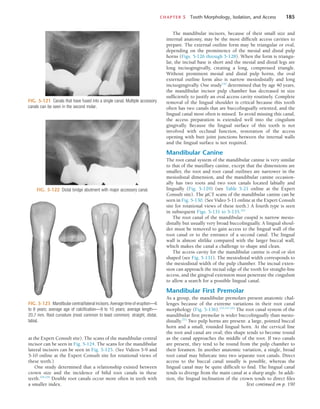
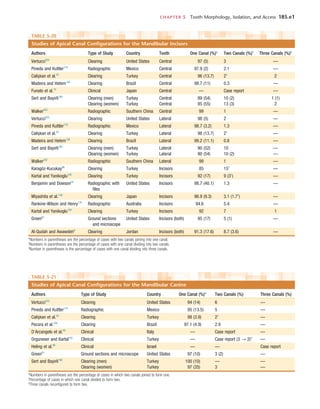
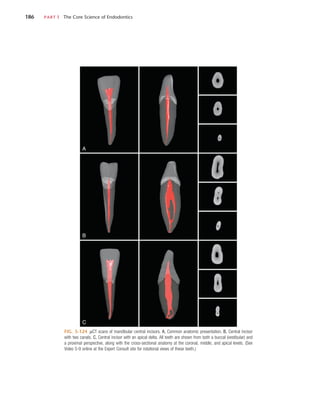
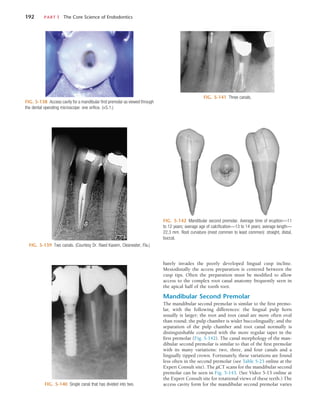
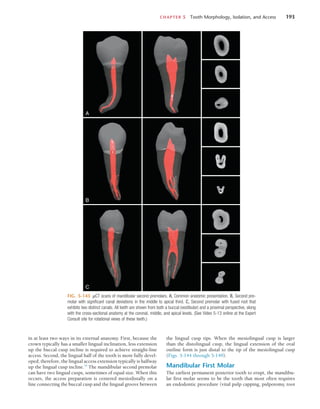
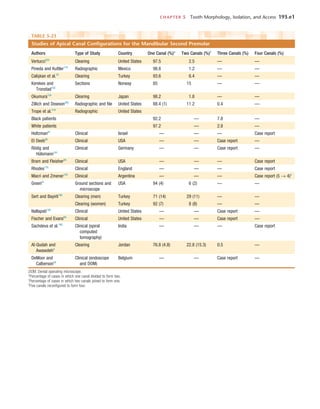
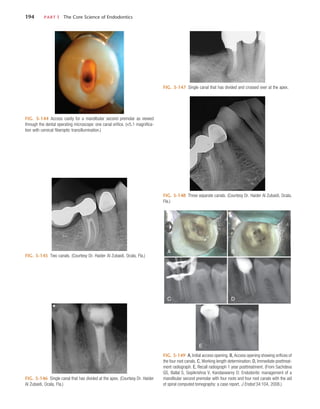
130
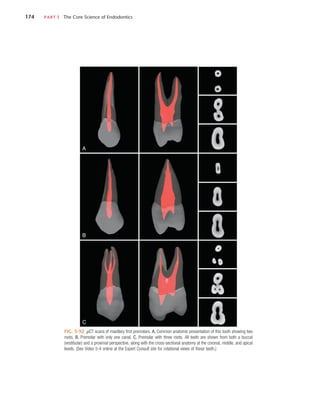
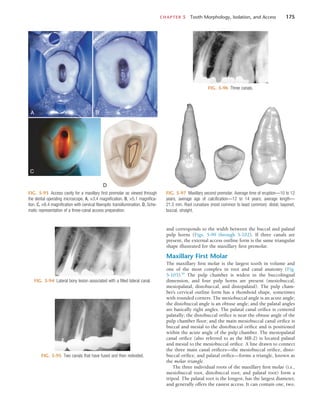
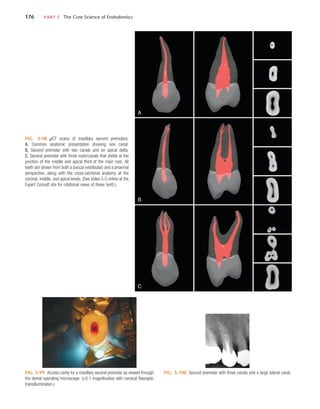
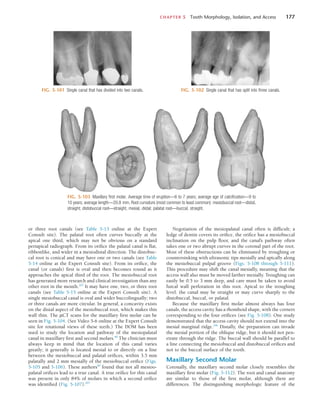
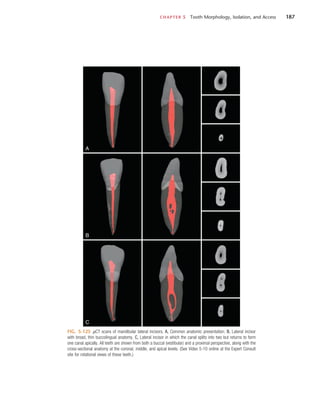
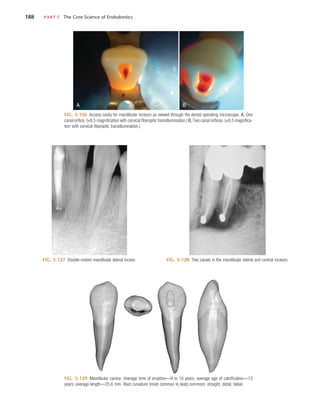
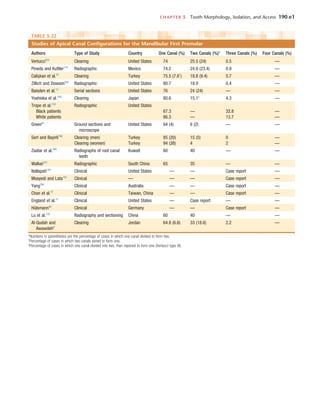
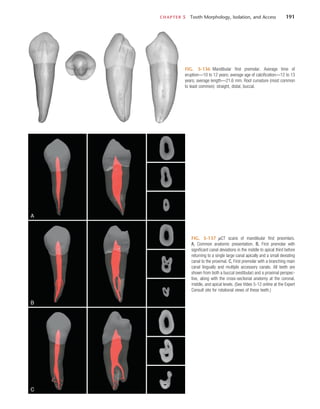
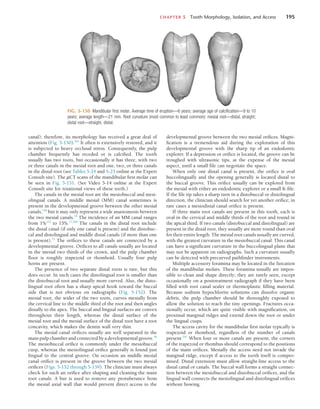
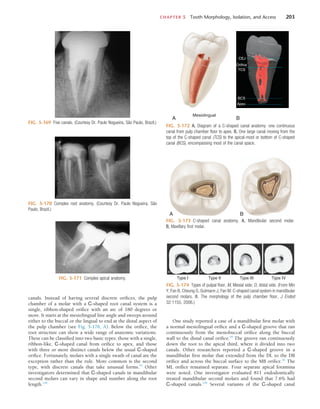
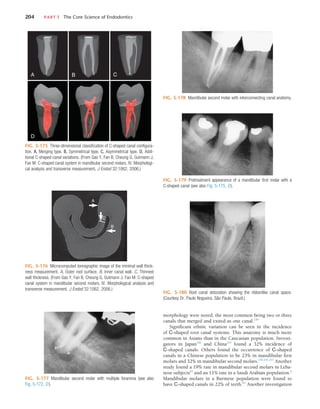
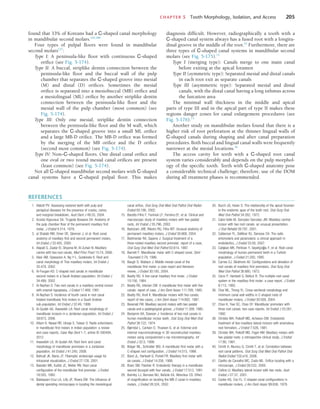
Components of the Root Canal System
Root Canal Anatomy
Clinical Determination of the Root Canal
Configuration
Objectives and Guidelines for Access Cavity
Preparation
Objectives
Key Steps to Consider in Access Preparation
Visualization of the Likely Internal Anatomy
Evaluation of the Cementoenamel Junction and Occlusal
Tooth Anatomy
Preparation of the Access Cavity Through the Lingual and
Occlusal Surfaces
Removal of All Defective Restorations and Caries Before Entry
into the Pulp Chamber
Removal of Unsupported Tooth Structure
Preparation of Access Cavity Walls that Do Not Restrict
Straight- or Direct-Line Passage of Instruments to the Apical
Foramen or Initial Canal Curvature
Inspection of the Pulp Chamber Walls and Floor
Tapering of Cavity Walls and Evaluation of Space Adequacy
for a Coronal Seal
Mechanical Phases of Access Cavity Preparation
Magnification and Illumination
Handpieces
Burs
Endodontic Explorer and Spoon
Ultrasonic Unit and Tips
Access Cavity Preparations
Anterior Teeth
Posterior Teeth
Challenging Access Preparations
Teeth with Minimal or No Clinical Crown
Heavily Restored Teeth (Including Those with Full
Coronal Coverage)
Access in Teeth with Calcified Canals
Crowded or Rotated Teeth
Errors in Access Cavity Preparation
Morphology of and Access Cavity Preparations for
Individual Teeth
Maxillary Central Incisor
Maxillary Lateral Incisor
Maxillary Canine
Maxillary First Premolar
Maxillary Second Premolar
Maxillary First Molar
Maxillary Second Molar
Maxillary Third Molar
Mandibular Central and Lateral Incisors
Mandibular Canine
Mandibular First Premolar
Mandibular Second Premolar
Mandibular First Molar
Mandibular Second Molar
Mandibular Third Molar
Teeth with C-Shaped Root Canal Systems
Tooth Morphology, Isolation,
and Access
JAMES L. GUTMANN  |  BING FAN
CHAPTER 5
 
CHAPTER OUTLINE
The dental pulp presents with a variety of configurations and
shapes throughout the dentition. Therefore, a thorough knowl-
edge of tooth morphology, careful interpretation of radio-
graphic documentation, and adequate access to and exploration
of the pulpal space are prerequisites for all root canal proce-
dures, whether nonsurgical or surgical.182
To enhance this
exploration and interpretation, magnification and illumination
are indispensable. This chapter describes and illustrates tooth
morphology and explains the techniques necessary to achieve
unobstructed, direct access to the root canal system. The clini-
cian is challenged to perform adequate enlarging, shaping,
cleaning, disinfection, and obturation of the pulpal space to
achieve predictable outcomes with root canal procedures.
However, the optimal result is difficult to achieve if the access
is not prepared properly. Therefore, knowledge of the complex-
ity of the root canal system is essential to understand the
principles and problems encountered in access preparation.
The complexity of the root canal system is best understood
by the integration of formative knowledge of tooth anatomy
and the interpretation of radiographic documentation. Careful
evaluation of two or more periapical radiographs, exposed at
different horizontal angulations of the x-ray cone, is essential.
http://dentalebooks.com
CHAPTER 5  Tooth Morphology, Isolation, and Access	 131
These divergently exposed radiographs along with cone-beam
computed tomography (CBCT) scans in some clinical situa-
tions (see Chapter 2) provide important information about
root canal morphology. However, the inclination of the x-ray
tube significantly influences the ability to detect variable root
canal systems present in many teeth. For example, in premo-
lars, if the horizontal angle is varied by either 20 or 40 degrees,
the number of root canals seen in the maxillary first and second
premolars and the mandibular first premolars coincides with
the number of canals actually present.134
However, in the man-
dibular second premolar, only the 40-degree horizontal angle
correctly identifies the root canal morphology. The careful
reading and interpretation of each radiograph before and
during root canal procedures is necessary because many teeth
present with unusual canal morphology. Unfortunately, the
interpretation of traditional radiographs may not always result
in the correct morphologic assessment, particularly when only
a buccolingual view is taken. In one study, 790 extracted man-
dibular incisors and premolars were radiographed to assess the
incidence of canal bifurcation in a root.147
When the fast break
guideline was used (i.e., interpreting a sudden disappearance
or narrowing of a canal as a sign of canal division, such as
bifurcation [Fig. 5-1]), the result was failure to identify one
third of these divisions from a single radiographic view. Thus,
evaluation of the root canal system is most accurate when the
information from several radiographic views is integrated with
a thorough clinical exploration of the interior and exterior
of the tooth. Alternatively, the recent development of micro-
computed tomography (µCT) scanning of teeth has greatly
increased clinical assessment of these complexities and three-
dimensional (3D) relationships found in root canal systems.
The main objectives of root canal procedures are adequate
enlargement, shaping, cleaning, and disinfection of all pulpal
spaces, along with obturation of these spaces with an accept-
able filling material. At times a root canal or its elaborate,
complex system may go undetected, which results in failure
to achieve the stated objectives. Therefore, the use of a vast
array of tools, in particular magnification and illumination,
is essential to accomplish these objectives on a more predict-
able basis.
Initially important aids for determining pulp space mor-
phology, in particular the pulp chamber and location of root
canal orifices, include multiple pretreatment radiographs,
CBCTs, examination of the pulp chamber floor with a sharp
explorer, visual assessment of color changes in the dentin,
FIG. 5-1  A, Abrupt disappearance of the large canal in the mandibular first premolar indicates a canal bifurca-
tion. B, The same is true for the maxillary first premolar.
A B
FIG. 5-2  Allowing sodium hypochlorite (NaOCl) to remain in the pulp
chamber may help locate a calcified root canal orifice. Tiny bubbles may
appear in the solution, indicating the position of the orifice. This is best
observed through magnification.
troughing of anatomic grooves with ultrasonic tips, staining
the chamber floor with 1% methylene blue dye, performing a
sodium hypochlorite “champagne bubble” test (Fig. 5-2), visu-
alizing the pulp chamber anatomy from established docu-
ments,107
and root canal bleeding points. Sequential application
of 17% aqueous ethylene diaminetetraacetic acid (EDTA) and
95% ethanol has been recommended for effective cleaning and
drying of the pulp chamber floor before visual inspection.207
Specifically, the use of the dental operating microscope
(DOM), which is intended to provide superior magnification,
increased lighting, and enhanced visibility,182
is recommended
to determine the location of root canal orifices in the properly
prepared coronal access (Fig. 5-3). Removal of dentin that may
obscure the location of these orifices is also enhanced with
better visualization with the DOM. The DOM also improves the
identification of extra canals (e.g., the mesiopalatal canal found
in many first and second maxillary molars) and has been shown
to be superior to the use of the naked eye and magnifying
loupes for this assessment.14,187
Additional studies have noted
that use of the DOM improves the detection of mesiopalatal
canals to more than 90% in maxillary first molars and 60% in
maxillary second molars.108,207
These evaluative studies demon-
strate that magnification and illumination greatly enhance the
identification of the pulp chamber morphology and ultimately
enable the clinician to achieve better outcomes within each of
the stated objectives for root canal procedures.
http://dentalebooks.com
132	 PART I  The Core Science of Endodontics
or reparative (irregular secondary, irritation, and tertiary)
dentin (Fig. 5-5).199
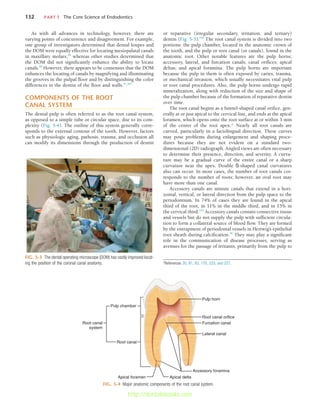
The root canal system is divided into two
portions: the pulp chamber, located in the anatomic crown of
the tooth, and the pulp or root canal (or canals), found in the
anatomic root. Other notable features are the pulp horns;
accessory, lateral, and furcation canals; canal orifices; apical
deltas; and apical foramina. The pulp horns are important
because the pulp in them is often exposed by caries, trauma,
or mechanical invasion, which usually necessitates vital pulp
or root canal procedures. Also, the pulp horns undergo rapid
mineralization, along with reduction of the size and shape of
the pulp chamber because of the formation of reparative dentin
over time.
The root canal begins as a funnel-shaped canal orifice, gen-
erally at or just apical to the cervical line, and ends at the apical
foramen, which opens onto the root surface at or within 3 mm
of the center of the root apex.* Nearly all root canals are
curved, particularly in a faciolingual direction. These curves
may pose problems during enlargement and shaping proce-
dures because they are not evident on a standard two-
dimensional (2D) radiograph. Angled views are often necessary
to determine their presence, direction, and severity. A curva-
ture may be a gradual curve of the entire canal or a sharp
curvature near the apex. Double S-shaped canal curvatures
also can occur. In most cases, the number of root canals cor-
responds to the number of roots; however, an oval root may
have more than one canal.
Accessory canals are minute canals that extend in a hori-
zontal, vertical, or lateral direction from the pulp space to the
periodontium. In 74% of cases they are found in the apical
third of the root, in 11% in the middle third, and in 15% in
the cervical third.223
Accessory canals contain connective tissue
and vessels but do not supply the pulp with sufficient circula-
tion to form a collateral source of blood flow. They are formed
by the entrapment of periodontal vessels in Hertwig’s epithelial
root sheath during calcification.46
They may play a significant
role in the communication of disease processes, serving as
avenues for the passage of irritants, primarily from the pulp to
FIG. 5-3  The dental operating microscope (DOM) has vastly improved locat-
ing the position of the coronal canal anatomy.
FIG. 5-4  Major anatomic components of the root canal system.
Pulp horn
Pulp chamber
Root canal
system
Root canal
Root canal orifice
Furcation canal
Lateral canal
Apical foramen Apical delta
Accessory foramina
*References 30, 81, 83, 170, 223, and 227.
As with all advances in technology, however, there are
varying points of concurrence and disagreement. For example,
one group of investigators determined that dental loupes and
the DOM were equally effective for locating mesiopalatal canals
in maxillary molars,29
whereas other studies determined that
the DOM did not significantly enhance the ability to locate
canals.80
However, there appears to be consensus that the DOM
enhances the locating of canals by magnifying and illuminating
the grooves in the pulpal floor and by distinguishing the color
differences in the dentin of the floor and walls.41,107
COMPONENTS OF THE ROOT
CANAL SYSTEM
The dental pulp is often referred to as the root canal system,
as opposed to a simple tube or circular space, due to its com-
plexity (Fig. 5-4). The outline of this system generally corre-
sponds to the external contour of the tooth. However, factors
such as physiologic aging, pathosis, trauma, and occlusion all
can modify its dimensions through the production of dentin
http://dentalebooks.com
CHAPTER 5  Tooth Morphology, Isolation, and Access	 133
the periodontium, although communication of inflammatory
processes may occur from either tissue.
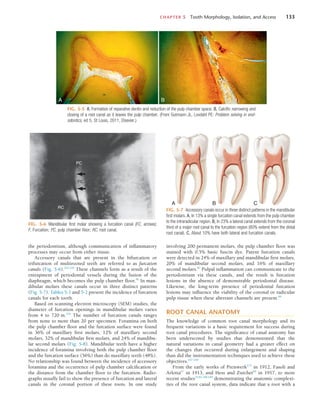
Accessory canals that are present in the bifurcation or
trifurcation of multirooted teeth are referred to as furcation
canals (Fig. 5-6).223,226
These channels form as a result of the
entrapment of periodontal vessels during the fusion of the
diaphragm, which becomes the pulp chamber floor.46
In man-
dibular molars these canals occur in three distinct patterns
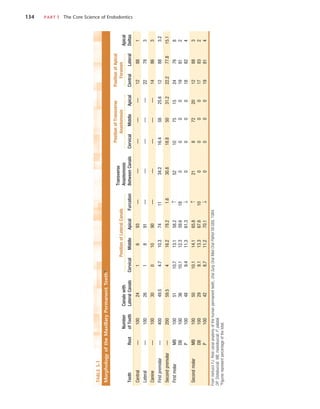
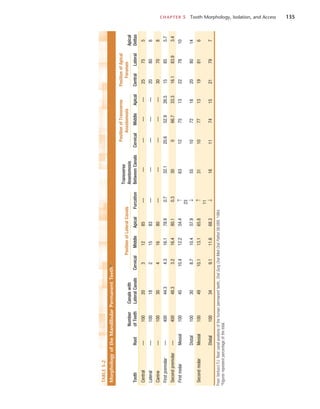
(Fig. 5-7). Tables 5-1 and 5-2 present the incidence of furcation
canals for each tooth.
Based on scanning electron microscopy (SEM) studies, the
diameter of furcation openings in mandibular molars varies
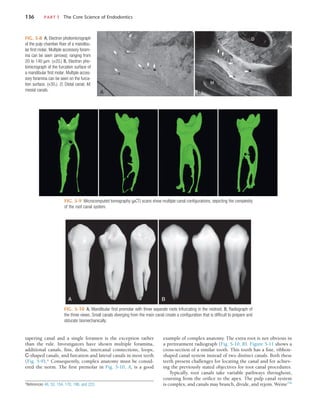
from 4 to 720 m.224
The number of furcation canals ranges
from none to more than 20 per specimen. Foramina on both
the pulp chamber floor and the furcation surface were found
in 36% of maxillary first molars, 12% of maxillary second
molars, 32% of mandibular first molars, and 24% of mandibu-
lar second molars (Fig. 5-8). Mandibular teeth have a higher
incidence of foramina involving both the pulp chamber floor
and the furcation surface (56%) than do maxillary teeth (48%).
No relationship was found between the incidence of accessory
foramina and the occurrence of pulp chamber calcification or
the distance from the chamber floor to the furcation. Radio-
graphs usually fail to show the presence of furcation and lateral
canals in the coronal portion of these roots. In one study
FIG. 5-6  Mandibular first molar showing a furcation canal (FC, arrows).
F, Furcation; PC, pulp chamber floor; RC, root canal.
FC
F
PC
RC
RC
FIG. 5-7  Accessory canals occur in three distinct patterns in the mandibular
first molars. A, In 13% a single furcation canal extends from the pulp chamber
to the intraradicular region. B, In 23% a lateral canal extends from the coronal
third of a major root canal to the furcation region (80% extend from the distal
root canal). C, About 10% have both lateral and furcation canals.
A B C
FIG. 5-5  A, Formation of reparative dentin and reduction of the pulp chamber space. B, Calcific narrowing and
closing of a root canal as it leaves the pulp chamber. (From Gutmann JL, Lovdahl PE: Problem solving in end-
odontics, ed 5, St Louis, 2011, Elsevier.)
A B
involving 200 permanent molars, the pulp chamber floor was
stained with 0.5% basic fuscin dye. Patent furcation canals
were detected in 24% of maxillary and mandibular first molars,
20% of mandibular second molars, and 16% of maxillary
second molars.87
Pulpal inflammation can communicate to the
periodontium via these canals, and the result is furcation
lesions in the absence of demonstrable periodontal disease.
Likewise, the long-term presence of periodontal furcation
lesions may influence the viability of the coronal or radicular
pulp tissue when these aberrant channels are present.84
ROOT CANAL ANATOMY
The knowledge of common root canal morphology and its
frequent variations is a basic requirement for success during
root canal procedures. The significance of canal anatomy has
been underscored by studies that demonstrated that the
natural variations in canal geometry had a greater effect on
the changes that occurred during enlargement and shaping
than did the instrumentation techniques used to achieve these
objectives.167-169
From the early works of Preiswerk175
in 1912, Fasoli and
Arlotta67
in 1913, and Hess and Zurcher90
in 1917, to more
recent studies33,82,100,190
demonstrating the anatomic complexi-
ties of the root canal system, data indicate that a root with a
134	 PART I  The Core Science of Endodontics
TABLE
5-1
 
Morphology
of
the
Maxillary
Permanent
Teeth*
Tooth
Root
Number
of
Teeth
Canals
with
Lateral
Canals
Position
of
Lateral
Canals
Transverse
Anastomosis
Between
Canals
Position
of
Transverse
Anastomosis
Position
of
Apical
Foramen
Apical
Deltas
Cervical
Middle
Apical
Furcation
Cervical
Middle
Apical
Central
Lateral
Central
—
100
24
1
6
93
—
—
—
—
—
12
88
1
Lateral
—
100
26
1
8
91
—
—
—
—
—
22
78
3
Canine
—
100
30
0
10
90
—
—
—
—
—
14
86
3
First
premolar
—
400
49.5
4.7
10.3
74
11
34.2
16.4
58
25.6
12
88
3.2
Second
premolar
—
200
59.5
4
16.2
78.2
1.6
30.8
18.8
50
31.2
22.2
77.8
15.1
First
molar
MB
100
51
10.7
13.1
58.2
↑
52
10
75
15
24
76
8
DB
100
36
10.1
12.3
59.6
18
0
0
0
0
19
81
2
P
100
48
9.4
11.3
61.3
↓
0
0
0
0
18
82
4
Second
molar
MB
100
50
10.1
14.1
65.8
↑
21
8
72
20
12
88
3
DB
100
29
9.1
13.3
67.6
10
0
0
0
0
17
83
2
P
100
42
8.7
11.2
70.1
↓
0
0
0
0
19
81
4
From
Vertucci
FJ:
Root
canal
anatomy
of
the
human
permanent
teeth,
Oral
Surg
Oral
Med
Oral
Pathol
58:589,
1984.
DP,
Distobuccal;
MB,
mesiobuccal;
P,
palatal.
*Figures
represent
percentage
of
the
total.
CHAPTER 5  Tooth Morphology, Isolation, and Access	 135
TABLE
5-2
 
Morphology
of
the
Mandibular
Permanent
Teeth*
Tooth
Root
Number
of
Teeth
Canals
with
Lateral
Canals
Position
of
Lateral
Canals
Transverse
Anastomosis
Between
Canals
Position
of
Transverse
Anastomosis
Position
of
Apical
Foramen
Apical
Deltas
Cervical
Middle
Apical
Furcation
Cervical
Middle
Apical
Central
Lateral
Central
—
100
20
3
12
85
—
—
—
—
—
25
75
5
Lateral
—
100
18
2
15
83
—
—
—
—
—
20
80
6
Canine
—
100
30
4
16
80
—
—
—
—
—
30
70
8
First
premolar
—
400
44.3
4.3
16.1
78.9
0.7
32.1
20.6
52.9
26.5
15
85
5.7
Second
premolar
—
400
48.3
3.2
16.4
80.1
0.3
30
0
66.7
33.3
16.1
83.9
3.4
First
molar
Mesial
100
45
10.4
12.2
54.4
↑
63
12
75
13
22
78
10
23
Distal
100
30
8.7
10.4
57.9
↓
55
10
72
18
20
80
14
Second
molar
Mesial
100
49
10.1
13.1
65.8
↑
31
10
77
13
19
81
6
11
Distal
100
34
9.1
11.6
68.3
↓
16
11
74
15
21
79
7
From
Vertucci
FJ:
Root
canal
anatomy
of
the
human
permanent
teeth,
Oral
Surg
Oral
Med
Oral
Pathol
58:589,
1984.
*Figures
represent
percentage
of
the
total.
136	 PART I  The Core Science of Endodontics
FIG. 5-8  A, Electron photomicrograph
of the pulp chamber floor of a mandibu-
lar first molar. Multiple accessory foram-
ina can be seen (arrows), ranging from
20 to 140 µm. (×20.) B, Electron pho-
tomicrograph of the furcation surface of
a mandibular first molar. Multiple acces-
sory foramina can be seen on the furca-
tion surface. (×30.). D, Distal canal; M,
mesial canals. A
D
M
B
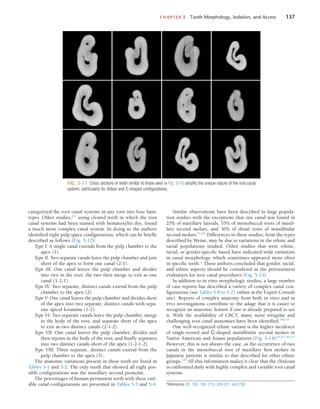
example of complex anatomy. The extra root is not obvious in
a pretreatment radiograph (Fig. 5-10, B). Figure 5-11 shows a
cross-section of a similar tooth. This tooth has a fine, ribbon-
shaped canal system instead of two distinct canals. Both these
teeth present challenges for locating the canal and for achiev-
ing the previously stated objectives for root canal procedures.
Typically, root canals take variable pathways throughout,
coursing from the orifice to the apex. The pulp canal system
is complex, and canals may branch, divide, and rejoin. Weine238
tapering canal and a single foramen is the exception rather
than the rule. Investigators have shown multiple foramina,
additional canals, fins, deltas, intercanal connections, loops,
C-shaped canals, and furcation and lateral canals in most teeth
(Fig. 5-9).* Consequently, complex anatomy must be consid-
ered the norm. The first premolar in Fig. 5-10, A, is a good
FIG. 5-9  Microcomputed tomography (µCT) scans show multiple canal configurations, depicting the complexity
of the root canal system.
FIG. 5-10  A, Mandibular first premolar with three separate roots trifurcating in the midroot. B, Radiograph of
the three views. Small canals diverging from the main canal create a configuration that is difficult to prepare and
obturate biomechanically.
A B
*References 48, 53, 154, 170, 196, and 223.
CHAPTER 5  Tooth Morphology, Isolation, and Access	 137
FIG. 5-11  Cross sections of teeth similar to those seen in Fig. 5-10 amplify the unique nature of the root canal
system, particularly its ribbon and C-shaped configurations.
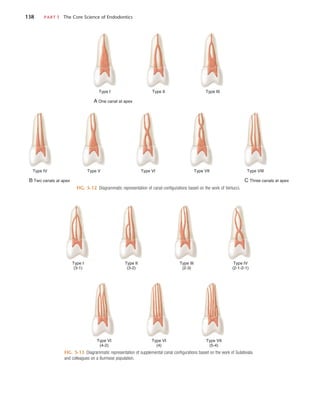
categorized the root canal systems in any root into four basic
types. Other studies,225
using cleared teeth in which the root
canal systems had been stained with hematoxylin dye, found
a much more complex canal system. In doing so the authors
identified eight pulp space configurations, which can be briefly
described as follows (Fig. 5-12):
Type I: A single canal extends from the pulp chamber to the
apex (1).
Type II: Two separate canals leave the pulp chamber and join
short of the apex to form one canal (2-1).
Type III: One canal leaves the pulp chamber and divides
into two in the root; the two then merge to exit as one
canal (1-2-1).
Type IV: Two separate, distinct canals extend from the pulp
chamber to the apex (2).
Type V: One canal leaves the pulp chamber and divides short
of the apex into two separate, distinct canals with sepa-
rate apical foramina (1-2).
Type VI: Two separate canals leave the pulp chamber, merge
in the body of the root, and separate short of the apex
to exit as two distinct canals (2-1-2).
Type VII: One canal leaves the pulp chamber, divides and
then rejoins in the body of the root, and finally separates
into two distinct canals short of the apex (1-2-1-2).
Type VIII: Three separate, distinct canals extend from the
pulp chamber to the apex (3).
The anatomic variations present in these teeth are listed in
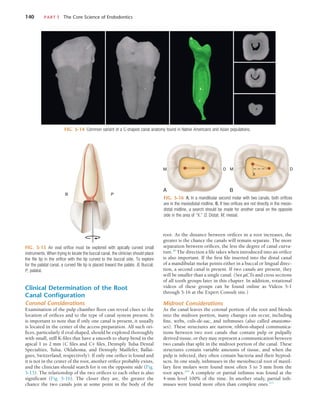
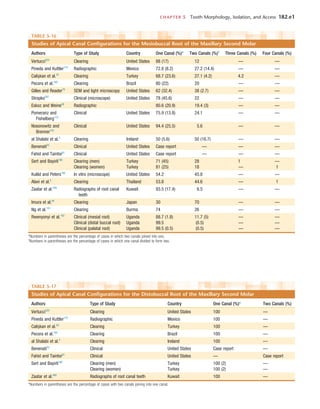
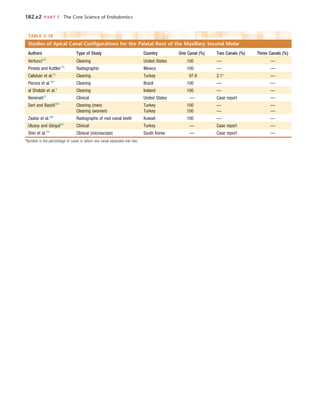
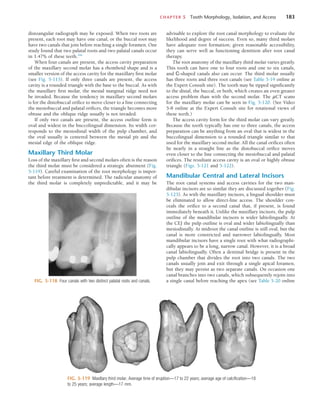
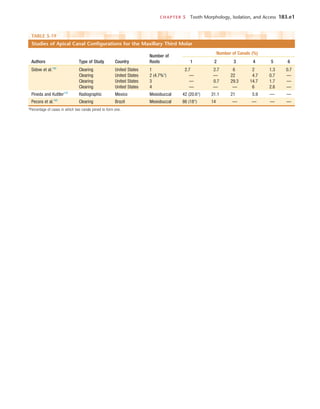
Tables 5-1 and 5-2. The only tooth that showed all eight pos-
sible configurations was the maxillary second premolar.
The percentages of human permanent teeth with these vari-
able canal configurations are presented in Tables 5-3 and 5-4. *References 82, 100, 190, 219, 229-231, and 236.
Similar observations have been described in large popula-
tion studies with the exceptions that one canal was found in
23% of maxillary laterals, 55% of mesiobuccal roots of maxil-
lary second molars, and 30% of distal roots of mandibular
second molars.33,242
Differences in these studies, from the types
described by Weine, may be due to variations in the ethnic and
racial populations studied. Other studies that were ethnic,
racial, or gender-specific based have indicated wide variations
in canal morphology, which sometimes appeared more often
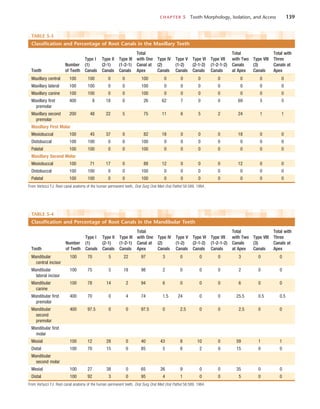
in specific teeth.* These authors concluded that gender, racial,
and ethnic aspects should be considered in the pretreatment
evaluation for root canal procedures (Fig. 5-13).
In addition to in vitro morphologic studies, a large number
of case reports has described a variety of complex canal con-
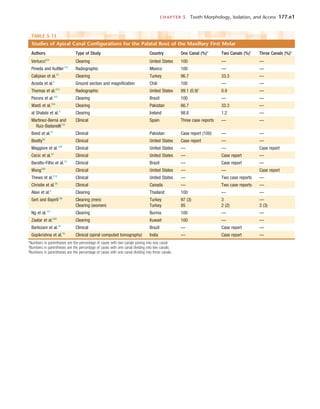
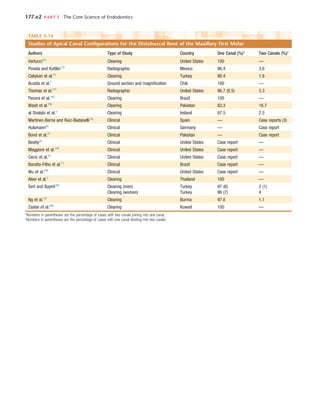
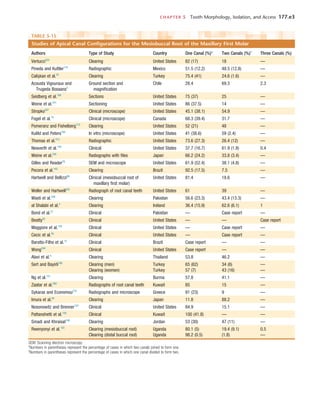
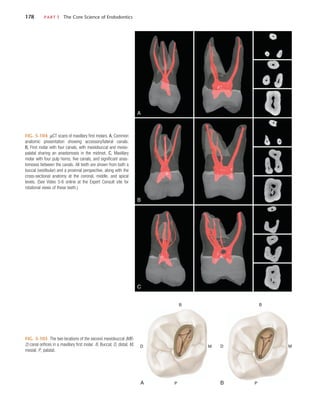
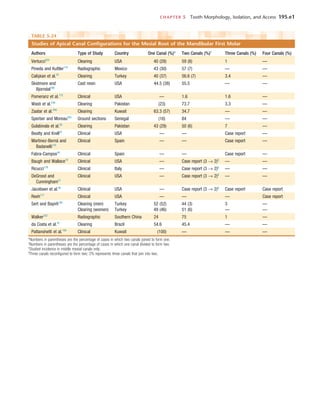
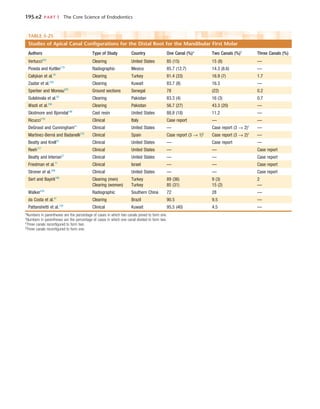
figurations (see Tables 5-8 to 5-27 online at the Expert Consult
site). Reports of complex anatomy from both in vitro and in
vivo investigations contribute to the adage that it is easier to
recognize an anatomic feature if one is already prepared to see
it. With the availability of CBCT, many more irregular and
challenging root canal anatomies have been identified.168,217
One well-recognized ethnic variant is the higher incidence
of single-rooted and C-shaped mandibular second molars in
Native American and Asians populations (Fig. 5-14).62,63,130,131
However, this is not always the case, as the occurrence of two
canals in the mesiobuccal root of maxillary first molars in
Japanese patients is similar to that described for other ethnic
groups.239
All this information makes it clear that the clinician
is confronted daily with highly complex and variable root canal
systems.
138	 PART I  The Core Science of Endodontics
FIG. 5-12  Diagrammatic representation of canal configurations based on the work of Vertucci.
A One canal at apex
Type I Type II Type III
B Two canals at apex
Type IV Type V Type VI Type VII
C Three canals at apex
Type VIII
FIG. 5-13  Diagrammatic representation of supplemental canal configurations based on the work of Gulabivala
and colleagues on a Burmese population.
Type I
(3-1)
Type VI
(4-2)
Type VI
(4)
Type VII
(5-4)
Type II
(3-2)
Type III
(2-3)
Type IV
(2-1-2-1)
CHAPTER 5  Tooth Morphology, Isolation, and Access	 139
TABLE 5-3 
Classification and Percentage of Root Canals in the Maxillary Teeth
Tooth
Number
of Teeth
Type I
(1)
Canals
Type II
(2-1)
Canals
Type III
(1-2-1)
Canals
Total
with One
Canal at
Apex
Type IV
(2)
Canals
Type V
(1-2)
Canals
Type VI
(2-1-2)
Canals
Type VII
(1-2-1-2)
Canals
Total
with Two
Canals
at Apex
Type VIII
(3)
Canals
Total with
Three
Canals at
Apex
Maxillary central 100 100 0 0 100 0 0 0 0 0 0 0
Maxillary lateral 100 100 0 0 100 0 0 0 0 0 0 0
Maxillary canine 100 100 0 0 100 0 0 0 0 0 0 0
Maxillary first
premolar
400 8 18 0 26 62 7 0 0 69 5 5
Maxillary second
premolar
200 48 22 5 75 11 6 5 2 24 1 1
Maxillary First Molar
Mesiobuccal 100 45 37 0 82 18 0 0 0 18 0 0
Distobuccal 100 100 0 0 100 0 0 0 0 0 0 0
Palatal 100 100 0 0 100 0 0 0 0 0 0 0
Maxillary Second Molar
Mesiobuccal 100 71 17 0 88 12 0 0 0 12 0 0
Distobuccal 100 100 0 0 100 0 0 0 0 0 0 0
Palatal 100 100 0 0 100 0 0 0 0 0 0 0
From Vertucci FJ: Root canal anatomy of the human permanent teeth, Oral Surg Oral Med Oral Pathol 58:589, 1984.
TABLE 5-4 
Classification and Percentage of Root Canals in the Mandibular Teeth
Tooth
Number
of Teeth
Type I
(1)
Canals
Type II
(2-1)
Canals
Type III
(1-2-1)
Canals
Total
with One
Canal at
Apex
Type IV
(2)
Canals
Type V
(1-2)
Canals
Type VI
(2-1-2)
Canals
Type VII
(1-2-1-2)
Canals
Total
with Two
Canals
at Apex
Type VIII
(3)
Canals
Total with
Three
Canals at
Apex
Mandibular
central incisor
100 70 5 22 97 3 0 0 0 3 0 0
Mandibular
lateral incisor
100 75 5 18 98 2 0 0 0 2 0 0
Mandibular
canine
100 78 14 2 94 6 0 0 0 6 0 0
Mandibular first
premolar
400 70 0 4 74 1.5 24 0 0 25.5 0.5 0.5
Mandibular
second
premolar
400 97.5 0 0 97.5 0 2.5 0 0 2.5 0 0
Mandibular first
molar
Mesial 100 12 28 0 40 43 8 10 0 59 1 1
Distal 100 70 15 0 85 5 8 2 0 15 0 0
Mandibular
second molar
Mesial 100 27 38 0 65 26 9 0 0 35 0 0
Distal 100 92 3 0 95 4 1 0 0 5 0 0
From Vertucci FJ: Root canal anatomy of the human permanent teeth, Oral Surg Oral Med Oral Pathol 58:589, 1984.
140	 PART I  The Core Science of Endodontics
root. As the distance between orifices in a root increases, the
greater is the chance the canals will remain separate. The more
separation between orifices, the less the degree of canal curva-
ture.40
The direction a file takes when introduced into an orifice
is also important. If the first file inserted into the distal canal
of a mandibular molar points either in a buccal or lingual direc-
tion, a second canal is present. If two canals are present, they
will be smaller than a single canal. (See µCTs and cross sections
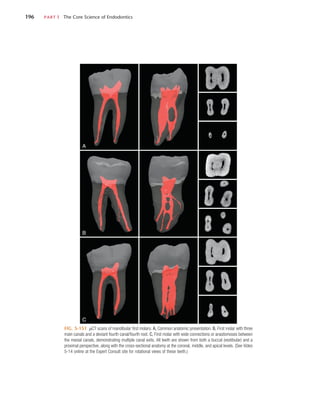
of all tooth groups later in this chapter. In addition, rotational
videos of these groups can be found online as Videos 5-1
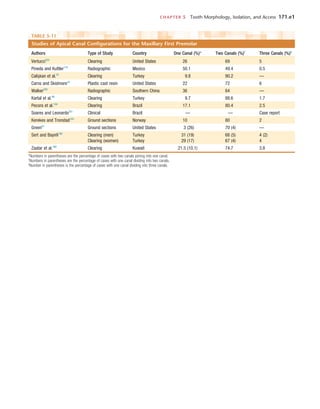
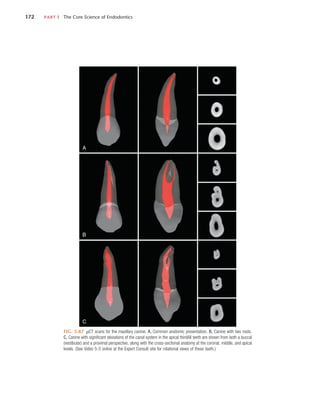
through 5-16 at the Expert Consult site.)
Midroot Considerations
As the canal leaves the coronal portion of the root and blends
into the midroot portion, many changes can occur, including
fins, webs, culs-de-sac, and isthmuses (also called anastomo-
ses). These structures are narrow, ribbon-shaped communica-
tions between two root canals that contain pulp or pulpally
derived tissue, or they may represent a communication between
two canals that split in the midroot portion of the canal. These
structures contain variable amounts of tissue, and when the
pulp is infected, they often contain bacteria and their byprod-
ucts. In one study, isthmuses in the mesiobuccal root of maxil-
lary first molars were found most often 3 to 5 mm from the
root apex.244
A complete or partial isthmus was found at the
4-mm level 100% of the time. In another study, partial isth-
muses were found more often than complete ones.213
Clinical Determination of the Root
Canal Configuration
Coronal Considerations
Examination of the pulp chamber floor can reveal clues to the
location of orifices and to the type of canal system present. It
is important to note that if only one canal is present, it usually
is located in the center of the access preparation. All such ori-
fices, particularly if oval shaped, should be explored thoroughly
with small, stiff K-files that have a smooth to sharp bend in the
apical 1 to 2 mm (C files and C+ files, Dentsply Tulsa Dental
Specialties, Tulsa, Oklahoma, and Dentsply Maillefer, Ballai-
gues, Switzerland, respectively). If only one orifice is found and
it is not in the center of the root, another orifice probably exists,
and the clinician should search for it on the opposite side (Fig.
5-15). The relationship of the two orifices to each other is also
significant (Fig. 5-16). The closer they are, the greater the
chance the two canals join at some point in the body of the
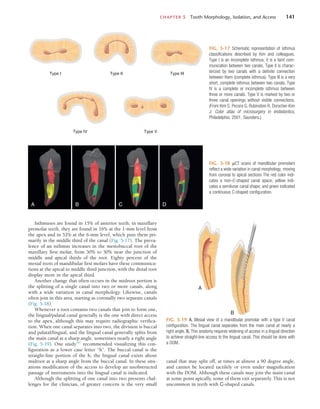
FIG. 5-14  Common variant of a C-shaped canal anatomy found in Native Americans and Asian populations.
FIG. 5-15  An oval orifice must be explored with apically curved small
instruments. When trying to locate the buccal canal, the clinician should place
the file tip in the orifice with the tip curved to the buccal side. To explore 
for the palatal canal, a curved file tip is placed toward the palate. B, Buccal;
P, palatal.
B P
FIG. 5-16  A, In a mandibular second molar with two canals, both orifices
are in the mesiodistal midline. B, If two orifices are not directly in the mesio-
distal midline, a search should be made for another canal on the opposite
side in the area of “X.” D, Distal; M, mesial.
M
X
D
M D
A B
CHAPTER 5  Tooth Morphology, Isolation, and Access	 141
Isthmuses are found in 15% of anterior teeth; in maxillary
premolar teeth, they are found in 16% at the 1-mm level from
the apex and in 52% at the 6-mm level, which puts them pri-
marily in the middle third of the canal (Fig. 5-17). The preva-
lence of an isthmus increases in the mesiobuccal root of the
maxillary first molar, from 30% to 50% near the junction of
middle and apical thirds of the root. Eighty percent of the
mesial roots of mandibular first molars have these communica-
tions at the apical to middle third junction, with the distal root
display more in the apical third.
Another change that often occurs in the midroot portion is
the splitting of a single canal into two or more canals, along
with a wide variation in canal morphology. Likewise, canals
often join in this area, starting as coronally two separate canals
(Fig. 5-18).
Whenever a root contains two canals that join to form one,
the lingual/palatal canal generally is the one with direct access
to the apex, although this may require radiographic verifica-
tion. When one canal separates into two, the division is buccal
and palatal/lingual, and the lingual canal generally splits from
the main canal at a sharp angle, sometimes nearly a right angle
(Fig. 5-19). One study197
recommended visualizing this con-
figuration as a lower case letter “h”. The buccal canal is the
straight-line portion of the h; the lingual canal exists about
midroot at a sharp angle from the buccal canal. In these situ-
ations modification of the access to develop an unobstructed
passage of instruments into the lingual canal is indicated.
Although the splitting of one canal into two presents chal-
lenges for the clinician, of greater concern is the very small
FIG. 5-17  Schematic representation of isthmus
classifications described by Kim and colleagues.
Type I is an incomplete isthmus; it is a faint com-
munication between two canals. Type II is charac-
terized by two canals with a definite connection
between them (complete isthmus). Type III is a very
short, complete isthmus between two canals. Type
IV is a complete or incomplete isthmus between
three or more canals. Type V is marked by two or
three canal openings without visible connections.
(From Kim S, Pecora G, Rubinstein R, Dorscher-Kim
J: Color atlas of microsurgery in endodontics,
Philadelphia, 2001, Saunders.)
Type I Type II Type III
Type V
Type IV
FIG. 5-18  µCT scans of mandibular premolars
reflect a wide variation in canal morphology, moving
from coronal to apical sections The red color indi-
cates a non–C-shaped canal space; yellow indi-
cates a semilunar canal shape; and green indicated
a continuous C-shaped configuration.
A B C D
FIG. 5-19  A, Mesial view of a mandibular premolar with a type V canal
configuration. The lingual canal separates from the main canal at nearly a
right angle. B, This anatomy requires widening of access in a lingual direction
to achieve straight-line access to the lingual canal. This should be done with
a DOM.
A
B
canal that may split off, at times at almost a 90 degree angle,
and cannot be located tactilely or even under magnification
with the DOM. Although these canals may join the main canal
at some point apically, some of them exit separately. This is not
uncommon in teeth with C-shaped canals.
142	 PART I  The Core Science of Endodontics
canal from the exterior surface of the root.”109
The diameter of
the foramen is 502 µm in individuals 18 to 25 years of age and
681 µm in those over age 55, which demonstrates the growth
of the AF with age.109
By comparison, these sizes are larger than
the cross-sectional diameter of #50 and #60 root canals files,
respectively. The AF does not normally exit at the anatomic
apex, but rather is offset 0.5 to 3 mm. This variation is more
marked in older teeth through cementum apposition. Studies
have shown that the AF coincides with the apical root vertex
in 17% to 46% of cases.*
The location and diameter of the CDJ differ from those of
the AF in maxillary anterior teeth.174
Extension of cementum
from the AF into the root canal differs considerably, even when
opposite canal walls are compared. Cementum reaches the
same level on all canal walls in only 5% of cases. The greatest
extension generally occurs on the concave side of the canal
curvature. This variability confirms that the CDJ and the AC
generally are not in the same area and that the CDJ should be
considered just a variable junction at which two histologic
tissues meet in the root canal (Fig. 5-21). The diameter of the
canal at the CDJ varies considerably; it was determined to be
353 µm for the central incisors, 292 µm for the lateral incisors,
and 298 µm for the canines.167
These measures approximate
the size of #30 to #35 root canal files.
In maxillary anterior teeth, the root apex and main AF
coincided in 17% of examined central incisors and canines and
*References 30, 81, 83, 170, 182, 208, 223, and 227.
Apical Considerations
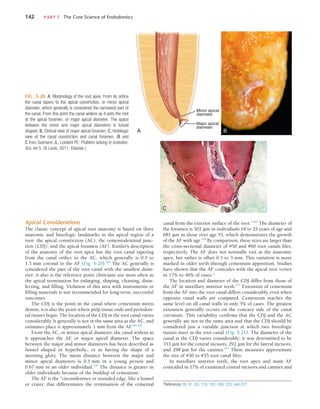
The classic concept of apical root anatomy is based on three
anatomic and histologic landmarks in the apical region of a
root: the apical constriction (AC), the cementodentinal junc-
tion (CDJ), and the apical foramen (AF). Kuttler’s description
of the anatomy of the root apex has the root canal tapering
from the canal orifice to the AC, which generally is 0.5 to
1.5 mm coronal to the AF (Fig. 5-20).109
The AC generally is
considered the part of the root canal with the smallest diam-
eter; it also is the reference point clinicians use most often as
the apical termination for enlarging, shaping, cleaning, disin-
fecting, and filling. Violation of this area with instruments or
filling materials is not recommended for long-term, successful
outcomes.
The CDJ is the point in the canal where cementum meets
dentin; it is also the point where pulp tissue ends and periodon-
tal tissues begin. The location of the CDJ in the root canal varies
considerably. It generally is not in the same area as the AC, and
estimates place it approximately 1 mm from the AF
.184,200
From the AC, or minor apical diameter, the canal widens as
it approaches the AF
, or major apical diameter. The space
between the major and minor diameters has been described as
funnel shaped or hyperbolic, or as having the shape of a
morning glory. The mean distance between the major and
minor apical diameters is 0.5 mm in a young person and
0.67 mm in an older individual.109
The distance is greater in
older individuals because of the buildup of cementum.
The AF is the “circumference or rounded edge, like a funnel
or crater, that differentiates the termination of the cemental
FIG. 5-20  A, Morphology of the root apex. From its orifice
the canal tapers to the apical constriction, or minor apical
diameter, which generally is considered the narrowest part of
the canal. From this point the canal widens as it exits the root
at the apical foramen, or major apical diameter. The space
between the minor and major apical diameters is funnel
shaped. B, Clinical view of major apical foramen. C, Histologic
view of the canal constriction and canal foramen. (B and
C from Gutmann JL, Lovdahl PE: Problem solving in endodon-
tics, ed 5, St Louis, 2011, Elsevier.)
Minor apical
diameter
Major apical
diameter
P
C
A B
CHAPTER 5  Tooth Morphology, Isolation, and Access	 143
and the distal root of mandibular molars. No main foramen
was seen in 24% of maxillary premolars and 26% of maxillary
incisors. The mesial roots of mandibular molars (50%) and
maxillary premolars (48%) and the mesial roots of maxillary
molars (42%) had the highest percentage of multiple main
foramina. This finding is consistent with observations that
blunted roots usually have more than one root canal. The mean
values for the size of the main foramen are listed in Table 5-6.
Sizes ranged from 210 µm for the maxillary premolars to
392 µm for the distal roots of the mandibular molars. All
groups of teeth had at least one accessory foramen. The maxil-
lary premolars had the most and the largest accessory foramina
(mean value, 53 µm) and the most complicated apical mor-
phologic makeup. The mandibular premolars had strikingly
similar characteristics, a possible reason root canal procedures
may fail in premolar teeth.
The morphology of the apical third of the root reflects mul-
tiple anatomic variations, including numerous accessory canals;
areas of resorption and repaired resorption; attached, embed-
ded, and free pulp stones; varying amounts of reparative dentin;
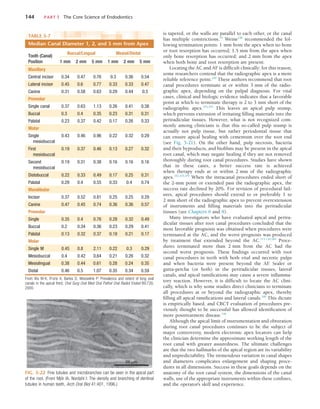
and varying root canal diameters (Table 5-7).140,141
Primary
dentinal tubules are found less often than in the coronal dentin
and are more or less irregular in direction and density. Some
areas are completely devoid of tubules. Fine tubular branches
(300 to 700 µm in diameter) that run at a 45-degree angle to
the main tubules and microbranches (25 to 200 µm in diam-
eter) that run at a 90-degree angle to the main tubules are often
present (Fig. 5-22). This variable nature of the apical structure
and significant absence of dentinal tubules may lead to reduced
chances of bacterial invasion into the dentinal walls; however,
it also presents challenges for all root canal procedures, from
cleaning and disinfection to obturation.
Clinically, considerable controversy exists over the exact
termination point for root canal procedures in the apical third
of the root; clinical determination of apical canal morphology
is difficult at best.84,193
The existence of an AC may be more
conceptual than real. Several studies have reported that a tra-
ditional single AC was present less than half the time, particu-
larly when apical root resorption and periradicular pathosis
were factors.44,55,192,238
The apical portion of the root canal often
in 7% of lateral incisors.139
Both the root apex and the AF of
the central incisors and canines were displaced distolabially,
whereas those of the lateral incisors were displaced distolin-
gually. The perpendicular distance from the root apex to the
AC and both mesiodistal and labiolingual root canal diameters
at the AC are shown in Table 5-5. The labiolingual diameter
in all maxillary anterior teeth is approximately 50 µm more
than the mesiodistal diameter. This has definite implications
for intracanal root canal procedures because only the mesio-
distal diameter is evident on radiographs.
Scanning electron microscopy has been used to determine
the number and size of main apical foramina, their distance
from the anatomic apex, and the size of accessory foramina.
Morfis et al.145
observed that more than one main foramen was
found in all teeth except the palatal root of maxillary molars
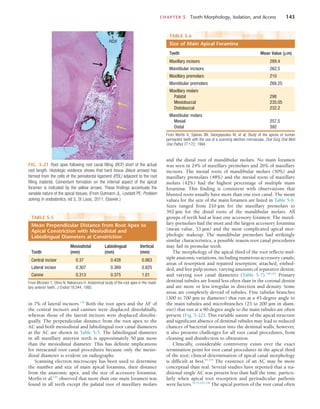
FIG. 5-21  Root apex following root canal filling (RCF) short of the actual
root length. Histologic evidence shows that hard tissue (black arrows) has
formed from the cells of the periodontal ligament (PDL) adjacent to the root
filling material. Cementum formation on the internal aspect of the apical
foramen is indicated by the yellow arrows. These findings accentuate the
variable nature of the apical tissues. (From Gutmann JL, Lovdahl PE: Problem
solving in endodontics, ed 5, St Louis, 2011, Elsevier.)
PDL
PDL
RDF
TABLE 5-5 
Mean Perpendicular Distance from Root Apex to
Apical Constriction with Mesiodistal and
Labiolingual Diameters at Constriction
Tooth
Mesiodistal
(mm)
Labiolingual
(mm)
Vertical
(mm)
Central incisor 0.37 0.428 0.863
Lateral incisor 0.307 0.369 0.825
Canine 0.313 0.375 1.01
From Mizutani T, Ohno N, Nakamura H: Anatomical study of the root apex in the maxil-
lary anterior teeth, J Endod 18:344, 1992.
TABLE 5-6 
Size of Main Apical Foramina
Teeth Mean Value (µm)
Maxillary incisors 289.4
Mandibular incisors 262.5
Maxillary premolars 210
Mandibular premolars 268.25
Maxillary molars
  Palatal 298
  Mesiobuccal 235.05
  Distobuccal 232.2
Mandibular molars
  Mesial 257.5
  Distal 392
From Morfis A, Sylaras SN, Georgopoulou M, et al: Study of the apices of human
permanent teeth with the use of a scanning electron microscope, Oral Surg Oral Med
Oral Pathol 77:172, 1994.
144	 PART I  The Core Science of Endodontics
FIG. 5-22  Fine tubules and microbranches can be seen in the apical part
of the root. (From Mjör IA, Nordahl I: The density and branching of dentinal
tubules in human teeth, Arch Oral Biol 41:401, 1996.)
25 m
TABLE 5-7 
Median Canal Diameter 1, 2, and 5 mm from Apex
Tooth (Canal)
Position
Buccal/Lingual Mesial/Distal
1 mm 2 mm 5 mm 1 mm 2 mm 5 mm
Maxillary
Central incisor 0.34 0.47 0.76 0.3 0.36 0.54
Lateral incisor 0.45 0.6 0.77 0.33 0.33 0.47
Canine 0.31 0.58 0.63 0.29 0.44 0.5
Premolar
Single canal 0.37 0.63 1.13 0.26 0.41 0.38
Buccal 0.3 0.4 0.35 0.23 0.31 0.31
Palatal 0.23 0.37 0.42 0.17 0.26 0.33
Molar
Single
mesiobuccal
0.43 0.46 0.96 0.22 0.32 0.29
First
mesiobuccal
0.19 0.37 0.46 0.13 0.27 0.32
Second
mesiobuccal
0.19 0.31 0.38 0.16 0.16 0.16
Distobuccal 0.22 0.33 0.49 0.17 0.25 0.31
Palatal 0.29 0.4 0.55 0.33 0.4 0.74
Mandibular
Incisor 0.37 0.52 0.81 0.25 0.25 0.29
Canine 0.47 0.45 0.74 0.36 0.36 0.57
Premolar
Single 0.35 0.4 0.76 0.28 0.32 0.49
Buccal 0.2 0.34 0.36 0.23 0.29 0.41
Palatal 0.13 0.32 0.37 0.18 0.21 0.17
Molar
Single M 0.45 0.8 2.11 0.22 0.3 0.29
Mesiobuccal 0.4 0.42 0.64 0.21 0.26 0.32
Mesiolingual 0.38 0.44 0.61 0.28 0.24 0.35
Distal 0.46 0.5 1.07 0.35 0.34 0.59
From Wu M-K, R’oris A, Barkis D, Wesselink P: Prevalence and extent of long oval
canals in the apical third, Oral Surg Oral Med Oral Pathol Oral Radiol Endod 89:739,
2000.
is tapered, or the walls are parallel to each other, or the canal
has multiple constrictions.55
Weine238
recommended the fol-
lowing termination points: 1 mm from the apex when no bone
or root resorption has occurred; 1.5 mm from the apex when
only bone resorption has occurred; and 2 mm from the apex
when both bone and root resorption are present.
Locating the AC and AF is difficult clinically; for this reason,
some researchers contend that the radiographic apex is a more
reliable reference point.250
These authors recommend that root
canal procedures terminate at or within 3 mm of the radio-
graphic apex, depending on the pulpal diagnosis. For vital
cases, clinical and biologic evidence indicates that a favorable
point at which to terminate therapy is 2 to 3 mm short of the
radiographic apex.103,195
This leaves an apical pulp stump,
which prevents extrusion of irritating filling materials into the
periradicular tissues. However, what is not recognized com-
monly among clinicians is that this so-called pulp stump is
actually not pulp tissue, but rather periodontal tissue that
can ensure apical healing with cementum over the root end
(see Fig. 5-21). On the other hand, pulp necrosis, bacteria
and their byproducts, and biofilms may be present in the apical
root canal, which may negate healing if they are not removed
thoroughly during root canal procedures. Studies have shown
that in these cases, a better success rate is achieved
when therapy ends at or within 2 mm of the radiographic
apex.102,103,195
When the intracanal procedures ended short of
the 2-mm point or extended past the radiographic apex, the
success rate declined by 20%. For revision of procedural fail-
ures, apical procedures should extend to or preferably 1 to
2 mm short of the radiographic apex to prevent overextension
of instruments and filling materials into the periradicular
tissues (see Chapters 6 and 8).
Many investigators who have evaluated apical and perira-
dicular tissues after root canal procedures concluded that the
most favorable prognosis was obtained when procedures were
terminated at the AC, and the worst prognosis was produced
by treatment that extended beyond the AC.113-116,180
Proce-
dures terminated more than 2 mm from the AC had the
second worst prognosis. These findings occurred with root
canal procedures in teeth with both vital and necrotic pulps
and when bacteria were present beyond the AF
. Sealer or
gutta-percha (or both) in the periradicular tissues, lateral
canals, and apical ramifications may cause a severe inflamma-
tory reaction. However, it is difficult to locate the AC clini-
cally, which is why some studies direct clinicians to terminate
all procedures at or beyond the radiographic apex, thereby
filling all apical ramifications and lateral canals.186
This dictate
is empirically based, and CBCT evaluation of procedures pre-
viously thought to be successful has allowed identification of
more posttreatment disease.158
Although the apical limit of instrumentation and obturation
during root canal procedures continues to be the subject of
major controversy, modern electronic apex locators can help
the clinician determine the approximate working length of the
root canal with greater assuredness. The ultimate challenges
are that the two hallmarks of the apical region are its variability
and unpredictability. The tremendous variation in canal shapes
and diameters complicates enlargement and shaping proce-
dures in all dimensions. Success in these goals depends on the
anatomy of the root canal system, the dimensions of the canal
walls, use of the appropriate instruments within these confines,
and the operator’s skill and experience.
CHAPTER 5  Tooth Morphology, Isolation, and Access	 145
KEY STEPS TO CONSIDER IN
ACCESS PREPARATION
Visualization of the Likely
Internal Anatomy
Internal tooth anatomy dictates access shape; therefore, the
first step in preparing an access cavity is visualization of the
position of the pulp space in the tooth. This visualization
requires evaluation of angled periapical radiographs and exam-
ination of the tooth anatomy at the coronal, cervical, and root
levels. Although only two-dimensional, diagnostic radiographs
help the clinician estimate the position of the pulp chamber,
the degree of chamber calcification, the number of roots and
canals, and the approximate canal length. Palpation along the
attached gingiva may aid in the determination of root location
and direction. This information, when considered together,
guides the clinician in the direction of the bur that is chosen
to begin cutting the access cavity.
Evaluation of the Cementoenamel Junction
and Occlusal Tooth Anatomy
Traditionally, access cavities have been prepared in relation to
the occlusal anatomy. However, complete reliance on the
occlusal/lingual anatomy is dangerous because this morphol-
ogy can change as the crown is destroyed by caries and recon-
structed with various restorative materials. Likewise, the root
may not be perpendicular to the occlusal surface of the tooth;
thus complete dependence on the occlusal or lingual anatomy
may explain the occurrence of some procedural errors, such as
coronal perforations along the cervical line or into the furca-
tion. Krasner and Rankow107
found that the cementoenamel
junction (CEJ) was the most important anatomic landmark for
determining the location of pulp chambers and root canal
orifices. Their study demonstrated the existence of a specific
and consistent anatomy of the pulp chamber floor. These
authors proposed guidelines, or spatial concepts, that apply to
the 3D assessment of the pulp chamber anatomy and that can
help the clinician determine the number and location of ori-
fices on the chamber floor (see Fig. 5-23, B).
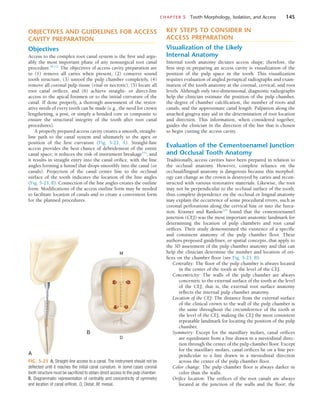
Centrality: The floor of the pulp chamber is always located
in the center of the tooth at the level of the CEJ.
Concentricity: The walls of the pulp chamber are always
concentric to the external surface of the tooth at the level
of the CEJ; that is, the external root surface anatomy
reflects the internal pulp chamber anatomy.
Location of the CEJ: The distance from the external surface
of the clinical crown to the wall of the pulp chamber is
the same throughout the circumference of the tooth at
the level of the CEJ, making the CEJ the most consistent
repeatable landmark for locating the position of the pulp
chamber.
Symmetry: Except for the maxillary molars, canal orifices
are equidistant from a line drawn in a mesiodistal direc-
tion through the center of the pulp chamber floor. Except
for the maxillary molars, canal orifices lie on a line per-
pendicular to a line drawn in a mesiodistal direction
across the center of the pulp chamber floor.
Color change: The pulp chamber floor is always darker in
color than the walls.
Orifice location: The orifices of the root canals are always
located at the junction of the walls and the floor; the
OBJECTIVES AND GUIDELINES FOR ACCESS
CAVITY PREPARATION
Objectives
Access to the complex root canal system is the first and argu-
ably the most important phase of any nonsurgical root canal
procedure.84,212
The objectives of access cavity preparation are
to (1) remove all caries when present, (2) conserve sound
tooth structure, (3) unroof the pulp chamber completely, (4)
remove all coronal pulp tissue (vital or necrotic), (5) locate all
root canal orifices, and (6) achieve straight- or direct-line
access to the apical foramen or to the initial curvature of the
canal. If done properly, a thorough assessment of the restor-
ative needs of every tooth can be made (e.g., the need for crown
lengthening, a post, or simply a bonded core or composite to
ensure the structural integrity of the tooth after root canal
procedures).
A properly prepared access cavity creates a smooth, straight-
line path to the canal system and ultimately to the apex or
position of the first curvature (Fig. 5-23, A). Straight-line
access provides the best chance of débridement of the entire
canal space; it reduces the risk of instrument breakage143
; and
it results in straight entry into the canal orifice, with the line
angles forming a funnel that drops smoothly into the canal (or
canals). Projection of the canal center line to the occlusal
surface of the tooth indicates the location of the line angles
(Fig. 5-23, B). Connection of the line angles creates the outline
form. Modifications of the access outline form may be needed
to facilitate location of canals and to create a convenient form
for the planned procedures.
FIG. 5-23  A, Straight-line access to a canal. The instrument should not be
deflected until it reaches the initial canal curvature. In some cases coronal
tooth structure must be sacrificed to obtain direct access to the pulp chamber.
B, Diagrammatic representation of centrality and concentricity of symmetry
and location of canal orifices. D, Distal; M, mesial.
M
D
A
B
146	 PART I  The Core Science of Endodontics
teeth that are lingually inclined or rotated, this is often the
preferred choice for access and is performed before the dental
dam is placed, or careful alignment of the root is determined
before a bur is used.84
Likewise, initial access through
crowns may be better achieved without a dental dam in place
so that the inclination of the root can be visualized; this
information can be used as an indicator of the direction of
the long axis of the treated tooth. Furthermore, canal iden-
tification and partial enlargement before dental dam place-
ment may be beneficial in some cases. The Micro-Opener
(Dentsply Maillefer) (Fig. 5-25, A) and EndoHandle with
Find and File instruments (Venta Innovative Dental Prod-
ucts, Logan, Utah) (Fig. 5-25, B) are excellent instruments
for locating canal orifices and developing the canal pathway
when a dental dam has not been placed. These flexible,
stainless steel hand instruments have variably tapered tips
and permit not only canal identification, but also initial
pathway formation when indicated. The former has offset
handles that provide enhanced visualization of the pulp
chamber, whereas the latter permits the use of a wide variety
of instruments of different sizes.
Removal of All Defective Restorations and
Caries before Entry Into the Pulp Chamber
Removal of all defective restorations and caries before entering
the root canal system is essential for many reasons.84
Hidden
caries or fractures are often identified, and the ability to deter-
mine the restorability of the tooth is enhanced. In this respect
it is not uncommon, before entering the pulp chamber, to stop
with the access opening preparation in favor of a crown length-
ening procedure or adding a bonded buildup. Subsequently,
the tooth will be much easier to isolate before entry into the
pulp chamber, and sound restorative margins will have been
identified. In some cases, an extraction may be indicated
because of tooth fracture or unrestorability (Fig. 5-26). Ulti-
mately, with an open preparation, canals are much easier to
locate, especially under enhanced illumination and magnifica-
tion, and intracanal procedures are facilitated. Studies have
indicated that clinicians were about 40% more likely to miss
fractures, caries, and marginal breakdown if restorations were
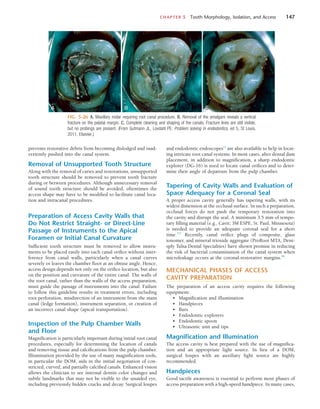
not completely removed.1
Working through a clean access also
orifices of the root canals are always located at the angles
in the floor-wall junction; and the orifices of the root
canals are always located at the terminus of the roots’
developmental fusion lines.
More than 95% of the teeth these investigators examined
conformed to these spatial relationships.107
Slightly less than
5% of mandibular second and third molars did not conform
because of the occurrence of C-shaped anatomy.
Preparation of the Access Cavity Through
the Lingual and Occlusal Surfaces
Access cavities on anterior teeth usually are prepared through
the lingual tooth surface, and those on posterior teeth are
prepared through the occlusal surface. These approaches are
the best for achieving straight-line access while reducing
esthetic and restorative concerns. Some authors have recom-
mended that the traditional anterior access for mandibular
incisors be moved from the lingual surface to the incisal
surface in selected cases135
; this allows better access to the
lingual canal and improves canal débridement (Fig. 5-24). In
FIG. 5-24  An incisal access cavity on mandibular anterior teeth may allow
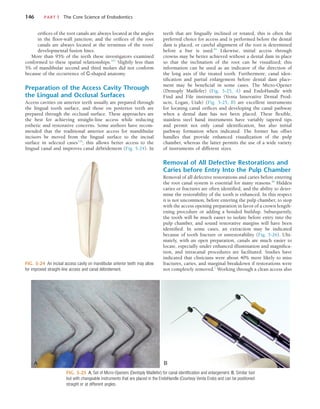
for improved straight-line access and canal débridement.
FIG. 5-25  A, Set of Micro-Openers (Dentsply Maillefer) for canal identification and enlargement. B, Similar tool
but with changeable instruments that are placed in the EndoHandle (Courtesy Venta Endo) and can be positioned
straight or at different angles.
A B
CHAPTER 5  Tooth Morphology, Isolation, and Access	 147
and endodontic endoscopes12
are also available to help in locat-
ing intricate root canal systems. In most cases, after dental dam
placement, in addition to magnification, a sharp endodontic
explorer (DG-16) is used to locate canal orifices and to deter-
mine their angle of departure from the pulp chamber.
Tapering of Cavity Walls and Evaluation of
Space Adequacy for a Coronal Seal
A proper access cavity generally has tapering walls, with its
widest dimension at the occlusal surface. In such a preparation,
occlusal forces do not push the temporary restoration into
the cavity and disrupt the seal. A minimum 3.5 mm of tempo-
rary filling material (e.g., Cavit; 3M ESPE, St. Paul, Minnesota)
is needed to provide an adequate coronal seal for a short
time.237
Recently, canal orifice plugs of composite, glass
ionomer, and mineral trioxide aggregate (ProRoot MTA, Dent-
sply Tulsa Dental Specialties) have shown promise in reducing
the risk of bacterial contamination of the canal system when
microleakage occurs at the coronal-restorative margins.96
MECHANICAL PHASES OF ACCESS
CAVITY PREPARATION
The preparation of an access cavity requires the following
equipment:
•	 Magnification and illumination
•	 Handpieces
•	 Burs
•	 Endodontic explorers
•	 Endodontic spoon
•	 Ultrasonic unit and tips
Magnification and Illumination
The access cavity is best prepared with the use of magnifica-
tion and an appropriate light source. In lieu of a DOM,
surgical loupes with an auxiliary light source are highly
recommended.
Handpieces
Good tactile awareness is essential to perform most phases of
access preparation with a high-speed handpiece. In many cases,
prevents restorative debris from becoming dislodged and inad-
vertently pushed into the canal system.
Removal of Unsupported Tooth Structure
Along with the removal of caries and restorations, unsupported
tooth structure should be removed to prevent tooth fracture
during or between procedures. Although unnecessary removal
of sound tooth structure should be avoided, oftentimes the
access shape may have to be modified to facilitate canal loca-
tion and intracanal procedures.
Preparation of Access Cavity Walls that
Do Not Restrict Straight- or Direct-Line
Passage of Instruments to the Apical
Foramen or Initial Canal Curvature
Sufficient tooth structure must be removed to allow instru-
ments to be placed easily into each canal orifice without inter-
ference from canal walls, particularly when a canal curves
severely or leaves the chamber floor at an obtuse angle. Hence,
access design depends not only on the orifice location, but also
on the position and curvature of the entire canal. The walls of
the root canal, rather than the walls of the access preparation,
must guide the passage of instruments into the canal. Failure
to follow this guideline results in treatment errors, including
root perforation, misdirection of an instrument from the main
canal (ledge formation), instrument separation, or creation of
an incorrect canal shape (apical transportation).
Inspection of the Pulp Chamber Walls
and Floor
Magnification is particularly important during initial root canal
procedures, especially for determining the location of canals
and removing tissue and calcifications from the pulp chamber.
Illumination provided by the use of many magnification tools,
in particular the DOM, aids in the initial negotiation of con-
stricted, curved, and partially calcified canals. Enhanced vision
allows the clinician to see internal dentin color changes and
subtle landmarks that may not be visible to the unaided eye,
including previously hidden cracks and decay. Surgical loupes
FIG. 5-26  A, Maxillary molar requiring root canal procedure. B, Removal of the amalgam reveals a vertical
fracture on the palatal margin. C, Complete cleaning and shaping of the canals. Fracture lines are still visible,
but no probings are present. (From Gutmann JL, Lovdahl PE: Problem solving in endodontics, ed 5, St Louis,
2011, Elsevier.)
A B C
C
148	 PART I  The Core Science of Endodontics
which are used as reference points for the working length
determination.
Round diamond burs (sizes #2 and #4) (Fig. 5-31) are
needed when the access must be made through porcelain or
metalloceramic restorations.84
Diamond burs are less traumatic
to porcelain than carbide burs and are more likely to penetrate
the porcelain without cracking or fracturing it. They should
always be used with water spray to control heat buildup in
porcelain restorations. After penetrating the porcelain with a
diamond bur, a carbide bur, such as a transmetal bur (Dentsply
Maillefer) (Fig. 5-32), is used for metal or dentin penetration
because of this bur’s greater cutting efficiency.84
the use of a slow-speed handpiece is indicated, which is espe-
cially helpful in the careful excavation of caries located in the
area of the anticipated access opening. For challenging access
cavity preparations, especially those involving calcified and
receded pulp chambers, even experienced clinicians may sacri-
fice cutting speed and efficiency in favor of the increased cutting
control of the slow-speed handpiece or an ultrasonic tip.
Burs
Numerous burs have been developed exclusively for access
cavity preparation. Providing a detailed, unabridged list of
these burs would be difficult, and most clinicians have their
own set of preferred access burs. To meet the overall needs
in this regard, various companies have developed access kits
with a large variety of burs (Dentsply Tulsa Dental Speciali-
ties; SS White, Lakewood, New Jersey; SybronEndo, Orange,
California; Ultradent Products, Inc., South Jordan, Utah). In
reality, creating an access cavity that meets the previously
stated guidelines is more important than worrying about
which burs are used in the process. This discussion, therefore,
covers some of the more common access burs.
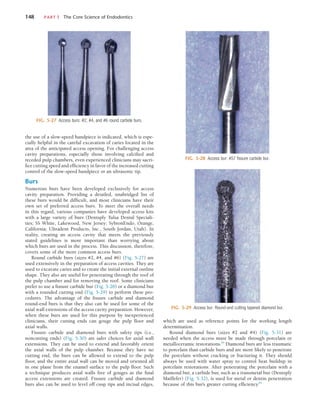
Round carbide burs (sizes #2, #4, and #6) (Fig. 5-27) are
used extensively in the preparation of access cavities. They are
used to excavate caries and to create the initial external outline
shape. They also are useful for penetrating through the roof of
the pulp chamber and for removing the roof. Some clinicians
prefer to use a fissure carbide bur (Fig. 5-28) or a diamond bur
with a rounded cutting end (Fig. 5-29) to perform these pro-
cedures. The advantage of the fissure carbide and diamond
round-end burs is that they also can be used for some of the
axial wall extensions of the access cavity preparation. However,
when these burs are used for this purpose by inexperienced
clinicians, their cutting ends can gouge the pulp floor and
axial walls.
Fissure carbide and diamond burs with safety tips (i.e.,
noncutting ends) (Fig. 5-30) are safer choices for axial wall
extensions. They can be used to extend and favorably orient
the axial walls of the pulp chamber. Because they have no
cutting end, the burs can be allowed to extend to the pulp
floor, and the entire axial wall can be moved and oriented all
in one plane from the enamel surface to the pulp floor. Such
a technique produces axial walls free of gouges as the final
access extensions are created. Fissure carbide and diamond
burs also can be used to level off cusp tips and incisal edges,
FIG. 5-27  Access burs: #2, #4, and #6 round carbide burs.
FIG. 5-28  Access bur: #57 fissure carbide bur.
FIG. 5-29  Access bur: Round-end cutting tapered diamond bur.
CHAPTER 5  Tooth Morphology, Isolation, and Access	 149
fine-grit diamond burs that efficiently cut zirconia (Komet
USA, Savannah, Georgia; Prima Dental Gloucester, England;
SS White). These diamond burs should be used with copious
water spray to minimize heat buildup in the zirconia crowns
during access preparations.84
Also, some diamond burs may
degrade rapidly when cutting through zirconia and should be
thrown away after one use.
Many teeth requiring access cavity preparations have metal
restorations that must be penetrated. These restorations may
be amalgams, all-metal cast restorations, or metal copings of
porcelain fused to metal crowns. As previously mentioned, a
transmetal bur is excellent for cutting through metal because
of its exceptional cutting efficiency. To penetrate a metallic
restoration, a new transmetal bur is recommended for each
restoration, together with copious water spray for maximal
cutting effect.
When a receded pulp chamber and calcified orifice are iden-
tified, or to locate and identify the canal orifice, countersinking
or cutting into the root is often indicated. Extended-shank
round burs, such as the Mueller bur (Brasseler USA, Savannah,
Georgia) (Fig. 5-33, A) or Extendo Bur (Dentsply Tulsa Dental
Specialties), also known as the LN bur (Dentsply Maillefer)
(Fig. 5-33, B), can be used. The Munce Discovery bur (CJM
Engineering, Santa Barbara, California) is similar to the Mueller
bur but has a stiffer shaft and is available in smaller head sizes.
The extra-long shank of these burs moves the head of the
handpiece away from the tooth, improving the clinician’s vis-
ibility during this delicate procedure. As an alternative, ultra-
sonic units offer good visibility with precision cutting.
Once the orifices have been located, they should be flared
or enlarged and blended into the axial walls of the access cavity.
This process permits the intracanal instruments used during
the enlargement and shaping procedures to penetrate the canal
effortlessly. Some clinicians might consider this task part of the
A significant trend in restorative dentistry is the increased
use of zirconia-based crowns and onlays. Zirconia has different
mechanical and thermal characteristics than metal. Carbide
burs do not cut zirconia efficiently or safely. Zirconia is a brittle
material and when cut can develop cracks that propagate
through the framework and lead to eventual failure of the
crown or onlay. Diamond bur manufacturers are aware of
these issues, and they are currently introducing medium- and
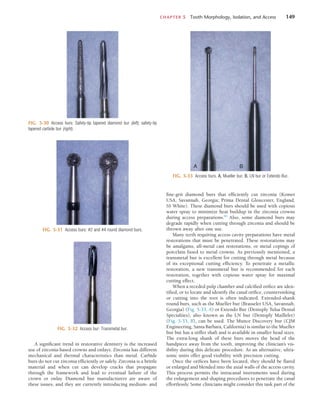
FIG. 5-30  Access burs: Safety-tip tapered diamond bur (left); safety-tip
tapered carbide bur (right).
FIG. 5-31  Access burs: #2 and #4 round diamond burs.
FIG. 5-32  Access bur: Transmetal bur.
FIG. 5-33  Access burs. A, Mueller bur. B, LN bur or Extendo Bur.
A B
150	 PART I  The Core Science of Endodontics
canal enlargement and shaping phase; however, when done
before deep canal penetration, it establishes a well-prepared
access opening and may prevent subsequent error.
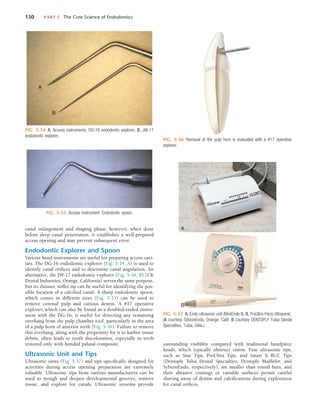
Endodontic Explorer and Spoon
Various hand instruments are useful for preparing access cavi-
ties. The DG-16 endodontic explorer (Fig. 5-34, A) is used to
identify canal orifices and to determine canal angulation. An
alternative, the JW-17 endodontic explorer (Fig. 5-34, B) (CK
Dental Industries, Orange, California) serves the same purpose,
but its thinner, stiffer tip can be useful for identifying the pos-
sible location of a calcified canal. A sharp endodontic spoon,
which comes in different sizes (Fig. 5-35) can be used to
remove coronal pulp and carious dentin. A #17 operative
explorer, which can also be found as a doubled-ended instru-
ment with the DG-16, is useful for detecting any remaining
overhang from the pulp chamber roof, particularly in the area
of a pulp horn of anterior teeth (Fig. 5-36). Failure to remove
this overhang, along with the propensity for it to harbor tissue
debris, often leads to tooth discoloration, especially in teeth
restored only with bonded palatal composite.
Ultrasonic Unit and Tips
Ultrasonic units (Fig. 5-37) and tips specifically designed for
activities during access opening preparation are extremely
valuable. Ultrasonic tips from various manufacturers can be
used to trough and deepen developmental grooves, remove
tissue, and explore for canals. Ultrasonic systems provide
FIG. 5-34  A, Access instruments: DG-16 endodontic explorer. B, JW-17
endodontic explorer.
A
B
FIG. 5-35  Access instrument: Endodontic spoon.
FIG. 5-36  Removal of the pulp horn is evaluated with a #17 operative
explorer.
FIG. 5-37  A, Endo ultrasonic unit (MiniEndo II). B, ProUltra Piezo Ultrasonic.
(A courtesy SybronEndo, Orange, Calif; B courtesy DENTSPLY Tulsa Dental
Specialties, Tulsa, Okla.)
A
B
outstanding visibility compared with traditional handpiece
heads, which typically obstruct vision. Fine ultrasonic tips,
such as Sine Tips, ProUltra Tips, and Smart X BUC Tips
(Dentsply Tulsa Dental Specialties; Dentsply Maillefer; and
SybronEndo, respectively), are smaller than round burs, and
their abrasive coatings or variable surfaces permit careful
shaving away of dentin and calcifications during exploration
for canal orifices.
CHAPTER 5  Tooth Morphology, Isolation, and Access	 151
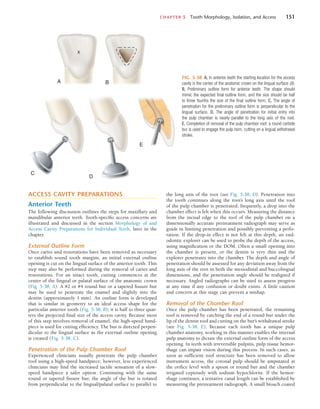
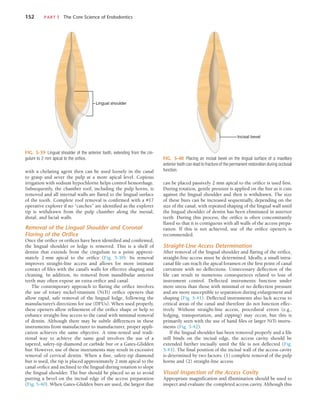
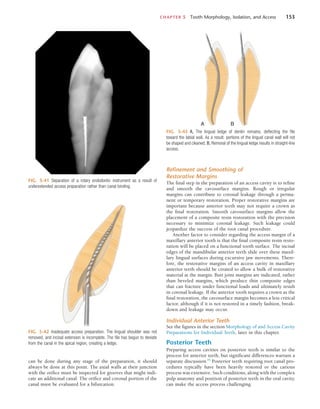
the long axis of the root (see Fig. 5-38, D). Penetration into
the tooth continues along the root’s long axis until the roof
of the pulp chamber is penetrated; frequently, a drop into the
chamber effect is felt when this occurs. Measuring the distance
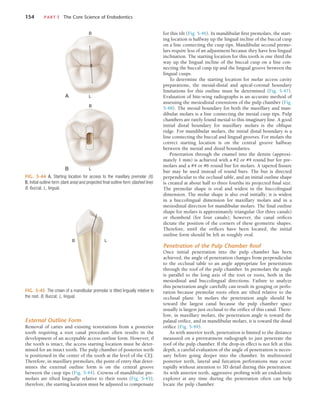
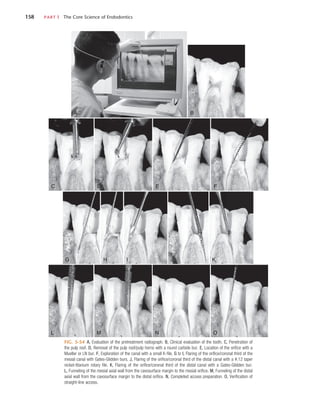
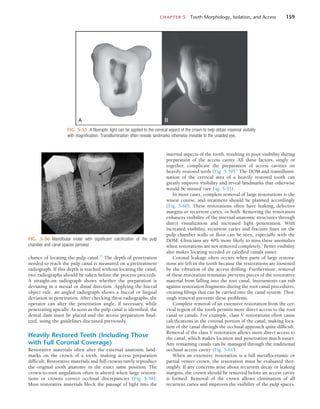
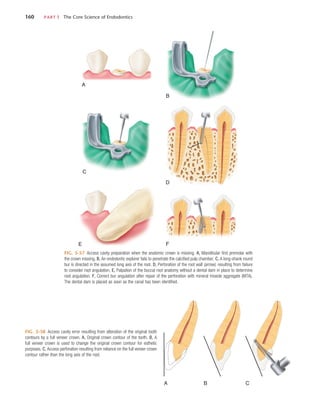
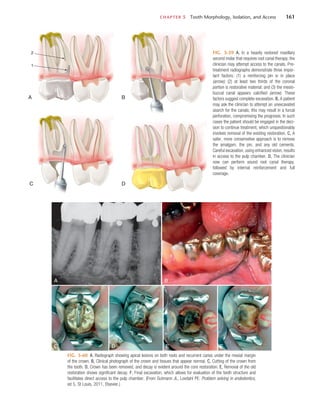
from the incisal edge to the roof of the pulp chamber on a
dimensionally accurate pretreatment radiograph may serve as
guide in limiting penetration and possibly preventing a perfo-
ration. If the drop-in effect is not felt at this depth, an end-
odontic explorer can be used to probe the depth of the access,
using magnification or the DOM. Often a small opening into
the chamber is present, or the dentin is very thin and the
explorer penetrates into the chamber. The depth and angle of
penetration should be assessed for any deviation away from the
long axis of the root in both the mesiodistal and buccolingual
dimensions, and the penetration angle should be realigned if
necessary. Angled radiographs can be used to assess progress
at any time if any confusion or doubt exists. A little caution
and concern at this stage can prevent a mishap.
Removal of the Chamber Roof
Once the pulp chamber has been penetrated, the remaining
roof is removed by catching the end of a round bur under the
lip of the dentin roof and cutting on the bur’s withdrawal stroke
(see Fig. 5-38, E). Because each tooth has a unique pulp
chamber anatomy, working in this manner enables the internal
pulp anatomy to dictate the external outline form of the access
opening. In teeth with irreversible pulpitis, pulp tissue hemor-
rhage can impair vision during this process. In such cases, as
soon as sufficient roof structure has been removed to allow
instrument access, the coronal pulp should be amputated at
the orifice level with a spoon or round bur and the chamber
irrigated copiously with sodium hypochlorite. If the hemor-
rhage continues, a tentative canal length can be established by
measuring the pretreatment radiograph. A small broach coated
ACCESS CAVITY PREPARATIONS
Anterior Teeth
The following discussion outlines the steps for maxillary and
mandibular anterior teeth. Tooth-specific access concerns are
illustrated and discussed in the section Morphology of and
Access Cavity Preparations for Individual Teeth, later in the
chapter.
External Outline Form
Once caries and restorations have been removed as necessary
to establish sound tooth margins, an initial external outline
opening is cut on the lingual surface of the anterior tooth. This
step may also be performed during the removal of caries and
restorations. For an intact tooth, cutting commences at the
center of the lingual or palatal surface of the anatomic crown
(Fig. 5-38, A). A #2 or #4 round bur or a tapered fissure bur
may be used to penetrate the enamel and slightly into the
dentin (approximately 1 mm). An outline form is developed
that is similar in geometry to an ideal access shape for the
particular anterior tooth (Fig. 5-38, B); it is half to three quar-
ters the projected final size of the access cavity. Because most
of this step involves removal of enamel, the high-speed hand-
piece is used for cutting efficiency. The bur is directed perpen-
dicular to the lingual surface as the external outline opening
is created (Fig. 5-38, C).
Penetration of the Pulp Chamber Roof
Experienced clinicians usually penetrate the pulp chamber
roof using a high-speed handpiece; however, less experienced
clinicians may find the increased tactile sensation of a slow-
speed handpiece a safer option. Continuing with the same
round or tapered fissure bur, the angle of the bur is rotated
from perpendicular to the lingual/palatal surface to parallel to
FIG. 5-38  A, In anterior teeth the starting location for the access
cavity is the center of the anatomic crown on the lingual surface (X).
B, Preliminary outline form for anterior teeth. The shape should
mimic the expected final outline form, and the size should be half
to three fourths the size of the final outline form. C, The angle of
penetration for the preliminary outline form is perpendicular to the
lingual surface. D, The angle of penetration for initial entry into
the pulp chamber is nearly parallel to the long axis of the root. 
E, Completion of removal of the pulp chamber roof; a round carbide
bur is used to engage the pulp horn, cutting on a lingual withdrawal
stroke.
A
X
B
C
D
E
152	 PART I  The Core Science of Endodontics
can be placed passively 2 mm apical to the orifice is used first.
During rotation, gentle pressure is applied on the bur as it cuts
against the lingual shoulder and then is withdrawn. The size
of these burs can be increased sequentially, depending on the
size of the canal, with repeated shaping of the lingual wall until
the lingual shoulder of dentin has been eliminated in anterior
teeth. During this process, the orifice is often concomitantly
flared so that it is contiguous with all walls of the access prepa-
ration. If this is not achieved, use of the orifice openers is
recommended.
Straight-Line Access Determination
After removal of the lingual shoulder and flaring of the orifice,
straight-line access must be determined. Ideally, a small intra-
canal file can reach the apical foramen or the first point of canal
curvature with no deflections. Unnecessary deflection of the
file can result in numerous consequences related to loss of
instrument control. Deflected instruments function under
more stress than those with minimal or no deflection pressure
and are more susceptible to separation during enlargement and
shaping (Fig. 5-41). Deflected instruments also lack access to
critical areas of the canal and therefore do not function effec-
tively. Without straight-line access, procedural errors (e.g.,
ledging, transportation, and zipping) may occur, but this is
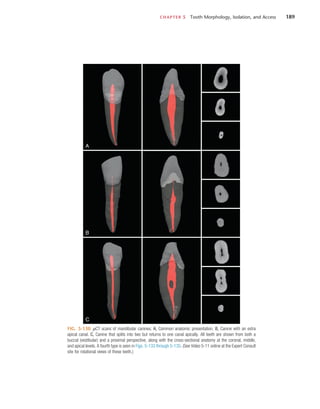
primarily seen with the use of hand files or larger NiTi instru-
ments (Fig. 5-42).
If the lingual shoulder has been removed properly and a file
still binds on the incisal edge, the access cavity should be
extended further incisally until the file is not deflected (Fig.
5-43). The final position of the incisal wall of the access cavity
is determined by two factors: (1) complete removal of the pulp
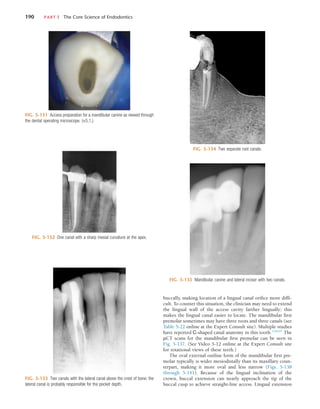
horns and (2) straight-line access.
Visual Inspection of the Access Cavity
Appropriate magnification and illumination should be used to
inspect and evaluate the completed access cavity. Although this
with a chelating agent then can be used loosely in the canal
to grasp and sever the pulp at a more apical level. Copious
irrigation with sodium hypochlorite helps control hemorrhage.
Subsequently, the chamber roof, including the pulp horns, is
removed and all internal walls are flared to the lingual surface
of the tooth. Complete roof removal is confirmed with a #17
operative explorer if no “catches” are identified as the explorer
tip is withdrawn from the pulp chamber along the mesial,
distal, and facial walls.
Removal of the Lingual Shoulder and Coronal
Flaring of the Orifice
Once the orifice or orifices have been identified and confirmed,
the lingual shoulder or ledge is removed. This is a shelf of
dentin that extends from the cingulum to a point approxi-
mately 2 mm apical to the orifice (Fig. 5-39). Its removal
improves straight-line access and allows for more intimate
contact of files with the canal’s walls for effective shaping and
cleaning. In addition, its removal from mandibular anterior
teeth may often expose an extra orifice and canal.
The contemporary approach to flaring the orifice involves
the use of rotary nickel-titanium (NiTi) orifice openers that
allow rapid, safe removal of the lingual ledge, following the
manufacturer’s directions for use (DFUs). When used properly,
these openers allow refinement of the orifice shape or help to
enhance straight-line access to the canal with minimal removal
of dentin. Although there may be subtle differences in these
instruments from manufacturer to manufacturer, proper appli-
cation achieves the same objective. A time-tested and tradi-
tional way to achieve the same goal involves the use of a
tapered, safety-tip diamond or carbide bur or a Gates-Glidden
bur. However, use of these instruments may result in excessive
removal of cervical dentin. When a fine, safety-tip diamond
bur is used, the tip is placed approximately 2 mm apical to the
canal orifice and inclined to the lingual during rotation to slope
the lingual shoulder. The bur should be placed so as to avoid
putting a bevel on the incisal edge of the access preparation
(Fig. 5-40). When Gates-Glidden burs are used, the largest that
FIG. 5-40  Placing an incisal bevel on the lingual surface of a maxillary
anterior tooth can lead to fracture of the permanent restoration during occlusal
function.
Incisal bevel
Lingual shoulder
FIG. 5-39  Lingual shoulder of the anterior tooth, extending from the cin-
gulum to 2 mm apical to the orifice.
CHAPTER 5  Tooth Morphology, Isolation, and Access	 153
Refinement and Smoothing of
Restorative Margins
The final step in the preparation of an access cavity is to refine
and smooth the cavosurface margins. Rough or irregular
margins can contribute to coronal leakage through a perma-
nent or temporary restoration. Proper restorative margins are
important because anterior teeth may not require a crown as
the final restoration. Smooth cavosurface margins allow the
placement of a composite resin restoration with the precision
necessary to minimize coronal leakage. Such leakage could
jeopardize the success of the root canal procedure.
Another factor to consider regarding the access margin of a
maxillary anterior tooth is that the final composite resin resto-
ration will be placed on a functional tooth surface. The incisal
edges of the mandibular anterior teeth slide over these maxil-
lary lingual surfaces during excursive jaw movements. There-
fore, the restorative margins of an access cavity in maxillary
anterior teeth should be created to allow a bulk of restorative
material at the margin. Butt joint margins are indicated, rather
than beveled margins, which produce thin composite edges
that can fracture under functional loads and ultimately result
in coronal leakage. If the anterior tooth requires a crown as the
final restoration, the cavosurface margin becomes a less critical
factor, although if it is not restored in a timely fashion, break-
down and leakage may occur.
Individual Anterior Teeth
See the figures in the section Morphology of and Access Cavity
Preparations for Individual Teeth, later in this chapter.
Posterior Teeth
Preparing access cavities on posterior teeth is similar to the
process for anterior teeth, but significant differences warrant a
separate discussion.84
Posterior teeth requiring root canal pro-
cedures typically have been heavily restored or the carious
process was extensive. Such conditions, along with the complex
pulp anatomy and position of posterior teeth in the oral cavity,
can make the access process challenging.
FIG. 5-41  Separation of a rotary endodontic instrument as a result of
underextended access preparation rather than canal binding.
FIG. 5-42  Inadequate access preparation. The lingual shoulder was not
removed, and incisal extension is incomplete. The file has begun to deviate
from the canal in the apical region, creating a ledge.
FIG. 5-43  A, The lingual ledge of dentin remains, deflecting the file
toward the labial wall. As a result, portions of the lingual canal wall will not
be shaped and cleaned. B, Removal of the lingual ledge results in straight-line
access.
A B
can be done during any stage of the preparation, it should
always be done at this point. The axial walls at their junction
with the orifice must be inspected for grooves that might indi-
cate an additional canal. The orifice and coronal portion of the
canal must be evaluated for a bifurcation.
154	 PART I  The Core Science of Endodontics
for this tilt (Fig. 5-46). In mandibular first premolars, the start-
ing location is halfway up the lingual incline of the buccal cusp
on a line connecting the cusp tips. Mandibular second premo-
lars require less of an adjustment because they have less lingual
inclination. The starting location for this tooth is one third the
way up the lingual incline of the buccal cusp on a line con-
necting the buccal cusp tip and the lingual groove between the
lingual cusps.
To determine the starting location for molar access cavity
preparations, the mesial-distal and apical-coronal boundary
limitations for this outline must be determined (Fig. 5-47).
Evaluation of bite-wing radiographs is an accurate method of
assessing the mesiodistal extensions of the pulp chamber (Fig.
5-48). The mesial boundary for both the maxillary and man-
dibular molars is a line connecting the mesial cusp tips. Pulp
chambers are rarely found mesial to this imaginary line. A good
initial distal boundary for maxillary molars is the oblique
ridge. For mandibular molars, the initial distal boundary is a
line connecting the buccal and lingual grooves. For molars the
correct starting location is on the central groove halfway
between the mesial and distal boundaries.
Penetration through the enamel into the dentin (approxi-
mately 1 mm) is achieved with a #2 or #4 round bur for pre-
molars and a #4 or #6 round bur for molars. A tapered fissure
bur may be used instead of round burs. The bur is directed
perpendicular to the occlusal table, and an initial outline shape
is created at about half to three fourths its projected final size.
The premolar shape is oval and widest in the buccolingual
dimension. The molar shape is also oval initially; it is widest
in a buccolingual dimension for maxillary molars and in a
mesiodistal direction for mandibular molars. The final outline
shape for molars is approximately triangular (for three canals)
or rhomboid (for four canals); however, the canal orifices
dictate the position of the corners of these geometric shapes.
Therefore, until the orifices have been located, the initial
outline form should be left as roughly oval.
Penetration of the Pulp Chamber Roof
Once initial penetration into the pulp chamber has been
achieved, the angle of penetration changes from perpendicular
to the occlusal table to an angle appropriate for penetration
through the roof of the pulp chamber. In premolars the angle
is parallel to the long axis of the root or roots, both in the
mesiodistal and buccolingual directions. Failure to analyze
this penetration angle carefully can result in gouging or perfo-
ration because premolar roots often are tilted relative to the
occlusal plane. In molars the penetration angle should be
toward the largest canal because the pulp chamber space
usually is largest just occlusal to the orifice of this canal. There-
fore, in maxillary molars, the penetration angle is toward the
palatal orifice, and in mandibular molars, it is toward the distal
orifice (Fig. 5-49).
As with anterior teeth, penetration is limited to the distance
measured on a pretreatment radiograph to just penetrate the
roof of the pulp chamber. If the drop-in effect is not felt at this
depth, a careful evaluation of the angle of penetration is neces-
sary before going deeper into the chamber. In multirooted
posterior teeth, lateral and furcation perforations may occur
rapidly without attention to 3D detail during this penetration.
As with anterior teeth, aggressive probing with an endodontic
explorer at any time during the penetration often can help
locate the pulp chamber.
FIG. 5-44  A, Starting location for access to the maxillary premolar (X).
B, Initial outline form (dark area) and projected final outline form (dashed line).
B, Buccal; L, lingual.
A
B
L
X
B
B
L
FIG. 5-45  The crown of a mandibular premolar is tilted lingually relative to
the root. B, Buccal; L, lingual.
L
B
External Outline Form
Removal of caries and existing restorations from a posterior
tooth requiring a root canal procedure often results in the
development of an acceptable access outline form. However, if
the tooth is intact, the access starting location must be deter-
mined for an intact tooth. The pulp chamber of posterior teeth
is positioned in the center of the tooth at the level of the CEJ.
Therefore, in maxillary premolars, the point of entry that deter-
mines the external outline form is on the central groove
between the cusp tips (Fig. 5-44). Crowns of mandibular pre-
molars are tilted lingually relative to their roots (Fig. 5-45);
therefore, the starting location must be adjusted to compensate
CHAPTER 5  Tooth Morphology, Isolation, and Access	 155
FIG. 5-46  A, Mandibular first premolar and access starting location (X)
(occlusal view). B, Mandibular first premolar and starting location (proximal
view). C, Mandibular second premolar and access starting location (X)
(occlusal view). D, Mandibular second premolar and starting location (proxi-
mal view). B, Buccal; DL, distolingual; L, lingual; ML, mesiolingual.
B
B L
L
B
DL cusp tip
ML cusp tip
B cusp tip
C
X
A
B
L
L cusp tip
B cusp tip
X
L
B
D
FIG. 5-47  A, Mesial and distal boundary of a maxillary molar with the
access starting location (X). B, Mesial and distal boundary of a mandibular
molar showing the access starting location (X). D, Distal; M, mesial; MB,
mesiobuccal; ML, mesiolingual.
A
D M
M B cusp tip
ML cusp tip
B
X
D M
M B cusp tip
M L cusp tip
X
FIG. 5-48  A, Periapical radiograph of the teeth in the maxillary right quad-
rant. B, Bite-wing radiograph of the same teeth provides a clearer delineation
of the pulpal morphology.
A
B
156	 PART I  The Core Science of Endodontics
FIG. 5-49  Angle of penetration toward the largest canal (palatal) in a maxil-
lary molar. B, Buccal; P, palatal.
B P
FIG. 5-50  A, Pulp roof/pulp horn removal. The round bur hooks
under the lip of the pulp horn. B, The bur is rotated and withdrawn
in an occlusal direction to remove the lip. C, Removal of a cervical
dentin bulge. A Gates-Glidden bur is placed just apical to the orifice
and withdrawn in a distoocclusal direction. D, A safety-tip tapered
diamond bur is used to blend and funnel the axial wall from the
cavosurface margin to the orifice.
A
B
C D
FIG. 5-51  Safety-tip carbide bur is used to shape the axial wall in one plane
from the orifice to the cavosurface margin. B, Buccal; P, palatal.
B P
Removal of the Chamber Roof
The bur of choice is used to remove the roof of the pulp
chamber completely, including all pulp horns (Fig. 5-50, A
and B). Visibility problems caused by pulpal hemorrhage
should be handled as described in the previous section for
anterior teeth. The goal is to funnel the corners of the access
cavity directly into the orifices, and a safety-tip diamond or
carbide bur (Multi Bur, Dentsply Tulsa Dental Specialties) per-
forms this task nicely (Fig. 5-50, C and D); it can be set on the
pulp floor and the entire axial wall shaped at one time, with
little or no apical pressure (Fig. 5-51). These burs are passed
between the orifices along the axial walls to remove the roof,
taper the internal walls, and create the desired external outline
shape simultaneously.
Identification of All Canal Orifices
In posterior teeth with multiple canals, the canal orifices play
an important role in determining the final extensions of the
external outline form of the access cavity. Ideally, the orifices
are located at the corners of the final preparation to facilitate
all of the root canal procedures (Fig. 5-52). Internally, the
access cavity should have all orifices positioned entirely on the
pulp floor and should not extend into an axial wall. Extension
of an orifice into the axial wall creates a “mouse hole” effect
(Fig. 5-53), which indicates internal underextension and
impedes straight-line access. In such cases the orifice must be
repositioned onto the pulp floor without interference from
axial walls.
Removal of the Cervical Dentin Bulges and
Orifice and Coronal Flaring
In posterior teeth the internal impediments to an ideal access
opening are the cervical dentin ledges or bulges and the natural
coronal canal constriction.84
The cervical bulges are shelves of
dentin that frequently overhang orifices in posterior teeth,
restricting access into root canals and accentuating existing
CHAPTER 5  Tooth Morphology, Isolation, and Access	 157
FIG. 5-52  An endodontic explorer is used to search for canal orifices.
FIG. 5-53  A, Mouse hole effect caused by exten-
sion of the orifice into the axial wall. B, Orifice that
lies completely on the pulp floor.
A B
canal curvatures.117
They can develop from mesial, distal,
buccal, and lingual walls inward. These bulges can be removed
safely with burs or ultrasonic instruments. The removal instru-
ments should be placed at the orifice level, and light pressure
should be used to cut laterally toward the dentin bulge to
remove the overhanging ledge (Fig. 5-54). After removal of the
ledge, the orifice and constricted coronal portion of the canal
can be flared with NiTi orifice openers, Gates-Glidden burs, or
large, tapered rotary instruments (.10/.12), which are used in
a sweeping upward motion with minimal lateral pressure away
from the furcation. As the orifice is enlarged, it should be
tapered and blended into the axial wall so that an explorer can
slide down the corner of the external outline form, down the
axial wall, and into the orifice without encountering any
obstructions (see Fig. 5-54).
Straight-Line Access Determination
Straight-line access is paramount to successful shaping, espe-
cially given the complexity of the root canal systems in poste-
rior teeth. Files must have unimpeded access to the apical
foramen or the first point of canal curvature to perform prop-
erly. Therefore, each canal must have straight-line access, and
adjustments must be made accordingly (see Fig. 5-54, O).
Visual Inspection of the Pulp Chamber Floor
The floor and walls must be inspected, using appropriate mag-
nification and illumination, to ensure that all canal orifices are
visible and no roof overhangs are present (Fig. 5-55).
Refinement and Smoothing of
the Restorative Margins
In both temporary and interim permanent restorations, the
restorative margins should be refined and smoothed to mini-
mize the potential for coronal leakage. The final permanent
restoration of choice for posterior teeth that have undergone a
root canal procedure is generally a crown or onlay, although
this may vary, depending on the opposing dentition and patient
function.
Individual Posterior Teeth
See the figures in the section Morphology of and Access Cavity
Preparations for Individual Teeth, later in the chapter.
CHALLENGING ACCESS PREPARATIONS
Teeth with Minimal or No Clinical Crown
Forming an access cavity on a tooth with little or no clinical
crown might seem to be a simple procedure. For example, in
young teeth, traumatic fractures often expose the pulp chamber,
making access preparation easy. However, in older teeth with
previous caries or large restorations, the pulp chambers typi-
cally have receded or calcified (Fig. 5-56). Loss of significant
coronal anatomy to guide penetration angles can make access
quite difficult. A thorough evaluation of these teeth clinically
and their root angulation on pretreatment radiographs is essen-
tial. Pulp chambers are located at the center of the crown at
the level of the CEJ. Access often is started without a dental
dam in place so that root eminences can be visualized and
palpated as access preparation progresses (Fig. 5-57). Every
effort is made to stay centered within the root for the best
158	 PART I  The Core Science of Endodontics
FIG. 5-54  A, Evaluation of the pretreatment radiograph. B, Clinical evaluation of the tooth. C, Penetration of
the pulp roof. D, Removal of the pulp roof/pulp horns with a round carbide bur. E, Location of the orifice with a
Mueller or LN bur. F, Exploration of the canal with a small K-file. G to I, Flaring of the orifice/coronal third of the
mesial canal with Gates-Glidden burs. J, Flaring of the orifice/coronal third of the distal canal with a #.12 taper
nickel-titanium rotary file. K, Flaring of the orifice/coronal third of the distal canal with a Gates-Glidden bur.
L, Funneling of the mesial axial wall from the cavosurface margin to the mesial orifice. M, Funneling of the distal
axial wall from the cavosurface margin to the distal orifice. N, Completed access preparation. O, Verification of
straight-line access.
K
J
A B
C D E F
G I
H
L M N O
CHAPTER 5  Tooth Morphology, Isolation, and Access	 159
FIG. 5-55  A fiberoptic light can be applied to the cervical aspect of the crown to help obtain maximal visibility
with magnification. Transillumination often reveals landmarks otherwise invisible to the unaided eye.
A B
FIG. 5-56  Mandibular molar with significant calcification of the pulp
chamber and canal spaces (arrows).
chance of locating the pulp canal.25
The depth of penetration
needed to reach the pulp canal is measured on a pretreatment
radiograph. If this depth is reached without locating the canal,
two radiographs should be taken before the process proceeds.
A straight-on radiograph shows whether the preparation is
deviating in a mesial or distal direction. Applying the buccal
object rule, an angled radiograph shows a buccal or lingual
deviation in penetration. After checking these radiographs, the
operator can alter the penetration angle, if necessary, while
penetrating apically. As soon as the pulp canal is identified, the
dental dam must be placed and the access preparation final-
ized, using the guidelines discussed previously.
Heavily Restored Teeth (Including Those
with Full Coronal Coverage)
Restorative materials often alter the external anatomic land-
marks on the crown of a tooth, making access preparation
difficult. Restorative materials and full crowns rarely reproduce
the original tooth anatomy in the exact same position. The
crown-to-root angulation often is altered when large restora-
tions or crowns correct occlusal discrepancies (Fig. 5-58).
Most restorative materials block the passage of light into the
internal aspects of the tooth, resulting in poor visibility during
preparation of the access cavity. All these factors, singly or
together, complicate the preparation of access cavities on
heavily restored teeth (Fig. 5-59).1
The DOM and transillumi-
nation of the cervical area of a heavily restored tooth can
greatly improve visibility and reveal landmarks that otherwise
would be missed (see Fig. 5-55).
In most cases, complete removal of large restorations is the
wisest course, and treatment should be planned accordingly
(Fig. 5-60). These restorations often have leaking, defective
margins or recurrent caries, or both. Removing the restoration
enhances visibility of the internal anatomic structures through
direct visualization and increased light penetration. With
increased visibility, recurrent caries and fracture lines on the
pulp chamber walls or floor can be seen, especially with the
DOM. Clinicians are 40% more likely to miss these anomalies
when restorations are not removed completely.1
Better visibility
also makes locating receded or calcified canals easier.
Coronal leakage often occurs when parts of large restora-
tions are left in the tooth because the restorations are loosened
by the vibration of the access drilling. Furthermore, removal
of these restoration remnants prevents pieces of the restorative
material from falling into the root canal. Instruments can rub
against restoration fragments during the root canal procedures,
creating filings that can be carried into the canal system. Thor-
ough removal prevents these problems.
Complete removal of an extensive restoration from the cer-
vical region of the tooth permits more direct access to the root
canal or canals. For example, class V restorations often cause
calcifications in the coronal portion of the canal, making loca-
tion of the canal through the occlusal approach quite difficult.
Removal of the class V restoration allows more direct access to
the canal, which makes location and penetration much easier.
Any remaining canals can be managed through the traditional
occlusal access cavity (Fig. 5-61).
When an extensive restoration is a full metalloceramic or
partial veneer crown, the restoration must be evaluated thor-
oughly. If any concerns arise about recurrent decay or leaking
margins, the crown should be removed before an access cavity
is formed. Removal of the crown allows elimination of all
recurrent caries and improves the visibility of the pulp spaces.
160	 PART I  The Core Science of Endodontics
FIG. 5-57  Access cavity preparation when the anatomic crown is missing. A, Mandibular first premolar with
the crown missing. B, An endodontic explorer fails to penetrate the calcified pulp chamber. C, A long-shank round
bur is directed in the assumed long axis of the root. D, Perforation of the root wall (arrow), resulting from failure
to consider root angulation. E, Palpation of the buccal root anatomy without a dental dam in place to determine
root angulation. F, Correct bur angulation after repair of the perforation with mineral trioxide aggregate (MTA).
The dental dam is placed as soon as the canal has been identified.
A
C
D
E
B
F
FIG. 5-58  Access cavity error resulting from alteration of the original tooth
contours by a full veneer crown. A, Original crown contour of the tooth. B, A
full veneer crown is used to change the original crown contour for esthetic
purposes. C, Access perforation resulting from reliance on the full veneer crown
contour rather than the long axis of the root.
A C
B
CHAPTER 5  Tooth Morphology, Isolation, and Access	 161
FIG. 5-59  A, In a heavily restored maxillary
second molar that requires root canal therapy, the
clinician may attempt access to the canals. Pre-
treatment radiographs demonstrate three impor-
tant factors: (1) a reinforcing pin is in place
(arrow); (2) at least two thirds of the coronal
portion is restorative material; and (3) the mesio-
buccal canal appears calcified (arrow). These
factors suggest complete excavation. B, A patient
may ask the clinician to attempt an unexcavated
search for the canals; this may result in a furcal
perforation, compromising the prognosis. In such
cases the patient should be engaged in the deci-
sion to continue treatment, which unquestionably
involves removal of the existing restoration. C, A
safer, more conservative approach is to remove
the amalgam, the pin, and any old cements.
Careful excavation, using enhanced vision, results
in access to the pulp chamber. D, The clinician
now can perform sound root canal therapy, 
followed by internal reinforcement and full
coverage.
A
1
2
B
C D
FIG. 5-60  A, Radiograph showing apical lesions on both roots and recurrent caries under the mesial margin
of the crown. B, Clinical photograph of the crown and tissues that appear normal. C, Cutting of the crown from
the tooth. D, Crown has been removed, and decay is evident around the core restoration. E, Removal of the old
restoration shows significant decay. F, Final excavation, which allows for evaluation of the tooth structure and
facilitates direct access to the pulp chamber. (From Gutmann JL, Lovdahl PE: Problem solving in endodontics,
ed 5, St Louis, 2011, Elsevier.)
A
C D E F
B
162	 PART I  The Core Science of Endodontics
Development of an access through an intact metalloceramic
crown should be done with caution. When such restorations
are placed, they often change the crown-to-root angulation
to correct preexisting occlusal discrepancies. Metalloceramic
crowns often alter previous tooth rotation. Both these situa-
tions make the preparation of access cavities challenging. Pre-
treatment radiographs can be helpful, but the metal in the full
veneer crown usually masks the underlying pulp chamber. In
these situations the best approach is to stay as centered in the
tooth as possible, using all available clinical and radiographic
FIG. 5-61  A, Extensive class V restoration necessitated by root caries and
periodontal disease that led to canal calcification (arrow). B, Access to the
canal is occluded by calcification. Removal of the facial restoration may be
required to obtain access from the buccal surface.
A B
FIG. 5-62  Access cavity preparation through a metalloceramic crown. A, A round diamond bur is used to
penetrate the porcelain. B, Following the access outline with the round diamond bur, a transmetal bur is used to
cut through the metal. C, Prepared access cavity allowing direct approach to the canals. D, Files are placed on
the access cavity walls without impingement.
A B
D
C
information. The DOM and transillumination of the CEJ are
valuable aids in this process.
Metalloceramic crowns are best penetrated with new, sharp
carbide burs. Round burs work well, but tungsten carbide
transmetal burs are more efficient. These crosscut fissure burs
are specifically designed to cut through metal restorative mate-
rials. Porcelain or metalloceramic restorations must be handled
delicately to minimize the potential for fracture (Fig. 5-62).
Whatever the nature of the crown, efforts should be made to
avoid being too conservative. Attempting to save the crown
often leads to an underextended preparation. All the guide-
lines for access cavity preparations discussed earlier must
be followed. When the preparation is complete, the margins
and internal spaces must be evaluated for caries, leakage, and
fractures.
Access in Teeth with Calcified Canals
Often a 2D pretreatment radiograph may be interpreted as
showing total or nearly total calcification of the pulp chamber
and radicular canal spaces (see Fig. 5-56). Unfortunately, these
spaces have adequate room to allow passage of millions of
microorganisms. Chronic inflammatory processes (e.g., caries,
medications, occlusal trauma, and aging) often cause pulpal
degeneration and concomitant narrowing of the root canal
system.84
Although the coronal portion of the canal may appear
diminished significantly, canals often become less calcified as
they approach the root apex. Despite these perceived 2D ana-
tomic alterations, many canals do exist, and attempts must be
made to manage them to the canal terminus.
Chambers and roots that demonstrate significant calcifica-
tions may present problems with locating, penetrating, and
CHAPTER 5  Tooth Morphology, Isolation, and Access	 163
negotiating the pulpal spaces.84
The use of magnification and
transillumination, as well as careful examination of color
changes and pulp chamber shapes, assists in locating the canals
(Fig. 5-63). However, the search for the root canal orifices
should be made only after the pulp chamber has been com-
pletely prepared and its floor has been cleaned and dried (95%
denatured ethanol may be useful for drying the floor and
enhancing visibility). A fiberoptic light directed through the
CEJ can reveal subtle landmarks and color changes that may
not otherwise be visible. The chamber floor is darker in color
than its walls, and developmental grooves connecting orifices
are lighter in color than the chamber floor. Awareness of these
color differences when searching for calcified orifices is essen-
tial, especially when searching for canal orifices that are located
at the angles formed by the floor and walls and at the end
points of developmental grooves. Additional methods to help
locate calcified root canals include staining the pulp chamber
floor with 1% methylene blue dye, performing the sodium
hypochlorite “champagne bubble” test (see Fig. 5-2) and
searching for canal bleeding points. These approaches are
enhanced when the area is viewed through magnification.
In teeth with significant calcifications that obscure and
block the root canal, the calcified material must be removed
slowly down the root. Long, thin ultrasonic tips should be used
under the high magnification of a DOM to avoid removing too
much tooth structure. As the clinician proceeds apically, expo-
sure of two radiographs should be considered, one from the
straight-on direction and the other from an angled direction.
A very small piece of lead foil placed at the apical extent of the
penetration can provide a radiographic reference.
Uncovering canals that contain calcified material is a chal-
lenge. When the canal is located, a small K-file (#6, #8, or #10
or, preferably, a C or C+ file [Dentsply Tulsa and Maillefer,
respectively]) coated with a chelating agent should be intro-
duced into the canal to determine patency. These instruments
provide added stiffness to the shaft for better penetration. The
file should not be removed until some canal enlargement has
occurred. The file should be used in short up-and-down move-
ments and in a selective circumferential filing motion, with
most of the lateral pressure directed away from the furcation.
This enlarges the coronal aspect of the canal safely and moves
it laterally, to avoid thinning of the dentin wall adjacent to the
FIG. 5-63  Mandibular molar with what appears to be almost complete
calcification of the pulp chamber and root canals. However, pathosis is
present, which indicates the presence of bacteria and some necrotic tissue
in the apical portion of the roots.
furcation. It also creates a path of insertion for larger files
and for preflaring burs. Figs. 5-64 through 5-69 illustrate
several methods that can be used to locate calcified spaces. For
the most successful results, the sequence should be followed
as shown.
If the canal orifice cannot be found, it is wise to stop exca-
vating the dentin to avoid weakening the tooth structure or
perforating into the periodontal ligament. Management of
these problems can be found in Chapter 19. There is no rapid
technique or solution for dealing with calcified root canals.84
Painstaking removal of small amounts of dentin with the aid
of the DOM and radiographic confirmation has proved to be
the safest approach.
Crowded or Rotated Teeth
Traditional access preparations may not be possible in patients
with crowded teeth. The decision about an alternative approach
FIG. 5-64  Mandibular first molar with a class I restoration, calcified canals,
and periradicular radiolucencies. Presumably a pulp exposure has occurred,
resulting in calcification and ultimate necrosis of the pulp tissue.
FIG. 5-65  Excavation of a restoration and base material. The cavity prepa-
ration is extended toward the assumed location of the pulp chamber, keeping
in mind that pulp chambers are located in the center of the tooth at the level
of the cementoenamel junction (CEJ).
164	 PART I  The Core Science of Endodontics
must be based on straight-line access principles and conserva-
tion of tooth structure. In certain circumstances a buccal access
preparation may be the treatment of choice (Fig. 5-70).84
Modern restorative materials have made repair of this access
esthetically acceptable.
Rotated teeth can present problems during access cavity
preparation because of the altered crown-to-root relationships.
According to a study by Moreinis,144
diagnostic periapical
radiographs, although only 2D, are indispensable for “deter-
mining the anatomic relationship of the crown to the root
and the angle of the root in the arch.” When these factors
are identified, reasonable variations in the access opening
must be visualized before the tooth is entered. Perforations in
rotated teeth during access preparation usually occur because
of faulty angulation of the bur with respect to the long axis of
the root.
Other problems can occur when tooth angulations are not
considered during preparation of an access cavity. Such prob-
lems include the following:
FIG. 5-66  Use a long-shank #2 or #4 round bur to remove dentin and
attempt to locate calcified canals.
FIG. 5-67  An endodontic explorer is used to probe the pulp floor. A straight
ultrasonic tip may be used to remove dentin. Angled radiographs must be
taken to monitor progress.
FIG. 5-68  At the first indication of a canal space, the smallest instrument
(i.e., a #.06 or #.08 C or C+ file or micro openers) should be introduced into
the canal. Gentle passive movement, both apical and rotational, often produces
some penetration. A slight pull, signaling resistance, usually is an indication
that the canal has been located. This should be confirmed by radiographs.
FIG. 5-69  A small K-file negotiates the canal to its terminus. An apex
locator or radiograph is used to confirm the file’s position.
•	 Mistaken identification of an already located canal,
resulting in a search in the wrong direction for additional
canals. Whenever a difficult canal is located, a file should
be placed in the canal and an angled radiograph taken.
This determines which canal has been located. A search
for another canal orifice can then begin in the correct
direction.
•	 Failure to locate a canal or extra canals.
•	 Excessive gouging of coronal or radicular tooth
structure.
•	 Instrument separation during attempts to locate an
orifice.
•	 Failure to débride all pulp tissue from the chamber.
The best way to handle any these problems is to prevent
them from occurring. A thorough radiographic examination is
CHAPTER 5  Tooth Morphology, Isolation, and Access	 165
crucial. The initial outline form occasionally can be created
without the dental dam, which facilitates positioning of the
bur with the long axis of the tooth. Bur penetration for both
depth and angulation should be confirmed frequently with
radiographs.
ERRORS IN ACCESS CAVITY PREPARATION
Unfortunately, errors can occur in the preparation of an access
cavity. Most are the result of failure to follow the access guide-
lines; others reflect a lack of understanding of the internal and
external tooth morphology. Common errors are discussed and
illustrated in Figs. 5-71 through 5-73 and detailed extensively
elsewhere in this text and other publications.84
MORPHOLOGY OF AND ACCESS CAVITY
PREPARATIONS FOR INDIVIDUAL TEETH
The anatomy shown in the following figures was obtained
from human teeth through the use of recently developed 3D
imaging techniques. The teeth were scanned in a high-
resolution, microcomputer-assisted tomographic scanner. The
data were then manipulated with proprietary computer pro-
grams to produce the 3D reconstructions and visualization.
The following individuals and sources are recognized to have
contributed greatly to this endeavor.
The 3D reconstructed images in this chapter were obtained
from the tooth and canal morphology database at the School
of Stomatology, Wuhan University, China. The database was
established by Dr. Bing Fan’s group and supported by the
National Natural Science Foundation of China (grant no.
30572042, 30872881, 81070821) and the Key Technologies
RD Programme of Hubei Province of China (grant no.
2007AA302B06). The microcomputed tomography machine
used for scanning was the µCT-50, Scanco Medical, Bassers-
dorf, Switzerland. The multiple softwares used for 3D recon-
struction included 3D-Doctor (Able Software Corp., Lexington,
Massachusetts) and VGStudio MAX (Volume Graphics GmbH,
Heidelberg, Germany).
Radiographs: Courtesy Dr. L. Stephen Buchanan, Santa
Barbara, California; Dr. John Khademi, Durango, Colorado;
Dr. Raed S. Kasem, Clearwater, Florida; Dr. Gary Manasse,
Jacksonville, Florida; Dr. Michael DeGrood, DeBary, Florida;
and Dr. Kevin Melker, Clearwater, Florida.
FIG. 5-70  A, Access cavity on crowded mandibular anterior teeth. The access preparation is cut through the
buccal surface on the canine. The lateral incisor has also been accessed through the buccal surface; root canal
procedures were performed, and the access cavity was permanently restored with composite. B, Obturation.
A B
Access cavity illustrations: Designed and formatted by Dr.
Richard Burns, San Mateo, California; and Dr. Eric Herbranson,
San Leandro, California.
All tables in this section that provide literature documenta-
tion for the studies on root canal anatomy are available online
at the Expert Consult site and can be accessed accordingly.
Maxillary Central Incisor
The root canal system outline of the maxillary central incisor
reflects the external surface outline (Fig. 5-74). A newly
erupted central incisor has three pulp horns, and the pulp
chamber is wider mesiodistally than buccolingually. A lingual
shoulder usually is present, and it must be removed to gain
access to the lingual wall of the root canal. The lingual shoul-
der prevents direct access to the root canal and deflects files
labially, often resulting in a ledge or perforation. In cross
section, the root canal at the CEJ is triangular in young teeth
and oval in older teeth. It gradually becomes round as it
approaches the apical foramen (see Table 5-8 online at the
Expert Consult site). The µCT scans of this tooth are seen in
Fig. 5-75. (See Video 5-1 online at the Expert Consult site for
rotational views of these teeth.)
The external access outline form for the maxillary central
incisor is a rounded triangle with its base toward the incisal
aspect (Figs. 5-76 through 5-79). The width of the triangular
base is determined by the distance between the mesial and
distal pulp horns. The mesial and distal external walls should
converge toward the cingulum. All internal walls should funnel
to the root canal orifice. If the lingual shoulder has been
removed properly, the entire orifice should be seen through the
access opening. The incisal internal wall should approach the
lingual surface of the tooth in a near butt joint to allow for a
bulk of restorative material on this functional surface.
Variation
The outline form of the access cavity changes to a more oval
shape as the tooth matures and the pulp horns recede because
the mesial and distal pulp horns are less prominent.
Maxillary Lateral Incisor
The pulp chamber outline of the maxillary lateral incisor is
similar to that of the maxillary central incisor; however, it is
CHAPTER 5  Tooth Morphology, Isolation, and Access	 165.e1
TABLE 5-8 
Studies of Apical Canal Configurations for the Maxillary Central Incisor
Authors Type of Study Country One Canal (%)* Two Canals (%) Four Canals (%)
Vertucci223
Clearing United States 100 — —
Pineda and Kuttler170
Radiographic Mexico 100 — —
Calişkan et al.33
Clearing Turkey 100 — —
Kasahara et al.101
Clearing Japan — — —
Mangani and Ruddle129
Clinical United States — — Case report
Todd218
Clinical United States — Case report —
Genovese and Marsico74
Clinical Italy — Case report —
Sinai and Lustbader194
Clinical United States — Case report —
Von der Vyver and Traub228
Clinical South Africa — Case report —
Cabo-Valle and Gonzalez-Gonzalez31
Clinical Spain — Case report —
Mader and Konzelman127
Clinical United States — Case report —
Lambruschini and Camps111
Clinical France — Case report —
Gonzalez-Plata and Gonzalez-Plata78
Clinical Mexico — Case report —
Patterson160
Clinical United States — Case report —
Heling88
Clinical Israel — Case report —
Al-Nazhan7
Clinical Saudi Arabia — Case report —
Lin et al.119
Clinical China — Case report —
Sponchiado et al.204
Clinical Brazil — Case report —
Sert and Bayirli190
Clearing (men) Turkey 98 (98) 2 (2) —
Clearing (women) Turkey 100 (98) 2 (2) —
*Number in parentheses is the percentage of cases with two canals joining into one canal.
166	 PART I  The Core Science of Endodontics
FIG. 5-71  A, Poor access placement and inadequate mesial extension leave both mesial orifices uncovered.
Information about the position and location of pulp chambers can be obtained through evaluation of pretreatment
radiographs, especially bite-wing radiographs, and assessment of the tooth anatomy at the cementoenamel
junction (CEJ). B, Inadequate extension of the distal access cavity leaves the distobuccal canal orifice unexposed.
All developmental grooves must be traced to their termination and must not be allowed to disappear into an axial
wall. C, Gross overextension of the access cavity weakens the coronal tooth structure and compromises the final
restoration. This mistake results from failure to determine correctly the position of the pulp chamber and the
angulation of the bur. D, Allowing debris to fall into canal orifices results in an iatrogenic mishap. Amalgam fillings
and dentin debris block canal orifices, preventing proper shaping and cleaning. Complete removal of the restora-
tion and copious irrigation help prevent this problem. E, Failure to remove the roof of the pulp chamber is a
serious underextension error; the pulp horns have been exposed. Bite-wing radiographs are excellent aids in
determining vertical depth. F, Access preparation in which the roof of the pulp chamber remains and the pulp
horns have been mistaken for canal orifices. The whitish color of the roof, the depth of the access cavity, and
the lack of developmental grooves are clues to this underextension. Root canal orifices generally are positioned
at or slightly apical to the CEJ. B, Buccal; D, distal; L, lingual; M, mesial.
L
B
D
M
A B L
B
D
M
L
B
D
M
C
D E
F
smaller, and two or no pulp horns may be present (Fig. 5-80).
This tooth is wider mesiodistally than buccolingually. A cross
section at the CEJ shows a pulp chamber centered in the root,
and its shape may be triangular, oval, or round. From the CEJ
the pulp canal becomes round in cross section in the midroot
and apical areas. The lingual shoulder of dentin must be
removed before instruments can be used to explore the canal
(see Table 5-9 online at the Expert Consult site). The µCT
scans of this tooth are shown in Fig. 5-81. (See Video 5-2
online at the Expert Consult site for rotational views of these
teeth.) Normally only one root canal is present, but other varia-
tions have been reported.
The external access outline form for the maxillary lateral
incisor may be a rounded triangle or an oval, depending on the
prominence of the mesial and distal pulp horns (Figs. 5-82
through 5-84). When the horns are prominent, the rounded
triangular shape is compressed mesiodistally relative to a
central incisor, producing a more slender triangle. The outline
form usually is oval if the mesial and distal pulp horns are not
prominent. All other aspects of the access preparation are the
same as those for the central incisor.
The maxillary lateral incisor often has anomalies. One
such variation in form is the presence of a palatal radicular or
developmental groove (Fig. 5-85).121,153-155,161-164
Although this
groove may be present on the roots of all anterior teeth, it is
more common in the maxillary lateral incisor. There is gener-
ally direct communication between the groove and the pulp
cavity, and this occurs primarily through dentinal tubules.
Dens invaginatus, another anomaly, has been classified into
three types based on severity, ranging from simple to more
complex.194
Type 1 is an invagination that is confined to the
crown. Type 2 is an invagination that extends past the CEJ but
does not involve the periradicular tissues. Type 3 is an invagi-
nation that extends beyond the CEJ and can have a second
apical foramen. Often both surgical and nonsurgical root canal
procedures are necessary to properly manage this condition.*
*References 155, 167, 170, 178, 179, 181, 182, 188, 195, and 208.
CHAPTER 5  Tooth Morphology, Isolation, and Access	 166.e1
TABLE 5-9 
Studies of Apical Canal Configurations for the Maxillary Lateral Incisor
Authors Type of Study Country One Canal (%)* Two Canals (%)†
Three Canals (%)
Vertucci223
Clearing United States 100 — —
Pineda and Kuttler170
Radiographic Mexico 100 — —
Calişkan et al.33
Clearing Turkey 95.1 4.9 —
Pecora et al.165
Clinical Brazil — Case report —
Thompson et al.216
Clinical United States — Case report (1) —
Fabra-Campos60
Clinical Spain — Case report —
Christie et al.38
Clinical Canada — Case report —
Walvekar and Behbehani233
Clinical Kuwait — — Case report
Collins42
Clinical Australia — Case report —
Sert and Bayirli190
Clearing (men) Turkey 97 (6) (3) —
Clearing (women) Turkey 100 (10) — —
*Numbers in parentheses are the percentage of cases with two canals joining into one canal.
†
Number in parentheses is the percentage of cases with one canal dividing into two canals.
CHAPTER 5  Tooth Morphology, Isolation, and Access	 167
FIG. 5-72  A, Overzealous tooth removal caused by improper bur angulation
and failure to recognize the lingual inclination of the tooth. This results in
weakening and mutilation of the coronal tooth structure, which often leads to
coronal fractures. B, Inadequate opening; the access cavity is positioned too
far to the gingival, with no incisal extension. This can lead to bur and file
breakage, coronal discoloration because the pulp horns remain, inadequate
instrumentation and obturation, root perforation, canal ledging, and apical
transportation. C, Labial perforation caused by failure to extend the prepara-
tion to the incisal before the bur shaft entered the access cavity. D, Furcation
perforation caused by failure to measure the distance between the occlusal
surface and the furcation. The bur bypasses the pulp chamber and creates
an opening into the periodontal tissues. Perforations weaken the tooth and
cause periodontal destruction. To ensure a satisfactory result, they must be
repaired as soon as they are made. E, Perforation of the mesial tooth surface
caused by failure to recognize that the tooth was tipped and failure to align
the bur with the long axis of the tooth. This is a common error in teeth with
full crowns. Even when these perforations are repaired correctly, they usually
cause a permanent periodontal problem because they occur in a difficult
maintenance area.
A B C
D E
FIG. 5-73  A, The most embarrassing error, with the greatest potential for
medical and legal damage, is entering the wrong tooth because of incorrect
dental dam placement. When the crowns of teeth appear identical, the clinician
should mark the tooth with a felt-tip marker before placing the dental dam. 
B, Burs and files can be broken if used with an improper motion, excessive
pressure, or before the access cavity has been properly prepared. A broken
instrument may lock into the canal walls, requiring excessive removal of tooth
structure to retrieve it. On occasion, fragments may not be retrievable.
A B
FIG. 5-74  Maxillary central incisor. Average time of eruption—7 to 8 years;
average age of calcification—10 years; average length—22.5 mm. Root
curvature (most common to least common): straight, labial, distal.
168	 PART I  The Core Science of Endodontics
FIG. 5-75  µCT scans of maxillary central incisors.
A, Common anatomic presentation. B, Central incisor with a
lateral canal, which is common. C, Rare multiple-canal varia-
tion. All teeth are shown from both a buccal (vestibular) and a
proximal perspective, along with the cross-sectional anatomy
at the coronal, middle, and apical levels. (See Video 5-1 online
at the Expert Consult site for rotational views of these teeth.)
A
B
C
FIG. 5-76  Access cavity for a maxillary central incisor as
viewed through the dental operating microscope. A, ×3.4 mag-
nification. B, ×8.4 magnification.
A B
CHAPTER 5  Tooth Morphology, Isolation, and Access	 169
FIG. 5-77  Curved accessory canal with intersecting straight lateral canal.
FIG. 5-78  Parallel accessory canal to main canal with a simple lateral canal.
FIG. 5-79  Double lateral canals.
FIG. 5-80  Maxillary lateral incisor. Average time of eruption—8 to 9 years;
average age of calcification—11 years; average length—22 mm. Root cur-
vature (most common to least common): distal, straight.
Maxillary Canine
The root canal system of the maxillary canine is similar in many
ways to that of the maxillary incisors (Fig. 5-86). A major dif-
ference is that it is wider labiolingually than mesiodistally.
Another difference is that it has no pulp horns. Its smallest
pointed incisal edge corresponds to the single cusp. The pulp
chamber outline at the CEJ is oval. A lingual shoulder is present,
which may prevent shaping and cleaning of the root canal in
its lingual dimension. From this point, the root canal remains
oval until it approaches the apical third of the root, where it
becomes constricted. Because of this oval shape, the clinician
must take care to circumferentially file labially and palatally to
shape and clean the canal properly.124
Usually one root canal is
present, although two canals have been reported (see Table
5-10 online at the Expert Consult site). The µCT scans for the
maxillary canine can be seen in Fig. 5-87. (See Video 5-3 online
at the Expert Consult site) for rotational views of these teeth.
The thin buccal bone over the canine eminence often disinte-
grates, and fenestration is an occasional anatomic finding.
The external access outline form is oval or slot shaped
because no mesial or distal pulp horns are present (Figs.
5-88 through 5-90). The mesiodistal width of the slot is deter-
mined by the mesiodistal width of the pulp chamber. The
incisogingival dimension is determined by straight-line access
factors and removal of the lingual shoulder. The incisal exten-
sion often approaches to within 2 to 3 mm of the incisal edge
to allow for straight-line access. The incisal wall meets the
lingual surface of the canine in a butt joint to provide adequate
thickness for restorative material because this tooth is heavily
involved in excursive occlusal guidance and function. All
internal walls funnel to the orifice.
Maxillary First Premolar
Most maxillary first premolars have two root canals, regardless
of the number of roots (Fig. 5-91). Ethnicity plays a factor in
that Asian people have a higher incidence of one canal than
do other ethnic groups.120,156
A furcation groove or developmental depression on the
palatal aspect of the buccal root is another anatomic feature.
Its prevalence has been reported as 62% to 100%.97,112,211
This
groove may pose a risk to root canal and restorative procedures
in this tooth.118
At the deepest part of the invagination, the
average dentin thickness was found to be 0.81 mm.
The pulp chamber of the maxillary first premolar is consid-
erably wider buccolingually than mesiodistally. In the bucco-
lingual dimension, the chamber outline shows a buccal and a
CHAPTER 5  Tooth Morphology, Isolation, and Access	 169.e1
TABLE 5-10 
Studies of Apical Canal Configurations for the Maxillary Canine
Authors Type of Study Country One Canal (%)* Two Canals (%)
Vertucci223
Clearing United States 100 —
Pineda and Kuttler170
Radiographic Mexico 100 —
Calişkan et al.33
Clearing Turkey 97.8 2.2
Sert and Bayirli190
Clearing (men) Turkey 98 (7) 2
Clearing (women) Turkey 96 4
Weisman243
Clinical Australia — Case report
Alapati et al.4
Clinical Kuwait — Case report
*Number in parentheses is the percentage of cases with two canals joining into one canal.
170	 PART I  The Core Science of Endodontics
FIG. 5-81  µCT scans of maxillary lateral incisors. A, Common anatomic presentation. B, Lateral incisor with
a large lateral canal, which is common. C, Lateral incisor with an apical delta. All teeth are shown from both a
buccal (vestibular) and a proximal perspective, along with the cross-sectional anatomy at the coronal, middle,
and apical levels. (See Video 5-2 online at the Expert Consult site for rotational views of these teeth.)
A
B
C
FIG. 5-82  Access cavity for a maxillary lateral incisor as viewed through the dental operating microscope.
A, ×3.4 magnification. B, ×5.1 magnification with cervical fiberoptic transillumination.
A B
CHAPTER 5  Tooth Morphology, Isolation, and Access	 171
FIG. 5-83  Lateral incisor with a canal loop and multiple lateral canals with
associated lesions.
FIG. 5-84  Multiple accessory foramina.
FIG. 5-85  Cadaver specimen showing a lingual/palatal groove.
FIG. 5-86  Maxillary canine. Average time of eruption—10 to 12 years;
average age of calcification—13 to 15 years; average length—26.5 mm.
Root curvature (most common to least common): distal, straight, labial.
palatal pulp horn. The buccal pulp horn usually is larger. From
the occlusal level, the chamber maintains a width similar that
of the floor, which is located just apical to the cervical line.
The palatal orifice is slightly larger than the buccal orifice. In
cross section at the CEJ, the palatal orifice is wider buccolin-
gually and kidney shaped because of its mesial concavity. From
the floor, two root canals take on a round shape at midroot
and rapidly taper to their apices, usually ending in extremely
narrow, curved root canals. The palatal canal usually is slightly
larger than the buccal canal. The maxillary first premolar may
have one, two, or three roots and canals; it most often has two
(see Table 5-11 online at the Expert Consult site). The µCT
scans for the maxillary first premolar can be seen in Fig. 5-92.
(See Video 5-4 available online at the Expert Consult site for
rotational views of these teeth.)
If two canals are present, they are labeled buccal and
palatal; three root canals are designated mesiobuccal,
distobuccal, and palatal. Directional positioning of small files
can help identify the anatomy. The roots are considerably
shorter and thinner than in the canines. In double-rooted
teeth, the roots most often are the same length. The buccal
root is often found to be fenestrated through the cortical
plate of bone; this can pose both nonsurgical and surgical
treatment challenges.
The access preparation for the maxillary first premolar is
oval or slot shaped (Figs. 5-93 through 5-96). It also is wide
buccolingually, narrow mesiodistally, and centered mesiodis-
tally between the cusp tips. In fact, the mesiodistal width
should correspond to the mesiodistal width of the pulp
chamber. The buccal extension typically is two thirds to three
fourths up the buccal cusp incline. The palatal extension is
approximately halfway up the palatal cusp incline. The buccal
and palatal walls funnel directly into the orifices. Because of
the mesial concavity of the root, the clinician must take care
CHAPTER 5  Tooth Morphology, Isolation, and Access	 171.e1
TABLE 5-11 
Studies of Apical Canal Configurations for the Maxillary First Premolar
Authors Type of Study Country One Canal (%)* Two Canals (%)†
Three Canals (%)‡
Vertucci223
Clearing United States 26 69 5
Pineda and Kuttler170
Radiographic Mexico 50.1 49.4 0.5
Calişkan et al.33
Clearing Turkey 9.8 90.2 —
Carns and Skidmore34
Plastic cast resin United States 22 72 6
Walker229
Radiographic Southern China 36 64 —
Kartal et al.99
Clearing Turkey 9.7 88.6 1.7
Pecora et al.164
Clearing Brazil 17.1 80.4 2.5
Soares and Leonardo201
Clinical Brazil — — Case report
Kerekes and Tronstad104
Ground sections Norway 10 80 2
Green81
Ground sections United States 3 (26) 70 (4) —
Sert and Bayirli190
Clearing (men) Turkey 31 (19) 68 (5) 4 (2)
Clearing (women) Turkey 29 (17) 67 (4) 4
Zaatar et al.260
Clearing Kuwait 21.5 (10.1) 74.7 3.8
*Numbers in parentheses are the percentage of cases with two canals joining into one canal.
†
Numbers in parentheses are the percentage of cases with one canal dividing into two canals.
‡
Number in parentheses is the percentage of cases with one canal dividing into three canals.
172	 PART I  The Core Science of Endodontics
FIG. 5-87  µCT scans for the maxillary canine. A, Common anatomic presentation. B, Canine with two roots.
C, Canine with significant deviations of the canal system in the apical thirdAll teeth are shown from both a buccal
(vestibular) and a proximal perspective, along with the cross-sectional anatomy at the coronal, middle, and apical
levels. (See Video 5-3 online at the Expert Consult site for rotational views of these teeth.)
A
B
C
CHAPTER 5  Tooth Morphology, Isolation, and Access	 173
FIG. 5-88  Access cavity for a maxillary canine as viewed through the
dental operating microscope. (×5.1 magnification with cervical fiberoptic
transillumination.)
FIG. 5-89  Canine with multiple accessory foramina.
FIG. 5-90  Canine with lateral canal dividing into two canals.
FIG. 5-91  Maxillary first premolar. Development and anatomic data:
average time of eruption—10 to 11 years; average age of calcification—12
to 13 years; average length—20.6 mm. Root curvature (most common to
least common): buccal root—lingual, straight, buccal; palatal root—straight,
buccal, distal; single root—straight, distal, buccal.
not to overextend the preparation in that direction because this
could result in perforation.
Variation
When three canals are present, the external outline form
becomes triangular, with the base on the buccal aspect. The
mesiobuccal and distobuccal corners of the triangle should be
positioned directly over the corresponding canal orifices.
Maxillary Second Premolar
The root canal system of the maxillary second premolar is
wider buccolingually than mesiodistally (Fig. 5-97). This tooth
may have one, two, or three roots and canals (see Table 5-12
online at the Expert Consult site). Two or three canals can
occur in a single root.68
The scans for the maxillary second
premolar can be seen in Fig. 5-98. (See Video 5-5 online at the
Expert Consult site for rotational views of these teeth.) Direc-
tional positioning of small files can help identify the anatomy.
The mesiodistal and buccolingual aspects of the pulp chamber
are similar to those of the first premolar. A buccal and a palatal
pulp horn are present; the buccal pulp horn is larger. A single
root is oval and wider buccolingually than mesiodistally. The
canal or canals remain oval from the pulp chamber floor and
taper rapidly to the apex. The roots of the maxillary second
premolar are approximately as long as those of the first premo-
lar, and apical curvature is common, particularly with large
maxillary sinus cavities.
When two canals are present in this tooth, the maxillary
second premolar access preparation is nearly identical to that
of the first premolar. Because this tooth usually has one root,
if two canals are present, they are nearly parallel to each other,
and the external outline form must have a greater buccolingual
extension, to permit straight-line access to these canals, than
with the first premolar with two roots and diverging canals. If
only one canal is present, the buccolingual extension is less
CHAPTER 5  Tooth Morphology, Isolation, and Access	 173.e1
TABLE 5-12 
Studies of Apical Canal Configurations for the Maxillary Second Premolar
Authors Type of Study Country One Canal (%)* Two Canals (%)†
Three Canals (%)‡
Vertucci223
Clearing United States 75 24 1
Pineda and Kuttler170
Radiographic Mexico 81.8 18.2 —
Calişkan et al.33
Clearing Turkey 72 28 —
Kartal et al.99
Clearing Turkey 55 44.3 0.7
Pecora et al.163
Clearing Brazil 67.3 32.4 0.3
Soares and Leonardo201
Clinical Brazil — — Case report
Ferreira et al.68
Clinical Brazil — — Case report
Barkhordar and Sapone17
Clinical United States — — Case report
Low121
Clinical Hong Kong — — Case report
Green81
Ground sections United States 96 (24) 4 (4) —
Sert and Bayirli190
Clearing (men) Turkey 49 (23) 46 (12) 5 (2)
Clearing (women) Turkey 75 (37) 21 (4) 4 (1)
Zaatar et al.260
Clearing Kuwait 69.9 (15.5) 29.1 1
Awawdeh et al.11
Clearing Jordan 13.8 (10.5) 84.1 (4.3) 1.5
*Numbers in parentheses are the percentage of cases with two canals joining into one canal.
†
Numbers in parentheses are the percentage of cases with one canal dividing into two canals.
‡
Numbers in parentheses are the percentage of cases with one canal dividing into three canals.
174	 PART I  The Core Science of Endodontics
FIG. 5-92  µCT scans of maxillary first premolars. A, Common anatomic presentation of this tooth showing two
roots. B, Premolar with only one canal. C, Premolar with three roots. All teeth are shown from both a buccal
(vestibular) and a proximal perspective, along with the cross-sectional anatomy at the coronal, middle, and apical
levels. (See Video 5-4 online at the Expert Consult site for rotational views of these teeth.)
A
B
C
CHAPTER 5  Tooth Morphology, Isolation, and Access	 175
and corresponds to the width between the buccal and palatal
pulp horns (Figs. 5-99 through 5-102). If three canals are
present, the external access outline form is the same triangular
shape illustrated for the maxillary first premolar.
Maxillary First Molar
The maxillary first molar is the largest tooth in volume and
one of the most complex in root and canal anatomy (Fig.
5-103).50
The pulp chamber is widest in the buccolingual
dimension, and four pulp horns are present (mesiobuccal,
mesiopalatal, distobuccal, and distopalatal). The pulp cham-
ber’s cervical outline form has a rhomboid shape, sometimes
with rounded corners. The mesiobuccal angle is an acute angle;
the distobuccal angle is an obtuse angle; and the palatal angles
are basically right angles. The palatal canal orifice is centered
palatally; the distobuccal orifice is near the obtuse angle of the
pulp chamber floor; and the main mesiobuccal canal orifice is
buccal and mesial to the distobuccal orifice and is positioned
within the acute angle of the pulp chamber. The mesiopalatal
canal orifice (also referred to as the MB-2) is located palatal
and mesial to the mesiobuccal orifice. A line drawn to connect
the three main canal orifices—the mesiobuccal orifice, disto-
buccal orifice, and palatal orifice—forms a triangle, known as
the molar triangle.
The three individual roots of the maxillary first molar (i.e.,
mesiobuccal root, distobuccal root, and palatal root) form a
tripod. The palatal root is the longest, has the largest diameter,
and generally offers the easiest access. It can contain one, two,
FIG. 5-93  Access cavity for a maxillary first premolar as viewed through
the dental operating microscope. A, ×3.4 magnification. B, ×5.1 magnifica-
tion. C, ×8.4 magnification with cervical fiberoptic transillumination. D, Sche-
matic representation of a three-canal access preparation.
D
A B
C
FIG. 5-94  Lateral bony lesion associated with a filled lateral canal.
FIG. 5-95  Two canals that have fused and then redivided.
FIG. 5-96  Three canals.
FIG. 5-97  Maxillary second premolar. Average time of eruption—10 to 12
years; average age of calcification—12 to 14 years; average length—
21.5 mm. Root curvature (most common to least common): distal, bayonet,
buccal, straight.
176	 PART I  The Core Science of Endodontics
FIG. 5-98  µCT scans of maxillary second premolars.
A, Common anatomic presentation showing one canal.
B, Second premolar with two canals and an apical delta.
C, Second premolar with three roots/canals that divide at the
junction of the middle and apical third of the main root. All
teeth are shown from both a buccal (vestibular) and a proximal
perspective, along with the cross-sectional anatomy at the
coronal, middle, and apical levels. (See Video 5-5 online at the
Expert Consult site for rotational views of these teeth.)
A
B
C
FIG. 5-99  Access cavity for a maxillary second premolar as viewed through
the dental operating microscope. (×5.1 magnification with cervical fiberoptic
transillumination.)
FIG. 5-100  Second premolar with three canals and a large lateral canal.
CHAPTER 5  Tooth Morphology, Isolation, and Access	 177
FIG. 5-101  Single canal that has divided into two canals. FIG. 5-102  Single canal that has split into three canals.
FIG. 5-103  Maxillary first molar. Average time of eruption—6 to 7 years; average age of calcification—9 to
10 years; average length—20.8 mm. Root curvature (most common to least common): mesiobuccal root—distal,
straight; distobuccal root—straight, mesial, distal; palatal root—buccal, straight.
or three root canals (see Table 5-13 online at the Expert
Consult site). The palatal root often curves buccally at the
apical one third, which may not be obvious on a standard
periapical radiograph. From its orifice the palatal canal is flat,
ribbonlike, and wider in a mesiodistal direction. The distobuc-
cal root is conical and may have one or two canals (see Table
5-14 online at the Expert Consult site). From its orifice, the
canal (or canals) first is oval and then becomes round as it
approaches the apical third of the root. The mesiobuccal root
has generated more research and clinical investigation than any
other root in the mouth.202
It may have one, two, or three root
canals (see Table 5-15 online at the Expert Consult site). A
single mesiobuccal canal is oval and wider buccolingually; two
or three canals are more circular. In general, a concavity exists
on the distal aspect of the mesiobuccal root, which makes this
wall thin. The µCT scans for the maxillary first molar can be
seen in Fig. 5-104. (See Video 5-6 online at the Expert Consult
site for rotational views of these teeth.) The DOM has been
used to study the location and pathway of the mesiopalatal
canal in maxillary first and second molars.80
The clinician must
always keep in mind that the location of this canal varies
greatly; it generally is located mesial to or directly on a line
between the mesiobuccal and palatal orifices, within 3.5 mm
palatally and 2 mm mesially of the mesiobuccal orifice (Figs.
5-105 and 5-106). These authors80
found that not all mesioo-
palatal orifices lead to a true canal. A true orifice for this canal
was present in only 84% of molars in which a second orifice
was identified (Fig. 5-107).205
Negotiation of the mesiopalatal canal often is difficult; a
ledge of dentin covers its orifice, the orifice has a mesiobuccal
inclination on the pulp floor, and the canal’s pathway often
takes one or two abrupt curves in the coronal part of the root.
Most of these obstructions can be eliminated by troughing or
countersinking with ultrasonic tips mesially and apically along
the mesiobuccal pulpal groove (Figs. 5-108 through 5-111).
This procedure may shift the canal mesially, meaning that the
access wall also must be moved farther mesially. Troughing can
easily be 0.5 to 3 mm deep, and care must be taken to avoid
furcal wall perforation in this root. Apical to the troughing
level. the canal may be straight or may curve sharply to the
distobuccal, buccal, or palatal.
Because the maxillary first molar almost always has four
canals, the access cavity has a rhomboid shape, with the corners
corresponding to the four orifices (see Fig. 5-108). One study
demonstrated that the access cavity should not extend into the
mesial marginal ridge.246
Distally, the preparation can invade
the mesial portion of the oblique ridge, but it should not pen-
etrate through the ridge. The buccal wall should be parallel to
a line connecting the mesiobuccal and distobuccal orifices and
not to the buccal surface of the tooth.
Maxillary Second Molar
Coronally, the maxillary second molar closely resembles the
maxillary first molar (Fig. 5-112). The root and canal anatomy
are similar to those of the first molar, although there are
differences. The distinguishing morphologic feature of the
CHAPTER 5  Tooth Morphology, Isolation, and Access	 177.e1
TABLE 5-13 
Studies of Apical Canal Configurations for the Palatal Root of the Maxillary First Molar
Authors Type of Study Country One Canal (%)* Two Canals (%)†
Three Canals (%)‡
Vertucci223
Clearing United States 100 — —
Pineda and Kuttler170
Radiographic Mexico 100 — —
Calişkan et al.33
Clearing Turkey 96.7 33.3 —
Acosta et al.2
Ground section and magnification Chili 100 — —
Thomas et al.215
Radiographic United States 99.1 (0.9)†
0.9 —
Pecora et al.163
Clearing Brazil 100 — —
Wasti et al.236
Clearing Pakistan 66.7 33.3 —
al Shalabi et al.3
Clearing Ireland 98.8 1.2 —
Martinez-Berná and
Ruiz-Badanelli132
Clinical Spain Three case reports — —
Bond et al.27
Clinical Pakistan Case report (100) — —
Beatty20
Clinical United States Case report — —
Maggiore et al.128
Clinical United States — — Case report
Cecic et al.35
Clinical United States — Case report —
Baratto-Filho et al.15
Clinical Brazil — Case report —
Wong248
Clinical United States — — Case report
Thews et al.214
Clinical United States — Two case reports —
Christie et al.39
Clinical Canada — Two case reports —
Alavi et al.5
Clearing Thailand 100 — —
Sert and Bayirli190
Clearing (men) Turkey 97 (3) 3 —
Clearing (women) Turkey 95 2 (2) 3 (3)
Ng et al.151
Clearing Burma 100 — —
Zaatar et al.260
Clearing Kuwait 100 — —
Barbizam et al.16
Clinical Brazil — Case report —
Gopikrishna et al.79
Clinical (spiral computed tomography) India — Case report —
*Numbers in parentheses are the percentage of cases with two canals joining into one canal.
†
Numbers in parentheses are the percentage of cases with one canal dividing into two canals.
‡
Numbers in parentheses are the percentage of cases with one canal dividing into three canals.
177.e2	 PART I  The Core Science of Endodontics
TABLE 5-14 
Studies of Apical Canal Configurations for the Distobuccal Root of the Maxillary First Molar
Authors Type of Study Country One Canal (%)* Two Canals (%)†
Vertucci223
Clearing United States 100 —
Pineda and Kuttler170
Radiographic Mexico 96.4 3.6
Calişkan et al.33
Clearing Turkey 98.4 1.6
Acosta et al.2
Ground section and magnification Chili 100 —
Thomas et al.215
Radiographic United States 96.7 (0.5) 3.3
Pecora et al.163
Clearing Brazil 100 —
Wasti et al.236
Clearing Pakistan 83.3 16.7
al Shalabi et al.3
Clearing Ireland 97.5 2.5
Martinez-Berná and Ruiz-Badanelli132
Clinical Spain — Case reports (3)
Hulsmann93
Clinical Germany — Case report
Bond et al.27
Clinical Pakistan — Case report
Beatty20
Clinical United States Case report —
Maggiore et al.128
Clinical United States Case report —
Cecic et al.35
Clinical United States Case report —
Baratto-Filho et al.15
Clinical Brazil Case report —
Wu et al.249
Clinical United States Case report —
Alavi et al.5
Clearing Thailand 100 —
Sert and Bayirli190
Clearing (men) Turkey 97 (6) 2 (1)
Clearing (women) Turkey 96 (7) 4
Ng et al.151
Clearing Burma 97.8 1.1
Zaatar et al.260
Clearing Kuwait 100 —
*Numbers in parentheses are the percentage of cases with two canals joining into one canal.
†
Numbers in parentheses are the percentage of cases with one canal dividing into two canals.
CHAPTER 5  Tooth Morphology, Isolation, and Access	 177.e3
TABLE 5-15 
Studies of Apical Canal Configurations for the Mesiobuccal Root of the Maxillary First Molar
Authors Type of Study Country One Canal (%)* Two Canals (%)†
Three Canals (%)
Vertucci223
Clearing United States 82 (17) 18 —
Pineda and Kuttler170
Radiographic Mexico 51.5 (12.2) 48.5 (12.8) —
Calişkan et al.33
Clearing Turkey 75.4 (41) 24.6 (1.6) —
Acousta Vigouraux and
Trugeda Bosaans2
Ground section and
magnification
Chile 28.4 69.3 2.3
Seidberg et al.188
Sections United States 75 (37) 25 —
Weine et al.241
Sectioning United States 86 (37.5) 14 —
Stropko207
Clinical (microscope) United States 45.1 (38.1) 54.9 —
Fogel et al.70
Clinical (microscope) Canada 68.3 (39.4) 31.7 —
Pomeranz and Fishelberg173
Clearing United States 52 (21) 48 —
Kulild and Peters108
In vitro (microscope) United States 41 (38.6) 59 (2.4) —
Thomas et al.215
Radiographic United States 73.6 (27.3) 26.4 (12) —
Neaverth et al.149
Clinical United States 37.7 (16.7) 61.9 (1.8) 0.4
Weine et al.240
Radiographs with files Japan 66.2 (24.2) 33.8 (3.4) —
Gilles and Reader76
SEM and microscope United States 61.9 (52.4) 38.1 (4.8) —
Pecora et al.165
Clearing Brazil 92.5 (17.5) 7.5 —
Hartwell and Bellizzi86
Clinical (mesiobuccal root of
maxillary first molar)
United States 81.4 18.6 —
Weller and Hartwell245
Radiograph of root canal teeth United States 61 39 —
Wasti et al.236
Clearing Pakistan 56.6 (23.3) 43.4 (13.3) —
al Shalabi et al.3
Clearing Ireland 36.4 (15.9) 62.6 (6.1) 1
Bond et al.27
Clinical Pakistan — Case report —
Beatty20
Clinical United States — — Case report
Maggiore et al.128
Clinical United States — Case report —
Cecic et al.35
Clinical United States — Case report —
Baratto-Filho et al.15
Clinical Brazil Case report — —
Wong248
Clinical United States Case report — —
Alavi et al.5
Clearing Thailand 53.8 46.2 —
Sert and Bayirli190
Clearing (men) Turkey 65 (62) 34 (6) —
Clearing (women) Turkey 57 (7) 43 (16) —
Ng et al.151
Clearing Burma 57.8 41.1 —
Zaatar et al.260
Radiographs of root canal teeth Kuwait 85 15 —
Sykaras and Economou210
Radiographs and microscope Greece 91 (23) 9 —
Imura et al.94
Clearing Japan 11.8 88.2 —
Nosonowitz and Brenner153
Clinical United States 84.9 15.1 —
Pattanshetti et al.159
Clinical Kuwait 100 (41.8) — —
Smadi and Khraisat198
Clearing Jordan 53 (30) 47 (11) —
Rwenyonyi et al.183
Clearing (mesiobuccal root) Uganda 80.1 (5) 19.4 (9.1) 0.5
Clearing (distal buccal root) Uganda 98.2 (0.5) (1.8) —
SEM, Scanning electron microscopy.
*Numbers in parentheses represent the percentage of cases in which two canals joined to form one.
†
Numbers in parentheses represent the percentage of cases in which one canal divided to form two.
178	 PART I  The Core Science of Endodontics
FIG. 5-104  µCT scans of maxillary first molars. A, Common
anatomic presentation showing accessory/lateral canals. 
B, First molar with four canals, with mesiobuccal and mesio-
palatal sharing an anastomosis in the midroot. C, Maxillary
molar with four pulp horns, five canals, and significant anas-
tomoses between the canals. All teeth are shown from both a
buccal (vestibular) and a proximal perspective, along with the
cross-sectional anatomy at the coronal, middle, and apical
levels. (See Video 5-6 online at the Expert Consult site for
rotational views of these teeth.)
A
B
C
FIG. 5-105  The two locations of the second mesiobuccal (MB-
2) canal orifices in a maxillary first molar. B, Buccal; D, distal; M,
mesial; P, palatal.
A
D M
B
P B
D M
B
P
CHAPTER 5  Tooth Morphology, Isolation, and Access	 179
FIG. 5-106  Access cavity for a maxillary first molar as viewed through the dental operating microscope.
A, Four apparent orifices, with a projection of dentin covering the mesial groove. (×3.4.) B, Removal of the mesial
projection and troughing of the mesial groove to locate the second mesiobuccal (MB-2) canal. (×5.1.) C, Despite
deepening of the mesial groove, the MB-2 canal cannot be located. (×8.5.) D, The MB-2 canal cannot be found
even after removal of the mesial groove. (×13.6.)
A
C D
B
FIG. 5-107  Access preparation for a maxillary first molar as viewed through the dental operating microscope.
A, Four apparent orifices located under ×3.4 magnification. B, Second mesiobuccal canal is located by deepening
the mesial groove. (×5.1.) C, Four distinct canal orifices can be seen. (×5.1 magnification with cervical fiberoptic
transillumination.)
A B C
FIG. 5-108  Four canals with loops and accessory canals. FIG. 5-109  Two canals in both buccal roots with a common foramen in
each root.
180	 PART I  The Core Science of Endodontics
FIG. 5-110  Two separate canals in palatal root. (Courtesy Dr. Paulo
Nogueira, São Paulo, Brazil.)
FIG. 5-111  A to D, Axial section spiral computed tomography (SCT) image of the maxillary arch. E to
G, Enlarged axial section SCT image of tooth #3 showing two palatal roots and two canals in the fused buccal
root. H to J, Enlarged axial section SCT image of tooth #14 showing the two palatal roots and a single canal in
the fused buccal root. (From Gopikrishna V, Reuben J, Kandaswamy D: Endodontic management of a maxillary
first molar with two palatal roots and a fused buccal root diagnosed with spiral computed tomography: a case
report, Oral Surg Oral Med Oral Pathol Oral Radiol Endod 105:e74, 2008.)
A B C
J
PALATAL
BUCCAL
I
PALATAL BUCCAL
F
PALATAL
BUCCAL
D E
PALATAL
BUCCAL
H
PALATAL
BUCCAL
G
PALATAL
BUCCAL
FIG. 5-112  Maxillary second molar. Average time of eruption—11 to 13 years; average age of calcification—14
to 16 years; average length—20 mm. Root curvature (most common to least common): mesiobuccal root—distal,
straight; distobuccal root—straight, mesial, distal; palatal root—straight, buccal.
maxillary second molar is that its three roots are grouped closer
together and are sometimes fused. Also, they generally are
shorter than the roots of the first molar and not as curved. The
second molar usually has one canal in each root; however, it
may have two or three mesiobuccal canals, one or two disto-
buccal canals, or two palatal canals (see Tables 5-16 to 5-18
online at the Expert Consult site). Four canals are less likely
to be present in the second molar than in the first molar. The
µCT scans for the maxillary second molar can be seen in Fig.
5-113. (See Video 5-7 online at the Expert Consult site for
rotational views of these teeth.) The three main orifices usually
form a flat triangle and sometimes almost a straight line (Figs.
5-114 through 5-118). The mesiobuccal canal orifice is located
more to the buccal and mesial than in the first molar; the dis-
tobuccal orifice approaches the midpoint between the mesio-
buccal and palatal orifices250
; and the palatal orifice usually is
CHAPTER 5  Tooth Morphology, Isolation, and Access	 181
FIG. 5-113  µCT scans of maxillary second molars; four
possible variations. A, Uncommon anatomic presentation of
this tooth with one canal. B, Second molar with two canals.
C, Second molar with three canals. D, Second molar with four
distinct canals. All teeth are shown from both a buccal (ves-
tibular) and a proximal perspective, along with the cross-
sectional anatomy at the coronal, middle, and apical levels.
(See Video 5-7 online at the Expert Consult site for rotational
views of these teeth.)
A
B
C
D
182	 PART I  The Core Science of Endodontics
FIG. 5-114  A, Three canal orifices in a maxillary second molar. B, Two canal orifices in a maxillary second
molar. B, Buccal; P, palatal; D, distal, DB, distobuccal; M, medial; MB, mesiobuccal.
A
B
D
MB
DB
M
P
P B
B
P
B
D M
P
FIG. 5-115  Access cavity for a maxillary second molar as viewed through the dental operating microscope.
A, Dentin projection covering the mesial aspect of the floor of the pulp chamber. (×8.4.) B, Fourth canal orifice
(second mesiobuccal, MB-2), which was identified after removal of the dentin projection and troughing of the
groove connecting the MB-1 orifice and the palatal (P) canal orifice. (×8.4.)
A B
FIG. 5-116  Severely curved mesiobuccal root with a right-angle curve in
the distobuccal (DB) root. FIG. 5-117  Four canals (MB-1, MB-2, DB, and P ) can be seen.
located at the most palatal aspect of the root. In general, the
canal orifices in the maxillary second molar are closer mesially
to each other than they are in the maxillary first molar.
The floor of the pulp chamber is markedly convex, which
gives the canal orifices a slight funnel shape. On occasion the
canals curve into the chamber at a more horizontal angle,
requiring removal of a lip of dentin so that a canal can be
entered more in a direct line with the axis. Teeth with two
canals usually have a buccal and a palatal canal of equal length
and diameter (see Fig. 5-114, B). These parallel root canals are
frequently superimposed radiographically, but they can be
imaged by exposing the radiograph from a distal angle. To
enhance radiographic visibility, especially when interference
arises from the malar process, a more perpendicular and
CHAPTER 5  Tooth Morphology, Isolation, and Access	 182.e1
TABLE 5-16 
Studies of Apical Canal Configurations for the Mesiobuccal Root of the Maxillary Second Molar
Authors Type of Study Country One Canal (%)* Two Canals (%)†
Three Canals (%) Four Canals (%)
Vertucci223
Clearing United States 88 (17) 12 — —
Pineda and Kuttler170
Radiographic Mexico 72.8 (8.2) 27.2 (14.4) — —
Calişkan et al.33
Clearing Turkey 68.7 (23.6) 27.1 (4.2) 4.2 —
Pecora et al.165
Clearing Brazil 80 (22) 20 — —
Gilles and Reader76
SEM and light microscopy United States 62 (32.4) 38 (2.7) — —
Stropko207
Clinical (microscope) United States 78 (45.6) 22 — —
Eskoz and Weine58
Radiographic 80.6 (20.9) 19.4 (3) — —
Pomeranz and
Fishelberg173
Clinical United States 75.9 (13.8) 24.1 — —
Nosonowitz and
Brenner153
Clinical United States 94.4 (25.5) 5.6 — —
al Shalabi et al.3
Clearing Ireland 50 (5.6) 50 (16.7) — —
Benenati23
Clinical United States Case report — — —
Fahid and Taintor61
Clinical United States Case report — — —
Sert and Bayirli190
Clearing (men) Turkey 71 (45) 28 1 —
Clearing (women) Turkey 81 (25) 18 — 1
Kulild and Peters108
In vitro (microscope) United States 54.2 45.8 — —
Alavi et al.5
Clearing Thailand 53.8 44.6 — 1
Zaatar et al.259
Radiographs of root canal
teeth
Kuwait 93.5 (17.4) 6.5 — —
Imura et al.94
Clearing Japan 30 70 — —
Ng et al.151
Clearing Burma 74 26 — —
Rwenyonyi et al.183
Clinical (mesial root) Uganda 88.7 (1.8) 11.7 (5) — —
Clinical (distal buccal root) Uganda 99.5 (0.5) — —
Clinical (palatal root) Uganda 99.5 (0.5) (0.5) — —
*Numbers in parentheses are the percentage of cases in which two canals joined into one.
†
Numbers in parentheses are the percentage of cases in which one canal divided to form two.
TABLE 5-17 
Studies of Apical Canal Configurations for the Distobuccal Root of the Maxillary Second Molar
Authors Type of Study Country One Canal (%)* Two Canals (%)
Vertucci223
Clearing United States 100 —
Pineda and Kuttler170
Radiographic Mexico 100 —
Calişkan et al.33
Clearing Turkey 100 —
Pecora et al.165
Clearing Brazil 100 —
al Shalabi et al.3
Clearing Ireland 100 —
Benenati23
Clinical United States Case report —
Fahid and Taintor61
Clinical United States — Case report
Sert and Bayirli190
Clearing (men) Turkey 100 (2) —
Clearing (women) Turkey 100 (2) —
Zaatar et al.260
Radiographs of root canal teeth Kuwait 100 —
*Numbers in parentheses are the percentage of cases with two canals joining into one canal.
182.e2	 PART I  The Core Science of Endodontics
TABLE 5-18 
Studies of Apical Canal Configurations for the Palatal Root of the Maxillary Second Molar
Authors Type of Study Country One Canal (%) Two Canals (%) Three Canals (%)
Vertucci223
Clearing United States 100 — —
Pineda and Kuttler170
Radiographic Mexico 100 — —
Calişkan et al.33
Clearing Turkey 97.9 2.1* —
Pecora et al.165
Clearing Brazil 100 — —
al Shalabi et al.3
Clearing Ireland 100 — —
Benenati23
Clinical United States — Case report —
Sert and Bayirli190
Clearing (men) Turkey 100 — —
Clearing (women) Turkey 100 — —
Zaatar et al.260
Radiographs of root canal teeth Kuwait 100 — —
Ulusoy and Görgul221
Clinical Turkey — Case report —
Shin et al.191
Clinical (microscope) South Korea — Case report —
*Number is the percentage of cases in which one canal separates into two.
CHAPTER 5  Tooth Morphology, Isolation, and Access	 183
FIG. 5-118  Four canals with two distinct palatal roots and canals.
FIG. 5-119  Maxillary third molar. Average time of eruption—17 to 22 years; average age of calcification—18
to 25 years; average length—17 mm.
distoangular radiograph may be exposed. When two roots are
present, each root may have one canal, or the buccal root may
have two canals that join before reaching a single foramen. One
study found that two palatal roots and two palatal canals occur
in 1.47% of these teeth.166
When four canals are present, the access cavity preparation
of the maxillary second molar has a rhomboid shape and is a
smaller version of the access cavity for the maxillary first molar
(see Fig. 5-115). If only three canals are present, the access
cavity is a rounded triangle with the base to the buccal. As with
the maxillary first molar, the mesial marginal ridge need not
be invaded. Because the tendency in maxillary second molars
is for the distobuccal orifice to move closer to a line connecting
the mesiobuccal and palatal orifices, the triangle becomes more
obtuse and the oblique ridge usually is not invaded.
If only two canals are present, the access outline form is
oval and widest in the buccolingual dimension. Its width cor-
responds to the mesiodistal width of the pulp chamber, and
the oval usually is centered between the mesial pit and the
mesial edge of the oblique ridge.
Maxillary Third Molar
Loss of the maxillary first and second molars often is the reason
the third molar must be considered a strategic abutment (Fig.
5-119). Careful examination of the root morphology is impor-
tant before treatment is determined. The radicular anatomy of
the third molar is completely unpredictable, and it may be
advisable to explore the root canal morphology to evaluate the
likelihood and degree of success. Even so, many third molars
have adequate root formation; given reasonable accessibility,
they can serve well as functioning dentition after root canal
therapy.
The root anatomy of the maxillary third molar varies greatly.
This tooth can have one to four roots and one to six canals,
and C-shaped canals also can occur. The third molar usually
has three roots and three root canals (see Table 5-19 online at
the Expert Consult site). The tooth may be tipped significantly
to the distal, the buccal, or both, which creates an even greater
access problem than with the second molar. The µCT scans
for the maxillary molar can be seen in Fig. 5-120. (See Video
5-8 online at the Expert Consult site for rotational views of
these teeth.)
The access cavity form for the third molar can vary greatly.
Because the tooth typically has one to three canals, the access
preparation can be anything from an oval that is widest in the
buccolingual dimension to a rounded triangle similar to that
used for the maxillary second molar. All the canal orifices often
lie nearly in a straight line as the distobuccal orifice moves
even closer to the line connecting the mesiobuccal and palatal
orifices. The resultant access cavity is an oval or highly obtuse
triangle (Figs. 5-121 and 5-122).
Mandibular Central and Lateral Incisors
The root canal systems and access cavities for the two man-
dibular incisors are so similar they are discussed together (Fig.
5-123). As with the maxillary incisors, a lingual shoulder must
be eliminated to allow direct-line access. The shoulder con-
ceals the orifice to a second canal that, if present, is found
immediately beneath it. Unlike the maxillary incisors, the pulp
outline of the mandibular incisors is wider labiolingually. At
the CEJ the pulp outline is oval and wider labiolingually than
mesiodistally. At midroot the canal outline is still oval, but the
canal is more constricted and narrower labiolingually. Most
mandibular incisors have a single root with what radiographi-
cally appears to be a long, narrow canal. However, it is a broad
canal labiolingually. Often a dentinal bridge is present in the
pulp chamber that divides the root into two canals. The two
canals usually join and exit through a single apical foramen,
but they may persist as two separate canals. On occasion one
canal branches into two canals, which subsequently rejoin into
a single canal before reaching the apex (see Table 5-20 online
CHAPTER 5  Tooth Morphology, Isolation, and Access	 183.e1
TABLE 5-19 
Studies of Apical Canal Configurations for the Maxillary Third Molar
Authors Type of Study Country
Number of
Roots
Number of Canals (%)
1 2 3 4 5 6
Sidow et al.192
Clearing United States 1 2.7 2.7 6 2 1.3 0.7
Clearing United States 2 (4.7%*) — — 22 4.7 0.7 —
Clearing United States 3 — 0.7 29.3 14.7 1.7 —
Clearing United States 4 — — — 6 2.6 —
Pineda and Kuttler170
Radiographic Mexico Mesiobuccal 42 (20.6*) 31.1 21 5.9 — —
Pecora et al.165
Clearing Brazil Mesiobuccal 86 (18*) 14 — — — —
*Percentage of cases in which two canals joined to form one.
184	 PART I  The Core Science of Endodontics
FIG. 5-120  µCT scans of maxillary third molars show a
range of anatomic variations; A, Single-canal tooth. B, Two-
rooted third molar. C, Two-rooted, three-canal third molar with
significant root curvatures. D, Three-rooted, four-canal third
molar. All teeth are shown from both a buccal (vestibular) and
a proximal perspective, along with the cross-sectional anatomy
at the coronal, middle, and apical levels. (See Video 5-8 online
at the Expert Consult site for rotational views of these teeth.)
A
B
C
D
CHAPTER 5  Tooth Morphology, Isolation, and Access	 185
FIG. 5-121  Canals that have fused into a single canal. Multiple accessory
canals can be seen in the second molar.
FIG. 5-122  Distal bridge abutment with major accessory canal.
FIG. 5-123  Mandibular central/lateral incisors. Average time of eruption—6
to 8 years; average age of calcification—9 to 10 years; average length—
20.7 mm. Root curvature (most common to least common): straight, distal,
labial.
at the Expert Consult site). The scans of the mandibular central
incisor can be seen in Fig. 5-124. The scans for the mandibular
lateral incisors can be seen in Fig. 5-125. (See Videos 5-9 and
5-10 online at the Expert Consult site for rotational views of
these teeth.)
One study determined that a relationship existed between
crown size and the incidence of bifid root canals in these
teeth.234,235
Double root canals occur more often in teeth with
a smaller index.
The mandibular incisors, because of their small size and
internal anatomy, may be the most difficult access cavities to
prepare. The external outline form may be triangular or oval,
depending on the prominence of the mesial and distal pulp
horns (Figs. 5-126 through 5-128). When the form is triangu-
lar, the incisal base is short and the mesial and distal legs are
long incisogingivally, creating a long, compressed triangle.
Without prominent mesial and distal pulp horns, the oval
external outline form also is narrow mesiodistally and long
incisogingivally. One study152
determined that by age 40 years,
the mandibular incisor pulp chamber has decreased in size
sufficiently to justify an oval access cavity routinely. Complete
removal of the lingual shoulder is critical because this tooth
often has two canals that are buccolingually oriented, and the
lingual canal most often is missed. To avoid missing this canal,
the access preparation is extended well into the cingulum
gingivally. Because the lingual surface of this tooth is not
involved with occlusal function, restoration of the access
opening with butt joint junctions between the internal walls
and the lingual surface is not required.
Mandibular Canine
The root canal system of the mandibular canine is very similar
to that of the maxillary canine, except that the dimensions are
smaller, the root and root canal outlines are narrower in the
mesiodistal dimension, and the mandibular canine occasion-
ally has two roots and two root canals located labially and
lingually (Fig. 5-129) (see Table 5-21 online at the Expert
Consult site). The µCT scans of the mandibular canine can be
seen in Fig. 5-130. (See Video 5-11 online at the Expert Consult
site for rotational views of these teeth.) A fourth type is seen
in subsequent Figs. 5-131 to 5-135.222
The root canal of the mandibular cuspid is narrow mesio-
distally but usually very broad buccolingually. A lingual shoul-
der must be removed to gain access to the lingual wall of the
root canal or to the entrance of a second canal. The lingual
wall is almost slitlike compared with the larger buccal wall,
which makes the canal a challenge to shape and clean.
The access cavity for the mandibular canine is oval or slot
shaped (see Fig. 5-131). The mesiodistal width corresponds to
the mesiodistal width of the pulp chamber. The incisal exten-
sion can approach the incisal edge of the tooth for straight-line
access, and the gingival extension must penetrate the cingulum
to allow a search for a possible lingual canal.
Mandibular First Premolar
As a group, the mandibular premolars present anatomic chal-
lenges because of the extreme variations in their root canal
morphology (Fig. 5-136).123,157,252
The root canal system of the
mandibular first premolar is wider buccolingually than mesio-
distally.253
Two pulp horns are present: a large, pointed buccal
horn and a small, rounded lingual horn. At the cervical line
the root and canal are oval; this shape tends to become round
as the canal approaches the middle of the root. If two canals
are present, they tend to be round from the pulp chamber to
their foramen. In another anatomic variation, a single, broad
root canal may bifurcate into two separate root canals. Direct
access to the buccal canal usually is possible, whereas the
lingual canal may be quite difficult to find. The lingual canal
tends to diverge from the main canal at a sharp angle. In addi-
tion, the lingual inclination of the crown tends to direct files
Text continued on p. 190
CHAPTER 5  Tooth Morphology, Isolation, and Access	 185.e1
TABLE 5-20 
Studies of Apical Canal Configurations for the Mandibular Incisors
Authors Type of Study Country Tooth One Canal (%)* Two Canals (%)†
Three Canals (%)‡
Vertucci223
Clearing United States Central 97 (5) 3 —
Pineda and Kuttler170
Radiographic Mexico Central 97.9 (2) 2.1 —
Calişkan et al.33
Clearing Turkey Central 96 (13.7) 2†
2
Madeira and Hetem126
Clearing Brazil Central 99.7 (11) 0.3 —
Funato et al.72
Clinical Japan Central — Case report —
Sert and Bayirli190
Clearing (men) Turkey Central 89 (54) 10 (2) 1 (1)
Clearing (women) Turkey Central 85 (55) 13 (3) 2
Walker232
Radiographic Southern China Central 99 1 —
Vertucci223
Clearing United States Lateral 98 (5) 2 —
Pineda and Kuttler170
Radiographic Mexico Lateral 98.7 (3.2) 1.3 —
Calişkan et al.33
Clearing Turkey Lateral 98 (13.7) 2†
—
Madeira and Hetem126
Clearing Brazil Lateral 99.2 (11.1) 0.8 —
Sert and Bayirli190
Clearing (men) Turkey Lateral 90 (52) 10 —
Clearing (women) Turkey Lateral 90 (54) 10 (2) —
Walker232
Radiographic Southern China Lateral 99 1 —
Karagöz-Kucukay98
Clearing Turkey Incisors 85 15†
—
Kartal and Yanikoglu100
Clearing Turkey Incisors 92 (17) 9 (3†
) —
Benjamin and Dowson24
Radiographic with
files
United States Incisors 98.7 (40.1) 1.3 —
Miyashita et al.138
Clearing Japan Incisors 96.9 (9.3) 3.1 (1.7†
) —
Rankine-Wilson and Henry176
Radiographic Australia Incisors 94.6 5.4 —
Kartal and Yanikoglu100
Clearing Turkey Incisors 92 7 1
Green81
Ground sections
and microscope
United States Incisors (both) 95 (17) 5 (1) —
Al-Qudah and Awawdeh9
Clearing Jordan Incisors (both) 91.3 (17.6) 8.7 (3.6) —
*Numbers in parentheses are the percentage of cases with two canals joining into one canal.
†
Numbers in parentheses are the percentage of cases with one canal dividing into two canals.
‡
Number in parentheses is the percentage of cases with one canal dividing into three canals.
TABLE 5-21 
Studies of Apical Canal Configurations for the Mandibular Canine
Authors Type of Study Country One Canal (%)* Two Canals (%) Three Canals (%)
Vertucci223
Clearing United States 94 (14) 6 —
Pineda and Kuttler170
Radiographic Mexico 95 (13.5) 5 —
Calişkan et al.33
Clearing Turkey 98 (3.9) 2†
—
Pecora et al.164
Clearing Brazil 97.1 (4.9) 2.9 —
D’Arcangelo et al.49
Clinical Italy — Case report —
Orguneser and Kartal155
Clinical Turkey — Case report (3 → 2)‡
—
Heling et al.89
Clinical Israel — — Case report
Green81
Ground sections and microscope United States 97 (10) 3 (2) —
Sert and Bayirli190
Clearing (men) Turkey 100 (10) — —
Clearing (women) Turkey 97 (35) 3 —
*Numbers in parentheses are the percentage of cases in which two canals joined to form one.
†
Percentage of cases in which one canal divided to form two.
‡
Three canals reconfigured to form two.
186	 PART I  The Core Science of Endodontics
FIG. 5-124  µCT scans of mandibular central incisors. A, Common anatomic presentation. B, Central incisor
with two canals. C, Central incisor with an apical delta. All teeth are shown from both a buccal (vestibular) and
a proximal perspective, along with the cross-sectional anatomy at the coronal, middle, and apical levels. (See
Video 5-9 online at the Expert Consult site for rotational views of these teeth.)
A
B
C
CHAPTER 5  Tooth Morphology, Isolation, and Access	 187
FIG. 5-125  µCT scans of mandibular lateral incisors. A, Common anatomic presentation. B, Lateral incisor
with broad, thin buccolingual anatomy. C, Lateral incisor in which the canal splits into two but returns to form
one canal apically. All teeth are shown from both a buccal (vestibular) and a proximal perspective, along with the
cross-sectional anatomy at the coronal, middle, and apical levels. (See Video 5-10 online at the Expert Consult
site for rotational views of these teeth.)
A
B
C
188	 PART I  The Core Science of Endodontics
FIG. 5-126  Access cavity for mandibular incisors as viewed through the dental operating microscope. A, One
canal orifice. (×8.5 magnification with cervical fiberoptic transillumination.) B, Two canal orifices. (×8.5 magnifica-
tion with cervical fiberoptic transillumination.)
A B
FIG. 5-127  Double-rooted mandibular lateral incisor. FIG. 5-128  Two canals in the mandibular lateral and central incisors.
FIG. 5-129  Mandibular canine. Average time of eruption—9 to 10 years; average age of calcification—13
years; average length—25.6 mm. Root curvature (most common to least common): straight, distal, labial.
CHAPTER 5  Tooth Morphology, Isolation, and Access	 189
FIG. 5-130  µCT scans of mandibular canines. A, Common anatomic presentation. B, Canine with an extra
apical canal. C, Canine that splits into two but returns to one canal apically. All teeth are shown from both a
buccal (vestibular) and a proximal perspective, along with the cross-sectional anatomy at the coronal, middle,
and apical levels. A fourth type is seen in Figs. 5-133 through 5-135. (See Video 5-11 online at the Expert Consult
site for rotational views of these teeth.)
A
B
C
190	 PART I  The Core Science of Endodontics
FIG. 5-131  Access preparation for a mandibular canine as viewed through
the dental operating microscope. (×5.1.)
FIG. 5-132  One canal with a sharp mesial curvature at the apex.
FIG. 5-133  Two canals with the lateral canal above the crest of bone; the
lateral canal is probably responsible for the pocket depth.
FIG. 5-134  Two separate root canals.
FIG. 5-135  Mandibular canine and lateral incisor with two canals.
buccally, making location of a lingual canal orifice more diffi-
cult. To counter this situation, the clinician may need to extend
the lingual wall of the access cavity farther lingually; this
makes the lingual canal easier to locate. The mandibular first
premolar sometimes may have three roots and three canals (see
Table 5-22 online at the Expert Consult site). Multiple studies
have reported C-shaped canal anatomy in this tooth.13,65,67
The
µCT scans for the mandibular first premolar can be seen in
Fig. 5-137. (See Video 5-12 online at the Expert Consult site
for rotational views of these teeth.)
The oval external outline form of the mandibular first pre-
molar typically is wider mesiodistally than its maxillary coun-
terpart, making it more oval and less narrow (Figs. 5-138
through 5-141). Because of the lingual inclination of the
crown, buccal extension can nearly approach the tip of the
buccal cusp to achieve straight-line access. Lingual extension
CHAPTER 5  Tooth Morphology, Isolation, and Access	 190.e1
TABLE 5-22 
Studies of Apical Canal Configurations for the Mandibular First Premolar
Authors Type of Study Country One Canal (%) Two Canals (%)* Three Canals (%) Four Canals (%)
Vertucci223
Clearing United States 74 25.5 (24) 0.5 —
Pineda and Kuttler170
Radiographic Mexico 74.2 24.9 (23.4) 0.9 —
Calişkan et al.33
Clearing Turkey 75.5 (7.6†
) 18.8 (9.4) 5.7 —
Zillich and Dowson262
Radiographic United States 80.7 18.9 0.4 —
Baisden et al.13
Serial sections United States 76 24 (24) — —
Yoshioka et al.258
Clearing Japan 80.6 15.1‡
4.3 —
Trope et al.219
Radiographic United States
  Black patients 67.3 — 32.8 —
  White patients 86.3 — 13.7 —
Green81
Ground sections and
microscope
United States 94 (4) 6 (2) — —
Sert and Bayirli190
Clearing (men) Turkey 85 (20) 15 (5) 0 —
Clearing (women) Turkey 94 (38) 4 2 —
Zaatar et al.260
Radiographs of root canal
teeth
Kuwait 60 40 — —
Walker231
Radiographic South China 65 35 — —
Nallapati146
Clinical United States — — Case report —
Moayedi and Lata142
Clinical — — — Case report —
Yang256
Clinical Australia — — Case report —
Chan et al.37
Clinical Taiwan, China — — Case report —
England et al.57
Clinical United States — Case report — —
Hülsmann92
Clinical Germany — — Case report —
Lu et al.122
Radiography and sectioning China 60 40 — —
Al-Qudah and
Awawdeh9
Clearing Jordan 64.8 (6.6) 33 (18.6) 2.2 —
*Numbers in parentheses are the percentage of cases in which one canal divided to form two.
†
Percentage of cases in which two canals joined to form one.
‡
Percentage of cases in which one canal divided into two, then rejoined to form one (Vertucci type VI).
CHAPTER 5  Tooth Morphology, Isolation, and Access	 191
FIG. 5-136  Mandibular first premolar. Average time of
eruption—10 to 12 years; average age of calcification—12 to 13
years; average length—21.6 mm. Root curvature (most common
to least common): straight, distal, buccal.
A
B
C
FIG. 5-137  µCT scans of mandibular first preomlars.
A, Common anatomic presentation. B, First premolar with
significant canal deviations in the middle to apical third before
returning to a single large canal apically and a small deviating
canal to the proximal. C, First premolar with a branching main
canal lingually and multiple accessory canals. All teeth are
shown from both a buccal (vestibular) and a proximal perspec-
tive, along with the cross-sectional anatomy at the coronal,
middle, and apical levels. (See Video 5-12 online at the Expert
Consult site for rotational views of these teeth.)
192	 PART I  The Core Science of Endodontics
FIG. 5-138  Access cavity for a mandibular first premolar as viewed through
the dental operating microscope: one orifice. (×5.1.)
FIG. 5-139  Two canals. (Courtesy Dr. Raed Kasem, Clearwater, Fla.)
FIG. 5-140  Single canal that has divided into two.
FIG. 5-141  Three canals.
FIG. 5-142  Mandibular second premolar. Average time of eruption—11
to 12 years; average age of calcification—13 to 14 years; average length—
22.3 mm. Root curvature (most common to least common): straight, distal,
buccal.
barely invades the poorly developed lingual cusp incline.
Mesiodistally the access preparation is centered between the
cusp tips. Often the preparation must be modified to allow
access to the complex root canal anatomy frequently seen in
the apical half of the tooth root.
Mandibular Second Premolar
The mandibular second premolar is similar to the first premo-
lar, with the following differences: the lingual pulp horn
usually is larger; the root and root canal are more often oval
than round; the pulp chamber is wider buccolingually; and the
separation of the pulp chamber and root canal normally is
distinguishable compared with the more regular taper in the
first premolar (Fig. 5-142). The canal morphology of the man-
dibular second premolar is similar to that of the first premolar
with its many variations: two, three, and four canals and a
lingually tipped crown. Fortunately, these variations are found
less often in the second premolar (see Table 5-23 online at the
Expert Consult site). The µCT scans for the mandibular second
premolar can be seen in Fig. 5-143. (See Video 5-13 online at
the Expert Consult site for rotational views of these teeth.) The
access cavity form for the mandibular second premolar varies
CHAPTER 5  Tooth Morphology, Isolation, and Access	 193
FIG. 5-143  µCT scans of mandibular second premolars. A, Common anatomic presentation. B, Second pre-
molar with significant canal deviations in the middle to apical third. C, Second premolar with fused root that
exhibits two distinct canals. All teeth are shown from both a buccal (vestibular) and a proximal perspective, along
with the cross-sectional anatomy at the coronal, middle, and apical levels. (See Video 5-13 online at the Expert
Consult site for rotational views of these teeth.)
A
B
C
in at least two ways in its external anatomy. First, because the
crown typically has a smaller lingual inclination, less extension
up the buccal cusp incline is required to achieve straight-line
access. Second, the lingual half of the tooth is more fully devel-
oped; therefore, the lingual access extension typically is halfway
up the lingual cusp incline.54
The mandibular second premolar
can have two lingual cusps, sometimes of equal size. When this
occurs, the access preparation is centered mesiodistally on a
line connecting the buccal cusp and the lingual groove between
the lingual cusp tips. When the mesiolingual cusp is larger
than the distolingual cusp, the lingual extension of the oval
outline form is just distal to the tip of the mesiolingual cusp
(Figs. 5-144 through 5-149).
Mandibular First Molar
The earliest permanent posterior tooth to erupt, the mandibu-
lar first molar seems to be the tooth that most often requires
an endodontic procedure (vital pulp capping, pulpotomy, root
CHAPTER 5  Tooth Morphology, Isolation, and Access	 193.e1
TABLE 5-23 
Studies of Apical Canal Configurations for the Mandibular Second Premolar
Authors Type of Study Country One Canal (%)* Two Canals (%)†
Three Canals (%) Four Canals (%)
Vertucci223
Clearing United States 97.5 2.5 — —
Pineda and Kuttler170
Radiographic Mexico 98.8 1.2 — —
Calişkan et al.33
Clearing Turkey 93.6 6.4 — —
Kerekes and
Tronstad103
Sections Norway 85 15 — —
Okumura154
Clearing Japan 98.2 1.8 — —
Zillich and Dowson263
Radiographic and file United States 88.4 (1) 11.2 0.4 —
Trope et al.219
Radiographic United States
Black patients 92.2 — 7.8 —
White patients 97.2 — 2.8 —
Holtzman91
Clinical Israel — — — Case report
El Deeb56
Clinical USA — — Case report —
Rödig and
Hülsmann181
Clinical Germany — — Case report —
Bram and Fleisher28
Clinical USA — — — Case report
Rhodes178
Clinical England — — — Case report
Macri and Zmener125
Clinical Argentina — — — Case report (5 → 4)‡
Green81
Ground sections and
microscope
USA 94 (4) 6 (2) — —
Sert and Bayirli190
Clearing (men) Turkey 71 (14) 29 (11) — —
Clearing (women) Turkey 92 (7) 8 (8) — —
Nallapati146
Clinical United States — — Case report —
Fischer and Evans69
Clinical United States — — Case report —
Sachdeva et al.185
Clinical (spiral
computed
tomography)
India — — — Case report
Al-Qudah and
Awawdeh9
Clearing Jordan 76.8 (4.8) 22.8 (15.3) 0.5 —
DeMoor and
Calberson54
Clinical (endoscope
and DOM)
Belgium — — Case report —
DOM, Dental operating microscope.
*Percentage of cases in which one canal divided to form two.
†
Percentage of cases in which two canals joined to form one.
‡
Five canals reconfigured to form four.
194	 PART I  The Core Science of Endodontics
FIG. 5-144  Access cavity for a mandibular second premolar as viewed
through the dental operating microscope: one canal orifice. (×5.1 magnifica-
tion with cervical fiberoptic transillumination.)
FIG. 5-145  Two canals. (Courtesy Dr. Haider Al Zubaidi, Ocala, Fla.)
FIG. 5-146  Single canal that has divided at the apex. (Courtesy Dr. Haider
Al Zubaidi, Ocala, Fla.)
FIG. 5-147  Single canal that has divided and crossed over at the apex.
FIG. 5-148  Three separate canals. (Courtesy Dr. Haider Al Zubaidi, Ocala,
Fla.)
FIG. 5-149  A, Initial access opening. B, Access opening showing orifices of
the four root canals. C, Working length determination. D, Immediate posttreat-
ment radiograph. E, Recall radiograph 1 year posttreatment. (From Sachdeva
GS, Ballal S, Gopikrishna V, Kandaswamy D: Endodontic management of a
mandibular second premolar with four roots and four root canals with the aid
of spiral computed tomography: a case report, J Endod 34:104, 2008.)
A B
C D
E
CHAPTER 5  Tooth Morphology, Isolation, and Access	 195
FIG. 5-150  Mandibular first molar. Average time of eruption—6 years; average age of calcification—9 to 10
years; average length—21 mm. Root curvature (most common to least common): mesial root—distal, straight;
distal root—straight, distal.
canal); therefore, its morphology has received a great deal of
attention (Fig. 5-150).261
It often is extensively restored, and it
is subjected to heavy occlusal stress. Consequently, the pulp
chamber frequently has receded or is calcified. The tooth
usually has two roots, but occasionally it has three, with two
or three canals in the mesial root and one, two, or three canals
in the distal root (see Tables 5-24 and 5-25 online at the Expert
Consult site). The µCT scans of the mandibular first molar can
be seen in Fig. 5-151. (See Video 5-14 online at the Expert
Consult site for rotational views of these teeth.)
The canals in the mesial root are the mesiobuccal and mesi-
olingual canals. A middle mesial (MM) canal sometimes is
present in the developmental groove between the other mesial
canals,148
but it may only represent a wide anastomosis between
the two mesial canals.54
The incidence of an MM canal ranges
from 1%223
to 15%.77,209
The canals in the distal root include
the distal canal (if only one canal is present) and the distobuc-
cal and distolingual and middle distal canals (if more than one
is present).75
The orifices to these canals are connected by a
developmental groove. Orifices to all canals usually are located
in the mesial two thirds of the crown, and the pulp chamber
floor is roughly trapezoid or rhomboid. Usually four pulp
horns are present.
The presence of two separate distal roots is rare, but this
does occur. In such cases the distolingual root is smaller than
the distobuccal root and usually more curved. Also, the disto-
lingual root often has a sharp apical hook toward the buccal
side that is not obvious on radiographs (Fig. 5-152). The
mesial root, the wider of the two roots, curves mesially from
the cervical line to the middle third of the root and then angles
distally to the apex. The buccal and lingual surfaces are convex
throughout their length, whereas the distal surface of the
mesial root and the mesial surface of the distal root have a root
concavity, which makes the dentin wall very thin.
The mesial canal orifices usually are well separated in the
main pulp chamber and connected by a developmental groove.40
The mesiobuccal orifice is commonly under the mesiobuccal
cusp, whereas the mesiolingual orifice generally is found just
lingual to the central groove. On occasion an middle mesial
canal orifice is present in the groove between the two mesial
orifices (Figs. 5-152 through 5-159). The clinician must always
check for such an orifice after shaping and cleaning the main
root canals. A bur is used to remove any protuberance from
the mesial axial wall that would prevent direct access to the
developmental groove between the two mesial orifices. Magni-
fication is a tremendous aid during the exploration of this
developmental groove with the sharp tip of an endodontic
explorer. If a depression or orifice is located, the groove can be
troughed with ultrasonic tips, at the expense of the mesial
aspect, until a small file can negotiate the space.
When only one distal canal is present, the orifice is oval
buccolingually and the opening generally is located distal to
the buccal groove. This orifice usually can be explored from
the mesial with either an endodontic explorer or a small K-file.
If the file tip takes a sharp turn in a distobuccal or distolingual
direction, the clinician should search for yet another orifice; in
rare cases a mesiodistal canal orifice is present.
If three main root canals are present in this tooth, each is
oval in the cervical and middle thirds of the root and round in
the apical third. If two canals (distobuccal and distolingual) are
present in the distal root, they usually are more round than oval
for their entire length. The mesial root canals usually are curved,
with the greatest curvature in the mesiobuccal canal. This canal
can have a significant curvature in the buccolingual plane that
may not be apparent on radiographs. Such a curvature usually
can be detected with precurved pathfinder instruments.
Multiple accessory foramina may be located in the furcation
of the mandibular molars. These foramina usually are impos-
sible to clean and shape directly; they are rarely seen, except
occasionally on a posttreatment radiograph if they have been
filled with root canal sealer or thermoplastic filling material.
Because sodium hypochlorite solutions can dissolve organic
debris, the pulp chamber should be thoroughly exposed to
allow the solution to reach the tiny openings. Fractures occa-
sionally occur, which are quite visible with magnification, on
proximal marginal ridges and extend down the root or under
the lingual cusps.
The access cavity for the mandibular first molar typically is
trapezoid or rhomboid, regardless of the number of canals
present.247
When four or more canals are present, the corners
of the trapezoid or rhombus should correspond to the positions
of the main orifices. Mesially the access need not invade the
marginal ridge, except if access to the tooth itself is compro-
mised. Distal extension must allow straight-line access to the
distal canal or canals. The buccal wall forms a straight connec-
tion between the mesiobuccal and distobuccal orifices, and the
lingual wall connects the mesiolingual and distolingual orifices
without bowing.
CHAPTER 5  Tooth Morphology, Isolation, and Access	 195.e1
TABLE 5-24 
Studies of Apical Canal Configurations for the Mesial Root of the Mandibular First Molar
Authors Type of Study Country One Canal (%)* Two Canals (%)†
Three Canals (%) Four Canals (%)
Vertucci223
Clearing USA 40 (28) 59 (8) 1 —
Pineda and Kuttler170
Radiographic Mexico 43 (30) 57 (7) — —
Calişkan et al.33
Clearing Turkey 40 (37) 56.6 (7) 3.4 —
Skidmore and
Bjorndal196
Cast resin USA 44.5 (38) 55.5 — —
Pomeranz et al.172
Clinical USA — 1.6 1.6 —
Wasti et al.236
Clearing Pakistan (23) 73.7 3.3 —
Zaatar et al.259
Clearing Kuwait 63.3 (57) 34.7 — —
Sperber and Moreau203
Ground sections Senegal (16) 84 — —
Gulabivala et al.82
Clearing Pakistan 43 (29) 50 (6) 7 —
Beatty and Krell22
Clinical USA — — Case report —
Martinez-Berná and
Badanelli133
Clinical Spain — — Case report —
Fabra-Campos59
Clinical Spain — — Case report —
Baugh and Wallace19
Clinical USA — Case report (3 → 2)§
— —
Ricucci179
Clinical Italy — Case report (3 → 2)§
— —
DeGrood and
Cunningham51
Clinical USA — Case report (3 → 2)§
— —
Jacobsen et al.95
Clinical USA — Case report (3 → 2)§
Case report Case report
Reeh177
Clinical USA — — — Case report
Sert and Bayirli190
Clearing (men) Turkey 52 (52) 44 (3) 3 —
Clearing (women) Turkey 49 (46) 51 (6) — —
Walker232
Radiographic Southern China 24 75 1 —
da Costa et al.47
Clearing Brazil 54.6 45.4 — —
Pattanshetti et al.159
Clinical Kuwait (100) — — —
*Numbers in parentheses are the percentage of cases in which two canals joined to form one.
†
Numbers in parentheses are the percentage of cases in which one canal divided to form two.
‡
Studied incidence in middle mesial canals only.
§
Three canals reconfigured to form two; 2% represents three canals that join into two.
195.e2	 PART I  The Core Science of Endodontics
TABLE 5-25 
Studies of Apical Canal Configurations for the Distal Root for the Mandibular First Molar
Authors Type of Study Country One Canal (%)* Two Canals (%)†
Three Canals (%)
Vertucci223
Clearing United States 85 (15) 15 (8) —
Pineda and Kuttler170
Radiographic Mexico 85.7 (12.7) 14.3 (8.6) —
Calişkan et al.33
Clearing Turkey 81.4 (33) 16.9 (7) 1.7
Zaatar et al.259
Clearing Kuwait 83.7 (8) 16.3 —
Sperber and Moreau203
Ground sections Senegal 78 (22) 0.2
Gulabivala et al.82
Clearing Pakistan 83.3 (4) 16 (3) 0.7
Wasti et al.236
Clearing Pakistan 56.7 (27) 43.3 (20) —
Skidmore and Bjorndal196
Cast resin United States 88.8 (18) 11.2 —
Ricucci179
Clinical Italy Case report — —
DeGrood and Cunningham51
Clinical United States — Case report (3 → 2)‡
—
Martinez-Berná and Badanelli133
Clinical Spain Case report (3 → 1)§
Case report (3 → 2)‡
—
Beatty and Krell22
Clinical United States — Case report —
Reeh177
Clinical United States — — Case report
Beatty and Interian21
Clinical United States — — Case report
Friedman et al.71
Clinical Israel — — Case report
Stroner et al.206
Clinical United States — — Case report
Sert and Bayirli190
Clearing (men) Turkey 89 (36) 9 (3) 2
Clearing (women) Turkey 85 (31) 15 (2) —
Walker232
Radiographic Southern China 72 28 —
da Costa et al.47
Clearing Brazil 90.5 9.5 —
Pattanshetti et al.159
Clinical Kuwait 95.5 (40) 4.5 —
*Numbers in parentheses are the percentage of cases in which two canals joined to form one.
†
Numbers in parentheses are the percentage of cases in which one canal divided to form two.
‡
Three canals reconfigured to form two.
§
Three canals reconfigured to form one.
196	 PART I  The Core Science of Endodontics
FIG. 5-151  µCT scans of mandibular first molars. A, Common anatomic presentation. B, First molar with three
main canals and a deviant fourth canal/fourth root. C, First molar with wide connections or anastomoses between
the mesial canals, demonstrating multiple canal exits. All teeth are shown from both a buccal (vestibular) and a
proximal perspective, along with the cross-sectional anatomy at the coronal, middle, and apical levels. (See Video
5-14 online at the Expert Consult site for rotational views of these teeth.)
A
B
C
CHAPTER 5  Tooth Morphology, Isolation, and Access	 197
FIG. 5-152  Access cavities for the mandibular first molar. A, Three mesial canal orifices and one distal canal
orifice. B, Two mesial and two distal canal orifices. B, Buccal; D, distal, distal orifice; DB, distobuccal orifice; DL,
distolingual orifice; L, labial; M, mesial; MB, mesiobuccal orifice; ML, mesiolingual orifice; MM, middle mesial
orifice.
A
B
M
MB
MM
ML
D
D
L
B
B
M
MB
DB
DL
ML
D
L
FIG. 5-153  Access cavity for a mandibular first molar as viewed through the dental operating microscope.
A, Three canal orifices (MB, ML, and D) and a dentinal projection (arrow) can be seen. (×5.1.) A possible middle
mesial (MM) orifice may be present along the mesial groove. B, Troughing of the mesial groove allows identifica-
tion of the MM canal orifice (arrow). (×5.1.)
B
A
FIG. 5-154  Two mesial and two distal canals. FIG. 5-155  Three canals in the distal root. (Courtesy Dr. Raed Kasem,
Clearwater, Fla.)
198	 PART I  The Core Science of Endodontics
FIG. 5-156  Three mesial canals.
FIG. 5-157  Three orifices in the mesial root and three orifices in the distal
root. (Courtesy Dr. Haider Al Zubaidi, Ocala, Fla.)
FIG. 5-158  A, Radix entomolaris. Notice lingual position of its orifice in relation to the two canals in the distal
root. B, Radiograph with obvious radix entomolaris on mandibular first molar that curves to the buccal. The reader
is referred to a recent publication that details extensively this type of anatomy (see following credit for part B).
(A courtesy Dr. William J. Aippersbach, Venice, Fla; B from Abella F, Patel S, Durán-Sindreu F et al: Mandibular
first molars with disto-lingual roots: review and clinical management, Int Endod J 45:963, 2012.)
A B
FIG. 5-159  Pretreatment radiograph. Notice position and appearance of
the distolingual root. (Courtesy Dr. William J. Aippersbach, Venice, Fla.)
A variation in root morphology is the presence of an extra
distolingual root.203
Usually this root has a type 1 canal con-
figuration. Two thirds of the first mandibular molars found in
a Chinese population had this variation.251
Similarly, this dis-
tolingual root occurred in 4% of mandibular first molars of a
Kuwaiti population.159
These results confirm the observation
that East Asian populations have more three-rooted mandibu-
lar first molars than do other racial groups.8
Mandibular molars, mainly first molars, may also have an
additional root located lingually or buccally. Although this is
a rare occurrence in Caucasian populations, it is more common
in Asian populations.220
The radix entomolaris (RE) is a super-
numerary root located distolingually in mandibular molars
(see Fig. 5-158),10,32
whereas the radix paramolaris (RP) is an
extra root located mesiobuccally. Each root usually contains a
single root canal. The orifice of the RE is located distolingually
to mesiolingually from the main canal or canals of the distal
root; the orifice of the RP is located mesiobuccally to distobuc-
cally from the main mesial root canals. A dark line or groove
from the main root canal on the pulp chamber floor leads to
CHAPTER 5  Tooth Morphology, Isolation, and Access	 199
FIG. 5-160  Mandibular second molar. Average time of eruption—11 to 13 years; average age of
calcification—14 to 15 years; average length—19.8 mm. Root curvature (most common to least common):
mesial root—distal, straight; distal root—straight, distal, mesial, buccal; single root—straight, distal, bayonet,
lingual.
these orifices.32
These anatomic variations present definite
challenges to therapy because of their orifice inclination and
root canal curvature. The canal can be straight, may have a
coronal curvature, or can have separate coronal and apical
curvatures.52
Mandibular Second Molar
The mandibular second molar is somewhat smaller coronally
than the first molar and tends to be more symmetric (Fig.
5-160). This tooth is identified by the proximity of its roots.
The two roots often sweep distally in a gradual curve, with the
apices close together. In some cases only one root is present.
The degree of canal curvature and the configuration were
studied in the mesial roots of 100 randomly selected mandibu-
lar first and second molars; 100% of the specimens showed
curvature in both buccolingual and mesiodistal views.45
The pulp chamber and canal orifices of the mandibular
second molar generally are not as large as those of the first
molar. This tooth may have one, two, three, or four root canals
(see Table 5-26 online at the Expert Consult site). The µCT
scans for the mandibular second molar can be seen in Fig.
5-161. (See Video 5-15 online at the Expert Consult site for
rotational views of these teeth.) Figs. 5-162 through 5-166
provide additional variations and views of this tooth.
The two mesial orifices are located closer together. In some
mandibular second molars with single or fused roots, a file
placed in the mesiobuccal canal may appear to be in the distal
canal. This happens because the two canals sometimes are
connected by a semicircular slit, a variation of the C-shaped
canal137,234,262
that often occurs in this tooth. The distal aspect
of the mesial root and the mesial aspect of the distal root have
concavities.
Mandibular second molars may have one to six canals,
although the most prevalent configurations are two, three, and
four canals (see Fig. 5-162). When three canals are present,
the access cavity is similar to that for the mandibular first
molar, although perhaps a bit more triangular and less rhom-
boid. The distal orifice is less often ribbon shaped buccolin-
gually; therefore, the buccal and lingual walls converge more
aggressively distally to form a triangle. The second molar may
have only two canals, one mesial and one distal, in which case
the orifices are nearly equal in size and line up in the bucco-
lingual center of the tooth. The access cavity for a two-canal
second molar is rectangular, wide mesiodistally and narrow
buccolingually. The access cavity for a single-canal mandibular
second molar is oval and is lined up in the center of the occlu-
sal surface.
Mandibular Third Molar
The mandibular third molar is anatomically unpredictable
and must be evaluated on the basis of its root formation
(Fig. 5-167).110
Fused short, severely curved, or malformed
roots often support well-formed crowns. This tooth may have
one to four roots and one to six canals (see Table 5-27
online at the Expert Consult site). The µCT scans for the
mandibular third molar can be seen in Fig. 5-168. (See Video
5-16 online at the Expert Consult site for rotational views of
these teeth.) Additional variations are seen in Figs. 5-169
through 5-171.
C-shaped canals also can occur (Fig. 5-172). Most of these
teeth can be successfully root treated, regardless of anatomic
irregularities; however, the long-term prognosis is determined
by the root surface volume in contact with bone. The clinician
must weigh the benefit of treatment against the prognosis.
The anatomy of the mandibular third molar is unpredict-
able; therefore, the access cavity can take any of several shapes.
When three or more canals are present, a traditional rounded
triangle or rhomboid shape is typical. When two canals are
present, a rectangular shape is used. For single-canal molars,
an oval shape is customary.
Teeth with C-Shaped Root Canal Systems
The main cause for C-shaped roots and canals is the failure of
Hertwig’s epithelial root sheath to fuse on either the buccal or
lingual root surface (Fig. 5-173). The C-shaped canal system
can assume many variations in its morphology (Fig. 5-174, A).
Further cross section of types I, II, and III are seen in Fig. 5-174,
B to D. The original classification133
has been modified and has
produced a more detailed description of C-shaped root and
canal morphology. The C-shaped canal configuration can vary
along the root depth so that the appearance of the orifices may
not be good predictors of the actual canal anatomy.62,64,137,234,262
Category I (C1): The shape is an uninterrupted “C” with
no separation or division (see Fig. 5-163, A).
Category II (C2): The canal shape resembles a semicolon
resulting from a discontinuation of the “C” outline (see
CHAPTER 5  Tooth Morphology, Isolation, and Access	 199.e1
TABLE 5-26 
Studies of Apical Canal Configurations of the Mandibular Second Molar
Authors Type of Study Country Root One Canal (%)* Two Canals (%)†
Three Canals (%) Other (%)
Vertucci223
Clearing United States Mesial 65 (38) 35 (9) — —
Pineda and
Kuttler170
Radiographic Mexico Mesial 78.6 (21) 21.4 (8) — —
Caliskan et al.33
Clearing Turkey Mesial 41.2 (19) 56.9 2 —
Weine et al.242
Radiographic
with file
USA Mesial 56 (52) 40 — 1.3 (one canal); 2.7
(C shaped)131
Manning130
Clearing Australia Mesial 73.5 (32) 24.5 (10) 2 —
Wells and
Bernier246
Clinical USA Mesial Case report — — —
Beatty and Krell22
Clinical USA Mesial — — Case report —
Pomeranz et al.72
Clinical USA Mesial — 2.6 (3 → 2)§
2.6 —
Sert and Bayirli190
Clearing (men) Turkey Mesial 70 (56) 30 (7) —
Clearing (women) Turkey Mesial 61 (50) 39 (6) —
Vertucci223
Clearing USA Distal 95 (3) 4 (1) —
Pineda and
Kuttler170
Radiographic Mexico Distal 96.5 (2) 3.5 (0.5) —
Caliskan et al.33
Clearing Turkey Distal 96.1 (14) 3.9 —
Weine et al.242
Radiographic
with file
USA Distal 94.6 (9) 1.3 1.3 (one canal);
2.7 C shaped
Manning130
Clearing Australia Distal 98.3 (1.7) —
Beatty and Krell22
Clinical USA Distal — Case report —
Wells and
Bernier246
Clinical USA Distal Case report (M
and D join)
— —
Sert and Bayirli190
Clearing (men) Turkey Distal 96 (18) 4 (2) —
Clearing (women) Turkey Distal 93 (19) 7 (5) —
M, Medial; D, distal.
*Numbers in parentheses are the percentage of cases in which two canals joined to form one.
†
Numbers in parentheses are the percentage of cases in which one canal divided to form two.
‡
Studied incidence in middle mesial canals only.
§
Three canals reconfigured to form two.
199.e2	 PART I  The Core Science of Endodontics
TABLE 5-27 
Studies of Apical Canal Configurations for the Mandibular Third Molar
Author
Type of
Study Country
Number
of Roots C-Shape
Number of Canals (%)
1 2 3 4 5 6
Sidow et al.192
Clearing United States 1 2 3.3 6.7 4.7 — — —
2 2 — 10 46.7 15.3 2 0.7
3 — — — 4 0.7 0.7 —
4 — — — — 0.7 0.7 —
Pineda and
Kuttler170
Radiographic Mexico Mesial 83.5 (18*) 16.5 (3†
) — — — —
Distal 95.7 (4*) 4.3(2†
) — — — —
Plotino171
Clinical Italy 3 Mesial — — — Case report — — —
1 Distal — — — Case report — — —
*Percentage of cases in which two canals joined to form one.
†
Percentage of cases in which one canal divided to form two.
200	 PART I  The Core Science of Endodontics
FIG. 5-161  µCT scans of mandibular second molars.
A, Two-canal second molar with fused roots. B, Second molar
with three initial canals ending in one canal apically in both
roots. C, Second molar with four distinct canals. All teeth are
shown from both a buccal (vestibular) and a proximal perspec-
tive, along with the cross-sectional anatomy at the coronal,
middle, and apical levels. (See Video 5-15 online at the Expert
Consult site for rotational views of these teeth.)
A
B
C
FIG. 5-162  Access cavity for a mandibular second molar as viewed through the dental operating microscope.
A, Two canal orifices (M and D). (×5.1.) B, Three canal orifices (MB, ML, and D). (×3.4 magnification with cervical
fiberoptic transillumination.) C, Four canal orifices identified (MB, ML, DB, and DL). (×5.1 magnification with cervi-
cal fiberoptic transillumination.)
A B C
CHAPTER 5  Tooth Morphology, Isolation, and Access	 201
FIG. 5-163  Classification of C-shaped canal configuration. (From Fan B, Cheung G, Fan M, Gutmann J:
C-shaped canal system in mandibular second molars. I. Anatomical fractures, J Endod 30:899, 2004.)
C1 C2
C3 C4
C5
A B
C D
F
E
FIG. 5-164  Anastomosis of all canals into one.
FIG. 5-165  Two canals with an accessory canal at the distal root apex.
FIG. 5-166  Fusion of mesial canals at the apex.
FIG. 5-167  Mandibular third molar. Average time of eruption—17 to
21 years; average age of calcification—18 to 25 years; average
length—18.5 mm.
Fig. 5-163, B), but either angle α or β should be no less
than 60 degrees.
Category III (C3): Two or three separate canals (see Fig.
5-163, C and D) and both angles, α and β, are less than
60 degrees.
Category IV (C4): Only one round or oval canal is in the
cross-section (see Fig. 5-163, E).
Category V (C5): No canal lumen can be observed (is
usually seen near the apex only) (see Fig. 5-163, F).
The C-shaped root canal system was first reported in 1979
in a maxillary molar.43
Most C-shaped canals occur in the
mandibular second molar (Figs. 5-175 through 5-180),234
but
they also have been reported in the mandibular first molar,146
the maxillary first and second molars, and the mandibular first
premolar.* One study reported the incidence of C-shaped canal
anatomy in maxillary first molars as 2 in 2175 (0.092%); this
study also determined that the DB and palatal orifices were
connected by a common groove (see Fig. 5-176, B).53
Investiga-
tors who examined 309 Chinese maxillary second molars
found C-shaped root canals in 4.9%.254
C-shaped mandibular molars are so named because of the
cross-sectional morphology of their fused roots and their root
*References 62, 63, 65, 66, 146,150, 252, 253, 261, and 262.
202	 PART I  The Core Science of Endodontics
FIG. 5-168  µCT scans of mandibular third molars represent
multiple variations for this tooth. A, Single C-shaped type canal.
B, Complex anatomy with significant canal curvatures apically.
C, Three canals that curve in multiple directions. D, Flattened,
ribbon-shaped canals with significant apical curvatures. All teeth are
shown from both a buccal (vestibular) and a proximal perspective,
along with the cross-sectional anatomy at the coronal, middle, and
apical levels. (See Video 5-16 online at the Expert Consult site for
rotational views of these teeth.)
A
B
C
D
CHAPTER 5  Tooth Morphology, Isolation, and Access	 203
FIG. 5-169  Five canals. (Courtesy Dr. Paulo Nogueira, São Paulo, Brazil.)
FIG. 5-170  Complex root anatomy. (Courtesy Dr. Paulo Nogueira, São
Paulo, Brazil.)
FIG. 5-171  Complex apical anatomy.
FIG. 5-172  A, Diagram of a C-shaped canal anatomy: one continuous
canal from pulp chamber floor to apex. B, One large canal moving from the
top of the C-shaped canal (TCS) to the apical-most or bottom of C-shaped
canal (BCS), encompassing most of the canal space.
Mesiolingual
A B
CEJ
BCS
Apex
Orifice
TCS
FIG. 5-173  C-shaped canal anatomy. A, Mandibular second molar.
B, Maxillary first molar.
B
A
FIG. 5-174  Types of pulpal floor. M, Mesial side; D, distal side. (From Min
Y, Fan B, Cheung G, Gutmann J, Fan M: C-shaped canal system in mandibular
second molars. III. The morphology of the pulp chamber floor, J Endod
32:1155, 2006.)
Type I
M D
Type II
M D
Type III
M D
Type IV
M D
canals. Instead of having several discrete orifices, the pulp
chamber of a molar with a C-shaped root canal system is a
single, ribbon-shaped orifice with an arc of 180 degrees or
more. It starts at the mesiolingual line angle and sweeps around
either to the buccal or the lingual to end at the distal aspect of
the pulp chamber (see Fig. 5-176, A). Below the orifice, the
root structure can show a wide range of anatomic variations.
These can be classified into two basic types: those with a single,
ribbon-like, C-shaped canal from orifice to apex, and those
with three or more distinct canals below the usual C-shaped
orifice. Fortunately, molars with a single swath of canal are the
exception rather than the rule. More common is the second
type, with discrete canals that take unusual forms.43
Other
investigators determined that C-shaped canals in mandibular
second molars can vary in shape and number along the root
length.136
One study reported a case of a mandibular first molar with
a normal mesiolingual orifice and a C-shaped groove that ran
continuously from the mesiobuccal orifice along the buccal
wall to the distal canal orifice.18
The groove ran continuously
down the root to the apical third, where it divided into two
canals. Other researchers reported a C-shaped groove in a
mandibular first molar that extended from the DL to the DB
orifice and across the buccal surface to the MB orifice.26
The
ML orifice remained separate. Four separate apical foramina
were noted. One investigator evaluated 811 endodontically
treated mandibular second molars and found that 7.6% had
C-shaped canals.239
Several variants of the C-shaped canal
204	 PART I  The Core Science of Endodontics
FIG. 5-176  Microcomputed tomographic image of the minimal wall thick-
ness measurement. A, Outer root surface. B, Inner canal wall. C, Thinnest
wall thickness. (From Gao Y, Fan B, Cheung G, Gutmann J, Fan M: C-shaped
canal system in mandibular second molars. IV. Morphological analysis and
transverse measurement, J Endod 32:1062, 2006.)
A
C
B
FIG. 5-177  Mandibular second molar with multiple foramina (see also
Fig. 5-172, D ).
FIG. 5-178  Mandibular second molar with interconnecting canal anatomy.
FIG. 5-179  Pretreatment appearance of a mandibular first molar with a
C-shaped canal (see also Fig. 5-175, D ).
FIG. 5-180  Root canal obturation showing the ribbonlike canal space.
(Courtesy Dr. Paulo Nogueira, São Paulo, Brazil.)
morphology were noted, the most common being two or three
canals that merged and exited as one canal.239
Significant ethnic variation can be seen in the incidence
of C-shaped root canal systems. This anatomy is much more
common in Asians than in the Caucasian population. Investi-
gators in Japan106
and China254
found a 32% incidence of
C-shaped canals. Others found the occurrence of C-shaped
canals in a Chinese population to be 23% in mandibular first
molars and 32% in mandibular second molars.254,255,257
Another
study found a 19% rate in mandibular second molars in Leba-
nese subjects85
and an 11% rate in a Saudi Arabian population.6
Mandibular molars in a Burmese population were found to
have C-shaped canals in 22% of teeth.82
Another investigation
FIG. 5-175  Three-dimensional classification of C-shaped canal configura-
tion. A, Merging type. B, Symmetrical type. C, Asymmetrical type. D, Addi-
tional C-shaped canal variations. (From Gao Y, Fan B, Cheung G, Gutmann J,
Fan M: C-shaped canal system in mandibular second molars. IV. Morphologi-
cal analysis and transverse measurement, J Endod 32:1062, 2006.)
C
B
A
D
CHAPTER 5  Tooth Morphology, Isolation, and Access	 205
found that 33% of Koreans had a C-shaped canal morphology
in mandibular second molars.105,189
Four types of pulpal floors were found in mandibular
second molars137
:
Type I: A peninsula-like floor with continuous C-shaped
orifice (see Fig. 5-174).
Type II: A buccal, striplike dentin connection between the
peninsula-like floor and the buccal wall of the pulp
chamber that separates the C-shaped groove into mesial
(M) and distal (D) orifices. Sometimes the mesial
orifice is separated into a mesiobuccal (MB) orifice and
a mesiolingual (ML) orifice by another striplike dentin
connection between the peninsula-like floor and the
mesial wall of the pulp chamber (most common) (see
Fig. 5-174).
Type III: Only one mesial, striplike dentin connection
between the peninsula-like floor and the M wall, which
separates the C-shaped groove into a small ML orifice
and a large MB-D orifice. The MB-D orifice was formed
by the merging of the MB orifice and the D orifice
(second most common) (see Fig. 5-174).
Type IV: Non–C-shaped floors. One distal canal orifice and
one oval or two round mesial canal orifices are present
(least common) (see Fig. 5-174).
Not all C-shaped mandibular second molars with C-shaped
canal systems have a C-shaped pulpal floor. This makes
diagnosis difficult. However, radiographically a tooth with a
C-shaped canal system always has a fused root with a longitu-
dinal groove in the middle of the root.63
Furthermore, there are
three types of C-shaped canal systems in mandibular second
molars (see Fig. 5-175).73
Type I (merging type): Canals merge to one main canal
before exiting at the apical foramen
Type II (symmetric type): Separated mesial and distal canals
in each root exit as separate canals
Type III (asymmetric type): Separated mesial and distal
canals, with the distal canal having a long isthmus across
the furcation area
The minimal wall thickness in the middle and apical
parts of type III and in the apical part of type II makes these
regions danger zones for canal enlargement procedures (see
Fig. 5-176).73
Another study on mandibular molars found that there is a
higher risk of root perforation at the thinner lingual walls of
C-shaped canals during shaping and after canal preparation
procedures. Both buccal and lingual canal walls were frequently
narrower at the mesial locations.36
The access cavity for teeth with a C-shaped root canal
system varies considerably and depends on the pulp morphol-
ogy of the specific tooth. Teeth with C-shaped anatomy pose
a considerable technical challenge; therefore, use of the DOM
during all treatment phases is recommended.
REFERENCES
1.	 Abbott PV: Assessing restored teeth with pulp and
periapical diseases for the presence of cracks, caries,
and marginal breakdown, Aust Dent J 49:33, 2004.
2.	 Acosta Vigouraux SA, Trugeda Bosaans SA: Anatomy of
the pulp chamber floor of the permanent maxillary first
molar, J Endod 4:214, 1978.
3.	 al Shalabi RM, Omer OE, Glennon J, et al: Root canal
anatomy of maxillary first and second permanent molars,
Int Endod J 33:405, 2000.
4.	 Alapati S, Zaatar EI, Shyama M, Al-Zuhair N: Maxillary
canine with two root canals, Med Princ Pract 15:74, 2006.
5.	 Alavi AM, Opasanon A, Ng Y-L, Gulabivala K: Root and
canal morphology of Thai maxillary molars, Int Endod J
35:478, 2002.
6.	 Al-Fougan KS: C-shaped root canals in mandibular
second molars in a Saudi Arabian population, Int Endod J
34:499, 2002.
7.	 Al-Nazhan S: Two root canals in a maxillary central incisor
with enamel hypoplasia, J Endod 17:469, 1991.
8.	 Al-Nazhan S: Incidence of fourth canal in root canal
treated mandibular first molars in a Saudi Arabian
sub-population, Int Endod J 32:49, 1999.
9.	 Al-Qudah AA, Awawdeh LA: Root canal morphology of
mandibular incisors in a Jordanian population, Int Endod J
39:873, 2006.
10.	 Attam K, Nawal RR, Utneja S, Talwar S: Radix entomolaris
in mandibular first molars in Indian population: a review
and case reports, Case Rep Dent 1-7, article ID 595494,
2012.
11.	 Awawdeh LA, Al-Qudah AA: Root form and canal
morphology of mandibular premolars in a Jordanian
population, Int Endod J 41:240, 2008.
12.	 Bahcall JK, Barss JT: Fiberoptic endoscope usage for
intracanal visualization, J Endod 27:128, 2001.
13.	 Baisden MK, Kulilid JC, Weller RN: Root canal
configuration of the mandibular first premolar, J Endod
18:505, 1992.
14.	 Baldassari-Cruz LA, Lilly JP, Rivera EM: The influence of
dental operating microscopes in locating the mesiolingual
canal orifice, Oral Surg Oral Med Oral Pathol Oral Radiol
Endod 93:190, 2002.
15.	 Baratto-Filho F, Fariniuk LF, Ferreira EF, et al: Clinical and
macroscopic study of maxillary molars with two palatal
roots, Int Endod J 35:796, 2002.
16.	 Barbizam JVB, Ribeiro RG, Filho MT: Unusual anatomy of
permanent maxillary molars, J Endod 30:668, 2004.
17.	 Barkhordar RA, Sapone J: Surgical treatment of a
three-rooted maxillary second premolar: report of a case,
Oral Surg Oral Med Oral Pathol 63:614, 1987.
18.	 Barnett F: Mandibular molar with C-shaped canal, Dent
Traumatol 2:79, 1986.
19.	 Baugh D, Wallace J: Middle mesial canal of the
mandibular first molar: a case report and literature
review, J Endod 30:185, 2004.
20.	 Beatty RG: A five-canal maxillary first molar, J Endod
10:156, 1984.
21.	 Beatty RG, Interian CM: A mandibular first molar with five
canals: report of case, J Am Dent Assoc 111:769, 1985.
22.	 Beatty RG, Krell K: Mandibular molars with five canals:
report of two cases, J Am Dent Assoc 114:802, 1987.
23.	 Benenati FW: Maxillary second molars with two palatal
canals and a palatogingival groove, J Endod 11:308, 1985.
24.	 Benjamin KA, Dowson J: Incidence of two root canals in
human mandibular incisor teeth, Oral Surg Oral Med Oral
Pathol 38:122, 1974.
25.	 Bjørndal L, Carlsen O, Thuesen G, et al: External and
internal macromorphology in 3D reconstructed maxillary
molars using computerized x-ray microtomography, Int
Endod J 32:3, 1999.
26.	 Bolger WL, Schindler WG: A mandibular first molar with a
C-shaped root configuration, J Endod 14:515, 1998.
27.	 Bond JL, Hartwell G, Portell FR: Maxillary first molar with
six canals, J Endod 14:258, 1988.
28.	 Bram SM, Fleisher R: Endodontic therapy in a mandibular
second bicuspid with four canals, J Endod 17:513, 1991.
29.	 Buhrley LJ, Barrows MJ, BeGole EA, Wenckus CS: Effect
of magnification on locating the MB-2 canal in maxillary
molars, J Endod 28:324, 2002.
30.	 Burch JG, Hulen S: The relationship of the apical foramen
to the anatomic apex of the tooth root, Oral Surg Oral
Med Oral Pathol 34:262, 1972.
31.	 Cabo-Valle M, Gonzalez-Gonzalez JM: Maxillary central
incisor with two root canals: an unusual presentation,  
J Oral Rehabil 28:797, 2001.
32.	 Calberson FL, DeMoor RJ, Deroose CA: The radix
entomolaris and paramolaris: a clinical approach in
endodontics, J Endod 33:58, 2007.
33.	 Calişkan MK, Pehlivan Y, Sepetçioǧlu F, et al: Root canal
morphology of human permanent teeth in a Turkish
population, J Endod 21:200, 1995.
34.	 Carnes EJ, Skidmore AE: Configurations and deviation of
root canals of maxillary first premolars, Oral Surg Oral
Med Oral Pathol 36:880, 1973.
35.	 Cecic P, Hartwell G, Bellizzi R: The multiple root canal
system in the maxillary first molar: a case report, J Endod
8:113, 1982.
36.	 Chai WL, Thong YL: Cross-sectional morphology and
minimum canal wall widths in C-shaped roots of
mandibular molars, J Endod 30:509, 2004.
37.	 Chan K, Yew SC, Chao SY: Mandibular premolars with
three root canals: two case reports, Int Endod J 25:261,
1992.
38.	 Christie WH, Peikoff MD, Acheson DW: Endodontic
treatment of two maxillary lateral incisors with anomalous
root formation, J Endod 7:528, 1981.
39.	 Christie WH, Peikoff MD, Fogel HM: Maxillary molars with
two palatal roots: a retrospective clinical study, J Endod
17:80, 1991.
40.	 Cimilli H, Mumcu G, Cimilli T, et al: Correlation between
root canal patterns, Oral Surg Oral Med Oral Pathol Oral
Radiol Endod 102:e16, 2006.
41.	 Coelho de Carvalho MC, Zuolo ML: Orifice locating with a
microscope, J Endod 26:532, 2000.
42.	 Collins IJ: Maxillary lateral incisor with two roots, Aust
Endod J 27:37, 2001.
43.	 Cooke HG, Cox FL: C-shaped canal configurations in
mandibular molars, J Am Dent Assoc 99:836, 1979.

Cohen’s - Access Opening.pdf

  • 1.
    130 Components of theRoot Canal System Root Canal Anatomy Clinical Determination of the Root Canal Configuration Objectives and Guidelines for Access Cavity Preparation Objectives Key Steps to Consider in Access Preparation Visualization of the Likely Internal Anatomy Evaluation of the Cementoenamel Junction and Occlusal Tooth Anatomy Preparation of the Access Cavity Through the Lingual and Occlusal Surfaces Removal of All Defective Restorations and Caries Before Entry into the Pulp Chamber Removal of Unsupported Tooth Structure Preparation of Access Cavity Walls that Do Not Restrict Straight- or Direct-Line Passage of Instruments to the Apical Foramen or Initial Canal Curvature Inspection of the Pulp Chamber Walls and Floor Tapering of Cavity Walls and Evaluation of Space Adequacy for a Coronal Seal Mechanical Phases of Access Cavity Preparation Magnification and Illumination Handpieces Burs Endodontic Explorer and Spoon Ultrasonic Unit and Tips Access Cavity Preparations Anterior Teeth Posterior Teeth Challenging Access Preparations Teeth with Minimal or No Clinical Crown Heavily Restored Teeth (Including Those with Full Coronal Coverage) Access in Teeth with Calcified Canals Crowded or Rotated Teeth Errors in Access Cavity Preparation Morphology of and Access Cavity Preparations for Individual Teeth Maxillary Central Incisor Maxillary Lateral Incisor Maxillary Canine Maxillary First Premolar Maxillary Second Premolar Maxillary First Molar Maxillary Second Molar Maxillary Third Molar Mandibular Central and Lateral Incisors Mandibular Canine Mandibular First Premolar Mandibular Second Premolar Mandibular First Molar Mandibular Second Molar Mandibular Third Molar Teeth with C-Shaped Root Canal Systems Tooth Morphology, Isolation, and Access JAMES L. GUTMANN  |  BING FAN CHAPTER 5   CHAPTER OUTLINE The dental pulp presents with a variety of configurations and shapes throughout the dentition. Therefore, a thorough knowl- edge of tooth morphology, careful interpretation of radio- graphic documentation, and adequate access to and exploration of the pulpal space are prerequisites for all root canal proce- dures, whether nonsurgical or surgical.182 To enhance this exploration and interpretation, magnification and illumination are indispensable. This chapter describes and illustrates tooth morphology and explains the techniques necessary to achieve unobstructed, direct access to the root canal system. The clini- cian is challenged to perform adequate enlarging, shaping, cleaning, disinfection, and obturation of the pulpal space to achieve predictable outcomes with root canal procedures. However, the optimal result is difficult to achieve if the access is not prepared properly. Therefore, knowledge of the complex- ity of the root canal system is essential to understand the principles and problems encountered in access preparation. The complexity of the root canal system is best understood by the integration of formative knowledge of tooth anatomy and the interpretation of radiographic documentation. Careful evaluation of two or more periapical radiographs, exposed at different horizontal angulations of the x-ray cone, is essential. http://dentalebooks.com
  • 2.
    CHAPTER 5  ToothMorphology, Isolation, and Access 131 These divergently exposed radiographs along with cone-beam computed tomography (CBCT) scans in some clinical situa- tions (see Chapter 2) provide important information about root canal morphology. However, the inclination of the x-ray tube significantly influences the ability to detect variable root canal systems present in many teeth. For example, in premo- lars, if the horizontal angle is varied by either 20 or 40 degrees, the number of root canals seen in the maxillary first and second premolars and the mandibular first premolars coincides with the number of canals actually present.134 However, in the man- dibular second premolar, only the 40-degree horizontal angle correctly identifies the root canal morphology. The careful reading and interpretation of each radiograph before and during root canal procedures is necessary because many teeth present with unusual canal morphology. Unfortunately, the interpretation of traditional radiographs may not always result in the correct morphologic assessment, particularly when only a buccolingual view is taken. In one study, 790 extracted man- dibular incisors and premolars were radiographed to assess the incidence of canal bifurcation in a root.147 When the fast break guideline was used (i.e., interpreting a sudden disappearance or narrowing of a canal as a sign of canal division, such as bifurcation [Fig. 5-1]), the result was failure to identify one third of these divisions from a single radiographic view. Thus, evaluation of the root canal system is most accurate when the information from several radiographic views is integrated with a thorough clinical exploration of the interior and exterior of the tooth. Alternatively, the recent development of micro- computed tomography (µCT) scanning of teeth has greatly increased clinical assessment of these complexities and three- dimensional (3D) relationships found in root canal systems. The main objectives of root canal procedures are adequate enlargement, shaping, cleaning, and disinfection of all pulpal spaces, along with obturation of these spaces with an accept- able filling material. At times a root canal or its elaborate, complex system may go undetected, which results in failure to achieve the stated objectives. Therefore, the use of a vast array of tools, in particular magnification and illumination, is essential to accomplish these objectives on a more predict- able basis. Initially important aids for determining pulp space mor- phology, in particular the pulp chamber and location of root canal orifices, include multiple pretreatment radiographs, CBCTs, examination of the pulp chamber floor with a sharp explorer, visual assessment of color changes in the dentin, FIG. 5-1  A, Abrupt disappearance of the large canal in the mandibular first premolar indicates a canal bifurca- tion. B, The same is true for the maxillary first premolar. A B FIG. 5-2  Allowing sodium hypochlorite (NaOCl) to remain in the pulp chamber may help locate a calcified root canal orifice. Tiny bubbles may appear in the solution, indicating the position of the orifice. This is best observed through magnification. troughing of anatomic grooves with ultrasonic tips, staining the chamber floor with 1% methylene blue dye, performing a sodium hypochlorite “champagne bubble” test (Fig. 5-2), visu- alizing the pulp chamber anatomy from established docu- ments,107 and root canal bleeding points. Sequential application of 17% aqueous ethylene diaminetetraacetic acid (EDTA) and 95% ethanol has been recommended for effective cleaning and drying of the pulp chamber floor before visual inspection.207 Specifically, the use of the dental operating microscope (DOM), which is intended to provide superior magnification, increased lighting, and enhanced visibility,182 is recommended to determine the location of root canal orifices in the properly prepared coronal access (Fig. 5-3). Removal of dentin that may obscure the location of these orifices is also enhanced with better visualization with the DOM. The DOM also improves the identification of extra canals (e.g., the mesiopalatal canal found in many first and second maxillary molars) and has been shown to be superior to the use of the naked eye and magnifying loupes for this assessment.14,187 Additional studies have noted that use of the DOM improves the detection of mesiopalatal canals to more than 90% in maxillary first molars and 60% in maxillary second molars.108,207 These evaluative studies demon- strate that magnification and illumination greatly enhance the identification of the pulp chamber morphology and ultimately enable the clinician to achieve better outcomes within each of the stated objectives for root canal procedures. http://dentalebooks.com
  • 3.
    132 PART I The Core Science of Endodontics or reparative (irregular secondary, irritation, and tertiary) dentin (Fig. 5-5).199 The root canal system is divided into two portions: the pulp chamber, located in the anatomic crown of the tooth, and the pulp or root canal (or canals), found in the anatomic root. Other notable features are the pulp horns; accessory, lateral, and furcation canals; canal orifices; apical deltas; and apical foramina. The pulp horns are important because the pulp in them is often exposed by caries, trauma, or mechanical invasion, which usually necessitates vital pulp or root canal procedures. Also, the pulp horns undergo rapid mineralization, along with reduction of the size and shape of the pulp chamber because of the formation of reparative dentin over time. The root canal begins as a funnel-shaped canal orifice, gen- erally at or just apical to the cervical line, and ends at the apical foramen, which opens onto the root surface at or within 3 mm of the center of the root apex.* Nearly all root canals are curved, particularly in a faciolingual direction. These curves may pose problems during enlargement and shaping proce- dures because they are not evident on a standard two- dimensional (2D) radiograph. Angled views are often necessary to determine their presence, direction, and severity. A curva- ture may be a gradual curve of the entire canal or a sharp curvature near the apex. Double S-shaped canal curvatures also can occur. In most cases, the number of root canals cor- responds to the number of roots; however, an oval root may have more than one canal. Accessory canals are minute canals that extend in a hori- zontal, vertical, or lateral direction from the pulp space to the periodontium. In 74% of cases they are found in the apical third of the root, in 11% in the middle third, and in 15% in the cervical third.223 Accessory canals contain connective tissue and vessels but do not supply the pulp with sufficient circula- tion to form a collateral source of blood flow. They are formed by the entrapment of periodontal vessels in Hertwig’s epithelial root sheath during calcification.46 They may play a significant role in the communication of disease processes, serving as avenues for the passage of irritants, primarily from the pulp to FIG. 5-3  The dental operating microscope (DOM) has vastly improved locat- ing the position of the coronal canal anatomy. FIG. 5-4  Major anatomic components of the root canal system. Pulp horn Pulp chamber Root canal system Root canal Root canal orifice Furcation canal Lateral canal Apical foramen Apical delta Accessory foramina *References 30, 81, 83, 170, 223, and 227. As with all advances in technology, however, there are varying points of concurrence and disagreement. For example, one group of investigators determined that dental loupes and the DOM were equally effective for locating mesiopalatal canals in maxillary molars,29 whereas other studies determined that the DOM did not significantly enhance the ability to locate canals.80 However, there appears to be consensus that the DOM enhances the locating of canals by magnifying and illuminating the grooves in the pulpal floor and by distinguishing the color differences in the dentin of the floor and walls.41,107 COMPONENTS OF THE ROOT CANAL SYSTEM The dental pulp is often referred to as the root canal system, as opposed to a simple tube or circular space, due to its com- plexity (Fig. 5-4). The outline of this system generally corre- sponds to the external contour of the tooth. However, factors such as physiologic aging, pathosis, trauma, and occlusion all can modify its dimensions through the production of dentin http://dentalebooks.com
  • 4.
    CHAPTER 5  ToothMorphology, Isolation, and Access 133 the periodontium, although communication of inflammatory processes may occur from either tissue. Accessory canals that are present in the bifurcation or trifurcation of multirooted teeth are referred to as furcation canals (Fig. 5-6).223,226 These channels form as a result of the entrapment of periodontal vessels during the fusion of the diaphragm, which becomes the pulp chamber floor.46 In man- dibular molars these canals occur in three distinct patterns (Fig. 5-7). Tables 5-1 and 5-2 present the incidence of furcation canals for each tooth. Based on scanning electron microscopy (SEM) studies, the diameter of furcation openings in mandibular molars varies from 4 to 720 m.224 The number of furcation canals ranges from none to more than 20 per specimen. Foramina on both the pulp chamber floor and the furcation surface were found in 36% of maxillary first molars, 12% of maxillary second molars, 32% of mandibular first molars, and 24% of mandibu- lar second molars (Fig. 5-8). Mandibular teeth have a higher incidence of foramina involving both the pulp chamber floor and the furcation surface (56%) than do maxillary teeth (48%). No relationship was found between the incidence of accessory foramina and the occurrence of pulp chamber calcification or the distance from the chamber floor to the furcation. Radio- graphs usually fail to show the presence of furcation and lateral canals in the coronal portion of these roots. In one study FIG. 5-6  Mandibular first molar showing a furcation canal (FC, arrows). F, Furcation; PC, pulp chamber floor; RC, root canal. FC F PC RC RC FIG. 5-7  Accessory canals occur in three distinct patterns in the mandibular first molars. A, In 13% a single furcation canal extends from the pulp chamber to the intraradicular region. B, In 23% a lateral canal extends from the coronal third of a major root canal to the furcation region (80% extend from the distal root canal). C, About 10% have both lateral and furcation canals. A B C FIG. 5-5  A, Formation of reparative dentin and reduction of the pulp chamber space. B, Calcific narrowing and closing of a root canal as it leaves the pulp chamber. (From Gutmann JL, Lovdahl PE: Problem solving in end- odontics, ed 5, St Louis, 2011, Elsevier.) A B involving 200 permanent molars, the pulp chamber floor was stained with 0.5% basic fuscin dye. Patent furcation canals were detected in 24% of maxillary and mandibular first molars, 20% of mandibular second molars, and 16% of maxillary second molars.87 Pulpal inflammation can communicate to the periodontium via these canals, and the result is furcation lesions in the absence of demonstrable periodontal disease. Likewise, the long-term presence of periodontal furcation lesions may influence the viability of the coronal or radicular pulp tissue when these aberrant channels are present.84 ROOT CANAL ANATOMY The knowledge of common root canal morphology and its frequent variations is a basic requirement for success during root canal procedures. The significance of canal anatomy has been underscored by studies that demonstrated that the natural variations in canal geometry had a greater effect on the changes that occurred during enlargement and shaping than did the instrumentation techniques used to achieve these objectives.167-169 From the early works of Preiswerk175 in 1912, Fasoli and Arlotta67 in 1913, and Hess and Zurcher90 in 1917, to more recent studies33,82,100,190 demonstrating the anatomic complexi- ties of the root canal system, data indicate that a root with a
  • 5.
    134 PART I The Core Science of Endodontics TABLE 5-1   Morphology of the Maxillary Permanent Teeth* Tooth Root Number of Teeth Canals with Lateral Canals Position of Lateral Canals Transverse Anastomosis Between Canals Position of Transverse Anastomosis Position of Apical Foramen Apical Deltas Cervical Middle Apical Furcation Cervical Middle Apical Central Lateral Central — 100 24 1 6 93 — — — — — 12 88 1 Lateral — 100 26 1 8 91 — — — — — 22 78 3 Canine — 100 30 0 10 90 — — — — — 14 86 3 First premolar — 400 49.5 4.7 10.3 74 11 34.2 16.4 58 25.6 12 88 3.2 Second premolar — 200 59.5 4 16.2 78.2 1.6 30.8 18.8 50 31.2 22.2 77.8 15.1 First molar MB 100 51 10.7 13.1 58.2 ↑ 52 10 75 15 24 76 8 DB 100 36 10.1 12.3 59.6 18 0 0 0 0 19 81 2 P 100 48 9.4 11.3 61.3 ↓ 0 0 0 0 18 82 4 Second molar MB 100 50 10.1 14.1 65.8 ↑ 21 8 72 20 12 88 3 DB 100 29 9.1 13.3 67.6 10 0 0 0 0 17 83 2 P 100 42 8.7 11.2 70.1 ↓ 0 0 0 0 19 81 4 From Vertucci FJ: Root canal anatomy of the human permanent teeth, Oral Surg Oral Med Oral Pathol 58:589, 1984. DP, Distobuccal; MB, mesiobuccal; P, palatal. *Figures represent percentage of the total.
  • 6.
    CHAPTER 5  ToothMorphology, Isolation, and Access 135 TABLE 5-2   Morphology of the Mandibular Permanent Teeth* Tooth Root Number of Teeth Canals with Lateral Canals Position of Lateral Canals Transverse Anastomosis Between Canals Position of Transverse Anastomosis Position of Apical Foramen Apical Deltas Cervical Middle Apical Furcation Cervical Middle Apical Central Lateral Central — 100 20 3 12 85 — — — — — 25 75 5 Lateral — 100 18 2 15 83 — — — — — 20 80 6 Canine — 100 30 4 16 80 — — — — — 30 70 8 First premolar — 400 44.3 4.3 16.1 78.9 0.7 32.1 20.6 52.9 26.5 15 85 5.7 Second premolar — 400 48.3 3.2 16.4 80.1 0.3 30 0 66.7 33.3 16.1 83.9 3.4 First molar Mesial 100 45 10.4 12.2 54.4 ↑ 63 12 75 13 22 78 10 23 Distal 100 30 8.7 10.4 57.9 ↓ 55 10 72 18 20 80 14 Second molar Mesial 100 49 10.1 13.1 65.8 ↑ 31 10 77 13 19 81 6 11 Distal 100 34 9.1 11.6 68.3 ↓ 16 11 74 15 21 79 7 From Vertucci FJ: Root canal anatomy of the human permanent teeth, Oral Surg Oral Med Oral Pathol 58:589, 1984. *Figures represent percentage of the total.
  • 7.
    136 PART I The Core Science of Endodontics FIG. 5-8  A, Electron photomicrograph of the pulp chamber floor of a mandibu- lar first molar. Multiple accessory foram- ina can be seen (arrows), ranging from 20 to 140 µm. (×20.) B, Electron pho- tomicrograph of the furcation surface of a mandibular first molar. Multiple acces- sory foramina can be seen on the furca- tion surface. (×30.). D, Distal canal; M, mesial canals. A D M B example of complex anatomy. The extra root is not obvious in a pretreatment radiograph (Fig. 5-10, B). Figure 5-11 shows a cross-section of a similar tooth. This tooth has a fine, ribbon- shaped canal system instead of two distinct canals. Both these teeth present challenges for locating the canal and for achiev- ing the previously stated objectives for root canal procedures. Typically, root canals take variable pathways throughout, coursing from the orifice to the apex. The pulp canal system is complex, and canals may branch, divide, and rejoin. Weine238 tapering canal and a single foramen is the exception rather than the rule. Investigators have shown multiple foramina, additional canals, fins, deltas, intercanal connections, loops, C-shaped canals, and furcation and lateral canals in most teeth (Fig. 5-9).* Consequently, complex anatomy must be consid- ered the norm. The first premolar in Fig. 5-10, A, is a good FIG. 5-9  Microcomputed tomography (µCT) scans show multiple canal configurations, depicting the complexity of the root canal system. FIG. 5-10  A, Mandibular first premolar with three separate roots trifurcating in the midroot. B, Radiograph of the three views. Small canals diverging from the main canal create a configuration that is difficult to prepare and obturate biomechanically. A B *References 48, 53, 154, 170, 196, and 223.
  • 8.
    CHAPTER 5  ToothMorphology, Isolation, and Access 137 FIG. 5-11  Cross sections of teeth similar to those seen in Fig. 5-10 amplify the unique nature of the root canal system, particularly its ribbon and C-shaped configurations. categorized the root canal systems in any root into four basic types. Other studies,225 using cleared teeth in which the root canal systems had been stained with hematoxylin dye, found a much more complex canal system. In doing so the authors identified eight pulp space configurations, which can be briefly described as follows (Fig. 5-12): Type I: A single canal extends from the pulp chamber to the apex (1). Type II: Two separate canals leave the pulp chamber and join short of the apex to form one canal (2-1). Type III: One canal leaves the pulp chamber and divides into two in the root; the two then merge to exit as one canal (1-2-1). Type IV: Two separate, distinct canals extend from the pulp chamber to the apex (2). Type V: One canal leaves the pulp chamber and divides short of the apex into two separate, distinct canals with sepa- rate apical foramina (1-2). Type VI: Two separate canals leave the pulp chamber, merge in the body of the root, and separate short of the apex to exit as two distinct canals (2-1-2). Type VII: One canal leaves the pulp chamber, divides and then rejoins in the body of the root, and finally separates into two distinct canals short of the apex (1-2-1-2). Type VIII: Three separate, distinct canals extend from the pulp chamber to the apex (3). The anatomic variations present in these teeth are listed in Tables 5-1 and 5-2. The only tooth that showed all eight pos- sible configurations was the maxillary second premolar. The percentages of human permanent teeth with these vari- able canal configurations are presented in Tables 5-3 and 5-4. *References 82, 100, 190, 219, 229-231, and 236. Similar observations have been described in large popula- tion studies with the exceptions that one canal was found in 23% of maxillary laterals, 55% of mesiobuccal roots of maxil- lary second molars, and 30% of distal roots of mandibular second molars.33,242 Differences in these studies, from the types described by Weine, may be due to variations in the ethnic and racial populations studied. Other studies that were ethnic, racial, or gender-specific based have indicated wide variations in canal morphology, which sometimes appeared more often in specific teeth.* These authors concluded that gender, racial, and ethnic aspects should be considered in the pretreatment evaluation for root canal procedures (Fig. 5-13). In addition to in vitro morphologic studies, a large number of case reports has described a variety of complex canal con- figurations (see Tables 5-8 to 5-27 online at the Expert Consult site). Reports of complex anatomy from both in vitro and in vivo investigations contribute to the adage that it is easier to recognize an anatomic feature if one is already prepared to see it. With the availability of CBCT, many more irregular and challenging root canal anatomies have been identified.168,217 One well-recognized ethnic variant is the higher incidence of single-rooted and C-shaped mandibular second molars in Native American and Asians populations (Fig. 5-14).62,63,130,131 However, this is not always the case, as the occurrence of two canals in the mesiobuccal root of maxillary first molars in Japanese patients is similar to that described for other ethnic groups.239 All this information makes it clear that the clinician is confronted daily with highly complex and variable root canal systems.
  • 9.
    138 PART I The Core Science of Endodontics FIG. 5-12  Diagrammatic representation of canal configurations based on the work of Vertucci. A One canal at apex Type I Type II Type III B Two canals at apex Type IV Type V Type VI Type VII C Three canals at apex Type VIII FIG. 5-13  Diagrammatic representation of supplemental canal configurations based on the work of Gulabivala and colleagues on a Burmese population. Type I (3-1) Type VI (4-2) Type VI (4) Type VII (5-4) Type II (3-2) Type III (2-3) Type IV (2-1-2-1)
  • 10.
    CHAPTER 5  ToothMorphology, Isolation, and Access 139 TABLE 5-3  Classification and Percentage of Root Canals in the Maxillary Teeth Tooth Number of Teeth Type I (1) Canals Type II (2-1) Canals Type III (1-2-1) Canals Total with One Canal at Apex Type IV (2) Canals Type V (1-2) Canals Type VI (2-1-2) Canals Type VII (1-2-1-2) Canals Total with Two Canals at Apex Type VIII (3) Canals Total with Three Canals at Apex Maxillary central 100 100 0 0 100 0 0 0 0 0 0 0 Maxillary lateral 100 100 0 0 100 0 0 0 0 0 0 0 Maxillary canine 100 100 0 0 100 0 0 0 0 0 0 0 Maxillary first premolar 400 8 18 0 26 62 7 0 0 69 5 5 Maxillary second premolar 200 48 22 5 75 11 6 5 2 24 1 1 Maxillary First Molar Mesiobuccal 100 45 37 0 82 18 0 0 0 18 0 0 Distobuccal 100 100 0 0 100 0 0 0 0 0 0 0 Palatal 100 100 0 0 100 0 0 0 0 0 0 0 Maxillary Second Molar Mesiobuccal 100 71 17 0 88 12 0 0 0 12 0 0 Distobuccal 100 100 0 0 100 0 0 0 0 0 0 0 Palatal 100 100 0 0 100 0 0 0 0 0 0 0 From Vertucci FJ: Root canal anatomy of the human permanent teeth, Oral Surg Oral Med Oral Pathol 58:589, 1984. TABLE 5-4  Classification and Percentage of Root Canals in the Mandibular Teeth Tooth Number of Teeth Type I (1) Canals Type II (2-1) Canals Type III (1-2-1) Canals Total with One Canal at Apex Type IV (2) Canals Type V (1-2) Canals Type VI (2-1-2) Canals Type VII (1-2-1-2) Canals Total with Two Canals at Apex Type VIII (3) Canals Total with Three Canals at Apex Mandibular central incisor 100 70 5 22 97 3 0 0 0 3 0 0 Mandibular lateral incisor 100 75 5 18 98 2 0 0 0 2 0 0 Mandibular canine 100 78 14 2 94 6 0 0 0 6 0 0 Mandibular first premolar 400 70 0 4 74 1.5 24 0 0 25.5 0.5 0.5 Mandibular second premolar 400 97.5 0 0 97.5 0 2.5 0 0 2.5 0 0 Mandibular first molar Mesial 100 12 28 0 40 43 8 10 0 59 1 1 Distal 100 70 15 0 85 5 8 2 0 15 0 0 Mandibular second molar Mesial 100 27 38 0 65 26 9 0 0 35 0 0 Distal 100 92 3 0 95 4 1 0 0 5 0 0 From Vertucci FJ: Root canal anatomy of the human permanent teeth, Oral Surg Oral Med Oral Pathol 58:589, 1984.
  • 11.
    140 PART I The Core Science of Endodontics root. As the distance between orifices in a root increases, the greater is the chance the canals will remain separate. The more separation between orifices, the less the degree of canal curva- ture.40 The direction a file takes when introduced into an orifice is also important. If the first file inserted into the distal canal of a mandibular molar points either in a buccal or lingual direc- tion, a second canal is present. If two canals are present, they will be smaller than a single canal. (See µCTs and cross sections of all tooth groups later in this chapter. In addition, rotational videos of these groups can be found online as Videos 5-1 through 5-16 at the Expert Consult site.) Midroot Considerations As the canal leaves the coronal portion of the root and blends into the midroot portion, many changes can occur, including fins, webs, culs-de-sac, and isthmuses (also called anastomo- ses). These structures are narrow, ribbon-shaped communica- tions between two root canals that contain pulp or pulpally derived tissue, or they may represent a communication between two canals that split in the midroot portion of the canal. These structures contain variable amounts of tissue, and when the pulp is infected, they often contain bacteria and their byprod- ucts. In one study, isthmuses in the mesiobuccal root of maxil- lary first molars were found most often 3 to 5 mm from the root apex.244 A complete or partial isthmus was found at the 4-mm level 100% of the time. In another study, partial isth- muses were found more often than complete ones.213 Clinical Determination of the Root Canal Configuration Coronal Considerations Examination of the pulp chamber floor can reveal clues to the location of orifices and to the type of canal system present. It is important to note that if only one canal is present, it usually is located in the center of the access preparation. All such ori- fices, particularly if oval shaped, should be explored thoroughly with small, stiff K-files that have a smooth to sharp bend in the apical 1 to 2 mm (C files and C+ files, Dentsply Tulsa Dental Specialties, Tulsa, Oklahoma, and Dentsply Maillefer, Ballai- gues, Switzerland, respectively). If only one orifice is found and it is not in the center of the root, another orifice probably exists, and the clinician should search for it on the opposite side (Fig. 5-15). The relationship of the two orifices to each other is also significant (Fig. 5-16). The closer they are, the greater the chance the two canals join at some point in the body of the FIG. 5-14  Common variant of a C-shaped canal anatomy found in Native Americans and Asian populations. FIG. 5-15  An oval orifice must be explored with apically curved small instruments. When trying to locate the buccal canal, the clinician should place the file tip in the orifice with the tip curved to the buccal side. To explore  for the palatal canal, a curved file tip is placed toward the palate. B, Buccal; P, palatal. B P FIG. 5-16  A, In a mandibular second molar with two canals, both orifices are in the mesiodistal midline. B, If two orifices are not directly in the mesio- distal midline, a search should be made for another canal on the opposite side in the area of “X.” D, Distal; M, mesial. M X D M D A B
  • 12.
    CHAPTER 5  ToothMorphology, Isolation, and Access 141 Isthmuses are found in 15% of anterior teeth; in maxillary premolar teeth, they are found in 16% at the 1-mm level from the apex and in 52% at the 6-mm level, which puts them pri- marily in the middle third of the canal (Fig. 5-17). The preva- lence of an isthmus increases in the mesiobuccal root of the maxillary first molar, from 30% to 50% near the junction of middle and apical thirds of the root. Eighty percent of the mesial roots of mandibular first molars have these communica- tions at the apical to middle third junction, with the distal root display more in the apical third. Another change that often occurs in the midroot portion is the splitting of a single canal into two or more canals, along with a wide variation in canal morphology. Likewise, canals often join in this area, starting as coronally two separate canals (Fig. 5-18). Whenever a root contains two canals that join to form one, the lingual/palatal canal generally is the one with direct access to the apex, although this may require radiographic verifica- tion. When one canal separates into two, the division is buccal and palatal/lingual, and the lingual canal generally splits from the main canal at a sharp angle, sometimes nearly a right angle (Fig. 5-19). One study197 recommended visualizing this con- figuration as a lower case letter “h”. The buccal canal is the straight-line portion of the h; the lingual canal exists about midroot at a sharp angle from the buccal canal. In these situ- ations modification of the access to develop an unobstructed passage of instruments into the lingual canal is indicated. Although the splitting of one canal into two presents chal- lenges for the clinician, of greater concern is the very small FIG. 5-17  Schematic representation of isthmus classifications described by Kim and colleagues. Type I is an incomplete isthmus; it is a faint com- munication between two canals. Type II is charac- terized by two canals with a definite connection between them (complete isthmus). Type III is a very short, complete isthmus between two canals. Type IV is a complete or incomplete isthmus between three or more canals. Type V is marked by two or three canal openings without visible connections. (From Kim S, Pecora G, Rubinstein R, Dorscher-Kim J: Color atlas of microsurgery in endodontics, Philadelphia, 2001, Saunders.) Type I Type II Type III Type V Type IV FIG. 5-18  µCT scans of mandibular premolars reflect a wide variation in canal morphology, moving from coronal to apical sections The red color indi- cates a non–C-shaped canal space; yellow indi- cates a semilunar canal shape; and green indicated a continuous C-shaped configuration. A B C D FIG. 5-19  A, Mesial view of a mandibular premolar with a type V canal configuration. The lingual canal separates from the main canal at nearly a right angle. B, This anatomy requires widening of access in a lingual direction to achieve straight-line access to the lingual canal. This should be done with a DOM. A B canal that may split off, at times at almost a 90 degree angle, and cannot be located tactilely or even under magnification with the DOM. Although these canals may join the main canal at some point apically, some of them exit separately. This is not uncommon in teeth with C-shaped canals.
  • 13.
    142 PART I The Core Science of Endodontics canal from the exterior surface of the root.”109 The diameter of the foramen is 502 µm in individuals 18 to 25 years of age and 681 µm in those over age 55, which demonstrates the growth of the AF with age.109 By comparison, these sizes are larger than the cross-sectional diameter of #50 and #60 root canals files, respectively. The AF does not normally exit at the anatomic apex, but rather is offset 0.5 to 3 mm. This variation is more marked in older teeth through cementum apposition. Studies have shown that the AF coincides with the apical root vertex in 17% to 46% of cases.* The location and diameter of the CDJ differ from those of the AF in maxillary anterior teeth.174 Extension of cementum from the AF into the root canal differs considerably, even when opposite canal walls are compared. Cementum reaches the same level on all canal walls in only 5% of cases. The greatest extension generally occurs on the concave side of the canal curvature. This variability confirms that the CDJ and the AC generally are not in the same area and that the CDJ should be considered just a variable junction at which two histologic tissues meet in the root canal (Fig. 5-21). The diameter of the canal at the CDJ varies considerably; it was determined to be 353 µm for the central incisors, 292 µm for the lateral incisors, and 298 µm for the canines.167 These measures approximate the size of #30 to #35 root canal files. In maxillary anterior teeth, the root apex and main AF coincided in 17% of examined central incisors and canines and *References 30, 81, 83, 170, 182, 208, 223, and 227. Apical Considerations The classic concept of apical root anatomy is based on three anatomic and histologic landmarks in the apical region of a root: the apical constriction (AC), the cementodentinal junc- tion (CDJ), and the apical foramen (AF). Kuttler’s description of the anatomy of the root apex has the root canal tapering from the canal orifice to the AC, which generally is 0.5 to 1.5 mm coronal to the AF (Fig. 5-20).109 The AC generally is considered the part of the root canal with the smallest diam- eter; it also is the reference point clinicians use most often as the apical termination for enlarging, shaping, cleaning, disin- fecting, and filling. Violation of this area with instruments or filling materials is not recommended for long-term, successful outcomes. The CDJ is the point in the canal where cementum meets dentin; it is also the point where pulp tissue ends and periodon- tal tissues begin. The location of the CDJ in the root canal varies considerably. It generally is not in the same area as the AC, and estimates place it approximately 1 mm from the AF .184,200 From the AC, or minor apical diameter, the canal widens as it approaches the AF , or major apical diameter. The space between the major and minor diameters has been described as funnel shaped or hyperbolic, or as having the shape of a morning glory. The mean distance between the major and minor apical diameters is 0.5 mm in a young person and 0.67 mm in an older individual.109 The distance is greater in older individuals because of the buildup of cementum. The AF is the “circumference or rounded edge, like a funnel or crater, that differentiates the termination of the cemental FIG. 5-20  A, Morphology of the root apex. From its orifice the canal tapers to the apical constriction, or minor apical diameter, which generally is considered the narrowest part of the canal. From this point the canal widens as it exits the root at the apical foramen, or major apical diameter. The space between the minor and major apical diameters is funnel shaped. B, Clinical view of major apical foramen. C, Histologic view of the canal constriction and canal foramen. (B and C from Gutmann JL, Lovdahl PE: Problem solving in endodon- tics, ed 5, St Louis, 2011, Elsevier.) Minor apical diameter Major apical diameter P C A B
  • 14.
    CHAPTER 5  ToothMorphology, Isolation, and Access 143 and the distal root of mandibular molars. No main foramen was seen in 24% of maxillary premolars and 26% of maxillary incisors. The mesial roots of mandibular molars (50%) and maxillary premolars (48%) and the mesial roots of maxillary molars (42%) had the highest percentage of multiple main foramina. This finding is consistent with observations that blunted roots usually have more than one root canal. The mean values for the size of the main foramen are listed in Table 5-6. Sizes ranged from 210 µm for the maxillary premolars to 392 µm for the distal roots of the mandibular molars. All groups of teeth had at least one accessory foramen. The maxil- lary premolars had the most and the largest accessory foramina (mean value, 53 µm) and the most complicated apical mor- phologic makeup. The mandibular premolars had strikingly similar characteristics, a possible reason root canal procedures may fail in premolar teeth. The morphology of the apical third of the root reflects mul- tiple anatomic variations, including numerous accessory canals; areas of resorption and repaired resorption; attached, embed- ded, and free pulp stones; varying amounts of reparative dentin; and varying root canal diameters (Table 5-7).140,141 Primary dentinal tubules are found less often than in the coronal dentin and are more or less irregular in direction and density. Some areas are completely devoid of tubules. Fine tubular branches (300 to 700 µm in diameter) that run at a 45-degree angle to the main tubules and microbranches (25 to 200 µm in diam- eter) that run at a 90-degree angle to the main tubules are often present (Fig. 5-22). This variable nature of the apical structure and significant absence of dentinal tubules may lead to reduced chances of bacterial invasion into the dentinal walls; however, it also presents challenges for all root canal procedures, from cleaning and disinfection to obturation. Clinically, considerable controversy exists over the exact termination point for root canal procedures in the apical third of the root; clinical determination of apical canal morphology is difficult at best.84,193 The existence of an AC may be more conceptual than real. Several studies have reported that a tra- ditional single AC was present less than half the time, particu- larly when apical root resorption and periradicular pathosis were factors.44,55,192,238 The apical portion of the root canal often in 7% of lateral incisors.139 Both the root apex and the AF of the central incisors and canines were displaced distolabially, whereas those of the lateral incisors were displaced distolin- gually. The perpendicular distance from the root apex to the AC and both mesiodistal and labiolingual root canal diameters at the AC are shown in Table 5-5. The labiolingual diameter in all maxillary anterior teeth is approximately 50 µm more than the mesiodistal diameter. This has definite implications for intracanal root canal procedures because only the mesio- distal diameter is evident on radiographs. Scanning electron microscopy has been used to determine the number and size of main apical foramina, their distance from the anatomic apex, and the size of accessory foramina. Morfis et al.145 observed that more than one main foramen was found in all teeth except the palatal root of maxillary molars FIG. 5-21  Root apex following root canal filling (RCF) short of the actual root length. Histologic evidence shows that hard tissue (black arrows) has formed from the cells of the periodontal ligament (PDL) adjacent to the root filling material. Cementum formation on the internal aspect of the apical foramen is indicated by the yellow arrows. These findings accentuate the variable nature of the apical tissues. (From Gutmann JL, Lovdahl PE: Problem solving in endodontics, ed 5, St Louis, 2011, Elsevier.) PDL PDL RDF TABLE 5-5  Mean Perpendicular Distance from Root Apex to Apical Constriction with Mesiodistal and Labiolingual Diameters at Constriction Tooth Mesiodistal (mm) Labiolingual (mm) Vertical (mm) Central incisor 0.37 0.428 0.863 Lateral incisor 0.307 0.369 0.825 Canine 0.313 0.375 1.01 From Mizutani T, Ohno N, Nakamura H: Anatomical study of the root apex in the maxil- lary anterior teeth, J Endod 18:344, 1992. TABLE 5-6  Size of Main Apical Foramina Teeth Mean Value (µm) Maxillary incisors 289.4 Mandibular incisors 262.5 Maxillary premolars 210 Mandibular premolars 268.25 Maxillary molars   Palatal 298   Mesiobuccal 235.05   Distobuccal 232.2 Mandibular molars   Mesial 257.5   Distal 392 From Morfis A, Sylaras SN, Georgopoulou M, et al: Study of the apices of human permanent teeth with the use of a scanning electron microscope, Oral Surg Oral Med Oral Pathol 77:172, 1994.
  • 15.
    144 PART I The Core Science of Endodontics FIG. 5-22  Fine tubules and microbranches can be seen in the apical part of the root. (From Mjör IA, Nordahl I: The density and branching of dentinal tubules in human teeth, Arch Oral Biol 41:401, 1996.) 25 m TABLE 5-7  Median Canal Diameter 1, 2, and 5 mm from Apex Tooth (Canal) Position Buccal/Lingual Mesial/Distal 1 mm 2 mm 5 mm 1 mm 2 mm 5 mm Maxillary Central incisor 0.34 0.47 0.76 0.3 0.36 0.54 Lateral incisor 0.45 0.6 0.77 0.33 0.33 0.47 Canine 0.31 0.58 0.63 0.29 0.44 0.5 Premolar Single canal 0.37 0.63 1.13 0.26 0.41 0.38 Buccal 0.3 0.4 0.35 0.23 0.31 0.31 Palatal 0.23 0.37 0.42 0.17 0.26 0.33 Molar Single mesiobuccal 0.43 0.46 0.96 0.22 0.32 0.29 First mesiobuccal 0.19 0.37 0.46 0.13 0.27 0.32 Second mesiobuccal 0.19 0.31 0.38 0.16 0.16 0.16 Distobuccal 0.22 0.33 0.49 0.17 0.25 0.31 Palatal 0.29 0.4 0.55 0.33 0.4 0.74 Mandibular Incisor 0.37 0.52 0.81 0.25 0.25 0.29 Canine 0.47 0.45 0.74 0.36 0.36 0.57 Premolar Single 0.35 0.4 0.76 0.28 0.32 0.49 Buccal 0.2 0.34 0.36 0.23 0.29 0.41 Palatal 0.13 0.32 0.37 0.18 0.21 0.17 Molar Single M 0.45 0.8 2.11 0.22 0.3 0.29 Mesiobuccal 0.4 0.42 0.64 0.21 0.26 0.32 Mesiolingual 0.38 0.44 0.61 0.28 0.24 0.35 Distal 0.46 0.5 1.07 0.35 0.34 0.59 From Wu M-K, R’oris A, Barkis D, Wesselink P: Prevalence and extent of long oval canals in the apical third, Oral Surg Oral Med Oral Pathol Oral Radiol Endod 89:739, 2000. is tapered, or the walls are parallel to each other, or the canal has multiple constrictions.55 Weine238 recommended the fol- lowing termination points: 1 mm from the apex when no bone or root resorption has occurred; 1.5 mm from the apex when only bone resorption has occurred; and 2 mm from the apex when both bone and root resorption are present. Locating the AC and AF is difficult clinically; for this reason, some researchers contend that the radiographic apex is a more reliable reference point.250 These authors recommend that root canal procedures terminate at or within 3 mm of the radio- graphic apex, depending on the pulpal diagnosis. For vital cases, clinical and biologic evidence indicates that a favorable point at which to terminate therapy is 2 to 3 mm short of the radiographic apex.103,195 This leaves an apical pulp stump, which prevents extrusion of irritating filling materials into the periradicular tissues. However, what is not recognized com- monly among clinicians is that this so-called pulp stump is actually not pulp tissue, but rather periodontal tissue that can ensure apical healing with cementum over the root end (see Fig. 5-21). On the other hand, pulp necrosis, bacteria and their byproducts, and biofilms may be present in the apical root canal, which may negate healing if they are not removed thoroughly during root canal procedures. Studies have shown that in these cases, a better success rate is achieved when therapy ends at or within 2 mm of the radiographic apex.102,103,195 When the intracanal procedures ended short of the 2-mm point or extended past the radiographic apex, the success rate declined by 20%. For revision of procedural fail- ures, apical procedures should extend to or preferably 1 to 2 mm short of the radiographic apex to prevent overextension of instruments and filling materials into the periradicular tissues (see Chapters 6 and 8). Many investigators who have evaluated apical and perira- dicular tissues after root canal procedures concluded that the most favorable prognosis was obtained when procedures were terminated at the AC, and the worst prognosis was produced by treatment that extended beyond the AC.113-116,180 Proce- dures terminated more than 2 mm from the AC had the second worst prognosis. These findings occurred with root canal procedures in teeth with both vital and necrotic pulps and when bacteria were present beyond the AF . Sealer or gutta-percha (or both) in the periradicular tissues, lateral canals, and apical ramifications may cause a severe inflamma- tory reaction. However, it is difficult to locate the AC clini- cally, which is why some studies direct clinicians to terminate all procedures at or beyond the radiographic apex, thereby filling all apical ramifications and lateral canals.186 This dictate is empirically based, and CBCT evaluation of procedures pre- viously thought to be successful has allowed identification of more posttreatment disease.158 Although the apical limit of instrumentation and obturation during root canal procedures continues to be the subject of major controversy, modern electronic apex locators can help the clinician determine the approximate working length of the root canal with greater assuredness. The ultimate challenges are that the two hallmarks of the apical region are its variability and unpredictability. The tremendous variation in canal shapes and diameters complicates enlargement and shaping proce- dures in all dimensions. Success in these goals depends on the anatomy of the root canal system, the dimensions of the canal walls, use of the appropriate instruments within these confines, and the operator’s skill and experience.
  • 16.
    CHAPTER 5  ToothMorphology, Isolation, and Access 145 KEY STEPS TO CONSIDER IN ACCESS PREPARATION Visualization of the Likely Internal Anatomy Internal tooth anatomy dictates access shape; therefore, the first step in preparing an access cavity is visualization of the position of the pulp space in the tooth. This visualization requires evaluation of angled periapical radiographs and exam- ination of the tooth anatomy at the coronal, cervical, and root levels. Although only two-dimensional, diagnostic radiographs help the clinician estimate the position of the pulp chamber, the degree of chamber calcification, the number of roots and canals, and the approximate canal length. Palpation along the attached gingiva may aid in the determination of root location and direction. This information, when considered together, guides the clinician in the direction of the bur that is chosen to begin cutting the access cavity. Evaluation of the Cementoenamel Junction and Occlusal Tooth Anatomy Traditionally, access cavities have been prepared in relation to the occlusal anatomy. However, complete reliance on the occlusal/lingual anatomy is dangerous because this morphol- ogy can change as the crown is destroyed by caries and recon- structed with various restorative materials. Likewise, the root may not be perpendicular to the occlusal surface of the tooth; thus complete dependence on the occlusal or lingual anatomy may explain the occurrence of some procedural errors, such as coronal perforations along the cervical line or into the furca- tion. Krasner and Rankow107 found that the cementoenamel junction (CEJ) was the most important anatomic landmark for determining the location of pulp chambers and root canal orifices. Their study demonstrated the existence of a specific and consistent anatomy of the pulp chamber floor. These authors proposed guidelines, or spatial concepts, that apply to the 3D assessment of the pulp chamber anatomy and that can help the clinician determine the number and location of ori- fices on the chamber floor (see Fig. 5-23, B). Centrality: The floor of the pulp chamber is always located in the center of the tooth at the level of the CEJ. Concentricity: The walls of the pulp chamber are always concentric to the external surface of the tooth at the level of the CEJ; that is, the external root surface anatomy reflects the internal pulp chamber anatomy. Location of the CEJ: The distance from the external surface of the clinical crown to the wall of the pulp chamber is the same throughout the circumference of the tooth at the level of the CEJ, making the CEJ the most consistent repeatable landmark for locating the position of the pulp chamber. Symmetry: Except for the maxillary molars, canal orifices are equidistant from a line drawn in a mesiodistal direc- tion through the center of the pulp chamber floor. Except for the maxillary molars, canal orifices lie on a line per- pendicular to a line drawn in a mesiodistal direction across the center of the pulp chamber floor. Color change: The pulp chamber floor is always darker in color than the walls. Orifice location: The orifices of the root canals are always located at the junction of the walls and the floor; the OBJECTIVES AND GUIDELINES FOR ACCESS CAVITY PREPARATION Objectives Access to the complex root canal system is the first and argu- ably the most important phase of any nonsurgical root canal procedure.84,212 The objectives of access cavity preparation are to (1) remove all caries when present, (2) conserve sound tooth structure, (3) unroof the pulp chamber completely, (4) remove all coronal pulp tissue (vital or necrotic), (5) locate all root canal orifices, and (6) achieve straight- or direct-line access to the apical foramen or to the initial curvature of the canal. If done properly, a thorough assessment of the restor- ative needs of every tooth can be made (e.g., the need for crown lengthening, a post, or simply a bonded core or composite to ensure the structural integrity of the tooth after root canal procedures). A properly prepared access cavity creates a smooth, straight- line path to the canal system and ultimately to the apex or position of the first curvature (Fig. 5-23, A). Straight-line access provides the best chance of débridement of the entire canal space; it reduces the risk of instrument breakage143 ; and it results in straight entry into the canal orifice, with the line angles forming a funnel that drops smoothly into the canal (or canals). Projection of the canal center line to the occlusal surface of the tooth indicates the location of the line angles (Fig. 5-23, B). Connection of the line angles creates the outline form. Modifications of the access outline form may be needed to facilitate location of canals and to create a convenient form for the planned procedures. FIG. 5-23  A, Straight-line access to a canal. The instrument should not be deflected until it reaches the initial canal curvature. In some cases coronal tooth structure must be sacrificed to obtain direct access to the pulp chamber. B, Diagrammatic representation of centrality and concentricity of symmetry and location of canal orifices. D, Distal; M, mesial. M D A B
  • 17.
    146 PART I The Core Science of Endodontics teeth that are lingually inclined or rotated, this is often the preferred choice for access and is performed before the dental dam is placed, or careful alignment of the root is determined before a bur is used.84 Likewise, initial access through crowns may be better achieved without a dental dam in place so that the inclination of the root can be visualized; this information can be used as an indicator of the direction of the long axis of the treated tooth. Furthermore, canal iden- tification and partial enlargement before dental dam place- ment may be beneficial in some cases. The Micro-Opener (Dentsply Maillefer) (Fig. 5-25, A) and EndoHandle with Find and File instruments (Venta Innovative Dental Prod- ucts, Logan, Utah) (Fig. 5-25, B) are excellent instruments for locating canal orifices and developing the canal pathway when a dental dam has not been placed. These flexible, stainless steel hand instruments have variably tapered tips and permit not only canal identification, but also initial pathway formation when indicated. The former has offset handles that provide enhanced visualization of the pulp chamber, whereas the latter permits the use of a wide variety of instruments of different sizes. Removal of All Defective Restorations and Caries before Entry Into the Pulp Chamber Removal of all defective restorations and caries before entering the root canal system is essential for many reasons.84 Hidden caries or fractures are often identified, and the ability to deter- mine the restorability of the tooth is enhanced. In this respect it is not uncommon, before entering the pulp chamber, to stop with the access opening preparation in favor of a crown length- ening procedure or adding a bonded buildup. Subsequently, the tooth will be much easier to isolate before entry into the pulp chamber, and sound restorative margins will have been identified. In some cases, an extraction may be indicated because of tooth fracture or unrestorability (Fig. 5-26). Ulti- mately, with an open preparation, canals are much easier to locate, especially under enhanced illumination and magnifica- tion, and intracanal procedures are facilitated. Studies have indicated that clinicians were about 40% more likely to miss fractures, caries, and marginal breakdown if restorations were not completely removed.1 Working through a clean access also orifices of the root canals are always located at the angles in the floor-wall junction; and the orifices of the root canals are always located at the terminus of the roots’ developmental fusion lines. More than 95% of the teeth these investigators examined conformed to these spatial relationships.107 Slightly less than 5% of mandibular second and third molars did not conform because of the occurrence of C-shaped anatomy. Preparation of the Access Cavity Through the Lingual and Occlusal Surfaces Access cavities on anterior teeth usually are prepared through the lingual tooth surface, and those on posterior teeth are prepared through the occlusal surface. These approaches are the best for achieving straight-line access while reducing esthetic and restorative concerns. Some authors have recom- mended that the traditional anterior access for mandibular incisors be moved from the lingual surface to the incisal surface in selected cases135 ; this allows better access to the lingual canal and improves canal débridement (Fig. 5-24). In FIG. 5-24  An incisal access cavity on mandibular anterior teeth may allow for improved straight-line access and canal débridement. FIG. 5-25  A, Set of Micro-Openers (Dentsply Maillefer) for canal identification and enlargement. B, Similar tool but with changeable instruments that are placed in the EndoHandle (Courtesy Venta Endo) and can be positioned straight or at different angles. A B
  • 18.
    CHAPTER 5  ToothMorphology, Isolation, and Access 147 and endodontic endoscopes12 are also available to help in locat- ing intricate root canal systems. In most cases, after dental dam placement, in addition to magnification, a sharp endodontic explorer (DG-16) is used to locate canal orifices and to deter- mine their angle of departure from the pulp chamber. Tapering of Cavity Walls and Evaluation of Space Adequacy for a Coronal Seal A proper access cavity generally has tapering walls, with its widest dimension at the occlusal surface. In such a preparation, occlusal forces do not push the temporary restoration into the cavity and disrupt the seal. A minimum 3.5 mm of tempo- rary filling material (e.g., Cavit; 3M ESPE, St. Paul, Minnesota) is needed to provide an adequate coronal seal for a short time.237 Recently, canal orifice plugs of composite, glass ionomer, and mineral trioxide aggregate (ProRoot MTA, Dent- sply Tulsa Dental Specialties) have shown promise in reducing the risk of bacterial contamination of the canal system when microleakage occurs at the coronal-restorative margins.96 MECHANICAL PHASES OF ACCESS CAVITY PREPARATION The preparation of an access cavity requires the following equipment: • Magnification and illumination • Handpieces • Burs • Endodontic explorers • Endodontic spoon • Ultrasonic unit and tips Magnification and Illumination The access cavity is best prepared with the use of magnifica- tion and an appropriate light source. In lieu of a DOM, surgical loupes with an auxiliary light source are highly recommended. Handpieces Good tactile awareness is essential to perform most phases of access preparation with a high-speed handpiece. In many cases, prevents restorative debris from becoming dislodged and inad- vertently pushed into the canal system. Removal of Unsupported Tooth Structure Along with the removal of caries and restorations, unsupported tooth structure should be removed to prevent tooth fracture during or between procedures. Although unnecessary removal of sound tooth structure should be avoided, oftentimes the access shape may have to be modified to facilitate canal loca- tion and intracanal procedures. Preparation of Access Cavity Walls that Do Not Restrict Straight- or Direct-Line Passage of Instruments to the Apical Foramen or Initial Canal Curvature Sufficient tooth structure must be removed to allow instru- ments to be placed easily into each canal orifice without inter- ference from canal walls, particularly when a canal curves severely or leaves the chamber floor at an obtuse angle. Hence, access design depends not only on the orifice location, but also on the position and curvature of the entire canal. The walls of the root canal, rather than the walls of the access preparation, must guide the passage of instruments into the canal. Failure to follow this guideline results in treatment errors, including root perforation, misdirection of an instrument from the main canal (ledge formation), instrument separation, or creation of an incorrect canal shape (apical transportation). Inspection of the Pulp Chamber Walls and Floor Magnification is particularly important during initial root canal procedures, especially for determining the location of canals and removing tissue and calcifications from the pulp chamber. Illumination provided by the use of many magnification tools, in particular the DOM, aids in the initial negotiation of con- stricted, curved, and partially calcified canals. Enhanced vision allows the clinician to see internal dentin color changes and subtle landmarks that may not be visible to the unaided eye, including previously hidden cracks and decay. Surgical loupes FIG. 5-26  A, Maxillary molar requiring root canal procedure. B, Removal of the amalgam reveals a vertical fracture on the palatal margin. C, Complete cleaning and shaping of the canals. Fracture lines are still visible, but no probings are present. (From Gutmann JL, Lovdahl PE: Problem solving in endodontics, ed 5, St Louis, 2011, Elsevier.) A B C C
  • 19.
    148 PART I The Core Science of Endodontics which are used as reference points for the working length determination. Round diamond burs (sizes #2 and #4) (Fig. 5-31) are needed when the access must be made through porcelain or metalloceramic restorations.84 Diamond burs are less traumatic to porcelain than carbide burs and are more likely to penetrate the porcelain without cracking or fracturing it. They should always be used with water spray to control heat buildup in porcelain restorations. After penetrating the porcelain with a diamond bur, a carbide bur, such as a transmetal bur (Dentsply Maillefer) (Fig. 5-32), is used for metal or dentin penetration because of this bur’s greater cutting efficiency.84 the use of a slow-speed handpiece is indicated, which is espe- cially helpful in the careful excavation of caries located in the area of the anticipated access opening. For challenging access cavity preparations, especially those involving calcified and receded pulp chambers, even experienced clinicians may sacri- fice cutting speed and efficiency in favor of the increased cutting control of the slow-speed handpiece or an ultrasonic tip. Burs Numerous burs have been developed exclusively for access cavity preparation. Providing a detailed, unabridged list of these burs would be difficult, and most clinicians have their own set of preferred access burs. To meet the overall needs in this regard, various companies have developed access kits with a large variety of burs (Dentsply Tulsa Dental Speciali- ties; SS White, Lakewood, New Jersey; SybronEndo, Orange, California; Ultradent Products, Inc., South Jordan, Utah). In reality, creating an access cavity that meets the previously stated guidelines is more important than worrying about which burs are used in the process. This discussion, therefore, covers some of the more common access burs. Round carbide burs (sizes #2, #4, and #6) (Fig. 5-27) are used extensively in the preparation of access cavities. They are used to excavate caries and to create the initial external outline shape. They also are useful for penetrating through the roof of the pulp chamber and for removing the roof. Some clinicians prefer to use a fissure carbide bur (Fig. 5-28) or a diamond bur with a rounded cutting end (Fig. 5-29) to perform these pro- cedures. The advantage of the fissure carbide and diamond round-end burs is that they also can be used for some of the axial wall extensions of the access cavity preparation. However, when these burs are used for this purpose by inexperienced clinicians, their cutting ends can gouge the pulp floor and axial walls. Fissure carbide and diamond burs with safety tips (i.e., noncutting ends) (Fig. 5-30) are safer choices for axial wall extensions. They can be used to extend and favorably orient the axial walls of the pulp chamber. Because they have no cutting end, the burs can be allowed to extend to the pulp floor, and the entire axial wall can be moved and oriented all in one plane from the enamel surface to the pulp floor. Such a technique produces axial walls free of gouges as the final access extensions are created. Fissure carbide and diamond burs also can be used to level off cusp tips and incisal edges, FIG. 5-27  Access burs: #2, #4, and #6 round carbide burs. FIG. 5-28  Access bur: #57 fissure carbide bur. FIG. 5-29  Access bur: Round-end cutting tapered diamond bur.
  • 20.
    CHAPTER 5  ToothMorphology, Isolation, and Access 149 fine-grit diamond burs that efficiently cut zirconia (Komet USA, Savannah, Georgia; Prima Dental Gloucester, England; SS White). These diamond burs should be used with copious water spray to minimize heat buildup in the zirconia crowns during access preparations.84 Also, some diamond burs may degrade rapidly when cutting through zirconia and should be thrown away after one use. Many teeth requiring access cavity preparations have metal restorations that must be penetrated. These restorations may be amalgams, all-metal cast restorations, or metal copings of porcelain fused to metal crowns. As previously mentioned, a transmetal bur is excellent for cutting through metal because of its exceptional cutting efficiency. To penetrate a metallic restoration, a new transmetal bur is recommended for each restoration, together with copious water spray for maximal cutting effect. When a receded pulp chamber and calcified orifice are iden- tified, or to locate and identify the canal orifice, countersinking or cutting into the root is often indicated. Extended-shank round burs, such as the Mueller bur (Brasseler USA, Savannah, Georgia) (Fig. 5-33, A) or Extendo Bur (Dentsply Tulsa Dental Specialties), also known as the LN bur (Dentsply Maillefer) (Fig. 5-33, B), can be used. The Munce Discovery bur (CJM Engineering, Santa Barbara, California) is similar to the Mueller bur but has a stiffer shaft and is available in smaller head sizes. The extra-long shank of these burs moves the head of the handpiece away from the tooth, improving the clinician’s vis- ibility during this delicate procedure. As an alternative, ultra- sonic units offer good visibility with precision cutting. Once the orifices have been located, they should be flared or enlarged and blended into the axial walls of the access cavity. This process permits the intracanal instruments used during the enlargement and shaping procedures to penetrate the canal effortlessly. Some clinicians might consider this task part of the A significant trend in restorative dentistry is the increased use of zirconia-based crowns and onlays. Zirconia has different mechanical and thermal characteristics than metal. Carbide burs do not cut zirconia efficiently or safely. Zirconia is a brittle material and when cut can develop cracks that propagate through the framework and lead to eventual failure of the crown or onlay. Diamond bur manufacturers are aware of these issues, and they are currently introducing medium- and FIG. 5-30  Access burs: Safety-tip tapered diamond bur (left); safety-tip tapered carbide bur (right). FIG. 5-31  Access burs: #2 and #4 round diamond burs. FIG. 5-32  Access bur: Transmetal bur. FIG. 5-33  Access burs. A, Mueller bur. B, LN bur or Extendo Bur. A B
  • 21.
    150 PART I The Core Science of Endodontics canal enlargement and shaping phase; however, when done before deep canal penetration, it establishes a well-prepared access opening and may prevent subsequent error. Endodontic Explorer and Spoon Various hand instruments are useful for preparing access cavi- ties. The DG-16 endodontic explorer (Fig. 5-34, A) is used to identify canal orifices and to determine canal angulation. An alternative, the JW-17 endodontic explorer (Fig. 5-34, B) (CK Dental Industries, Orange, California) serves the same purpose, but its thinner, stiffer tip can be useful for identifying the pos- sible location of a calcified canal. A sharp endodontic spoon, which comes in different sizes (Fig. 5-35) can be used to remove coronal pulp and carious dentin. A #17 operative explorer, which can also be found as a doubled-ended instru- ment with the DG-16, is useful for detecting any remaining overhang from the pulp chamber roof, particularly in the area of a pulp horn of anterior teeth (Fig. 5-36). Failure to remove this overhang, along with the propensity for it to harbor tissue debris, often leads to tooth discoloration, especially in teeth restored only with bonded palatal composite. Ultrasonic Unit and Tips Ultrasonic units (Fig. 5-37) and tips specifically designed for activities during access opening preparation are extremely valuable. Ultrasonic tips from various manufacturers can be used to trough and deepen developmental grooves, remove tissue, and explore for canals. Ultrasonic systems provide FIG. 5-34  A, Access instruments: DG-16 endodontic explorer. B, JW-17 endodontic explorer. A B FIG. 5-35  Access instrument: Endodontic spoon. FIG. 5-36  Removal of the pulp horn is evaluated with a #17 operative explorer. FIG. 5-37  A, Endo ultrasonic unit (MiniEndo II). B, ProUltra Piezo Ultrasonic. (A courtesy SybronEndo, Orange, Calif; B courtesy DENTSPLY Tulsa Dental Specialties, Tulsa, Okla.) A B outstanding visibility compared with traditional handpiece heads, which typically obstruct vision. Fine ultrasonic tips, such as Sine Tips, ProUltra Tips, and Smart X BUC Tips (Dentsply Tulsa Dental Specialties; Dentsply Maillefer; and SybronEndo, respectively), are smaller than round burs, and their abrasive coatings or variable surfaces permit careful shaving away of dentin and calcifications during exploration for canal orifices.
  • 22.
    CHAPTER 5  ToothMorphology, Isolation, and Access 151 the long axis of the root (see Fig. 5-38, D). Penetration into the tooth continues along the root’s long axis until the roof of the pulp chamber is penetrated; frequently, a drop into the chamber effect is felt when this occurs. Measuring the distance from the incisal edge to the roof of the pulp chamber on a dimensionally accurate pretreatment radiograph may serve as guide in limiting penetration and possibly preventing a perfo- ration. If the drop-in effect is not felt at this depth, an end- odontic explorer can be used to probe the depth of the access, using magnification or the DOM. Often a small opening into the chamber is present, or the dentin is very thin and the explorer penetrates into the chamber. The depth and angle of penetration should be assessed for any deviation away from the long axis of the root in both the mesiodistal and buccolingual dimensions, and the penetration angle should be realigned if necessary. Angled radiographs can be used to assess progress at any time if any confusion or doubt exists. A little caution and concern at this stage can prevent a mishap. Removal of the Chamber Roof Once the pulp chamber has been penetrated, the remaining roof is removed by catching the end of a round bur under the lip of the dentin roof and cutting on the bur’s withdrawal stroke (see Fig. 5-38, E). Because each tooth has a unique pulp chamber anatomy, working in this manner enables the internal pulp anatomy to dictate the external outline form of the access opening. In teeth with irreversible pulpitis, pulp tissue hemor- rhage can impair vision during this process. In such cases, as soon as sufficient roof structure has been removed to allow instrument access, the coronal pulp should be amputated at the orifice level with a spoon or round bur and the chamber irrigated copiously with sodium hypochlorite. If the hemor- rhage continues, a tentative canal length can be established by measuring the pretreatment radiograph. A small broach coated ACCESS CAVITY PREPARATIONS Anterior Teeth The following discussion outlines the steps for maxillary and mandibular anterior teeth. Tooth-specific access concerns are illustrated and discussed in the section Morphology of and Access Cavity Preparations for Individual Teeth, later in the chapter. External Outline Form Once caries and restorations have been removed as necessary to establish sound tooth margins, an initial external outline opening is cut on the lingual surface of the anterior tooth. This step may also be performed during the removal of caries and restorations. For an intact tooth, cutting commences at the center of the lingual or palatal surface of the anatomic crown (Fig. 5-38, A). A #2 or #4 round bur or a tapered fissure bur may be used to penetrate the enamel and slightly into the dentin (approximately 1 mm). An outline form is developed that is similar in geometry to an ideal access shape for the particular anterior tooth (Fig. 5-38, B); it is half to three quar- ters the projected final size of the access cavity. Because most of this step involves removal of enamel, the high-speed hand- piece is used for cutting efficiency. The bur is directed perpen- dicular to the lingual surface as the external outline opening is created (Fig. 5-38, C). Penetration of the Pulp Chamber Roof Experienced clinicians usually penetrate the pulp chamber roof using a high-speed handpiece; however, less experienced clinicians may find the increased tactile sensation of a slow- speed handpiece a safer option. Continuing with the same round or tapered fissure bur, the angle of the bur is rotated from perpendicular to the lingual/palatal surface to parallel to FIG. 5-38  A, In anterior teeth the starting location for the access cavity is the center of the anatomic crown on the lingual surface (X). B, Preliminary outline form for anterior teeth. The shape should mimic the expected final outline form, and the size should be half to three fourths the size of the final outline form. C, The angle of penetration for the preliminary outline form is perpendicular to the lingual surface. D, The angle of penetration for initial entry into the pulp chamber is nearly parallel to the long axis of the root.  E, Completion of removal of the pulp chamber roof; a round carbide bur is used to engage the pulp horn, cutting on a lingual withdrawal stroke. A X B C D E
  • 23.
    152 PART I The Core Science of Endodontics can be placed passively 2 mm apical to the orifice is used first. During rotation, gentle pressure is applied on the bur as it cuts against the lingual shoulder and then is withdrawn. The size of these burs can be increased sequentially, depending on the size of the canal, with repeated shaping of the lingual wall until the lingual shoulder of dentin has been eliminated in anterior teeth. During this process, the orifice is often concomitantly flared so that it is contiguous with all walls of the access prepa- ration. If this is not achieved, use of the orifice openers is recommended. Straight-Line Access Determination After removal of the lingual shoulder and flaring of the orifice, straight-line access must be determined. Ideally, a small intra- canal file can reach the apical foramen or the first point of canal curvature with no deflections. Unnecessary deflection of the file can result in numerous consequences related to loss of instrument control. Deflected instruments function under more stress than those with minimal or no deflection pressure and are more susceptible to separation during enlargement and shaping (Fig. 5-41). Deflected instruments also lack access to critical areas of the canal and therefore do not function effec- tively. Without straight-line access, procedural errors (e.g., ledging, transportation, and zipping) may occur, but this is primarily seen with the use of hand files or larger NiTi instru- ments (Fig. 5-42). If the lingual shoulder has been removed properly and a file still binds on the incisal edge, the access cavity should be extended further incisally until the file is not deflected (Fig. 5-43). The final position of the incisal wall of the access cavity is determined by two factors: (1) complete removal of the pulp horns and (2) straight-line access. Visual Inspection of the Access Cavity Appropriate magnification and illumination should be used to inspect and evaluate the completed access cavity. Although this with a chelating agent then can be used loosely in the canal to grasp and sever the pulp at a more apical level. Copious irrigation with sodium hypochlorite helps control hemorrhage. Subsequently, the chamber roof, including the pulp horns, is removed and all internal walls are flared to the lingual surface of the tooth. Complete roof removal is confirmed with a #17 operative explorer if no “catches” are identified as the explorer tip is withdrawn from the pulp chamber along the mesial, distal, and facial walls. Removal of the Lingual Shoulder and Coronal Flaring of the Orifice Once the orifice or orifices have been identified and confirmed, the lingual shoulder or ledge is removed. This is a shelf of dentin that extends from the cingulum to a point approxi- mately 2 mm apical to the orifice (Fig. 5-39). Its removal improves straight-line access and allows for more intimate contact of files with the canal’s walls for effective shaping and cleaning. In addition, its removal from mandibular anterior teeth may often expose an extra orifice and canal. The contemporary approach to flaring the orifice involves the use of rotary nickel-titanium (NiTi) orifice openers that allow rapid, safe removal of the lingual ledge, following the manufacturer’s directions for use (DFUs). When used properly, these openers allow refinement of the orifice shape or help to enhance straight-line access to the canal with minimal removal of dentin. Although there may be subtle differences in these instruments from manufacturer to manufacturer, proper appli- cation achieves the same objective. A time-tested and tradi- tional way to achieve the same goal involves the use of a tapered, safety-tip diamond or carbide bur or a Gates-Glidden bur. However, use of these instruments may result in excessive removal of cervical dentin. When a fine, safety-tip diamond bur is used, the tip is placed approximately 2 mm apical to the canal orifice and inclined to the lingual during rotation to slope the lingual shoulder. The bur should be placed so as to avoid putting a bevel on the incisal edge of the access preparation (Fig. 5-40). When Gates-Glidden burs are used, the largest that FIG. 5-40  Placing an incisal bevel on the lingual surface of a maxillary anterior tooth can lead to fracture of the permanent restoration during occlusal function. Incisal bevel Lingual shoulder FIG. 5-39  Lingual shoulder of the anterior tooth, extending from the cin- gulum to 2 mm apical to the orifice.
  • 24.
    CHAPTER 5  ToothMorphology, Isolation, and Access 153 Refinement and Smoothing of Restorative Margins The final step in the preparation of an access cavity is to refine and smooth the cavosurface margins. Rough or irregular margins can contribute to coronal leakage through a perma- nent or temporary restoration. Proper restorative margins are important because anterior teeth may not require a crown as the final restoration. Smooth cavosurface margins allow the placement of a composite resin restoration with the precision necessary to minimize coronal leakage. Such leakage could jeopardize the success of the root canal procedure. Another factor to consider regarding the access margin of a maxillary anterior tooth is that the final composite resin resto- ration will be placed on a functional tooth surface. The incisal edges of the mandibular anterior teeth slide over these maxil- lary lingual surfaces during excursive jaw movements. There- fore, the restorative margins of an access cavity in maxillary anterior teeth should be created to allow a bulk of restorative material at the margin. Butt joint margins are indicated, rather than beveled margins, which produce thin composite edges that can fracture under functional loads and ultimately result in coronal leakage. If the anterior tooth requires a crown as the final restoration, the cavosurface margin becomes a less critical factor, although if it is not restored in a timely fashion, break- down and leakage may occur. Individual Anterior Teeth See the figures in the section Morphology of and Access Cavity Preparations for Individual Teeth, later in this chapter. Posterior Teeth Preparing access cavities on posterior teeth is similar to the process for anterior teeth, but significant differences warrant a separate discussion.84 Posterior teeth requiring root canal pro- cedures typically have been heavily restored or the carious process was extensive. Such conditions, along with the complex pulp anatomy and position of posterior teeth in the oral cavity, can make the access process challenging. FIG. 5-41  Separation of a rotary endodontic instrument as a result of underextended access preparation rather than canal binding. FIG. 5-42  Inadequate access preparation. The lingual shoulder was not removed, and incisal extension is incomplete. The file has begun to deviate from the canal in the apical region, creating a ledge. FIG. 5-43  A, The lingual ledge of dentin remains, deflecting the file toward the labial wall. As a result, portions of the lingual canal wall will not be shaped and cleaned. B, Removal of the lingual ledge results in straight-line access. A B can be done during any stage of the preparation, it should always be done at this point. The axial walls at their junction with the orifice must be inspected for grooves that might indi- cate an additional canal. The orifice and coronal portion of the canal must be evaluated for a bifurcation.
  • 25.
    154 PART I The Core Science of Endodontics for this tilt (Fig. 5-46). In mandibular first premolars, the start- ing location is halfway up the lingual incline of the buccal cusp on a line connecting the cusp tips. Mandibular second premo- lars require less of an adjustment because they have less lingual inclination. The starting location for this tooth is one third the way up the lingual incline of the buccal cusp on a line con- necting the buccal cusp tip and the lingual groove between the lingual cusps. To determine the starting location for molar access cavity preparations, the mesial-distal and apical-coronal boundary limitations for this outline must be determined (Fig. 5-47). Evaluation of bite-wing radiographs is an accurate method of assessing the mesiodistal extensions of the pulp chamber (Fig. 5-48). The mesial boundary for both the maxillary and man- dibular molars is a line connecting the mesial cusp tips. Pulp chambers are rarely found mesial to this imaginary line. A good initial distal boundary for maxillary molars is the oblique ridge. For mandibular molars, the initial distal boundary is a line connecting the buccal and lingual grooves. For molars the correct starting location is on the central groove halfway between the mesial and distal boundaries. Penetration through the enamel into the dentin (approxi- mately 1 mm) is achieved with a #2 or #4 round bur for pre- molars and a #4 or #6 round bur for molars. A tapered fissure bur may be used instead of round burs. The bur is directed perpendicular to the occlusal table, and an initial outline shape is created at about half to three fourths its projected final size. The premolar shape is oval and widest in the buccolingual dimension. The molar shape is also oval initially; it is widest in a buccolingual dimension for maxillary molars and in a mesiodistal direction for mandibular molars. The final outline shape for molars is approximately triangular (for three canals) or rhomboid (for four canals); however, the canal orifices dictate the position of the corners of these geometric shapes. Therefore, until the orifices have been located, the initial outline form should be left as roughly oval. Penetration of the Pulp Chamber Roof Once initial penetration into the pulp chamber has been achieved, the angle of penetration changes from perpendicular to the occlusal table to an angle appropriate for penetration through the roof of the pulp chamber. In premolars the angle is parallel to the long axis of the root or roots, both in the mesiodistal and buccolingual directions. Failure to analyze this penetration angle carefully can result in gouging or perfo- ration because premolar roots often are tilted relative to the occlusal plane. In molars the penetration angle should be toward the largest canal because the pulp chamber space usually is largest just occlusal to the orifice of this canal. There- fore, in maxillary molars, the penetration angle is toward the palatal orifice, and in mandibular molars, it is toward the distal orifice (Fig. 5-49). As with anterior teeth, penetration is limited to the distance measured on a pretreatment radiograph to just penetrate the roof of the pulp chamber. If the drop-in effect is not felt at this depth, a careful evaluation of the angle of penetration is neces- sary before going deeper into the chamber. In multirooted posterior teeth, lateral and furcation perforations may occur rapidly without attention to 3D detail during this penetration. As with anterior teeth, aggressive probing with an endodontic explorer at any time during the penetration often can help locate the pulp chamber. FIG. 5-44  A, Starting location for access to the maxillary premolar (X). B, Initial outline form (dark area) and projected final outline form (dashed line). B, Buccal; L, lingual. A B L X B B L FIG. 5-45  The crown of a mandibular premolar is tilted lingually relative to the root. B, Buccal; L, lingual. L B External Outline Form Removal of caries and existing restorations from a posterior tooth requiring a root canal procedure often results in the development of an acceptable access outline form. However, if the tooth is intact, the access starting location must be deter- mined for an intact tooth. The pulp chamber of posterior teeth is positioned in the center of the tooth at the level of the CEJ. Therefore, in maxillary premolars, the point of entry that deter- mines the external outline form is on the central groove between the cusp tips (Fig. 5-44). Crowns of mandibular pre- molars are tilted lingually relative to their roots (Fig. 5-45); therefore, the starting location must be adjusted to compensate
  • 26.
    CHAPTER 5  ToothMorphology, Isolation, and Access 155 FIG. 5-46  A, Mandibular first premolar and access starting location (X) (occlusal view). B, Mandibular first premolar and starting location (proximal view). C, Mandibular second premolar and access starting location (X) (occlusal view). D, Mandibular second premolar and starting location (proxi- mal view). B, Buccal; DL, distolingual; L, lingual; ML, mesiolingual. B B L L B DL cusp tip ML cusp tip B cusp tip C X A B L L cusp tip B cusp tip X L B D FIG. 5-47  A, Mesial and distal boundary of a maxillary molar with the access starting location (X). B, Mesial and distal boundary of a mandibular molar showing the access starting location (X). D, Distal; M, mesial; MB, mesiobuccal; ML, mesiolingual. A D M M B cusp tip ML cusp tip B X D M M B cusp tip M L cusp tip X FIG. 5-48  A, Periapical radiograph of the teeth in the maxillary right quad- rant. B, Bite-wing radiograph of the same teeth provides a clearer delineation of the pulpal morphology. A B
  • 27.
    156 PART I The Core Science of Endodontics FIG. 5-49  Angle of penetration toward the largest canal (palatal) in a maxil- lary molar. B, Buccal; P, palatal. B P FIG. 5-50  A, Pulp roof/pulp horn removal. The round bur hooks under the lip of the pulp horn. B, The bur is rotated and withdrawn in an occlusal direction to remove the lip. C, Removal of a cervical dentin bulge. A Gates-Glidden bur is placed just apical to the orifice and withdrawn in a distoocclusal direction. D, A safety-tip tapered diamond bur is used to blend and funnel the axial wall from the cavosurface margin to the orifice. A B C D FIG. 5-51  Safety-tip carbide bur is used to shape the axial wall in one plane from the orifice to the cavosurface margin. B, Buccal; P, palatal. B P Removal of the Chamber Roof The bur of choice is used to remove the roof of the pulp chamber completely, including all pulp horns (Fig. 5-50, A and B). Visibility problems caused by pulpal hemorrhage should be handled as described in the previous section for anterior teeth. The goal is to funnel the corners of the access cavity directly into the orifices, and a safety-tip diamond or carbide bur (Multi Bur, Dentsply Tulsa Dental Specialties) per- forms this task nicely (Fig. 5-50, C and D); it can be set on the pulp floor and the entire axial wall shaped at one time, with little or no apical pressure (Fig. 5-51). These burs are passed between the orifices along the axial walls to remove the roof, taper the internal walls, and create the desired external outline shape simultaneously. Identification of All Canal Orifices In posterior teeth with multiple canals, the canal orifices play an important role in determining the final extensions of the external outline form of the access cavity. Ideally, the orifices are located at the corners of the final preparation to facilitate all of the root canal procedures (Fig. 5-52). Internally, the access cavity should have all orifices positioned entirely on the pulp floor and should not extend into an axial wall. Extension of an orifice into the axial wall creates a “mouse hole” effect (Fig. 5-53), which indicates internal underextension and impedes straight-line access. In such cases the orifice must be repositioned onto the pulp floor without interference from axial walls. Removal of the Cervical Dentin Bulges and Orifice and Coronal Flaring In posterior teeth the internal impediments to an ideal access opening are the cervical dentin ledges or bulges and the natural coronal canal constriction.84 The cervical bulges are shelves of dentin that frequently overhang orifices in posterior teeth, restricting access into root canals and accentuating existing
  • 28.
    CHAPTER 5  ToothMorphology, Isolation, and Access 157 FIG. 5-52  An endodontic explorer is used to search for canal orifices. FIG. 5-53  A, Mouse hole effect caused by exten- sion of the orifice into the axial wall. B, Orifice that lies completely on the pulp floor. A B canal curvatures.117 They can develop from mesial, distal, buccal, and lingual walls inward. These bulges can be removed safely with burs or ultrasonic instruments. The removal instru- ments should be placed at the orifice level, and light pressure should be used to cut laterally toward the dentin bulge to remove the overhanging ledge (Fig. 5-54). After removal of the ledge, the orifice and constricted coronal portion of the canal can be flared with NiTi orifice openers, Gates-Glidden burs, or large, tapered rotary instruments (.10/.12), which are used in a sweeping upward motion with minimal lateral pressure away from the furcation. As the orifice is enlarged, it should be tapered and blended into the axial wall so that an explorer can slide down the corner of the external outline form, down the axial wall, and into the orifice without encountering any obstructions (see Fig. 5-54). Straight-Line Access Determination Straight-line access is paramount to successful shaping, espe- cially given the complexity of the root canal systems in poste- rior teeth. Files must have unimpeded access to the apical foramen or the first point of canal curvature to perform prop- erly. Therefore, each canal must have straight-line access, and adjustments must be made accordingly (see Fig. 5-54, O). Visual Inspection of the Pulp Chamber Floor The floor and walls must be inspected, using appropriate mag- nification and illumination, to ensure that all canal orifices are visible and no roof overhangs are present (Fig. 5-55). Refinement and Smoothing of the Restorative Margins In both temporary and interim permanent restorations, the restorative margins should be refined and smoothed to mini- mize the potential for coronal leakage. The final permanent restoration of choice for posterior teeth that have undergone a root canal procedure is generally a crown or onlay, although this may vary, depending on the opposing dentition and patient function. Individual Posterior Teeth See the figures in the section Morphology of and Access Cavity Preparations for Individual Teeth, later in the chapter. CHALLENGING ACCESS PREPARATIONS Teeth with Minimal or No Clinical Crown Forming an access cavity on a tooth with little or no clinical crown might seem to be a simple procedure. For example, in young teeth, traumatic fractures often expose the pulp chamber, making access preparation easy. However, in older teeth with previous caries or large restorations, the pulp chambers typi- cally have receded or calcified (Fig. 5-56). Loss of significant coronal anatomy to guide penetration angles can make access quite difficult. A thorough evaluation of these teeth clinically and their root angulation on pretreatment radiographs is essen- tial. Pulp chambers are located at the center of the crown at the level of the CEJ. Access often is started without a dental dam in place so that root eminences can be visualized and palpated as access preparation progresses (Fig. 5-57). Every effort is made to stay centered within the root for the best
  • 29.
    158 PART I The Core Science of Endodontics FIG. 5-54  A, Evaluation of the pretreatment radiograph. B, Clinical evaluation of the tooth. C, Penetration of the pulp roof. D, Removal of the pulp roof/pulp horns with a round carbide bur. E, Location of the orifice with a Mueller or LN bur. F, Exploration of the canal with a small K-file. G to I, Flaring of the orifice/coronal third of the mesial canal with Gates-Glidden burs. J, Flaring of the orifice/coronal third of the distal canal with a #.12 taper nickel-titanium rotary file. K, Flaring of the orifice/coronal third of the distal canal with a Gates-Glidden bur. L, Funneling of the mesial axial wall from the cavosurface margin to the mesial orifice. M, Funneling of the distal axial wall from the cavosurface margin to the distal orifice. N, Completed access preparation. O, Verification of straight-line access. K J A B C D E F G I H L M N O
  • 30.
    CHAPTER 5  ToothMorphology, Isolation, and Access 159 FIG. 5-55  A fiberoptic light can be applied to the cervical aspect of the crown to help obtain maximal visibility with magnification. Transillumination often reveals landmarks otherwise invisible to the unaided eye. A B FIG. 5-56  Mandibular molar with significant calcification of the pulp chamber and canal spaces (arrows). chance of locating the pulp canal.25 The depth of penetration needed to reach the pulp canal is measured on a pretreatment radiograph. If this depth is reached without locating the canal, two radiographs should be taken before the process proceeds. A straight-on radiograph shows whether the preparation is deviating in a mesial or distal direction. Applying the buccal object rule, an angled radiograph shows a buccal or lingual deviation in penetration. After checking these radiographs, the operator can alter the penetration angle, if necessary, while penetrating apically. As soon as the pulp canal is identified, the dental dam must be placed and the access preparation final- ized, using the guidelines discussed previously. Heavily Restored Teeth (Including Those with Full Coronal Coverage) Restorative materials often alter the external anatomic land- marks on the crown of a tooth, making access preparation difficult. Restorative materials and full crowns rarely reproduce the original tooth anatomy in the exact same position. The crown-to-root angulation often is altered when large restora- tions or crowns correct occlusal discrepancies (Fig. 5-58). Most restorative materials block the passage of light into the internal aspects of the tooth, resulting in poor visibility during preparation of the access cavity. All these factors, singly or together, complicate the preparation of access cavities on heavily restored teeth (Fig. 5-59).1 The DOM and transillumi- nation of the cervical area of a heavily restored tooth can greatly improve visibility and reveal landmarks that otherwise would be missed (see Fig. 5-55). In most cases, complete removal of large restorations is the wisest course, and treatment should be planned accordingly (Fig. 5-60). These restorations often have leaking, defective margins or recurrent caries, or both. Removing the restoration enhances visibility of the internal anatomic structures through direct visualization and increased light penetration. With increased visibility, recurrent caries and fracture lines on the pulp chamber walls or floor can be seen, especially with the DOM. Clinicians are 40% more likely to miss these anomalies when restorations are not removed completely.1 Better visibility also makes locating receded or calcified canals easier. Coronal leakage often occurs when parts of large restora- tions are left in the tooth because the restorations are loosened by the vibration of the access drilling. Furthermore, removal of these restoration remnants prevents pieces of the restorative material from falling into the root canal. Instruments can rub against restoration fragments during the root canal procedures, creating filings that can be carried into the canal system. Thor- ough removal prevents these problems. Complete removal of an extensive restoration from the cer- vical region of the tooth permits more direct access to the root canal or canals. For example, class V restorations often cause calcifications in the coronal portion of the canal, making loca- tion of the canal through the occlusal approach quite difficult. Removal of the class V restoration allows more direct access to the canal, which makes location and penetration much easier. Any remaining canals can be managed through the traditional occlusal access cavity (Fig. 5-61). When an extensive restoration is a full metalloceramic or partial veneer crown, the restoration must be evaluated thor- oughly. If any concerns arise about recurrent decay or leaking margins, the crown should be removed before an access cavity is formed. Removal of the crown allows elimination of all recurrent caries and improves the visibility of the pulp spaces.
  • 31.
    160 PART I The Core Science of Endodontics FIG. 5-57  Access cavity preparation when the anatomic crown is missing. A, Mandibular first premolar with the crown missing. B, An endodontic explorer fails to penetrate the calcified pulp chamber. C, A long-shank round bur is directed in the assumed long axis of the root. D, Perforation of the root wall (arrow), resulting from failure to consider root angulation. E, Palpation of the buccal root anatomy without a dental dam in place to determine root angulation. F, Correct bur angulation after repair of the perforation with mineral trioxide aggregate (MTA). The dental dam is placed as soon as the canal has been identified. A C D E B F FIG. 5-58  Access cavity error resulting from alteration of the original tooth contours by a full veneer crown. A, Original crown contour of the tooth. B, A full veneer crown is used to change the original crown contour for esthetic purposes. C, Access perforation resulting from reliance on the full veneer crown contour rather than the long axis of the root. A C B
  • 32.
    CHAPTER 5  ToothMorphology, Isolation, and Access 161 FIG. 5-59  A, In a heavily restored maxillary second molar that requires root canal therapy, the clinician may attempt access to the canals. Pre- treatment radiographs demonstrate three impor- tant factors: (1) a reinforcing pin is in place (arrow); (2) at least two thirds of the coronal portion is restorative material; and (3) the mesio- buccal canal appears calcified (arrow). These factors suggest complete excavation. B, A patient may ask the clinician to attempt an unexcavated search for the canals; this may result in a furcal perforation, compromising the prognosis. In such cases the patient should be engaged in the deci- sion to continue treatment, which unquestionably involves removal of the existing restoration. C, A safer, more conservative approach is to remove the amalgam, the pin, and any old cements. Careful excavation, using enhanced vision, results in access to the pulp chamber. D, The clinician now can perform sound root canal therapy,  followed by internal reinforcement and full coverage. A 1 2 B C D FIG. 5-60  A, Radiograph showing apical lesions on both roots and recurrent caries under the mesial margin of the crown. B, Clinical photograph of the crown and tissues that appear normal. C, Cutting of the crown from the tooth. D, Crown has been removed, and decay is evident around the core restoration. E, Removal of the old restoration shows significant decay. F, Final excavation, which allows for evaluation of the tooth structure and facilitates direct access to the pulp chamber. (From Gutmann JL, Lovdahl PE: Problem solving in endodontics, ed 5, St Louis, 2011, Elsevier.) A C D E F B
  • 33.
    162 PART I The Core Science of Endodontics Development of an access through an intact metalloceramic crown should be done with caution. When such restorations are placed, they often change the crown-to-root angulation to correct preexisting occlusal discrepancies. Metalloceramic crowns often alter previous tooth rotation. Both these situa- tions make the preparation of access cavities challenging. Pre- treatment radiographs can be helpful, but the metal in the full veneer crown usually masks the underlying pulp chamber. In these situations the best approach is to stay as centered in the tooth as possible, using all available clinical and radiographic FIG. 5-61  A, Extensive class V restoration necessitated by root caries and periodontal disease that led to canal calcification (arrow). B, Access to the canal is occluded by calcification. Removal of the facial restoration may be required to obtain access from the buccal surface. A B FIG. 5-62  Access cavity preparation through a metalloceramic crown. A, A round diamond bur is used to penetrate the porcelain. B, Following the access outline with the round diamond bur, a transmetal bur is used to cut through the metal. C, Prepared access cavity allowing direct approach to the canals. D, Files are placed on the access cavity walls without impingement. A B D C information. The DOM and transillumination of the CEJ are valuable aids in this process. Metalloceramic crowns are best penetrated with new, sharp carbide burs. Round burs work well, but tungsten carbide transmetal burs are more efficient. These crosscut fissure burs are specifically designed to cut through metal restorative mate- rials. Porcelain or metalloceramic restorations must be handled delicately to minimize the potential for fracture (Fig. 5-62). Whatever the nature of the crown, efforts should be made to avoid being too conservative. Attempting to save the crown often leads to an underextended preparation. All the guide- lines for access cavity preparations discussed earlier must be followed. When the preparation is complete, the margins and internal spaces must be evaluated for caries, leakage, and fractures. Access in Teeth with Calcified Canals Often a 2D pretreatment radiograph may be interpreted as showing total or nearly total calcification of the pulp chamber and radicular canal spaces (see Fig. 5-56). Unfortunately, these spaces have adequate room to allow passage of millions of microorganisms. Chronic inflammatory processes (e.g., caries, medications, occlusal trauma, and aging) often cause pulpal degeneration and concomitant narrowing of the root canal system.84 Although the coronal portion of the canal may appear diminished significantly, canals often become less calcified as they approach the root apex. Despite these perceived 2D ana- tomic alterations, many canals do exist, and attempts must be made to manage them to the canal terminus. Chambers and roots that demonstrate significant calcifica- tions may present problems with locating, penetrating, and
  • 34.
    CHAPTER 5  ToothMorphology, Isolation, and Access 163 negotiating the pulpal spaces.84 The use of magnification and transillumination, as well as careful examination of color changes and pulp chamber shapes, assists in locating the canals (Fig. 5-63). However, the search for the root canal orifices should be made only after the pulp chamber has been com- pletely prepared and its floor has been cleaned and dried (95% denatured ethanol may be useful for drying the floor and enhancing visibility). A fiberoptic light directed through the CEJ can reveal subtle landmarks and color changes that may not otherwise be visible. The chamber floor is darker in color than its walls, and developmental grooves connecting orifices are lighter in color than the chamber floor. Awareness of these color differences when searching for calcified orifices is essen- tial, especially when searching for canal orifices that are located at the angles formed by the floor and walls and at the end points of developmental grooves. Additional methods to help locate calcified root canals include staining the pulp chamber floor with 1% methylene blue dye, performing the sodium hypochlorite “champagne bubble” test (see Fig. 5-2) and searching for canal bleeding points. These approaches are enhanced when the area is viewed through magnification. In teeth with significant calcifications that obscure and block the root canal, the calcified material must be removed slowly down the root. Long, thin ultrasonic tips should be used under the high magnification of a DOM to avoid removing too much tooth structure. As the clinician proceeds apically, expo- sure of two radiographs should be considered, one from the straight-on direction and the other from an angled direction. A very small piece of lead foil placed at the apical extent of the penetration can provide a radiographic reference. Uncovering canals that contain calcified material is a chal- lenge. When the canal is located, a small K-file (#6, #8, or #10 or, preferably, a C or C+ file [Dentsply Tulsa and Maillefer, respectively]) coated with a chelating agent should be intro- duced into the canal to determine patency. These instruments provide added stiffness to the shaft for better penetration. The file should not be removed until some canal enlargement has occurred. The file should be used in short up-and-down move- ments and in a selective circumferential filing motion, with most of the lateral pressure directed away from the furcation. This enlarges the coronal aspect of the canal safely and moves it laterally, to avoid thinning of the dentin wall adjacent to the FIG. 5-63  Mandibular molar with what appears to be almost complete calcification of the pulp chamber and root canals. However, pathosis is present, which indicates the presence of bacteria and some necrotic tissue in the apical portion of the roots. furcation. It also creates a path of insertion for larger files and for preflaring burs. Figs. 5-64 through 5-69 illustrate several methods that can be used to locate calcified spaces. For the most successful results, the sequence should be followed as shown. If the canal orifice cannot be found, it is wise to stop exca- vating the dentin to avoid weakening the tooth structure or perforating into the periodontal ligament. Management of these problems can be found in Chapter 19. There is no rapid technique or solution for dealing with calcified root canals.84 Painstaking removal of small amounts of dentin with the aid of the DOM and radiographic confirmation has proved to be the safest approach. Crowded or Rotated Teeth Traditional access preparations may not be possible in patients with crowded teeth. The decision about an alternative approach FIG. 5-64  Mandibular first molar with a class I restoration, calcified canals, and periradicular radiolucencies. Presumably a pulp exposure has occurred, resulting in calcification and ultimate necrosis of the pulp tissue. FIG. 5-65  Excavation of a restoration and base material. The cavity prepa- ration is extended toward the assumed location of the pulp chamber, keeping in mind that pulp chambers are located in the center of the tooth at the level of the cementoenamel junction (CEJ).
  • 35.
    164 PART I The Core Science of Endodontics must be based on straight-line access principles and conserva- tion of tooth structure. In certain circumstances a buccal access preparation may be the treatment of choice (Fig. 5-70).84 Modern restorative materials have made repair of this access esthetically acceptable. Rotated teeth can present problems during access cavity preparation because of the altered crown-to-root relationships. According to a study by Moreinis,144 diagnostic periapical radiographs, although only 2D, are indispensable for “deter- mining the anatomic relationship of the crown to the root and the angle of the root in the arch.” When these factors are identified, reasonable variations in the access opening must be visualized before the tooth is entered. Perforations in rotated teeth during access preparation usually occur because of faulty angulation of the bur with respect to the long axis of the root. Other problems can occur when tooth angulations are not considered during preparation of an access cavity. Such prob- lems include the following: FIG. 5-66  Use a long-shank #2 or #4 round bur to remove dentin and attempt to locate calcified canals. FIG. 5-67  An endodontic explorer is used to probe the pulp floor. A straight ultrasonic tip may be used to remove dentin. Angled radiographs must be taken to monitor progress. FIG. 5-68  At the first indication of a canal space, the smallest instrument (i.e., a #.06 or #.08 C or C+ file or micro openers) should be introduced into the canal. Gentle passive movement, both apical and rotational, often produces some penetration. A slight pull, signaling resistance, usually is an indication that the canal has been located. This should be confirmed by radiographs. FIG. 5-69  A small K-file negotiates the canal to its terminus. An apex locator or radiograph is used to confirm the file’s position. • Mistaken identification of an already located canal, resulting in a search in the wrong direction for additional canals. Whenever a difficult canal is located, a file should be placed in the canal and an angled radiograph taken. This determines which canal has been located. A search for another canal orifice can then begin in the correct direction. • Failure to locate a canal or extra canals. • Excessive gouging of coronal or radicular tooth structure. • Instrument separation during attempts to locate an orifice. • Failure to débride all pulp tissue from the chamber. The best way to handle any these problems is to prevent them from occurring. A thorough radiographic examination is
  • 36.
    CHAPTER 5  ToothMorphology, Isolation, and Access 165 crucial. The initial outline form occasionally can be created without the dental dam, which facilitates positioning of the bur with the long axis of the tooth. Bur penetration for both depth and angulation should be confirmed frequently with radiographs. ERRORS IN ACCESS CAVITY PREPARATION Unfortunately, errors can occur in the preparation of an access cavity. Most are the result of failure to follow the access guide- lines; others reflect a lack of understanding of the internal and external tooth morphology. Common errors are discussed and illustrated in Figs. 5-71 through 5-73 and detailed extensively elsewhere in this text and other publications.84 MORPHOLOGY OF AND ACCESS CAVITY PREPARATIONS FOR INDIVIDUAL TEETH The anatomy shown in the following figures was obtained from human teeth through the use of recently developed 3D imaging techniques. The teeth were scanned in a high- resolution, microcomputer-assisted tomographic scanner. The data were then manipulated with proprietary computer pro- grams to produce the 3D reconstructions and visualization. The following individuals and sources are recognized to have contributed greatly to this endeavor. The 3D reconstructed images in this chapter were obtained from the tooth and canal morphology database at the School of Stomatology, Wuhan University, China. The database was established by Dr. Bing Fan’s group and supported by the National Natural Science Foundation of China (grant no. 30572042, 30872881, 81070821) and the Key Technologies RD Programme of Hubei Province of China (grant no. 2007AA302B06). The microcomputed tomography machine used for scanning was the µCT-50, Scanco Medical, Bassers- dorf, Switzerland. The multiple softwares used for 3D recon- struction included 3D-Doctor (Able Software Corp., Lexington, Massachusetts) and VGStudio MAX (Volume Graphics GmbH, Heidelberg, Germany). Radiographs: Courtesy Dr. L. Stephen Buchanan, Santa Barbara, California; Dr. John Khademi, Durango, Colorado; Dr. Raed S. Kasem, Clearwater, Florida; Dr. Gary Manasse, Jacksonville, Florida; Dr. Michael DeGrood, DeBary, Florida; and Dr. Kevin Melker, Clearwater, Florida. FIG. 5-70  A, Access cavity on crowded mandibular anterior teeth. The access preparation is cut through the buccal surface on the canine. The lateral incisor has also been accessed through the buccal surface; root canal procedures were performed, and the access cavity was permanently restored with composite. B, Obturation. A B Access cavity illustrations: Designed and formatted by Dr. Richard Burns, San Mateo, California; and Dr. Eric Herbranson, San Leandro, California. All tables in this section that provide literature documenta- tion for the studies on root canal anatomy are available online at the Expert Consult site and can be accessed accordingly. Maxillary Central Incisor The root canal system outline of the maxillary central incisor reflects the external surface outline (Fig. 5-74). A newly erupted central incisor has three pulp horns, and the pulp chamber is wider mesiodistally than buccolingually. A lingual shoulder usually is present, and it must be removed to gain access to the lingual wall of the root canal. The lingual shoul- der prevents direct access to the root canal and deflects files labially, often resulting in a ledge or perforation. In cross section, the root canal at the CEJ is triangular in young teeth and oval in older teeth. It gradually becomes round as it approaches the apical foramen (see Table 5-8 online at the Expert Consult site). The µCT scans of this tooth are seen in Fig. 5-75. (See Video 5-1 online at the Expert Consult site for rotational views of these teeth.) The external access outline form for the maxillary central incisor is a rounded triangle with its base toward the incisal aspect (Figs. 5-76 through 5-79). The width of the triangular base is determined by the distance between the mesial and distal pulp horns. The mesial and distal external walls should converge toward the cingulum. All internal walls should funnel to the root canal orifice. If the lingual shoulder has been removed properly, the entire orifice should be seen through the access opening. The incisal internal wall should approach the lingual surface of the tooth in a near butt joint to allow for a bulk of restorative material on this functional surface. Variation The outline form of the access cavity changes to a more oval shape as the tooth matures and the pulp horns recede because the mesial and distal pulp horns are less prominent. Maxillary Lateral Incisor The pulp chamber outline of the maxillary lateral incisor is similar to that of the maxillary central incisor; however, it is
  • 37.
    CHAPTER 5  ToothMorphology, Isolation, and Access 165.e1 TABLE 5-8  Studies of Apical Canal Configurations for the Maxillary Central Incisor Authors Type of Study Country One Canal (%)* Two Canals (%) Four Canals (%) Vertucci223 Clearing United States 100 — — Pineda and Kuttler170 Radiographic Mexico 100 — — Calişkan et al.33 Clearing Turkey 100 — — Kasahara et al.101 Clearing Japan — — — Mangani and Ruddle129 Clinical United States — — Case report Todd218 Clinical United States — Case report — Genovese and Marsico74 Clinical Italy — Case report — Sinai and Lustbader194 Clinical United States — Case report — Von der Vyver and Traub228 Clinical South Africa — Case report — Cabo-Valle and Gonzalez-Gonzalez31 Clinical Spain — Case report — Mader and Konzelman127 Clinical United States — Case report — Lambruschini and Camps111 Clinical France — Case report — Gonzalez-Plata and Gonzalez-Plata78 Clinical Mexico — Case report — Patterson160 Clinical United States — Case report — Heling88 Clinical Israel — Case report — Al-Nazhan7 Clinical Saudi Arabia — Case report — Lin et al.119 Clinical China — Case report — Sponchiado et al.204 Clinical Brazil — Case report — Sert and Bayirli190 Clearing (men) Turkey 98 (98) 2 (2) — Clearing (women) Turkey 100 (98) 2 (2) — *Number in parentheses is the percentage of cases with two canals joining into one canal.
  • 38.
    166 PART I The Core Science of Endodontics FIG. 5-71  A, Poor access placement and inadequate mesial extension leave both mesial orifices uncovered. Information about the position and location of pulp chambers can be obtained through evaluation of pretreatment radiographs, especially bite-wing radiographs, and assessment of the tooth anatomy at the cementoenamel junction (CEJ). B, Inadequate extension of the distal access cavity leaves the distobuccal canal orifice unexposed. All developmental grooves must be traced to their termination and must not be allowed to disappear into an axial wall. C, Gross overextension of the access cavity weakens the coronal tooth structure and compromises the final restoration. This mistake results from failure to determine correctly the position of the pulp chamber and the angulation of the bur. D, Allowing debris to fall into canal orifices results in an iatrogenic mishap. Amalgam fillings and dentin debris block canal orifices, preventing proper shaping and cleaning. Complete removal of the restora- tion and copious irrigation help prevent this problem. E, Failure to remove the roof of the pulp chamber is a serious underextension error; the pulp horns have been exposed. Bite-wing radiographs are excellent aids in determining vertical depth. F, Access preparation in which the roof of the pulp chamber remains and the pulp horns have been mistaken for canal orifices. The whitish color of the roof, the depth of the access cavity, and the lack of developmental grooves are clues to this underextension. Root canal orifices generally are positioned at or slightly apical to the CEJ. B, Buccal; D, distal; L, lingual; M, mesial. L B D M A B L B D M L B D M C D E F smaller, and two or no pulp horns may be present (Fig. 5-80). This tooth is wider mesiodistally than buccolingually. A cross section at the CEJ shows a pulp chamber centered in the root, and its shape may be triangular, oval, or round. From the CEJ the pulp canal becomes round in cross section in the midroot and apical areas. The lingual shoulder of dentin must be removed before instruments can be used to explore the canal (see Table 5-9 online at the Expert Consult site). The µCT scans of this tooth are shown in Fig. 5-81. (See Video 5-2 online at the Expert Consult site for rotational views of these teeth.) Normally only one root canal is present, but other varia- tions have been reported. The external access outline form for the maxillary lateral incisor may be a rounded triangle or an oval, depending on the prominence of the mesial and distal pulp horns (Figs. 5-82 through 5-84). When the horns are prominent, the rounded triangular shape is compressed mesiodistally relative to a central incisor, producing a more slender triangle. The outline form usually is oval if the mesial and distal pulp horns are not prominent. All other aspects of the access preparation are the same as those for the central incisor. The maxillary lateral incisor often has anomalies. One such variation in form is the presence of a palatal radicular or developmental groove (Fig. 5-85).121,153-155,161-164 Although this groove may be present on the roots of all anterior teeth, it is more common in the maxillary lateral incisor. There is gener- ally direct communication between the groove and the pulp cavity, and this occurs primarily through dentinal tubules. Dens invaginatus, another anomaly, has been classified into three types based on severity, ranging from simple to more complex.194 Type 1 is an invagination that is confined to the crown. Type 2 is an invagination that extends past the CEJ but does not involve the periradicular tissues. Type 3 is an invagi- nation that extends beyond the CEJ and can have a second apical foramen. Often both surgical and nonsurgical root canal procedures are necessary to properly manage this condition.* *References 155, 167, 170, 178, 179, 181, 182, 188, 195, and 208.
  • 39.
    CHAPTER 5  ToothMorphology, Isolation, and Access 166.e1 TABLE 5-9  Studies of Apical Canal Configurations for the Maxillary Lateral Incisor Authors Type of Study Country One Canal (%)* Two Canals (%)† Three Canals (%) Vertucci223 Clearing United States 100 — — Pineda and Kuttler170 Radiographic Mexico 100 — — Calişkan et al.33 Clearing Turkey 95.1 4.9 — Pecora et al.165 Clinical Brazil — Case report — Thompson et al.216 Clinical United States — Case report (1) — Fabra-Campos60 Clinical Spain — Case report — Christie et al.38 Clinical Canada — Case report — Walvekar and Behbehani233 Clinical Kuwait — — Case report Collins42 Clinical Australia — Case report — Sert and Bayirli190 Clearing (men) Turkey 97 (6) (3) — Clearing (women) Turkey 100 (10) — — *Numbers in parentheses are the percentage of cases with two canals joining into one canal. † Number in parentheses is the percentage of cases with one canal dividing into two canals.
  • 40.
    CHAPTER 5  ToothMorphology, Isolation, and Access 167 FIG. 5-72  A, Overzealous tooth removal caused by improper bur angulation and failure to recognize the lingual inclination of the tooth. This results in weakening and mutilation of the coronal tooth structure, which often leads to coronal fractures. B, Inadequate opening; the access cavity is positioned too far to the gingival, with no incisal extension. This can lead to bur and file breakage, coronal discoloration because the pulp horns remain, inadequate instrumentation and obturation, root perforation, canal ledging, and apical transportation. C, Labial perforation caused by failure to extend the prepara- tion to the incisal before the bur shaft entered the access cavity. D, Furcation perforation caused by failure to measure the distance between the occlusal surface and the furcation. The bur bypasses the pulp chamber and creates an opening into the periodontal tissues. Perforations weaken the tooth and cause periodontal destruction. To ensure a satisfactory result, they must be repaired as soon as they are made. E, Perforation of the mesial tooth surface caused by failure to recognize that the tooth was tipped and failure to align the bur with the long axis of the tooth. This is a common error in teeth with full crowns. Even when these perforations are repaired correctly, they usually cause a permanent periodontal problem because they occur in a difficult maintenance area. A B C D E FIG. 5-73  A, The most embarrassing error, with the greatest potential for medical and legal damage, is entering the wrong tooth because of incorrect dental dam placement. When the crowns of teeth appear identical, the clinician should mark the tooth with a felt-tip marker before placing the dental dam.  B, Burs and files can be broken if used with an improper motion, excessive pressure, or before the access cavity has been properly prepared. A broken instrument may lock into the canal walls, requiring excessive removal of tooth structure to retrieve it. On occasion, fragments may not be retrievable. A B FIG. 5-74  Maxillary central incisor. Average time of eruption—7 to 8 years; average age of calcification—10 years; average length—22.5 mm. Root curvature (most common to least common): straight, labial, distal.
  • 41.
    168 PART I The Core Science of Endodontics FIG. 5-75  µCT scans of maxillary central incisors. A, Common anatomic presentation. B, Central incisor with a lateral canal, which is common. C, Rare multiple-canal varia- tion. All teeth are shown from both a buccal (vestibular) and a proximal perspective, along with the cross-sectional anatomy at the coronal, middle, and apical levels. (See Video 5-1 online at the Expert Consult site for rotational views of these teeth.) A B C FIG. 5-76  Access cavity for a maxillary central incisor as viewed through the dental operating microscope. A, ×3.4 mag- nification. B, ×8.4 magnification. A B
  • 42.
    CHAPTER 5  ToothMorphology, Isolation, and Access 169 FIG. 5-77  Curved accessory canal with intersecting straight lateral canal. FIG. 5-78  Parallel accessory canal to main canal with a simple lateral canal. FIG. 5-79  Double lateral canals. FIG. 5-80  Maxillary lateral incisor. Average time of eruption—8 to 9 years; average age of calcification—11 years; average length—22 mm. Root cur- vature (most common to least common): distal, straight. Maxillary Canine The root canal system of the maxillary canine is similar in many ways to that of the maxillary incisors (Fig. 5-86). A major dif- ference is that it is wider labiolingually than mesiodistally. Another difference is that it has no pulp horns. Its smallest pointed incisal edge corresponds to the single cusp. The pulp chamber outline at the CEJ is oval. A lingual shoulder is present, which may prevent shaping and cleaning of the root canal in its lingual dimension. From this point, the root canal remains oval until it approaches the apical third of the root, where it becomes constricted. Because of this oval shape, the clinician must take care to circumferentially file labially and palatally to shape and clean the canal properly.124 Usually one root canal is present, although two canals have been reported (see Table 5-10 online at the Expert Consult site). The µCT scans for the maxillary canine can be seen in Fig. 5-87. (See Video 5-3 online at the Expert Consult site) for rotational views of these teeth. The thin buccal bone over the canine eminence often disinte- grates, and fenestration is an occasional anatomic finding. The external access outline form is oval or slot shaped because no mesial or distal pulp horns are present (Figs. 5-88 through 5-90). The mesiodistal width of the slot is deter- mined by the mesiodistal width of the pulp chamber. The incisogingival dimension is determined by straight-line access factors and removal of the lingual shoulder. The incisal exten- sion often approaches to within 2 to 3 mm of the incisal edge to allow for straight-line access. The incisal wall meets the lingual surface of the canine in a butt joint to provide adequate thickness for restorative material because this tooth is heavily involved in excursive occlusal guidance and function. All internal walls funnel to the orifice. Maxillary First Premolar Most maxillary first premolars have two root canals, regardless of the number of roots (Fig. 5-91). Ethnicity plays a factor in that Asian people have a higher incidence of one canal than do other ethnic groups.120,156 A furcation groove or developmental depression on the palatal aspect of the buccal root is another anatomic feature. Its prevalence has been reported as 62% to 100%.97,112,211 This groove may pose a risk to root canal and restorative procedures in this tooth.118 At the deepest part of the invagination, the average dentin thickness was found to be 0.81 mm. The pulp chamber of the maxillary first premolar is consid- erably wider buccolingually than mesiodistally. In the bucco- lingual dimension, the chamber outline shows a buccal and a
  • 43.
    CHAPTER 5  ToothMorphology, Isolation, and Access 169.e1 TABLE 5-10  Studies of Apical Canal Configurations for the Maxillary Canine Authors Type of Study Country One Canal (%)* Two Canals (%) Vertucci223 Clearing United States 100 — Pineda and Kuttler170 Radiographic Mexico 100 — Calişkan et al.33 Clearing Turkey 97.8 2.2 Sert and Bayirli190 Clearing (men) Turkey 98 (7) 2 Clearing (women) Turkey 96 4 Weisman243 Clinical Australia — Case report Alapati et al.4 Clinical Kuwait — Case report *Number in parentheses is the percentage of cases with two canals joining into one canal.
  • 44.
    170 PART I The Core Science of Endodontics FIG. 5-81  µCT scans of maxillary lateral incisors. A, Common anatomic presentation. B, Lateral incisor with a large lateral canal, which is common. C, Lateral incisor with an apical delta. All teeth are shown from both a buccal (vestibular) and a proximal perspective, along with the cross-sectional anatomy at the coronal, middle, and apical levels. (See Video 5-2 online at the Expert Consult site for rotational views of these teeth.) A B C FIG. 5-82  Access cavity for a maxillary lateral incisor as viewed through the dental operating microscope. A, ×3.4 magnification. B, ×5.1 magnification with cervical fiberoptic transillumination. A B
  • 45.
    CHAPTER 5  ToothMorphology, Isolation, and Access 171 FIG. 5-83  Lateral incisor with a canal loop and multiple lateral canals with associated lesions. FIG. 5-84  Multiple accessory foramina. FIG. 5-85  Cadaver specimen showing a lingual/palatal groove. FIG. 5-86  Maxillary canine. Average time of eruption—10 to 12 years; average age of calcification—13 to 15 years; average length—26.5 mm. Root curvature (most common to least common): distal, straight, labial. palatal pulp horn. The buccal pulp horn usually is larger. From the occlusal level, the chamber maintains a width similar that of the floor, which is located just apical to the cervical line. The palatal orifice is slightly larger than the buccal orifice. In cross section at the CEJ, the palatal orifice is wider buccolin- gually and kidney shaped because of its mesial concavity. From the floor, two root canals take on a round shape at midroot and rapidly taper to their apices, usually ending in extremely narrow, curved root canals. The palatal canal usually is slightly larger than the buccal canal. The maxillary first premolar may have one, two, or three roots and canals; it most often has two (see Table 5-11 online at the Expert Consult site). The µCT scans for the maxillary first premolar can be seen in Fig. 5-92. (See Video 5-4 available online at the Expert Consult site for rotational views of these teeth.) If two canals are present, they are labeled buccal and palatal; three root canals are designated mesiobuccal, distobuccal, and palatal. Directional positioning of small files can help identify the anatomy. The roots are considerably shorter and thinner than in the canines. In double-rooted teeth, the roots most often are the same length. The buccal root is often found to be fenestrated through the cortical plate of bone; this can pose both nonsurgical and surgical treatment challenges. The access preparation for the maxillary first premolar is oval or slot shaped (Figs. 5-93 through 5-96). It also is wide buccolingually, narrow mesiodistally, and centered mesiodis- tally between the cusp tips. In fact, the mesiodistal width should correspond to the mesiodistal width of the pulp chamber. The buccal extension typically is two thirds to three fourths up the buccal cusp incline. The palatal extension is approximately halfway up the palatal cusp incline. The buccal and palatal walls funnel directly into the orifices. Because of the mesial concavity of the root, the clinician must take care
  • 46.
    CHAPTER 5  ToothMorphology, Isolation, and Access 171.e1 TABLE 5-11  Studies of Apical Canal Configurations for the Maxillary First Premolar Authors Type of Study Country One Canal (%)* Two Canals (%)† Three Canals (%)‡ Vertucci223 Clearing United States 26 69 5 Pineda and Kuttler170 Radiographic Mexico 50.1 49.4 0.5 Calişkan et al.33 Clearing Turkey 9.8 90.2 — Carns and Skidmore34 Plastic cast resin United States 22 72 6 Walker229 Radiographic Southern China 36 64 — Kartal et al.99 Clearing Turkey 9.7 88.6 1.7 Pecora et al.164 Clearing Brazil 17.1 80.4 2.5 Soares and Leonardo201 Clinical Brazil — — Case report Kerekes and Tronstad104 Ground sections Norway 10 80 2 Green81 Ground sections United States 3 (26) 70 (4) — Sert and Bayirli190 Clearing (men) Turkey 31 (19) 68 (5) 4 (2) Clearing (women) Turkey 29 (17) 67 (4) 4 Zaatar et al.260 Clearing Kuwait 21.5 (10.1) 74.7 3.8 *Numbers in parentheses are the percentage of cases with two canals joining into one canal. † Numbers in parentheses are the percentage of cases with one canal dividing into two canals. ‡ Number in parentheses is the percentage of cases with one canal dividing into three canals.
  • 47.
    172 PART I The Core Science of Endodontics FIG. 5-87  µCT scans for the maxillary canine. A, Common anatomic presentation. B, Canine with two roots. C, Canine with significant deviations of the canal system in the apical thirdAll teeth are shown from both a buccal (vestibular) and a proximal perspective, along with the cross-sectional anatomy at the coronal, middle, and apical levels. (See Video 5-3 online at the Expert Consult site for rotational views of these teeth.) A B C
  • 48.
    CHAPTER 5  ToothMorphology, Isolation, and Access 173 FIG. 5-88  Access cavity for a maxillary canine as viewed through the dental operating microscope. (×5.1 magnification with cervical fiberoptic transillumination.) FIG. 5-89  Canine with multiple accessory foramina. FIG. 5-90  Canine with lateral canal dividing into two canals. FIG. 5-91  Maxillary first premolar. Development and anatomic data: average time of eruption—10 to 11 years; average age of calcification—12 to 13 years; average length—20.6 mm. Root curvature (most common to least common): buccal root—lingual, straight, buccal; palatal root—straight, buccal, distal; single root—straight, distal, buccal. not to overextend the preparation in that direction because this could result in perforation. Variation When three canals are present, the external outline form becomes triangular, with the base on the buccal aspect. The mesiobuccal and distobuccal corners of the triangle should be positioned directly over the corresponding canal orifices. Maxillary Second Premolar The root canal system of the maxillary second premolar is wider buccolingually than mesiodistally (Fig. 5-97). This tooth may have one, two, or three roots and canals (see Table 5-12 online at the Expert Consult site). Two or three canals can occur in a single root.68 The scans for the maxillary second premolar can be seen in Fig. 5-98. (See Video 5-5 online at the Expert Consult site for rotational views of these teeth.) Direc- tional positioning of small files can help identify the anatomy. The mesiodistal and buccolingual aspects of the pulp chamber are similar to those of the first premolar. A buccal and a palatal pulp horn are present; the buccal pulp horn is larger. A single root is oval and wider buccolingually than mesiodistally. The canal or canals remain oval from the pulp chamber floor and taper rapidly to the apex. The roots of the maxillary second premolar are approximately as long as those of the first premo- lar, and apical curvature is common, particularly with large maxillary sinus cavities. When two canals are present in this tooth, the maxillary second premolar access preparation is nearly identical to that of the first premolar. Because this tooth usually has one root, if two canals are present, they are nearly parallel to each other, and the external outline form must have a greater buccolingual extension, to permit straight-line access to these canals, than with the first premolar with two roots and diverging canals. If only one canal is present, the buccolingual extension is less
  • 49.
    CHAPTER 5  ToothMorphology, Isolation, and Access 173.e1 TABLE 5-12  Studies of Apical Canal Configurations for the Maxillary Second Premolar Authors Type of Study Country One Canal (%)* Two Canals (%)† Three Canals (%)‡ Vertucci223 Clearing United States 75 24 1 Pineda and Kuttler170 Radiographic Mexico 81.8 18.2 — Calişkan et al.33 Clearing Turkey 72 28 — Kartal et al.99 Clearing Turkey 55 44.3 0.7 Pecora et al.163 Clearing Brazil 67.3 32.4 0.3 Soares and Leonardo201 Clinical Brazil — — Case report Ferreira et al.68 Clinical Brazil — — Case report Barkhordar and Sapone17 Clinical United States — — Case report Low121 Clinical Hong Kong — — Case report Green81 Ground sections United States 96 (24) 4 (4) — Sert and Bayirli190 Clearing (men) Turkey 49 (23) 46 (12) 5 (2) Clearing (women) Turkey 75 (37) 21 (4) 4 (1) Zaatar et al.260 Clearing Kuwait 69.9 (15.5) 29.1 1 Awawdeh et al.11 Clearing Jordan 13.8 (10.5) 84.1 (4.3) 1.5 *Numbers in parentheses are the percentage of cases with two canals joining into one canal. † Numbers in parentheses are the percentage of cases with one canal dividing into two canals. ‡ Numbers in parentheses are the percentage of cases with one canal dividing into three canals.
  • 50.
    174 PART I The Core Science of Endodontics FIG. 5-92  µCT scans of maxillary first premolars. A, Common anatomic presentation of this tooth showing two roots. B, Premolar with only one canal. C, Premolar with three roots. All teeth are shown from both a buccal (vestibular) and a proximal perspective, along with the cross-sectional anatomy at the coronal, middle, and apical levels. (See Video 5-4 online at the Expert Consult site for rotational views of these teeth.) A B C
  • 51.
    CHAPTER 5  ToothMorphology, Isolation, and Access 175 and corresponds to the width between the buccal and palatal pulp horns (Figs. 5-99 through 5-102). If three canals are present, the external access outline form is the same triangular shape illustrated for the maxillary first premolar. Maxillary First Molar The maxillary first molar is the largest tooth in volume and one of the most complex in root and canal anatomy (Fig. 5-103).50 The pulp chamber is widest in the buccolingual dimension, and four pulp horns are present (mesiobuccal, mesiopalatal, distobuccal, and distopalatal). The pulp cham- ber’s cervical outline form has a rhomboid shape, sometimes with rounded corners. The mesiobuccal angle is an acute angle; the distobuccal angle is an obtuse angle; and the palatal angles are basically right angles. The palatal canal orifice is centered palatally; the distobuccal orifice is near the obtuse angle of the pulp chamber floor; and the main mesiobuccal canal orifice is buccal and mesial to the distobuccal orifice and is positioned within the acute angle of the pulp chamber. The mesiopalatal canal orifice (also referred to as the MB-2) is located palatal and mesial to the mesiobuccal orifice. A line drawn to connect the three main canal orifices—the mesiobuccal orifice, disto- buccal orifice, and palatal orifice—forms a triangle, known as the molar triangle. The three individual roots of the maxillary first molar (i.e., mesiobuccal root, distobuccal root, and palatal root) form a tripod. The palatal root is the longest, has the largest diameter, and generally offers the easiest access. It can contain one, two, FIG. 5-93  Access cavity for a maxillary first premolar as viewed through the dental operating microscope. A, ×3.4 magnification. B, ×5.1 magnifica- tion. C, ×8.4 magnification with cervical fiberoptic transillumination. D, Sche- matic representation of a three-canal access preparation. D A B C FIG. 5-94  Lateral bony lesion associated with a filled lateral canal. FIG. 5-95  Two canals that have fused and then redivided. FIG. 5-96  Three canals. FIG. 5-97  Maxillary second premolar. Average time of eruption—10 to 12 years; average age of calcification—12 to 14 years; average length— 21.5 mm. Root curvature (most common to least common): distal, bayonet, buccal, straight.
  • 52.
    176 PART I The Core Science of Endodontics FIG. 5-98  µCT scans of maxillary second premolars. A, Common anatomic presentation showing one canal. B, Second premolar with two canals and an apical delta. C, Second premolar with three roots/canals that divide at the junction of the middle and apical third of the main root. All teeth are shown from both a buccal (vestibular) and a proximal perspective, along with the cross-sectional anatomy at the coronal, middle, and apical levels. (See Video 5-5 online at the Expert Consult site for rotational views of these teeth.) A B C FIG. 5-99  Access cavity for a maxillary second premolar as viewed through the dental operating microscope. (×5.1 magnification with cervical fiberoptic transillumination.) FIG. 5-100  Second premolar with three canals and a large lateral canal.
  • 53.
    CHAPTER 5  ToothMorphology, Isolation, and Access 177 FIG. 5-101  Single canal that has divided into two canals. FIG. 5-102  Single canal that has split into three canals. FIG. 5-103  Maxillary first molar. Average time of eruption—6 to 7 years; average age of calcification—9 to 10 years; average length—20.8 mm. Root curvature (most common to least common): mesiobuccal root—distal, straight; distobuccal root—straight, mesial, distal; palatal root—buccal, straight. or three root canals (see Table 5-13 online at the Expert Consult site). The palatal root often curves buccally at the apical one third, which may not be obvious on a standard periapical radiograph. From its orifice the palatal canal is flat, ribbonlike, and wider in a mesiodistal direction. The distobuc- cal root is conical and may have one or two canals (see Table 5-14 online at the Expert Consult site). From its orifice, the canal (or canals) first is oval and then becomes round as it approaches the apical third of the root. The mesiobuccal root has generated more research and clinical investigation than any other root in the mouth.202 It may have one, two, or three root canals (see Table 5-15 online at the Expert Consult site). A single mesiobuccal canal is oval and wider buccolingually; two or three canals are more circular. In general, a concavity exists on the distal aspect of the mesiobuccal root, which makes this wall thin. The µCT scans for the maxillary first molar can be seen in Fig. 5-104. (See Video 5-6 online at the Expert Consult site for rotational views of these teeth.) The DOM has been used to study the location and pathway of the mesiopalatal canal in maxillary first and second molars.80 The clinician must always keep in mind that the location of this canal varies greatly; it generally is located mesial to or directly on a line between the mesiobuccal and palatal orifices, within 3.5 mm palatally and 2 mm mesially of the mesiobuccal orifice (Figs. 5-105 and 5-106). These authors80 found that not all mesioo- palatal orifices lead to a true canal. A true orifice for this canal was present in only 84% of molars in which a second orifice was identified (Fig. 5-107).205 Negotiation of the mesiopalatal canal often is difficult; a ledge of dentin covers its orifice, the orifice has a mesiobuccal inclination on the pulp floor, and the canal’s pathway often takes one or two abrupt curves in the coronal part of the root. Most of these obstructions can be eliminated by troughing or countersinking with ultrasonic tips mesially and apically along the mesiobuccal pulpal groove (Figs. 5-108 through 5-111). This procedure may shift the canal mesially, meaning that the access wall also must be moved farther mesially. Troughing can easily be 0.5 to 3 mm deep, and care must be taken to avoid furcal wall perforation in this root. Apical to the troughing level. the canal may be straight or may curve sharply to the distobuccal, buccal, or palatal. Because the maxillary first molar almost always has four canals, the access cavity has a rhomboid shape, with the corners corresponding to the four orifices (see Fig. 5-108). One study demonstrated that the access cavity should not extend into the mesial marginal ridge.246 Distally, the preparation can invade the mesial portion of the oblique ridge, but it should not pen- etrate through the ridge. The buccal wall should be parallel to a line connecting the mesiobuccal and distobuccal orifices and not to the buccal surface of the tooth. Maxillary Second Molar Coronally, the maxillary second molar closely resembles the maxillary first molar (Fig. 5-112). The root and canal anatomy are similar to those of the first molar, although there are differences. The distinguishing morphologic feature of the
  • 54.
    CHAPTER 5  ToothMorphology, Isolation, and Access 177.e1 TABLE 5-13  Studies of Apical Canal Configurations for the Palatal Root of the Maxillary First Molar Authors Type of Study Country One Canal (%)* Two Canals (%)† Three Canals (%)‡ Vertucci223 Clearing United States 100 — — Pineda and Kuttler170 Radiographic Mexico 100 — — Calişkan et al.33 Clearing Turkey 96.7 33.3 — Acosta et al.2 Ground section and magnification Chili 100 — — Thomas et al.215 Radiographic United States 99.1 (0.9)† 0.9 — Pecora et al.163 Clearing Brazil 100 — — Wasti et al.236 Clearing Pakistan 66.7 33.3 — al Shalabi et al.3 Clearing Ireland 98.8 1.2 — Martinez-Berná and Ruiz-Badanelli132 Clinical Spain Three case reports — — Bond et al.27 Clinical Pakistan Case report (100) — — Beatty20 Clinical United States Case report — — Maggiore et al.128 Clinical United States — — Case report Cecic et al.35 Clinical United States — Case report — Baratto-Filho et al.15 Clinical Brazil — Case report — Wong248 Clinical United States — — Case report Thews et al.214 Clinical United States — Two case reports — Christie et al.39 Clinical Canada — Two case reports — Alavi et al.5 Clearing Thailand 100 — — Sert and Bayirli190 Clearing (men) Turkey 97 (3) 3 — Clearing (women) Turkey 95 2 (2) 3 (3) Ng et al.151 Clearing Burma 100 — — Zaatar et al.260 Clearing Kuwait 100 — — Barbizam et al.16 Clinical Brazil — Case report — Gopikrishna et al.79 Clinical (spiral computed tomography) India — Case report — *Numbers in parentheses are the percentage of cases with two canals joining into one canal. † Numbers in parentheses are the percentage of cases with one canal dividing into two canals. ‡ Numbers in parentheses are the percentage of cases with one canal dividing into three canals.
  • 55.
    177.e2 PART I The Core Science of Endodontics TABLE 5-14  Studies of Apical Canal Configurations for the Distobuccal Root of the Maxillary First Molar Authors Type of Study Country One Canal (%)* Two Canals (%)† Vertucci223 Clearing United States 100 — Pineda and Kuttler170 Radiographic Mexico 96.4 3.6 Calişkan et al.33 Clearing Turkey 98.4 1.6 Acosta et al.2 Ground section and magnification Chili 100 — Thomas et al.215 Radiographic United States 96.7 (0.5) 3.3 Pecora et al.163 Clearing Brazil 100 — Wasti et al.236 Clearing Pakistan 83.3 16.7 al Shalabi et al.3 Clearing Ireland 97.5 2.5 Martinez-Berná and Ruiz-Badanelli132 Clinical Spain — Case reports (3) Hulsmann93 Clinical Germany — Case report Bond et al.27 Clinical Pakistan — Case report Beatty20 Clinical United States Case report — Maggiore et al.128 Clinical United States Case report — Cecic et al.35 Clinical United States Case report — Baratto-Filho et al.15 Clinical Brazil Case report — Wu et al.249 Clinical United States Case report — Alavi et al.5 Clearing Thailand 100 — Sert and Bayirli190 Clearing (men) Turkey 97 (6) 2 (1) Clearing (women) Turkey 96 (7) 4 Ng et al.151 Clearing Burma 97.8 1.1 Zaatar et al.260 Clearing Kuwait 100 — *Numbers in parentheses are the percentage of cases with two canals joining into one canal. † Numbers in parentheses are the percentage of cases with one canal dividing into two canals.
  • 56.
    CHAPTER 5  ToothMorphology, Isolation, and Access 177.e3 TABLE 5-15  Studies of Apical Canal Configurations for the Mesiobuccal Root of the Maxillary First Molar Authors Type of Study Country One Canal (%)* Two Canals (%)† Three Canals (%) Vertucci223 Clearing United States 82 (17) 18 — Pineda and Kuttler170 Radiographic Mexico 51.5 (12.2) 48.5 (12.8) — Calişkan et al.33 Clearing Turkey 75.4 (41) 24.6 (1.6) — Acousta Vigouraux and Trugeda Bosaans2 Ground section and magnification Chile 28.4 69.3 2.3 Seidberg et al.188 Sections United States 75 (37) 25 — Weine et al.241 Sectioning United States 86 (37.5) 14 — Stropko207 Clinical (microscope) United States 45.1 (38.1) 54.9 — Fogel et al.70 Clinical (microscope) Canada 68.3 (39.4) 31.7 — Pomeranz and Fishelberg173 Clearing United States 52 (21) 48 — Kulild and Peters108 In vitro (microscope) United States 41 (38.6) 59 (2.4) — Thomas et al.215 Radiographic United States 73.6 (27.3) 26.4 (12) — Neaverth et al.149 Clinical United States 37.7 (16.7) 61.9 (1.8) 0.4 Weine et al.240 Radiographs with files Japan 66.2 (24.2) 33.8 (3.4) — Gilles and Reader76 SEM and microscope United States 61.9 (52.4) 38.1 (4.8) — Pecora et al.165 Clearing Brazil 92.5 (17.5) 7.5 — Hartwell and Bellizzi86 Clinical (mesiobuccal root of maxillary first molar) United States 81.4 18.6 — Weller and Hartwell245 Radiograph of root canal teeth United States 61 39 — Wasti et al.236 Clearing Pakistan 56.6 (23.3) 43.4 (13.3) — al Shalabi et al.3 Clearing Ireland 36.4 (15.9) 62.6 (6.1) 1 Bond et al.27 Clinical Pakistan — Case report — Beatty20 Clinical United States — — Case report Maggiore et al.128 Clinical United States — Case report — Cecic et al.35 Clinical United States — Case report — Baratto-Filho et al.15 Clinical Brazil Case report — — Wong248 Clinical United States Case report — — Alavi et al.5 Clearing Thailand 53.8 46.2 — Sert and Bayirli190 Clearing (men) Turkey 65 (62) 34 (6) — Clearing (women) Turkey 57 (7) 43 (16) — Ng et al.151 Clearing Burma 57.8 41.1 — Zaatar et al.260 Radiographs of root canal teeth Kuwait 85 15 — Sykaras and Economou210 Radiographs and microscope Greece 91 (23) 9 — Imura et al.94 Clearing Japan 11.8 88.2 — Nosonowitz and Brenner153 Clinical United States 84.9 15.1 — Pattanshetti et al.159 Clinical Kuwait 100 (41.8) — — Smadi and Khraisat198 Clearing Jordan 53 (30) 47 (11) — Rwenyonyi et al.183 Clearing (mesiobuccal root) Uganda 80.1 (5) 19.4 (9.1) 0.5 Clearing (distal buccal root) Uganda 98.2 (0.5) (1.8) — SEM, Scanning electron microscopy. *Numbers in parentheses represent the percentage of cases in which two canals joined to form one. † Numbers in parentheses represent the percentage of cases in which one canal divided to form two.
  • 57.
    178 PART I The Core Science of Endodontics FIG. 5-104  µCT scans of maxillary first molars. A, Common anatomic presentation showing accessory/lateral canals.  B, First molar with four canals, with mesiobuccal and mesio- palatal sharing an anastomosis in the midroot. C, Maxillary molar with four pulp horns, five canals, and significant anas- tomoses between the canals. All teeth are shown from both a buccal (vestibular) and a proximal perspective, along with the cross-sectional anatomy at the coronal, middle, and apical levels. (See Video 5-6 online at the Expert Consult site for rotational views of these teeth.) A B C FIG. 5-105  The two locations of the second mesiobuccal (MB- 2) canal orifices in a maxillary first molar. B, Buccal; D, distal; M, mesial; P, palatal. A D M B P B D M B P
  • 58.
    CHAPTER 5  ToothMorphology, Isolation, and Access 179 FIG. 5-106  Access cavity for a maxillary first molar as viewed through the dental operating microscope. A, Four apparent orifices, with a projection of dentin covering the mesial groove. (×3.4.) B, Removal of the mesial projection and troughing of the mesial groove to locate the second mesiobuccal (MB-2) canal. (×5.1.) C, Despite deepening of the mesial groove, the MB-2 canal cannot be located. (×8.5.) D, The MB-2 canal cannot be found even after removal of the mesial groove. (×13.6.) A C D B FIG. 5-107  Access preparation for a maxillary first molar as viewed through the dental operating microscope. A, Four apparent orifices located under ×3.4 magnification. B, Second mesiobuccal canal is located by deepening the mesial groove. (×5.1.) C, Four distinct canal orifices can be seen. (×5.1 magnification with cervical fiberoptic transillumination.) A B C FIG. 5-108  Four canals with loops and accessory canals. FIG. 5-109  Two canals in both buccal roots with a common foramen in each root.
  • 59.
    180 PART I The Core Science of Endodontics FIG. 5-110  Two separate canals in palatal root. (Courtesy Dr. Paulo Nogueira, São Paulo, Brazil.) FIG. 5-111  A to D, Axial section spiral computed tomography (SCT) image of the maxillary arch. E to G, Enlarged axial section SCT image of tooth #3 showing two palatal roots and two canals in the fused buccal root. H to J, Enlarged axial section SCT image of tooth #14 showing the two palatal roots and a single canal in the fused buccal root. (From Gopikrishna V, Reuben J, Kandaswamy D: Endodontic management of a maxillary first molar with two palatal roots and a fused buccal root diagnosed with spiral computed tomography: a case report, Oral Surg Oral Med Oral Pathol Oral Radiol Endod 105:e74, 2008.) A B C J PALATAL BUCCAL I PALATAL BUCCAL F PALATAL BUCCAL D E PALATAL BUCCAL H PALATAL BUCCAL G PALATAL BUCCAL FIG. 5-112  Maxillary second molar. Average time of eruption—11 to 13 years; average age of calcification—14 to 16 years; average length—20 mm. Root curvature (most common to least common): mesiobuccal root—distal, straight; distobuccal root—straight, mesial, distal; palatal root—straight, buccal. maxillary second molar is that its three roots are grouped closer together and are sometimes fused. Also, they generally are shorter than the roots of the first molar and not as curved. The second molar usually has one canal in each root; however, it may have two or three mesiobuccal canals, one or two disto- buccal canals, or two palatal canals (see Tables 5-16 to 5-18 online at the Expert Consult site). Four canals are less likely to be present in the second molar than in the first molar. The µCT scans for the maxillary second molar can be seen in Fig. 5-113. (See Video 5-7 online at the Expert Consult site for rotational views of these teeth.) The three main orifices usually form a flat triangle and sometimes almost a straight line (Figs. 5-114 through 5-118). The mesiobuccal canal orifice is located more to the buccal and mesial than in the first molar; the dis- tobuccal orifice approaches the midpoint between the mesio- buccal and palatal orifices250 ; and the palatal orifice usually is
  • 60.
    CHAPTER 5  ToothMorphology, Isolation, and Access 181 FIG. 5-113  µCT scans of maxillary second molars; four possible variations. A, Uncommon anatomic presentation of this tooth with one canal. B, Second molar with two canals. C, Second molar with three canals. D, Second molar with four distinct canals. All teeth are shown from both a buccal (ves- tibular) and a proximal perspective, along with the cross- sectional anatomy at the coronal, middle, and apical levels. (See Video 5-7 online at the Expert Consult site for rotational views of these teeth.) A B C D
  • 61.
    182 PART I The Core Science of Endodontics FIG. 5-114  A, Three canal orifices in a maxillary second molar. B, Two canal orifices in a maxillary second molar. B, Buccal; P, palatal; D, distal, DB, distobuccal; M, medial; MB, mesiobuccal. A B D MB DB M P P B B P B D M P FIG. 5-115  Access cavity for a maxillary second molar as viewed through the dental operating microscope. A, Dentin projection covering the mesial aspect of the floor of the pulp chamber. (×8.4.) B, Fourth canal orifice (second mesiobuccal, MB-2), which was identified after removal of the dentin projection and troughing of the groove connecting the MB-1 orifice and the palatal (P) canal orifice. (×8.4.) A B FIG. 5-116  Severely curved mesiobuccal root with a right-angle curve in the distobuccal (DB) root. FIG. 5-117  Four canals (MB-1, MB-2, DB, and P ) can be seen. located at the most palatal aspect of the root. In general, the canal orifices in the maxillary second molar are closer mesially to each other than they are in the maxillary first molar. The floor of the pulp chamber is markedly convex, which gives the canal orifices a slight funnel shape. On occasion the canals curve into the chamber at a more horizontal angle, requiring removal of a lip of dentin so that a canal can be entered more in a direct line with the axis. Teeth with two canals usually have a buccal and a palatal canal of equal length and diameter (see Fig. 5-114, B). These parallel root canals are frequently superimposed radiographically, but they can be imaged by exposing the radiograph from a distal angle. To enhance radiographic visibility, especially when interference arises from the malar process, a more perpendicular and
  • 62.
    CHAPTER 5  ToothMorphology, Isolation, and Access 182.e1 TABLE 5-16  Studies of Apical Canal Configurations for the Mesiobuccal Root of the Maxillary Second Molar Authors Type of Study Country One Canal (%)* Two Canals (%)† Three Canals (%) Four Canals (%) Vertucci223 Clearing United States 88 (17) 12 — — Pineda and Kuttler170 Radiographic Mexico 72.8 (8.2) 27.2 (14.4) — — Calişkan et al.33 Clearing Turkey 68.7 (23.6) 27.1 (4.2) 4.2 — Pecora et al.165 Clearing Brazil 80 (22) 20 — — Gilles and Reader76 SEM and light microscopy United States 62 (32.4) 38 (2.7) — — Stropko207 Clinical (microscope) United States 78 (45.6) 22 — — Eskoz and Weine58 Radiographic 80.6 (20.9) 19.4 (3) — — Pomeranz and Fishelberg173 Clinical United States 75.9 (13.8) 24.1 — — Nosonowitz and Brenner153 Clinical United States 94.4 (25.5) 5.6 — — al Shalabi et al.3 Clearing Ireland 50 (5.6) 50 (16.7) — — Benenati23 Clinical United States Case report — — — Fahid and Taintor61 Clinical United States Case report — — — Sert and Bayirli190 Clearing (men) Turkey 71 (45) 28 1 — Clearing (women) Turkey 81 (25) 18 — 1 Kulild and Peters108 In vitro (microscope) United States 54.2 45.8 — — Alavi et al.5 Clearing Thailand 53.8 44.6 — 1 Zaatar et al.259 Radiographs of root canal teeth Kuwait 93.5 (17.4) 6.5 — — Imura et al.94 Clearing Japan 30 70 — — Ng et al.151 Clearing Burma 74 26 — — Rwenyonyi et al.183 Clinical (mesial root) Uganda 88.7 (1.8) 11.7 (5) — — Clinical (distal buccal root) Uganda 99.5 (0.5) — — Clinical (palatal root) Uganda 99.5 (0.5) (0.5) — — *Numbers in parentheses are the percentage of cases in which two canals joined into one. † Numbers in parentheses are the percentage of cases in which one canal divided to form two. TABLE 5-17  Studies of Apical Canal Configurations for the Distobuccal Root of the Maxillary Second Molar Authors Type of Study Country One Canal (%)* Two Canals (%) Vertucci223 Clearing United States 100 — Pineda and Kuttler170 Radiographic Mexico 100 — Calişkan et al.33 Clearing Turkey 100 — Pecora et al.165 Clearing Brazil 100 — al Shalabi et al.3 Clearing Ireland 100 — Benenati23 Clinical United States Case report — Fahid and Taintor61 Clinical United States — Case report Sert and Bayirli190 Clearing (men) Turkey 100 (2) — Clearing (women) Turkey 100 (2) — Zaatar et al.260 Radiographs of root canal teeth Kuwait 100 — *Numbers in parentheses are the percentage of cases with two canals joining into one canal.
  • 63.
    182.e2 PART I The Core Science of Endodontics TABLE 5-18  Studies of Apical Canal Configurations for the Palatal Root of the Maxillary Second Molar Authors Type of Study Country One Canal (%) Two Canals (%) Three Canals (%) Vertucci223 Clearing United States 100 — — Pineda and Kuttler170 Radiographic Mexico 100 — — Calişkan et al.33 Clearing Turkey 97.9 2.1* — Pecora et al.165 Clearing Brazil 100 — — al Shalabi et al.3 Clearing Ireland 100 — — Benenati23 Clinical United States — Case report — Sert and Bayirli190 Clearing (men) Turkey 100 — — Clearing (women) Turkey 100 — — Zaatar et al.260 Radiographs of root canal teeth Kuwait 100 — — Ulusoy and Görgul221 Clinical Turkey — Case report — Shin et al.191 Clinical (microscope) South Korea — Case report — *Number is the percentage of cases in which one canal separates into two.
  • 64.
    CHAPTER 5  ToothMorphology, Isolation, and Access 183 FIG. 5-118  Four canals with two distinct palatal roots and canals. FIG. 5-119  Maxillary third molar. Average time of eruption—17 to 22 years; average age of calcification—18 to 25 years; average length—17 mm. distoangular radiograph may be exposed. When two roots are present, each root may have one canal, or the buccal root may have two canals that join before reaching a single foramen. One study found that two palatal roots and two palatal canals occur in 1.47% of these teeth.166 When four canals are present, the access cavity preparation of the maxillary second molar has a rhomboid shape and is a smaller version of the access cavity for the maxillary first molar (see Fig. 5-115). If only three canals are present, the access cavity is a rounded triangle with the base to the buccal. As with the maxillary first molar, the mesial marginal ridge need not be invaded. Because the tendency in maxillary second molars is for the distobuccal orifice to move closer to a line connecting the mesiobuccal and palatal orifices, the triangle becomes more obtuse and the oblique ridge usually is not invaded. If only two canals are present, the access outline form is oval and widest in the buccolingual dimension. Its width cor- responds to the mesiodistal width of the pulp chamber, and the oval usually is centered between the mesial pit and the mesial edge of the oblique ridge. Maxillary Third Molar Loss of the maxillary first and second molars often is the reason the third molar must be considered a strategic abutment (Fig. 5-119). Careful examination of the root morphology is impor- tant before treatment is determined. The radicular anatomy of the third molar is completely unpredictable, and it may be advisable to explore the root canal morphology to evaluate the likelihood and degree of success. Even so, many third molars have adequate root formation; given reasonable accessibility, they can serve well as functioning dentition after root canal therapy. The root anatomy of the maxillary third molar varies greatly. This tooth can have one to four roots and one to six canals, and C-shaped canals also can occur. The third molar usually has three roots and three root canals (see Table 5-19 online at the Expert Consult site). The tooth may be tipped significantly to the distal, the buccal, or both, which creates an even greater access problem than with the second molar. The µCT scans for the maxillary molar can be seen in Fig. 5-120. (See Video 5-8 online at the Expert Consult site for rotational views of these teeth.) The access cavity form for the third molar can vary greatly. Because the tooth typically has one to three canals, the access preparation can be anything from an oval that is widest in the buccolingual dimension to a rounded triangle similar to that used for the maxillary second molar. All the canal orifices often lie nearly in a straight line as the distobuccal orifice moves even closer to the line connecting the mesiobuccal and palatal orifices. The resultant access cavity is an oval or highly obtuse triangle (Figs. 5-121 and 5-122). Mandibular Central and Lateral Incisors The root canal systems and access cavities for the two man- dibular incisors are so similar they are discussed together (Fig. 5-123). As with the maxillary incisors, a lingual shoulder must be eliminated to allow direct-line access. The shoulder con- ceals the orifice to a second canal that, if present, is found immediately beneath it. Unlike the maxillary incisors, the pulp outline of the mandibular incisors is wider labiolingually. At the CEJ the pulp outline is oval and wider labiolingually than mesiodistally. At midroot the canal outline is still oval, but the canal is more constricted and narrower labiolingually. Most mandibular incisors have a single root with what radiographi- cally appears to be a long, narrow canal. However, it is a broad canal labiolingually. Often a dentinal bridge is present in the pulp chamber that divides the root into two canals. The two canals usually join and exit through a single apical foramen, but they may persist as two separate canals. On occasion one canal branches into two canals, which subsequently rejoin into a single canal before reaching the apex (see Table 5-20 online
  • 65.
    CHAPTER 5  ToothMorphology, Isolation, and Access 183.e1 TABLE 5-19  Studies of Apical Canal Configurations for the Maxillary Third Molar Authors Type of Study Country Number of Roots Number of Canals (%) 1 2 3 4 5 6 Sidow et al.192 Clearing United States 1 2.7 2.7 6 2 1.3 0.7 Clearing United States 2 (4.7%*) — — 22 4.7 0.7 — Clearing United States 3 — 0.7 29.3 14.7 1.7 — Clearing United States 4 — — — 6 2.6 — Pineda and Kuttler170 Radiographic Mexico Mesiobuccal 42 (20.6*) 31.1 21 5.9 — — Pecora et al.165 Clearing Brazil Mesiobuccal 86 (18*) 14 — — — — *Percentage of cases in which two canals joined to form one.
  • 66.
    184 PART I The Core Science of Endodontics FIG. 5-120  µCT scans of maxillary third molars show a range of anatomic variations; A, Single-canal tooth. B, Two- rooted third molar. C, Two-rooted, three-canal third molar with significant root curvatures. D, Three-rooted, four-canal third molar. All teeth are shown from both a buccal (vestibular) and a proximal perspective, along with the cross-sectional anatomy at the coronal, middle, and apical levels. (See Video 5-8 online at the Expert Consult site for rotational views of these teeth.) A B C D
  • 67.
    CHAPTER 5  ToothMorphology, Isolation, and Access 185 FIG. 5-121  Canals that have fused into a single canal. Multiple accessory canals can be seen in the second molar. FIG. 5-122  Distal bridge abutment with major accessory canal. FIG. 5-123  Mandibular central/lateral incisors. Average time of eruption—6 to 8 years; average age of calcification—9 to 10 years; average length— 20.7 mm. Root curvature (most common to least common): straight, distal, labial. at the Expert Consult site). The scans of the mandibular central incisor can be seen in Fig. 5-124. The scans for the mandibular lateral incisors can be seen in Fig. 5-125. (See Videos 5-9 and 5-10 online at the Expert Consult site for rotational views of these teeth.) One study determined that a relationship existed between crown size and the incidence of bifid root canals in these teeth.234,235 Double root canals occur more often in teeth with a smaller index. The mandibular incisors, because of their small size and internal anatomy, may be the most difficult access cavities to prepare. The external outline form may be triangular or oval, depending on the prominence of the mesial and distal pulp horns (Figs. 5-126 through 5-128). When the form is triangu- lar, the incisal base is short and the mesial and distal legs are long incisogingivally, creating a long, compressed triangle. Without prominent mesial and distal pulp horns, the oval external outline form also is narrow mesiodistally and long incisogingivally. One study152 determined that by age 40 years, the mandibular incisor pulp chamber has decreased in size sufficiently to justify an oval access cavity routinely. Complete removal of the lingual shoulder is critical because this tooth often has two canals that are buccolingually oriented, and the lingual canal most often is missed. To avoid missing this canal, the access preparation is extended well into the cingulum gingivally. Because the lingual surface of this tooth is not involved with occlusal function, restoration of the access opening with butt joint junctions between the internal walls and the lingual surface is not required. Mandibular Canine The root canal system of the mandibular canine is very similar to that of the maxillary canine, except that the dimensions are smaller, the root and root canal outlines are narrower in the mesiodistal dimension, and the mandibular canine occasion- ally has two roots and two root canals located labially and lingually (Fig. 5-129) (see Table 5-21 online at the Expert Consult site). The µCT scans of the mandibular canine can be seen in Fig. 5-130. (See Video 5-11 online at the Expert Consult site for rotational views of these teeth.) A fourth type is seen in subsequent Figs. 5-131 to 5-135.222 The root canal of the mandibular cuspid is narrow mesio- distally but usually very broad buccolingually. A lingual shoul- der must be removed to gain access to the lingual wall of the root canal or to the entrance of a second canal. The lingual wall is almost slitlike compared with the larger buccal wall, which makes the canal a challenge to shape and clean. The access cavity for the mandibular canine is oval or slot shaped (see Fig. 5-131). The mesiodistal width corresponds to the mesiodistal width of the pulp chamber. The incisal exten- sion can approach the incisal edge of the tooth for straight-line access, and the gingival extension must penetrate the cingulum to allow a search for a possible lingual canal. Mandibular First Premolar As a group, the mandibular premolars present anatomic chal- lenges because of the extreme variations in their root canal morphology (Fig. 5-136).123,157,252 The root canal system of the mandibular first premolar is wider buccolingually than mesio- distally.253 Two pulp horns are present: a large, pointed buccal horn and a small, rounded lingual horn. At the cervical line the root and canal are oval; this shape tends to become round as the canal approaches the middle of the root. If two canals are present, they tend to be round from the pulp chamber to their foramen. In another anatomic variation, a single, broad root canal may bifurcate into two separate root canals. Direct access to the buccal canal usually is possible, whereas the lingual canal may be quite difficult to find. The lingual canal tends to diverge from the main canal at a sharp angle. In addi- tion, the lingual inclination of the crown tends to direct files Text continued on p. 190
  • 68.
    CHAPTER 5  ToothMorphology, Isolation, and Access 185.e1 TABLE 5-20  Studies of Apical Canal Configurations for the Mandibular Incisors Authors Type of Study Country Tooth One Canal (%)* Two Canals (%)† Three Canals (%)‡ Vertucci223 Clearing United States Central 97 (5) 3 — Pineda and Kuttler170 Radiographic Mexico Central 97.9 (2) 2.1 — Calişkan et al.33 Clearing Turkey Central 96 (13.7) 2† 2 Madeira and Hetem126 Clearing Brazil Central 99.7 (11) 0.3 — Funato et al.72 Clinical Japan Central — Case report — Sert and Bayirli190 Clearing (men) Turkey Central 89 (54) 10 (2) 1 (1) Clearing (women) Turkey Central 85 (55) 13 (3) 2 Walker232 Radiographic Southern China Central 99 1 — Vertucci223 Clearing United States Lateral 98 (5) 2 — Pineda and Kuttler170 Radiographic Mexico Lateral 98.7 (3.2) 1.3 — Calişkan et al.33 Clearing Turkey Lateral 98 (13.7) 2† — Madeira and Hetem126 Clearing Brazil Lateral 99.2 (11.1) 0.8 — Sert and Bayirli190 Clearing (men) Turkey Lateral 90 (52) 10 — Clearing (women) Turkey Lateral 90 (54) 10 (2) — Walker232 Radiographic Southern China Lateral 99 1 — Karagöz-Kucukay98 Clearing Turkey Incisors 85 15† — Kartal and Yanikoglu100 Clearing Turkey Incisors 92 (17) 9 (3† ) — Benjamin and Dowson24 Radiographic with files United States Incisors 98.7 (40.1) 1.3 — Miyashita et al.138 Clearing Japan Incisors 96.9 (9.3) 3.1 (1.7† ) — Rankine-Wilson and Henry176 Radiographic Australia Incisors 94.6 5.4 — Kartal and Yanikoglu100 Clearing Turkey Incisors 92 7 1 Green81 Ground sections and microscope United States Incisors (both) 95 (17) 5 (1) — Al-Qudah and Awawdeh9 Clearing Jordan Incisors (both) 91.3 (17.6) 8.7 (3.6) — *Numbers in parentheses are the percentage of cases with two canals joining into one canal. † Numbers in parentheses are the percentage of cases with one canal dividing into two canals. ‡ Number in parentheses is the percentage of cases with one canal dividing into three canals. TABLE 5-21  Studies of Apical Canal Configurations for the Mandibular Canine Authors Type of Study Country One Canal (%)* Two Canals (%) Three Canals (%) Vertucci223 Clearing United States 94 (14) 6 — Pineda and Kuttler170 Radiographic Mexico 95 (13.5) 5 — Calişkan et al.33 Clearing Turkey 98 (3.9) 2† — Pecora et al.164 Clearing Brazil 97.1 (4.9) 2.9 — D’Arcangelo et al.49 Clinical Italy — Case report — Orguneser and Kartal155 Clinical Turkey — Case report (3 → 2)‡ — Heling et al.89 Clinical Israel — — Case report Green81 Ground sections and microscope United States 97 (10) 3 (2) — Sert and Bayirli190 Clearing (men) Turkey 100 (10) — — Clearing (women) Turkey 97 (35) 3 — *Numbers in parentheses are the percentage of cases in which two canals joined to form one. † Percentage of cases in which one canal divided to form two. ‡ Three canals reconfigured to form two.
  • 69.
    186 PART I The Core Science of Endodontics FIG. 5-124  µCT scans of mandibular central incisors. A, Common anatomic presentation. B, Central incisor with two canals. C, Central incisor with an apical delta. All teeth are shown from both a buccal (vestibular) and a proximal perspective, along with the cross-sectional anatomy at the coronal, middle, and apical levels. (See Video 5-9 online at the Expert Consult site for rotational views of these teeth.) A B C
  • 70.
    CHAPTER 5  ToothMorphology, Isolation, and Access 187 FIG. 5-125  µCT scans of mandibular lateral incisors. A, Common anatomic presentation. B, Lateral incisor with broad, thin buccolingual anatomy. C, Lateral incisor in which the canal splits into two but returns to form one canal apically. All teeth are shown from both a buccal (vestibular) and a proximal perspective, along with the cross-sectional anatomy at the coronal, middle, and apical levels. (See Video 5-10 online at the Expert Consult site for rotational views of these teeth.) A B C
  • 71.
    188 PART I The Core Science of Endodontics FIG. 5-126  Access cavity for mandibular incisors as viewed through the dental operating microscope. A, One canal orifice. (×8.5 magnification with cervical fiberoptic transillumination.) B, Two canal orifices. (×8.5 magnifica- tion with cervical fiberoptic transillumination.) A B FIG. 5-127  Double-rooted mandibular lateral incisor. FIG. 5-128  Two canals in the mandibular lateral and central incisors. FIG. 5-129  Mandibular canine. Average time of eruption—9 to 10 years; average age of calcification—13 years; average length—25.6 mm. Root curvature (most common to least common): straight, distal, labial.
  • 72.
    CHAPTER 5  ToothMorphology, Isolation, and Access 189 FIG. 5-130  µCT scans of mandibular canines. A, Common anatomic presentation. B, Canine with an extra apical canal. C, Canine that splits into two but returns to one canal apically. All teeth are shown from both a buccal (vestibular) and a proximal perspective, along with the cross-sectional anatomy at the coronal, middle, and apical levels. A fourth type is seen in Figs. 5-133 through 5-135. (See Video 5-11 online at the Expert Consult site for rotational views of these teeth.) A B C
  • 73.
    190 PART I The Core Science of Endodontics FIG. 5-131  Access preparation for a mandibular canine as viewed through the dental operating microscope. (×5.1.) FIG. 5-132  One canal with a sharp mesial curvature at the apex. FIG. 5-133  Two canals with the lateral canal above the crest of bone; the lateral canal is probably responsible for the pocket depth. FIG. 5-134  Two separate root canals. FIG. 5-135  Mandibular canine and lateral incisor with two canals. buccally, making location of a lingual canal orifice more diffi- cult. To counter this situation, the clinician may need to extend the lingual wall of the access cavity farther lingually; this makes the lingual canal easier to locate. The mandibular first premolar sometimes may have three roots and three canals (see Table 5-22 online at the Expert Consult site). Multiple studies have reported C-shaped canal anatomy in this tooth.13,65,67 The µCT scans for the mandibular first premolar can be seen in Fig. 5-137. (See Video 5-12 online at the Expert Consult site for rotational views of these teeth.) The oval external outline form of the mandibular first pre- molar typically is wider mesiodistally than its maxillary coun- terpart, making it more oval and less narrow (Figs. 5-138 through 5-141). Because of the lingual inclination of the crown, buccal extension can nearly approach the tip of the buccal cusp to achieve straight-line access. Lingual extension
  • 74.
    CHAPTER 5  ToothMorphology, Isolation, and Access 190.e1 TABLE 5-22  Studies of Apical Canal Configurations for the Mandibular First Premolar Authors Type of Study Country One Canal (%) Two Canals (%)* Three Canals (%) Four Canals (%) Vertucci223 Clearing United States 74 25.5 (24) 0.5 — Pineda and Kuttler170 Radiographic Mexico 74.2 24.9 (23.4) 0.9 — Calişkan et al.33 Clearing Turkey 75.5 (7.6† ) 18.8 (9.4) 5.7 — Zillich and Dowson262 Radiographic United States 80.7 18.9 0.4 — Baisden et al.13 Serial sections United States 76 24 (24) — — Yoshioka et al.258 Clearing Japan 80.6 15.1‡ 4.3 — Trope et al.219 Radiographic United States   Black patients 67.3 — 32.8 —   White patients 86.3 — 13.7 — Green81 Ground sections and microscope United States 94 (4) 6 (2) — — Sert and Bayirli190 Clearing (men) Turkey 85 (20) 15 (5) 0 — Clearing (women) Turkey 94 (38) 4 2 — Zaatar et al.260 Radiographs of root canal teeth Kuwait 60 40 — — Walker231 Radiographic South China 65 35 — — Nallapati146 Clinical United States — — Case report — Moayedi and Lata142 Clinical — — — Case report — Yang256 Clinical Australia — — Case report — Chan et al.37 Clinical Taiwan, China — — Case report — England et al.57 Clinical United States — Case report — — Hülsmann92 Clinical Germany — — Case report — Lu et al.122 Radiography and sectioning China 60 40 — — Al-Qudah and Awawdeh9 Clearing Jordan 64.8 (6.6) 33 (18.6) 2.2 — *Numbers in parentheses are the percentage of cases in which one canal divided to form two. † Percentage of cases in which two canals joined to form one. ‡ Percentage of cases in which one canal divided into two, then rejoined to form one (Vertucci type VI).
  • 75.
    CHAPTER 5  ToothMorphology, Isolation, and Access 191 FIG. 5-136  Mandibular first premolar. Average time of eruption—10 to 12 years; average age of calcification—12 to 13 years; average length—21.6 mm. Root curvature (most common to least common): straight, distal, buccal. A B C FIG. 5-137  µCT scans of mandibular first preomlars. A, Common anatomic presentation. B, First premolar with significant canal deviations in the middle to apical third before returning to a single large canal apically and a small deviating canal to the proximal. C, First premolar with a branching main canal lingually and multiple accessory canals. All teeth are shown from both a buccal (vestibular) and a proximal perspec- tive, along with the cross-sectional anatomy at the coronal, middle, and apical levels. (See Video 5-12 online at the Expert Consult site for rotational views of these teeth.)
  • 76.
    192 PART I The Core Science of Endodontics FIG. 5-138  Access cavity for a mandibular first premolar as viewed through the dental operating microscope: one orifice. (×5.1.) FIG. 5-139  Two canals. (Courtesy Dr. Raed Kasem, Clearwater, Fla.) FIG. 5-140  Single canal that has divided into two. FIG. 5-141  Three canals. FIG. 5-142  Mandibular second premolar. Average time of eruption—11 to 12 years; average age of calcification—13 to 14 years; average length— 22.3 mm. Root curvature (most common to least common): straight, distal, buccal. barely invades the poorly developed lingual cusp incline. Mesiodistally the access preparation is centered between the cusp tips. Often the preparation must be modified to allow access to the complex root canal anatomy frequently seen in the apical half of the tooth root. Mandibular Second Premolar The mandibular second premolar is similar to the first premo- lar, with the following differences: the lingual pulp horn usually is larger; the root and root canal are more often oval than round; the pulp chamber is wider buccolingually; and the separation of the pulp chamber and root canal normally is distinguishable compared with the more regular taper in the first premolar (Fig. 5-142). The canal morphology of the man- dibular second premolar is similar to that of the first premolar with its many variations: two, three, and four canals and a lingually tipped crown. Fortunately, these variations are found less often in the second premolar (see Table 5-23 online at the Expert Consult site). The µCT scans for the mandibular second premolar can be seen in Fig. 5-143. (See Video 5-13 online at the Expert Consult site for rotational views of these teeth.) The access cavity form for the mandibular second premolar varies
  • 77.
    CHAPTER 5  ToothMorphology, Isolation, and Access 193 FIG. 5-143  µCT scans of mandibular second premolars. A, Common anatomic presentation. B, Second pre- molar with significant canal deviations in the middle to apical third. C, Second premolar with fused root that exhibits two distinct canals. All teeth are shown from both a buccal (vestibular) and a proximal perspective, along with the cross-sectional anatomy at the coronal, middle, and apical levels. (See Video 5-13 online at the Expert Consult site for rotational views of these teeth.) A B C in at least two ways in its external anatomy. First, because the crown typically has a smaller lingual inclination, less extension up the buccal cusp incline is required to achieve straight-line access. Second, the lingual half of the tooth is more fully devel- oped; therefore, the lingual access extension typically is halfway up the lingual cusp incline.54 The mandibular second premolar can have two lingual cusps, sometimes of equal size. When this occurs, the access preparation is centered mesiodistally on a line connecting the buccal cusp and the lingual groove between the lingual cusp tips. When the mesiolingual cusp is larger than the distolingual cusp, the lingual extension of the oval outline form is just distal to the tip of the mesiolingual cusp (Figs. 5-144 through 5-149). Mandibular First Molar The earliest permanent posterior tooth to erupt, the mandibu- lar first molar seems to be the tooth that most often requires an endodontic procedure (vital pulp capping, pulpotomy, root
  • 78.
    CHAPTER 5  ToothMorphology, Isolation, and Access 193.e1 TABLE 5-23  Studies of Apical Canal Configurations for the Mandibular Second Premolar Authors Type of Study Country One Canal (%)* Two Canals (%)† Three Canals (%) Four Canals (%) Vertucci223 Clearing United States 97.5 2.5 — — Pineda and Kuttler170 Radiographic Mexico 98.8 1.2 — — Calişkan et al.33 Clearing Turkey 93.6 6.4 — — Kerekes and Tronstad103 Sections Norway 85 15 — — Okumura154 Clearing Japan 98.2 1.8 — — Zillich and Dowson263 Radiographic and file United States 88.4 (1) 11.2 0.4 — Trope et al.219 Radiographic United States Black patients 92.2 — 7.8 — White patients 97.2 — 2.8 — Holtzman91 Clinical Israel — — — Case report El Deeb56 Clinical USA — — Case report — Rödig and Hülsmann181 Clinical Germany — — Case report — Bram and Fleisher28 Clinical USA — — — Case report Rhodes178 Clinical England — — — Case report Macri and Zmener125 Clinical Argentina — — — Case report (5 → 4)‡ Green81 Ground sections and microscope USA 94 (4) 6 (2) — — Sert and Bayirli190 Clearing (men) Turkey 71 (14) 29 (11) — — Clearing (women) Turkey 92 (7) 8 (8) — — Nallapati146 Clinical United States — — Case report — Fischer and Evans69 Clinical United States — — Case report — Sachdeva et al.185 Clinical (spiral computed tomography) India — — — Case report Al-Qudah and Awawdeh9 Clearing Jordan 76.8 (4.8) 22.8 (15.3) 0.5 — DeMoor and Calberson54 Clinical (endoscope and DOM) Belgium — — Case report — DOM, Dental operating microscope. *Percentage of cases in which one canal divided to form two. † Percentage of cases in which two canals joined to form one. ‡ Five canals reconfigured to form four.
  • 79.
    194 PART I The Core Science of Endodontics FIG. 5-144  Access cavity for a mandibular second premolar as viewed through the dental operating microscope: one canal orifice. (×5.1 magnifica- tion with cervical fiberoptic transillumination.) FIG. 5-145  Two canals. (Courtesy Dr. Haider Al Zubaidi, Ocala, Fla.) FIG. 5-146  Single canal that has divided at the apex. (Courtesy Dr. Haider Al Zubaidi, Ocala, Fla.) FIG. 5-147  Single canal that has divided and crossed over at the apex. FIG. 5-148  Three separate canals. (Courtesy Dr. Haider Al Zubaidi, Ocala, Fla.) FIG. 5-149  A, Initial access opening. B, Access opening showing orifices of the four root canals. C, Working length determination. D, Immediate posttreat- ment radiograph. E, Recall radiograph 1 year posttreatment. (From Sachdeva GS, Ballal S, Gopikrishna V, Kandaswamy D: Endodontic management of a mandibular second premolar with four roots and four root canals with the aid of spiral computed tomography: a case report, J Endod 34:104, 2008.) A B C D E
  • 80.
    CHAPTER 5  ToothMorphology, Isolation, and Access 195 FIG. 5-150  Mandibular first molar. Average time of eruption—6 years; average age of calcification—9 to 10 years; average length—21 mm. Root curvature (most common to least common): mesial root—distal, straight; distal root—straight, distal. canal); therefore, its morphology has received a great deal of attention (Fig. 5-150).261 It often is extensively restored, and it is subjected to heavy occlusal stress. Consequently, the pulp chamber frequently has receded or is calcified. The tooth usually has two roots, but occasionally it has three, with two or three canals in the mesial root and one, two, or three canals in the distal root (see Tables 5-24 and 5-25 online at the Expert Consult site). The µCT scans of the mandibular first molar can be seen in Fig. 5-151. (See Video 5-14 online at the Expert Consult site for rotational views of these teeth.) The canals in the mesial root are the mesiobuccal and mesi- olingual canals. A middle mesial (MM) canal sometimes is present in the developmental groove between the other mesial canals,148 but it may only represent a wide anastomosis between the two mesial canals.54 The incidence of an MM canal ranges from 1%223 to 15%.77,209 The canals in the distal root include the distal canal (if only one canal is present) and the distobuc- cal and distolingual and middle distal canals (if more than one is present).75 The orifices to these canals are connected by a developmental groove. Orifices to all canals usually are located in the mesial two thirds of the crown, and the pulp chamber floor is roughly trapezoid or rhomboid. Usually four pulp horns are present. The presence of two separate distal roots is rare, but this does occur. In such cases the distolingual root is smaller than the distobuccal root and usually more curved. Also, the disto- lingual root often has a sharp apical hook toward the buccal side that is not obvious on radiographs (Fig. 5-152). The mesial root, the wider of the two roots, curves mesially from the cervical line to the middle third of the root and then angles distally to the apex. The buccal and lingual surfaces are convex throughout their length, whereas the distal surface of the mesial root and the mesial surface of the distal root have a root concavity, which makes the dentin wall very thin. The mesial canal orifices usually are well separated in the main pulp chamber and connected by a developmental groove.40 The mesiobuccal orifice is commonly under the mesiobuccal cusp, whereas the mesiolingual orifice generally is found just lingual to the central groove. On occasion an middle mesial canal orifice is present in the groove between the two mesial orifices (Figs. 5-152 through 5-159). The clinician must always check for such an orifice after shaping and cleaning the main root canals. A bur is used to remove any protuberance from the mesial axial wall that would prevent direct access to the developmental groove between the two mesial orifices. Magni- fication is a tremendous aid during the exploration of this developmental groove with the sharp tip of an endodontic explorer. If a depression or orifice is located, the groove can be troughed with ultrasonic tips, at the expense of the mesial aspect, until a small file can negotiate the space. When only one distal canal is present, the orifice is oval buccolingually and the opening generally is located distal to the buccal groove. This orifice usually can be explored from the mesial with either an endodontic explorer or a small K-file. If the file tip takes a sharp turn in a distobuccal or distolingual direction, the clinician should search for yet another orifice; in rare cases a mesiodistal canal orifice is present. If three main root canals are present in this tooth, each is oval in the cervical and middle thirds of the root and round in the apical third. If two canals (distobuccal and distolingual) are present in the distal root, they usually are more round than oval for their entire length. The mesial root canals usually are curved, with the greatest curvature in the mesiobuccal canal. This canal can have a significant curvature in the buccolingual plane that may not be apparent on radiographs. Such a curvature usually can be detected with precurved pathfinder instruments. Multiple accessory foramina may be located in the furcation of the mandibular molars. These foramina usually are impos- sible to clean and shape directly; they are rarely seen, except occasionally on a posttreatment radiograph if they have been filled with root canal sealer or thermoplastic filling material. Because sodium hypochlorite solutions can dissolve organic debris, the pulp chamber should be thoroughly exposed to allow the solution to reach the tiny openings. Fractures occa- sionally occur, which are quite visible with magnification, on proximal marginal ridges and extend down the root or under the lingual cusps. The access cavity for the mandibular first molar typically is trapezoid or rhomboid, regardless of the number of canals present.247 When four or more canals are present, the corners of the trapezoid or rhombus should correspond to the positions of the main orifices. Mesially the access need not invade the marginal ridge, except if access to the tooth itself is compro- mised. Distal extension must allow straight-line access to the distal canal or canals. The buccal wall forms a straight connec- tion between the mesiobuccal and distobuccal orifices, and the lingual wall connects the mesiolingual and distolingual orifices without bowing.
  • 81.
    CHAPTER 5  ToothMorphology, Isolation, and Access 195.e1 TABLE 5-24  Studies of Apical Canal Configurations for the Mesial Root of the Mandibular First Molar Authors Type of Study Country One Canal (%)* Two Canals (%)† Three Canals (%) Four Canals (%) Vertucci223 Clearing USA 40 (28) 59 (8) 1 — Pineda and Kuttler170 Radiographic Mexico 43 (30) 57 (7) — — Calişkan et al.33 Clearing Turkey 40 (37) 56.6 (7) 3.4 — Skidmore and Bjorndal196 Cast resin USA 44.5 (38) 55.5 — — Pomeranz et al.172 Clinical USA — 1.6 1.6 — Wasti et al.236 Clearing Pakistan (23) 73.7 3.3 — Zaatar et al.259 Clearing Kuwait 63.3 (57) 34.7 — — Sperber and Moreau203 Ground sections Senegal (16) 84 — — Gulabivala et al.82 Clearing Pakistan 43 (29) 50 (6) 7 — Beatty and Krell22 Clinical USA — — Case report — Martinez-Berná and Badanelli133 Clinical Spain — — Case report — Fabra-Campos59 Clinical Spain — — Case report — Baugh and Wallace19 Clinical USA — Case report (3 → 2)§ — — Ricucci179 Clinical Italy — Case report (3 → 2)§ — — DeGrood and Cunningham51 Clinical USA — Case report (3 → 2)§ — — Jacobsen et al.95 Clinical USA — Case report (3 → 2)§ Case report Case report Reeh177 Clinical USA — — — Case report Sert and Bayirli190 Clearing (men) Turkey 52 (52) 44 (3) 3 — Clearing (women) Turkey 49 (46) 51 (6) — — Walker232 Radiographic Southern China 24 75 1 — da Costa et al.47 Clearing Brazil 54.6 45.4 — — Pattanshetti et al.159 Clinical Kuwait (100) — — — *Numbers in parentheses are the percentage of cases in which two canals joined to form one. † Numbers in parentheses are the percentage of cases in which one canal divided to form two. ‡ Studied incidence in middle mesial canals only. § Three canals reconfigured to form two; 2% represents three canals that join into two.
  • 82.
    195.e2 PART I The Core Science of Endodontics TABLE 5-25  Studies of Apical Canal Configurations for the Distal Root for the Mandibular First Molar Authors Type of Study Country One Canal (%)* Two Canals (%)† Three Canals (%) Vertucci223 Clearing United States 85 (15) 15 (8) — Pineda and Kuttler170 Radiographic Mexico 85.7 (12.7) 14.3 (8.6) — Calişkan et al.33 Clearing Turkey 81.4 (33) 16.9 (7) 1.7 Zaatar et al.259 Clearing Kuwait 83.7 (8) 16.3 — Sperber and Moreau203 Ground sections Senegal 78 (22) 0.2 Gulabivala et al.82 Clearing Pakistan 83.3 (4) 16 (3) 0.7 Wasti et al.236 Clearing Pakistan 56.7 (27) 43.3 (20) — Skidmore and Bjorndal196 Cast resin United States 88.8 (18) 11.2 — Ricucci179 Clinical Italy Case report — — DeGrood and Cunningham51 Clinical United States — Case report (3 → 2)‡ — Martinez-Berná and Badanelli133 Clinical Spain Case report (3 → 1)§ Case report (3 → 2)‡ — Beatty and Krell22 Clinical United States — Case report — Reeh177 Clinical United States — — Case report Beatty and Interian21 Clinical United States — — Case report Friedman et al.71 Clinical Israel — — Case report Stroner et al.206 Clinical United States — — Case report Sert and Bayirli190 Clearing (men) Turkey 89 (36) 9 (3) 2 Clearing (women) Turkey 85 (31) 15 (2) — Walker232 Radiographic Southern China 72 28 — da Costa et al.47 Clearing Brazil 90.5 9.5 — Pattanshetti et al.159 Clinical Kuwait 95.5 (40) 4.5 — *Numbers in parentheses are the percentage of cases in which two canals joined to form one. † Numbers in parentheses are the percentage of cases in which one canal divided to form two. ‡ Three canals reconfigured to form two. § Three canals reconfigured to form one.
  • 83.
    196 PART I The Core Science of Endodontics FIG. 5-151  µCT scans of mandibular first molars. A, Common anatomic presentation. B, First molar with three main canals and a deviant fourth canal/fourth root. C, First molar with wide connections or anastomoses between the mesial canals, demonstrating multiple canal exits. All teeth are shown from both a buccal (vestibular) and a proximal perspective, along with the cross-sectional anatomy at the coronal, middle, and apical levels. (See Video 5-14 online at the Expert Consult site for rotational views of these teeth.) A B C
  • 84.
    CHAPTER 5  ToothMorphology, Isolation, and Access 197 FIG. 5-152  Access cavities for the mandibular first molar. A, Three mesial canal orifices and one distal canal orifice. B, Two mesial and two distal canal orifices. B, Buccal; D, distal, distal orifice; DB, distobuccal orifice; DL, distolingual orifice; L, labial; M, mesial; MB, mesiobuccal orifice; ML, mesiolingual orifice; MM, middle mesial orifice. A B M MB MM ML D D L B B M MB DB DL ML D L FIG. 5-153  Access cavity for a mandibular first molar as viewed through the dental operating microscope. A, Three canal orifices (MB, ML, and D) and a dentinal projection (arrow) can be seen. (×5.1.) A possible middle mesial (MM) orifice may be present along the mesial groove. B, Troughing of the mesial groove allows identifica- tion of the MM canal orifice (arrow). (×5.1.) B A FIG. 5-154  Two mesial and two distal canals. FIG. 5-155  Three canals in the distal root. (Courtesy Dr. Raed Kasem, Clearwater, Fla.)
  • 85.
    198 PART I The Core Science of Endodontics FIG. 5-156  Three mesial canals. FIG. 5-157  Three orifices in the mesial root and three orifices in the distal root. (Courtesy Dr. Haider Al Zubaidi, Ocala, Fla.) FIG. 5-158  A, Radix entomolaris. Notice lingual position of its orifice in relation to the two canals in the distal root. B, Radiograph with obvious radix entomolaris on mandibular first molar that curves to the buccal. The reader is referred to a recent publication that details extensively this type of anatomy (see following credit for part B). (A courtesy Dr. William J. Aippersbach, Venice, Fla; B from Abella F, Patel S, Durán-Sindreu F et al: Mandibular first molars with disto-lingual roots: review and clinical management, Int Endod J 45:963, 2012.) A B FIG. 5-159  Pretreatment radiograph. Notice position and appearance of the distolingual root. (Courtesy Dr. William J. Aippersbach, Venice, Fla.) A variation in root morphology is the presence of an extra distolingual root.203 Usually this root has a type 1 canal con- figuration. Two thirds of the first mandibular molars found in a Chinese population had this variation.251 Similarly, this dis- tolingual root occurred in 4% of mandibular first molars of a Kuwaiti population.159 These results confirm the observation that East Asian populations have more three-rooted mandibu- lar first molars than do other racial groups.8 Mandibular molars, mainly first molars, may also have an additional root located lingually or buccally. Although this is a rare occurrence in Caucasian populations, it is more common in Asian populations.220 The radix entomolaris (RE) is a super- numerary root located distolingually in mandibular molars (see Fig. 5-158),10,32 whereas the radix paramolaris (RP) is an extra root located mesiobuccally. Each root usually contains a single root canal. The orifice of the RE is located distolingually to mesiolingually from the main canal or canals of the distal root; the orifice of the RP is located mesiobuccally to distobuc- cally from the main mesial root canals. A dark line or groove from the main root canal on the pulp chamber floor leads to
  • 86.
    CHAPTER 5  ToothMorphology, Isolation, and Access 199 FIG. 5-160  Mandibular second molar. Average time of eruption—11 to 13 years; average age of calcification—14 to 15 years; average length—19.8 mm. Root curvature (most common to least common): mesial root—distal, straight; distal root—straight, distal, mesial, buccal; single root—straight, distal, bayonet, lingual. these orifices.32 These anatomic variations present definite challenges to therapy because of their orifice inclination and root canal curvature. The canal can be straight, may have a coronal curvature, or can have separate coronal and apical curvatures.52 Mandibular Second Molar The mandibular second molar is somewhat smaller coronally than the first molar and tends to be more symmetric (Fig. 5-160). This tooth is identified by the proximity of its roots. The two roots often sweep distally in a gradual curve, with the apices close together. In some cases only one root is present. The degree of canal curvature and the configuration were studied in the mesial roots of 100 randomly selected mandibu- lar first and second molars; 100% of the specimens showed curvature in both buccolingual and mesiodistal views.45 The pulp chamber and canal orifices of the mandibular second molar generally are not as large as those of the first molar. This tooth may have one, two, three, or four root canals (see Table 5-26 online at the Expert Consult site). The µCT scans for the mandibular second molar can be seen in Fig. 5-161. (See Video 5-15 online at the Expert Consult site for rotational views of these teeth.) Figs. 5-162 through 5-166 provide additional variations and views of this tooth. The two mesial orifices are located closer together. In some mandibular second molars with single or fused roots, a file placed in the mesiobuccal canal may appear to be in the distal canal. This happens because the two canals sometimes are connected by a semicircular slit, a variation of the C-shaped canal137,234,262 that often occurs in this tooth. The distal aspect of the mesial root and the mesial aspect of the distal root have concavities. Mandibular second molars may have one to six canals, although the most prevalent configurations are two, three, and four canals (see Fig. 5-162). When three canals are present, the access cavity is similar to that for the mandibular first molar, although perhaps a bit more triangular and less rhom- boid. The distal orifice is less often ribbon shaped buccolin- gually; therefore, the buccal and lingual walls converge more aggressively distally to form a triangle. The second molar may have only two canals, one mesial and one distal, in which case the orifices are nearly equal in size and line up in the bucco- lingual center of the tooth. The access cavity for a two-canal second molar is rectangular, wide mesiodistally and narrow buccolingually. The access cavity for a single-canal mandibular second molar is oval and is lined up in the center of the occlu- sal surface. Mandibular Third Molar The mandibular third molar is anatomically unpredictable and must be evaluated on the basis of its root formation (Fig. 5-167).110 Fused short, severely curved, or malformed roots often support well-formed crowns. This tooth may have one to four roots and one to six canals (see Table 5-27 online at the Expert Consult site). The µCT scans for the mandibular third molar can be seen in Fig. 5-168. (See Video 5-16 online at the Expert Consult site for rotational views of these teeth.) Additional variations are seen in Figs. 5-169 through 5-171. C-shaped canals also can occur (Fig. 5-172). Most of these teeth can be successfully root treated, regardless of anatomic irregularities; however, the long-term prognosis is determined by the root surface volume in contact with bone. The clinician must weigh the benefit of treatment against the prognosis. The anatomy of the mandibular third molar is unpredict- able; therefore, the access cavity can take any of several shapes. When three or more canals are present, a traditional rounded triangle or rhomboid shape is typical. When two canals are present, a rectangular shape is used. For single-canal molars, an oval shape is customary. Teeth with C-Shaped Root Canal Systems The main cause for C-shaped roots and canals is the failure of Hertwig’s epithelial root sheath to fuse on either the buccal or lingual root surface (Fig. 5-173). The C-shaped canal system can assume many variations in its morphology (Fig. 5-174, A). Further cross section of types I, II, and III are seen in Fig. 5-174, B to D. The original classification133 has been modified and has produced a more detailed description of C-shaped root and canal morphology. The C-shaped canal configuration can vary along the root depth so that the appearance of the orifices may not be good predictors of the actual canal anatomy.62,64,137,234,262 Category I (C1): The shape is an uninterrupted “C” with no separation or division (see Fig. 5-163, A). Category II (C2): The canal shape resembles a semicolon resulting from a discontinuation of the “C” outline (see
  • 87.
    CHAPTER 5  ToothMorphology, Isolation, and Access 199.e1 TABLE 5-26  Studies of Apical Canal Configurations of the Mandibular Second Molar Authors Type of Study Country Root One Canal (%)* Two Canals (%)† Three Canals (%) Other (%) Vertucci223 Clearing United States Mesial 65 (38) 35 (9) — — Pineda and Kuttler170 Radiographic Mexico Mesial 78.6 (21) 21.4 (8) — — Caliskan et al.33 Clearing Turkey Mesial 41.2 (19) 56.9 2 — Weine et al.242 Radiographic with file USA Mesial 56 (52) 40 — 1.3 (one canal); 2.7 (C shaped)131 Manning130 Clearing Australia Mesial 73.5 (32) 24.5 (10) 2 — Wells and Bernier246 Clinical USA Mesial Case report — — — Beatty and Krell22 Clinical USA Mesial — — Case report — Pomeranz et al.72 Clinical USA Mesial — 2.6 (3 → 2)§ 2.6 — Sert and Bayirli190 Clearing (men) Turkey Mesial 70 (56) 30 (7) — Clearing (women) Turkey Mesial 61 (50) 39 (6) — Vertucci223 Clearing USA Distal 95 (3) 4 (1) — Pineda and Kuttler170 Radiographic Mexico Distal 96.5 (2) 3.5 (0.5) — Caliskan et al.33 Clearing Turkey Distal 96.1 (14) 3.9 — Weine et al.242 Radiographic with file USA Distal 94.6 (9) 1.3 1.3 (one canal); 2.7 C shaped Manning130 Clearing Australia Distal 98.3 (1.7) — Beatty and Krell22 Clinical USA Distal — Case report — Wells and Bernier246 Clinical USA Distal Case report (M and D join) — — Sert and Bayirli190 Clearing (men) Turkey Distal 96 (18) 4 (2) — Clearing (women) Turkey Distal 93 (19) 7 (5) — M, Medial; D, distal. *Numbers in parentheses are the percentage of cases in which two canals joined to form one. † Numbers in parentheses are the percentage of cases in which one canal divided to form two. ‡ Studied incidence in middle mesial canals only. § Three canals reconfigured to form two.
  • 88.
    199.e2 PART I The Core Science of Endodontics TABLE 5-27  Studies of Apical Canal Configurations for the Mandibular Third Molar Author Type of Study Country Number of Roots C-Shape Number of Canals (%) 1 2 3 4 5 6 Sidow et al.192 Clearing United States 1 2 3.3 6.7 4.7 — — — 2 2 — 10 46.7 15.3 2 0.7 3 — — — 4 0.7 0.7 — 4 — — — — 0.7 0.7 — Pineda and Kuttler170 Radiographic Mexico Mesial 83.5 (18*) 16.5 (3† ) — — — — Distal 95.7 (4*) 4.3(2† ) — — — — Plotino171 Clinical Italy 3 Mesial — — — Case report — — — 1 Distal — — — Case report — — — *Percentage of cases in which two canals joined to form one. † Percentage of cases in which one canal divided to form two.
  • 89.
    200 PART I The Core Science of Endodontics FIG. 5-161  µCT scans of mandibular second molars. A, Two-canal second molar with fused roots. B, Second molar with three initial canals ending in one canal apically in both roots. C, Second molar with four distinct canals. All teeth are shown from both a buccal (vestibular) and a proximal perspec- tive, along with the cross-sectional anatomy at the coronal, middle, and apical levels. (See Video 5-15 online at the Expert Consult site for rotational views of these teeth.) A B C FIG. 5-162  Access cavity for a mandibular second molar as viewed through the dental operating microscope. A, Two canal orifices (M and D). (×5.1.) B, Three canal orifices (MB, ML, and D). (×3.4 magnification with cervical fiberoptic transillumination.) C, Four canal orifices identified (MB, ML, DB, and DL). (×5.1 magnification with cervi- cal fiberoptic transillumination.) A B C
  • 90.
    CHAPTER 5  ToothMorphology, Isolation, and Access 201 FIG. 5-163  Classification of C-shaped canal configuration. (From Fan B, Cheung G, Fan M, Gutmann J: C-shaped canal system in mandibular second molars. I. Anatomical fractures, J Endod 30:899, 2004.) C1 C2 C3 C4 C5 A B C D F E FIG. 5-164  Anastomosis of all canals into one. FIG. 5-165  Two canals with an accessory canal at the distal root apex. FIG. 5-166  Fusion of mesial canals at the apex. FIG. 5-167  Mandibular third molar. Average time of eruption—17 to 21 years; average age of calcification—18 to 25 years; average length—18.5 mm. Fig. 5-163, B), but either angle α or β should be no less than 60 degrees. Category III (C3): Two or three separate canals (see Fig. 5-163, C and D) and both angles, α and β, are less than 60 degrees. Category IV (C4): Only one round or oval canal is in the cross-section (see Fig. 5-163, E). Category V (C5): No canal lumen can be observed (is usually seen near the apex only) (see Fig. 5-163, F). The C-shaped root canal system was first reported in 1979 in a maxillary molar.43 Most C-shaped canals occur in the mandibular second molar (Figs. 5-175 through 5-180),234 but they also have been reported in the mandibular first molar,146 the maxillary first and second molars, and the mandibular first premolar.* One study reported the incidence of C-shaped canal anatomy in maxillary first molars as 2 in 2175 (0.092%); this study also determined that the DB and palatal orifices were connected by a common groove (see Fig. 5-176, B).53 Investiga- tors who examined 309 Chinese maxillary second molars found C-shaped root canals in 4.9%.254 C-shaped mandibular molars are so named because of the cross-sectional morphology of their fused roots and their root *References 62, 63, 65, 66, 146,150, 252, 253, 261, and 262.
  • 91.
    202 PART I The Core Science of Endodontics FIG. 5-168  µCT scans of mandibular third molars represent multiple variations for this tooth. A, Single C-shaped type canal. B, Complex anatomy with significant canal curvatures apically. C, Three canals that curve in multiple directions. D, Flattened, ribbon-shaped canals with significant apical curvatures. All teeth are shown from both a buccal (vestibular) and a proximal perspective, along with the cross-sectional anatomy at the coronal, middle, and apical levels. (See Video 5-16 online at the Expert Consult site for rotational views of these teeth.) A B C D
  • 92.
    CHAPTER 5  ToothMorphology, Isolation, and Access 203 FIG. 5-169  Five canals. (Courtesy Dr. Paulo Nogueira, São Paulo, Brazil.) FIG. 5-170  Complex root anatomy. (Courtesy Dr. Paulo Nogueira, São Paulo, Brazil.) FIG. 5-171  Complex apical anatomy. FIG. 5-172  A, Diagram of a C-shaped canal anatomy: one continuous canal from pulp chamber floor to apex. B, One large canal moving from the top of the C-shaped canal (TCS) to the apical-most or bottom of C-shaped canal (BCS), encompassing most of the canal space. Mesiolingual A B CEJ BCS Apex Orifice TCS FIG. 5-173  C-shaped canal anatomy. A, Mandibular second molar. B, Maxillary first molar. B A FIG. 5-174  Types of pulpal floor. M, Mesial side; D, distal side. (From Min Y, Fan B, Cheung G, Gutmann J, Fan M: C-shaped canal system in mandibular second molars. III. The morphology of the pulp chamber floor, J Endod 32:1155, 2006.) Type I M D Type II M D Type III M D Type IV M D canals. Instead of having several discrete orifices, the pulp chamber of a molar with a C-shaped root canal system is a single, ribbon-shaped orifice with an arc of 180 degrees or more. It starts at the mesiolingual line angle and sweeps around either to the buccal or the lingual to end at the distal aspect of the pulp chamber (see Fig. 5-176, A). Below the orifice, the root structure can show a wide range of anatomic variations. These can be classified into two basic types: those with a single, ribbon-like, C-shaped canal from orifice to apex, and those with three or more distinct canals below the usual C-shaped orifice. Fortunately, molars with a single swath of canal are the exception rather than the rule. More common is the second type, with discrete canals that take unusual forms.43 Other investigators determined that C-shaped canals in mandibular second molars can vary in shape and number along the root length.136 One study reported a case of a mandibular first molar with a normal mesiolingual orifice and a C-shaped groove that ran continuously from the mesiobuccal orifice along the buccal wall to the distal canal orifice.18 The groove ran continuously down the root to the apical third, where it divided into two canals. Other researchers reported a C-shaped groove in a mandibular first molar that extended from the DL to the DB orifice and across the buccal surface to the MB orifice.26 The ML orifice remained separate. Four separate apical foramina were noted. One investigator evaluated 811 endodontically treated mandibular second molars and found that 7.6% had C-shaped canals.239 Several variants of the C-shaped canal
  • 93.
    204 PART I The Core Science of Endodontics FIG. 5-176  Microcomputed tomographic image of the minimal wall thick- ness measurement. A, Outer root surface. B, Inner canal wall. C, Thinnest wall thickness. (From Gao Y, Fan B, Cheung G, Gutmann J, Fan M: C-shaped canal system in mandibular second molars. IV. Morphological analysis and transverse measurement, J Endod 32:1062, 2006.) A C B FIG. 5-177  Mandibular second molar with multiple foramina (see also Fig. 5-172, D ). FIG. 5-178  Mandibular second molar with interconnecting canal anatomy. FIG. 5-179  Pretreatment appearance of a mandibular first molar with a C-shaped canal (see also Fig. 5-175, D ). FIG. 5-180  Root canal obturation showing the ribbonlike canal space. (Courtesy Dr. Paulo Nogueira, São Paulo, Brazil.) morphology were noted, the most common being two or three canals that merged and exited as one canal.239 Significant ethnic variation can be seen in the incidence of C-shaped root canal systems. This anatomy is much more common in Asians than in the Caucasian population. Investi- gators in Japan106 and China254 found a 32% incidence of C-shaped canals. Others found the occurrence of C-shaped canals in a Chinese population to be 23% in mandibular first molars and 32% in mandibular second molars.254,255,257 Another study found a 19% rate in mandibular second molars in Leba- nese subjects85 and an 11% rate in a Saudi Arabian population.6 Mandibular molars in a Burmese population were found to have C-shaped canals in 22% of teeth.82 Another investigation FIG. 5-175  Three-dimensional classification of C-shaped canal configura- tion. A, Merging type. B, Symmetrical type. C, Asymmetrical type. D, Addi- tional C-shaped canal variations. (From Gao Y, Fan B, Cheung G, Gutmann J, Fan M: C-shaped canal system in mandibular second molars. IV. Morphologi- cal analysis and transverse measurement, J Endod 32:1062, 2006.) C B A D
  • 94.
    CHAPTER 5  ToothMorphology, Isolation, and Access 205 found that 33% of Koreans had a C-shaped canal morphology in mandibular second molars.105,189 Four types of pulpal floors were found in mandibular second molars137 : Type I: A peninsula-like floor with continuous C-shaped orifice (see Fig. 5-174). Type II: A buccal, striplike dentin connection between the peninsula-like floor and the buccal wall of the pulp chamber that separates the C-shaped groove into mesial (M) and distal (D) orifices. Sometimes the mesial orifice is separated into a mesiobuccal (MB) orifice and a mesiolingual (ML) orifice by another striplike dentin connection between the peninsula-like floor and the mesial wall of the pulp chamber (most common) (see Fig. 5-174). Type III: Only one mesial, striplike dentin connection between the peninsula-like floor and the M wall, which separates the C-shaped groove into a small ML orifice and a large MB-D orifice. The MB-D orifice was formed by the merging of the MB orifice and the D orifice (second most common) (see Fig. 5-174). Type IV: Non–C-shaped floors. One distal canal orifice and one oval or two round mesial canal orifices are present (least common) (see Fig. 5-174). Not all C-shaped mandibular second molars with C-shaped canal systems have a C-shaped pulpal floor. This makes diagnosis difficult. However, radiographically a tooth with a C-shaped canal system always has a fused root with a longitu- dinal groove in the middle of the root.63 Furthermore, there are three types of C-shaped canal systems in mandibular second molars (see Fig. 5-175).73 Type I (merging type): Canals merge to one main canal before exiting at the apical foramen Type II (symmetric type): Separated mesial and distal canals in each root exit as separate canals Type III (asymmetric type): Separated mesial and distal canals, with the distal canal having a long isthmus across the furcation area The minimal wall thickness in the middle and apical parts of type III and in the apical part of type II makes these regions danger zones for canal enlargement procedures (see Fig. 5-176).73 Another study on mandibular molars found that there is a higher risk of root perforation at the thinner lingual walls of C-shaped canals during shaping and after canal preparation procedures. Both buccal and lingual canal walls were frequently narrower at the mesial locations.36 The access cavity for teeth with a C-shaped root canal system varies considerably and depends on the pulp morphol- ogy of the specific tooth. Teeth with C-shaped anatomy pose a considerable technical challenge; therefore, use of the DOM during all treatment phases is recommended. REFERENCES 1. Abbott PV: Assessing restored teeth with pulp and periapical diseases for the presence of cracks, caries, and marginal breakdown, Aust Dent J 49:33, 2004. 2. Acosta Vigouraux SA, Trugeda Bosaans SA: Anatomy of the pulp chamber floor of the permanent maxillary first molar, J Endod 4:214, 1978. 3. al Shalabi RM, Omer OE, Glennon J, et al: Root canal anatomy of maxillary first and second permanent molars, Int Endod J 33:405, 2000. 4. Alapati S, Zaatar EI, Shyama M, Al-Zuhair N: Maxillary canine with two root canals, Med Princ Pract 15:74, 2006. 5. Alavi AM, Opasanon A, Ng Y-L, Gulabivala K: Root and canal morphology of Thai maxillary molars, Int Endod J 35:478, 2002. 6. Al-Fougan KS: C-shaped root canals in mandibular second molars in a Saudi Arabian population, Int Endod J 34:499, 2002. 7. Al-Nazhan S: Two root canals in a maxillary central incisor with enamel hypoplasia, J Endod 17:469, 1991. 8. Al-Nazhan S: Incidence of fourth canal in root canal treated mandibular first molars in a Saudi Arabian sub-population, Int Endod J 32:49, 1999. 9. Al-Qudah AA, Awawdeh LA: Root canal morphology of mandibular incisors in a Jordanian population, Int Endod J 39:873, 2006. 10. Attam K, Nawal RR, Utneja S, Talwar S: Radix entomolaris in mandibular first molars in Indian population: a review and case reports, Case Rep Dent 1-7, article ID 595494, 2012. 11. Awawdeh LA, Al-Qudah AA: Root form and canal morphology of mandibular premolars in a Jordanian population, Int Endod J 41:240, 2008. 12. Bahcall JK, Barss JT: Fiberoptic endoscope usage for intracanal visualization, J Endod 27:128, 2001. 13. Baisden MK, Kulilid JC, Weller RN: Root canal configuration of the mandibular first premolar, J Endod 18:505, 1992. 14. Baldassari-Cruz LA, Lilly JP, Rivera EM: The influence of dental operating microscopes in locating the mesiolingual canal orifice, Oral Surg Oral Med Oral Pathol Oral Radiol Endod 93:190, 2002. 15. Baratto-Filho F, Fariniuk LF, Ferreira EF, et al: Clinical and macroscopic study of maxillary molars with two palatal roots, Int Endod J 35:796, 2002. 16. Barbizam JVB, Ribeiro RG, Filho MT: Unusual anatomy of permanent maxillary molars, J Endod 30:668, 2004. 17. Barkhordar RA, Sapone J: Surgical treatment of a three-rooted maxillary second premolar: report of a case, Oral Surg Oral Med Oral Pathol 63:614, 1987. 18. Barnett F: Mandibular molar with C-shaped canal, Dent Traumatol 2:79, 1986. 19. Baugh D, Wallace J: Middle mesial canal of the mandibular first molar: a case report and literature review, J Endod 30:185, 2004. 20. Beatty RG: A five-canal maxillary first molar, J Endod 10:156, 1984. 21. Beatty RG, Interian CM: A mandibular first molar with five canals: report of case, J Am Dent Assoc 111:769, 1985. 22. Beatty RG, Krell K: Mandibular molars with five canals: report of two cases, J Am Dent Assoc 114:802, 1987. 23. Benenati FW: Maxillary second molars with two palatal canals and a palatogingival groove, J Endod 11:308, 1985. 24. Benjamin KA, Dowson J: Incidence of two root canals in human mandibular incisor teeth, Oral Surg Oral Med Oral Pathol 38:122, 1974. 25. Bjørndal L, Carlsen O, Thuesen G, et al: External and internal macromorphology in 3D reconstructed maxillary molars using computerized x-ray microtomography, Int Endod J 32:3, 1999. 26. Bolger WL, Schindler WG: A mandibular first molar with a C-shaped root configuration, J Endod 14:515, 1998. 27. Bond JL, Hartwell G, Portell FR: Maxillary first molar with six canals, J Endod 14:258, 1988. 28. Bram SM, Fleisher R: Endodontic therapy in a mandibular second bicuspid with four canals, J Endod 17:513, 1991. 29. Buhrley LJ, Barrows MJ, BeGole EA, Wenckus CS: Effect of magnification on locating the MB-2 canal in maxillary molars, J Endod 28:324, 2002. 30. Burch JG, Hulen S: The relationship of the apical foramen to the anatomic apex of the tooth root, Oral Surg Oral Med Oral Pathol 34:262, 1972. 31. Cabo-Valle M, Gonzalez-Gonzalez JM: Maxillary central incisor with two root canals: an unusual presentation,   J Oral Rehabil 28:797, 2001. 32. Calberson FL, DeMoor RJ, Deroose CA: The radix entomolaris and paramolaris: a clinical approach in endodontics, J Endod 33:58, 2007. 33. Calişkan MK, Pehlivan Y, Sepetçioǧlu F, et al: Root canal morphology of human permanent teeth in a Turkish population, J Endod 21:200, 1995. 34. Carnes EJ, Skidmore AE: Configurations and deviation of root canals of maxillary first premolars, Oral Surg Oral Med Oral Pathol 36:880, 1973. 35. Cecic P, Hartwell G, Bellizzi R: The multiple root canal system in the maxillary first molar: a case report, J Endod 8:113, 1982. 36. Chai WL, Thong YL: Cross-sectional morphology and minimum canal wall widths in C-shaped roots of mandibular molars, J Endod 30:509, 2004. 37. Chan K, Yew SC, Chao SY: Mandibular premolars with three root canals: two case reports, Int Endod J 25:261, 1992. 38. Christie WH, Peikoff MD, Acheson DW: Endodontic treatment of two maxillary lateral incisors with anomalous root formation, J Endod 7:528, 1981. 39. Christie WH, Peikoff MD, Fogel HM: Maxillary molars with two palatal roots: a retrospective clinical study, J Endod 17:80, 1991. 40. Cimilli H, Mumcu G, Cimilli T, et al: Correlation between root canal patterns, Oral Surg Oral Med Oral Pathol Oral Radiol Endod 102:e16, 2006. 41. Coelho de Carvalho MC, Zuolo ML: Orifice locating with a microscope, J Endod 26:532, 2000. 42. Collins IJ: Maxillary lateral incisor with two roots, Aust Endod J 27:37, 2001. 43. Cooke HG, Cox FL: C-shaped canal configurations in mandibular molars, J Am Dent Assoc 99:836, 1979.