Past Participle as Adjective
Formation of the Past Participle1.  Simply remove the –AR, -ER, or –IR from the end of the infinitivehablar>>hablcomer>>comvivir>>viv2.  Add ado for –AR verbs and ido for –ER, -IR Verbshabladocomidovivido
-ER, -IR VerbsWhen an –ER or –IR verb is placed in past participle form, and the “i” in “ido” is placed next to a vowel, it must be accented.Examples	caer->>caídocreer->>creídoleer->>leídooír>>oído(son)reír->>sonreídotraer->>traído
IrregularsThere are a number of irregulars in the past participle, as there are in English.  Memorize!
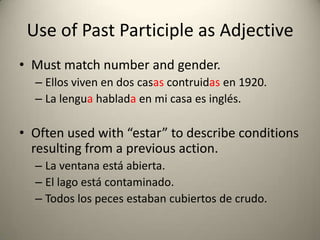
Use of Past Participle as AdjectiveMust match number and gender.Ellosviven en dos casascontruidas en 1920.La lenguahablada en mi casa esinglés.  Often used with “estar” to describe conditions resulting from a previous action.  La ventanaestá abierta.El lagoestá contaminado.Todos los pecesestabancubiertos de crudo.
Differences between ENG and SPAEnglish past participle and past tense are often similar in form and use.I closed the book.The thief stood behind the closed door.  Spanish, the two forms are used very differently and look very dissimilar.  Yo cerré la puerta.  Ahora la puerta está cerrada.Resolvieron el problema.  Ahora el problema está resuelto.

14-Past participle as adjective

  • 1.
  • 2.
    Formation of thePast Participle1. Simply remove the –AR, -ER, or –IR from the end of the infinitivehablar>>hablcomer>>comvivir>>viv2. Add ado for –AR verbs and ido for –ER, -IR Verbshabladocomidovivido
  • 3.
    -ER, -IR VerbsWhenan –ER or –IR verb is placed in past participle form, and the “i” in “ido” is placed next to a vowel, it must be accented.Examples caer->>caídocreer->>creídoleer->>leídooír>>oído(son)reír->>sonreídotraer->>traído
  • 4.
    IrregularsThere are anumber of irregulars in the past participle, as there are in English. Memorize!
  • 5.
    Use of PastParticiple as AdjectiveMust match number and gender.Ellosviven en dos casascontruidas en 1920.La lenguahablada en mi casa esinglés. Often used with “estar” to describe conditions resulting from a previous action. La ventanaestá abierta.El lagoestá contaminado.Todos los pecesestabancubiertos de crudo.
  • 6.
    Differences between ENGand SPAEnglish past participle and past tense are often similar in form and use.I closed the book.The thief stood behind the closed door. Spanish, the two forms are used very differently and look very dissimilar. Yo cerré la puerta. Ahora la puerta está cerrada.Resolvieron el problema. Ahora el problema está resuelto.