NORTHEAST SCHOOL OF
AGRICULTURE
FOURT FOURT-MONTH
PRACTICE ENGLISH II
ENGINEER OSCAR GARCIA
GROUP PRACTICE #3
MEMBERS:
Muñoz Muñoz Ericssón Orlando
 There are many ways to talk about the past in English,
but the simple past is the most common form. The simple
past in English is equivalent to indefinite imperfect and
past tense of Spanish. We use the past simple to
complete actions in the past. The time period of these
actions is not important as in Spanish. In the past simple
regular verbs and no irregular verbs.
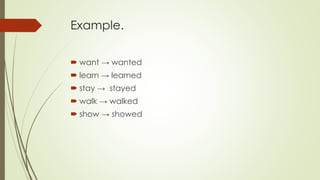
Example.
 want → wanted
 learn → learned
 stay → stayed
 walk → walked
 show → showed
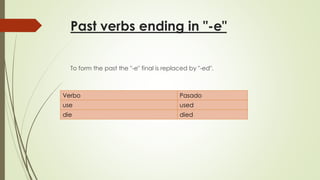
Past verbs ending in "-e"
To form the past the "-e" final is replaced by "-ed".
Verbo Pasado
use used
die died
Denial in the simple past
The formation of negation in "simple past" is simpler than the assertion.
Its structure is:
[SUBJECT] + did + not + [infinitive]
The question in the simple past
 To build the query to do the auxiliary verb used in the past (did).
The structure is:
Did + [SUBJECT] + [infinitive]
Conjugación Significado
did I sing? ¿canté?
did you sing? ¿cantaste?
did he sing? ¿cantó?
did we sing? ¿cantamos?
did you sing? ¿cantasteis?
did they sing? ¿cantaron?
Link.
 https://www.youtube.com/watch?v=htl9dwwvYas
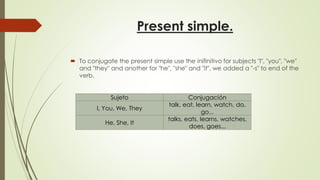
Present simple.
 To conjugate the present simple use the inifinitivo for subjects "I", "you", "we"
and "they" and another for "he", "she" and "it", we added a "-s" to end of the
verb.
Sujeto Conjugación
I, You, We, They
talk, eat, learn, watch, do,
go...
He, She, It
talks, eats, learns, watches,
does, goes...
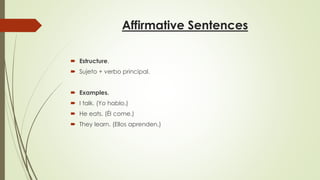
Affirmative Sentences
 Estructure.
 Sujeto + verbo principal.
 Examples.
 I talk. (Yo hablo.)
 He eats. (Él come.)
 They learn. (Ellos aprenden.)
Negative Sentences
 Estructure.
 Sujeto + verbo auxiliar ("to do") + auxiliar negativo ("not") + verbo principal.
• examples:
I do not [don't] talk. (Yo no hablo.)
• He does not [doesn't] eat. (Él no come.)
• They do not [don't] learn. (Ellos no aprenden.)
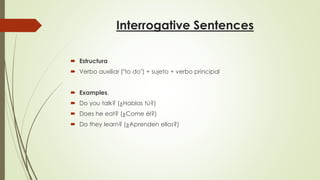
Interrogative Sentences
 Estructura
 Verbo auxiliar ("to do") + sujeto + verbo principal
 Examples.
 Do you talk? (¿Hablas tú?)
 Does he eat? (¿Come él?)
 Do they learn? (¿Aprenden ellos?)
Link.
 https://www.youtube.com/watch?v=oHdIAqVp-pk
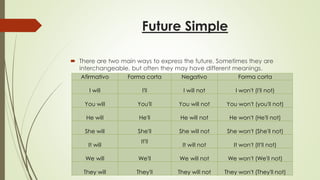
Future Simple
 There are two main ways to express the future. Sometimes they are
interchangeable, but often they may have different meanings.
Afirmativo Forma corta Negativo Forma corta
I will I'll I will not I won't (I'll not)
You will You'll You will not You won't (you'll not)
He will He'll He will not He won't (He'll not)
She will She'll She will not She won't (She'll not)
It will
It'll
It will not It won't (It'll not)
We will We'll We will not We won't (We'll not)
They will They'll They will not They won't (They'll not)
Link.
 https://www.youtube.com/watch?v=0XrlpIWHXxI

Past simple

  • 1.
    NORTHEAST SCHOOL OF AGRICULTURE FOURTFOURT-MONTH PRACTICE ENGLISH II ENGINEER OSCAR GARCIA GROUP PRACTICE #3 MEMBERS: Muñoz Muñoz Ericssón Orlando
  • 2.
     There aremany ways to talk about the past in English, but the simple past is the most common form. The simple past in English is equivalent to indefinite imperfect and past tense of Spanish. We use the past simple to complete actions in the past. The time period of these actions is not important as in Spanish. In the past simple regular verbs and no irregular verbs.
  • 3.
    Example.  want →wanted  learn → learned  stay → stayed  walk → walked  show → showed
  • 4.
    Past verbs endingin "-e" To form the past the "-e" final is replaced by "-ed". Verbo Pasado use used die died
  • 5.
    Denial in thesimple past The formation of negation in "simple past" is simpler than the assertion. Its structure is: [SUBJECT] + did + not + [infinitive]
  • 6.
    The question inthe simple past  To build the query to do the auxiliary verb used in the past (did). The structure is: Did + [SUBJECT] + [infinitive] Conjugación Significado did I sing? ¿canté? did you sing? ¿cantaste? did he sing? ¿cantó? did we sing? ¿cantamos? did you sing? ¿cantasteis? did they sing? ¿cantaron?
  • 7.
  • 8.
    Present simple.  Toconjugate the present simple use the inifinitivo for subjects "I", "you", "we" and "they" and another for "he", "she" and "it", we added a "-s" to end of the verb. Sujeto Conjugación I, You, We, They talk, eat, learn, watch, do, go... He, She, It talks, eats, learns, watches, does, goes...
  • 9.
    Affirmative Sentences  Estructure. Sujeto + verbo principal.  Examples.  I talk. (Yo hablo.)  He eats. (Él come.)  They learn. (Ellos aprenden.)
  • 10.
    Negative Sentences  Estructure. Sujeto + verbo auxiliar ("to do") + auxiliar negativo ("not") + verbo principal. • examples: I do not [don't] talk. (Yo no hablo.) • He does not [doesn't] eat. (Él no come.) • They do not [don't] learn. (Ellos no aprenden.)
  • 11.
    Interrogative Sentences  Estructura Verbo auxiliar ("to do") + sujeto + verbo principal  Examples.  Do you talk? (¿Hablas tú?)  Does he eat? (¿Come él?)  Do they learn? (¿Aprenden ellos?)
  • 12.
  • 13.
    Future Simple  Thereare two main ways to express the future. Sometimes they are interchangeable, but often they may have different meanings. Afirmativo Forma corta Negativo Forma corta I will I'll I will not I won't (I'll not) You will You'll You will not You won't (you'll not) He will He'll He will not He won't (He'll not) She will She'll She will not She won't (She'll not) It will It'll It will not It won't (It'll not) We will We'll We will not We won't (We'll not) They will They'll They will not They won't (They'll not)
  • 14.