Homework Help
https://www.homeworkping.com/
Research Paper help
https://www.homeworkping.com/
Online Tutoring
https://www.homeworkping.com/
click here for freelancing tutoring sites
EN BANC
G.R. No. 132601 January 19, 1999
LEO ECHEGARAY, petitioner,
vs.
SECRETARY OF JUSTICE, ET AL., respondents.
R E S O L U T I O N
PUNO, J.:
For resolution are public respondents' Urgent Motion for Reconsideration of the Resolution of this Court dated
January 4, 1990 temporarily restraining the execution of petitioner and Supplemental Motion to Urgent
Motion for Reconsideration. It is the submission of public respondents that:
1.The Decision in this case having become final and executory, its execution enters the exclusive
ambit of authority of the executive authority. The issuance of the TRO may be construed as
trenching on that sphere of executive authority;
2.The issuance of the temporary restraining order . . . creates dangerous precedent as there will
never be an end to litigation because there is always a possibility that Congress may repeal a
law.
3.Congress had earlier deliberated extensively on the death penalty bill. To be certain, whatever
question may now be raised on the Death Penalty Law before the present Congress within the
6-month period given by this Honorable Court had in all probability been fully debated upon . .
.
4.Under the time honored maxim lex futuro, judex praeterito, the law looks forward while the
judge looks at the past, . . . the Honorable Court in issuing the TRO has transcended its power
of judicial review.
5.At this moment, certain circumstances/supervening events transpired to the effect that the
repeal or modification of the law imposing death penalty has become nil, to wit:
a. The public pronouncement of President Estrada that he will veto any law imposing the
death penalty involving heinous crimes.
b. The resolution of Congressman Golez, et al., that they are against the repeal of the law;
c. The fact that Senator Roco's resolution to repeal the law only bears his signature and
that of Senator Pimentel.
In their Supplemental Motion to Urgent Motion for Reconsideration, public respondents attached a copy of
House Resolution No. 629 introduced by Congressman Golez entitled "Resolution expressing the sense of the
House of Representative to reject any move to review Republic Act No. 7659 which provided for the re-
imposition of death penalty, notifying the Senate, the Judiciary and the Executive Department of the position of
the House of Representative on this matter, and urging the President to exhaust all means under the law to
immediately implement the death penalty law." The Resolution was concurred in by one hundred thirteen (113)
congressman.
In their Consolidated Comment, petitioner contends: (1) the stay order. . . is within the scope of judicial power
and duty and does not trench on executive powers nor on congressional prerogatives; (2) the exercise by this
Court of its power to stay execution was reasonable; (3) the Court did not lose jurisdiction to address incidental
matters involved or arising from the petition; (4) public respondents are estopped from challenging the Court's
jurisdiction; and (5) there is no certainty that the law on capital punishment will not be repealed or modified
until Congress convenes and considers all the various resolutions and bills filed before it.
Prefatorily, the Court likes to emphasize that the instant motions concern matters that are not incidents in G.R.
No. 117472, where the death penalty was imposed on petitioner on automatic review of his conviction by this
Court. The instant motions were filed in this case, G.R. No. 132601, where the constitutionality of R.A. No. 8177
(Lethal Injection Law) and its implementing rules and regulations was assailed by petitioner. For this reason,
the Court in its Resolution of January 4, 1999 merely noted the Motion to Set Aside of Rodessa "Baby" R.
Echegaray dated January 7, 1999 and Entry of Appearance of her counsel dated January 5, 1999. Clearly, she
has no legal standing to intervene in the case at bar, let alone the fact that the interest of the State is properly
represented by the Solicitor General.
We shall now resolve the basic issues raised by the public respondents.
I
First. We do not agree with the sweeping submission of the public respondents that this Court lost its
jurisdiction over the case at bar and hence can no longer restrain the execution of the petitioner. Obviously,
public respondents are invoking the rule that final judgments can no longer be altered in accord with the
principle that "it is just as important that there should be a place to end as there should be a place to begin
litigation." 1 To start with, the Court is not changing even a comma of its final Decision. It is appropriate to
examine with precision the metes and bounds of the Decision of this Court that became final. These metes and
bounds are clearly spelled out in the Entry of Judgment in this case, viz:
ENTRY OF JUDGMENT
This is to certify that on October 12, 1998 a decision rendered in the above-entitled case was
filed in this Office, the dispositive part of which reads as follows:
WHEREFORE, the petition is DENIED insofar as petitioner seeks to declare
the assailed statute (Republic Act No. 8177) as unconstitutional; but
GRANTED insofar as Sections 17 and 19 of the Rules and Regulations to
Implement Republic Act No. 8177 are concerned, which are hereby declared
INVALID because (a) Section 17 contravenes Article 83 of the Revised Penal
Code, as amended by Section 25 of Republic Act No. 7659; and (b) Section 19
fails to provide for review and approval of the Lethal Injection Manual by the
Secretary of Justice, and unjustifiably makes the manual confidential, hence
unavailable to interested parties including the accused/convict and counsel.
Respondents are hereby enjoined from enforcing and implementing Republic
Act No. 8177 until the aforesaid Sections 17 and 19 of the Rules and
Regulations to Implement Republic Act No. 8177 are appropriately amended,
revised and/or corrected in accordance with this Decision.
SO ORDERED.
and that the same has, on November 6, 1988 become final and executory and is hereby recorded
in the Book of Entries of Judgment.
Manila, Philippine.
Clerk of Court
By: (SGD) TERESITA G.
DIMAISIP
Acting Chief
Judicial Records Office
The records will show that before the Entry of Judgment, the Secretary of Justice, the Honorable Serafin
Cuevas, filed with this Court on October 21, 1998 a Compliance where he submitted the Amended Rules and
Regulations implementing R.A. No. 8177 in compliance with our Decision. On October 28, 1998, Secretary
Cuevas submitted a Manifestation informing the Court that he has caused the publication of the said Amended
Rules and Regulations as required by the Administrative Code. It is crystalline that the Decision of this Court
that became final and unalterable mandated: (1) that R.A. No. 8177 is not unconstitutional; (2) that sections 17
and 19 of the Rules and Regulations to Implement R.A. No. 8177 are invalid, and (3) R.A. No. 8177 cannot be
enforced and implemented until sections 17 and 19 of the Rules and Regulations to Implement R.A. No. 8177
are amended. It is also daylight clear that this Decision was not altered a whit by this Court. Contrary to the
submission of the Solicitor General, the rule on finality of judgment cannot divest this Court of its jurisdiction
to execute and enforce the same judgment. Retired Justice Camilo Quiason synthesized the well established
jurisprudence on this issue as
follows: 2
xxx xxx xxx
the finality of a judgment does not mean that the Court has lost all its powers nor the case. By the
finality of the judgment, what the court loses is its jurisdiction to amend, modify or alter the same.
Even after the judgment has become final the court retains its jurisdiction to execute and enforce
it. 3 There is a difference between the jurisdiction of the court to execute its judgment and its
jurisdiction to amend, modify or alter the same. The former continues even after the judgment has
become final for the purpose of enforcement of judgment; the latter terminates when the judgment
becomes final. 4 . . . For after the judgment has become final facts and circumstances may transpire
which can render the execution unjust or impossible. 5
In truth, the arguments of the Solicitor General has long been rejected by this Court. As aptly pointed out by
the petitioner, as early as 1915, this Court has unequivocably ruled in the case of Director of Prisons v. Judge of
First Instance, 6 viz:
This Supreme Court has repeatedly declared in various decisions, which constitute
jurisprudence on the subject, that in criminal cases, after the sentence has been pronounced
and the period for reopening the same cannot change or alter its judgment, as its jurisdiction
has terminated . . . When in cases of appeal or review the cause has been returned thereto for
execution, in the event that the judgment has been affirmed, it performs a ministerial duty in
issuing the proper order. But it does not follow from this cessation of functions on the part of
the court with reference to the ending of the cause that the judicial authority terminates by
having then passed completely to the Executive. The particulars of the execution itself, which
are certainly not always included in the judgment and writ of execution, in any event are
absolutely under the control of the judicial authority, while the executive has no power over the
person of the convict except to provide for carrying out of the penalty and to pardon.
Getting down to the solution of the question in the case at bar, which is that of execution of a
capital sentence, it must be accepted as a hypothesis that postponement of the date can be
requested. There can be no dispute on this point. It is a well-known principle that
notwithstanding the order of execution and the executory nature thereof on the date set or at
the proper time, the date therefor can be postponed, even in sentences of death. Under the
common law this postponement can be ordered in three ways: (1) By command of the King; (2)
by discretion (arbitrio) of the court; and (3) by mandate of the law. It is sufficient to state this
principle of the common law to render impossible that assertion in absolute terms that after the
convict has once been placed in jail the trial court can not reopen the case to investigate the
facts that show the need for postponement. If one of the ways is by direction of the court, it is
acknowledged that even after the date of the execution has been fixed, and notwithstanding the
general rule that after the (court) has performed its ministerial duty of ordering the
execution . . . and its part is ended, if however a circumstance arises that ought to delay the
execution, and there is an imperative duty to investigate the emergency and to order a
postponement. Then the question arises as to whom the application for postponing the
execution ought to be addressed while the circumstances is under investigation and so to who
has jurisdiction to make the investigation.
The power to control the execution of its decision is an essential aspect of jurisdiction. It cannot be the subject
of substantial subtraction for our Constitution 7 vests the entirety of judicial power in one Supreme Court and
in such lower courts as may be established by law. To be sure, the important part of a litigation, whether civil or
criminal, is the process of execution of decisions where supervening events may change the circumstance of the
parties and compel courts to intervene and adjust the rights of the litigants to prevent unfairness. It is because
of these unforseen, supervening contingencies that courts have been conceded the inherent and necessary
power of control of its processes and orders to make them conformable to law and justice. 8 For this purpose,
Section 6 of Rule 135 provides that "when by law jurisdiction is conferred on a court or judicial officer, all
auxiliary writs, processes and other means necessary to carry it into effect may be employed by such court or
officer and if the procedure to be followed in the exercise of such jurisdiction is not specifically pointed out by
law or by these rules, any suitable process or mode of proceeding may be adopted which appears conformable
to the spirit of said law or rules." It bears repeating that what the Court restrained temporarily is the execution
of its own Decision to give it reasonable time to check its fairness in light of supervening events in Congress as
alleged by petitioner. The Court, contrary to popular misimpression, did not restrain the effectivity of a law
enacted by Congress.1âwphi1.nêt
The more disquieting dimension of the submission of the public respondents that this Court has no jurisdiction
to restrain the execution of petitioner is that it can diminish the independence of the judiciary. Since the
implant of republicanism in our soil, our courts have been conceded the jurisdiction to enforce their final
decisions. In accord with this unquestioned jurisdiction, this Court promulgated rules concerning pleading,
practice and procedure which, among others, spelled out the rules on execution of judgments. These rules are
all predicated on the assumption that courts have the inherent, necessary and incidental power to control and
supervise the process of execution of their decisions. Rule 39 governs execution, satisfaction and effects of
judgments in civil cases. Rule 120 governs judgments in criminal cases. It should be stressed that the power to
promulgate rules of pleading, practice and procedure was granted by our Constitutions to this Court to
enhance its independence, for in the words of Justice Isagani Cruz "without independence and integrity, courts
will lose that popular trust so essential to the maintenance of their vigor as champions of justice." 9 Hence, our
Constitutions continuously vested this power to this Court for it enhances its independence. Under the 1935
Constitution, the power of this Court to promulgate rules concerning pleading, practice and procedure was
granted but it appeared to be co-existent with legislative power for it was subject to the power of Congress to
repeal, alter or supplement. Thus, its Section 13, Article VIII provides:
Sec.13. The Supreme Court shall have the power to promulgate rules concerning pleading,
practice and procedure in all courts, and the admission to the practice of law. Said rules shall
be uniform for all courts of the same grade and shall not diminish, increase, or modify
substantive rights. The existing laws on pleading, practice and procedure are hereby repealed
as statutes, and are declared Rules of Court, subject to the power of the Supreme Court to alter
and modify the same. The Congress have the power to repeal, alter or supplement the rules
concerning pleading, practice and procedure, and the admission to the practice of law in the
Philippines.
The said power of Congress, however, is not as absolute as it may appear on its surface. In In re
Cunanan 10Congress in the exercise of its power to amend rules of the Supreme Court regarding admission to
the practice of law, enacted the Bar Flunkers Act of 1953 11 which considered as a passing grade, the average of
70% in the bar examinations after July 4, 1946 up to August 1951 and 71% in the 1952 bar examinations. This
Court struck down the law as unconstitutional. In his ponencia, Mr. Justice Diokno held that " . . . the disputed
law is not a legislation; it is a judgment — a judgment promulgated by this Court during the aforecited years
affecting the bar candidates concerned; and although this Court certainly can revoke these judgments even
now, for justifiable reasons, it is no less certain that only this Court, and not the legislative nor executive
department, that may do so. Any attempt on the part of these department would be a clear usurpation of its
function, as is the case with the law in question." 12The venerable jurist further ruled: "It is obvious, therefore,
that the ultimate power to grant license for the practice of law belongs exclusively to this Court, and the law
passed by Congress on the matter is of permissive character, or as other authorities say, merely to fix the
minimum conditions for the license." By its ruling, this Court qualified the absolutist tone of the power of
Congress to "repeal, alter or supplement the rules concerning pleading, practice and procedure, and the
admission to the practice of law in the Philippines.
The ruling of this Court in In re Cunanan was not changed by the 1973 Constitution. For the 1973 Constitution
reiterated the power of this Court "to promulgate rules concerning pleading, practice and procedure in all
courts, . . . which, however, may be repealed, altered or supplemented by the Batasang Pambansa . . . ." More
completely, Section 5(2)5 of its Article X provided:
xxx xxx xxx
Sec.5. The Supreme Court shall have the following powers.
xxx xxx xxx
(5) Promulgate rules concerning pleading, practice, and
procedure in all courts, the admission to the practice of law, and
the integration of the Bar, which, however, may be repealed,
altered, or supplemented by the Batasang Pambansa. Such
rules shall provide a simplified and inexpensive procedure for
the speedy disposition of cases, shall be uniform for all courts of
the same grade, and shall not diminish, increase, or modify
substantive rights.
Well worth noting is that the 1973 Constitution further strengthened the independence of the judiciary by
giving to it the additional power to promulgate rules governing the integration of the Bar. 13
The 1987 Constitution molded an even stronger and more independent judiciary. Among others, it enhanced
the rule making power of this Court. Its Section 5(5), Article VIII provides:
xxx xxx xxx
Sec. 5. The Supreme Court shall have the following powers:
xxx xxx xxx
(5) Promulgate rules concerning the protection and
enforcement of constitutional rights, pleading, practice and
procedure in all courts, the admission to the practice of law, the
Integrated Bar, and legal assistance to the underprivileged.
Such rules shall provide a simplified and inexpensive procedure
for the speedy disposition of cases, shall be uniform for all
courts of the same grade, and shall not diminish, increase, or
modify substantive rights. Rules of procedure of special courts
and quasi-judicial bodies shall remain effective unless
disapproved by the Supreme Court.
The rule making power of this Court was expanded. This Court for the first time was given the power to
promulgate rules concerning the protection and enforcement of constitutional rights. The Court was also
granted for the first time the power to disapprove rules of procedure of special courts and quasi-judicial bodies.
But most importantly, the 1987 Constitution took away the power of Congress to repeal, alter, or supplement
rules concerning pleading, practice and procedure. In fine, the power to promulgate rules of pleading, practice
and procedure is no longer shared by this Court with Congress, more so with the Executive. If the manifest
intent of the 1987 Constitution is to strengthen the independence of the judiciary, it is inutile to urge, as public
respondents do, that this Court has no jurisdiction to control the process of execution of its decisions, a power
conceded to it and which it has exercised since time immemorial.
To be sure, it is too late in the day for public respondents to assail the jurisdiction of this Court to control and
supervise the implementation of its decision in the case at bar. As aforestated, our Decision became final and
executory on November 6, 1998. The records reveal that after November 6, 1998, or on December 8, 1998, no
less than the Secretary of Justice recognized the jurisdiction of this Court by filing a Manifestation and Urgent
Motion to compel the trial judge, the Honorable Thelma A. Ponferrada, RTC, Br. 104, Quezon City to provide
him ". . . a certified true copy of the Warrant of Execution dated November 17, 1998 bearing the designated
execution day of death convict Leo Echegaray and allow (him) to reveal or announce the contents thereof,
particularly the execution date fixed by such trial court to the public when requested." The relevant portions of
the Manifestation and Urgent Motion filed by the Secretary of Justice beseeching this Court "to provide the
appropriate relief" state:
xxx xxx xxx
5. Instead of filing a comment on Judge Ponferrada's Manifestation however,
herein respondent is submitting the instant Manifestation and Motion (a) to
stress, inter alia, that the non-disclosure of the date of execution deprives herein
respondent of vital information necessary for the exercise of his statutory
powers, as well as renders nugatory the constitutional guarantee that
recognizes the people's right to information of public concern, and (b) to ask
this Honorable Court to provide the appropriate relief.
6. The non-disclosure of the date of execution deprives herein respondent of
vital information necessary for the exercise of his power of supervision and
control over the Bureau of Corrections pursuant to Section 39, Chapter 8, Book
IV of the Administrative Code of 1987, in relation to Title III, Book IV of such
Administrative Code, insofar as the enforcement of Republic Act No. 8177 and
the Amended Rules and Regulations to Implement Republic Act No. 8177 is
concerned and for the discharge of the mandate of seeing to it that laws and
rules relative to the execution of sentence are faithfully observed.
7. On the other hand, the willful omission to reveal the information about the
precise day of execution limits the exercise by the President of executive
clemency powers pursuant to Section 19, Article VII (Executive Department) of
the 1987 Philippine Constitution and Article 81 of the Revised Penal Code, as
amended, which provides that the death sentence shall be carried out "without
prejudice to the exercise by the President of his executive powers at all times."
(Emphasis supplied) For instance, the President cannot grant reprieve, i.e.,
postpone the execution of a sentence to a day certain (People v. Vera, 65 Phil.
56, 110 [1937]) in the absence of a precise date to reckon with. The exercise of
such clemency power, at this time, might even work to the prejudice of the
convict and defeat the purpose of the Constitution and the applicable statute as
when the date at execution set by the President would be earlier than that
designated by the court.
8. Moreover, the deliberate non-disclosure of information about the date of
execution to herein respondent and the public violates Section 7, Article III (Bill
of Rights) and Section 28, Article II (Declaration of Principles and State
Policies) of the 1987 Philippine Constitution which read:
Sec. 7. The right of the people to information on matters of public concern shall
be recognized. Access to official records, and to documents and papers
pertaining to official acts, transactions, or decisions, as well as to government
research data used as basis for policy development shall, be afforded the citizen,
subject to such limitations as may be provided by law.
Sec. 28. Subject to reasonable conditions prescribed by law, the State adopts
and implements a policy of full public disclosure of all transactions involving
public interest.
9. The "right to information" provision is self-executing. It supplies "the rules
by means of which the right to information may be enjoyed (Cooley, A Treatise
on the Constitutional Limitations, 167 [1972]) by guaranteeing the right and
mandating the duty to afford access to sources of information. Hence, the
fundamental right therein recognized may be asserted by the people upon the
ratification of the Constitution without need for any ancillary act of the
Legislature (Id., at p. 165) What may be provided for by the Legislature are
reasonable conditions and limitations upon the access to be afforded which
must, of necessity, be consistent with the declared State policy of full public
disclosure of all transactions involving public interest (Constitution, Art. II,
Sec. 28). However, it cannot be overemphasized that whatever limitation may
be prescribed by the Legislature, the right and the duty under Art. III, Sec. 7
have become operative and enforceable by virtue of the adoption of the New
Charter." (Decision of the Supreme Court En Banc in Legaspi v. Civil Service
Commission, 150 SCRA 530, 534-535 [1987].
The same motion to compel Judge Ponferrada to reveal the date of execution of petitioner Echegaray was filed
by his counsel, Atty. Theodore Te, on December 7, 1998. He invoked his client's right to due process and the
public's right to information. The Solicitor General, as counsel for public respondents, did not oppose
petitioner's motion on the ground that this Court has no more jurisdiction over the process of execution of
Echegaray. This Court granted the relief prayed for by the Secretary of Justice and by the counsel of the
petitioner in its Resolution of December 15, 1998. There was not a whimper of protest from the public
respondents and they are now estopped from contending that this Court has lost its jurisdiction to grant said
relief. The jurisdiction of this Court does not depend on the convenience of litigants.
II
Second. We likewise reject the public respondents' contention that the "decision in this case having become
final and executory, its execution enters the exclusive ambit of authority of the executive department . . .. By
granting the TRO, the Honorable Court has in effect granted reprieve which is an executive
function." 14 Public respondents cite as their authority for this proposition, Section 19, Article VII of the
Constitution which reads:
Except in cases of impeachment, or as otherwise provided in this Constitution, the President
may grant reprieves, commutations, and pardons, and remit fines and forfeitures after
conviction by final judgment. He shall also have the power to grant amnesty with the
concurrence of a majority of all the members of the Congress.
The text and tone of this provision will not yield to the interpretation suggested by the public respondents. The
provision is simply the source of power of the President to grant reprieves, commutations, and pardons and
remit fines and forfeitures after conviction by final judgment. It also provides the authority for the President to
grant amnesty with the concurrence of a majority of all the members of the Congress. The provision, however,
cannot be interpreted as denying the power of courts to control the enforcement of their decisions after their
finality. In truth, an accused who has been convicted by final judgment still possesses collateral rights and these
rights can be claimed in the appropriate courts. For instance, a death convict who become insane after his final
conviction cannot be executed while in a state of insanity. 15 As observed by Antieau, "today, it is generally
assumed that due process of law will prevent the government from executing the death sentence upon a person
who is insane at the time of execution." 16 The suspension of such a death sentence is undisputably an exercise
of judicial power. It is not a usurpation of the presidential power of reprieve though its effects is the same —
the temporary suspension of the execution of the death convict. In the same vein, it cannot be denied that
Congress can at any time amend R.A. No. 7659 by reducing the penalty of death to life imprisonment. The
effect of such an amendment is like that of commutation of sentence. But by no stretch of the imagination can
the exercise by Congress of its plenary power to amend laws be considered as a violation of the power of the
President to commute final sentences of conviction. The powers of the Executive, the Legislative and the
Judiciary to save the life of a death convict do not exclude each other for the simple reason that there is no
higher right than the right to life. Indeed, in various States in the United States, laws have even been enacted
expressly granting courts the power to suspend execution of convicts and their constitutionality has been
upheld over arguments that they infringe upon the power of the President to grant reprieves. For the public
respondents therefore to contend that only the Executive can protect the right to life of an accused after his
final conviction is to violate the principle of co-equal and coordinate powers of the three branches of our
government.
III
Third. The Court's resolution temporarily restraining the execution of petitioner must be put in its proper
perspective as it has been grievously distorted especially by those who make a living by vilifying courts.
Petitioner filed his Very Urgent Motion for Issuance of TRO on December 28, 1998 at about 11:30 p.m. He
invoked several grounds, viz: (1) that his execution has been set on January 4, the first working day of 1999; (b)
that members of Congress had either sought for his executive clemency and/or review or repeal of the law
authorizing capital punishment; (b.1) that Senator Aquilino Pimentel's resolution asking that clemency be
granted to the petitioner and that capital punishment be reviewed has been concurred by thirteen (13) other
senators; (b.2) Senate President Marcelo Fernan and Senator Miriam S. Defensor have publicly declared they
would seek a review of the death penalty law; (b.3) Senator Paul Roco has also sought the repeal of capital
punishment, and (b.4) Congressman Salacrib Baterina, Jr., and thirty five (35) other congressmen are
demanding review of the same law.
When the Very Urgent Motion was filed, the Court was already in its traditional recess and would only resume
session on January 18, 1999. Even then, Chief Justice Hilario Davide, Jr. called the Court to a Special Session
on January 4, 1991 17 at 10. a.m. to deliberate on petitioner's Very Urgent Motion. The Court hardly had five
(5) hours to resolve petitioner's motion as he was due to be executed at 3 p.m. Thus, the Court had the difficult
problem of resolving whether petitioner's allegations about the moves in Congress to repeal or amend the
Death Penalty Law are mere speculations or not. To the Court's majority, there were good reasons why the
Court should not immediately dismiss petitioner's allegations as mere speculations and surmises. They noted
that petitioner's allegations were made in a pleading under oath and were widely publicized in the print and
broadcast media. It was also of judicial notice that the 11th Congress is a new Congress and has no less than
one hundred thirty (130) new members whose views on capital punishment are still unexpressed. The present
Congress is therefore different from the Congress that enacted the Death Penalty Law (R.A. No. 7659) and the
Lethal Injection Law (R.A. No. 8177). In contrast, the Court's minority felt that petitioner's allegations lacked
clear factual bases. There was hardly a time to verify petitioner's allegations as his execution was set at 3 p.m.
And verification from Congress was impossible as Congress was not in session. Given these constraints, the
Court's majority did not rush to judgment but took an extremely cautious stance by temporarily restraining
the execution of petitioner. The suspension was temporary — "until June 15, 1999, coeval with the
constitutional duration of the present regular session of Congress, unless it sooner becomes certain that no
repeal or modification of the law is going to be made." The extreme caution taken by the Court was compelled,
among others, by the fear that any error of the Court in not stopping the execution of the petitioner will
preclude any further relief for all rights stop at the graveyard. As life was at, stake, the Court refused to
constitutionalize haste and the hysteria of some partisans. The Court's majority felt it needed the certainty that
the legislature will not petitioner as alleged by his counsel. It was believed that law and equitable considerations
demand no less before allowing the State to take the life of one its citizens.
The temporary restraining order of this Court has produced its desired result, i.e., the crystallization of the
issue whether Congress is disposed to review capital punishment. The public respondents, thru the Solicitor
General, cite posterior events that negate beyond doubt the possibility that Congress will repeal or amend the
death penalty law. He names these supervening events as follows:
xxx xxx xxx
a.The public pronouncement of President Estrada that he will veto any law imposing the death
penalty involving heinous crimes.
b.The resolution of Congressman Golez, et al., that they are against the repeal of the law;
c.The fact that Senator Roco's resolution to repeal the law only bears his signature and that of
Senator Pimentel.18
In their Supplemental Motion to Urgent Motion for Reconsideration, the Solicitor General cited House
Resolution No. 629 introduced by Congressman Golez entitled "Resolution expressing the sense of the House of
Representatives to reject any move to review R.A. No. 7659 which provided for the reimposition of death
penalty, notifying the Senate, the Judiciary and the Executive Department of the position of the House of
Representative on this matter and urging the President to exhaust all means under the law to immediately
implement the death penalty law." The Golez resolution was signed by 113 congressman as of January 11, 1999.
In a marathon session yesterday that extended up 3 o'clock in the morning, the House of Representative with
minor, the House of Representative with minor amendments formally adopted the Golez resolution by an
overwhelming vote. House Resolution No. 25 expressed the sentiment that the House ". . . does not desire at this
time to review Republic Act 7659." In addition, the President has stated that he will not request Congress to
ratify the Second Protocol in review of the prevalence of heinous crimes in the country. In light of these
developments, the Court's TRO should now be lifted as it has served its legal and humanitarian purpose.
A last note. In 1922, the famous Clarence Darrow predicted that ". . . the question of capital punishment had
been the subject of endless discussion and will probably never be settled so long as men believe in
punishment." 19 In our clime and time when heinous crimes continue to be unchecked, the debate on the legal
and moral predicates of capital punishment has been regrettably blurred by emotionalism because of the
unfaltering faith of the pro and anti-death partisans on the right and righteousness of their postulates. To be
sure, any debate, even if it is no more than an exchange of epithets is healthy in a democracy. But when the
debate deteriorates to discord due to the overuse of words that wound, when anger threatens to turn the
majority rule to tyranny, it is the especial duty of this Court to assure that the guarantees of the Bill of Rights
to the minority fully hold. As Justice Brennan reminds us ". . . it is the very purpose of the Constitution — and
particularly the Bill of Rights — to declare certain values transcendent, beyond the reach of temporary
political majorities." 20 Man has yet to invent a better hatchery of justice than the courts. It is a hatchery
where justice will bloom only when we can prevent the roots of reason to be blown away by the winds of rage.
The flame of the rule of law cannot be ignited by rage, especially the rage of the mob which is the mother of
unfairness. The business of courts in rendering justice is to be fair and they can pass their litmus test only when
they can be fair to him who is momentarily the most hated by society. 21
IN VIEW WHEREOF, the Court grants the public respondents' Urgent Motion for Reconsideration and
Supplemental Motion to Urgent Motion for Reconsideration and lifts the Temporary Restraining Order issued
in its Resolution of January 4, 1999.
The Court also orders respondent trial court judge (Hon. Thelma A. Ponferrada, Regional Trial Court, Quezon
City, Branch 104) to set anew the date for execution of the convict/petitioner in accordance with applicable
provisions of law and the Rules of Court, without further delay.
SO ORDERED.
Davide, Jr., C.J., Romero, Bellosillo, Melo, Kapunan, Mendoza, Martinez, Quisumbing, Purisima and Pardo, JJ.,
concur.
Vitug and Panganiban, JJ., Please see Separate Opinion.
Buena and Gonzaga-Reyes, JJ., took no part.
Separate Opinions
VITUG, J., separate opinion;
Let me state at the outset that I have humbly maintained that Republic Act No. 7659, insofar as it prescribes
the death penalty, falls short of the strict norm set forth by the Constitution. I and some of my brethren on the
Court, who hold similarly, have consistently expressed this stand in the affirmance by the Court of death
sentences imposed by Regional Trial Courts.
In its resolution of 04 January 1999, the Court resolved to issue in the above-numbered petition a temporary
restraining order ("TRO") because, among other things, of what had been stated to be indications that
Congress would re-examine the death penalty law. It was principally out of respect and comity to a co-equal
branch of the government, i.e., to reasonably allow it that opportunity if truly minded, that motivated the
Court to grant, after deliberation, a limited time for the purpose.
The Court, it must be stressed, did not, by issuing the TRO, thereby reconsider its judgment convicting the
accused or recall the imposition of the death penalty.
The doctrine has almost invariably been that after a decision becomes final and executory, nothing else is
further done except to see to its compliance since for the Court to adopt otherwise would be to put no end to
litigations The rule notwithstanding, the Court retains control over the case until the full satisfaction of the
final judgment conformably with established legal processes. Hence, the Court has taken cognizance of the
petition assailing before it the use of lethal injection by the State to carry out the death sentence. In any event,
jurisprudence teaches that the rule of immutability of final and executory judgments admits of settled
exceptions. Concededly, the Court may, for instance, suspend the execution of a final judgment when it
becomes imperative in the higher interest of justice or when supervening events warrant it. 1 Certainly, this
extraordinary relief cannot be denied any man, whatever might be his station, whose right to life is the issue at
stake. The pronouncement in Director of Prisons vs. Judge of First Instance of Cavite, 2 should be instructive.
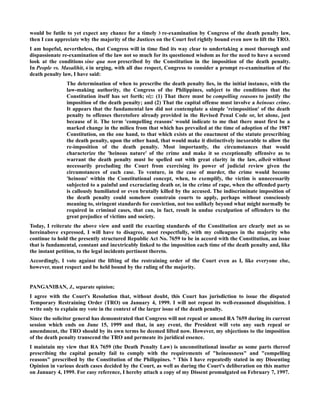
Thus —
This Supreme Court has repeatedly declared in various decisions, which constitute
jurisprudence on the subject, that in criminal cases, after the sentence has been pronounced
and the period for reopening the same has elapsed, the court can not change or after its
judgment, as its jurisdiction has terminated, functus est officio suo, according to the classical
phrase. When in cases of appeal or review the cause has been returned thereto for execution, in
the event that the judgment has been affirmed, it performs a ministerial duty in issuing the
proper order. But it does not follow from this cessation of functions on the part of the court
with reference to the ending of the cause that the judicial authority terminates by having then
passed completely to the executive. The particulars of the execution itself, which are certainly
not always included in the judgment and writ of execution, in any event are absolutely under
the control of the judicial authority, while the executive has no power over the person of the
convict except to provide for carrying out the penalty and to pardon.
Getting down to the solution of the question in the case at bar, which is that of execution of a
capital sentence, it must be accepted as a hypothesis that postponement of the date can be
requested. There can be no dispute on this point. It is a well-known principle that,
notwithstanding the order of execution and the executory nature thereof on the date set or at
the proper time, the date therefor can be postponed, even in sentences of death. Under the
common law this postponement can be ordered in three ways: (1) By command of the King; (2)
by discretion (arbitrio) of the court; and (3) by mandate of the law. It is sufficient to state this
principle of the common law to render impossible the assertion in absolute terms that after the
convict has once been placed in jail the trial court can not reopen the case to investigate the
facts that show the need for postponement. If one of the ways is by direction of the court, it is
acknowledged that even after the date of the execution has been fixed, and notwithstanding the
general rule that after the Court of First Instance has performed its ministerial duty of
ordering the execution, functus est officio suo, and its part is ended, if however a circumstance
arises that ought to delay the execution, there is an imperative duty to investigate the
emergency and to order a postponement . . ..
In fine, the authority of the Court to see to the proper execution of its final judgment, the power of the
President to grant pardon, commutation or reprieve, and the prerogative of Congress to repeal or modify the
law that could benefit the convicted accused are not essentially preclusive of one another nor constitutionally
incompatible and may each be exercised within their respective spheres and confines. Thus, the stay of
execution issued by the Court would not prevent either the President from exercising his pardoning power or
Congress from enacting a measure that may be advantageous to the adjudged offender.
The TRO of this Court has provided that it shall be lifted even before its expiry date of 15 June 1999, "coeval
with the duration of the present regular session of Congress," if it "sooner becomes certain that no repeal or
modification of the law is going to be made." The "Urgent Motion for Reconsideration" filed by the Office of
the Solicitor General states that as of the moment, "certain circumstances/supervening events (have) transpired
to the effect that the repeal or modification of the law imposing death penalty has become nil . . .." If, indeed, it
would be futile to yet expect any chance for a timely 3 re-examination by Congress of the death penalty law,
then I can appreciate why the majority of the Justices on the Court feel rightly bound even now to lift the TRO.
I am hopeful, nevertheless, that Congress will in time find its way clear to undertaking a most thorough and
dispassionate re-examination of the law not so much for its questioned wisdom as for the need to have a second
look at the conditions sine qua non prescribed by the Constitution in the imposition of the death penalty.
In People vs. Masalihit, 4 in urging, with all due respect, Congress to consider a prompt re-examination of the
death penalty law, I have said:
The determination of when to prescribe the death penalty lies, in the initial instance, with the
law-making authority, the Congress of the Philippines, subject to the conditions that the
Constitution itself has set forth; viz: (1) That there must be compelling reasons to justify the
imposition of the death penalty; and (2) That the capital offense must involve a heinous crime.
It appears that the fundamental law did not contemplate a simple 'reimposition' of the death
penalty to offenses theretofore already provided in the Revised Penal Code or, let alone, just
because of it. The term 'compelling reasons' would indicate to me that there must first be a
marked change in the milieu from that which has prevailed at the time of adoption of the 1987
Constitution, on the one hand, to that which exists at the enactment of the statute prescribing
the death penalty, upon the other hand, that would make it distinctively inexorable to allow the
re-imposition of the death penalty. Most importantly, the circumstances that would
characterize the 'heinous nature' of the crime and make it so exceptionally offensive as to
warrant the death penalty must be spelled out with great clarity in the law, albeit without
necessarily precluding the Court from exercising its power of judicial review given the
circumstances of each case. To venture, in the case of murder, the crime would become
'heinous' within the Constitutional concept, when, to exemplify, the victim is unnecessarily
subjected to a painful and excruciating death or, in the crime of rape, when the offended party
is callously humiliated or even brutally killed by the accused. The indiscriminate imposition of
the death penalty could somehow constrain courts to apply, perhaps without consciously
meaning to, stringent standards for conviction, not too unlikely beyond what might normally be
required in criminal cases, that can, in fact, result in undue exculpation of offenders to the
great prejudice of victims and society.
Today, I reiterate the above view and until the exacting standards of the Constitution are clearly met as so
hereinabove expressed, I will have to disagree, most respectfully, with my colleagues in the majority who
continue to hold the presently structured Republic Act No. 7659 to be in accord with the Constitution, an issue
that is fundamental, constant and inextricably linked to the imposition each time of the death penalty and, like
the instant petition, to the legal incidents pertinent thereto.
Accordingly, I vote against the lifting of the restraining order of the Court even as I, like everyone else,
however, must respect and be held bound by the ruling of the majority.
PANGANIBAN, J., separate opinion;
I agree with the Court's Resolution that, without doubt, this Court has jurisdiction to issue the disputed
Temporary Restraining Order (TRO) on January 4, 1999. I will not repeat its well-reasoned disquisition. I
write only to explain my vote in the context of the larger issue of the death penalty.
Since the solicitor general has demonstrated that Congress will not repeal or amend RA 7659 during its current
session which ends on June 15, 1999 and that, in any event, the President will veto any such repeal or
amendment, the TRO should by its own terms be deemed lifted now. However, my objections to the imposition
of the death penalty transcend the TRO and permeate its juridical essence.
I maintain my view that RA 7659 (the Death Penalty Law) is unconstitutional insofar as some parts thereof
prescribing the capital penalty fail to comply with the requirements of "heinousness" and "compelling
reasons" prescribed by the Constitution of the Philippines. * This I have repeatedly stated in my Dissenting
Opinion in various death cases decided by the Court, as well as during the Court's deliberation on this matter
on January 4, 1999. For easy reference, I hereby attach a copy of my Dissent promulgated on February 7, 1997.
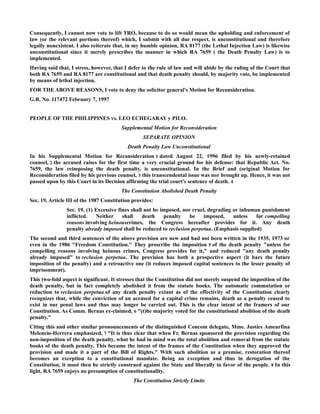
Consequently, I cannot now vote to lift TRO, because to do so would mean the upholding and enforcement of
law (or the relevant portions thereof) which, I submit with all due respect, is unconstitutional and therefore
legally nonexistent. I also reiterate that, in my humble opinion, RA 8177 (the Lethal Injection Law) is likewise
unconstitutional since it merely prescribes the manner in which RA 7659 ( the Death Penalty Law) is to
implemented.
Having said that, I stress, however, that I defer to the rule of law and will abide by the ruling of the Court that
both RA 7659 and RA 8177 are constitutional and that death penalty should, by majority vote, be implemented
by means of lethal injection.
FOR THE ABOVE REASONS, I vote to deny the solicitor general's Motion for Reconsideration.
G.R. No. 117472 February 7, 1997
PEOPLE OF THE PHILIPPINES vs. LEO ECHEGARAY y PILO.
Supplemental Motion for Reconsideration
SEPARATE OPINION
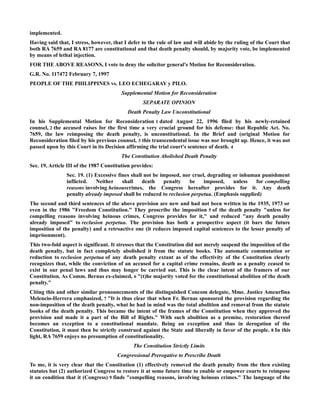
Death Penalty Law Unconstitutional
In his Supplemental Motion for Reconsideration 1 dated August 22, 1996 filed by his newly-retained
counsel, 2 the accused raises for the first time a very crucial ground for his defense: that Republic Act. No.
7659, the law reimposing the death penalty, is unconstitutional. In the Brief and (original Motion for
Reconsideration filed by his previous counsel, 3 this transcendental issue was nor brought up. Hence, it was not
passed upon by this Court in its Decision affirming the trial court's sentence of death. 4
The Constitution Abolished Death Penalty
Sec. 19, Article III of the 1987 Constitution provides:
Sec. 19. (1) Excessive fines shall not be imposed, nor cruel, degrading or inhuman punishment
inflicted. Neither shall death penalty be imposed, unless for compelling
reasons involving heinouscrimes, the Congress hereafter provides for it. Any death
penalty already imposed shall be reduced to reclusion perpetua. (Emphasis supplied)
The second and third sentences of the above provision are new and had not been written in the 1935, 1973 or
even in the 1986 "Freedom Constitution." They proscribe the imposition 5 of the death penalty "unless for
compelling reasons involving heinous crimes, Congress provides for it," and reduced "any death penalty
already imposed" to reclusion perpetua. The provision has both a prospective aspect (it bars the future
imposition of the penalty) and a retroactive one (it reduces imposed capital sentences to the lesser penalty of
imprisonment).
This two-fold aspect is significant. It stresses that the Constitution did not merely suspend the imposition of the
death penalty, but in fact completely abolished it from the statute books. The automatic commutation or
reduction to reclusion perpetua of any death penalty extant as of the effectivity of the Constitution clearly
recognizes that, while the conviction of an accused for a capital crime remains, death as a penalty ceased to
exist in our penal laws and thus may longer be carried out. This is the clear intent of the framers of our
Constitution. As Comm. Bernas ex-claimed, 6 "(t)he majority voted for the constitutional abolition of the death
penalty."
Citing this and other similar pronouncements of the distinguished Concom delegate, Mme. Justice Ameurfina
Melencio-Herrera emphasized, 7 "It is thus clear that when Fr. Bernas sponsored the provision regarding the
non-imposition of the death penalty, what he had in mind was the total abolition and removal from the statute
books of the death penalty. This became the intent of the frames of the Constitution when they approved the
provision and made it a part of the Bill of Rights." With such abolition as a premise, restoration thereof
becomes an exception to a constitutional mandate. Being an exception and thus in derogation of the
Constitution, it must then be strictly construed against the State and liberally in favor of the people. 8 In this
light, RA 7659 enjoys no presumption of constitutionality.
The Constitution Strictly Limits
Congressional Prerogative to Prescribe Death
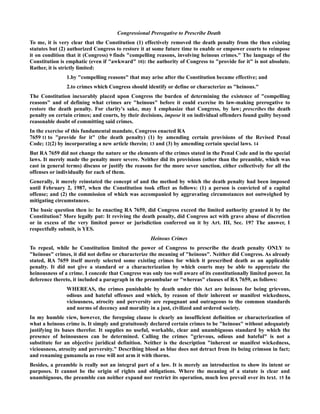
To me, it is very clear that the Constitution (1) effectively removed the death penalty from the then existing
statutes but (2) authorized Congress to restore it at some future time to enable or empower courts to reimpose
it on condition that it (Congress) 9 finds "compelling reasons, involving heinous crimes." The language of the
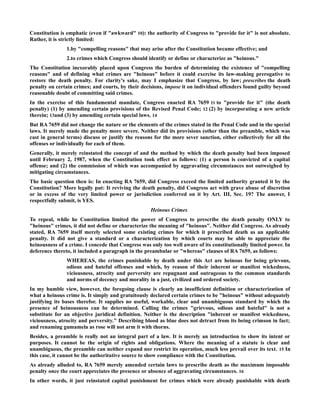
Constitution is emphatic (even if "awkward" 10): the authority of Congress to "provide for it" is not absolute.
Rather, it is strictly limited:
1.by "compelling reasons" that may arise after the Constitution became effective; and
2.to crimes which Congress should identify or define or characterize as "heinous."
The Constitution inexorably placed upon Congress the burden of determining the existence of "compelling
reasons" and of defining what crimes are "heinous" before it could exercise its law-making prerogative to
restore the death penalty. For clarity's sake, may I emphasize that Congress, by law; prescribes the death
penalty on certain crimes; and courts, by their decisions, impose it on individual offenders found guilty beyond
reasonable doubt of committing said crimes.
In the exercise of this fundamental mandate, Congress enacted RA 7659 11 to "provide for it" (the death
penalty) (1) by amending certain provisions of the Revised Penal Code; 12 (2) by incorporating a new article
therein; 13and (3) by amending certain special laws. 14
But RA 7659 did not change the nature or the elements of the crimes stated in the Penal Code and in the special
laws. It merely made the penalty more severe. Neither did its provisions (other than the preamble, which was
cast in general terms) discuss or justify the reasons for the more sever sanction, either collectively for all the
offenses or individually for each of them.
Generally, it merely reinstated the concept of and the method by which the death penalty had been imposed
until February 2, 1987, when the Constitution took effect as follows: (1) a person is convicted of a capital
offense; and (2) the commission of which was accompanied by aggravating circumstances not outweighed by
mitigating circumstances.
The basic question then is: In enacting RA 7659, did Congress exceed the limited authority granted it by the
Constitution? More legally put: It reviving the death penalty, did Congress act with grave abuse of discretion
or in excess of the very limited power or jurisdiction conferred on it by Art. III, Sec. 19? The answer, I
respectfully submit, is YES.
Heinous Crimes
To repeal, while he Constitution limited the power of Congress to prescribe the death penalty ONLY to
"heinous" crimes, it did not define or characterize the meaning of "heinous". Neither did Congress. As already
stated, RA 7659 itself merely selected some existing crimes for which it prescribed death as an applicable
penalty. It did not give a standard or a characterization by which courts may be able to appreciate the
heinousness of a crime. I concede that Congress was only too well aware of its constitutionally limited power. In
deference thereto, it included a paragraph in the preambular or "whereas" clauses of RA 7659, as follows:
WHEREAS, the crimes punishable by death under this Act are heinous for being grievous,
odious and hateful offenses and which, by reason of their inherent or manifest wickedness,
viciousness, atrocity and perversity are repugnant and outrageous to the common standards
and norms of decency and morality in a just, civilized and ordered society.
In my humble view, however, the foregoing clause is clearly an insufficient definition or characterization of
what a heinous crime is. It simply and gratuitously declared certain crimes to be "heinous" without adequately
justifying its bases therefor. It supplies no useful, workable, clear and unambiguous standard by which the
presence of heinousness can be determined. Calling the crimes "grievous, odious and hateful" is not a
substitute for an objective juridical definition. Neither is the description "inherent or manifest wickedness,
viciousness, atrocity and perversity." Describing blood as blue does not detract from its being crimson in fact;
and renaming gumamela as rose will not arm it with thorns.
Besides, a preamble is really not an integral part of a law. It is merely an introduction to show its intent or
purposes. It cannot be the origin of rights and obligations. Where the meaning of a statute is clear and
unambiguous, the preamble can neither expand nor restrict its operation, much less prevail over its text. 15 In
this case, it cannot be the authoritative source to show compliance with the Constitution.
As already alluded to, RA 7659 merely amended certain laws to prescribe death as the maximum imposable
penalty once the court appreciates the presence or absence of aggravating circumstances. 16
In other words, it just reinstated capital punishment for crimes which were already punishable with death
prior to the effectivity of the 1987 Constitution. With the possible exception of plunder and qualified
bribery, 17 no new crimes were introduced by RA 7659. The offenses punished by death under said law were
already to punishable by the Revised Penal Code 18 and by special laws.
During the debate on Senate Bill No. 891 which later became RA 7659, Sen. Jose Lina, in answer to a question
of Sen. Ernesto Maceda, wryly said: 19
So we did not go that far from the Revised Penal Code, Mr. President, and from existing special
laws which, before abolition of the death penalty, had already death as the maximum penalty.
By merely reimposing capital punishment on the very same crimes which were already penalized with death
prior to the charter's effectivity, Congress I submit has not fulfilled its specific and positive constitutional duty.
If the Constitutional Commission intended merely to allow Congress to prescribe death for these very same
crimes, it would not have written Sec. 19 of Article III into the fundamental law. But the stubborn fact is it did.
Verily, the intention to 1) delete the death penalty from our criminal laws and 2) make its restoration possible
only under and subject to stringent conditions is evident not only from the language of the Constitution but also
from the charter debates on this matter.
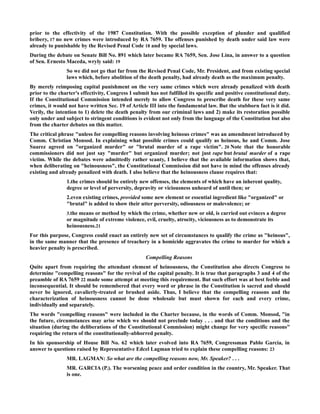
The critical phrase "unless for compelling reasons involving heinous crimes" was an amendment introduced by
Comm. Christian Monsod. In explaining what possible crimes could qualify as heinous, he and Comm. Jose
Suarez agreed on "organized murder" or "brutal murder of a rape victim". 20 Note that the honorable
commissioners did not just say "murder" but organized murder; not just rape but brutal murder of a rape
victim. While the debates were admittedly rather scanty, I believe that the available information shows that,
when deliberating on "heinousness", the Constitutional Commission did not have in mind the offenses already
existing and already penalized with death. I also believe that the heinousness clause requires that:
1.the crimes should be entirely new offenses, the elements of which have an inherent quality,
degree or level of perversity, depravity or viciousness unheard of until then; or
2.even existing crimes, provided some new element or essential ingredient like "organized" or
"brutal" is added to show their utter perversity, odiousness or malevolence; or
3.the means or method by which the crime, whether new or old, is carried out evinces a degree
or magnitude of extreme violence, evil, cruelty, atrocity, viciousness as to demonstrate its
heinousness.21
For this purpose, Congress could enact an entirely new set of circumstances to qualify the crime as "heinous",
in the same manner that the presence of treachery in a homicide aggravates the crime to murder for which a
heavier penalty is prescribed.
Compelling Reasons
Quite apart from requiring the attendant element of heinousness, the Constitution also directs Congress to
determine "compelling reasons" for the revival of the capital penalty. It is true that paragraphs 3 and 4 of the
preamble of RA 7659 22 made some attempt at meeting this requirement. But such effort was at best feeble and
inconsequential. It should be remembered that every word or phrase in the Constitution is sacred and should
never be ignored, cavalierly-treated or brushed aside. Thus, I believe that the compelling reasons and the
characterization of heinousness cannot be done wholesale but must shown for each and every crime,
individually and separately.
The words "compelling reasons" were included in the Charter because, in the words of Comm. Monsod, "in
the future, circumstances may arise which we should not preclude today . . . and that the conditions and the
situation (during the deliberations of the Constitutional Commission) might change for very specific reasons"
requiring the return of the constitutionally-abhorred penalty.
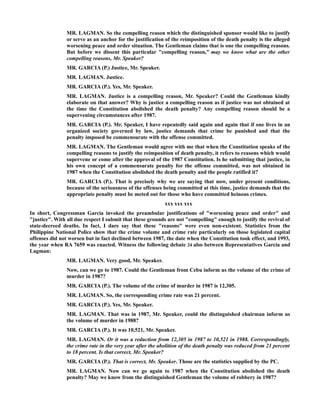
In his sponsorship of House Bill No. 62 which later evolved into RA 7659, Congressman Pablo Garcia, in
answer to questions raised by Representative Edcel Lagman tried to explain these compelling reasons: 23
MR. LAGMAN: So what are the compelling reasons now, Mr. Speaker? . . .
MR. GARCIA (P.). The worsening peace and order condition in the country, Mr. Speaker. That
is one.
MR. LAGMAN. So the compelling reason which the distinguished sponsor would like to justify
or serve as an anchor for the justification of the reimposition of the death penalty is the alleged
worsening peace and order situation. The Gentleman claims that is one the compelling reasons.
But before we dissent this particular "compelling reason," may we know what are the other
compelling reasons, Mr. Speaker?
MR. GARCIA (P.) Justice, Mr. Speaker.
MR. LAGMAN. Justice.
MR. GARCIA (P.). Yes, Mr. Speaker.
MR. LAGMAN. Justice is a compelling reason, Mr. Speaker? Could the Gentleman kindly
elaborate on that answer? Why is justice a compelling reason as if justice was not obtained at
the time the Constitution abolished the death penalty? Any compelling reason should be a
supervening circumstances after 1987.
MR. GARCIA (P.). Mr. Speaker, I have repeatedly said again and again that if one lives in an
organized society governed by law, justice demands that crime be punished and that the
penalty imposed be commensurate with the offense committed.
MR. LAGMAN. The Gentleman would agree with me that when the Constitution speaks of the
compelling reasons to justify the reimposition of death penalty, it refers to reasons which would
supervene or come after the approval of the 1987 Constitution. Is he submitting that justice, in
his own concept of a commensurate penalty for the offense committed, was not obtained in
1987 when the Constitution abolished the death penalty and the people ratified it?
MR. GARCIA (P.). That is precisely why we are saying that now, under present conditions,
because of the seriousness of the offenses being committed at this time, justice demands that the
appropriate penalty must be meted out for those who have committed heinous crimes.
xxx xxx xxx
In short, Congressman Garcia invoked the preambular justifications of "worsening peace and order" and
"justice". With all due respect I submit that these grounds are not "compelling" enough to justify the revival of
state-decreed deaths. In fact, I dare say that these "reasons" were even non-existent. Statistics from the
Philippine National Police show that the crime volume and crime rate particularly on those legislated capital
offenses did not worsen but in fact declined between 1987, the date when the Constitution took effect, and 1993,
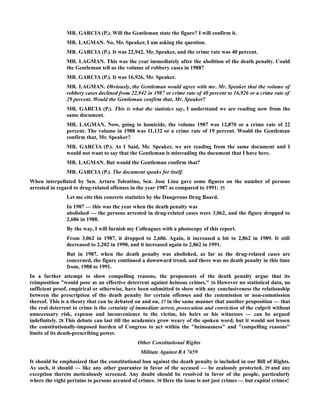
the year when RA 7659 was enacted. Witness the following debate 24 also between Representatives Garcia and
Lagman:
MR. LAGMAN. Very good, Mr. Speaker.
Now, can we go to 1987. Could the Gentleman from Cebu inform us the volume of the crime of
murder in 1987?
MR. GARCIA (P.). The volume of the crime of murder in 1987 is 12,305.
MR. LAGMAN. So, the corresponding crime rate was 21 percent.
MR. GARCIA (P.). Yes, Mr. Speaker.
MR. LAGMAN. That was in 1987, Mr. Speaker, could the distinguished chairman inform us
the volume of murder in 1988?
MR. GARCIA (P.). It was 10,521, Mr. Speaker.
MR. LAGMAN. Or it was a reduction from 12,305 in 1987 to 10,521 in 1988. Correspondingly,
the crime rate in the very year after the abolition of the death penalty was reduced from 21 percent
to 18 percent. Is that correct, Mr. Speaker?
MR. GARCIA (P.). That is correct, Mr. Speaker. Those are the statistics supplied by the PC.
MR. LAGMAN. Now can we go again to 1987 when the Constitution abolished the death
penalty? May we know from the distinguished Gentleman the volume of robbery in 1987?
MR. GARCIA (P.). Will the Gentleman state the figure? I will confirm it.
MR. LAGMAN. No, Mr. Speaker, I am asking the question.
MR. GARCIA (P.). It was 22,942, Mr. Speaker, and the crime rate was 40 percent.
MR. LAGMAN. This was the year immediately after the abolition of the death penalty. Could
the Gentleman tell us the volume of robbery cases in 1988?
MR. GARCIA (P.). It was 16,926, Mr. Speaker.
MR. LAGMAN. Obviously, the Gentleman would agree with me. Mr. Speaker that the volume of
robbery cases declined from 22,942 in 1987 or crime rate of 40 percent to 16,926 or a crime rate of
29 percent. Would the Gentleman confirm that, Mr. Speaker?
MR. GARCIA (P.). This is what the statistics say, I understand we are reading now from the
same document.
MR. LAGMAN. Now, going to homicide, the volume 1987 was 12,870 or a crime rate of 22
percent. The volume in 1988 was 11,132 or a crime rate of 19 percent. Would the Gentleman
confirm that, Mr. Speaker?
MR. GARCIA (P.). As I Said, Mr. Speaker, we are reading from the same document and I
would not want to say that the Gentleman is misreading the document that I have here.
MR. LAGMAN. But would the Gentleman confirm that?
MR. GARCIA (P.). The document speaks for itself.
When interpellated by Sen. Arturo Tolentino, Sen. Jose Lina gave some figures on the number of persons
arrested in regard to drug-related offenses in the year 1987 as compared to 1991: 25
Let me cite this concrete statistics by the Dangerous Drug Board.
In 1987 — this was the year when the death penalty was
abolished — the persons arrested in drug-related cases were 3,062, and the figure dropped to
2,686 in 1988.
By the way, I will furnish my Colleagues with a photocopy of this report.
From 3,062 in 1987, it dropped to 2,686. Again, it increased a bit to 2,862 in 1989. It still
decreased to 2,202 in 1990, and it increased again to 2,862 in 1991.
But in 1987, when the death penalty was abolished, as far as the drug-related cases are
concerned, the figure continued a downward trend, and there was no death penalty in this time
from, 1988 to 1991.
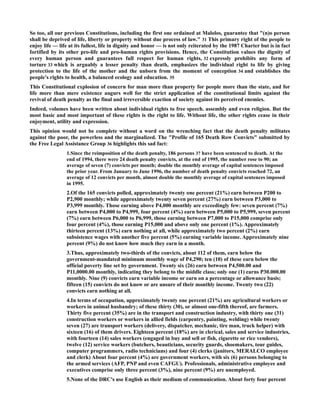
In a further attempt to show compelling reasons, the proponents of the death penalty argue that its
reimposition "would pose as an effective deterrent against heinous crimes." 26 However no statistical data, no
sufficient proof, empirical or otherwise, have been submitted to show with any conclusiveness the relationship
between the prescription of the death penalty for certain offenses and the commission or non-commission
thereof. This is a theory that can be debated on and on, 27 in the same manner that another proposition — that
the real deterrent to crime is the certainty of immediate arrest, prosecution and conviction of the culprit without
unnecessary risk, expense and inconvenience to the victim, his heirs or his witnesses — can be argued
indefinitely. 28 This debate can last till the academics grow weary of the spoken word, but it would not lessen
the constitutionally-imposed burden of Congress to act within the "heinousness" and "compelling reasons"
limits of its death-prescribing power.
Other Constitutional Rights
Militate Against RA 7659
It should be emphasized that the constitutional ban against the death penalty is included in our Bill of Rights.
As such, it should — like any other guarantee in favor of the accused — be zealously protected, 29 and any
exception thereto meticulously screened. Any doubt should be resolved in favor of the people, particularly
where the right pertains to persons accused of crimes. 30 Here the issue is not just crimes — but capital crimes!
So too, all our previous Constitutions, including the first one ordained at Malolos, guarantee that "(n)o person
shall be deprived of life, liberty or property without due process of law." 31 This primary right of the people to
enjoy life — life at its fullest, life in dignity and honor — is not only reiterated by the 1987 Charter but is in fact
fortified by its other pro-life and pro-human rights provisions. Hence, the Constitution values the dignity of
every human person and guarantees full respect for human rights, 32 expressly prohibits any form of
torture 33 which is arguably a lesser penalty than death, emphasizes the individual right to life by giving
protection to the life of the mother and the unborn from the moment of conception 34 and establishes the
people's rights to health, a balanced ecology and education. 35
This Constitutional explosion of concern for man more than property for people more than the state, and for
life more than mere existence augurs well for the strict application of the constitutional limits against the
revival of death penalty as the final and irreversible exaction of society against its perceived enemies.
Indeed, volumes have been written about individual rights to free speech. assembly and even religion. But the
most basic and most important of these rights is the right to life. Without life, the other rights cease in their
enjoyment, utility and expression.
This opinion would not be complete without a word on the wrenching fact that the death penalty militates
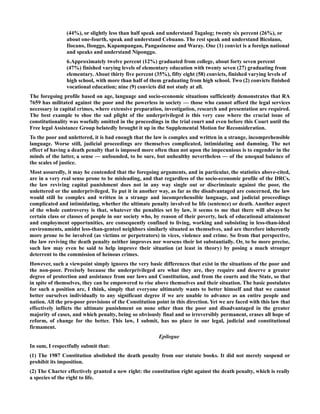
against the poor, the powerless and the marginalized. The "Profile of 165 Death Row Convicts" submitted by
the Free Legal Assistance Group 36 highlights this sad fact:
1.Since the reimposition of the death penalty, 186 persons 37 have been sentenced to death. At the
end of 1994, there were 24 death penalty convicts, at the end of 1995, the number rose to 90; an
average of seven (7) convicts per month; double the monthly average of capital sentences imposed
the prior year. From January to June 1996, the number of death penalty convicts reached 72, an
average of 12 convicts per month, almost double the monthly average of capital sentences imposed
in 1995.
2.Of the 165 convicts polled, approximately twenty one percent (21%) earn between P200 to
P2,900 monthly; while approximately twenty seven percent (27%) earn between P3,000 to
P3,999 monthly. Those earning above P4,000 monthly are exceedingly few: seven percent (7%)
earn between P4,000 to P4,999, four percent (4%) earn between P5,000 to P5,999, seven percent
(7%) earn between P6,000 to P6,999, those earning between P7,000 to P15,000 comprise only
four percent (4%), those earning P15,000 and above only one percent (1%). Approximately
thirteen percent (13%) earn nothing at all, while approximately two percent (2%) earn
subsistence wages with another five percent (5%) earning variable income. Approximately nine
percent (9%) do not know how much they earn in a month.
3.Thus, approximately two-thirds of the convicts, about 112 of them, earn below the
government-mandated minimum monthly wage of P4,290; ten (10) of these earn below the
official poverty line set by government. Twenty six (26) earn between P4,500.00 and
P11,0000.00 monthly, indicating they belong to the middle class; only one (1) earns P30.000.00
monthly. Nine (9) convicts earn variable income or earn on a percentage or allowance basis;
fifteen (15) convicts do not know or are unsure of their monthly income. Twenty two (22)
convicts earn nothing at all.
4.In terms of occupation, approximately twenty one percent (21%) are agricultural workers or
workers in animal husbandry; of these thirty (30), or almost one-fifth thereof, are farmers.
Thirty five percent (35%) are in the transport and construction industry, with thirty one (31)
construction workers or workers in allied fields (carpentry, painting, welding) while twenty
seven (27) are transport workers (delivery, dispatcher, mechanic, tire man, truck helper) with
sixteen (16) of them drivers. Eighteen percent (18%) are in clerical, sales and service industries,
with fourteen (14) sales workers (engaged in buy and sell or fish, cigarette or rice vendors),
twelve (12) service workers (butchers, beauticians, security guards, shoemakers, tour guides,
computer programmers, radio technicians) and four (4) clerks (janitors, MERALCO employee
and clerk) About four percent (4%) are government workers, with six (6) persons belonging to
the armed services (AFP, PNP and even CAFGU). Professionals, administrative employee and
executives comprise only three percent (3%), nine percent (9%) are unemployed.
5.None of the DRC's use English as their medium of communication. About forty four percent
(44%), or slightly less than half speak and understand Tagalog; twenty six percent (26%), or
about one-fourth, speak and understand Cebuano. The rest speak and understand Bicolano,
Ilocano, Ilonggo, Kapampangan, Pangasinense and Waray. One (1) convict is a foreign national
and speaks and understand Niponggo.
6.Approximately twelve percent (12%) graduated from college, about forty seven percent
(47%) finished varying levels of elementary education with twenty seven (27) graduating from
elementary. About thirty five percent (35%), fifty eight (58) convicts, finished varying levels of
high school, with more than half of them graduating from high school. Two (2) convicts finished
vocational education; nine (9) convicts did not study at all.
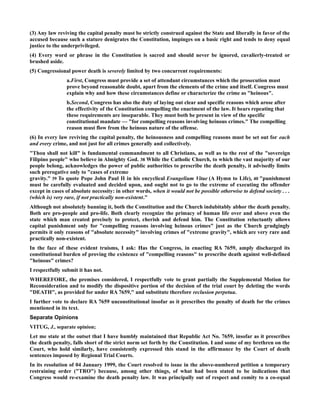
The foregoing profile based on age, language and socio-economic situations sufficiently demonstrates that RA
7659 has militated against the poor and the powerless in society — those who cannot afford the legal services
necessary in capital crimes, where extensive preparation, investigation, research and presentation are required.
The best example to shoe the sad plight of the underprivileged is this very case where the crucial issue of
constitutionality was woefully omitted in the proceedings in the trial court and even before this Court until the
Free legal Assistance Group belatedly brought it up in the Supplemental Motion for Reconsideration.
To the poor and unlettered, it is bad enough that the law is complex and written in a strange, incomprehensible
language. Worse still, judicial proceedings are themselves complicated, intimidating and damning. The net
effect of having a death penalty that is imposed more often than not upon the impecunious is to engender in the
minds of the latter, a sense — unfounded, to be sure, but unhealthy nevertheless — of the unequal balance of
the scales of justice.
Most assuredly, it may be contended that the foregoing arguments, and in particular, the statistics above-cited,
are in a very real sense prone to be misleading, and that regardless of the socio-economic profile of the DRCs,
the law reviving capital punishment does not in any way single out or discriminate against the poor, the
unlettered or the underprivileged. To put it in another way, as far as the disadvantaged are concerned, the law
would still be complex and written in a strange and incomprehensible language, and judicial proceedings
complicated and intimidating, whether the ultimate penalty involved be life (sentence) or death. Another aspect
of the whole controversy is that, whatever the penalties set by law, it seems to me that there will always be
certain class or classes of people in our society who, by reason of their poverty, lack of educational attainment
and employment opportunities, are consequently confined to living, working and subsisting in less-than-ideal
environments, amidst less-than-genteel neighbors similarly situated as themselves, and are therefore inherently
more prone to be involved (as victims or perpetrators) in vices, violence and crime. So from that perspective,
the law reviving the death penalty neither improves nor worsens their lot substantially. Or, to be more precise,
such law may even be said to help improve their situation (at least in theory) by posing a much stronger
deterrent to the commission of heinous crimes.
However, such a viewpoint simply ignores the very basic differences that exist in the situations of the poor and
the non-poor. Precisely because the underprivileged are what they are, they require and deserve a greater
degree of protection and assistance from our laws and Constitution, and from the courts and the State, so that
in spite of themselves, they can be empowered to rise above themselves and their situation. The basic postulates
for such a position are, I think, simply that everyone ultimately wants to better himself and that we cannot
better ourselves individually to any significant degree if we are unable to advance as an entire people and
nation. All the pro-poor provisions of the Constitution point in this direction. Yet we are faced with this law that
effectively inflicts the ultimate punishment on none other than the poor and disadvantaged in the greater
majority of cases, and which penalty, being so obviously final and so irreversibly permanent, erases all hope of
reform, of change for the better. This law, I submit, has no place in our legal, judicial and constitutional
firmament.
Epilogue
In sum, I respectfully submit that:
(1) The 1987 Constitution abolished the death penalty from our statute books. It did not merely suspend or
prohibit its imposition.
(2) The Charter effectively granted a new right: the constitution right against the death penalty, which is really
a species of the right to life.
(3) Any law reviving the capital penalty must be strictly construed against the State and liberally in favor of the
accused because such a stature denigrates the Constitution, impinges on a basic right and tends to deny equal
justice to the underprivileged.
(4) Every word or phrase in the Constitution is sacred and should never be ignored, cavalierly-treated or
brushed aside.
(5) Congressional power death is severely limited by two concurrent requirements:
a.First, Congress must provide a set of attendant circumstances which the prosecution must
prove beyond reasonable doubt, apart from the elements of the crime and itself. Congress must
explain why and how these circumstances define or characterize the crime as "heinous".
b.Second, Congress has also the duty of laying out clear and specific reasons which arose after
the effectivity of the Constitution compelling the enactment of the law. It bears repeating that
these requirements are inseparable. They must both be present in view of the specific
constitutional mandate — "for compelling reasons involving heinous crimes." The compelling
reason must flow from the heinous nature of the offense.
(6) In every law reviving the capital penalty, the heinousness and compelling reasons must be set out for each
and every crime, and not just for all crimes generally and collectively.
"Thou shall not kill" is fundamental commandment to all Christians, as well as to the rest of the "sovereign
Filipino people" who believe in Almighty God. 38 While the Catholic Church, to which the vast majority of our
people belong, acknowledges the power of public authorities to prescribe the death penalty, it advisedly limits
such prerogative only to "cases of extreme
gravity." 39 To quote Pope John Paul II in his encyclical Evangelium Vitae (A Hymn to Life), 40 "punishment
must be carefully evaluated and decided upon, and ought not to go to the extreme of executing the offender
except in cases of absolute necessity: in other words, when it would not be possible otherwise to defend society . . .
(which is) very rare, if not practically non-existent."
Although not absolutely banning it, both the Constitution and the Church indubitably abhor the death penalty.
Both are pro-people and pro-life. Both clearly recognize the primacy of human life over and above even the
state which man created precisely to protect, cherish and defend him. The Constitution reluctantly allows
capital punishment only for "compelling reasons involving heinous crimes" just as the Church grudgingly
permits it only reasons of "absolute necessity" involving crimes of "extreme gravity", which are very rare and
practically non-existent.
In the face of these evident truisms, I ask: Has the Congress, in enacting RA 7659, amply discharged its
constitutional burden of proving the existence of "compelling reasons" to prescribe death against well-defined
"heinous" crimes?
I respectfully submit it has not.
WHEREFORE, the premises considered, I respectfully vote to grant partially the Supplemental Motion for
Reconsideration and to modify the dispositive portion of the decision of the trial court by deleting the words
"DEATH", as provided for under RA 7659," and substitute therefore reclusion perpetua.
I further vote to declare RA 7659 unconstitutional insofar as it prescribes the penalty of death for the crimes
mentioned in its text.
Separate Opinions
VITUG, J., separate opinion;
Let me state at the outset that I have humbly maintained that Republic Act No. 7659, insofar as it prescribes
the death penalty, falls short of the strict norm set forth by the Constitution. I and some of my brethren on the
Court, who hold similarly, have consistently expressed this stand in the affirmance by the Court of death
sentences imposed by Regional Trial Courts.
In its resolution of 04 January 1999, the Court resolved to issue in the above-numbered petition a temporary
restraining order ("TRO") because, among other things, of what had been stated to be indications that
Congress would re-examine the death penalty law. It was principally out of respect and comity to a co-equal
branch of the government, i.e., to reasonably allow it that opportunity if truly minded, that motivated the
Court to grant, after deliberation, a limited time for the purpose.
The Court, it must be stressed, did not, by issuing the TRO, thereby reconsider its judgment convicting the
accused or recall the imposition of the death penalty.
The doctrine has almost invariably been that after a decision becomes final and executory, nothing else is
further done except to see to its compliance since for the Court to adopt otherwise would be to put no end to
litigations The rule notwithstanding, the Court retains control over the case until the full satisfaction of the
final judgment conformably with established legal processes. Hence, the Court has taken cognizance of the
petition assailing before it the use of lethal injection by the State to carry out the death sentence. In any event,
jurisprudence teaches that the rule of immutability of final and executory judgments admits of settled
exceptions. Concededly, the Court may, for instance, suspend the execution of a final judgment when it
becomes imperative in the higher interest of justice or when supervening events warrant it. 1 Certainly, this
extraordinary relief cannot be denied any man, whatever might be his station, whose right to life is the issue at
stake. The pronouncement in Director of Prisons vs. Judge of First Instance of Cavite, 2 should be instructive.
Thus —
This Supreme Court has repeatedly declared in various decisions, which constitute
jurisprudence on the subject, that in criminal cases, after the sentence has been pronounced
and the period for reopening the same has elapsed, the court can not change or after its
judgment, as its jurisdiction has terminated, functus est officio suo, according to the classical
phrase. When in cases of appeal or review the cause has been returned thereto for execution, in
the event that the judgment has been affirmed, it performs a ministerial duty in issuing the
proper order. But it does not follow from this cessation of functions on the part of the court
with reference to the ending of the cause that the judicial authority terminates by having then
passed completely to the executive. The particulars of the execution itself, which are certainly
not always included in the judgment and writ of execution, in any event are absolutely under
the control of the judicial authority, while the executive has no power over the person of the
convict except to provide for carrying out the penalty and to pardon.
Getting down to the solution of the question in the case at bar, which is that of execution of a
capital sentence, it must be accepted as a hypothesis that postponement of the date can be
requested. There can be no dispute on this point. It is a well-known principle that,
notwithstanding the order of execution and the executory nature thereof on the date set or at
the proper time, the date therefor can be postponed, even in sentences of death. Under the
common law this postponement can be ordered in three ways: (1) By command of the King; (2)
by discretion (arbitrio) of the court; and (3) by mandate of the law. It is sufficient to state this
principle of the common law to render impossible the assertion in absolute terms that after the
convict has once been placed in jail the trial court can not reopen the case to investigate the
facts that show the need for postponement. If one of the ways is by direction of the court, it is
acknowledged that even after the date of the execution has been fixed, and notwithstanding the
general rule that after the Court of First Instance has performed its ministerial duty of
ordering the execution, functus est officio suo, and its part is ended, if however a circumstance
arises that ought to delay the execution, there is an imperative duty to investigate the
emergency and to order a postponement . . ..
In fine, the authority of the Court to see to the proper execution of its final judgment, the power of the
President to grant pardon, commutation or reprieve, and the prerogative of Congress to repeal or modify the
law that could benefit the convicted accused are not essentially preclusive of one another nor constitutionally
incompatible and may each be exercised within their respective spheres and confines. Thus, the stay of
execution issued by the Court would not prevent either the President from exercising his pardoning power or
Congress from enacting a measure that may be advantageous to the adjudged offender.
The TRO of this Court has provided that it shall be lifted even before its expiry date of 15 June 1999, "coeval
with the duration of the present regular session of Congress," if it "sooner becomes certain that no repeal or
modification of the law is going to be made." The "Urgent Motion for Reconsideration" filed by the Office of
the Solicitor General states that as of the moment, "certain circumstances/supervening events (have) transpired
to the effect that the repeal or modification of the law imposing death penalty has become nil . . .." If, indeed, it
would be futile to yet expect any chance for a timely 3 re-examination by Congress of the death penalty law,
then I can appreciate why the majority of the Justices on the Court feel rightly bound even now to lift the TRO.
I am hopeful, nevertheless, that Congress will in time find its way clear to undertaking a most thorough and
dispassionate re-examination of the law not so much for its questioned wisdom as for the need to have a second
look at the conditions sine qua non prescribed by the Constitution in the imposition of the death penalty.
In People vs. Masalihit, 4 in urging, with all due respect, Congress to consider a prompt re-examination of the
death penalty law, I have said:
The determination of when to prescribe the death penalty lies, in the initial instance, with the
law-making authority, the Congress of the Philippines, subject to the conditions that the
Constitution itself has set forth; viz: (1) That there must be compelling reasons to justify the
imposition of the death penalty; and (2) That the capital offense must involve a heinous crime.
It appears that the fundamental law did not contemplate a simple 'reimposition' of the death
penalty to offenses theretofore already provided in the Revised Penal Code or, let alone, just
because of it. The term 'compelling reasons' would indicate to me that there must first be a
marked change in the milieu from that which has prevailed at the time of adoption of the 1987
Constitution, on the one hand, to that which exists at the enactment of the statute prescribing
the death penalty, upon the other hand, that would make it distinctively inexorable to allow the
re-imposition of the death penalty. Most importantly, the circumstances that would
characterize the 'heinous nature' of the crime and make it so exceptionally offensive as to
warrant the death penalty must be spelled out with great clarity in the law, albeit without
necessarily precluding the Court from exercising its power of judicial review given the
circumstances of each case. To venture, in the case of murder, the crime would become
'heinous' within the Constitutional concept, when, to exemplify, the victim is unnecessarily
subjected to a painful and excruciating death or, in the crime of rape, when the offended party
is callously humiliated or even brutally killed by the accused. The indiscriminate imposition of
the death penalty could somehow constrain courts to apply, perhaps without consciously
meaning to, stringent standards for conviction, not too unlikely beyond what might normally be
required in criminal cases, that can, in fact, result in undue exculpation of offenders to the
great prejudice of victims and society.
Today, I reiterate the above view and until the exacting standards of the Constitution are clearly met as so
hereinabove expressed, I will have to disagree, most respectfully, with my colleagues in the majority who
continue to hold the presently structured Republic Act No. 7659 to be in accord with the Constitution, an issue
that is fundamental, constant and inextricably linked to the imposition each time of the death penalty and, like
the instant petition, to the legal incidents pertinent thereto.
Accordingly, I vote against the lifting of the restraining order of the Court even as I, like everyone else,
however, must respect and be held bound by the ruling of the majority.
PANGANIBAN, J., separate opinion;
I agree with the Court's Resolution that, without doubt, this Court has jurisdiction to issue the disputed
Temporary Restraining Order (TRO) on January 4, 1999. I will not repeat its well-reasoned disquisition. I
write only to explain my vote in the context of the larger issue of the death penalty.
Since the solicitor general has demonstrated that Congress will not repeal or amend RA 7659 during its current
session which ends on June 15, 1999 and that, in any event, the President will veto any such repeal or
amendment, the TRO should by its own terms be deemed lifted now. However, my objections to the imposition
of the death penalty transcend the TRO and permeate its juridical essence.
I maintain my view that RA 7659 (the Death Penalty Law) is unconstitutional insofar as some parts thereof
prescribing the capital penalty fail to comply with the requirements of "heinousness" and "compelling
reasons" prescribed by the Constitution of the Philippines. * This I have repeatedly stated in my Dissenting
Opinion in various death cases decided by the Court, as well as during the Court's deliberation on this matter
on January 4, 1999. For easy reference, I hereby attach a copy of my Dissent promulgated on February 7, 1997.
Consequently, I cannot now vote to lift TRO, because to do so would mean the upholding and enforcement of
law (or the relevant portions thereof) which, I submit with all due respect, is unconstitutional and therefore
legally nonexistent. I also reiterate that, in my humble opinion, RA 8177 (the Lethal Injection Law) is likewise
unconstitutional since it merely prescribes the manner in which RA 7659 ( the Death Penalty Law) is to
implemented.
Having said that, I stress, however, that I defer to the rule of law and will abide by the ruling of the Court that
both RA 7659 and RA 8177 are constitutional and that death penalty should, by majority vote, be implemented
by means of lethal injection.
FOR THE ABOVE REASONS, I vote to deny the solicitor general's Motion for Reconsideration.
G.R. No. 117472 February 7, 1997
PEOPLE OF THE PHILIPPINES vs. LEO ECHEGARAY y PILO.
Supplemental Motion for Reconsideration
SEPARATE OPINION
Death Penalty Law Unconstitutional
In his Supplemental Motion for Reconsideration 1 dated August 22, 1996 filed by his newly-retained
counsel, 2 the accused raises for the first time a very crucial ground for his defense: that Republic Act. No.
7659, the law reimposing the death penalty, is unconstitutional. In the Brief and (original Motion for
Reconsideration filed by his previous counsel, 3 this transcendental issue was nor brought up. Hence, it was not
passed upon by this Court in its Decision affirming the trial court's sentence of death. 4
The Constitution Abolished Death Penalty
Sec. 19, Article III of the 1987 Constitution provides:
Sec. 19. (1) Excessive fines shall not be imposed, nor cruel, degrading or inhuman punishment
inflicted. Neither shall death penalty be imposed, unless for compelling
reasons involving heinouscrimes, the Congress hereafter provides for it. Any death
penalty already imposed shall be reduced to reclusion perpetua. (Emphasis supplied)
The second and third sentences of the above provision are new and had not been written in the 1935, 1973 or
even in the 1986 "Freedom Constitution." They proscribe the imposition 5 of the death penalty "unless for
compelling reasons involving heinous crimes, Congress provides for it," and reduced "any death penalty
already imposed" to reclusion perpetua. The provision has both a prospective aspect (it bars the future
imposition of the penalty) and a retroactive one (it reduces imposed capital sentences to the lesser penalty of
imprisonment).
This two-fold aspect is significant. It stresses that the Constitution did not merely suspend the imposition of the
death penalty, but in fact completely abolished it from the statute books. The automatic commutation or
reduction to reclusion perpetua of any death penalty extant as of the effectivity of the Constitution clearly
recognizes that, while the conviction of an accused for a capital crime remains, death as a penalty ceased to
exist in our penal laws and thus may longer be carried out. This is the clear intent of the framers of our
Constitution. As Comm. Bernas ex-claimed, 6 "(t)he majority voted for the constitutional abolition of the death
penalty."
Citing this and other similar pronouncements of the distinguished Concom delegate, Mme. Justice Ameurfina
Melencio-Herrera emphasized, 7 "It is thus clear that when Fr. Bernas sponsored the provision regarding the
non-imposition of the death penalty, what he had in mind was the total abolition and removal from the statute
books of the death penalty. This became the intent of the frames of the Constitution when they approved the
provision and made it a part of the Bill of Rights." With such abolition as a premise, restoration thereof
becomes an exception to a constitutional mandate. Being an exception and thus in derogation of the
Constitution, it must then be strictly construed against the State and liberally in favor of the people. 8 In this
light, RA 7659 enjoys no presumption of constitutionality.
The Constitution Strictly Limits
Congressional Prerogative to Prescribe Death
To me, it is very clear that the Constitution (1) effectively removed the death penalty from the then existing
statutes but (2) authorized Congress to restore it at some future time to enable or empower courts to reimpose
it on condition that it (Congress) 9 finds "compelling reasons, involving heinous crimes." The language of the
Constitution is emphatic (even if "awkward" 10): the authority of Congress to "provide for it" is not absolute.
Rather, it is strictly limited:
1.by "compelling reasons" that may arise after the Constitution became effective; and
2.to crimes which Congress should identify or define or characterize as "heinous."
The Constitution inexorably placed upon Congress the burden of determining the existence of "compelling
reasons" and of defining what crimes are "heinous" before it could exercise its law-making prerogative to
restore the death penalty. For clarity's sake, may I emphasize that Congress, by law; prescribes the death
penalty on certain crimes; and courts, by their decisions, impose it on individual offenders found guilty beyond
reasonable doubt of committing said crimes.
In the exercise of this fundamental mandate, Congress enacted RA
7659 11 to "provide for it" (the death penalty) (1) by amending certain provisions of the Revised Penal
Code; 12(2) by incorporating a new article therein; 13 and (3) by amending certain special laws. 14
But RA 7659 did not change the nature or the elements of the crimes stated in the Penal Code and in the special
laws. It merely made the penalty more severe. Neither did its provisions (other than the preamble, which was
cast in general terms) discuss or justify the reasons for the more sever sanction, either collectively for all the
offenses or individually for each of them.
Generally, it merely reinstated the concept of and the method by which the death penalty had been imposed
until February 2, 1987, when the Constitution took effect as follows: (1) a person is convicted of a capital
offense; and (2) the commission of which was accompanied by aggravating circumstances not outweighed by
mitigating circumstances.
The basic question then is: In enacting RA 7659, did Congress exceed the limited authority granted it by the
Constitution? More legally put: It reviving the death penalty, did Congress act with grave abuse of discretion
or in excess of the very limited power or jurisdiction conferred on it by Art. III, Sec. 19? The answer, I
respectfully submit, is YES.
Heinous Crimes
To repeal, while he Constitution limited the power of Congress to prescribe the death penalty ONLY to
"heinous" crimes, it did not define or characterize the meaning of "heinous". Neither did Congress. As already
stated, RA 7659 itself merely selected some existing crimes for which it prescribed death as an applicable
penalty. It did not give a standard or a characterization by which courts may be able to appreciate the
heinousness of a crime. I concede that Congress was only too well aware of its constitutionally limited power. In
deference thereto, it included a paragraph in the preambular or "whereas" clauses of RA 7659, as follows:
WHEREAS, the crimes punishable by death under this Act are heinous for being grievous,
odious and hateful offenses and which, by reason of their inherent or manifest wickedness,
viciousness, atrocity and perversity are repugnant and outrageous to the common standards
and norms of decency and morality in a just, civilized and ordered society.
In my humble view, however, the foregoing clause is clearly an insufficient definition or characterization of
what a heinous crime is. It simply and gratuitously declared certain crimes to be "heinous" without adequately
justifying its bases therefor. It supplies no useful, workable, clear and unambiguous standard by which the
presence of heinousness can be determined. Calling the crimes "grievous, odious and hateful" is not a
substitute for an objective juridical definition. Neither is the description "inherent or manifest wickedness,
viciousness, atrocity and perversity." Describing blood as blue does not detract from its being crimson in fact;
and renaming gumamela as rose will not arm it with thorns.
Besides, a preamble is really not an integral part of a law. It is merely an introduction to show its intent or
purposes. It cannot be the origin of rights and obligations. Where the meaning of a statute is clear and
unambiguous, the preamble can neither expand nor restrict its operation, much less prevail over its text. 15 In
this case, it cannot be the authoritative source to show compliance with the Constitution.
As already alluded to, RA 7659 merely amended certain laws to prescribe death as the maximum imposable
penalty once the court appreciates the presence or absence of aggravating circumstances. 16
In other words, it just reinstated capital punishment for crimes which were already punishable with death
prior to the effectivity of the 1987 Constitution. With the possible exception of plunder and qualified
bribery, 17 no new crimes were introduced by RA 7659. The offenses punished by death under said law were
already to punishable by the Revised Penal Code 18 and by special laws.
During the debate on Senate Bill No. 891 which later became RA 7659, Sen. Jose Lina, in answer to a question
of Sen. Ernesto Maceda, wryly said: 19
So we did not go that far from the Revised Penal Code, Mr. President, and from existing special
laws which, before abolition of the death penalty, had already death as the maximum penalty.
By merely reimposing capital punishment on the very same crimes which were already penalized with death
prior to the charter's effectivity, Congress I submit has not fulfilled its specific and positive constitutional duty.
If the Constitutional Commission intended merely to allow Congress to prescribe death for these very same
crimes, it would not have written Sec. 19 of Article III into the fundamental law. But the stubborn fact is it did.
Verily, the intention to 1) delete the death penalty from our criminal laws and 2) make its restoration possible
only under and subject to stringent conditions is evident not only from the language of the Constitution but also
from the charter debates on this matter.
The critical phrase "unless for compelling reasons involving heinous crimes" was an amendment introduced by
Comm. Christian Monsod. In explaining what possible crimes could qualify as heinous, he and Comm. Jose
Suarez agreed on "organized murder" or "brutal murder of a rape victim". 20 Note that the honorable
commissioners did not just say "murder" but organized murder; not just rape but brutal murder of a rape
victim. While the debates were admittedly rather scanty, I believe that the available information shows that,
when deliberating on "heinousness", the Constitutional Commission did not have in mind the offenses already
existing and already penalized with death. I also believe that the heinousness clause requires that:
1. the crimes should be entirely new offenses, the elements of which have an inherent quality,
degree or level of perversity, depravity or viciousness unheard of until then; or
2. even existing crimes, provided some new element or essential ingredient like "organized" or
"brutal" is added to show their utter perversity, odiousness or malevolence; or
3) the means or method by which the crime, whether new or old, is carried out evinces a degree
or magnitude of extreme violence, evil, cruelty, atrocity, viciousness as to demonstrate its
heinousness.21
For this purpose, Congress could enact an entirely new set of circumstances to qualify the crime as "heinous",
in the same manner that the presence of treachery in a homicide aggravates the crime to murder for which a
heavier penalty is prescribed.
Compelling Reasons
Quite apart from requiring the attendant element of heinousness, the Constitution also directs Congress to
determine "compelling reasons" for the revival of the capital penalty. It is true that paragraphs 3 and 4 of the
preamble of RA 7659 22 made some attempt at meeting this requirement. But such effort was at best feeble and
inconsequential. It should be remembered that every word or phrase in the Constitution is sacred and should
never be ignored, cavalierly-treated or brushed aside. Thus, I believe that the compelling reasons and the
characterization of heinousness cannot be done wholesale but must shown for each and every crime,
individually and separately.
The words "compelling reasons" were included in the Charter because, in the words of Comm. Monsod, "in
the future, circumstances may arise which we should not preclude today . . . and that the conditions and the
situation (during the deliberations of the Constitutional Commission) might change for very specific reasons"
requiring the return of the constitutionally-abhorred penalty.
In his sponsorship of House Bill No. 62 which later evolved into RA 7659, Congressman Pablo Garcia, in
answer to questions raised by Representative Edcel Lagman tried to explain these compelling reasons: 23
MR. LAGMAN: So what are the compelling reasons now, Mr. Speaker? . . .
MR. GARCIA (P.). The worsening peace and order condition in the country, Mr. Speaker. That
is one.
MR. LAGMAN. So the compelling reason which the distinguished sponsor would like to justify
or serve as an anchor for the justification of the reimposition of the death penalty is the alleged
worsening peace and order situation. The Gentleman claims that is one the compelling reasons.
But before we dissent this particular "compelling reason," may we know what are the other
compelling reasons, Mr. Speaker?
MR. GARCIA (P.) Justice, Mr. Speaker.
MR. LAGMAN. Justice.
MR. GARCIA (P.). Yes, Mr. Speaker.
MR. LAGMAN. Justice is a compelling reason, Mr. Speaker? Could the Gentleman kindly
elaborate on that answer? Why is justice a compelling reason as if justice was not obtained at
the time the Constitution abolished the death penalty? Any compelling reason should be a
supervening circumstances after 1987.
MR. GARCIA (P.). Mr. Speaker, I have repeatedly said again and again that if one lives in an
organized society governed by law, justice demands that crime be punished and that the
penalty imposed be commensurate with the offense committed.
MR. LAGMAN. The Gentleman would agree with me that when the Constitution speaks of the
compelling reasons to justify the reimposition of death penalty, it refers to reasons which would
supervene or come after the approval of the 1987 Constitution. Is he submitting that justice, in
his own concept of a commensurate penalty for the offense committed, was not obtained in
1987 when the Constitution abolished the death penalty and the people ratified it?
MR. GARCIA (P.). That is precisely why we are saying that now, under present conditions,
because of the seriousness of the offenses being committed at this time, justice demands that the
appropriate penalty must be meted out for those who have committed heinous crimes.
xxx xxx xxx
In short, Congressman Garcia invoked the preambular justifications of "worsening peace and order" and
"justice". With all due respect I submit that these grounds are not "compelling" enough to justify the revival of
state-decreed deaths. In fact, I dare say that these "reasons" were even non-existent. Statistics from the
Philippine National Police show that the crime volume and crime rate particularly on those legislated capital
offenses did not worsen but in fact declined between 1987, the date when the Constitution took effect, and 1993,
the year when RA 7659 was enacted. Witness the following debate 24 also between Representatives Garcia and
Lagman:
MR. LAGMAN. Very good, Mr. Speaker.
Now, can we go to 1987. Could the Gentleman from Cebu inform us the volume of the crime of
murder in 1987?
MR. GARCIA (P.). The volume of the crime of murder in 1987 is 12,305.
MR. LAGMAN. So, the corresponding crime rate was 21 percent.
MR. GARCIA (P.). Yes, Mr. Speaker.
MR. LAGMAN. That was in 1987, Mr. Speaker, could the distinguished chairman inform us
the volume of murder in 1988?
MR. GARCIA (P.). It was 10,521, Mr. Speaker.
MR. LAGMAN. Or it was a reduction from 12,305 in 1987 to 10,521 in 1988. Correspondingly,
the crime rate in the very year after the abolition of the death penalty was reduced from 21 percent
to 18 percent. Is that correct, Mr. Speaker?
MR. GARCIA (P.). That is correct, Mr. Speaker. Those are the statistics supplied by the PC.
MR. LAGMAN. Now can we go again to 1987 when the Constitution abolished the death
penalty? May we know from the distinguished Gentleman the volume of robbery in 1987?
MR. GARCIA (P.). Will the Gentleman state the figure? I will confirm it.
MR. LAGMAN. No, Mr. Speaker, I am asking the question.
MR. GARCIA (P.). It was 22,942, Mr. Speaker, and the crime rate was 40 percent.
MR. LAGMAN. This was the year immediately after the abolition of the death penalty. Could
the Gentleman tell us the volume of robbery cases in 1988?
MR. GARCIA (P.). It was 16,926, Mr. Speaker.
MR. LAGMAN. Obviously, the Gentleman would agree with me. Mr. Speaker that the volume of
robbery cases declined from 22,942 in 1987 or crime rate of 40 percent to 16,926 or a crime rate of
29 percent. Would the Gentleman confirm that, Mr. Speaker?
MR. GARCIA (P.). This is what the statistics say, I understand we are reading now from the
same document.
MR. LAGMAN. Now, going to homicide, the volume 1987 was 12,870 or a crime rate of 22
percent. The volume in 1988 was 11,132 or a crime rate of 19 percent. Would the Gentleman
confirm that, Mr. Speaker?
MR. GARCIA (P.). As I Said, Mr. Speaker, we are reading from the same document and I
would not want to say that the Gentleman is misreading the document that I have here.
MR. LAGMAN. But would the Gentleman confirm that?
MR. GARCIA (P.). The document speaks for itself.
When interpellated by Sen. Arturo Tolentino, Sen. Jose Lina gave some figures on the number of persons
arrested in regard to drug-related offenses in the year 1987 as compared to 1991: 25
Let me cite this concrete statistics by the Dangerous Drug Board.
In 1987 — this was the year when the death penalty was abolished — the persons arrested in
drug-related cases were 3,062, and the figure dropped to 2,686 in 1988.
By the way, I will furnish my Colleagues with a photocopy of this report.
From 3,062 in 1987, it dropped to 2,686. Again, it increased a bit to 2,862 in 1989. It still
decreased to 2,202 in 1990, and it increased again to 2,862 in 1991.
But in 1987, when the death penalty was abolished, as far as the drug-related cases are
concerned, the figure continued a downward trend, and there was no death penalty in this time
from, 1988 to 1991.
In a further attempt to show compelling reasons, the proponents of the death penalty argue that its
reimposition "would pose as an effective deterrent against heinous crimes." 26 However no statistical data, no
sufficient proof, empirical or otherwise, have been submitted to show with any conclusiveness the relationship
between the prescription of the death penalty for certain offenses and the commission or non-commission
thereof. This is a theory that can be debated on and on, 27 in the same manner that another proposition — that
the real deterrent to crime is the certainty of immediate arrest, prosecution and conviction of the culprit without
unnecessary risk, expense and inconvenience to the victim, his heirs or his witnesses — can be argued
indefinitely. 28 This debate can last till the academics grow weary of the spoken word, but it would not lessen
the constitutionally-imposed burden of Congress to act within the "heinousness" and "compelling reasons"
limits of its death-prescribing power.
Other Constitutional Rights
Militate Against RA 7659
It should be emphasized that the constitutional ban against the death penalty is included in our Bill of Rights.
As such, it should — like any other guarantee in favor of the accused — be zealously protected, 29 and any
exception thereto meticulously screened. Any doubt should be resolved in favor of the people, particularly
where the right pertains to persons accused of crimes. 30 Here the issue is not just crimes — but capital crimes!
So too, all our previous Constitutions, including the first one ordained at Malolos, guarantee that "(n)o person
shall be deprived of life, liberty or property without due process of law." 31 This primary right of the people to
enjoy life — life at its fullest, life in dignity and honor — is not only reiterated by the 1987 Charter but is in fact
fortified by its other pro-life and pro-human rights provisions. Hence, the Constitution values the dignity of
every human person and guarantees full respect for human rights, 32 expressly prohibits any form of
torture 33 which is arguably a lesser penalty than death, emphasizes the individual right to life by giving
protection to the life of the mother and the unborn from the moment of conception 34 and establishes the
people's rights to health, a balanced ecology and education. 35
This Constitutional explosion of concern for man more than property for people more than the state, and for
life more than mere existence augurs well for the strict application of the constitutional limits against the
revival of death penalty as the final and irreversible exaction of society against its perceived enemies.
Indeed, volumes have been written about individual rights to free speech. assembly and even religion. But the
most basic and most important of these rights is the right to life. Without life, the other rights cease in their
enjoyment, utility and expression.
This opinion would not be complete without a word on the wrenching fact that the death penalty militates
against the poor, the powerless and the marginalized. The "Profile of 165 Death Row Convicts" submitted by
the Free Legal Assistance Group 36 highlights this sad fact:
1.Since the reimposition of the death penalty, 186 persons 37 have been sentenced to death. At the
end of 1994, there were 24 death penalty convicts, at the end of 1995, the number rose to 90; an
average of seven (7) convicts per month; double the monthly average of capital sentences imposed
the prior year. From January to June 1996, the number of death penalty convicts reached 72, an
average of 12 convicts per month, almost double the monthly average of capital sentences imposed
in 1995.
2.Of the 165 convicts polled, approximately twenty one percent (21%) earn between P200 to
P2,900 monthly; while approximately twenty seven percent (27%) earn between P3,000 to
P3,999 monthly. Those earning above P4,000 monthly are exceedingly few: seven percent (7%)
earn between P4,000 to P4,999, four percent (4%) earn between P5,000 to P5,999, seven percent
(7%) earn between P6,000 to P6,999, those earning between P7,000 to P15,000 comprise only
four percent (4%), those earning P15,000 and above only one percent (1%). Approximately
thirteen percent (13%) earn nothing at all, while approximately two percent (2%) earn
subsistence wages with another five percent (5%) earning variable income. Approximately nine
percent (9%) do not know how much they earn in a month.
3.Thus, approximately two-thirds of the convicts, about 112 of them, earn below the
government-mandated minimum monthly wage of P4,290; ten (10) of these earn below the
official poverty line set by government. Twenty six (26) earn between P4,500.00 and
P11,0000.00 monthly, indicating they belong to the middle class; only one (1) earns P30.000.00
monthly. Nine (9) convicts earn variable income or earn on a percentage or allowance basis;
fifteen (15) convicts do not know or are unsure of their monthly income. Twenty two (22)
convicts earn nothing at all.
4.In terms of occupation, approximately twenty one percent (21%) are agricultural workers or
workers in animal husbandry; of these thirty (30), or almost one-fifth thereof, are farmers.
Thirty five percent (35%) are in the transport and construction industry, with thirty one (31)
construction workers or workers in allied fields (carpentry, painting, welding) while twenty
seven (27) are transport workers (delivery, dispatcher, mechanic, tire man, truck helper) with
sixteen (16) of them drivers. Eighteen percent (18%) are in clerical, sales and service industries,
with fourteen (14) sales workers (engaged in buy and sell or fish, cigarette or rice vendors),
twelve (12) service workers (butchers, beauticians, security guards, shoemakers, tour guides,
computer programmers, radio technicians) and four (4) clerks (janitors, MERALCO employee
and clerk) About four percent (4%) are government workers, with six (6) persons belonging to
the armed services (AFP, PNP and even CAFGU). Professionals, administrative employee and
executives comprise only three percent (3%), nine percent (9%) are unemployed.
5.None of the DRC's use English as their medium of communication. About forty four percent
(44%), or slightly less than half speak and understand Tagalog; twenty six percent (26%), or
about one-fourth, speak and understand Cebuano. The rest speak and understand Bicolano,
Ilocano, Ilonggo, Kapampangan, Pangasinense and Waray. One (1) convict is a foreign national
and speaks and understand Niponggo.
6.Approximately twelve percent (12%) graduated from college, about forty seven percent
(47%) finished varying levels of elementary education with twenty seven (27) graduating from
elementary. About thirty five percent (35%), fifty eight (58) convicts, finished varying levels of
high school, with more than half of them graduating from high school. Two (2) convicts finished
vocational education; nine (9) convicts did not study at all.
The foregoing profile based on age, language and socio-economic situations sufficiently demonstrates that RA
7659 has militated against the poor and the powerless in society — those who cannot afford the legal services
necessary in capital crimes, where extensive preparation, investigation, research and presentation are required.
The best example to shoe the sad plight of the underprivileged is this very case where the crucial issue of
constitutionality was woefully omitted in the proceedings in the trial court and even before this Court until the
Free legal Assistance Group belatedly brought it up in the Supplemental Motion for Reconsideration.
To the poor and unlettered, it is bad enough that the law is complex and written in a strange, incomprehensible
language. Worse still, judicial proceedings are themselves complicated, intimidating and damning. The net
effect of having a death penalty that is imposed more often than not upon the impecunious is to engender in the
minds of the latter, a sense — unfounded, to be sure, but unhealthy nevertheless — of the unequal balance of
the scales of justice.
Most assuredly, it may be contended that the foregoing arguments, and in particular, the statistics above-cited,
are in a very real sense prone to be misleading, and that regardless of the socio-economic profile of the DRCs,
the law reviving capital punishment does not in any way single out or discriminate against the poor, the
unlettered or the underprivileged. To put it in another way, as far as the disadvantaged are concerned, the law
would still be complex and written in a strange and incomprehensible language, and judicial proceedings
complicated and intimidating, whether the ultimate penalty involved be life (sentence) or death. Another aspect
of the whole controversy is that, whatever the penalties set by law, it seems to me that there will always be
certain class or classes of people in our society who, by reason of their poverty, lack of educational attainment
and employment opportunities, are consequently confined to living, working and subsisting in less-than-ideal
environments, amidst less-than-genteel neighbors similarly situated as themselves, and are therefore inherently
more prone to be involved (as victims or perpetrators) in vices, violence and crime. So from that perspective,
the law reviving the death penalty neither improves nor worsens their lot substantially. Or, to be more precise,
such law may even be said to help improve their situation (at least in theory) by posing a much stronger
deterrent to the commission of heinous crimes.
However, such a viewpoint simply ignores the very basic differences that exist in the situations of the poor and
the non-poor. Precisely because the underprivileged are what they are, they require and deserve a greater
degree of protection and assistance from our laws and Constitution, and from the courts and the State, so that
in spite of themselves, they can be empowered to rise above themselves and their situation. The basic postulates
for such a position are, I think, simply that everyone ultimately wants to better himself and that we cannot
better ourselves individually to any significant degree if we are unable to advance as an entire people and
nation. All the pro-poor provisions of the Constitution point in this direction. Yet we are faced with this law that
effectively inflicts the ultimate punishment on none other than the poor and disadvantaged in the greater
majority of cases, and which penalty, being so obviously final and so irreversibly permanent, erases all hope of
reform, of change for the better. This law, I submit, has no place in our legal, judicial and constitutional
firmament.
Epilogue
In sum, I respectfully submit that:
1. The 1987 Constitution abolished the death penalty from our statute books. It did not merely suspend or
prohibit its imposition.
2. The Charter effectively granted a new right: the constitution right against the death penalty, which is
really a species of the right to life.
3. Any law reviving the capital penalty must be strictly construed against the State and liberally in favor
of the accused because such a stature denigrates the Constitution, impinges on a basic right and tends
to deny equal justice to the underprivileged.
4. Every word or phrase in the Constitution is sacred and should never be ignored, cavalierly-treated or
brushed aside.
5. Congressional power death is severely limited by two concurrent requirements:
a.First, Congress must provide a set of attendant circumstances which the prosecution must
prove beyond reasonable doubt, apart from the elements of the crime and itself. Congress must
explain why and how these circumstances define or characterize the crime as "heinous".
Second, Congress has also the duty of laying out clear and specific reasons which arose after the effectivity of
the Constitution compelling the enactment of the law. It bears repeating that these requirements are
inseparable. They must both be present in view of the specific constitutional mandate — "for compelling
reasons involving heinous crimes." The compelling reason must flow from the heinous nature of the offense.
1.In every law reviving the capital penalty, the heinousness and compelling reasons must be set out
for each and every crime, and not just for all crimes generally and collectively.
"Thou shall not kill" is fundamental commandment to all Christians, as well as to the rest of the "sovereign
Filipino people" who believe in Almighty God. 38 While the Catholic Church, to which the vast majority of our
people belong, acknowledges the power of public authorities to prescribe the death penalty, it advisedly limits
such prerogative only to "cases of extreme
gravity." 39 To quote Pope John Paul II in his encyclical Evangelium Vitae (A Hymn to Life), 40 "punishment
must be carefully evaluated and decided upon, and ought not to go to the extreme of executing the offender
except in cases of absolute necessity: in other words, when it would not be possible otherwise to defend society . . .
(which is) very rare, if not practically non-existent."
Although not absolutely banning it, both the Constitution and the Church indubitably abhor the death penalty.
Both are pro-people and pro-life. Both clearly recognize the primacy of human life over and above even the
state which man created precisely to protect, cherish and defend him. The Constitution reluctantly allows
capital punishment only for "compelling reasons involving heinous crimes" just as the Church grudgingly
permits it only reasons of "absolute necessity" involving crimes of "extreme gravity", which are very rare and
practically non-existent.
In the face of these evident truisms, I ask: Has the Congress, in enacting RA 7659, amply discharged its
constitutional burden of proving the existence of "compelling reasons" to prescribe death against well-defined
"heinous" crimes?
I respectfully submit it has not.
WHEREFORE, the premises considered, I respectfully vote to grant partially the Supplemental Motion for
Reconsideration and to modify the dispositive portion of the decision of the trial court by deleting the words
"DEATH", as provided for under RA 7659," and substitute therefore reclusion perpetua.
I further vote to declare RA 7659 unconstitutional insofar as it prescribes the penalty of death for the crimes
mentioned in its text.
Footnotes
1 Stoll v. Gottlieb, 305 US 165, 172; 59 S. Ct. 134, 138; 83 L. ed. 104 [1938].
2 Philippine Courts and their Jurisdiction, p. 13, 1998 ed.
3 Citing Miranda v. Tiangco, 96 Phil. 526; Santos v. Acuna, 100 Phil. 230; American Insurance
Co. v. US Lines Co., 63 SCRA 325; Republic v. Reyes, 71 SCRA 426; Luzon Stevedoring Corp.
v. Reyes, 71 SCRA 655; Agricultural and Industrial Marketing Inc. v. CA, 118 SCRA 49; Vasco
v. CA, 81 SCRA 712; Mindanao Portland Cement Corp. v. Laquihan, 120 SCRA 930.
4 Ibid., at pp. 12-14, citing Miranda v. Tiangco, 96 Phil. 526; Santos v. Acuna, 63 O.G. 358;
Cabaya v. Hon. R. Mendoza, 113 SCRA 400; Bueno Industrial and Development Corp. v.
Encaje, 104 SCRA 388.
5 Ibid., pp. 14-15 citing Molina v. dela Riva, 8 Phil. 569; Behn Meyer & Co. v. McMicking, 11
Phil. 276; Warmer Barnes & Co. v. Jaucian, 13 Phil. 4; Espiritu v. Crossfield, 14 Phil. 588;
Mata v. Lichauco, 36 Phil. 809; De la Costa v. Cleofas, 67 Phil. 686; Omar v. Jose, 77 Phil. 703;
City of Butuan v. Ortiz, 113 Phil. 636; De los Santos v. Rodriguez, 22 SCRA 551; City of Cebu v.
Mendoza, 66 SCRA 174.
6 29 Phil. 267 (1915), p. 270.
7 Sec. 1, Article VIII of the 1987 Constitution.
8 Sec. 5(f), Rule 135.
9 Philippine Political Law, p. 225, 1993 ed.
10 94 Phil. 534 (1954), pp. 550-555.
11 R.A. No. 372.
12 94 Phil. 550, p. 551.
13 See In re Integration of the Bar of the Philippines, January 9, 1973, 49 SCRA 22.
14 See pp. 3-4 of Urgent Motion for Reconsideration.
15 See Art. 79 of the Revised Penal Code.
16 Modern Constitutional Law, Vol. 1, p. 409, 1969 ed., citing Caritativo v. California, 357 US
549, 21 L ed. 2d 1531, 78 S. Ct. 1263 [1958].
17 December 30 and 31, 1998 were declared holidays. January 1, 1999 was an official holiday.
January 2 was a Saturday and January 3 was a Sunday.
18 Urgent Motion for Reconsideration of Public respondents, p. 8.
19 Darrow, Crime: Its Cause and Treatment, p. 166 (1922).
20 Eisler, A Justice For All, p. 268.
21 "Where personal liberty is involved, a democratic society employs a different arithmetic and
insists that it is less important to reach an unshakable decision than to do justice." Pollack,
Proposals to Curtail Habeas Corpus for State Prisoners: Collateral Attack on the Great Writ.
66 Yale LJ 50, 65 (1956).
VITUG, J., separate opinion;
1 Candelana vs. Cañizares, 4 SCRA 738; Philippine Veterans Bank vs. Intermediate Appellate
Court, 178 SCRA 545, Lipana vs. Development Bank of Rizal, 154 SCRA 257; Lee vs. De
Guzman, 187 SCRA 276, Bachrach Corporation vs. Court of Appeals, G.R. No. 128349, 25
September 1998.
2 29 Phil 267.
3 At least for Mr. Echegaray.
4 G.R. No 124329, 14 December 1998.
PANGANIBAN, J., separate opinion;
* I have further explained my unflinching position on this matter in my recent book Battles in
the Supreme Court, particularly on page 58 to 84.
Separate opinion;
1 It is called "Supplemental" because there was a (main) Motion for Reconsideration filed by
the previous counsel of the accused, which this Court already denied.
2 The Anti Death Penalty Task Force of the Free Legal Assistance Group — Pablito V. Sanidad,
Jose Manuel I. Diokno, Arno V. Sanidad, Efren Moncupa, Eduardo R. Abaya and Ma. Victoria
I. Diokno — filed its Notice of Appearance dated August 22, 1996 only on August 23, 1996, after
the Per CuriamDecision of this Court was promulgated on June 25, 1996.
3 Atty. Julian R. Vitug, Jr.
4 The bulk of jurisprudence precludes raising an issue for the first time only on appeal. See, for
instance, Manila Bay Club Corporation vs. Court of Appeals, 249 SCRA 303, October 13, 1995;
Manila Bay Club Corporation vs. Court of Appeals, 245 SCRA 715, July 11, 1995; Securities
and Exchange Commission vs. Court of Appeals, 246 SCRA 738, July 21, 1995. However, the
Court resolved to tackle the question of constitutionality of Republic Act No. 7659 in this case,
anticipating that the same question would be raised anyway in many other subsequent
instances. The Court resolved to determine and dispose of the issue once and for all, at the first
opportunity. To let the issue pass unresolved just because it was raised after the promulgation
of the decision affirming conviction may result in grave injustice.
5 In People vs. Muñoz, 170 SCRA 107, February 9, 1989, the Court, prior to the enactment and
effectivity of RA 7659, ruled by a vote of 9-6 (J. Cruz, ponente, C.J. Fernan, JJ., Gutierrez, Jr.,
Feliciano, Gancayco, Padilla, Bidin, Griño-Aquino and Medialdea, concurring) that the death
penalty was not abolished but only prohibited from imposed. But see also the persuasive
Dissenting Opinion of Mme. Justice Ameurfina Melencio-Herrera (joined by JJ. Narvasa,
Paras, Sarmiento, Cortes and Regalado) who contended that the Constitution totally abolished
the death penalty and removed it form the statute books. People vs. Muñoz reversed the earlier
"abolition" doctrine uniformly held in People vs. Gavarra, 155 SCRA 327, October 30, 1987,
(per C.J. Yap); People vs. Masangkay, 155 SCRA 113, October 27, 1987, (per J. Melencio-
Herrera) and People vs. Atencio, 156 SCRA 242, December 10, 1987 (per C.J. Narvasa). It is
time that these cases are revisited by this Court.
6 This quote is taken from I Record of the Constitutional Commission, p. 676 (July 17, 1986) as
follows:
Fr. Bernas:
xxx xxx xxx
My recollection on this is that there was a division in the Committee not on whether the death
penalty should be abolished or not, but rather on whether the abolition should be done by the
Constitution — in which case it cannot be restored by the legislature — or left to the
legislature. The majority voted for the constitutional abolition of the death penalty. And the
reason is that capital punishment is inhuman for the convict and his family who are
traumatized by the waiting, even if it is never carried out. There is no evidence that death
penalty deterred deadly criminals, hence, life should not be destroyed just in the hope that
other lives might be saved. Assuming mastery over the life of another man is just too
presumptuous for any man. The fact that the death penalty as an institution has been there
from time immemorial should not deter us from reviewing it. Human life is more valuable than
an institution intended precisely to serve human life. So basically, this is the summary of the
reason which were presented in support of the constitutional abolition of the death penalty
(emphasis supplied)
7 Dissenting Opinion in People vs. Muñoz, supra, p. 129.
8 Thus in People vs. Burgos, 144 SCRA 1, September 4, 1986, we held that a statute which
allows an exception to a constitutional right (against warrantless arrests) should be strictly
construed.
9 In his scholarly Memorandum, Fr. Joaquin G. Bernas, S.J. as amicus curiae in People vs.
Pedro V. Malabago (G.R. No. 115686, December 2, 1996), vigorously argues that RA 7659 has
validly restored the death penalty which may now be imposed provided that the prosecution
proves, and the court is convinced, that (a) the accused is guilty of a crime designated by RA
7659 as capital, (b) whose commission is accompanied by aggravating circumstances as defined
by Arts. 14 and 15 of the Revised Penal Code, (c) the accompanying aggravating circumstance
must be one which can be characterized by the court as making the crime "heinous", and (d)
that the execution of the offender is demanded by "compelling reasons" related to the offense.
In other words, according to him, it is the courts — not Congress — that have responsibility of
determining the heinousness of a crime and the compelling reason for its imposition upon a
particular offender, depending on the facts of each case. I cannot however subscribe to this
view. The Constitution clearly identifies Congress as the sovereign entity which is given
the onus of fulfilling these two constitutional limitations.
10 People vs. Muñoz, supra, p. 121.
11 Which became effective on December 31, 1993, per People vs. Burgos, 234 SCRA 555, 569,
July 29, 1994; People vs. Godoy, 250 SCRA 676, December 6, 1995; People vs. Albert, 251
SCRA 136, December 11, 1995.
12 Art. 114 — Treason; Art. 123 — Qualified Piracy; Art. 246 — Parricide;
Art. 248 — Murder; Art. 255 — Infanticide; Art. 267 — Kidnapping and Serious Illegal
Detention; Art. 294 — Robbery with violence against or intimidation of persons; Art. 320 —
Destructive Arson; Art. 335 — Rape.
13 Art. 221-A on Qualified Bribery.
14 Sec. 2, RA 7080 — Plunder; Secs. 3, 4, 5, 7, 8 and 9 of Article II of
RA 6425 — Prohibited Drugs; Secs. 14, 14-A and 15 of Article III of said RA 6425 —
Carnapping.
15 A preamble is not an essential part of a statute. (Agpalo, Statutory Construction, Second
Edition 1990; Martin, Statutory Construction, Sixth Edition, 1984). The function of the
preamble is to supply reasons and explanation and not to confer power or determine rights.
Hence it cannot be given the effect of enlarging the scope or effect of a statute. (C. Dallas
Sands, Statutes and Statutory Construction, Fourth Edition, Volume LA, § 20.03).
16 Under Sec. 11, RA 7659, it appears that death is the mandatory penalty for rape, regardless
of the presence or absence of aggravating or mitigating circumstances, "(w)hen by reason or on
the occasion of the rape, a homicide is committed," or when it is "committed with any of the
attendant circumstances enumerated" in said section.
17 While in plunder and qualified bribery are "new" capital offenses, RA 7659 nonetheless fails
to justify why they are considered heinous. In addition, the specific compelling reasons for the
prescribed penalty of death are note laid out by the statute.
18 In the case of rape, RA 7659 provided certain attendant circumstances which the
prosecution must prove before courts can impose the extreme penalty. Just the same however,
the law did not explain why said circumstances would make the crimes heinous. Neither did it
set forth the complelling reasons therefor.
19 Record of the Senate, First Regular Session, January 18 to March 11, 1993, Volume III, No.
48, January 25, 1993, p. 122.
20 I Record of the Constitutional Commission, July 18, 1986, pp. 742-743:
MR. SUAREZ The Gentleman advisedly used the words 'heinous crimes', whatever is the
pronunciation. Will the Gentleman give examples of 'heinous crimes'? For example, would the
head of an organized syndicate in dope distribution or dope smuggling fall within the
qualification of a heinous offender such as to preclude the application of the principle of
abolition of death penalty?
MR. MONSOD Yes, Madam President. That is one of the possible crimes that would qualify for
a heinous crime. Another would be organized murder. In other words, yesterday there were
many arguments for and against, and they all had merit. But in the contemporary society, we
recognize the sacredness of human life and — I think it was Honorable Laurel who said this
yesterday — it is only God who gives and takes life. However, the voice of the people is also the
voice of God, and we cannot presume to have the wisdom of the ages. Therefore, it is entirely
possible in the future that circumstances may arise which we should not preclude today. We
know that this is very difficult question. The fact that the arguments yesterday were quite
impassioned and meritorious merely tell us that this is far from a well-settled issue. At least in
my personal opinion, we would like the death penalty to be abolished. However, in the future
we should allow the National Assembly in its wisdom and as representatives of the people, to
still impose the death penalty for the common good, in specific cases.
MR. SUAREZ. Thank you.
I would like to pursue some more the Gentleman's definition of 'heinous crimes'. Would the
brutal murder of a rape victim be considered as falling within that classification?
MR. MONSOD. Madam President, yes, particularly, if it is a person in authority. He would,
therefore, add as an aggravating circumstance to the crime the abuse of this position authority.
MR. SUAREZ. Thank you.
21 Some examples of this may be taken by Congress from Richmond vs. Lewis, 506 US 40, like
"gratuitous violence" or "needless mutilation" of the victim.
22 Paragraph 3 & 4 of the preamble reads:
WHEREAS, due to the alarming upsurge of such crimes which has resulted not only in
the loss of human lives and wanton destruction of property but has also affected the
nation's efforts towards sustainable economic development and prosperity while at the
same time has undermined the people's faith in the Government and the latter's ability
to maintain peace and order in the country.
WHEREAS, the Congress, in the interest of justice, public order and the rule of law, and the
need to rationalize and harmonize the penal sanctions for heinous crimes, finds compelling
reasons to impose the death penalty for said crimes;
23 Record of the House of Representatives, First Regular Session, 1992-1993, Volume IV,
February 10, 1993, p. 674, emphasis supplied.
24 Record of the House of Representatives, First Regular Session, 1992-1993, Vol. III,
November 10, 1992, p. 448; emphasis supplied.
25 Record of the Senate, First Regular Session, January 18 to March 11, 1993, Volume III, No.
50, January 27, 1993, pp. 176-177.
26 See "Sponsorship Remarks" of Rep. Manuel Sanchez, Record of the House of
Representatives, November 9, 1992, pp. 40-42.
27 Witness, for instance, this interesting exchange between Commissioners Joaquin Bernas and
Napoleon Rama (I Record of the Constitutional Commission, p. 678):
FR. BERNAS. When some experts appeared before us and we asked them if there was evidence
to show that the death penalty had deterred the commission of deadly crimes, none of them was
able to say that there was evidence, conclusive evidence, for that.
MR. RAMA. I am curious. Who are experts then — social scientist or penologists or what?
FR. BERNAS. Penologists.
MR. RAMA. Of course we are aware that there is also another school of thought here, another
set of experts, who would swear that the death penalty discourages crimes or criminality. Of
course. Commissioner Bernas knows that never in our history has there been a higher incidence
of crime. I say that criminality was at its zenith during the last decade.
FR. BERNAS. Correct, in spite of the existence of the death penalty.
MR. RAMA. Yes, but not necessarily in spite of the existence of the death penalty. At any rate,
does the sponsor think that in removing the death penalty, it would not affect, one way or
another, the crime rate of the country?
FR. BERNAS. The position taken by the majority of those who voted in favor of this provision
is that means other than the death penalty should be used for the prevention of crime.
28 Cf. Report to the United Nations Committee on Crime Prosecution and Control, United
Nations Social Affairs Division, Crime Prevention and Criminal Justice Branch, Vienna, 1988,
p. 110.
29 Former Chief Justice Enriquez M. Freehand, in his book, The Bill of Rights, (Second
Edition, 1972, p. 4.) states: "A regime of constitutionalism is thus unthinkable without an
assurance of the primacy of a bill of rights. Precisely a constitution exists to assure that in the
discharge of the governmental functions, the dignity that is the birthright of every human being
is duly safeguarded. . . ." In the context of the role of a bill of right the vast powers of
government are clearly to be exercise within the limits set by the constitution, particularly the
bill of rights. In Ermita-Malate Hotel and Motel Operators vs. City Mayor of Manila, (L-24693,
July 31, 1967), it was held that the exercise of police power, insofar as it may affect the life,
liberty or property of any person is subject to judicial inquiry. The guarantee in Sec. 1 of
Article III of the Constitution embraces life, liberty and property. In the words of Justice
Roberto Concepcion in People vs. Hernandez, (99 Phil 515, 551-2 [1956]), ". . . individual
freedom is too basic, too transcendental and vital in a republican state, like ours, to be denied
upon mere general principle and abstract consideration of public safety. Indeed, the
preservation of liberty is such a major preoccupation of our political system that, not satisfied
with guaranteeing its enjoyment in the very first paragraph of section (1) of the Bill of Rights,
the framers of our Constitution devoted paragraphs (3), (4), (5), (6), (7), (8), (11), (12), (13),
(14), (15), (16), (17), (18), and (21) of said section (1) to the protection of several aspects of
freedom. . . ." These guarantees are preserved in the 1987 Constitution, according to Fr.
Bernas.
30 See, for instance People vs. Sinatao, 249 SCRA 554, 571, October 25, 1995, and People vs.
Pidia, 249 SCRA 687, 702-703, November 10, 1995.
31 Art. III, Sec. 1.
32 Art. III, Sec. 11.
33 Art. II, Sec. 12 (2).
34 Art. II, Sec. 12.
35 Art. II, Secs. 15, 16 & 17.
36 For details, see Annex A of the Memorandum for the Accused-Appellant dated September
26, 1996 filed by the Free Legal Assistance Group in People vs. Malabago, G.R. No. 115686,
December 2, 1996.
37 The FLAG-submitted Profile states that have been sentenced to death by trial courts since
the effectivity of RA 7659. The Philippine Star issue of December 9, 1996, page 17, however
reports that, quoting Sen. Ernesto Herrera, the total number of death row inmates has gone up
to 267, as of November, 1996, of whom, more than one half (139) are rape convicts. Some major
dailies (Philippine Daily Inquirer, Philippine Star, Manila Standard) in their February 3, 1997
issue up the death row figure to 300, as of the end of January 1997, with 450 as the probable
number at the end of 1997.
38 The preamble of the Constitution is theistic. It declares the "sovereign Filipino people's
imploration of the "aid of Almighty God".
39 Cetechism of the Catholic Churh, p. 512, Word and Life Publications:
2266. Preserving the common good of society requires rendering the aggressor unable
to inflict harm. For this reason the traditional teaching of the Church has
acknowledged as well-founded the right and duty of legitimate public authority to
punish malefactors by means of penalties commensurate with the gravity of the crime,
not excluding, in cases of extreme gravity, the death penalty. For analogous reasons
those holding authority have the right to repel by armed force aggressors against the
community in their charge.
40 Evangelium Vitae, items no. 55 and 56 states:
55. This should not cause surprise: to kill a human being, in whom the image of God is
present, is a particularly serious sin. Only God is the master of life! Yet from the
beginning, faced with the many and often tragic cases which occur in the life of
individuals and society, Christian reflection has sought a fuller and deeper
understanding of what God's commandment prohibits and prescribes. There are, in
fact situations in which values proposed by God's Law seem to involve a genuine
paradox. This happens for example in the case of legitimate defence, in which the right
to protect one's own life and the duty not to harm someone else's life are difficult to
reconcile in practice. Certainly, the intrinsic value of life and the duty to love oneself no
less than others are the basis of a true right to self-defence. The demanding
commandment of love of neighbor, set forth in the Old Testament and confirmed by
Jesus, itself presupposes love of oneself as the basis of comparison: "You shall love your
neighbor as yourself" (Mk. 12:31). Consequently, no one can renounce the right to self-
defence out of lack of love for life or for self. This can only be done in virtue of a heroic
love which deepens and transfigures the love of self into a radical self-offering,
according to the spirit of the Gospel Beatitudes (cf. Mt. 5:38-40). The sublime example
of this self-offering is the Lord Jesus himself.
Moreover, "legitimate defence can be not only a right but a grave duty for someone
responsible for another's life, the common good of the family or of the State."
Unfortunately it happens that the need to render the aggresor incapable of causing
harm sometimes involves taking his life. In this case, the fatal outcome is attributable to
the aggressor incapable whose action brought it about, even though he may not be
morally responsible because of a lack of the use of reason.
56. This is context in which to place the problem of the death penalty. On this matter
there is a growing tendency, both in the Church and in civil society, to demand that it
be applied in a very limited way or even that it be abolished completely. The problem
must be viewed in the context of a system of penal justice even more in line with dignity
and thus, in the end, with God's plan for man and society. The primary purpose of the
punishment which society inflicts is "to redress the disorder caused by the offence."
Public authority must redress the violation of personal and social rights by imposing on
the offender to regain the exercise of his or her freedom. In this way authority also
fulfills the purpose of defending public order and ensuring people's safety, while at the
same time offering the offender an incentive and help to change his or her behavior and
be rehabilitated.
It is clear that, for these purposes to be achieved, the nature and extent of the
punishment must be carefully evaluated and decided upon, and ought not go to the
extreme of executing the offender except in cases of absolute necessity: in other words,
when it would not be possible other wise to defend society. Today however, as a result of
steady improvements in the organization of the penal system, such cases are very rare,
if not partically non-existent.1âwphi1.nêt
In any event, the principle, set forth in the new Catechism of the Catholic Church
remains valid: "If bloodless means are sufficient to defend human lives against an
aggressor and to protect public order and the safety of persons, public authority must
limit itself to such means, because they better correspond to the concrete conditions of
the common good and are more in conformity to the dignity of the human person."
The Lawphil Project - Arellano Law Foundation
EN BANC
[G.R. No. 127022. June 28, 2000]
FIRESTONE CERAMICS, INC., BOOMTOWN DEVELOPMENT CORPORATION, Spouses
CYNTHIA D. CHING and CHING TIONG KENG, Spouses CARMEN SOCO and LORENZO
ONG ENG CHONG, Spouses SOLEDAD B. YU and YU SY CHIA and LETICIA NOCOM
CHAN, petitioners, vs. COURT OF APPEALS, LORENZO J. GANA, PATROCINIO E.
MARGOLLES, ALICE E. SOTTO, VIRGINIA E. VILLONGCO, EDGARDO C. ESPINOSA,
LUCIA E. LAPERAL, NORMA C. ESPINOSA, TERESITA E. CASAL, PELTAN
DEVELOPMENT, INC., REGIONAL TRIAL COURT (formerly CFI of Rizal) and the
REGISTER OF DEEDS OF LAS PIÑAS, METRO MANILA. respondents.
ALEJANDRO B. REY, petitioner-intervenor.
[G.R. No. 127245. June 28, 2000]
REPUBLIC OF THE PHILIPPINES, represented by the DIRECTOR, LAND MANAGEMENT
BUREAU, petitioner, vs. HON. COURT OF APPEALS, LORENZO J. GANA, PATROCNIO E.
MARGOLLES, ALICE E. SOTTO, VIRGINIA E. VILLONGCO, EDGARDO C. ESPINOSA,
LUCIAA. LAPERAL, NORMA C. ESPINOSA, TERESITA E. CASAL, PELTAN
DEVELOPMENT INC., THE REGIONAL TRIAL COURT (formerly CFI) of RIZAL, and THE
REGISTER OF DEEDS OF LAS PIÑAS, respondents.
R E S O L U T I O N
PURISIMA, J.:
This resolves petitioners’ Motions to Refer to the Court En Banc these consolidated cases, which
the Third Division decided on September 2, 1999. The motions for reconsideration seasonably
filed by the petitioners, Republic of the Philippines and Firestone Ceramics, Inc., et al., are
pending.
Under Supreme Court Circular No. 2-89, dated February 7, 1989, as amended by the Resolution
of November 18, 1993:
xxx, the following are considered en banc cases:
1.....Cases in which the constitutionality or validity of any treaty, international or executive
agreement, law, executive order, or presidential decree, proclamation, order, instruction,
ordinance, or regulation is in question;
2.....Criminal cases in which the appealed decision imposes the death penalty;
3.....Cases raising novel questions of law;
4.....Cases affecting ambassadors, other public ministers and consuls;
5.....Cases involving decisions, resolutions or orders of the Civil Service Commission, Commission
on Elections, and Commission on Audit;
6.....Cases where the penalty to be imposed is the dismissal of a judge, officer or employee of the
judiciary, disbarment of a lawyer, or either the suspension of any of them for a period of more
than one (1) year or a fine exceeding P10,000.00 or both;
7.....Cases where a doctrine or principle laid down by the court en banc or in division may be
modified or reversed;
8.....Cases assigned to a division which in the opinion of at least three (3) members thereof merit
the attention of the court en banc and are acceptable to a majority of the actual membership of
the court en banc; and
9.....All other cases as the court en banc by a majority of its actual membership may deem of
sufficient importance to merit its attention.
The cases at bar involve a vast tract of land with an area of around ninety-nine (99) hectares
presumptively belonging to the Republic of the Philippines, which land had been adjudicated to
private individuals by a court alleged to be without jurisdiction. Since the validity of the said
decision and the original certificate of title as well as transfer certificates of title issued pursuant
thereto hinges on the classification of subject area at the time it was so adjudicated,
determination of the validity of the disposition thereof is in order.
The assailed decision does not indicate the classification of the land in question, when the herein
private respondents obtained their decree of registration thereover.
In Limketkai Sons Milling, Inc. vs. Court of Appeals, the Court conceded that it is not infallible.
Should any error of judgment be perceived, it does not blindly adhere to such error, and the
parties adversely affected thereby are not precluded from seeking relief therefrom, by way of a
motion for reconsideration. In this jurisdiction, rectification of an error, more than anything else,
is of paramount importance.
Here, there was submitted to the Court en consulta, petitioners’ Motions to Refer to the Court En
Banc these consolidated cases for the consideration of the Court. A pleading, entitled "FOR THE
CONSIDERATION OF THE COURT EN BANC, EN CONSULTA," was presented but when the
same was first brought to its attention on March 7, 2000, the Court opined that since the Third
Division had not yet acted on subject motions to refer the cases to the Banc, it was then
premature for the Court to resolve the consulta. However, the Court succinctly cautioned that the
action of the Third Division on the matter would just be tentative.
On March 8, 2000, the Third Division voted 4-1 to deny petitioners’ motion to transfer these cases
to the Banc. Thus, on March 14, 2000, the Court deliberated on the consulta and thereafter, voted
9-5 to accept the cases for the Banc to pass upon in view of the finding that the cases above
entitled are of sufficient importance to merit its attention. Evidently, the action of the Court
under the premises is a legitimate and valid exercise of its RESIDUAL POWER within the
contemplation of paragraph 9 of the Resolution En Banc of November 18, 1993, which reads:
"All other cases as the court en banc by a majority of its actual membership may deem of
sufficient importance to merit its attention." (underscoring supplied)
Untenable is the contention of Justice Panganiban that the Chief Justice and the eight (8)
Associate Justices who voted to treat these consolidated cases as En Banc cases, have not given
any cogent or compelling reason for such action. Considering that paragraph 9 of the Resolution
of this Court dated November 18, 1993, has been cited to support the majority opinion, it is
decisively clear that these consolidated cases have been found to be of sufficient importance to
merit the attention and disposition of the entire Court en banc and therefore, the prayer of the
Republic of the Philippines and the private petitioners for the Court en banc to hear and resolve
their pending motions for reconsideration, is meritorious. The aforesaid finding by the Court
constitutes a reason cogent and compelling enough to warrant the majority ruling that the Court
En Banc has to act upon and decide petitioners’ motions for reconsideration.
It bears stressing that where, as in the present cases, the Court En Banc entertains a case for its
resolution and disposition, it does so without implying that the Division of origin is incapable of
rendering objective and fair justice. The action of the Court simply means that the nature of the
cases calls for en banc attention and consideration. Neither can it be concluded that the Court has
taken undue advantage of sheer voting strength. It was merely guided by the well-studied finding
and sustainable opinion of the majority of its actual membership - that, indeed, subject cases are
of sufficient importance meriting the action and decision of the whole Court. It is, of course,
beyond cavil that all the members of this highest Court of the land are always embued with the
noblest of intentions in interpreting and applying the germane provisions of law, jurisprudence,
rules and Resolutions of the Court – to the end that public interest be duly safeguarded and rule
of law be observed.
Reliance by Justice Panganiban on the ruling of the Court in the Sumilao case is misplaced. The
said case is not on all fours with these cases. In the Sumilao case, before it was brought to the
Banc en consulta, the motion for reconsideration of the decision therein rendered had been voted
upon by the Second Division with a vote of 2-2. The Court ruled that the stalemate resulting from
the said voting constituted a denial of the motion for reconsideration.
In the two consolidated cases under consideration, however, the Motions for Reconsideration of
the petitioners, Republic of the Philippines and Firestone Ceramics, Inc., et al., are pending and
unresolved.
Taking into account the importance of these cases and the issues raised, let alone the enormous
value of the area in litigation, which is claimed as government property, there is merit in the
prayer of petitioners that their pending motions for reconsideration should be resolved by the
Court En Banc.
WHEREFORE, these consolidated cases are considered and treated as en banc cases; and
petitioners’ motions for reconsideration are hereby set for oral argument on July 18, 2000, at
11:00 a.m. Let corresponding notices issue.
SO ORDERED.
Davide, Jr., C.J., (Chairman), Bellosillo, Kapunan, Mendoza, Buena, Ynares-Santiago and De
Leon, Jr. JJ., concur.
Melo, J., joined the dissents and in lieu of the close vote, urge that this action be not repeated and
that it be reviewed again.
Puno, J., see separate opinion.
Vitug, J., joined the dissenting justices.
Panganiban, J., see dissenting opinion.
Quisumbing, and Pardo, JJ., joined the dissent of J. Reyes.
Gonzaga-Reyes, J., see dissenting opinion.
Republic of the Philippines
SUPREME COURT
Baguio City
EN BANC
G.R. No. 132922 April 21, 1998
TELECOMMUNICATIONS AND BROADCAST ATTORNEYS OF THE PHILIPPINES, INC.
and GMA NETWORK, INC., petitioners,
vs.
THE COMMISSION ON ELECTIONS, respondent.
MENDOZA, J.:
In Osmeña v. COMELEC, G.R. No. 132231, decided March 31, 1998, 1 we upheld the validity of
§ 11(b) of R.A. No. 6646 which prohibits the sale or donation of print space or air time for
political ads, except to the Commission on Elections under §90, of B.P. No. 881, the Omnibus
Election Code, with respect to print media, and §92, with respect to broadcast media. In the
present case, we consider the validity of §92 of B.P. Blg. No. 881 against claims that the
requirement that radio and television time be given free takes property without due process of
law; that it violates the eminent domain clause of the Constitution which provides for the
payment of just compensation; that it denies broadcast media the equal protection of the laws;
and that, in any event, it violates the terms of the franchise of petitioner GMA Network, Inc.
Petitioner Telecommunications and Broadcast Attorneys of the Philippines, Inc. is an
organization of lawyers of radio and television broadcasting companies. They are suing as
citizens, taxpayers, and registered voters. The other petitioner, GMA Network, Inc., operates
radio and television broadcasting stations throughout the Philippines under a franchise granted
by Congress.
Petitioners challenge the validity of §92 on the ground (1) that it takes property without due
process of law and without just compensation; (2) that it denies radio and television broadcast
companies the equal protection of the laws; and (3) that it is in excess of the power given to the
COMELEC to supervise or regulate the operation of media of communication or information
during the period of election.
The Question of Standing
At the threshold of this suit is the question of standing of petitioner Telecommunications and
Broadcast Attorneys of the Philippines, Inc. (TELEBAP). As already noted, its members assert an
interest as lawyers of radio and television broadcasting companies and as citizens, taxpayers, and
registered voters.
In those cases 2 in which citizens were authorized to sue, this Court upheld their standing in view
of the "transcendental importance" of the constitutional question raised which justified the
granting of relief. In contrast, in the case at bar, as will presently be shown, petitioner's
substantive claim is without merit. To the extent, therefore, that a party's standing is determined
by the substantive merit of his case or preliminary estimate thereof, petitioner TELEBAP must
be held to be without standing. Indeed, a citizen will be allowed to raise a constitutional question
only when he can show that he has personally suffered some actual or threatened injury as a
result of the allegedly illegal conduct of the government; the injury fairly is fairly traceable to the
challenged action; and the injury is likely to be redressed by a favorable action. 3 Members of
petitioner have not shown that they have suffered harm as a result of the operation of §92 of B.P.
Blg. 881.
Nor do members of petitioner TELEBAP have an interest as registered voters since this case does
not concern their right of suffrage. Their interest in §92 of B.P. Blg. 881 should be precisely in
upholding its validity.
Much less do they have an interest as taxpayers since this case does not involve the exercise by
Congress of its taxing or spending power. 4 A party suing as a taxpayer must specifically show
that he has a sufficient interest in preventing the illegal expenditure of money raised by taxation
and that he will sustain a direct injury as a result of the enforcement of the questioned statute.
Nor indeed as a corporate entity does TELEBAP have standing to assert the rights of radio and
television broadcasting companies. Standing jus tertii will be recognized only if it can be shown
that the party suing has some substantial relation to the third party, or that the third party
cannot assert his constitutional right, or that the eight of the third party will be diluted unless the
party in court is allowed to espouse the third party's constitutional claim. None of these
circumstances is here present. The mere fact that TELEBAP is composed of lawyers in the
broadcast industry does not entitle them to bring this suit in their name as representatives of the
affected companies.
Nevertheless, we have decided to take this case since the other petitioner, GMA Network, Inc.,
appears to have the requisite standing to bring this constitutional challenge. Petitioner operates
radio and television broadcast stations in the Philippines affected by the enforcement of §92 of
B.P. Blg. 881 requiring radio and television broadcast companies to provide free air time to the
COMELEC for the use of candidates for campaign and other political purposes.
Petitioner claims that it suffered losses running to several million pesos in providing COMELEC
Time in connection with the 1992 presidential election and the 1995 senatorial election and that it
stands to suffer even more should it be required to do so again this year. Petitioner's allegation
that it will suffer losses again because it is required to provide free air time is sufficient to give it
standing to question the validity of §92. 5
Airing of COMELEC Time, a
Reasonable Condition for
Grant of Petitioner's
Franchise
As pointed out in our decision in Osmeña v. COMELEC, §11(b) of R.A. No. 6646 and §90 and
§92 of the B.P. Blg. 881 are part and parcel of a regulatory scheme designed to equalize the
opportunity of candidates in an election in regard to the use of mass media for political
campaigns. These statutory provisions state in relevant parts:
R.A. No. 6646
Sec. 11. Prohibited Forms of Election Propaganda. — In addition to the forms of election
propaganda prohibited under Section 85 of Batas Pambansa Blg. 881, it shall be unlawful:
xxx xxx xxx
(b) for any newspapers, radio broadcasting or television station, or other mass media, or any
person making use of the mass media to sell or to give free of charge print space or air time for
campaign or other political purposes except to the Commission as provided under Section 90 and
92 of Batas Pambansa Blg. 881. Any mass media columnist, commentator, announcer or
personality who is a candidate for any elective public office shall take a leave of absence from his
work as such during the campaign period.
B.P. Blg. 881, (Omnibus Election Code)
Sec. 90. Comelec space. — The Commission shall procure space in at least one newspaper of
general circulation in every province or city; Provided, however, That in the absence of said
newspaper, publication shall be done in any other magazine or periodical in said province or city,
which shall be known as "Comelec Space" wherein candidates can announce their candidacy.
Said space shall be allocated, free of charge, equally and impartially by the Commission among
all candidates within the area in which the newspaper is circulated. (Sec. 45, 1978 EC).
Sec. 92. Comelec time. — The commission shall procure radio and television time to be known as
"Comelec Time" which shall be allocated equally and impartially among the candidates within
the area of coverage of all radio and television stations. For this purpose, the franchise of all
radio broadcasting and television stations are hereby amended so as to provide radio or television
time, free of charge, during the period of the campaign. (Sec. 46, 1978 EC)
Thus, the law prohibits mass media from selling or donating print space and air time to the
candidates and requires the COMELEC instead to procure print space and air time for
allocation to the candidates. It will be noted that while §90 of B.P. Blg. 881 requires the
COMELEC to procure print space which, as we have held, should be paid for, §92 states that air
time shall be procured by the COMELEC free of charge.
Petitioners contend that §92 of BP Blg. 881 violates the due process clause 6 and the eminent
domain provision 7 of the Constitution by taking air time from radio and television broadcasting
stations without payment of just compensation. Petitioners claim that the primary source of
revenue of the radio and television stations is the sale of air time to advertisers and that to
require these stations to provide free air time is to authorize a taking which is not "a de minimis
temporary limitation or restraint upon the use of private property." According to petitioners, in
1992, the GMA Network, Inc. lost P22,498,560.00 in providing free air time of one (1) hour every
morning from Mondays to Fridays and one (1) hour on Tuesdays and Thursday from 7:00 to 8:00
p.m. (prime time) and, in this year's elections, it stands to lose P58,980,850.00 in view of
COMELEC'S requirement that radio and television stations provide at least 30 minutes of prime
time daily for the COMELEC Time. 8
Petitioners' argument is without merit, All broadcasting, whether by radio or by television
stations, is licensed by the government. Airwave frequencies have to be allocated as there are
more individuals who want to broadcast than there are frequencies to assign. 9 A franchise is thus
a privilege subject, among other things, to amended by Congress in accordance with the
constitutional provision that "any such franchise or right granted . . . shall be subject to
amendment, alteration or repeal by the Congress when the common good so requires." 10
The idea that broadcast stations may be required to provide COMELEC Time free of charge is
not new. It goes back to the Election Code of 1971 (R.A. No. 6388), which provided:
Sec. 49. Regulation of election propaganda through mass media. — (a) The franchise of all radio
broadcasting and television stations are hereby amended so as to require each such station to
furnish free of charge, upon request of the Commission [on Elections], during the period of sixty
days before the election not more than fifteen minutes of prime time once a week which shall be
known as "Comelec Time" and which shall be used exclusively by the Commission to disseminate
vital election information. Said "Comelec Time" shall be considered as part of the public service
time said stations are required to furnish the Government for the dissemination of public
information and education under their respective franchises or permits.
The provision was carried over with slight modification by the 1978 Election Code (P.D. No.
1296), which provided:
Sec. 46. COMELEC Time. — The Commission [on Elections] shall procure radio and television
time to be known as "COMELEC Time" which shall be allocated equally and impartially among
the candidates within the area of coverage of said radio and television stations. For this purpose,
the franchises of all radio broadcasting and television stations are hereby amended so as to
require such stations to furnish the Commission radio or television time, free of charge, during
the period of the campaign, at least once but not oftener than every other day.
Substantially the same provision is now embodied in §92 of B.P. Blg. 881.
Indeed, provisions for COMELEC Tima have been made by amendment of the franchises of
radio and television broadcast stations and, until the present case was brought, such provisions
had not been thought of as taking property without just compensation. Art. XII, §11 of the
Constitution authorizes the amendment of franchises for "the common good." What better
measure can be conceived for the common good than one for free air time for the benefit not only
of candidates but even more of the public, particularly the voters, so that they will be fully
informed of the issues in an election? "[I]t is the right of the viewers and listeners, not the right of
the broadcasters, which is paramount." 11
Nor indeed can there be any constitutional objection to the requirement that broadcast stations
give free air time. Even in the United States, there are responsible scholars who believe that
government controls on broadcast media can constitutionally be instituted to ensure diversity of
views and attention to public affairs to further the system of free expression. For this purpose,
broadcast stations may be required to give free air time to candidates in an election. 12 Thus,
Professor Cass R. Sunstein of the University of Chicago Law School, in urging reforms in
regulations affecting the broadcast industry, writes:
Elections. We could do a lot to improve coverage of electoral campaigns. Most important,
government should ensure free media time for candidates. Almost all European nations make
such provisions; the United States does not. Perhaps government should pay for such time on its
own. Perhaps broadcasters should have to offer it as a condition for receiving a license. Perhaps a
commitment to provide free time would count in favor of the grant of a license in the first
instance. Steps of this sort would simultaneously promote attention to public affairs and greater
diversity of view. They would also help overcome the distorting effects of "soundbites" and the
corrosive financial pressures faced by candidates in seeking time on the media. 13
In truth, radio and television broadcasting companies, which are given franchises, do not own the
airwaves and frequencies through which they transmit broadcast signals and images. They are
merely given the temporary privilege of using them. Since a franchise is a mere privilege, the
exercise of the privilege may reasonably be burdened with the performance by the grantee of
some form of public service. Thus, in De Villata v. Stanley, 14 a regulation requiring interisland
vessels licensed to engage in the interisland trade to carry mail and, for this purpose, to give
advance notice to postal authorities of date and hour of sailings of vessels and of changes of
sailing hours to enable them to tender mail for transportation at the last practicable hour prior to
the vessel's departure, was held to be a reasonable condition for the state grant of license.
Although the question of compensation for the carriage of mail was not in issue, the Court
strongly implied that such service could be without compensation, as in fact under Spanish
sovereignty the mail was carried free. 15
In Philippine Long Distance Telephone Company v. NTC, 16 the Court ordered the PLDT to
allow the interconnection of its domestic telephone system with the international gateway facility
of Eastern Telecom. The Court cited (1) the provisions of the legislative franchise allowing such
interconnection; (2) the absence of any physical, technical, or economic basis for restricting the
linking up of two separate telephone systems; and (3) the possibility of increase in the volume of
international traffic and more efficient service, at more moderate cost, as a result of
interconnection.
Similarly, in the earlier case of PLDT v. NTC, 17 it was held:
Such regulation of the use and ownership of telecommunications systems is in the exercise of the
plenary police power of the State for the promotion of the general welfare. The 1987 Constitution
recognizes the existence of that power when it provides:
Sec. 6. The use of property bears a social function, and all economic agents shall contribute to the
common good. Individuals and private groups, including corporations, cooperatives, and similar
collective organizations, shall have the right to own, establish, and operate economic enterprises,
subject to the duty of the State to promote distributive justice and to intervene when the common
good so demands (Article XII).
The interconnection which has been required of PLDT is a form of "intervention" with property
rights dictated by "the objective of government to promote the rapid expansion of
telecommunications services in all areas of the Philippines, . . . to maximize the use of
telecommunications facilities available, . . . in recognition of the vital role of communications in
nation building . . . and to ensure that all users of the public telecommunications service have
access to all other users of the service wherever they may be within the Philippines at an
acceptable standard of service and at reasonable cost" (DOTC Circular No. 90-248).
Undoubtedly, the encompassing objective is the common good. The NTC, as the regulatory
agency of the State, merely exercised its delegated authority to regulate the use of
telecommunications networks when it decreed interconnection.
In the granting of the privilege to operate broadcast stations and thereafter supervising radio and
television stations, the state spends considerable public funds in licensing and supervising such
stations. 18 It would be strange if it cannot even require the licensees to render public service by
giving free air time.
Considerable effort is made in the dissent of Mr. Justice Panganiban to show that the production
of television programs involves large expenditure and requires the use of equipment for which
huge investments have to be made. The dissent cites the claim of GMA Network that the grant of
free air time to the COMELEC for the duration of the 1998 campaign period would cost the
company P52,380,000, representing revenue it would otherwise earn if the air time were sold to
advertisers, and the amount of P6,600,850, representing the cost of producing a program for the
COMELEC Time, or the total amount of P58,980,850.
The claim that petitioner would be losing P52,380,000 in unrealized revenue from advertising is
based on the assumption that air time is "finished product" which, it is said, become the property
of the company, like oil produced from refining or similar natural resources after undergoing a
process for their production. But air time is not owned by broadcast companies. As held in Red
Lion Broadcasting Co. v. F.C.C., 19 which upheld the right of a party personally attacked to
reply, "licenses to broadcast do not confer ownership of designated frequencies, but only the
temporary privilege of using them." Consequently, "a license permits broadcasting, but the
license has no constitutional right to be the one who holds the license or to monopolize a radio
frequency to the exclusion of his fellow citizens. There is nothing in the First Amendment which
prevents the Government from requiring a licensee to share his frequency with others and to
conduct himself as a proxy or fiduciary with obligations to present those views and voices which
are representative of his community and which would otherwise, by necessity, be barred from the
airwaves." 20 As radio and television broadcast stations do not own the airwaves, no private
property is taken by the requirement that they provide air time to the COMELEC.
Justice Panganiban's dissent quotes from Tolentino on the Civil Code which says that "the air
lanes themselves 'are not property because they cannot be appropriated for the benefit of any
individual.'" (p. 5) That means neither the State nor the stations own the air lanes. Yet the dissent
also says that "The franchise holders can recover their huge investments only by selling air time
to advertisers." (p. 13) If air lanes cannot be appropriated, how can they be used to produce air
time which the franchise holders can sell to recover their investment? There is a contradiction
here.
As to the additional amount of P6,600,850, it is claimed that this is the cost of producing a
program and it is for such items as "sets and props," "video tapes," "miscellaneous (other rental,
supplies, transportation, etc.)," and "technical facilities (technical crew such as director and
cameraman as well as 'on air plugs')." There is no basis for this claim. Expenses for these items
will be for the account of the candidates. COMELEC Resolution No. 2983, §6(d) specifically
provides in this connection:
(d) Additional services such as tape-recording or video-taping of programs, the preparation of
visual aids, terms and condition thereof, and consideration to be paid therefor may be arranged
by the candidates with the radio/television station concerned. However, no radio/television station
shall make any discrimination among candidates relative to charges, terms, practices or facilities
for in connection with the services rendered.
It is unfortunate that in the effort to show that there is taking of private property worth millions
of pesos, the unsubstantiated charge is made that by its decision the Court permits the "grand
larceny of precious time," and allows itself to become "the people's unwitting oppressor." The
charge is really unfortunate. In Jackson v. Rosenbaun, 21 Justice Holmes was so incensed by the
resistance of property owners to the erection of party walls that he was led to say in his original
draft, "a statute, which embodies the community's understanding of the reciprocal rights and
duties of neighboring landowners, does not need to invoke the penalty larceny of the police power
in its justification." Holmes's brethren corrected his taste, and Holmes had to amend the passage
so that in the end it spoke only of invoking "the police power." 22 Justice Holmes spoke of the
"petty larceny" of the police power. Now we are being told of the "grand larceny [by means of
the police power] of precious air time."
Giving Free Air Time a Duty
Assumed by Petitioner
Petitioners claim that §92 is an invalid amendment of R.A. No. 7252 which granted GMA
Network, Inc. a franchise for the operation of radio and television broadcasting stations. They
argue that although §5 of R.A. No. 7252 gives the government the power to temporarily use and
operate the stations of petitioner GMA Network or to authorize such use and operation, the
exercise of this right must be compensated.
The cited provision of. R.A. No. 7252 states:
Sec. 5. Right of Government. — A special right is hereby reserved to the President of the
Philippines, in times of rebellion, public peril, calamity, emergency, disaster or disturbance of
peace and order, to temporarily take over and operate the stations of the grantee, to temporarily
suspend the operation of any station in the interest of public safety, security and public welfare,
or to authorize the temporary use and operation thereof by any agency of the Government, upon
due compensation to the grantee, for the use of said stations during the period when they shall be
so operated.
The basic flaw in petitioner's argument is that it assumes that the provision for COMELEC Time
constitutes the use and operation of the stations of the GMA Network, Inc., This is not so. Under
§92 of B.P. Blg. 881, the COMELEC does not take over the operation of radio and television
stations but only the allocation of air time to the candidates for the purpose of ensuring, among
other things, equal opportunity, time, and the right to reply as mandated by the Constitution. 23
Indeed, it is wrong to claim an amendment of petitioner's franchise for the reason that B.P. Blg.
881, which is said to have amended R.A. No. 7252, actually antedated it. 24 The provision of §92
of B.P. Blg. 881 must be deemed instead to be incorporated in R.A. No. 7252. And, indeed, §4 of
the latter statute does.
For the fact is that the duty imposed on the GMA Network, Inc. by its franchise to render
"adequate public service time" implements §92 of B.P. Blg. 881. Undoubtedly, its purpose is to
enable the government to communicate with the people on matters of public interest. Thus, R.A.
No. 7252 provides:
Sec. 4. Responsibility to the Public. — The grantee shall provide adequate public service time to
enable the Government, through the said broadcasting stations, to reach the population on
important public issues; provide at all times sound and balanced programming; promote public
participation such as in community programming; assist in the functions of public information
and education; conform to the ethics of honest enterprise; and not use its station for the
broadcasting of obscene and indecent language, speech, act or scene, or for the dissemination of
deliberately false information or willful misrepresentation, or to the detriment of the public
interest, or to incite, encourage, or assist in subversive or treasonable acts. (Emphasis added).
It is noteworthy that §40 of R.A. No. 6388, from which §92 of B.P. Blg. 881 was taken, expressly
provided that the COMELEC Time should "be considered as part of the public service time said
stations are required to furnish the Government for the dissemination of public information and
education under their respective franchises or permits." There is no reason to suppose that §92 of
B.P. Blg. 881 considers the COMELEC Time therein provided to be otherwise than as a public
service which petitioner is required to render under §4 of its charter (R.A. No. 7252). In sum, B.P.
Blg. 881, §92 is not an invalid amendment of petitioner's franchise but the enforcement of a duty
voluntarily assumed by petitioner in accepting a public grant of privilege.
Thus far, we have confined the discussion to the provision of §92 of B.P. Blg. 881 for free air time
without taking into account COMELEC Resolution No. 2983-A, §2 of which states:
Sec. 2. Grant of "Comelec Time." — Every radio broadcasting and television station operating
under franchise shall grant the Commission, upon payment of just compensation, at least thirty
(30) minutes of prime time daily, to be known as "Comelec Time", effective February 10, 1998
for candidates for President, Vice-President and Senators, and effective March 27, 1998, for
candidates for local elective offices, until May 9, 1998. (Emphasis added).
This is because the amendment providing for the payment of "just compensation" is invalid,
being in contravention of §92 of B.P. Blg. 881 that radio and television time given during the
period of the campaign shall be "free of charge." Indeed, Resolution No. 2983 originally provided
that the time allocated shall be "free of charge," just as §92 requires such time to be given "free
of charge." The amendment appears to be a reaction to petitioner's claim in this case that the
original provision was unconstitutional because it allegedly authorized the taking of property
without just compensation.
The Solicitor General, relying on the amendment, claims that there should be no more dispute
because the payment of compensation is now provided for. It is basic, however, that an
administrative agency cannot, in the exercise of lawmaking, amend a statute of Congress. Since
§2 of Resolution No. 2983-A is invalid, it cannot be invoked by the parties.
Law Allows Flextime for Programming
by Stations, Not Confiscation of
Air Time by COMELEC
It is claimed that there is no standard in the law to guide the COMELEC in procuring free air
time and that "theoretically the COMELEC can demand all of the air time of such stations." 25
Petitioners do not claim that COMELEC Resolution No. 2983-A arbitrarily sequesters radio and
television time. What they claim is that because of the breadth of the statutory language, the
provision in question is susceptible of "unbridled, arbitrary and oppressive exercise." 26
The contention has no basis. For one, the COMELEC is required to procure free air time for
candidates "within the area of coverage" of a particular radio or television broadcaster so that it
cannot, for example, procure such time for candidates outside that area. At what time of the day
and how much time the COMELEC may procure will have to be determined by it in relation to
the overall objective of informing the public about the candidates, their qualifications and their
programs of government. As stated in Osmeña v. COMELEC, the COMELEC Time provided for
in §92, as well as the COMELEC Space provided for in §90, is in lieu of paid ads which
candidates are prohibited to have under §11(b) of R.A. No. 6646. Accordingly, this objective must
be kept in mind in determining the details of the COMELEC Time as well as those of the
COMELEC Space.
There would indeed be objection to the grant of power to the COMELEC if §92 were so detailed
as to leave no room for accommodation of the demands of radio and television programming. For
were that the case, there could be an intrusion into the editorial prerogatives of radio and
television stations.
Differential Treatment of
Broadcast Media Justified
Petitioners complain that B.P. Blg. 881, §92 singles out radio and television stations to provide
free air time. They contend that newspapers and magazines are not similarly required as, in fact,
in Philippine Press Institute v. COMELEC, 27 we upheld their right to the payment of just
compensation for the print space they may provide under §90.
The argument will not bear analysis. It rests on the fallacy that broadcast media are entitled to
the same treatment under the free speech guarantee of the Constitution as the print media. There
are important differences in the characteristics of the two media, however, which justify their
differential treatment for free speech purposes. Because of the physical limitations of the
broadcast spectrum, the government must, of necessity, allocate broadcast frequencies to those
wishing to use them. There is no similar justification for government allocation and regulation of
the print media. 28
In the allocation of limited resources, relevant conditions may validly be imposed on the grantees
or licensees. The reason for this is that, as already noted, the government spends public funds for
the allocation and regulation of the broadcast industry, which it does not do in the case of the
print media. To require the radio and television broadcast industry to provide free air time for
the COMELEC Time is a fair exchange for what the industry gets.
From another point of view, this Court has also held that because of the unique and pervasive
influence of the broadcast media, "[n]ecessarily . . . the freedom of television and radio
broadcasting is somewhat lesser in scope than the freedom accorded to newspaper and print
media." 29
The broadcast media have also established a uniquely pervasive presence in the lives of all
Filipinos. Newspapers and current books are found only in metropolitan areas and in the
poblaciones of municipalities accessible to fast and regular transportation. Even here, there are
low income masses who find the cost of books, newspapers, and magazines beyond their humble
means. Basic needs like food and shelter perforce enjoy high priorities.
On the other hand, the transistor radio is found everywhere. The television set is also becoming
universal. Their message may be simultaneously received by a national or regional audience of
listeners including the indifferent or unwilling who happen to be within reach of a blaring radio
or television set. The materials broadcast over the airwaves reach every person of every age,
persons of varying susceptibilities to persuasion, persons of different I.Q.s and mental
capabilities, persons whose reactions to inflammatory or offensive speech would he difficult to
monitor or predict. The impact of the vibrant speech is forceful and immediate. Unlike readers of
the printed work, the radio audience has lesser opportunity to cogitate, analyze, and reject the
utterance. 30
Petitioners' assertion therefore that §92 of B.P. Blg. 881 denies them the equal protection of the
law has no basis. In addition, their plea that §92 (free air time) and §11(b) of R.A. No. 6646 (ban
on paid political ads) should be invalidated would pave the way for a return to the old regime
where moneyed candidates could monopolize media advertising to the disadvantage of candidates
with less resources. That is what Congress tried to reform in 1987 with the enactment of R.A. No.
6646. We are not free to set aside the judgment of Congress, especially in light of the recent
failure of interested parties to have the law repealed or at least modified.
Requirement of COMELEC Time, a
Reasonable Exercise of the
State's Power to Regulate
Use of Franchises
Finally, it is argued that the power to supervise or regulate given to the COMELEC under Art.
IX-C, §4 of the Constitution does not include the power to prohibit. In the first place, what the
COMELEC is authorized to supervise or regulate by Art. IX-C, §4 of the Constitution, 31 among
other things, is the use by media of information of their franchises or permits, while what
Congress (not the COMELEC) prohibits is the sale or donation of print space or air time for
political ads. In other words, the object of supervision or regulation is different from the object of
the prohibition. It is another fallacy for petitioners to contend that the power to regulate does not
include the power to prohibit. This may have force if the object of the power were the same.
In the second place, the prohibition in §11(b) of R.A. No. 6646 is only half of the regulatory
provision in the statute. The other half is the mandate to the COMELEC to procure print space
and air time for allocation to candidates. As we said in Osmeña v. COMELEC:
The term political "ad ban" when used to describe §11(b) of R.A. No. 6646, is misleading, for
even as §11(b) prohibits the sale or donation of print space and air time to political candidates, it
mandates the COMELEC to procure and itself allocate to the candidates space and time in the
media. There is no suppression of political ads but only a regulation of the time and manner of
advertising.
xxx xxx xxx
. . . What is involved here is simply regulation of this nature. Instead of leaving candidates to
advertise freely in the mass media, the law provides for allocation, by the COMELEC of print
space and air time to give all candidates equal time and space for the purpose of ensuring "free,
orderly, honest, peaceful, and credible elections."
With the prohibition on media advertising by candidates themselves, the COMELEC Time and
COMELEC Space are about the only means through which candidates can advertise their
qualifications and programs of government. More than merely depriving their qualifications and
programs of government. More than merely depriving candidates of time for their ads, the
failure of broadcast stations to provide air time unless paid by the government would clearly
deprive the people of their right to know. Art III, §7 of the Constitution provides that "the right
of the people to information on matters of public concern shall be recognized," while Art. XII, §6
states that "the use of property bears a social function [and] the right to own, establish, and
operate economic enterprises [is] subject to the duty of the State to promote distributive justice
and to intervene when the common good so demands."
To affirm the validity of §92 of B.P. Blg. 881 is to hold public broadcasters to their obligation to
see to it that the variety and vigor of public debate on issues in an election is maintained. For
while broadcast media are not mere common carriers but entities with free speech rights, they
are also public trustees charged with the duty of ensuring that the people have access to the
diversity of views on political issues. This right of the people is paramount to the autonomy of
broadcast media. To affirm the validity of §92, therefore, is likewise to uphold the people's right
to information on matters of public concern. The use of property bears a social function and is
subject to the state's duty to intervene for the common good. Broadcast media can find their just
and highest reward in the fact that whatever altruistic service they may render in connection
with the holding of elections is for that common good.
For the foregoing reasons, the petition is dismissed.
SO ORDERED.
Narvasa, C.J., Regalado, Davide, Jr., Bellosillo, Melo, Puno, Kapunan, Martinez and
Quisumbing, JJ., concur.
Separate Opinions
VITUG, J., separate opinion;
I assent in most part to the well-considered opinion written by Mr. Justice Vicente V. Mendoza in
his ponencia, particularly, in holding that petitioner TELEBAP lacks locus standi in filing the
instant petition and in declaring that Section 92 of Batas Pambansa Blg. 881 is a legitimate
exercise of police power of the State.
The grant of franchise to broadcast media is a privilege burdened with responsibilities. While it
is, primordially, a business enterprise, it nevertheless, also addresses in many ways certain
imperatives of public service. In Stone vs. Mississippi (101, U.S. 814, cited in Cruz, Constitutional
Law, 1995 ed., p. 40.), a case involving a franchise to sell lotteries which petitioner claims to be a
contract which may not be impaired, the United States Supreme Court opined:
. . . (T)he Legislature cannot bargain away the police power of a State. Irrevocable grants of
property and franchises may be made if they do not impair the supreme authority to make laws
for the right government of the State; but no Legislature can curtail the power of its successors to
make such laws as they may deem proper in matters of police. . .
In this case, the assailed law, in my view, has not failed in meeting the standards set forth for its
lawful exercise, i.e., (a) that its utilization is demanded by the interests of the public, and (b) that
the means employed are reasonably necessary, and not unduly oppressive, for the
accomplishment of the purposes and objectives of the law.
I cannot consider COMELEC Resolution No. 2983-A, particularly Section 2 thereof, as being in
contravention of B.P. No. 881. There is nothing in the law that prohibits the COMELEC from
itself procuring airtime, perhaps longer than that which can reasonably be allocated, if it believes
that in so opting, it does so for the public good.
I vote to DISMISS the petition.
ROMERO, J., dissenting;
Section 92 of BP 881 constitutes taking of private property without just compensation. The power
of eminent domain is a power inherent in sovereignty and requires no constitutional provision to
give it force. It is the rightful authority which exists in every sovereignty, to control and regulate
those rights of a public nature which pertain to its citizens in common, and to appropriate and
control individual property for the public benefit as the public safety, necessity, convenience or
welfare demand. 1 The right to appropriate private property to public use, however, lies dormant
in the state until legislative action is had, pointing out the occasions, the modes, the conditions
and agencies for its appropriation. 2
Section 92 of BP 881 states
Sec. 92. — Comelec Time — The Comelec shall procure radio and television time to be known as
"Comelec Time" which shall be allocated equally and impartially among the candidates within
the area of coverage of all radio and television stations. For this purpose, the franchise of all
radio and television stations are hereby attended so as to provide radio and television time free of
charge during the period of election campaign.
Pursuant to Section 92 of BP 881, respondent COMELEC on March 3, 1998 passed Resolution
2983-A, the pertinent provision of which reads as follows:
Sec. 2. Grant of "Comelec Time." — Every radio broadcasting and television station operating
under franchise shall grant the Commission, upon payment of just compensation, at least thirty
(30) minutes of prime time daily, to be known as "Comelec Time," effective February 10, 1998
for candidates for President, Vice-President and Senators, and effective March 27, 1998, for
candidates for local elective offices, until May 9, 1998.
Section 92 of BP 881, insofar as it requires radio and television stations to provide Comelec with
radio and television time free of charge is a flagrant violation of the constitutional mandate that
private property shall not be taken for public use without just compensation. While it is inherent
in the State, the sovereign right to appropriate property has never been understood to include
taking property for public purposes without the duty and responsibility of ordering
compensation to the individual whose property has been sacrificed for the good of the
community. Hence, Section 9 Article III of the 1987 Constitution which reads "No private
property shall be taken for public use without just compensation," gives us two limitations on the
power of eminent domain: (1) the purpose of taking must be for public use and (2) just
compensation must be given to the owner of the private property.
There is, of course, no question that the taking of the property in the case at bar is for public use,
i.e. to ensure that air time is allocated equally among the candidates, however, there is no
justification for the taking without payment of just compensation. While Resolution No. 2983-A
has provided that just compensation shall be paid for the 30 minutes of prime time granted by
the television stations to respondent Comelec, we note that the resolution was passed pursuant to
Section 92 of BP 881 which mandates that radio and television time be provided to respondent
Comelec free of charge. Since the legislative intent is the controlling element in determining the
administrative powers, rights, privileges and immunities granted, 3 respondent Comelec may, at
any time, despite the resolution passed, compel television and radio stations to provide it with
airtime free of charge.
Apparently, Sec. 92 of BP 881 justices such taking under the guise of police power regulation
which cannot be validly done. Police power must be distinguished from the power of eminent
domain. In the exercise of police power, there is a restriction of property interest to promote
public welfare or interest which involves no compensable taking. When the power of eminent
domain, however, is exercised, property interest is appropriated and applied to some public
purpose, necessitating compensation therefor. Traditional distinctions between police power and
the power of eminent domain precluded application of both powers at the same time in the same
subject. 4 Hence, in the case of City of Baguio v. NAWASA, 5 the Court held that a law requiring
the transfer of all municipal waterworks systems to NAWASA in exchange for its assets of
equivalent value involved the exercise of eminent domain because the property involved was
wholesome and intended for public use. Property condemned under the exercise of police power,
on the other hand, is noxious or intended for noxious purpose and, consequently, is not
compensable. Police power proceeds from the principle that every holder of property, however
absolute and unqualified may be his title, holds it under the implied liability that his use of it
shall not be injurious to the equal enjoyment of others having an equal right to the enjoyment of
their property, nor injurious to the rights of the community. Rights of property, like all other
social and conventional rights, are subject to reasonable limitations in their enjoyment as shall
prevent them from being injurious, and to such reasonable restraits and regulations established
by law as the legislature, under the governing and controlling power vested in them by the
constitution, may think necessary and expedient. 6
In the case of Small Landowners of the Philippines Inc. v. Secretary of Agrarian Reform, we
found occasion to note that recent trends show a mingling of the police power and the power of
eminent domain, with the latter being used as an implement of the former like the power of
taxation. Citing the cases of Berman v. Parker 7 and Penn Central Transportation Co. v. New
York City 8 where owners of the Grand Central Terminal who were not allowed to construct a
multi-story building to preserve a historic landmark were allowed certain compensatory rights to
mitigate the loss caused by the regulation, this Court is Small Landowners of the Philippines, Inc.
case held that measures prescribing retention limits for landowners under the Agrarian Reform
Law involved the exercise of police power for the regulation of private property in accordance
with the constitution. And, where to carry out the regulation, it became necessary to deprive
owners of whatever lands they may own in excess of the maximum area allowed, the Court held
that there was definitely a taking under the power of eminent domain for which payment of just
compensation was imperative.
The petition before us is no different from the above-cited case. Insofar as See 92 of BP 881 read
in conjunction with Sec 11(b) of RA 6646 restricts the sale or donation of airtime by radio and
television stations during the campaign period to respondent Comelec, there is an exercise of
police power for the regulation of property in accordance with the Constitution. To the extent
however that Sec 92 of BP 881 mandates that airtime be provided free of charge to respondent
Comelec to be allocated equally among all candidates, the regulation exceeds the limits of police
power and should be recognized as a taking. In the case of Pennsylvania Coal v. Mahon, 9 Justice
Holmes laid down the limits of police power in this wise," The general rule is that while property
may be regulated to a certain extent, if the regulation goes too far, it will be recognized as a
taking."
While the power of eminent domain often results in the appropriation of title to or possession of
property, it need not always be the case. It is a settled rule that neither acquisition of title nor
total destruction of value is essential to taking and it is usually in cases where title remains with
the private owner that inquiry should be made to determine whether the impairment of a
property is merely regulated or amounts to a compensable taking. A regulation which deprives
any person of the profitable use of his property constitutes a taking and entitles him to
compensation unless the invasion of rights is so slight as to permit the regulation to be justified
under the police power. Similarly, a police regulation which unreasonably restricts the right to
use business property for business purposes, amounts to taking of private property and the
owner may recover therefor. 10 It is also settled jurisprudence that acquisition of right of way
easement falls within the purview of eminent domain. 11
While there is no taking or appropriation of title to, and possession of the expropriated property
in the case at bar, there is compensable taking inasmuch as them is a loss of the earnings for the
airtime which the petitioner-intervenors are compelled to donate. It is a loss which, to paraphrase
Philippine Press Institute v. Comelec, 12 could hardly be considered "de minimis" if we are to
take into account the monetary value of the compulsory donation measured by the current
advertising rates of the radio and television stations.
In the case of Philippine Press Institute v. Comelec, 13 we had occasion to state that newspapers
and other print media are not compelled to donate free space to respondent Comelec inasmuch as
this would be in violation of the constitutional provision that no private property shall be taken
for public use without just compensation. We find no cogent reason why radio and television
stations should be treated considering that their operating expenses as compared to those of the
newspaper and other print media publishers involve considerably greater amount of financial
resources.
The fact that one needs a franchise from government to establish a radio and television station
while no license is needed to start a newspaper should not be made a basis for treating broadcast
media any differently from the print media in compelling the former to "donate" airtime to
respondent Comelec. While no franchises and rights are granted except under the condition that
it shall be subject to amendment, alteration, or repeal by the Congress when the common good so
requires, 14 this provides no license for government to disregard the cardinal rule that
corporations with franchises are as much entitled to due process and equal protection of laws
guaranteed under the Constitution.
ACCORDINGLY, I vote to declare Section 92 of BP 881 insofar as it mandates that radio and
television time be provided to respondent Comelec free of charge UNCONSTITUTIONAL.
PANGANIBAN, J., dissenting;
At issue in this case is the constitutionality of Section 92 of the Omnibus Election Code 1 which
compels all broadcast stations in the country "to provide radio and television time, free of charge,
during the period of the [election] campaigns," which the Commission on Elections shall allocate
"equally and impartially among the candidates . . ." Petitioners contend, and I agree, that this
legal provision is unconstitutional because it confiscates private property without due process of
law and without payment of just compensation, and denies broadcast media equal protection of
the law.
In Philippine Press Institute, Inc. (PPI) vs. Commission on Elections, 2 this Court ruled that print
media companies cannot be required to donate advertising space, free of charge, to the Comelec
for equal allocation among candidates, on the ground that such compulsory seizure of print space
is equivalent to a proscribed taking of private property for public use without payment of just
compensation. 3
The Court's majority in the present case, speaking through the distinguished Mr. Justice Vicente
V. Mendoza, holds, however, that the foregoing PPI doctrine applies only to print media, not to
broadcast (radio and TV) networks, arguing that "radio and television broadcasting companies,
which are given franchises, do not own the airwaves and frequencies through which they
transmit broadcast signals and images. They are merely given the temporary privilege of using
them. Since a franchise is a mere privilege, the exercise of the privilege may reasonably be
burdened with the performance by the grantee of some form of public service." In other words,
the majority theorizes that the forced donation of air time to the Comelec is a means by which the
State gets compensation for the grant of the franchise and/or the use of the air lanes.
With all due respect, I disagree. The majority is relying on a theoretical distinction that does not
make any real difference. Theory must yield to reality. I respectfully submit the following
arguments to support my dissent:
1. The State does not own the airwaves and broadcast frequencies. It merely allocates, supervises
and regulates their proper use. Thus, other than collecting supervision or regulatory fees which it
already does, it cannot exact any onerous and unreasonable post facto burdens from the
franchise holders, without due process and just compensation. Moreover, the invocation of the
"common good" does not excuse the unbridled and clearly excessive taking of a franchisee's
property.
2. Assuming arguendo that the State owns the air lanes, the broadcasting companies already pay
rental fees to the government for their use. Hence, the seizure of air time cannot be justified by
the theory of compensation.
3. Airwaves and frequencies alone, without the radio and television owner's humongous
investments amounting to billions of pesos, cannot be utilized for broadcasting purposes. Hence,
a forced donation of broadcast time is in actual fact a taking of such investments without due
process and without payment of just compensation.
Let me explain further each of these arguments.
I. The State Does Not Own Air Lanes:
It Merely Regulates Their Proper Use;
"Common Good" Does Not Excuse Unbridled Taking.
Significantly, the majority does not claim that the State owns the air lanes. It merely contends
that "broadcasting, whether by radio or by television stations, is licensed by the government.
Airwave frequencies have to be allocated as there are more individuals who want to broadcast
than there are frequencies to assign. A franchise is thus a privilege subject among other thing . . .
to amendment, alteration or repeal by the Congress when the common good so requires." 4 True
enough, a "franchise started out as a 'royal privilege or [a] branch of the King's prerogative,
subsisting in the hands of a subject.'" 5
Indeed, while the Constitution expressly provides that "[a]ll lands of the public domain, waters,
mineral, coal, petroleum, and other mineral oils, all forces, all forces of potential energy, fisheries,
forests or timber, wildlife, flora and fauna, and other natural resources are owned by the State,"
it is silent as to the ownership of the airwaves and frequencies. It is then reasonable to say that no
one owns them. Like the air we breathe and the sunshine that sustains life, the air lanes
themselves "are not property because they cannot be appropriated for the benefit of any
individual," 6 but are to be used to the best advantage of all.
Because, as mentioned earlier, there are more prospective users than frequencies, the State — in
the exercise of its police power — allocates, supervises and regulates their use, so as to derive
maximum benefit for the general public. The franchise granted by the legislature to broadcasting
companies is essentially for the purpose of putting order in the use of the airwaves by assigning to
such companies their respective frequencies. The purpose is not to grant them the privilege of
using public property. For, as earlier stated, airwaves are not owned by the government.
Accordingly, the National Telecommunications Commission (NTC) was tasked by law to
institutionalize this regulation of the air lanes. To cover the administrative cost of supervision and
regulation, the NTC levies charges, which have been revised upwards in NTC Memorandum
Circular No. 14-8-94 dated August 26, 1994. In accordance with this Circular, Petitioner GMA
Network, Inc., for the year 1996, paid the NTC P2,880,591 of which P2,501,776.30 was NTC
"supervision and regulation fee," as borne out by its Audited Consolidated Financial Statements
for said year, on file with the Securities and Exchange Commission. In short, for its work of
allocation, supervision and regulation, the government is adequately compensated by the
broadcast media through the payment of fees unilaterally set by the former.
Franchisee's Property Cannot
Be Taken Without Just Compensation
In stamping unbridled donations with its imprimatur, the majority overlooks the twofold nature
and purpose of a franchise: other than serving the public benefit which is subject to government
regulation, it must also be to the franchise holder's advantage. Once granted, a franchise (not the
air lanes) together with concomitant private rights, becomes property of the grantee. 7 It is
regarded by law precisely as other property and, as any other property, it is safeguarded by the
Constitution from arbitrary revocation or impairment. 8 The rights under a franchise can be
neither taken nor curtailed for public use or purpose, even by the government as the grantor,
without payment of just compensation 9 as guaranteed under our fundamental law. 10 The fact
that the franchise relates to public use or purpose does not entitle the state to abrogate or impair
its use without just compensation. 11
The majority further claims that, constitutionally, 12 franchises are always subject to alteration
by Congress, "when the common good so requires." The question then boils down to this: Does
Section 92 of the Omnibus Election Code constitute a franchise modification for the "common
good," or an "unlawful taking of private property"? To answer this question, I go back to
Philippine Press Institute, Inc. vs. Commission on Elections, where a unanimous Supreme Court
held: 13
To compel print media companies to donate "Comelec space" of the dimensions specified in
Section 2 of Resolution No. 2772 (not less than one-half page), amounts to "taking" of private
personal property for public use or purposes. Section 2 failed to specify the intended frequency of
such compulsory "donation:" only once during the period from 6 March 1995 (or 21 March
1995) until 12 May 1995? or everyday or once a week? or as often as Comelec may direct during
the same period? The extent of the taking or deprivation is not insubstantial; this is not a case of
a de minimis temporary limitation or restraint upon the use of private property. The monetary
value of the compulsory "donation," measured by the advertising rates ordinarily charged by
newspaper publishers whether in cities or in non-urban areas, may be very substantial indeed.
(Emphasis in original)
"Common Good" Does Not Justify Unbridled
Taking of Franchisee's Broadcast Time
Like the questioned resolution in PPI, Section 92 contains no limit as to the amount and
recurrence of the "donation" of air time that Comelec can demand from radio and TV stations.
There are no guidelines or standards provided as to the choice of stations, time and frequency of
airing, and programs to be aired. Theoretically, Comelec can compel the use of all the air time of
a station. The fact that Comelec has not exercised its granted power arbitrarily is immaterial
because the law, as worded, admits of unbridled exercise.
A statute is considered void for overbreadth when "it offends the constitutional principle that a
governmental purpose to control or prevent activities constitutionally subject to state regulations
may not be achieved by means which sweep unnecessarily broadly and thereby invade the area of
protected freedoms." (Zwickler v. Koota, 19 L ed 2d 444 [1967]). In a series of decisions this
Court has held that, even though the governmental purpose be legitimate and substantial, that
purpose cannot be pursued by means that broadly stifle fundamental personal liberties when the
end can be more narrowly achieved. The breadth of legislative abridgment must be viewed in the
light of less drastic means for achieving the same basic purpose. 14
In a 1968 opinion, the American Supreme Court made clear that the absence of such reasonable
and definite standards in a legislation of its character is fatal. Where, as in the case of the above
paragraphs, the majority of the Court could discern "an overbreadth that makes possible
oppressive or capricious application" of the statutory provisions, the line dividing the valid from
the constitutionally infirm has been crossed. Such provisions offend the constitutional principle
that "a governmental purpose to control or prevent activities constitutionally subject to state
regulation may not be achieved by means which sweep unnecessarily broadly and thereby invade
the area of protected freedoms."
It is undeniable, therefore, that even though the governmental purpose be legitimate and
substantial, they cannot be pursued by means that broadly stifle fundamental personal liberties
when the end can be more narrowly achieved. For precision of regulation is the touchstone in an
area so closely related to our most precious freedoms. 15
As a rule, a statute may be said to be vague and invalid if "it leaves law enforces (in the case, the
Comelec) unbridled discretion in carrying out its provisions and becomes an arbitrary flexing of
the government muscle." 16
Moreover, the extent of the actual taking of air time is enormous, exorbitant and unreasonable.
In their Memorandum, 17 petitioners allege (and this has not been rebutted at all) that during the
1992 election period, GMA Network has been compelled to donate P22,498.560 worth of
advertising revenues; and for the current election period, GMA stands to lose a staggering
P58,980,850. Now, clearly and most obviously, these amounts are not inconsequential or de
minimis. They constitute arbitrary taking on a grand scale!
American jurisprudence is replete with citations showing that "[l]egislative regulation of public
utilities must not have the effect of depriving an owner of his property without due process of
law, nor of confiscating or appropriating private property without due process of law, nor of
confiscating or appropriating private property without just compensation, nor of limiting or
prescribing irrevocably vested rights or privileges lawfully acquired under a charter or
franchise." The power to regulate is subject to these constitutional limits. 18 Consequently,
"rights under a franchise cannot be taken or damaged for a public use without the making of just
compensation therefor." 19 To do so is clearly beyond the power of the legislature to regulate.
II. Assuming That the State Owns Air Lanes,
Broadcast Companies Already Pay Rental Therefor.
Let me grant for the moment and for the sake of argument that the State owns the air lanes and
that, by its grant of a franchise, it should thus receive compensation for the use of said
frequencies. I say, however, that by remitting unreasonably high "annual fees and charges,"
which as earlier stated amounts to millions of pesos yearly, television stations are in effect paying
rental fees for the use (not just the regulation) of said frequencies. Except for the annual
inspection conducted by the NTC, no other significant service is performed by the government in
exchange for the enormous fees charged the stations. Evidently, the sums collected by the NTC
exceed the cost of services performed by it, and are therefore more properly understood as rental
fees for the use of the frequencies granted them. 20
Since the use of the air frequencies is already paid for annually by the broadcast entities, there is
no basis for the government, through the Comelec, to compel unbridled donation of the air time
of said companies without due process and without payment of just compensation.
In fact, even in the case of state-owned resources referred to earlier — like oil, minerals and coal
— once the license to exploit and develop them is granted to a private corporation, the
government can no longer arbitrarily confiscate or appropriate them gratis under the guise of
serving the common good. Crude oil, for instance, once explored, drilled, and refined is thereafter
considered the property of the authorized explorer (or refiner) which can sell it to the public and
even to the government itself. The State simply cannot demand free gasoline for the operation of
public facilities even if they benefit the people in general. It still has to pay compensation
therefor.
III. Airwaves Useless Without Huge
Investment of Broadcast Companies
Setting up and operating a credible broadcasting network requires billions of pesos in
investments. It is precisely the broadcast licensee's use of a state-granted franchise or privilege
which occasions its acquisition of private property in the form of broadcast facilities and its
production of air time. These properties are distinct from its franchise. 21 The 1996 Audited
Consolidated Balance Sheet of Petitioner GMA, on file with the SEC, shows that its "property
and equipment," which it uses in its broadcast function, amount to over one billion pesos or, to be
exact, P1,245,741,487. 22 This does not include the cost of producing the programs to be
broadcast, talent fees and other aspects of broadcasting. In their Memorandum, 23 petitioners
explain that the total cost for GMA to stay on the air (for television) at present is approximately
P136,100 per hour, which includes electricity, depreciation, repairs and maintenance, technical
facilities, salaries, and so on. The point is: The franchise holders can recover their huge
investments only by selling air time to advertisers. This is their "product," their valuable
property which Section 92 forcibly takes from them in massive amounts without payment of just
compensation.
It is too simplistic to say that because the Constitution allows Congress to alter franchises, ergo,
an unbridled taking of private property may be allowed. If such appropriation were only, to use
the words of PPI vs. Comelec, de minimis or insignificant — say, one hour once or twice a month
— perhaps, it can be justified by the promotion of the "common good." But a taking in the
gargantuan amount of over P58 million from Petitioner GMA for the 1998 election season alone
is an actual seizure of its private investment, and not at all a reasonable "compensation" or
"alteration" for the "common good." Certainly, this partakes of CONFISCATION of private
property.
What makes the taking of air time even more odious is its ex post facto nature. When the
broadcast companies acquired their franchises and set up their expensive facilities, they were not
informed of the immensity of the donations they are now compelled to give.
Note should be made, too, of the fact that what Section 92 takes away is air time. Air time is the
"finished product" after a station uses its own broadcast facilities. The frequency is lust the
specific "route" or "channel" by which this medium reaches the TV sets of the general public.
Technically, therefore, the wholesale alteration by Section 92 of all broadcast franchise would
appear unrelated to the compelled donations. While the express modification is in the franchise,
what Section 92 really does is that it takes away the end product of the facilities which were set
up through the use of the entrepreneurs' investments and the broadcasters' work.
EPILOGUE
By way of epilogue, I must point out that even Respondent Comelec expressly recognizes the need
for just compensation. Thus, Section 2 of its Resolution No. 2983-A states that "[e]very radio
broadcasting and television station operating under franchise shall grant the Commission, upon
payment of just compensation, at least thirty (30) minutes of prime time daily to be known as
'Comelec Time' . . ." And yet, even with such a judicious legal position taken by the very agency
tasked by the Constitution to administer elections, the majority still insists on an arbitrary
seizure of precious property produced and owned by private enterprise.
That Petitioner GMA is a viable, even profitable, enterprise 24 is no argument for seizing its
profits. The State cannot rob the rich to feed the poor in the guise of promoting the "common
good." Truly, the end never justifies the means.
It cannot be denied that the amount and the extent of the air time demanded from GMA is huge
and exorbitant, amounting, I repeat, to over P58 million for the 1998 election season alone. If the
air time required from "every radio and television station" in the country in the magnitude
stated in the aforesaid Comelec Resolution 2983-A is added up and costed, the total would indeed
be staggering — in several hundred million pesos.
Smacking of undisguised discrimination is the fact that in PPI vs. Comelec, this Court has
required payment of print media ads but, in this case, compels broadcast stations to donate their
end product on a massive scale. The simplistic distinction given — that radio and TV stations are
mere grantees of government franchises while newspaper companies are not — does not justify
the grand larceny of precious air time. This is a violation not only of private property, but also of
the constitutional right to equal protection itself. The proffered distinction between print and
broadcast media is too insignificant and too flimsy to be a valid justification for the
discrimination. The print and broadcast media are equal in the sense that both derive their
revenues principally from paid ads. They should thus be treated equally by the law in respect of
such ads.
To sum up, the Bill of Rights of our Constitution expressly guarantees the following rights:
1. No person, whether rich or poor, shall be deprived of property without due process. 25
2. Such property shall not be taken by the government, even for the use of the general public,
without first paying just compensation to the owner. 26
3. No one, regardless of social or financial status, shall be denied equal protection of the law. 27
The majority, however, peremptorily brushes aside all these sacred guarantees and prefers to rely
on the nebulous legal theory that broadcast stations are mere recipients of state-granted
franchises which can be altered or withdrawn anytime or otherwise burdened with post facto
elephantine yokes. By this short-circuited rationalization, the majority blithely ignores the
private entrepreneurs' billion-peso investments and the broadcast professionals' grit and toil in
transforming these invisible franchises into merchandisable property; and conveniently forgets
the grim reality that the taking of honestly earned media assets is unbridled, exorbitant and
arbitrary. Worse, the government, 28 against which these constitutional rights to property were
in the first place written, prudently agrees to respect them and to pay adequate compensation for
their taking. But ironically, the majority rejects the exemplary observance by the government of
the people's rights and insists on the confiscation of their private property.
I have always believed that the Supreme Court is the ever vigilant guardian of the constitutional
rights of the citizens and their ultimate protector against the tyrannies of their own government. I
am afraid that by this unfortunate Decision, the majority, in this instance, has instead converted
this honorable and majestic Court into the people's unwitting oppressor.
WHEREFORE, I vote to GRANT the petition and to declare Section 92 of the Omnibus Election
Code UNCONSTITUTIONAL and VOID.
Purisima, J., dissents.
Separate Opinions
VITUG, J., separate opinion;
I assent in most part to the well-considered opinion written by Mr. Justice Vicente V. Mendoza in
his ponencia, particularly, in holding that petitioner TELEBAP lacks locus standi in filing the
instant petition and in declaring that Section 92 of Batas Pambansa Blg. 881 is a legitimate
exercise of police power of the State.
The grant of franchise to broadcast media is a privilege burdened with responsibilities. While it
is, primordially, a business enterprise, it nevertheless, also addresses in many ways certain
imperatives of public service. In Stone vs. Mississippi (101, U.S. 814, cited in Cruz, Constitutional
Law, 1995 ed., p. 40.), a case involving a franchise to sell lotteries which petitioner claims to be a
contract which may not be impaired, the United States Supreme Court opined:
. . . (T)he Legislature cannot bargain away the police power of a State. Irrevocable grants of
property and franchises may be made if they do not impair the supreme authority to make laws
for the right government of the State; but no Legislature can curtail the power of its successors to
make such laws as they may deem proper in matters of police. . .
In this case, the assailed law, in my view, has not failed in meeting the standards set forth for its
lawful exercise, i.e., (a) that its utilization is demanded by the interests of the public, and (b) that
the means employed are reasonably necessary, and not unduly oppressive, for the
accomplishment of the purposes and objectives of the law.
I cannot consider COMELEC Resolution No. 2983-A, particularly Section 2 thereof, as being in
contravention of B.P. No. 881. There is nothing in the law that prohibits the COMELEC from
itself procuring airtime, perhaps longer than that which can reasonably be allocated, if it believes
that in so opting, it does so for the public good.
I vote to DISMISS the petition.
ROMERO, J., dissenting;
Section 92 of BP 881 constitutes taking of private property without just compensation. The power
of eminent domain is a power inherent in sovereignty and requires no constitutional provision to
give it force. It is the rightful authority which exists in every sovereignty, to control and regulate
those rights of a public nature which pertain to its citizens in common, and to appropriate and
control individual property for the public benefit as the public safety, necessity, convenience or
welfare demand. 1 The right to appropriate private property to public use, however, lies dormant
in the state until legislative action is had, pointing out the occasions, the modes, the conditions
and agencies for its appropriation. 2
Section 92 of BP 881 states
Sec. 92. — Comelec Time — The Comelec shall procure radio and television time to be known as
"Comelec Time" which shall be allocated equally and impartially among the candidates within
the area of coverage of all radio and television stations. For this purpose, the franchise of all
radio and television stations are hereby attended so as to provide radio and television time free of
charge during the period of election campaign.
Pursuant to Section 92 of BP 881, respondent COMELEC on March 3, 1998 passed Resolution
2983-A, the pertinent provision of which reads as follows:
Sec. 2. Grant of "Comelec Time." — Every radio broadcasting and television station operating
under franchise shall grant the Commission, upon payment of just compensation, at least thirty
(30) minutes of prime time daily, to be known as "Comelec Time," effective February 10, 1998
for candidates for President, Vice-President and Senators, and effective March 27, 1998, for
candidates for local elective offices, until May 9, 1998.
Section 92 of BP 881, insofar as it requires radio and television stations to provide Comelec with
radio and television time free of charge is a flagrant violation of the constitutional mandate that
private property shall not be taken for public use without just compensation. While it is inherent
in the State, the sovereign right to appropriate property has never been understood to include
taking property for public purposes without the duty and responsibility of ordering
compensation to the individual whose property has been sacrificed for the good of the
community. Hence, Section 9 Article III of the 1987 Constitution which reads "No private
property shall be taken for public use without just compensation," gives us two limitations on the
power of eminent domain: (1) the purpose of taking must be for public use and (2) just
compensation must be given to the owner of the private property.
There is, of course, no question that the taking of the property in the case at bar is for public use,
i.e. to ensure that air time is allocated equally among the candidates, however, there is no
justification for the taking without payment of just compensation. While Resolution No. 2983-A
has provided that just compensation shall be paid for the 30 minutes of prime time granted by
the television stations to respondent Comelec, we note that the resolution was passed pursuant to
Section 92 of BP 881 which mandates that radio and television time be provided to respondent
Comelec free of charge. Since the legislative intent is the controlling element in determining the
administrative powers, rights, privileges and immunities granted, 3 respondent Comelec may, at
any time, despite the resolution passed, compel television and radio stations to provide it with
airtime free of charge.
Apparently, Sec. 92 of BP 881 justices such taking under the guise of police power regulation
which cannot be validly done. Police power must be distinguished from the power of eminent
domain. In the exercise of police power, there is a restriction of property interest to promote
public welfare or interest which involves no compensable taking. When the power of eminent
domain, however, is exercised, property interest is appropriated and applied to some public
purpose, necessitating compensation therefor. Traditional distinctions between police power and
the power of eminent domain precluded application of both powers at the same time in the same
subject. 4 Hence, in the case of City of Baguio v. NAWASA, 5 the Court held that a law requiring
the transfer of all municipal waterworks systems to NAWASA in exchange for its assets of
equivalent value involved the exercise of eminent domain because the property involved was
wholesome and intended for public use. Property condemned under the exercise of police power,
on the other hand, is noxious or intended for noxious purpose and, consequently, is not
compensable. Police power proceeds from the principle that every holder of property, however
absolute and unqualified may be his title, holds it under the implied liability that his use of it
shall not be injurious to the equal enjoyment of others having an equal right to the enjoyment of
their property, nor injurious to the rights of the community. Rights of property, like all other
social and conventional rights, are subject to reasonable limitations in their enjoyment as shall
prevent them from being injurious, and to such reasonable restraits and regulations established
by law as the legislature, under the governing and controlling power vested in them by the
constitution, may think necessary and expedient. 6
In the case of Small Landowners of the Philippines Inc. v. Secretary of Agrarian Reform, we
found occasion to note that recent trends show a mingling of the police power and the power of
eminent domain, with the latter being used as an implement of the former like the power of
taxation. Citing the cases of Berman v. Parker 7 and Penn Central Transportation Co. v. New
York City 8 where owners of the Grand Central Terminal who were not allowed to construct a
multi-story building to preserve a historic landmark were allowed certain compensatory rights to
mitigate the loss caused by the regulation, this Court is Small Landowners of the Philippines, Inc.
case held that measures prescribing retention limits for landowners under the Agrarian Reform
Law involved the exercise of police power for the regulation of private property in accordance
with the constitution. And, where to carry out the regulation, it became necessary to deprive
owners of whatever lands they may own in excess of the maximum area allowed, the Court held
that there was definitely a taking under the power of eminent domain for which payment of just
compensation was imperative.
The petition before us is no different from the above-cited case. Insofar as See 92 of BP 881 read
in conjunction with Sec 11(b) of RA 6646 restricts the sale or donation of airtime by radio and
television stations during the campaign period to respondent Comelec, there is an exercise of
police power for the regulation of property in accordance with the Constitution. To the extent
however that Sec 92 of BP 881 mandates that airtime be provided free of charge to respondent
Comelec to be allocated equally among all candidates, the regulation exceeds the limits of police
power and should be recognized as a taking. In the case of Pennsylvania Coal v. Mahon, 9 Justice
Holmes laid down the limits of police power in this wise," The general rule is that while property
may be regulated to a certain extent, if the regulation goes too far, it will be recognized as a
taking."
While the power of eminent domain often results in the appropriation of title to or possession of
property, it need not always be the case. It is a settled rule that neither acquisition of title nor
total destruction of value is essential to taking and it is usually in cases where title remains with
the private owner that inquiry should be made to determine whether the impairment of a
property is merely regulated or amounts to a compensable taking. A regulation which deprives
any person of the profitable use of his property constitutes a taking and entitles him to
compensation unless the invasion of rights is so slight as to permit the regulation to be justified
under the police power. Similarly, a police regulation which unreasonably restricts the right to
use business property for business purposes, amounts to taking of private property and the
owner may recover therefor. 10 It is also settled jurisprudence that acquisition of right of way
easement falls within the purview of eminent domain. 11
While there is no taking or appropriation of title to, and possession of the expropriated property
in the case at bar, there is compensable taking inasmuch as them is a loss of the earnings for the
airtime which the petitioner-intervenors are compelled to donate. It is a loss which, to paraphrase
Philippine Press Institute v. Comelec, 12 could hardly be considered "de minimis" if we are to
take into account the monetary value of the compulsory donation measured by the current
advertising rates of the radio and television stations.
In the case of Philippine Press Institute v. Comelec, 13 we had occasion to state that newspapers
and other print media are not compelled to donate free space to respondent Comelec inasmuch as
this would be in violation of the constitutional provision that no private property shall be taken
for public use without just compensation. We find no cogent reason why radio and television
stations should be treated considering that their operating expenses as compared to those of the
newspaper and other print media publishers involve considerably greater amount of financial
resources.
The fact that one needs a franchise from government to establish a radio and television station
while no license is needed to start a newspaper should not be made a basis for treating broadcast
media any differently from the print media in compelling the former to "donate" airtime to
respondent Comelec. While no franchises and rights are granted except under the condition that
it shall be subject to amendment, alteration, or repeal by the Congress when the common good so
requires, 14 this provides no license for government to disregard the cardinal rule that
corporations with franchises are as much entitled to due process and equal protection of laws
guaranteed under the Constitution.
ACCORDINGLY, I vote to declare Section 92 of BP 881 insofar as it mandates that radio and
television time be provided to respondent Comelec free of charge UNCONSTITUTIONAL.
PANGANIBAN, J., dissenting;
At issue in this case is the constitutionality of Section 92 of the Omnibus Election Code 1 which
compels all broadcast stations in the country "to provide radio and television time, free of charge,
during the period of the [election] campaigns," which the Commission on Elections shall allocate
"equally and impartially among the candidates . . ." Petitioners contend, and I agree, that this
legal provision is unconstitutional because it confiscates private property without due process of
law and without payment of just compensation, and denies broadcast media equal protection of
the law.
In Philippine Press Institute, Inc. (PPI) vs. Commission on Elections, 2 this Court ruled that print
media companies cannot be required to donate advertising space, free of charge, to the Comelec
for equal allocation among candidates, on the ground that such compulsory seizure of print space
is equivalent to a proscribed taking of private property for public use without payment of just
compensation. 3
The Court's majority in the present case, speaking through the distinguished Mr. Justice Vicente
V. Mendoza, holds, however, that the foregoing PPI doctrine applies only to print media, not to
broadcast (radio and TV) networks, arguing that "radio and television broadcasting companies,
which are given franchises, do not own the airwaves and frequencies through which they
transmit broadcast signals and images. They are merely given the temporary privilege of using
them. Since a franchise is a mere privilege, the exercise of the privilege may reasonably be
burdened with the performance by the grantee of some form of public service." In other words,
the majority theorizes that the forced donation of air time to the Comelec is a means by which the
State gets compensation for the grant of the franchise and/or the use of the air lanes.
With all due respect, I disagree. The majority is relying on a theoretical distinction that does not
make any real difference. Theory must yield to reality. I respectfully submit the following
arguments to support my dissent:
1. The State does not own the airwaves and broadcast frequencies. It merely allocates, supervises
and regulates their proper use. Thus, other than collecting supervision or regulatory fees which it
already does, it cannot exact any onerous and unreasonable post facto burdens from the
franchise holders, without due process and just compensation. Moreover, the invocation of the
"common good" does not excuse the unbridled and clearly excessive taking of a franchisee's
property.
2. Assuming arguendo that the State owns the air lanes, the broadcasting companies already pay
rental fees to the government for their use. Hence, the seizure of air time cannot be justified by
the theory of compensation.
3. Airwaves and frequencies alone, without the radio and television owner's humongous
investments amounting to billions of pesos, cannot be utilized for broadcasting purposes. Hence,
a forced donation of broadcast time is in actual fact a taking of such investments without due
process and without payment of just compensation.
Let me explain further each of these arguments.
I. The State Does Not Own Air Lanes:
It Merely Regulates Their Proper Use;
"Common Good" Does Not Excuse Unbridled Taking.
Significantly, the majority does not claim that the State owns the air lanes. It merely contends
that "broadcasting, whether by radio or by television stations, is licensed by the government.
Airwave frequencies have to be allocated as there are more individuals who want to broadcast
than there are frequencies to assign. A franchise is thus a privilege subject among other thing . . .
to amendment, alteration or repeal by the Congress when the common good so requires." 4 True
enough, a "franchise started out as a 'royal privilege or [a] branch of the King's prerogative,
subsisting in the hands of a subject.'" 5
Indeed, while the Constitution expressly provides that "[a]ll lands of the public domain, waters,
mineral, coal, petroleum, and other mineral oils, all forces, all forces of potential energy, fisheries,
forests or timber, wildlife, flora and fauna, and other natural resources are owned by the State,"
it is silent as to the ownership of the airwaves and frequencies. It is then reasonable to say that no
one owns them. Like the air we breathe and the sunshine that sustains life, the air lanes
themselves "are not property because they cannot be appropriated for the benefit of any
individual," 6 but are to be used to the best advantage of all.
Because, as mentioned earlier, there are more prospective users than frequencies, the State — in
the exercise of its police power — allocates, supervises and regulates their use, so as to derive
maximum benefit for the general public. The franchise granted by the legislature to broadcasting
companies is essentially for the purpose of putting order in the use of the airwaves by assigning to
such companies their respective frequencies. The purpose is not to grant them the privilege of
using public property. For, as earlier stated, airwaves are not owned by the government.
Accordingly, the National Telecommunications Commission (NTC) was tasked by law to
institutionalize this regulation of the air lanes. To cover the administrative cost of supervision and
regulation, the NTC levies charges, which have been revised upwards in NTC Memorandum
Circular No. 14-8-94 dated August 26, 1994. In accordance with this Circular, Petitioner GMA
Network, Inc., for the year 1996, paid the NTC P2,880,591 of which P2,501,776.30 was NTC
"supervision and regulation fee," as borne out by its Audited Consolidated Financial Statements
for said year, on file with the Securities and Exchange Commission. In short, for its work of
allocation, supervision and regulation, the government is adequately compensated by the
broadcast media through the payment of fees unilaterally set by the former.
Franchisee's Property Cannot
Be Taken Without Just Compensation
In stamping unbridled donations with its imprimatur, the majority overlooks the twofold nature
and purpose of a franchise: other than serving the public benefit which is subject to government
regulation, it must also be to the franchise holder's advantage. Once granted, a franchise (not the
air lanes) together with concomitant private rights, becomes property of the grantee. 7 It is
regarded by law precisely as other property and, as any other property, it is safeguarded by the
Constitution from arbitrary revocation or impairment. 8 The rights under a franchise can be
neither taken nor curtailed for public use or purpose, even by the government as the grantor,
without payment of just compensation 9 as guaranteed under our fundamental law. 10 The fact
that the franchise relates to public use or purpose does not entitle the state to abrogate or impair
its use without just compensation. 11
The majority further claims that, constitutionally, 12 franchises are always subject to alteration
by Congress, "when the common good so requires." The question then boils down to this: Does
Section 92 of the Omnibus Election Code constitute a franchise modification for the "common
good," or an "unlawful taking of private property"? To answer this question, I go back to
Philippine Press Institute, Inc. vs. Commission on Elections, where a unanimous Supreme Court
held: 13
To compel print media companies to donate "Comelec space" of the dimensions specified in
Section 2 of Resolution No. 2772 (not less than one-half page), amounts to "taking" of private
personal property for public use or purposes. Section 2 failed to specify the intended frequency of
such compulsory "donation:" only once during the period from 6 March 1995 (or 21 March
1995) until 12 May 1995? or everyday or once a week? or as often as Comelec may direct during
the same period? The extent of the taking or deprivation is not insubstantial; this is not a case of
a de minimis temporary limitation or restraint upon the use of private property. The monetary
value of the compulsory "donation," measured by the advertising rates ordinarily charged by
newspaper publishers whether in cities or in non-urban areas, may be very substantial indeed.
(Emphasis in original)
"Common Good" Does Not Justify Unbridled
Taking of Franchisee's Broadcast Time
Like the questioned resolution in PPI, Section 92 contains no limit as to the amount and
recurrence of the "donation" of air time that Comelec can demand from radio and TV stations.
There are no guidelines or standards provided as to the choice of stations, time and frequency of
airing, and programs to be aired. Theoretically, Comelec can compel the use of all the air time of
a station. The fact that Comelec has not exercised its granted power arbitrarily is immaterial
because the law, as worded, admits of unbridled exercise.
A statute is considered void for overbreadth when "it offends the constitutional principle that a
governmental purpose to control or prevent activities constitutionally subject to state regulations
may not be achieved by means which sweep unnecessarily broadly and thereby invade the area of
protected freedoms." (Zwickler v. Koota, 19 L ed 2d 444 [1967]). In a series of decisions this
Court has held that, even though the governmental purpose be legitimate and substantial, that
purpose cannot be pursued by means that broadly stifle fundamental personal liberties when the
end can be more narrowly achieved. The breadth of legislative abridgment must be viewed in the
light of less drastic means for achieving the same basic purpose. 14
In a 1968 opinion, the American Supreme Court made clear that the absence of such reasonable
and definite standards in a legislation of its character is fatal. Where, as in the case of the above
paragraphs, the majority of the Court could discern "an overbreadth that makes possible
oppressive or capricious application" of the statutory provisions, the line dividing the valid from
the constitutionally infirm has been crossed. Such provisions offend the constitutional principle
that "a governmental purpose to control or prevent activities constitutionally subject to state
regulation may not be achieved by means which sweep unnecessarily broadly and thereby invade
the area of protected freedoms."
It is undeniable, therefore, that even though the governmental purpose be legitimate and
substantial, they cannot be pursued by means that broadly stifle fundamental personal liberties
when the end can be more narrowly achieved. For precision of regulation is the touchstone in an
area so closely related to our most precious freedoms. 15
As a rule, a statute may be said to be vague and invalid if "it leaves law enforces (in the case, the
Comelec) unbridled discretion in carrying out its provisions and becomes an arbitrary flexing of
the government muscle." 16
Moreover, the extent of the actual taking of air time is enormous, exorbitant and unreasonable.
In their Memorandum, 17 petitioners allege (and this has not been rebutted at all) that during the
1992 election period, GMA Network has been compelled to donate P22,498.560 worth of
advertising revenues; and for the current election period, GMA stands to lose a staggering
P58,980,850. Now, clearly and most obviously, these amounts are not inconsequential or de
minimis. They constitute arbitrary taking on a grand scale!
American jurisprudence is replete with citations showing that "[l]egislative regulation of public
utilities must not have the effect of depriving an owner of his property without due process of
law, nor of confiscating or appropriating private property without due process of law, nor of
confiscating or appropriating private property without just compensation, nor of limiting or
prescribing irrevocably vested rights or privileges lawfully acquired under a charter or
franchise." The power to regulate is subject to these constitutional limits. 18 Consequently,
"rights under a franchise cannot be taken or damaged for a public use without the making of just
compensation therefor." 19 To do so is clearly beyond the power of the legislature to regulate.
II. Assuming That the State Owns Air Lanes,
Broadcast Companies Already Pay Rental Therefor.
Let me grant for the moment and for the sake of argument that the State owns the air lanes and
that, by its grant of a franchise, it should thus receive compensation for the use of said
frequencies. I say, however, that by remitting unreasonably high "annual fees and charges,"
which as earlier stated amounts to millions of pesos yearly, television stations are in effect paying
rental fees for the use (not just the regulation) of said frequencies. Except for the annual
inspection conducted by the NTC, no other significant service is performed by the government in
exchange for the enormous fees charged the stations. Evidently, the sums collected by the NTC
exceed the cost of services performed by it, and are therefore more properly understood as rental
fees for the use of the frequencies granted them. 20
Since the use of the air frequencies is already paid for annually by the broadcast entities, there is
no basis for the government, through the Comelec, to compel unbridled donation of the air time
of said companies without due process and without payment of just compensation.
In fact, even in the case of state-owned resources referred to earlier — like oil, minerals and coal
— once the license to exploit and develop them is granted to a private corporation, the
government can no longer arbitrarily confiscate or appropriate them gratis under the guise of
serving the common good. Crude oil, for instance, once explored, drilled, and refined is thereafter
considered the property of the authorized explorer (or refiner) which can sell it to the public and
even to the government itself. The State simply cannot demand free gasoline for the operation of
public facilities even if they benefit the people in general. It still has to pay compensation
therefor.
III. Airwaves Useless Without Huge
Investment of Broadcast Companies
Setting up and operating a credible broadcasting network requires billions of pesos in
investments. It is precisely the broadcast licensee's use of a state-granted franchise or privilege
which occasions its acquisition of private property in the form of broadcast facilities and its
production of air time. These properties are distinct from its franchise. 21 The 1996 Audited
Consolidated Balance Sheet of Petitioner GMA, on file with the SEC, shows that its "property
and equipment," which it uses in its broadcast function, amount to over one billion pesos or, to be
exact, P1,245,741,487. 22 This does not include the cost of producing the programs to be
broadcast, talent fees and other aspects of broadcasting. In their Memorandum, 23 petitioners
explain that the total cost for GMA to stay on the air (for television) at present is approximately
P136,100 per hour, which includes electricity, depreciation, repairs and maintenance, technical
facilities, salaries, and so on. The point is: The franchise holders can recover their huge
investments only by selling air time to advertisers. This is their "product," their valuable
property which Section 92 forcibly takes from them in massive amounts without payment of just
compensation.
It is too simplistic to say that because the Constitution allows Congress to alter franchises, ergo,
an unbridled taking of private property may be allowed. If such appropriation were only, to use
the words of PPI vs. Comelec, de minimis or insignificant — say, one hour once or twice a month
— perhaps, it can be justified by the promotion of the "common good." But a taking in the
gargantuan amount of over P58 million from Petitioner GMA for the 1998 election season alone
is an actual seizure of its private investment, and not at all a reasonable "compensation" or
"alteration" for the "common good." Certainly, this partakes of CONFISCATION of private
property.
What makes the taking of air time even more odious is its ex post facto nature. When the
broadcast companies acquired their franchises and set up their expensive facilities, they were not
informed of the immensity of the donations they are now compelled to give.
Note should be made, too, of the fact that what Section 92 takes away is air time. Air time is the
"finished product" after a station uses its own broadcast facilities. The frequency is lust the
specific "route" or "channel" by which this medium reaches the TV sets of the general public.
Technically, therefore, the wholesale alteration by Section 92 of all broadcast franchise would
appear unrelated to the compelled donations. While the express modification is in the franchise,
what Section 92 really does is that it takes away the end product of the facilities which were set
up through the use of the entrepreneurs' investments and the broadcasters' work.
EPILOGUE
By way of epilogue, I must point out that even Respondent Comelec expressly recognizes the need
for just compensation. Thus, Section 2 of its Resolution No. 2983-A states that "[e]very radio
broadcasting and television station operating under franchise shall grant the Commission, upon
payment of just compensation, at least thirty (30) minutes of prime time daily to be known as
'Comelec Time' . . ." And yet, even with such a judicious legal position taken by the very agency
tasked by the Constitution to administer elections, the majority still insists on an arbitrary
seizure of precious property produced and owned by private enterprise.
That Petitioner GMA is a viable, even profitable, enterprise 24 is no argument for seizing its
profits. The State cannot rob the rich to feed the poor in the guise of promoting the "common
good." Truly, the end never justifies the means.
It cannot be denied that the amount and the extent of the air time demanded from GMA is huge
and exorbitant, amounting, I repeat, to over P58 million for the 1998 election season alone. If the
air time required from "every radio and television station" in the country in the magnitude
stated in the aforesaid Comelec Resolution 2983-A is added up and costed, the total would indeed
be staggering — in several hundred million pesos.
Smacking of undisguised discrimination is the fact that in PPI vs. Comelec, this Court has
required payment of print media ads but, in this case, compels broadcast stations to donate their
end product on a massive scale. The simplistic distinction given — that radio and TV stations are
mere grantees of government franchises while newspaper companies are not — does not justify
the grand larceny of precious air time. This is a violation not only of private property, but also of
the constitutional right to equal protection itself. The proffered distinction between print and
broadcast media is too insignificant and too flimsy to be a valid justification for the
discrimination. The print and broadcast media are equal in the sense that both derive their
revenues principally from paid ads. They should thus be treated equally by the law in respect of
such ads.
To sum up, the Bill of Rights of our Constitution expressly guarantees the following rights:
1. No person, whether rich or poor, shall be deprived of property without due process. 25
2. Such property shall not be taken by the government, even for the use of the general public,
without first paying just compensation to the owner. 26
3. No one, regardless of social or financial status, shall be denied equal protection of the law. 27
The majority, however, peremptorily brushes aside all these sacred guarantees and prefers to rely
on the nebulous legal theory that broadcast stations are mere recipients of state-granted
franchises which can be altered or withdrawn anytime or otherwise burdened with post facto
elephantine yokes. By this short-circuited rationalization, the majority blithely ignores the
private entrepreneurs' billion-peso investments and the broadcast professionals' grit and toil in
transforming these invisible franchises into merchandisable property; and conveniently forgets
the grim reality that the taking of honestly earned media assets is unbridled, exorbitant and
arbitrary. Worse, the government, 28 against which these constitutional rights to property were
in the first place written, prudently agrees to respect them and to pay adequate compensation for
their taking. But ironically, the majority rejects the exemplary observance by the government of
the people's rights and insists on the confiscation of their private property.
I have always believed that the Supreme Court is the ever vigilant guardian of the constitutional
rights of the citizens and their ultimate protector against the tyrannies of their own government. I
am afraid that by this unfortunate Decision, the majority, in this instance, has instead converted
this honorable and majestic Court into the people's unwitting oppressor.
WHEREFORE, I vote to GRANT the petition and to declare Section 92 of the Omnibus Election
Code UNCONSTITUTIONAL and VOID.
Purisima, J., dissents.
Footnotes
1 Reiterated in Kapisanan ng mga Broadkaster sa Pilipinas (Negros Occidental Chapter) v.
COMELEC, (res.), G.R. No. 132749, April 2, 1998.
2 Emergency Powers Cases [Araneta v. Dinglasan], 84 Phil. 368 (1949), Iloilo Palay and Corn
Planters Ass'n v. Feliciano, 121 Phil. 358 (1965); Philconsa v. Gimenez, 122 Phil. 894 (1965); CLU
v. Executive Secretary, 194 SCRA 317 (1991).
3 Lawyers League for a Better Philippines v. Aquino, G.R. Nos. 73748, 73972 and 73990, May 22,
1986; In re Bermudez, 145 SCRA 160 (1986); Tatad v. Garcia, Jr., 243 SCRA 436, 473 (1995)
(Mendoza, J., concurring).
4 CONST., ART. VI, §§ 24-25 and 29.
5 In Valmonte v. Philippine Charity Sweepstakes Office, (res), G.R. No. 78716, Sept. 22, 1987, we
held that the party bringing a suit challenging the constitutionality of a law must show "not only
that the law is invalid, but also that he has sustained or is in immediate danger of sustaining some
direct injury as a result of its enforcement, and not merely that he suffers thereby in some
indefinite way. It must appear that the person complaining has been or is about to be denied
some right or privilege to which he is lawfully entitled or that he is about to be subjected to some
burdens or penalties by reason of the statute complained of." (Emphasis added)
6 Art. III, §1 provides: "No person shall be deprived of life, liberty, or property without due
process of law, nor shall any person be denied the equal protection of the laws."
7 Id., §9 provides: "Private Property shall not be taken for public use without just compensation.
8 Memorandum for Petitioners, pp. 21-28.
9 Eastern Broadcasting Corp. (DYRE) v. Dans, Jr., 137 SCRA 628 (1985); Red Lion Broadcasting
Corp. Co. v. FCC, 395 U.S. 367, 23 L. Ed2d 371 (1969). See The Radio Act (Act No. 3846, as
amended), §3(c) & (d).
10 Art, XII, §11.
11 Red Lion Broadcasting Corp. v. FCC, 395 U.S. at 390, 23 L.Ed.2d at 389.
12 E.g., OWEN M. FISS, THE IRONY OF THE FREE SPEECH 2-3 (1996) ("Surely the state
can be an oppressor, but it may also be a source of freedom . . . In some instances,
instrumentalities of the state will try to stifle free and open debate, and the First Amendment is
the tried-and-true mechanism that stops or prevents such abuse of state power. In other
instances, however, the state may have to further the robustness of public debate . . . It may have
to allocate public resources . . . to those whose voices would not otherwise be heard in the public
square."); CASS R. SUNSTEIN, DEMOCRACY AND THE PROBLEM OF FREE SPEECH 50-
51 (1993) ("The idea that threats to speech stem from the government is undoubtedly correct, but
as usually understood, it is far too simple. Sometimes threats come from what seems to be the
private sphere, and, much more fundamentally, these threats could not be made without legal
entitlements that enable some private actors but not others to speak and to be heard . . .
[Government regulation] may therefore be necessary.")
13 CASS R. SUNSTEIN, id., at 85 (emphasis added).
14 32 Phil. 541 (1915).
15 The Court said:
Considerable expenditures of public money have been made in the past and continue to be made
annually for the purpose of securing the safety of vessels plying in Philippine waters. [Here the
Court enumerated many government facilities to make the coastwise transportation safe.] Can it
be fairly contended that a regulation is unreasonable which requires vessels licensed to engage in
the interisland trade, in whose behalf the public funds are so lavishly expended, to hold
themselves in readiness to carry the public mails when duly tendered for transportation, and to
give such reasonable notice of their sailing hours as will insure the prompt dispatch of all mails
ready for delivery at the hours thus designated? Id., at 552.
16 241 SCRA 486 (1995).
17 190 SCRA 717, 734 (1990) (italics by the Court).
18 For example, under the Radio Act (Act No. 3846, as amended), the government performs,
inter alia, the following functions:
Sec. 3. The Secretary of Public Works and Communications is hereby empowered, to regulate the
construction or manufacture, possession, control, sale and transfer or radio transmitters or
transceivers (combination transmitter-receiver) and the establishment, use, the operation of all
radio stations and of all form of radio communications and transmissions within the Philippines.
In addition to the above he shall have the following specific powers and duties;
xxx xxx xxx
(c) He shall assigns call letter and assign frequencies for each station licensed by him for each
station established by virtue of a franchise granted by the Congress of the Philippines and specify
the stations to which each of such frequencies may be used;
(d) He shall promulgate rules and regulations to prevent and eliminate interference between
stations and carry out the provisions of this Act and the provisions of the International Radio
Regulations: Provided, however, That changes in the frequencies or in the authorized power, or in
the character of omitted signals, or in the type of the power supply, or in the hours of operations
of any licensed stations, shall not be made without first giving the station license a hearing.
19 395 U.S. at 394, 23 L.Ed.2d at 391, quoting 47 U.S.C. §301.
20 395 U.S. at 389, 23 L.Ed.2d at 388-389.
21 260 U.S. 22, 67 L.Ed. 107 (1922).
22 260 U.S. at 31, 67 L.Ed. at 112. HOLMES-LASKI LETTERS 457, quoted in P. FREUND, A.
SUTHERLAND, M. HOWE AND B. BROWN, CONSTITUTION LAW, CASES AND OTHER
PROBLEMS 1095 (1978).
23 Art. IX-C, §4.
24 B.P. Blg. 881 took effect on Dec. 3, 1985, whereas R.A. No. 7252 took effect on March 20, 1992.
25 Memorandum for Petitioners, p. 17.
26 Ibid.
27 244 SCRA 272 (1995).
28 In the United States, because of recognition of these differences in the characteristics of news
media, it has been held that broadcast stations may be required to give persons subjected to
personal attack during discussion of an important public issue the right to reply. (Red Lion
Broadcasting Corp. v. FCC, 395 U.S. 367, 23 L.Ed.2d 371 (1969), but similar "right of reply" is
inapplicable to newspapers. It was pointed out that a statute providing for such right "operates
as a command in the same sense as a statute or regulation forbidding [the newspaper] to publish
specified matter . . . [It] exacts a penalty on the basis of the content of a newspaper. The first
phase of the penalty [is] exacted in terms of the cost in printing and in taking up space that could
be devoted to other material the newspaper may have preferred to print . . . [Faced with such a
penalty] editors might well conclude that the safe course is to avoid controversy. [Thus, the
government-enforced] right of access inescapably "dampens the vigor and limits the variety of
public debate." (Miami Herald Pub. Co. v. Tornillo, 418 U.S. 241, 4L.Ed.2d 730 (1974))
29 Eastern Broadcasting (DYRE) Corporation v. Dans, Jr., 137 SCRA at 635.
30 Id., at 635-636.
31 This provision reads: "The Commission may, during the election period, supervise or regulate
the enjoyment or utilization of all franchises or permits for the operation of transportation and
other utilities, media of communication or information, all grants, special privileges, or
concessions granted by the Government or any subdivision, agency, or instrumentality thereof,
including any government-owned or controlled corporation or its subsidiary. Such supervision or
regulation shall aim to ensure equal opportunity, time, and space, and the rights to reply,
including reasonable, equal rates therefor, for public information campaigns and forums among
candidates in connection with the objective of holding free, orderly, honest, peaceful, and credible
elections."
ROMERO, J., dissenting;
1 Cooley, Thomas, II A Treatise on Constitutional Limitations, pp. 1110, [1927].
2 Supra, at p. 1119.
3 Horack, Frank, Sutherland Statutory Construction, p. 279 [1939].
4 Association of Small Landowners of the Philippines, Inc. vs. Secretary of Agrarian Reform, 175
SCRA 343 [1989].
5 108 Phil. 144.
6 See Cooley, Thomas II Constitutional Limitations, 8th Ed, pp. 1224 [1927].
7 348 US 1954 (1964).
8 438 US 104.
9 260 US 393.
10 Cooley, Thomas, II Constitutional Limitations, pp. 1161 [1927].
11 Napocor v. CA, 129 SCRA 665 [1984]; Garcia v. CA, 102 SCRA 597 [1981]; Republic v. PLDT,
26 SCRA 620 [1969].
12 244 SCRA 272 [1995].
13 Supra.
14 See Section 11, Article XII of the 1987 Constitution.
PANGANIBAN, J., dissenting;
1 § 92 of BP Blg. 881 (Omnibus Election Code) provides:
Sec. 92. Comelec time. — The Commission shall procure radio and television time to be known as
"Comelec Time" which shall be allocated equally and impartially among the candidates within
the area of coverage of all radio and television stations. For this purpose, the franchise of all
radio broadcasting and television stations are hereby amended so as to provide radio or television
time, free of charge, during the period of the campaign.
2 244 SCRA 272, May 22, 1995, per Feliciano, J.
3 § 9, Art. III of the Constitution provides:
Sec. 9. Private property shall not be taken for public use without just compensation.
4 Pp. 6-7, Decision in GR 132922.
5 Finch, adopted by Blackstone in State v. Twin Village Water Co., 98 Me 214, 56 A 763 (1903),
cited in Radio Communication of the Philippines, Inc. vs. National Telecommunications
Commission, 150 SCRA 450, 457, May 29, 1987. Also in Lim vs. Pacquing, 240 SCRA 649, 678,
January 27, 1995.
6 Tolentino, Arturo M., Commentaries and Jurisprudence on the Civil Code of the Philippines, p.
2, Vol. II, (1992); citing 3 Planiol & Ripert 59.
7 36 Am Jur 2d, § 4 Franchises.
8 Ibid., § 5.
9 Ibid., § citing Los Angeles v. Los Angeles Gas & Electric Corp. 251 US 32, 64 L ed. 121, 40 S Ct
76; United States v. Brooklyn Union Gas Co. (CA 2 NY) 168 F 2d 391; South California Gas Co.
v. Los Angeles, 50 Cal 2d 713, 329 P 2d 289. Also in English Ave. Coach Corp. v. New York, 286
NY 84, 35 NE 2d 907.
10 See footnote no. 3.
11 36 Am Jur 2d, §8 Franchises, citing Grand Turk Western R. Co. v. South Bend, 227 US 544, 57
L ed. 633, 33 S Ct 303; Wilcox Consolidated Gas Co., 212 US 19, 53 L ed. 382, 29 S Ct 192;
Wilmington & W.R. Co. v. Reid, 13 Wall (US) 264, 20 L ed. 568; Arkansas State Highway
Commission v. Arkansas Power & Light Co., 231 Ark 307, 330 SW 2d 77; and others.
12 § 11, Art. XII of the Constitution provides:
Sec. 11. No franchise, certificate, or any other form of authorization for the operation of a public
utility shall be granted except to citizens of the Philippines or to corporations or associations
organized under the laws of the Philippines at least sixty per centum of whose capital is owned by
such citizens, nor shall such franchise, certificate or authorization be exclusive in character or for
a longer period than fifty years. Neither shall any such franchise or right be granted except under
the condition that is shall be subject to amendment, alteration, or repeal by the Congress when
the common good so requires. The State shall encourage equity participation in public utilities by
the general public. The participation of foreign investors in the governing body of any public
utility enterprise shall be limited to their proportionate share in its capital, and all the executive
and managing officers of such corporation or association must be citizens of the Philippines.
13 244 SCRA at p. 279.
14 Blo Urrquar Adiong v. Comelec, 207 SCRA 712, 719, March 31, 1992, per Gutierrez, J., cited
in Memorandum for Petitioners, p. 15.
15 Gonzales vs. Comelec, 27 SCRA 835, 871, April 18, 1969, per Fernando, J.
16 People vs. Nazario, 165 SCRA 186, 195, August 31, 1988, per Sarmiento, J.
17 See pp. 20-27 for the detailed computation.
18 Agbayani, Aguendo F., Commentaries and Jurisprudence on the Commercial Laws of the
Philippines, p. 560, 1993 ed.; citing Fisher vs. Yangco Steamship Company, 31 Phil 1, (1915),
referring to Chicago etc. R. Co. vs. Minnesota, 134 U.S. 418, Minneapolis Eastern R. Co. vs.
Minnesota, 134 U.S. 467, Chicago etc. R. Co. vs. Wellman, 143 U.S. 339, Smyth vs. Arnes, 169
U.S. 466, 524, Henderson Bridge Co. vs. Henderson City, 173 U.S. 592, 614.
19 36 Am Jur 2d 732; citing Los Angeles v. Los Angeles Gas & E. Corp. 251 U.S. 32, 64 L ed 121,
40 S Ct 76; United States v. Brooklyn Union Gas Co. (CA2 NY) 168 F2d 391; Southern California
Gas Co. v. Los Angeles, 50 Cal 2d 713, 329 P2d 289, cert den 359 US 907, 3 L ed 2d 572, 79 S Ct
583.
20 Apart from paying "supervision fees," broadcast media also pay normal taxes, imposts, fees,
assessments and other government charges.
21 36 Am Jur 2d pp. 724 and 727; citing Gordon v. Appeal Tax Ct. 3 How (US) 133, 11 L ed. 529;
Bridgeport v. New York & N.H.R. Co., 36 Conn 255; Consolidated Gas Co. v. Baltimore, 101 Md
541, 61 A 532.
22 In the case of ABS-CBN Broadcasting Corporation, the amount is much larger:
P3,196,912,000, per its Audited Consolidated Financial Report as of December 31, 1996, on file
with the SEC.
23 At p. 20. See also Annex B of said Memorandum.
24 This is not to say that all broadcast networks are profitable. A comparative study of their
Financial Statements on file with the SEC shows that a majority are not really profitable.
25 § 1, Art. III of the Constitution.
26 § 9, Art. III of the Constitution.
27 § 1, Art. III of the Constitution.
28 As personified in this case by the Comelec.

144151651 case2

  • 1.
    Homework Help https://www.homeworkping.com/ Research Paperhelp https://www.homeworkping.com/ Online Tutoring https://www.homeworkping.com/ click here for freelancing tutoring sites EN BANC G.R. No. 132601 January 19, 1999 LEO ECHEGARAY, petitioner, vs. SECRETARY OF JUSTICE, ET AL., respondents. R E S O L U T I O N PUNO, J.: For resolution are public respondents' Urgent Motion for Reconsideration of the Resolution of this Court dated January 4, 1990 temporarily restraining the execution of petitioner and Supplemental Motion to Urgent Motion for Reconsideration. It is the submission of public respondents that: 1.The Decision in this case having become final and executory, its execution enters the exclusive ambit of authority of the executive authority. The issuance of the TRO may be construed as trenching on that sphere of executive authority; 2.The issuance of the temporary restraining order . . . creates dangerous precedent as there will never be an end to litigation because there is always a possibility that Congress may repeal a law. 3.Congress had earlier deliberated extensively on the death penalty bill. To be certain, whatever question may now be raised on the Death Penalty Law before the present Congress within the 6-month period given by this Honorable Court had in all probability been fully debated upon . . . 4.Under the time honored maxim lex futuro, judex praeterito, the law looks forward while the judge looks at the past, . . . the Honorable Court in issuing the TRO has transcended its power of judicial review. 5.At this moment, certain circumstances/supervening events transpired to the effect that the repeal or modification of the law imposing death penalty has become nil, to wit: a. The public pronouncement of President Estrada that he will veto any law imposing the death penalty involving heinous crimes. b. The resolution of Congressman Golez, et al., that they are against the repeal of the law; c. The fact that Senator Roco's resolution to repeal the law only bears his signature and that of Senator Pimentel.
  • 2.
    In their SupplementalMotion to Urgent Motion for Reconsideration, public respondents attached a copy of House Resolution No. 629 introduced by Congressman Golez entitled "Resolution expressing the sense of the House of Representative to reject any move to review Republic Act No. 7659 which provided for the re- imposition of death penalty, notifying the Senate, the Judiciary and the Executive Department of the position of the House of Representative on this matter, and urging the President to exhaust all means under the law to immediately implement the death penalty law." The Resolution was concurred in by one hundred thirteen (113) congressman. In their Consolidated Comment, petitioner contends: (1) the stay order. . . is within the scope of judicial power and duty and does not trench on executive powers nor on congressional prerogatives; (2) the exercise by this Court of its power to stay execution was reasonable; (3) the Court did not lose jurisdiction to address incidental matters involved or arising from the petition; (4) public respondents are estopped from challenging the Court's jurisdiction; and (5) there is no certainty that the law on capital punishment will not be repealed or modified until Congress convenes and considers all the various resolutions and bills filed before it. Prefatorily, the Court likes to emphasize that the instant motions concern matters that are not incidents in G.R. No. 117472, where the death penalty was imposed on petitioner on automatic review of his conviction by this Court. The instant motions were filed in this case, G.R. No. 132601, where the constitutionality of R.A. No. 8177 (Lethal Injection Law) and its implementing rules and regulations was assailed by petitioner. For this reason, the Court in its Resolution of January 4, 1999 merely noted the Motion to Set Aside of Rodessa "Baby" R. Echegaray dated January 7, 1999 and Entry of Appearance of her counsel dated January 5, 1999. Clearly, she has no legal standing to intervene in the case at bar, let alone the fact that the interest of the State is properly represented by the Solicitor General. We shall now resolve the basic issues raised by the public respondents. I First. We do not agree with the sweeping submission of the public respondents that this Court lost its jurisdiction over the case at bar and hence can no longer restrain the execution of the petitioner. Obviously, public respondents are invoking the rule that final judgments can no longer be altered in accord with the principle that "it is just as important that there should be a place to end as there should be a place to begin litigation." 1 To start with, the Court is not changing even a comma of its final Decision. It is appropriate to examine with precision the metes and bounds of the Decision of this Court that became final. These metes and bounds are clearly spelled out in the Entry of Judgment in this case, viz: ENTRY OF JUDGMENT This is to certify that on October 12, 1998 a decision rendered in the above-entitled case was filed in this Office, the dispositive part of which reads as follows: WHEREFORE, the petition is DENIED insofar as petitioner seeks to declare the assailed statute (Republic Act No. 8177) as unconstitutional; but GRANTED insofar as Sections 17 and 19 of the Rules and Regulations to Implement Republic Act No. 8177 are concerned, which are hereby declared INVALID because (a) Section 17 contravenes Article 83 of the Revised Penal Code, as amended by Section 25 of Republic Act No. 7659; and (b) Section 19 fails to provide for review and approval of the Lethal Injection Manual by the Secretary of Justice, and unjustifiably makes the manual confidential, hence unavailable to interested parties including the accused/convict and counsel. Respondents are hereby enjoined from enforcing and implementing Republic Act No. 8177 until the aforesaid Sections 17 and 19 of the Rules and Regulations to Implement Republic Act No. 8177 are appropriately amended, revised and/or corrected in accordance with this Decision. SO ORDERED. and that the same has, on November 6, 1988 become final and executory and is hereby recorded in the Book of Entries of Judgment. Manila, Philippine.
  • 3.
    Clerk of Court By:(SGD) TERESITA G. DIMAISIP Acting Chief Judicial Records Office The records will show that before the Entry of Judgment, the Secretary of Justice, the Honorable Serafin Cuevas, filed with this Court on October 21, 1998 a Compliance where he submitted the Amended Rules and Regulations implementing R.A. No. 8177 in compliance with our Decision. On October 28, 1998, Secretary Cuevas submitted a Manifestation informing the Court that he has caused the publication of the said Amended Rules and Regulations as required by the Administrative Code. It is crystalline that the Decision of this Court that became final and unalterable mandated: (1) that R.A. No. 8177 is not unconstitutional; (2) that sections 17 and 19 of the Rules and Regulations to Implement R.A. No. 8177 are invalid, and (3) R.A. No. 8177 cannot be enforced and implemented until sections 17 and 19 of the Rules and Regulations to Implement R.A. No. 8177 are amended. It is also daylight clear that this Decision was not altered a whit by this Court. Contrary to the submission of the Solicitor General, the rule on finality of judgment cannot divest this Court of its jurisdiction to execute and enforce the same judgment. Retired Justice Camilo Quiason synthesized the well established jurisprudence on this issue as follows: 2 xxx xxx xxx the finality of a judgment does not mean that the Court has lost all its powers nor the case. By the finality of the judgment, what the court loses is its jurisdiction to amend, modify or alter the same. Even after the judgment has become final the court retains its jurisdiction to execute and enforce it. 3 There is a difference between the jurisdiction of the court to execute its judgment and its jurisdiction to amend, modify or alter the same. The former continues even after the judgment has become final for the purpose of enforcement of judgment; the latter terminates when the judgment becomes final. 4 . . . For after the judgment has become final facts and circumstances may transpire which can render the execution unjust or impossible. 5 In truth, the arguments of the Solicitor General has long been rejected by this Court. As aptly pointed out by the petitioner, as early as 1915, this Court has unequivocably ruled in the case of Director of Prisons v. Judge of First Instance, 6 viz: This Supreme Court has repeatedly declared in various decisions, which constitute jurisprudence on the subject, that in criminal cases, after the sentence has been pronounced and the period for reopening the same cannot change or alter its judgment, as its jurisdiction has terminated . . . When in cases of appeal or review the cause has been returned thereto for execution, in the event that the judgment has been affirmed, it performs a ministerial duty in issuing the proper order. But it does not follow from this cessation of functions on the part of the court with reference to the ending of the cause that the judicial authority terminates by having then passed completely to the Executive. The particulars of the execution itself, which are certainly not always included in the judgment and writ of execution, in any event are absolutely under the control of the judicial authority, while the executive has no power over the person of the convict except to provide for carrying out of the penalty and to pardon. Getting down to the solution of the question in the case at bar, which is that of execution of a capital sentence, it must be accepted as a hypothesis that postponement of the date can be requested. There can be no dispute on this point. It is a well-known principle that notwithstanding the order of execution and the executory nature thereof on the date set or at the proper time, the date therefor can be postponed, even in sentences of death. Under the common law this postponement can be ordered in three ways: (1) By command of the King; (2) by discretion (arbitrio) of the court; and (3) by mandate of the law. It is sufficient to state this principle of the common law to render impossible that assertion in absolute terms that after the convict has once been placed in jail the trial court can not reopen the case to investigate the facts that show the need for postponement. If one of the ways is by direction of the court, it is
  • 4.
    acknowledged that evenafter the date of the execution has been fixed, and notwithstanding the general rule that after the (court) has performed its ministerial duty of ordering the execution . . . and its part is ended, if however a circumstance arises that ought to delay the execution, and there is an imperative duty to investigate the emergency and to order a postponement. Then the question arises as to whom the application for postponing the execution ought to be addressed while the circumstances is under investigation and so to who has jurisdiction to make the investigation. The power to control the execution of its decision is an essential aspect of jurisdiction. It cannot be the subject of substantial subtraction for our Constitution 7 vests the entirety of judicial power in one Supreme Court and in such lower courts as may be established by law. To be sure, the important part of a litigation, whether civil or criminal, is the process of execution of decisions where supervening events may change the circumstance of the parties and compel courts to intervene and adjust the rights of the litigants to prevent unfairness. It is because of these unforseen, supervening contingencies that courts have been conceded the inherent and necessary power of control of its processes and orders to make them conformable to law and justice. 8 For this purpose, Section 6 of Rule 135 provides that "when by law jurisdiction is conferred on a court or judicial officer, all auxiliary writs, processes and other means necessary to carry it into effect may be employed by such court or officer and if the procedure to be followed in the exercise of such jurisdiction is not specifically pointed out by law or by these rules, any suitable process or mode of proceeding may be adopted which appears conformable to the spirit of said law or rules." It bears repeating that what the Court restrained temporarily is the execution of its own Decision to give it reasonable time to check its fairness in light of supervening events in Congress as alleged by petitioner. The Court, contrary to popular misimpression, did not restrain the effectivity of a law enacted by Congress.1âwphi1.nêt The more disquieting dimension of the submission of the public respondents that this Court has no jurisdiction to restrain the execution of petitioner is that it can diminish the independence of the judiciary. Since the implant of republicanism in our soil, our courts have been conceded the jurisdiction to enforce their final decisions. In accord with this unquestioned jurisdiction, this Court promulgated rules concerning pleading, practice and procedure which, among others, spelled out the rules on execution of judgments. These rules are all predicated on the assumption that courts have the inherent, necessary and incidental power to control and supervise the process of execution of their decisions. Rule 39 governs execution, satisfaction and effects of judgments in civil cases. Rule 120 governs judgments in criminal cases. It should be stressed that the power to promulgate rules of pleading, practice and procedure was granted by our Constitutions to this Court to enhance its independence, for in the words of Justice Isagani Cruz "without independence and integrity, courts will lose that popular trust so essential to the maintenance of their vigor as champions of justice." 9 Hence, our Constitutions continuously vested this power to this Court for it enhances its independence. Under the 1935 Constitution, the power of this Court to promulgate rules concerning pleading, practice and procedure was granted but it appeared to be co-existent with legislative power for it was subject to the power of Congress to repeal, alter or supplement. Thus, its Section 13, Article VIII provides: Sec.13. The Supreme Court shall have the power to promulgate rules concerning pleading, practice and procedure in all courts, and the admission to the practice of law. Said rules shall be uniform for all courts of the same grade and shall not diminish, increase, or modify substantive rights. The existing laws on pleading, practice and procedure are hereby repealed as statutes, and are declared Rules of Court, subject to the power of the Supreme Court to alter and modify the same. The Congress have the power to repeal, alter or supplement the rules concerning pleading, practice and procedure, and the admission to the practice of law in the Philippines. The said power of Congress, however, is not as absolute as it may appear on its surface. In In re Cunanan 10Congress in the exercise of its power to amend rules of the Supreme Court regarding admission to the practice of law, enacted the Bar Flunkers Act of 1953 11 which considered as a passing grade, the average of 70% in the bar examinations after July 4, 1946 up to August 1951 and 71% in the 1952 bar examinations. This Court struck down the law as unconstitutional. In his ponencia, Mr. Justice Diokno held that " . . . the disputed law is not a legislation; it is a judgment — a judgment promulgated by this Court during the aforecited years affecting the bar candidates concerned; and although this Court certainly can revoke these judgments even now, for justifiable reasons, it is no less certain that only this Court, and not the legislative nor executive department, that may do so. Any attempt on the part of these department would be a clear usurpation of its
  • 5.
    function, as isthe case with the law in question." 12The venerable jurist further ruled: "It is obvious, therefore, that the ultimate power to grant license for the practice of law belongs exclusively to this Court, and the law passed by Congress on the matter is of permissive character, or as other authorities say, merely to fix the minimum conditions for the license." By its ruling, this Court qualified the absolutist tone of the power of Congress to "repeal, alter or supplement the rules concerning pleading, practice and procedure, and the admission to the practice of law in the Philippines. The ruling of this Court in In re Cunanan was not changed by the 1973 Constitution. For the 1973 Constitution reiterated the power of this Court "to promulgate rules concerning pleading, practice and procedure in all courts, . . . which, however, may be repealed, altered or supplemented by the Batasang Pambansa . . . ." More completely, Section 5(2)5 of its Article X provided: xxx xxx xxx Sec.5. The Supreme Court shall have the following powers. xxx xxx xxx (5) Promulgate rules concerning pleading, practice, and procedure in all courts, the admission to the practice of law, and the integration of the Bar, which, however, may be repealed, altered, or supplemented by the Batasang Pambansa. Such rules shall provide a simplified and inexpensive procedure for the speedy disposition of cases, shall be uniform for all courts of the same grade, and shall not diminish, increase, or modify substantive rights. Well worth noting is that the 1973 Constitution further strengthened the independence of the judiciary by giving to it the additional power to promulgate rules governing the integration of the Bar. 13 The 1987 Constitution molded an even stronger and more independent judiciary. Among others, it enhanced the rule making power of this Court. Its Section 5(5), Article VIII provides: xxx xxx xxx Sec. 5. The Supreme Court shall have the following powers: xxx xxx xxx (5) Promulgate rules concerning the protection and enforcement of constitutional rights, pleading, practice and procedure in all courts, the admission to the practice of law, the Integrated Bar, and legal assistance to the underprivileged. Such rules shall provide a simplified and inexpensive procedure for the speedy disposition of cases, shall be uniform for all courts of the same grade, and shall not diminish, increase, or modify substantive rights. Rules of procedure of special courts and quasi-judicial bodies shall remain effective unless disapproved by the Supreme Court. The rule making power of this Court was expanded. This Court for the first time was given the power to promulgate rules concerning the protection and enforcement of constitutional rights. The Court was also granted for the first time the power to disapprove rules of procedure of special courts and quasi-judicial bodies. But most importantly, the 1987 Constitution took away the power of Congress to repeal, alter, or supplement rules concerning pleading, practice and procedure. In fine, the power to promulgate rules of pleading, practice and procedure is no longer shared by this Court with Congress, more so with the Executive. If the manifest intent of the 1987 Constitution is to strengthen the independence of the judiciary, it is inutile to urge, as public respondents do, that this Court has no jurisdiction to control the process of execution of its decisions, a power conceded to it and which it has exercised since time immemorial. To be sure, it is too late in the day for public respondents to assail the jurisdiction of this Court to control and supervise the implementation of its decision in the case at bar. As aforestated, our Decision became final and
  • 6.
    executory on November6, 1998. The records reveal that after November 6, 1998, or on December 8, 1998, no less than the Secretary of Justice recognized the jurisdiction of this Court by filing a Manifestation and Urgent Motion to compel the trial judge, the Honorable Thelma A. Ponferrada, RTC, Br. 104, Quezon City to provide him ". . . a certified true copy of the Warrant of Execution dated November 17, 1998 bearing the designated execution day of death convict Leo Echegaray and allow (him) to reveal or announce the contents thereof, particularly the execution date fixed by such trial court to the public when requested." The relevant portions of the Manifestation and Urgent Motion filed by the Secretary of Justice beseeching this Court "to provide the appropriate relief" state: xxx xxx xxx 5. Instead of filing a comment on Judge Ponferrada's Manifestation however, herein respondent is submitting the instant Manifestation and Motion (a) to stress, inter alia, that the non-disclosure of the date of execution deprives herein respondent of vital information necessary for the exercise of his statutory powers, as well as renders nugatory the constitutional guarantee that recognizes the people's right to information of public concern, and (b) to ask this Honorable Court to provide the appropriate relief. 6. The non-disclosure of the date of execution deprives herein respondent of vital information necessary for the exercise of his power of supervision and control over the Bureau of Corrections pursuant to Section 39, Chapter 8, Book IV of the Administrative Code of 1987, in relation to Title III, Book IV of such Administrative Code, insofar as the enforcement of Republic Act No. 8177 and the Amended Rules and Regulations to Implement Republic Act No. 8177 is concerned and for the discharge of the mandate of seeing to it that laws and rules relative to the execution of sentence are faithfully observed. 7. On the other hand, the willful omission to reveal the information about the precise day of execution limits the exercise by the President of executive clemency powers pursuant to Section 19, Article VII (Executive Department) of the 1987 Philippine Constitution and Article 81 of the Revised Penal Code, as amended, which provides that the death sentence shall be carried out "without prejudice to the exercise by the President of his executive powers at all times." (Emphasis supplied) For instance, the President cannot grant reprieve, i.e., postpone the execution of a sentence to a day certain (People v. Vera, 65 Phil. 56, 110 [1937]) in the absence of a precise date to reckon with. The exercise of such clemency power, at this time, might even work to the prejudice of the convict and defeat the purpose of the Constitution and the applicable statute as when the date at execution set by the President would be earlier than that designated by the court. 8. Moreover, the deliberate non-disclosure of information about the date of execution to herein respondent and the public violates Section 7, Article III (Bill of Rights) and Section 28, Article II (Declaration of Principles and State Policies) of the 1987 Philippine Constitution which read: Sec. 7. The right of the people to information on matters of public concern shall be recognized. Access to official records, and to documents and papers pertaining to official acts, transactions, or decisions, as well as to government research data used as basis for policy development shall, be afforded the citizen, subject to such limitations as may be provided by law. Sec. 28. Subject to reasonable conditions prescribed by law, the State adopts and implements a policy of full public disclosure of all transactions involving public interest. 9. The "right to information" provision is self-executing. It supplies "the rules by means of which the right to information may be enjoyed (Cooley, A Treatise on the Constitutional Limitations, 167 [1972]) by guaranteeing the right and
  • 7.
    mandating the dutyto afford access to sources of information. Hence, the fundamental right therein recognized may be asserted by the people upon the ratification of the Constitution without need for any ancillary act of the Legislature (Id., at p. 165) What may be provided for by the Legislature are reasonable conditions and limitations upon the access to be afforded which must, of necessity, be consistent with the declared State policy of full public disclosure of all transactions involving public interest (Constitution, Art. II, Sec. 28). However, it cannot be overemphasized that whatever limitation may be prescribed by the Legislature, the right and the duty under Art. III, Sec. 7 have become operative and enforceable by virtue of the adoption of the New Charter." (Decision of the Supreme Court En Banc in Legaspi v. Civil Service Commission, 150 SCRA 530, 534-535 [1987]. The same motion to compel Judge Ponferrada to reveal the date of execution of petitioner Echegaray was filed by his counsel, Atty. Theodore Te, on December 7, 1998. He invoked his client's right to due process and the public's right to information. The Solicitor General, as counsel for public respondents, did not oppose petitioner's motion on the ground that this Court has no more jurisdiction over the process of execution of Echegaray. This Court granted the relief prayed for by the Secretary of Justice and by the counsel of the petitioner in its Resolution of December 15, 1998. There was not a whimper of protest from the public respondents and they are now estopped from contending that this Court has lost its jurisdiction to grant said relief. The jurisdiction of this Court does not depend on the convenience of litigants. II Second. We likewise reject the public respondents' contention that the "decision in this case having become final and executory, its execution enters the exclusive ambit of authority of the executive department . . .. By granting the TRO, the Honorable Court has in effect granted reprieve which is an executive function." 14 Public respondents cite as their authority for this proposition, Section 19, Article VII of the Constitution which reads: Except in cases of impeachment, or as otherwise provided in this Constitution, the President may grant reprieves, commutations, and pardons, and remit fines and forfeitures after conviction by final judgment. He shall also have the power to grant amnesty with the concurrence of a majority of all the members of the Congress. The text and tone of this provision will not yield to the interpretation suggested by the public respondents. The provision is simply the source of power of the President to grant reprieves, commutations, and pardons and remit fines and forfeitures after conviction by final judgment. It also provides the authority for the President to grant amnesty with the concurrence of a majority of all the members of the Congress. The provision, however, cannot be interpreted as denying the power of courts to control the enforcement of their decisions after their finality. In truth, an accused who has been convicted by final judgment still possesses collateral rights and these rights can be claimed in the appropriate courts. For instance, a death convict who become insane after his final conviction cannot be executed while in a state of insanity. 15 As observed by Antieau, "today, it is generally assumed that due process of law will prevent the government from executing the death sentence upon a person who is insane at the time of execution." 16 The suspension of such a death sentence is undisputably an exercise of judicial power. It is not a usurpation of the presidential power of reprieve though its effects is the same — the temporary suspension of the execution of the death convict. In the same vein, it cannot be denied that Congress can at any time amend R.A. No. 7659 by reducing the penalty of death to life imprisonment. The effect of such an amendment is like that of commutation of sentence. But by no stretch of the imagination can the exercise by Congress of its plenary power to amend laws be considered as a violation of the power of the President to commute final sentences of conviction. The powers of the Executive, the Legislative and the Judiciary to save the life of a death convict do not exclude each other for the simple reason that there is no higher right than the right to life. Indeed, in various States in the United States, laws have even been enacted expressly granting courts the power to suspend execution of convicts and their constitutionality has been upheld over arguments that they infringe upon the power of the President to grant reprieves. For the public respondents therefore to contend that only the Executive can protect the right to life of an accused after his final conviction is to violate the principle of co-equal and coordinate powers of the three branches of our government.
  • 8.
    III Third. The Court'sresolution temporarily restraining the execution of petitioner must be put in its proper perspective as it has been grievously distorted especially by those who make a living by vilifying courts. Petitioner filed his Very Urgent Motion for Issuance of TRO on December 28, 1998 at about 11:30 p.m. He invoked several grounds, viz: (1) that his execution has been set on January 4, the first working day of 1999; (b) that members of Congress had either sought for his executive clemency and/or review or repeal of the law authorizing capital punishment; (b.1) that Senator Aquilino Pimentel's resolution asking that clemency be granted to the petitioner and that capital punishment be reviewed has been concurred by thirteen (13) other senators; (b.2) Senate President Marcelo Fernan and Senator Miriam S. Defensor have publicly declared they would seek a review of the death penalty law; (b.3) Senator Paul Roco has also sought the repeal of capital punishment, and (b.4) Congressman Salacrib Baterina, Jr., and thirty five (35) other congressmen are demanding review of the same law. When the Very Urgent Motion was filed, the Court was already in its traditional recess and would only resume session on January 18, 1999. Even then, Chief Justice Hilario Davide, Jr. called the Court to a Special Session on January 4, 1991 17 at 10. a.m. to deliberate on petitioner's Very Urgent Motion. The Court hardly had five (5) hours to resolve petitioner's motion as he was due to be executed at 3 p.m. Thus, the Court had the difficult problem of resolving whether petitioner's allegations about the moves in Congress to repeal or amend the Death Penalty Law are mere speculations or not. To the Court's majority, there were good reasons why the Court should not immediately dismiss petitioner's allegations as mere speculations and surmises. They noted that petitioner's allegations were made in a pleading under oath and were widely publicized in the print and broadcast media. It was also of judicial notice that the 11th Congress is a new Congress and has no less than one hundred thirty (130) new members whose views on capital punishment are still unexpressed. The present Congress is therefore different from the Congress that enacted the Death Penalty Law (R.A. No. 7659) and the Lethal Injection Law (R.A. No. 8177). In contrast, the Court's minority felt that petitioner's allegations lacked clear factual bases. There was hardly a time to verify petitioner's allegations as his execution was set at 3 p.m. And verification from Congress was impossible as Congress was not in session. Given these constraints, the Court's majority did not rush to judgment but took an extremely cautious stance by temporarily restraining the execution of petitioner. The suspension was temporary — "until June 15, 1999, coeval with the constitutional duration of the present regular session of Congress, unless it sooner becomes certain that no repeal or modification of the law is going to be made." The extreme caution taken by the Court was compelled, among others, by the fear that any error of the Court in not stopping the execution of the petitioner will preclude any further relief for all rights stop at the graveyard. As life was at, stake, the Court refused to constitutionalize haste and the hysteria of some partisans. The Court's majority felt it needed the certainty that the legislature will not petitioner as alleged by his counsel. It was believed that law and equitable considerations demand no less before allowing the State to take the life of one its citizens. The temporary restraining order of this Court has produced its desired result, i.e., the crystallization of the issue whether Congress is disposed to review capital punishment. The public respondents, thru the Solicitor General, cite posterior events that negate beyond doubt the possibility that Congress will repeal or amend the death penalty law. He names these supervening events as follows: xxx xxx xxx a.The public pronouncement of President Estrada that he will veto any law imposing the death penalty involving heinous crimes. b.The resolution of Congressman Golez, et al., that they are against the repeal of the law; c.The fact that Senator Roco's resolution to repeal the law only bears his signature and that of Senator Pimentel.18 In their Supplemental Motion to Urgent Motion for Reconsideration, the Solicitor General cited House Resolution No. 629 introduced by Congressman Golez entitled "Resolution expressing the sense of the House of Representatives to reject any move to review R.A. No. 7659 which provided for the reimposition of death penalty, notifying the Senate, the Judiciary and the Executive Department of the position of the House of Representative on this matter and urging the President to exhaust all means under the law to immediately implement the death penalty law." The Golez resolution was signed by 113 congressman as of January 11, 1999. In a marathon session yesterday that extended up 3 o'clock in the morning, the House of Representative with
  • 9.
    minor, the Houseof Representative with minor amendments formally adopted the Golez resolution by an overwhelming vote. House Resolution No. 25 expressed the sentiment that the House ". . . does not desire at this time to review Republic Act 7659." In addition, the President has stated that he will not request Congress to ratify the Second Protocol in review of the prevalence of heinous crimes in the country. In light of these developments, the Court's TRO should now be lifted as it has served its legal and humanitarian purpose. A last note. In 1922, the famous Clarence Darrow predicted that ". . . the question of capital punishment had been the subject of endless discussion and will probably never be settled so long as men believe in punishment." 19 In our clime and time when heinous crimes continue to be unchecked, the debate on the legal and moral predicates of capital punishment has been regrettably blurred by emotionalism because of the unfaltering faith of the pro and anti-death partisans on the right and righteousness of their postulates. To be sure, any debate, even if it is no more than an exchange of epithets is healthy in a democracy. But when the debate deteriorates to discord due to the overuse of words that wound, when anger threatens to turn the majority rule to tyranny, it is the especial duty of this Court to assure that the guarantees of the Bill of Rights to the minority fully hold. As Justice Brennan reminds us ". . . it is the very purpose of the Constitution — and particularly the Bill of Rights — to declare certain values transcendent, beyond the reach of temporary political majorities." 20 Man has yet to invent a better hatchery of justice than the courts. It is a hatchery where justice will bloom only when we can prevent the roots of reason to be blown away by the winds of rage. The flame of the rule of law cannot be ignited by rage, especially the rage of the mob which is the mother of unfairness. The business of courts in rendering justice is to be fair and they can pass their litmus test only when they can be fair to him who is momentarily the most hated by society. 21 IN VIEW WHEREOF, the Court grants the public respondents' Urgent Motion for Reconsideration and Supplemental Motion to Urgent Motion for Reconsideration and lifts the Temporary Restraining Order issued in its Resolution of January 4, 1999. The Court also orders respondent trial court judge (Hon. Thelma A. Ponferrada, Regional Trial Court, Quezon City, Branch 104) to set anew the date for execution of the convict/petitioner in accordance with applicable provisions of law and the Rules of Court, without further delay. SO ORDERED. Davide, Jr., C.J., Romero, Bellosillo, Melo, Kapunan, Mendoza, Martinez, Quisumbing, Purisima and Pardo, JJ., concur. Vitug and Panganiban, JJ., Please see Separate Opinion. Buena and Gonzaga-Reyes, JJ., took no part. Separate Opinions VITUG, J., separate opinion; Let me state at the outset that I have humbly maintained that Republic Act No. 7659, insofar as it prescribes the death penalty, falls short of the strict norm set forth by the Constitution. I and some of my brethren on the Court, who hold similarly, have consistently expressed this stand in the affirmance by the Court of death sentences imposed by Regional Trial Courts. In its resolution of 04 January 1999, the Court resolved to issue in the above-numbered petition a temporary restraining order ("TRO") because, among other things, of what had been stated to be indications that Congress would re-examine the death penalty law. It was principally out of respect and comity to a co-equal branch of the government, i.e., to reasonably allow it that opportunity if truly minded, that motivated the Court to grant, after deliberation, a limited time for the purpose. The Court, it must be stressed, did not, by issuing the TRO, thereby reconsider its judgment convicting the
  • 10.
    accused or recallthe imposition of the death penalty. The doctrine has almost invariably been that after a decision becomes final and executory, nothing else is further done except to see to its compliance since for the Court to adopt otherwise would be to put no end to litigations The rule notwithstanding, the Court retains control over the case until the full satisfaction of the final judgment conformably with established legal processes. Hence, the Court has taken cognizance of the petition assailing before it the use of lethal injection by the State to carry out the death sentence. In any event, jurisprudence teaches that the rule of immutability of final and executory judgments admits of settled exceptions. Concededly, the Court may, for instance, suspend the execution of a final judgment when it becomes imperative in the higher interest of justice or when supervening events warrant it. 1 Certainly, this extraordinary relief cannot be denied any man, whatever might be his station, whose right to life is the issue at stake. The pronouncement in Director of Prisons vs. Judge of First Instance of Cavite, 2 should be instructive. Thus — This Supreme Court has repeatedly declared in various decisions, which constitute jurisprudence on the subject, that in criminal cases, after the sentence has been pronounced and the period for reopening the same has elapsed, the court can not change or after its judgment, as its jurisdiction has terminated, functus est officio suo, according to the classical phrase. When in cases of appeal or review the cause has been returned thereto for execution, in the event that the judgment has been affirmed, it performs a ministerial duty in issuing the proper order. But it does not follow from this cessation of functions on the part of the court with reference to the ending of the cause that the judicial authority terminates by having then passed completely to the executive. The particulars of the execution itself, which are certainly not always included in the judgment and writ of execution, in any event are absolutely under the control of the judicial authority, while the executive has no power over the person of the convict except to provide for carrying out the penalty and to pardon. Getting down to the solution of the question in the case at bar, which is that of execution of a capital sentence, it must be accepted as a hypothesis that postponement of the date can be requested. There can be no dispute on this point. It is a well-known principle that, notwithstanding the order of execution and the executory nature thereof on the date set or at the proper time, the date therefor can be postponed, even in sentences of death. Under the common law this postponement can be ordered in three ways: (1) By command of the King; (2) by discretion (arbitrio) of the court; and (3) by mandate of the law. It is sufficient to state this principle of the common law to render impossible the assertion in absolute terms that after the convict has once been placed in jail the trial court can not reopen the case to investigate the facts that show the need for postponement. If one of the ways is by direction of the court, it is acknowledged that even after the date of the execution has been fixed, and notwithstanding the general rule that after the Court of First Instance has performed its ministerial duty of ordering the execution, functus est officio suo, and its part is ended, if however a circumstance arises that ought to delay the execution, there is an imperative duty to investigate the emergency and to order a postponement . . .. In fine, the authority of the Court to see to the proper execution of its final judgment, the power of the President to grant pardon, commutation or reprieve, and the prerogative of Congress to repeal or modify the law that could benefit the convicted accused are not essentially preclusive of one another nor constitutionally incompatible and may each be exercised within their respective spheres and confines. Thus, the stay of execution issued by the Court would not prevent either the President from exercising his pardoning power or Congress from enacting a measure that may be advantageous to the adjudged offender. The TRO of this Court has provided that it shall be lifted even before its expiry date of 15 June 1999, "coeval with the duration of the present regular session of Congress," if it "sooner becomes certain that no repeal or modification of the law is going to be made." The "Urgent Motion for Reconsideration" filed by the Office of the Solicitor General states that as of the moment, "certain circumstances/supervening events (have) transpired to the effect that the repeal or modification of the law imposing death penalty has become nil . . .." If, indeed, it would be futile to yet expect any chance for a timely 3 re-examination by Congress of the death penalty law, then I can appreciate why the majority of the Justices on the Court feel rightly bound even now to lift the TRO. I am hopeful, nevertheless, that Congress will in time find its way clear to undertaking a most thorough and
  • 11.
    dispassionate re-examination ofthe law not so much for its questioned wisdom as for the need to have a second look at the conditions sine qua non prescribed by the Constitution in the imposition of the death penalty. In People vs. Masalihit, 4 in urging, with all due respect, Congress to consider a prompt re-examination of the death penalty law, I have said: The determination of when to prescribe the death penalty lies, in the initial instance, with the law-making authority, the Congress of the Philippines, subject to the conditions that the Constitution itself has set forth; viz: (1) That there must be compelling reasons to justify the imposition of the death penalty; and (2) That the capital offense must involve a heinous crime. It appears that the fundamental law did not contemplate a simple 'reimposition' of the death penalty to offenses theretofore already provided in the Revised Penal Code or, let alone, just because of it. The term 'compelling reasons' would indicate to me that there must first be a marked change in the milieu from that which has prevailed at the time of adoption of the 1987 Constitution, on the one hand, to that which exists at the enactment of the statute prescribing the death penalty, upon the other hand, that would make it distinctively inexorable to allow the re-imposition of the death penalty. Most importantly, the circumstances that would characterize the 'heinous nature' of the crime and make it so exceptionally offensive as to warrant the death penalty must be spelled out with great clarity in the law, albeit without necessarily precluding the Court from exercising its power of judicial review given the circumstances of each case. To venture, in the case of murder, the crime would become 'heinous' within the Constitutional concept, when, to exemplify, the victim is unnecessarily subjected to a painful and excruciating death or, in the crime of rape, when the offended party is callously humiliated or even brutally killed by the accused. The indiscriminate imposition of the death penalty could somehow constrain courts to apply, perhaps without consciously meaning to, stringent standards for conviction, not too unlikely beyond what might normally be required in criminal cases, that can, in fact, result in undue exculpation of offenders to the great prejudice of victims and society. Today, I reiterate the above view and until the exacting standards of the Constitution are clearly met as so hereinabove expressed, I will have to disagree, most respectfully, with my colleagues in the majority who continue to hold the presently structured Republic Act No. 7659 to be in accord with the Constitution, an issue that is fundamental, constant and inextricably linked to the imposition each time of the death penalty and, like the instant petition, to the legal incidents pertinent thereto. Accordingly, I vote against the lifting of the restraining order of the Court even as I, like everyone else, however, must respect and be held bound by the ruling of the majority. PANGANIBAN, J., separate opinion; I agree with the Court's Resolution that, without doubt, this Court has jurisdiction to issue the disputed Temporary Restraining Order (TRO) on January 4, 1999. I will not repeat its well-reasoned disquisition. I write only to explain my vote in the context of the larger issue of the death penalty. Since the solicitor general has demonstrated that Congress will not repeal or amend RA 7659 during its current session which ends on June 15, 1999 and that, in any event, the President will veto any such repeal or amendment, the TRO should by its own terms be deemed lifted now. However, my objections to the imposition of the death penalty transcend the TRO and permeate its juridical essence. I maintain my view that RA 7659 (the Death Penalty Law) is unconstitutional insofar as some parts thereof prescribing the capital penalty fail to comply with the requirements of "heinousness" and "compelling reasons" prescribed by the Constitution of the Philippines. * This I have repeatedly stated in my Dissenting Opinion in various death cases decided by the Court, as well as during the Court's deliberation on this matter on January 4, 1999. For easy reference, I hereby attach a copy of my Dissent promulgated on February 7, 1997. Consequently, I cannot now vote to lift TRO, because to do so would mean the upholding and enforcement of law (or the relevant portions thereof) which, I submit with all due respect, is unconstitutional and therefore legally nonexistent. I also reiterate that, in my humble opinion, RA 8177 (the Lethal Injection Law) is likewise unconstitutional since it merely prescribes the manner in which RA 7659 ( the Death Penalty Law) is to
  • 12.
    implemented. Having said that,I stress, however, that I defer to the rule of law and will abide by the ruling of the Court that both RA 7659 and RA 8177 are constitutional and that death penalty should, by majority vote, be implemented by means of lethal injection. FOR THE ABOVE REASONS, I vote to deny the solicitor general's Motion for Reconsideration. G.R. No. 117472 February 7, 1997 PEOPLE OF THE PHILIPPINES vs. LEO ECHEGARAY y PILO. Supplemental Motion for Reconsideration SEPARATE OPINION Death Penalty Law Unconstitutional In his Supplemental Motion for Reconsideration 1 dated August 22, 1996 filed by his newly-retained counsel, 2 the accused raises for the first time a very crucial ground for his defense: that Republic Act. No. 7659, the law reimposing the death penalty, is unconstitutional. In the Brief and (original Motion for Reconsideration filed by his previous counsel, 3 this transcendental issue was nor brought up. Hence, it was not passed upon by this Court in its Decision affirming the trial court's sentence of death. 4 The Constitution Abolished Death Penalty Sec. 19, Article III of the 1987 Constitution provides: Sec. 19. (1) Excessive fines shall not be imposed, nor cruel, degrading or inhuman punishment inflicted. Neither shall death penalty be imposed, unless for compelling reasons involving heinouscrimes, the Congress hereafter provides for it. Any death penalty already imposed shall be reduced to reclusion perpetua. (Emphasis supplied) The second and third sentences of the above provision are new and had not been written in the 1935, 1973 or even in the 1986 "Freedom Constitution." They proscribe the imposition 5 of the death penalty "unless for compelling reasons involving heinous crimes, Congress provides for it," and reduced "any death penalty already imposed" to reclusion perpetua. The provision has both a prospective aspect (it bars the future imposition of the penalty) and a retroactive one (it reduces imposed capital sentences to the lesser penalty of imprisonment). This two-fold aspect is significant. It stresses that the Constitution did not merely suspend the imposition of the death penalty, but in fact completely abolished it from the statute books. The automatic commutation or reduction to reclusion perpetua of any death penalty extant as of the effectivity of the Constitution clearly recognizes that, while the conviction of an accused for a capital crime remains, death as a penalty ceased to exist in our penal laws and thus may longer be carried out. This is the clear intent of the framers of our Constitution. As Comm. Bernas ex-claimed, 6 "(t)he majority voted for the constitutional abolition of the death penalty." Citing this and other similar pronouncements of the distinguished Concom delegate, Mme. Justice Ameurfina Melencio-Herrera emphasized, 7 "It is thus clear that when Fr. Bernas sponsored the provision regarding the non-imposition of the death penalty, what he had in mind was the total abolition and removal from the statute books of the death penalty. This became the intent of the frames of the Constitution when they approved the provision and made it a part of the Bill of Rights." With such abolition as a premise, restoration thereof becomes an exception to a constitutional mandate. Being an exception and thus in derogation of the Constitution, it must then be strictly construed against the State and liberally in favor of the people. 8 In this light, RA 7659 enjoys no presumption of constitutionality. The Constitution Strictly Limits Congressional Prerogative to Prescribe Death To me, it is very clear that the Constitution (1) effectively removed the death penalty from the then existing statutes but (2) authorized Congress to restore it at some future time to enable or empower courts to reimpose it on condition that it (Congress) 9 finds "compelling reasons, involving heinous crimes." The language of the
  • 13.
    Constitution is emphatic(even if "awkward" 10): the authority of Congress to "provide for it" is not absolute. Rather, it is strictly limited: 1.by "compelling reasons" that may arise after the Constitution became effective; and 2.to crimes which Congress should identify or define or characterize as "heinous." The Constitution inexorably placed upon Congress the burden of determining the existence of "compelling reasons" and of defining what crimes are "heinous" before it could exercise its law-making prerogative to restore the death penalty. For clarity's sake, may I emphasize that Congress, by law; prescribes the death penalty on certain crimes; and courts, by their decisions, impose it on individual offenders found guilty beyond reasonable doubt of committing said crimes. In the exercise of this fundamental mandate, Congress enacted RA 7659 11 to "provide for it" (the death penalty) (1) by amending certain provisions of the Revised Penal Code; 12 (2) by incorporating a new article therein; 13and (3) by amending certain special laws. 14 But RA 7659 did not change the nature or the elements of the crimes stated in the Penal Code and in the special laws. It merely made the penalty more severe. Neither did its provisions (other than the preamble, which was cast in general terms) discuss or justify the reasons for the more sever sanction, either collectively for all the offenses or individually for each of them. Generally, it merely reinstated the concept of and the method by which the death penalty had been imposed until February 2, 1987, when the Constitution took effect as follows: (1) a person is convicted of a capital offense; and (2) the commission of which was accompanied by aggravating circumstances not outweighed by mitigating circumstances. The basic question then is: In enacting RA 7659, did Congress exceed the limited authority granted it by the Constitution? More legally put: It reviving the death penalty, did Congress act with grave abuse of discretion or in excess of the very limited power or jurisdiction conferred on it by Art. III, Sec. 19? The answer, I respectfully submit, is YES. Heinous Crimes To repeal, while he Constitution limited the power of Congress to prescribe the death penalty ONLY to "heinous" crimes, it did not define or characterize the meaning of "heinous". Neither did Congress. As already stated, RA 7659 itself merely selected some existing crimes for which it prescribed death as an applicable penalty. It did not give a standard or a characterization by which courts may be able to appreciate the heinousness of a crime. I concede that Congress was only too well aware of its constitutionally limited power. In deference thereto, it included a paragraph in the preambular or "whereas" clauses of RA 7659, as follows: WHEREAS, the crimes punishable by death under this Act are heinous for being grievous, odious and hateful offenses and which, by reason of their inherent or manifest wickedness, viciousness, atrocity and perversity are repugnant and outrageous to the common standards and norms of decency and morality in a just, civilized and ordered society. In my humble view, however, the foregoing clause is clearly an insufficient definition or characterization of what a heinous crime is. It simply and gratuitously declared certain crimes to be "heinous" without adequately justifying its bases therefor. It supplies no useful, workable, clear and unambiguous standard by which the presence of heinousness can be determined. Calling the crimes "grievous, odious and hateful" is not a substitute for an objective juridical definition. Neither is the description "inherent or manifest wickedness, viciousness, atrocity and perversity." Describing blood as blue does not detract from its being crimson in fact; and renaming gumamela as rose will not arm it with thorns. Besides, a preamble is really not an integral part of a law. It is merely an introduction to show its intent or purposes. It cannot be the origin of rights and obligations. Where the meaning of a statute is clear and unambiguous, the preamble can neither expand nor restrict its operation, much less prevail over its text. 15 In this case, it cannot be the authoritative source to show compliance with the Constitution. As already alluded to, RA 7659 merely amended certain laws to prescribe death as the maximum imposable penalty once the court appreciates the presence or absence of aggravating circumstances. 16 In other words, it just reinstated capital punishment for crimes which were already punishable with death
  • 14.
    prior to theeffectivity of the 1987 Constitution. With the possible exception of plunder and qualified bribery, 17 no new crimes were introduced by RA 7659. The offenses punished by death under said law were already to punishable by the Revised Penal Code 18 and by special laws. During the debate on Senate Bill No. 891 which later became RA 7659, Sen. Jose Lina, in answer to a question of Sen. Ernesto Maceda, wryly said: 19 So we did not go that far from the Revised Penal Code, Mr. President, and from existing special laws which, before abolition of the death penalty, had already death as the maximum penalty. By merely reimposing capital punishment on the very same crimes which were already penalized with death prior to the charter's effectivity, Congress I submit has not fulfilled its specific and positive constitutional duty. If the Constitutional Commission intended merely to allow Congress to prescribe death for these very same crimes, it would not have written Sec. 19 of Article III into the fundamental law. But the stubborn fact is it did. Verily, the intention to 1) delete the death penalty from our criminal laws and 2) make its restoration possible only under and subject to stringent conditions is evident not only from the language of the Constitution but also from the charter debates on this matter. The critical phrase "unless for compelling reasons involving heinous crimes" was an amendment introduced by Comm. Christian Monsod. In explaining what possible crimes could qualify as heinous, he and Comm. Jose Suarez agreed on "organized murder" or "brutal murder of a rape victim". 20 Note that the honorable commissioners did not just say "murder" but organized murder; not just rape but brutal murder of a rape victim. While the debates were admittedly rather scanty, I believe that the available information shows that, when deliberating on "heinousness", the Constitutional Commission did not have in mind the offenses already existing and already penalized with death. I also believe that the heinousness clause requires that: 1.the crimes should be entirely new offenses, the elements of which have an inherent quality, degree or level of perversity, depravity or viciousness unheard of until then; or 2.even existing crimes, provided some new element or essential ingredient like "organized" or "brutal" is added to show their utter perversity, odiousness or malevolence; or 3.the means or method by which the crime, whether new or old, is carried out evinces a degree or magnitude of extreme violence, evil, cruelty, atrocity, viciousness as to demonstrate its heinousness.21 For this purpose, Congress could enact an entirely new set of circumstances to qualify the crime as "heinous", in the same manner that the presence of treachery in a homicide aggravates the crime to murder for which a heavier penalty is prescribed. Compelling Reasons Quite apart from requiring the attendant element of heinousness, the Constitution also directs Congress to determine "compelling reasons" for the revival of the capital penalty. It is true that paragraphs 3 and 4 of the preamble of RA 7659 22 made some attempt at meeting this requirement. But such effort was at best feeble and inconsequential. It should be remembered that every word or phrase in the Constitution is sacred and should never be ignored, cavalierly-treated or brushed aside. Thus, I believe that the compelling reasons and the characterization of heinousness cannot be done wholesale but must shown for each and every crime, individually and separately. The words "compelling reasons" were included in the Charter because, in the words of Comm. Monsod, "in the future, circumstances may arise which we should not preclude today . . . and that the conditions and the situation (during the deliberations of the Constitutional Commission) might change for very specific reasons" requiring the return of the constitutionally-abhorred penalty. In his sponsorship of House Bill No. 62 which later evolved into RA 7659, Congressman Pablo Garcia, in answer to questions raised by Representative Edcel Lagman tried to explain these compelling reasons: 23 MR. LAGMAN: So what are the compelling reasons now, Mr. Speaker? . . . MR. GARCIA (P.). The worsening peace and order condition in the country, Mr. Speaker. That is one.
  • 15.
    MR. LAGMAN. Sothe compelling reason which the distinguished sponsor would like to justify or serve as an anchor for the justification of the reimposition of the death penalty is the alleged worsening peace and order situation. The Gentleman claims that is one the compelling reasons. But before we dissent this particular "compelling reason," may we know what are the other compelling reasons, Mr. Speaker? MR. GARCIA (P.) Justice, Mr. Speaker. MR. LAGMAN. Justice. MR. GARCIA (P.). Yes, Mr. Speaker. MR. LAGMAN. Justice is a compelling reason, Mr. Speaker? Could the Gentleman kindly elaborate on that answer? Why is justice a compelling reason as if justice was not obtained at the time the Constitution abolished the death penalty? Any compelling reason should be a supervening circumstances after 1987. MR. GARCIA (P.). Mr. Speaker, I have repeatedly said again and again that if one lives in an organized society governed by law, justice demands that crime be punished and that the penalty imposed be commensurate with the offense committed. MR. LAGMAN. The Gentleman would agree with me that when the Constitution speaks of the compelling reasons to justify the reimposition of death penalty, it refers to reasons which would supervene or come after the approval of the 1987 Constitution. Is he submitting that justice, in his own concept of a commensurate penalty for the offense committed, was not obtained in 1987 when the Constitution abolished the death penalty and the people ratified it? MR. GARCIA (P.). That is precisely why we are saying that now, under present conditions, because of the seriousness of the offenses being committed at this time, justice demands that the appropriate penalty must be meted out for those who have committed heinous crimes. xxx xxx xxx In short, Congressman Garcia invoked the preambular justifications of "worsening peace and order" and "justice". With all due respect I submit that these grounds are not "compelling" enough to justify the revival of state-decreed deaths. In fact, I dare say that these "reasons" were even non-existent. Statistics from the Philippine National Police show that the crime volume and crime rate particularly on those legislated capital offenses did not worsen but in fact declined between 1987, the date when the Constitution took effect, and 1993, the year when RA 7659 was enacted. Witness the following debate 24 also between Representatives Garcia and Lagman: MR. LAGMAN. Very good, Mr. Speaker. Now, can we go to 1987. Could the Gentleman from Cebu inform us the volume of the crime of murder in 1987? MR. GARCIA (P.). The volume of the crime of murder in 1987 is 12,305. MR. LAGMAN. So, the corresponding crime rate was 21 percent. MR. GARCIA (P.). Yes, Mr. Speaker. MR. LAGMAN. That was in 1987, Mr. Speaker, could the distinguished chairman inform us the volume of murder in 1988? MR. GARCIA (P.). It was 10,521, Mr. Speaker. MR. LAGMAN. Or it was a reduction from 12,305 in 1987 to 10,521 in 1988. Correspondingly, the crime rate in the very year after the abolition of the death penalty was reduced from 21 percent to 18 percent. Is that correct, Mr. Speaker? MR. GARCIA (P.). That is correct, Mr. Speaker. Those are the statistics supplied by the PC. MR. LAGMAN. Now can we go again to 1987 when the Constitution abolished the death penalty? May we know from the distinguished Gentleman the volume of robbery in 1987?
  • 16.
    MR. GARCIA (P.).Will the Gentleman state the figure? I will confirm it. MR. LAGMAN. No, Mr. Speaker, I am asking the question. MR. GARCIA (P.). It was 22,942, Mr. Speaker, and the crime rate was 40 percent. MR. LAGMAN. This was the year immediately after the abolition of the death penalty. Could the Gentleman tell us the volume of robbery cases in 1988? MR. GARCIA (P.). It was 16,926, Mr. Speaker. MR. LAGMAN. Obviously, the Gentleman would agree with me. Mr. Speaker that the volume of robbery cases declined from 22,942 in 1987 or crime rate of 40 percent to 16,926 or a crime rate of 29 percent. Would the Gentleman confirm that, Mr. Speaker? MR. GARCIA (P.). This is what the statistics say, I understand we are reading now from the same document. MR. LAGMAN. Now, going to homicide, the volume 1987 was 12,870 or a crime rate of 22 percent. The volume in 1988 was 11,132 or a crime rate of 19 percent. Would the Gentleman confirm that, Mr. Speaker? MR. GARCIA (P.). As I Said, Mr. Speaker, we are reading from the same document and I would not want to say that the Gentleman is misreading the document that I have here. MR. LAGMAN. But would the Gentleman confirm that? MR. GARCIA (P.). The document speaks for itself. When interpellated by Sen. Arturo Tolentino, Sen. Jose Lina gave some figures on the number of persons arrested in regard to drug-related offenses in the year 1987 as compared to 1991: 25 Let me cite this concrete statistics by the Dangerous Drug Board. In 1987 — this was the year when the death penalty was abolished — the persons arrested in drug-related cases were 3,062, and the figure dropped to 2,686 in 1988. By the way, I will furnish my Colleagues with a photocopy of this report. From 3,062 in 1987, it dropped to 2,686. Again, it increased a bit to 2,862 in 1989. It still decreased to 2,202 in 1990, and it increased again to 2,862 in 1991. But in 1987, when the death penalty was abolished, as far as the drug-related cases are concerned, the figure continued a downward trend, and there was no death penalty in this time from, 1988 to 1991. In a further attempt to show compelling reasons, the proponents of the death penalty argue that its reimposition "would pose as an effective deterrent against heinous crimes." 26 However no statistical data, no sufficient proof, empirical or otherwise, have been submitted to show with any conclusiveness the relationship between the prescription of the death penalty for certain offenses and the commission or non-commission thereof. This is a theory that can be debated on and on, 27 in the same manner that another proposition — that the real deterrent to crime is the certainty of immediate arrest, prosecution and conviction of the culprit without unnecessary risk, expense and inconvenience to the victim, his heirs or his witnesses — can be argued indefinitely. 28 This debate can last till the academics grow weary of the spoken word, but it would not lessen the constitutionally-imposed burden of Congress to act within the "heinousness" and "compelling reasons" limits of its death-prescribing power. Other Constitutional Rights Militate Against RA 7659 It should be emphasized that the constitutional ban against the death penalty is included in our Bill of Rights. As such, it should — like any other guarantee in favor of the accused — be zealously protected, 29 and any exception thereto meticulously screened. Any doubt should be resolved in favor of the people, particularly where the right pertains to persons accused of crimes. 30 Here the issue is not just crimes — but capital crimes!
  • 17.
    So too, allour previous Constitutions, including the first one ordained at Malolos, guarantee that "(n)o person shall be deprived of life, liberty or property without due process of law." 31 This primary right of the people to enjoy life — life at its fullest, life in dignity and honor — is not only reiterated by the 1987 Charter but is in fact fortified by its other pro-life and pro-human rights provisions. Hence, the Constitution values the dignity of every human person and guarantees full respect for human rights, 32 expressly prohibits any form of torture 33 which is arguably a lesser penalty than death, emphasizes the individual right to life by giving protection to the life of the mother and the unborn from the moment of conception 34 and establishes the people's rights to health, a balanced ecology and education. 35 This Constitutional explosion of concern for man more than property for people more than the state, and for life more than mere existence augurs well for the strict application of the constitutional limits against the revival of death penalty as the final and irreversible exaction of society against its perceived enemies. Indeed, volumes have been written about individual rights to free speech. assembly and even religion. But the most basic and most important of these rights is the right to life. Without life, the other rights cease in their enjoyment, utility and expression. This opinion would not be complete without a word on the wrenching fact that the death penalty militates against the poor, the powerless and the marginalized. The "Profile of 165 Death Row Convicts" submitted by the Free Legal Assistance Group 36 highlights this sad fact: 1.Since the reimposition of the death penalty, 186 persons 37 have been sentenced to death. At the end of 1994, there were 24 death penalty convicts, at the end of 1995, the number rose to 90; an average of seven (7) convicts per month; double the monthly average of capital sentences imposed the prior year. From January to June 1996, the number of death penalty convicts reached 72, an average of 12 convicts per month, almost double the monthly average of capital sentences imposed in 1995. 2.Of the 165 convicts polled, approximately twenty one percent (21%) earn between P200 to P2,900 monthly; while approximately twenty seven percent (27%) earn between P3,000 to P3,999 monthly. Those earning above P4,000 monthly are exceedingly few: seven percent (7%) earn between P4,000 to P4,999, four percent (4%) earn between P5,000 to P5,999, seven percent (7%) earn between P6,000 to P6,999, those earning between P7,000 to P15,000 comprise only four percent (4%), those earning P15,000 and above only one percent (1%). Approximately thirteen percent (13%) earn nothing at all, while approximately two percent (2%) earn subsistence wages with another five percent (5%) earning variable income. Approximately nine percent (9%) do not know how much they earn in a month. 3.Thus, approximately two-thirds of the convicts, about 112 of them, earn below the government-mandated minimum monthly wage of P4,290; ten (10) of these earn below the official poverty line set by government. Twenty six (26) earn between P4,500.00 and P11,0000.00 monthly, indicating they belong to the middle class; only one (1) earns P30.000.00 monthly. Nine (9) convicts earn variable income or earn on a percentage or allowance basis; fifteen (15) convicts do not know or are unsure of their monthly income. Twenty two (22) convicts earn nothing at all. 4.In terms of occupation, approximately twenty one percent (21%) are agricultural workers or workers in animal husbandry; of these thirty (30), or almost one-fifth thereof, are farmers. Thirty five percent (35%) are in the transport and construction industry, with thirty one (31) construction workers or workers in allied fields (carpentry, painting, welding) while twenty seven (27) are transport workers (delivery, dispatcher, mechanic, tire man, truck helper) with sixteen (16) of them drivers. Eighteen percent (18%) are in clerical, sales and service industries, with fourteen (14) sales workers (engaged in buy and sell or fish, cigarette or rice vendors), twelve (12) service workers (butchers, beauticians, security guards, shoemakers, tour guides, computer programmers, radio technicians) and four (4) clerks (janitors, MERALCO employee and clerk) About four percent (4%) are government workers, with six (6) persons belonging to the armed services (AFP, PNP and even CAFGU). Professionals, administrative employee and executives comprise only three percent (3%), nine percent (9%) are unemployed. 5.None of the DRC's use English as their medium of communication. About forty four percent
  • 18.
    (44%), or slightlyless than half speak and understand Tagalog; twenty six percent (26%), or about one-fourth, speak and understand Cebuano. The rest speak and understand Bicolano, Ilocano, Ilonggo, Kapampangan, Pangasinense and Waray. One (1) convict is a foreign national and speaks and understand Niponggo. 6.Approximately twelve percent (12%) graduated from college, about forty seven percent (47%) finished varying levels of elementary education with twenty seven (27) graduating from elementary. About thirty five percent (35%), fifty eight (58) convicts, finished varying levels of high school, with more than half of them graduating from high school. Two (2) convicts finished vocational education; nine (9) convicts did not study at all. The foregoing profile based on age, language and socio-economic situations sufficiently demonstrates that RA 7659 has militated against the poor and the powerless in society — those who cannot afford the legal services necessary in capital crimes, where extensive preparation, investigation, research and presentation are required. The best example to shoe the sad plight of the underprivileged is this very case where the crucial issue of constitutionality was woefully omitted in the proceedings in the trial court and even before this Court until the Free legal Assistance Group belatedly brought it up in the Supplemental Motion for Reconsideration. To the poor and unlettered, it is bad enough that the law is complex and written in a strange, incomprehensible language. Worse still, judicial proceedings are themselves complicated, intimidating and damning. The net effect of having a death penalty that is imposed more often than not upon the impecunious is to engender in the minds of the latter, a sense — unfounded, to be sure, but unhealthy nevertheless — of the unequal balance of the scales of justice. Most assuredly, it may be contended that the foregoing arguments, and in particular, the statistics above-cited, are in a very real sense prone to be misleading, and that regardless of the socio-economic profile of the DRCs, the law reviving capital punishment does not in any way single out or discriminate against the poor, the unlettered or the underprivileged. To put it in another way, as far as the disadvantaged are concerned, the law would still be complex and written in a strange and incomprehensible language, and judicial proceedings complicated and intimidating, whether the ultimate penalty involved be life (sentence) or death. Another aspect of the whole controversy is that, whatever the penalties set by law, it seems to me that there will always be certain class or classes of people in our society who, by reason of their poverty, lack of educational attainment and employment opportunities, are consequently confined to living, working and subsisting in less-than-ideal environments, amidst less-than-genteel neighbors similarly situated as themselves, and are therefore inherently more prone to be involved (as victims or perpetrators) in vices, violence and crime. So from that perspective, the law reviving the death penalty neither improves nor worsens their lot substantially. Or, to be more precise, such law may even be said to help improve their situation (at least in theory) by posing a much stronger deterrent to the commission of heinous crimes. However, such a viewpoint simply ignores the very basic differences that exist in the situations of the poor and the non-poor. Precisely because the underprivileged are what they are, they require and deserve a greater degree of protection and assistance from our laws and Constitution, and from the courts and the State, so that in spite of themselves, they can be empowered to rise above themselves and their situation. The basic postulates for such a position are, I think, simply that everyone ultimately wants to better himself and that we cannot better ourselves individually to any significant degree if we are unable to advance as an entire people and nation. All the pro-poor provisions of the Constitution point in this direction. Yet we are faced with this law that effectively inflicts the ultimate punishment on none other than the poor and disadvantaged in the greater majority of cases, and which penalty, being so obviously final and so irreversibly permanent, erases all hope of reform, of change for the better. This law, I submit, has no place in our legal, judicial and constitutional firmament. Epilogue In sum, I respectfully submit that: (1) The 1987 Constitution abolished the death penalty from our statute books. It did not merely suspend or prohibit its imposition. (2) The Charter effectively granted a new right: the constitution right against the death penalty, which is really a species of the right to life.
  • 19.
    (3) Any lawreviving the capital penalty must be strictly construed against the State and liberally in favor of the accused because such a stature denigrates the Constitution, impinges on a basic right and tends to deny equal justice to the underprivileged. (4) Every word or phrase in the Constitution is sacred and should never be ignored, cavalierly-treated or brushed aside. (5) Congressional power death is severely limited by two concurrent requirements: a.First, Congress must provide a set of attendant circumstances which the prosecution must prove beyond reasonable doubt, apart from the elements of the crime and itself. Congress must explain why and how these circumstances define or characterize the crime as "heinous". b.Second, Congress has also the duty of laying out clear and specific reasons which arose after the effectivity of the Constitution compelling the enactment of the law. It bears repeating that these requirements are inseparable. They must both be present in view of the specific constitutional mandate — "for compelling reasons involving heinous crimes." The compelling reason must flow from the heinous nature of the offense. (6) In every law reviving the capital penalty, the heinousness and compelling reasons must be set out for each and every crime, and not just for all crimes generally and collectively. "Thou shall not kill" is fundamental commandment to all Christians, as well as to the rest of the "sovereign Filipino people" who believe in Almighty God. 38 While the Catholic Church, to which the vast majority of our people belong, acknowledges the power of public authorities to prescribe the death penalty, it advisedly limits such prerogative only to "cases of extreme gravity." 39 To quote Pope John Paul II in his encyclical Evangelium Vitae (A Hymn to Life), 40 "punishment must be carefully evaluated and decided upon, and ought not to go to the extreme of executing the offender except in cases of absolute necessity: in other words, when it would not be possible otherwise to defend society . . . (which is) very rare, if not practically non-existent." Although not absolutely banning it, both the Constitution and the Church indubitably abhor the death penalty. Both are pro-people and pro-life. Both clearly recognize the primacy of human life over and above even the state which man created precisely to protect, cherish and defend him. The Constitution reluctantly allows capital punishment only for "compelling reasons involving heinous crimes" just as the Church grudgingly permits it only reasons of "absolute necessity" involving crimes of "extreme gravity", which are very rare and practically non-existent. In the face of these evident truisms, I ask: Has the Congress, in enacting RA 7659, amply discharged its constitutional burden of proving the existence of "compelling reasons" to prescribe death against well-defined "heinous" crimes? I respectfully submit it has not. WHEREFORE, the premises considered, I respectfully vote to grant partially the Supplemental Motion for Reconsideration and to modify the dispositive portion of the decision of the trial court by deleting the words "DEATH", as provided for under RA 7659," and substitute therefore reclusion perpetua. I further vote to declare RA 7659 unconstitutional insofar as it prescribes the penalty of death for the crimes mentioned in its text. Separate Opinions VITUG, J., separate opinion; Let me state at the outset that I have humbly maintained that Republic Act No. 7659, insofar as it prescribes the death penalty, falls short of the strict norm set forth by the Constitution. I and some of my brethren on the Court, who hold similarly, have consistently expressed this stand in the affirmance by the Court of death sentences imposed by Regional Trial Courts. In its resolution of 04 January 1999, the Court resolved to issue in the above-numbered petition a temporary restraining order ("TRO") because, among other things, of what had been stated to be indications that Congress would re-examine the death penalty law. It was principally out of respect and comity to a co-equal
  • 20.
    branch of thegovernment, i.e., to reasonably allow it that opportunity if truly minded, that motivated the Court to grant, after deliberation, a limited time for the purpose. The Court, it must be stressed, did not, by issuing the TRO, thereby reconsider its judgment convicting the accused or recall the imposition of the death penalty. The doctrine has almost invariably been that after a decision becomes final and executory, nothing else is further done except to see to its compliance since for the Court to adopt otherwise would be to put no end to litigations The rule notwithstanding, the Court retains control over the case until the full satisfaction of the final judgment conformably with established legal processes. Hence, the Court has taken cognizance of the petition assailing before it the use of lethal injection by the State to carry out the death sentence. In any event, jurisprudence teaches that the rule of immutability of final and executory judgments admits of settled exceptions. Concededly, the Court may, for instance, suspend the execution of a final judgment when it becomes imperative in the higher interest of justice or when supervening events warrant it. 1 Certainly, this extraordinary relief cannot be denied any man, whatever might be his station, whose right to life is the issue at stake. The pronouncement in Director of Prisons vs. Judge of First Instance of Cavite, 2 should be instructive. Thus — This Supreme Court has repeatedly declared in various decisions, which constitute jurisprudence on the subject, that in criminal cases, after the sentence has been pronounced and the period for reopening the same has elapsed, the court can not change or after its judgment, as its jurisdiction has terminated, functus est officio suo, according to the classical phrase. When in cases of appeal or review the cause has been returned thereto for execution, in the event that the judgment has been affirmed, it performs a ministerial duty in issuing the proper order. But it does not follow from this cessation of functions on the part of the court with reference to the ending of the cause that the judicial authority terminates by having then passed completely to the executive. The particulars of the execution itself, which are certainly not always included in the judgment and writ of execution, in any event are absolutely under the control of the judicial authority, while the executive has no power over the person of the convict except to provide for carrying out the penalty and to pardon. Getting down to the solution of the question in the case at bar, which is that of execution of a capital sentence, it must be accepted as a hypothesis that postponement of the date can be requested. There can be no dispute on this point. It is a well-known principle that, notwithstanding the order of execution and the executory nature thereof on the date set or at the proper time, the date therefor can be postponed, even in sentences of death. Under the common law this postponement can be ordered in three ways: (1) By command of the King; (2) by discretion (arbitrio) of the court; and (3) by mandate of the law. It is sufficient to state this principle of the common law to render impossible the assertion in absolute terms that after the convict has once been placed in jail the trial court can not reopen the case to investigate the facts that show the need for postponement. If one of the ways is by direction of the court, it is acknowledged that even after the date of the execution has been fixed, and notwithstanding the general rule that after the Court of First Instance has performed its ministerial duty of ordering the execution, functus est officio suo, and its part is ended, if however a circumstance arises that ought to delay the execution, there is an imperative duty to investigate the emergency and to order a postponement . . .. In fine, the authority of the Court to see to the proper execution of its final judgment, the power of the President to grant pardon, commutation or reprieve, and the prerogative of Congress to repeal or modify the law that could benefit the convicted accused are not essentially preclusive of one another nor constitutionally incompatible and may each be exercised within their respective spheres and confines. Thus, the stay of execution issued by the Court would not prevent either the President from exercising his pardoning power or Congress from enacting a measure that may be advantageous to the adjudged offender. The TRO of this Court has provided that it shall be lifted even before its expiry date of 15 June 1999, "coeval with the duration of the present regular session of Congress," if it "sooner becomes certain that no repeal or modification of the law is going to be made." The "Urgent Motion for Reconsideration" filed by the Office of the Solicitor General states that as of the moment, "certain circumstances/supervening events (have) transpired to the effect that the repeal or modification of the law imposing death penalty has become nil . . .." If, indeed, it
  • 21.
    would be futileto yet expect any chance for a timely 3 re-examination by Congress of the death penalty law, then I can appreciate why the majority of the Justices on the Court feel rightly bound even now to lift the TRO. I am hopeful, nevertheless, that Congress will in time find its way clear to undertaking a most thorough and dispassionate re-examination of the law not so much for its questioned wisdom as for the need to have a second look at the conditions sine qua non prescribed by the Constitution in the imposition of the death penalty. In People vs. Masalihit, 4 in urging, with all due respect, Congress to consider a prompt re-examination of the death penalty law, I have said: The determination of when to prescribe the death penalty lies, in the initial instance, with the law-making authority, the Congress of the Philippines, subject to the conditions that the Constitution itself has set forth; viz: (1) That there must be compelling reasons to justify the imposition of the death penalty; and (2) That the capital offense must involve a heinous crime. It appears that the fundamental law did not contemplate a simple 'reimposition' of the death penalty to offenses theretofore already provided in the Revised Penal Code or, let alone, just because of it. The term 'compelling reasons' would indicate to me that there must first be a marked change in the milieu from that which has prevailed at the time of adoption of the 1987 Constitution, on the one hand, to that which exists at the enactment of the statute prescribing the death penalty, upon the other hand, that would make it distinctively inexorable to allow the re-imposition of the death penalty. Most importantly, the circumstances that would characterize the 'heinous nature' of the crime and make it so exceptionally offensive as to warrant the death penalty must be spelled out with great clarity in the law, albeit without necessarily precluding the Court from exercising its power of judicial review given the circumstances of each case. To venture, in the case of murder, the crime would become 'heinous' within the Constitutional concept, when, to exemplify, the victim is unnecessarily subjected to a painful and excruciating death or, in the crime of rape, when the offended party is callously humiliated or even brutally killed by the accused. The indiscriminate imposition of the death penalty could somehow constrain courts to apply, perhaps without consciously meaning to, stringent standards for conviction, not too unlikely beyond what might normally be required in criminal cases, that can, in fact, result in undue exculpation of offenders to the great prejudice of victims and society. Today, I reiterate the above view and until the exacting standards of the Constitution are clearly met as so hereinabove expressed, I will have to disagree, most respectfully, with my colleagues in the majority who continue to hold the presently structured Republic Act No. 7659 to be in accord with the Constitution, an issue that is fundamental, constant and inextricably linked to the imposition each time of the death penalty and, like the instant petition, to the legal incidents pertinent thereto. Accordingly, I vote against the lifting of the restraining order of the Court even as I, like everyone else, however, must respect and be held bound by the ruling of the majority. PANGANIBAN, J., separate opinion; I agree with the Court's Resolution that, without doubt, this Court has jurisdiction to issue the disputed Temporary Restraining Order (TRO) on January 4, 1999. I will not repeat its well-reasoned disquisition. I write only to explain my vote in the context of the larger issue of the death penalty. Since the solicitor general has demonstrated that Congress will not repeal or amend RA 7659 during its current session which ends on June 15, 1999 and that, in any event, the President will veto any such repeal or amendment, the TRO should by its own terms be deemed lifted now. However, my objections to the imposition of the death penalty transcend the TRO and permeate its juridical essence. I maintain my view that RA 7659 (the Death Penalty Law) is unconstitutional insofar as some parts thereof prescribing the capital penalty fail to comply with the requirements of "heinousness" and "compelling reasons" prescribed by the Constitution of the Philippines. * This I have repeatedly stated in my Dissenting Opinion in various death cases decided by the Court, as well as during the Court's deliberation on this matter on January 4, 1999. For easy reference, I hereby attach a copy of my Dissent promulgated on February 7, 1997.
  • 22.
    Consequently, I cannotnow vote to lift TRO, because to do so would mean the upholding and enforcement of law (or the relevant portions thereof) which, I submit with all due respect, is unconstitutional and therefore legally nonexistent. I also reiterate that, in my humble opinion, RA 8177 (the Lethal Injection Law) is likewise unconstitutional since it merely prescribes the manner in which RA 7659 ( the Death Penalty Law) is to implemented. Having said that, I stress, however, that I defer to the rule of law and will abide by the ruling of the Court that both RA 7659 and RA 8177 are constitutional and that death penalty should, by majority vote, be implemented by means of lethal injection. FOR THE ABOVE REASONS, I vote to deny the solicitor general's Motion for Reconsideration. G.R. No. 117472 February 7, 1997 PEOPLE OF THE PHILIPPINES vs. LEO ECHEGARAY y PILO. Supplemental Motion for Reconsideration SEPARATE OPINION Death Penalty Law Unconstitutional In his Supplemental Motion for Reconsideration 1 dated August 22, 1996 filed by his newly-retained counsel, 2 the accused raises for the first time a very crucial ground for his defense: that Republic Act. No. 7659, the law reimposing the death penalty, is unconstitutional. In the Brief and (original Motion for Reconsideration filed by his previous counsel, 3 this transcendental issue was nor brought up. Hence, it was not passed upon by this Court in its Decision affirming the trial court's sentence of death. 4 The Constitution Abolished Death Penalty Sec. 19, Article III of the 1987 Constitution provides: Sec. 19. (1) Excessive fines shall not be imposed, nor cruel, degrading or inhuman punishment inflicted. Neither shall death penalty be imposed, unless for compelling reasons involving heinouscrimes, the Congress hereafter provides for it. Any death penalty already imposed shall be reduced to reclusion perpetua. (Emphasis supplied) The second and third sentences of the above provision are new and had not been written in the 1935, 1973 or even in the 1986 "Freedom Constitution." They proscribe the imposition 5 of the death penalty "unless for compelling reasons involving heinous crimes, Congress provides for it," and reduced "any death penalty already imposed" to reclusion perpetua. The provision has both a prospective aspect (it bars the future imposition of the penalty) and a retroactive one (it reduces imposed capital sentences to the lesser penalty of imprisonment). This two-fold aspect is significant. It stresses that the Constitution did not merely suspend the imposition of the death penalty, but in fact completely abolished it from the statute books. The automatic commutation or reduction to reclusion perpetua of any death penalty extant as of the effectivity of the Constitution clearly recognizes that, while the conviction of an accused for a capital crime remains, death as a penalty ceased to exist in our penal laws and thus may longer be carried out. This is the clear intent of the framers of our Constitution. As Comm. Bernas ex-claimed, 6 "(t)he majority voted for the constitutional abolition of the death penalty." Citing this and other similar pronouncements of the distinguished Concom delegate, Mme. Justice Ameurfina Melencio-Herrera emphasized, 7 "It is thus clear that when Fr. Bernas sponsored the provision regarding the non-imposition of the death penalty, what he had in mind was the total abolition and removal from the statute books of the death penalty. This became the intent of the frames of the Constitution when they approved the provision and made it a part of the Bill of Rights." With such abolition as a premise, restoration thereof becomes an exception to a constitutional mandate. Being an exception and thus in derogation of the Constitution, it must then be strictly construed against the State and liberally in favor of the people. 8 In this light, RA 7659 enjoys no presumption of constitutionality. The Constitution Strictly Limits
  • 23.
    Congressional Prerogative toPrescribe Death To me, it is very clear that the Constitution (1) effectively removed the death penalty from the then existing statutes but (2) authorized Congress to restore it at some future time to enable or empower courts to reimpose it on condition that it (Congress) 9 finds "compelling reasons, involving heinous crimes." The language of the Constitution is emphatic (even if "awkward" 10): the authority of Congress to "provide for it" is not absolute. Rather, it is strictly limited: 1.by "compelling reasons" that may arise after the Constitution became effective; and 2.to crimes which Congress should identify or define or characterize as "heinous." The Constitution inexorably placed upon Congress the burden of determining the existence of "compelling reasons" and of defining what crimes are "heinous" before it could exercise its law-making prerogative to restore the death penalty. For clarity's sake, may I emphasize that Congress, by law; prescribes the death penalty on certain crimes; and courts, by their decisions, impose it on individual offenders found guilty beyond reasonable doubt of committing said crimes. In the exercise of this fundamental mandate, Congress enacted RA 7659 11 to "provide for it" (the death penalty) (1) by amending certain provisions of the Revised Penal Code; 12(2) by incorporating a new article therein; 13 and (3) by amending certain special laws. 14 But RA 7659 did not change the nature or the elements of the crimes stated in the Penal Code and in the special laws. It merely made the penalty more severe. Neither did its provisions (other than the preamble, which was cast in general terms) discuss or justify the reasons for the more sever sanction, either collectively for all the offenses or individually for each of them. Generally, it merely reinstated the concept of and the method by which the death penalty had been imposed until February 2, 1987, when the Constitution took effect as follows: (1) a person is convicted of a capital offense; and (2) the commission of which was accompanied by aggravating circumstances not outweighed by mitigating circumstances. The basic question then is: In enacting RA 7659, did Congress exceed the limited authority granted it by the Constitution? More legally put: It reviving the death penalty, did Congress act with grave abuse of discretion or in excess of the very limited power or jurisdiction conferred on it by Art. III, Sec. 19? The answer, I respectfully submit, is YES. Heinous Crimes To repeal, while he Constitution limited the power of Congress to prescribe the death penalty ONLY to "heinous" crimes, it did not define or characterize the meaning of "heinous". Neither did Congress. As already stated, RA 7659 itself merely selected some existing crimes for which it prescribed death as an applicable penalty. It did not give a standard or a characterization by which courts may be able to appreciate the heinousness of a crime. I concede that Congress was only too well aware of its constitutionally limited power. In deference thereto, it included a paragraph in the preambular or "whereas" clauses of RA 7659, as follows: WHEREAS, the crimes punishable by death under this Act are heinous for being grievous, odious and hateful offenses and which, by reason of their inherent or manifest wickedness, viciousness, atrocity and perversity are repugnant and outrageous to the common standards and norms of decency and morality in a just, civilized and ordered society. In my humble view, however, the foregoing clause is clearly an insufficient definition or characterization of what a heinous crime is. It simply and gratuitously declared certain crimes to be "heinous" without adequately justifying its bases therefor. It supplies no useful, workable, clear and unambiguous standard by which the presence of heinousness can be determined. Calling the crimes "grievous, odious and hateful" is not a substitute for an objective juridical definition. Neither is the description "inherent or manifest wickedness, viciousness, atrocity and perversity." Describing blood as blue does not detract from its being crimson in fact; and renaming gumamela as rose will not arm it with thorns. Besides, a preamble is really not an integral part of a law. It is merely an introduction to show its intent or purposes. It cannot be the origin of rights and obligations. Where the meaning of a statute is clear and unambiguous, the preamble can neither expand nor restrict its operation, much less prevail over its text. 15 In
  • 24.
    this case, itcannot be the authoritative source to show compliance with the Constitution. As already alluded to, RA 7659 merely amended certain laws to prescribe death as the maximum imposable penalty once the court appreciates the presence or absence of aggravating circumstances. 16 In other words, it just reinstated capital punishment for crimes which were already punishable with death prior to the effectivity of the 1987 Constitution. With the possible exception of plunder and qualified bribery, 17 no new crimes were introduced by RA 7659. The offenses punished by death under said law were already to punishable by the Revised Penal Code 18 and by special laws. During the debate on Senate Bill No. 891 which later became RA 7659, Sen. Jose Lina, in answer to a question of Sen. Ernesto Maceda, wryly said: 19 So we did not go that far from the Revised Penal Code, Mr. President, and from existing special laws which, before abolition of the death penalty, had already death as the maximum penalty. By merely reimposing capital punishment on the very same crimes which were already penalized with death prior to the charter's effectivity, Congress I submit has not fulfilled its specific and positive constitutional duty. If the Constitutional Commission intended merely to allow Congress to prescribe death for these very same crimes, it would not have written Sec. 19 of Article III into the fundamental law. But the stubborn fact is it did. Verily, the intention to 1) delete the death penalty from our criminal laws and 2) make its restoration possible only under and subject to stringent conditions is evident not only from the language of the Constitution but also from the charter debates on this matter. The critical phrase "unless for compelling reasons involving heinous crimes" was an amendment introduced by Comm. Christian Monsod. In explaining what possible crimes could qualify as heinous, he and Comm. Jose Suarez agreed on "organized murder" or "brutal murder of a rape victim". 20 Note that the honorable commissioners did not just say "murder" but organized murder; not just rape but brutal murder of a rape victim. While the debates were admittedly rather scanty, I believe that the available information shows that, when deliberating on "heinousness", the Constitutional Commission did not have in mind the offenses already existing and already penalized with death. I also believe that the heinousness clause requires that: 1. the crimes should be entirely new offenses, the elements of which have an inherent quality, degree or level of perversity, depravity or viciousness unheard of until then; or 2. even existing crimes, provided some new element or essential ingredient like "organized" or "brutal" is added to show their utter perversity, odiousness or malevolence; or 3) the means or method by which the crime, whether new or old, is carried out evinces a degree or magnitude of extreme violence, evil, cruelty, atrocity, viciousness as to demonstrate its heinousness.21 For this purpose, Congress could enact an entirely new set of circumstances to qualify the crime as "heinous", in the same manner that the presence of treachery in a homicide aggravates the crime to murder for which a heavier penalty is prescribed. Compelling Reasons Quite apart from requiring the attendant element of heinousness, the Constitution also directs Congress to determine "compelling reasons" for the revival of the capital penalty. It is true that paragraphs 3 and 4 of the preamble of RA 7659 22 made some attempt at meeting this requirement. But such effort was at best feeble and inconsequential. It should be remembered that every word or phrase in the Constitution is sacred and should never be ignored, cavalierly-treated or brushed aside. Thus, I believe that the compelling reasons and the characterization of heinousness cannot be done wholesale but must shown for each and every crime, individually and separately. The words "compelling reasons" were included in the Charter because, in the words of Comm. Monsod, "in the future, circumstances may arise which we should not preclude today . . . and that the conditions and the situation (during the deliberations of the Constitutional Commission) might change for very specific reasons" requiring the return of the constitutionally-abhorred penalty. In his sponsorship of House Bill No. 62 which later evolved into RA 7659, Congressman Pablo Garcia, in answer to questions raised by Representative Edcel Lagman tried to explain these compelling reasons: 23
  • 25.
    MR. LAGMAN: Sowhat are the compelling reasons now, Mr. Speaker? . . . MR. GARCIA (P.). The worsening peace and order condition in the country, Mr. Speaker. That is one. MR. LAGMAN. So the compelling reason which the distinguished sponsor would like to justify or serve as an anchor for the justification of the reimposition of the death penalty is the alleged worsening peace and order situation. The Gentleman claims that is one the compelling reasons. But before we dissent this particular "compelling reason," may we know what are the other compelling reasons, Mr. Speaker? MR. GARCIA (P.) Justice, Mr. Speaker. MR. LAGMAN. Justice. MR. GARCIA (P.). Yes, Mr. Speaker. MR. LAGMAN. Justice is a compelling reason, Mr. Speaker? Could the Gentleman kindly elaborate on that answer? Why is justice a compelling reason as if justice was not obtained at the time the Constitution abolished the death penalty? Any compelling reason should be a supervening circumstances after 1987. MR. GARCIA (P.). Mr. Speaker, I have repeatedly said again and again that if one lives in an organized society governed by law, justice demands that crime be punished and that the penalty imposed be commensurate with the offense committed. MR. LAGMAN. The Gentleman would agree with me that when the Constitution speaks of the compelling reasons to justify the reimposition of death penalty, it refers to reasons which would supervene or come after the approval of the 1987 Constitution. Is he submitting that justice, in his own concept of a commensurate penalty for the offense committed, was not obtained in 1987 when the Constitution abolished the death penalty and the people ratified it? MR. GARCIA (P.). That is precisely why we are saying that now, under present conditions, because of the seriousness of the offenses being committed at this time, justice demands that the appropriate penalty must be meted out for those who have committed heinous crimes. xxx xxx xxx In short, Congressman Garcia invoked the preambular justifications of "worsening peace and order" and "justice". With all due respect I submit that these grounds are not "compelling" enough to justify the revival of state-decreed deaths. In fact, I dare say that these "reasons" were even non-existent. Statistics from the Philippine National Police show that the crime volume and crime rate particularly on those legislated capital offenses did not worsen but in fact declined between 1987, the date when the Constitution took effect, and 1993, the year when RA 7659 was enacted. Witness the following debate 24 also between Representatives Garcia and Lagman: MR. LAGMAN. Very good, Mr. Speaker. Now, can we go to 1987. Could the Gentleman from Cebu inform us the volume of the crime of murder in 1987? MR. GARCIA (P.). The volume of the crime of murder in 1987 is 12,305. MR. LAGMAN. So, the corresponding crime rate was 21 percent. MR. GARCIA (P.). Yes, Mr. Speaker. MR. LAGMAN. That was in 1987, Mr. Speaker, could the distinguished chairman inform us the volume of murder in 1988? MR. GARCIA (P.). It was 10,521, Mr. Speaker. MR. LAGMAN. Or it was a reduction from 12,305 in 1987 to 10,521 in 1988. Correspondingly, the crime rate in the very year after the abolition of the death penalty was reduced from 21 percent to 18 percent. Is that correct, Mr. Speaker?
  • 26.
    MR. GARCIA (P.).That is correct, Mr. Speaker. Those are the statistics supplied by the PC. MR. LAGMAN. Now can we go again to 1987 when the Constitution abolished the death penalty? May we know from the distinguished Gentleman the volume of robbery in 1987? MR. GARCIA (P.). Will the Gentleman state the figure? I will confirm it. MR. LAGMAN. No, Mr. Speaker, I am asking the question. MR. GARCIA (P.). It was 22,942, Mr. Speaker, and the crime rate was 40 percent. MR. LAGMAN. This was the year immediately after the abolition of the death penalty. Could the Gentleman tell us the volume of robbery cases in 1988? MR. GARCIA (P.). It was 16,926, Mr. Speaker. MR. LAGMAN. Obviously, the Gentleman would agree with me. Mr. Speaker that the volume of robbery cases declined from 22,942 in 1987 or crime rate of 40 percent to 16,926 or a crime rate of 29 percent. Would the Gentleman confirm that, Mr. Speaker? MR. GARCIA (P.). This is what the statistics say, I understand we are reading now from the same document. MR. LAGMAN. Now, going to homicide, the volume 1987 was 12,870 or a crime rate of 22 percent. The volume in 1988 was 11,132 or a crime rate of 19 percent. Would the Gentleman confirm that, Mr. Speaker? MR. GARCIA (P.). As I Said, Mr. Speaker, we are reading from the same document and I would not want to say that the Gentleman is misreading the document that I have here. MR. LAGMAN. But would the Gentleman confirm that? MR. GARCIA (P.). The document speaks for itself. When interpellated by Sen. Arturo Tolentino, Sen. Jose Lina gave some figures on the number of persons arrested in regard to drug-related offenses in the year 1987 as compared to 1991: 25 Let me cite this concrete statistics by the Dangerous Drug Board. In 1987 — this was the year when the death penalty was abolished — the persons arrested in drug-related cases were 3,062, and the figure dropped to 2,686 in 1988. By the way, I will furnish my Colleagues with a photocopy of this report. From 3,062 in 1987, it dropped to 2,686. Again, it increased a bit to 2,862 in 1989. It still decreased to 2,202 in 1990, and it increased again to 2,862 in 1991. But in 1987, when the death penalty was abolished, as far as the drug-related cases are concerned, the figure continued a downward trend, and there was no death penalty in this time from, 1988 to 1991. In a further attempt to show compelling reasons, the proponents of the death penalty argue that its reimposition "would pose as an effective deterrent against heinous crimes." 26 However no statistical data, no sufficient proof, empirical or otherwise, have been submitted to show with any conclusiveness the relationship between the prescription of the death penalty for certain offenses and the commission or non-commission thereof. This is a theory that can be debated on and on, 27 in the same manner that another proposition — that the real deterrent to crime is the certainty of immediate arrest, prosecution and conviction of the culprit without unnecessary risk, expense and inconvenience to the victim, his heirs or his witnesses — can be argued indefinitely. 28 This debate can last till the academics grow weary of the spoken word, but it would not lessen the constitutionally-imposed burden of Congress to act within the "heinousness" and "compelling reasons" limits of its death-prescribing power. Other Constitutional Rights Militate Against RA 7659 It should be emphasized that the constitutional ban against the death penalty is included in our Bill of Rights.
  • 27.
    As such, itshould — like any other guarantee in favor of the accused — be zealously protected, 29 and any exception thereto meticulously screened. Any doubt should be resolved in favor of the people, particularly where the right pertains to persons accused of crimes. 30 Here the issue is not just crimes — but capital crimes! So too, all our previous Constitutions, including the first one ordained at Malolos, guarantee that "(n)o person shall be deprived of life, liberty or property without due process of law." 31 This primary right of the people to enjoy life — life at its fullest, life in dignity and honor — is not only reiterated by the 1987 Charter but is in fact fortified by its other pro-life and pro-human rights provisions. Hence, the Constitution values the dignity of every human person and guarantees full respect for human rights, 32 expressly prohibits any form of torture 33 which is arguably a lesser penalty than death, emphasizes the individual right to life by giving protection to the life of the mother and the unborn from the moment of conception 34 and establishes the people's rights to health, a balanced ecology and education. 35 This Constitutional explosion of concern for man more than property for people more than the state, and for life more than mere existence augurs well for the strict application of the constitutional limits against the revival of death penalty as the final and irreversible exaction of society against its perceived enemies. Indeed, volumes have been written about individual rights to free speech. assembly and even religion. But the most basic and most important of these rights is the right to life. Without life, the other rights cease in their enjoyment, utility and expression. This opinion would not be complete without a word on the wrenching fact that the death penalty militates against the poor, the powerless and the marginalized. The "Profile of 165 Death Row Convicts" submitted by the Free Legal Assistance Group 36 highlights this sad fact: 1.Since the reimposition of the death penalty, 186 persons 37 have been sentenced to death. At the end of 1994, there were 24 death penalty convicts, at the end of 1995, the number rose to 90; an average of seven (7) convicts per month; double the monthly average of capital sentences imposed the prior year. From January to June 1996, the number of death penalty convicts reached 72, an average of 12 convicts per month, almost double the monthly average of capital sentences imposed in 1995. 2.Of the 165 convicts polled, approximately twenty one percent (21%) earn between P200 to P2,900 monthly; while approximately twenty seven percent (27%) earn between P3,000 to P3,999 monthly. Those earning above P4,000 monthly are exceedingly few: seven percent (7%) earn between P4,000 to P4,999, four percent (4%) earn between P5,000 to P5,999, seven percent (7%) earn between P6,000 to P6,999, those earning between P7,000 to P15,000 comprise only four percent (4%), those earning P15,000 and above only one percent (1%). Approximately thirteen percent (13%) earn nothing at all, while approximately two percent (2%) earn subsistence wages with another five percent (5%) earning variable income. Approximately nine percent (9%) do not know how much they earn in a month. 3.Thus, approximately two-thirds of the convicts, about 112 of them, earn below the government-mandated minimum monthly wage of P4,290; ten (10) of these earn below the official poverty line set by government. Twenty six (26) earn between P4,500.00 and P11,0000.00 monthly, indicating they belong to the middle class; only one (1) earns P30.000.00 monthly. Nine (9) convicts earn variable income or earn on a percentage or allowance basis; fifteen (15) convicts do not know or are unsure of their monthly income. Twenty two (22) convicts earn nothing at all. 4.In terms of occupation, approximately twenty one percent (21%) are agricultural workers or workers in animal husbandry; of these thirty (30), or almost one-fifth thereof, are farmers. Thirty five percent (35%) are in the transport and construction industry, with thirty one (31) construction workers or workers in allied fields (carpentry, painting, welding) while twenty seven (27) are transport workers (delivery, dispatcher, mechanic, tire man, truck helper) with sixteen (16) of them drivers. Eighteen percent (18%) are in clerical, sales and service industries, with fourteen (14) sales workers (engaged in buy and sell or fish, cigarette or rice vendors), twelve (12) service workers (butchers, beauticians, security guards, shoemakers, tour guides, computer programmers, radio technicians) and four (4) clerks (janitors, MERALCO employee and clerk) About four percent (4%) are government workers, with six (6) persons belonging to
  • 28.
    the armed services(AFP, PNP and even CAFGU). Professionals, administrative employee and executives comprise only three percent (3%), nine percent (9%) are unemployed. 5.None of the DRC's use English as their medium of communication. About forty four percent (44%), or slightly less than half speak and understand Tagalog; twenty six percent (26%), or about one-fourth, speak and understand Cebuano. The rest speak and understand Bicolano, Ilocano, Ilonggo, Kapampangan, Pangasinense and Waray. One (1) convict is a foreign national and speaks and understand Niponggo. 6.Approximately twelve percent (12%) graduated from college, about forty seven percent (47%) finished varying levels of elementary education with twenty seven (27) graduating from elementary. About thirty five percent (35%), fifty eight (58) convicts, finished varying levels of high school, with more than half of them graduating from high school. Two (2) convicts finished vocational education; nine (9) convicts did not study at all. The foregoing profile based on age, language and socio-economic situations sufficiently demonstrates that RA 7659 has militated against the poor and the powerless in society — those who cannot afford the legal services necessary in capital crimes, where extensive preparation, investigation, research and presentation are required. The best example to shoe the sad plight of the underprivileged is this very case where the crucial issue of constitutionality was woefully omitted in the proceedings in the trial court and even before this Court until the Free legal Assistance Group belatedly brought it up in the Supplemental Motion for Reconsideration. To the poor and unlettered, it is bad enough that the law is complex and written in a strange, incomprehensible language. Worse still, judicial proceedings are themselves complicated, intimidating and damning. The net effect of having a death penalty that is imposed more often than not upon the impecunious is to engender in the minds of the latter, a sense — unfounded, to be sure, but unhealthy nevertheless — of the unequal balance of the scales of justice. Most assuredly, it may be contended that the foregoing arguments, and in particular, the statistics above-cited, are in a very real sense prone to be misleading, and that regardless of the socio-economic profile of the DRCs, the law reviving capital punishment does not in any way single out or discriminate against the poor, the unlettered or the underprivileged. To put it in another way, as far as the disadvantaged are concerned, the law would still be complex and written in a strange and incomprehensible language, and judicial proceedings complicated and intimidating, whether the ultimate penalty involved be life (sentence) or death. Another aspect of the whole controversy is that, whatever the penalties set by law, it seems to me that there will always be certain class or classes of people in our society who, by reason of their poverty, lack of educational attainment and employment opportunities, are consequently confined to living, working and subsisting in less-than-ideal environments, amidst less-than-genteel neighbors similarly situated as themselves, and are therefore inherently more prone to be involved (as victims or perpetrators) in vices, violence and crime. So from that perspective, the law reviving the death penalty neither improves nor worsens their lot substantially. Or, to be more precise, such law may even be said to help improve their situation (at least in theory) by posing a much stronger deterrent to the commission of heinous crimes. However, such a viewpoint simply ignores the very basic differences that exist in the situations of the poor and the non-poor. Precisely because the underprivileged are what they are, they require and deserve a greater degree of protection and assistance from our laws and Constitution, and from the courts and the State, so that in spite of themselves, they can be empowered to rise above themselves and their situation. The basic postulates for such a position are, I think, simply that everyone ultimately wants to better himself and that we cannot better ourselves individually to any significant degree if we are unable to advance as an entire people and nation. All the pro-poor provisions of the Constitution point in this direction. Yet we are faced with this law that effectively inflicts the ultimate punishment on none other than the poor and disadvantaged in the greater majority of cases, and which penalty, being so obviously final and so irreversibly permanent, erases all hope of reform, of change for the better. This law, I submit, has no place in our legal, judicial and constitutional firmament. Epilogue In sum, I respectfully submit that: 1. The 1987 Constitution abolished the death penalty from our statute books. It did not merely suspend or
  • 29.
    prohibit its imposition. 2.The Charter effectively granted a new right: the constitution right against the death penalty, which is really a species of the right to life. 3. Any law reviving the capital penalty must be strictly construed against the State and liberally in favor of the accused because such a stature denigrates the Constitution, impinges on a basic right and tends to deny equal justice to the underprivileged. 4. Every word or phrase in the Constitution is sacred and should never be ignored, cavalierly-treated or brushed aside. 5. Congressional power death is severely limited by two concurrent requirements: a.First, Congress must provide a set of attendant circumstances which the prosecution must prove beyond reasonable doubt, apart from the elements of the crime and itself. Congress must explain why and how these circumstances define or characterize the crime as "heinous". Second, Congress has also the duty of laying out clear and specific reasons which arose after the effectivity of the Constitution compelling the enactment of the law. It bears repeating that these requirements are inseparable. They must both be present in view of the specific constitutional mandate — "for compelling reasons involving heinous crimes." The compelling reason must flow from the heinous nature of the offense. 1.In every law reviving the capital penalty, the heinousness and compelling reasons must be set out for each and every crime, and not just for all crimes generally and collectively. "Thou shall not kill" is fundamental commandment to all Christians, as well as to the rest of the "sovereign Filipino people" who believe in Almighty God. 38 While the Catholic Church, to which the vast majority of our people belong, acknowledges the power of public authorities to prescribe the death penalty, it advisedly limits such prerogative only to "cases of extreme gravity." 39 To quote Pope John Paul II in his encyclical Evangelium Vitae (A Hymn to Life), 40 "punishment must be carefully evaluated and decided upon, and ought not to go to the extreme of executing the offender except in cases of absolute necessity: in other words, when it would not be possible otherwise to defend society . . . (which is) very rare, if not practically non-existent." Although not absolutely banning it, both the Constitution and the Church indubitably abhor the death penalty. Both are pro-people and pro-life. Both clearly recognize the primacy of human life over and above even the state which man created precisely to protect, cherish and defend him. The Constitution reluctantly allows capital punishment only for "compelling reasons involving heinous crimes" just as the Church grudgingly permits it only reasons of "absolute necessity" involving crimes of "extreme gravity", which are very rare and practically non-existent. In the face of these evident truisms, I ask: Has the Congress, in enacting RA 7659, amply discharged its constitutional burden of proving the existence of "compelling reasons" to prescribe death against well-defined "heinous" crimes? I respectfully submit it has not. WHEREFORE, the premises considered, I respectfully vote to grant partially the Supplemental Motion for Reconsideration and to modify the dispositive portion of the decision of the trial court by deleting the words "DEATH", as provided for under RA 7659," and substitute therefore reclusion perpetua. I further vote to declare RA 7659 unconstitutional insofar as it prescribes the penalty of death for the crimes mentioned in its text. Footnotes 1 Stoll v. Gottlieb, 305 US 165, 172; 59 S. Ct. 134, 138; 83 L. ed. 104 [1938]. 2 Philippine Courts and their Jurisdiction, p. 13, 1998 ed. 3 Citing Miranda v. Tiangco, 96 Phil. 526; Santos v. Acuna, 100 Phil. 230; American Insurance Co. v. US Lines Co., 63 SCRA 325; Republic v. Reyes, 71 SCRA 426; Luzon Stevedoring Corp. v. Reyes, 71 SCRA 655; Agricultural and Industrial Marketing Inc. v. CA, 118 SCRA 49; Vasco
  • 30.
    v. CA, 81SCRA 712; Mindanao Portland Cement Corp. v. Laquihan, 120 SCRA 930. 4 Ibid., at pp. 12-14, citing Miranda v. Tiangco, 96 Phil. 526; Santos v. Acuna, 63 O.G. 358; Cabaya v. Hon. R. Mendoza, 113 SCRA 400; Bueno Industrial and Development Corp. v. Encaje, 104 SCRA 388. 5 Ibid., pp. 14-15 citing Molina v. dela Riva, 8 Phil. 569; Behn Meyer & Co. v. McMicking, 11 Phil. 276; Warmer Barnes & Co. v. Jaucian, 13 Phil. 4; Espiritu v. Crossfield, 14 Phil. 588; Mata v. Lichauco, 36 Phil. 809; De la Costa v. Cleofas, 67 Phil. 686; Omar v. Jose, 77 Phil. 703; City of Butuan v. Ortiz, 113 Phil. 636; De los Santos v. Rodriguez, 22 SCRA 551; City of Cebu v. Mendoza, 66 SCRA 174. 6 29 Phil. 267 (1915), p. 270. 7 Sec. 1, Article VIII of the 1987 Constitution. 8 Sec. 5(f), Rule 135. 9 Philippine Political Law, p. 225, 1993 ed. 10 94 Phil. 534 (1954), pp. 550-555. 11 R.A. No. 372. 12 94 Phil. 550, p. 551. 13 See In re Integration of the Bar of the Philippines, January 9, 1973, 49 SCRA 22. 14 See pp. 3-4 of Urgent Motion for Reconsideration. 15 See Art. 79 of the Revised Penal Code. 16 Modern Constitutional Law, Vol. 1, p. 409, 1969 ed., citing Caritativo v. California, 357 US 549, 21 L ed. 2d 1531, 78 S. Ct. 1263 [1958]. 17 December 30 and 31, 1998 were declared holidays. January 1, 1999 was an official holiday. January 2 was a Saturday and January 3 was a Sunday. 18 Urgent Motion for Reconsideration of Public respondents, p. 8. 19 Darrow, Crime: Its Cause and Treatment, p. 166 (1922). 20 Eisler, A Justice For All, p. 268. 21 "Where personal liberty is involved, a democratic society employs a different arithmetic and insists that it is less important to reach an unshakable decision than to do justice." Pollack, Proposals to Curtail Habeas Corpus for State Prisoners: Collateral Attack on the Great Writ. 66 Yale LJ 50, 65 (1956). VITUG, J., separate opinion; 1 Candelana vs. Cañizares, 4 SCRA 738; Philippine Veterans Bank vs. Intermediate Appellate Court, 178 SCRA 545, Lipana vs. Development Bank of Rizal, 154 SCRA 257; Lee vs. De Guzman, 187 SCRA 276, Bachrach Corporation vs. Court of Appeals, G.R. No. 128349, 25 September 1998. 2 29 Phil 267. 3 At least for Mr. Echegaray. 4 G.R. No 124329, 14 December 1998. PANGANIBAN, J., separate opinion; * I have further explained my unflinching position on this matter in my recent book Battles in the Supreme Court, particularly on page 58 to 84. Separate opinion;
  • 31.
    1 It iscalled "Supplemental" because there was a (main) Motion for Reconsideration filed by the previous counsel of the accused, which this Court already denied. 2 The Anti Death Penalty Task Force of the Free Legal Assistance Group — Pablito V. Sanidad, Jose Manuel I. Diokno, Arno V. Sanidad, Efren Moncupa, Eduardo R. Abaya and Ma. Victoria I. Diokno — filed its Notice of Appearance dated August 22, 1996 only on August 23, 1996, after the Per CuriamDecision of this Court was promulgated on June 25, 1996. 3 Atty. Julian R. Vitug, Jr. 4 The bulk of jurisprudence precludes raising an issue for the first time only on appeal. See, for instance, Manila Bay Club Corporation vs. Court of Appeals, 249 SCRA 303, October 13, 1995; Manila Bay Club Corporation vs. Court of Appeals, 245 SCRA 715, July 11, 1995; Securities and Exchange Commission vs. Court of Appeals, 246 SCRA 738, July 21, 1995. However, the Court resolved to tackle the question of constitutionality of Republic Act No. 7659 in this case, anticipating that the same question would be raised anyway in many other subsequent instances. The Court resolved to determine and dispose of the issue once and for all, at the first opportunity. To let the issue pass unresolved just because it was raised after the promulgation of the decision affirming conviction may result in grave injustice. 5 In People vs. Muñoz, 170 SCRA 107, February 9, 1989, the Court, prior to the enactment and effectivity of RA 7659, ruled by a vote of 9-6 (J. Cruz, ponente, C.J. Fernan, JJ., Gutierrez, Jr., Feliciano, Gancayco, Padilla, Bidin, Griño-Aquino and Medialdea, concurring) that the death penalty was not abolished but only prohibited from imposed. But see also the persuasive Dissenting Opinion of Mme. Justice Ameurfina Melencio-Herrera (joined by JJ. Narvasa, Paras, Sarmiento, Cortes and Regalado) who contended that the Constitution totally abolished the death penalty and removed it form the statute books. People vs. Muñoz reversed the earlier "abolition" doctrine uniformly held in People vs. Gavarra, 155 SCRA 327, October 30, 1987, (per C.J. Yap); People vs. Masangkay, 155 SCRA 113, October 27, 1987, (per J. Melencio- Herrera) and People vs. Atencio, 156 SCRA 242, December 10, 1987 (per C.J. Narvasa). It is time that these cases are revisited by this Court. 6 This quote is taken from I Record of the Constitutional Commission, p. 676 (July 17, 1986) as follows: Fr. Bernas: xxx xxx xxx My recollection on this is that there was a division in the Committee not on whether the death penalty should be abolished or not, but rather on whether the abolition should be done by the Constitution — in which case it cannot be restored by the legislature — or left to the legislature. The majority voted for the constitutional abolition of the death penalty. And the reason is that capital punishment is inhuman for the convict and his family who are traumatized by the waiting, even if it is never carried out. There is no evidence that death penalty deterred deadly criminals, hence, life should not be destroyed just in the hope that other lives might be saved. Assuming mastery over the life of another man is just too presumptuous for any man. The fact that the death penalty as an institution has been there from time immemorial should not deter us from reviewing it. Human life is more valuable than an institution intended precisely to serve human life. So basically, this is the summary of the reason which were presented in support of the constitutional abolition of the death penalty (emphasis supplied) 7 Dissenting Opinion in People vs. Muñoz, supra, p. 129. 8 Thus in People vs. Burgos, 144 SCRA 1, September 4, 1986, we held that a statute which allows an exception to a constitutional right (against warrantless arrests) should be strictly construed. 9 In his scholarly Memorandum, Fr. Joaquin G. Bernas, S.J. as amicus curiae in People vs. Pedro V. Malabago (G.R. No. 115686, December 2, 1996), vigorously argues that RA 7659 has
  • 32.
    validly restored thedeath penalty which may now be imposed provided that the prosecution proves, and the court is convinced, that (a) the accused is guilty of a crime designated by RA 7659 as capital, (b) whose commission is accompanied by aggravating circumstances as defined by Arts. 14 and 15 of the Revised Penal Code, (c) the accompanying aggravating circumstance must be one which can be characterized by the court as making the crime "heinous", and (d) that the execution of the offender is demanded by "compelling reasons" related to the offense. In other words, according to him, it is the courts — not Congress — that have responsibility of determining the heinousness of a crime and the compelling reason for its imposition upon a particular offender, depending on the facts of each case. I cannot however subscribe to this view. The Constitution clearly identifies Congress as the sovereign entity which is given the onus of fulfilling these two constitutional limitations. 10 People vs. Muñoz, supra, p. 121. 11 Which became effective on December 31, 1993, per People vs. Burgos, 234 SCRA 555, 569, July 29, 1994; People vs. Godoy, 250 SCRA 676, December 6, 1995; People vs. Albert, 251 SCRA 136, December 11, 1995. 12 Art. 114 — Treason; Art. 123 — Qualified Piracy; Art. 246 — Parricide; Art. 248 — Murder; Art. 255 — Infanticide; Art. 267 — Kidnapping and Serious Illegal Detention; Art. 294 — Robbery with violence against or intimidation of persons; Art. 320 — Destructive Arson; Art. 335 — Rape. 13 Art. 221-A on Qualified Bribery. 14 Sec. 2, RA 7080 — Plunder; Secs. 3, 4, 5, 7, 8 and 9 of Article II of RA 6425 — Prohibited Drugs; Secs. 14, 14-A and 15 of Article III of said RA 6425 — Carnapping. 15 A preamble is not an essential part of a statute. (Agpalo, Statutory Construction, Second Edition 1990; Martin, Statutory Construction, Sixth Edition, 1984). The function of the preamble is to supply reasons and explanation and not to confer power or determine rights. Hence it cannot be given the effect of enlarging the scope or effect of a statute. (C. Dallas Sands, Statutes and Statutory Construction, Fourth Edition, Volume LA, § 20.03). 16 Under Sec. 11, RA 7659, it appears that death is the mandatory penalty for rape, regardless of the presence or absence of aggravating or mitigating circumstances, "(w)hen by reason or on the occasion of the rape, a homicide is committed," or when it is "committed with any of the attendant circumstances enumerated" in said section. 17 While in plunder and qualified bribery are "new" capital offenses, RA 7659 nonetheless fails to justify why they are considered heinous. In addition, the specific compelling reasons for the prescribed penalty of death are note laid out by the statute. 18 In the case of rape, RA 7659 provided certain attendant circumstances which the prosecution must prove before courts can impose the extreme penalty. Just the same however, the law did not explain why said circumstances would make the crimes heinous. Neither did it set forth the complelling reasons therefor. 19 Record of the Senate, First Regular Session, January 18 to March 11, 1993, Volume III, No. 48, January 25, 1993, p. 122. 20 I Record of the Constitutional Commission, July 18, 1986, pp. 742-743: MR. SUAREZ The Gentleman advisedly used the words 'heinous crimes', whatever is the pronunciation. Will the Gentleman give examples of 'heinous crimes'? For example, would the head of an organized syndicate in dope distribution or dope smuggling fall within the qualification of a heinous offender such as to preclude the application of the principle of abolition of death penalty? MR. MONSOD Yes, Madam President. That is one of the possible crimes that would qualify for a heinous crime. Another would be organized murder. In other words, yesterday there were
  • 33.
    many arguments forand against, and they all had merit. But in the contemporary society, we recognize the sacredness of human life and — I think it was Honorable Laurel who said this yesterday — it is only God who gives and takes life. However, the voice of the people is also the voice of God, and we cannot presume to have the wisdom of the ages. Therefore, it is entirely possible in the future that circumstances may arise which we should not preclude today. We know that this is very difficult question. The fact that the arguments yesterday were quite impassioned and meritorious merely tell us that this is far from a well-settled issue. At least in my personal opinion, we would like the death penalty to be abolished. However, in the future we should allow the National Assembly in its wisdom and as representatives of the people, to still impose the death penalty for the common good, in specific cases. MR. SUAREZ. Thank you. I would like to pursue some more the Gentleman's definition of 'heinous crimes'. Would the brutal murder of a rape victim be considered as falling within that classification? MR. MONSOD. Madam President, yes, particularly, if it is a person in authority. He would, therefore, add as an aggravating circumstance to the crime the abuse of this position authority. MR. SUAREZ. Thank you. 21 Some examples of this may be taken by Congress from Richmond vs. Lewis, 506 US 40, like "gratuitous violence" or "needless mutilation" of the victim. 22 Paragraph 3 & 4 of the preamble reads: WHEREAS, due to the alarming upsurge of such crimes which has resulted not only in the loss of human lives and wanton destruction of property but has also affected the nation's efforts towards sustainable economic development and prosperity while at the same time has undermined the people's faith in the Government and the latter's ability to maintain peace and order in the country. WHEREAS, the Congress, in the interest of justice, public order and the rule of law, and the need to rationalize and harmonize the penal sanctions for heinous crimes, finds compelling reasons to impose the death penalty for said crimes; 23 Record of the House of Representatives, First Regular Session, 1992-1993, Volume IV, February 10, 1993, p. 674, emphasis supplied. 24 Record of the House of Representatives, First Regular Session, 1992-1993, Vol. III, November 10, 1992, p. 448; emphasis supplied. 25 Record of the Senate, First Regular Session, January 18 to March 11, 1993, Volume III, No. 50, January 27, 1993, pp. 176-177. 26 See "Sponsorship Remarks" of Rep. Manuel Sanchez, Record of the House of Representatives, November 9, 1992, pp. 40-42. 27 Witness, for instance, this interesting exchange between Commissioners Joaquin Bernas and Napoleon Rama (I Record of the Constitutional Commission, p. 678): FR. BERNAS. When some experts appeared before us and we asked them if there was evidence to show that the death penalty had deterred the commission of deadly crimes, none of them was able to say that there was evidence, conclusive evidence, for that. MR. RAMA. I am curious. Who are experts then — social scientist or penologists or what? FR. BERNAS. Penologists. MR. RAMA. Of course we are aware that there is also another school of thought here, another set of experts, who would swear that the death penalty discourages crimes or criminality. Of course. Commissioner Bernas knows that never in our history has there been a higher incidence of crime. I say that criminality was at its zenith during the last decade. FR. BERNAS. Correct, in spite of the existence of the death penalty.
  • 34.
    MR. RAMA. Yes,but not necessarily in spite of the existence of the death penalty. At any rate, does the sponsor think that in removing the death penalty, it would not affect, one way or another, the crime rate of the country? FR. BERNAS. The position taken by the majority of those who voted in favor of this provision is that means other than the death penalty should be used for the prevention of crime. 28 Cf. Report to the United Nations Committee on Crime Prosecution and Control, United Nations Social Affairs Division, Crime Prevention and Criminal Justice Branch, Vienna, 1988, p. 110. 29 Former Chief Justice Enriquez M. Freehand, in his book, The Bill of Rights, (Second Edition, 1972, p. 4.) states: "A regime of constitutionalism is thus unthinkable without an assurance of the primacy of a bill of rights. Precisely a constitution exists to assure that in the discharge of the governmental functions, the dignity that is the birthright of every human being is duly safeguarded. . . ." In the context of the role of a bill of right the vast powers of government are clearly to be exercise within the limits set by the constitution, particularly the bill of rights. In Ermita-Malate Hotel and Motel Operators vs. City Mayor of Manila, (L-24693, July 31, 1967), it was held that the exercise of police power, insofar as it may affect the life, liberty or property of any person is subject to judicial inquiry. The guarantee in Sec. 1 of Article III of the Constitution embraces life, liberty and property. In the words of Justice Roberto Concepcion in People vs. Hernandez, (99 Phil 515, 551-2 [1956]), ". . . individual freedom is too basic, too transcendental and vital in a republican state, like ours, to be denied upon mere general principle and abstract consideration of public safety. Indeed, the preservation of liberty is such a major preoccupation of our political system that, not satisfied with guaranteeing its enjoyment in the very first paragraph of section (1) of the Bill of Rights, the framers of our Constitution devoted paragraphs (3), (4), (5), (6), (7), (8), (11), (12), (13), (14), (15), (16), (17), (18), and (21) of said section (1) to the protection of several aspects of freedom. . . ." These guarantees are preserved in the 1987 Constitution, according to Fr. Bernas. 30 See, for instance People vs. Sinatao, 249 SCRA 554, 571, October 25, 1995, and People vs. Pidia, 249 SCRA 687, 702-703, November 10, 1995. 31 Art. III, Sec. 1. 32 Art. III, Sec. 11. 33 Art. II, Sec. 12 (2). 34 Art. II, Sec. 12. 35 Art. II, Secs. 15, 16 & 17. 36 For details, see Annex A of the Memorandum for the Accused-Appellant dated September 26, 1996 filed by the Free Legal Assistance Group in People vs. Malabago, G.R. No. 115686, December 2, 1996. 37 The FLAG-submitted Profile states that have been sentenced to death by trial courts since the effectivity of RA 7659. The Philippine Star issue of December 9, 1996, page 17, however reports that, quoting Sen. Ernesto Herrera, the total number of death row inmates has gone up to 267, as of November, 1996, of whom, more than one half (139) are rape convicts. Some major dailies (Philippine Daily Inquirer, Philippine Star, Manila Standard) in their February 3, 1997 issue up the death row figure to 300, as of the end of January 1997, with 450 as the probable number at the end of 1997. 38 The preamble of the Constitution is theistic. It declares the "sovereign Filipino people's imploration of the "aid of Almighty God". 39 Cetechism of the Catholic Churh, p. 512, Word and Life Publications: 2266. Preserving the common good of society requires rendering the aggressor unable to inflict harm. For this reason the traditional teaching of the Church has
  • 35.
    acknowledged as well-foundedthe right and duty of legitimate public authority to punish malefactors by means of penalties commensurate with the gravity of the crime, not excluding, in cases of extreme gravity, the death penalty. For analogous reasons those holding authority have the right to repel by armed force aggressors against the community in their charge. 40 Evangelium Vitae, items no. 55 and 56 states: 55. This should not cause surprise: to kill a human being, in whom the image of God is present, is a particularly serious sin. Only God is the master of life! Yet from the beginning, faced with the many and often tragic cases which occur in the life of individuals and society, Christian reflection has sought a fuller and deeper understanding of what God's commandment prohibits and prescribes. There are, in fact situations in which values proposed by God's Law seem to involve a genuine paradox. This happens for example in the case of legitimate defence, in which the right to protect one's own life and the duty not to harm someone else's life are difficult to reconcile in practice. Certainly, the intrinsic value of life and the duty to love oneself no less than others are the basis of a true right to self-defence. The demanding commandment of love of neighbor, set forth in the Old Testament and confirmed by Jesus, itself presupposes love of oneself as the basis of comparison: "You shall love your neighbor as yourself" (Mk. 12:31). Consequently, no one can renounce the right to self- defence out of lack of love for life or for self. This can only be done in virtue of a heroic love which deepens and transfigures the love of self into a radical self-offering, according to the spirit of the Gospel Beatitudes (cf. Mt. 5:38-40). The sublime example of this self-offering is the Lord Jesus himself. Moreover, "legitimate defence can be not only a right but a grave duty for someone responsible for another's life, the common good of the family or of the State." Unfortunately it happens that the need to render the aggresor incapable of causing harm sometimes involves taking his life. In this case, the fatal outcome is attributable to the aggressor incapable whose action brought it about, even though he may not be morally responsible because of a lack of the use of reason. 56. This is context in which to place the problem of the death penalty. On this matter there is a growing tendency, both in the Church and in civil society, to demand that it be applied in a very limited way or even that it be abolished completely. The problem must be viewed in the context of a system of penal justice even more in line with dignity and thus, in the end, with God's plan for man and society. The primary purpose of the punishment which society inflicts is "to redress the disorder caused by the offence." Public authority must redress the violation of personal and social rights by imposing on the offender to regain the exercise of his or her freedom. In this way authority also fulfills the purpose of defending public order and ensuring people's safety, while at the same time offering the offender an incentive and help to change his or her behavior and be rehabilitated. It is clear that, for these purposes to be achieved, the nature and extent of the punishment must be carefully evaluated and decided upon, and ought not go to the extreme of executing the offender except in cases of absolute necessity: in other words, when it would not be possible other wise to defend society. Today however, as a result of steady improvements in the organization of the penal system, such cases are very rare, if not partically non-existent.1âwphi1.nêt In any event, the principle, set forth in the new Catechism of the Catholic Church remains valid: "If bloodless means are sufficient to defend human lives against an aggressor and to protect public order and the safety of persons, public authority must limit itself to such means, because they better correspond to the concrete conditions of the common good and are more in conformity to the dignity of the human person."
  • 36.
    The Lawphil Project- Arellano Law Foundation EN BANC [G.R. No. 127022. June 28, 2000] FIRESTONE CERAMICS, INC., BOOMTOWN DEVELOPMENT CORPORATION, Spouses CYNTHIA D. CHING and CHING TIONG KENG, Spouses CARMEN SOCO and LORENZO ONG ENG CHONG, Spouses SOLEDAD B. YU and YU SY CHIA and LETICIA NOCOM CHAN, petitioners, vs. COURT OF APPEALS, LORENZO J. GANA, PATROCINIO E. MARGOLLES, ALICE E. SOTTO, VIRGINIA E. VILLONGCO, EDGARDO C. ESPINOSA, LUCIA E. LAPERAL, NORMA C. ESPINOSA, TERESITA E. CASAL, PELTAN DEVELOPMENT, INC., REGIONAL TRIAL COURT (formerly CFI of Rizal) and the REGISTER OF DEEDS OF LAS PIÑAS, METRO MANILA. respondents. ALEJANDRO B. REY, petitioner-intervenor. [G.R. No. 127245. June 28, 2000] REPUBLIC OF THE PHILIPPINES, represented by the DIRECTOR, LAND MANAGEMENT BUREAU, petitioner, vs. HON. COURT OF APPEALS, LORENZO J. GANA, PATROCNIO E. MARGOLLES, ALICE E. SOTTO, VIRGINIA E. VILLONGCO, EDGARDO C. ESPINOSA, LUCIAA. LAPERAL, NORMA C. ESPINOSA, TERESITA E. CASAL, PELTAN DEVELOPMENT INC., THE REGIONAL TRIAL COURT (formerly CFI) of RIZAL, and THE REGISTER OF DEEDS OF LAS PIÑAS, respondents. R E S O L U T I O N PURISIMA, J.: This resolves petitioners’ Motions to Refer to the Court En Banc these consolidated cases, which the Third Division decided on September 2, 1999. The motions for reconsideration seasonably filed by the petitioners, Republic of the Philippines and Firestone Ceramics, Inc., et al., are pending.
  • 37.
    Under Supreme CourtCircular No. 2-89, dated February 7, 1989, as amended by the Resolution of November 18, 1993: xxx, the following are considered en banc cases: 1.....Cases in which the constitutionality or validity of any treaty, international or executive agreement, law, executive order, or presidential decree, proclamation, order, instruction, ordinance, or regulation is in question; 2.....Criminal cases in which the appealed decision imposes the death penalty; 3.....Cases raising novel questions of law; 4.....Cases affecting ambassadors, other public ministers and consuls; 5.....Cases involving decisions, resolutions or orders of the Civil Service Commission, Commission on Elections, and Commission on Audit; 6.....Cases where the penalty to be imposed is the dismissal of a judge, officer or employee of the judiciary, disbarment of a lawyer, or either the suspension of any of them for a period of more than one (1) year or a fine exceeding P10,000.00 or both; 7.....Cases where a doctrine or principle laid down by the court en banc or in division may be modified or reversed; 8.....Cases assigned to a division which in the opinion of at least three (3) members thereof merit the attention of the court en banc and are acceptable to a majority of the actual membership of the court en banc; and 9.....All other cases as the court en banc by a majority of its actual membership may deem of sufficient importance to merit its attention. The cases at bar involve a vast tract of land with an area of around ninety-nine (99) hectares presumptively belonging to the Republic of the Philippines, which land had been adjudicated to private individuals by a court alleged to be without jurisdiction. Since the validity of the said decision and the original certificate of title as well as transfer certificates of title issued pursuant thereto hinges on the classification of subject area at the time it was so adjudicated, determination of the validity of the disposition thereof is in order.
  • 38.
    The assailed decisiondoes not indicate the classification of the land in question, when the herein private respondents obtained their decree of registration thereover. In Limketkai Sons Milling, Inc. vs. Court of Appeals, the Court conceded that it is not infallible. Should any error of judgment be perceived, it does not blindly adhere to such error, and the parties adversely affected thereby are not precluded from seeking relief therefrom, by way of a motion for reconsideration. In this jurisdiction, rectification of an error, more than anything else, is of paramount importance. Here, there was submitted to the Court en consulta, petitioners’ Motions to Refer to the Court En Banc these consolidated cases for the consideration of the Court. A pleading, entitled "FOR THE CONSIDERATION OF THE COURT EN BANC, EN CONSULTA," was presented but when the same was first brought to its attention on March 7, 2000, the Court opined that since the Third Division had not yet acted on subject motions to refer the cases to the Banc, it was then premature for the Court to resolve the consulta. However, the Court succinctly cautioned that the action of the Third Division on the matter would just be tentative. On March 8, 2000, the Third Division voted 4-1 to deny petitioners’ motion to transfer these cases to the Banc. Thus, on March 14, 2000, the Court deliberated on the consulta and thereafter, voted 9-5 to accept the cases for the Banc to pass upon in view of the finding that the cases above entitled are of sufficient importance to merit its attention. Evidently, the action of the Court under the premises is a legitimate and valid exercise of its RESIDUAL POWER within the contemplation of paragraph 9 of the Resolution En Banc of November 18, 1993, which reads: "All other cases as the court en banc by a majority of its actual membership may deem of sufficient importance to merit its attention." (underscoring supplied) Untenable is the contention of Justice Panganiban that the Chief Justice and the eight (8) Associate Justices who voted to treat these consolidated cases as En Banc cases, have not given any cogent or compelling reason for such action. Considering that paragraph 9 of the Resolution of this Court dated November 18, 1993, has been cited to support the majority opinion, it is decisively clear that these consolidated cases have been found to be of sufficient importance to merit the attention and disposition of the entire Court en banc and therefore, the prayer of the Republic of the Philippines and the private petitioners for the Court en banc to hear and resolve their pending motions for reconsideration, is meritorious. The aforesaid finding by the Court constitutes a reason cogent and compelling enough to warrant the majority ruling that the Court En Banc has to act upon and decide petitioners’ motions for reconsideration. It bears stressing that where, as in the present cases, the Court En Banc entertains a case for its resolution and disposition, it does so without implying that the Division of origin is incapable of rendering objective and fair justice. The action of the Court simply means that the nature of the cases calls for en banc attention and consideration. Neither can it be concluded that the Court has taken undue advantage of sheer voting strength. It was merely guided by the well-studied finding and sustainable opinion of the majority of its actual membership - that, indeed, subject cases are of sufficient importance meriting the action and decision of the whole Court. It is, of course,
  • 39.
    beyond cavil thatall the members of this highest Court of the land are always embued with the noblest of intentions in interpreting and applying the germane provisions of law, jurisprudence, rules and Resolutions of the Court – to the end that public interest be duly safeguarded and rule of law be observed. Reliance by Justice Panganiban on the ruling of the Court in the Sumilao case is misplaced. The said case is not on all fours with these cases. In the Sumilao case, before it was brought to the Banc en consulta, the motion for reconsideration of the decision therein rendered had been voted upon by the Second Division with a vote of 2-2. The Court ruled that the stalemate resulting from the said voting constituted a denial of the motion for reconsideration. In the two consolidated cases under consideration, however, the Motions for Reconsideration of the petitioners, Republic of the Philippines and Firestone Ceramics, Inc., et al., are pending and unresolved. Taking into account the importance of these cases and the issues raised, let alone the enormous value of the area in litigation, which is claimed as government property, there is merit in the prayer of petitioners that their pending motions for reconsideration should be resolved by the Court En Banc. WHEREFORE, these consolidated cases are considered and treated as en banc cases; and petitioners’ motions for reconsideration are hereby set for oral argument on July 18, 2000, at 11:00 a.m. Let corresponding notices issue. SO ORDERED. Davide, Jr., C.J., (Chairman), Bellosillo, Kapunan, Mendoza, Buena, Ynares-Santiago and De Leon, Jr. JJ., concur. Melo, J., joined the dissents and in lieu of the close vote, urge that this action be not repeated and that it be reviewed again. Puno, J., see separate opinion. Vitug, J., joined the dissenting justices. Panganiban, J., see dissenting opinion. Quisumbing, and Pardo, JJ., joined the dissent of J. Reyes.
  • 40.
    Gonzaga-Reyes, J., seedissenting opinion. Republic of the Philippines SUPREME COURT Baguio City EN BANC G.R. No. 132922 April 21, 1998 TELECOMMUNICATIONS AND BROADCAST ATTORNEYS OF THE PHILIPPINES, INC. and GMA NETWORK, INC., petitioners, vs. THE COMMISSION ON ELECTIONS, respondent. MENDOZA, J.: In Osmeña v. COMELEC, G.R. No. 132231, decided March 31, 1998, 1 we upheld the validity of § 11(b) of R.A. No. 6646 which prohibits the sale or donation of print space or air time for political ads, except to the Commission on Elections under §90, of B.P. No. 881, the Omnibus Election Code, with respect to print media, and §92, with respect to broadcast media. In the present case, we consider the validity of §92 of B.P. Blg. No. 881 against claims that the requirement that radio and television time be given free takes property without due process of law; that it violates the eminent domain clause of the Constitution which provides for the payment of just compensation; that it denies broadcast media the equal protection of the laws; and that, in any event, it violates the terms of the franchise of petitioner GMA Network, Inc. Petitioner Telecommunications and Broadcast Attorneys of the Philippines, Inc. is an organization of lawyers of radio and television broadcasting companies. They are suing as
  • 41.
    citizens, taxpayers, andregistered voters. The other petitioner, GMA Network, Inc., operates radio and television broadcasting stations throughout the Philippines under a franchise granted by Congress. Petitioners challenge the validity of §92 on the ground (1) that it takes property without due process of law and without just compensation; (2) that it denies radio and television broadcast companies the equal protection of the laws; and (3) that it is in excess of the power given to the COMELEC to supervise or regulate the operation of media of communication or information during the period of election. The Question of Standing At the threshold of this suit is the question of standing of petitioner Telecommunications and Broadcast Attorneys of the Philippines, Inc. (TELEBAP). As already noted, its members assert an interest as lawyers of radio and television broadcasting companies and as citizens, taxpayers, and registered voters. In those cases 2 in which citizens were authorized to sue, this Court upheld their standing in view of the "transcendental importance" of the constitutional question raised which justified the granting of relief. In contrast, in the case at bar, as will presently be shown, petitioner's substantive claim is without merit. To the extent, therefore, that a party's standing is determined by the substantive merit of his case or preliminary estimate thereof, petitioner TELEBAP must be held to be without standing. Indeed, a citizen will be allowed to raise a constitutional question only when he can show that he has personally suffered some actual or threatened injury as a result of the allegedly illegal conduct of the government; the injury fairly is fairly traceable to the challenged action; and the injury is likely to be redressed by a favorable action. 3 Members of petitioner have not shown that they have suffered harm as a result of the operation of §92 of B.P. Blg. 881. Nor do members of petitioner TELEBAP have an interest as registered voters since this case does not concern their right of suffrage. Their interest in §92 of B.P. Blg. 881 should be precisely in upholding its validity. Much less do they have an interest as taxpayers since this case does not involve the exercise by Congress of its taxing or spending power. 4 A party suing as a taxpayer must specifically show that he has a sufficient interest in preventing the illegal expenditure of money raised by taxation and that he will sustain a direct injury as a result of the enforcement of the questioned statute. Nor indeed as a corporate entity does TELEBAP have standing to assert the rights of radio and television broadcasting companies. Standing jus tertii will be recognized only if it can be shown that the party suing has some substantial relation to the third party, or that the third party cannot assert his constitutional right, or that the eight of the third party will be diluted unless the party in court is allowed to espouse the third party's constitutional claim. None of these
  • 42.
    circumstances is herepresent. The mere fact that TELEBAP is composed of lawyers in the broadcast industry does not entitle them to bring this suit in their name as representatives of the affected companies. Nevertheless, we have decided to take this case since the other petitioner, GMA Network, Inc., appears to have the requisite standing to bring this constitutional challenge. Petitioner operates radio and television broadcast stations in the Philippines affected by the enforcement of §92 of B.P. Blg. 881 requiring radio and television broadcast companies to provide free air time to the COMELEC for the use of candidates for campaign and other political purposes. Petitioner claims that it suffered losses running to several million pesos in providing COMELEC Time in connection with the 1992 presidential election and the 1995 senatorial election and that it stands to suffer even more should it be required to do so again this year. Petitioner's allegation that it will suffer losses again because it is required to provide free air time is sufficient to give it standing to question the validity of §92. 5 Airing of COMELEC Time, a Reasonable Condition for Grant of Petitioner's Franchise As pointed out in our decision in Osmeña v. COMELEC, §11(b) of R.A. No. 6646 and §90 and §92 of the B.P. Blg. 881 are part and parcel of a regulatory scheme designed to equalize the opportunity of candidates in an election in regard to the use of mass media for political campaigns. These statutory provisions state in relevant parts: R.A. No. 6646 Sec. 11. Prohibited Forms of Election Propaganda. — In addition to the forms of election propaganda prohibited under Section 85 of Batas Pambansa Blg. 881, it shall be unlawful: xxx xxx xxx (b) for any newspapers, radio broadcasting or television station, or other mass media, or any person making use of the mass media to sell or to give free of charge print space or air time for campaign or other political purposes except to the Commission as provided under Section 90 and
  • 43.
    92 of BatasPambansa Blg. 881. Any mass media columnist, commentator, announcer or personality who is a candidate for any elective public office shall take a leave of absence from his work as such during the campaign period. B.P. Blg. 881, (Omnibus Election Code) Sec. 90. Comelec space. — The Commission shall procure space in at least one newspaper of general circulation in every province or city; Provided, however, That in the absence of said newspaper, publication shall be done in any other magazine or periodical in said province or city, which shall be known as "Comelec Space" wherein candidates can announce their candidacy. Said space shall be allocated, free of charge, equally and impartially by the Commission among all candidates within the area in which the newspaper is circulated. (Sec. 45, 1978 EC). Sec. 92. Comelec time. — The commission shall procure radio and television time to be known as "Comelec Time" which shall be allocated equally and impartially among the candidates within the area of coverage of all radio and television stations. For this purpose, the franchise of all radio broadcasting and television stations are hereby amended so as to provide radio or television time, free of charge, during the period of the campaign. (Sec. 46, 1978 EC) Thus, the law prohibits mass media from selling or donating print space and air time to the candidates and requires the COMELEC instead to procure print space and air time for allocation to the candidates. It will be noted that while §90 of B.P. Blg. 881 requires the COMELEC to procure print space which, as we have held, should be paid for, §92 states that air time shall be procured by the COMELEC free of charge. Petitioners contend that §92 of BP Blg. 881 violates the due process clause 6 and the eminent domain provision 7 of the Constitution by taking air time from radio and television broadcasting stations without payment of just compensation. Petitioners claim that the primary source of revenue of the radio and television stations is the sale of air time to advertisers and that to require these stations to provide free air time is to authorize a taking which is not "a de minimis temporary limitation or restraint upon the use of private property." According to petitioners, in 1992, the GMA Network, Inc. lost P22,498,560.00 in providing free air time of one (1) hour every morning from Mondays to Fridays and one (1) hour on Tuesdays and Thursday from 7:00 to 8:00 p.m. (prime time) and, in this year's elections, it stands to lose P58,980,850.00 in view of COMELEC'S requirement that radio and television stations provide at least 30 minutes of prime time daily for the COMELEC Time. 8 Petitioners' argument is without merit, All broadcasting, whether by radio or by television stations, is licensed by the government. Airwave frequencies have to be allocated as there are more individuals who want to broadcast than there are frequencies to assign. 9 A franchise is thus a privilege subject, among other things, to amended by Congress in accordance with the constitutional provision that "any such franchise or right granted . . . shall be subject to amendment, alteration or repeal by the Congress when the common good so requires." 10
  • 44.
    The idea thatbroadcast stations may be required to provide COMELEC Time free of charge is not new. It goes back to the Election Code of 1971 (R.A. No. 6388), which provided: Sec. 49. Regulation of election propaganda through mass media. — (a) The franchise of all radio broadcasting and television stations are hereby amended so as to require each such station to furnish free of charge, upon request of the Commission [on Elections], during the period of sixty days before the election not more than fifteen minutes of prime time once a week which shall be known as "Comelec Time" and which shall be used exclusively by the Commission to disseminate vital election information. Said "Comelec Time" shall be considered as part of the public service time said stations are required to furnish the Government for the dissemination of public information and education under their respective franchises or permits. The provision was carried over with slight modification by the 1978 Election Code (P.D. No. 1296), which provided: Sec. 46. COMELEC Time. — The Commission [on Elections] shall procure radio and television time to be known as "COMELEC Time" which shall be allocated equally and impartially among the candidates within the area of coverage of said radio and television stations. For this purpose, the franchises of all radio broadcasting and television stations are hereby amended so as to require such stations to furnish the Commission radio or television time, free of charge, during the period of the campaign, at least once but not oftener than every other day. Substantially the same provision is now embodied in §92 of B.P. Blg. 881. Indeed, provisions for COMELEC Tima have been made by amendment of the franchises of radio and television broadcast stations and, until the present case was brought, such provisions had not been thought of as taking property without just compensation. Art. XII, §11 of the Constitution authorizes the amendment of franchises for "the common good." What better measure can be conceived for the common good than one for free air time for the benefit not only of candidates but even more of the public, particularly the voters, so that they will be fully informed of the issues in an election? "[I]t is the right of the viewers and listeners, not the right of the broadcasters, which is paramount." 11 Nor indeed can there be any constitutional objection to the requirement that broadcast stations give free air time. Even in the United States, there are responsible scholars who believe that government controls on broadcast media can constitutionally be instituted to ensure diversity of views and attention to public affairs to further the system of free expression. For this purpose, broadcast stations may be required to give free air time to candidates in an election. 12 Thus, Professor Cass R. Sunstein of the University of Chicago Law School, in urging reforms in regulations affecting the broadcast industry, writes:
  • 45.
    Elections. We coulddo a lot to improve coverage of electoral campaigns. Most important, government should ensure free media time for candidates. Almost all European nations make such provisions; the United States does not. Perhaps government should pay for such time on its own. Perhaps broadcasters should have to offer it as a condition for receiving a license. Perhaps a commitment to provide free time would count in favor of the grant of a license in the first instance. Steps of this sort would simultaneously promote attention to public affairs and greater diversity of view. They would also help overcome the distorting effects of "soundbites" and the corrosive financial pressures faced by candidates in seeking time on the media. 13 In truth, radio and television broadcasting companies, which are given franchises, do not own the airwaves and frequencies through which they transmit broadcast signals and images. They are merely given the temporary privilege of using them. Since a franchise is a mere privilege, the exercise of the privilege may reasonably be burdened with the performance by the grantee of some form of public service. Thus, in De Villata v. Stanley, 14 a regulation requiring interisland vessels licensed to engage in the interisland trade to carry mail and, for this purpose, to give advance notice to postal authorities of date and hour of sailings of vessels and of changes of sailing hours to enable them to tender mail for transportation at the last practicable hour prior to the vessel's departure, was held to be a reasonable condition for the state grant of license. Although the question of compensation for the carriage of mail was not in issue, the Court strongly implied that such service could be without compensation, as in fact under Spanish sovereignty the mail was carried free. 15 In Philippine Long Distance Telephone Company v. NTC, 16 the Court ordered the PLDT to allow the interconnection of its domestic telephone system with the international gateway facility of Eastern Telecom. The Court cited (1) the provisions of the legislative franchise allowing such interconnection; (2) the absence of any physical, technical, or economic basis for restricting the linking up of two separate telephone systems; and (3) the possibility of increase in the volume of international traffic and more efficient service, at more moderate cost, as a result of interconnection. Similarly, in the earlier case of PLDT v. NTC, 17 it was held: Such regulation of the use and ownership of telecommunications systems is in the exercise of the plenary police power of the State for the promotion of the general welfare. The 1987 Constitution recognizes the existence of that power when it provides: Sec. 6. The use of property bears a social function, and all economic agents shall contribute to the common good. Individuals and private groups, including corporations, cooperatives, and similar collective organizations, shall have the right to own, establish, and operate economic enterprises, subject to the duty of the State to promote distributive justice and to intervene when the common good so demands (Article XII). The interconnection which has been required of PLDT is a form of "intervention" with property
  • 46.
    rights dictated by"the objective of government to promote the rapid expansion of telecommunications services in all areas of the Philippines, . . . to maximize the use of telecommunications facilities available, . . . in recognition of the vital role of communications in nation building . . . and to ensure that all users of the public telecommunications service have access to all other users of the service wherever they may be within the Philippines at an acceptable standard of service and at reasonable cost" (DOTC Circular No. 90-248). Undoubtedly, the encompassing objective is the common good. The NTC, as the regulatory agency of the State, merely exercised its delegated authority to regulate the use of telecommunications networks when it decreed interconnection. In the granting of the privilege to operate broadcast stations and thereafter supervising radio and television stations, the state spends considerable public funds in licensing and supervising such stations. 18 It would be strange if it cannot even require the licensees to render public service by giving free air time. Considerable effort is made in the dissent of Mr. Justice Panganiban to show that the production of television programs involves large expenditure and requires the use of equipment for which huge investments have to be made. The dissent cites the claim of GMA Network that the grant of free air time to the COMELEC for the duration of the 1998 campaign period would cost the company P52,380,000, representing revenue it would otherwise earn if the air time were sold to advertisers, and the amount of P6,600,850, representing the cost of producing a program for the COMELEC Time, or the total amount of P58,980,850. The claim that petitioner would be losing P52,380,000 in unrealized revenue from advertising is based on the assumption that air time is "finished product" which, it is said, become the property of the company, like oil produced from refining or similar natural resources after undergoing a process for their production. But air time is not owned by broadcast companies. As held in Red Lion Broadcasting Co. v. F.C.C., 19 which upheld the right of a party personally attacked to reply, "licenses to broadcast do not confer ownership of designated frequencies, but only the temporary privilege of using them." Consequently, "a license permits broadcasting, but the license has no constitutional right to be the one who holds the license or to monopolize a radio frequency to the exclusion of his fellow citizens. There is nothing in the First Amendment which prevents the Government from requiring a licensee to share his frequency with others and to conduct himself as a proxy or fiduciary with obligations to present those views and voices which are representative of his community and which would otherwise, by necessity, be barred from the airwaves." 20 As radio and television broadcast stations do not own the airwaves, no private property is taken by the requirement that they provide air time to the COMELEC. Justice Panganiban's dissent quotes from Tolentino on the Civil Code which says that "the air lanes themselves 'are not property because they cannot be appropriated for the benefit of any individual.'" (p. 5) That means neither the State nor the stations own the air lanes. Yet the dissent also says that "The franchise holders can recover their huge investments only by selling air time to advertisers." (p. 13) If air lanes cannot be appropriated, how can they be used to produce air time which the franchise holders can sell to recover their investment? There is a contradiction here.
  • 47.
    As to theadditional amount of P6,600,850, it is claimed that this is the cost of producing a program and it is for such items as "sets and props," "video tapes," "miscellaneous (other rental, supplies, transportation, etc.)," and "technical facilities (technical crew such as director and cameraman as well as 'on air plugs')." There is no basis for this claim. Expenses for these items will be for the account of the candidates. COMELEC Resolution No. 2983, §6(d) specifically provides in this connection: (d) Additional services such as tape-recording or video-taping of programs, the preparation of visual aids, terms and condition thereof, and consideration to be paid therefor may be arranged by the candidates with the radio/television station concerned. However, no radio/television station shall make any discrimination among candidates relative to charges, terms, practices or facilities for in connection with the services rendered. It is unfortunate that in the effort to show that there is taking of private property worth millions of pesos, the unsubstantiated charge is made that by its decision the Court permits the "grand larceny of precious time," and allows itself to become "the people's unwitting oppressor." The charge is really unfortunate. In Jackson v. Rosenbaun, 21 Justice Holmes was so incensed by the resistance of property owners to the erection of party walls that he was led to say in his original draft, "a statute, which embodies the community's understanding of the reciprocal rights and duties of neighboring landowners, does not need to invoke the penalty larceny of the police power in its justification." Holmes's brethren corrected his taste, and Holmes had to amend the passage so that in the end it spoke only of invoking "the police power." 22 Justice Holmes spoke of the "petty larceny" of the police power. Now we are being told of the "grand larceny [by means of the police power] of precious air time." Giving Free Air Time a Duty Assumed by Petitioner Petitioners claim that §92 is an invalid amendment of R.A. No. 7252 which granted GMA Network, Inc. a franchise for the operation of radio and television broadcasting stations. They argue that although §5 of R.A. No. 7252 gives the government the power to temporarily use and operate the stations of petitioner GMA Network or to authorize such use and operation, the exercise of this right must be compensated. The cited provision of. R.A. No. 7252 states: Sec. 5. Right of Government. — A special right is hereby reserved to the President of the Philippines, in times of rebellion, public peril, calamity, emergency, disaster or disturbance of peace and order, to temporarily take over and operate the stations of the grantee, to temporarily suspend the operation of any station in the interest of public safety, security and public welfare,
  • 48.
    or to authorizethe temporary use and operation thereof by any agency of the Government, upon due compensation to the grantee, for the use of said stations during the period when they shall be so operated. The basic flaw in petitioner's argument is that it assumes that the provision for COMELEC Time constitutes the use and operation of the stations of the GMA Network, Inc., This is not so. Under §92 of B.P. Blg. 881, the COMELEC does not take over the operation of radio and television stations but only the allocation of air time to the candidates for the purpose of ensuring, among other things, equal opportunity, time, and the right to reply as mandated by the Constitution. 23 Indeed, it is wrong to claim an amendment of petitioner's franchise for the reason that B.P. Blg. 881, which is said to have amended R.A. No. 7252, actually antedated it. 24 The provision of §92 of B.P. Blg. 881 must be deemed instead to be incorporated in R.A. No. 7252. And, indeed, §4 of the latter statute does. For the fact is that the duty imposed on the GMA Network, Inc. by its franchise to render "adequate public service time" implements §92 of B.P. Blg. 881. Undoubtedly, its purpose is to enable the government to communicate with the people on matters of public interest. Thus, R.A. No. 7252 provides: Sec. 4. Responsibility to the Public. — The grantee shall provide adequate public service time to enable the Government, through the said broadcasting stations, to reach the population on important public issues; provide at all times sound and balanced programming; promote public participation such as in community programming; assist in the functions of public information and education; conform to the ethics of honest enterprise; and not use its station for the broadcasting of obscene and indecent language, speech, act or scene, or for the dissemination of deliberately false information or willful misrepresentation, or to the detriment of the public interest, or to incite, encourage, or assist in subversive or treasonable acts. (Emphasis added). It is noteworthy that §40 of R.A. No. 6388, from which §92 of B.P. Blg. 881 was taken, expressly provided that the COMELEC Time should "be considered as part of the public service time said stations are required to furnish the Government for the dissemination of public information and education under their respective franchises or permits." There is no reason to suppose that §92 of B.P. Blg. 881 considers the COMELEC Time therein provided to be otherwise than as a public service which petitioner is required to render under §4 of its charter (R.A. No. 7252). In sum, B.P. Blg. 881, §92 is not an invalid amendment of petitioner's franchise but the enforcement of a duty voluntarily assumed by petitioner in accepting a public grant of privilege. Thus far, we have confined the discussion to the provision of §92 of B.P. Blg. 881 for free air time without taking into account COMELEC Resolution No. 2983-A, §2 of which states: Sec. 2. Grant of "Comelec Time." — Every radio broadcasting and television station operating under franchise shall grant the Commission, upon payment of just compensation, at least thirty
  • 49.
    (30) minutes ofprime time daily, to be known as "Comelec Time", effective February 10, 1998 for candidates for President, Vice-President and Senators, and effective March 27, 1998, for candidates for local elective offices, until May 9, 1998. (Emphasis added). This is because the amendment providing for the payment of "just compensation" is invalid, being in contravention of §92 of B.P. Blg. 881 that radio and television time given during the period of the campaign shall be "free of charge." Indeed, Resolution No. 2983 originally provided that the time allocated shall be "free of charge," just as §92 requires such time to be given "free of charge." The amendment appears to be a reaction to petitioner's claim in this case that the original provision was unconstitutional because it allegedly authorized the taking of property without just compensation. The Solicitor General, relying on the amendment, claims that there should be no more dispute because the payment of compensation is now provided for. It is basic, however, that an administrative agency cannot, in the exercise of lawmaking, amend a statute of Congress. Since §2 of Resolution No. 2983-A is invalid, it cannot be invoked by the parties. Law Allows Flextime for Programming by Stations, Not Confiscation of Air Time by COMELEC It is claimed that there is no standard in the law to guide the COMELEC in procuring free air time and that "theoretically the COMELEC can demand all of the air time of such stations." 25 Petitioners do not claim that COMELEC Resolution No. 2983-A arbitrarily sequesters radio and television time. What they claim is that because of the breadth of the statutory language, the provision in question is susceptible of "unbridled, arbitrary and oppressive exercise." 26 The contention has no basis. For one, the COMELEC is required to procure free air time for candidates "within the area of coverage" of a particular radio or television broadcaster so that it cannot, for example, procure such time for candidates outside that area. At what time of the day and how much time the COMELEC may procure will have to be determined by it in relation to the overall objective of informing the public about the candidates, their qualifications and their programs of government. As stated in Osmeña v. COMELEC, the COMELEC Time provided for in §92, as well as the COMELEC Space provided for in §90, is in lieu of paid ads which candidates are prohibited to have under §11(b) of R.A. No. 6646. Accordingly, this objective must be kept in mind in determining the details of the COMELEC Time as well as those of the COMELEC Space. There would indeed be objection to the grant of power to the COMELEC if §92 were so detailed as to leave no room for accommodation of the demands of radio and television programming. For
  • 50.
    were that thecase, there could be an intrusion into the editorial prerogatives of radio and television stations. Differential Treatment of Broadcast Media Justified Petitioners complain that B.P. Blg. 881, §92 singles out radio and television stations to provide free air time. They contend that newspapers and magazines are not similarly required as, in fact, in Philippine Press Institute v. COMELEC, 27 we upheld their right to the payment of just compensation for the print space they may provide under §90. The argument will not bear analysis. It rests on the fallacy that broadcast media are entitled to the same treatment under the free speech guarantee of the Constitution as the print media. There are important differences in the characteristics of the two media, however, which justify their differential treatment for free speech purposes. Because of the physical limitations of the broadcast spectrum, the government must, of necessity, allocate broadcast frequencies to those wishing to use them. There is no similar justification for government allocation and regulation of the print media. 28 In the allocation of limited resources, relevant conditions may validly be imposed on the grantees or licensees. The reason for this is that, as already noted, the government spends public funds for the allocation and regulation of the broadcast industry, which it does not do in the case of the print media. To require the radio and television broadcast industry to provide free air time for the COMELEC Time is a fair exchange for what the industry gets. From another point of view, this Court has also held that because of the unique and pervasive influence of the broadcast media, "[n]ecessarily . . . the freedom of television and radio broadcasting is somewhat lesser in scope than the freedom accorded to newspaper and print media." 29 The broadcast media have also established a uniquely pervasive presence in the lives of all Filipinos. Newspapers and current books are found only in metropolitan areas and in the poblaciones of municipalities accessible to fast and regular transportation. Even here, there are low income masses who find the cost of books, newspapers, and magazines beyond their humble means. Basic needs like food and shelter perforce enjoy high priorities. On the other hand, the transistor radio is found everywhere. The television set is also becoming universal. Their message may be simultaneously received by a national or regional audience of listeners including the indifferent or unwilling who happen to be within reach of a blaring radio or television set. The materials broadcast over the airwaves reach every person of every age, persons of varying susceptibilities to persuasion, persons of different I.Q.s and mental
  • 51.
    capabilities, persons whosereactions to inflammatory or offensive speech would he difficult to monitor or predict. The impact of the vibrant speech is forceful and immediate. Unlike readers of the printed work, the radio audience has lesser opportunity to cogitate, analyze, and reject the utterance. 30 Petitioners' assertion therefore that §92 of B.P. Blg. 881 denies them the equal protection of the law has no basis. In addition, their plea that §92 (free air time) and §11(b) of R.A. No. 6646 (ban on paid political ads) should be invalidated would pave the way for a return to the old regime where moneyed candidates could monopolize media advertising to the disadvantage of candidates with less resources. That is what Congress tried to reform in 1987 with the enactment of R.A. No. 6646. We are not free to set aside the judgment of Congress, especially in light of the recent failure of interested parties to have the law repealed or at least modified. Requirement of COMELEC Time, a Reasonable Exercise of the State's Power to Regulate Use of Franchises Finally, it is argued that the power to supervise or regulate given to the COMELEC under Art. IX-C, §4 of the Constitution does not include the power to prohibit. In the first place, what the COMELEC is authorized to supervise or regulate by Art. IX-C, §4 of the Constitution, 31 among other things, is the use by media of information of their franchises or permits, while what Congress (not the COMELEC) prohibits is the sale or donation of print space or air time for political ads. In other words, the object of supervision or regulation is different from the object of the prohibition. It is another fallacy for petitioners to contend that the power to regulate does not include the power to prohibit. This may have force if the object of the power were the same. In the second place, the prohibition in §11(b) of R.A. No. 6646 is only half of the regulatory provision in the statute. The other half is the mandate to the COMELEC to procure print space and air time for allocation to candidates. As we said in Osmeña v. COMELEC: The term political "ad ban" when used to describe §11(b) of R.A. No. 6646, is misleading, for even as §11(b) prohibits the sale or donation of print space and air time to political candidates, it mandates the COMELEC to procure and itself allocate to the candidates space and time in the media. There is no suppression of political ads but only a regulation of the time and manner of advertising. xxx xxx xxx
  • 52.
    . . .What is involved here is simply regulation of this nature. Instead of leaving candidates to advertise freely in the mass media, the law provides for allocation, by the COMELEC of print space and air time to give all candidates equal time and space for the purpose of ensuring "free, orderly, honest, peaceful, and credible elections." With the prohibition on media advertising by candidates themselves, the COMELEC Time and COMELEC Space are about the only means through which candidates can advertise their qualifications and programs of government. More than merely depriving their qualifications and programs of government. More than merely depriving candidates of time for their ads, the failure of broadcast stations to provide air time unless paid by the government would clearly deprive the people of their right to know. Art III, §7 of the Constitution provides that "the right of the people to information on matters of public concern shall be recognized," while Art. XII, §6 states that "the use of property bears a social function [and] the right to own, establish, and operate economic enterprises [is] subject to the duty of the State to promote distributive justice and to intervene when the common good so demands." To affirm the validity of §92 of B.P. Blg. 881 is to hold public broadcasters to their obligation to see to it that the variety and vigor of public debate on issues in an election is maintained. For while broadcast media are not mere common carriers but entities with free speech rights, they are also public trustees charged with the duty of ensuring that the people have access to the diversity of views on political issues. This right of the people is paramount to the autonomy of broadcast media. To affirm the validity of §92, therefore, is likewise to uphold the people's right to information on matters of public concern. The use of property bears a social function and is subject to the state's duty to intervene for the common good. Broadcast media can find their just and highest reward in the fact that whatever altruistic service they may render in connection with the holding of elections is for that common good. For the foregoing reasons, the petition is dismissed. SO ORDERED. Narvasa, C.J., Regalado, Davide, Jr., Bellosillo, Melo, Puno, Kapunan, Martinez and Quisumbing, JJ., concur. Separate Opinions
  • 53.
    VITUG, J., separateopinion; I assent in most part to the well-considered opinion written by Mr. Justice Vicente V. Mendoza in his ponencia, particularly, in holding that petitioner TELEBAP lacks locus standi in filing the instant petition and in declaring that Section 92 of Batas Pambansa Blg. 881 is a legitimate exercise of police power of the State. The grant of franchise to broadcast media is a privilege burdened with responsibilities. While it is, primordially, a business enterprise, it nevertheless, also addresses in many ways certain imperatives of public service. In Stone vs. Mississippi (101, U.S. 814, cited in Cruz, Constitutional Law, 1995 ed., p. 40.), a case involving a franchise to sell lotteries which petitioner claims to be a contract which may not be impaired, the United States Supreme Court opined: . . . (T)he Legislature cannot bargain away the police power of a State. Irrevocable grants of property and franchises may be made if they do not impair the supreme authority to make laws for the right government of the State; but no Legislature can curtail the power of its successors to make such laws as they may deem proper in matters of police. . . In this case, the assailed law, in my view, has not failed in meeting the standards set forth for its lawful exercise, i.e., (a) that its utilization is demanded by the interests of the public, and (b) that the means employed are reasonably necessary, and not unduly oppressive, for the accomplishment of the purposes and objectives of the law. I cannot consider COMELEC Resolution No. 2983-A, particularly Section 2 thereof, as being in contravention of B.P. No. 881. There is nothing in the law that prohibits the COMELEC from itself procuring airtime, perhaps longer than that which can reasonably be allocated, if it believes that in so opting, it does so for the public good. I vote to DISMISS the petition. ROMERO, J., dissenting; Section 92 of BP 881 constitutes taking of private property without just compensation. The power of eminent domain is a power inherent in sovereignty and requires no constitutional provision to give it force. It is the rightful authority which exists in every sovereignty, to control and regulate those rights of a public nature which pertain to its citizens in common, and to appropriate and control individual property for the public benefit as the public safety, necessity, convenience or welfare demand. 1 The right to appropriate private property to public use, however, lies dormant in the state until legislative action is had, pointing out the occasions, the modes, the conditions and agencies for its appropriation. 2
  • 54.
    Section 92 ofBP 881 states Sec. 92. — Comelec Time — The Comelec shall procure radio and television time to be known as "Comelec Time" which shall be allocated equally and impartially among the candidates within the area of coverage of all radio and television stations. For this purpose, the franchise of all radio and television stations are hereby attended so as to provide radio and television time free of charge during the period of election campaign. Pursuant to Section 92 of BP 881, respondent COMELEC on March 3, 1998 passed Resolution 2983-A, the pertinent provision of which reads as follows: Sec. 2. Grant of "Comelec Time." — Every radio broadcasting and television station operating under franchise shall grant the Commission, upon payment of just compensation, at least thirty (30) minutes of prime time daily, to be known as "Comelec Time," effective February 10, 1998 for candidates for President, Vice-President and Senators, and effective March 27, 1998, for candidates for local elective offices, until May 9, 1998. Section 92 of BP 881, insofar as it requires radio and television stations to provide Comelec with radio and television time free of charge is a flagrant violation of the constitutional mandate that private property shall not be taken for public use without just compensation. While it is inherent in the State, the sovereign right to appropriate property has never been understood to include taking property for public purposes without the duty and responsibility of ordering compensation to the individual whose property has been sacrificed for the good of the community. Hence, Section 9 Article III of the 1987 Constitution which reads "No private property shall be taken for public use without just compensation," gives us two limitations on the power of eminent domain: (1) the purpose of taking must be for public use and (2) just compensation must be given to the owner of the private property. There is, of course, no question that the taking of the property in the case at bar is for public use, i.e. to ensure that air time is allocated equally among the candidates, however, there is no justification for the taking without payment of just compensation. While Resolution No. 2983-A has provided that just compensation shall be paid for the 30 minutes of prime time granted by the television stations to respondent Comelec, we note that the resolution was passed pursuant to Section 92 of BP 881 which mandates that radio and television time be provided to respondent Comelec free of charge. Since the legislative intent is the controlling element in determining the administrative powers, rights, privileges and immunities granted, 3 respondent Comelec may, at any time, despite the resolution passed, compel television and radio stations to provide it with airtime free of charge. Apparently, Sec. 92 of BP 881 justices such taking under the guise of police power regulation which cannot be validly done. Police power must be distinguished from the power of eminent domain. In the exercise of police power, there is a restriction of property interest to promote public welfare or interest which involves no compensable taking. When the power of eminent
  • 55.
    domain, however, isexercised, property interest is appropriated and applied to some public purpose, necessitating compensation therefor. Traditional distinctions between police power and the power of eminent domain precluded application of both powers at the same time in the same subject. 4 Hence, in the case of City of Baguio v. NAWASA, 5 the Court held that a law requiring the transfer of all municipal waterworks systems to NAWASA in exchange for its assets of equivalent value involved the exercise of eminent domain because the property involved was wholesome and intended for public use. Property condemned under the exercise of police power, on the other hand, is noxious or intended for noxious purpose and, consequently, is not compensable. Police power proceeds from the principle that every holder of property, however absolute and unqualified may be his title, holds it under the implied liability that his use of it shall not be injurious to the equal enjoyment of others having an equal right to the enjoyment of their property, nor injurious to the rights of the community. Rights of property, like all other social and conventional rights, are subject to reasonable limitations in their enjoyment as shall prevent them from being injurious, and to such reasonable restraits and regulations established by law as the legislature, under the governing and controlling power vested in them by the constitution, may think necessary and expedient. 6 In the case of Small Landowners of the Philippines Inc. v. Secretary of Agrarian Reform, we found occasion to note that recent trends show a mingling of the police power and the power of eminent domain, with the latter being used as an implement of the former like the power of taxation. Citing the cases of Berman v. Parker 7 and Penn Central Transportation Co. v. New York City 8 where owners of the Grand Central Terminal who were not allowed to construct a multi-story building to preserve a historic landmark were allowed certain compensatory rights to mitigate the loss caused by the regulation, this Court is Small Landowners of the Philippines, Inc. case held that measures prescribing retention limits for landowners under the Agrarian Reform Law involved the exercise of police power for the regulation of private property in accordance with the constitution. And, where to carry out the regulation, it became necessary to deprive owners of whatever lands they may own in excess of the maximum area allowed, the Court held that there was definitely a taking under the power of eminent domain for which payment of just compensation was imperative. The petition before us is no different from the above-cited case. Insofar as See 92 of BP 881 read in conjunction with Sec 11(b) of RA 6646 restricts the sale or donation of airtime by radio and television stations during the campaign period to respondent Comelec, there is an exercise of police power for the regulation of property in accordance with the Constitution. To the extent however that Sec 92 of BP 881 mandates that airtime be provided free of charge to respondent Comelec to be allocated equally among all candidates, the regulation exceeds the limits of police power and should be recognized as a taking. In the case of Pennsylvania Coal v. Mahon, 9 Justice Holmes laid down the limits of police power in this wise," The general rule is that while property may be regulated to a certain extent, if the regulation goes too far, it will be recognized as a taking." While the power of eminent domain often results in the appropriation of title to or possession of property, it need not always be the case. It is a settled rule that neither acquisition of title nor total destruction of value is essential to taking and it is usually in cases where title remains with the private owner that inquiry should be made to determine whether the impairment of a
  • 56.
    property is merelyregulated or amounts to a compensable taking. A regulation which deprives any person of the profitable use of his property constitutes a taking and entitles him to compensation unless the invasion of rights is so slight as to permit the regulation to be justified under the police power. Similarly, a police regulation which unreasonably restricts the right to use business property for business purposes, amounts to taking of private property and the owner may recover therefor. 10 It is also settled jurisprudence that acquisition of right of way easement falls within the purview of eminent domain. 11 While there is no taking or appropriation of title to, and possession of the expropriated property in the case at bar, there is compensable taking inasmuch as them is a loss of the earnings for the airtime which the petitioner-intervenors are compelled to donate. It is a loss which, to paraphrase Philippine Press Institute v. Comelec, 12 could hardly be considered "de minimis" if we are to take into account the monetary value of the compulsory donation measured by the current advertising rates of the radio and television stations. In the case of Philippine Press Institute v. Comelec, 13 we had occasion to state that newspapers and other print media are not compelled to donate free space to respondent Comelec inasmuch as this would be in violation of the constitutional provision that no private property shall be taken for public use without just compensation. We find no cogent reason why radio and television stations should be treated considering that their operating expenses as compared to those of the newspaper and other print media publishers involve considerably greater amount of financial resources. The fact that one needs a franchise from government to establish a radio and television station while no license is needed to start a newspaper should not be made a basis for treating broadcast media any differently from the print media in compelling the former to "donate" airtime to respondent Comelec. While no franchises and rights are granted except under the condition that it shall be subject to amendment, alteration, or repeal by the Congress when the common good so requires, 14 this provides no license for government to disregard the cardinal rule that corporations with franchises are as much entitled to due process and equal protection of laws guaranteed under the Constitution. ACCORDINGLY, I vote to declare Section 92 of BP 881 insofar as it mandates that radio and television time be provided to respondent Comelec free of charge UNCONSTITUTIONAL. PANGANIBAN, J., dissenting; At issue in this case is the constitutionality of Section 92 of the Omnibus Election Code 1 which compels all broadcast stations in the country "to provide radio and television time, free of charge, during the period of the [election] campaigns," which the Commission on Elections shall allocate "equally and impartially among the candidates . . ." Petitioners contend, and I agree, that this legal provision is unconstitutional because it confiscates private property without due process of law and without payment of just compensation, and denies broadcast media equal protection of
  • 57.
    the law. In PhilippinePress Institute, Inc. (PPI) vs. Commission on Elections, 2 this Court ruled that print media companies cannot be required to donate advertising space, free of charge, to the Comelec for equal allocation among candidates, on the ground that such compulsory seizure of print space is equivalent to a proscribed taking of private property for public use without payment of just compensation. 3 The Court's majority in the present case, speaking through the distinguished Mr. Justice Vicente V. Mendoza, holds, however, that the foregoing PPI doctrine applies only to print media, not to broadcast (radio and TV) networks, arguing that "radio and television broadcasting companies, which are given franchises, do not own the airwaves and frequencies through which they transmit broadcast signals and images. They are merely given the temporary privilege of using them. Since a franchise is a mere privilege, the exercise of the privilege may reasonably be burdened with the performance by the grantee of some form of public service." In other words, the majority theorizes that the forced donation of air time to the Comelec is a means by which the State gets compensation for the grant of the franchise and/or the use of the air lanes. With all due respect, I disagree. The majority is relying on a theoretical distinction that does not make any real difference. Theory must yield to reality. I respectfully submit the following arguments to support my dissent: 1. The State does not own the airwaves and broadcast frequencies. It merely allocates, supervises and regulates their proper use. Thus, other than collecting supervision or regulatory fees which it already does, it cannot exact any onerous and unreasonable post facto burdens from the franchise holders, without due process and just compensation. Moreover, the invocation of the "common good" does not excuse the unbridled and clearly excessive taking of a franchisee's property. 2. Assuming arguendo that the State owns the air lanes, the broadcasting companies already pay rental fees to the government for their use. Hence, the seizure of air time cannot be justified by the theory of compensation. 3. Airwaves and frequencies alone, without the radio and television owner's humongous investments amounting to billions of pesos, cannot be utilized for broadcasting purposes. Hence, a forced donation of broadcast time is in actual fact a taking of such investments without due process and without payment of just compensation. Let me explain further each of these arguments. I. The State Does Not Own Air Lanes:
  • 58.
    It Merely RegulatesTheir Proper Use; "Common Good" Does Not Excuse Unbridled Taking. Significantly, the majority does not claim that the State owns the air lanes. It merely contends that "broadcasting, whether by radio or by television stations, is licensed by the government. Airwave frequencies have to be allocated as there are more individuals who want to broadcast than there are frequencies to assign. A franchise is thus a privilege subject among other thing . . . to amendment, alteration or repeal by the Congress when the common good so requires." 4 True enough, a "franchise started out as a 'royal privilege or [a] branch of the King's prerogative, subsisting in the hands of a subject.'" 5 Indeed, while the Constitution expressly provides that "[a]ll lands of the public domain, waters, mineral, coal, petroleum, and other mineral oils, all forces, all forces of potential energy, fisheries, forests or timber, wildlife, flora and fauna, and other natural resources are owned by the State," it is silent as to the ownership of the airwaves and frequencies. It is then reasonable to say that no one owns them. Like the air we breathe and the sunshine that sustains life, the air lanes themselves "are not property because they cannot be appropriated for the benefit of any individual," 6 but are to be used to the best advantage of all. Because, as mentioned earlier, there are more prospective users than frequencies, the State — in the exercise of its police power — allocates, supervises and regulates their use, so as to derive maximum benefit for the general public. The franchise granted by the legislature to broadcasting companies is essentially for the purpose of putting order in the use of the airwaves by assigning to such companies their respective frequencies. The purpose is not to grant them the privilege of using public property. For, as earlier stated, airwaves are not owned by the government. Accordingly, the National Telecommunications Commission (NTC) was tasked by law to institutionalize this regulation of the air lanes. To cover the administrative cost of supervision and regulation, the NTC levies charges, which have been revised upwards in NTC Memorandum Circular No. 14-8-94 dated August 26, 1994. In accordance with this Circular, Petitioner GMA Network, Inc., for the year 1996, paid the NTC P2,880,591 of which P2,501,776.30 was NTC "supervision and regulation fee," as borne out by its Audited Consolidated Financial Statements for said year, on file with the Securities and Exchange Commission. In short, for its work of allocation, supervision and regulation, the government is adequately compensated by the broadcast media through the payment of fees unilaterally set by the former. Franchisee's Property Cannot Be Taken Without Just Compensation
  • 59.
    In stamping unbridleddonations with its imprimatur, the majority overlooks the twofold nature and purpose of a franchise: other than serving the public benefit which is subject to government regulation, it must also be to the franchise holder's advantage. Once granted, a franchise (not the air lanes) together with concomitant private rights, becomes property of the grantee. 7 It is regarded by law precisely as other property and, as any other property, it is safeguarded by the Constitution from arbitrary revocation or impairment. 8 The rights under a franchise can be neither taken nor curtailed for public use or purpose, even by the government as the grantor, without payment of just compensation 9 as guaranteed under our fundamental law. 10 The fact that the franchise relates to public use or purpose does not entitle the state to abrogate or impair its use without just compensation. 11 The majority further claims that, constitutionally, 12 franchises are always subject to alteration by Congress, "when the common good so requires." The question then boils down to this: Does Section 92 of the Omnibus Election Code constitute a franchise modification for the "common good," or an "unlawful taking of private property"? To answer this question, I go back to Philippine Press Institute, Inc. vs. Commission on Elections, where a unanimous Supreme Court held: 13 To compel print media companies to donate "Comelec space" of the dimensions specified in Section 2 of Resolution No. 2772 (not less than one-half page), amounts to "taking" of private personal property for public use or purposes. Section 2 failed to specify the intended frequency of such compulsory "donation:" only once during the period from 6 March 1995 (or 21 March 1995) until 12 May 1995? or everyday or once a week? or as often as Comelec may direct during the same period? The extent of the taking or deprivation is not insubstantial; this is not a case of a de minimis temporary limitation or restraint upon the use of private property. The monetary value of the compulsory "donation," measured by the advertising rates ordinarily charged by newspaper publishers whether in cities or in non-urban areas, may be very substantial indeed. (Emphasis in original) "Common Good" Does Not Justify Unbridled Taking of Franchisee's Broadcast Time Like the questioned resolution in PPI, Section 92 contains no limit as to the amount and recurrence of the "donation" of air time that Comelec can demand from radio and TV stations. There are no guidelines or standards provided as to the choice of stations, time and frequency of airing, and programs to be aired. Theoretically, Comelec can compel the use of all the air time of a station. The fact that Comelec has not exercised its granted power arbitrarily is immaterial because the law, as worded, admits of unbridled exercise. A statute is considered void for overbreadth when "it offends the constitutional principle that a governmental purpose to control or prevent activities constitutionally subject to state regulations may not be achieved by means which sweep unnecessarily broadly and thereby invade the area of
  • 60.
    protected freedoms." (Zwicklerv. Koota, 19 L ed 2d 444 [1967]). In a series of decisions this Court has held that, even though the governmental purpose be legitimate and substantial, that purpose cannot be pursued by means that broadly stifle fundamental personal liberties when the end can be more narrowly achieved. The breadth of legislative abridgment must be viewed in the light of less drastic means for achieving the same basic purpose. 14 In a 1968 opinion, the American Supreme Court made clear that the absence of such reasonable and definite standards in a legislation of its character is fatal. Where, as in the case of the above paragraphs, the majority of the Court could discern "an overbreadth that makes possible oppressive or capricious application" of the statutory provisions, the line dividing the valid from the constitutionally infirm has been crossed. Such provisions offend the constitutional principle that "a governmental purpose to control or prevent activities constitutionally subject to state regulation may not be achieved by means which sweep unnecessarily broadly and thereby invade the area of protected freedoms." It is undeniable, therefore, that even though the governmental purpose be legitimate and substantial, they cannot be pursued by means that broadly stifle fundamental personal liberties when the end can be more narrowly achieved. For precision of regulation is the touchstone in an area so closely related to our most precious freedoms. 15 As a rule, a statute may be said to be vague and invalid if "it leaves law enforces (in the case, the Comelec) unbridled discretion in carrying out its provisions and becomes an arbitrary flexing of the government muscle." 16 Moreover, the extent of the actual taking of air time is enormous, exorbitant and unreasonable. In their Memorandum, 17 petitioners allege (and this has not been rebutted at all) that during the 1992 election period, GMA Network has been compelled to donate P22,498.560 worth of advertising revenues; and for the current election period, GMA stands to lose a staggering P58,980,850. Now, clearly and most obviously, these amounts are not inconsequential or de minimis. They constitute arbitrary taking on a grand scale! American jurisprudence is replete with citations showing that "[l]egislative regulation of public utilities must not have the effect of depriving an owner of his property without due process of law, nor of confiscating or appropriating private property without due process of law, nor of confiscating or appropriating private property without just compensation, nor of limiting or prescribing irrevocably vested rights or privileges lawfully acquired under a charter or franchise." The power to regulate is subject to these constitutional limits. 18 Consequently, "rights under a franchise cannot be taken or damaged for a public use without the making of just compensation therefor." 19 To do so is clearly beyond the power of the legislature to regulate. II. Assuming That the State Owns Air Lanes, Broadcast Companies Already Pay Rental Therefor.
  • 61.
    Let me grantfor the moment and for the sake of argument that the State owns the air lanes and that, by its grant of a franchise, it should thus receive compensation for the use of said frequencies. I say, however, that by remitting unreasonably high "annual fees and charges," which as earlier stated amounts to millions of pesos yearly, television stations are in effect paying rental fees for the use (not just the regulation) of said frequencies. Except for the annual inspection conducted by the NTC, no other significant service is performed by the government in exchange for the enormous fees charged the stations. Evidently, the sums collected by the NTC exceed the cost of services performed by it, and are therefore more properly understood as rental fees for the use of the frequencies granted them. 20 Since the use of the air frequencies is already paid for annually by the broadcast entities, there is no basis for the government, through the Comelec, to compel unbridled donation of the air time of said companies without due process and without payment of just compensation. In fact, even in the case of state-owned resources referred to earlier — like oil, minerals and coal — once the license to exploit and develop them is granted to a private corporation, the government can no longer arbitrarily confiscate or appropriate them gratis under the guise of serving the common good. Crude oil, for instance, once explored, drilled, and refined is thereafter considered the property of the authorized explorer (or refiner) which can sell it to the public and even to the government itself. The State simply cannot demand free gasoline for the operation of public facilities even if they benefit the people in general. It still has to pay compensation therefor. III. Airwaves Useless Without Huge Investment of Broadcast Companies Setting up and operating a credible broadcasting network requires billions of pesos in investments. It is precisely the broadcast licensee's use of a state-granted franchise or privilege which occasions its acquisition of private property in the form of broadcast facilities and its production of air time. These properties are distinct from its franchise. 21 The 1996 Audited Consolidated Balance Sheet of Petitioner GMA, on file with the SEC, shows that its "property and equipment," which it uses in its broadcast function, amount to over one billion pesos or, to be exact, P1,245,741,487. 22 This does not include the cost of producing the programs to be broadcast, talent fees and other aspects of broadcasting. In their Memorandum, 23 petitioners explain that the total cost for GMA to stay on the air (for television) at present is approximately P136,100 per hour, which includes electricity, depreciation, repairs and maintenance, technical facilities, salaries, and so on. The point is: The franchise holders can recover their huge investments only by selling air time to advertisers. This is their "product," their valuable property which Section 92 forcibly takes from them in massive amounts without payment of just compensation.
  • 62.
    It is toosimplistic to say that because the Constitution allows Congress to alter franchises, ergo, an unbridled taking of private property may be allowed. If such appropriation were only, to use the words of PPI vs. Comelec, de minimis or insignificant — say, one hour once or twice a month — perhaps, it can be justified by the promotion of the "common good." But a taking in the gargantuan amount of over P58 million from Petitioner GMA for the 1998 election season alone is an actual seizure of its private investment, and not at all a reasonable "compensation" or "alteration" for the "common good." Certainly, this partakes of CONFISCATION of private property. What makes the taking of air time even more odious is its ex post facto nature. When the broadcast companies acquired their franchises and set up their expensive facilities, they were not informed of the immensity of the donations they are now compelled to give. Note should be made, too, of the fact that what Section 92 takes away is air time. Air time is the "finished product" after a station uses its own broadcast facilities. The frequency is lust the specific "route" or "channel" by which this medium reaches the TV sets of the general public. Technically, therefore, the wholesale alteration by Section 92 of all broadcast franchise would appear unrelated to the compelled donations. While the express modification is in the franchise, what Section 92 really does is that it takes away the end product of the facilities which were set up through the use of the entrepreneurs' investments and the broadcasters' work. EPILOGUE By way of epilogue, I must point out that even Respondent Comelec expressly recognizes the need for just compensation. Thus, Section 2 of its Resolution No. 2983-A states that "[e]very radio broadcasting and television station operating under franchise shall grant the Commission, upon payment of just compensation, at least thirty (30) minutes of prime time daily to be known as 'Comelec Time' . . ." And yet, even with such a judicious legal position taken by the very agency tasked by the Constitution to administer elections, the majority still insists on an arbitrary seizure of precious property produced and owned by private enterprise. That Petitioner GMA is a viable, even profitable, enterprise 24 is no argument for seizing its profits. The State cannot rob the rich to feed the poor in the guise of promoting the "common good." Truly, the end never justifies the means. It cannot be denied that the amount and the extent of the air time demanded from GMA is huge and exorbitant, amounting, I repeat, to over P58 million for the 1998 election season alone. If the air time required from "every radio and television station" in the country in the magnitude stated in the aforesaid Comelec Resolution 2983-A is added up and costed, the total would indeed be staggering — in several hundred million pesos. Smacking of undisguised discrimination is the fact that in PPI vs. Comelec, this Court has required payment of print media ads but, in this case, compels broadcast stations to donate their
  • 63.
    end product ona massive scale. The simplistic distinction given — that radio and TV stations are mere grantees of government franchises while newspaper companies are not — does not justify the grand larceny of precious air time. This is a violation not only of private property, but also of the constitutional right to equal protection itself. The proffered distinction between print and broadcast media is too insignificant and too flimsy to be a valid justification for the discrimination. The print and broadcast media are equal in the sense that both derive their revenues principally from paid ads. They should thus be treated equally by the law in respect of such ads. To sum up, the Bill of Rights of our Constitution expressly guarantees the following rights: 1. No person, whether rich or poor, shall be deprived of property without due process. 25 2. Such property shall not be taken by the government, even for the use of the general public, without first paying just compensation to the owner. 26 3. No one, regardless of social or financial status, shall be denied equal protection of the law. 27 The majority, however, peremptorily brushes aside all these sacred guarantees and prefers to rely on the nebulous legal theory that broadcast stations are mere recipients of state-granted franchises which can be altered or withdrawn anytime or otherwise burdened with post facto elephantine yokes. By this short-circuited rationalization, the majority blithely ignores the private entrepreneurs' billion-peso investments and the broadcast professionals' grit and toil in transforming these invisible franchises into merchandisable property; and conveniently forgets the grim reality that the taking of honestly earned media assets is unbridled, exorbitant and arbitrary. Worse, the government, 28 against which these constitutional rights to property were in the first place written, prudently agrees to respect them and to pay adequate compensation for their taking. But ironically, the majority rejects the exemplary observance by the government of the people's rights and insists on the confiscation of their private property. I have always believed that the Supreme Court is the ever vigilant guardian of the constitutional rights of the citizens and their ultimate protector against the tyrannies of their own government. I am afraid that by this unfortunate Decision, the majority, in this instance, has instead converted this honorable and majestic Court into the people's unwitting oppressor. WHEREFORE, I vote to GRANT the petition and to declare Section 92 of the Omnibus Election Code UNCONSTITUTIONAL and VOID. Purisima, J., dissents.
  • 64.
    Separate Opinions VITUG, J.,separate opinion; I assent in most part to the well-considered opinion written by Mr. Justice Vicente V. Mendoza in his ponencia, particularly, in holding that petitioner TELEBAP lacks locus standi in filing the instant petition and in declaring that Section 92 of Batas Pambansa Blg. 881 is a legitimate exercise of police power of the State. The grant of franchise to broadcast media is a privilege burdened with responsibilities. While it is, primordially, a business enterprise, it nevertheless, also addresses in many ways certain imperatives of public service. In Stone vs. Mississippi (101, U.S. 814, cited in Cruz, Constitutional Law, 1995 ed., p. 40.), a case involving a franchise to sell lotteries which petitioner claims to be a contract which may not be impaired, the United States Supreme Court opined: . . . (T)he Legislature cannot bargain away the police power of a State. Irrevocable grants of property and franchises may be made if they do not impair the supreme authority to make laws for the right government of the State; but no Legislature can curtail the power of its successors to make such laws as they may deem proper in matters of police. . . In this case, the assailed law, in my view, has not failed in meeting the standards set forth for its lawful exercise, i.e., (a) that its utilization is demanded by the interests of the public, and (b) that the means employed are reasonably necessary, and not unduly oppressive, for the accomplishment of the purposes and objectives of the law. I cannot consider COMELEC Resolution No. 2983-A, particularly Section 2 thereof, as being in contravention of B.P. No. 881. There is nothing in the law that prohibits the COMELEC from itself procuring airtime, perhaps longer than that which can reasonably be allocated, if it believes that in so opting, it does so for the public good. I vote to DISMISS the petition. ROMERO, J., dissenting; Section 92 of BP 881 constitutes taking of private property without just compensation. The power of eminent domain is a power inherent in sovereignty and requires no constitutional provision to give it force. It is the rightful authority which exists in every sovereignty, to control and regulate those rights of a public nature which pertain to its citizens in common, and to appropriate and control individual property for the public benefit as the public safety, necessity, convenience or
  • 65.
    welfare demand. 1The right to appropriate private property to public use, however, lies dormant in the state until legislative action is had, pointing out the occasions, the modes, the conditions and agencies for its appropriation. 2 Section 92 of BP 881 states Sec. 92. — Comelec Time — The Comelec shall procure radio and television time to be known as "Comelec Time" which shall be allocated equally and impartially among the candidates within the area of coverage of all radio and television stations. For this purpose, the franchise of all radio and television stations are hereby attended so as to provide radio and television time free of charge during the period of election campaign. Pursuant to Section 92 of BP 881, respondent COMELEC on March 3, 1998 passed Resolution 2983-A, the pertinent provision of which reads as follows: Sec. 2. Grant of "Comelec Time." — Every radio broadcasting and television station operating under franchise shall grant the Commission, upon payment of just compensation, at least thirty (30) minutes of prime time daily, to be known as "Comelec Time," effective February 10, 1998 for candidates for President, Vice-President and Senators, and effective March 27, 1998, for candidates for local elective offices, until May 9, 1998. Section 92 of BP 881, insofar as it requires radio and television stations to provide Comelec with radio and television time free of charge is a flagrant violation of the constitutional mandate that private property shall not be taken for public use without just compensation. While it is inherent in the State, the sovereign right to appropriate property has never been understood to include taking property for public purposes without the duty and responsibility of ordering compensation to the individual whose property has been sacrificed for the good of the community. Hence, Section 9 Article III of the 1987 Constitution which reads "No private property shall be taken for public use without just compensation," gives us two limitations on the power of eminent domain: (1) the purpose of taking must be for public use and (2) just compensation must be given to the owner of the private property. There is, of course, no question that the taking of the property in the case at bar is for public use, i.e. to ensure that air time is allocated equally among the candidates, however, there is no justification for the taking without payment of just compensation. While Resolution No. 2983-A has provided that just compensation shall be paid for the 30 minutes of prime time granted by the television stations to respondent Comelec, we note that the resolution was passed pursuant to Section 92 of BP 881 which mandates that radio and television time be provided to respondent Comelec free of charge. Since the legislative intent is the controlling element in determining the administrative powers, rights, privileges and immunities granted, 3 respondent Comelec may, at any time, despite the resolution passed, compel television and radio stations to provide it with airtime free of charge.
  • 66.
    Apparently, Sec. 92of BP 881 justices such taking under the guise of police power regulation which cannot be validly done. Police power must be distinguished from the power of eminent domain. In the exercise of police power, there is a restriction of property interest to promote public welfare or interest which involves no compensable taking. When the power of eminent domain, however, is exercised, property interest is appropriated and applied to some public purpose, necessitating compensation therefor. Traditional distinctions between police power and the power of eminent domain precluded application of both powers at the same time in the same subject. 4 Hence, in the case of City of Baguio v. NAWASA, 5 the Court held that a law requiring the transfer of all municipal waterworks systems to NAWASA in exchange for its assets of equivalent value involved the exercise of eminent domain because the property involved was wholesome and intended for public use. Property condemned under the exercise of police power, on the other hand, is noxious or intended for noxious purpose and, consequently, is not compensable. Police power proceeds from the principle that every holder of property, however absolute and unqualified may be his title, holds it under the implied liability that his use of it shall not be injurious to the equal enjoyment of others having an equal right to the enjoyment of their property, nor injurious to the rights of the community. Rights of property, like all other social and conventional rights, are subject to reasonable limitations in their enjoyment as shall prevent them from being injurious, and to such reasonable restraits and regulations established by law as the legislature, under the governing and controlling power vested in them by the constitution, may think necessary and expedient. 6 In the case of Small Landowners of the Philippines Inc. v. Secretary of Agrarian Reform, we found occasion to note that recent trends show a mingling of the police power and the power of eminent domain, with the latter being used as an implement of the former like the power of taxation. Citing the cases of Berman v. Parker 7 and Penn Central Transportation Co. v. New York City 8 where owners of the Grand Central Terminal who were not allowed to construct a multi-story building to preserve a historic landmark were allowed certain compensatory rights to mitigate the loss caused by the regulation, this Court is Small Landowners of the Philippines, Inc. case held that measures prescribing retention limits for landowners under the Agrarian Reform Law involved the exercise of police power for the regulation of private property in accordance with the constitution. And, where to carry out the regulation, it became necessary to deprive owners of whatever lands they may own in excess of the maximum area allowed, the Court held that there was definitely a taking under the power of eminent domain for which payment of just compensation was imperative. The petition before us is no different from the above-cited case. Insofar as See 92 of BP 881 read in conjunction with Sec 11(b) of RA 6646 restricts the sale or donation of airtime by radio and television stations during the campaign period to respondent Comelec, there is an exercise of police power for the regulation of property in accordance with the Constitution. To the extent however that Sec 92 of BP 881 mandates that airtime be provided free of charge to respondent Comelec to be allocated equally among all candidates, the regulation exceeds the limits of police power and should be recognized as a taking. In the case of Pennsylvania Coal v. Mahon, 9 Justice Holmes laid down the limits of police power in this wise," The general rule is that while property may be regulated to a certain extent, if the regulation goes too far, it will be recognized as a taking."
  • 67.
    While the powerof eminent domain often results in the appropriation of title to or possession of property, it need not always be the case. It is a settled rule that neither acquisition of title nor total destruction of value is essential to taking and it is usually in cases where title remains with the private owner that inquiry should be made to determine whether the impairment of a property is merely regulated or amounts to a compensable taking. A regulation which deprives any person of the profitable use of his property constitutes a taking and entitles him to compensation unless the invasion of rights is so slight as to permit the regulation to be justified under the police power. Similarly, a police regulation which unreasonably restricts the right to use business property for business purposes, amounts to taking of private property and the owner may recover therefor. 10 It is also settled jurisprudence that acquisition of right of way easement falls within the purview of eminent domain. 11 While there is no taking or appropriation of title to, and possession of the expropriated property in the case at bar, there is compensable taking inasmuch as them is a loss of the earnings for the airtime which the petitioner-intervenors are compelled to donate. It is a loss which, to paraphrase Philippine Press Institute v. Comelec, 12 could hardly be considered "de minimis" if we are to take into account the monetary value of the compulsory donation measured by the current advertising rates of the radio and television stations. In the case of Philippine Press Institute v. Comelec, 13 we had occasion to state that newspapers and other print media are not compelled to donate free space to respondent Comelec inasmuch as this would be in violation of the constitutional provision that no private property shall be taken for public use without just compensation. We find no cogent reason why radio and television stations should be treated considering that their operating expenses as compared to those of the newspaper and other print media publishers involve considerably greater amount of financial resources. The fact that one needs a franchise from government to establish a radio and television station while no license is needed to start a newspaper should not be made a basis for treating broadcast media any differently from the print media in compelling the former to "donate" airtime to respondent Comelec. While no franchises and rights are granted except under the condition that it shall be subject to amendment, alteration, or repeal by the Congress when the common good so requires, 14 this provides no license for government to disregard the cardinal rule that corporations with franchises are as much entitled to due process and equal protection of laws guaranteed under the Constitution. ACCORDINGLY, I vote to declare Section 92 of BP 881 insofar as it mandates that radio and television time be provided to respondent Comelec free of charge UNCONSTITUTIONAL. PANGANIBAN, J., dissenting; At issue in this case is the constitutionality of Section 92 of the Omnibus Election Code 1 which compels all broadcast stations in the country "to provide radio and television time, free of charge,
  • 68.
    during the periodof the [election] campaigns," which the Commission on Elections shall allocate "equally and impartially among the candidates . . ." Petitioners contend, and I agree, that this legal provision is unconstitutional because it confiscates private property without due process of law and without payment of just compensation, and denies broadcast media equal protection of the law. In Philippine Press Institute, Inc. (PPI) vs. Commission on Elections, 2 this Court ruled that print media companies cannot be required to donate advertising space, free of charge, to the Comelec for equal allocation among candidates, on the ground that such compulsory seizure of print space is equivalent to a proscribed taking of private property for public use without payment of just compensation. 3 The Court's majority in the present case, speaking through the distinguished Mr. Justice Vicente V. Mendoza, holds, however, that the foregoing PPI doctrine applies only to print media, not to broadcast (radio and TV) networks, arguing that "radio and television broadcasting companies, which are given franchises, do not own the airwaves and frequencies through which they transmit broadcast signals and images. They are merely given the temporary privilege of using them. Since a franchise is a mere privilege, the exercise of the privilege may reasonably be burdened with the performance by the grantee of some form of public service." In other words, the majority theorizes that the forced donation of air time to the Comelec is a means by which the State gets compensation for the grant of the franchise and/or the use of the air lanes. With all due respect, I disagree. The majority is relying on a theoretical distinction that does not make any real difference. Theory must yield to reality. I respectfully submit the following arguments to support my dissent: 1. The State does not own the airwaves and broadcast frequencies. It merely allocates, supervises and regulates their proper use. Thus, other than collecting supervision or regulatory fees which it already does, it cannot exact any onerous and unreasonable post facto burdens from the franchise holders, without due process and just compensation. Moreover, the invocation of the "common good" does not excuse the unbridled and clearly excessive taking of a franchisee's property. 2. Assuming arguendo that the State owns the air lanes, the broadcasting companies already pay rental fees to the government for their use. Hence, the seizure of air time cannot be justified by the theory of compensation. 3. Airwaves and frequencies alone, without the radio and television owner's humongous investments amounting to billions of pesos, cannot be utilized for broadcasting purposes. Hence, a forced donation of broadcast time is in actual fact a taking of such investments without due process and without payment of just compensation. Let me explain further each of these arguments.
  • 69.
    I. The StateDoes Not Own Air Lanes: It Merely Regulates Their Proper Use; "Common Good" Does Not Excuse Unbridled Taking. Significantly, the majority does not claim that the State owns the air lanes. It merely contends that "broadcasting, whether by radio or by television stations, is licensed by the government. Airwave frequencies have to be allocated as there are more individuals who want to broadcast than there are frequencies to assign. A franchise is thus a privilege subject among other thing . . . to amendment, alteration or repeal by the Congress when the common good so requires." 4 True enough, a "franchise started out as a 'royal privilege or [a] branch of the King's prerogative, subsisting in the hands of a subject.'" 5 Indeed, while the Constitution expressly provides that "[a]ll lands of the public domain, waters, mineral, coal, petroleum, and other mineral oils, all forces, all forces of potential energy, fisheries, forests or timber, wildlife, flora and fauna, and other natural resources are owned by the State," it is silent as to the ownership of the airwaves and frequencies. It is then reasonable to say that no one owns them. Like the air we breathe and the sunshine that sustains life, the air lanes themselves "are not property because they cannot be appropriated for the benefit of any individual," 6 but are to be used to the best advantage of all. Because, as mentioned earlier, there are more prospective users than frequencies, the State — in the exercise of its police power — allocates, supervises and regulates their use, so as to derive maximum benefit for the general public. The franchise granted by the legislature to broadcasting companies is essentially for the purpose of putting order in the use of the airwaves by assigning to such companies their respective frequencies. The purpose is not to grant them the privilege of using public property. For, as earlier stated, airwaves are not owned by the government. Accordingly, the National Telecommunications Commission (NTC) was tasked by law to institutionalize this regulation of the air lanes. To cover the administrative cost of supervision and regulation, the NTC levies charges, which have been revised upwards in NTC Memorandum Circular No. 14-8-94 dated August 26, 1994. In accordance with this Circular, Petitioner GMA Network, Inc., for the year 1996, paid the NTC P2,880,591 of which P2,501,776.30 was NTC "supervision and regulation fee," as borne out by its Audited Consolidated Financial Statements for said year, on file with the Securities and Exchange Commission. In short, for its work of allocation, supervision and regulation, the government is adequately compensated by the broadcast media through the payment of fees unilaterally set by the former. Franchisee's Property Cannot
  • 70.
    Be Taken WithoutJust Compensation In stamping unbridled donations with its imprimatur, the majority overlooks the twofold nature and purpose of a franchise: other than serving the public benefit which is subject to government regulation, it must also be to the franchise holder's advantage. Once granted, a franchise (not the air lanes) together with concomitant private rights, becomes property of the grantee. 7 It is regarded by law precisely as other property and, as any other property, it is safeguarded by the Constitution from arbitrary revocation or impairment. 8 The rights under a franchise can be neither taken nor curtailed for public use or purpose, even by the government as the grantor, without payment of just compensation 9 as guaranteed under our fundamental law. 10 The fact that the franchise relates to public use or purpose does not entitle the state to abrogate or impair its use without just compensation. 11 The majority further claims that, constitutionally, 12 franchises are always subject to alteration by Congress, "when the common good so requires." The question then boils down to this: Does Section 92 of the Omnibus Election Code constitute a franchise modification for the "common good," or an "unlawful taking of private property"? To answer this question, I go back to Philippine Press Institute, Inc. vs. Commission on Elections, where a unanimous Supreme Court held: 13 To compel print media companies to donate "Comelec space" of the dimensions specified in Section 2 of Resolution No. 2772 (not less than one-half page), amounts to "taking" of private personal property for public use or purposes. Section 2 failed to specify the intended frequency of such compulsory "donation:" only once during the period from 6 March 1995 (or 21 March 1995) until 12 May 1995? or everyday or once a week? or as often as Comelec may direct during the same period? The extent of the taking or deprivation is not insubstantial; this is not a case of a de minimis temporary limitation or restraint upon the use of private property. The monetary value of the compulsory "donation," measured by the advertising rates ordinarily charged by newspaper publishers whether in cities or in non-urban areas, may be very substantial indeed. (Emphasis in original) "Common Good" Does Not Justify Unbridled Taking of Franchisee's Broadcast Time Like the questioned resolution in PPI, Section 92 contains no limit as to the amount and recurrence of the "donation" of air time that Comelec can demand from radio and TV stations. There are no guidelines or standards provided as to the choice of stations, time and frequency of airing, and programs to be aired. Theoretically, Comelec can compel the use of all the air time of a station. The fact that Comelec has not exercised its granted power arbitrarily is immaterial because the law, as worded, admits of unbridled exercise. A statute is considered void for overbreadth when "it offends the constitutional principle that a
  • 71.
    governmental purpose tocontrol or prevent activities constitutionally subject to state regulations may not be achieved by means which sweep unnecessarily broadly and thereby invade the area of protected freedoms." (Zwickler v. Koota, 19 L ed 2d 444 [1967]). In a series of decisions this Court has held that, even though the governmental purpose be legitimate and substantial, that purpose cannot be pursued by means that broadly stifle fundamental personal liberties when the end can be more narrowly achieved. The breadth of legislative abridgment must be viewed in the light of less drastic means for achieving the same basic purpose. 14 In a 1968 opinion, the American Supreme Court made clear that the absence of such reasonable and definite standards in a legislation of its character is fatal. Where, as in the case of the above paragraphs, the majority of the Court could discern "an overbreadth that makes possible oppressive or capricious application" of the statutory provisions, the line dividing the valid from the constitutionally infirm has been crossed. Such provisions offend the constitutional principle that "a governmental purpose to control or prevent activities constitutionally subject to state regulation may not be achieved by means which sweep unnecessarily broadly and thereby invade the area of protected freedoms." It is undeniable, therefore, that even though the governmental purpose be legitimate and substantial, they cannot be pursued by means that broadly stifle fundamental personal liberties when the end can be more narrowly achieved. For precision of regulation is the touchstone in an area so closely related to our most precious freedoms. 15 As a rule, a statute may be said to be vague and invalid if "it leaves law enforces (in the case, the Comelec) unbridled discretion in carrying out its provisions and becomes an arbitrary flexing of the government muscle." 16 Moreover, the extent of the actual taking of air time is enormous, exorbitant and unreasonable. In their Memorandum, 17 petitioners allege (and this has not been rebutted at all) that during the 1992 election period, GMA Network has been compelled to donate P22,498.560 worth of advertising revenues; and for the current election period, GMA stands to lose a staggering P58,980,850. Now, clearly and most obviously, these amounts are not inconsequential or de minimis. They constitute arbitrary taking on a grand scale! American jurisprudence is replete with citations showing that "[l]egislative regulation of public utilities must not have the effect of depriving an owner of his property without due process of law, nor of confiscating or appropriating private property without due process of law, nor of confiscating or appropriating private property without just compensation, nor of limiting or prescribing irrevocably vested rights or privileges lawfully acquired under a charter or franchise." The power to regulate is subject to these constitutional limits. 18 Consequently, "rights under a franchise cannot be taken or damaged for a public use without the making of just compensation therefor." 19 To do so is clearly beyond the power of the legislature to regulate. II. Assuming That the State Owns Air Lanes,
  • 72.
    Broadcast Companies AlreadyPay Rental Therefor. Let me grant for the moment and for the sake of argument that the State owns the air lanes and that, by its grant of a franchise, it should thus receive compensation for the use of said frequencies. I say, however, that by remitting unreasonably high "annual fees and charges," which as earlier stated amounts to millions of pesos yearly, television stations are in effect paying rental fees for the use (not just the regulation) of said frequencies. Except for the annual inspection conducted by the NTC, no other significant service is performed by the government in exchange for the enormous fees charged the stations. Evidently, the sums collected by the NTC exceed the cost of services performed by it, and are therefore more properly understood as rental fees for the use of the frequencies granted them. 20 Since the use of the air frequencies is already paid for annually by the broadcast entities, there is no basis for the government, through the Comelec, to compel unbridled donation of the air time of said companies without due process and without payment of just compensation. In fact, even in the case of state-owned resources referred to earlier — like oil, minerals and coal — once the license to exploit and develop them is granted to a private corporation, the government can no longer arbitrarily confiscate or appropriate them gratis under the guise of serving the common good. Crude oil, for instance, once explored, drilled, and refined is thereafter considered the property of the authorized explorer (or refiner) which can sell it to the public and even to the government itself. The State simply cannot demand free gasoline for the operation of public facilities even if they benefit the people in general. It still has to pay compensation therefor. III. Airwaves Useless Without Huge Investment of Broadcast Companies Setting up and operating a credible broadcasting network requires billions of pesos in investments. It is precisely the broadcast licensee's use of a state-granted franchise or privilege which occasions its acquisition of private property in the form of broadcast facilities and its production of air time. These properties are distinct from its franchise. 21 The 1996 Audited Consolidated Balance Sheet of Petitioner GMA, on file with the SEC, shows that its "property and equipment," which it uses in its broadcast function, amount to over one billion pesos or, to be exact, P1,245,741,487. 22 This does not include the cost of producing the programs to be broadcast, talent fees and other aspects of broadcasting. In their Memorandum, 23 petitioners explain that the total cost for GMA to stay on the air (for television) at present is approximately P136,100 per hour, which includes electricity, depreciation, repairs and maintenance, technical facilities, salaries, and so on. The point is: The franchise holders can recover their huge investments only by selling air time to advertisers. This is their "product," their valuable property which Section 92 forcibly takes from them in massive amounts without payment of just
  • 73.
    compensation. It is toosimplistic to say that because the Constitution allows Congress to alter franchises, ergo, an unbridled taking of private property may be allowed. If such appropriation were only, to use the words of PPI vs. Comelec, de minimis or insignificant — say, one hour once or twice a month — perhaps, it can be justified by the promotion of the "common good." But a taking in the gargantuan amount of over P58 million from Petitioner GMA for the 1998 election season alone is an actual seizure of its private investment, and not at all a reasonable "compensation" or "alteration" for the "common good." Certainly, this partakes of CONFISCATION of private property. What makes the taking of air time even more odious is its ex post facto nature. When the broadcast companies acquired their franchises and set up their expensive facilities, they were not informed of the immensity of the donations they are now compelled to give. Note should be made, too, of the fact that what Section 92 takes away is air time. Air time is the "finished product" after a station uses its own broadcast facilities. The frequency is lust the specific "route" or "channel" by which this medium reaches the TV sets of the general public. Technically, therefore, the wholesale alteration by Section 92 of all broadcast franchise would appear unrelated to the compelled donations. While the express modification is in the franchise, what Section 92 really does is that it takes away the end product of the facilities which were set up through the use of the entrepreneurs' investments and the broadcasters' work. EPILOGUE By way of epilogue, I must point out that even Respondent Comelec expressly recognizes the need for just compensation. Thus, Section 2 of its Resolution No. 2983-A states that "[e]very radio broadcasting and television station operating under franchise shall grant the Commission, upon payment of just compensation, at least thirty (30) minutes of prime time daily to be known as 'Comelec Time' . . ." And yet, even with such a judicious legal position taken by the very agency tasked by the Constitution to administer elections, the majority still insists on an arbitrary seizure of precious property produced and owned by private enterprise. That Petitioner GMA is a viable, even profitable, enterprise 24 is no argument for seizing its profits. The State cannot rob the rich to feed the poor in the guise of promoting the "common good." Truly, the end never justifies the means. It cannot be denied that the amount and the extent of the air time demanded from GMA is huge and exorbitant, amounting, I repeat, to over P58 million for the 1998 election season alone. If the air time required from "every radio and television station" in the country in the magnitude stated in the aforesaid Comelec Resolution 2983-A is added up and costed, the total would indeed be staggering — in several hundred million pesos.
  • 74.
    Smacking of undisguiseddiscrimination is the fact that in PPI vs. Comelec, this Court has required payment of print media ads but, in this case, compels broadcast stations to donate their end product on a massive scale. The simplistic distinction given — that radio and TV stations are mere grantees of government franchises while newspaper companies are not — does not justify the grand larceny of precious air time. This is a violation not only of private property, but also of the constitutional right to equal protection itself. The proffered distinction between print and broadcast media is too insignificant and too flimsy to be a valid justification for the discrimination. The print and broadcast media are equal in the sense that both derive their revenues principally from paid ads. They should thus be treated equally by the law in respect of such ads. To sum up, the Bill of Rights of our Constitution expressly guarantees the following rights: 1. No person, whether rich or poor, shall be deprived of property without due process. 25 2. Such property shall not be taken by the government, even for the use of the general public, without first paying just compensation to the owner. 26 3. No one, regardless of social or financial status, shall be denied equal protection of the law. 27 The majority, however, peremptorily brushes aside all these sacred guarantees and prefers to rely on the nebulous legal theory that broadcast stations are mere recipients of state-granted franchises which can be altered or withdrawn anytime or otherwise burdened with post facto elephantine yokes. By this short-circuited rationalization, the majority blithely ignores the private entrepreneurs' billion-peso investments and the broadcast professionals' grit and toil in transforming these invisible franchises into merchandisable property; and conveniently forgets the grim reality that the taking of honestly earned media assets is unbridled, exorbitant and arbitrary. Worse, the government, 28 against which these constitutional rights to property were in the first place written, prudently agrees to respect them and to pay adequate compensation for their taking. But ironically, the majority rejects the exemplary observance by the government of the people's rights and insists on the confiscation of their private property. I have always believed that the Supreme Court is the ever vigilant guardian of the constitutional rights of the citizens and their ultimate protector against the tyrannies of their own government. I am afraid that by this unfortunate Decision, the majority, in this instance, has instead converted this honorable and majestic Court into the people's unwitting oppressor. WHEREFORE, I vote to GRANT the petition and to declare Section 92 of the Omnibus Election Code UNCONSTITUTIONAL and VOID.
  • 75.
    Purisima, J., dissents. Footnotes 1Reiterated in Kapisanan ng mga Broadkaster sa Pilipinas (Negros Occidental Chapter) v. COMELEC, (res.), G.R. No. 132749, April 2, 1998. 2 Emergency Powers Cases [Araneta v. Dinglasan], 84 Phil. 368 (1949), Iloilo Palay and Corn Planters Ass'n v. Feliciano, 121 Phil. 358 (1965); Philconsa v. Gimenez, 122 Phil. 894 (1965); CLU v. Executive Secretary, 194 SCRA 317 (1991). 3 Lawyers League for a Better Philippines v. Aquino, G.R. Nos. 73748, 73972 and 73990, May 22, 1986; In re Bermudez, 145 SCRA 160 (1986); Tatad v. Garcia, Jr., 243 SCRA 436, 473 (1995) (Mendoza, J., concurring). 4 CONST., ART. VI, §§ 24-25 and 29. 5 In Valmonte v. Philippine Charity Sweepstakes Office, (res), G.R. No. 78716, Sept. 22, 1987, we held that the party bringing a suit challenging the constitutionality of a law must show "not only that the law is invalid, but also that he has sustained or is in immediate danger of sustaining some direct injury as a result of its enforcement, and not merely that he suffers thereby in some indefinite way. It must appear that the person complaining has been or is about to be denied some right or privilege to which he is lawfully entitled or that he is about to be subjected to some burdens or penalties by reason of the statute complained of." (Emphasis added) 6 Art. III, §1 provides: "No person shall be deprived of life, liberty, or property without due process of law, nor shall any person be denied the equal protection of the laws." 7 Id., §9 provides: "Private Property shall not be taken for public use without just compensation. 8 Memorandum for Petitioners, pp. 21-28. 9 Eastern Broadcasting Corp. (DYRE) v. Dans, Jr., 137 SCRA 628 (1985); Red Lion Broadcasting Corp. Co. v. FCC, 395 U.S. 367, 23 L. Ed2d 371 (1969). See The Radio Act (Act No. 3846, as amended), §3(c) & (d). 10 Art, XII, §11.
  • 76.
    11 Red LionBroadcasting Corp. v. FCC, 395 U.S. at 390, 23 L.Ed.2d at 389. 12 E.g., OWEN M. FISS, THE IRONY OF THE FREE SPEECH 2-3 (1996) ("Surely the state can be an oppressor, but it may also be a source of freedom . . . In some instances, instrumentalities of the state will try to stifle free and open debate, and the First Amendment is the tried-and-true mechanism that stops or prevents such abuse of state power. In other instances, however, the state may have to further the robustness of public debate . . . It may have to allocate public resources . . . to those whose voices would not otherwise be heard in the public square."); CASS R. SUNSTEIN, DEMOCRACY AND THE PROBLEM OF FREE SPEECH 50- 51 (1993) ("The idea that threats to speech stem from the government is undoubtedly correct, but as usually understood, it is far too simple. Sometimes threats come from what seems to be the private sphere, and, much more fundamentally, these threats could not be made without legal entitlements that enable some private actors but not others to speak and to be heard . . . [Government regulation] may therefore be necessary.") 13 CASS R. SUNSTEIN, id., at 85 (emphasis added). 14 32 Phil. 541 (1915). 15 The Court said: Considerable expenditures of public money have been made in the past and continue to be made annually for the purpose of securing the safety of vessels plying in Philippine waters. [Here the Court enumerated many government facilities to make the coastwise transportation safe.] Can it be fairly contended that a regulation is unreasonable which requires vessels licensed to engage in the interisland trade, in whose behalf the public funds are so lavishly expended, to hold themselves in readiness to carry the public mails when duly tendered for transportation, and to give such reasonable notice of their sailing hours as will insure the prompt dispatch of all mails ready for delivery at the hours thus designated? Id., at 552. 16 241 SCRA 486 (1995). 17 190 SCRA 717, 734 (1990) (italics by the Court). 18 For example, under the Radio Act (Act No. 3846, as amended), the government performs, inter alia, the following functions: Sec. 3. The Secretary of Public Works and Communications is hereby empowered, to regulate the construction or manufacture, possession, control, sale and transfer or radio transmitters or transceivers (combination transmitter-receiver) and the establishment, use, the operation of all radio stations and of all form of radio communications and transmissions within the Philippines.
  • 77.
    In addition tothe above he shall have the following specific powers and duties; xxx xxx xxx (c) He shall assigns call letter and assign frequencies for each station licensed by him for each station established by virtue of a franchise granted by the Congress of the Philippines and specify the stations to which each of such frequencies may be used; (d) He shall promulgate rules and regulations to prevent and eliminate interference between stations and carry out the provisions of this Act and the provisions of the International Radio Regulations: Provided, however, That changes in the frequencies or in the authorized power, or in the character of omitted signals, or in the type of the power supply, or in the hours of operations of any licensed stations, shall not be made without first giving the station license a hearing. 19 395 U.S. at 394, 23 L.Ed.2d at 391, quoting 47 U.S.C. §301. 20 395 U.S. at 389, 23 L.Ed.2d at 388-389. 21 260 U.S. 22, 67 L.Ed. 107 (1922). 22 260 U.S. at 31, 67 L.Ed. at 112. HOLMES-LASKI LETTERS 457, quoted in P. FREUND, A. SUTHERLAND, M. HOWE AND B. BROWN, CONSTITUTION LAW, CASES AND OTHER PROBLEMS 1095 (1978). 23 Art. IX-C, §4. 24 B.P. Blg. 881 took effect on Dec. 3, 1985, whereas R.A. No. 7252 took effect on March 20, 1992. 25 Memorandum for Petitioners, p. 17. 26 Ibid. 27 244 SCRA 272 (1995). 28 In the United States, because of recognition of these differences in the characteristics of news media, it has been held that broadcast stations may be required to give persons subjected to personal attack during discussion of an important public issue the right to reply. (Red Lion
  • 78.
    Broadcasting Corp. v.FCC, 395 U.S. 367, 23 L.Ed.2d 371 (1969), but similar "right of reply" is inapplicable to newspapers. It was pointed out that a statute providing for such right "operates as a command in the same sense as a statute or regulation forbidding [the newspaper] to publish specified matter . . . [It] exacts a penalty on the basis of the content of a newspaper. The first phase of the penalty [is] exacted in terms of the cost in printing and in taking up space that could be devoted to other material the newspaper may have preferred to print . . . [Faced with such a penalty] editors might well conclude that the safe course is to avoid controversy. [Thus, the government-enforced] right of access inescapably "dampens the vigor and limits the variety of public debate." (Miami Herald Pub. Co. v. Tornillo, 418 U.S. 241, 4L.Ed.2d 730 (1974)) 29 Eastern Broadcasting (DYRE) Corporation v. Dans, Jr., 137 SCRA at 635. 30 Id., at 635-636. 31 This provision reads: "The Commission may, during the election period, supervise or regulate the enjoyment or utilization of all franchises or permits for the operation of transportation and other utilities, media of communication or information, all grants, special privileges, or concessions granted by the Government or any subdivision, agency, or instrumentality thereof, including any government-owned or controlled corporation or its subsidiary. Such supervision or regulation shall aim to ensure equal opportunity, time, and space, and the rights to reply, including reasonable, equal rates therefor, for public information campaigns and forums among candidates in connection with the objective of holding free, orderly, honest, peaceful, and credible elections." ROMERO, J., dissenting; 1 Cooley, Thomas, II A Treatise on Constitutional Limitations, pp. 1110, [1927]. 2 Supra, at p. 1119. 3 Horack, Frank, Sutherland Statutory Construction, p. 279 [1939]. 4 Association of Small Landowners of the Philippines, Inc. vs. Secretary of Agrarian Reform, 175 SCRA 343 [1989]. 5 108 Phil. 144. 6 See Cooley, Thomas II Constitutional Limitations, 8th Ed, pp. 1224 [1927].
  • 79.
    7 348 US1954 (1964). 8 438 US 104. 9 260 US 393. 10 Cooley, Thomas, II Constitutional Limitations, pp. 1161 [1927]. 11 Napocor v. CA, 129 SCRA 665 [1984]; Garcia v. CA, 102 SCRA 597 [1981]; Republic v. PLDT, 26 SCRA 620 [1969]. 12 244 SCRA 272 [1995]. 13 Supra. 14 See Section 11, Article XII of the 1987 Constitution. PANGANIBAN, J., dissenting; 1 § 92 of BP Blg. 881 (Omnibus Election Code) provides: Sec. 92. Comelec time. — The Commission shall procure radio and television time to be known as "Comelec Time" which shall be allocated equally and impartially among the candidates within the area of coverage of all radio and television stations. For this purpose, the franchise of all radio broadcasting and television stations are hereby amended so as to provide radio or television time, free of charge, during the period of the campaign. 2 244 SCRA 272, May 22, 1995, per Feliciano, J. 3 § 9, Art. III of the Constitution provides: Sec. 9. Private property shall not be taken for public use without just compensation. 4 Pp. 6-7, Decision in GR 132922. 5 Finch, adopted by Blackstone in State v. Twin Village Water Co., 98 Me 214, 56 A 763 (1903),
  • 80.
    cited in RadioCommunication of the Philippines, Inc. vs. National Telecommunications Commission, 150 SCRA 450, 457, May 29, 1987. Also in Lim vs. Pacquing, 240 SCRA 649, 678, January 27, 1995. 6 Tolentino, Arturo M., Commentaries and Jurisprudence on the Civil Code of the Philippines, p. 2, Vol. II, (1992); citing 3 Planiol & Ripert 59. 7 36 Am Jur 2d, § 4 Franchises. 8 Ibid., § 5. 9 Ibid., § citing Los Angeles v. Los Angeles Gas & Electric Corp. 251 US 32, 64 L ed. 121, 40 S Ct 76; United States v. Brooklyn Union Gas Co. (CA 2 NY) 168 F 2d 391; South California Gas Co. v. Los Angeles, 50 Cal 2d 713, 329 P 2d 289. Also in English Ave. Coach Corp. v. New York, 286 NY 84, 35 NE 2d 907. 10 See footnote no. 3. 11 36 Am Jur 2d, §8 Franchises, citing Grand Turk Western R. Co. v. South Bend, 227 US 544, 57 L ed. 633, 33 S Ct 303; Wilcox Consolidated Gas Co., 212 US 19, 53 L ed. 382, 29 S Ct 192; Wilmington & W.R. Co. v. Reid, 13 Wall (US) 264, 20 L ed. 568; Arkansas State Highway Commission v. Arkansas Power & Light Co., 231 Ark 307, 330 SW 2d 77; and others. 12 § 11, Art. XII of the Constitution provides: Sec. 11. No franchise, certificate, or any other form of authorization for the operation of a public utility shall be granted except to citizens of the Philippines or to corporations or associations organized under the laws of the Philippines at least sixty per centum of whose capital is owned by such citizens, nor shall such franchise, certificate or authorization be exclusive in character or for a longer period than fifty years. Neither shall any such franchise or right be granted except under the condition that is shall be subject to amendment, alteration, or repeal by the Congress when the common good so requires. The State shall encourage equity participation in public utilities by the general public. The participation of foreign investors in the governing body of any public utility enterprise shall be limited to their proportionate share in its capital, and all the executive and managing officers of such corporation or association must be citizens of the Philippines. 13 244 SCRA at p. 279. 14 Blo Urrquar Adiong v. Comelec, 207 SCRA 712, 719, March 31, 1992, per Gutierrez, J., cited in Memorandum for Petitioners, p. 15.
  • 81.
    15 Gonzales vs.Comelec, 27 SCRA 835, 871, April 18, 1969, per Fernando, J. 16 People vs. Nazario, 165 SCRA 186, 195, August 31, 1988, per Sarmiento, J. 17 See pp. 20-27 for the detailed computation. 18 Agbayani, Aguendo F., Commentaries and Jurisprudence on the Commercial Laws of the Philippines, p. 560, 1993 ed.; citing Fisher vs. Yangco Steamship Company, 31 Phil 1, (1915), referring to Chicago etc. R. Co. vs. Minnesota, 134 U.S. 418, Minneapolis Eastern R. Co. vs. Minnesota, 134 U.S. 467, Chicago etc. R. Co. vs. Wellman, 143 U.S. 339, Smyth vs. Arnes, 169 U.S. 466, 524, Henderson Bridge Co. vs. Henderson City, 173 U.S. 592, 614. 19 36 Am Jur 2d 732; citing Los Angeles v. Los Angeles Gas & E. Corp. 251 U.S. 32, 64 L ed 121, 40 S Ct 76; United States v. Brooklyn Union Gas Co. (CA2 NY) 168 F2d 391; Southern California Gas Co. v. Los Angeles, 50 Cal 2d 713, 329 P2d 289, cert den 359 US 907, 3 L ed 2d 572, 79 S Ct 583. 20 Apart from paying "supervision fees," broadcast media also pay normal taxes, imposts, fees, assessments and other government charges. 21 36 Am Jur 2d pp. 724 and 727; citing Gordon v. Appeal Tax Ct. 3 How (US) 133, 11 L ed. 529; Bridgeport v. New York & N.H.R. Co., 36 Conn 255; Consolidated Gas Co. v. Baltimore, 101 Md 541, 61 A 532. 22 In the case of ABS-CBN Broadcasting Corporation, the amount is much larger: P3,196,912,000, per its Audited Consolidated Financial Report as of December 31, 1996, on file with the SEC. 23 At p. 20. See also Annex B of said Memorandum. 24 This is not to say that all broadcast networks are profitable. A comparative study of their Financial Statements on file with the SEC shows that a majority are not really profitable. 25 § 1, Art. III of the Constitution. 26 § 9, Art. III of the Constitution.
  • 82.
    27 § 1,Art. III of the Constitution. 28 As personified in this case by the Comelec.