Procedures and Laws regarding civil matters
By
Shajathali S
PSG College of Arts and Science
Meaning and Object
 Meaning
The Law relating to the practices and procedures to
be followed in civil courts is regulated by Code of Civil
Procedure, 1908.
 Objective
To consolidate and amend the law relating to the
procedure and practices followed Civil Courts of India.
To create jurisdiction , while the rules indicate the
mode in which the jurisdiction exercised
Overview
 Civil Procedure Code(herein after known as CPC) consist
of 2 parts .
 Part 1 consist of 158 sections.
 Part 2 consist of The Orders and Rules contained in
schedule 1.
 It does not affect any special jurisdiction or power
conferred by any Special Law.
 In case any dispute arise between CPC and Special Law
the latter will prevail.
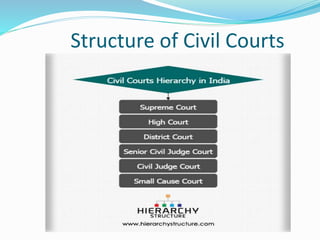
Structure of Civil Courts
Jurisdiction of Civil Court
Jurisdiction over Subject Matter
Jurisdiction over Territory or Territorial
Jurisdiction
Jurisdiction over Person
Jurisdiction over Pecuniary Limit or
Pecuniary Jurisdiction
Jurisdiction over Subject Matter
 The jurisdiction to try certain matters by
certain Court is limited by statute
 E.g. A small cause court can try suits for
money due under a promissory note or a suit
for price of work done
 Company cases and other Tax cases has its own
jurisdiction
Territorial Jurisdiction
 A territorial limit of jurisdiction for each court is fixed
by the Government .
 Thus, it can try matters falling within the territorial
limits of jurisdiction.
 E.g. Coimbatore Alternate Dispute Tribunal court can
deal with the matters only which falls under its
territorial territorial limits .It cant deal with matters
and disputes arises in Madurai, Kanyakumari etc.
Jurisdiction over persons
 All persons of whatever nationality are subject
to the jurisdiction of Civil Court of the country
 Except a foreign State , its Ruler or its
representatives
 E.g. Embassy of foreign countries and foreign
country itself.
Pecuniary Jurisdiction
 Pecuniary jurisdiction fixes that a particular type of Court
shall only have jurisdiction over suits, the amount or value
of which does not exceed a particular limit
 The limit is fixed by the government which may be
amended time to time as they think fit.
 States may fix according to their authority
 The pecuniary jurisdiction need not to be same for all the
states in India
 May fix by Bare Acts.
Jurisdictions may further classified as
 Original Jurisdiction - A Court tries and decides suits
filed before.
 Appellate Jurisdiction – A Court hears appeals against
decisions or decrees passed by subordinate Courts.
 Original and Appellate Jurisdiction – The court has
both Original and Appellate jurisdiction
 Stay on Suits
 Bar on suits
Appeals, Reference, Review and
Revisions
 Appeals :
Appeal is an option available to the defendant , incase if
he lost the decree in his side or if he thinks the decree
provided was not fare. He has an option to make an appeal
to the Higher Courts .
Types of appeals:
1. Appeal from original decree(sec 96-99)
2.Second Appeal (sec 100-103)
3.Appeal from Orders(104-106)
4.Appeal to Supreme Court(109-112)
 Reference:
Subject to conditions as may be prescribed, at any
time before judgment of a Court in which a suit has been
instituted may state a case and refer the same for option of
the High Court and the High Court may make such order
thereon as it thinks fit.(sec 13)
District Courts can make a reference with High Court in
a matter which it thinks a further clarification is needed or
refer to a Judgment which already given by the court in
which the court is not familiar with.
 Review:
Section 114 read with Order 47 Rule 1
Any person considering himself aggrieved by a decree or
an order may apply for a review of judgment to the court which
passed the decree or made the order on any of the grounds as
mentioned in Order 47 Rule 1
 Revision (sec 115)
The High Court may call for the record of any case which
has been decided by any Court subordinate to such High Court
and in which no appeals lies thereto, and if such subordinate
Court appears-
1. to have exercised a case not vest in by law
2.to have failed to exercise a jurisdiction
3.to have acted illegally or immaterial regularity.
Summary Proceedings
 A procedure by way of summary suit applies to suits upon
bill of exchange or promissory notes, when the plaintiff
desires to move faster proceedings.
 The object is to prevent unreasonable obstructions by the
defendant.
 Apply for following Courts:
1.High Courts, City Courts;
2.Other courts: In such courts where the High
Court allowed the Order 37.
 A case arises by a written contract or other legal contract
methods which obliged a debt by defendant.
 Essentials for Summary Suit:
1.A proof that the suit is filed under Order 37
2.No relief from other section or order is claimed
3.Inscription below the number of suit in the title of
the suit that the suit is established under Order 37 of the
CPC.
 Defendant has to appear before 10 days of summon.
 Days may be provided to him to produce evidence if the
court thinks he has a cause of action which is worthy.
Conclusion
Kindly ask your doubt without
hesitation!
Share your points regarding the
lesson!
Only we can ask for us! No one will

Civil Procedure Code 1908

  • 1.
    Procedures and Lawsregarding civil matters By Shajathali S PSG College of Arts and Science
  • 2.
    Meaning and Object Meaning The Law relating to the practices and procedures to be followed in civil courts is regulated by Code of Civil Procedure, 1908.  Objective To consolidate and amend the law relating to the procedure and practices followed Civil Courts of India. To create jurisdiction , while the rules indicate the mode in which the jurisdiction exercised
  • 3.
    Overview  Civil ProcedureCode(herein after known as CPC) consist of 2 parts .  Part 1 consist of 158 sections.  Part 2 consist of The Orders and Rules contained in schedule 1.  It does not affect any special jurisdiction or power conferred by any Special Law.  In case any dispute arise between CPC and Special Law the latter will prevail.
  • 4.
  • 5.
    Jurisdiction of CivilCourt Jurisdiction over Subject Matter Jurisdiction over Territory or Territorial Jurisdiction Jurisdiction over Person Jurisdiction over Pecuniary Limit or Pecuniary Jurisdiction
  • 6.
    Jurisdiction over SubjectMatter  The jurisdiction to try certain matters by certain Court is limited by statute  E.g. A small cause court can try suits for money due under a promissory note or a suit for price of work done  Company cases and other Tax cases has its own jurisdiction
  • 7.
    Territorial Jurisdiction  Aterritorial limit of jurisdiction for each court is fixed by the Government .  Thus, it can try matters falling within the territorial limits of jurisdiction.  E.g. Coimbatore Alternate Dispute Tribunal court can deal with the matters only which falls under its territorial territorial limits .It cant deal with matters and disputes arises in Madurai, Kanyakumari etc.
  • 8.
    Jurisdiction over persons All persons of whatever nationality are subject to the jurisdiction of Civil Court of the country  Except a foreign State , its Ruler or its representatives  E.g. Embassy of foreign countries and foreign country itself.
  • 9.
    Pecuniary Jurisdiction  Pecuniaryjurisdiction fixes that a particular type of Court shall only have jurisdiction over suits, the amount or value of which does not exceed a particular limit  The limit is fixed by the government which may be amended time to time as they think fit.  States may fix according to their authority  The pecuniary jurisdiction need not to be same for all the states in India  May fix by Bare Acts.
  • 10.
    Jurisdictions may furtherclassified as  Original Jurisdiction - A Court tries and decides suits filed before.  Appellate Jurisdiction – A Court hears appeals against decisions or decrees passed by subordinate Courts.  Original and Appellate Jurisdiction – The court has both Original and Appellate jurisdiction  Stay on Suits  Bar on suits
  • 11.
    Appeals, Reference, Reviewand Revisions  Appeals : Appeal is an option available to the defendant , incase if he lost the decree in his side or if he thinks the decree provided was not fare. He has an option to make an appeal to the Higher Courts . Types of appeals: 1. Appeal from original decree(sec 96-99) 2.Second Appeal (sec 100-103) 3.Appeal from Orders(104-106) 4.Appeal to Supreme Court(109-112)
  • 12.
     Reference: Subject toconditions as may be prescribed, at any time before judgment of a Court in which a suit has been instituted may state a case and refer the same for option of the High Court and the High Court may make such order thereon as it thinks fit.(sec 13) District Courts can make a reference with High Court in a matter which it thinks a further clarification is needed or refer to a Judgment which already given by the court in which the court is not familiar with.
  • 13.
     Review: Section 114read with Order 47 Rule 1 Any person considering himself aggrieved by a decree or an order may apply for a review of judgment to the court which passed the decree or made the order on any of the grounds as mentioned in Order 47 Rule 1  Revision (sec 115) The High Court may call for the record of any case which has been decided by any Court subordinate to such High Court and in which no appeals lies thereto, and if such subordinate Court appears- 1. to have exercised a case not vest in by law 2.to have failed to exercise a jurisdiction 3.to have acted illegally or immaterial regularity.
  • 14.
    Summary Proceedings  Aprocedure by way of summary suit applies to suits upon bill of exchange or promissory notes, when the plaintiff desires to move faster proceedings.  The object is to prevent unreasonable obstructions by the defendant.  Apply for following Courts: 1.High Courts, City Courts; 2.Other courts: In such courts where the High Court allowed the Order 37.
  • 15.
     A casearises by a written contract or other legal contract methods which obliged a debt by defendant.  Essentials for Summary Suit: 1.A proof that the suit is filed under Order 37 2.No relief from other section or order is claimed 3.Inscription below the number of suit in the title of the suit that the suit is established under Order 37 of the CPC.  Defendant has to appear before 10 days of summon.  Days may be provided to him to produce evidence if the court thinks he has a cause of action which is worthy.
  • 16.
    Conclusion Kindly ask yourdoubt without hesitation! Share your points regarding the lesson! Only we can ask for us! No one will