The Limiting Absorption Principle for the
Elasticity Operator in Homogeneous
Anisotropic Media
                                        Alejandro Domínguez-Torres1


Abstract
The spectral theory is studied and the principle of limiting absorption is proved for the elasticity operator
derived from the wave equations in infinite elastic homogeneous anisotropic media.


The Wave Equation for Elastic Homogeneous Anisotropic Media
For a medium obeying the generalized Hooke´s Law, the linear stress-strain relations in rectangular
Cartesian coordinates xi ; i  1,2,3; are [Achenbach p. 52 and Fedorov pp. 8-9]

(1)                                        ij  Cijlm lm ; i , j , l , m  1,2,3.

Here  ij is the stress tensor,  lm is the strain tensor, and C ijlm are the elastic coefficients satisfying the
symmetry conditions [Achenbach p. 52 and Fedorov pp. 12-15]:

(2)                                          Cijlm  C jilm  Cijml  Clmij .

In this way, only 21 independent constants are involved. Moreover, the convention summation for
repeated suffixes is assumed.

The strain tensor may be expressed in terms of the displacement vector ui ; i  1,2,3; by

                                                       1  u       u 
(3)                                              ij   i  j  .
                                                      2  x j xi 
                                                                  

In the absence of body forces and considering that the density of the medium is constant and equal to
one, the equation of motions are [Fedorov pp. 85-86]

                                                 2ui           2um
(4)                                                    C ijlm          .
                                                 t 2          x j xl

It is also assumed that the constants C ijlm have numerical values such that the strain energy W is
positive definite for symmetric stress components  ij   ji , where:

1
  This research paper is derived from the thesis dissertation (Spectral Theory for Elasticity Equations) presented
           th
(August 24 , 1989) by the author for obtaining the degree of Master of Science (Physics) at the School of Sciences
in the Universidad Nacional Autónoma de México. This paper never was published.

                                                     Page 1 de 14
1
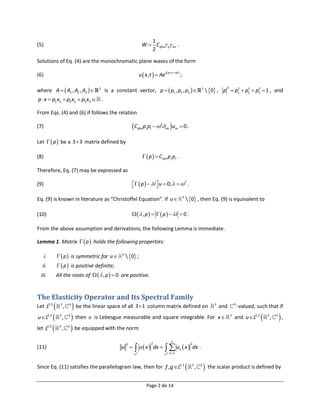
(5)                                                                  W  Cijlm ij  lm .
                                                                        2

Solutions of Eq. (4) are the monochromatic plane waves of the form

(6)                                                                u  x , t   Aei  px t  ;

where A   A1 , A2 , A3                   is a constant vector, p   p1 , p2 , p3                                       0 , p  p1  p2  p3  1 , and
                                         3                                                                               3                2
                                                                                                                                          2    2    2


p  x  p1 x1  p2 x2  p3 x3  .

From Eqs. (4) and (6) if follows the relation

(7)                                                          C   ijlm   pj pl  2 im  um  0 .

Let   p  be a 3  3 matrix defined by

(8)                                                                    p   C ijlm p j pl .

Therefore, Eq. (7) may be expressed as

(9)                                                            p   I  u  0;    2 .
                                                                          

Eq. (9) is known in literature as “Christoffel Equation”. If u                                       3
                                                                                                           0 , then Eq. (9) is equivalent to

(10)                                                            , p     p   I  0 .

From the above assumption and derivations, the following Lemma is immediate.

Lemma 1. Matrix   p  holds the following properties:

      i.          p  is symmetric for u          3
                                                          0 ;
  ii.             p  is positive definite;
  iii.          All the roots of    , p   0 are positive.


The Elasticity Operator and Its Spectral Family
Let L2,3         3
                      ,   3
                                be the linear space of all 3  1 column matrix defined on                                       3
                                                                                                                                     and          3
                                                                                                                                                      -valued, such that if
u L2,3         3
                     ,    3
                               then u is Lebesgue measurable and square integrable. For                                             x       3
                                                                                                                                                  and u L2,3      3
                                                                                                                                                                        ,   3
                                                                                                                                                                                ,
let L2,3        3
                     ,    3
                               be equipped with the norm
                                                                                            3
                                                                   u  x  dx         u x
                                                                             2
                                                              
                                                         2                                                    2
(11)                                                 u                                           n               dx .
                                                               3                       3   n 1


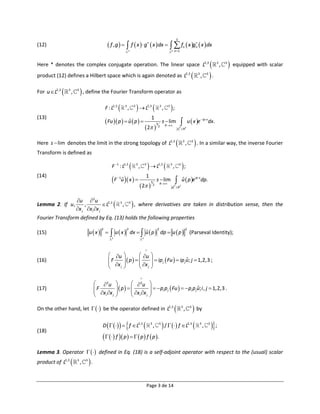
Since Eq. (11) satisfies the parallelogram law, then for f , g L2,3                                         3
                                                                                                                  ,   3
                                                                                                                           the scalar product is defined by
                                                                          Page 2 de 14
3
(12)                                                f , g    f  x   g  x  dx    fn  x gn  x  dx
                                                                                                      

                                                                        3                                                          3   n 1


Here * denotes the complex conjugate operation. The linear space L2,3                                                                                                                         3
                                                                                                                                                                                                   ,   3
                                                                                                                                                                                                              equipped with scalar
product (12) defines a Hilbert space which is again denoted as L2,3                                                                                                    3
                                                                                                                                                                              ,       3
                                                                                                                                                                                          .
For u L2,3      3
                      ,   3
                               , define the Fourier Transform operator as
                                                  F : L2,3         3
                                                                        ,       3
                                                                                    L                2,3           3
                                                                                                                          ,    3
                                                                                                                                   ;
(13)                                                                                                      1
                                                   Fu  p   u  p  
                                                                ˆ                                                         s  lim               u  x e
                                                                                                                                                                               ip x
                                                                                                                                                                                        dx.
                                                                                                     2 
                                                                                                                  3           R 
                                                                                                                      2                        2
                                                                                                                                            x R       2


Here s  lim denotes the limit in the strong topology of L2,3                                                                                     3
                                                                                                                                                           ,     3
                                                                                                                                                                      . In a similar way, the inverse Fourier
Transform is defined as

                                                      F 1 : L2,3                  3
                                                                                        ,           3
                                                                                                        L          2,3          3
                                                                                                                                       ,       3
                                                                                                                                                   ;
                                                      F u   x  
(14)                                                                                                1
                                                                                                                                            u  p e
                                                          1                                                                                                          ip x
                                                         ˆ                                                        s  lim                    ˆ                                dp.
                                                                                         2 
                                                                                                          3           R 
                                                                                                              2                        2
                                                                                                                                   p R        2


                          u  2u
Lemma 2. If u,                ,          L2,3             3
                                                                ,           3
                                                                                 , where derivatives are taken in distribution sense, then the
                          x j xi x j
Fourier Transform defined by Eq. (13) holds the following properties

                                      ux           ux                 dx   u  p  dp  u  p 
                                              2                         2                                         2                                        2
(15)                                                                               ˆ                                                                            (Parseval Identity);
                                                      3                                         3


                                                                                                    
                                                     u                 u                             
(16)                                                F
                                                     x          p  
                                                                         x                               ip j  Fu   ip ju; j  1,2,3 ;
                                                                                                          
                                                                                                                                ˆ
                                                        j               j                              
                                                                                            
                                             2u                   2u                                
(17)                                       F
                                            x x          p  
                                                                   x x                                  pi p j  Fu    pi p j u; i , j  1,2,3 .
                                                                                                         
                                                                                                                                        ˆ
                                              i   j               i j                                 

On the other hand, let    be the operator defined in L2,3                                                                                     3
                                                                                                                                                       ,        3
                                                                                                                                                                      by

(18)
                                                                    
                                               D       f  L2,3                                   3
                                                                                                              ,       3
                                                                                                                           /    f  L                    2,3        3
                                                                                                                                                                                  ,     3
                                                                                                                                                                                            ;
                                                   f   p     p  f  p  .
Lemma 3. Operator    defined in Eq. (18) is a self-adjoint operator with respect to the (usual) scalar
product of L2,3          3
                              ,   3
                                      .

                                                                                                        Page 3 de 14
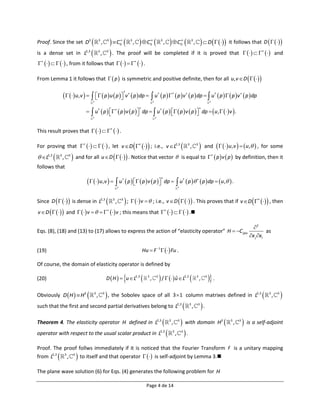
Proof. Since the set D3                           3
                                                       ,       3
                                                                     C  ,  C  ,  C 
                                                                                
                                                                                0
                                                                                            3                  
                                                                                                               0
                                                                                                                                3                        
                                                                                                                                                         0
                                                                                                                                                                       3
                                                                                                                                                                               ,         D   it follows that D    
is a dense set in L2,3                            3
                                                       ,       3
                                                                    . The proof will be completed                                                                     if it is proved that        and
       , from it follows that        .

From Lemma 1 it follows that   p  is symmetric and positive definite, then for all u, v  D     


                       u,v      p  u  p  v  p  dp   u  p    p  v  p  dp   u  p    p v  p  dp
                                                                                    †
                                                                                                                          †                 †                                                         †               
                                                     
                                       3                                                                           3                                                                                3


                                     u†  p    p  v  p   dp   u†  p    p  v  p   dp  u ,    v  .
                                                                                                                                                                                      
                                                                                                  
                                       3                                                                               3


This result proves that        .

For proving that        , let v D   ; i.e., v L2,3                                                                                             3
                                                                                                                                                                       ,           3
                                                                                                                                                                                           and     u , v    u ,  , for some
 L2,3        3
                    ,   3
                             and for all u  D     . Notice that vector                                                                          is equal to   p  v  p  by definition, then it
follows that

                                      u,v    u  p    p  v  p 
                                                                                                                                
                                                                            
                                                                                †
                                                                                                                                    dp   u†  p    p  dp  u ,  .
                                                                            3                                                                        3


Since D      is dense in L2,3                                3
                                                                        ,       3
                                                                                     ;   v   ; i.e., v  D     . This proves that if v D   , then                                                                


v  D      and    v       v ; this means that        .

                                                                                                                                                                                                                                   2
Eqs. (8), (18) and (13) to (17) allows to express the action of “elasticity operator” H  C ijlm                                                                                                                                         as
                                                                                                                                                                                                                                 x j xl

(19)                                                                                                    Hu  F 1   Fu .

Of course, the domain of elasticity operator is defined by

(20)                                                           D  H   u  L2,3                        3
                                                                                                               ,           3
                                                                                                                                /    u  L 
                                                                                                                                          ˆ                  2,3                   3
                                                                                                                                                                                       ,        3
                                                                                                                                                                                                     .
Obviously D  H   H2                    3
                                               ,           3
                                                                , the Sobolev space of all                                                  3  1 column matrixes defined in L2,3                                                          3
                                                                                                                                                                                                                                                 ,   3
                                                                                                                                                                                                                                                         
such that the first and second partial derivatives belong to L                                                                                       2,3
                                                                                                                                                                  3
                                                                                                                                                                           ,       3
                                                                                                                                                                                           .
Theorem 4. The elasticity operator H defined in L2,3                                                                                    3
                                                                                                                                             ,       3
                                                                                                                                                          with domain H                                   2   3
                                                                                                                                                                                                                    ,   3
                                                                                                                                                                                                                               is a self-adjoint
operator with respect to the usual scalar product in L2,3                                                                                   3
                                                                                                                                                 ,       3
                                                                                                                                                           .
Proof. The proof follws immediately if it is noticed that the Fourier Transform F is a unitary mapping
                             
from L2,3 3 , 3 to itself and that operator    is self-adjoint by Lemma 3.

The plane wave solution (6) for Eqs. (4) generates the following problem for H

                                                                                                          Page 4 de 14
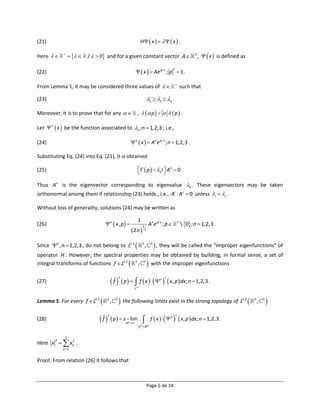
(21)                                                                 H   x     x  .

Here      
                      /   0 and for a given constant vector A                                               3
                                                                                                                        ,   x  is defined as

                                                                 x   Ae ip x ; p  1 .
                                                                                                     2
(22)

From Lemma 1, it may be considered three values of                                                     
                                                                                                             such that

(23)                                                                               1  2  3 .

Moreover, it is to prove that for any                            ,   p      p  .

Let  n  x  be the function associated to n ; n  1,2,3 ; i.e.,

(24)                                                          n  x   An e ipx ; n  1,2,3 .

Substituting Eq. (24) into Eq. (21), it is obtained

(25)                                                                  p   nI  An  0 .
                                                                                  

Thus An is the eigenvector corresponding to eigenvalue n . These eigenvectors may be taken
orthonormal among them if relationship (23) holds., i.e., Ai  A j  0 unless i   j .

Without loss of generality, solutions (24) may be written as

                                                                   1
(26)                               n  x , p                                    An eipx ; p         3
                                                                                                              0 ; n  1,2,3 .
                                                             2 
                                                                           3
                                                                               2


Since n , n  1,2,3 , do not belong to L2,3                              3
                                                                               ,       3
                                                                                            , they will be called the “improper eigenfunctions” of
operator H . However, the spectral properties may be obtained by building, in formal sense, a set of
                                                         
integral transforms of functions f L2,3 3 , 3 with the improper eigenfunctions    
                                         f          p   f  x    n   x , p  dx; n  1,2,3 .
                                                 n                                             
(27)
                                                                3


Lemma 5. For every f L2,3         3
                                         ,   3
                                                  the following limits exist in the strong topology of L                                   2,3   3
                                                                                                                                                       ,   3
                                                                                                                                                               
                               f                                                     f  x     n   x , p  dx ; n  1,2,3 .
                                                                                                         
                                          p   sM 
                                     n
(28)                                               lim
                                                                       2
                                                                    x  M2


             3
Here x   xk .
        2   2

            k 1


Proof. From relation (26) it follows that


                                                                                   Page 5 de 14
3                                                                                      
                        f  x     n   x , p  dx 
                                                                                                  1                                                      1
(29)                                                                                                             2 f  x   Ane  ipx dx                                                                   f j  x  e  ipx dx  An .
                                                                                                                                               j 1   2  2                                                                           
                                                                                                                                                                                                                                            j
                                                                                   2  2
                                                                                                       3                                                    3
                                                                                                                                                                                                                                        
            2                                                                                                   2                                                                                             2
         x M2                                                                                                 x M                                                                                          x M2


Since A n are constants for j  1,2,3 ; and fj L2
        j                                               , then from the Plancharel’s Theorem [Bochner                                        3
                                                                                                                                                   ,
and Chandrasekaran pp.112-113] it follows that the integral (29) converges in the norm of L  ,  and                                                                                                                                       2     3


the limit belongs to the same linear space.

For f L2,3                3
                                ,       3
                                             , Lemma 5 associates to it a vector  f                                                                                        1
                                                                                                                                                                                                     
                                                                                                                                                                                 , f 2 , f 3 , where f n L2                       3
                                                                                                                                                                                                                                        ,        , n  1,2,3 .
Moreover, the following result holds.

Lemma 6. For each f L2,3                                         3
                                                                       ,       3
                                                                                    , it follows the Parseval Identity
                                                                                                                                       3
                                                                                                                            fn
                                                                                                                       2                               2
(30)                                                                                                               f                                                         .
                                                                                                                                   n 1
                                                                                                                                                       L2       3
                                                                                                                                                                     ,   

Here f n , n  1,2,3 ; are defined by expression (28).

Proof. From relations (26) and (27) it follows that

(31)                                                                                                     ˆ       ˆ        ˆ        ˆ
                                                                                                   f n  f  A1 , f  A2 , f  A3  fA ;                                 
                                                                           ˆ
where A is a 3  3 matrix whose columns are formed by An , n  1,2,3 ; and f  Ff . Moreover, A is an
orthogonal matrix since its columns are orthonormal vector, thus A1  A† .

On the other hand,

                                                                      
        3                                        3                                                         3                                                             3

                                            fn, fn                                                 f n  p  dp                                            f  p                                f  p               fˆ  p  A
                        2                                                                                                                  2                                                     2                  2                             2
                fn                                                                                                                                                                   n
                                                                                                                                                                                                                       dp                           dp
       n 1
                        2
                        L      3
                                    ,          n 1
                                                                           2
                                                                           L       3
                                                                                       ,              n 1        3                                            3    n 1                                3                     3


                                                 fˆ  p                               f x
                                                               2                                               2                           2
                                                                  dp                                             dx  f .
                                                 3                                         3


The previous to last equality follows from Parseval’s identity for Fourier Transforms [Bochner and
Chandrasekaran p. 113].

Define the following linear operator

                                                                                                    : L2,3        L   3
                                                                                                                               ,           3               2,3               3
                                                                                                                                                                                 ,       3
                                                                                                                                                                                             
(32)
                                                                                                   f  f   f , f , f  .        1           2       3


Therefore, from Lemma 6 the next identity holds

(33)                                                                                                   f  f , f L2,3                                             3
                                                                                                                                                                         ,       3
                                                                                                                                                                                     .
This means that

                                                                                                                           Page 6 de 14
(34)                                                                   I .

Therefore  is a partial isometry and   P is the orthogonal projection of  L2,3                                                                    3
                                                                                                                                                              ,       3
                                                                                                                                                                            , the
range of  .

(35)                                            
                                        f  f  A1 , f  A2 , f  A3 ; f  L2,3 
                                             ˆ        ˆ        ˆ                                   3
                                                                                                        ,       3
                                                                                                                    .
                                                            ˆ
This means that the components of f are the projections of f on each An ; n  1,2,3 . Therefore, the
vector base formed by An ; n  1,2,3 ; vector f may be expressed as


                                                                       
                                              f   f  An An ; f  L2,3                                  
                                                        3
(36)                                                 ˆ                                      3
                                                                                                ,       3

                                                       n 1


From this interpretation and from Plancherel´s Theorem [Bochner and Chandrasekaran pp.112-113] it is
obtained the following result.

Lemma 7. For each f L2,3      3
                                    ,    3
                                              , the following limits exist on For each L                               2,3   3
                                                                                                                                   ,   3
                                                                                                                                           .
                                                                            3
                                          f  s  lim                f  p   x , p  dp .
                                                                                        n
(37)                                                                                n
                                                      M 
                                                                   p M2 n 1
                                                                    2


Here fn ; n  1,2,3 ; are the components of f .

From Eq. (37), it may be seen that

(38)                                                                f  F 1 Af .

Theorem 8. The operator  defined in (32) is a unitary linear operator; i.e.,

(39)                                                                I   .

Proof. The first equality of (39) follows from (34). On the other hand, since A is orthonormal, then it is
the matrix of a bijective linear transformation. Thus, if f L2,3 3 , 3 then g  Af L2,3 3 , 3 .                                                                                  
Moreover, since F is a unitary linear transformation from L2,3                                 3
                                                                                                    ,       3
                                                                                                                 to itself, then F                 1
                                                                                                                                                     g L2,3             3
                                                                                                                                                                              ,   3
                                                                                                                                                                                      .
Therefore, if h   f ,

(40)                                                 f     f   h  h† A .
                                                                              ˆ

From Eq. (38) it follows that
                                                                                

                                         h†   f    FF 1 Af    Af   fA† .
                                                      †             †        †
(41)                                     ˆ
                                                   

Combination of Eqs. (40) and (41) gives

                                                       f  fA† A  fI  f .

                                                                   Page 7 de 14
Eq. (39) is the eigenfunction expansion in abstract form; i.e., for each, it follows the next representation

(42)                                                                          f   f .

This eigenfunction expansion may be used to obtain a representation for the elasticity operator H .

Theorem 9. The operator  whose action is given by Eqs. (32), (35), and (36) defines a spectral
representation for H in the sense

(43)                                                                                           
                                                   Hf  1 f 1 , 2 f 2 , 3 f 3 ; f  D  H  .

Proof. Since D3      3
                          ,    3
                                 C  
                                       0
                                           3
                                               ,     C  
                                                           0
                                                                      3
                                                                          ,     C    
                                                                                        0
                                                                                                3
                                                                                                    ,      is a dense set on L2,3                   3
                                                                                                                                                          ,   3
                                                                                                                                                                   , thus if
f  D  H  and g  D3          , then
                                   3


                 Hf , g   Hf ,  g   F   Ff ,F Ag      Ff ,FF Ag     Ff , Ag 
                                                        1                    1                                 1

(44)
                              A   Ff , g    A   IFf , g    A   AA Ff , g    A   Af , g  .
                                       †                          †                                 †         †         †


Matrix A†    A is a diagonal matrix whose components are the eigenvalues of    :

(45)                                                     A†    A  i    ij     .

Thus Eq. (44) becomes

(46)                                            Hf , g    A   Af , g      f , g  .
                                                                          †


Eq. (43) follows immediately from Eq (46) since D3                                 3
                                                                                        ,   3
                                                                                                 is a dense set on L   2,3        3
                                                                                                                                        ,       3
                                                                                                                                                     .
Notice that Eq. (43) implies that

(47)                                                                      H   .

This means that operator  diagonalizes operator H .

Let Pn   be the orthogonal projection on the corresponding eigenspace of n   ; n  1,2,3 . Then Pn   is
given by [Kato]

                                                                  1            dz
(48)                                               Pn  p              p   p   z ; n  1,2,3 .
                                                                  2 i Cn  

Here C n  p  is a simple closed curve around n  p  ; n  1,2,3 . From Lemma 6, Lemma 7, Theorem 8, and
Theorem 9, the following corollary is proved.

Corollary 10. Operators    , H , and Pn   hold the following properties on L2,3                                         3
                                                                                                                                    ,       3
                                                                                                                                                


                                                                          Page 8 de 14
3
(49)                                                 P  p   I; p 
                                                     n 1
                                                               n
                                                                                             3
                                                                                                  0 ;

                                                           3
(50)                                        p   A n  p  Pn  p  A† ; p                           3
                                                                                                                0 ;
                                                       n 1


                                      3                                               3
(51)                      H  F 1 A n  p  Pn  p  A†    n  p  Pn  p  ; p                                3
                                                                                                                              0 ;
                                     n 1                                            n 1

                                                       3
(52)                                                  P  I; P
                                                      n 1
                                                               n          n       Pn   .


In order to find out more properties of the spectrum of the elasticity operator, return to Christoffel
equation (9) and its corresponding associated equation (10). For a fixed  , Eq. (10) defines a two-
dimensional surface on the vector spaced defined by vector p . Since the second term in Eq. (10) is
                                                                                                 p
proportional to    2 and p   p1 , p2 , p3   3  0 , with p  p1  p2  p3  1 ; let q  1 be the
                                                                    2   2   2    2

                                                                                                 2
                                                                  2   1
“slowness vector” [Achenbach p. 126], then it follows that q  . In this way and in virtue of Eq. (8),
                                                                                                               
Eq. (9) becomes

               p   I  u  C ijlm pl pm   im  u  C ijlm ql qm   im  u   C ijlmql qm   im  u  0 .
                                                                                                         

This last equation in turn implies that

(53)                                                   1, q     q   I  0 .

Eq. (53) describes an inverse velocity two-dimensional surface known in literature as “slowness surface”.
                                                                         1
Notice that this surface is independent of                                2
                                                                                     and only depends on the direction of propagation
vector q .

An alternative way of describing the slowness surface is by noticing that Eq. (53) is a polynomial of third
degree that in turn may be factorized in a unique way as

(54)                                         1, q   Q1 1, q  Q2 1, q  Q3 1, q   0 .

The locus described by each Qn 1, q  ; n  1,2,3 ; is given by the following set

(55)                                          Sn               3
                                                                       / n    1; n  1,2,3 .

Therefore, the slowness surface is given by
                                                                                 3
(56)                                                                   S             Sn .
                                                                              n 1


This description for the slowness surface permits defining a system of generalized radial coordinates on
  3
    :

                                                                   Page 9 de 14
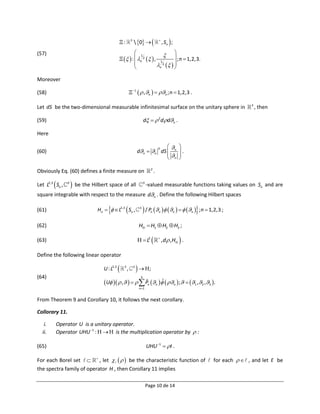
:          3
                                                             0                 
                                                                                        , Sn  ;
(57)                                                  1              
                                               :  n 2   , 1         ; n  1,2,3.
                                                                 n 2   
                                                                           

Moreover

(58)                                                     1   ,n   n ; n  1,2,3 .

                                                                                                                              3
Let dS be the two-dimensional measurable infinitesimal surface on the unitary sphere in                                           , then

(59)                                                                  d   2d dn .

Here

                                                                                                     
                                                                dn  n dS  n
                                                                        3
(60)                                                                                                 .
                                                                                                       
                                                                             n                        
                                                                            2
Obviously Eq. (60) defines a finite measure on                                  .

        
Let L2,3 Sn ,   3
                     be the Hilbert space of all                     3
                                                                          -valued measurable functions taking values on Sn and are
square integrable with respect to the measure dn . Define the following Hilbert spaces

(61)                                 
                                Hn    L2,3  Sn ,             3
                                                                      / P         ; n  1,2,3 ;
                                                                            n       n              n        n


(62)                                                             H  H1  H2  H3 ;

(63)                                                              L2             
                                                                                        , d  , H  .

Define the following linear operator

                                   U : L2,3    3
                                                    ,       3
                                                                  ;
(64)                                                              3
                                   U   ,     Pn n   n  ;  1 ,2 ,3  .
                                                                 n 1


From Theorem 9 and Corollary 10, it follows the next corollary.

Collorary 11.

   i.    Operator U is a unitary operator.
  ii.    Operator UHU 1 :    is the multiplication operator by  :

(65)                                                                      UHU 1  I .

For each Borel set   , let     be the characteristic function of                                          for each   , and let E be
the spectra family of operator H , then Corollary 11 implies

                                                                          Page 10 de 14
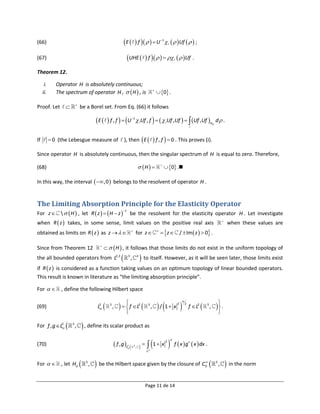
(66)                                                             E   f      U                      1
                                                                                                                    Uf    ;

(67)                                                              UHE   f         Uf .
Theorem 12.

      i.      Operator H is absolutely continuous;
     ii.      The spectrum of operator H ,   H  , is                                              
                                                                                                          0 .

                          
Proof. Let                   be a Borel set. From Eq. (66) it follows

                                             E   f , f   U       1
                                                                                Uf , f     Uf ,Uf    Uf ,Uf H d  .
                                                                                                                                                       


If          0 (the Lebesgue measure of                          ), then  E                         f , f   0 . This proves (i).
Since operator H is absolutely continuous, then the singular spectrum of H is equal to zero. Therefore,

(68)                                                                                H                  
                                                                                                                0 .

In this way, the interval   ,0  belongs to the resolvent of operator H .


The Limiting Absorption Principle for the Elasticity Operator
For z     H  , let R  z    H  z  be the resolvent for the elasticity operator H . Let investigate
                                           1


when R  z  takes, in some sense, limit values on the positive real axis  when these values are
obtained as limits on R  z  as z     for z    z  /  Im  z   0 .

Since from Theorem 12                         
                                                     H  , it follows that those limits do not exist in the uniform topology of
the all bounded operators from L2,3                               3
                                                                       ,           3
                                                                                        to itself. However, as it will be seen later, those limits exist
if R  z  is considered as a function taking values on an optimum topology of linear bounded operators.
This result is known in literature as “the limiting absorption principle”.

For           , define the following Hilbert space


                                                                                                          / 1  x         
                                                                                                                            
(69)                                         L2 
                                              
                                                    3
                                                        ,      f L 
                                                                
                                                                                       2     3
                                                                                                 ,
                                                                                                                        2       2
                                                                                                                                    f  L2    3
                                                                                                                                                   ,        .
                                                                                                                                                            
                                                                                                                                                              

For f , g L2
                    3
                          ,        , define its scalar product as

                                                                                             1  x 
                                                                                                                2 
(70)                                                     f , g L 
                                                                   2
                                                                   
                                                                           3
                                                                               ,                                    f  x  g  x  dx .
                                                                                             3


For           , let H           3
                                        ,    be the Hilbert space given by the closure of C                                                  
                                                                                                                                               0
                                                                                                                                                           3
                                                                                                                                                               ,    in the norm

                                                                                            Page 11 de 14


                                                                   F 1  p  Ff                                            ; f C 0                    .
                                                                      1     2 2                                                              3
(71)                                   f    H      3
                                                         ,
                                                                                                                                                   ,
                                                                                                         L2      3
                                                                                                                      ,   

Here F and F 1 denote the forward Fourier Transform and inverse Fourier Transform operators defined
              
on L2 3 , , respectively.

Theorem 13. For   1 2 ,                          
                                                          0 , and Sn defined by Eq. (55), there is a trace bounded operator
Tn    ; n  1,2,3 ; from space H                        3
                                                                 ,     to space L  S ,  such that if 
                                                                                             2
                                                                                                     n                                                 n   is given by Eq. (58), then

(72)                                  T            ; C 
                                        n                             n              n
                                                                                                         
                                                                                                         0
                                                                                                                          3
                                                                                                                              ,        H 
                                                                                                                                         
                                                                                                                                                   3
                                                                                                                                                       ,    
Moreover, Tn   is a Hölder continuous mapping from                                                     
                                                                                                                   0 to the space of bounded linear operators
from H       3
                   ,     to L  S ,  with exponent
                              2
                                  n


                                                 1          3
                                              2 , if   2 ;
                                           
                                                          3
(73)                                     1   , if   , with   0 arbitrary small;
                                                          2
                                                       3
                                            1, if   2 .
                                           

Proof. This theorem is a particular case of the Trace Theorem proved by Weder [Weder].

Define the following linear operator for n  1,2,3 ;

                                                     Bn ,    : L2,3             3
                                                                                       H ;
                                                                                         ,       3
                                                                                                                  n
(74)
                                                     Bn ,              f  P   T      f    .
                                                                                 n           n       n                                  n


                                                                                
                                                                                   
                                                                                2  2
Here         
                        0 ,   1 2 , and   1  x                                          . Thus, from Theorem 13 is Hölder continuous with
exponent  given by (73).

Now define the linear operator

(75)                                         B    f  B1,    f  B2,    f  B3,    f .

It follows that this last operator is also Hölder continuous with exponent  given by (73).

In this way, from Eq. (65) the next results are immediate for f  D  H  ,

(76)                                                                 U f   ,    B    f    ;

(77)                                                             UH f   ,     B    f    .


                                                                                Page 12 de 14
Moreover, for z                               
                                                       and for each compact interval I                                                               
                                                                                                                                                                0 , such that  belongs to I , it follows
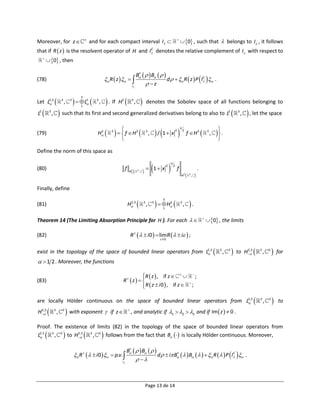
that if R  z  is the resolvent operator of H and I denotes the relative complement of I with respect to                   C

  
        0 , then

                                                                                                      B    B   
                                                                                                       

(78)                                                                   R  z                                                        d    R  z  P  I   .
                                                                                                                                                                 C

                                                                                               I
                                                                                                                       z

Let L2,3                                L                         . If   H2                            
                                           3
                           3       3               2      3                                   3
                              ,                             ,                                   ,                   denotes the Sobolev space of all functions belonging to
                                           1

L2        3
               ,        such that its first and second generalized derivatives belong to also to L                                                                                                                 2       3
                                                                                                                                                                                                                                 ,    , let the space

                                                                                                                                   / 1  x               
                                                                                                                                                               
(79)                                                      H 
                                                           2              3
                                                                                 f H 
                                                                                  
                                                                                                      2               3
                                                                                                                          ,
                                                                                                                                                       2           2
                                                                                                                                                                       f H2                  3
                                                                                                                                                                                                   ,        .
                                                                                                                                                                                                            
                                                                                                                                                                                                           

Define the norm of this space as


                                                                                                                                              
                                                                                                                                               
                                                                                                                                           2       2
(80)                                                                                  f   H  2
                                                                                                     3
                                                                                                          ,         1 x                                 f                           .
                                                                                                                                                               H2         3
                                                                                                                                                                               ,   

Finally, define

                                                                                          H                                       H                                  .
                                                                                                                                      3
                                                                                           2,3                    3           3                2               3
(81)                                                                                                                  ,                                           ,
                                                                                                                                      1


Theorem 14 (The Limiting Absorption Principle for H ). For each                                                                                                                          
                                                                                                                                                                                                0 , the limits

(82)                                                                                          R     i 0   limR    i  ;
                                                                                                                                     0


exist in the topology of the space of bounded linear operators from L2,3
                                                                                                                                                                                                           3
                                                                                                                                                                                                                 ,   3
                                                                                                                                                                                                                                2,3
                                                                                                                                                                                                                             to H        3
                                                                                                                                                                                                                                                ,   3
                                                                                                                                                                                                                                                           for
  1 2 . Moreover, the functions

                                                                                             R  z  , if z     ;
                                                                                             
(83)                                                                              R  z   
                                                                                              R  z  i 0  , if z  ;
                                                                                                                      
                                                                                             

are locally Hölder continuous on the space of bounded linear operators from L2,3
                                                                                                                                                                                                                                          3
                                                                                                                                                                                                                                                ,   3
                                                                                                                                                                                                                                                           to
H 
 2,3               3
                       ,   3
                                with exponent                          if z            
                                                                                              , and analytic if 1  2  3 and if Im  z   0 .

Proof. The existence of limits (82) in the topology of the space of bounded linear operators from
               2,3
                                                                
L2,3 3 , 3 to H 3 , 3 follows from the fact that B   is locally Hölder continuous. Moreover,

                                                                                      B    B   
                                                                                       

                                        R     i 0    p.v.                                                               d   i B    B      R    P  I  .
                                                                                                                                                                               C

                                                                                 I
                                                                                                       


                                                                                                                  Page 13 de 14
The Hölder continuity of (83) follows from Privalov-Plemelj’ Theorem [Weder]. The analyticity follows
from the analyticity of the slowness surface [Weder].


References
Achenbach, J. D. (1975). Wave propagation in elastic solids. North Holland Publishing Company.

Bochner, S. and Chandrasekaran, K. (1949). Fourier Transforms. Princeton University Press.

Fedorov, F. I. (1968). Theory of elastic waves in crystals. Plenum Press.

Kato, T. (1976). Perturbation theory for linear operators. Springer Verlag.

Weder, R. (1985). Analyticity of the scattering matrix for elastic waves in crystals. J. Math. Pures et Appl.
    64; pp. 121-148.


                                                Page 14 de 14

The limiting absorption principle for the elastic equations

  • 1.
    The Limiting AbsorptionPrinciple for the Elasticity Operator in Homogeneous Anisotropic Media Alejandro Domínguez-Torres1 Abstract The spectral theory is studied and the principle of limiting absorption is proved for the elasticity operator derived from the wave equations in infinite elastic homogeneous anisotropic media. The Wave Equation for Elastic Homogeneous Anisotropic Media For a medium obeying the generalized Hooke´s Law, the linear stress-strain relations in rectangular Cartesian coordinates xi ; i  1,2,3; are [Achenbach p. 52 and Fedorov pp. 8-9] (1)  ij  Cijlm lm ; i , j , l , m  1,2,3. Here  ij is the stress tensor,  lm is the strain tensor, and C ijlm are the elastic coefficients satisfying the symmetry conditions [Achenbach p. 52 and Fedorov pp. 12-15]: (2) Cijlm  C jilm  Cijml  Clmij . In this way, only 21 independent constants are involved. Moreover, the convention summation for repeated suffixes is assumed. The strain tensor may be expressed in terms of the displacement vector ui ; i  1,2,3; by 1  u u  (3)  ij   i  j  . 2  x j xi    In the absence of body forces and considering that the density of the medium is constant and equal to one, the equation of motions are [Fedorov pp. 85-86] 2ui 2um (4)  C ijlm . t 2 x j xl It is also assumed that the constants C ijlm have numerical values such that the strain energy W is positive definite for symmetric stress components  ij   ji , where: 1 This research paper is derived from the thesis dissertation (Spectral Theory for Elasticity Equations) presented th (August 24 , 1989) by the author for obtaining the degree of Master of Science (Physics) at the School of Sciences in the Universidad Nacional Autónoma de México. This paper never was published. Page 1 de 14
  • 2.
    1 (5) W  Cijlm ij  lm . 2 Solutions of Eq. (4) are the monochromatic plane waves of the form (6) u  x , t   Aei  px t  ; where A   A1 , A2 , A3   is a constant vector, p   p1 , p2 , p3   0 , p  p1  p2  p3  1 , and 3 3 2 2 2 2 p  x  p1 x1  p2 x2  p3 x3  . From Eqs. (4) and (6) if follows the relation (7) C ijlm pj pl  2 im  um  0 . Let   p  be a 3  3 matrix defined by (8)   p   C ijlm p j pl . Therefore, Eq. (7) may be expressed as (9)   p   I  u  0;    2 .   Eq. (9) is known in literature as “Christoffel Equation”. If u 3 0 , then Eq. (9) is equivalent to (10)    , p     p   I  0 . From the above assumption and derivations, the following Lemma is immediate. Lemma 1. Matrix   p  holds the following properties: i.   p  is symmetric for u 3 0 ; ii.   p  is positive definite; iii. All the roots of    , p   0 are positive. The Elasticity Operator and Its Spectral Family Let L2,3  3 , 3  be the linear space of all 3  1 column matrix defined on 3 and 3 -valued, such that if u L2,3  3 , 3  then u is Lebesgue measurable and square integrable. For x 3 and u L2,3  3 , 3 , let L2,3  3 , 3  be equipped with the norm 3 u  x  dx    u x 2  2 2 (11) u  n dx . 3 3 n 1 Since Eq. (11) satisfies the parallelogram law, then for f , g L2,3  3 , 3  the scalar product is defined by Page 2 de 14
  • 3.
    3 (12)  f , g    f  x   g  x  dx    fn  x gn  x  dx  3 3 n 1 Here * denotes the complex conjugate operation. The linear space L2,3  3 , 3  equipped with scalar product (12) defines a Hilbert space which is again denoted as L2,3  3 , 3 . For u L2,3  3 , 3  , define the Fourier Transform operator as F : L2,3  3 , 3 L  2,3 3 , 3 ; (13) 1  Fu  p   u  p   ˆ s  lim  u  x e  ip x dx.  2  3 R  2 2 x R 2 Here s  lim denotes the limit in the strong topology of L2,3  3 , 3  . In a similar way, the inverse Fourier Transform is defined as F 1 : L2,3  3 , 3 L  2,3 3 , 3 ; F u   x   (14) 1  u  p e 1 ip x ˆ s  lim ˆ dp.  2  3 R  2 2 p R 2 u  2u Lemma 2. If u, ,  L2,3  3 , 3  , where derivatives are taken in distribution sense, then the x j xi x j Fourier Transform defined by Eq. (13) holds the following properties ux   ux dx   u  p  dp  u  p  2 2 2 2 (15) ˆ (Parseval Identity); 3 3   u   u  (16) F  x   p     x   ip j  Fu   ip ju; j  1,2,3 ;  ˆ  j   j     2u    2u  (17) F  x x   p     x x    pi p j  Fu    pi p j u; i , j  1,2,3 .  ˆ  i j   i j  On the other hand, let    be the operator defined in L2,3  3 , 3  by (18)  D       f  L2,3  3 , 3  /    f  L  2,3 3 , 3 ;     f   p     p  f  p  . Lemma 3. Operator    defined in Eq. (18) is a self-adjoint operator with respect to the (usual) scalar product of L2,3  3 , 3 . Page 3 de 14
  • 4.
    Proof. Since theset D3  3 , 3   C  ,  C  ,  C   0 3  0 3  0 3 ,   D   it follows that D     is a dense set in L2,3  3 , 3  . The proof will be completed if it is proved that        and        , from it follows that        . From Lemma 1 it follows that   p  is symmetric and positive definite, then for all u, v  D         u,v      p  u  p  v  p  dp   u  p    p  v  p  dp   u  p    p v  p  dp †  † †  †    3 3 3   u†  p    p  v  p   dp   u†  p    p  v  p   dp  u ,    v  .       3 3 This result proves that        . For proving that        , let v D   ; i.e., v L2,3    3 , 3  and     u , v    u ,  , for some  L2,3  3 , 3  and for all u  D     . Notice that vector  is equal to   p  v  p  by definition, then it follows that    u,v    u  p    p  v  p     † dp   u†  p    p  dp  u ,  . 3 3 Since D      is dense in L2,3  3 , 3  ;   v   ; i.e., v  D     . This proves that if v D   , then  v  D      and    v       v ; this means that        . 2 Eqs. (8), (18) and (13) to (17) allows to express the action of “elasticity operator” H  C ijlm as x j xl (19) Hu  F 1   Fu . Of course, the domain of elasticity operator is defined by (20) D  H   u  L2,3   3 , 3  /    u  L  ˆ 2,3 3 , 3  . Obviously D  H   H2  3 , 3  , the Sobolev space of all 3  1 column matrixes defined in L2,3  3 , 3  such that the first and second partial derivatives belong to L 2,3  3 , 3 . Theorem 4. The elasticity operator H defined in L2,3  3 , 3  with domain H  2 3 , 3  is a self-adjoint operator with respect to the usual scalar product in L2,3  3 , 3 . Proof. The proof follws immediately if it is noticed that the Fourier Transform F is a unitary mapping   from L2,3 3 , 3 to itself and that operator    is self-adjoint by Lemma 3. The plane wave solution (6) for Eqs. (4) generates the following problem for H Page 4 de 14
  • 5.
    (21) H   x     x  . Here       /   0 and for a given constant vector A 3 ,   x  is defined as   x   Ae ip x ; p  1 . 2 (22) From Lemma 1, it may be considered three values of    such that (23) 1  2  3 . Moreover, it is to prove that for any   ,   p      p  . Let  n  x  be the function associated to n ; n  1,2,3 ; i.e., (24)  n  x   An e ipx ; n  1,2,3 . Substituting Eq. (24) into Eq. (21), it is obtained (25)   p   nI  An  0 .   Thus An is the eigenvector corresponding to eigenvalue n . These eigenvectors may be taken orthonormal among them if relationship (23) holds., i.e., Ai  A j  0 unless i   j . Without loss of generality, solutions (24) may be written as 1 (26) n  x , p  An eipx ; p  3 0 ; n  1,2,3 . 2  3 2 Since n , n  1,2,3 , do not belong to L2,3  3 , 3  , they will be called the “improper eigenfunctions” of operator H . However, the spectral properties may be obtained by building, in formal sense, a set of  integral transforms of functions f L2,3 3 , 3 with the improper eigenfunctions  f  p   f  x    n   x , p  dx; n  1,2,3 . n  (27) 3 Lemma 5. For every f L2,3  3 , 3  the following limits exist in the strong topology of L  2,3 3 , 3  f f  x     n   x , p  dx ; n  1,2,3 .   p   sM  n (28)  lim 2 x  M2 3 Here x   xk . 2 2 k 1 Proof. From relation (26) it follows that Page 5 de 14
  • 6.
    3   f  x     n   x , p  dx   1 1 (29)  2 f  x   Ane  ipx dx     f j  x  e  ipx dx  An . j 1   2  2  j 2  2 3 3   2 2 2 x M2 x M x M2 Since A n are constants for j  1,2,3 ; and fj L2 j  , then from the Plancharel’s Theorem [Bochner  3 , and Chandrasekaran pp.112-113] it follows that the integral (29) converges in the norm of L  ,  and 2 3 the limit belongs to the same linear space. For f L2,3  3 , 3  , Lemma 5 associates to it a vector  f 1  , f 2 , f 3 , where f n L2  3 ,  , n  1,2,3 . Moreover, the following result holds. Lemma 6. For each f L2,3  3 , 3  , it follows the Parseval Identity 3  fn 2 2 (30) f . n 1 L2  3 ,  Here f n , n  1,2,3 ; are defined by expression (28). Proof. From relations (26) and (27) it follows that (31) ˆ  ˆ ˆ ˆ f n  f  A1 , f  A2 , f  A3  fA ;  ˆ where A is a 3  3 matrix whose columns are formed by An , n  1,2,3 ; and f  Ff . Moreover, A is an orthogonal matrix since its columns are orthonormal vector, thus A1  A† . On the other hand,   3 3 3 3   fn, fn    f n  p  dp    f  p  f  p  fˆ  p  A 2 2 2 2 2 fn n  dp  dp n 1 2 L  3 ,  n 1 2 L 3 ,  n 1 3 3 n 1 3 3  fˆ  p   f x 2 2 2  dp  dx  f . 3 3 The previous to last equality follows from Parseval’s identity for Fourier Transforms [Bochner and Chandrasekaran p. 113]. Define the following linear operator  : L2,3   L  3 , 3 2,3 3 , 3  (32) f  f   f , f , f  . 1 2 3 Therefore, from Lemma 6 the next identity holds (33) f  f , f L2,3  3 , 3 . This means that Page 6 de 14
  • 7.
    (34)   I . Therefore  is a partial isometry and   P is the orthogonal projection of  L2,3   3 , 3   , the range of  . (35)  f  f  A1 , f  A2 , f  A3 ; f  L2,3  ˆ ˆ ˆ  3 , 3 . ˆ This means that the components of f are the projections of f on each An ; n  1,2,3 . Therefore, the vector base formed by An ; n  1,2,3 ; vector f may be expressed as   f   f  An An ; f  L2,3   3 (36) ˆ 3 , 3 n 1 From this interpretation and from Plancherel´s Theorem [Bochner and Chandrasekaran pp.112-113] it is obtained the following result. Lemma 7. For each f L2,3  3 , 3  , the following limits exist on For each L  2,3 3 , 3 . 3  f  s  lim   f  p   x , p  dp . n (37) n M  p M2 n 1 2 Here fn ; n  1,2,3 ; are the components of f . From Eq. (37), it may be seen that (38)  f  F 1 Af . Theorem 8. The operator  defined in (32) is a unitary linear operator; i.e., (39)   I   . Proof. The first equality of (39) follows from (34). On the other hand, since A is orthonormal, then it is the matrix of a bijective linear transformation. Thus, if f L2,3 3 , 3 then g  Af L2,3 3 , 3 .     Moreover, since F is a unitary linear transformation from L2,3  3 , 3  to itself, then F 1 g L2,3  3 , 3 . Therefore, if h   f , (40)  f     f   h  h† A . ˆ From Eq. (38) it follows that  h†   f    FF 1 Af    Af   fA† . † † † (41) ˆ   Combination of Eqs. (40) and (41) gives  f  fA† A  fI  f . Page 7 de 14
  • 8.
    Eq. (39) isthe eigenfunction expansion in abstract form; i.e., for each, it follows the next representation (42) f   f . This eigenfunction expansion may be used to obtain a representation for the elasticity operator H . Theorem 9. The operator  whose action is given by Eqs. (32), (35), and (36) defines a spectral representation for H in the sense (43)   Hf  1 f 1 , 2 f 2 , 3 f 3 ; f  D  H  . Proof. Since D3  3 , 3  C   0 3 ,  C   0 3 ,  C   0 3 ,  is a dense set on L2,3  3 , 3  , thus if f  D  H  and g  D3   , then 3  Hf , g   Hf ,  g   F   Ff ,F Ag      Ff ,FF Ag     Ff , Ag   1 1 1 (44)   A   Ff , g    A   IFf , g    A   AA Ff , g    A   Af , g  . † † † † † Matrix A†    A is a diagonal matrix whose components are the eigenvalues of    : (45)   A†    A  i    ij     . Thus Eq. (44) becomes (46)  Hf , g    A   Af , g      f , g  . † Eq. (43) follows immediately from Eq (46) since D3  3 , 3  is a dense set on L  2,3 3 , 3  . Notice that Eq. (43) implies that (47) H   . This means that operator  diagonalizes operator H . Let Pn   be the orthogonal projection on the corresponding eigenspace of n   ; n  1,2,3 . Then Pn   is given by [Kato] 1 dz (48) Pn  p   p   p   z ; n  1,2,3 . 2 i Cn   Here C n  p  is a simple closed curve around n  p  ; n  1,2,3 . From Lemma 6, Lemma 7, Theorem 8, and Theorem 9, the following corollary is proved. Corollary 10. Operators    , H , and Pn   hold the following properties on L2,3  3 , 3  Page 8 de 14
  • 9.
    3 (49)  P  p   I; p  n 1 n 3 0 ; 3 (50)   p   A n  p  Pn  p  A† ; p  3 0 ; n 1 3 3 (51) H  F 1 A n  p  Pn  p  A†    n  p  Pn  p  ; p  3 0 ; n 1 n 1 3 (52)  P  I; P n 1 n n  Pn   . In order to find out more properties of the spectrum of the elasticity operator, return to Christoffel equation (9) and its corresponding associated equation (10). For a fixed  , Eq. (10) defines a two- dimensional surface on the vector spaced defined by vector p . Since the second term in Eq. (10) is p proportional to    2 and p   p1 , p2 , p3   3 0 , with p  p1  p2  p3  1 ; let q  1 be the 2 2 2 2  2 2 1 “slowness vector” [Achenbach p. 126], then it follows that q  . In this way and in virtue of Eq. (8),  Eq. (9) becomes   p   I  u  C ijlm pl pm   im  u  C ijlm ql qm   im  u   C ijlmql qm   im  u  0 .         This last equation in turn implies that (53)  1, q     q   I  0 . Eq. (53) describes an inverse velocity two-dimensional surface known in literature as “slowness surface”. 1 Notice that this surface is independent of    2 and only depends on the direction of propagation vector q . An alternative way of describing the slowness surface is by noticing that Eq. (53) is a polynomial of third degree that in turn may be factorized in a unique way as (54)  1, q   Q1 1, q  Q2 1, q  Q3 1, q   0 . The locus described by each Qn 1, q  ; n  1,2,3 ; is given by the following set (55) Sn    3 / n    1; n  1,2,3 . Therefore, the slowness surface is given by 3 (56) S Sn . n 1 This description for the slowness surface permits defining a system of generalized radial coordinates on 3 : Page 9 de 14
  • 10.
    : 3 0    , Sn  ; (57)  1      :  n 2   , 1  ; n  1,2,3.  n 2      Moreover (58)  1   ,n   n ; n  1,2,3 . 3 Let dS be the two-dimensional measurable infinitesimal surface on the unitary sphere in , then (59) d   2d dn . Here   dn  n dS  n 3 (60)  .   n  2 Obviously Eq. (60) defines a finite measure on .  Let L2,3 Sn , 3  be the Hilbert space of all 3 -valued measurable functions taking values on Sn and are square integrable with respect to the measure dn . Define the following Hilbert spaces (61)  Hn    L2,3  Sn , 3  / P         ; n  1,2,3 ; n n n n (62) H  H1  H2  H3 ; (63)   L2   , d  , H  . Define the following linear operator U : L2,3  3 , 3   ; (64) 3 U   ,     Pn n   n  ;  1 ,2 ,3  . n 1 From Theorem 9 and Corollary 10, it follows the next corollary. Collorary 11. i. Operator U is a unitary operator. ii. Operator UHU 1 :    is the multiplication operator by  : (65) UHU 1  I . For each Borel set   , let     be the characteristic function of for each   , and let E be the spectra family of operator H , then Corollary 11 implies Page 10 de 14
  • 11.
    (66) E   f      U 1     Uf    ; (67) UHE   f         Uf . Theorem 12. i. Operator H is absolutely continuous; ii. The spectrum of operator H ,   H  , is   0 .  Proof. Let  be a Borel set. From Eq. (66) it follows  E   f , f   U 1  Uf , f     Uf ,Uf    Uf ,Uf H d  .  If  0 (the Lebesgue measure of ), then  E   f , f   0 . This proves (i). Since operator H is absolutely continuous, then the singular spectrum of H is equal to zero. Therefore, (68)  H     0 . In this way, the interval   ,0  belongs to the resolvent of operator H . The Limiting Absorption Principle for the Elasticity Operator For z    H  , let R  z    H  z  be the resolvent for the elasticity operator H . Let investigate 1 when R  z  takes, in some sense, limit values on the positive real axis  when these values are obtained as limits on R  z  as z     for z    z  /  Im  z   0 . Since from Theorem 12     H  , it follows that those limits do not exist in the uniform topology of the all bounded operators from L2,3  3 , 3  to itself. However, as it will be seen later, those limits exist if R  z  is considered as a function taking values on an optimum topology of linear bounded operators. This result is known in literature as “the limiting absorption principle”. For   , define the following Hilbert space  / 1  x   (69) L2   3 ,    f L   2 3 , 2 2 f  L2  3 ,  .    For f , g L2   3 ,  , define its scalar product as  1  x  2  (70)  f , g L  2  3 ,  f  x  g  x  dx . 3 For   , let H  3 ,  be the Hilbert space given by the closure of C   0 3 ,  in the norm Page 11 de 14
  • 12.
      F 1  p  Ff ; f C 0  . 1 2 2  3 (71) f H  3 , , L2  3 ,  Here F and F 1 denote the forward Fourier Transform and inverse Fourier Transform operators defined   on L2 3 , , respectively. Theorem 13. For   1 2 ,     0 , and Sn defined by Eq. (55), there is a trace bounded operator Tn    ; n  1,2,3 ; from space H  3 ,  to space L  S ,  such that if  2 n n is given by Eq. (58), then (72) T            ; C  n n n  0 3 ,  H   3 ,  Moreover, Tn   is a Hölder continuous mapping from   0 to the space of bounded linear operators from H  3 ,  to L  S ,  with exponent 2 n  1 3    2 , if   2 ;   3 (73)   1   , if   , with   0 arbitrary small;  2  3  1, if   2 .  Proof. This theorem is a particular case of the Trace Theorem proved by Weder [Weder]. Define the following linear operator for n  1,2,3 ; Bn ,    : L2,3  3 H ; , 3 n (74) Bn ,    f  P   T      f    . n n n  n    2  2 Here     0 ,   1 2 , and   1  x . Thus, from Theorem 13 is Hölder continuous with exponent  given by (73). Now define the linear operator (75) B    f  B1,    f  B2,    f  B3,    f . It follows that this last operator is also Hölder continuous with exponent  given by (73). In this way, from Eq. (65) the next results are immediate for f  D  H  , (76) U f   ,    B    f    ; (77) UH f   ,     B    f    . Page 12 de 14
  • 13.
    Moreover, for z  and for each compact interval I    0 , such that  belongs to I , it follows that if R  z  is the resolvent operator of H and I denotes the relative complement of I with respect to C   0 , then B    B     (78)  R  z     d    R  z  P  I   . C I  z Let L2,3    L   . If H2   3 3 3 2 3 3  ,  , , denotes the Sobolev space of all functions belonging to 1 L2  3 ,  such that its first and second generalized derivatives belong to also to L  2 3 ,  , let the space  / 1  x   (79) H  2 3    f H   2 3 , 2 2 f H2  3 ,  .    Define the norm of this space as    2 2 (80) f H 2  3 ,   1 x f . H2  3 ,  Finally, define H    H  . 3 2,3 3 3 2 3 (81) ,  , 1 Theorem 14 (The Limiting Absorption Principle for H ). For each     0 , the limits (82) R     i 0   limR    i  ;  0 exist in the topology of the space of bounded linear operators from L2,3   3 , 3  2,3 to H  3 , 3  for   1 2 . Moreover, the functions R  z  , if z     ;  (83) R  z     R  z  i 0  , if z  ;   are locally Hölder continuous on the space of bounded linear operators from L2,3   3 , 3  to H  2,3 3 , 3  with exponent  if z   , and analytic if 1  2  3 and if Im  z   0 . Proof. The existence of limits (82) in the topology of the space of bounded linear operators from   2,3    L2,3 3 , 3 to H 3 , 3 follows from the fact that B   is locally Hölder continuous. Moreover, B    B      R     i 0    p.v. d   i B    B      R    P  I  .  C I   Page 13 de 14
  • 14.
    The Hölder continuityof (83) follows from Privalov-Plemelj’ Theorem [Weder]. The analyticity follows from the analyticity of the slowness surface [Weder]. References Achenbach, J. D. (1975). Wave propagation in elastic solids. North Holland Publishing Company. Bochner, S. and Chandrasekaran, K. (1949). Fourier Transforms. Princeton University Press. Fedorov, F. I. (1968). Theory of elastic waves in crystals. Plenum Press. Kato, T. (1976). Perturbation theory for linear operators. Springer Verlag. Weder, R. (1985). Analyticity of the scattering matrix for elastic waves in crystals. J. Math. Pures et Appl. 64; pp. 121-148. Page 14 de 14