Active Transport
Active Transport
Cell Membrane Pumps
Cell Membrane Pumps
and Vesicle Transport
Active Transport
Active Transport
 Active transport
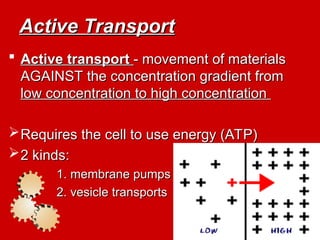
Active transport - movement of materials
- movement of materials
AGAINST the concentration gradient from
low concentration to high concentration
Requires the cell to use energy (ATP)
Requires the cell to use energy (ATP)
2 kinds:
2 kinds:
1. membrane pumps
1. membrane pumps
2. vesicle transports
1. Cell Membrane Pumps
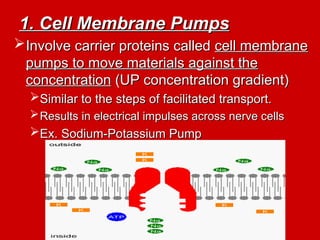
Involve carrier proteins called
Involve carrier proteins called cell membrane
cell membrane
pumps to move materials against the
concentration
concentration (UP concentration gradient)
(UP concentration gradient)
Similar to the steps of facilitated transport.
Similar to the steps of facilitated transport.
Results in electrical impulses across nerve cells
Results in electrical impulses across nerve cells
Ex. Sodium-Potassium Pump
Ex. Sodium-Potassium Pump
2. Vesicle Transport
 Some substances (ex. Food) are
Some substances (ex. Food) are too BIG
too BIG
to pass through membrane
OR
OR
large quantities
large quantities need to pass through the cell
need to pass through the cell
 These situations use
These situations use vesicle transport
vesicle transport
 Two kinds
Two kinds
1.
1.Endocytosis
Endocytosis
2.
2.Exocytosis
Exocytosis
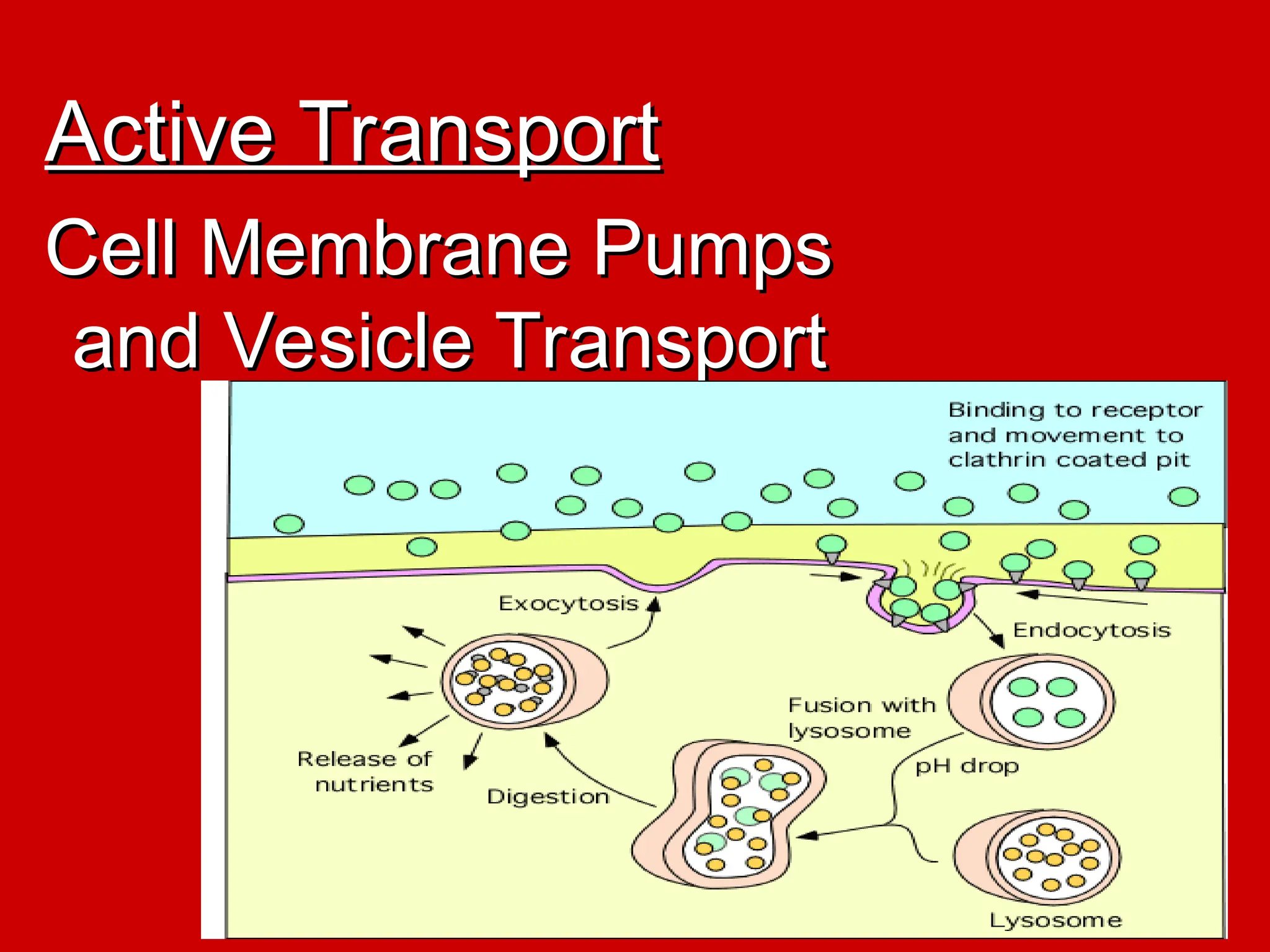
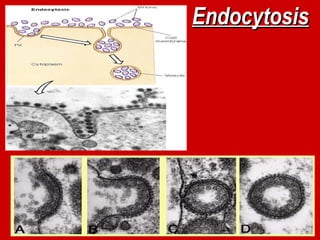
Endocytosis
Endocytosis
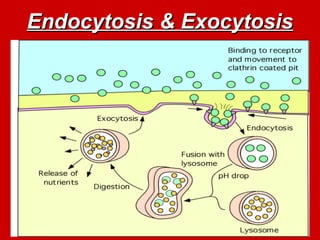
 Cells ingest external fluid, macromolecules &
Cells ingest external fluid, macromolecules &
large particles (including other cells)
 External materials are enclosed by part of the
External materials are enclosed by part of the
cell, forming a pouch
 The pouch pinches off cell membrane &
The pouch pinches off cell membrane &
becomes a membrane bound organelle called

 a
a vesicle
vesicle
 Vesicles can fuse with lysosomes to digests
Vesicles can fuse with lysosomes to digests
contents.
contents.
Two kinds of Endocytosis:
1.
1. Phagocytosis
Phagocytosis – movement of large particles or whole
– movement of large particles or whole
cells. *Possible feeding method, or a method of defense
to destroy bacteria/viruses
2.
2. Pinocytosis
Pinocytosis – transport of solutes or liquids
– transport of solutes or liquids
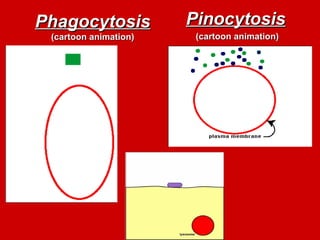
Phagocytosis
Phagocytosis
(cartoon animation)
(cartoon animation)
Pinocytosis
Pinocytosis
(cartoon animation)
(cartoon animation)
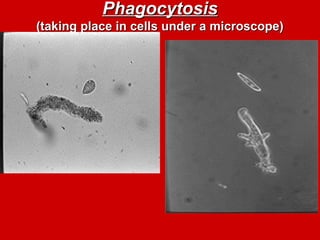
Phagocytosis
Phagocytosis
(taking place in cells under a microscope)
Endocytosis
Endocytosis
Exocytosis
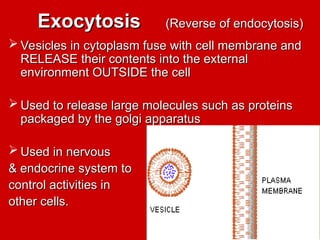
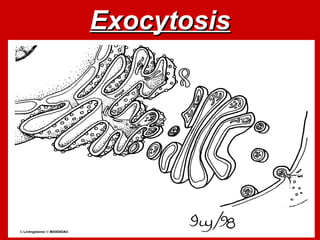
Exocytosis (Reverse of endocytosis)
(Reverse of endocytosis)
 Vesicles in cytoplasm fuse with cell membrane and
Vesicles in cytoplasm fuse with cell membrane and
RELEASE their contents into the external
environment OUTSIDE the cell
 Used to release large molecules such as proteins
Used to release large molecules such as proteins
packaged by the golgi apparatus
 Used in nervous
Used in nervous
& endocrine system to
control activities in
other cells.
other cells.
Exocytosis
Exocytosis
Endocytosis & Exocytosis
Endocytosis
Endocytosis
• http://www.maxanim.com/physiology/Endo
cytosis%20and%20Exocytosis/Endocytosi
s%20and%20Exocytosis.htm

6_Active transport for bacterial cell membrane.ppt

  • 1.
    Active Transport Active Transport CellMembrane Pumps Cell Membrane Pumps and Vesicle Transport and Vesicle Transport
  • 2.
    Active Transport Active Transport Active transport Active transport - movement of materials - movement of materials AGAINST the concentration gradient from AGAINST the concentration gradient from low concentration to high concentration low concentration to high concentration Requires the cell to use energy (ATP) Requires the cell to use energy (ATP) 2 kinds: 2 kinds: 1. membrane pumps 1. membrane pumps 2. vesicle transports 2. vesicle transports
  • 3.
    1. Cell MembranePumps 1. Cell Membrane Pumps Involve carrier proteins called Involve carrier proteins called cell membrane cell membrane pumps to move materials against the pumps to move materials against the concentration concentration (UP concentration gradient) (UP concentration gradient) Similar to the steps of facilitated transport. Similar to the steps of facilitated transport. Results in electrical impulses across nerve cells Results in electrical impulses across nerve cells Ex. Sodium-Potassium Pump Ex. Sodium-Potassium Pump
  • 4.
    2. Vesicle Transport 2.Vesicle Transport  Some substances (ex. Food) are Some substances (ex. Food) are too BIG too BIG to pass through membrane to pass through membrane OR OR large quantities large quantities need to pass through the cell need to pass through the cell  These situations use These situations use vesicle transport vesicle transport  Two kinds Two kinds 1. 1.Endocytosis Endocytosis 2. 2.Exocytosis Exocytosis
  • 5.
    Endocytosis Endocytosis  Cells ingestexternal fluid, macromolecules & Cells ingest external fluid, macromolecules & large particles (including other cells) large particles (including other cells)  External materials are enclosed by part of the External materials are enclosed by part of the cell, forming a pouch cell, forming a pouch  The pouch pinches off cell membrane & The pouch pinches off cell membrane & becomes a membrane bound organelle called becomes a membrane bound organelle called   a a vesicle vesicle  Vesicles can fuse with lysosomes to digests Vesicles can fuse with lysosomes to digests contents. contents. Two kinds of Endocytosis: Two kinds of Endocytosis: 1. 1. Phagocytosis Phagocytosis – movement of large particles or whole – movement of large particles or whole cells. *Possible feeding method, or a method of defense cells. *Possible feeding method, or a method of defense to destroy bacteria/viruses to destroy bacteria/viruses 2. 2. Pinocytosis Pinocytosis – transport of solutes or liquids – transport of solutes or liquids
  • 6.
  • 7.
    Phagocytosis Phagocytosis (taking place incells under a microscope) (taking place in cells under a microscope)
  • 8.
  • 9.
    Exocytosis Exocytosis (Reverse ofendocytosis) (Reverse of endocytosis)  Vesicles in cytoplasm fuse with cell membrane and Vesicles in cytoplasm fuse with cell membrane and RELEASE their contents into the external RELEASE their contents into the external environment OUTSIDE the cell environment OUTSIDE the cell  Used to release large molecules such as proteins Used to release large molecules such as proteins packaged by the golgi apparatus packaged by the golgi apparatus  Used in nervous Used in nervous & endocrine system to & endocrine system to control activities in control activities in other cells. other cells.
  • 10.
  • 11.
  • 12.