Paragraph Writing,
Transitional Words
Lecture No. 14
Zafar Ullah, lecturer in English zafarullah76@gmail.com
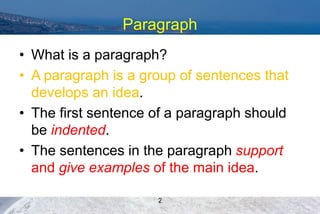
Paragraph
• What is a paragraph?
• A paragraph is a group of sentences that
develops an idea.
• The first sentence of a paragraph should
be indented.
• The sentences in the paragraph support
and give examples of the main idea.
2
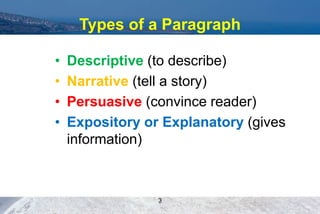
Types of a Paragraph
• Descriptive (to describe)
• Narrative (tell a story)
• Persuasive (convince reader)
• Expository or Explanatory (gives
information)
3
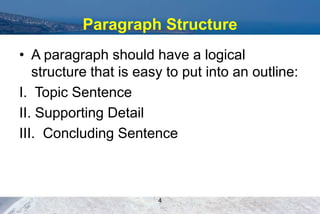
Paragraph Structure
• A paragraph should have a logical
structure that is easy to put into an outline:
I. Topic Sentence
II. Supporting Detail
III. Concluding Sentence
4
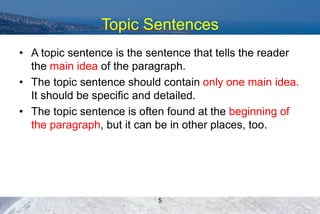
Topic Sentences
• A topic sentence is the sentence that tells the reader
the main idea of the paragraph.
• The topic sentence should contain only one main idea.
It should be specific and detailed.
• The topic sentence is often found at the beginning of
the paragraph, but it can be in other places, too.
5
Topic Sentences: Good
Examples
• When I was a child, I lived in a house that
had a strange atmosphere.
• Kashmir Valley in Pakistan is the most
beautiful place on Earth.
• My favourite item of clothing is a
comfortable, worn pair of jeans that I have
had for many years.
6
Supporting Details
• Sentences that are connected to the main
idea. They include information or details
the reader needs in order to understand
the topic.
• Sentences should be ordered in the best
possible order. They can be ordered by
time, location, evidence, examples,
event, importance.
7
Closing Statement/ Concluding
Sentence
• Sums up the paragraph message. It
reminds the readers of the topic.
• Restate the topic sentence in some
different words.
• Summarizes the paragraph.
8
The ancient Egyptians believed in many
different gods and goddesses and each one
had their own role to play in maintaining
peace and harmony across the land. Some
gods and goddesses took part in creation. Other
gods and goddesses brought the flood every
year. Some offered protection, and some took
care of people after they died. Moreover,
Egyptians had local gods who represented
towns and minor gods who represented plants or
animals. Consequently, the ancient Egyptians
believed that it was important to worship
these gods and goddesses so that life
continued smoothly.
Topic Sentence
D
E
T
A
I
L
S
9
Paragraph: A Good Example
We bought our first house last November, and we
love it. It is located in F-7. Although we cannot see the
lake from our house, we do have a beautiful view of
Margalla Hills. Our house has three bedrooms, two
bathrooms, a living room and a family room, and a
large kitchen and dining area. Furthermore, we also
have a large backyard and a small garden. To
conclude, we are very happy to own our own home
and I hope that we will live there for several years.
10
Paragraph: A Bad Example
I live in a house in F-7. I like the view
from our house. We have lived there since
November. We also have a sports car that
I like very much. We were in an accident
a few months ago. We hit a deer that was
crossing the street at night. I felt sorry for
the deer, but it cost a lot of money to repair
the car.
11
Unity in Paragraph
• Every sentence must support the main
idea.
• Stick to the point.
• Put details in a logical order.
• i.Chronological.
• ii.In relation to each other.
• iii.In order of its importance
12
Transitional Words/ Discourse Markers
To show sequence
first, second, third, then, after, afterward, since,
before, when, whenever, until, as soon as, as long
as, while, again, also, besides, finally, furthermore,
last, moreover, next, still, too
To show cause and effect
therefore, thus, consequently, as a result, for this
reason, so, so that, accordingly, because, for this
purpose, hence, thereupon, to this end, since
13
Cont…
To compare
similarly, likewise, in like manner, also, in fact,
actually, indeed, certainly, again, in the same way,
once more
To contrast
however, on the one hand / on the other hand, in
contrast, conversely, but, yet, on the contrary,
nevertheless, nonetheless, still, notwithstanding,
despite, still, although, even though, in spite of,
instead, regardless
14
Cont…
To show addition
and, in addition, also, furthermore, moreover, besides,
next, again, too, second, third, another, finally
To indicate time
before, now, after, afterwards, subsequently, later,
earlier, meanwhile, in the meantime, while, as long as,
so far, after a bit, after a few days, after a while, as
soon as, at last, at length, at that time, before, earlier,
immediately, in the mean time, in the past, lately,
presently, shortly, simultaneously, since, then, there
after, until, when 15
Cont…
To give examples
for example, for instance, specifically, namely, to
illustrate, that is, in particular, after all, even,
indeed, in fact, of course, such as, the following
example
To generalize
in general, for the most part, as a general rule, on
the whole, usually, typically, To emphasize a point,
indeed, in fact, as a matter of fact, even,
16
Cont…
To show Place
above, adjacent to, below, beyond, closer to,
elsewhere, far, farther on, here, near, nearby,
opposite to, there, to the left, to the right
To show qualification
frequently, often, usually, in general,
occasionally, provided, in case, unless, when,
since, because, for, if
17
Cont…
To signal concession
of course, naturally, although it is true that, granted
that, I admit that, it may appear that, although,
though, no doubt, to be sure, whereas, of course,
doubtless, undoubtedly, certainly,
To conclude or summarize
in conclusion, to conclude, in summary, to
summarize, in short, in other words, therefore,
thus, in reality, as a result, as has been noted, as I
have said, as we have seen, as mentioned earlier,
in any event, on the whole, therefore 18
Thanks
19
Question Answers
20

Functional English 27. Paragraph Writing, Transitional Words. Code. 0077

  • 1.
    Paragraph Writing, Transitional Words LectureNo. 14 Zafar Ullah, lecturer in English zafarullah76@gmail.com
  • 2.
    Paragraph • What isa paragraph? • A paragraph is a group of sentences that develops an idea. • The first sentence of a paragraph should be indented. • The sentences in the paragraph support and give examples of the main idea. 2
  • 3.
    Types of aParagraph • Descriptive (to describe) • Narrative (tell a story) • Persuasive (convince reader) • Expository or Explanatory (gives information) 3
  • 4.
    Paragraph Structure • Aparagraph should have a logical structure that is easy to put into an outline: I. Topic Sentence II. Supporting Detail III. Concluding Sentence 4
  • 5.
    Topic Sentences • Atopic sentence is the sentence that tells the reader the main idea of the paragraph. • The topic sentence should contain only one main idea. It should be specific and detailed. • The topic sentence is often found at the beginning of the paragraph, but it can be in other places, too. 5
  • 6.
    Topic Sentences: Good Examples •When I was a child, I lived in a house that had a strange atmosphere. • Kashmir Valley in Pakistan is the most beautiful place on Earth. • My favourite item of clothing is a comfortable, worn pair of jeans that I have had for many years. 6
  • 7.
    Supporting Details • Sentencesthat are connected to the main idea. They include information or details the reader needs in order to understand the topic. • Sentences should be ordered in the best possible order. They can be ordered by time, location, evidence, examples, event, importance. 7
  • 8.
    Closing Statement/ Concluding Sentence •Sums up the paragraph message. It reminds the readers of the topic. • Restate the topic sentence in some different words. • Summarizes the paragraph. 8
  • 9.
    The ancient Egyptiansbelieved in many different gods and goddesses and each one had their own role to play in maintaining peace and harmony across the land. Some gods and goddesses took part in creation. Other gods and goddesses brought the flood every year. Some offered protection, and some took care of people after they died. Moreover, Egyptians had local gods who represented towns and minor gods who represented plants or animals. Consequently, the ancient Egyptians believed that it was important to worship these gods and goddesses so that life continued smoothly. Topic Sentence D E T A I L S 9
  • 10.
    Paragraph: A GoodExample We bought our first house last November, and we love it. It is located in F-7. Although we cannot see the lake from our house, we do have a beautiful view of Margalla Hills. Our house has three bedrooms, two bathrooms, a living room and a family room, and a large kitchen and dining area. Furthermore, we also have a large backyard and a small garden. To conclude, we are very happy to own our own home and I hope that we will live there for several years. 10
  • 11.
    Paragraph: A BadExample I live in a house in F-7. I like the view from our house. We have lived there since November. We also have a sports car that I like very much. We were in an accident a few months ago. We hit a deer that was crossing the street at night. I felt sorry for the deer, but it cost a lot of money to repair the car. 11
  • 12.
    Unity in Paragraph •Every sentence must support the main idea. • Stick to the point. • Put details in a logical order. • i.Chronological. • ii.In relation to each other. • iii.In order of its importance 12
  • 13.
    Transitional Words/ DiscourseMarkers To show sequence first, second, third, then, after, afterward, since, before, when, whenever, until, as soon as, as long as, while, again, also, besides, finally, furthermore, last, moreover, next, still, too To show cause and effect therefore, thus, consequently, as a result, for this reason, so, so that, accordingly, because, for this purpose, hence, thereupon, to this end, since 13
  • 14.
    Cont… To compare similarly, likewise,in like manner, also, in fact, actually, indeed, certainly, again, in the same way, once more To contrast however, on the one hand / on the other hand, in contrast, conversely, but, yet, on the contrary, nevertheless, nonetheless, still, notwithstanding, despite, still, although, even though, in spite of, instead, regardless 14
  • 15.
    Cont… To show addition and,in addition, also, furthermore, moreover, besides, next, again, too, second, third, another, finally To indicate time before, now, after, afterwards, subsequently, later, earlier, meanwhile, in the meantime, while, as long as, so far, after a bit, after a few days, after a while, as soon as, at last, at length, at that time, before, earlier, immediately, in the mean time, in the past, lately, presently, shortly, simultaneously, since, then, there after, until, when 15
  • 16.
    Cont… To give examples forexample, for instance, specifically, namely, to illustrate, that is, in particular, after all, even, indeed, in fact, of course, such as, the following example To generalize in general, for the most part, as a general rule, on the whole, usually, typically, To emphasize a point, indeed, in fact, as a matter of fact, even, 16
  • 17.
    Cont… To show Place above,adjacent to, below, beyond, closer to, elsewhere, far, farther on, here, near, nearby, opposite to, there, to the left, to the right To show qualification frequently, often, usually, in general, occasionally, provided, in case, unless, when, since, because, for, if 17
  • 18.
    Cont… To signal concession ofcourse, naturally, although it is true that, granted that, I admit that, it may appear that, although, though, no doubt, to be sure, whereas, of course, doubtless, undoubtedly, certainly, To conclude or summarize in conclusion, to conclude, in summary, to summarize, in short, in other words, therefore, thus, in reality, as a result, as has been noted, as I have said, as we have seen, as mentioned earlier, in any event, on the whole, therefore 18
  • 19.
  • 20.