Constructing Paragraphs  for an Essay University of the Sacred Heart Department of Humanities Center for Language Development Across the Disciplines LAD
Objective To construct effective paragraphs for an essay
Before Starting to Write Choose a topic to write about Brainstorm Research the topic you selected, and make sure you keep track of your references Review all the information before starting to write Organize the ideas in a logical way
Focusing on Content
Writing with Attitude Identify your audience Who will read your essay? Identify the purpose and tone of your writing Objective  / Subjective Casual / Formal Persuasive / Informative Expository / Argumentative
The Basics of Writing When writing, you must do three basic things: Introduce your topic (introduction)   Provide details that support your topic (body)   Write an appropriate conclusion
Outlining Prepare an outline to: Determine which information is related to the topic Organize your ideas (order of importance, chronological order, spatial…) Structure your essay (Introduction-Body-Conclusion)
Introductory Paragraphs Capture your reader’s interest through an attention getter  by using   Incidents Examples Vivid descriptions Statistics Dialogue Unusual or interesting facts Quotes Anecdotes
Introductory Paragraphs State  the main idea Establish the organization of the essay Introduce important terms or situations relevant to your writing
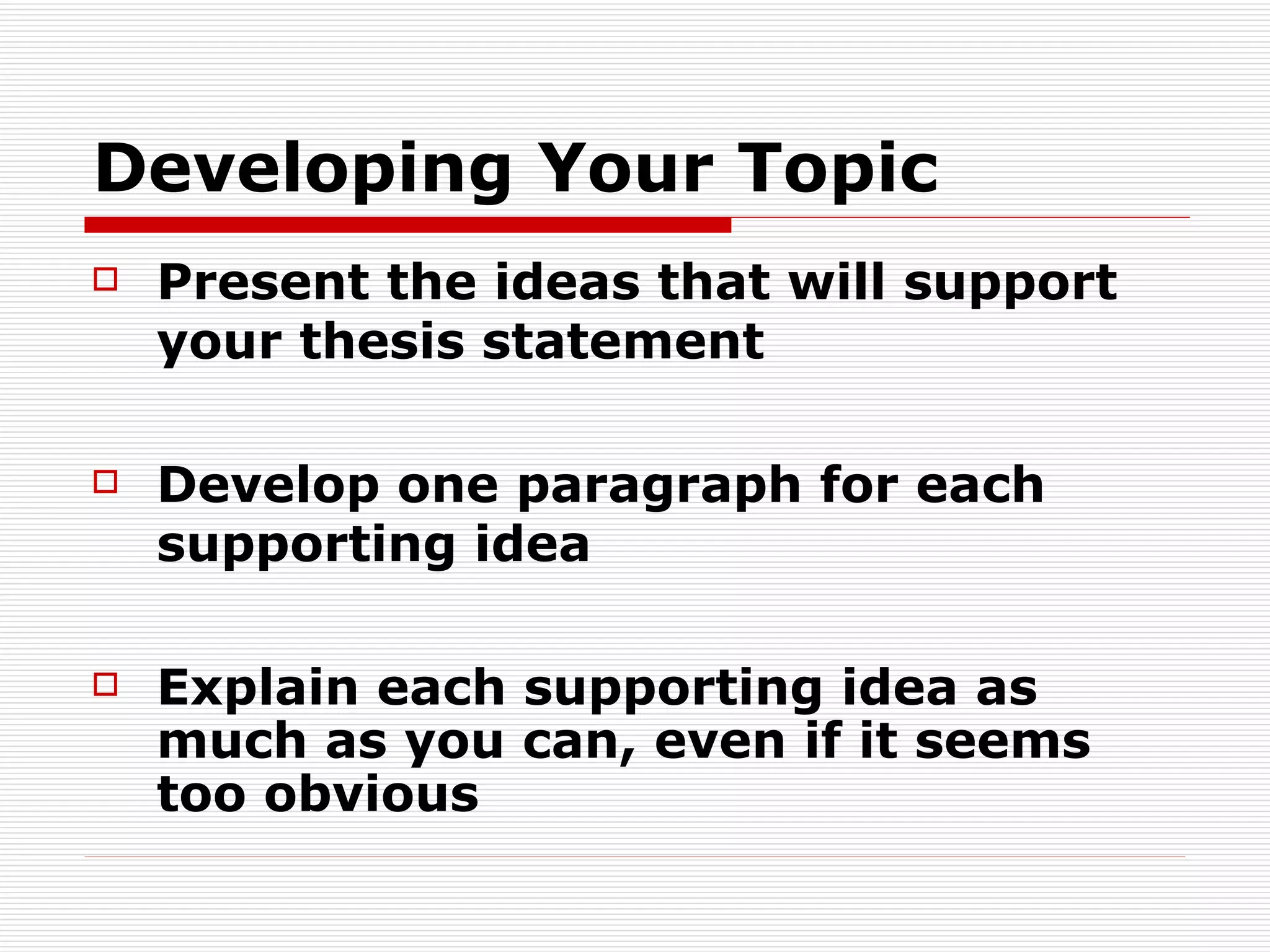
Developing Your Topic Present the ideas that will support your  thesis statement Develop one paragraph for each supporting idea Explain each supporting idea as much as you can, even if it seems too obvious
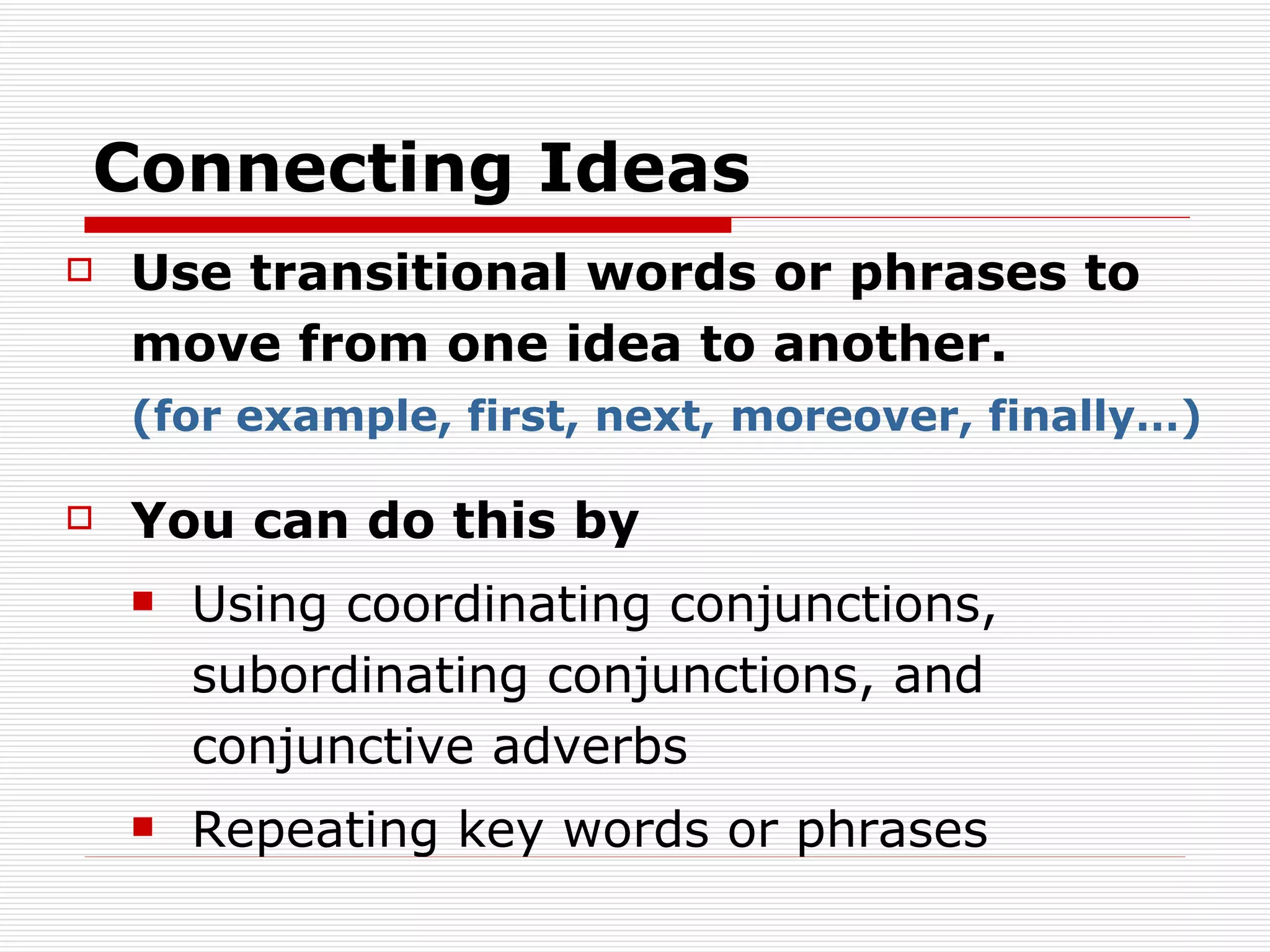
Connecting Ideas Use transitional words or phrases to move from one idea to another. (for example,   first, next, moreover, finally…) You can do this by  Using coordinating conjunctions, subordinating conjunctions, and conjunctive adverbs Repeating key words or phrases
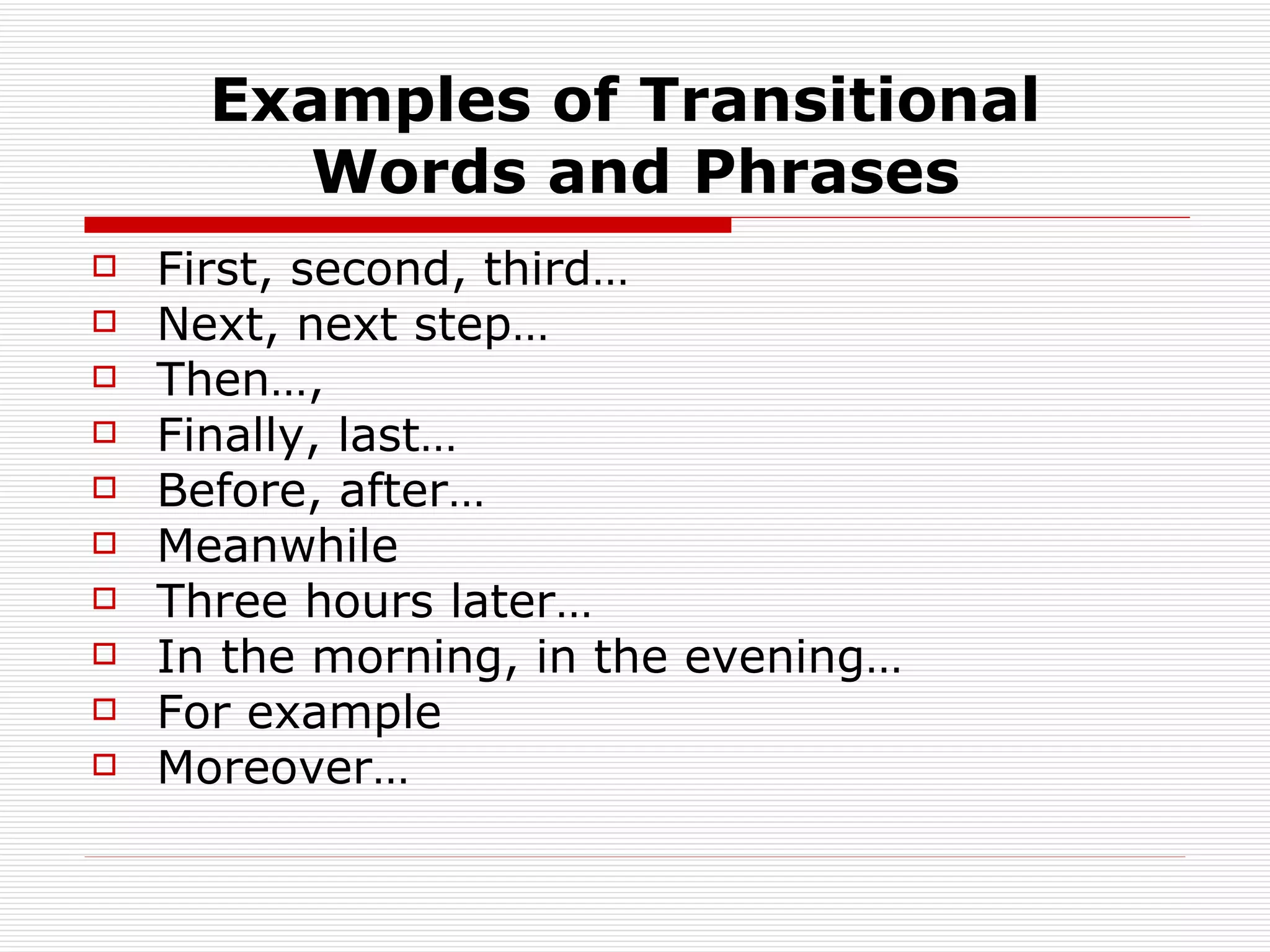
Examples of Transitional  Words and Phrases First, second, third… Next, next step… Then…,  Finally, last… Before, after… Meanwhile Three hours later… In the morning, in the evening… For example Moreover…
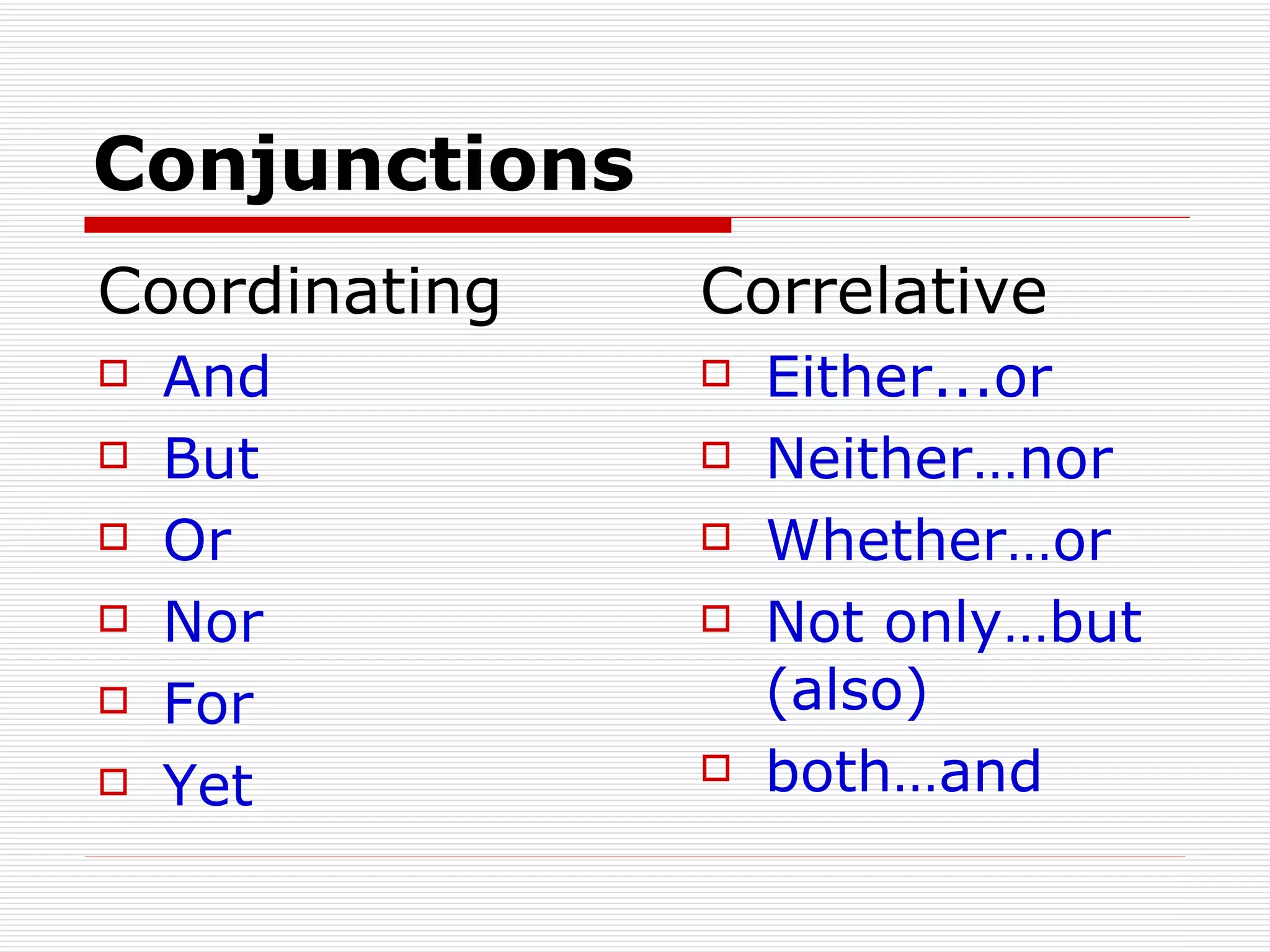
Conjunctions Coordinating  And But Or Nor For Yet Correlative Either...or Neither…nor Whether…or Not only…but (also) both…and
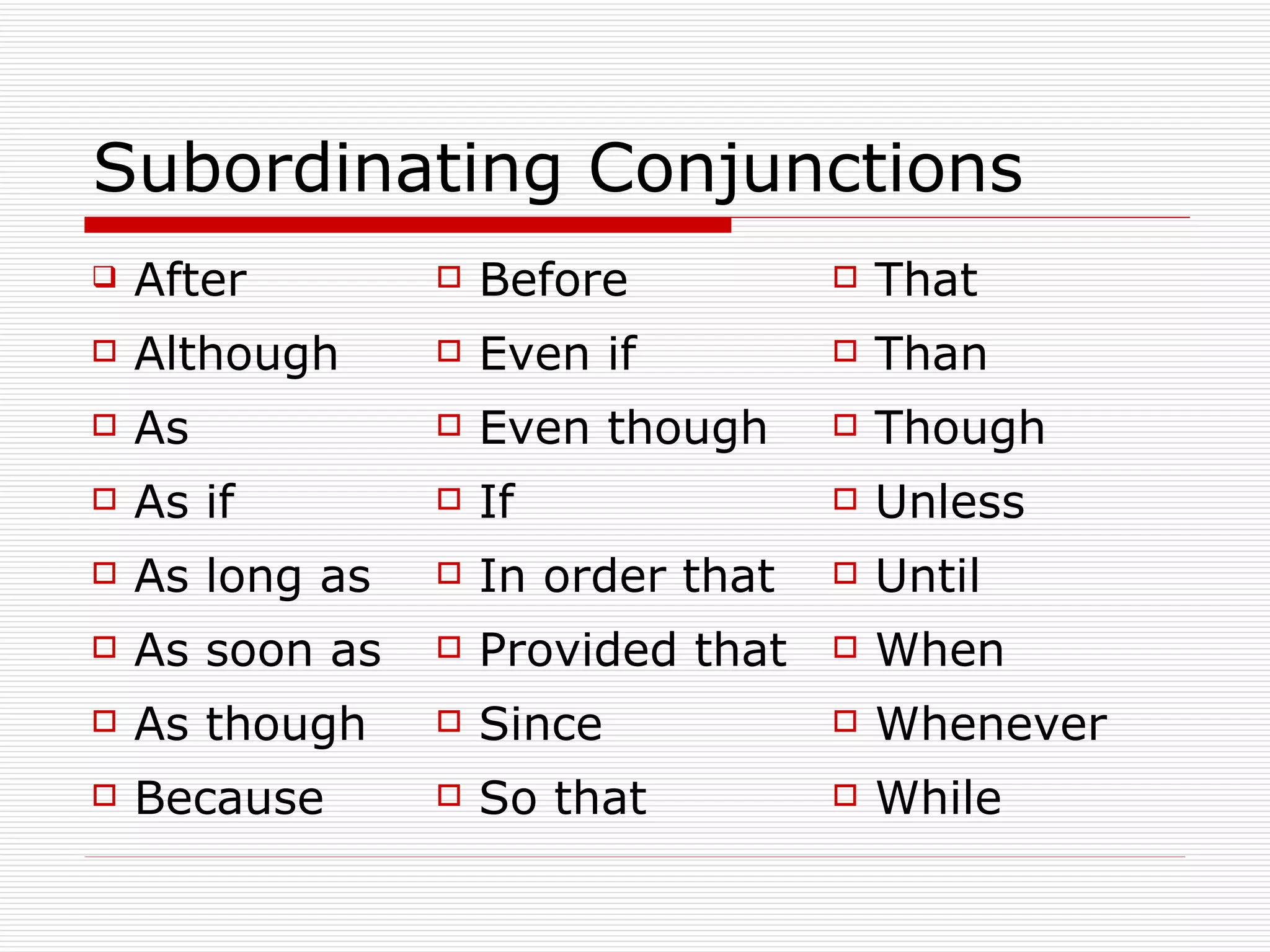
Subordinating Conjunctions While So that Because Whenever Since As though When Provided that As soon as Until In order that As long as Unless If As if Though Even though As Than Even if Although That Before After
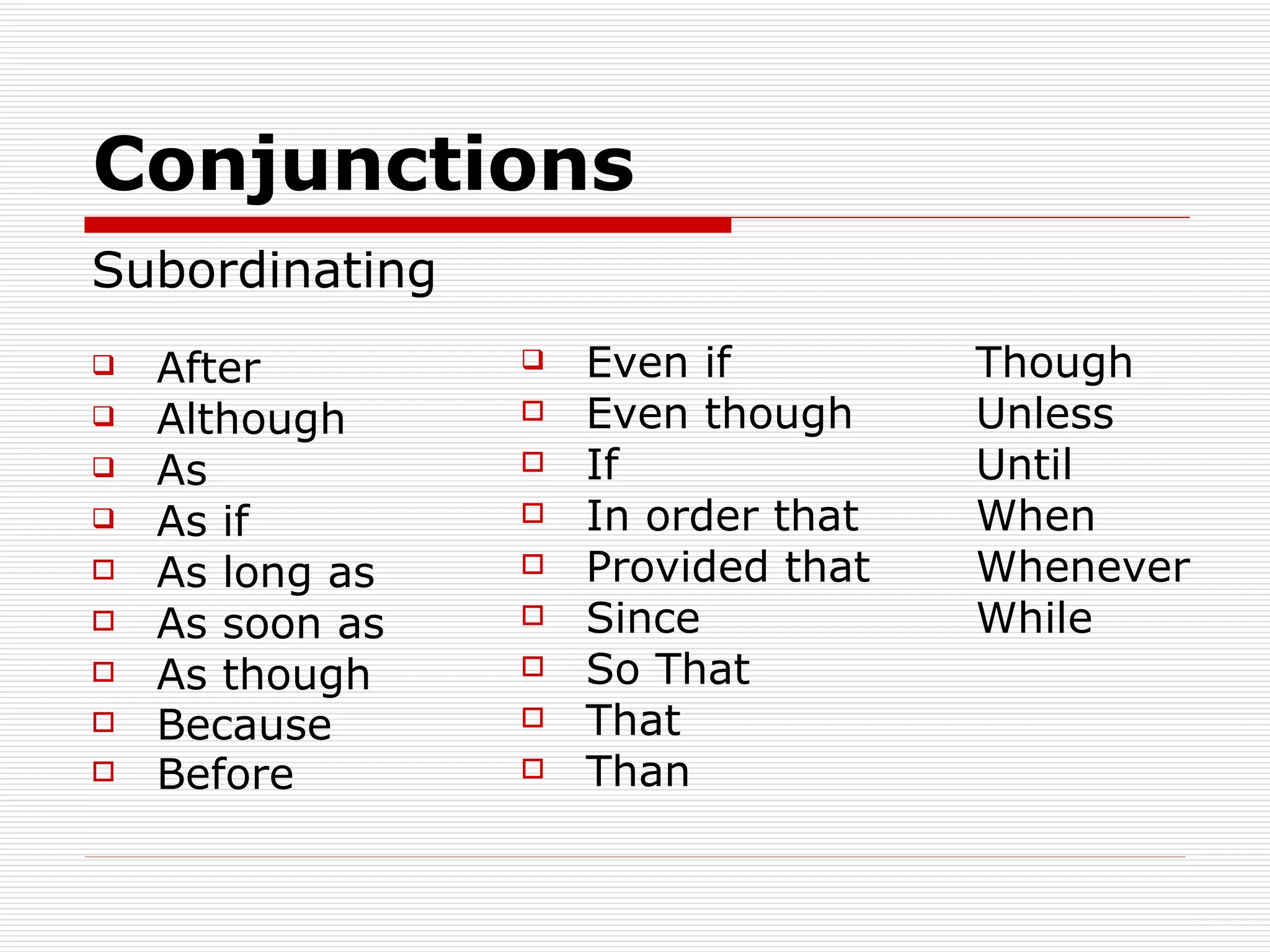
Conjunctions Subordinating After Although As As if As long as As soon as As though Because   Before Even if   Though Even though   Unless    If   Until In order that   When  Provided that   Whenever Since   While So That That Than
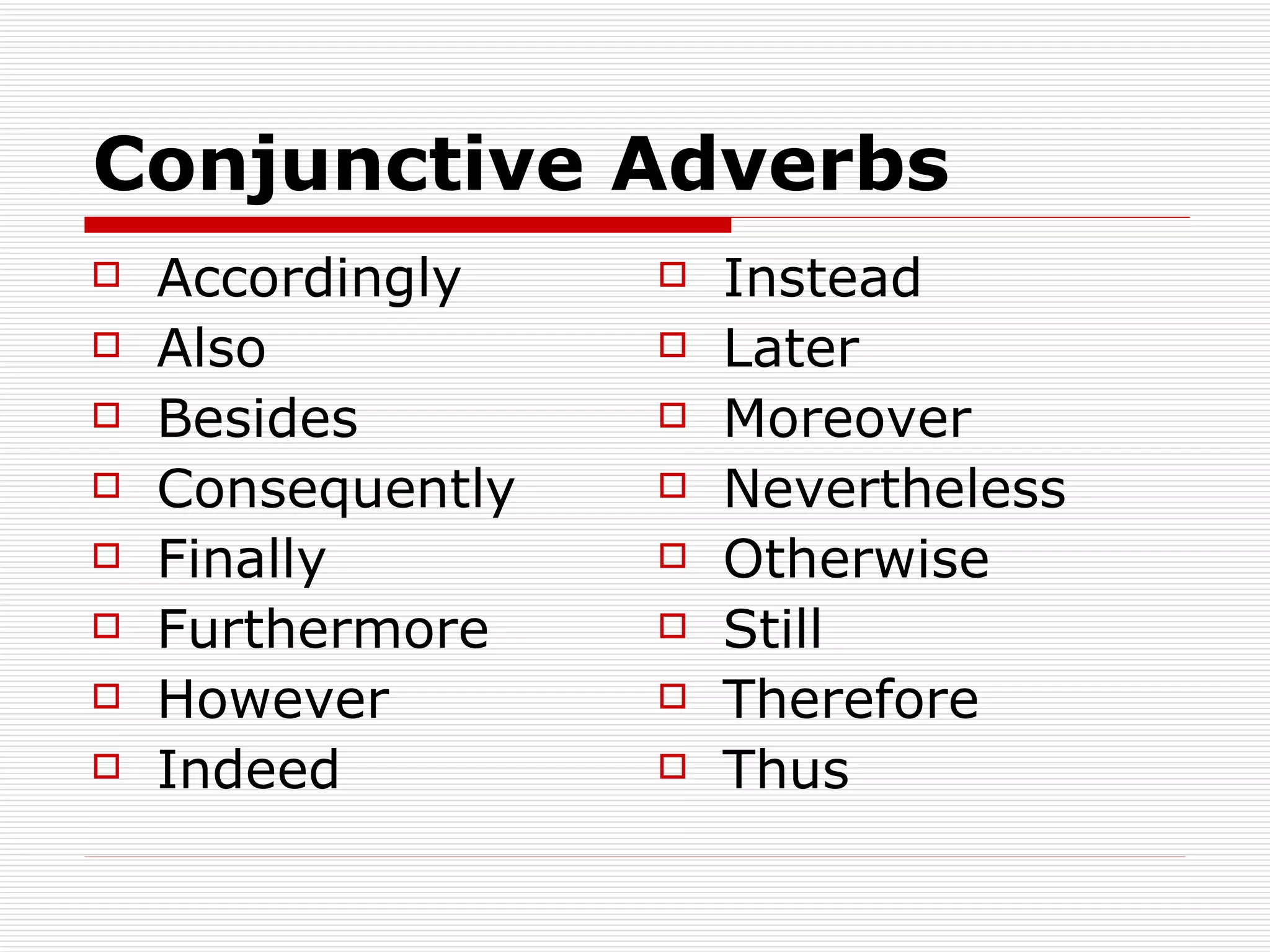
Conjunctive   Adverbs Accordingly Also Besides Consequently Finally Furthermore However Indeed Instead Later Moreover Nevertheless Otherwise Still Therefore Thus
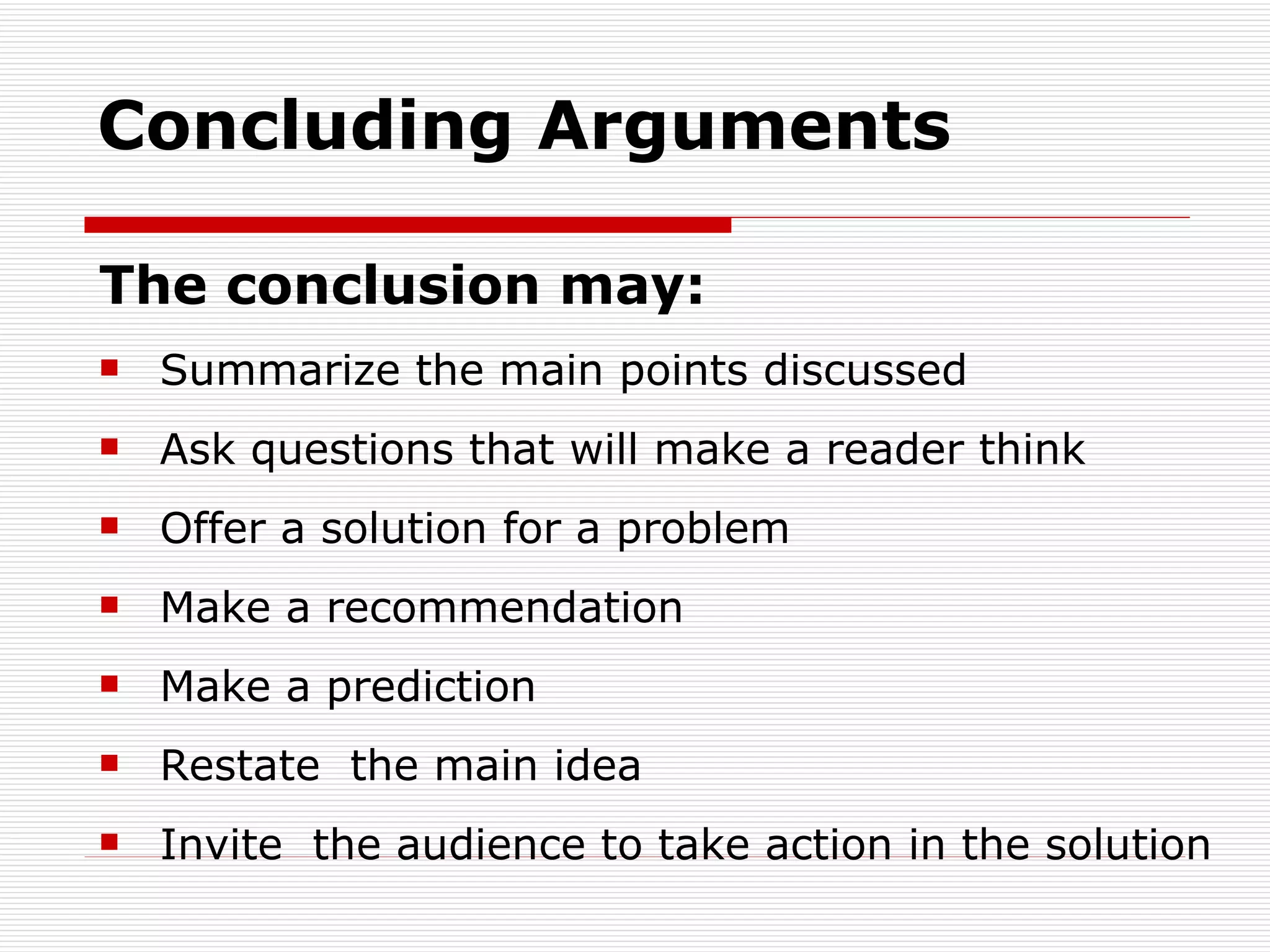
Concluding Arguments The conclusion may: Summarize the main points discussed  Ask questions that will make a reader think  Offer a solution for a problem Make a recommendation  Make a prediction  Restate  the main idea  Invite  the audience to take action in the solution
For More Information… You can visit the following web sites: The Unicorn Pen.  http://www.anitraweb.org/write/unicorn/essays.html Index English Grammar and Composition http://www.ccc.commnet.edu/grammar/index2.htm
Center for Language Development Across the Disciplines Prepared by: Thalia N. Nazario-Santiago   Coordinator for the Center for Languages and Cultures   April-June 2003 Revised by:  Patricia Kidd   Administrative Assistant Revised by:  Prof. Delia Serrano   January 2005 Thank you!

Constructing Paragraphs in an Essay

  • 1.
    Constructing Paragraphs for an Essay University of the Sacred Heart Department of Humanities Center for Language Development Across the Disciplines LAD
  • 2.
    Objective To constructeffective paragraphs for an essay
  • 3.
    Before Starting toWrite Choose a topic to write about Brainstorm Research the topic you selected, and make sure you keep track of your references Review all the information before starting to write Organize the ideas in a logical way
  • 4.
  • 5.
    Writing with AttitudeIdentify your audience Who will read your essay? Identify the purpose and tone of your writing Objective / Subjective Casual / Formal Persuasive / Informative Expository / Argumentative
  • 6.
    The Basics ofWriting When writing, you must do three basic things: Introduce your topic (introduction) Provide details that support your topic (body) Write an appropriate conclusion
  • 7.
    Outlining Prepare anoutline to: Determine which information is related to the topic Organize your ideas (order of importance, chronological order, spatial…) Structure your essay (Introduction-Body-Conclusion)
  • 8.
    Introductory Paragraphs Captureyour reader’s interest through an attention getter by using Incidents Examples Vivid descriptions Statistics Dialogue Unusual or interesting facts Quotes Anecdotes
  • 9.
    Introductory Paragraphs State the main idea Establish the organization of the essay Introduce important terms or situations relevant to your writing
  • 10.
    Developing Your TopicPresent the ideas that will support your thesis statement Develop one paragraph for each supporting idea Explain each supporting idea as much as you can, even if it seems too obvious
  • 11.
    Connecting Ideas Usetransitional words or phrases to move from one idea to another. (for example, first, next, moreover, finally…) You can do this by Using coordinating conjunctions, subordinating conjunctions, and conjunctive adverbs Repeating key words or phrases
  • 12.
    Examples of Transitional Words and Phrases First, second, third… Next, next step… Then…, Finally, last… Before, after… Meanwhile Three hours later… In the morning, in the evening… For example Moreover…
  • 13.
    Conjunctions Coordinating And But Or Nor For Yet Correlative Either...or Neither…nor Whether…or Not only…but (also) both…and
  • 14.
    Subordinating Conjunctions WhileSo that Because Whenever Since As though When Provided that As soon as Until In order that As long as Unless If As if Though Even though As Than Even if Although That Before After
  • 15.
    Conjunctions Subordinating AfterAlthough As As if As long as As soon as As though Because Before Even if Though Even though Unless If Until In order that When Provided that Whenever Since While So That That Than
  • 16.
    Conjunctive Adverbs Accordingly Also Besides Consequently Finally Furthermore However Indeed Instead Later Moreover Nevertheless Otherwise Still Therefore Thus
  • 17.
    Concluding Arguments Theconclusion may: Summarize the main points discussed Ask questions that will make a reader think Offer a solution for a problem Make a recommendation Make a prediction Restate the main idea Invite the audience to take action in the solution
  • 18.
    For More Information…You can visit the following web sites: The Unicorn Pen. http://www.anitraweb.org/write/unicorn/essays.html Index English Grammar and Composition http://www.ccc.commnet.edu/grammar/index2.htm
  • 19.
    Center for LanguageDevelopment Across the Disciplines Prepared by: Thalia N. Nazario-Santiago Coordinator for the Center for Languages and Cultures April-June 2003 Revised by: Patricia Kidd Administrative Assistant Revised by: Prof. Delia Serrano January 2005 Thank you!