Academic Achievement Team
Academic Reading: What is it? How do you do it?
Lesson Aims
• Look at sources : academic and non-academic
• Ways to read effectively
• Look at journal article structure
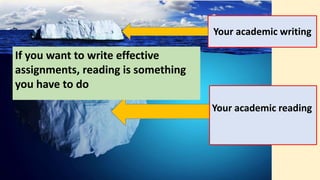
Your academic writing
Your academic reading
If you want to write effective
assignments, reading is something
you have to do
“I don’t like reading”
• "At school, I studied subjects I didn’t enjoy.”
• “I was told that I wasn’t a good reader.”
• “My reading skills are not very good.”
At university, if you enjoy your subject, you’ll enjoy reading about it
This is a chance to start fresh and become a new you
Skills only get better with practice - there are things you can do to improve
Reading is Very Personal
Which do you prefer to do?
Read online or read paper books?
Read with music or in silence?
Read in the library or at home?
Read in the morning or at night?
Read alone or with a group?
Make sure you are in the right “reading mood” and
remove distractions
Choosing Academic Sources
Discuss the different factors that could affect
small and medium sized businesses in the UK in
2019
• Good Academic Sources
(books, journal articles
etc.)
• Work by writers you know
are key figures.
• Articles from quality
newspapers
• Websites from
organisations in your
subject
• Blogs
• Online discussion forums.
• Websites sponsored by
companies.
• Sources found through
general Googling!
What to Read
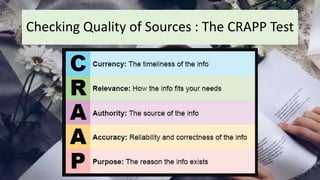
Checking Quality of Sources : The CRAPP Test
CRAPP Test
• Currency : When was it published or posted? Has the information
changed? Have the ideas changed in this research area?
• Relevance: Is the information related to your assignment? Is the
information at an academic level (who is the audience?)?
• Authority : where does it come from? Who is the author? Who is the
organisation? Can the source be considered trustworthy?
• Accuracy: Is the information supported by evidence? Do the links work?
Is the language accurate? Is the language unbiased?
• Purpose: Why was it written? Is it objective or biased? Is it arguing a
particular viewpoint?
Instead of reading like this……………….
Passive Reading
You need to read like this….
Active Reading
Active Reading 1 : Before you Read
First : understand your assignment question :
• ”What do I need to do?”
• “What are my initial thoughts on the subject?”
If you don’t understand your question then you could write the wrong answer
Look at source and think what information you expect to find in it? What could it be about?
Doing this gets your brain working and you begin to engage
Title : “Social media addiction and social media reactions: The implications for job
performance”
What could it be about?
- Definitions of addition / types of social media
- Examples of how job performance is affected / positive? Negative?
- What the examples mean – does work need to change?
• Read with a purpose:
• Think : what is the main idea in each paragraph?
• Underline or useful information, so you can find it again
Active Reading 2 : While you Read
Important: If you cannot use it, then don’t read it
How can it help me with an assignment ?
How could I use the information in my writing?
highlight
Before putting the book away (or turning off the book)
• Reflect on what you have read
• Was it useful?
• What were its main ideas?
• How could you explain the ideas to
someone?
Why? It can help you remember better by creating mental connections in
your brain
Active Reading 3 : After Reading
Build up to difficult texts
Journals have information on new
research
There will be journals for your
subject
They can tricky to read at first, and
can take time and a lot of focus
So read a general book first to give
you ideas and then build up
Your teachers will always be able to
recommend books
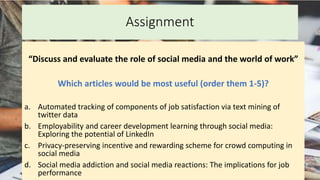
Assignment
“Discuss and evaluate the role of social media and the world of work”
Which articles would be most useful (order them 1-5)?
a. Automated tracking of components of job satisfaction via text mining of
twitter data
b. Employability and career development learning through social media:
Exploring the potential of LinkedIn
c. Privacy-preserving incentive and rewarding scheme for crowd computing in
social media
d. Social media addiction and social media reactions: The implications for job
performance
Journal Article: What does it contain?
[Note: the following exercises were done in class using real secondary
sources and worksheets, and so do not feature on this PPT.]
Journal Structure
Re-cap
• Academic sources
• Ways to read actively
• Journal articles

Academic reading

  • 1.
    Academic Achievement Team AcademicReading: What is it? How do you do it?
  • 2.
    Lesson Aims • Lookat sources : academic and non-academic • Ways to read effectively • Look at journal article structure
  • 3.
    Your academic writing Youracademic reading If you want to write effective assignments, reading is something you have to do
  • 4.
    “I don’t likereading” • "At school, I studied subjects I didn’t enjoy.” • “I was told that I wasn’t a good reader.” • “My reading skills are not very good.” At university, if you enjoy your subject, you’ll enjoy reading about it This is a chance to start fresh and become a new you Skills only get better with practice - there are things you can do to improve
  • 5.
    Reading is VeryPersonal Which do you prefer to do? Read online or read paper books? Read with music or in silence? Read in the library or at home? Read in the morning or at night? Read alone or with a group? Make sure you are in the right “reading mood” and remove distractions
  • 6.
  • 7.
    Discuss the differentfactors that could affect small and medium sized businesses in the UK in 2019
  • 8.
    • Good AcademicSources (books, journal articles etc.) • Work by writers you know are key figures. • Articles from quality newspapers • Websites from organisations in your subject • Blogs • Online discussion forums. • Websites sponsored by companies. • Sources found through general Googling! What to Read
  • 9.
    Checking Quality ofSources : The CRAPP Test
  • 10.
    CRAPP Test • Currency: When was it published or posted? Has the information changed? Have the ideas changed in this research area? • Relevance: Is the information related to your assignment? Is the information at an academic level (who is the audience?)? • Authority : where does it come from? Who is the author? Who is the organisation? Can the source be considered trustworthy? • Accuracy: Is the information supported by evidence? Do the links work? Is the language accurate? Is the language unbiased? • Purpose: Why was it written? Is it objective or biased? Is it arguing a particular viewpoint?
  • 12.
    Instead of readinglike this………………. Passive Reading
  • 13.
    You need toread like this…. Active Reading
  • 14.
    Active Reading 1: Before you Read First : understand your assignment question : • ”What do I need to do?” • “What are my initial thoughts on the subject?” If you don’t understand your question then you could write the wrong answer Look at source and think what information you expect to find in it? What could it be about? Doing this gets your brain working and you begin to engage Title : “Social media addiction and social media reactions: The implications for job performance” What could it be about? - Definitions of addition / types of social media - Examples of how job performance is affected / positive? Negative? - What the examples mean – does work need to change?
  • 15.
    • Read witha purpose: • Think : what is the main idea in each paragraph? • Underline or useful information, so you can find it again Active Reading 2 : While you Read Important: If you cannot use it, then don’t read it How can it help me with an assignment ? How could I use the information in my writing? highlight
  • 16.
    Before putting thebook away (or turning off the book) • Reflect on what you have read • Was it useful? • What were its main ideas? • How could you explain the ideas to someone? Why? It can help you remember better by creating mental connections in your brain Active Reading 3 : After Reading
  • 17.
    Build up todifficult texts Journals have information on new research There will be journals for your subject They can tricky to read at first, and can take time and a lot of focus So read a general book first to give you ideas and then build up Your teachers will always be able to recommend books
  • 18.
    Assignment “Discuss and evaluatethe role of social media and the world of work” Which articles would be most useful (order them 1-5)? a. Automated tracking of components of job satisfaction via text mining of twitter data b. Employability and career development learning through social media: Exploring the potential of LinkedIn c. Privacy-preserving incentive and rewarding scheme for crowd computing in social media d. Social media addiction and social media reactions: The implications for job performance
  • 20.
    Journal Article: Whatdoes it contain? [Note: the following exercises were done in class using real secondary sources and worksheets, and so do not feature on this PPT.]
  • 21.
  • 22.
    Re-cap • Academic sources •Ways to read actively • Journal articles

Editor's Notes

  • #16 Predict meaning – forecast – weather forecast – remember it isn’t about being right or wrong, it is just about waking your mind up.
  • #17 These skills take time and as you progress, these will improve – so don’t worry about doing them all – just use one or two things when you read
  • #18 These skills take time and as you progress, these will improve – so don’t worry about doing them all – just use one or two things when you read