Chapter 12 Review Clickers
© 2014 Pearson Education, Inc.
The Cosmic Perspective
Seventh Edition
Asteroids, Comets,
and Dwarf Planets:
Their Natures,
Orbits, and Impacts
Chapter 12
Asteroids
a) are rocky and small–typically the size of a grain of
rice or a marble.
b) are rocky, with a wide range of sizes, up to
hundreds of miles in diameter.
c) have only thin atmospheres.
d) are made mostly of metals.
e) are mostly found in the inner solar system.
Chapter 12
Asteroids
a) are rocky and small–typically the size of a grain of
rice or a marble.
b) are rocky, with a wide range of sizes, up to
hundreds of miles in diameter.
c) have only thin atmospheres.
d) are made mostly of metals.
e) are mostly found in the inner solar system.
Chapter 12
If you keep pushing a person on a swing with
little pushes, at just the right frequency, they
will swing very high. This is an example of
a) Newton's second law.
b) Newton's first law.
c) energy conservation.
d) resonance.
e) conservation of angular momentum.
Chapter 12
If you keep pushing a person on a swing with
little pushes, at just the right frequency, they
will swing very high. This is an example of
a) Newton's second law.
b) Newton's first law.
c) energy conservation.
d) resonance.
e) conservation of angular momentum.
Chapter 12
Orbits of asteroids in the asteroid belt
a) often intersect the orbits of the planets.
b) are mostly between Mars and Jupiter.
c) are grouped into patterns by resonances with
Jupiter.
d) are mostly inside the frost line.
e) all except A
Chapter 12
Orbits of asteroids in the asteroid belt
a) often intersect the orbits of the planets.
b) are mostly between Mars and Jupiter.
c) are grouped into patterns by resonances with
Jupiter.
d) are mostly inside the frost line.
e) all except A
Chapter 12
What is the best way to find the density of an
asteroid?
a) Look at its spectrum.
b) Study a sample of its matter.
c) Find an asteroid with a moon and use Kepler's
3rd
law.
d) none of the above
Chapter 12
What is the best way to find the density of an
asteroid?
a) Look at its spectrum.
b) Study a sample of its matter.
c) Find an asteroid with a moon and use Kepler's
3rd
law.
d) none of the above
Chapter 12
Most meteorites come from
a) stars.
b) destroyed planets.
c) asteroids.
d) the Moon and Mars.
e) material ejected from volcanoes.
Chapter 12
Most meteorites come from
a) stars.
b) destroyed planets.
c) asteroids.
d) the Moon and Mars.
e) material ejected from volcanoes.
Chapter 12
A typical meteorite is
a) about the size of a house, and makes a crater when it
impacts Earth's surface.
b) about the size of a pea or grain of rice, and is invisible
when it lands.
c) about the size of a pea or grain of rice, and makes a
bright streak in the sky as it burns up.
d) about the size of a large city, and causes widespread
destruction when it impacts Earth's surface.
Chapter 12
A typical meteorite is
a) about the size of a house, and makes a crater when it
impacts Earth's surface.
b) about the size of a pea or grain of rice, and is invisible
when it lands.
c) about the size of a pea or grain of rice, and makes a
bright streak in the sky as it burns up.
d) about the size of a large city, and causes widespread
destruction when it impacts Earth's surface.
Chapter 12
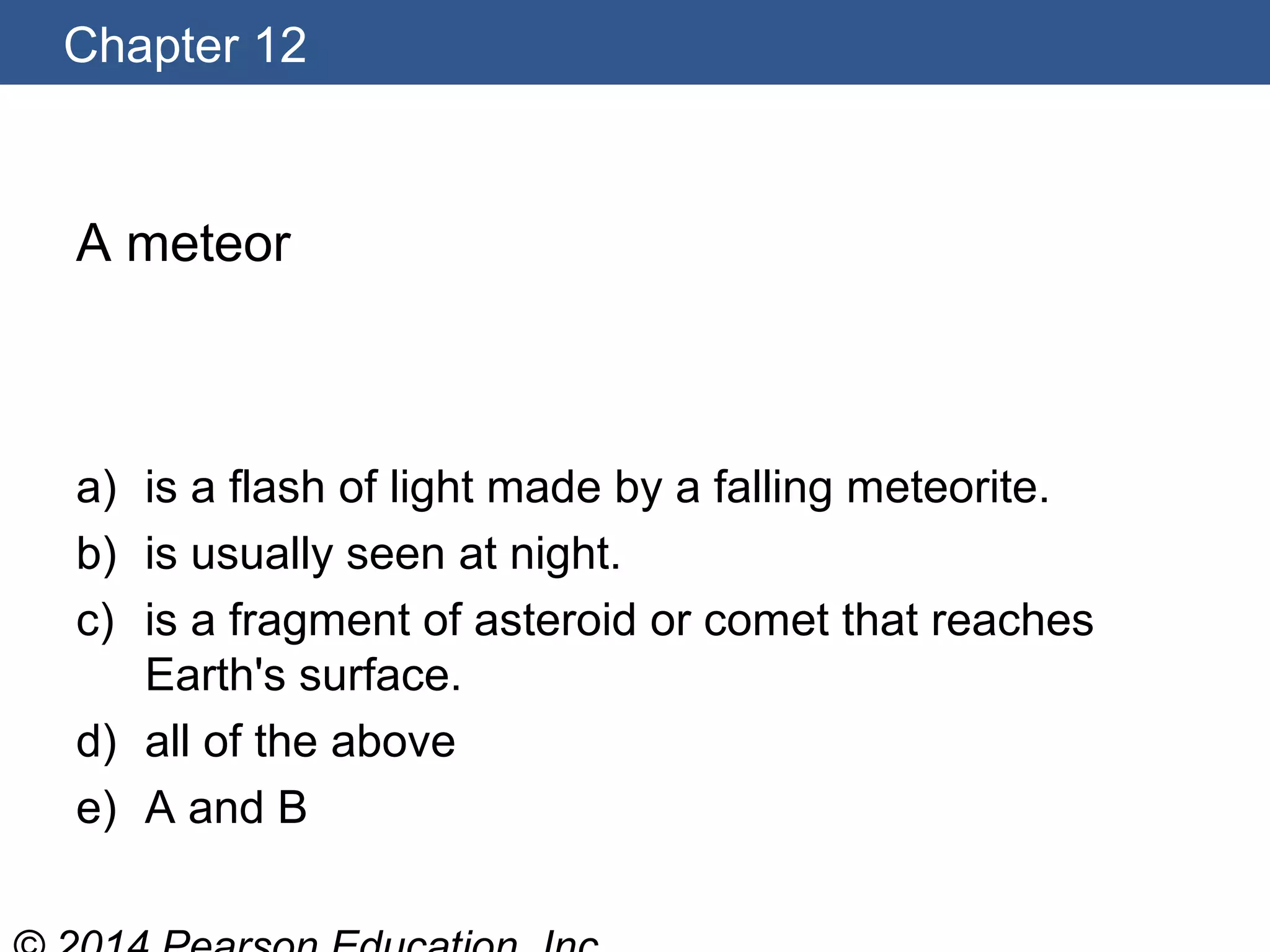
A meteor
a) is a flash of light made by a falling meteorite.
b) is usually seen at night.
c) is a fragment of asteroid or comet that reaches
Earth's surface.
d) all of the above
e) A and B
Chapter 12
A meteor
a) is a flash of light made by a falling meteorite.
b) is usually seen at night.
c) is a fragment of asteroid or comet that reaches
Earth's surface.
d) all of the above
e) A and B
Chapter 12
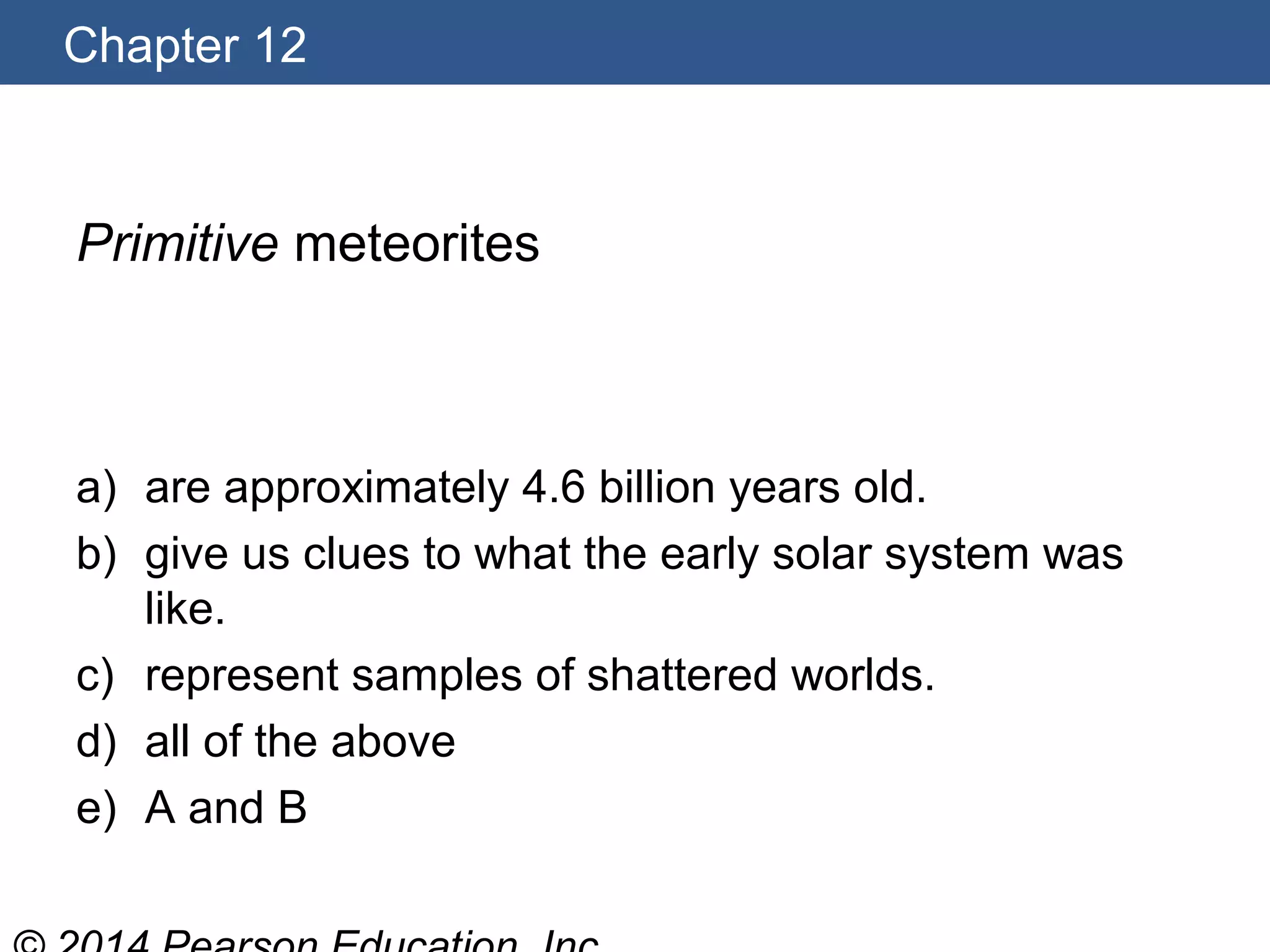
Primitive meteorites
a) are approximately 4.6 billion years old.
b) give us clues to what the early solar system was
like.
c) represent samples of shattered worlds.
d) all of the above
e) A and B
Chapter 12
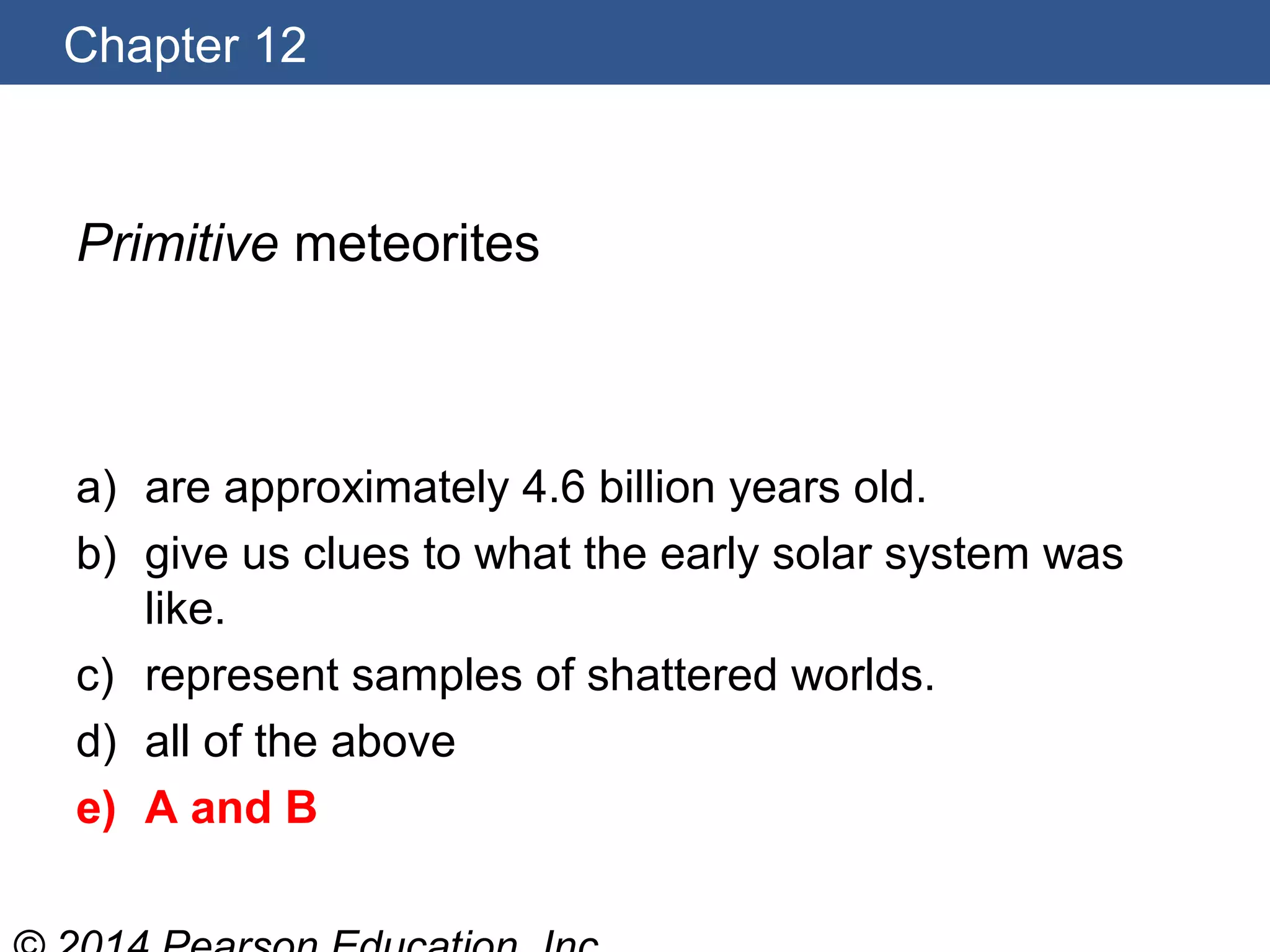
Primitive meteorites
a) are approximately 4.6 billion years old.
b) give us clues to what the early solar system was
like.
c) represent samples of shattered worlds.
d) all of the above
e) A and B
Chapter 12
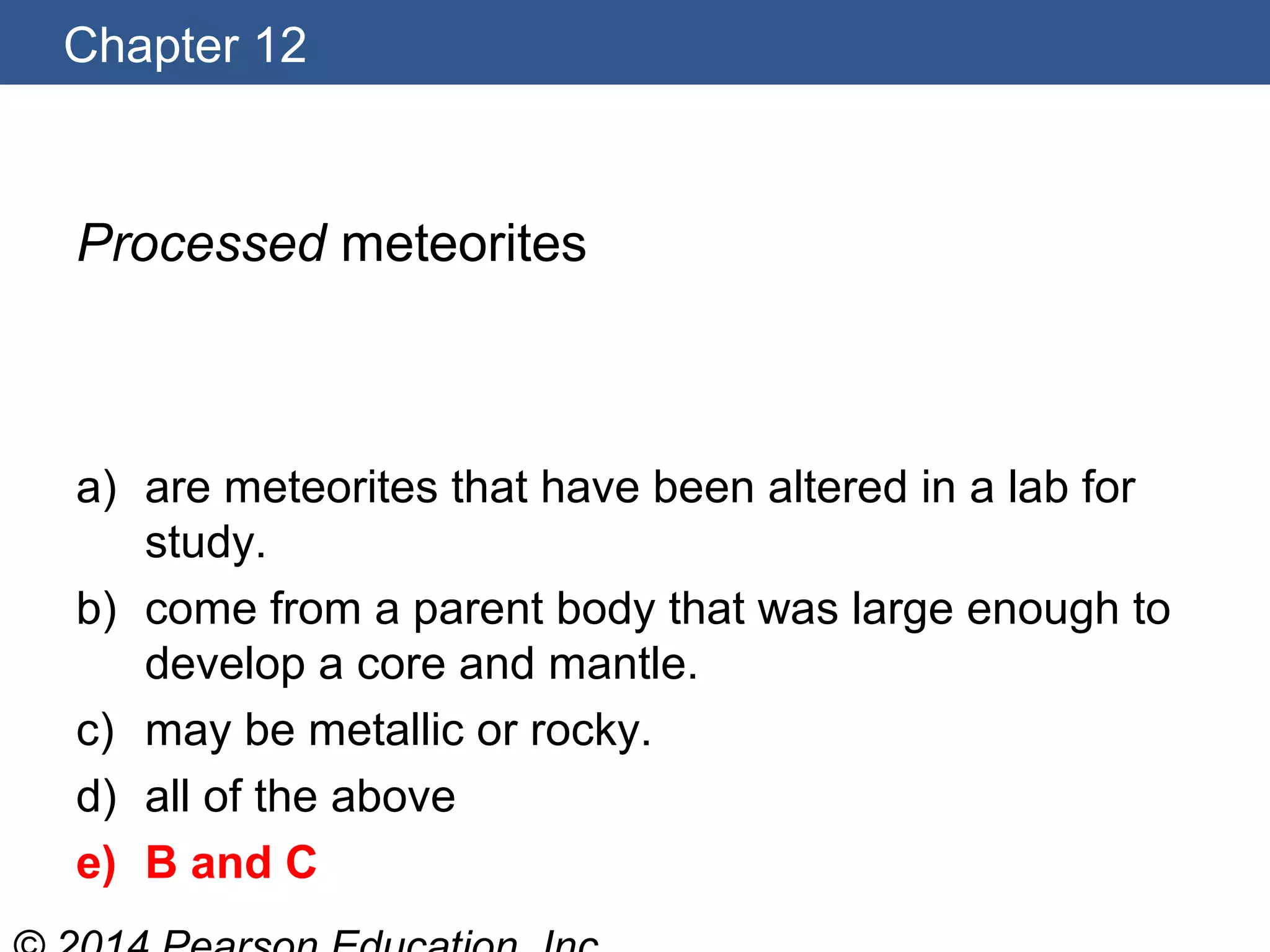
Processed meteorites
a) are meteorites that have been altered in a lab for
study.
b) come from a parent body that was large enough to
develop a core and mantle.
c) may be metallic or rocky.
d) all of the above
e) B and C
Chapter 12
Processed meteorites
a) are meteorites that have been altered in a lab for
study.
b) come from a parent body that was large enough to
develop a core and mantle.
c) may be metallic or rocky.
d) all of the above
e) B and C
Chapter 12
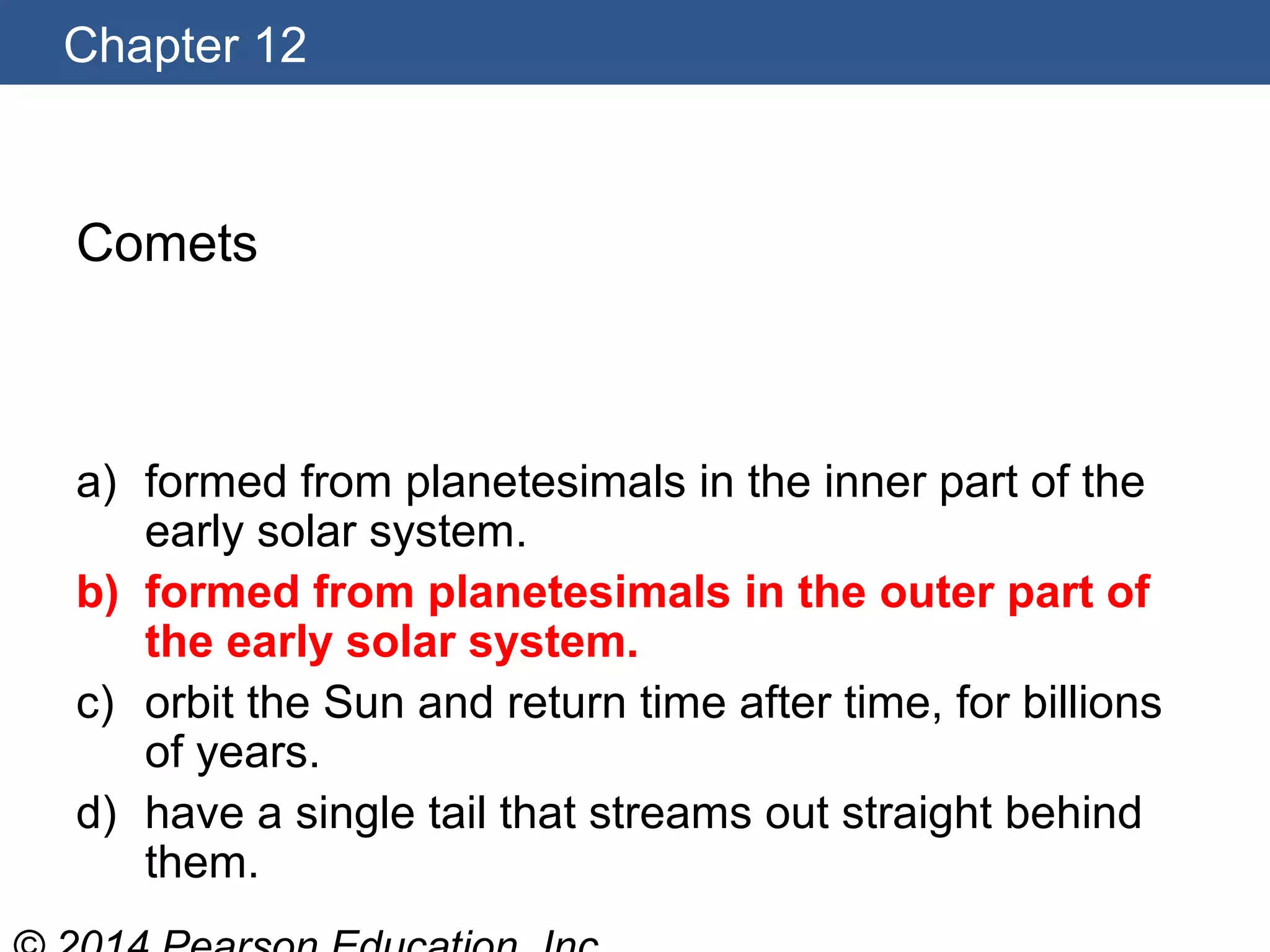
Comets
a) formed from planetesimals in the inner part of the
early solar system.
b) formed from planetesimals in the outer part of the
early solar system.
c) orbit the Sun and return time after time, for billions
of years.
d) have a single tail that streams out straight behind
them.
Chapter 12
Comets
a) formed from planetesimals in the inner part of the
early solar system.
b) formed from planetesimals in the outer part of
the early solar system.
c) orbit the Sun and return time after time, for billions
of years.
d) have a single tail that streams out straight behind
them.
Chapter 12
The nucleus of a comet
a) is made of rock.
b) is made of dust and ice, like a dirty snowball.
c) turns to gas when the comet nears the Sun.
d) All of the above
e) B and C
Chapter 12
The nucleus of a comet
a) is made of rock.
b) is made of dust and ice, like a dirty snowball.
c) turns to gas when the comet nears the Sun.
d) All of the above
e) B and C
Chapter 12
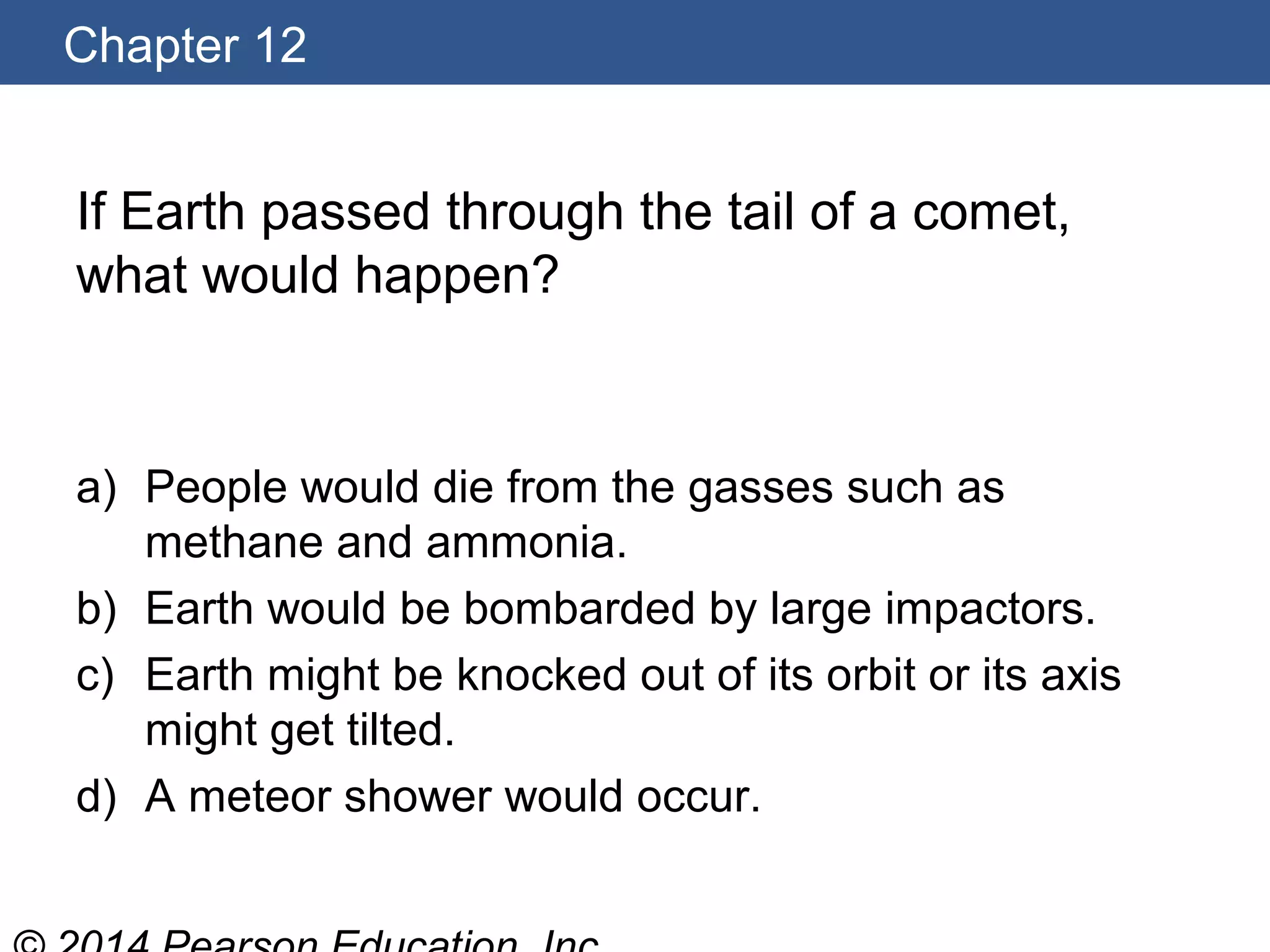
If Earth passed through the tail of a comet,
what would happen?
a) People would die from the gasses such as
methane and ammonia.
b) Earth would be bombarded by large impactors.
c) Earth might be knocked out of its orbit or its axis
might get tilted.
d) A meteor shower would occur.
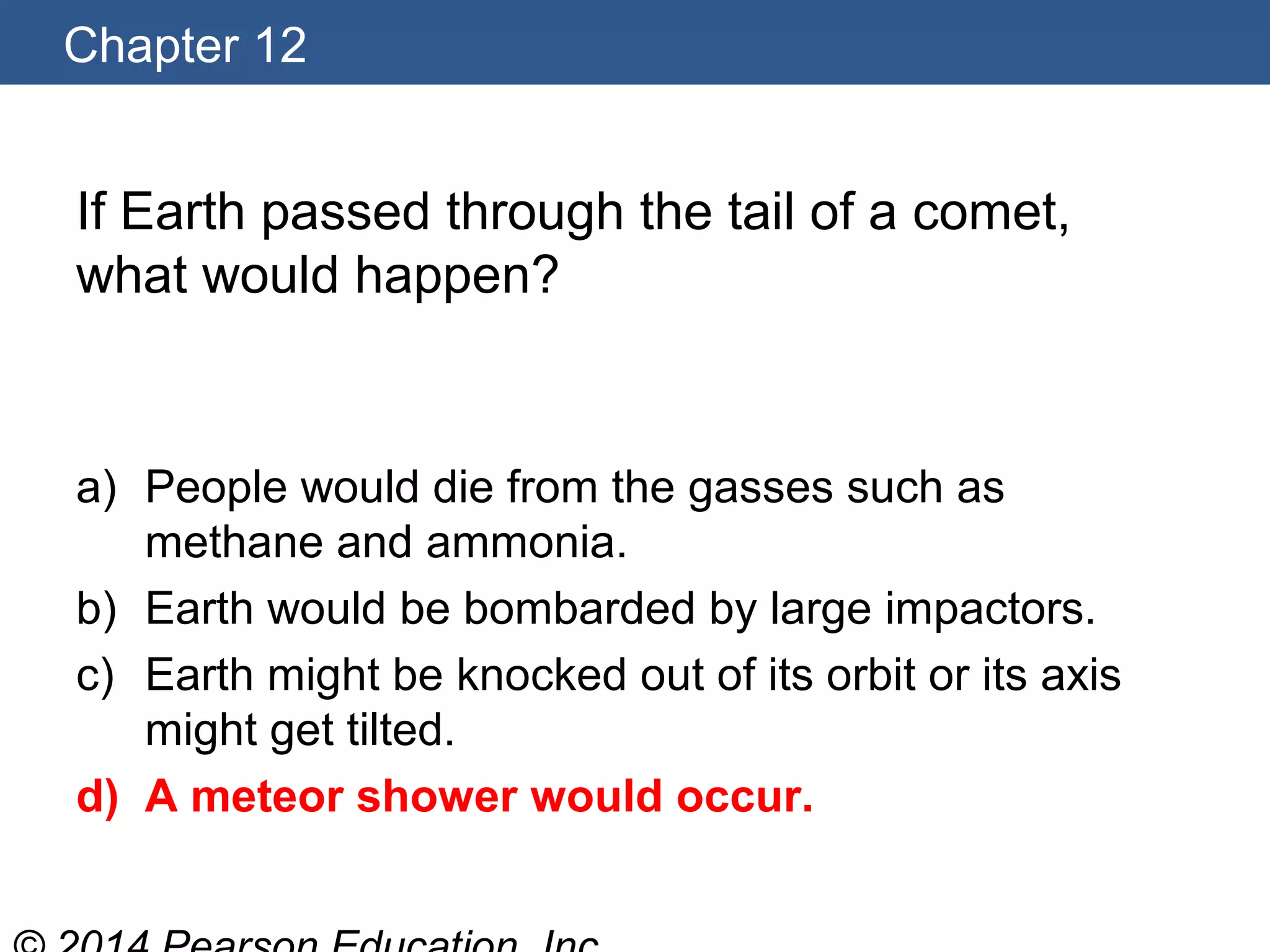
Chapter 12
If Earth passed through the tail of a comet,
what would happen?
a) People would die from the gasses such as
methane and ammonia.
b) Earth would be bombarded by large impactors.
c) Earth might be knocked out of its orbit or its axis
might get tilted.
d) A meteor shower would occur.
Chapter 12
Why is there a meteor shower every year on
Aug. 10, 11, and 12?
a) Meteorites only enter the solar system on certain
dates.
b) Meteorites often have 1 year orbital periods.
c) Earth passes through the orbit of a comet and
hits the remaining debris at the same time each
year.
d) none of the above
Chapter 12
Why is there a meteor shower every year on
Aug. 10, 11, and 12?
a) Meteorites only enter the solar system on certain
dates.
b) Meteorites often have 1 year orbital periods.
c) Earth passes through the orbit of a comet and
hits the remaining debris at the same time each
year.
d) none of the above
Chapter 12
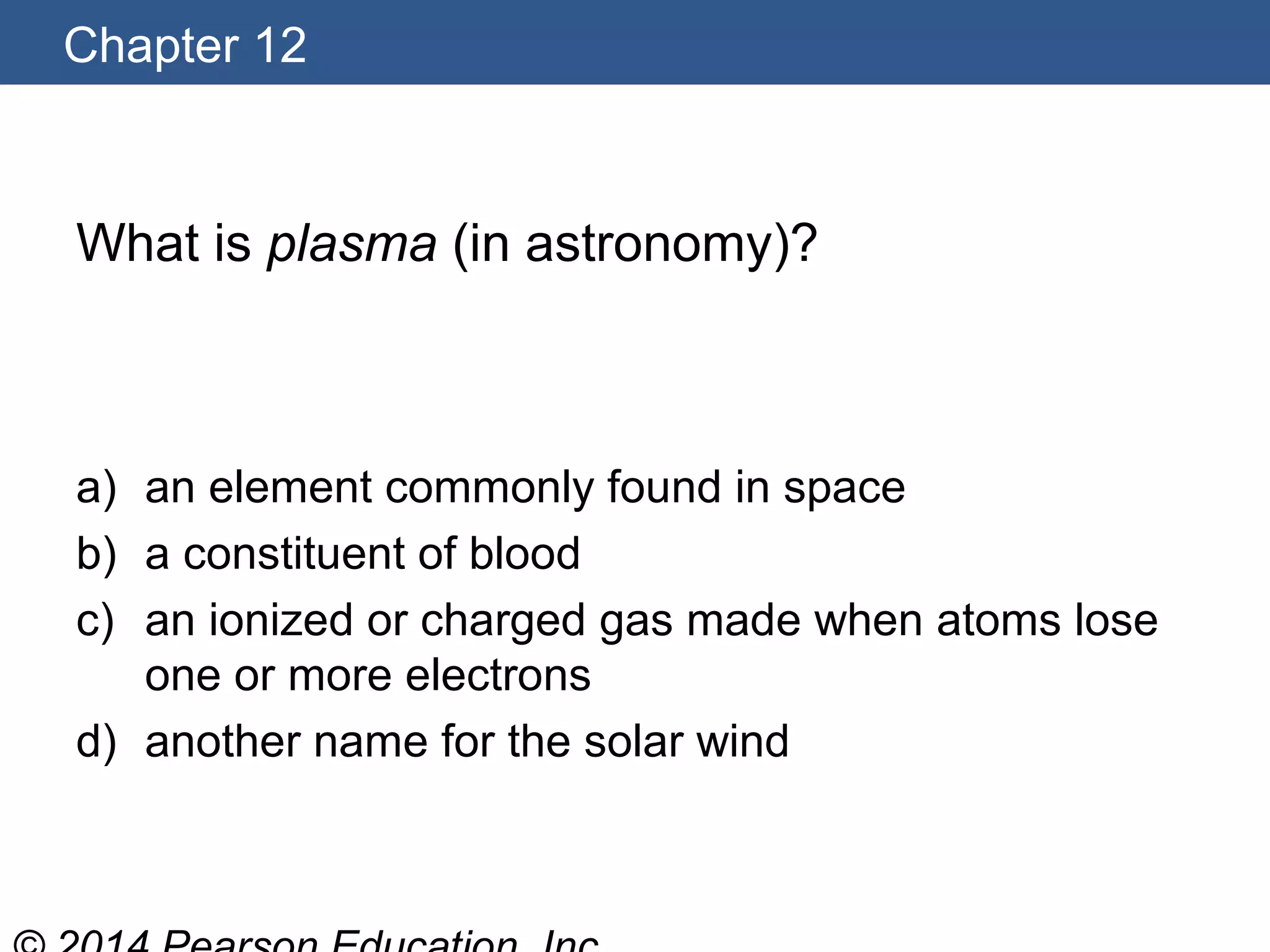
What is plasma (in astronomy)?
a) an element commonly found in space
b) a constituent of blood
c) an ionized or charged gas made when atoms lose
one or more electrons
d) another name for the solar wind
Chapter 12
What is plasma (in astronomy)?
a) an element commonly found in space
b) a constituent of blood
c) an ionized or charged gas made when atoms
lose one or more electrons
d) another name for the solar wind
Chapter 12
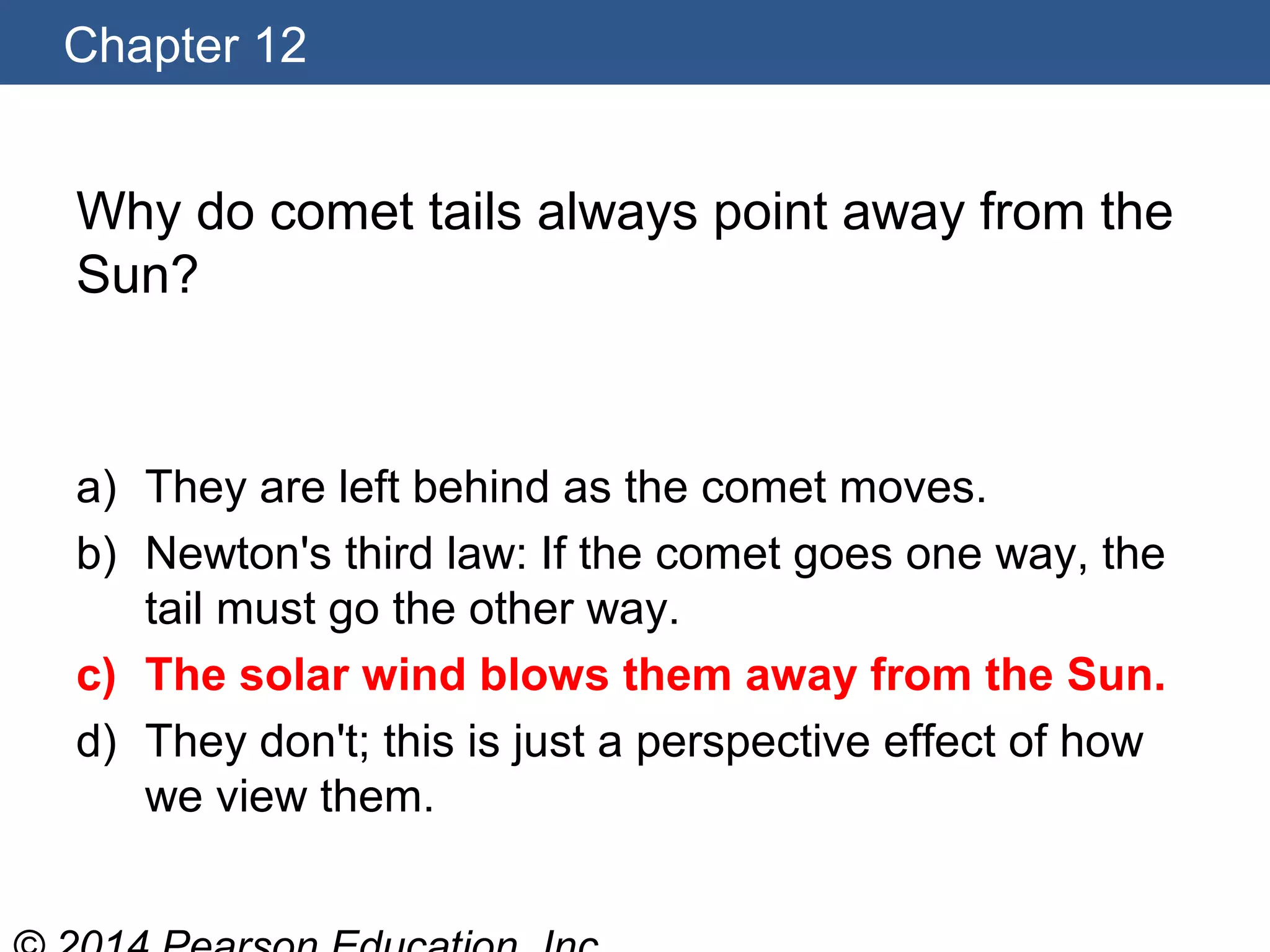
Why do comet tails always point away from the
Sun?
a) They are left behind as the comet moves.
b) Newton's third law: If the comet goes one way, the
tail must go the other way.
c) The solar wind blows them away from the Sun.
d) They don't; this is just a perspective effect of how
we view them.
Chapter 12
Why do comet tails always point away from the
Sun?
a) They are left behind as the comet moves.
b) Newton's third law: If the comet goes one way, the
tail must go the other way.
c) The solar wind blows them away from the Sun.
d) They don't; this is just a perspective effect of how
we view them.
Chapter 12
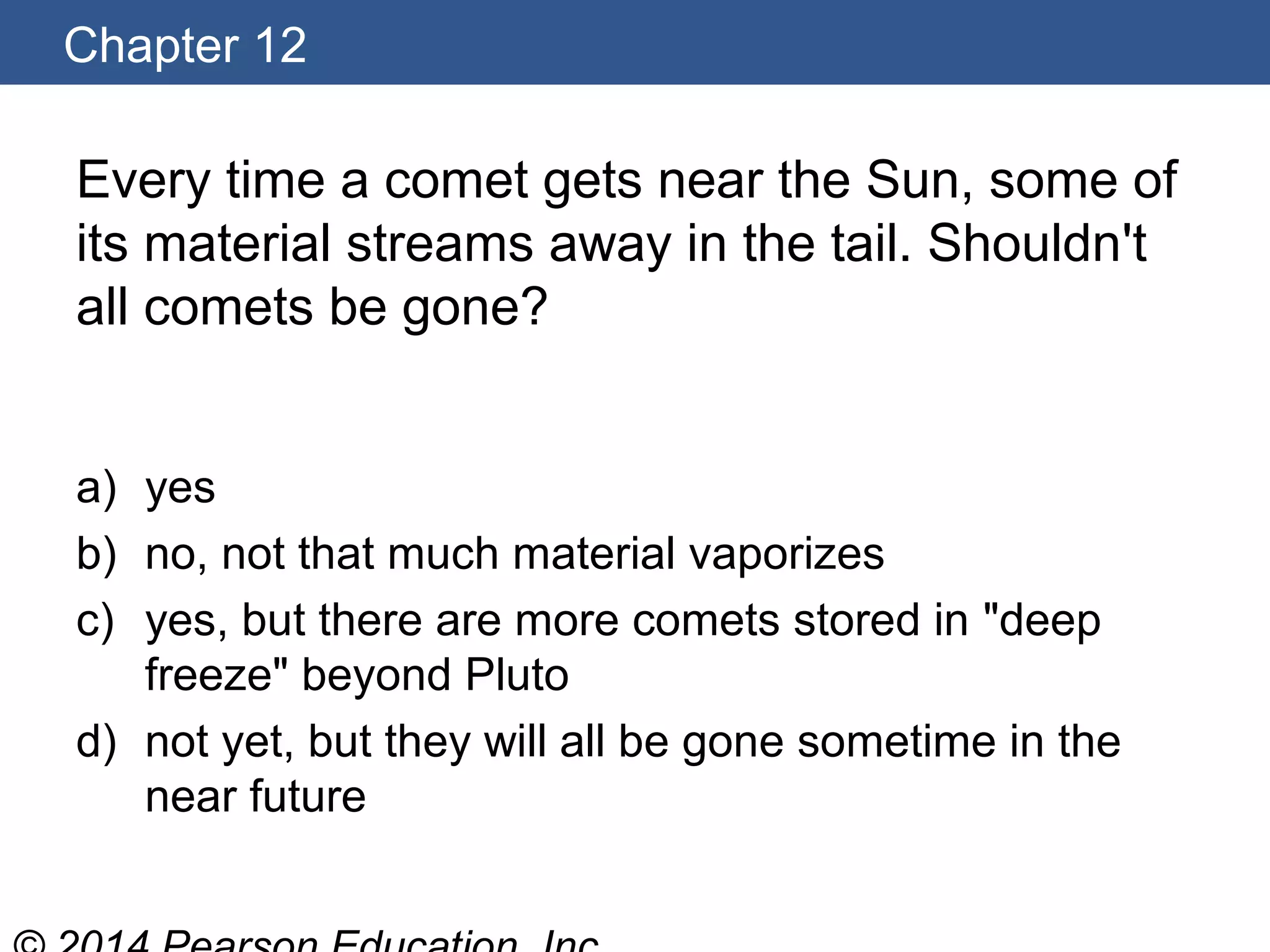
Every time a comet gets near the Sun, some of
its material streams away in the tail. Shouldn't
all comets be gone?
a) yes
b) no, not that much material vaporizes
c) yes, but there are more comets stored in "deep
freeze" beyond Pluto
d) not yet, but they will all be gone sometime in the
near future
Chapter 12
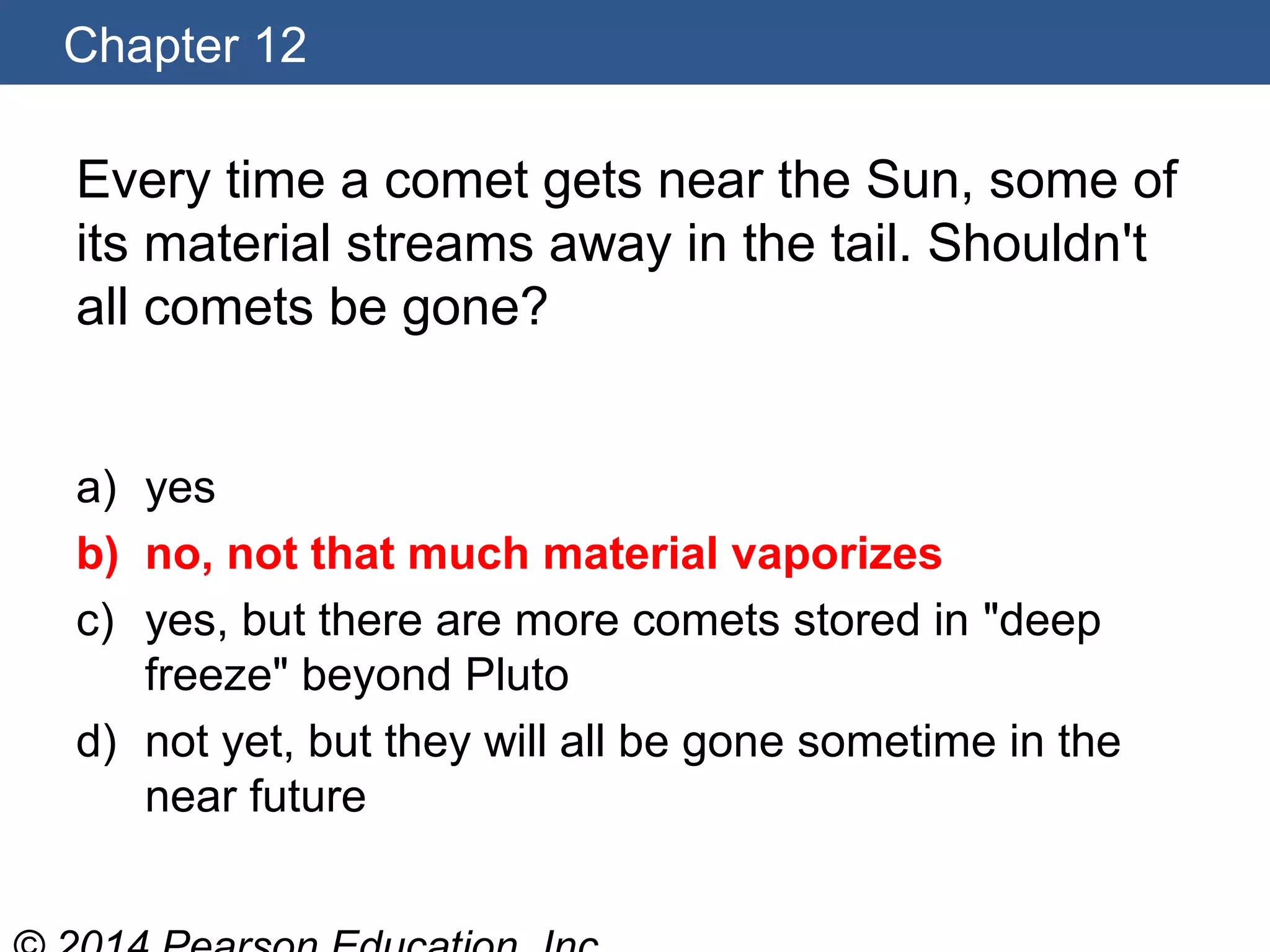
Every time a comet gets near the Sun, some of
its material streams away in the tail. Shouldn't
all comets be gone?
a) yes
b) no, not that much material vaporizes
c) yes, but there are more comets stored in "deep
freeze" beyond Pluto
d) not yet, but they will all be gone sometime in the
near future
Chapter 12
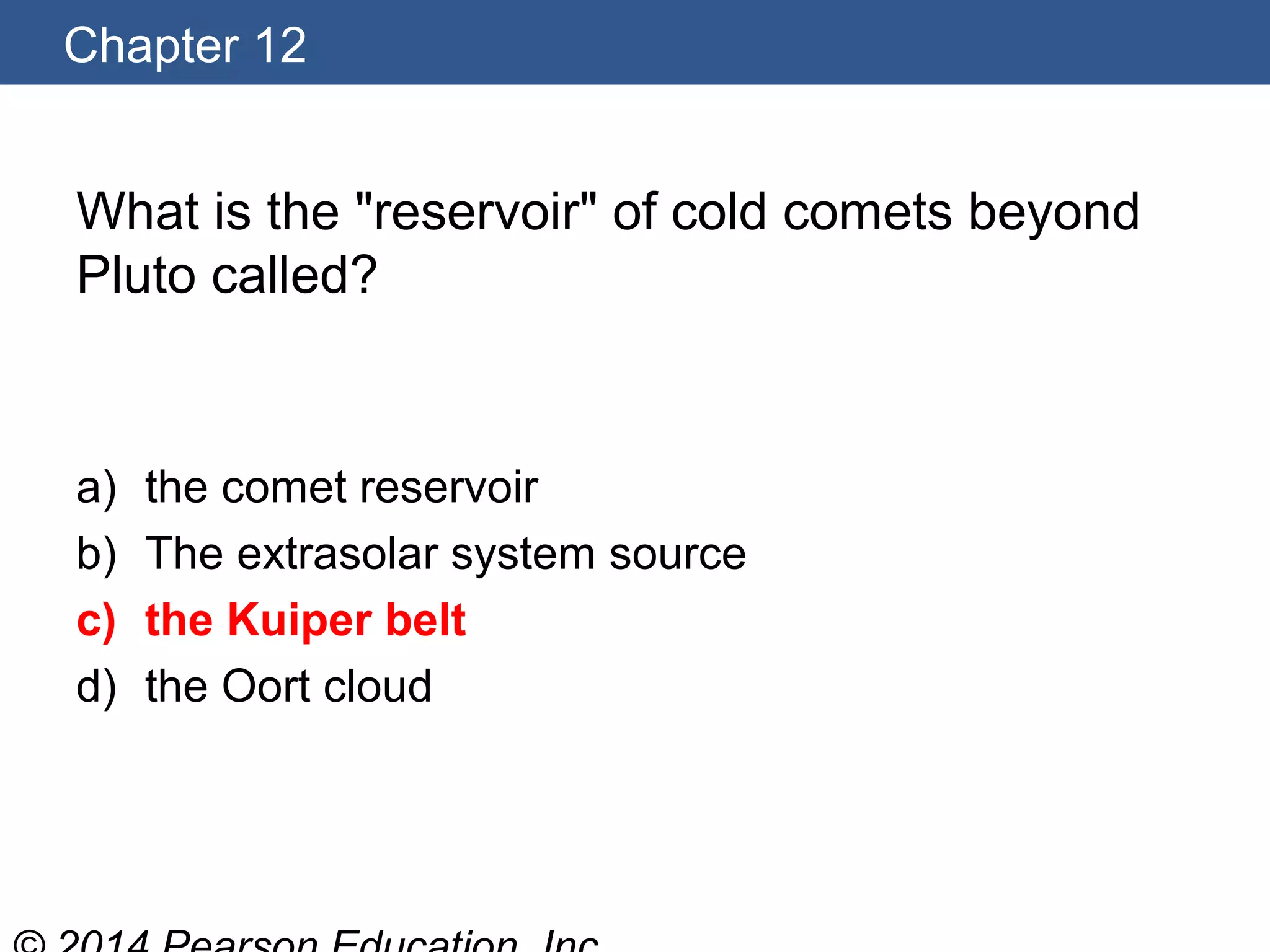
What is the "reservoir" of cold comets beyond
Pluto called?
a) the comet reservoir
b) The extrasolar system source
c) the Kuiper belt
d) the Oort cloud
Chapter 12
What is the "reservoir" of cold comets beyond
Pluto called?
a) the comet reservoir
b) The extrasolar system source
c) the Kuiper belt
d) the Oort cloud
Chapter 12
What do astronomers think Pluto is?
a) a major planet
b) a large Kuiper belt comet
c) an escaped moon of Neptune
d) an asteroid
Chapter 12
What do astronomers think Pluto is?
a) a major planet
b) a large Kuiper belt comet
c) an escaped moon of Neptune
d) an asteroid
Chapter 12
Why do some comets come from far out in
space and from all different directions (i.e., not
in the plane of the solar system)?
a) They come from other solar systems.
b) They come from nebulae in interstellar space.
c) They come from a giant spherical cloud called
the Oort cloud.
d) They come from the Kuiper belt when a comet is
flung out by Neptune's gravity.
Chapter 12
Why do some comets come from far out in
space and from all different directions (i.e., not
in the plane of the solar system)?
a) They come from other solar systems.
b) They come from nebulae in interstellar space.
c) They come from a giant spherical cloud called
the Oort cloud.
d) They come from the Kuiper belt when a comet is
flung out by Neptune's gravity.
Chapter 12
About how often is it estimated that an asteroid
or comet impacts Earth with sufficient energy to
cause mass extinction?
a) once a millennium
b) once every million years
c) once every hundred million years
d) once in Earth's history
Chapter 12
About how often is it estimated that an asteroid
or comet impacts Earth with sufficient energy to
cause mass extinction?
a) once a millennium
b) once every million years
c) once every hundred million years
d) once in Earth's history
Chapter 12
Surprising discovery? - A small asteroid that
orbits within the asteroid belt has an active
volcano.
a) Plausible. Several small objects in the solar system
have active volcanoes.
b) Plausible. Several asteroids are known to be
composed of basaltic material (lava).
c) Implausible. Only planets, not moons or asteroids,
have volcanoes.
d) Implausible. Asteroids are too small to be
geologically active now.
Chapter 12
Surprising discovery? - A small asteroid that
orbits within the asteroid belt has an active
volcano.
a) Plausible. Several small objects in the solar system
have active volcanoes.
b) Plausible. Several asteroids are known to be
composed of basaltic material (lava).
c) Implausible. Only planets, not moons or asteroids,
have volcanoes.
d) Implausible. Asteroids are too small to be
geologically active now.
Chapter 12
Surprising discovery? - A mission to Pluto finds
that it has lakes of liquid water on its surface.
a) Plausible. Other icy bodies at great distances from the
Sun may also have liquid water on their surfaces.
b) Plausible. Studies of Pluto's surface show a long, narrow
feature that looks like a lake.
c) Implausible. Water would be frozen at Pluto's temperature,
and we know of no heating sources that would cause the
water to melt.
d) Implausible. Pluto is mostly made of rock and metals,
not water.
Chapter 12
Surprising discovery? - A mission to Pluto finds
that it has lakes of liquid water on its surface.
a) Plausible. Other icy bodies at great distances from the
Sun may also have liquid water on their surfaces.
b) Plausible. Studies of Pluto's surface show a long, narrow
feature that looks like a lake.
c) Implausible. Water would be frozen at Pluto's
temperature, and we know of no heating sources
that would cause the water to melt.
d) Implausible. Pluto is mostly made of rock and metals,
not water.

12 review clickers

  • 1.
    Chapter 12 ReviewClickers © 2014 Pearson Education, Inc. The Cosmic Perspective Seventh Edition Asteroids, Comets, and Dwarf Planets: Their Natures, Orbits, and Impacts
  • 2.
    Chapter 12 Asteroids a) arerocky and small–typically the size of a grain of rice or a marble. b) are rocky, with a wide range of sizes, up to hundreds of miles in diameter. c) have only thin atmospheres. d) are made mostly of metals. e) are mostly found in the inner solar system.
  • 3.
    Chapter 12 Asteroids a) arerocky and small–typically the size of a grain of rice or a marble. b) are rocky, with a wide range of sizes, up to hundreds of miles in diameter. c) have only thin atmospheres. d) are made mostly of metals. e) are mostly found in the inner solar system.
  • 4.
    Chapter 12 If youkeep pushing a person on a swing with little pushes, at just the right frequency, they will swing very high. This is an example of a) Newton's second law. b) Newton's first law. c) energy conservation. d) resonance. e) conservation of angular momentum.
  • 5.
    Chapter 12 If youkeep pushing a person on a swing with little pushes, at just the right frequency, they will swing very high. This is an example of a) Newton's second law. b) Newton's first law. c) energy conservation. d) resonance. e) conservation of angular momentum.
  • 6.
    Chapter 12 Orbits ofasteroids in the asteroid belt a) often intersect the orbits of the planets. b) are mostly between Mars and Jupiter. c) are grouped into patterns by resonances with Jupiter. d) are mostly inside the frost line. e) all except A
  • 7.
    Chapter 12 Orbits ofasteroids in the asteroid belt a) often intersect the orbits of the planets. b) are mostly between Mars and Jupiter. c) are grouped into patterns by resonances with Jupiter. d) are mostly inside the frost line. e) all except A
  • 8.
    Chapter 12 What isthe best way to find the density of an asteroid? a) Look at its spectrum. b) Study a sample of its matter. c) Find an asteroid with a moon and use Kepler's 3rd law. d) none of the above
  • 9.
    Chapter 12 What isthe best way to find the density of an asteroid? a) Look at its spectrum. b) Study a sample of its matter. c) Find an asteroid with a moon and use Kepler's 3rd law. d) none of the above
  • 10.
    Chapter 12 Most meteoritescome from a) stars. b) destroyed planets. c) asteroids. d) the Moon and Mars. e) material ejected from volcanoes.
  • 11.
    Chapter 12 Most meteoritescome from a) stars. b) destroyed planets. c) asteroids. d) the Moon and Mars. e) material ejected from volcanoes.
  • 12.
    Chapter 12 A typicalmeteorite is a) about the size of a house, and makes a crater when it impacts Earth's surface. b) about the size of a pea or grain of rice, and is invisible when it lands. c) about the size of a pea or grain of rice, and makes a bright streak in the sky as it burns up. d) about the size of a large city, and causes widespread destruction when it impacts Earth's surface.
  • 13.
    Chapter 12 A typicalmeteorite is a) about the size of a house, and makes a crater when it impacts Earth's surface. b) about the size of a pea or grain of rice, and is invisible when it lands. c) about the size of a pea or grain of rice, and makes a bright streak in the sky as it burns up. d) about the size of a large city, and causes widespread destruction when it impacts Earth's surface.
  • 14.
    Chapter 12 A meteor a)is a flash of light made by a falling meteorite. b) is usually seen at night. c) is a fragment of asteroid or comet that reaches Earth's surface. d) all of the above e) A and B
  • 15.
    Chapter 12 A meteor a)is a flash of light made by a falling meteorite. b) is usually seen at night. c) is a fragment of asteroid or comet that reaches Earth's surface. d) all of the above e) A and B
  • 16.
    Chapter 12 Primitive meteorites a)are approximately 4.6 billion years old. b) give us clues to what the early solar system was like. c) represent samples of shattered worlds. d) all of the above e) A and B
  • 17.
    Chapter 12 Primitive meteorites a)are approximately 4.6 billion years old. b) give us clues to what the early solar system was like. c) represent samples of shattered worlds. d) all of the above e) A and B
  • 18.
    Chapter 12 Processed meteorites a)are meteorites that have been altered in a lab for study. b) come from a parent body that was large enough to develop a core and mantle. c) may be metallic or rocky. d) all of the above e) B and C
  • 19.
    Chapter 12 Processed meteorites a)are meteorites that have been altered in a lab for study. b) come from a parent body that was large enough to develop a core and mantle. c) may be metallic or rocky. d) all of the above e) B and C
  • 20.
    Chapter 12 Comets a) formedfrom planetesimals in the inner part of the early solar system. b) formed from planetesimals in the outer part of the early solar system. c) orbit the Sun and return time after time, for billions of years. d) have a single tail that streams out straight behind them.
  • 21.
    Chapter 12 Comets a) formedfrom planetesimals in the inner part of the early solar system. b) formed from planetesimals in the outer part of the early solar system. c) orbit the Sun and return time after time, for billions of years. d) have a single tail that streams out straight behind them.
  • 22.
    Chapter 12 The nucleusof a comet a) is made of rock. b) is made of dust and ice, like a dirty snowball. c) turns to gas when the comet nears the Sun. d) All of the above e) B and C
  • 23.
    Chapter 12 The nucleusof a comet a) is made of rock. b) is made of dust and ice, like a dirty snowball. c) turns to gas when the comet nears the Sun. d) All of the above e) B and C
  • 24.
    Chapter 12 If Earthpassed through the tail of a comet, what would happen? a) People would die from the gasses such as methane and ammonia. b) Earth would be bombarded by large impactors. c) Earth might be knocked out of its orbit or its axis might get tilted. d) A meteor shower would occur.
  • 25.
    Chapter 12 If Earthpassed through the tail of a comet, what would happen? a) People would die from the gasses such as methane and ammonia. b) Earth would be bombarded by large impactors. c) Earth might be knocked out of its orbit or its axis might get tilted. d) A meteor shower would occur.
  • 26.
    Chapter 12 Why isthere a meteor shower every year on Aug. 10, 11, and 12? a) Meteorites only enter the solar system on certain dates. b) Meteorites often have 1 year orbital periods. c) Earth passes through the orbit of a comet and hits the remaining debris at the same time each year. d) none of the above
  • 27.
    Chapter 12 Why isthere a meteor shower every year on Aug. 10, 11, and 12? a) Meteorites only enter the solar system on certain dates. b) Meteorites often have 1 year orbital periods. c) Earth passes through the orbit of a comet and hits the remaining debris at the same time each year. d) none of the above
  • 28.
    Chapter 12 What isplasma (in astronomy)? a) an element commonly found in space b) a constituent of blood c) an ionized or charged gas made when atoms lose one or more electrons d) another name for the solar wind
  • 29.
    Chapter 12 What isplasma (in astronomy)? a) an element commonly found in space b) a constituent of blood c) an ionized or charged gas made when atoms lose one or more electrons d) another name for the solar wind
  • 30.
    Chapter 12 Why docomet tails always point away from the Sun? a) They are left behind as the comet moves. b) Newton's third law: If the comet goes one way, the tail must go the other way. c) The solar wind blows them away from the Sun. d) They don't; this is just a perspective effect of how we view them.
  • 31.
    Chapter 12 Why docomet tails always point away from the Sun? a) They are left behind as the comet moves. b) Newton's third law: If the comet goes one way, the tail must go the other way. c) The solar wind blows them away from the Sun. d) They don't; this is just a perspective effect of how we view them.
  • 32.
    Chapter 12 Every timea comet gets near the Sun, some of its material streams away in the tail. Shouldn't all comets be gone? a) yes b) no, not that much material vaporizes c) yes, but there are more comets stored in "deep freeze" beyond Pluto d) not yet, but they will all be gone sometime in the near future
  • 33.
    Chapter 12 Every timea comet gets near the Sun, some of its material streams away in the tail. Shouldn't all comets be gone? a) yes b) no, not that much material vaporizes c) yes, but there are more comets stored in "deep freeze" beyond Pluto d) not yet, but they will all be gone sometime in the near future
  • 34.
    Chapter 12 What isthe "reservoir" of cold comets beyond Pluto called? a) the comet reservoir b) The extrasolar system source c) the Kuiper belt d) the Oort cloud
  • 35.
    Chapter 12 What isthe "reservoir" of cold comets beyond Pluto called? a) the comet reservoir b) The extrasolar system source c) the Kuiper belt d) the Oort cloud
  • 36.
    Chapter 12 What doastronomers think Pluto is? a) a major planet b) a large Kuiper belt comet c) an escaped moon of Neptune d) an asteroid
  • 37.
    Chapter 12 What doastronomers think Pluto is? a) a major planet b) a large Kuiper belt comet c) an escaped moon of Neptune d) an asteroid
  • 38.
    Chapter 12 Why dosome comets come from far out in space and from all different directions (i.e., not in the plane of the solar system)? a) They come from other solar systems. b) They come from nebulae in interstellar space. c) They come from a giant spherical cloud called the Oort cloud. d) They come from the Kuiper belt when a comet is flung out by Neptune's gravity.
  • 39.
    Chapter 12 Why dosome comets come from far out in space and from all different directions (i.e., not in the plane of the solar system)? a) They come from other solar systems. b) They come from nebulae in interstellar space. c) They come from a giant spherical cloud called the Oort cloud. d) They come from the Kuiper belt when a comet is flung out by Neptune's gravity.
  • 40.
    Chapter 12 About howoften is it estimated that an asteroid or comet impacts Earth with sufficient energy to cause mass extinction? a) once a millennium b) once every million years c) once every hundred million years d) once in Earth's history
  • 41.
    Chapter 12 About howoften is it estimated that an asteroid or comet impacts Earth with sufficient energy to cause mass extinction? a) once a millennium b) once every million years c) once every hundred million years d) once in Earth's history
  • 42.
    Chapter 12 Surprising discovery?- A small asteroid that orbits within the asteroid belt has an active volcano. a) Plausible. Several small objects in the solar system have active volcanoes. b) Plausible. Several asteroids are known to be composed of basaltic material (lava). c) Implausible. Only planets, not moons or asteroids, have volcanoes. d) Implausible. Asteroids are too small to be geologically active now.
  • 43.
    Chapter 12 Surprising discovery?- A small asteroid that orbits within the asteroid belt has an active volcano. a) Plausible. Several small objects in the solar system have active volcanoes. b) Plausible. Several asteroids are known to be composed of basaltic material (lava). c) Implausible. Only planets, not moons or asteroids, have volcanoes. d) Implausible. Asteroids are too small to be geologically active now.
  • 44.
    Chapter 12 Surprising discovery?- A mission to Pluto finds that it has lakes of liquid water on its surface. a) Plausible. Other icy bodies at great distances from the Sun may also have liquid water on their surfaces. b) Plausible. Studies of Pluto's surface show a long, narrow feature that looks like a lake. c) Implausible. Water would be frozen at Pluto's temperature, and we know of no heating sources that would cause the water to melt. d) Implausible. Pluto is mostly made of rock and metals, not water.
  • 45.
    Chapter 12 Surprising discovery?- A mission to Pluto finds that it has lakes of liquid water on its surface. a) Plausible. Other icy bodies at great distances from the Sun may also have liquid water on their surfaces. b) Plausible. Studies of Pluto's surface show a long, narrow feature that looks like a lake. c) Implausible. Water would be frozen at Pluto's temperature, and we know of no heating sources that would cause the water to melt. d) Implausible. Pluto is mostly made of rock and metals, not water.

Editor's Notes

  • #3 Answer: b) are rocky, with a wide range of sizes, up to hundreds of miles in diameter.
  • #4 Answer: b) are rocky, with a wide range of sizes, up to hundreds of miles in diameter.
  • #5 Answer: d) resonance.
  • #6 Answer: d) resonance.
  • #7 Answer: e) all except A
  • #8 Answer: e) all except A
  • #9 Answer: c) Find an asteroid with a moon and use Kepler's 3rd law. Note that this will only work if you know the size of the asteroid as well!
  • #10 Answer: c) Find an asteroid with a moon and use Kepler's 3rd law. Note that this will only work if you know the size of the asteroid as well!
  • #11 Answer: c) asteroids.
  • #12 Answer: c) asteroids.
  • #13 Answer: c) about the size of a pea or grain of rice, and makes a bright streak in the sky as it burns up.
  • #14 Answer: c) about the size of a pea or grain of rice, and makes a bright streak in the sky as it burns up.
  • #15 Answer: e) A and B
  • #16 Answer: e) A and B
  • #17 Answer: e) A and B
  • #18 Answer: e) A and B
  • #19 Answer: e) B and C
  • #20 Answer: e) B and C
  • #21 Answer: b) formed from planetesimals in the outer part of the early solar system.
  • #22 Answer: b) formed from planetesimals in the outer part of the early solar system.
  • #23 Answer: e) B and C
  • #24 Answer: e) B and C
  • #25 Answer: d) A meteor shower would occur.
  • #26 Answer: d) A meteor shower would occur.
  • #27 Answer: c) Earth passes through the orbit of a comet and hits the remaining debris at the same time each year.
  • #28 Answer: c) Earth passes through the orbit of a comet and hits the remaining debris at the same time each year.
  • #29 Answer: c) an ionized or charged gas made when atoms lose one or more electrons
  • #30 Answer: c) an ionized or charged gas made when atoms lose one or more electrons
  • #31 Answer: c) The solar wind blows them away from the Sun.
  • #32 Answer: c) The solar wind blows them away from the Sun.
  • #33 Answer: b) no, not that much material vaporizes
  • #34 Answer: b) no, not that much material vaporizes
  • #35 Answer: c) the Kuiper belt
  • #36 Answer: c) the Kuiper belt
  • #37 Answer: b) a large Kuiper belt comet
  • #38 Answer: b) a large Kuiper belt comet
  • #39 Answer: c) They come from a giant spherical cloud called the Oort cloud.
  • #40 Answer: c) They come from a giant spherical cloud called the Oort cloud.
  • #41 Answer: c) once every hundred million years
  • #42 Answer: c) once every hundred million years
  • #43 Answer: d) Implausible. Asteroids are too small to be geologically active now.
  • #44 Answer: d) Implausible. Asteroids are too small to be geologically active now.
  • #45 Answer: c) Implausible. Water would be frozen at Pluto's temperature, and we know of no heating sources that would cause the water to melt.
  • #46 Answer: c) Implausible. Water would be frozen at Pluto's temperature, and we know of no heating sources that would cause the water to melt.