Chapter 7 Review Clickers
© 2014 Pearson Education, Inc.
The Cosmic Perspective
Seventh Edition
Our Planetary
System
Chapter 7
Which planets have a rocky, relatively dense
composition?
a) Jupiter, Saturn, Earth, and Mars
b) Uranus, Neptune, Earth, and Mars
c) Jupiter, Saturn, Uranus, and Neptune
d) Mercury, Venus, Earth, and Mars
Chapter 7
Which planets have a rocky, relatively dense
composition?
a) Jupiter, Saturn, Earth, and Mars
b) Uranus, Neptune, Earth, and Mars
c) Jupiter, Saturn, Uranus, and Neptune
d) Mercury, Venus, Earth, and Mars
Chapter 7
Most of the solar system's planets
a) are made of rocks and minerals.
b) are made of gas.
c) orbit the Sun in the same direction.
d) rotate in the same direction as they orbit the Sun.
e) C and D
Chapter 7
Most of the solar system's planets
a) are made of rocks and minerals.
b) are made of gas.
c) orbit the Sun in the same direction.
d) rotate in the same direction as they orbit the Sun.
e) C and D
Chapter 7
What patterns can been seen comparing the
terrestrial planets (Mercury, Venus, Earth,
Mars) to the Jovian planets (Jupiter, Saturn,
Uranus, Neptune)?
a) The jovian planets are much more massive.
b) The terrestrial planets are much more dense.
c) The terrestrial planets are rocky and the jovian
planets are gaseous.
d) All of the above
e) A and C.
Chapter 7
What patterns can been seen comparing the
terrestrial planets (Mercury, Venus, Earth,
Mars) to the Jovian planets (Jupiter, Saturn,
Uranus, Neptune)?
a) The jovian planets are much more massive.
b) The terrestrial planets are much more dense.
c) The terrestrial planets are rocky and the jovian
planets are gaseous.
d) All of the above
e) A and C.
Chapter 7
Where do asteroids come from?
a) There are the remains of a planet between Mars
and Jupiter that broke up.
b) They are escaped small moons.
c) They are leftover planetesimals from the inner solar
system.
d) They are leftover planetesimals from the outer
solar system.
Chapter 7
Where do asteroids come from?
a) There are the remains of a planet between Mars
and Jupiter that broke up.
b) They are escaped small moons.
c) They are leftover planetesimals from the inner
solar system.
d) They are leftover planetesimals from the outer
solar system.
Chapter 7
Where do comets come from?
a) There are the remains of a planet between Mars
and Jupiter that broke up.
b) They are escaped small moons.
c) They are leftover planetesimals from the inner solar
system.
d) They are leftover planetesimals from the outer
solar system.
Chapter 7
Where do comets come from?
a) There are the remains of a planet between Mars
and Jupiter that broke up.
b) They are escaped small moons.
c) They are leftover planetesimals from the inner solar
system.
d) They are leftover planetesimals from the outer
solar system.
Chapter 7
Where do asteroids orbit?
a) between Mars and Jupiter
b) in the same plane as the planets
c) some in the plane of the planets, some at large
angles to it
d) between Neptune and Pluto
e) A and C
Chapter 7
Where do asteroids orbit?
a) between Mars and Jupiter
b) in the same plane as the planets
c) some in the plane of the planets, some at large
angles to it
d) between Neptune and Pluto
e) A and C
Chapter 7
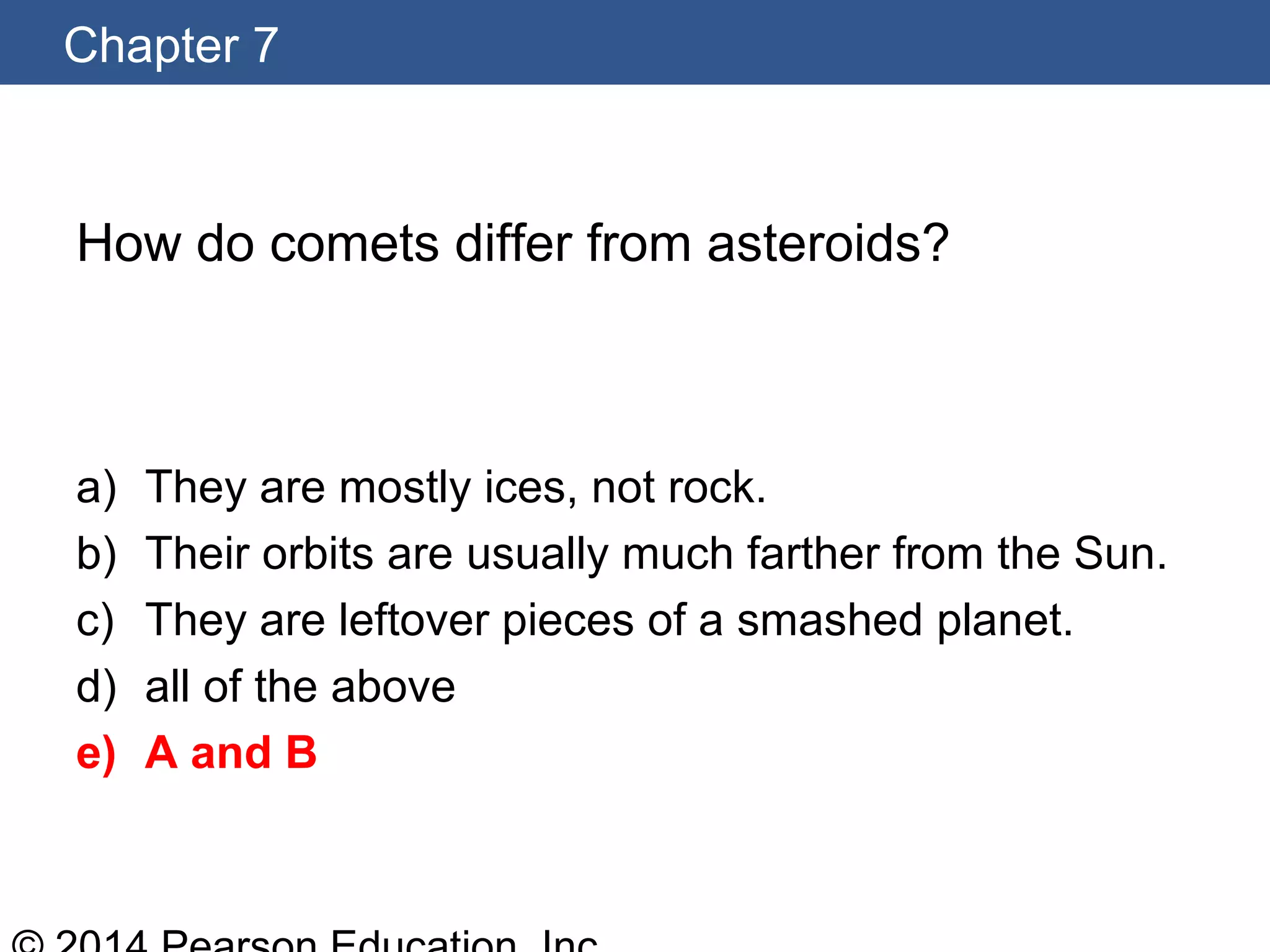
How do comets differ from asteroids?
a) They are mostly ices, not rock.
b) Their orbits are usually much farther from the Sun.
c) They are leftover pieces of a smashed planet.
d) all of the above
e) A and B
Chapter 7
How do comets differ from asteroids?
a) They are mostly ices, not rock.
b) Their orbits are usually much farther from the Sun.
c) They are leftover pieces of a smashed planet.
d) all of the above
e) A and B
Chapter 7
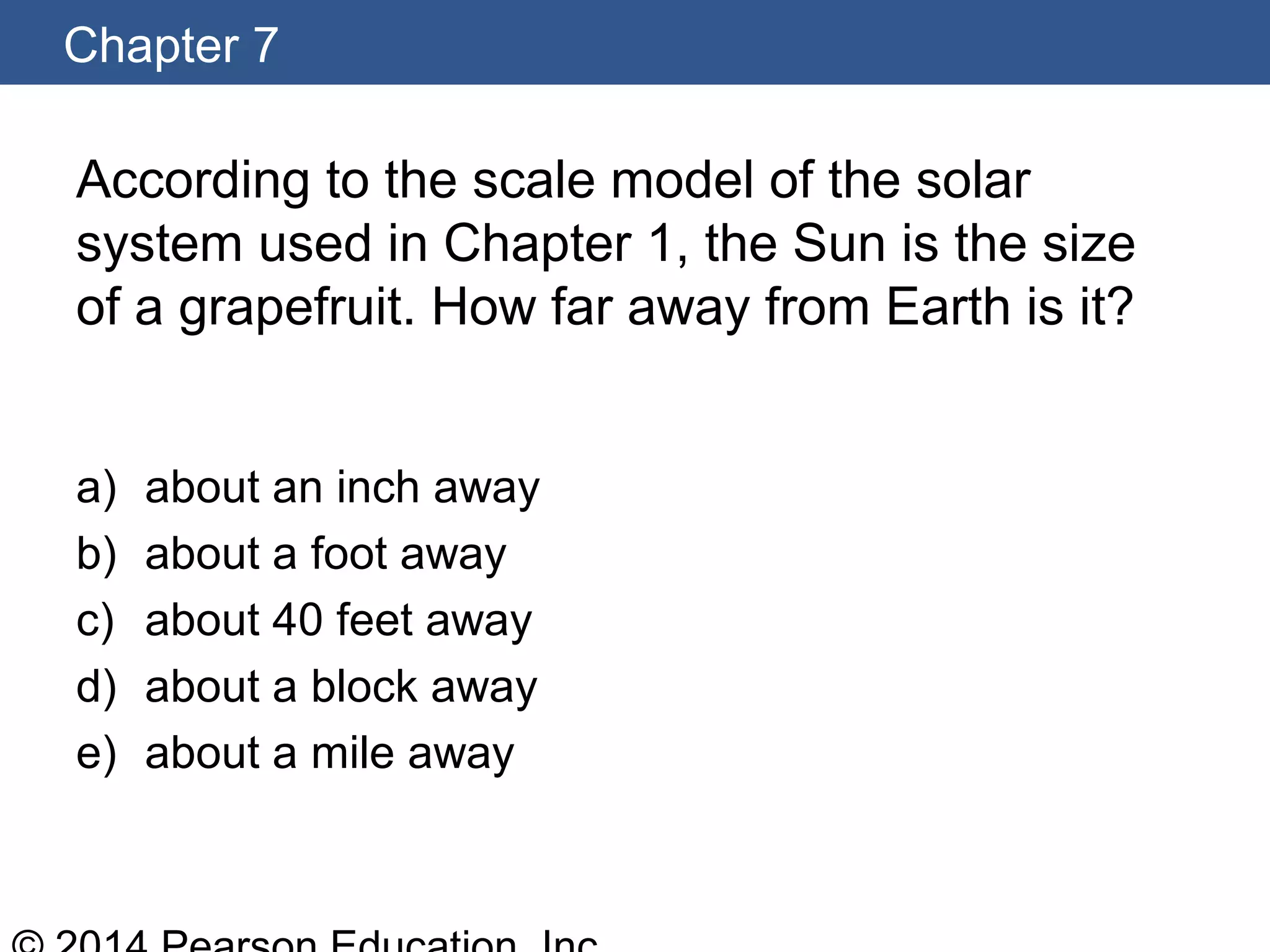
According to the scale model of the solar
system used in Chapter 1, the Sun is the size
of a grapefruit. How far away from Earth is it?
a) about an inch away
b) about a foot away
c) about 40 feet away
d) about a block away
e) about a mile away
Chapter 7
According to the scale model of the solar
system used in Chapter 1, the Sun is the size
of a grapefruit. How far away from Earth is it?
a) about an inch away
b) about a foot away
c) about 40 feet away
d) about a block away
e) about a mile away
Chapter 7
According to the scale model of the solar
system used in Chapter 1, where does the
asteroid belt lie?
a) between Mars and Jupiter, around the National Air
and Space Museum
b) between Uranus and Neptune, around the Hirshorn
Museum
c) between Neptune and Pluto, around the Art and
Industries Building
d) beyond Neptune, but still within the Mall
e) well beyond the orbits of the planets, and off the
scale completely (i.e. in a different state)
Chapter 7
According to the scale model of the solar
system used in Chapter 1, where does the
asteroid belt lie?
a) between Mars and Jupiter, around the National
Air and Space Museum
b) between Uranus and Neptune, around the Hirshorn
Museum
c) between Neptune and Pluto, around the Art and
Industries Building
d) beyond Neptune, but still within the Mall
e) well beyond the orbits of the planets, and off the
scale completely (i.e. in a different state)
Chapter 7
According to the scale model of the solar
system used in Chapter 1, where does the
Kuiper belt lie?
a) between Mars and Jupiter, around the National Air
and Space Museum
b) between Uranus and Neptune, around the Hirshorn
Museum
c) between Neptune and Pluto, around the Art and
Industries Building
d) beyond Neptune, but still within the Mall
e) well beyond the orbits of the planets, and off the
scale completely (i.e. in a different state)
Chapter 7
According to the scale model of the solar
system used in Chapter 1, where does the
Kuiper belt lie?
a) between Mars and Jupiter, around the National Air
and Space Museum
b) between Uranus and Neptune, around the Hirshorn
Museum
c) between Neptune and Pluto, around the Art and
Industries Building
d) beyond Neptune, but still within the Mall
e) well beyond the orbits of the planets, and off the
scale completely (i.e. in a different state)
Chapter 7
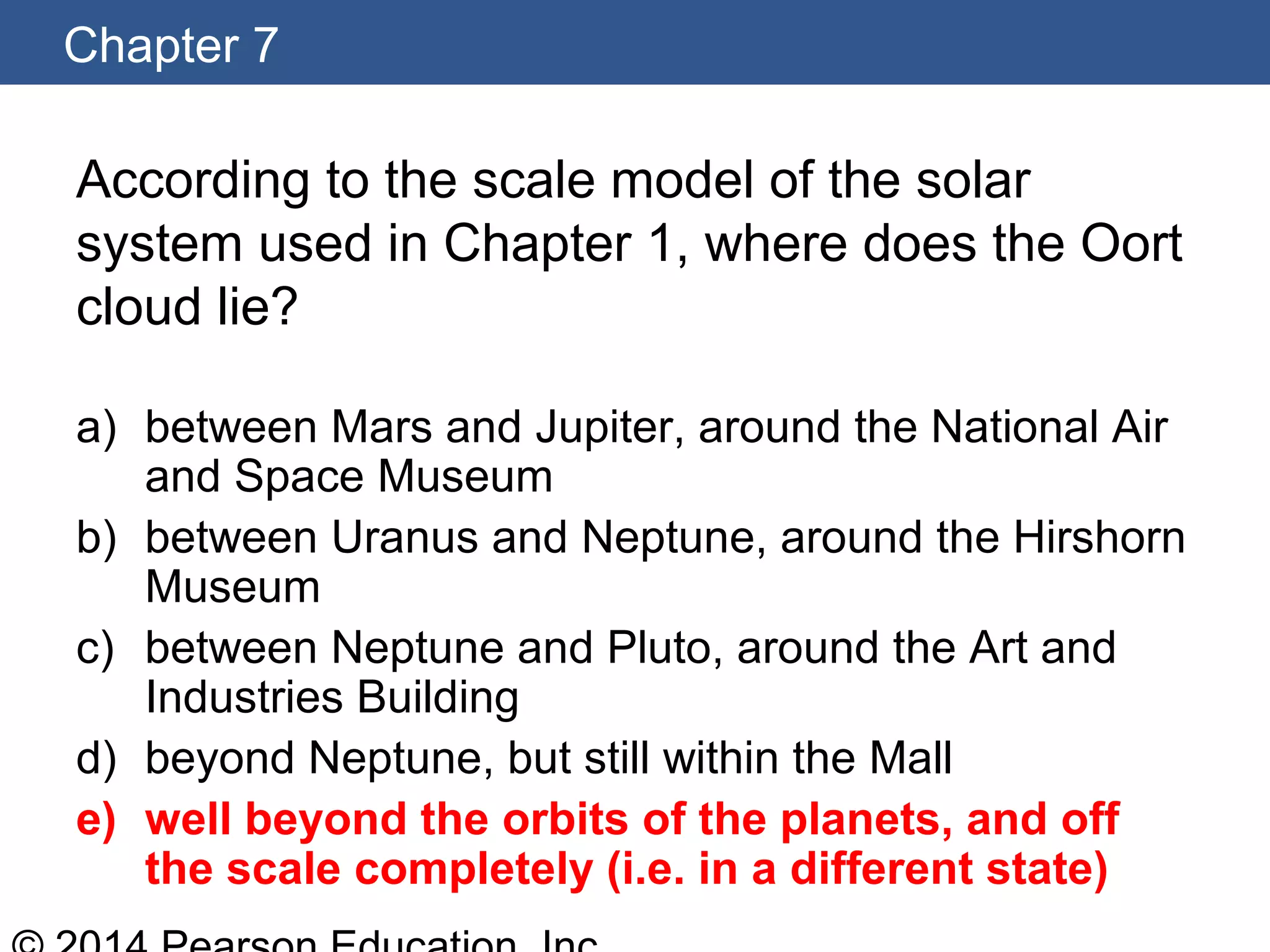
According to the scale model of the solar
system used in Chapter 1, where does the Oort
cloud lie?
a) between Mars and Jupiter, around the National Air
and Space Museum
b) between Uranus and Neptune, around the Hirshorn
Museum
c) between Neptune and Pluto, around the Art and
Industries Building
d) beyond Neptune, but still within the Mall
e) well beyond the orbits of the planets, and off the
scale completely (i.e. in a different state)
Chapter 7
According to the scale model of the solar
system used in Chapter 1, where does the Oort
cloud lie?
a) between Mars and Jupiter, around the National Air
and Space Museum
b) between Uranus and Neptune, around the Hirshorn
Museum
c) between Neptune and Pluto, around the Art and
Industries Building
d) beyond Neptune, but still within the Mall
e) well beyond the orbits of the planets, and off
the scale completely (i.e. in a different state)
Chapter 7
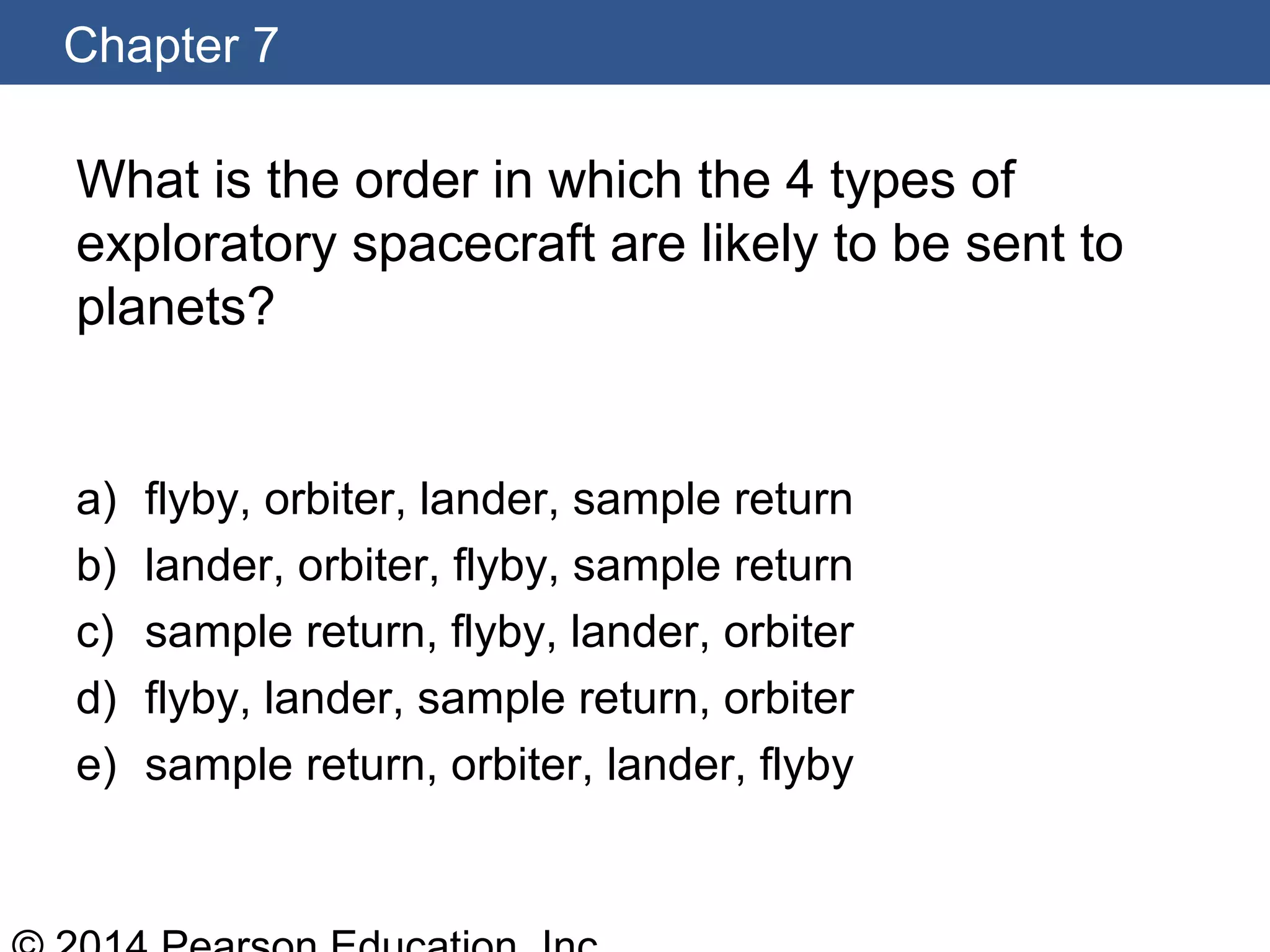
What is the order in which the 4 types of
exploratory spacecraft are likely to be sent to
planets?
a) flyby, orbiter, lander, sample return
b) lander, orbiter, flyby, sample return
c) sample return, flyby, lander, orbiter
d) flyby, lander, sample return, orbiter
e) sample return, orbiter, lander, flyby
Chapter 7
What is the order in which the 4 types of
exploratory spacecraft are likely to be sent to
planets?
a) flyby, orbiter, lander, sample return
b) lander, orbiter, flyby, sample return
c) sample return, flyby, lander, orbiter
d) flyby, lander, sample return, orbiter
e) sample return, orbiter, lander, flyby

07 review clickers

  • 1.
    Chapter 7 ReviewClickers © 2014 Pearson Education, Inc. The Cosmic Perspective Seventh Edition Our Planetary System
  • 2.
    Chapter 7 Which planetshave a rocky, relatively dense composition? a) Jupiter, Saturn, Earth, and Mars b) Uranus, Neptune, Earth, and Mars c) Jupiter, Saturn, Uranus, and Neptune d) Mercury, Venus, Earth, and Mars
  • 3.
    Chapter 7 Which planetshave a rocky, relatively dense composition? a) Jupiter, Saturn, Earth, and Mars b) Uranus, Neptune, Earth, and Mars c) Jupiter, Saturn, Uranus, and Neptune d) Mercury, Venus, Earth, and Mars
  • 4.
    Chapter 7 Most ofthe solar system's planets a) are made of rocks and minerals. b) are made of gas. c) orbit the Sun in the same direction. d) rotate in the same direction as they orbit the Sun. e) C and D
  • 5.
    Chapter 7 Most ofthe solar system's planets a) are made of rocks and minerals. b) are made of gas. c) orbit the Sun in the same direction. d) rotate in the same direction as they orbit the Sun. e) C and D
  • 6.
    Chapter 7 What patternscan been seen comparing the terrestrial planets (Mercury, Venus, Earth, Mars) to the Jovian planets (Jupiter, Saturn, Uranus, Neptune)? a) The jovian planets are much more massive. b) The terrestrial planets are much more dense. c) The terrestrial planets are rocky and the jovian planets are gaseous. d) All of the above e) A and C.
  • 7.
    Chapter 7 What patternscan been seen comparing the terrestrial planets (Mercury, Venus, Earth, Mars) to the Jovian planets (Jupiter, Saturn, Uranus, Neptune)? a) The jovian planets are much more massive. b) The terrestrial planets are much more dense. c) The terrestrial planets are rocky and the jovian planets are gaseous. d) All of the above e) A and C.
  • 8.
    Chapter 7 Where doasteroids come from? a) There are the remains of a planet between Mars and Jupiter that broke up. b) They are escaped small moons. c) They are leftover planetesimals from the inner solar system. d) They are leftover planetesimals from the outer solar system.
  • 9.
    Chapter 7 Where doasteroids come from? a) There are the remains of a planet between Mars and Jupiter that broke up. b) They are escaped small moons. c) They are leftover planetesimals from the inner solar system. d) They are leftover planetesimals from the outer solar system.
  • 10.
    Chapter 7 Where docomets come from? a) There are the remains of a planet between Mars and Jupiter that broke up. b) They are escaped small moons. c) They are leftover planetesimals from the inner solar system. d) They are leftover planetesimals from the outer solar system.
  • 11.
    Chapter 7 Where docomets come from? a) There are the remains of a planet between Mars and Jupiter that broke up. b) They are escaped small moons. c) They are leftover planetesimals from the inner solar system. d) They are leftover planetesimals from the outer solar system.
  • 12.
    Chapter 7 Where doasteroids orbit? a) between Mars and Jupiter b) in the same plane as the planets c) some in the plane of the planets, some at large angles to it d) between Neptune and Pluto e) A and C
  • 13.
    Chapter 7 Where doasteroids orbit? a) between Mars and Jupiter b) in the same plane as the planets c) some in the plane of the planets, some at large angles to it d) between Neptune and Pluto e) A and C
  • 14.
    Chapter 7 How docomets differ from asteroids? a) They are mostly ices, not rock. b) Their orbits are usually much farther from the Sun. c) They are leftover pieces of a smashed planet. d) all of the above e) A and B
  • 15.
    Chapter 7 How docomets differ from asteroids? a) They are mostly ices, not rock. b) Their orbits are usually much farther from the Sun. c) They are leftover pieces of a smashed planet. d) all of the above e) A and B
  • 16.
    Chapter 7 According tothe scale model of the solar system used in Chapter 1, the Sun is the size of a grapefruit. How far away from Earth is it? a) about an inch away b) about a foot away c) about 40 feet away d) about a block away e) about a mile away
  • 17.
    Chapter 7 According tothe scale model of the solar system used in Chapter 1, the Sun is the size of a grapefruit. How far away from Earth is it? a) about an inch away b) about a foot away c) about 40 feet away d) about a block away e) about a mile away
  • 18.
    Chapter 7 According tothe scale model of the solar system used in Chapter 1, where does the asteroid belt lie? a) between Mars and Jupiter, around the National Air and Space Museum b) between Uranus and Neptune, around the Hirshorn Museum c) between Neptune and Pluto, around the Art and Industries Building d) beyond Neptune, but still within the Mall e) well beyond the orbits of the planets, and off the scale completely (i.e. in a different state)
  • 19.
    Chapter 7 According tothe scale model of the solar system used in Chapter 1, where does the asteroid belt lie? a) between Mars and Jupiter, around the National Air and Space Museum b) between Uranus and Neptune, around the Hirshorn Museum c) between Neptune and Pluto, around the Art and Industries Building d) beyond Neptune, but still within the Mall e) well beyond the orbits of the planets, and off the scale completely (i.e. in a different state)
  • 20.
    Chapter 7 According tothe scale model of the solar system used in Chapter 1, where does the Kuiper belt lie? a) between Mars and Jupiter, around the National Air and Space Museum b) between Uranus and Neptune, around the Hirshorn Museum c) between Neptune and Pluto, around the Art and Industries Building d) beyond Neptune, but still within the Mall e) well beyond the orbits of the planets, and off the scale completely (i.e. in a different state)
  • 21.
    Chapter 7 According tothe scale model of the solar system used in Chapter 1, where does the Kuiper belt lie? a) between Mars and Jupiter, around the National Air and Space Museum b) between Uranus and Neptune, around the Hirshorn Museum c) between Neptune and Pluto, around the Art and Industries Building d) beyond Neptune, but still within the Mall e) well beyond the orbits of the planets, and off the scale completely (i.e. in a different state)
  • 22.
    Chapter 7 According tothe scale model of the solar system used in Chapter 1, where does the Oort cloud lie? a) between Mars and Jupiter, around the National Air and Space Museum b) between Uranus and Neptune, around the Hirshorn Museum c) between Neptune and Pluto, around the Art and Industries Building d) beyond Neptune, but still within the Mall e) well beyond the orbits of the planets, and off the scale completely (i.e. in a different state)
  • 23.
    Chapter 7 According tothe scale model of the solar system used in Chapter 1, where does the Oort cloud lie? a) between Mars and Jupiter, around the National Air and Space Museum b) between Uranus and Neptune, around the Hirshorn Museum c) between Neptune and Pluto, around the Art and Industries Building d) beyond Neptune, but still within the Mall e) well beyond the orbits of the planets, and off the scale completely (i.e. in a different state)
  • 24.
    Chapter 7 What isthe order in which the 4 types of exploratory spacecraft are likely to be sent to planets? a) flyby, orbiter, lander, sample return b) lander, orbiter, flyby, sample return c) sample return, flyby, lander, orbiter d) flyby, lander, sample return, orbiter e) sample return, orbiter, lander, flyby
  • 25.
    Chapter 7 What isthe order in which the 4 types of exploratory spacecraft are likely to be sent to planets? a) flyby, orbiter, lander, sample return b) lander, orbiter, flyby, sample return c) sample return, flyby, lander, orbiter d) flyby, lander, sample return, orbiter e) sample return, orbiter, lander, flyby

Editor's Notes

  • #3 Answer: d) Mercury, Venus, Earth, and Mars
  • #4 Answer: d) Mercury, Venus, Earth, and Mars
  • #5 Answer: e) C and D
  • #6 Answer: e) C and D
  • #7 Answer: d) All of the above
  • #8 Answer: d) All of the above
  • #9 Answer: c) They are leftover planetesimals from the inner solar system
  • #10 Answer: c) They are leftover planetesimals from the inner solar system
  • #11 Answer: d) They are leftover planetesimals from the outer solar system.
  • #12 Answer: d) They are leftover planetesimals from the outer solar system.
  • #13 Answer: e) A and C
  • #14 Answer: e) A and C
  • #15 Answer: e) A and B
  • #16 Answer: e) A and B
  • #17 Answer: c) about 40 feet away
  • #18 Answer: c) about 40 feet away
  • #19 Answer: a) between Mars and Jupiter, around the National Air and Space Museum
  • #20 Answer: a) between Mars and Jupiter, around the National Air and Space Museum
  • #21 Answer: d) beyond Neptune, but still within the Mall
  • #22 Answer: d) beyond Neptune, but still within the Mall
  • #23 Answer: e) well beyond the orbits of the planets, and off the scale completely (i.e. in a different state)
  • #24 Answer: e) well beyond the orbits of the planets, and off the scale completely (i.e. in a different state)
  • #25 Answer: a) flyby, orbiter, lander, sample return
  • #26 Answer: a) flyby, orbiter, lander, sample return