Solar System
Ancient Observations
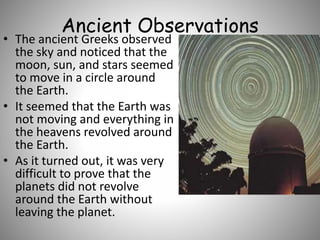
• The ancient Greeks observed
the sky and noticed that the
moon, sun, and stars seemed
to move in a circle around
the Earth.
• It seemed that the Earth was
not moving and everything in
the heavens revolved around
the Earth.
• As it turned out, it was very
difficult to prove that the
planets did not revolve
around the Earth without
leaving the planet.
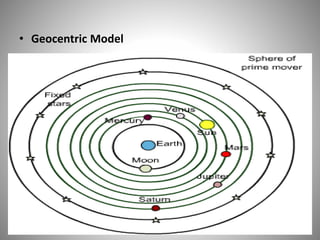
• Geocentric Model
Geocentric Theory
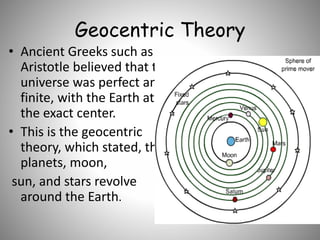
• Ancient Greeks such as
Aristotle believed that the
universe was perfect and
finite, with the Earth at
the exact center.
• This is the geocentric
theory, which stated, the
planets, moon,
sun, and stars revolve
around the Earth.
Claudius Ptolemy
•Ptolemaic Model
•Earth-centered
•His model of the solar system and
heavenly sphere was a refinement of
previous models developed by Greek
astronomers.
• His model had the planets move in little circles
that also moved in bigger circles.
• This belief persisted for about 1500 years.
• Earth was the center of not only the solar
system, but the entire universe.
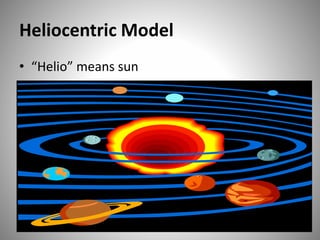
Heliocentric Model
• “Helio” means sun
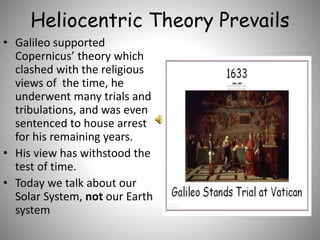
Heliocentric Theory Prevails
• Galileo supported
Copernicus’ theory which
clashed with the religious
views of the time, he
underwent many trials and
tribulations, and was even
sentenced to house arrest
for his remaining years.
• His view has withstood the
test of time.
• Today we talk about our
Solar System, not our Earth
system
ORIGIN OF THE SOLAR SYSTEM
• All the building material necessary to make our Solar
System was assembled in the process of
nucleosynthesis in the early Universe, in stellar cores
and during supernova explosions
• Protons, neutrons and electrons were made in the first
3 min. of the existence of the Universe
• Hydrogen, deuterium, helium, lithium and beryllium
were made in the first 30 min.
• Heavier elements all the way up to iron were
synthesized by nuclear fusion in stars
• All elements heavier than iron were made in supernova
explosions
• We are made out of that stuff!!!
The origin of planets
• The most likely explanation of the creation of our Solar
System involves the familiar process of star formation
out of a collapsing molecular cloud of gas and dust.
This is called the solar nebula theory
• A rotating cloud, compressed by a passing shock wave,
collapses into a flat, spinning disk with a protostar at its
center
• Planets are made out of the disk material in the process
of condensation and coagulation of dust particles
• When nuclear fusion begins in the central star and it
becomes luminous enough, most of the remaining
debris is cleared away (this process is seen in T Tauri
stars)
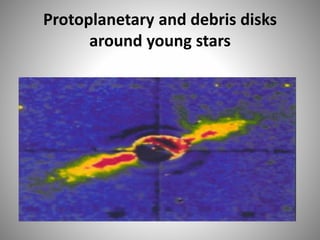
Protoplanetary and debris disks
around young stars
• Properties of the Solar System indicate that the
solar nebula theory is the most plausible one
• The solar nebula theory predicts that planets
should form as a by-product of star formation
• This means that protoplanetary disks should be
common around other stars and so should be the
planets
• Observations show that ~50% of young, solar-
mass stars have such disks and that some older
stars have dusty debris disks around them that
could hide planetary companions
Two kinds of planets
• Planets are clearly divided into two types:
terrestrial (Earthlike) planets and Jovian planets
(gas giants)
• Terrestrial planets, Mercury, Venus, Earth and
Mars, lie in the inner Solar System, are small,
rocky and dense, and have less dense
atmospheres than the Jovian planets
• Jovian planets, Jupiter, Saturn, Uranus and
Neptune, lie in the outer Solar System, are large,
gaseous and low-density objects
• Pluto does not fit either of these two categories
Two Kinds of Planets
Planets of our solar system can be divided into
two very different kinds:
Terrestrial (earthlike) planets:
Mercury, Venus, Earth, Mars
Jovian (Jupiter-like) planets: Jupiter,
Saturn, Uranus, Neptune
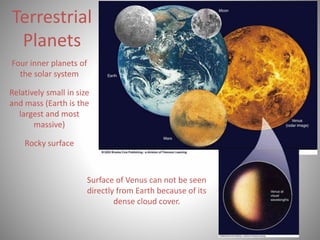
Terrestrial
Planets
Four inner planets of
the solar system
Relatively small in size
and mass (Earth is the
largest and most
massive)
Rocky surface
Surface of Venus can not be seen
directly from Earth because of its
dense cloud cover.
Craters on Planets’ Surfaces
Craters (like on our
moon’s surface) are
common
throughout the
solar system.
Not seen on
Jovian planets
because they
don’t have a solid
surface.
The Jovian Planets
Much larger in mass
and size than
terrestrial planets
Much lower
average density
All have rings (not
only Saturn!)
Mostly gas; no
solid surface
Planetary Orbits
Earth
Venus
Mercury
All planets in almost
circular (elliptical)
orbits around the sun,
in approx. the same
plane (ecliptic).
Sense of revolution:
counter-clockwise
Sense of rotation:
counter-clockwise
(with exception of
Venus, Uranus, and
Pluto)
Orbits generally
inclined by no
more than 3.4o
Exceptions:
Mercury (7o)
Pluto (17.2o)
(Distances and times reproduced to scale)

Solar system-report

  • 1.
  • 2.
    Ancient Observations • Theancient Greeks observed the sky and noticed that the moon, sun, and stars seemed to move in a circle around the Earth. • It seemed that the Earth was not moving and everything in the heavens revolved around the Earth. • As it turned out, it was very difficult to prove that the planets did not revolve around the Earth without leaving the planet.
  • 3.
  • 4.
    Geocentric Theory • AncientGreeks such as Aristotle believed that the universe was perfect and finite, with the Earth at the exact center. • This is the geocentric theory, which stated, the planets, moon, sun, and stars revolve around the Earth.
  • 5.
    Claudius Ptolemy •Ptolemaic Model •Earth-centered •Hismodel of the solar system and heavenly sphere was a refinement of previous models developed by Greek astronomers.
  • 6.
    • His modelhad the planets move in little circles that also moved in bigger circles. • This belief persisted for about 1500 years. • Earth was the center of not only the solar system, but the entire universe.
  • 8.
  • 9.
    Heliocentric Theory Prevails •Galileo supported Copernicus’ theory which clashed with the religious views of the time, he underwent many trials and tribulations, and was even sentenced to house arrest for his remaining years. • His view has withstood the test of time. • Today we talk about our Solar System, not our Earth system
  • 11.
    ORIGIN OF THESOLAR SYSTEM • All the building material necessary to make our Solar System was assembled in the process of nucleosynthesis in the early Universe, in stellar cores and during supernova explosions • Protons, neutrons and electrons were made in the first 3 min. of the existence of the Universe • Hydrogen, deuterium, helium, lithium and beryllium were made in the first 30 min. • Heavier elements all the way up to iron were synthesized by nuclear fusion in stars • All elements heavier than iron were made in supernova explosions • We are made out of that stuff!!!
  • 12.
    The origin ofplanets • The most likely explanation of the creation of our Solar System involves the familiar process of star formation out of a collapsing molecular cloud of gas and dust. This is called the solar nebula theory • A rotating cloud, compressed by a passing shock wave, collapses into a flat, spinning disk with a protostar at its center • Planets are made out of the disk material in the process of condensation and coagulation of dust particles • When nuclear fusion begins in the central star and it becomes luminous enough, most of the remaining debris is cleared away (this process is seen in T Tauri stars)
  • 13.
    Protoplanetary and debrisdisks around young stars
  • 14.
    • Properties ofthe Solar System indicate that the solar nebula theory is the most plausible one • The solar nebula theory predicts that planets should form as a by-product of star formation • This means that protoplanetary disks should be common around other stars and so should be the planets • Observations show that ~50% of young, solar- mass stars have such disks and that some older stars have dusty debris disks around them that could hide planetary companions
  • 15.
    Two kinds ofplanets • Planets are clearly divided into two types: terrestrial (Earthlike) planets and Jovian planets (gas giants) • Terrestrial planets, Mercury, Venus, Earth and Mars, lie in the inner Solar System, are small, rocky and dense, and have less dense atmospheres than the Jovian planets • Jovian planets, Jupiter, Saturn, Uranus and Neptune, lie in the outer Solar System, are large, gaseous and low-density objects • Pluto does not fit either of these two categories
  • 16.
    Two Kinds ofPlanets Planets of our solar system can be divided into two very different kinds: Terrestrial (earthlike) planets: Mercury, Venus, Earth, Mars Jovian (Jupiter-like) planets: Jupiter, Saturn, Uranus, Neptune
  • 17.
    Terrestrial Planets Four inner planetsof the solar system Relatively small in size and mass (Earth is the largest and most massive) Rocky surface Surface of Venus can not be seen directly from Earth because of its dense cloud cover.
  • 18.
    Craters on Planets’Surfaces Craters (like on our moon’s surface) are common throughout the solar system. Not seen on Jovian planets because they don’t have a solid surface.
  • 19.
    The Jovian Planets Muchlarger in mass and size than terrestrial planets Much lower average density All have rings (not only Saturn!) Mostly gas; no solid surface
  • 20.
    Planetary Orbits Earth Venus Mercury All planetsin almost circular (elliptical) orbits around the sun, in approx. the same plane (ecliptic). Sense of revolution: counter-clockwise Sense of rotation: counter-clockwise (with exception of Venus, Uranus, and Pluto) Orbits generally inclined by no more than 3.4o Exceptions: Mercury (7o) Pluto (17.2o) (Distances and times reproduced to scale)