Virtual Field Trip to the Sun
Earth Science
Mrs. Baker
The Sun
Welcome to our colossal tour through the many
sweltering layers of the Sun. I’m sure you will enjoy
the red-hot inferno of a landscape in experiencing this
gigantic beast. So… 10, 9, 8…2, 1BLAST OFF!
Here is our Space Shuttle
Up,
up
and
awa
Here is our Space Shuttle
Off to our nearest star . . . the
Sun! The Sun is only 93 million
miles away.
Bye Earth! We will be
back soon.
Through our journey you will be able to view
the many sights and sounds of our sun.
Please refer to your inflight television for
updated information of each of our stops
along our way.
We have reached the sun!
Wow…the Sun sure does make a
lot of noise
Click on image below to hear our suns magnificent
sounds
Can you feel the blazing heat? The Sun is
about 4.5 million degrees Fahrenheit.
Click on image below
Now lets take a closer blistery look. We will
descending into the ferocious core. The
temperature of the Sun’s core is 27 million
degrees.
Now that is HOT!
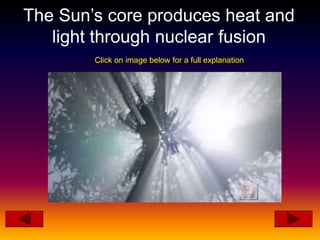
The Sun’s core produces heat and
light through nuclear fusion
Click on image below for a full explanation
Activity 1
Using the video from the previous slide,
explain nuclear fusion in one to two
sentences.
(Click the image if you need to view another explanation on nuclear
fusion)
Now we will be
heading back to the
surface to study the
photosphere.
Look at your inflight
television screens.
The photosphere is
the layer of the sun
we see from Earth.
The Photosphere is also know as the “light
sphere.” On this layer is we can find sunspots. It is
hard to see them from here, let us move a little
closer to take a better look!
Perfect, we can see them very
easily now!
These two pictures of the Sun show how the number of sunspots changes. The picture
on the left was taken near solar maximum in March 2001. It shows many sunspots. The
picture on the right was taken near solar minimum in January 2005. It doesn't have any
sunspots at all! An average sunspot cycle lasts for eleven years.
Activity 2: So are we in solar maximum in 2013 or solar
minimum?
Click on the image to find out.
Sunspots are dark cooler areas located on the photosphere.
Even though sunspots are cooler they are still 7,800 degrees
Fahrenheit – OUCH!
The number of sunspots increases or decreases depending if
we are in solar maximum or solar minimum.
Click on image below to find out more about
sunspots
Solar Maximum
Solar minimum refers to a period of several Earth years when the
number of sunspots is lowest; solar maximum occurs in the years
when sunspots are most numerous. During solar maximum, activity on
the Sun and the effects of space weather on our terrestrial
environment are high. At solar minimum, the sun may go many days
with no sunspots visible. At maximum, there may be several hundred
sunspots on any day.
Learn more about solar maximum, which is believed to be the
strongest solar activity we have seen
in modern times.
Solar Max Article
Activity 3
During what year will we be entering into
solar minimum?
Watch out!!!
What is that large loop of gas?
• A solar prominence is a loop of gas that
connects sunspots.
• There are more solar prominences during
solar maximum than during solar
minimum.
– True
– False
Try again
There are more solar prominences because
there are more sunspots. Click on the image
below to experience a solar prominence
caught on video.
Right!!!
We are off the next blistery
layer!
The chromosphere or “the color sphere” is
the layer that gives us the beautiful reddish
color we see everyday on Earth.
The chromosphere lies just outside the photosphere. On the
picture below, the chromosphere can be seen as a red glow just
around the Sun.
Activity 4: Do all stars produce the same reddish glow?
Click on the image below to find out.
What is going on?!?
We must have just reached the corona!
The corona has been found to emit x-ray
radiation.
The corona or “the crown” reaches a
sweltering one million degrees! Because the
corona is so thin, you can only see it during a
solar eclipse, when the glare of the Sun itself
(its photosphere) is blocked by the moon.
Activity 5: Why is the corona referred to as “the
crown?”
What is a solar eclipse? Do we have them
in New Jersey?
Activity 6: During a solar eclipse, what object is blocking the
light from the sun to earth?
Click on the image and encounter a solar eclipse.
Solar Eclipses are really amazing, want
to find out more?
Watch closely there are questions you will need to
answer based on the video
Activity 7
So why does a solar eclipse not happen
every month?
Need some help? Click on my image to refer back to the
video clip
Activity 8
If a solar eclipse is seen in Paris, France will
we be able to see that same solar eclipse in
Leonia, New Jersey?
Need some help? Click on my image to refer back to the
video clip
Well…it is time to head back home now.
Click on the image below to watch us
return safely to earth.
Click on the image to see a live feed from Cape Canaveral as
we descent back to Earth.

Virtual Field Trip

  • 1.
    Virtual Field Tripto the Sun Earth Science Mrs. Baker
  • 2.
    The Sun Welcome toour colossal tour through the many sweltering layers of the Sun. I’m sure you will enjoy the red-hot inferno of a landscape in experiencing this gigantic beast. So… 10, 9, 8…2, 1BLAST OFF!
  • 3.
    Here is ourSpace Shuttle
  • 4.
  • 5.
    Here is ourSpace Shuttle Off to our nearest star . . . the Sun! The Sun is only 93 million miles away.
  • 6.
    Bye Earth! Wewill be back soon.
  • 7.
    Through our journeyyou will be able to view the many sights and sounds of our sun. Please refer to your inflight television for updated information of each of our stops along our way.
  • 8.
    We have reachedthe sun! Wow…the Sun sure does make a lot of noise Click on image below to hear our suns magnificent sounds
  • 9.
    Can you feelthe blazing heat? The Sun is about 4.5 million degrees Fahrenheit. Click on image below
  • 10.
    Now lets takea closer blistery look. We will descending into the ferocious core. The temperature of the Sun’s core is 27 million degrees. Now that is HOT!
  • 11.
    The Sun’s coreproduces heat and light through nuclear fusion Click on image below for a full explanation
  • 12.
    Activity 1 Using thevideo from the previous slide, explain nuclear fusion in one to two sentences. (Click the image if you need to view another explanation on nuclear fusion)
  • 13.
    Now we willbe heading back to the surface to study the photosphere. Look at your inflight television screens. The photosphere is the layer of the sun we see from Earth.
  • 14.
    The Photosphere isalso know as the “light sphere.” On this layer is we can find sunspots. It is hard to see them from here, let us move a little closer to take a better look!
  • 15.
    Perfect, we cansee them very easily now! These two pictures of the Sun show how the number of sunspots changes. The picture on the left was taken near solar maximum in March 2001. It shows many sunspots. The picture on the right was taken near solar minimum in January 2005. It doesn't have any sunspots at all! An average sunspot cycle lasts for eleven years. Activity 2: So are we in solar maximum in 2013 or solar minimum? Click on the image to find out.
  • 16.
    Sunspots are darkcooler areas located on the photosphere. Even though sunspots are cooler they are still 7,800 degrees Fahrenheit – OUCH! The number of sunspots increases or decreases depending if we are in solar maximum or solar minimum. Click on image below to find out more about sunspots
  • 17.
    Solar Maximum Solar minimumrefers to a period of several Earth years when the number of sunspots is lowest; solar maximum occurs in the years when sunspots are most numerous. During solar maximum, activity on the Sun and the effects of space weather on our terrestrial environment are high. At solar minimum, the sun may go many days with no sunspots visible. At maximum, there may be several hundred sunspots on any day. Learn more about solar maximum, which is believed to be the strongest solar activity we have seen in modern times. Solar Max Article
  • 18.
    Activity 3 During whatyear will we be entering into solar minimum?
  • 19.
  • 20.
    What is thatlarge loop of gas? • A solar prominence is a loop of gas that connects sunspots. • There are more solar prominences during solar maximum than during solar minimum. – True – False
  • 21.
  • 22.
    There are moresolar prominences because there are more sunspots. Click on the image below to experience a solar prominence caught on video. Right!!!
  • 23.
    We are offthe next blistery layer! The chromosphere or “the color sphere” is the layer that gives us the beautiful reddish color we see everyday on Earth.
  • 24.
    The chromosphere liesjust outside the photosphere. On the picture below, the chromosphere can be seen as a red glow just around the Sun. Activity 4: Do all stars produce the same reddish glow? Click on the image below to find out.
  • 25.
    What is goingon?!? We must have just reached the corona! The corona has been found to emit x-ray radiation.
  • 26.
    The corona or“the crown” reaches a sweltering one million degrees! Because the corona is so thin, you can only see it during a solar eclipse, when the glare of the Sun itself (its photosphere) is blocked by the moon. Activity 5: Why is the corona referred to as “the crown?”
  • 27.
    What is asolar eclipse? Do we have them in New Jersey? Activity 6: During a solar eclipse, what object is blocking the light from the sun to earth? Click on the image and encounter a solar eclipse.
  • 28.
    Solar Eclipses arereally amazing, want to find out more? Watch closely there are questions you will need to answer based on the video
  • 29.
    Activity 7 So whydoes a solar eclipse not happen every month? Need some help? Click on my image to refer back to the video clip
  • 30.
    Activity 8 If asolar eclipse is seen in Paris, France will we be able to see that same solar eclipse in Leonia, New Jersey? Need some help? Click on my image to refer back to the video clip
  • 31.
    Well…it is timeto head back home now. Click on the image below to watch us return safely to earth. Click on the image to see a live feed from Cape Canaveral as we descent back to Earth.