"Voyage" 
is about as 
close as I got to 
astronomy during a 
30 year career as an 
artist, so it is a privilege 
and an honor to stand 
here before you as a 
peer in this queen 
of sciences.
Jeffrey Foster Friedman 
Universidad de Puerto Rico 
Michael S. Foster 
Spectratek 
Jeffrey T. Baker 
Baker Adaptive Optics 
David Mozurkewich 
Seabrook Engineering 
Leonid Goray 
International Intellectual Group 
Jason Warren 
(IBM)) 
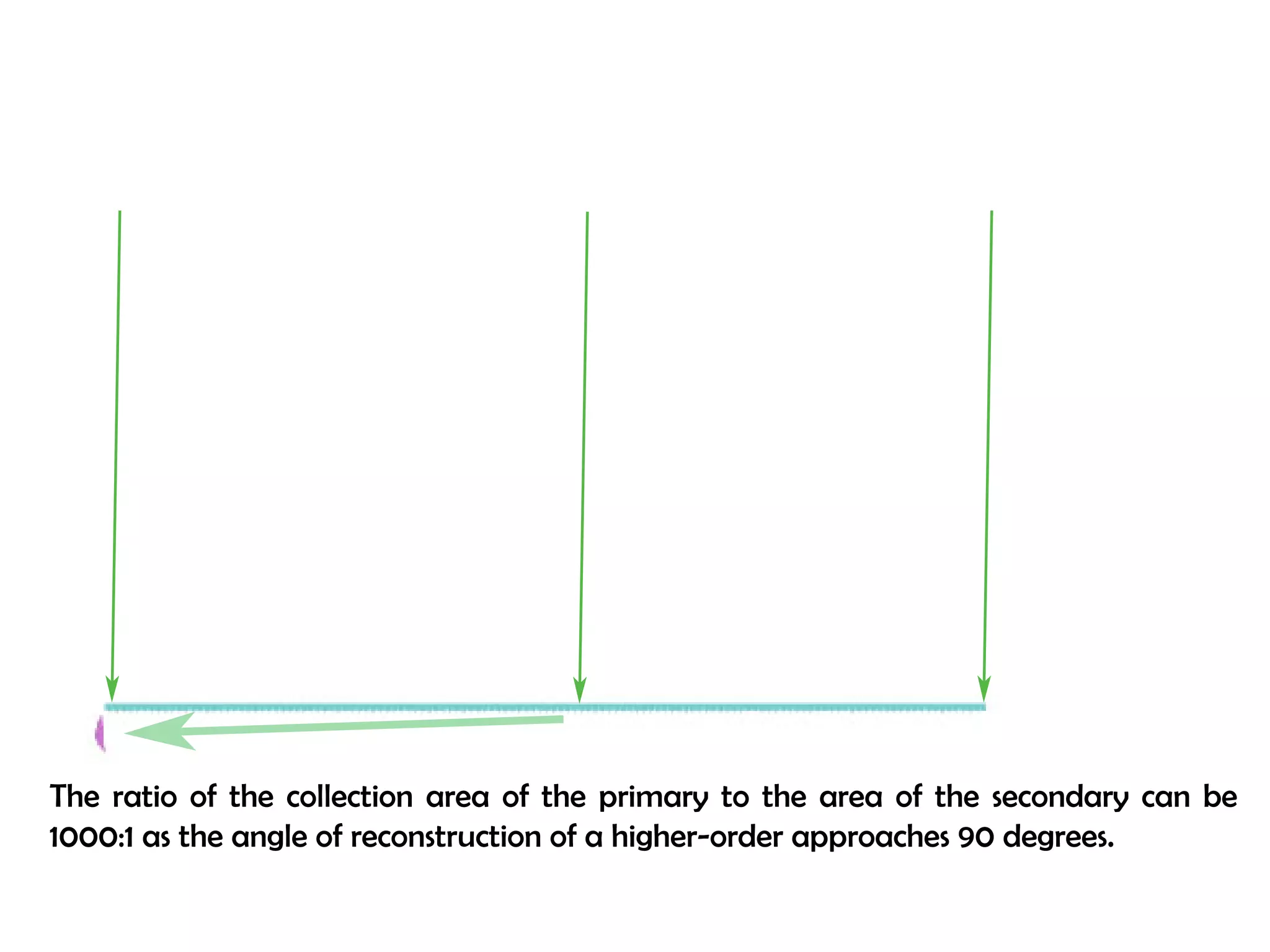
DeWitt 
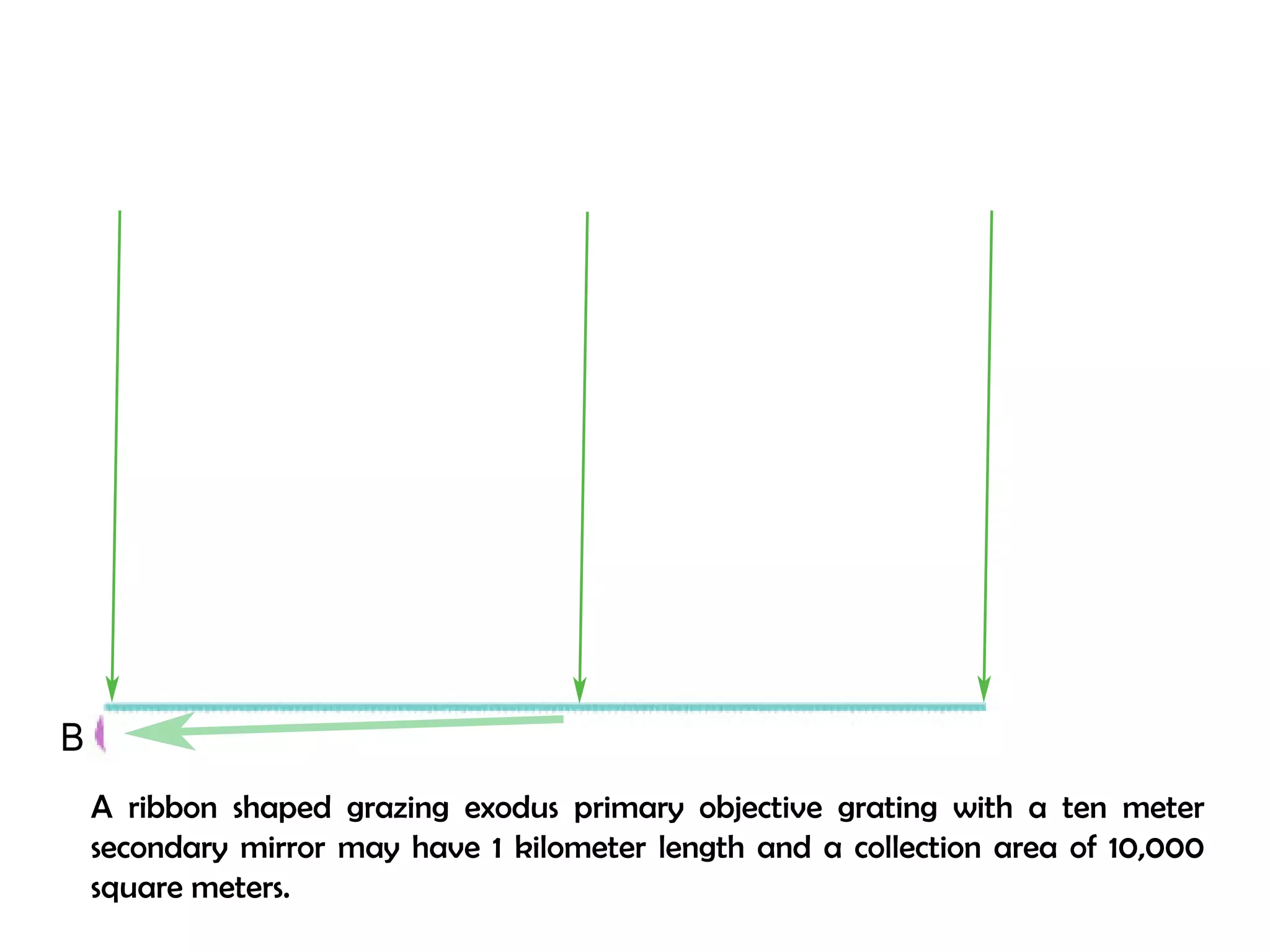
Tool 
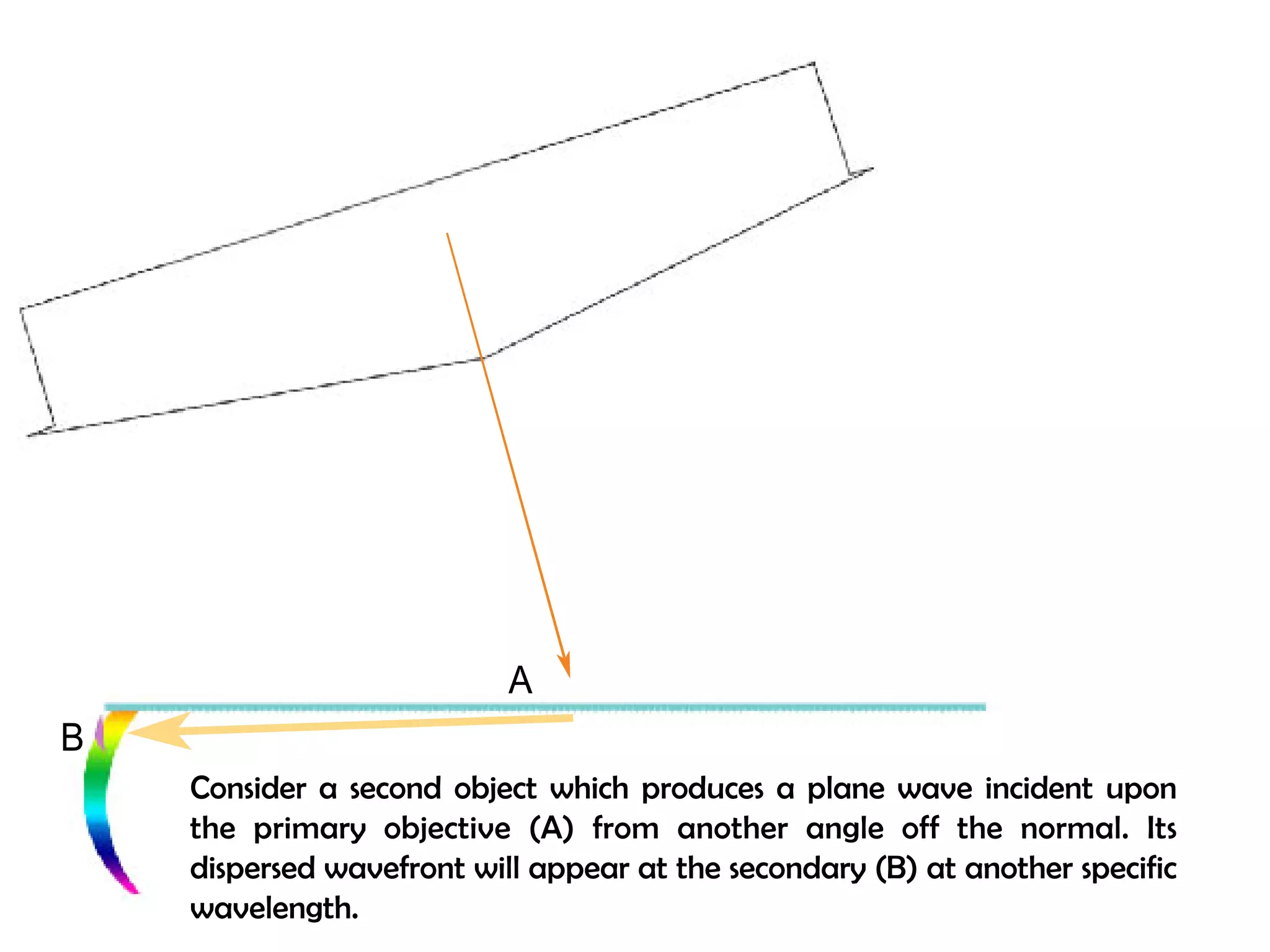
Brothers 
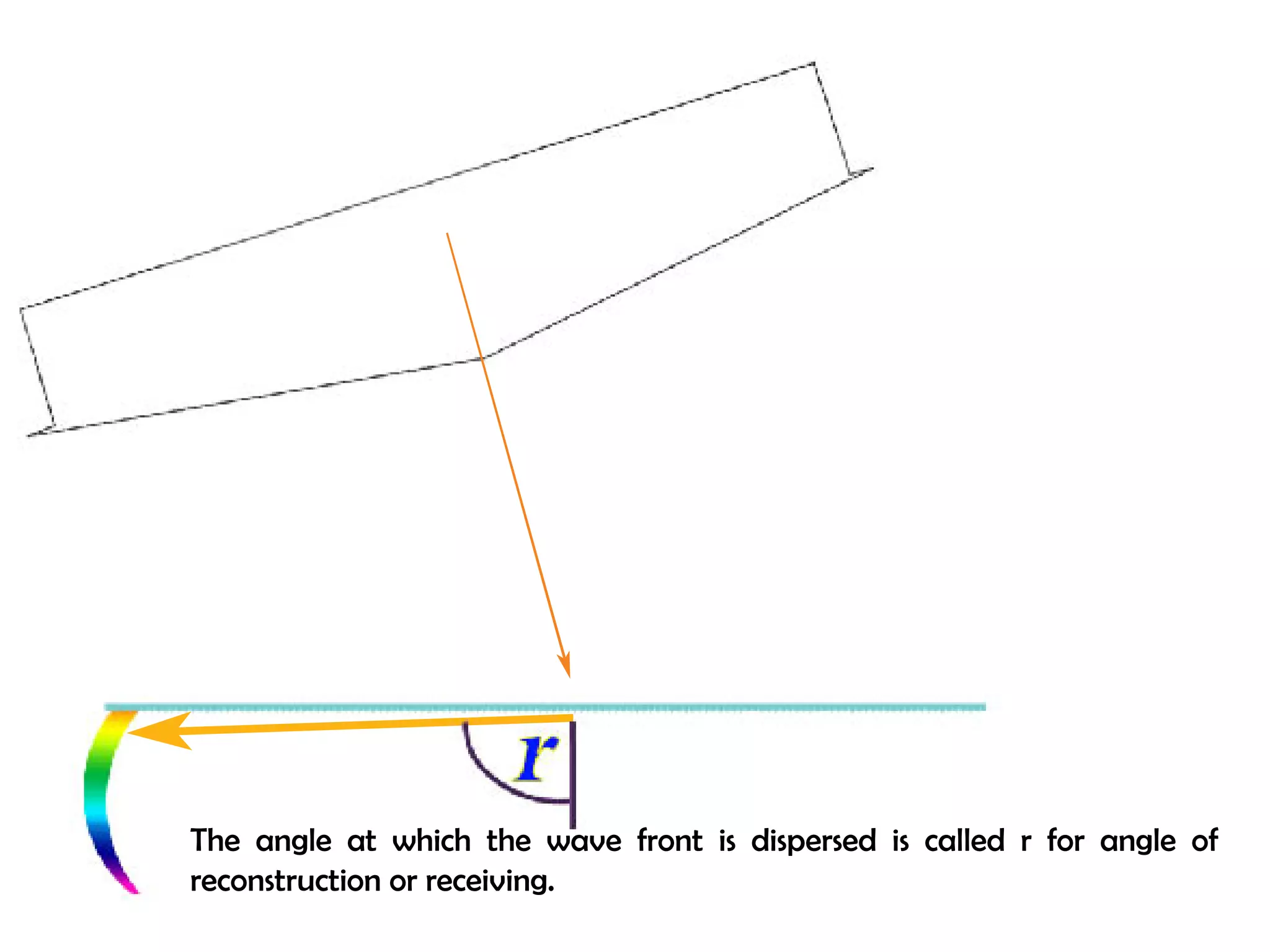
Co. 
Fortunately, I have help from these credentialed experts and 
institutional support from NIAC and DeWitt Brothers Tool Co.
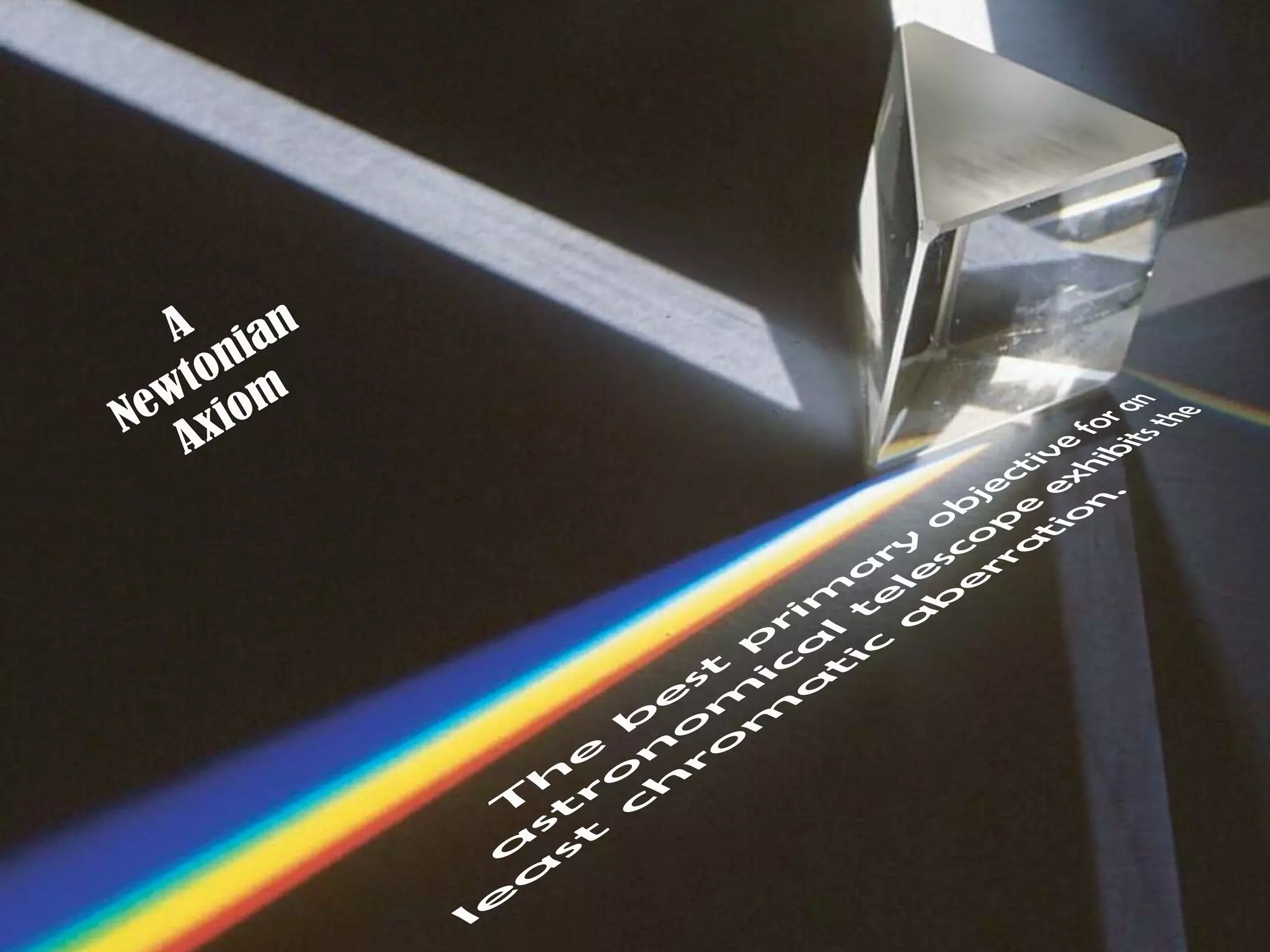
A 
Newtonian 
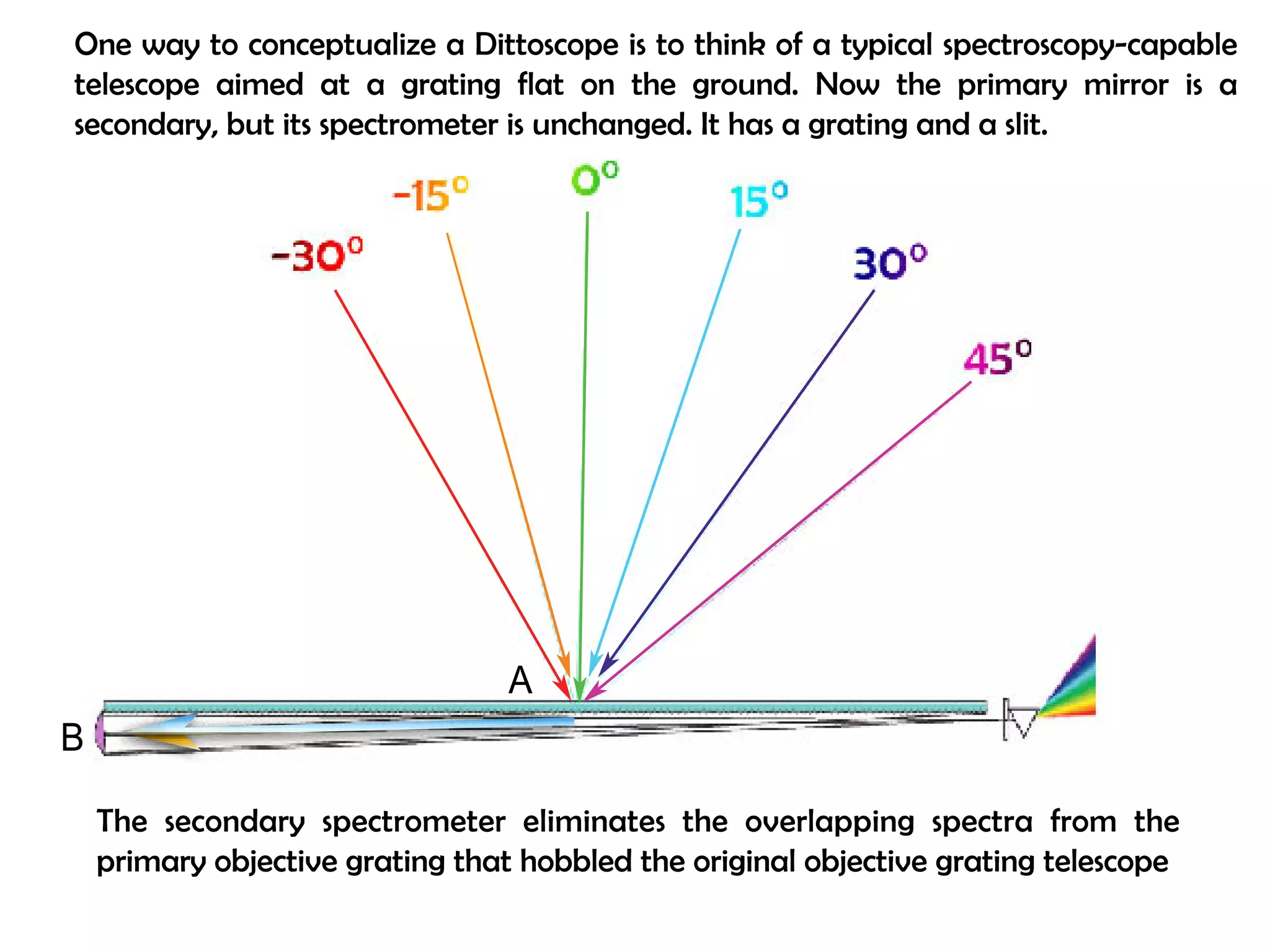
Axiom
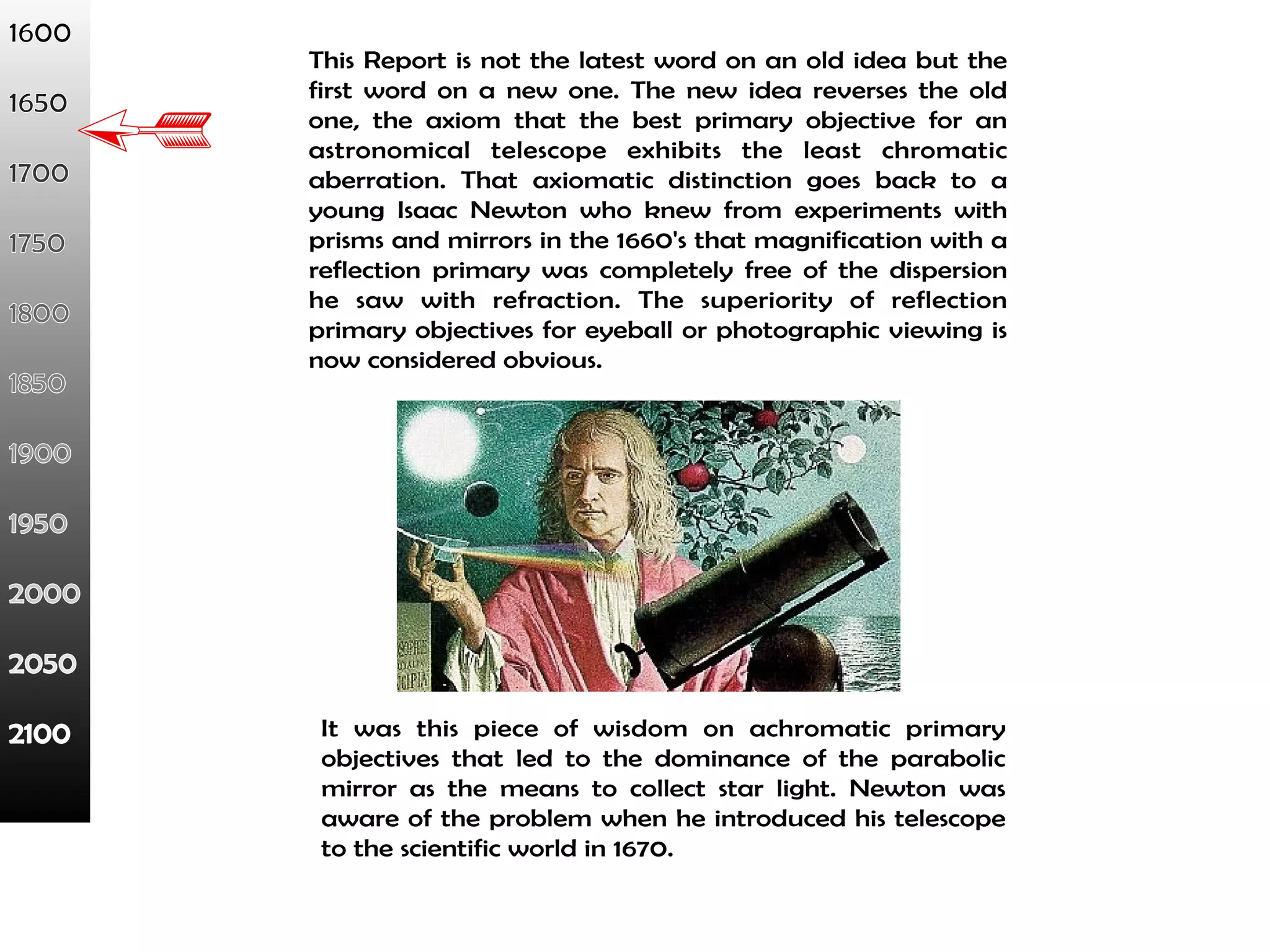
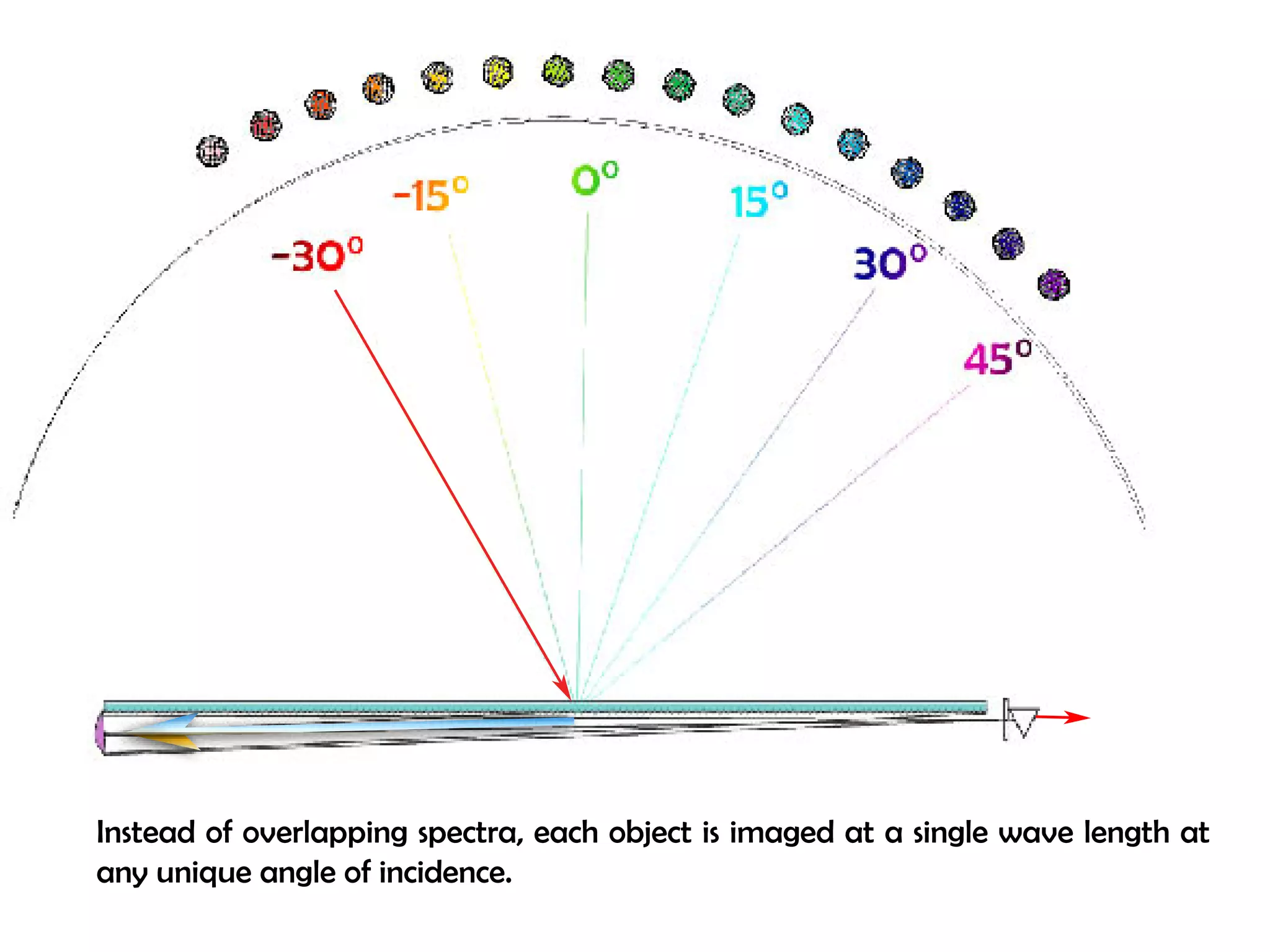
This Report is not the latest word on an old idea but the 
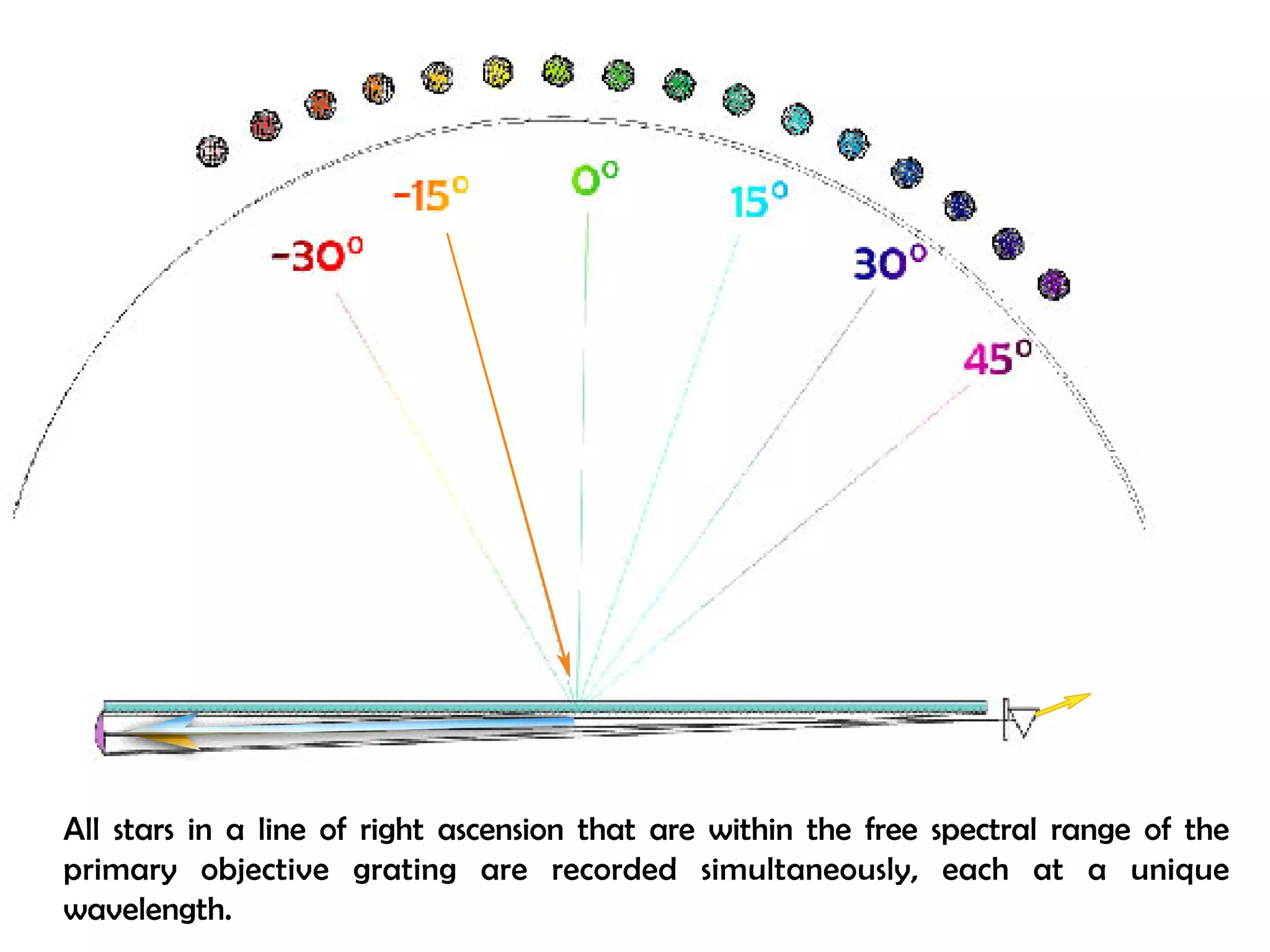
first word on a new one. The new idea reverses the old 
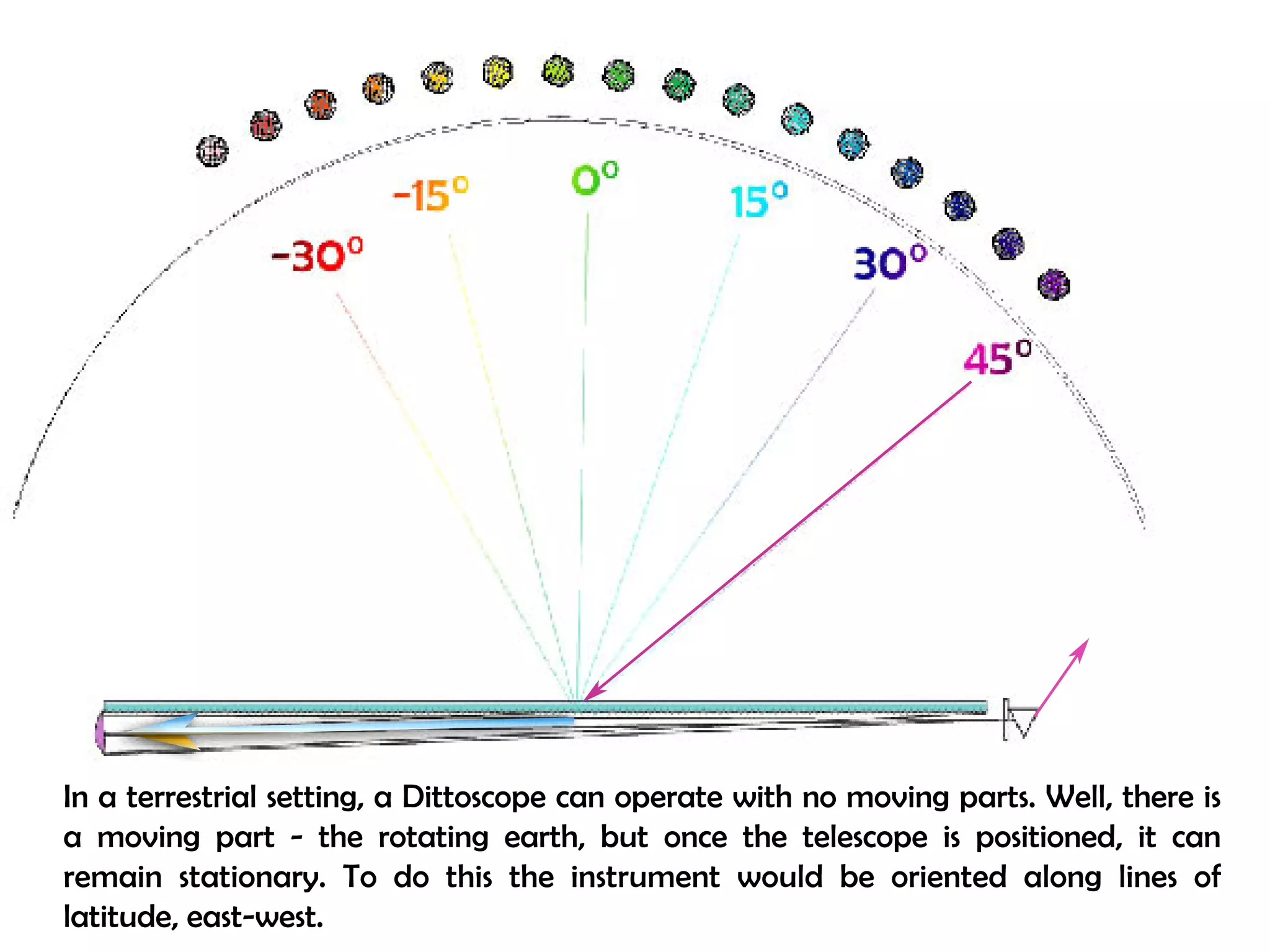
one, the axiom that the best primary objective for an 
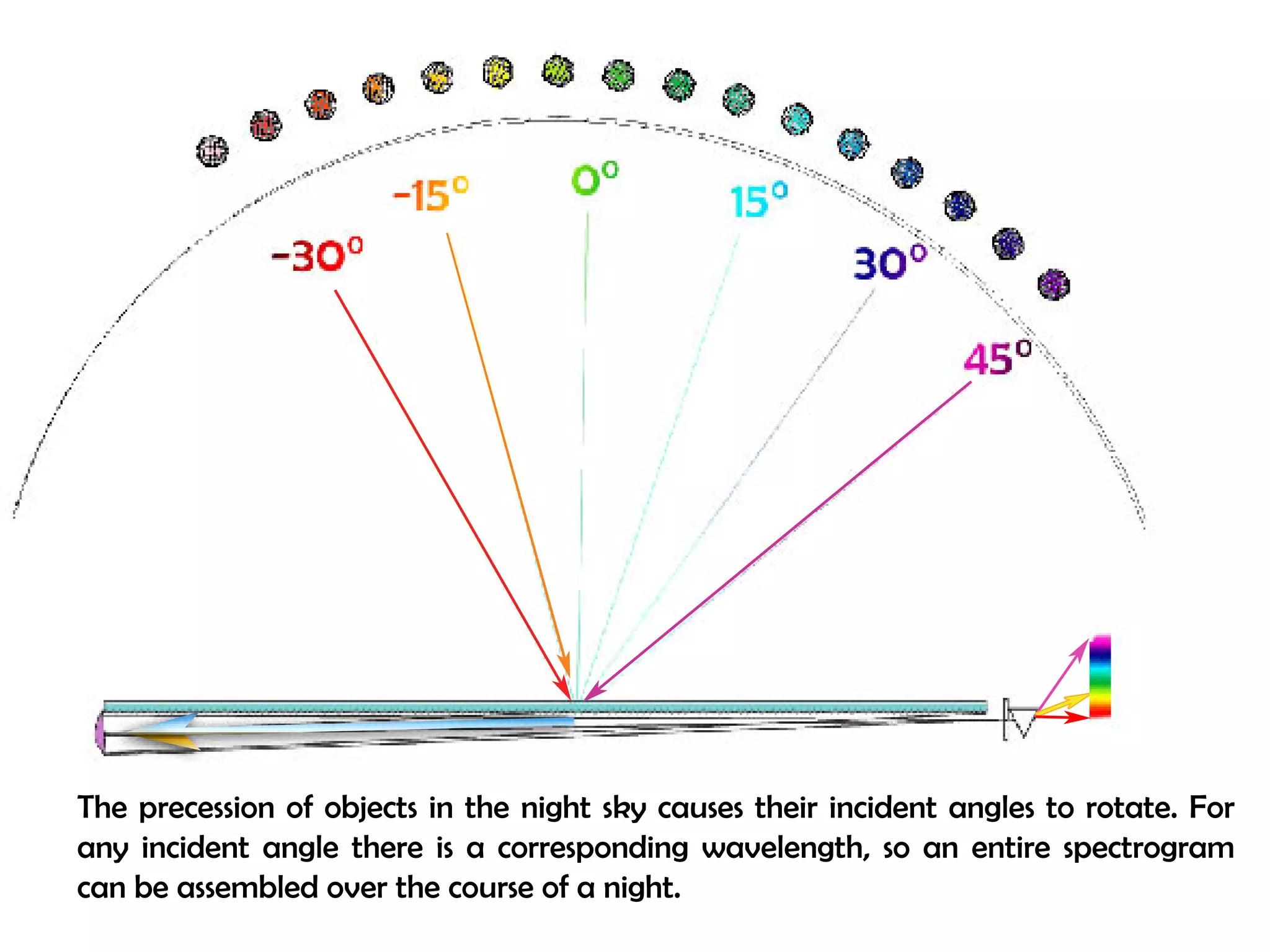
astronomical telescope exhibits the least chromatic 
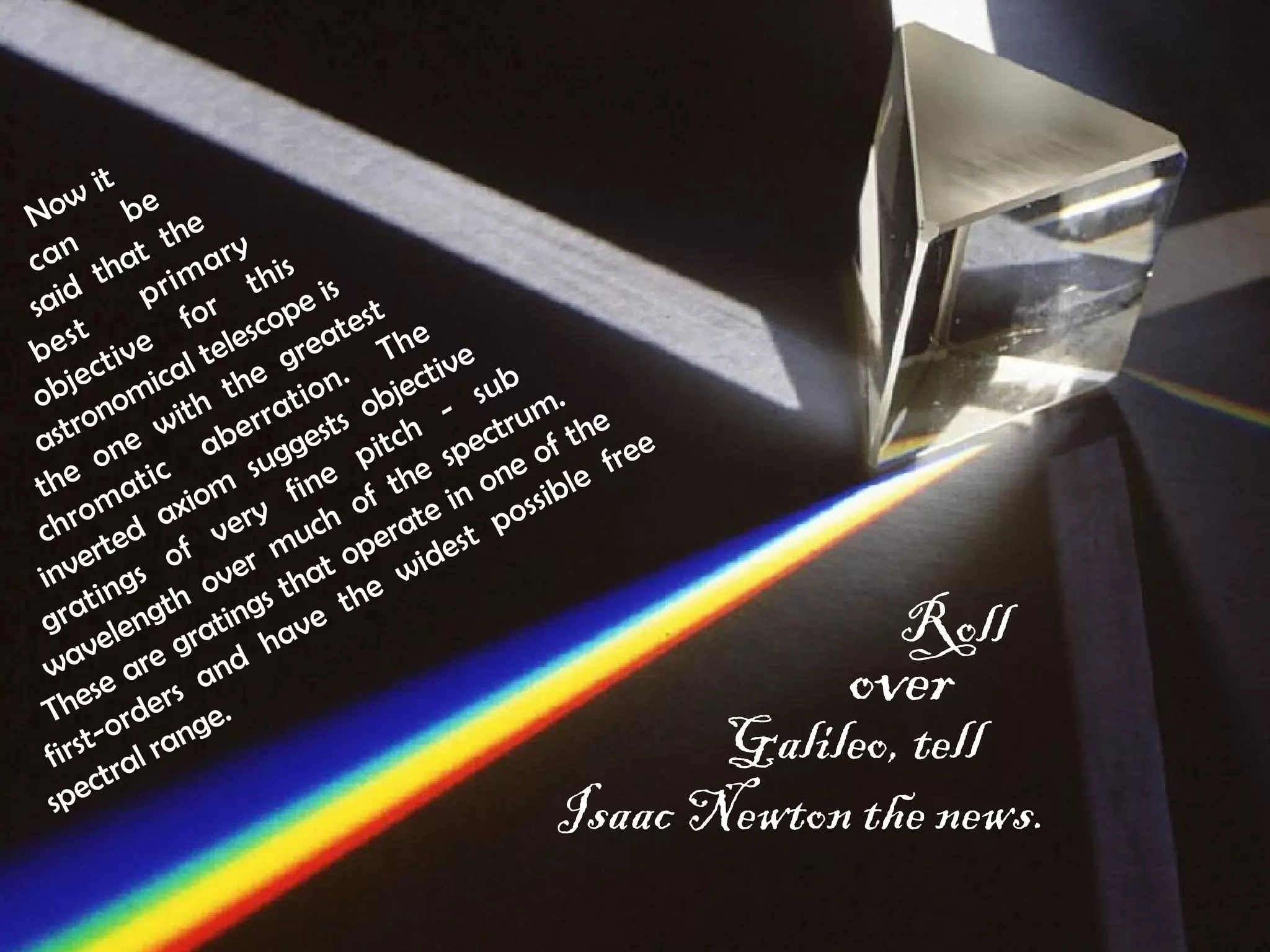
aberration. That axiomatic distinction goes back to a 
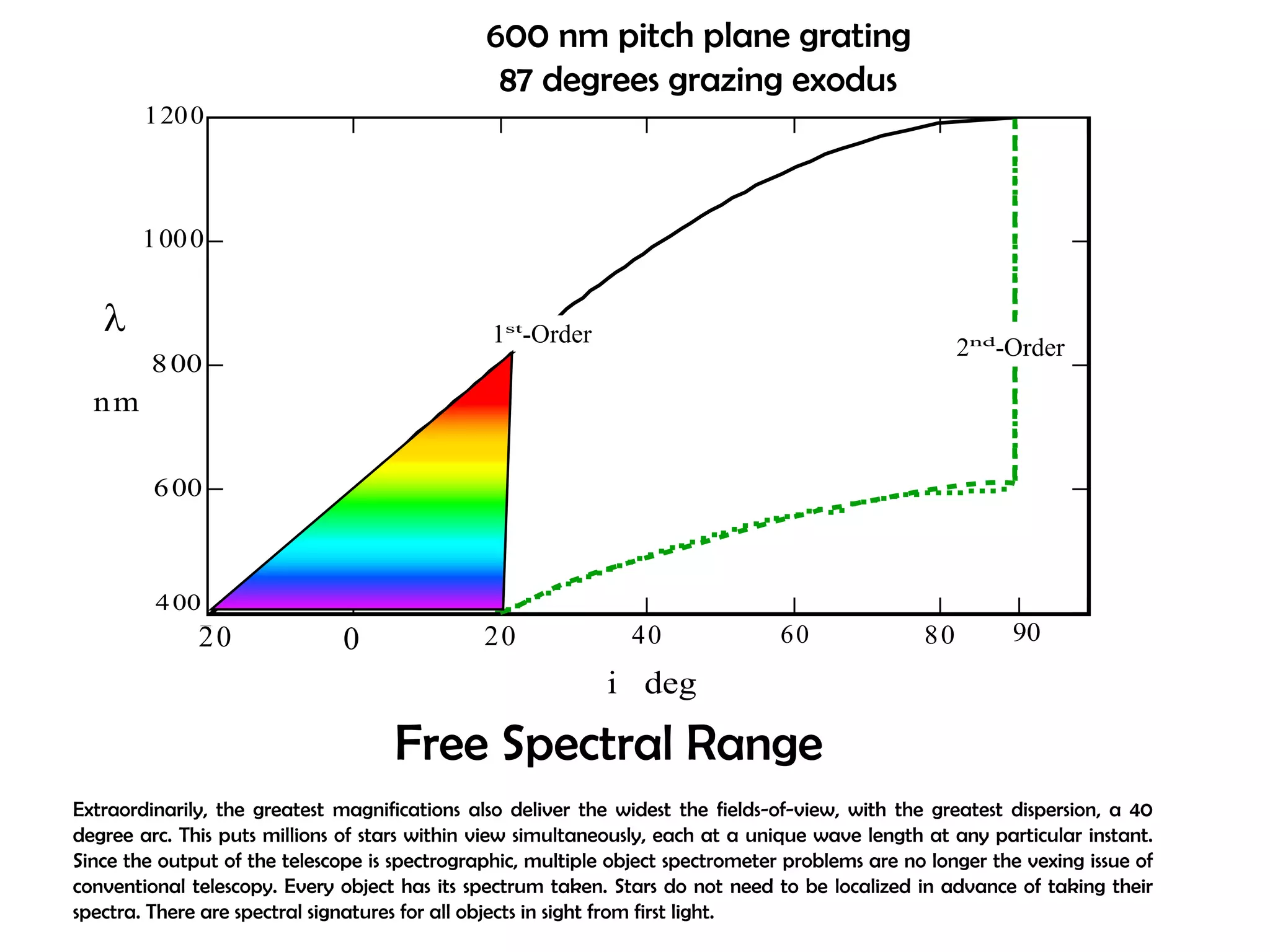
young Isaac Newton who knew from experiments with 
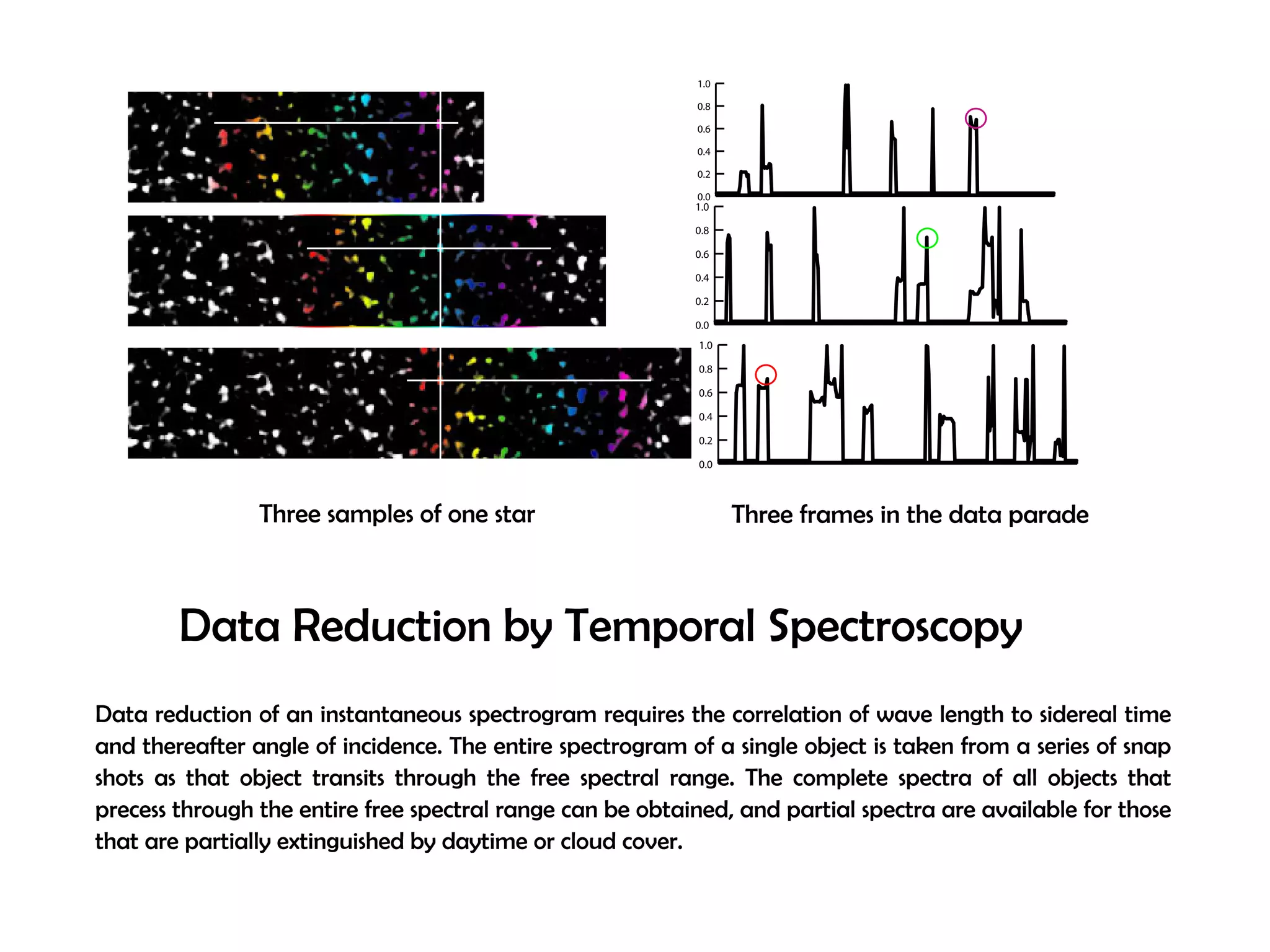
prisms and mirrors in the 1660's that magnification with a 
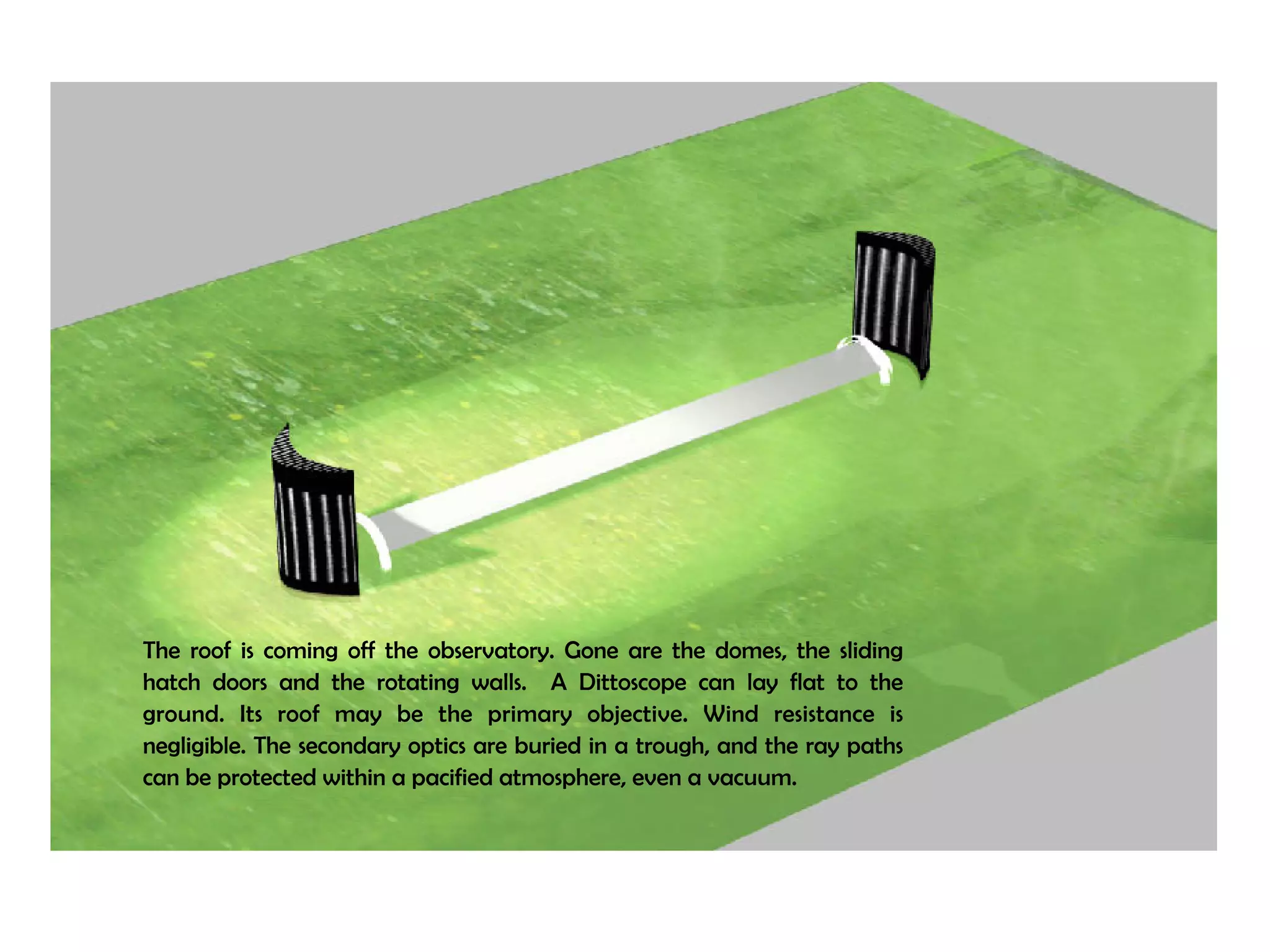
reflection primary was completely free of the dispersion 
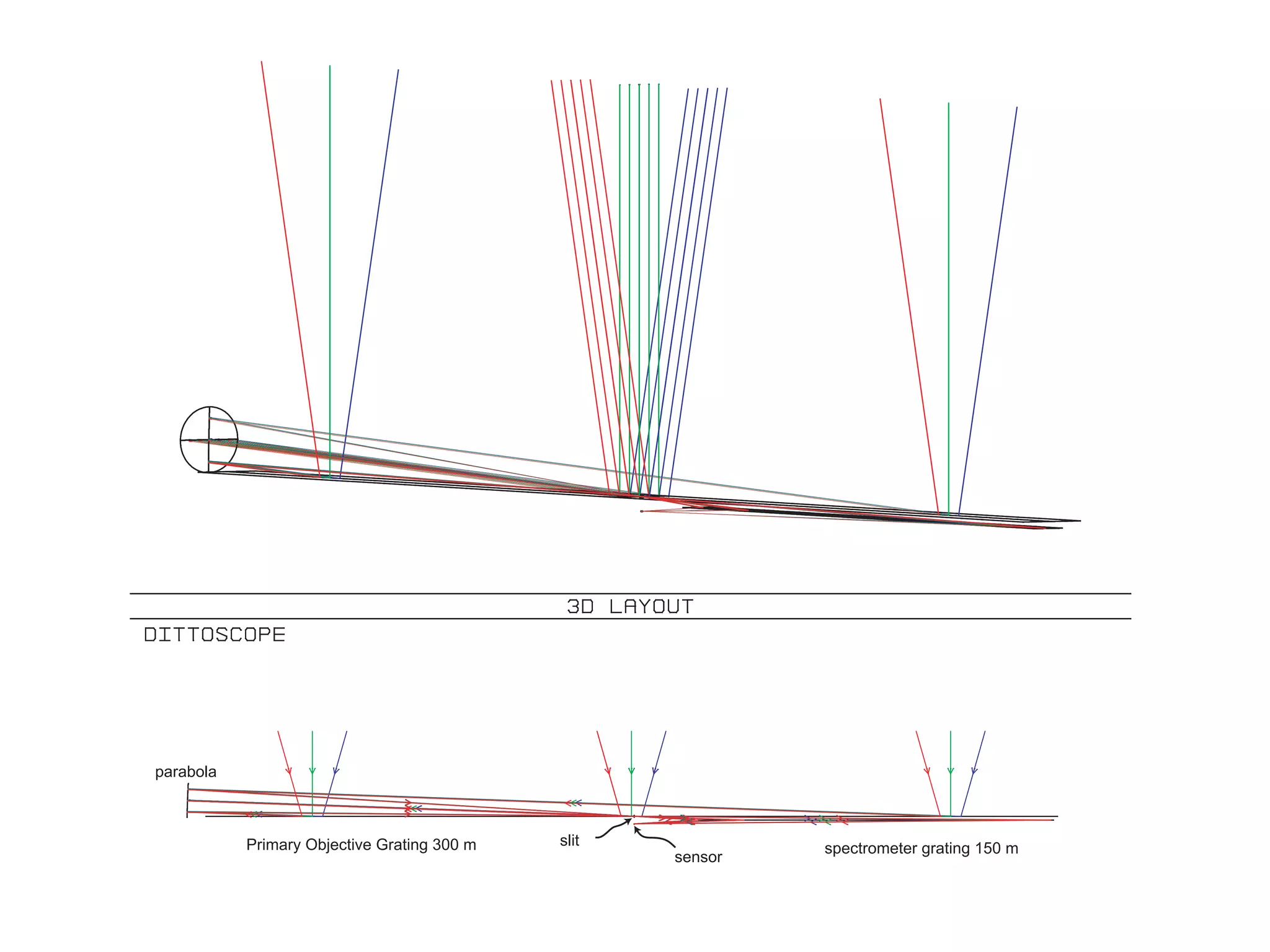
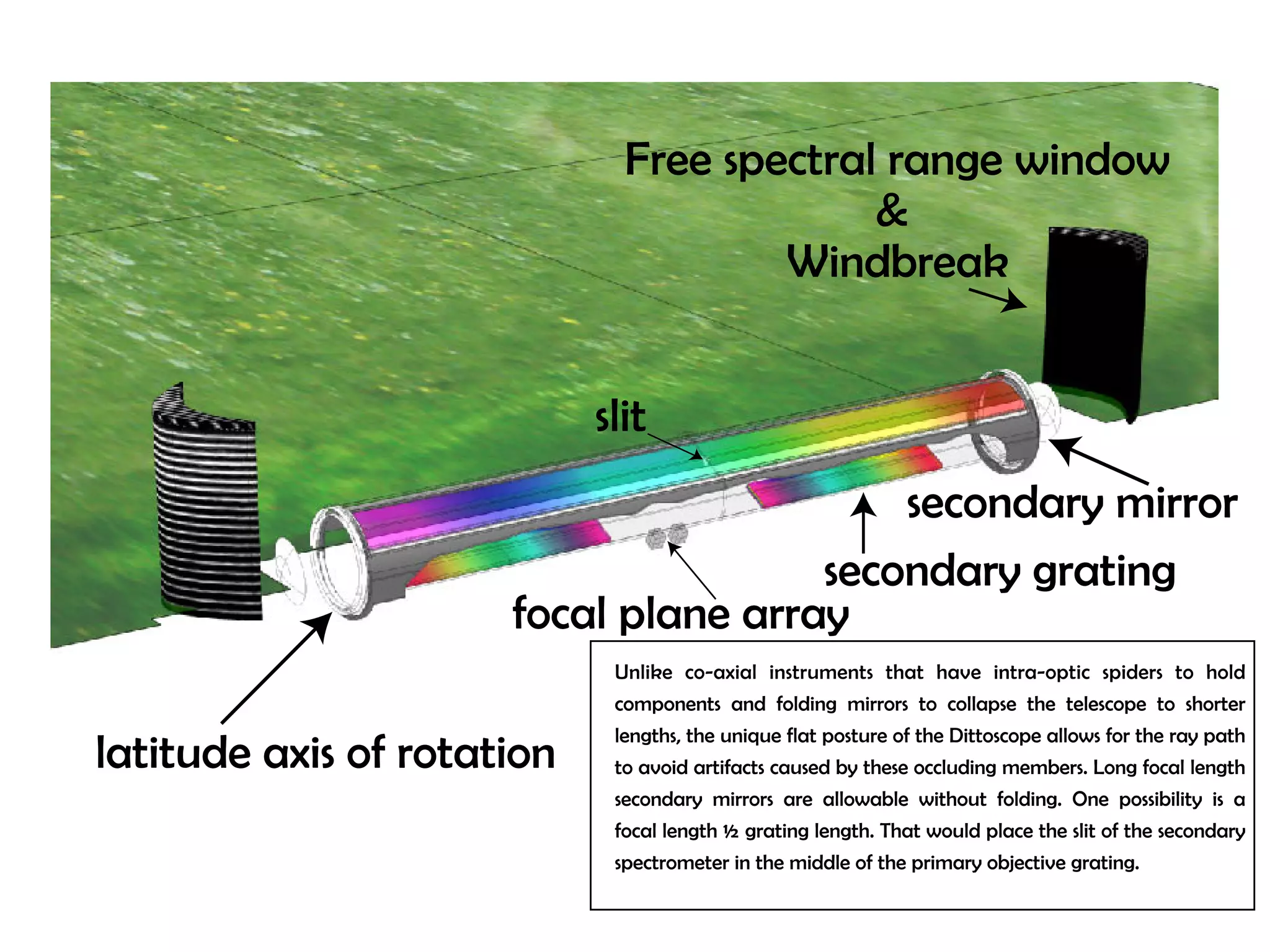
he saw with refraction. The superiority of reflection 
primary objectives for eyeball or photographic viewing is 
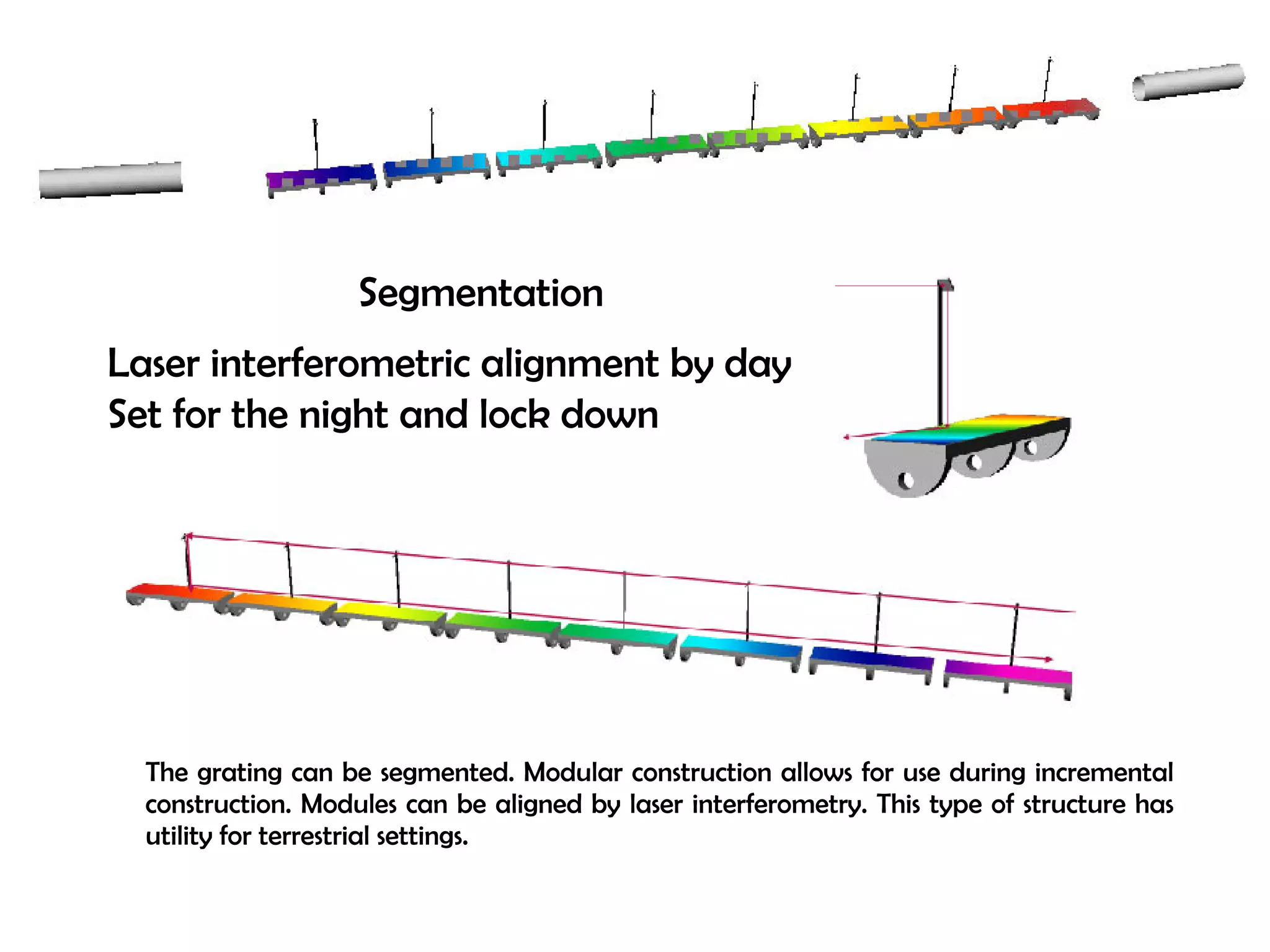
now considered obvious. 
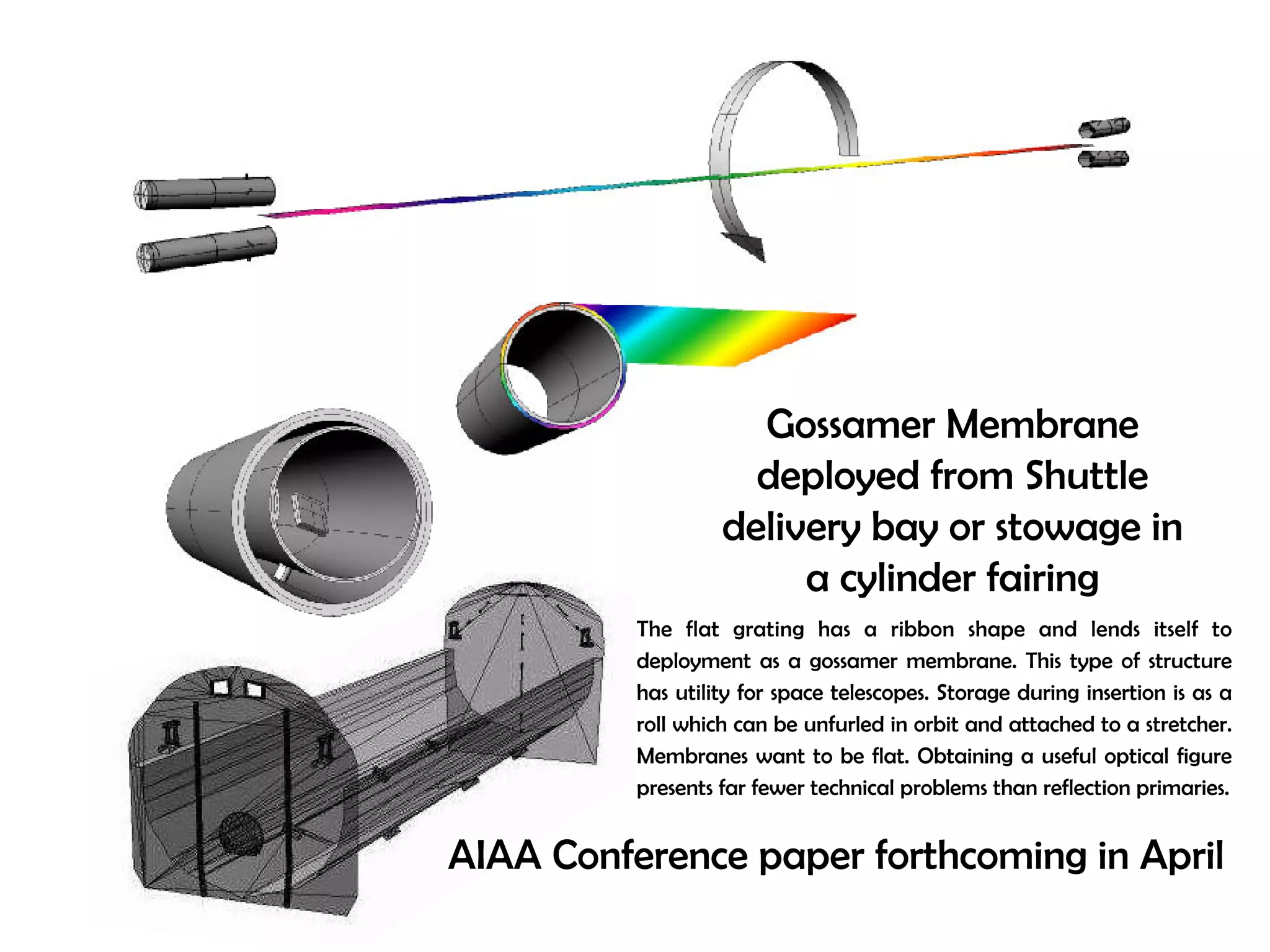
It was this piece of wisdom on achromatic primary 
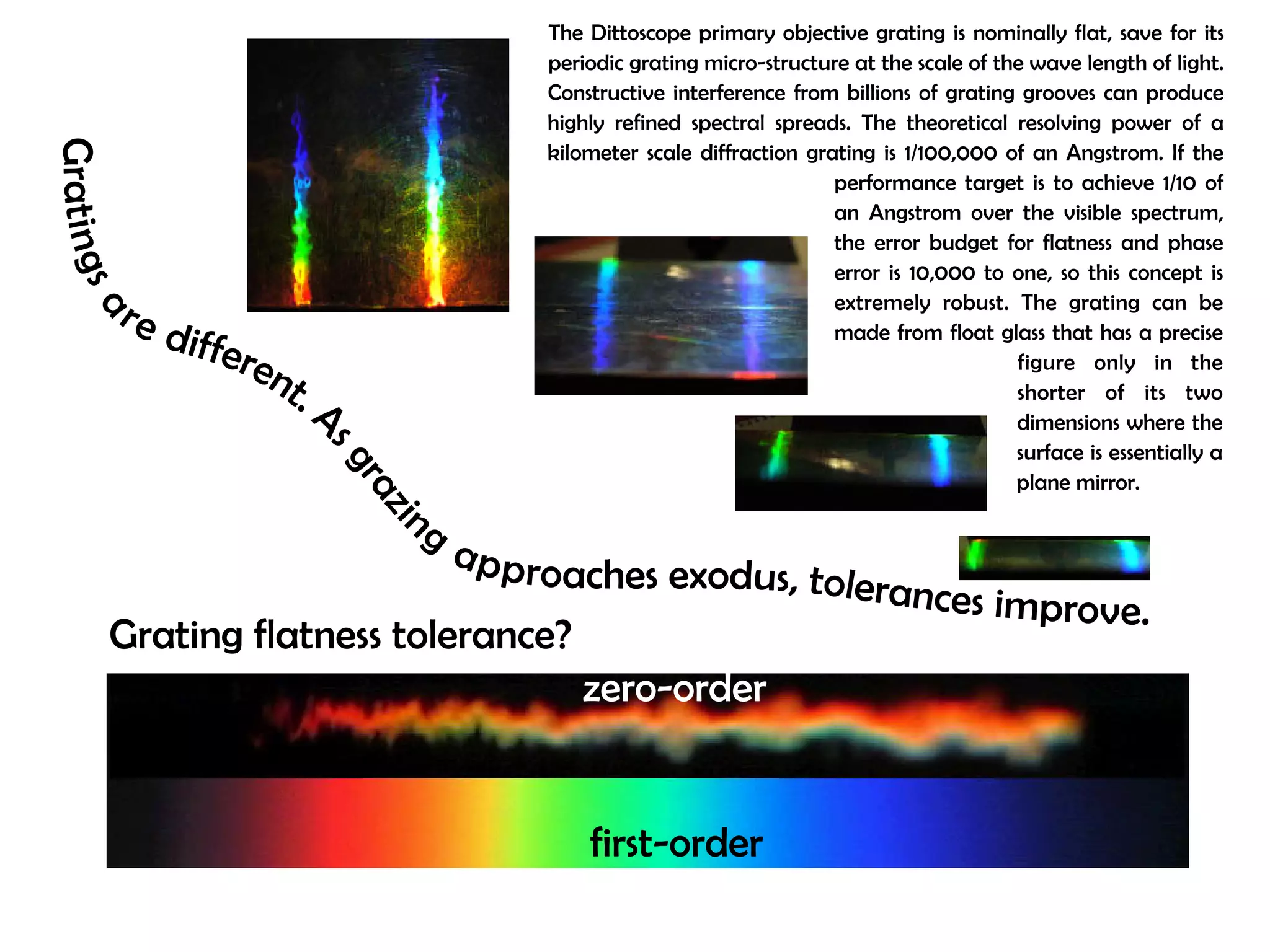
objectives that led to the dominance of the parabolic 
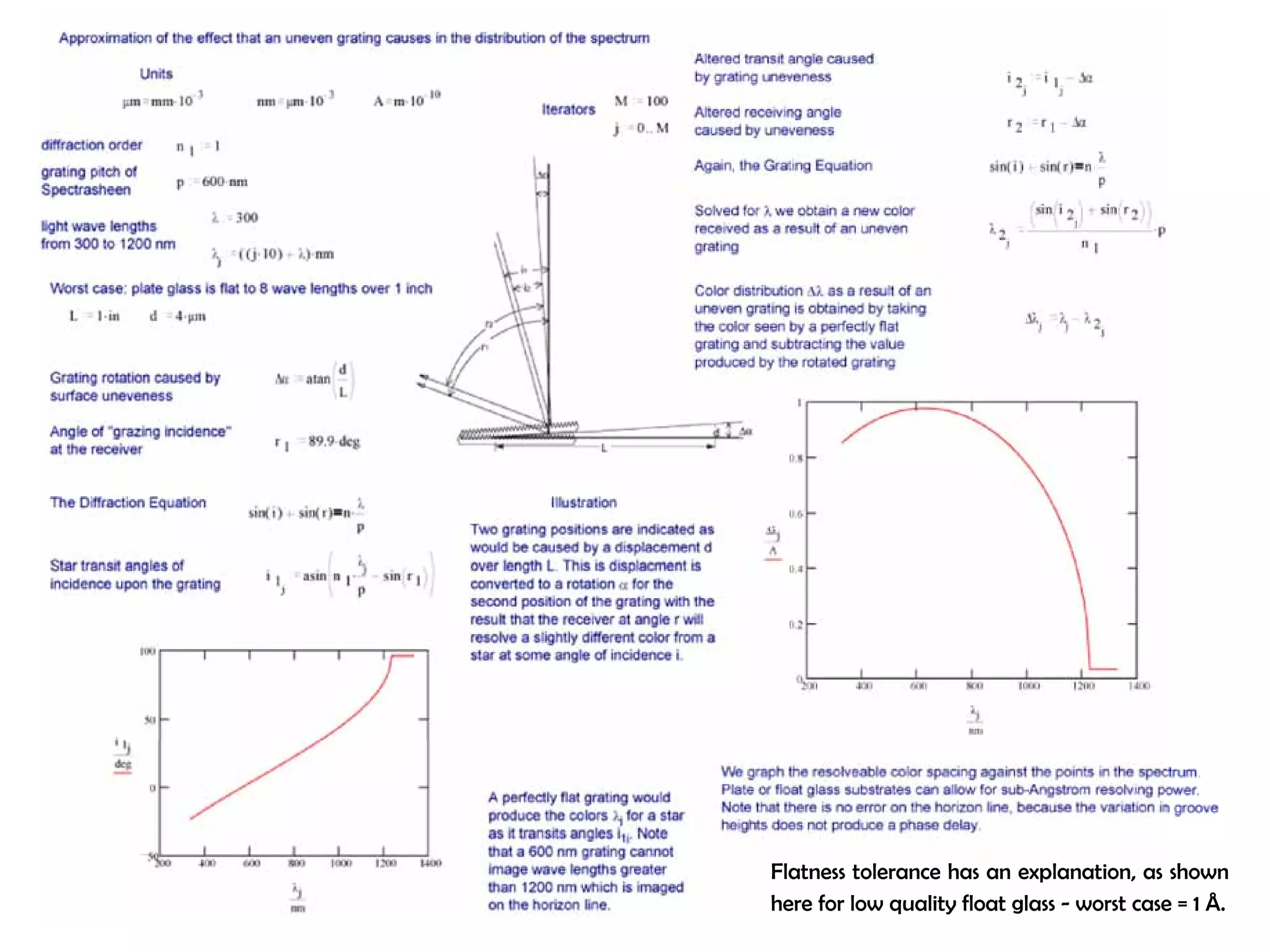
mirror as the means to collect star light. Newton was 
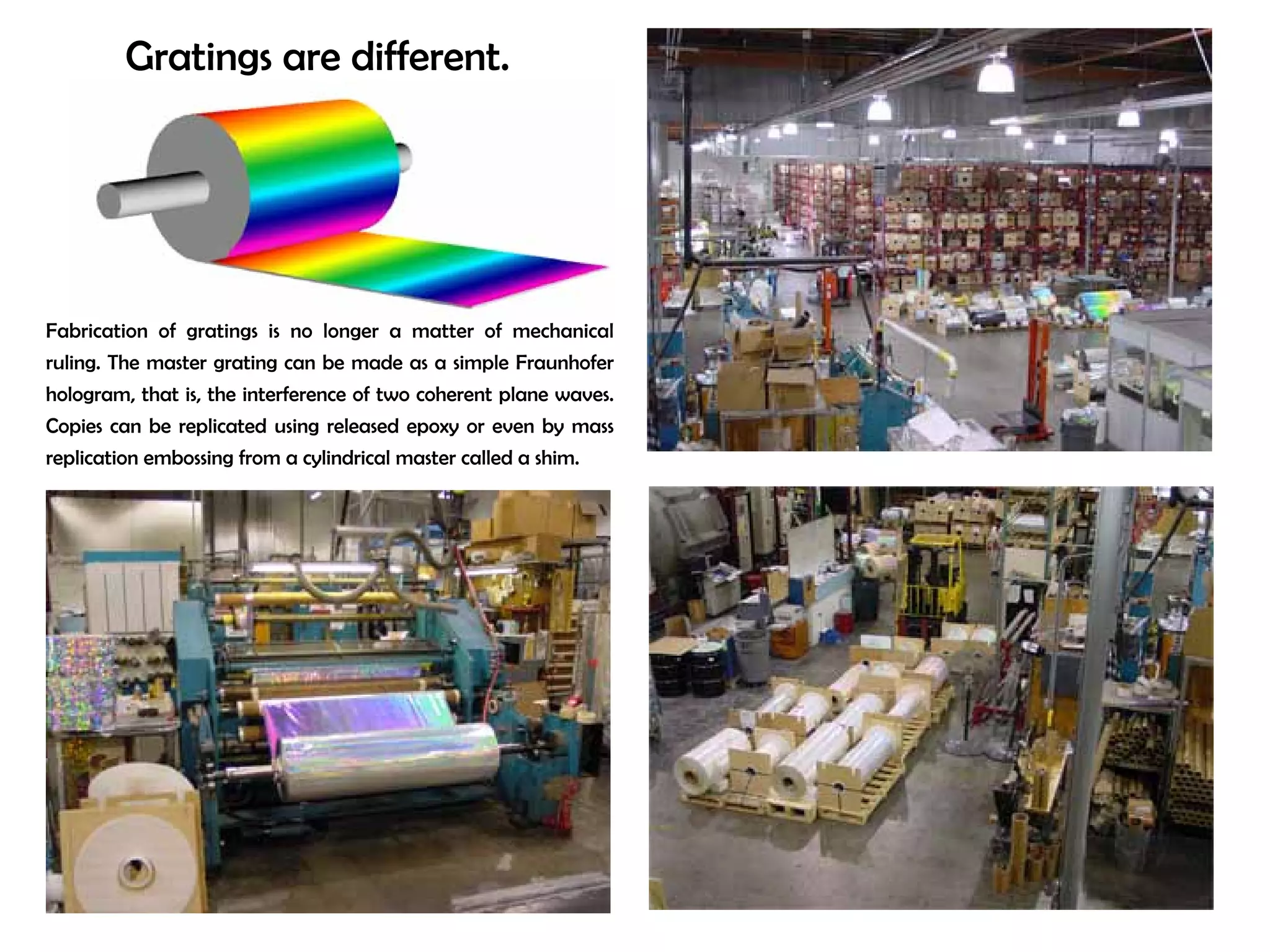
aware of the problem when he introduced his telescope 
to the scientific world in 1670.
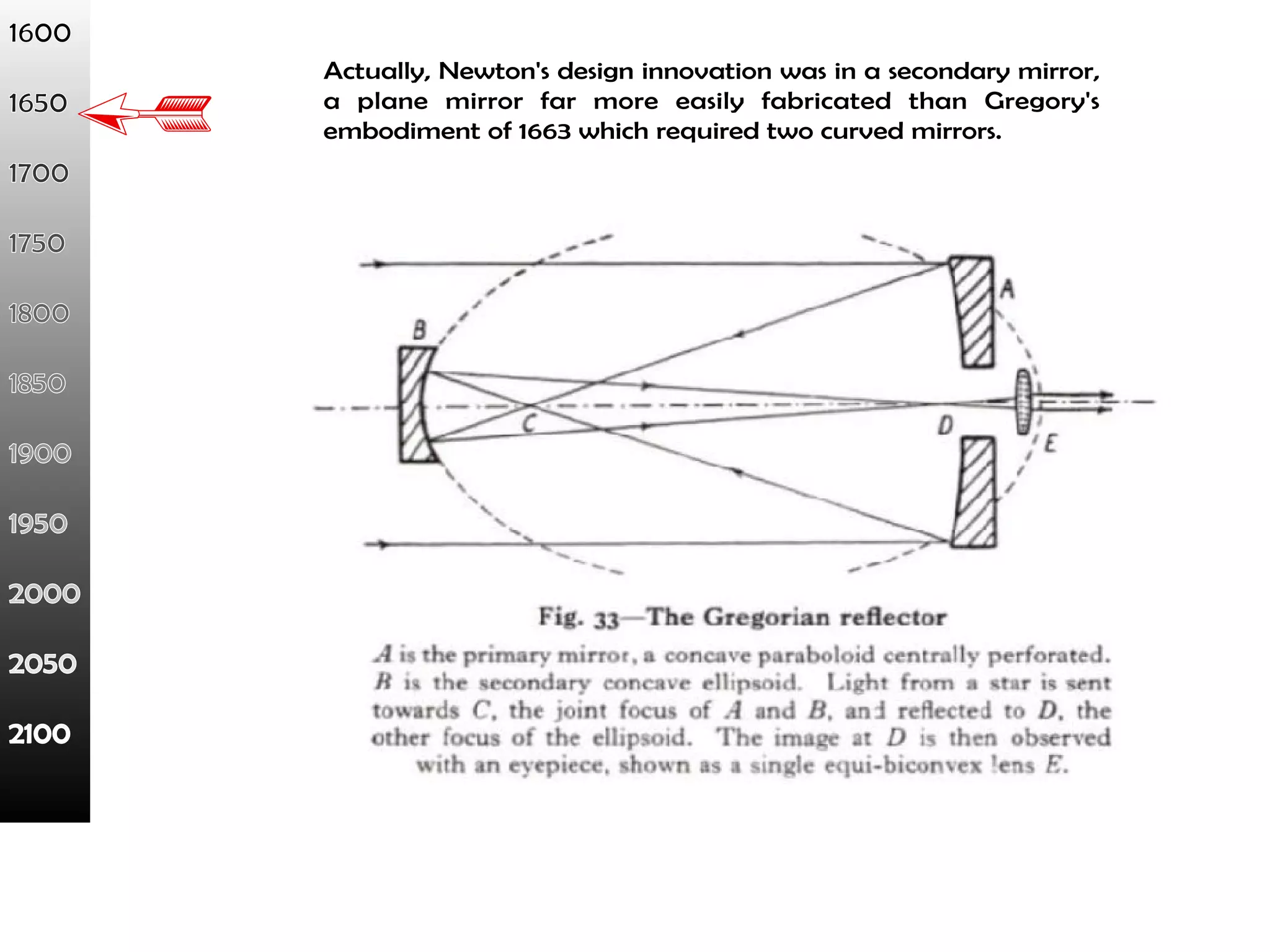
Actually, Newton's design innovation was in a secondary mirror, 
a plane mirror far more easily fabricated than Gregory's 
embodiment of 1663 which required two curved mirrors.
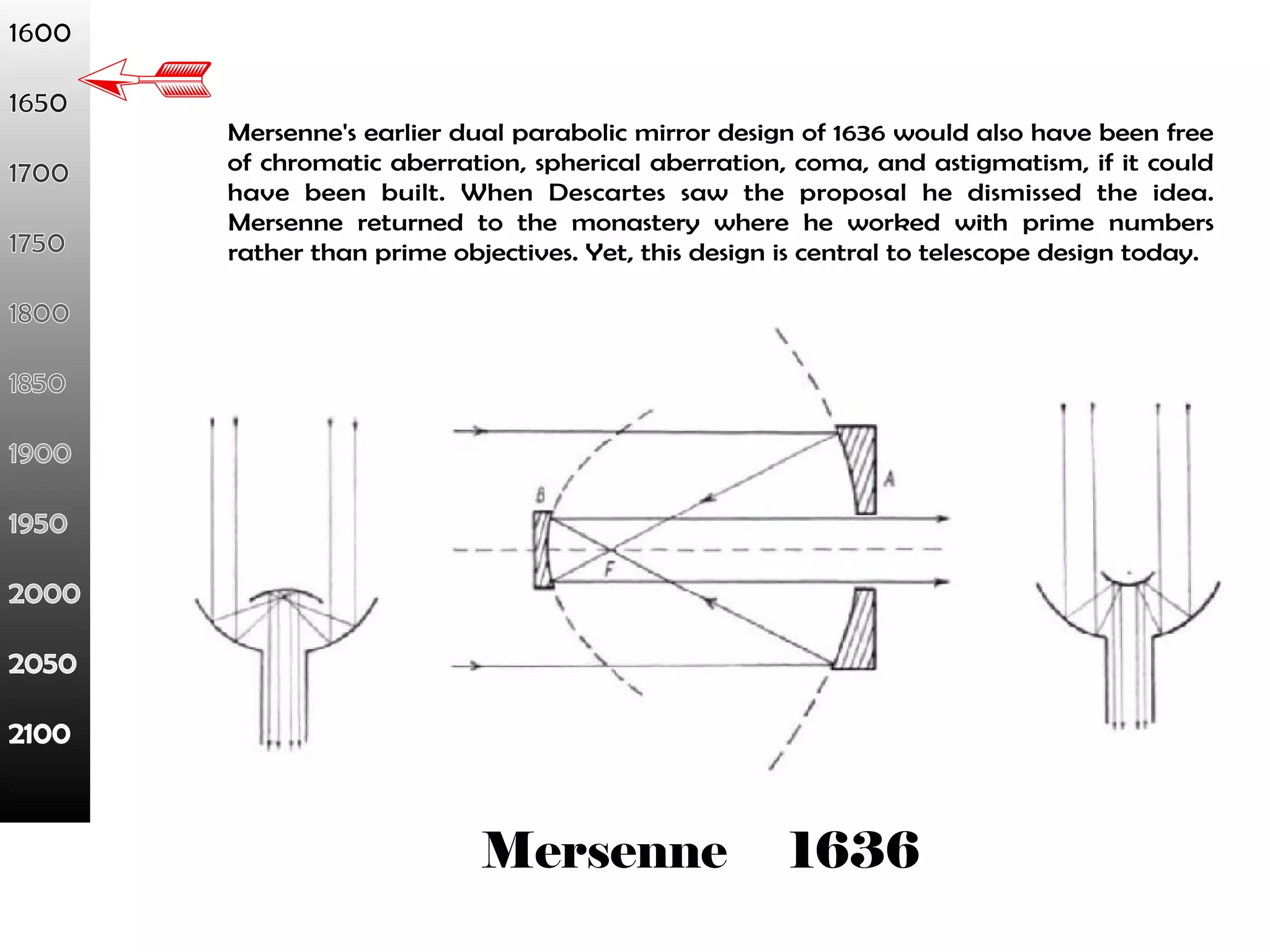
Mersenne's earlier dual parabolic mirror design of 1636 would also have been free 
of chromatic aberration, spherical aberration, coma, and astigmatism, if it could 
have been built. When Descartes saw the proposal he dismissed the idea. 
Mersenne returned to the monastery where he worked with prime numbers 
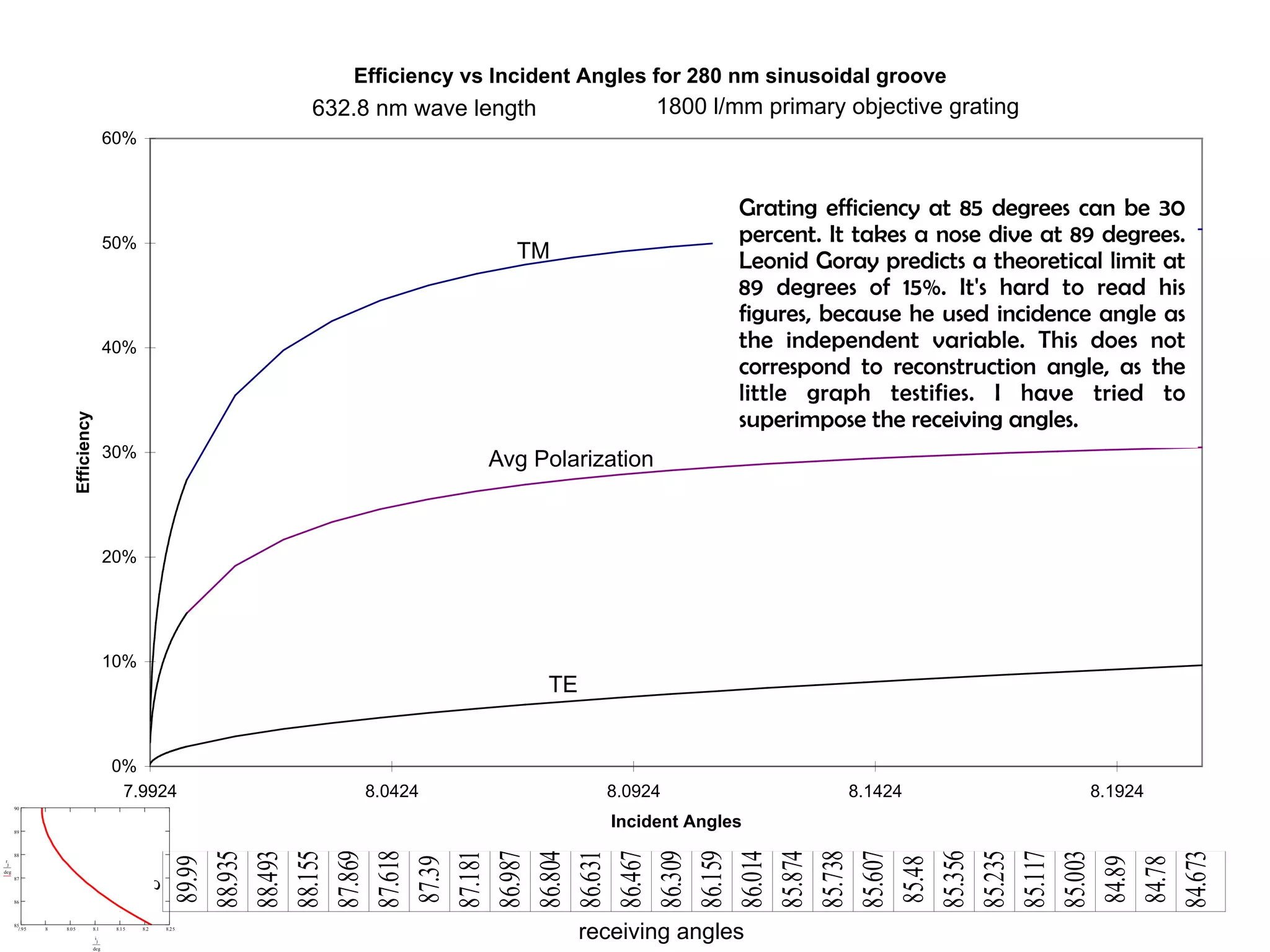
rather than prime objectives. Yet, this design is central to telescope design today. 
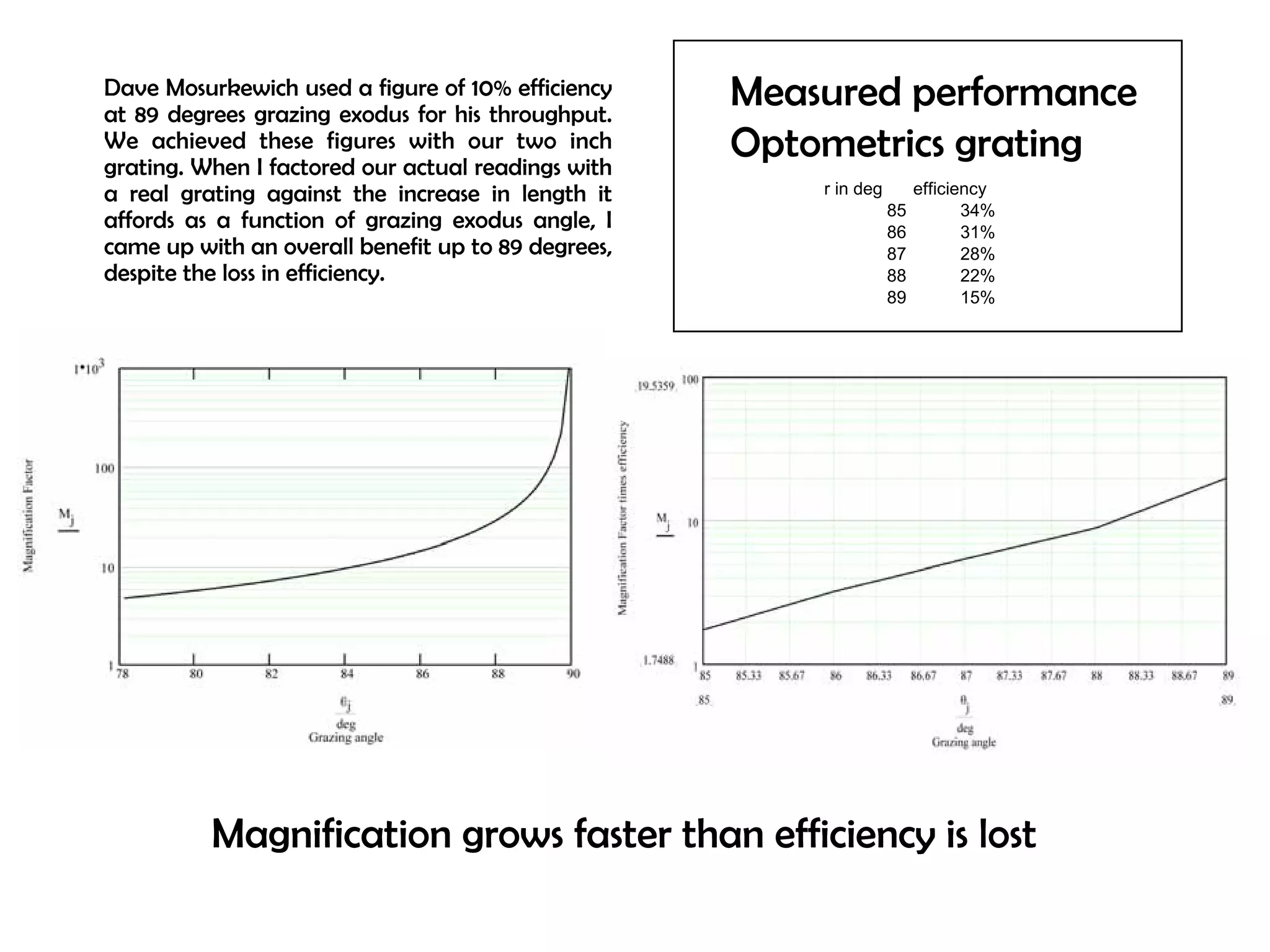
Mersenne 1636
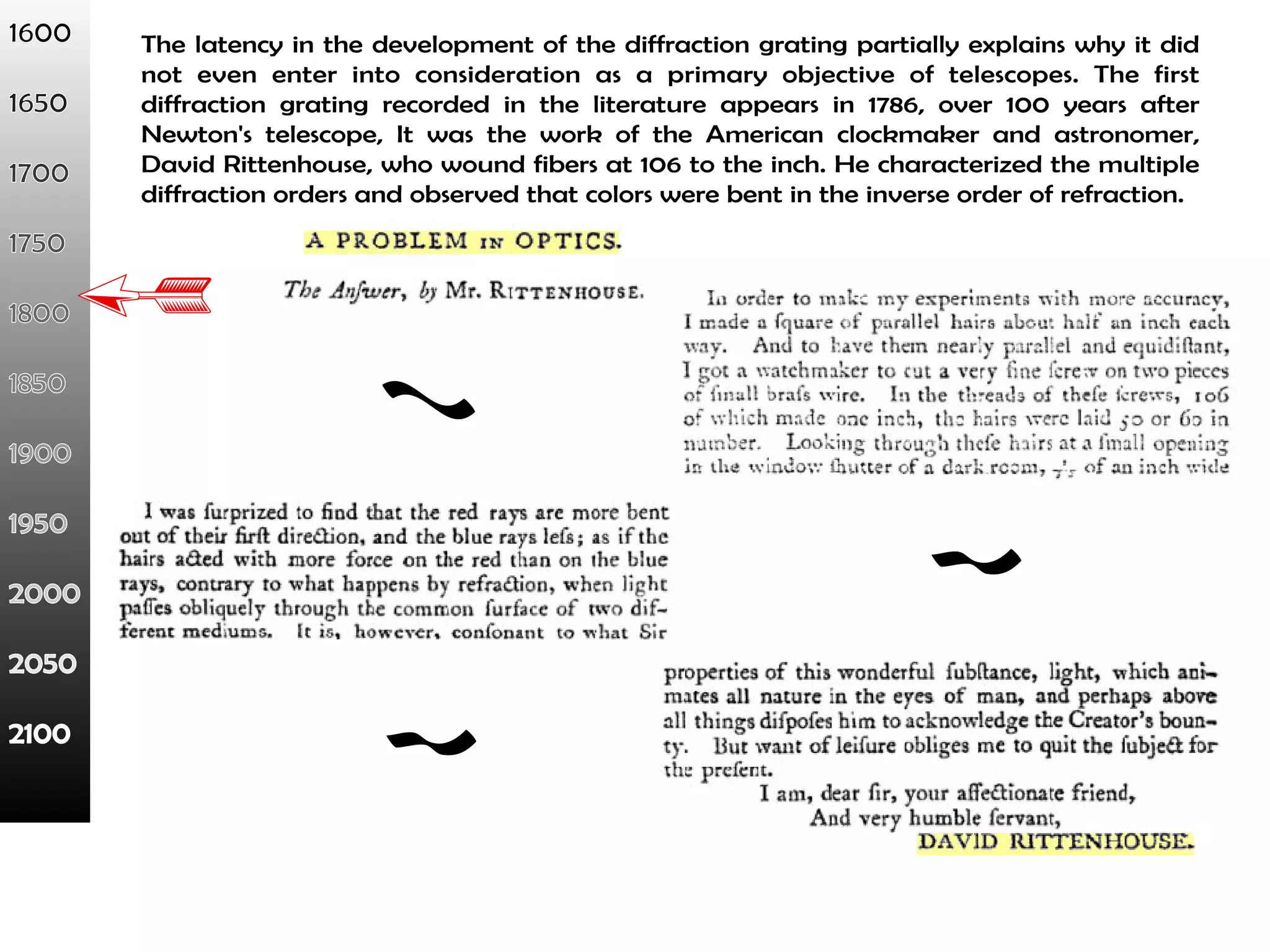
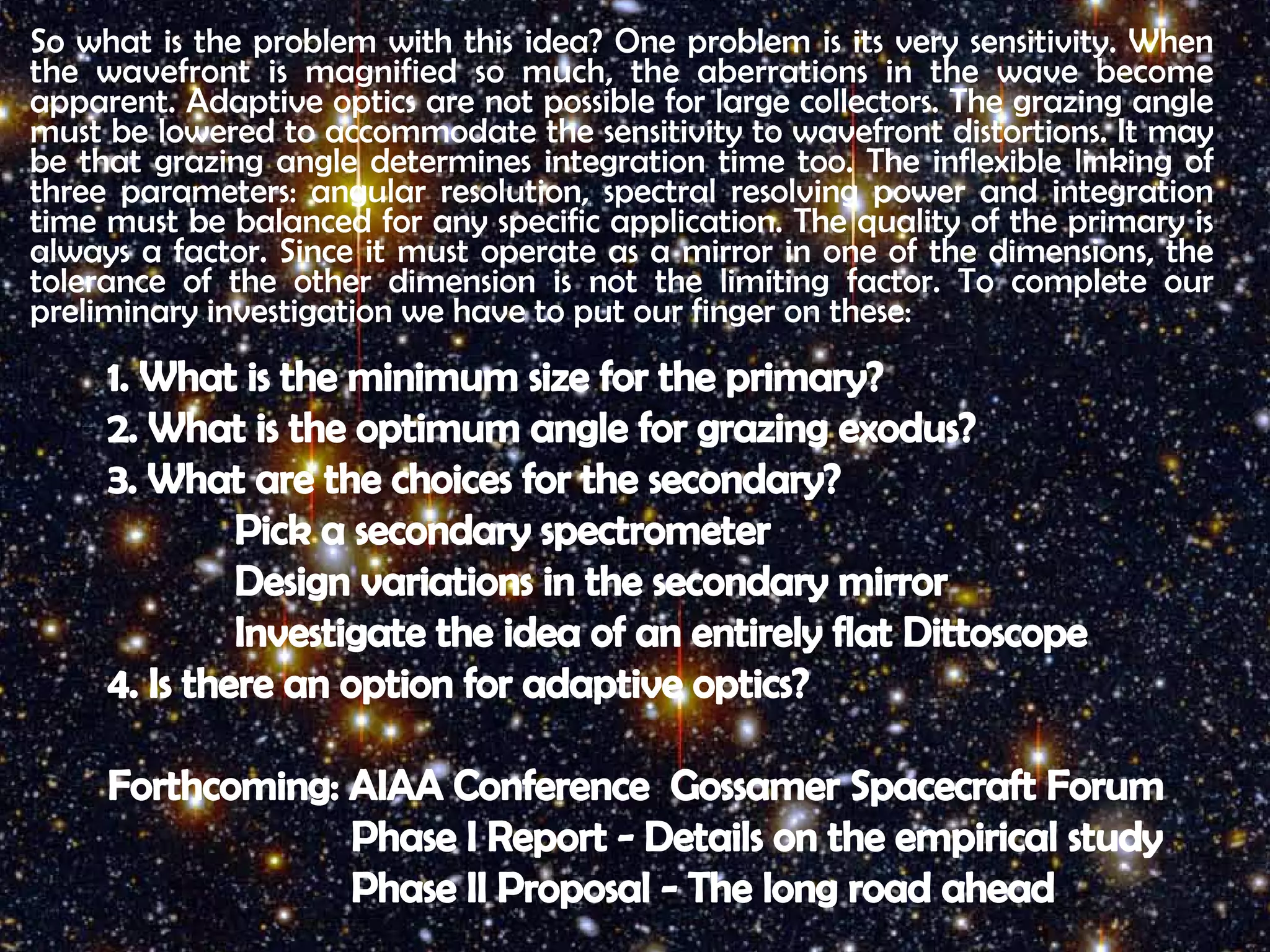
The latency in the development of the diffraction grating partially explains why it did 
not even enter into consideration as a primary objective of telescopes. The first 
diffraction grating recorded in the literature appears in 1786, over 100 years after 
Newton's telescope, It was the work of the American clockmaker and astronomer, 
David Rittenhouse, who wound fibers at 106 to the inch. He characterized the multiple 
diffraction orders and observed that colors were bent in the inverse order of refraction.
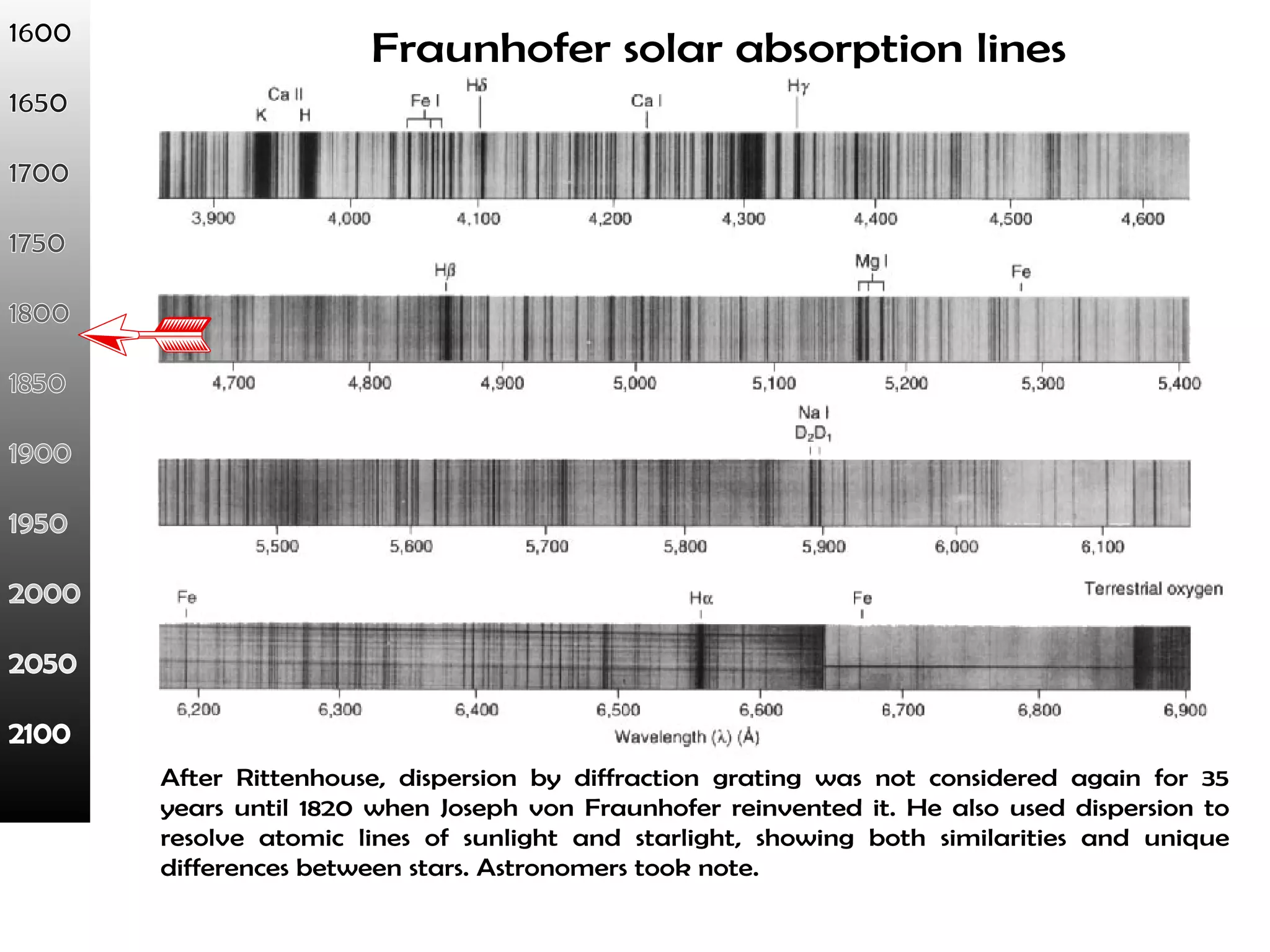
Fraunhofer solar absorption lines 
After Rittenhouse, dispersion by diffraction grating was not considered again for 35 
years until 1820 when Joseph von Fraunhofer reinvented it. He also used dispersion to 
resolve atomic lines of sunlight and starlight, showing both similarities and unique 
differences between stars. Astronomers took note.
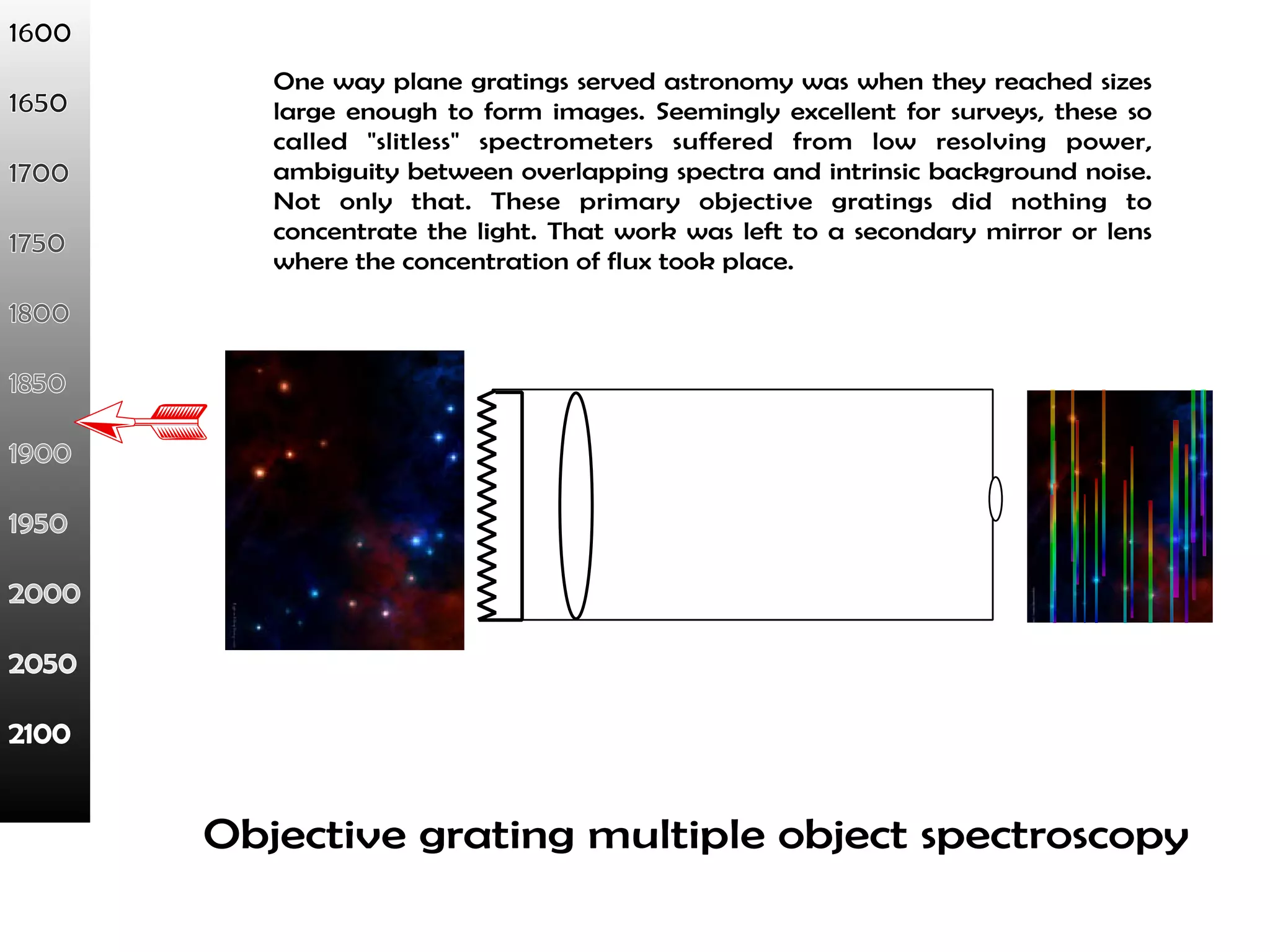
One way plane gratings served astronomy was when they reached sizes 
large enough to form images. Seemingly excellent for surveys, these so 
called "slitless" spectrometers suffered from low resolving power, 
ambiguity between overlapping spectra and intrinsic background noise. 
Not only that. These primary objective gratings did nothing to 
concentrate the light. That work was left to a secondary mirror or lens 
where the concentration of flux took place. 
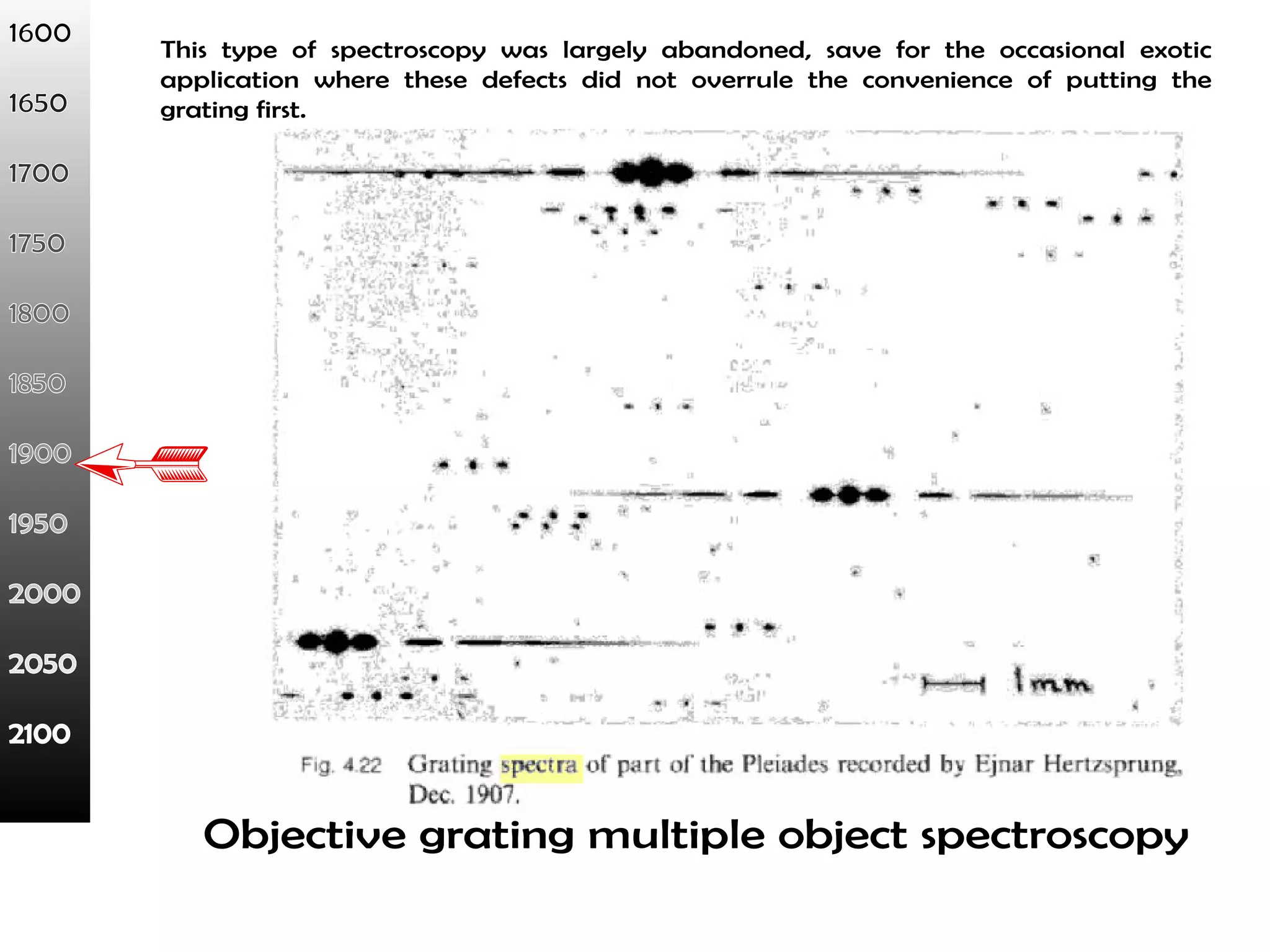
Objective grating multiple object spectroscopy
This type of spectroscopy was largely abandoned, save for the occasional exotic 
application where these defects did not overrule the convenience of putting the 
grating first. 
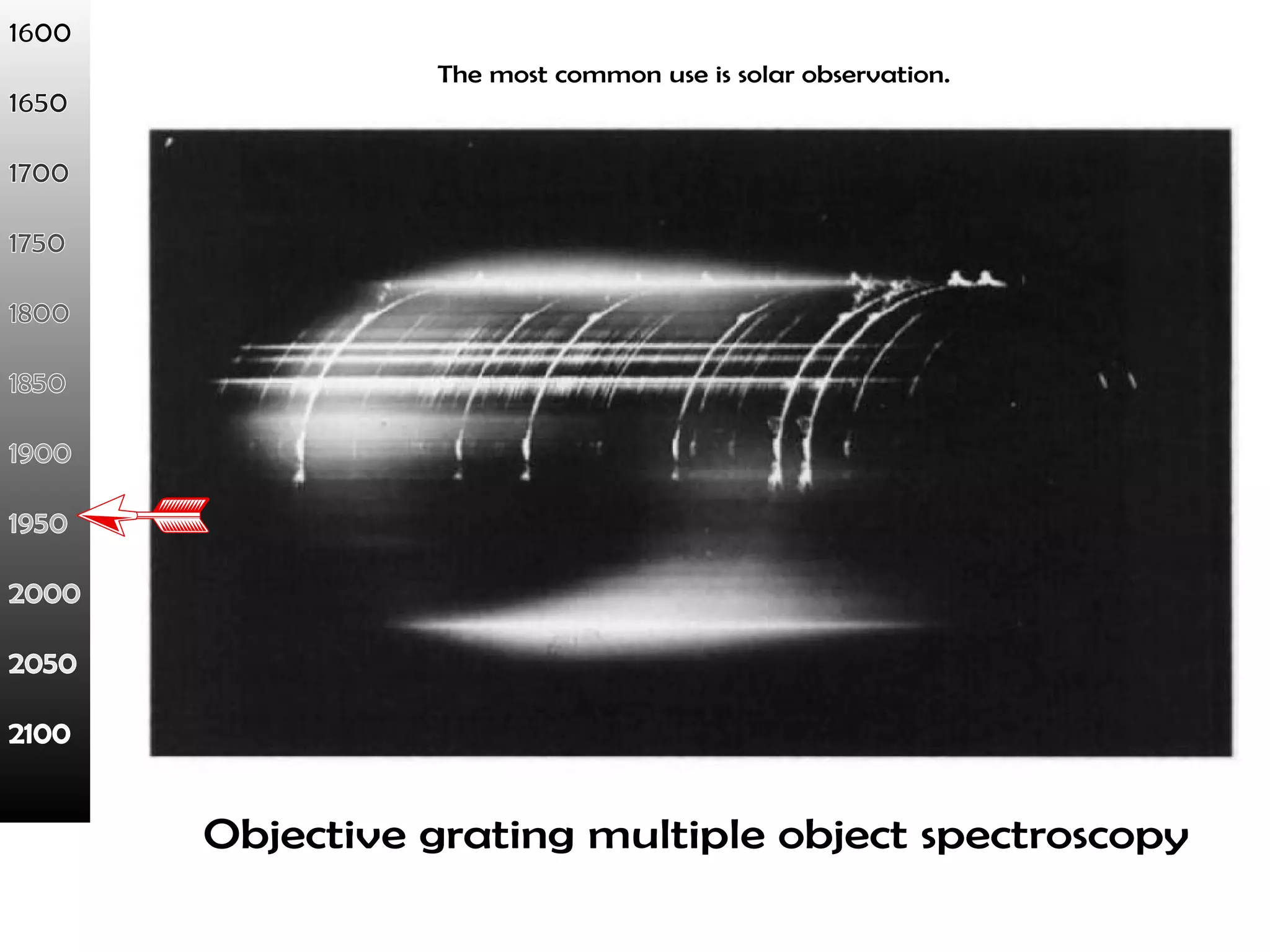
Objective grating multiple object spectroscopy
The most common use is solar observation. 
Objective grating multiple object spectroscopy
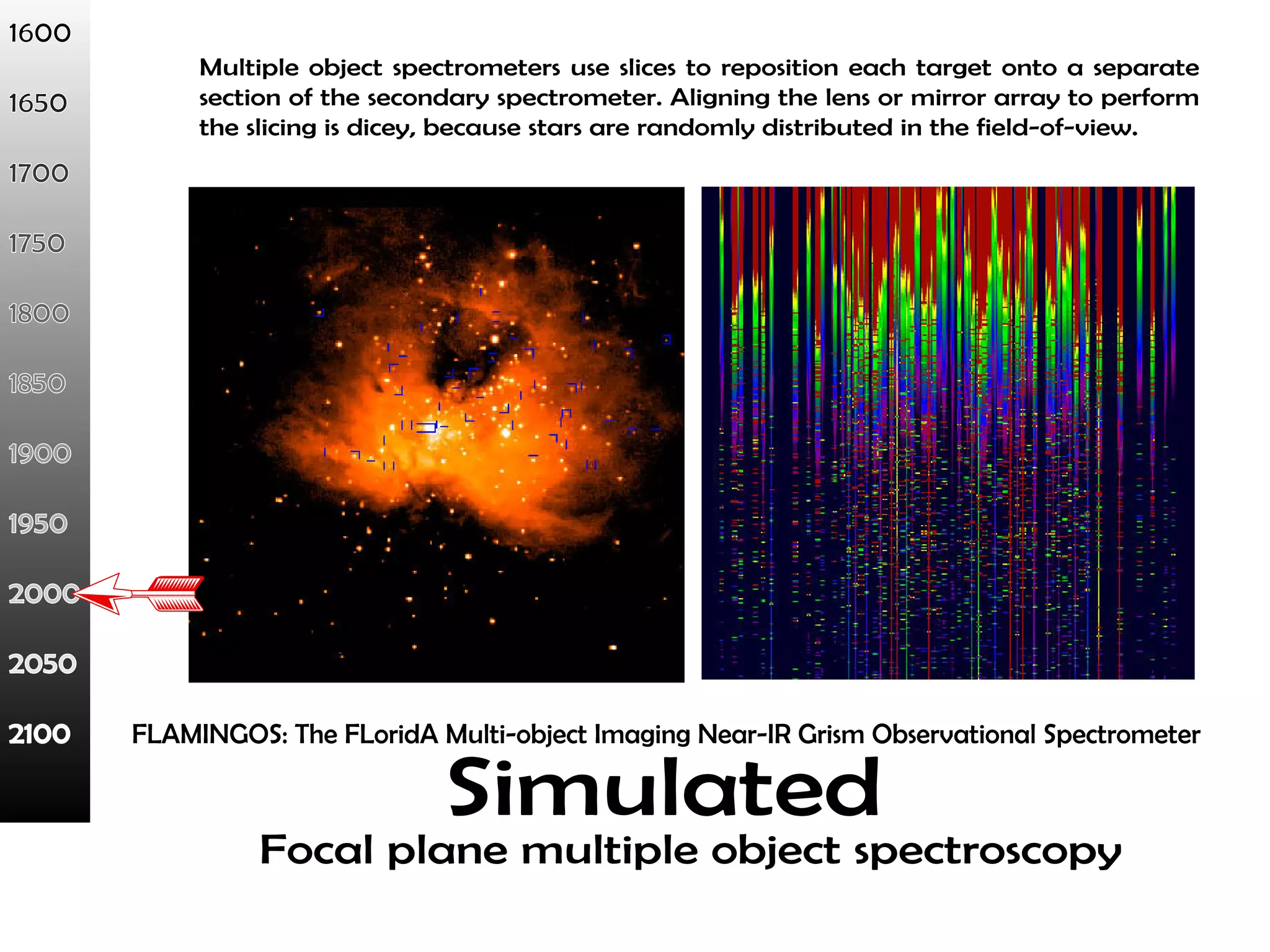
Multiple object spectrometers use slices to reposition each target onto a separate 
section of the secondary spectrometer. Aligning the lens or mirror array to perform 
the slicing is dicey, because stars are randomly distributed in the field-of-view. 
FLAMINGOS: The FLoridA Multi-object Imaging Near-IR Grism Observational Spectrometer 
Simulated 
Focal plane multiple object spectroscopy
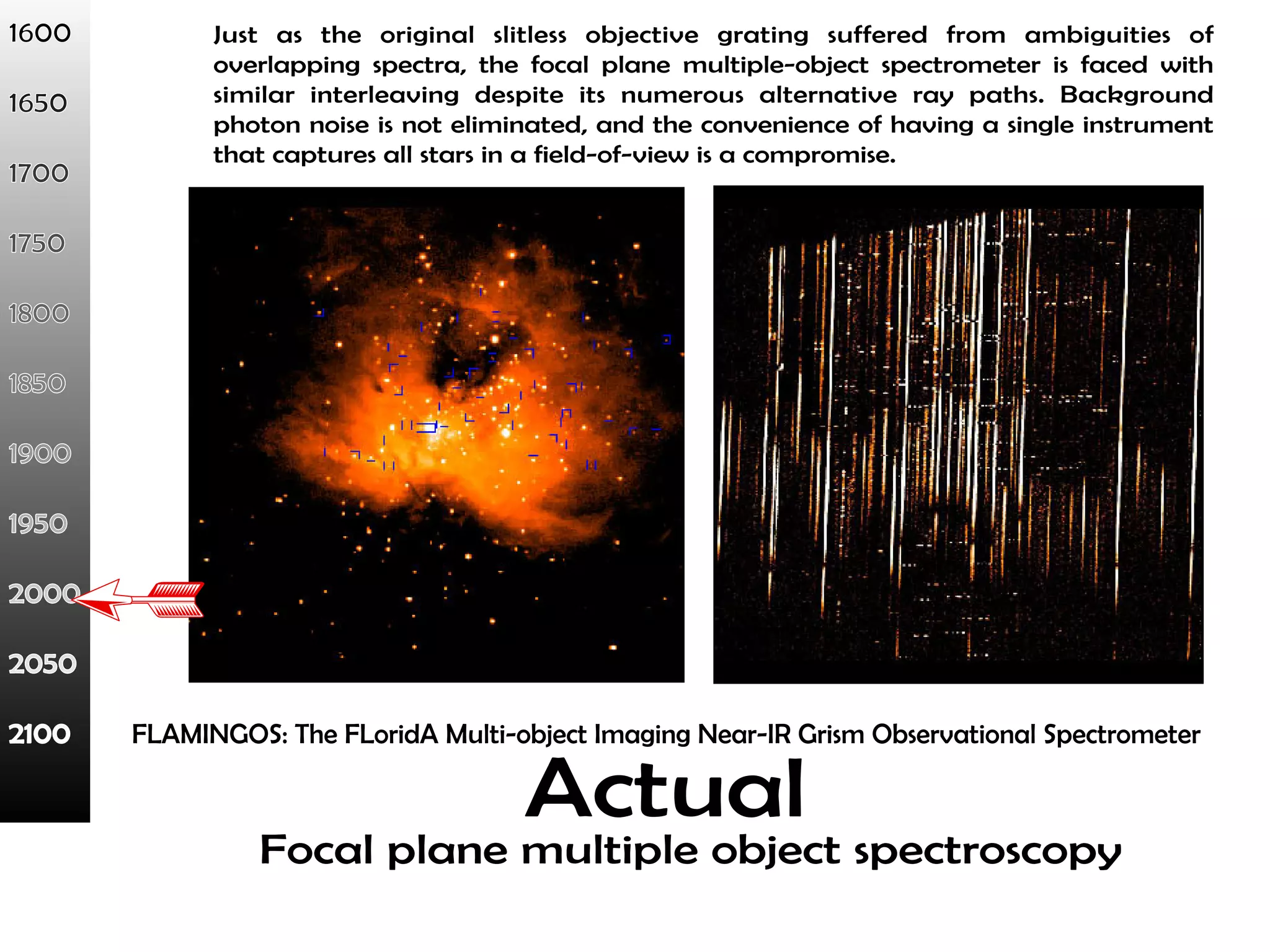
Just as the original slitless objective grating suffered from ambiguities of 
overlapping spectra, the focal plane multiple-object spectrometer is faced with 
similar interleaving despite its numerous alternative ray paths. Background 
photon noise is not eliminated, and the convenience of having a single instrument 
that captures all stars in a field-of-view is a compromise. 
FLAMINGOS: The FLoridA Multi-object Imaging Near-IR Grism Observational Spectrometer 
Actual 
Focal plane multiple object spectroscopy
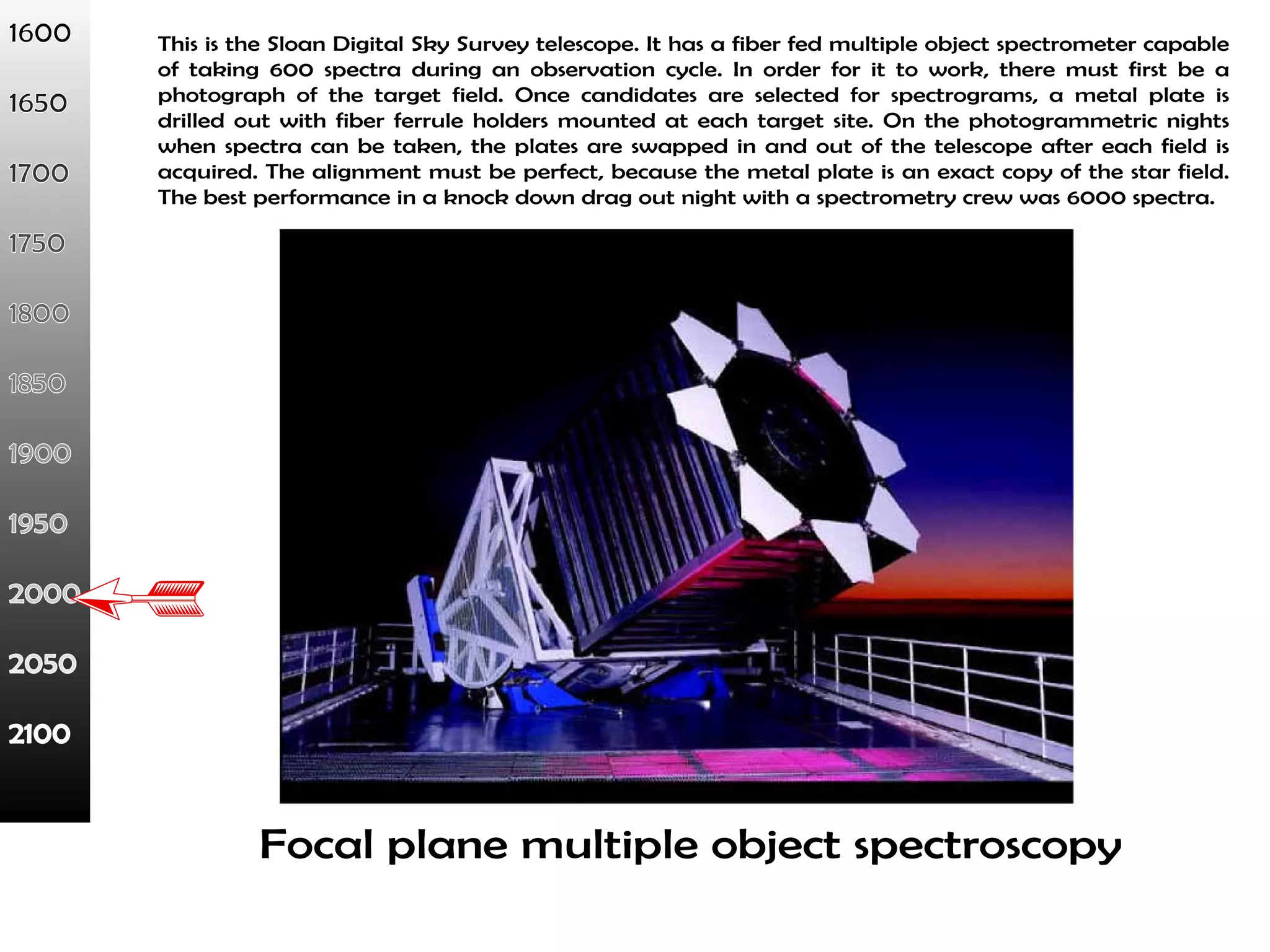
This is the Sloan Digital Sky Survey telescope. It has a fiber fed multiple object spectrometer capable 
of taking 600 spectra during an observation cycle. In order for it to work, there must first be a 
photograph of the target field. Once candidates are selected for spectrograms, a metal plate is 
drilled out with fiber ferrule holders mounted at each target site. On the photogrammetric nights 
when spectra can be taken, the plates are swapped in and out of the telescope after each field is 
acquired. The alignment must be perfect, because the metal plate is an exact copy of the star field. 
The best performance in a knock down drag out night with a spectrometry crew was 6000 spectra. 
Focal plane multiple object spectroscopy
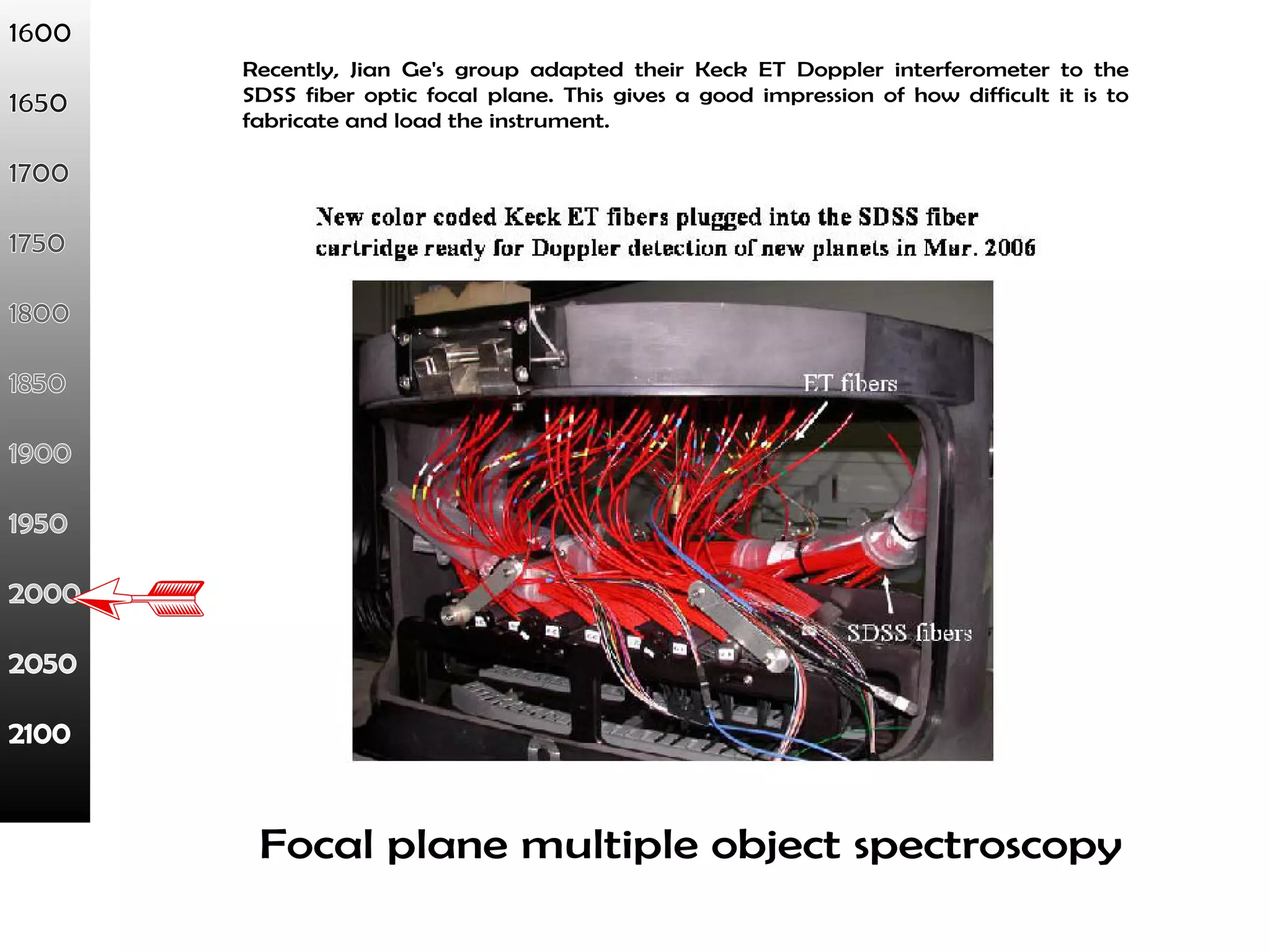
Recently, Jian Ge's group adapted their Keck ET Doppler interferometer to the 
SDSS fiber optic focal plane. This gives a good impression of how difficult it is to 
fabricate and load the instrument. 
Focal plane multiple object spectroscopy
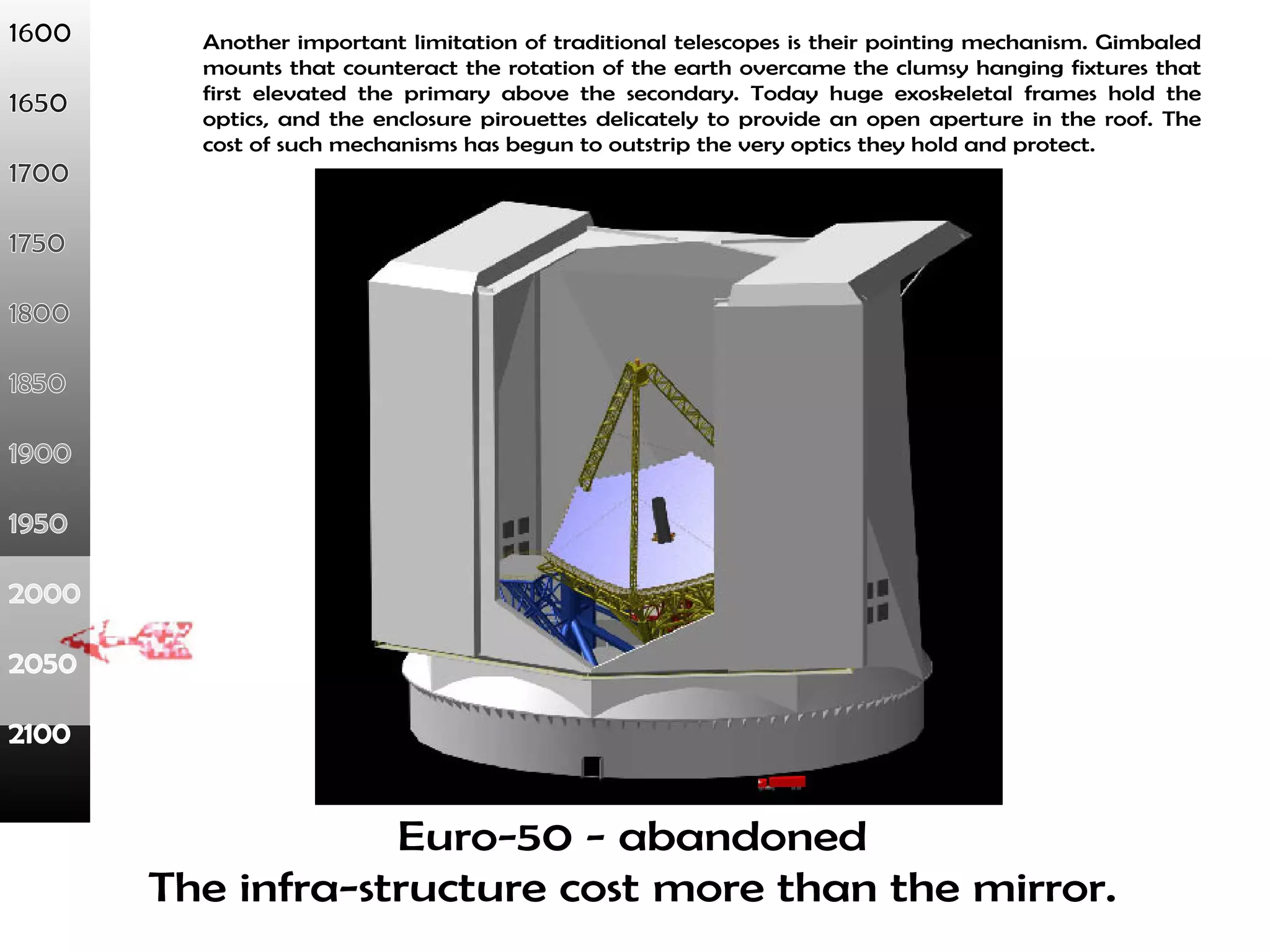
Another important limitation of traditional telescopes is their pointing mechanism. Gimbaled 
mounts that counteract the rotation of the earth overcame the clumsy hanging fixtures that 
first elevated the primary above the secondary. Today huge exoskeletal frames hold the 
optics, and the enclosure pirouettes delicately to provide an open aperture in the roof. The 
cost of such mechanisms has begun to outstrip the very optics they hold and protect. 
Euro-50 - abandoned 
The infra-structure cost more than the mirror.
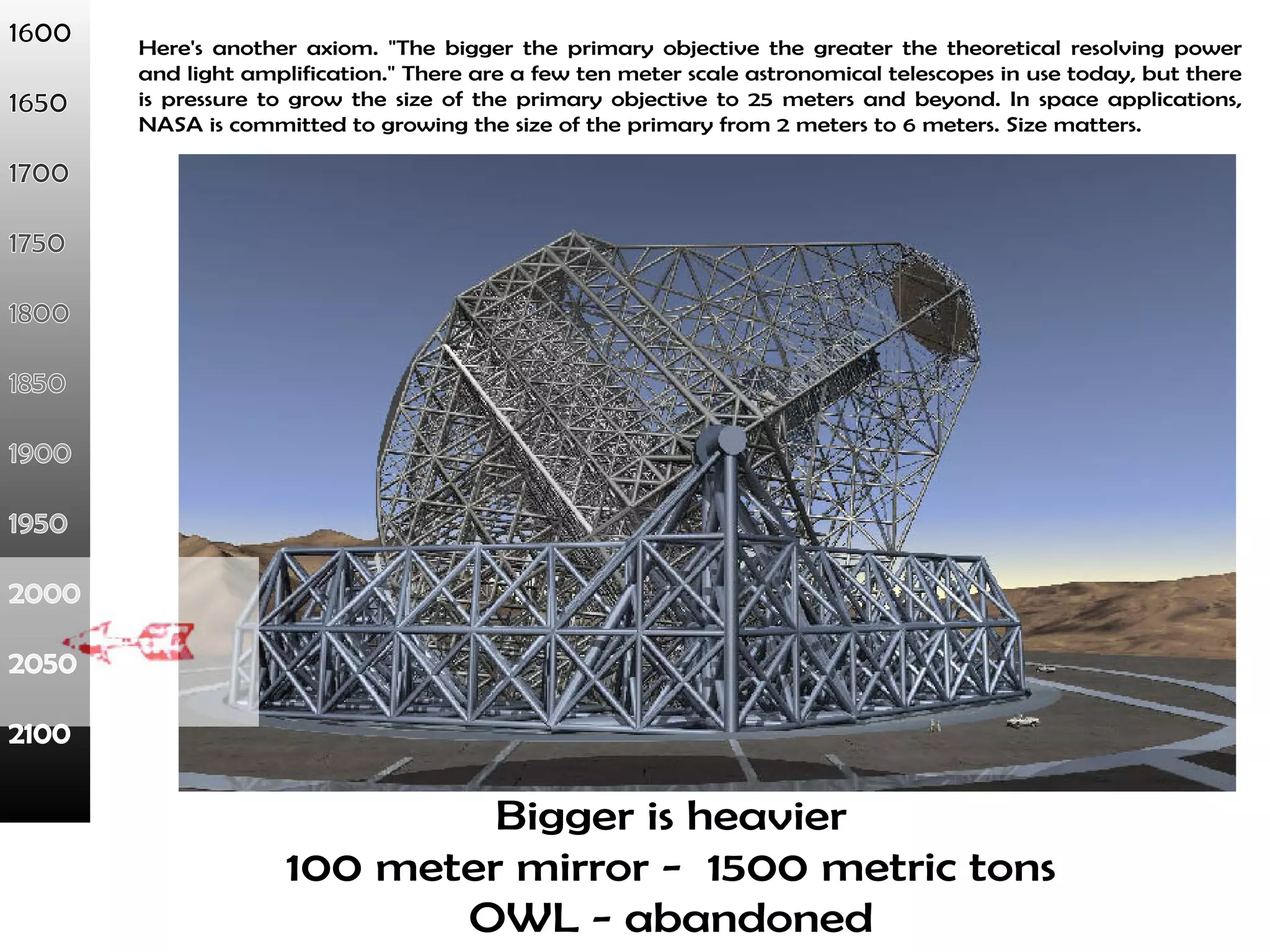
Here's another axiom. "The bigger the primary objective the greater the theoretical resolving power 
and light amplification." There are a few ten meter scale astronomical telescopes in use today, but there 
is pressure to grow the size of the primary objective to 25 meters and beyond. In space applications, 
NASA is committed to growing the size of the primary from 2 meters to 6 meters. Size matters. 
Bigger is heavier 
100 meter mirror - 1500 metric tons 
OWL - abandoned
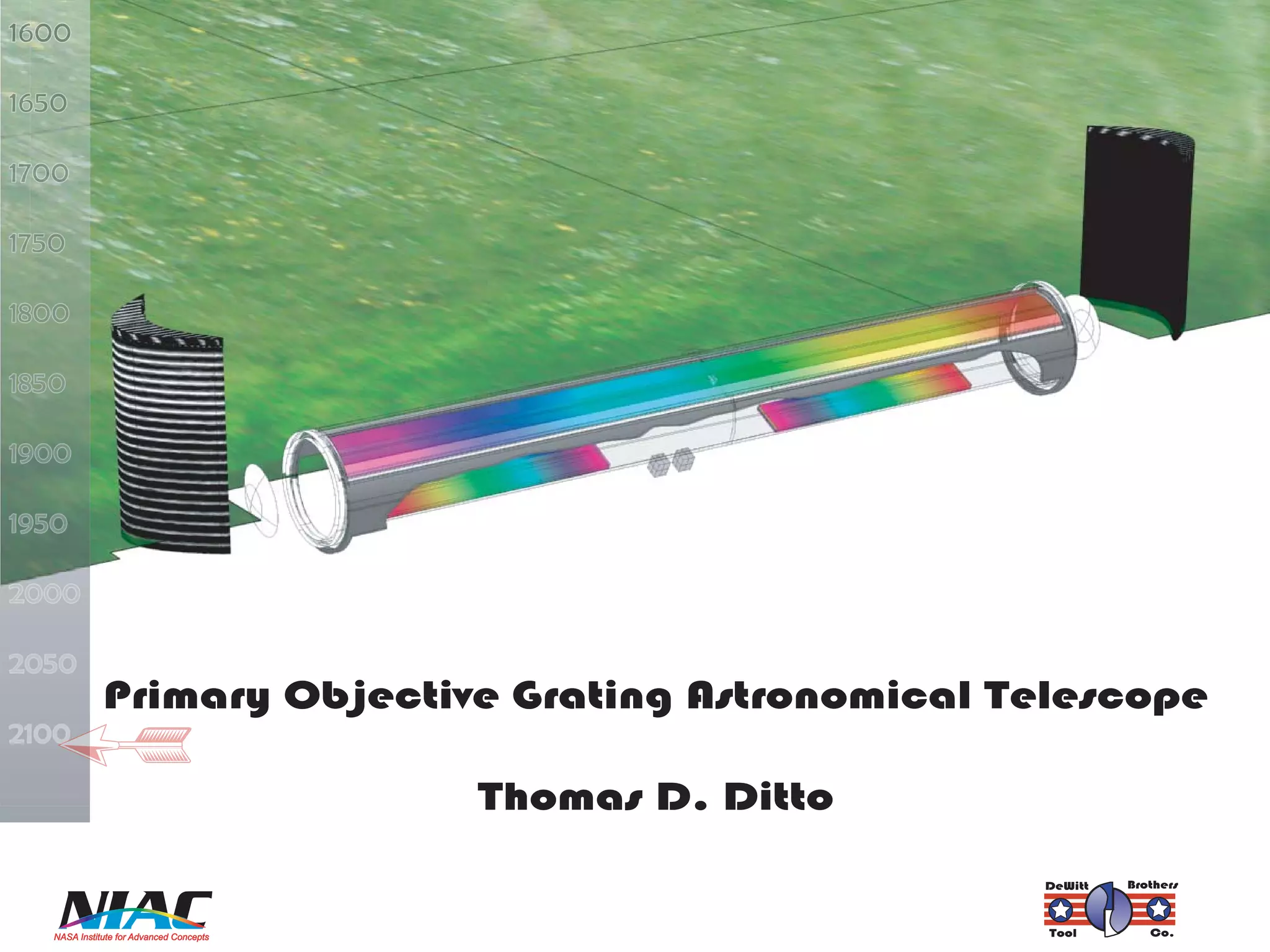
Primary Objective Grating Astronomical Telescope 
Thomas D. Ditto 
DeWitt 
Tool 
Brothers 
Co.
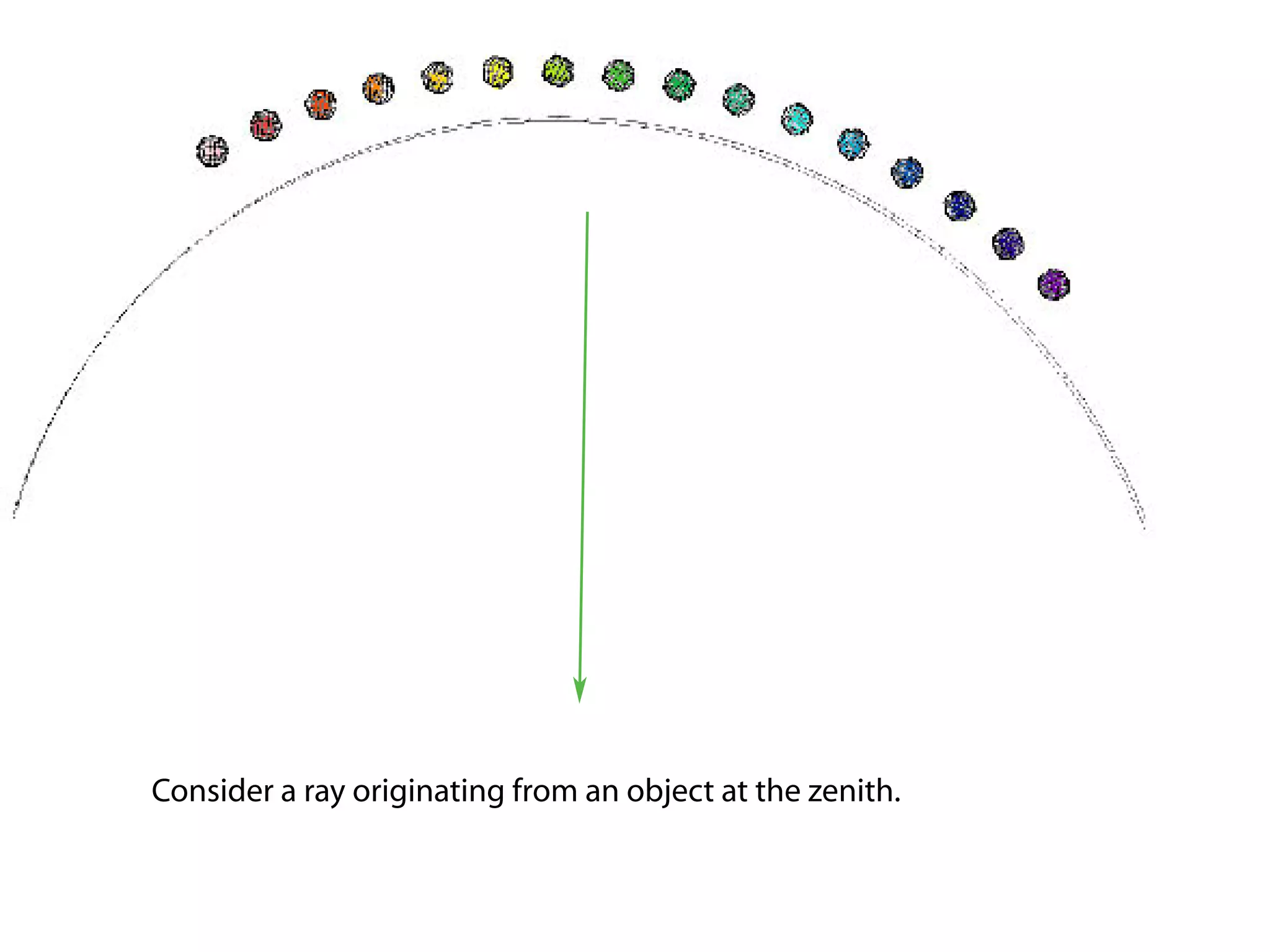
Consider a ray originating from an object at the zenith.
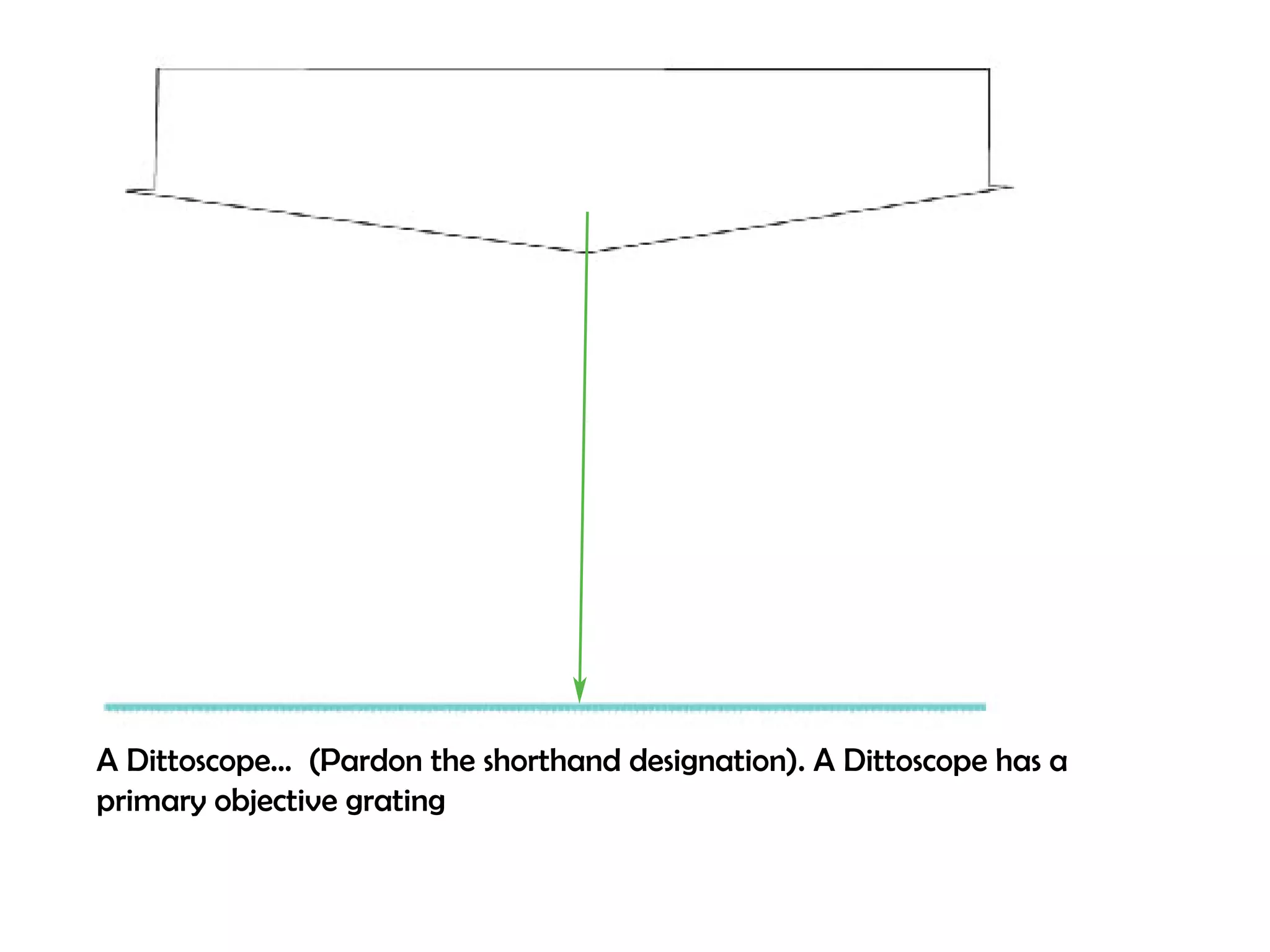
A Dittoscope… (Pardon the shorthand designation). A Dittoscope has a 
primary objective grating
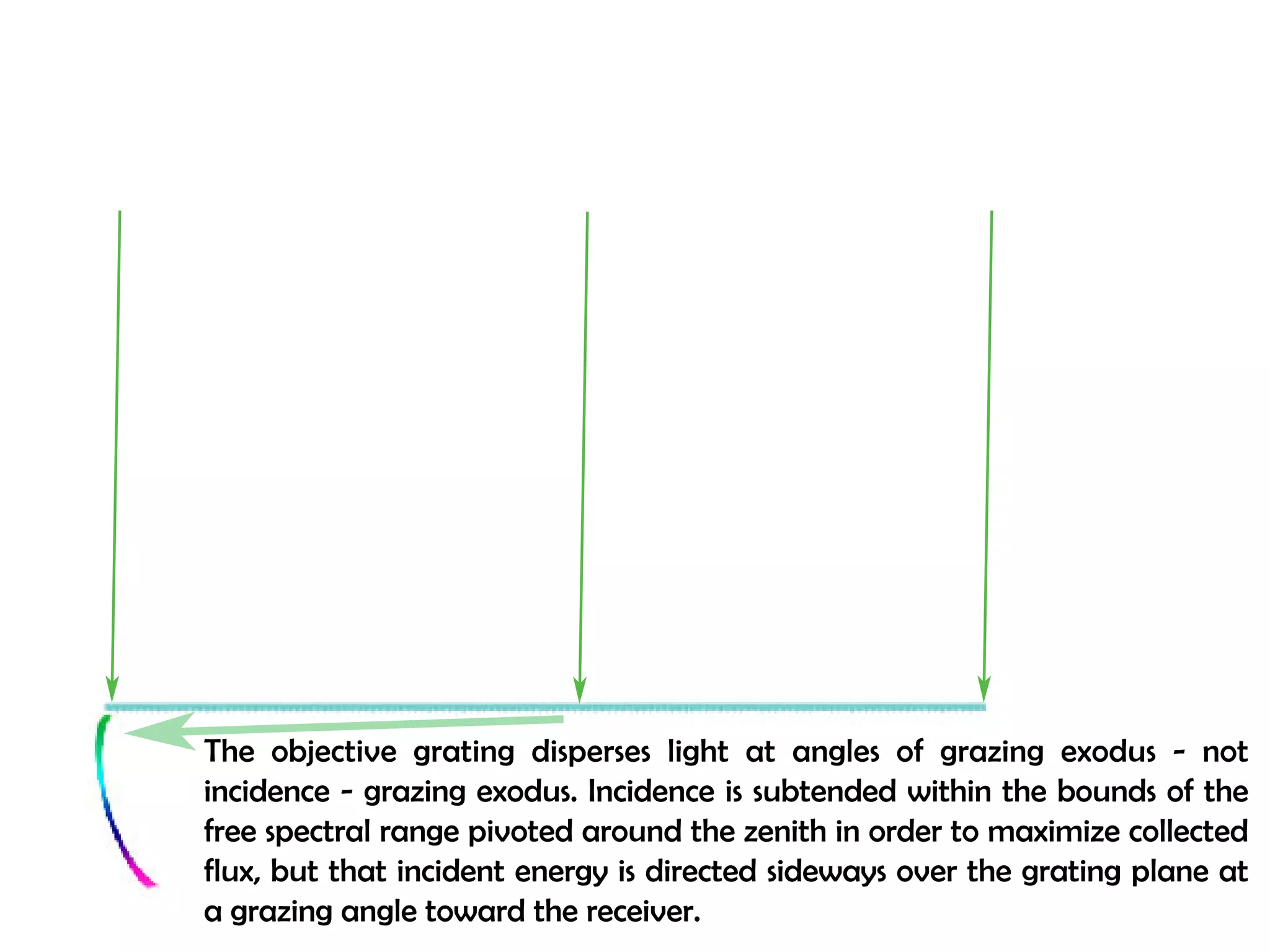
The objective grating disperses light at angles of grazing exodus - not 
incidence - grazing exodus. Incidence is subtended within the bounds of the 
free spectral range pivoted around the zenith in order to maximize collected 
flux, but that incident energy is directed sideways over the grating plane at 
a grazing angle toward the receiver.
The ratio of the collection area of the primary to the area of the secondary can be 
1000:1 as the angle of reconstruction of a higher-order approaches 90 degrees.
B 
A ribbon shaped grazing exodus primary objective grating with a ten meter 
secondary mirror may have 1 kilometer length and a collection area of 10,000 
square meters.
A 
B 
Consider a second object which produces a plane wave incident upon 
the primary objective (A) from another angle off the normal. Its 
dispersed wavefront will appear at the secondary (B) at another specific 
wavelength.
The angle at which the wave front is dispersed is called r for angle of 
reconstruction or receiving.
A 
B 
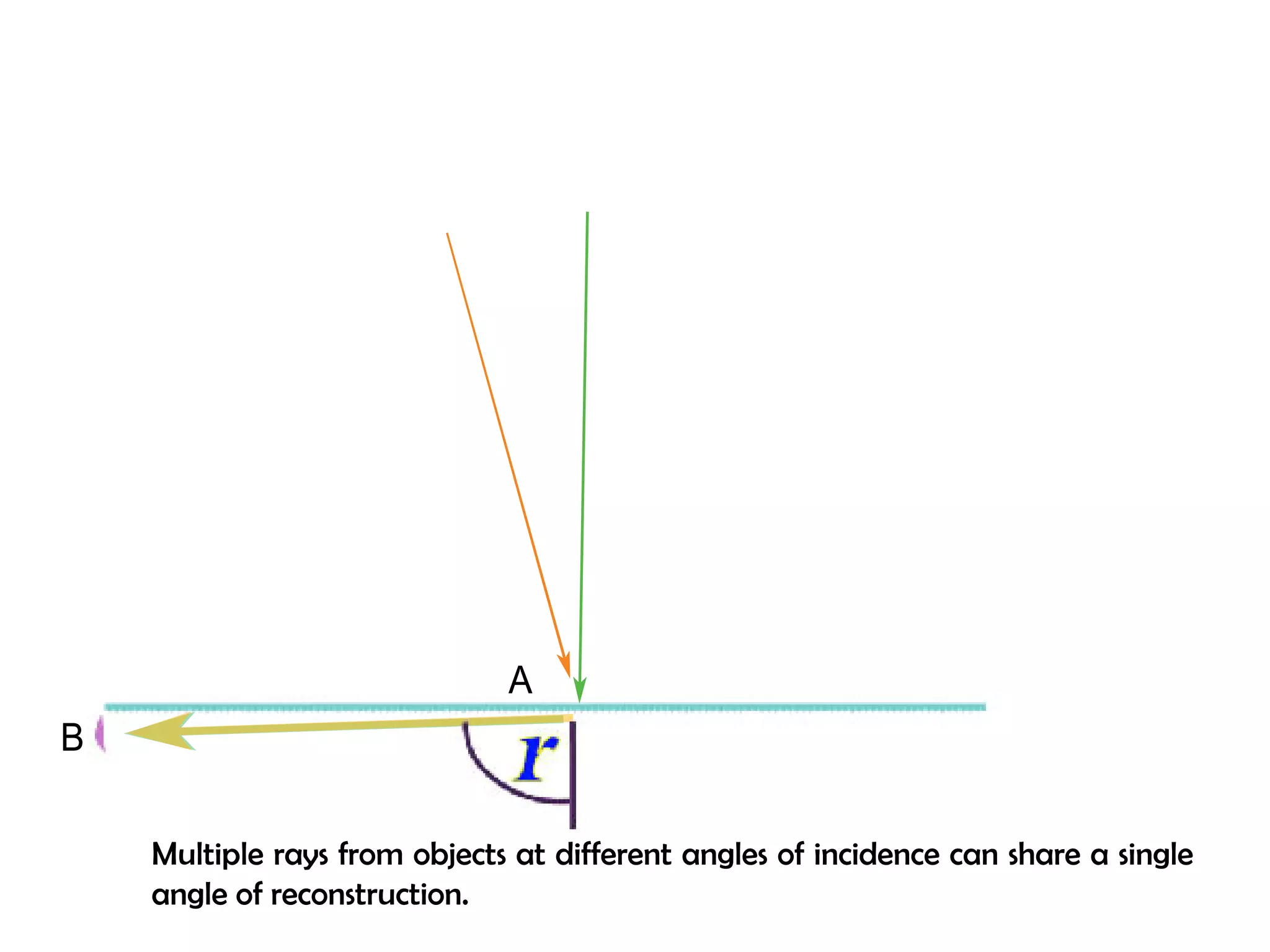
Multiple rays from objects at different angles of incidence can share a single 
angle of reconstruction.
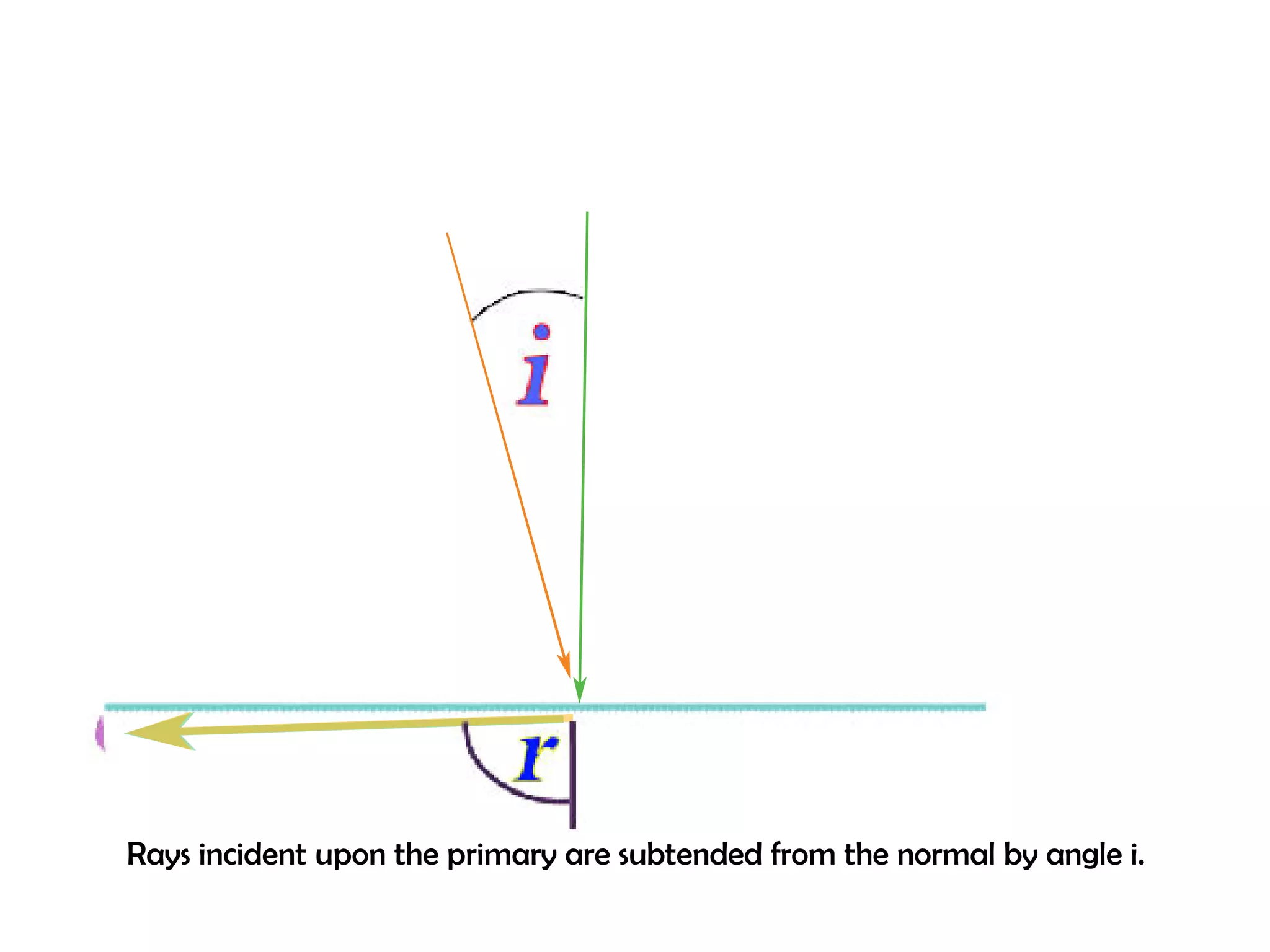
Rays incident upon the primary are subtended from the normal by angle i.
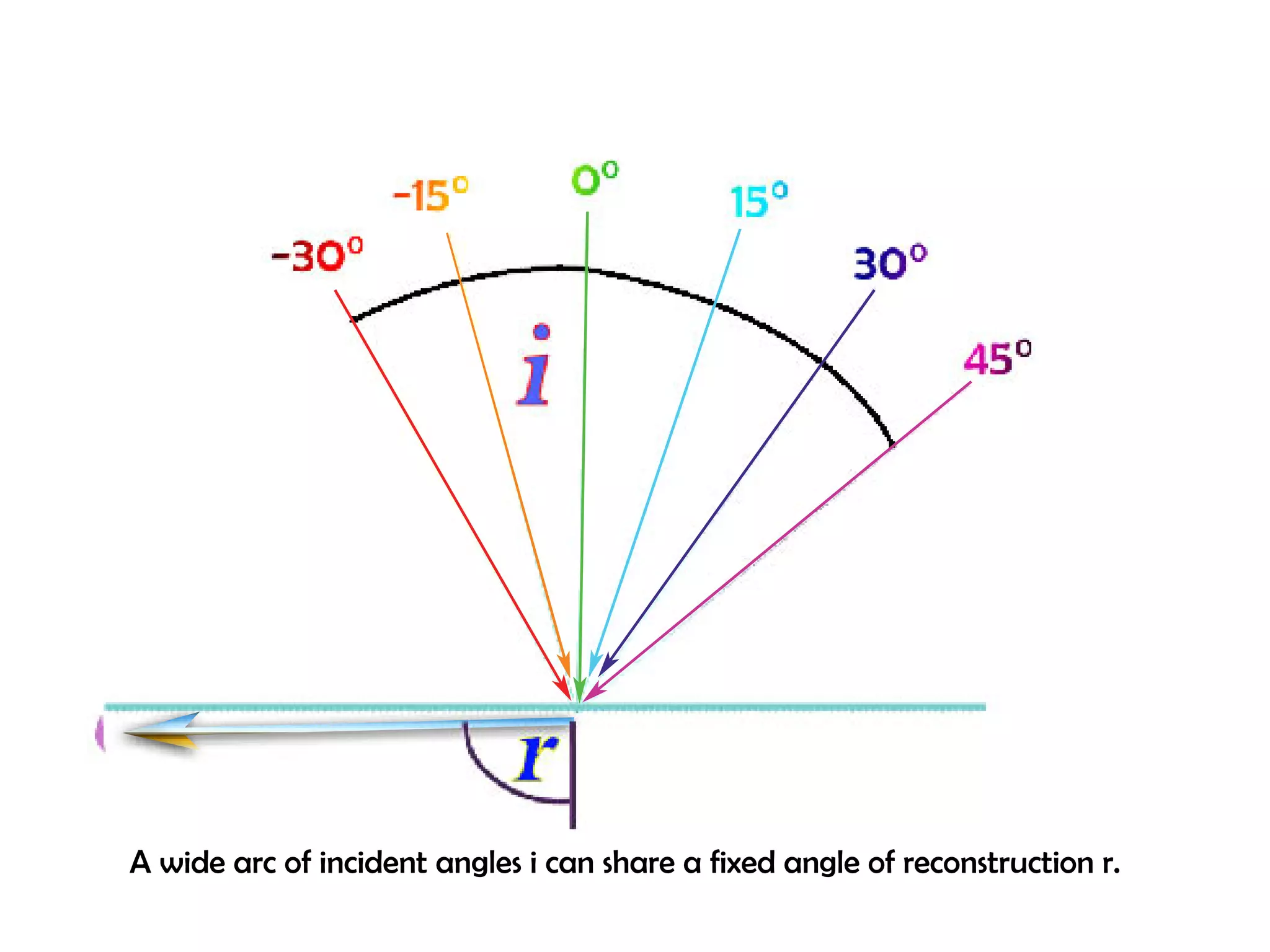
A wide arc of incident angles i can share a fixed angle of reconstruction r.
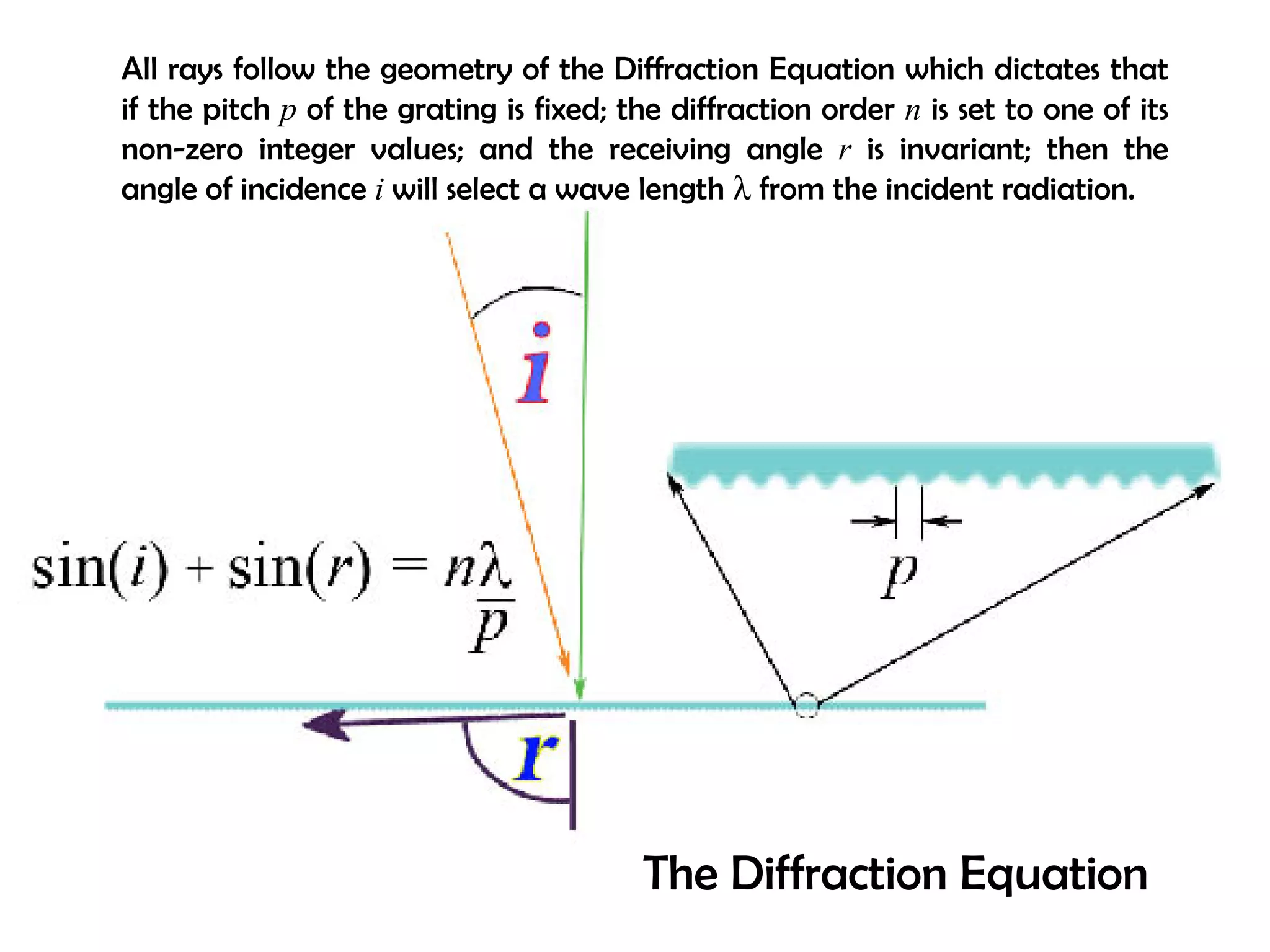
All rays follow the geometry of the Diffraction Equation which dictates that 
if the pitch p of the grating is fixed; the diffraction order n is set to one of its 
non-zero integer values; and the receiving angle r is invariant; then the 
angle of incidence i will select a wave length l from the incident radiation. 
The Diffraction Equation
One way to conceptualize a Dittoscope is to think of a typical spectroscopy-capable 
telescope aimed at a grating flat on the ground. Now the primary mirror is a 
secondary, but its spectrometer is unchanged. It has a grating and a slit. 
A 
B C D E 
The secondary spectrometer eliminates the overlapping spectra from the 
primary objective grating that hobbled the original objective grating telescope
Instead of overlapping spectra, each object is imaged at a single wave length at 
any unique angle of incidence.
All stars in a line of right ascension that are within the free spectral range of the 
primary objective grating are recorded simultaneously, each at a unique 
wavelength.
In a terrestrial setting, a Dittoscope can operate with no moving parts. Well, there is 
a moving part - the rotating earth, but once the telescope is positioned, it can 
remain stationary. To do this the instrument would be oriented along lines of 
latitude, east-west.
The precession of objects in the night sky causes their incident angles to rotate. For 
any incident angle there is a corresponding wavelength, so an entire spectrogram 
can be assembled over the course of a night.
it 
Now can be 
said that the 
bes t pr imary 
objective for this 
astronomical telescope is 
the one with the greatest 
chromatic aberration. The 
inverted axiom suggests objective 
gratings of very fine pitch - sub 
wavelength over much of the spectrum. 
These are gratings that operate in one of the 
first-orders and have the widest possible free 
spectral range. 
Roll 
over Galileo, tel l Isaac Newton the new s.
1200 
1000 
800 
600 
400 
600 nm pitch plane grating 
87 degrees grazing exodus 
1st-Order 2nd-Order 
20 0 20 40 60 80 90 
l 
nm 
i deg 
Free Spectral Range 
Extraordinarily, the greatest magnifications also deliver the widest the fields-of-view, with the greatest dispersion, a 40 
degree arc. This puts millions of stars within view simultaneously, each at a unique wave length at any particular instant. 
Since the output of the telescope is spectrographic, multiple object spectrometer problems are no longer the vexing issue of 
conventional telescopy. Every object has its spectrum taken. Stars do not need to be localized in advance of taking their 
spectra. There are spectral signatures for all objects in sight from first light.
1.0 
0.8 
0.6 
0.4 
0.2 
0.0 
1.0 
0.8 
0.6 
0.4 
0.2 
0.0 
1.0 
0.8 
0.6 
0.4 
0.2 
0.0 
Three samples of one star Three frames in the data parade 
Data Reduction by Temporal Spectroscopy 
Data reduction of an instantaneous spectrogram requires the correlation of wave length to sidereal time 
and thereafter angle of incidence. The entire spectrogram of a single object is taken from a series of snap 
shots as that object transits through the free spectral range. The complete spectra of all objects that 
precess through the entire free spectral range can be obtained, and partial spectra are available for those 
that are partially extinguished by daytime or cloud cover.
The roof is coming off the observatory. Gone are the domes, the sliding 
hatch doors and the rotating walls. A Dittoscope can lay flat to the 
ground. Its roof may be the primary objective. Wind resistance is 
negligible. The secondary optics are buried in a trough, and the ray paths 
can be protected within a pacified atmosphere, even a vacuum.
Free spectral range window 
& 
Windbreak 
secondary mirror 
secondary grating 
focal plane array 
latitude axis of rotation 
slit 
Unlike co-axial instruments that have intra-optic spiders to hold 
components and folding mirrors to collapse the telescope to shorter 
lengths, the unique flat posture of the Dittoscope allows for the ray path 
to avoid artifacts caused by these occluding members. Long focal length 
secondary mirrors are allowable without folding. One possibility is a 
focal length ½ grating length. That would place the slit of the secondary 
spectrometer in the middle of the primary objective grating.
parabola 
slit 
Primary Objective Grating 300 m spectrometer grating 150 m 
sensor
Segmentation 
Laser interferometric alignment by day 
Set for the night and lock down 
The grating can be segmented. Modular construction allows for use during incremental 
construction. Modules can be aligned by laser interferometry. This type of structure has 
utility for terrestrial settings.
Gossamer Membrane 
deployed from Shuttle 
delivery bay or stowage in 
a cylinder fairing 
The flat grating has a ribbon shape and lends itself to 
deployment as a gossamer membrane. This type of structure 
has utility for space telescopes. Storage during insertion is as a 
roll which can be unfurled in orbit and attached to a stretcher. 
Membranes want to be flat. Obtaining a useful optical figure 
presents far fewer technical problems than reflection primaries. 
AIAA Conference paper forthcoming in April
The Dittoscope primary objective grating is nominally flat, save for its 
periodic grating micro-structure at the scale of the wave length of light. 
Constructive interference from billions of grating grooves can produce 
highly refined spectral spreads. The theoretical resolving power of a 
kilometer scale diffraction grating is 1/100,000 of an Angstrom. If the 
Grating flatness tolerance? 
Gratings are different. As grazing approaches exodus, tolerances improve. 
zero-order 
first-order 
performance target is to achieve 1/10 of 
an Angstrom over the visible spectrum, 
the error budget for flatness and phase 
error is 10,000 to one, so this concept is 
extremely robust. The grating can be 
made from float glass that has a precise 
figure only in the 
shorter of its two 
dimensions where the 
surface is essentially a 
plane mirror.
Flatness tolerance has an explanation, as shown 
here for low quality float glass - worst case = 1 Å.
Gratings are different. 
Fabrication of gratings is no longer a matter of mechanical 
ruling. The master grating can be made as a simple Fraunhofer 
hologram, that is, the interference of two coherent plane waves. 
Copies can be replicated using released epoxy or even by mass 
replication embossing from a cylindrical master called a shim. 
zero-order
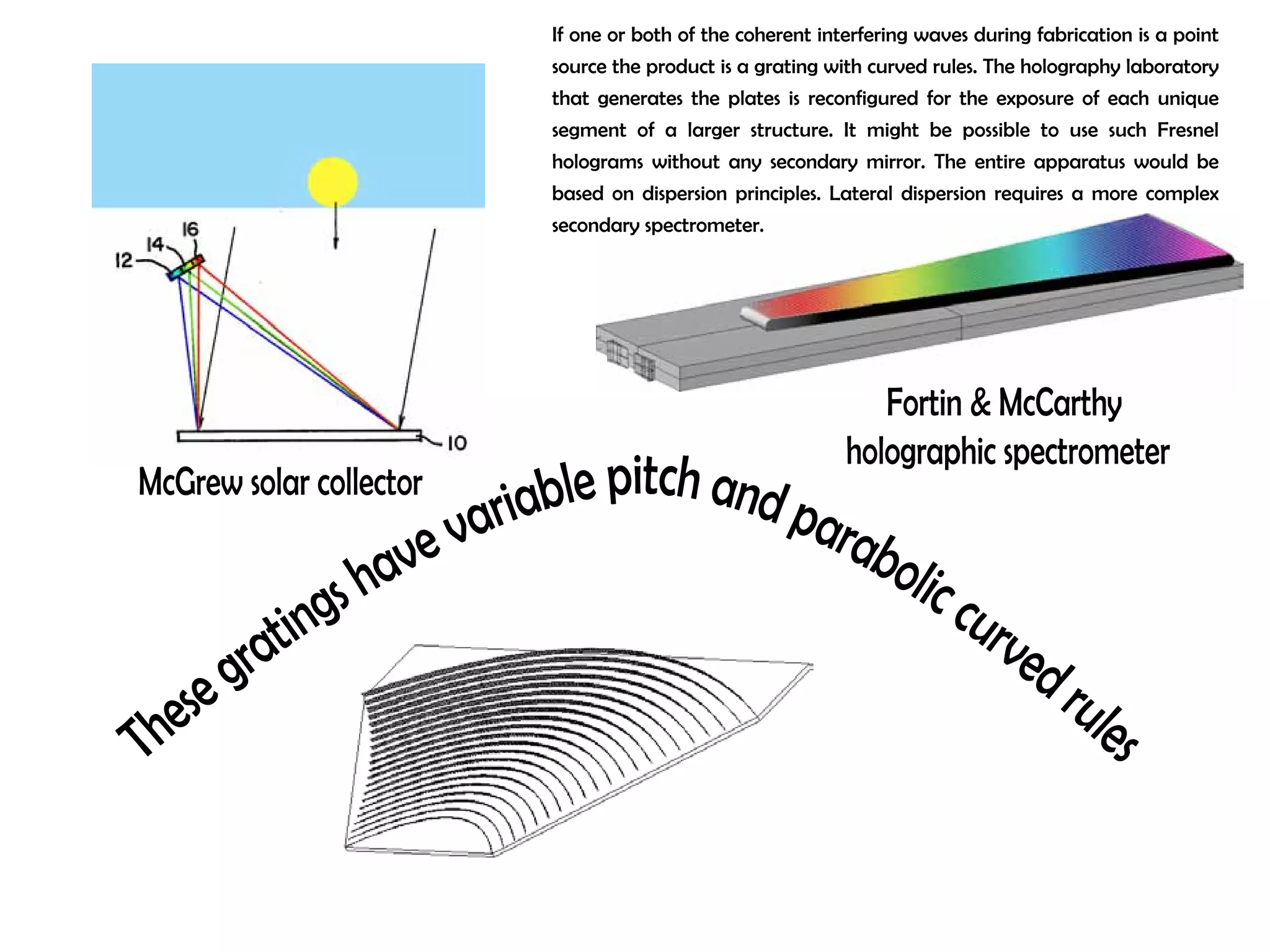
If one or both of the coherent interfering waves during fabrication is a point 
source the product is a grating with curved rules. The holography laboratory 
that generates the plates is reconfigured for the exposure of each unique 
segment of a larger structure. It might be possible to use such Fresnel 
holograms without any secondary mirror. The entire apparatus would be 
based on dispersion principles. Lateral dispersion requires a more complex 
secondary spectrometer. 
McGrew solar collector 
variable pitch and have parabolic gratings curved These zero-order 
rules 
Fortin & McCarthy 
holographic spectrometer
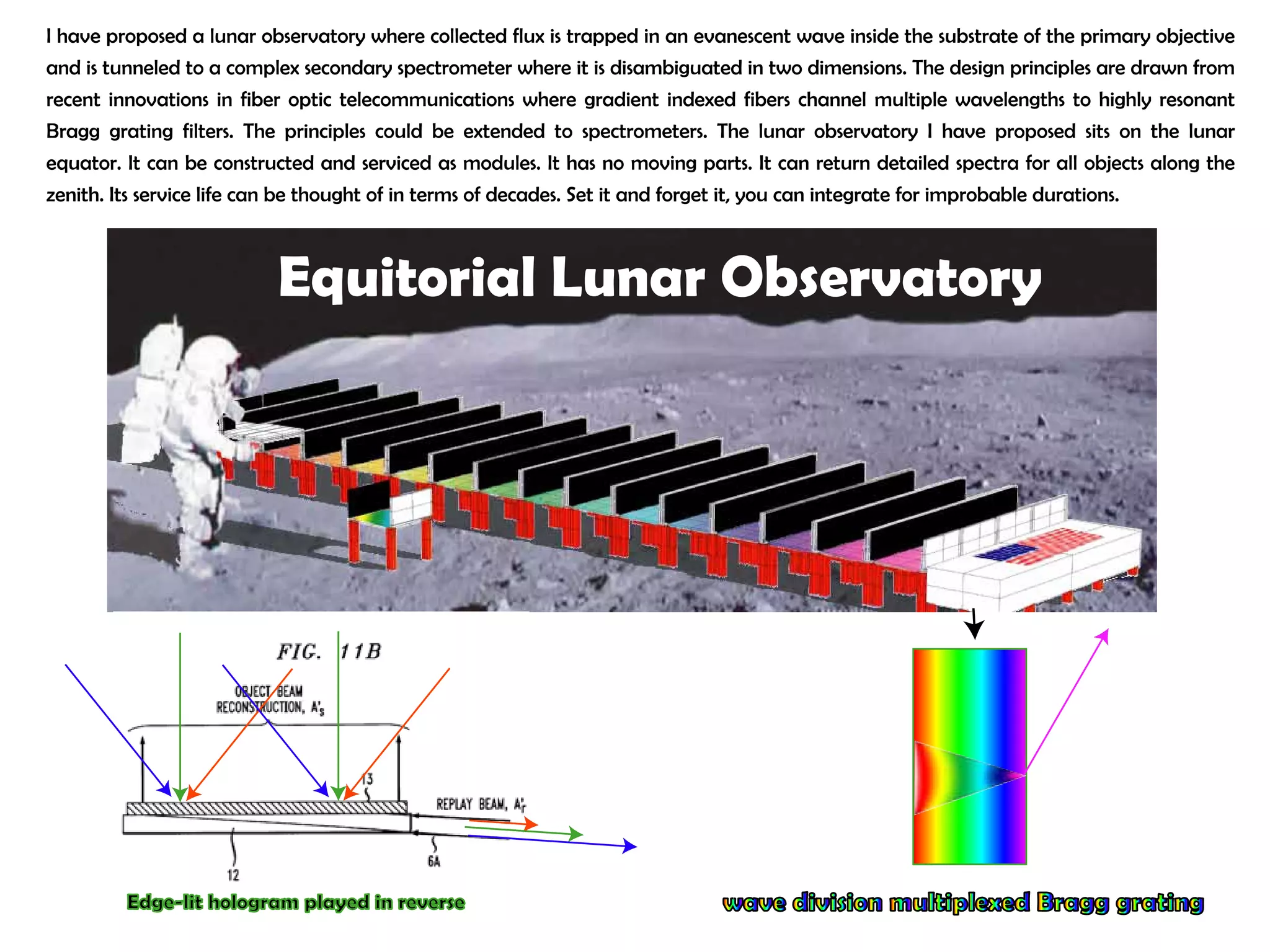
I have proposed a lunar observatory where collected flux is trapped in an evanescent wave inside the substrate of the primary objective 
and is tunneled to a complex secondary spectrometer where it is disambiguated in two dimensions. The design principles are drawn from 
recent innovations in fiber optic telecommunications where gradient indexed fibers channel multiple wavelengths to highly resonant 
Bragg grating filters. The principles could be extended to spectrometers. The lunar observatory I have proposed sits on the lunar 
equator. It can be constructed and serviced as modules. It has no moving parts. It can return detailed spectra for all objects along the 
zenith. Its service life can be thought of in terms of decades. Set it and forget it, you can integrate for improbable durations. 
Equitorial Lunar Observatory 
Edge-lit hologram played in reverse
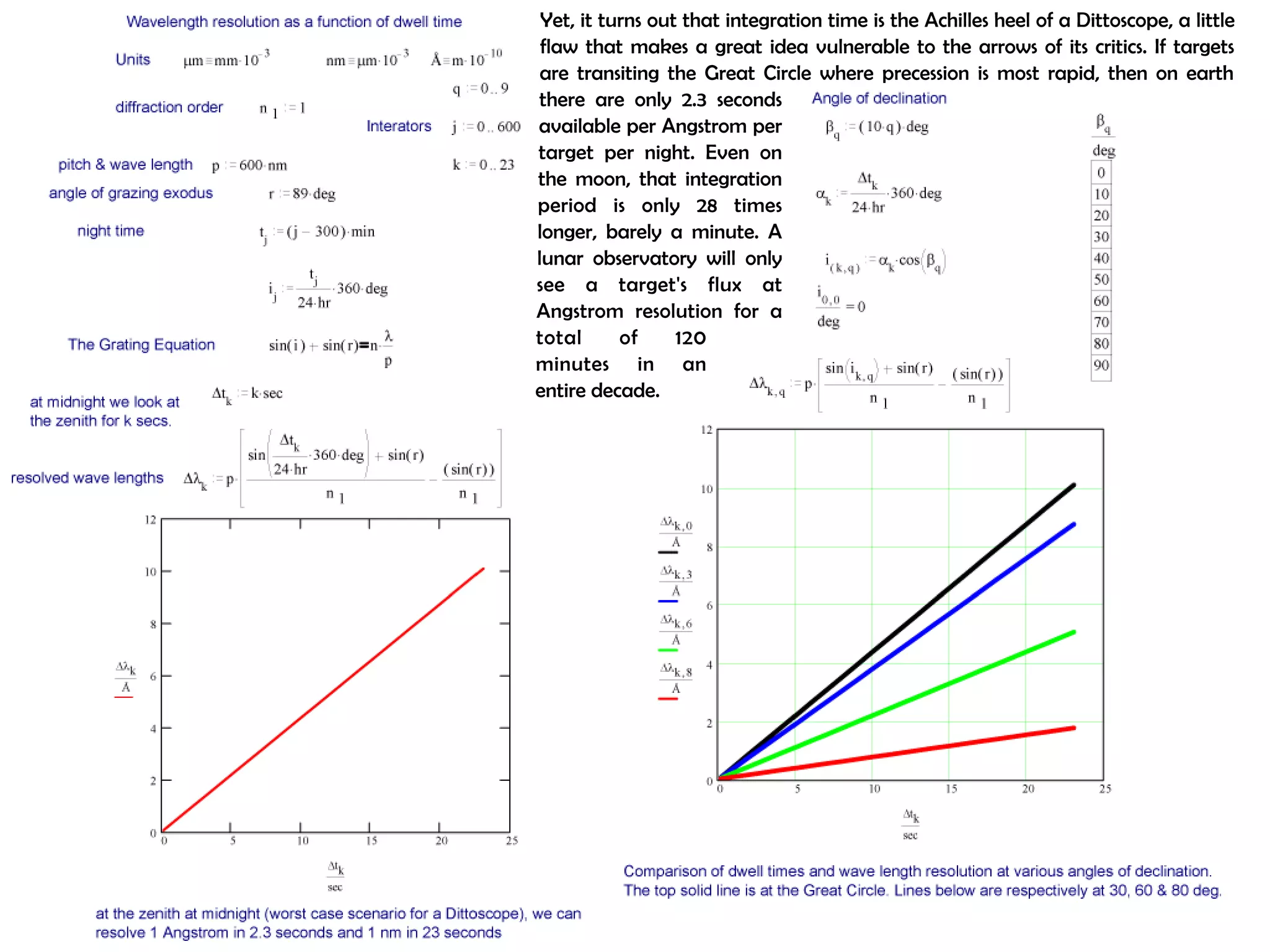
Yet, it turns out that integration time is the Achilles heel of a Dittoscope, a little 
flaw that makes a great idea vulnerable to the arrows of its critics. If targets 
are transiting the Great Circle where precession is most rapid, then on earth 
there are only 2.3 seconds 
available per Angstrom per 
target per night. Even on 
the moon, that integration 
period is only 28 times 
longer, barely a minute. A 
lunar observatory will only 
see a target's flux at 
Angstrom resolution for a 
total of 120 
minutes in an 
entire decade.
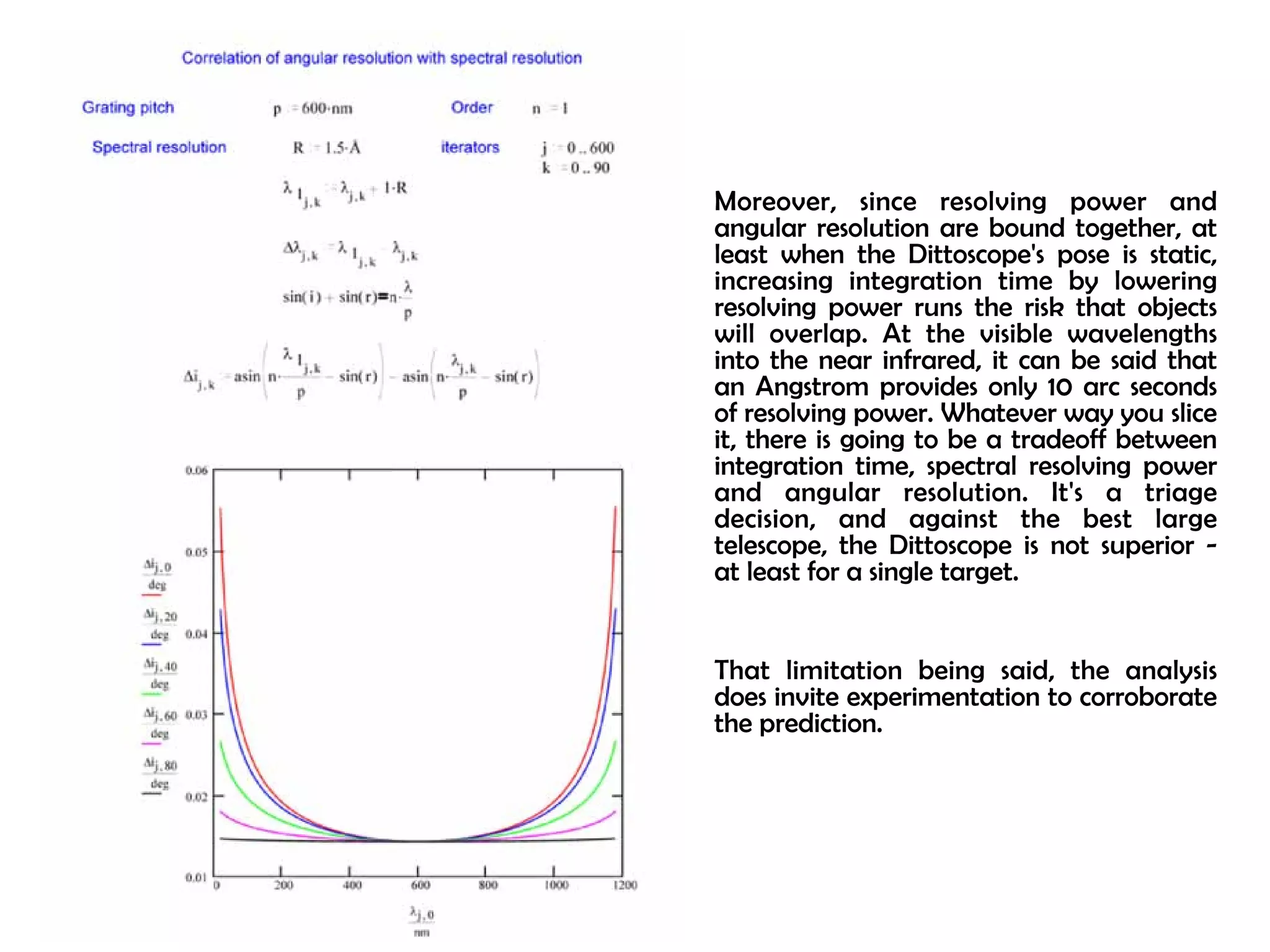
Moreover, since resolving power and 
angular resolution are bound together, at 
least when the Dittoscope's pose is static, 
increasing integration time by lowering 
resolving power runs the risk that objects 
will overlap. At the visible wavelengths 
into the near infrared, it can be said that 
an Angstrom provides only 10 arc seconds 
of resolving power. Whatever way you slice 
it, there is going to be a tradeoff between 
integration time, spectral resolving power 
and angular resolution. It's a triage 
decision, and against the best large 
telescope, the Dittoscope is not superior - 
at least for a single target. 
That limitation being said, the analysis 
does invite experimentation to corroborate 
the prediction.
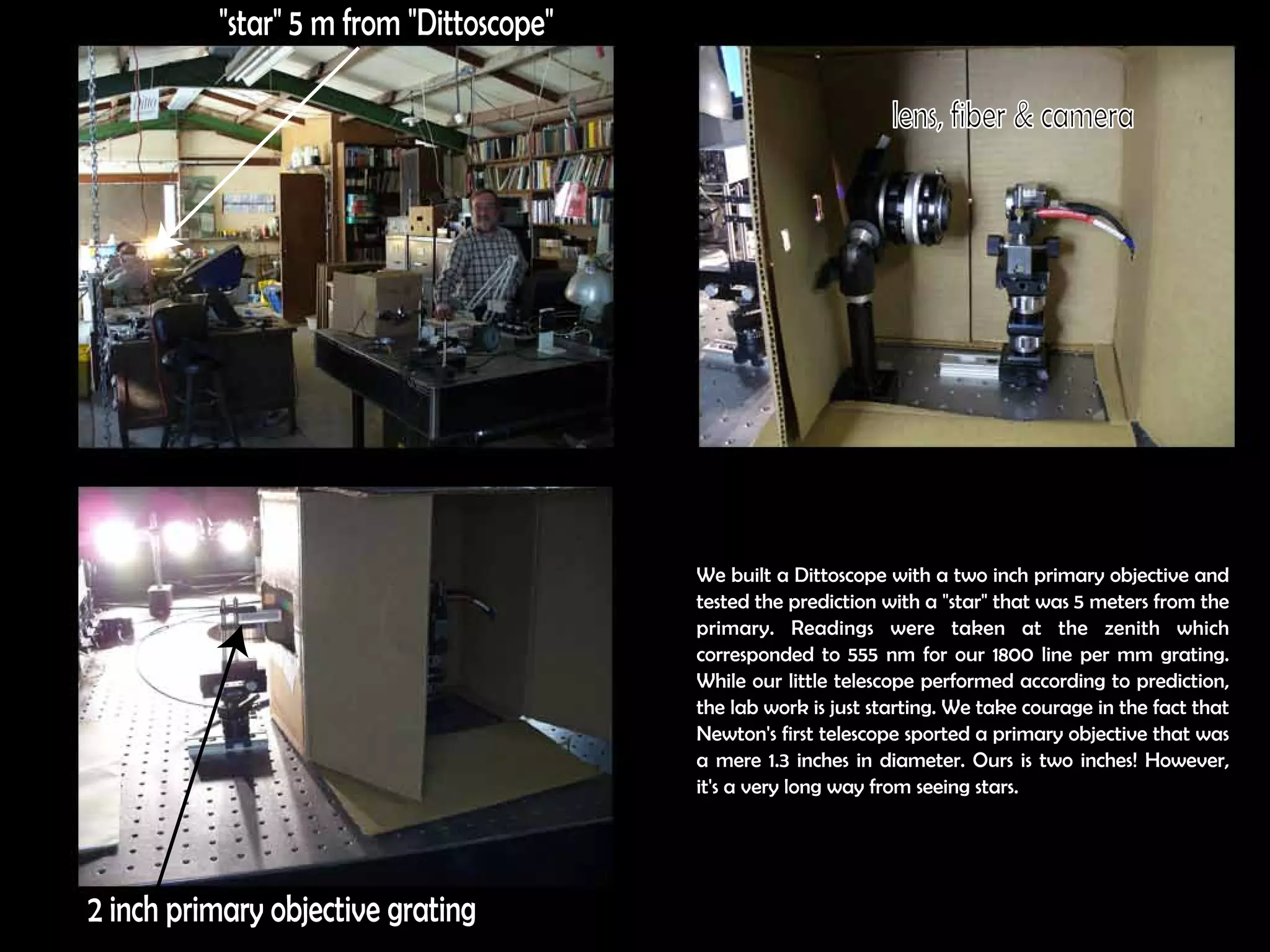
lens, fiber & camera 
"star" 5 m from "Dittoscope" 
We built a Dittoscope with a two inch primary objective and 
tested the prediction with a "star" that was 5 meters from the 
primary. Readings were taken at the zenith which 
corresponded to 555 nm for our 1800 line per mm grating. 
While our little telescope performed according to prediction, 
the lab work is just starting. We take courage in the fact that 
Newton's first telescope sported a primary objective that was 
a mere 1.3 inches in diameter. Ours is two inches! However, 
it's a very long way from seeing stars. 
2 inch primary objective grating Ditto
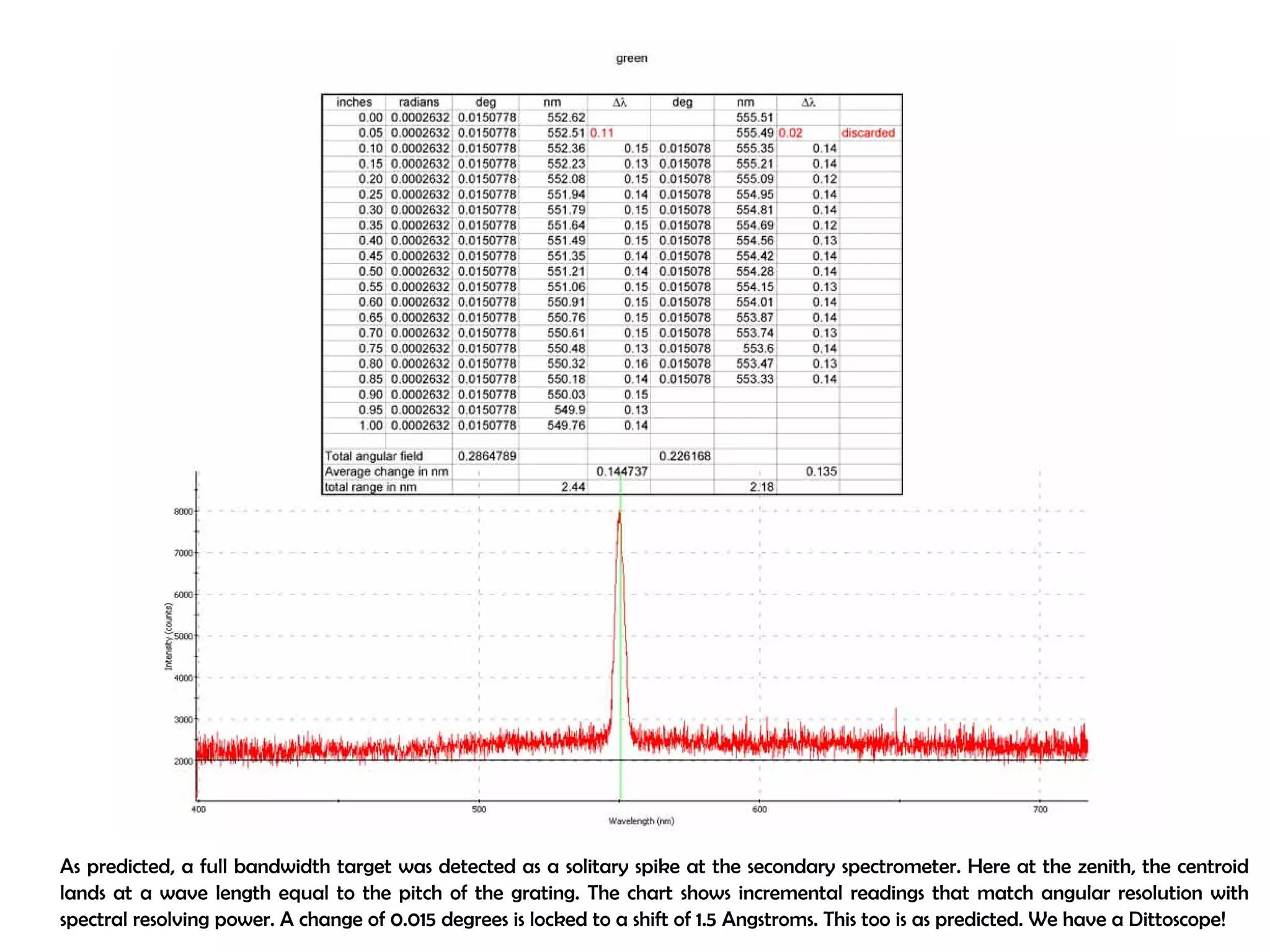
As predicted, a full bandwidth target was detected as a solitary spike at the secondary spectrometer. Here at the zenith, the centroid 
lands at a wave length equal to the pitch of the grating. The chart shows incremental readings that match angular resolution with 
spectral resolving power. A change of 0.015 degrees is locked to a shift of 1.5 Angstroms. This too is as predicted. We have a Dittoscope!
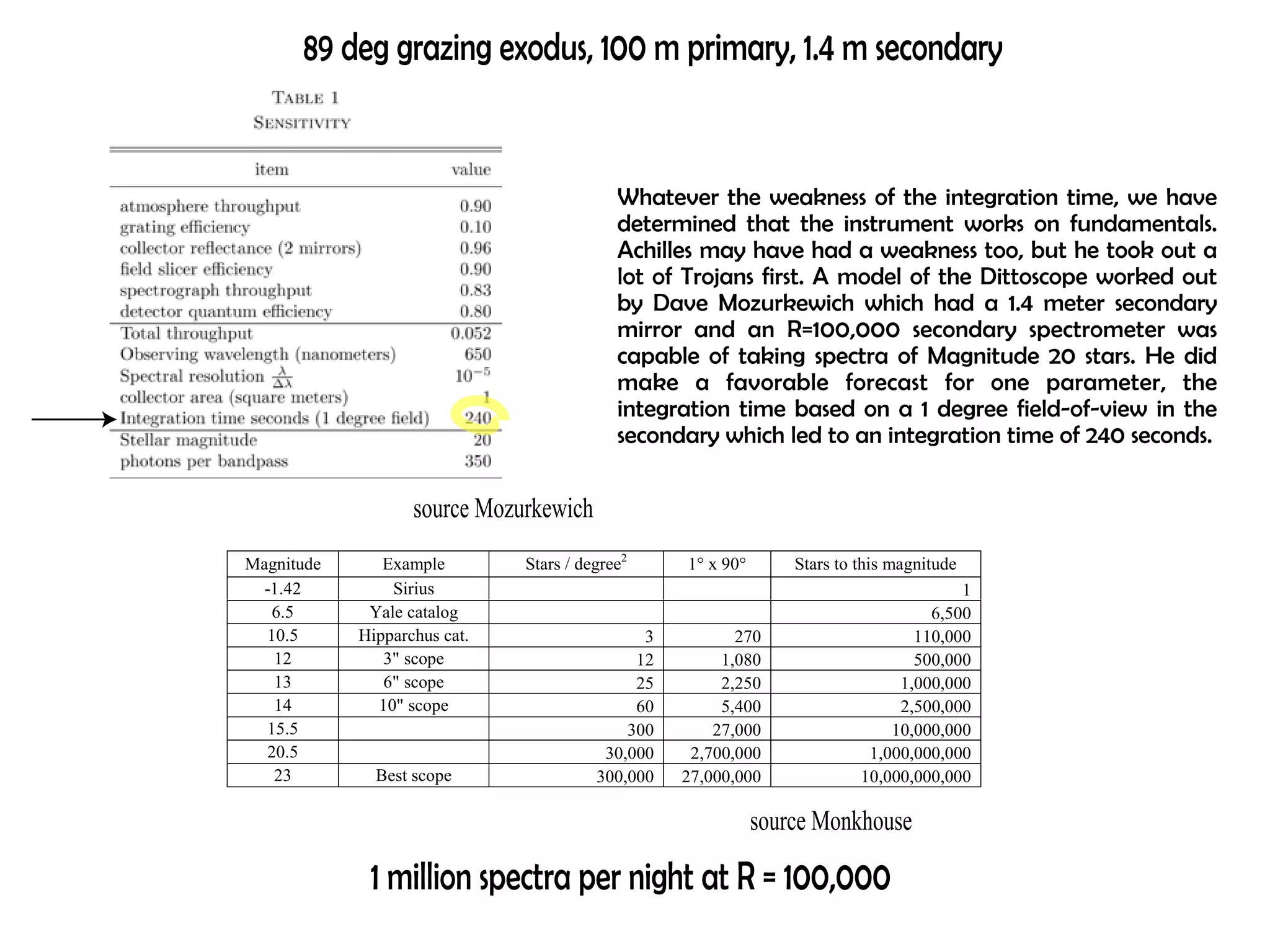
89 deg grazing exodus, 100 m primary, 1.4 m secondary 
Whatever the weakness of the integration time, we have 
determined that the instrument works on fundamentals. 
Achilles may have had a weakness too, but he took out a 
lot of Trojans first. A model of the Dittoscope worked out 
by Dave Mozurkewich which had a 1.4 meter secondary 
mirror and an R=100,000 secondary spectrometer was 
capable of taking spectra of Magnitude 20 stars. He did 
make a favorable forecast for one parameter, the 
integration time based on a 1 degree field-of-view in the 
secondary which led to an integration time of 240 seconds. 
Magnitude Example Stars / degree2 1° x 90° Stars to this magnitude 
-1.42 Sirius 1 
6.5 Yale catalog 6,500 
10.5 Hipparchus cat. 3 270 110,000 
12 3" scope 12 1,080 500,000 
13 6" scope 25 2,250 1,000,000 
14 10" scope 60 5,400 2,500,000 
15.5 300 27,000 10,000,000 
20.5 30,000 2,700,000 1,000,000,000 
23 Best scope 300,000 27,000,000 10,000,000,000 
source Monkhouse 
source Mozurkewich 
1 million spectra per night at R = 100,000
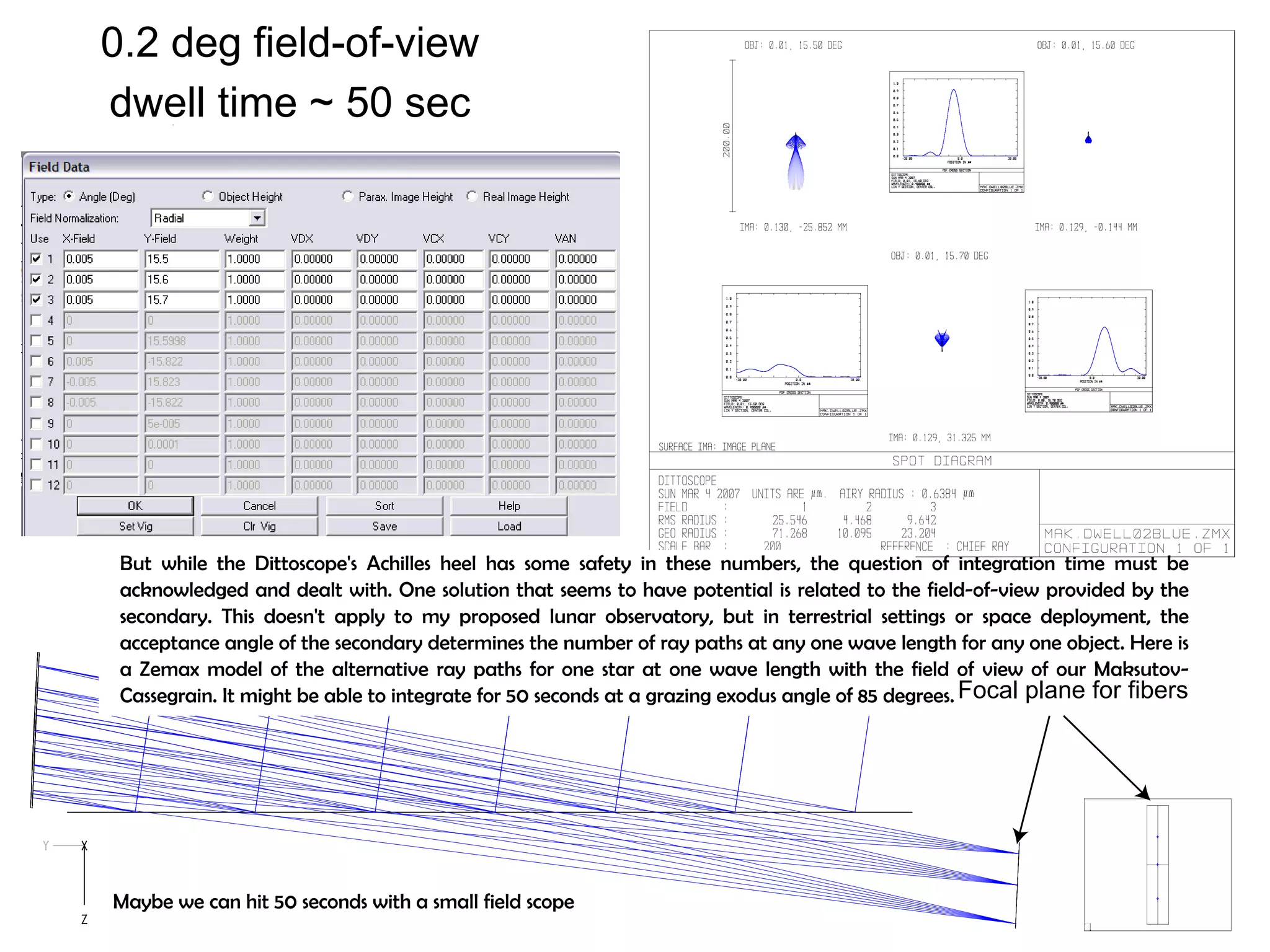
0.2 deg field-of-view 
But while the Dittoscope's Achilles heel has some safety in these numbers, the question of integration time must be 
acknowledged and dealt with. One solution that seems to have potential is related to the field-of-view provided by the 
secondary. This doesn't apply to my proposed lunar observatory, but in terrestrial settings or space deployment, the 
acceptance angle of the secondary determines the number of ray paths at any one wave length for any one object. Here is 
a Zemax model of the alternative ray paths for one star at one wave length with the field of view of our Maksutov- 
Cassegrain. It might be able to integrate for 50 seconds at a grazing exodus angle of 85 degrees. 
Focal plane for fibers 
dwell time ~ 50 sec 
Maybe we can hit 50 seconds with a small field scope
Efficiency vs Incident Angles for 280 nm sinusoidal groove 
60% 
50% 
40% 
30% 
20% 
10% 
0% 
Avg Polarization 
Grating efficiency at 85 degrees can be 30 
percent. It takes a nose dive at 89 degrees. 
Leonid Goray predicts a theoretical limit at 
89 degrees of 15%. It's hard to read his 
figures, because he used incidence angle as 
the independent variable. This does not 
correspond to reconstruction angle, as the 
little graph testifies. I have tried to 
superimpose the receiving angles. 
7.9924 8.0424 8.0924 8.1424 8.1924 
Incident Angles 
Efficiency 
1800 l/mm primary 632.8 nm wave length objective grating 
TM 
TE 
rj 
deg 
89.99 
88.935 
88.493 
88.155 
87.869 
87.618 
87.39 
87.181 
86.987 
86.804 
86.631 
86.467 
86.309 
86.159 
86.014 
85.874 
85.738 
85.607 
85.48 
85.356 
85.235 
85.117 
85.003 
84.89 
84.78 
84.673 
90 
89 
88 
87 
86 
85 
7.95 8 8.05 8.1 8.15 8.2 8.25 
rj 
deg 
ij 
deg 
receiving angles
Measured performance 
Optometrics grating 
r in deg efficiency 
85 34% 
86 31% 
87 28% 
88 22% 
89 15% 
Dave Mosurkewich used a figure of 10% efficiency 
at 89 degrees grazing exodus for his throughput. 
We achieved these figures with our two inch 
grating. When I factored our actual readings with 
a real grating against the increase in length it 
affords as a function of grazing exodus angle, I 
came up with an overall benefit up to 89 degrees, 
despite the loss in efficiency. 
Magnification grows faster than efficiency is lost
So what is the problem with this idea? One problem is its very sensitivity. When 
the wavefront is magnified so much, the aberrations in the wave become 
apparent. Adaptive optics are not possible for large collectors. The grazing angle 
must be lowered to accommodate the sensitivity to wavefront distortions. It may 
be that grazing angle determines integration time too. The inflexible linking of 
three parameters: angular resolution, spectral resolving power and integration 
time must be balanced for any specific application. The quality of the primary is 
always a factor. Since it must operate as a mirror in one of the dimensions, the 
tolerance of the other dimension is not the limiting factor. To complete our 
preliminary investigation we have to put our finger on these: 
1. What is the minimum size for the primary? 
2. What is the optimum angle for grazing exodus? 
3. What are the choices for the secondary? 
Pick a secondary spectrometer 
Design variations in the secondary mirror 
Investigate the idea of an entirely flat Dittoscope 
4. Is there an option for adaptive optics? 
Forthcoming: AIAA Conference Gossamer Spacecraft Forum 
Phase I Report - Details on the empirical study 
Phase II Proposal - The long road ahead

1316 ditto[1]

  • 1.
    "Voyage" is aboutas close as I got to astronomy during a 30 year career as an artist, so it is a privilege and an honor to stand here before you as a peer in this queen of sciences.
  • 2.
    Jeffrey Foster Friedman Universidad de Puerto Rico Michael S. Foster Spectratek Jeffrey T. Baker Baker Adaptive Optics David Mozurkewich Seabrook Engineering Leonid Goray International Intellectual Group Jason Warren (IBM)) DeWitt Tool Brothers Co. Fortunately, I have help from these credentialed experts and institutional support from NIAC and DeWitt Brothers Tool Co.
  • 3.
  • 4.
    This Report isnot the latest word on an old idea but the first word on a new one. The new idea reverses the old one, the axiom that the best primary objective for an astronomical telescope exhibits the least chromatic aberration. That axiomatic distinction goes back to a young Isaac Newton who knew from experiments with prisms and mirrors in the 1660's that magnification with a reflection primary was completely free of the dispersion he saw with refraction. The superiority of reflection primary objectives for eyeball or photographic viewing is now considered obvious. It was this piece of wisdom on achromatic primary objectives that led to the dominance of the parabolic mirror as the means to collect star light. Newton was aware of the problem when he introduced his telescope to the scientific world in 1670.
  • 5.
    Actually, Newton's designinnovation was in a secondary mirror, a plane mirror far more easily fabricated than Gregory's embodiment of 1663 which required two curved mirrors.
  • 6.
    Mersenne's earlier dualparabolic mirror design of 1636 would also have been free of chromatic aberration, spherical aberration, coma, and astigmatism, if it could have been built. When Descartes saw the proposal he dismissed the idea. Mersenne returned to the monastery where he worked with prime numbers rather than prime objectives. Yet, this design is central to telescope design today. Mersenne 1636
  • 7.
    The latency inthe development of the diffraction grating partially explains why it did not even enter into consideration as a primary objective of telescopes. The first diffraction grating recorded in the literature appears in 1786, over 100 years after Newton's telescope, It was the work of the American clockmaker and astronomer, David Rittenhouse, who wound fibers at 106 to the inch. He characterized the multiple diffraction orders and observed that colors were bent in the inverse order of refraction.
  • 8.
    Fraunhofer solar absorptionlines After Rittenhouse, dispersion by diffraction grating was not considered again for 35 years until 1820 when Joseph von Fraunhofer reinvented it. He also used dispersion to resolve atomic lines of sunlight and starlight, showing both similarities and unique differences between stars. Astronomers took note.
  • 9.
    One way planegratings served astronomy was when they reached sizes large enough to form images. Seemingly excellent for surveys, these so called "slitless" spectrometers suffered from low resolving power, ambiguity between overlapping spectra and intrinsic background noise. Not only that. These primary objective gratings did nothing to concentrate the light. That work was left to a secondary mirror or lens where the concentration of flux took place. Objective grating multiple object spectroscopy
  • 10.
    This type ofspectroscopy was largely abandoned, save for the occasional exotic application where these defects did not overrule the convenience of putting the grating first. Objective grating multiple object spectroscopy
  • 11.
    The most commonuse is solar observation. Objective grating multiple object spectroscopy
  • 12.
    Multiple object spectrometersuse slices to reposition each target onto a separate section of the secondary spectrometer. Aligning the lens or mirror array to perform the slicing is dicey, because stars are randomly distributed in the field-of-view. FLAMINGOS: The FLoridA Multi-object Imaging Near-IR Grism Observational Spectrometer Simulated Focal plane multiple object spectroscopy
  • 13.
    Just as theoriginal slitless objective grating suffered from ambiguities of overlapping spectra, the focal plane multiple-object spectrometer is faced with similar interleaving despite its numerous alternative ray paths. Background photon noise is not eliminated, and the convenience of having a single instrument that captures all stars in a field-of-view is a compromise. FLAMINGOS: The FLoridA Multi-object Imaging Near-IR Grism Observational Spectrometer Actual Focal plane multiple object spectroscopy
  • 14.
    This is theSloan Digital Sky Survey telescope. It has a fiber fed multiple object spectrometer capable of taking 600 spectra during an observation cycle. In order for it to work, there must first be a photograph of the target field. Once candidates are selected for spectrograms, a metal plate is drilled out with fiber ferrule holders mounted at each target site. On the photogrammetric nights when spectra can be taken, the plates are swapped in and out of the telescope after each field is acquired. The alignment must be perfect, because the metal plate is an exact copy of the star field. The best performance in a knock down drag out night with a spectrometry crew was 6000 spectra. Focal plane multiple object spectroscopy
  • 15.
    Recently, Jian Ge'sgroup adapted their Keck ET Doppler interferometer to the SDSS fiber optic focal plane. This gives a good impression of how difficult it is to fabricate and load the instrument. Focal plane multiple object spectroscopy
  • 16.
    Another important limitationof traditional telescopes is their pointing mechanism. Gimbaled mounts that counteract the rotation of the earth overcame the clumsy hanging fixtures that first elevated the primary above the secondary. Today huge exoskeletal frames hold the optics, and the enclosure pirouettes delicately to provide an open aperture in the roof. The cost of such mechanisms has begun to outstrip the very optics they hold and protect. Euro-50 - abandoned The infra-structure cost more than the mirror.
  • 17.
    Here's another axiom."The bigger the primary objective the greater the theoretical resolving power and light amplification." There are a few ten meter scale astronomical telescopes in use today, but there is pressure to grow the size of the primary objective to 25 meters and beyond. In space applications, NASA is committed to growing the size of the primary from 2 meters to 6 meters. Size matters. Bigger is heavier 100 meter mirror - 1500 metric tons OWL - abandoned
  • 18.
    Primary Objective GratingAstronomical Telescope Thomas D. Ditto DeWitt Tool Brothers Co.
  • 19.
    Consider a rayoriginating from an object at the zenith.
  • 20.
    A Dittoscope… (Pardonthe shorthand designation). A Dittoscope has a primary objective grating
  • 21.
    The objective gratingdisperses light at angles of grazing exodus - not incidence - grazing exodus. Incidence is subtended within the bounds of the free spectral range pivoted around the zenith in order to maximize collected flux, but that incident energy is directed sideways over the grating plane at a grazing angle toward the receiver.
  • 22.
    The ratio ofthe collection area of the primary to the area of the secondary can be 1000:1 as the angle of reconstruction of a higher-order approaches 90 degrees.
  • 23.
    B A ribbonshaped grazing exodus primary objective grating with a ten meter secondary mirror may have 1 kilometer length and a collection area of 10,000 square meters.
  • 24.
    A B Considera second object which produces a plane wave incident upon the primary objective (A) from another angle off the normal. Its dispersed wavefront will appear at the secondary (B) at another specific wavelength.
  • 25.
    The angle atwhich the wave front is dispersed is called r for angle of reconstruction or receiving.
  • 26.
    A B Multiplerays from objects at different angles of incidence can share a single angle of reconstruction.
  • 27.
    Rays incident uponthe primary are subtended from the normal by angle i.
  • 28.
    A wide arcof incident angles i can share a fixed angle of reconstruction r.
  • 29.
    All rays followthe geometry of the Diffraction Equation which dictates that if the pitch p of the grating is fixed; the diffraction order n is set to one of its non-zero integer values; and the receiving angle r is invariant; then the angle of incidence i will select a wave length l from the incident radiation. The Diffraction Equation
  • 30.
    One way toconceptualize a Dittoscope is to think of a typical spectroscopy-capable telescope aimed at a grating flat on the ground. Now the primary mirror is a secondary, but its spectrometer is unchanged. It has a grating and a slit. A B C D E The secondary spectrometer eliminates the overlapping spectra from the primary objective grating that hobbled the original objective grating telescope
  • 31.
    Instead of overlappingspectra, each object is imaged at a single wave length at any unique angle of incidence.
  • 32.
    All stars ina line of right ascension that are within the free spectral range of the primary objective grating are recorded simultaneously, each at a unique wavelength.
  • 33.
    In a terrestrialsetting, a Dittoscope can operate with no moving parts. Well, there is a moving part - the rotating earth, but once the telescope is positioned, it can remain stationary. To do this the instrument would be oriented along lines of latitude, east-west.
  • 34.
    The precession ofobjects in the night sky causes their incident angles to rotate. For any incident angle there is a corresponding wavelength, so an entire spectrogram can be assembled over the course of a night.
  • 35.
    it Now canbe said that the bes t pr imary objective for this astronomical telescope is the one with the greatest chromatic aberration. The inverted axiom suggests objective gratings of very fine pitch - sub wavelength over much of the spectrum. These are gratings that operate in one of the first-orders and have the widest possible free spectral range. Roll over Galileo, tel l Isaac Newton the new s.
  • 36.
    1200 1000 800 600 400 600 nm pitch plane grating 87 degrees grazing exodus 1st-Order 2nd-Order 20 0 20 40 60 80 90 l nm i deg Free Spectral Range Extraordinarily, the greatest magnifications also deliver the widest the fields-of-view, with the greatest dispersion, a 40 degree arc. This puts millions of stars within view simultaneously, each at a unique wave length at any particular instant. Since the output of the telescope is spectrographic, multiple object spectrometer problems are no longer the vexing issue of conventional telescopy. Every object has its spectrum taken. Stars do not need to be localized in advance of taking their spectra. There are spectral signatures for all objects in sight from first light.
  • 37.
    1.0 0.8 0.6 0.4 0.2 0.0 1.0 0.8 0.6 0.4 0.2 0.0 1.0 0.8 0.6 0.4 0.2 0.0 Three samples of one star Three frames in the data parade Data Reduction by Temporal Spectroscopy Data reduction of an instantaneous spectrogram requires the correlation of wave length to sidereal time and thereafter angle of incidence. The entire spectrogram of a single object is taken from a series of snap shots as that object transits through the free spectral range. The complete spectra of all objects that precess through the entire free spectral range can be obtained, and partial spectra are available for those that are partially extinguished by daytime or cloud cover.
  • 38.
    The roof iscoming off the observatory. Gone are the domes, the sliding hatch doors and the rotating walls. A Dittoscope can lay flat to the ground. Its roof may be the primary objective. Wind resistance is negligible. The secondary optics are buried in a trough, and the ray paths can be protected within a pacified atmosphere, even a vacuum.
  • 39.
    Free spectral rangewindow & Windbreak secondary mirror secondary grating focal plane array latitude axis of rotation slit Unlike co-axial instruments that have intra-optic spiders to hold components and folding mirrors to collapse the telescope to shorter lengths, the unique flat posture of the Dittoscope allows for the ray path to avoid artifacts caused by these occluding members. Long focal length secondary mirrors are allowable without folding. One possibility is a focal length ½ grating length. That would place the slit of the secondary spectrometer in the middle of the primary objective grating.
  • 40.
    parabola slit PrimaryObjective Grating 300 m spectrometer grating 150 m sensor
  • 41.
    Segmentation Laser interferometricalignment by day Set for the night and lock down The grating can be segmented. Modular construction allows for use during incremental construction. Modules can be aligned by laser interferometry. This type of structure has utility for terrestrial settings.
  • 42.
    Gossamer Membrane deployedfrom Shuttle delivery bay or stowage in a cylinder fairing The flat grating has a ribbon shape and lends itself to deployment as a gossamer membrane. This type of structure has utility for space telescopes. Storage during insertion is as a roll which can be unfurled in orbit and attached to a stretcher. Membranes want to be flat. Obtaining a useful optical figure presents far fewer technical problems than reflection primaries. AIAA Conference paper forthcoming in April
  • 43.
    The Dittoscope primaryobjective grating is nominally flat, save for its periodic grating micro-structure at the scale of the wave length of light. Constructive interference from billions of grating grooves can produce highly refined spectral spreads. The theoretical resolving power of a kilometer scale diffraction grating is 1/100,000 of an Angstrom. If the Grating flatness tolerance? Gratings are different. As grazing approaches exodus, tolerances improve. zero-order first-order performance target is to achieve 1/10 of an Angstrom over the visible spectrum, the error budget for flatness and phase error is 10,000 to one, so this concept is extremely robust. The grating can be made from float glass that has a precise figure only in the shorter of its two dimensions where the surface is essentially a plane mirror.
  • 44.
    Flatness tolerance hasan explanation, as shown here for low quality float glass - worst case = 1 Å.
  • 45.
    Gratings are different. Fabrication of gratings is no longer a matter of mechanical ruling. The master grating can be made as a simple Fraunhofer hologram, that is, the interference of two coherent plane waves. Copies can be replicated using released epoxy or even by mass replication embossing from a cylindrical master called a shim. zero-order
  • 46.
    If one orboth of the coherent interfering waves during fabrication is a point source the product is a grating with curved rules. The holography laboratory that generates the plates is reconfigured for the exposure of each unique segment of a larger structure. It might be possible to use such Fresnel holograms without any secondary mirror. The entire apparatus would be based on dispersion principles. Lateral dispersion requires a more complex secondary spectrometer. McGrew solar collector variable pitch and have parabolic gratings curved These zero-order rules Fortin & McCarthy holographic spectrometer
  • 47.
    I have proposeda lunar observatory where collected flux is trapped in an evanescent wave inside the substrate of the primary objective and is tunneled to a complex secondary spectrometer where it is disambiguated in two dimensions. The design principles are drawn from recent innovations in fiber optic telecommunications where gradient indexed fibers channel multiple wavelengths to highly resonant Bragg grating filters. The principles could be extended to spectrometers. The lunar observatory I have proposed sits on the lunar equator. It can be constructed and serviced as modules. It has no moving parts. It can return detailed spectra for all objects along the zenith. Its service life can be thought of in terms of decades. Set it and forget it, you can integrate for improbable durations. Equitorial Lunar Observatory Edge-lit hologram played in reverse
  • 48.
    Yet, it turnsout that integration time is the Achilles heel of a Dittoscope, a little flaw that makes a great idea vulnerable to the arrows of its critics. If targets are transiting the Great Circle where precession is most rapid, then on earth there are only 2.3 seconds available per Angstrom per target per night. Even on the moon, that integration period is only 28 times longer, barely a minute. A lunar observatory will only see a target's flux at Angstrom resolution for a total of 120 minutes in an entire decade.
  • 49.
    Moreover, since resolvingpower and angular resolution are bound together, at least when the Dittoscope's pose is static, increasing integration time by lowering resolving power runs the risk that objects will overlap. At the visible wavelengths into the near infrared, it can be said that an Angstrom provides only 10 arc seconds of resolving power. Whatever way you slice it, there is going to be a tradeoff between integration time, spectral resolving power and angular resolution. It's a triage decision, and against the best large telescope, the Dittoscope is not superior - at least for a single target. That limitation being said, the analysis does invite experimentation to corroborate the prediction.
  • 50.
    lens, fiber &camera "star" 5 m from "Dittoscope" We built a Dittoscope with a two inch primary objective and tested the prediction with a "star" that was 5 meters from the primary. Readings were taken at the zenith which corresponded to 555 nm for our 1800 line per mm grating. While our little telescope performed according to prediction, the lab work is just starting. We take courage in the fact that Newton's first telescope sported a primary objective that was a mere 1.3 inches in diameter. Ours is two inches! However, it's a very long way from seeing stars. 2 inch primary objective grating Ditto
  • 51.
    As predicted, afull bandwidth target was detected as a solitary spike at the secondary spectrometer. Here at the zenith, the centroid lands at a wave length equal to the pitch of the grating. The chart shows incremental readings that match angular resolution with spectral resolving power. A change of 0.015 degrees is locked to a shift of 1.5 Angstroms. This too is as predicted. We have a Dittoscope!
  • 52.
    89 deg grazingexodus, 100 m primary, 1.4 m secondary Whatever the weakness of the integration time, we have determined that the instrument works on fundamentals. Achilles may have had a weakness too, but he took out a lot of Trojans first. A model of the Dittoscope worked out by Dave Mozurkewich which had a 1.4 meter secondary mirror and an R=100,000 secondary spectrometer was capable of taking spectra of Magnitude 20 stars. He did make a favorable forecast for one parameter, the integration time based on a 1 degree field-of-view in the secondary which led to an integration time of 240 seconds. Magnitude Example Stars / degree2 1° x 90° Stars to this magnitude -1.42 Sirius 1 6.5 Yale catalog 6,500 10.5 Hipparchus cat. 3 270 110,000 12 3" scope 12 1,080 500,000 13 6" scope 25 2,250 1,000,000 14 10" scope 60 5,400 2,500,000 15.5 300 27,000 10,000,000 20.5 30,000 2,700,000 1,000,000,000 23 Best scope 300,000 27,000,000 10,000,000,000 source Monkhouse source Mozurkewich 1 million spectra per night at R = 100,000
  • 53.
    0.2 deg field-of-view But while the Dittoscope's Achilles heel has some safety in these numbers, the question of integration time must be acknowledged and dealt with. One solution that seems to have potential is related to the field-of-view provided by the secondary. This doesn't apply to my proposed lunar observatory, but in terrestrial settings or space deployment, the acceptance angle of the secondary determines the number of ray paths at any one wave length for any one object. Here is a Zemax model of the alternative ray paths for one star at one wave length with the field of view of our Maksutov- Cassegrain. It might be able to integrate for 50 seconds at a grazing exodus angle of 85 degrees. Focal plane for fibers dwell time ~ 50 sec Maybe we can hit 50 seconds with a small field scope
  • 54.
    Efficiency vs IncidentAngles for 280 nm sinusoidal groove 60% 50% 40% 30% 20% 10% 0% Avg Polarization Grating efficiency at 85 degrees can be 30 percent. It takes a nose dive at 89 degrees. Leonid Goray predicts a theoretical limit at 89 degrees of 15%. It's hard to read his figures, because he used incidence angle as the independent variable. This does not correspond to reconstruction angle, as the little graph testifies. I have tried to superimpose the receiving angles. 7.9924 8.0424 8.0924 8.1424 8.1924 Incident Angles Efficiency 1800 l/mm primary 632.8 nm wave length objective grating TM TE rj deg 89.99 88.935 88.493 88.155 87.869 87.618 87.39 87.181 86.987 86.804 86.631 86.467 86.309 86.159 86.014 85.874 85.738 85.607 85.48 85.356 85.235 85.117 85.003 84.89 84.78 84.673 90 89 88 87 86 85 7.95 8 8.05 8.1 8.15 8.2 8.25 rj deg ij deg receiving angles
  • 55.
    Measured performance Optometricsgrating r in deg efficiency 85 34% 86 31% 87 28% 88 22% 89 15% Dave Mosurkewich used a figure of 10% efficiency at 89 degrees grazing exodus for his throughput. We achieved these figures with our two inch grating. When I factored our actual readings with a real grating against the increase in length it affords as a function of grazing exodus angle, I came up with an overall benefit up to 89 degrees, despite the loss in efficiency. Magnification grows faster than efficiency is lost
  • 56.
    So what isthe problem with this idea? One problem is its very sensitivity. When the wavefront is magnified so much, the aberrations in the wave become apparent. Adaptive optics are not possible for large collectors. The grazing angle must be lowered to accommodate the sensitivity to wavefront distortions. It may be that grazing angle determines integration time too. The inflexible linking of three parameters: angular resolution, spectral resolving power and integration time must be balanced for any specific application. The quality of the primary is always a factor. Since it must operate as a mirror in one of the dimensions, the tolerance of the other dimension is not the limiting factor. To complete our preliminary investigation we have to put our finger on these: 1. What is the minimum size for the primary? 2. What is the optimum angle for grazing exodus? 3. What are the choices for the secondary? Pick a secondary spectrometer Design variations in the secondary mirror Investigate the idea of an entirely flat Dittoscope 4. Is there an option for adaptive optics? Forthcoming: AIAA Conference Gossamer Spacecraft Forum Phase I Report - Details on the empirical study Phase II Proposal - The long road ahead