Lucky Imaging
Life in the visible after HST
Tim Staley
Southampton Seminar Series
February 2012
WWW: timstaley.co.uk 1 / 73
Outline
1 Atmospheric effects
2 High spatial resolution astronomy
3 Adaptive optics
4 Lucky imaging
5 Lucky imaging + AO
2 / 73
Outline
1 Atmospheric effects
2 High spatial resolution astronomy
3 Adaptive optics
4 Lucky imaging
5 Lucky imaging + AO
3 / 73
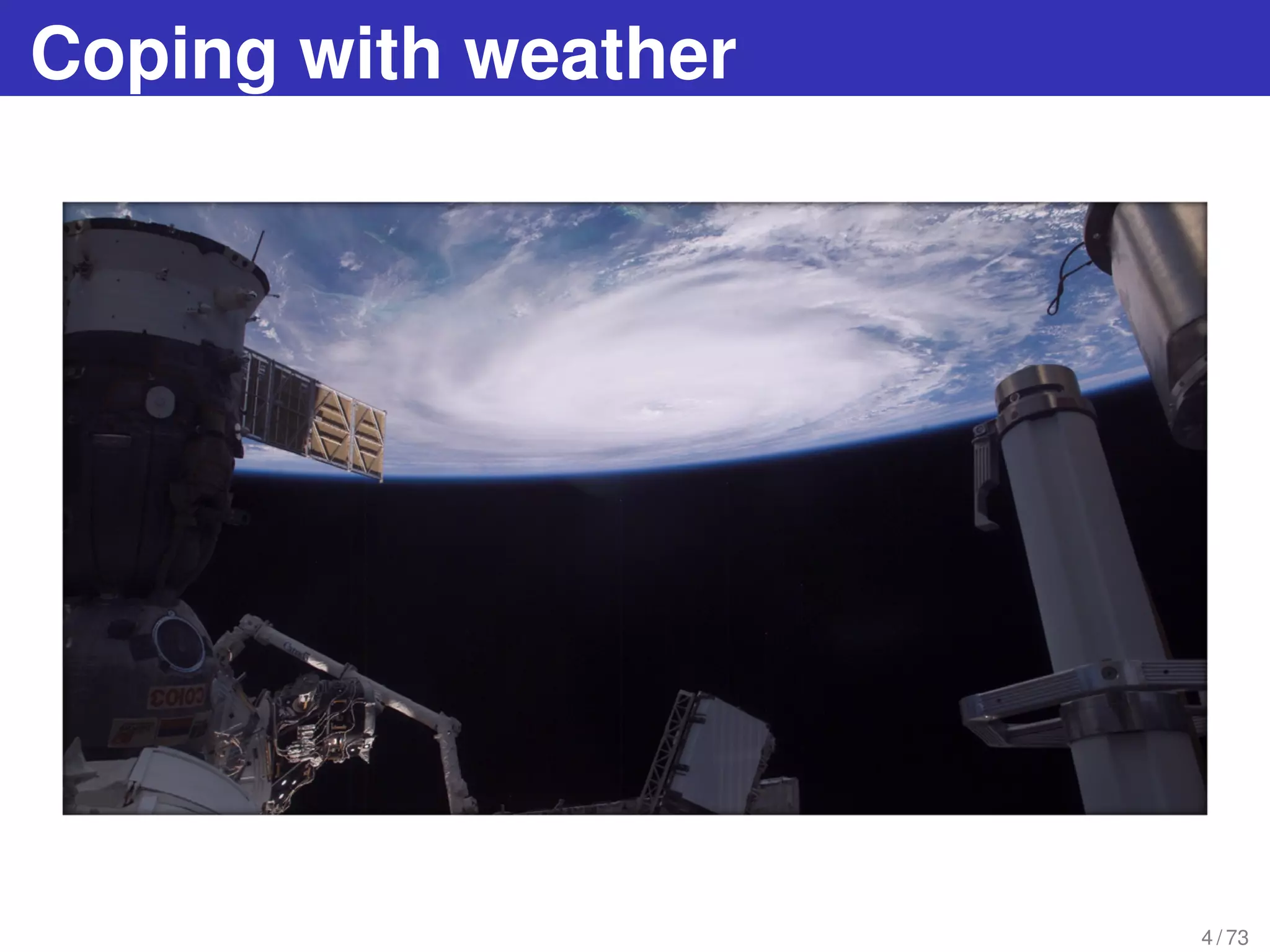
Coping with weather
4 / 73
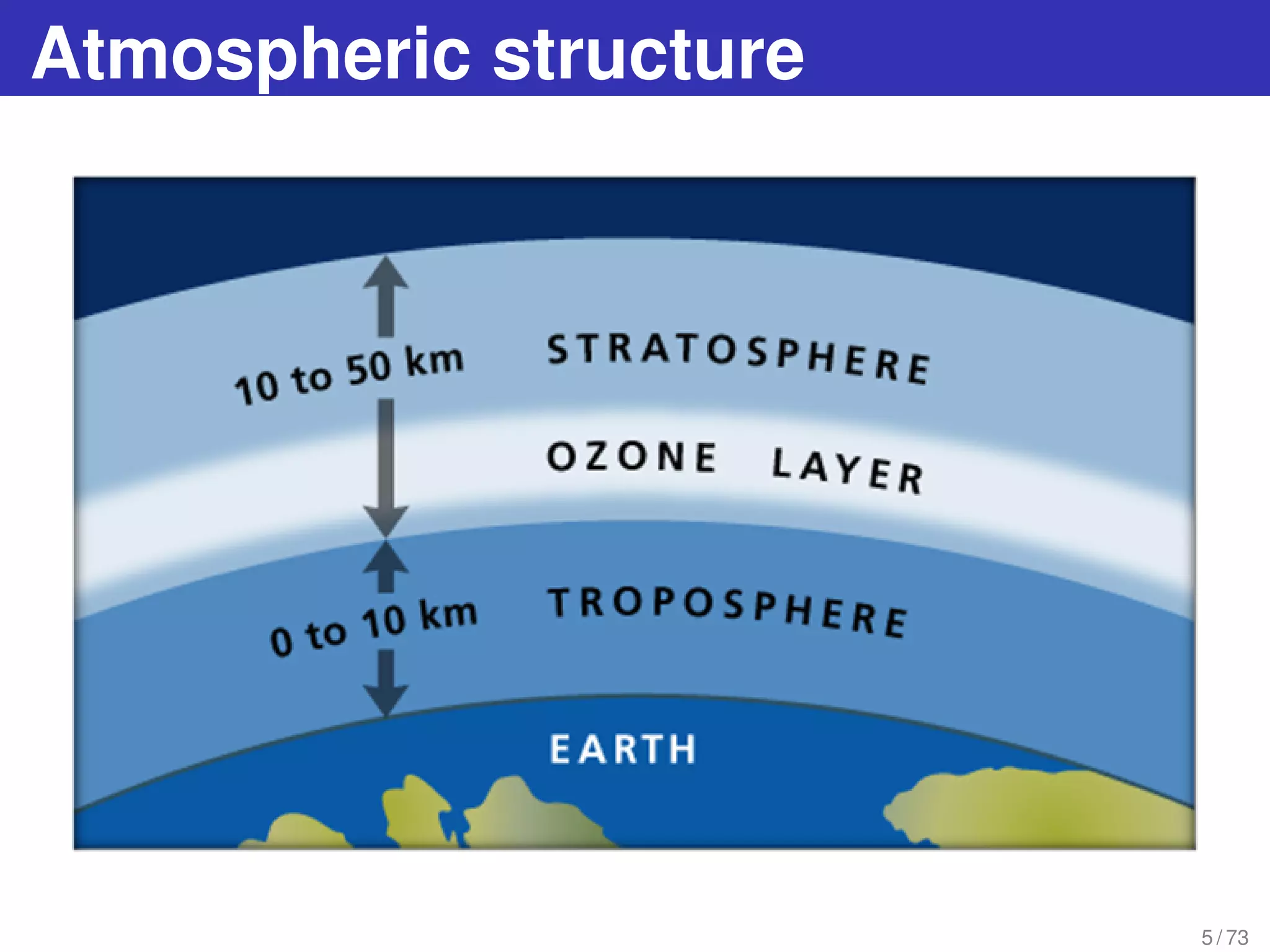
Atmospheric structure
5 / 73
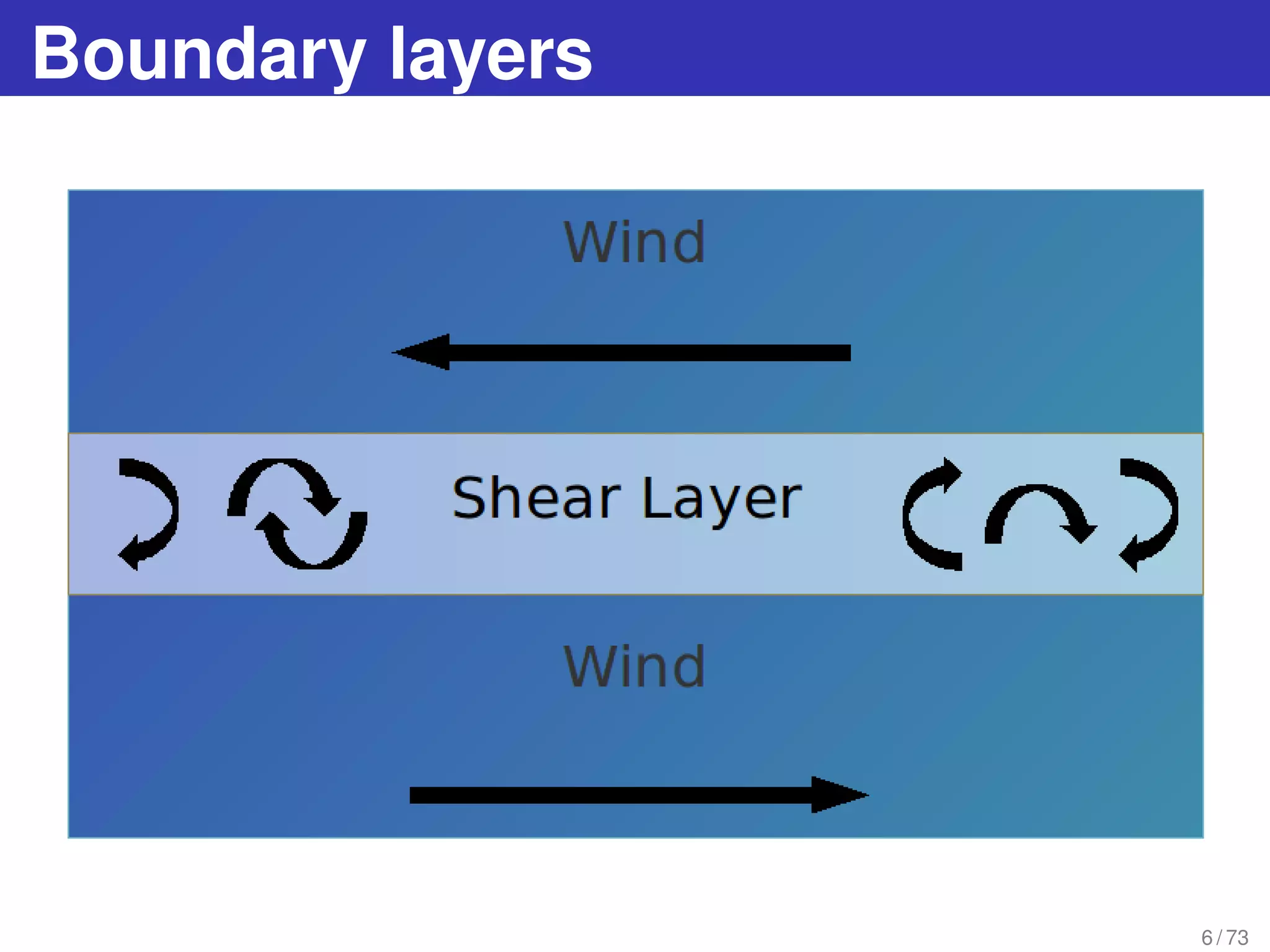
Boundary layers
6 / 73
Kelvin-Helmholtz instability –>
turbulence
7 / 73
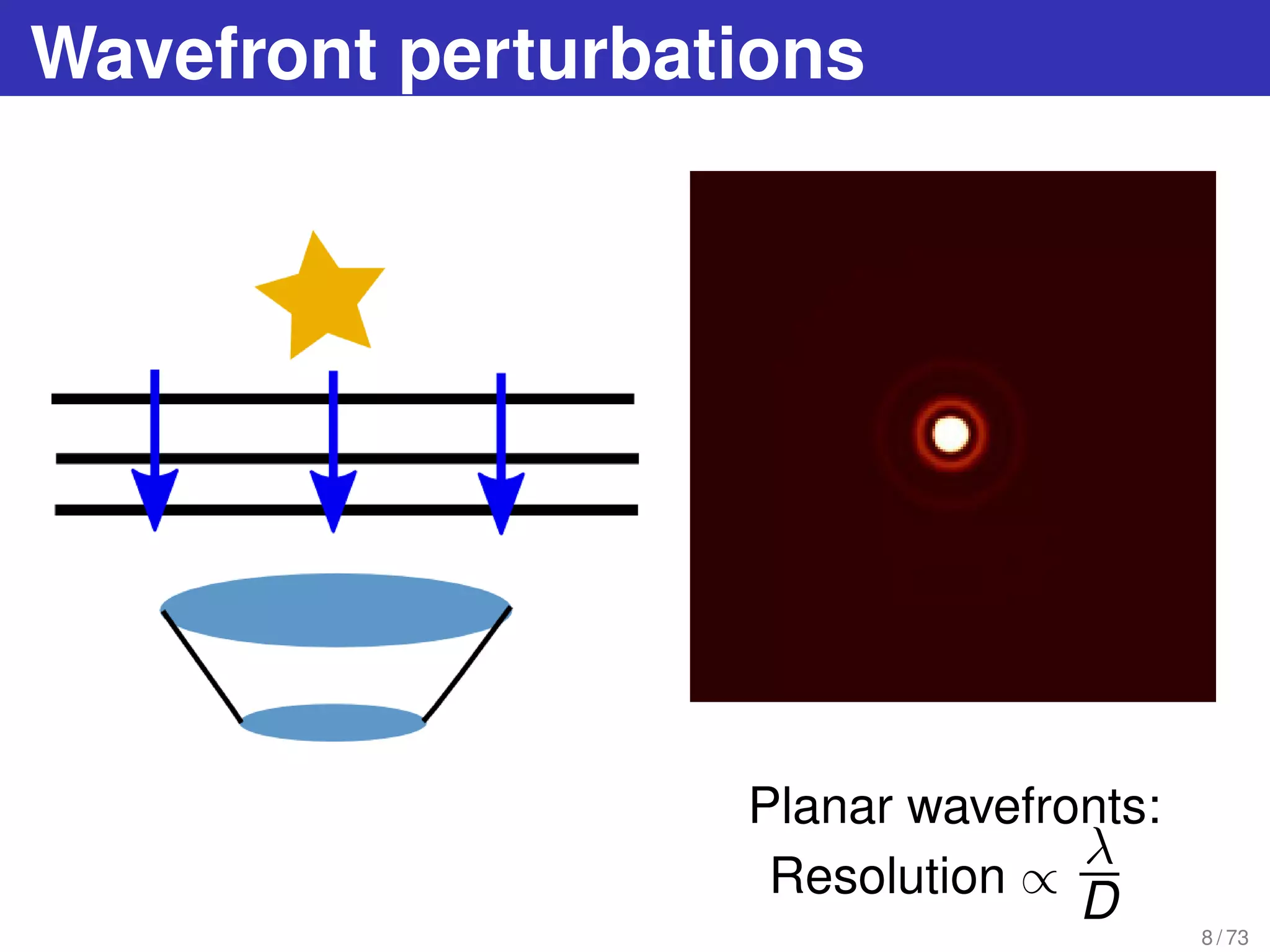
Wavefront perturbations
Planar wavefronts:
Resolution ∝
λ
D 8 / 73
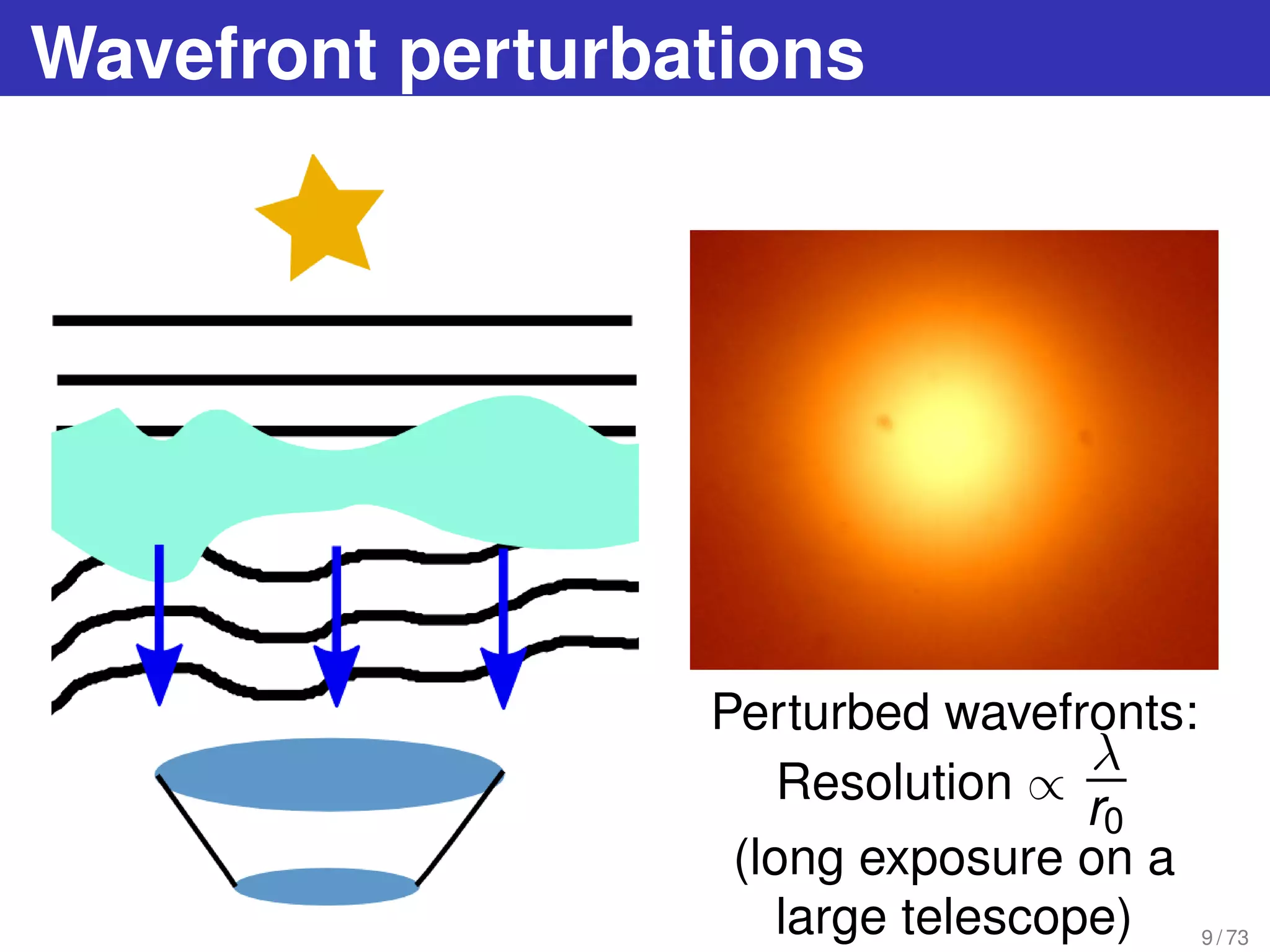
Wavefront perturbations
Perturbed wavefronts:
Resolution ∝
λ
r0
(long exposure on a
large telescope) 9 / 73
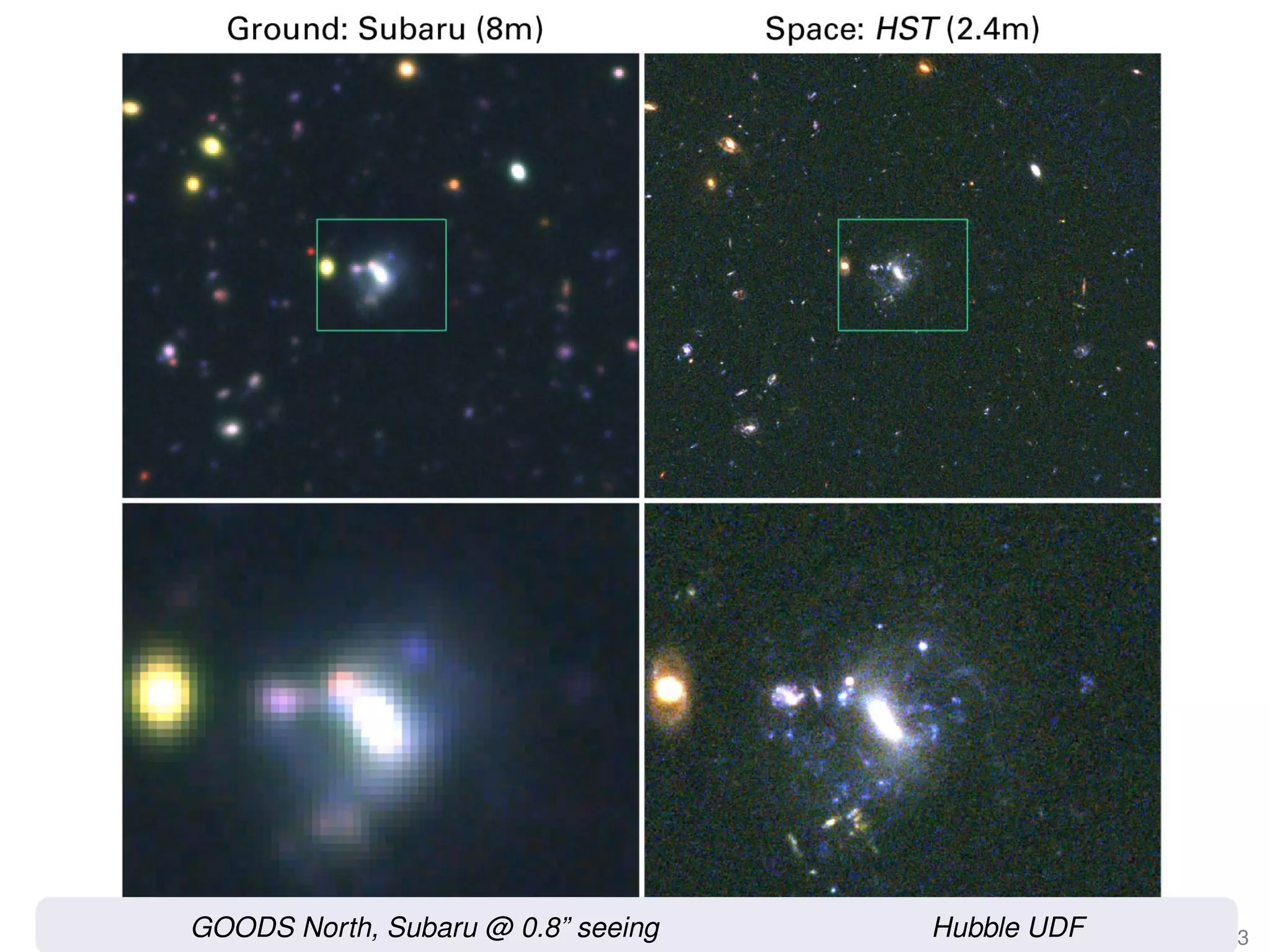
10 / 73GOODS North, Subaru @ 0.8” seeing Hubble UDF
Outline
1 Atmospheric effects
2 High spatial resolution astronomy
3 Adaptive optics
4 Lucky imaging
5 Lucky imaging + AO
11 / 73
Why bother?
12 / 73
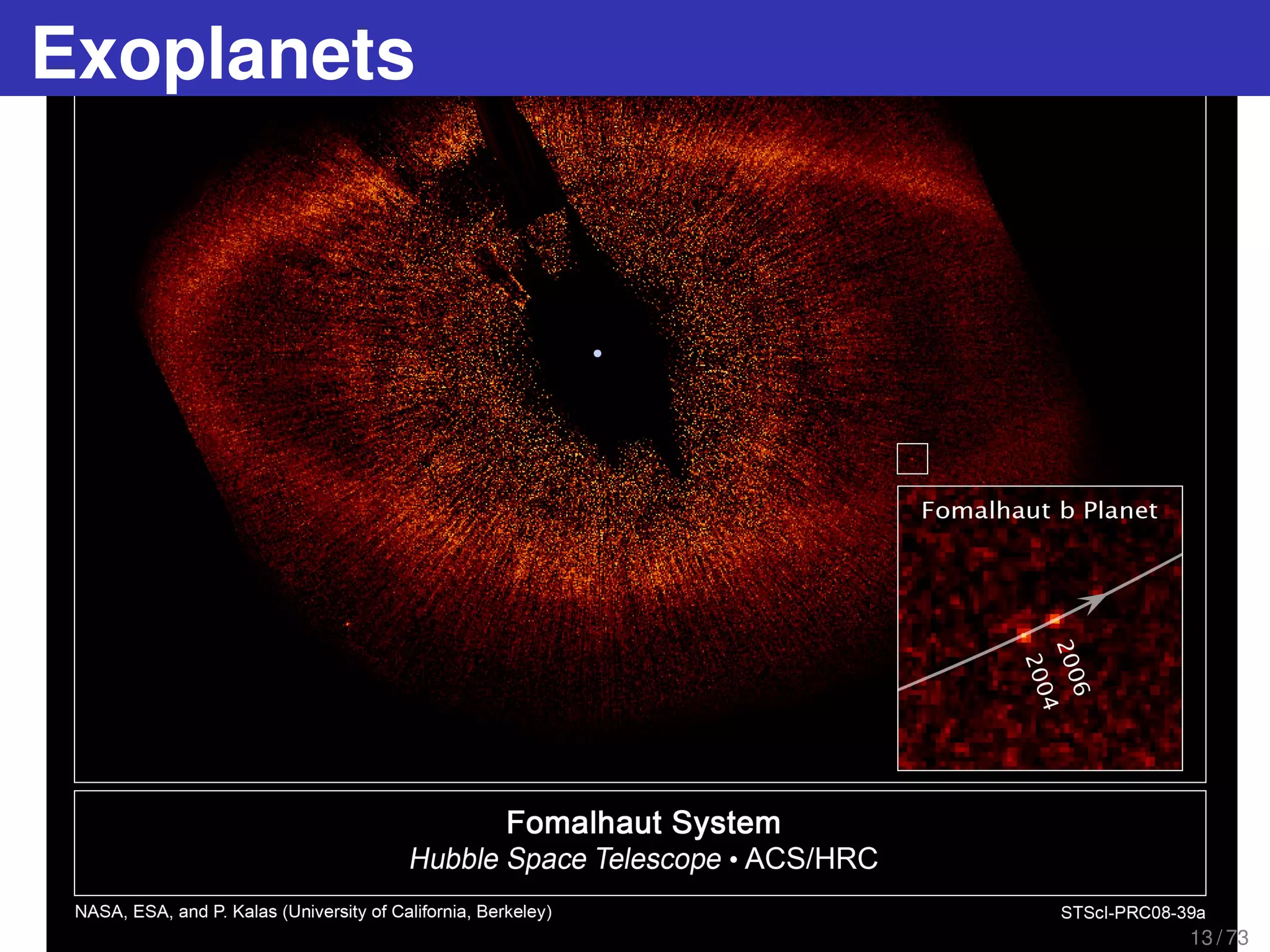
Exoplanets
13 / 73
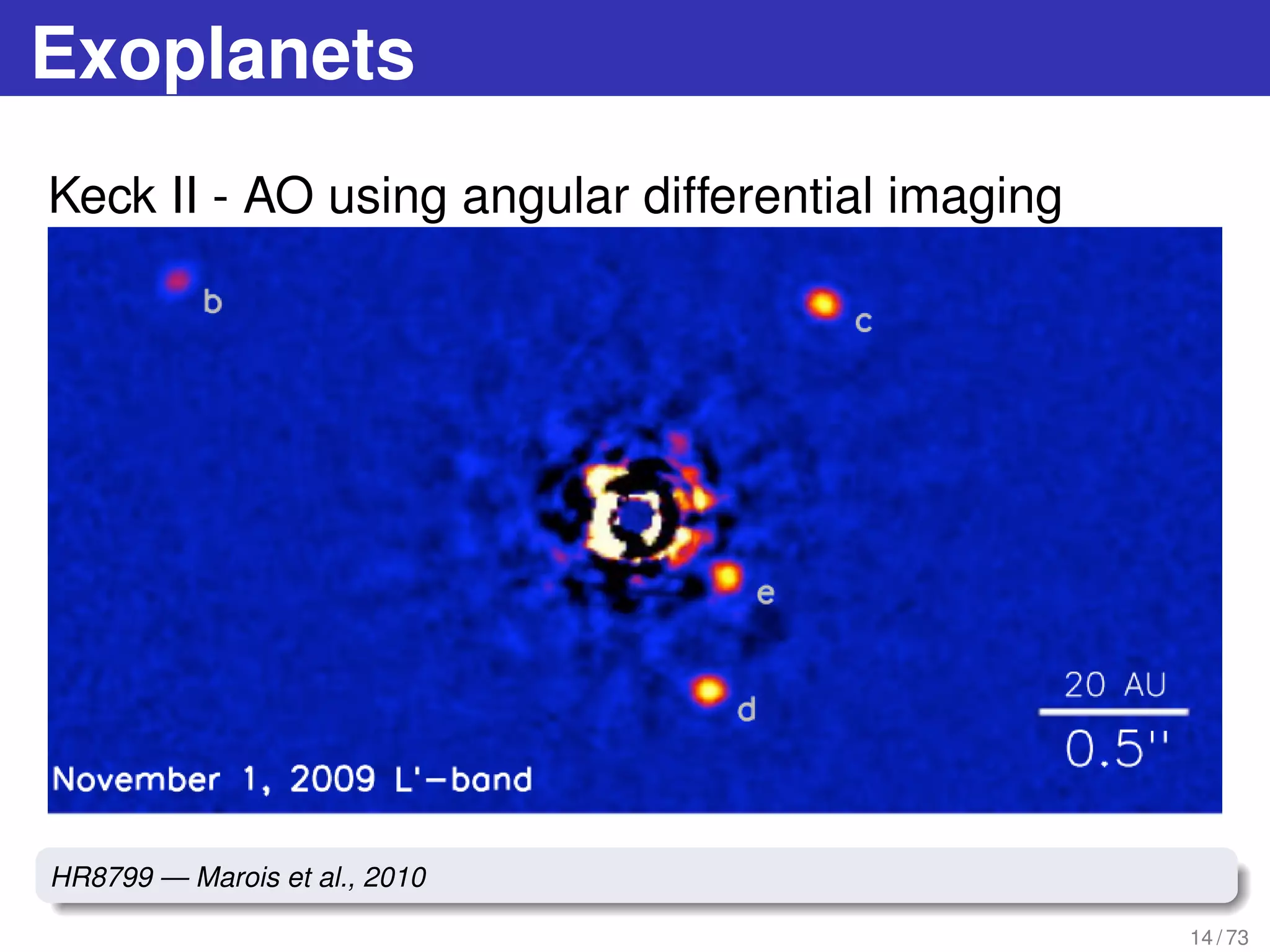
Exoplanets
Keck II - AO using angular differential imaging
14 / 73
HR8799 — Marois et al., 2010
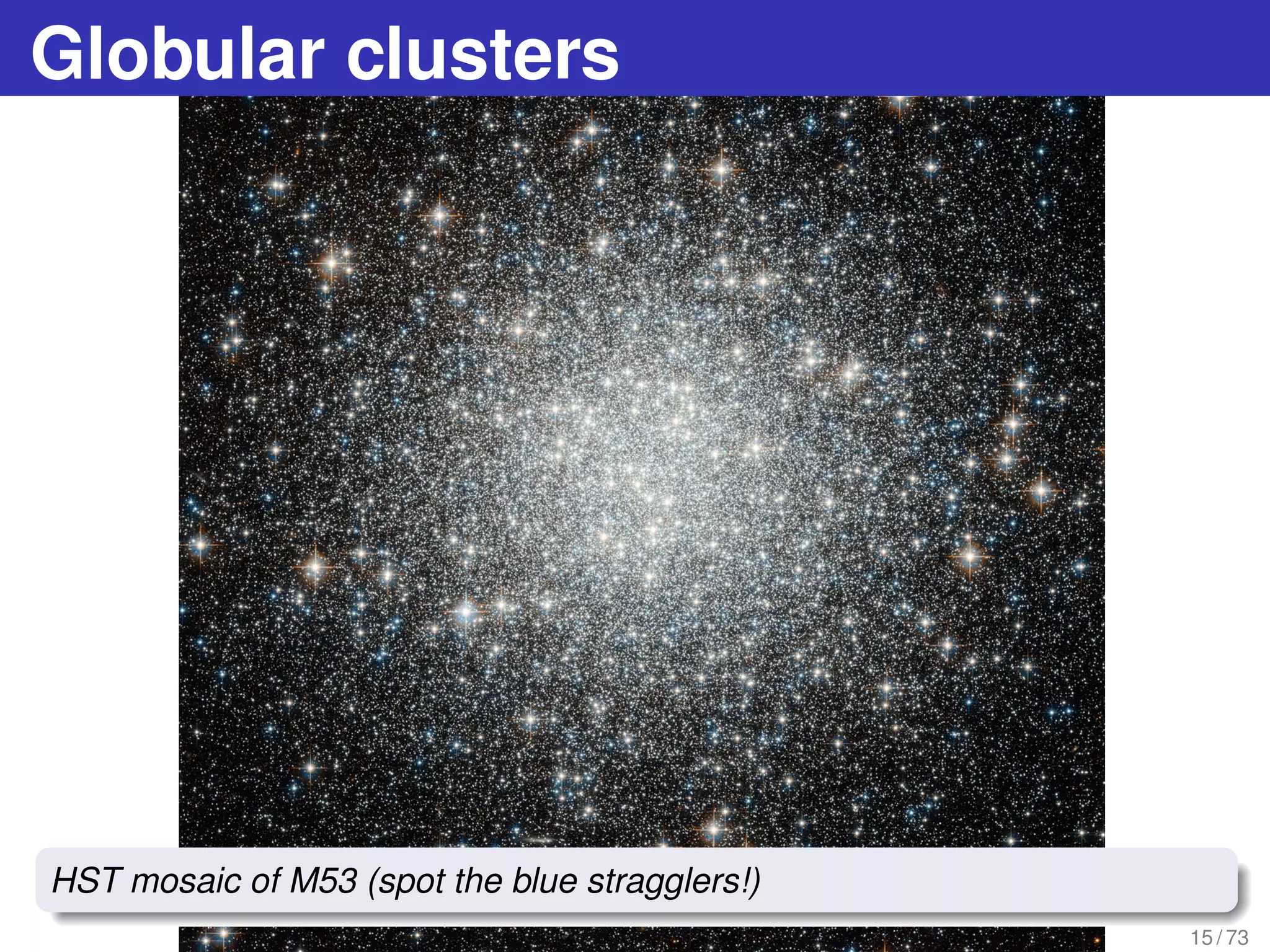
Globular clusters
15 / 73
HST mosaic of M53 (spot the blue stragglers!)
16 / 73
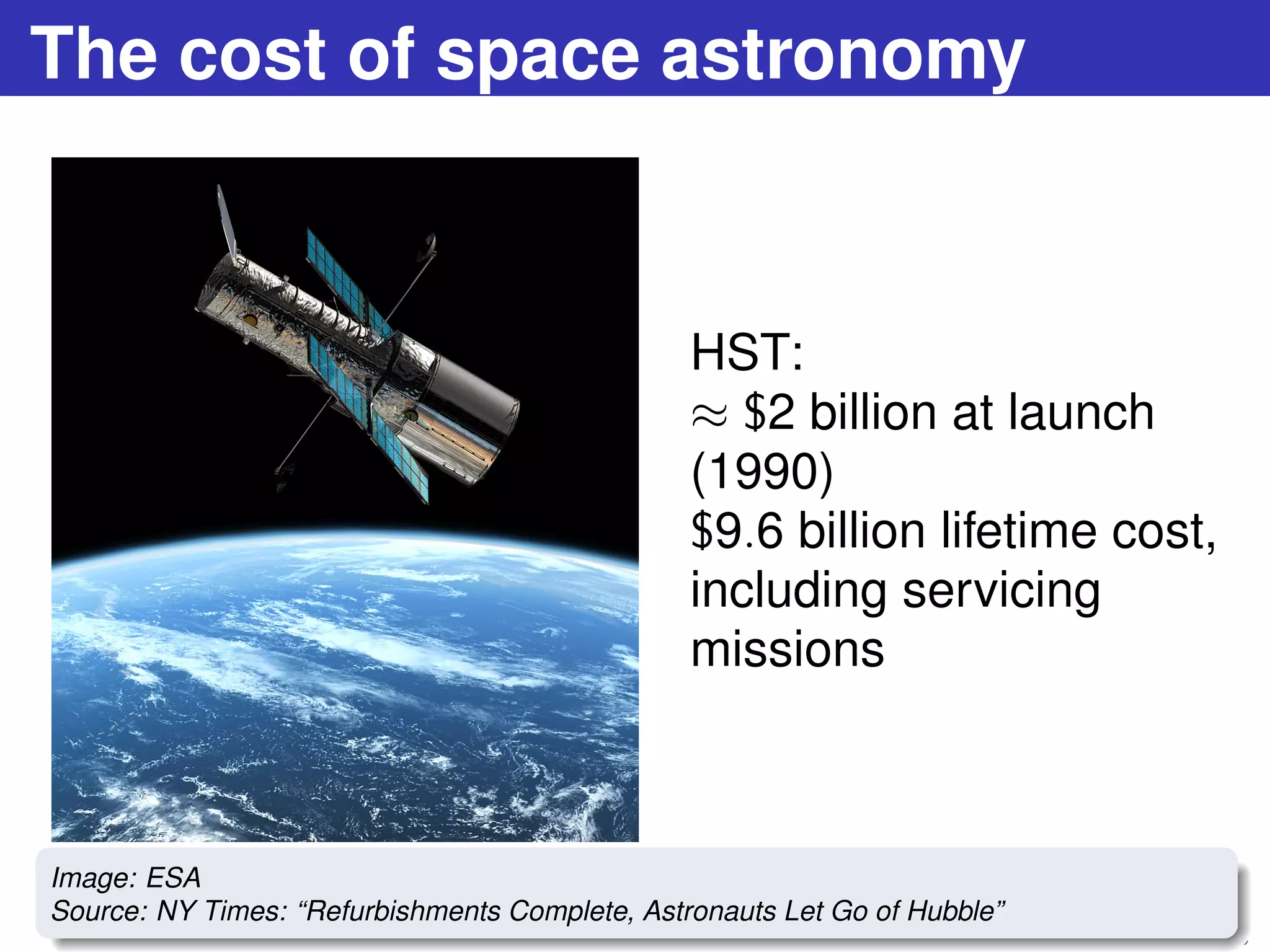
The cost of space astronomy
HST:
≈ $2 billion at launch
(1990)
$9.6 billion lifetime cost,
including servicing
missions
17 / 73
Image: ESA
Source: NY Times: “Refurbishments Complete, Astronauts Let Go of Hubble”
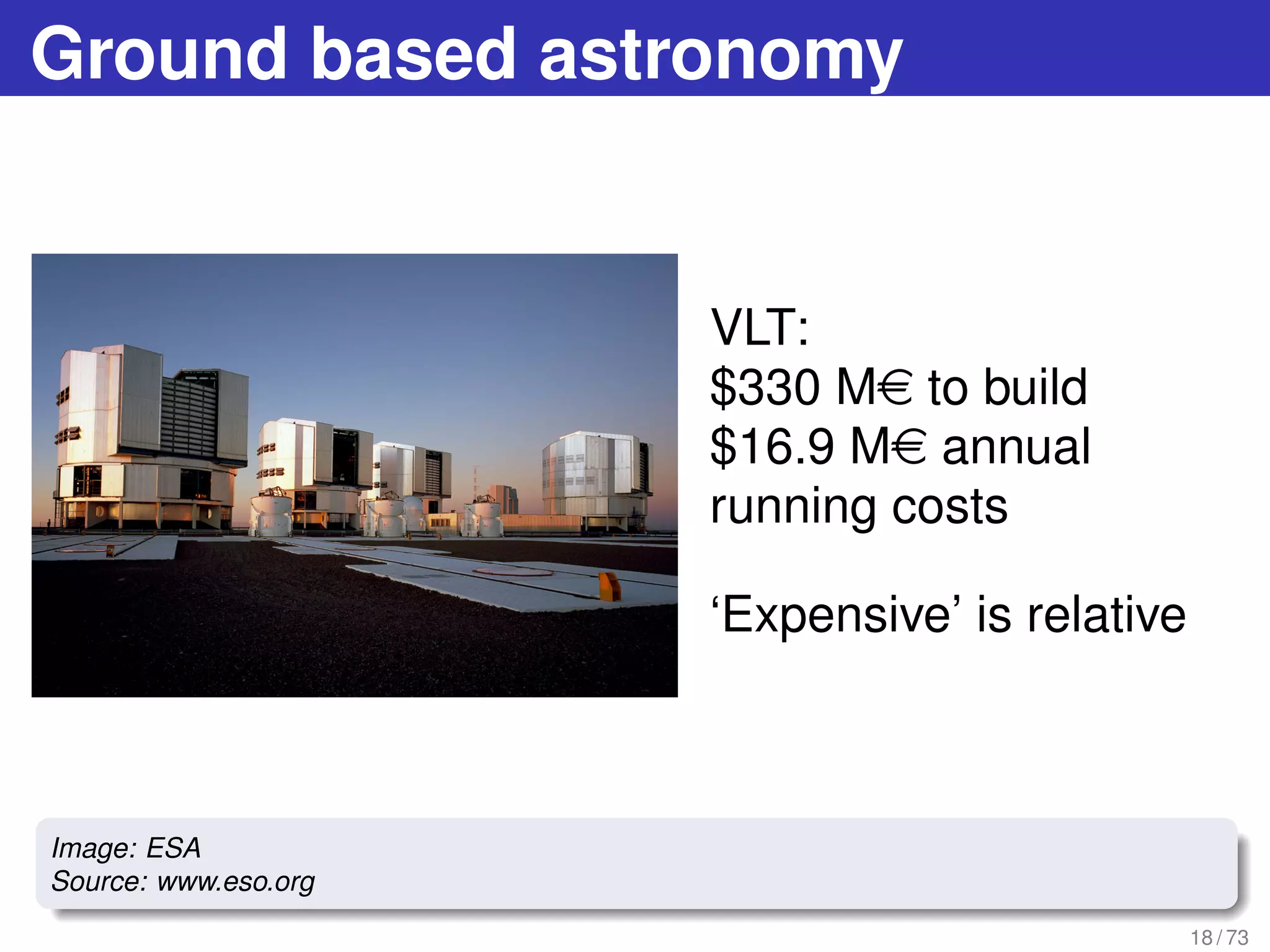
Ground based astronomy
VLT:
$330 Me to build
$16.9 Me annual
running costs
‘Expensive’ is relative
18 / 73
Image: ESA
Source: www.eso.org
Outline
1 Atmospheric effects
2 High spatial resolution astronomy
3 Adaptive optics
4 Lucky imaging
5 Lucky imaging + AO
19 / 73
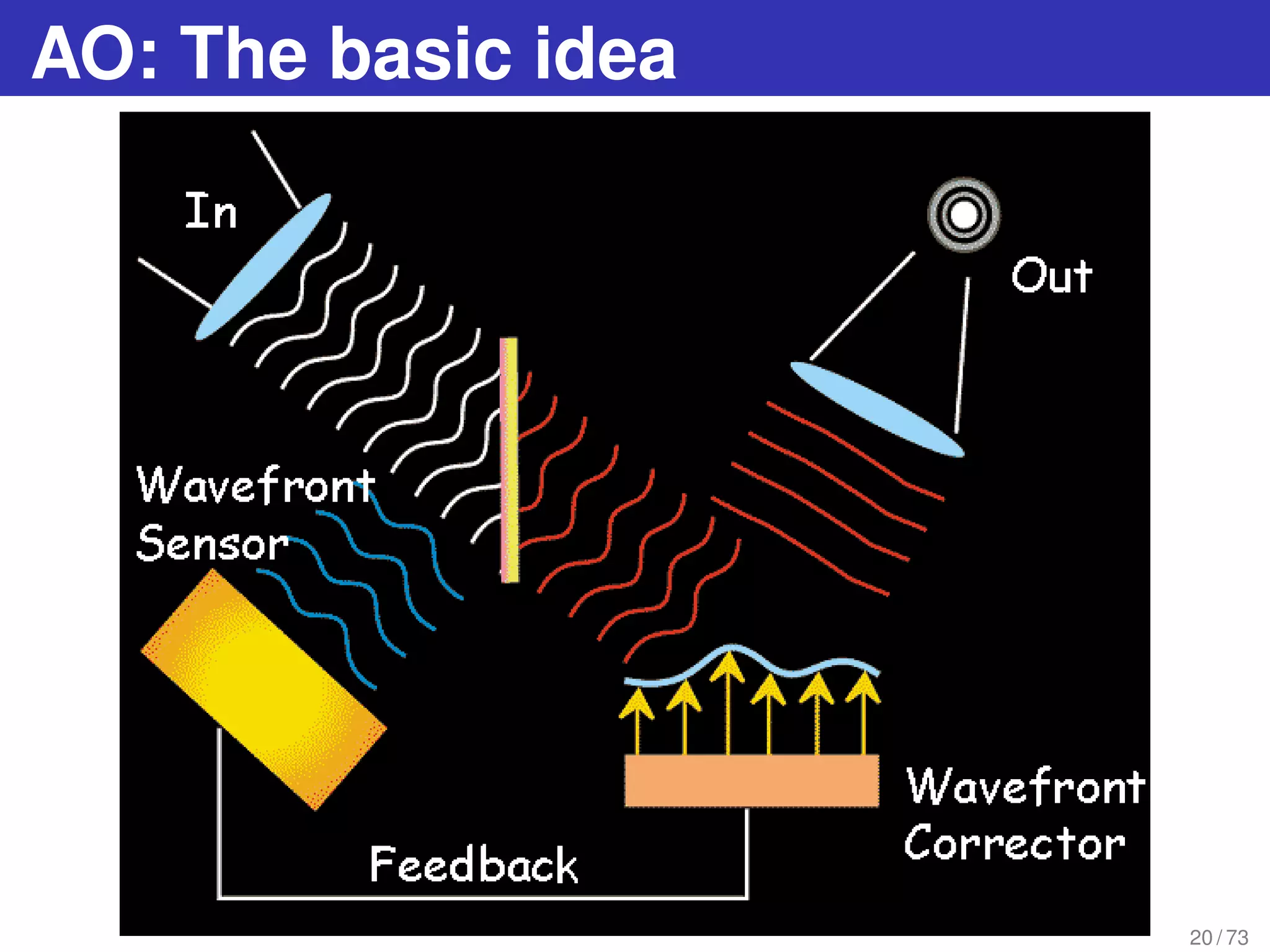
AO: The basic idea
20 / 73
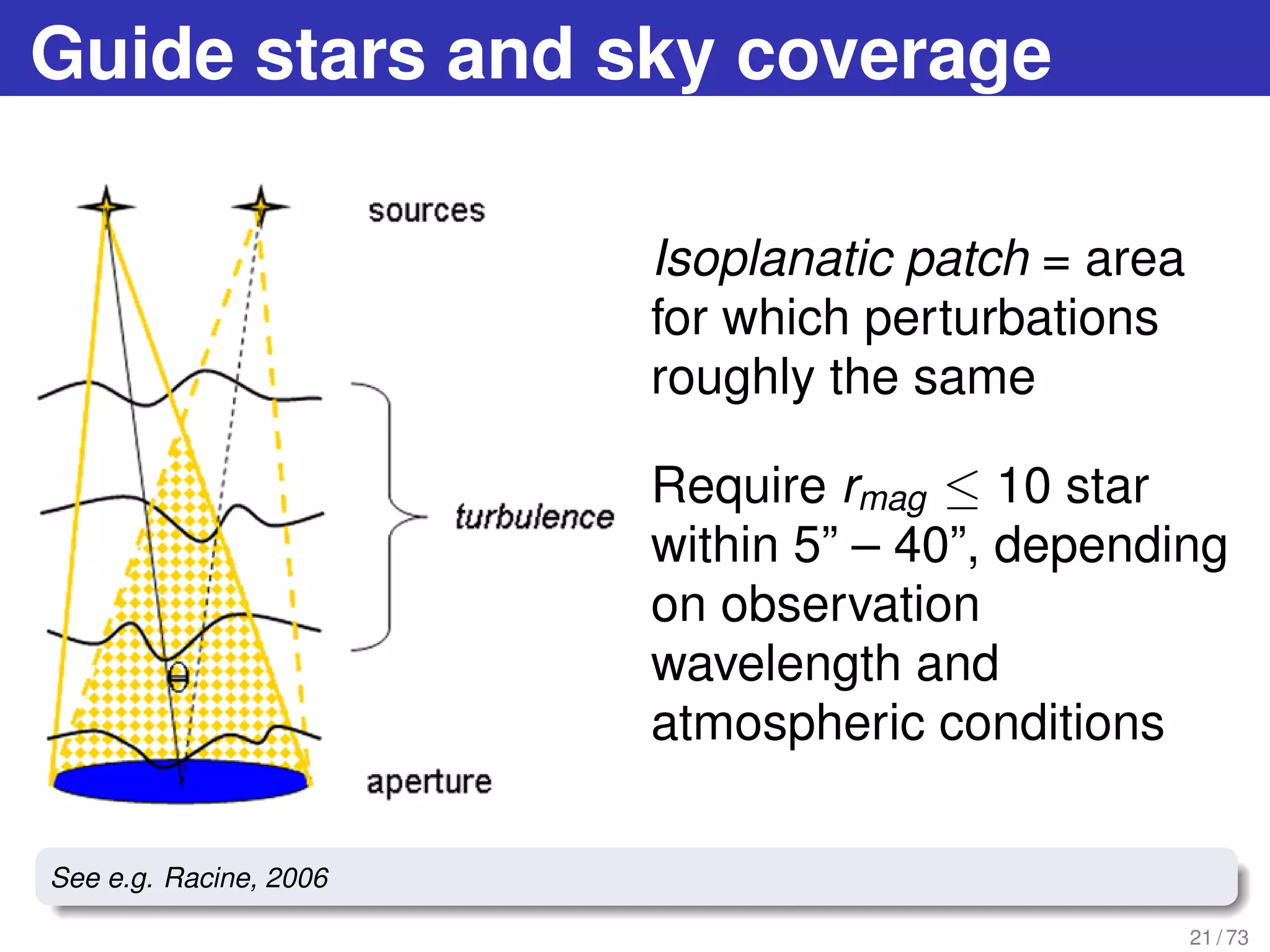
Guide stars and sky coverage
Isoplanatic patch = area
for which perturbations
roughly the same
Require rmag ≤ 10 star
within 5” – 40”, depending
on observation
wavelength and
atmospheric conditions
21 / 73
See e.g. Racine, 2006
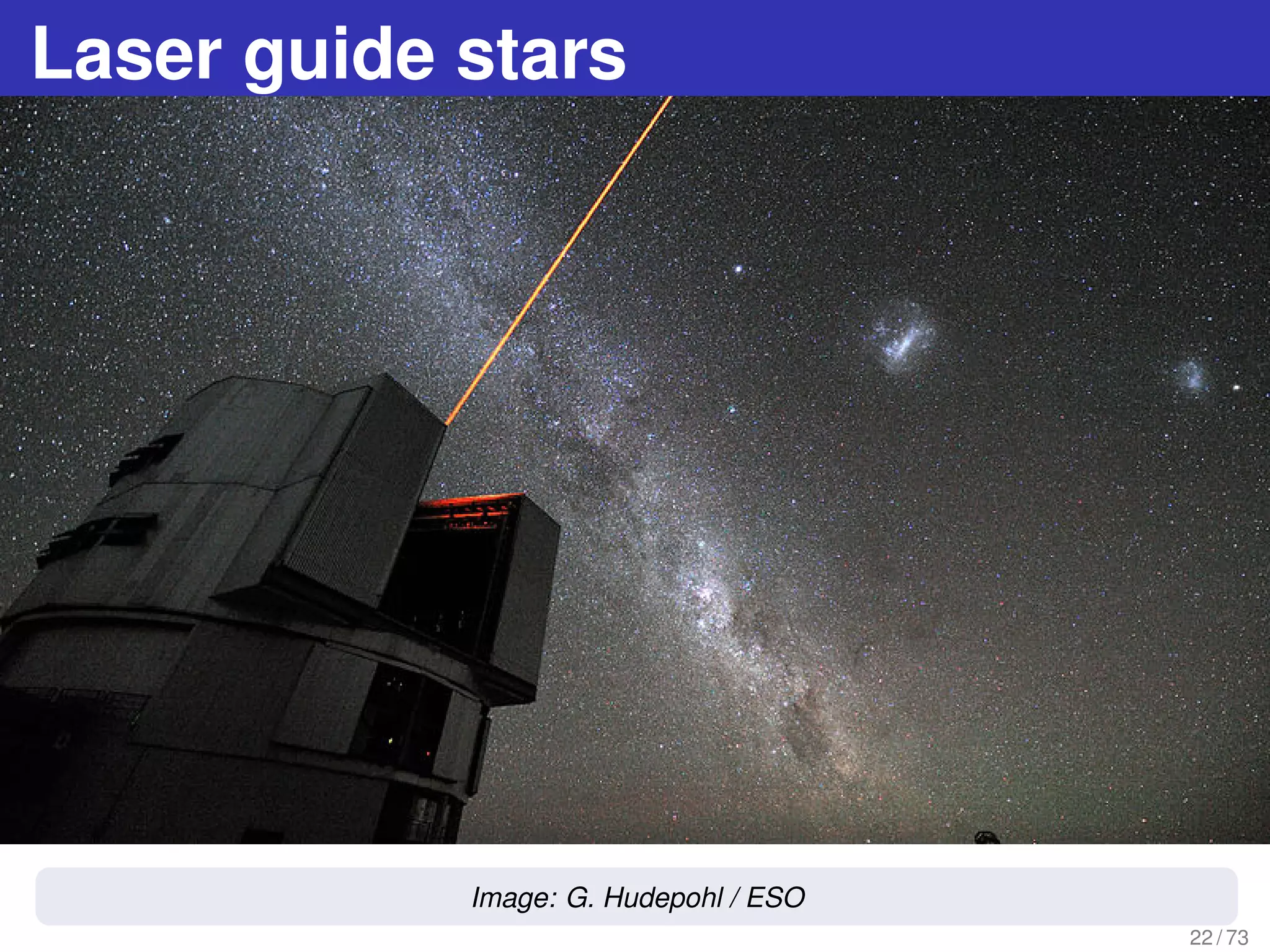
Laser guide stars
22 / 73
Image: G. Hudepohl / ESO
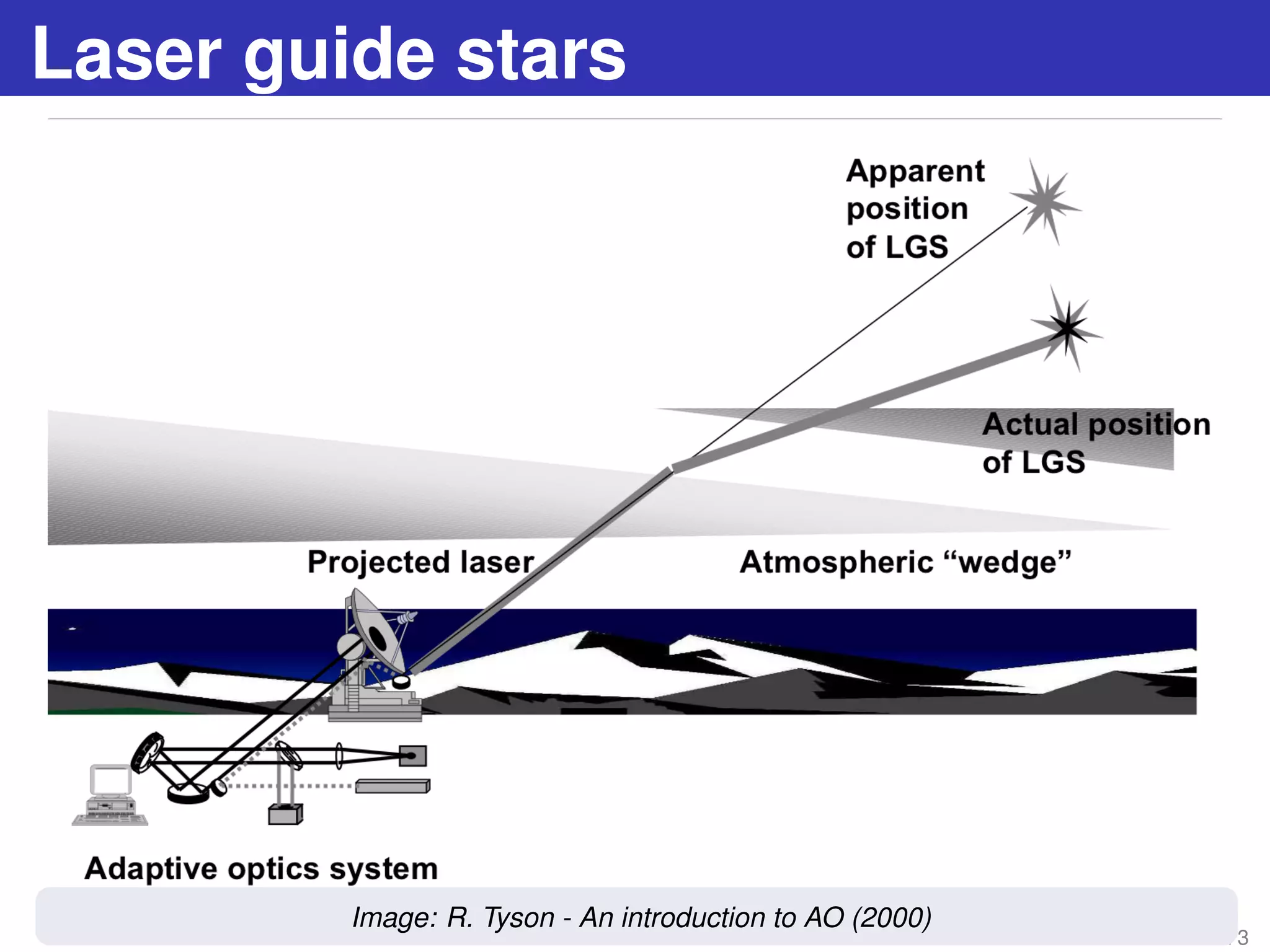
Laser guide stars
23 / 73
Image: R. Tyson - An introduction to AO (2000)
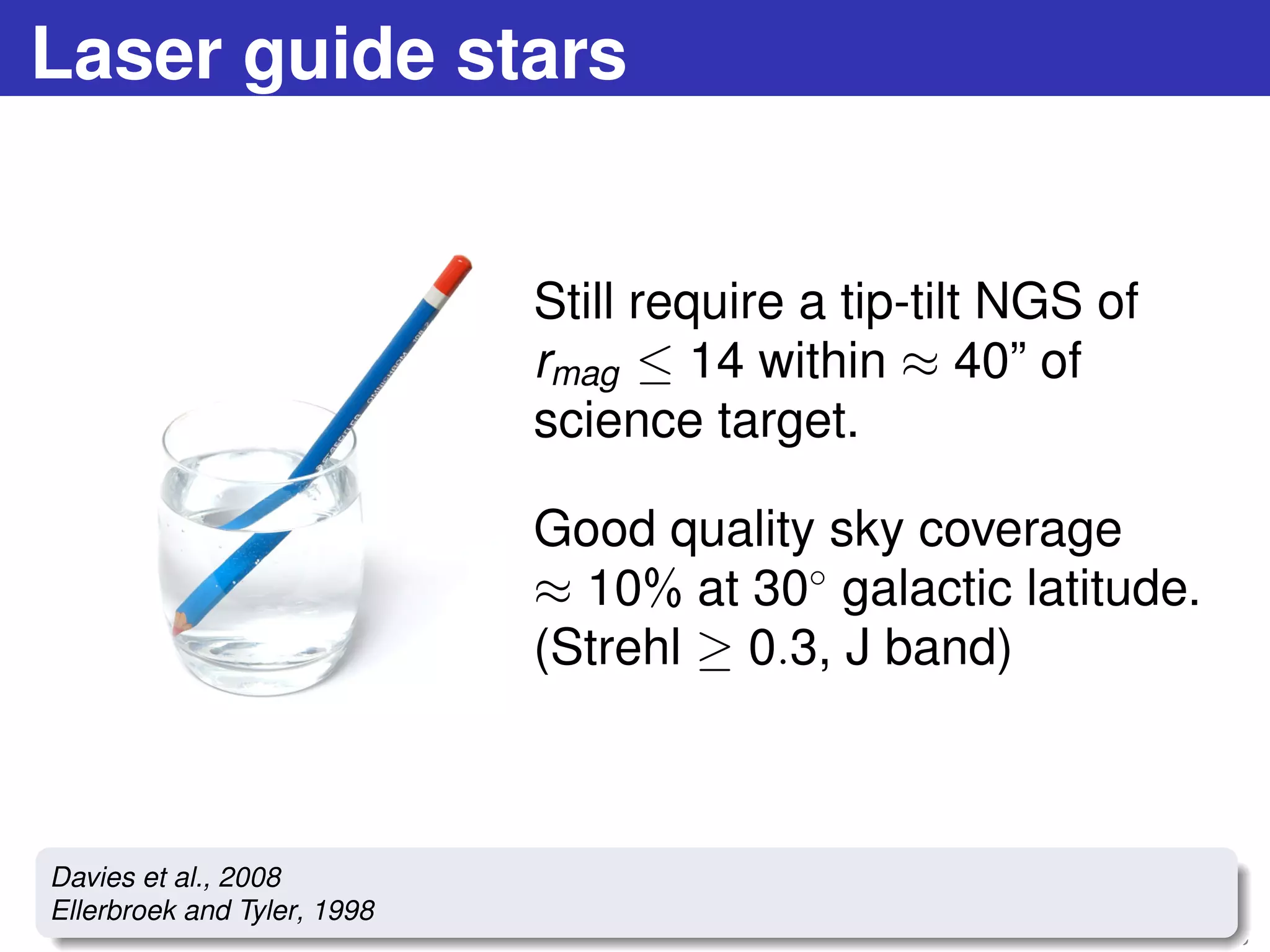
Laser guide stars
Still require a tip-tilt NGS of
rmag ≤ 14 within ≈ 40” of
science target.
Good quality sky coverage
≈ 10% at 30◦
galactic latitude.
(Strehl ≥ 0.3, J band)
24 / 73
Davies et al., 2008
Ellerbroek and Tyler, 1998
(Strehl?)
The ratio of peak intensity compared to a perfect
telescope (0 to 1)
HST Strehl near 1, but suffers pixellation effects.
AO Strehl usually varies from around 0.2 – 0.6
Seeing “Strehl” depends on the telescope, but is
typically ≈ 0.01 on medium size telescopes in
the visible.
25 / 73
Outline
1 Atmospheric effects
2 High spatial resolution astronomy
3 Adaptive optics
4 Lucky imaging
5 Lucky imaging + AO
26 / 73
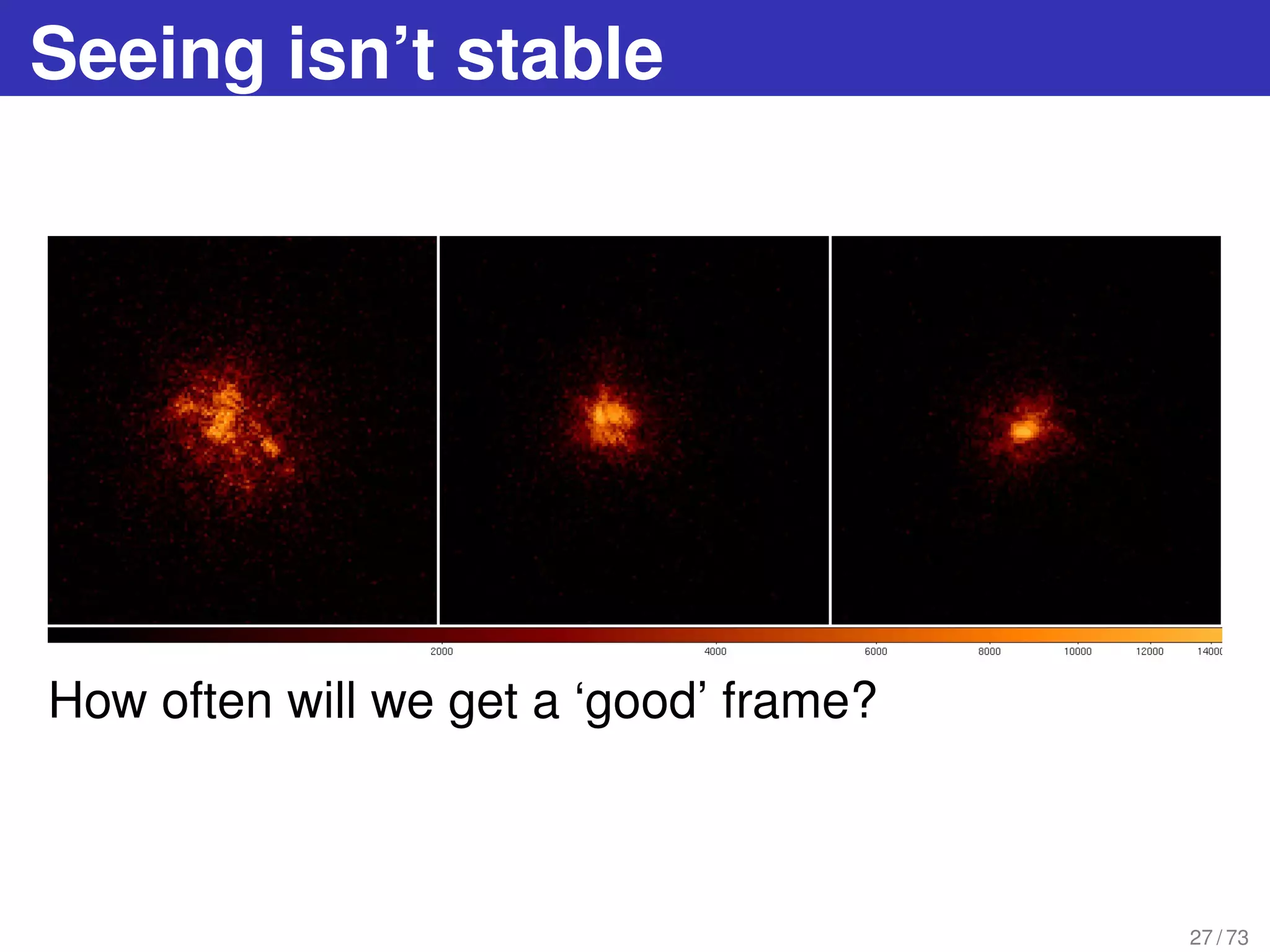
Seeing isn’t stable
How often will we get a ‘good’ frame?
27 / 73
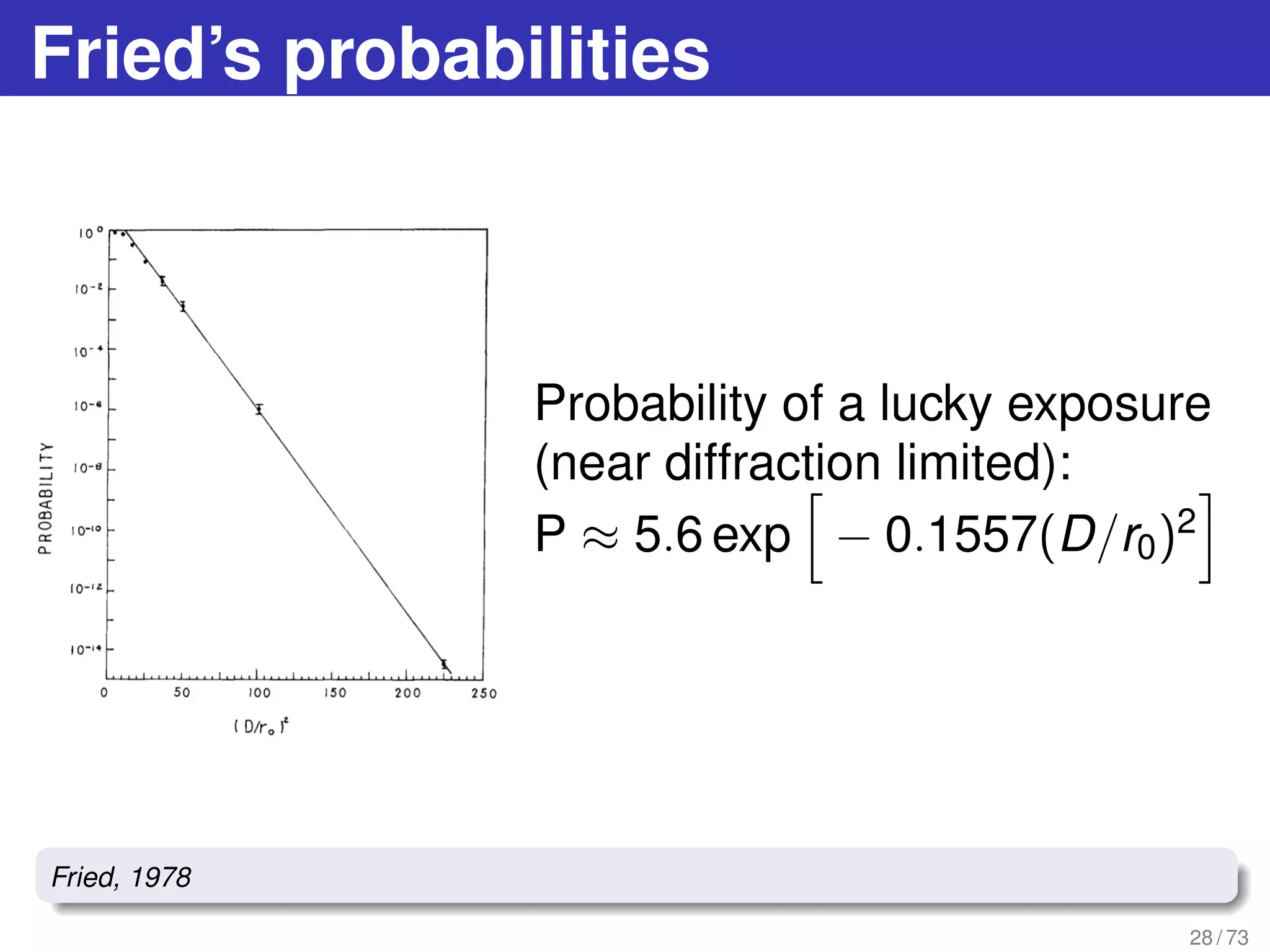
Fried’s probabilities
Probability of a lucky exposure
(near diffraction limited):
P ≈ 5.6 exp − 0.1557(D/r0)2
28 / 73
Fried, 1978
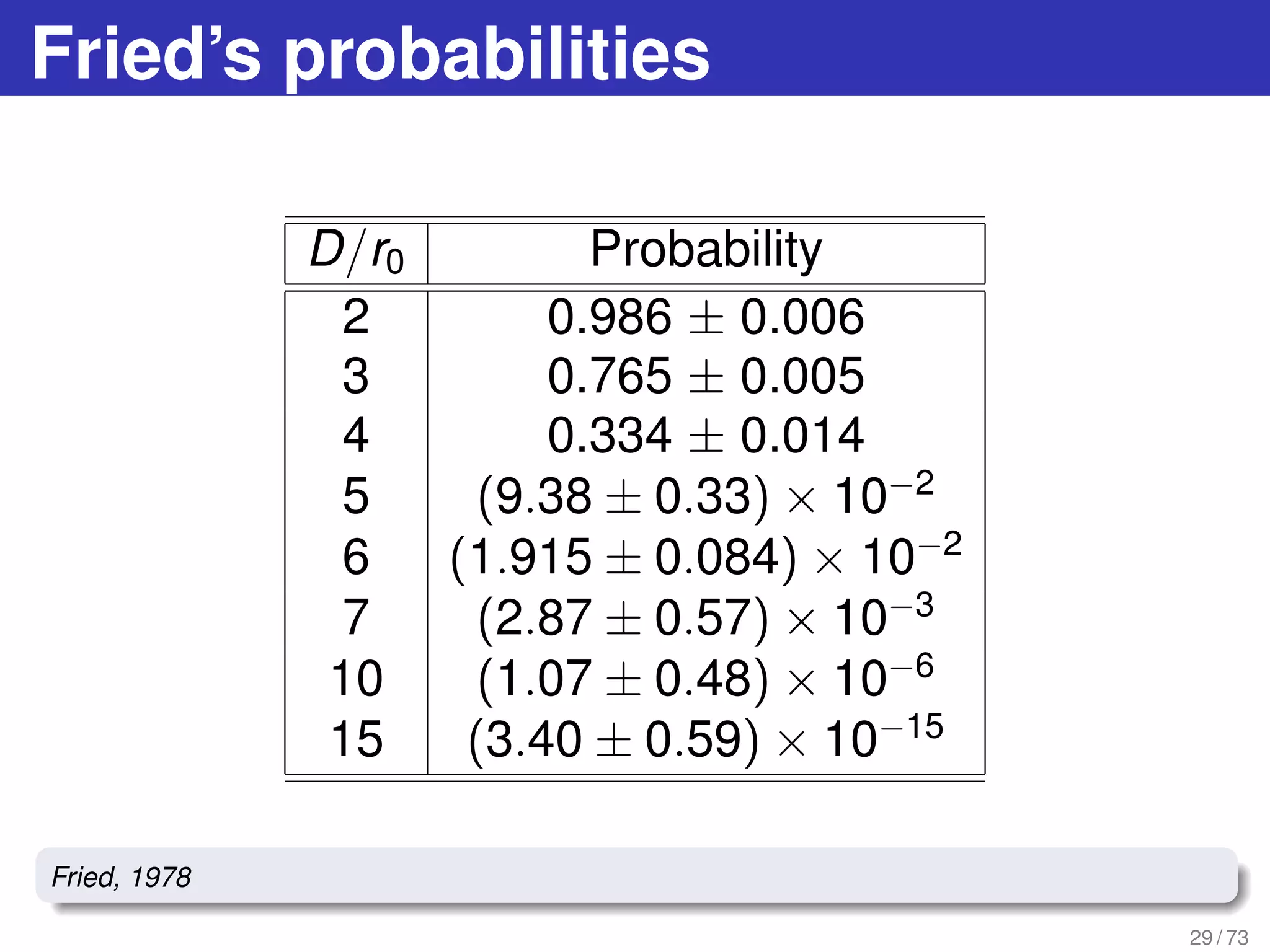
Fried’s probabilities
D/r0 Probability
2 0.986 ± 0.006
3 0.765 ± 0.005
4 0.334 ± 0.014
5 (9.38 ± 0.33) × 10−2
6 (1.915 ± 0.084) × 10−2
7 (2.87 ± 0.57) × 10−3
10 (1.07 ± 0.48) × 10−6
15 (3.40 ± 0.59) × 10−15
29 / 73
Fried, 1978
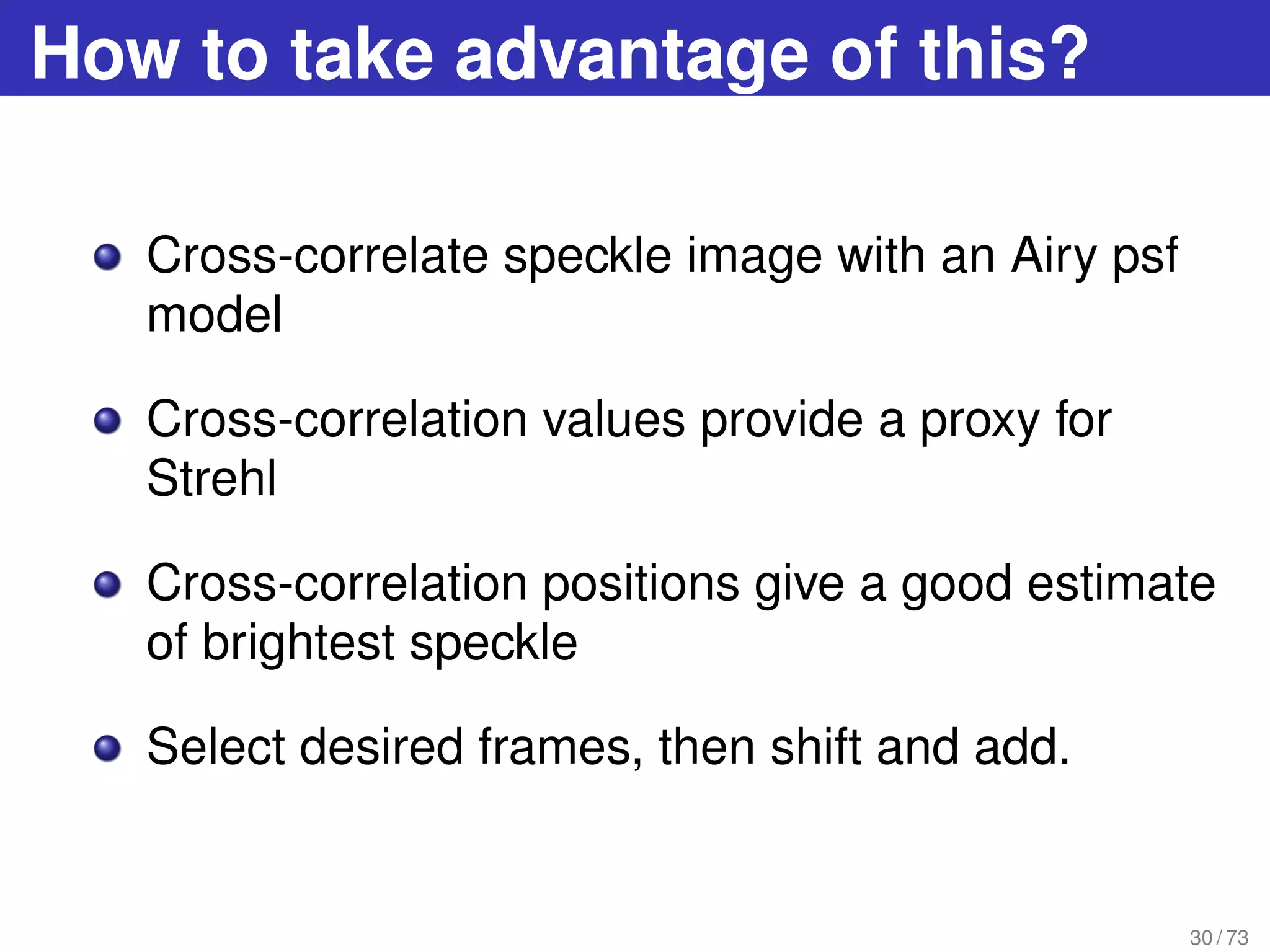
How to take advantage of this?
Cross-correlate speckle image with an Airy psf
model
Cross-correlation values provide a proxy for
Strehl
Cross-correlation positions give a good estimate
of brightest speckle
Select desired frames, then shift and add.
30 / 73
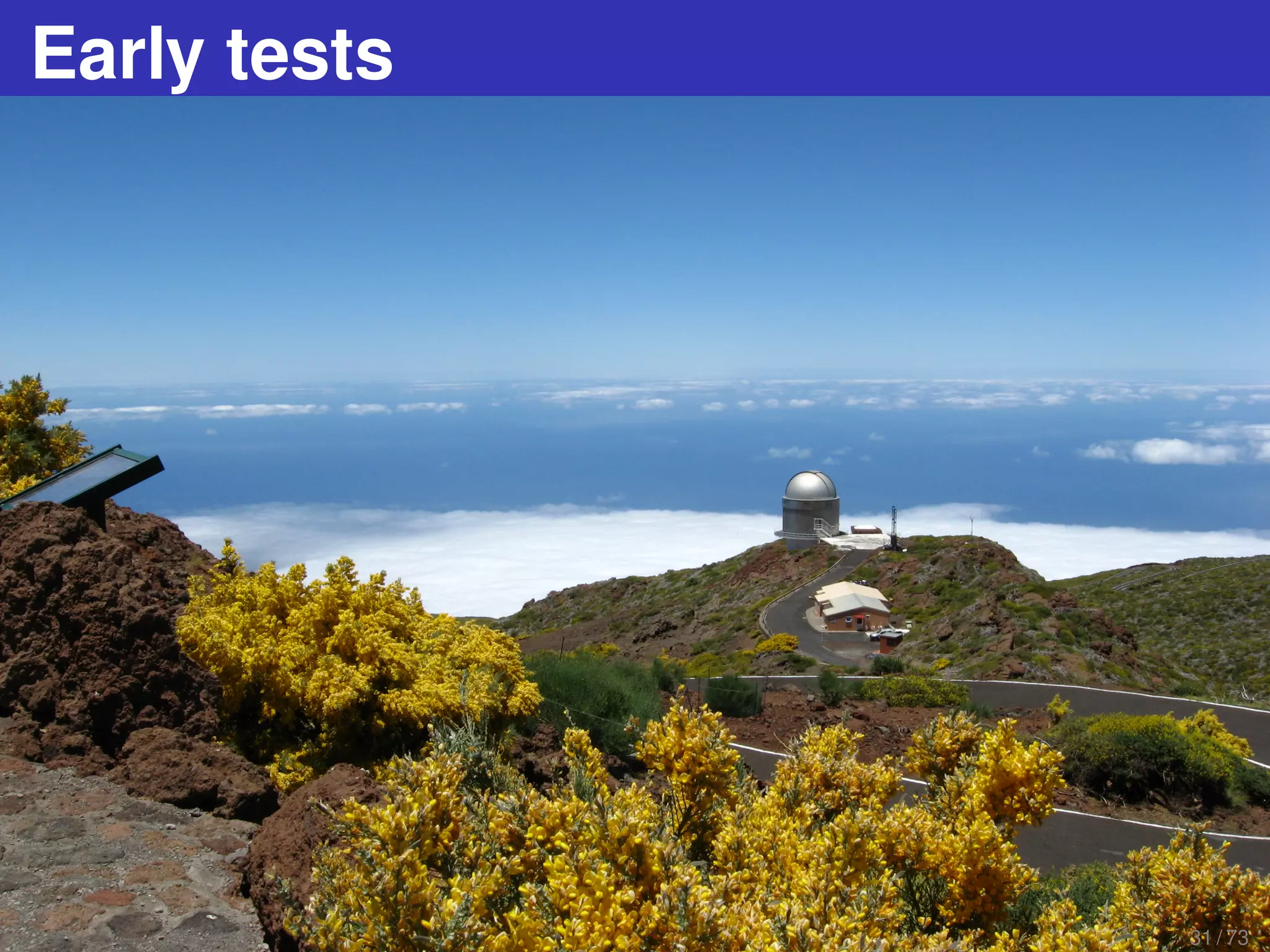
Early tests
31 / 73
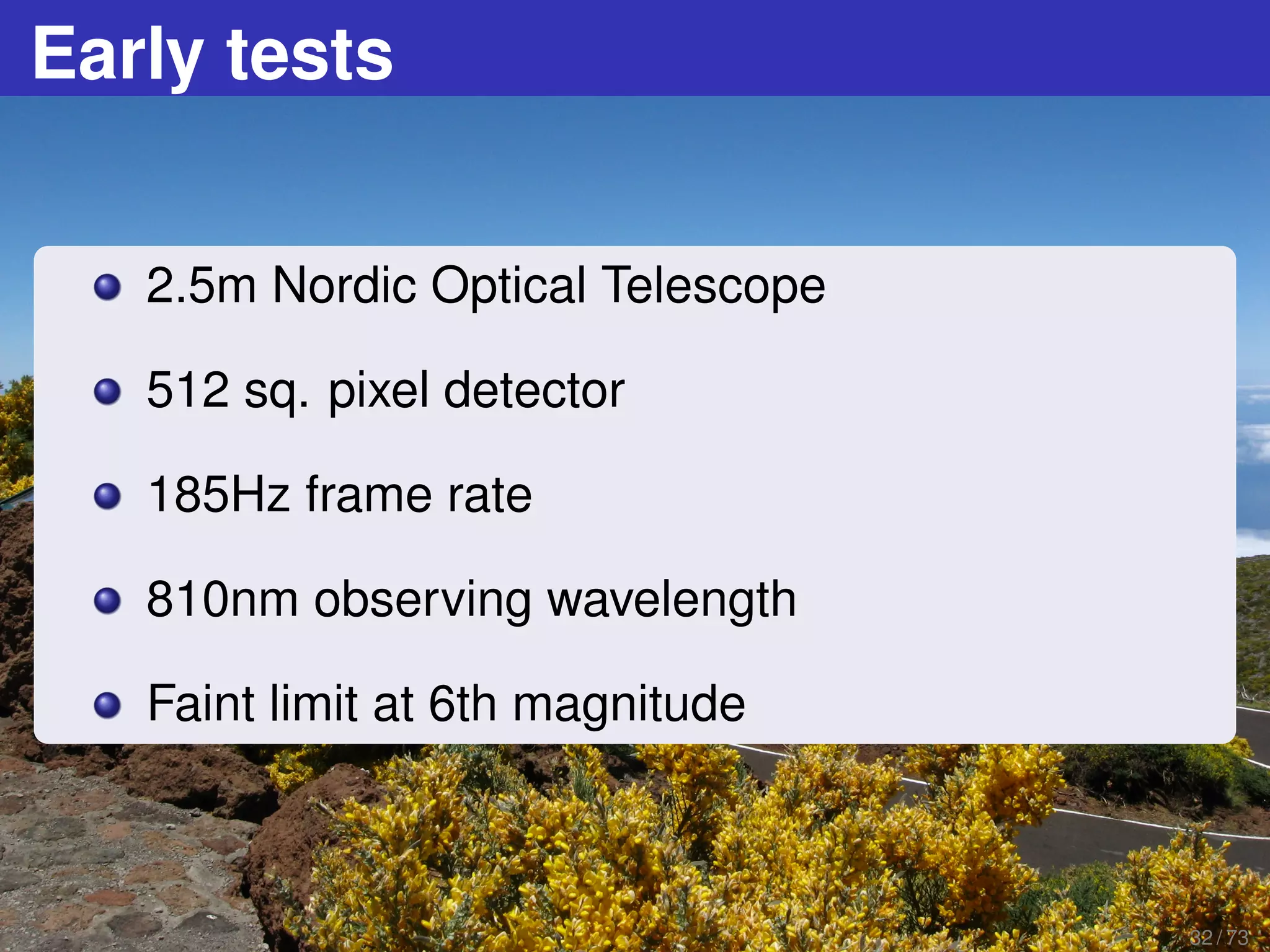
Early tests
2.5m Nordic Optical Telescope
512 sq. pixel detector
185Hz frame rate
810nm observing wavelength
Faint limit at 6th magnitude
32 / 73
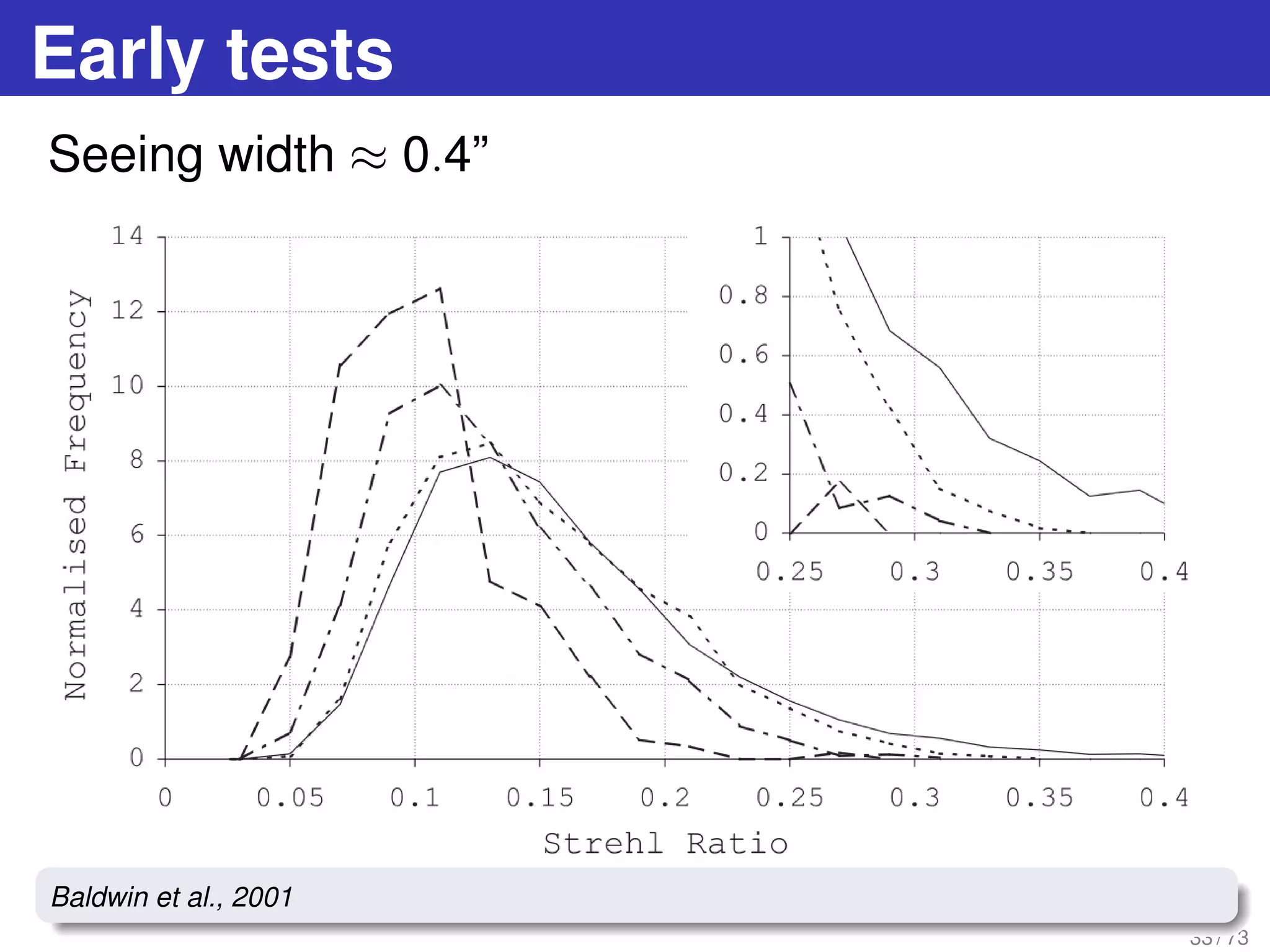
Early tests
Seeing width ≈ 0.4”
33 / 73
Baldwin et al., 2001
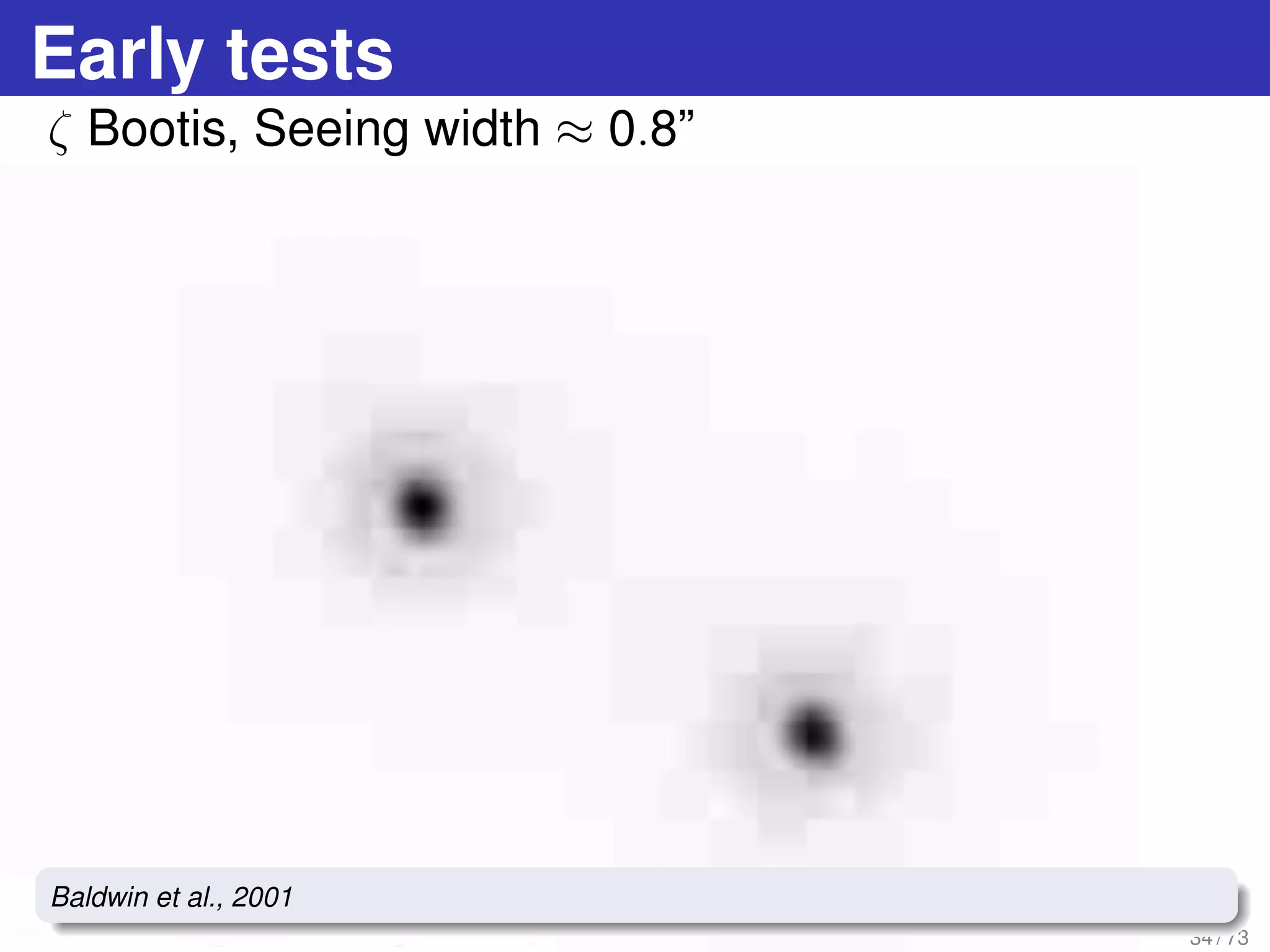
Early tests
ζ Bootis, Seeing width ≈ 0.8”
34 / 73
Baldwin et al., 2001
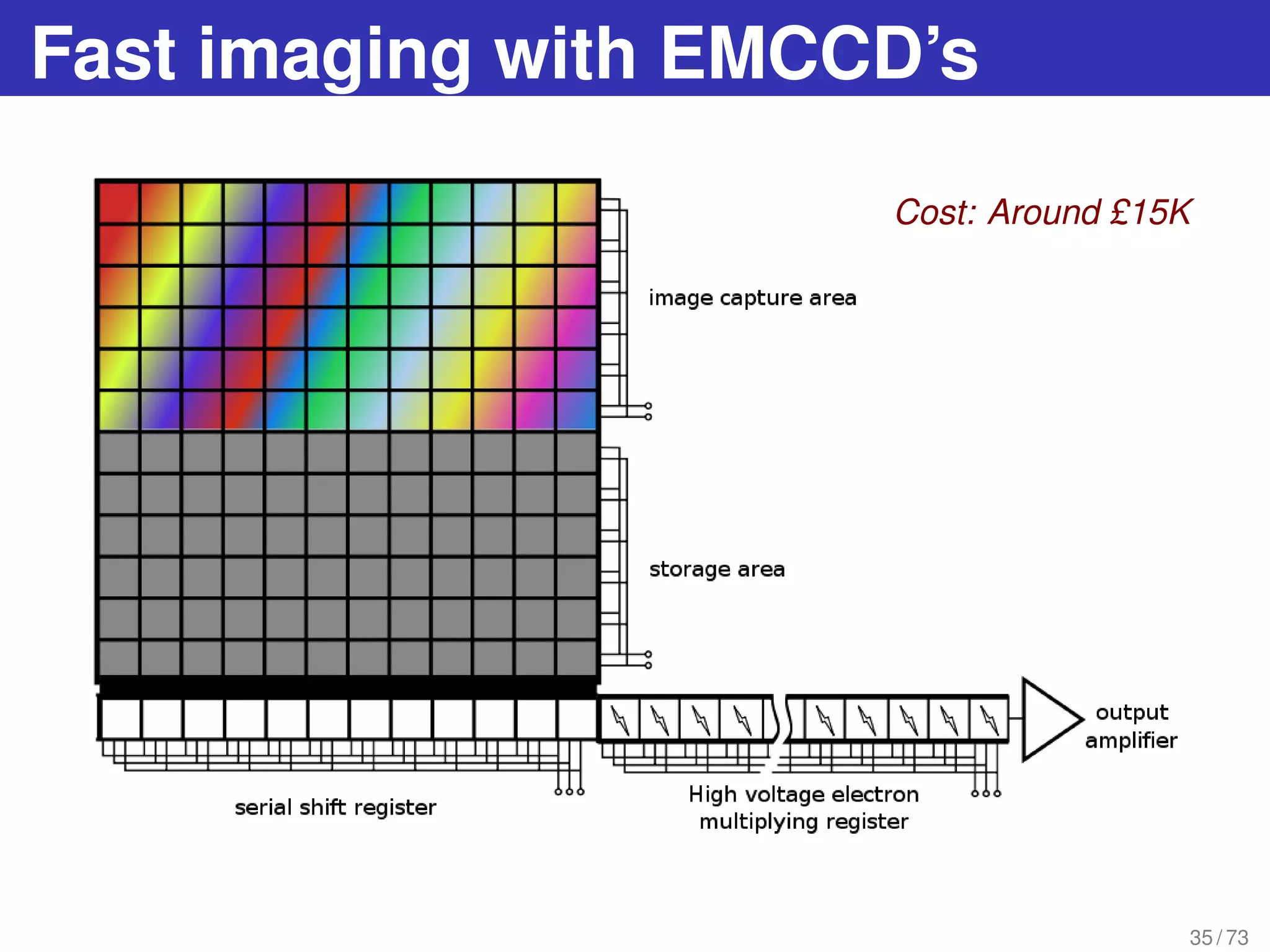
Fast imaging with EMCCD’s
35 / 73
Cost: Around £15K
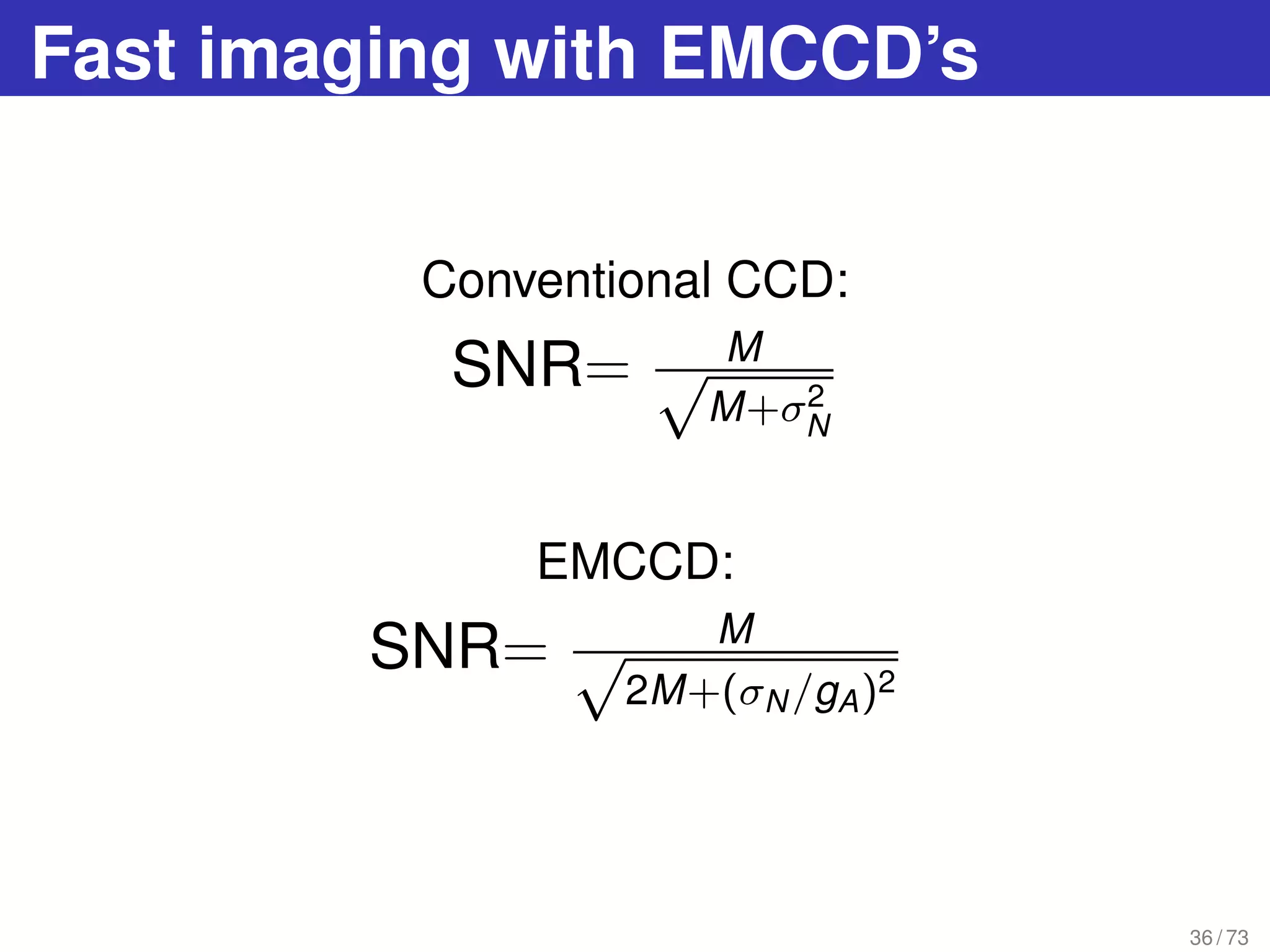
Fast imaging with EMCCD’s
Conventional CCD:
SNR= M√
M+σ2
N
EMCCD:
SNR= M√
2M+(σN /gA)2
36 / 73
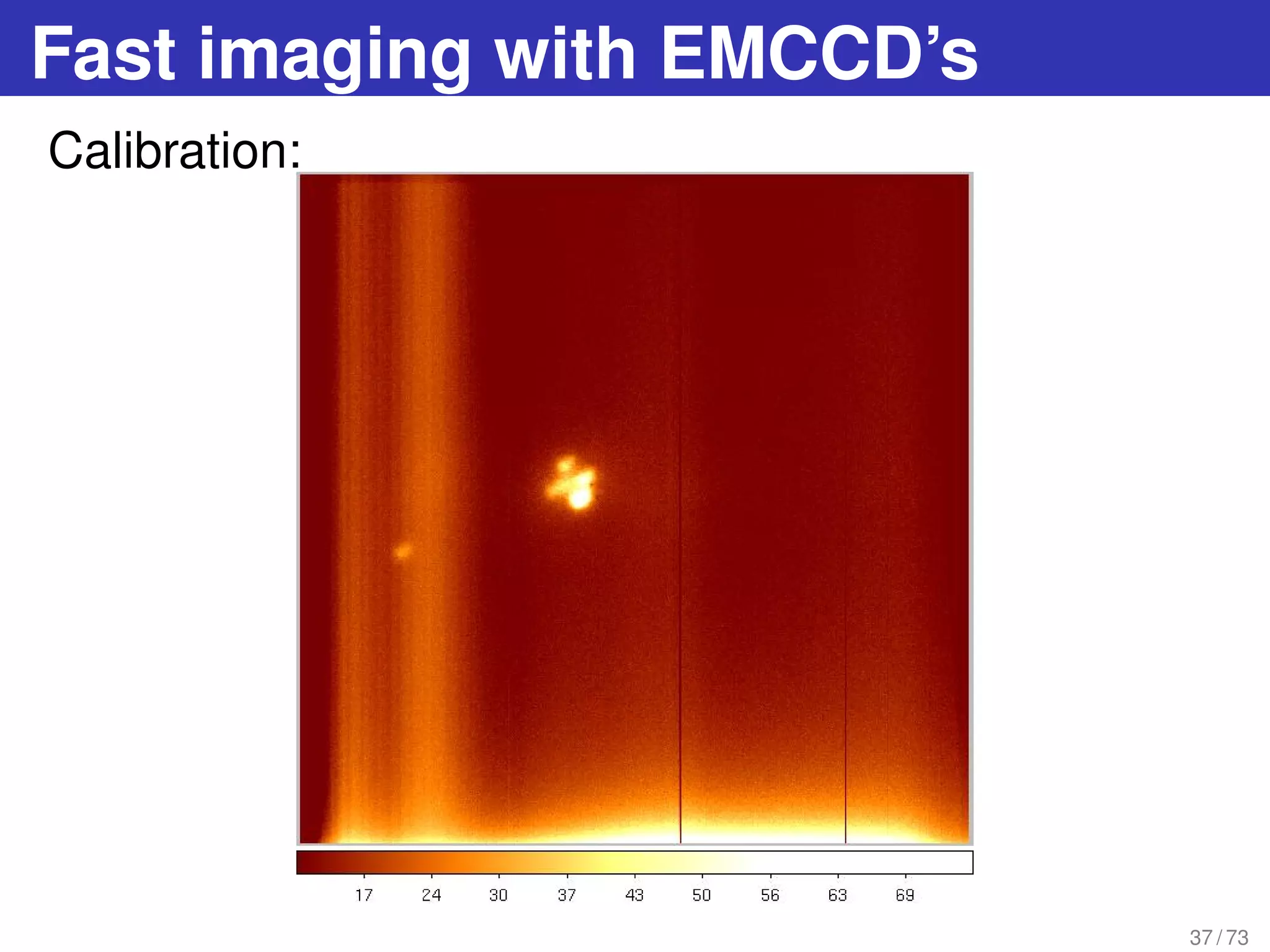
Fast imaging with EMCCD’s
Calibration:
37 / 73
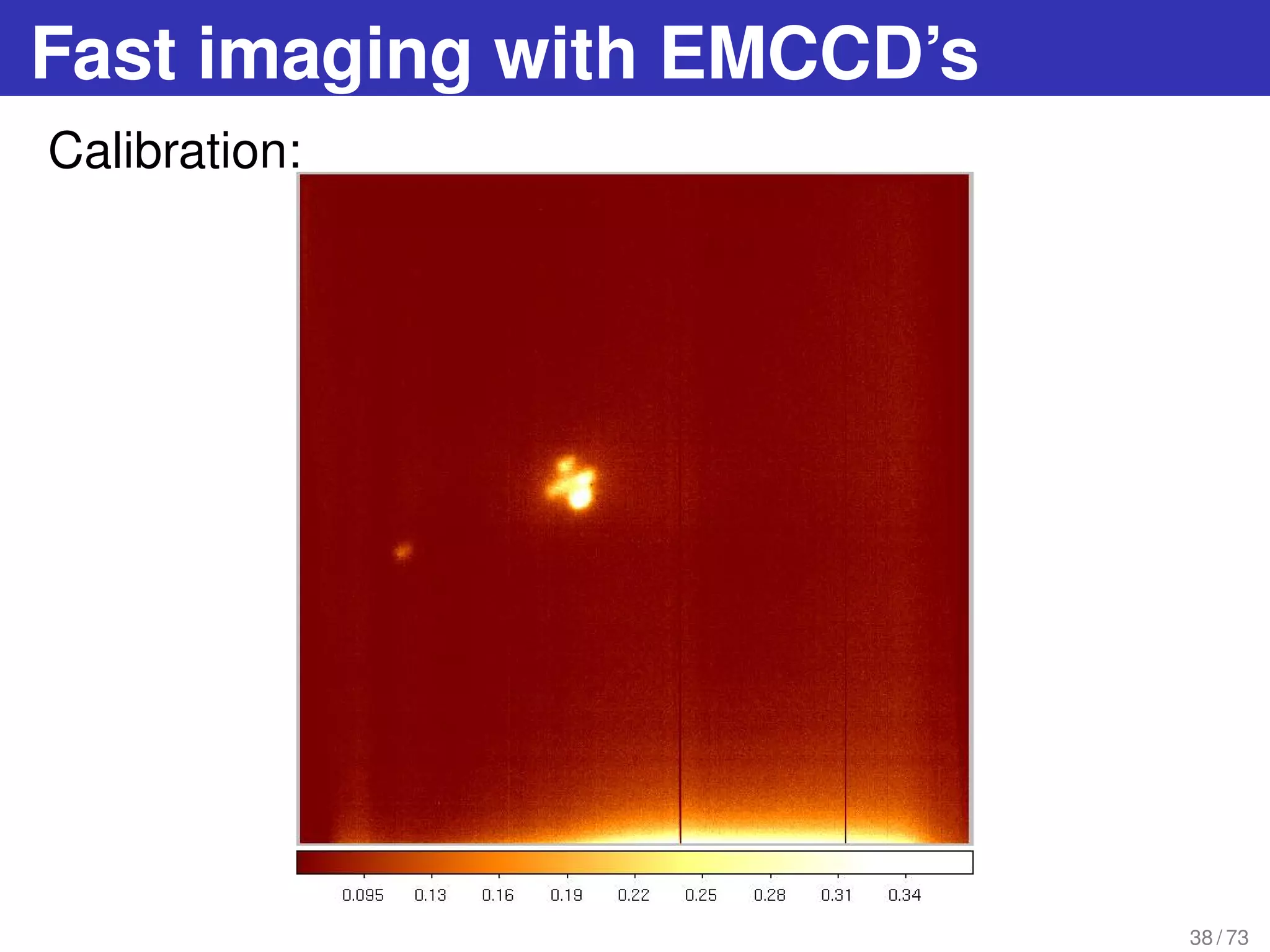
Fast imaging with EMCCD’s
Calibration:
38 / 73
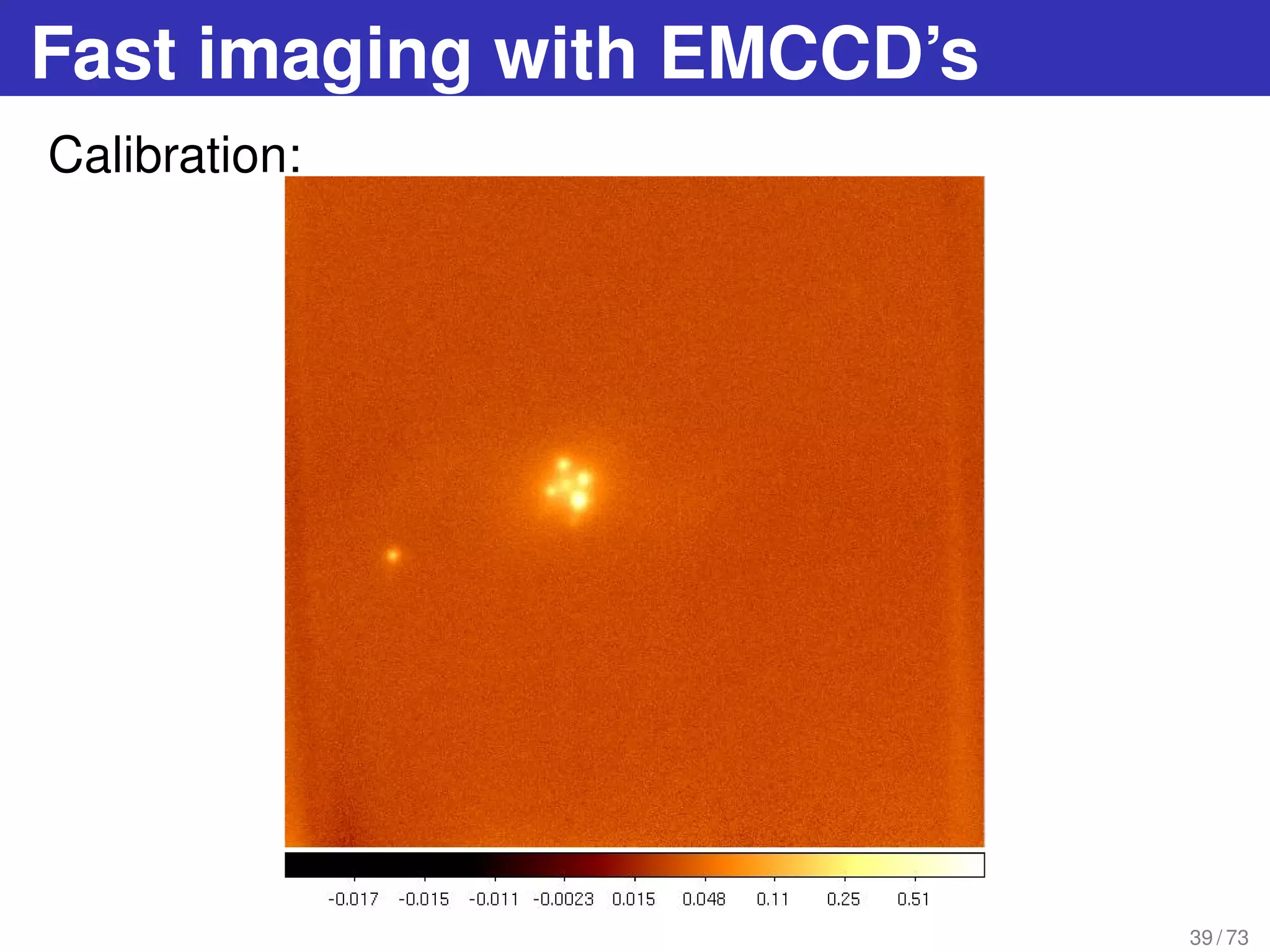
Fast imaging with EMCCD’s
Calibration:
39 / 73
Fast imaging with EMCCD’s
Limited pixel size, 1K2
Can only get 30 sq. arcseconds Nyquist
sampled on 2.5m telescope.
Readout electronics are a bottleneck on the
frame rate
40 / 73
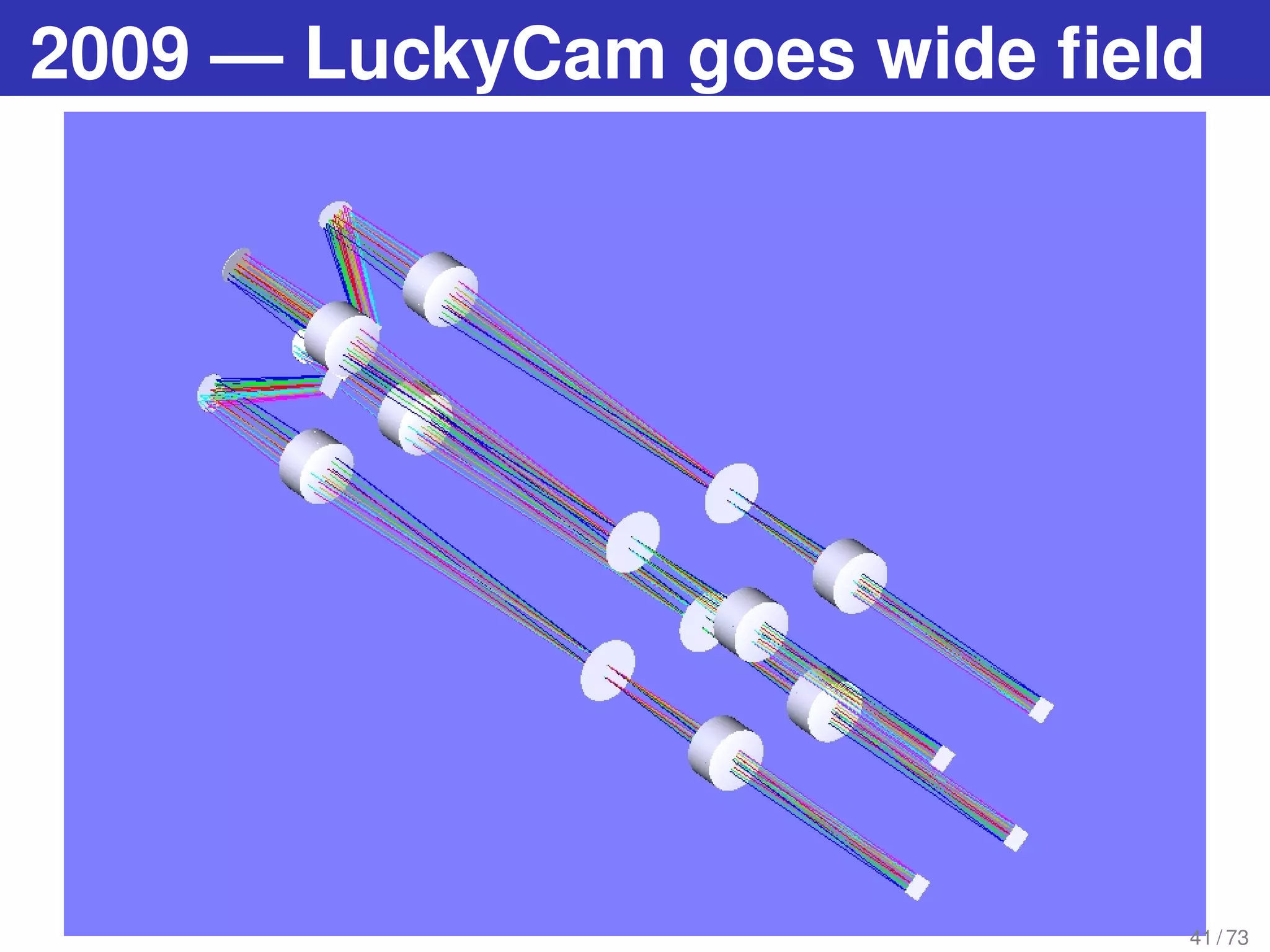
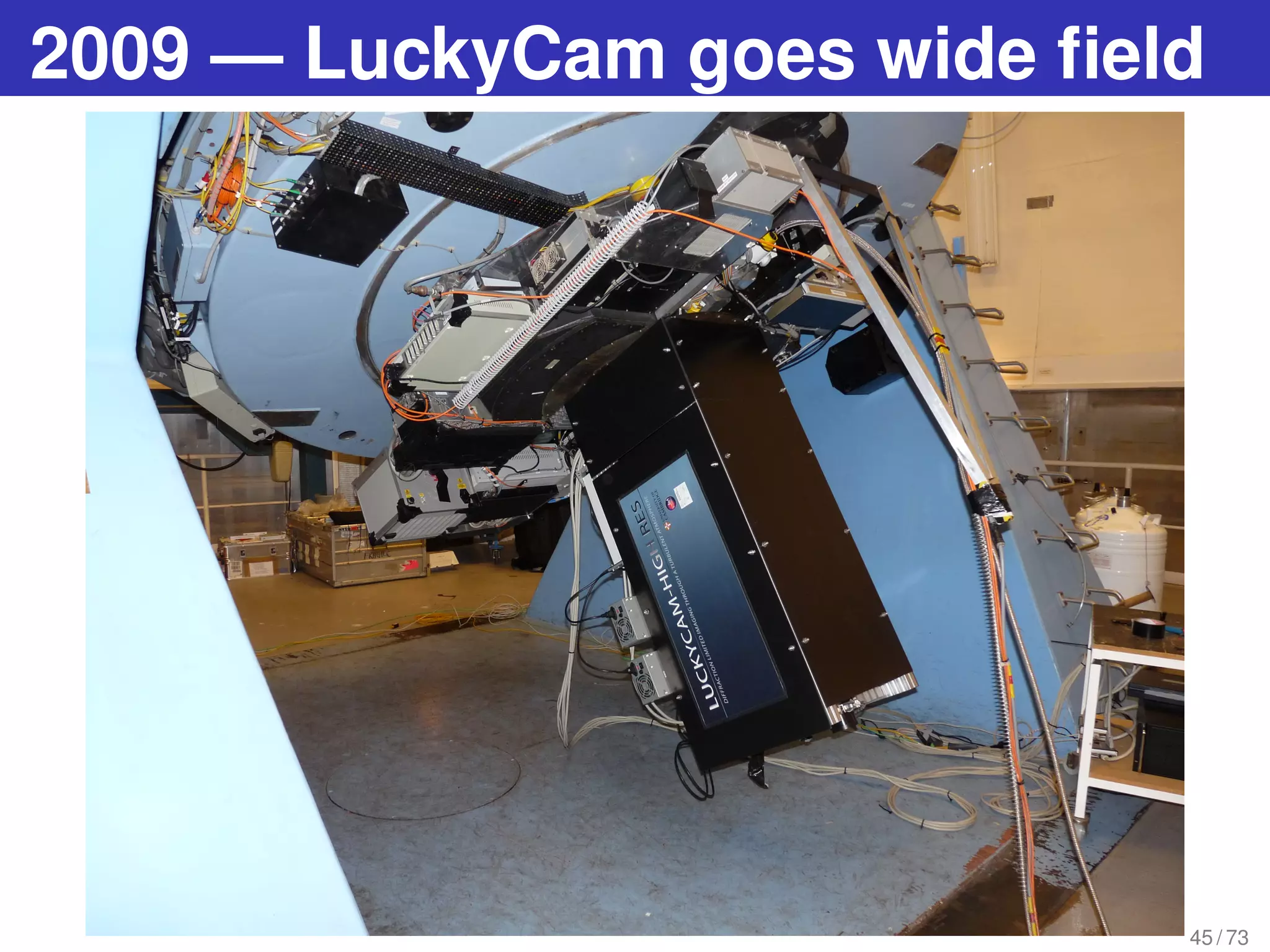
2009 — LuckyCam goes wide field
41 / 73
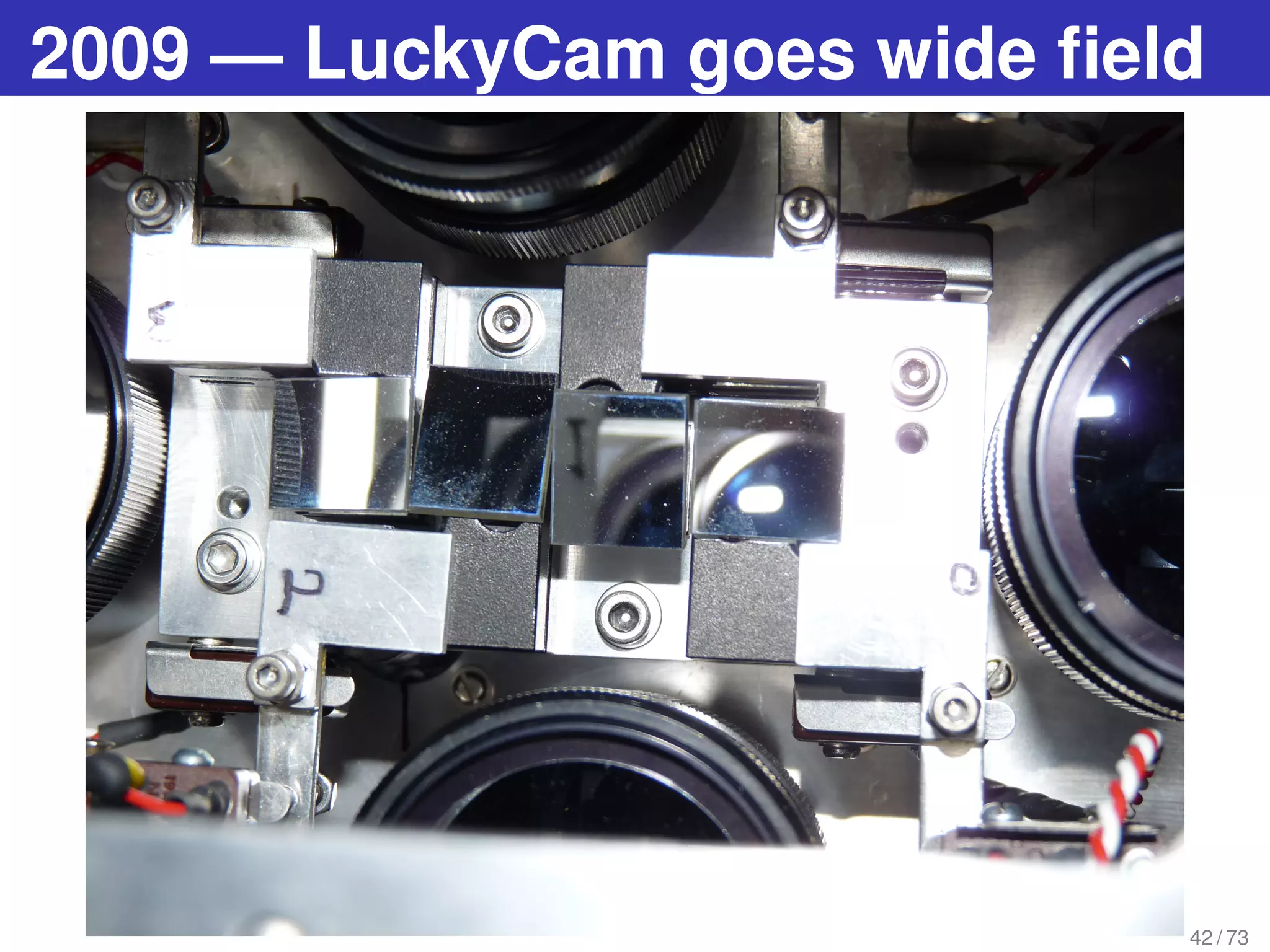
2009 — LuckyCam goes wide field
42 / 73
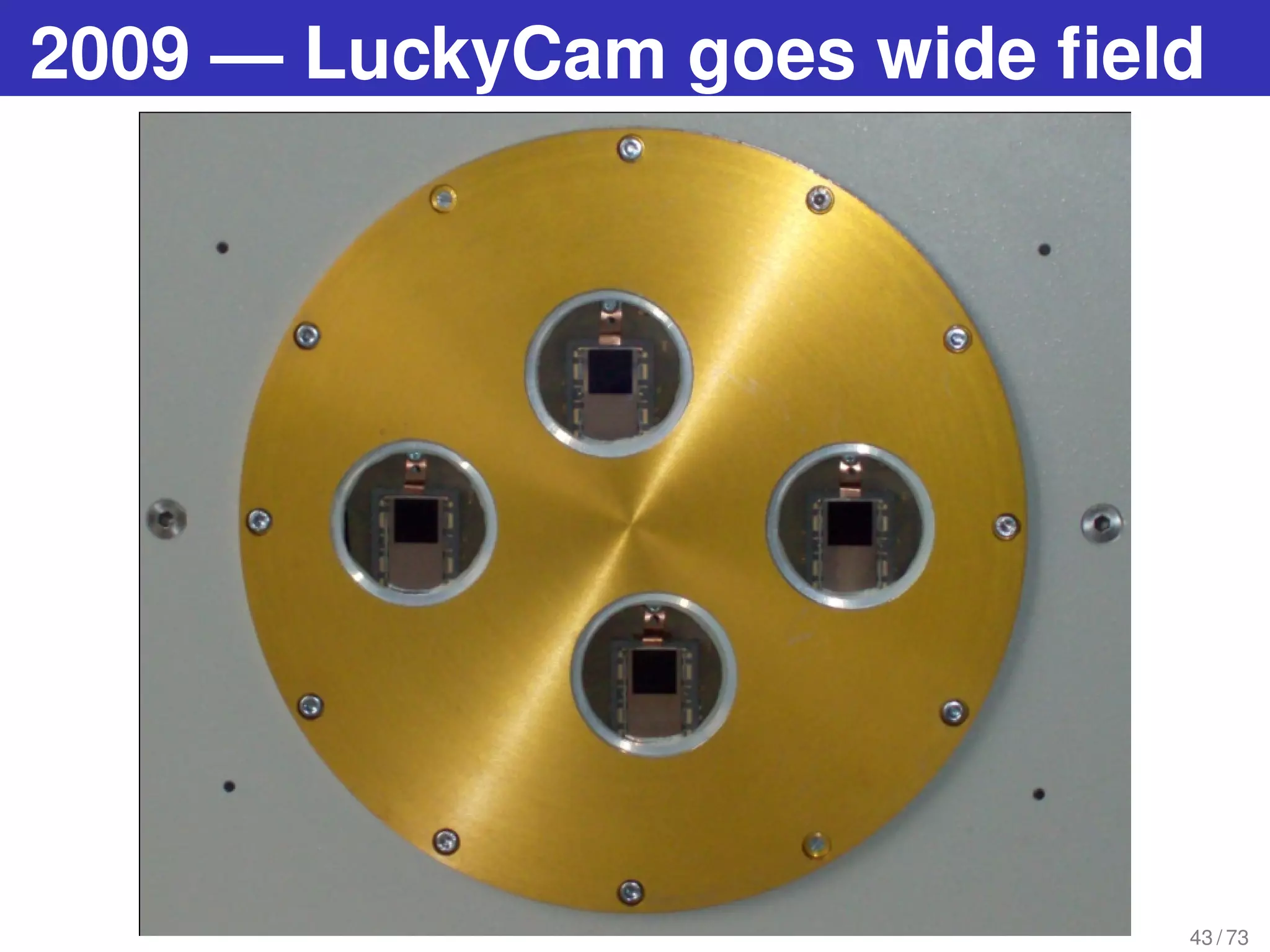
2009 — LuckyCam goes wide field
43 / 73
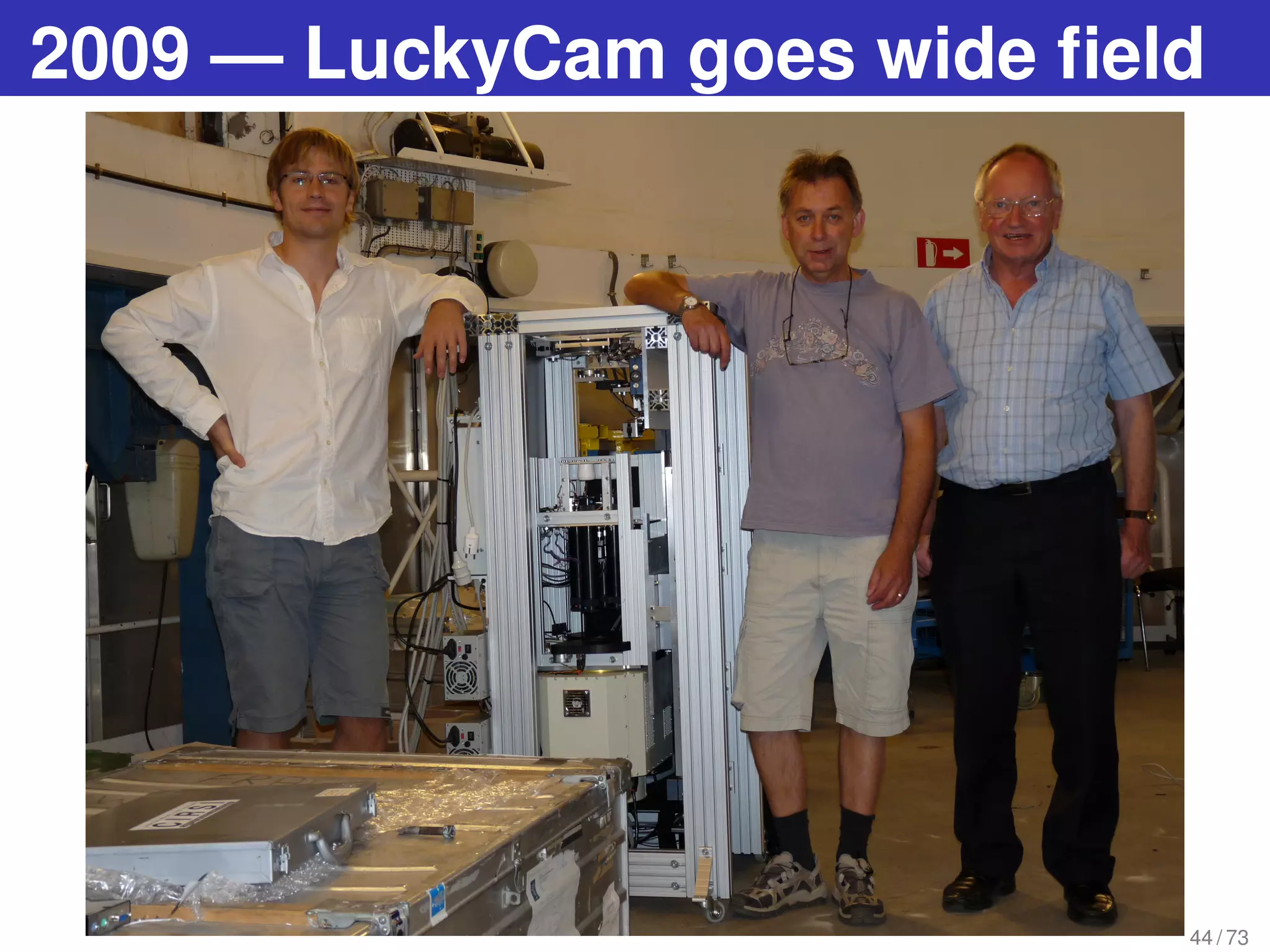
2009 — LuckyCam goes wide field
44 / 73
2009 — LuckyCam goes wide field
45 / 73
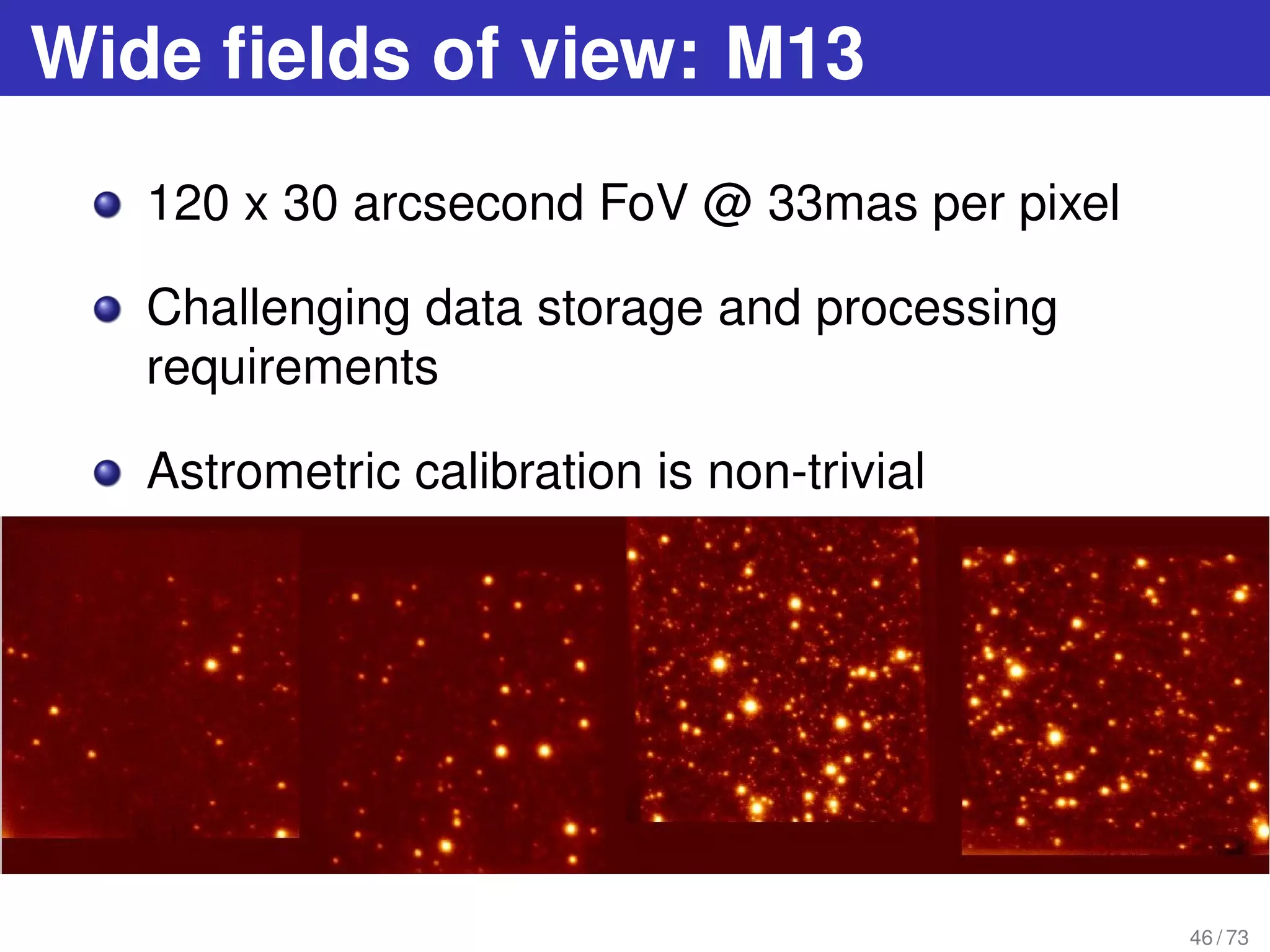
Wide fields of view: M13
120 x 30 arcsecond FoV @ 33mas per pixel
Challenging data storage and processing
requirements
Astrometric calibration is non-trivial
46 / 73
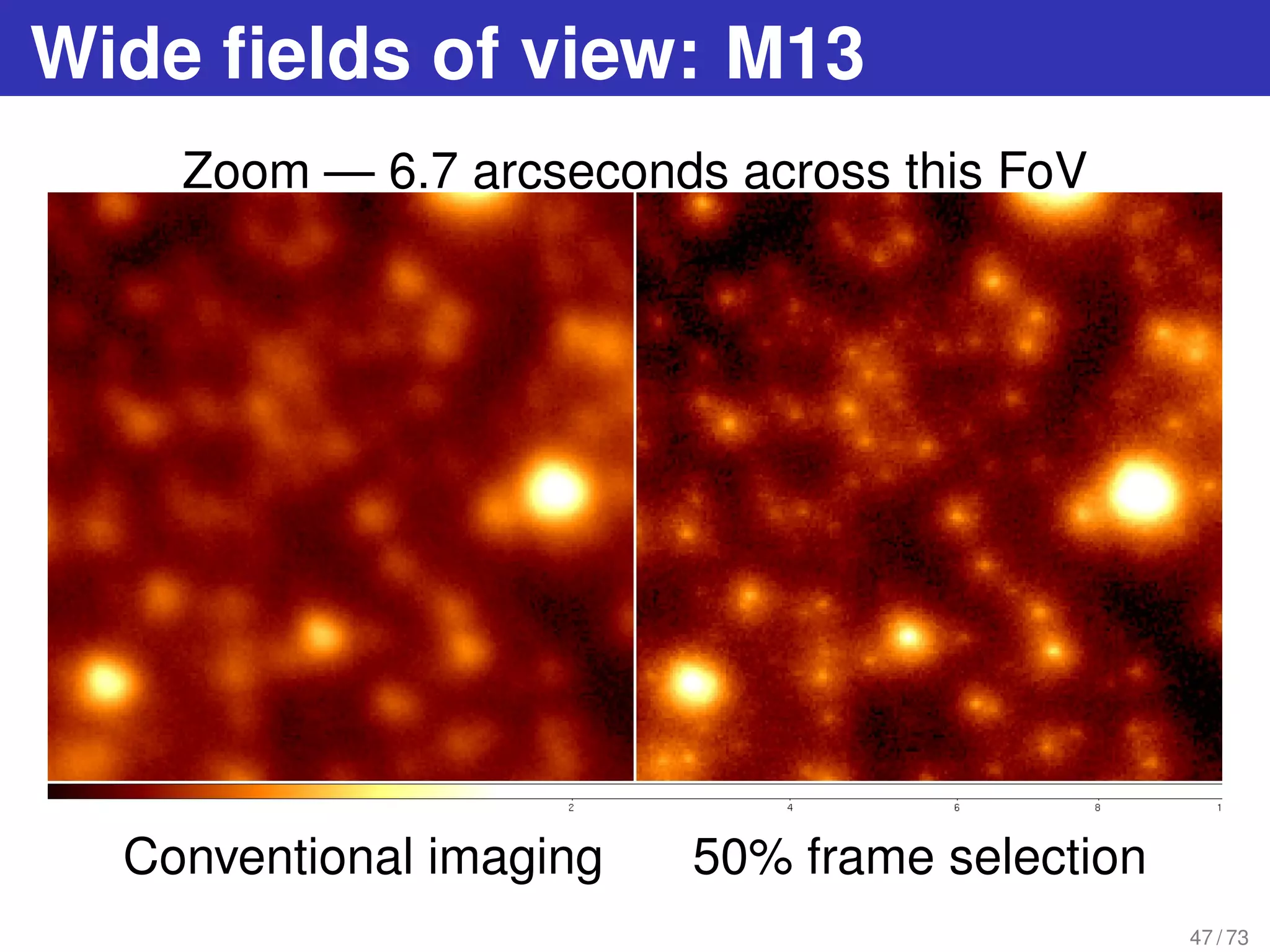
Wide fields of view: M13
Zoom — 6.7 arcseconds across this FoV
Conventional imaging 50% frame selection
47 / 73
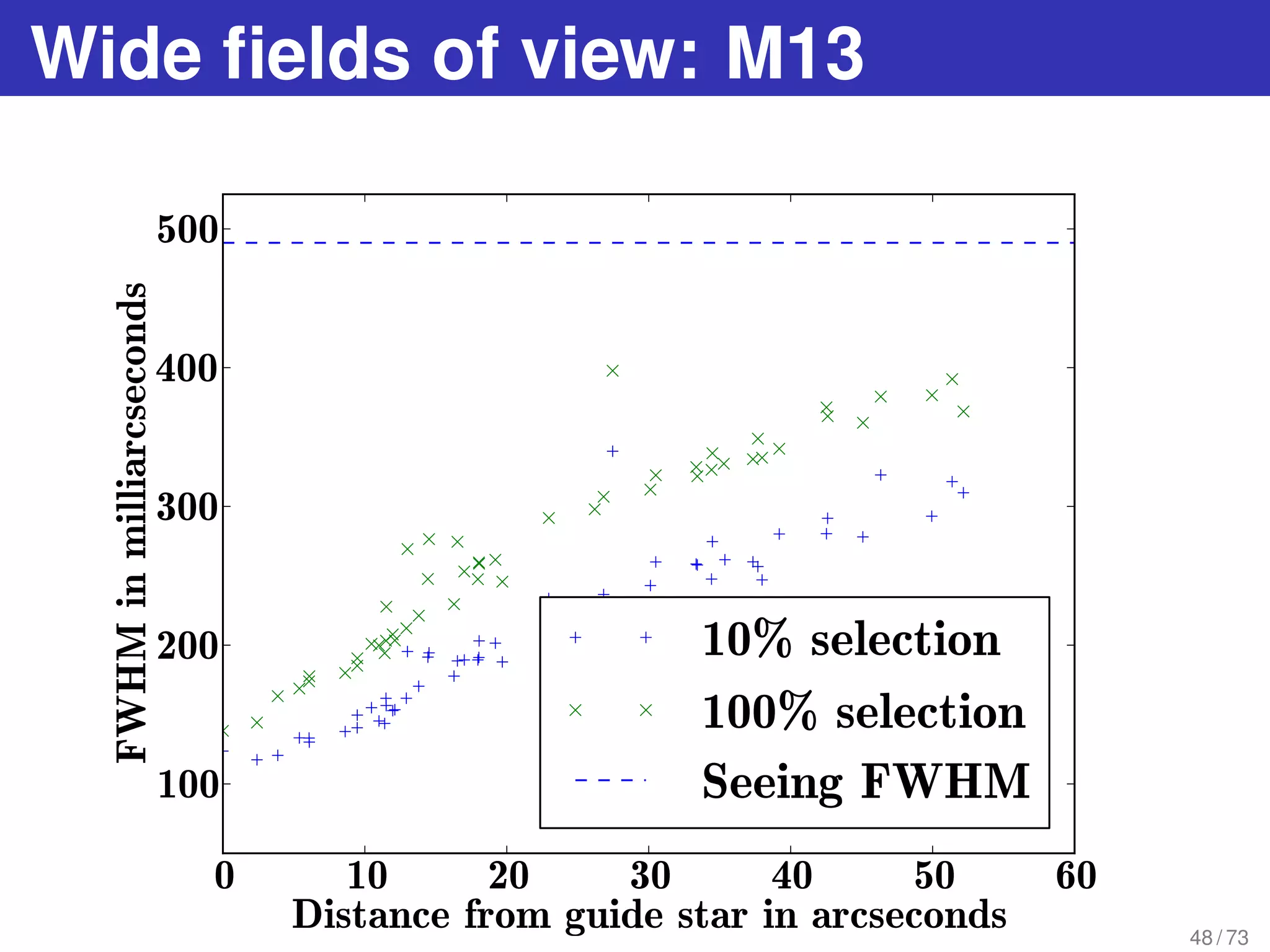
Wide fields of view: M13
0 10 20 30 40 50 60
Distance from guide star in arcseconds
100
200
300
400
500
FWHMinmilliarcseconds
10% selection
100% selection
Seeing FWHM
48 / 73
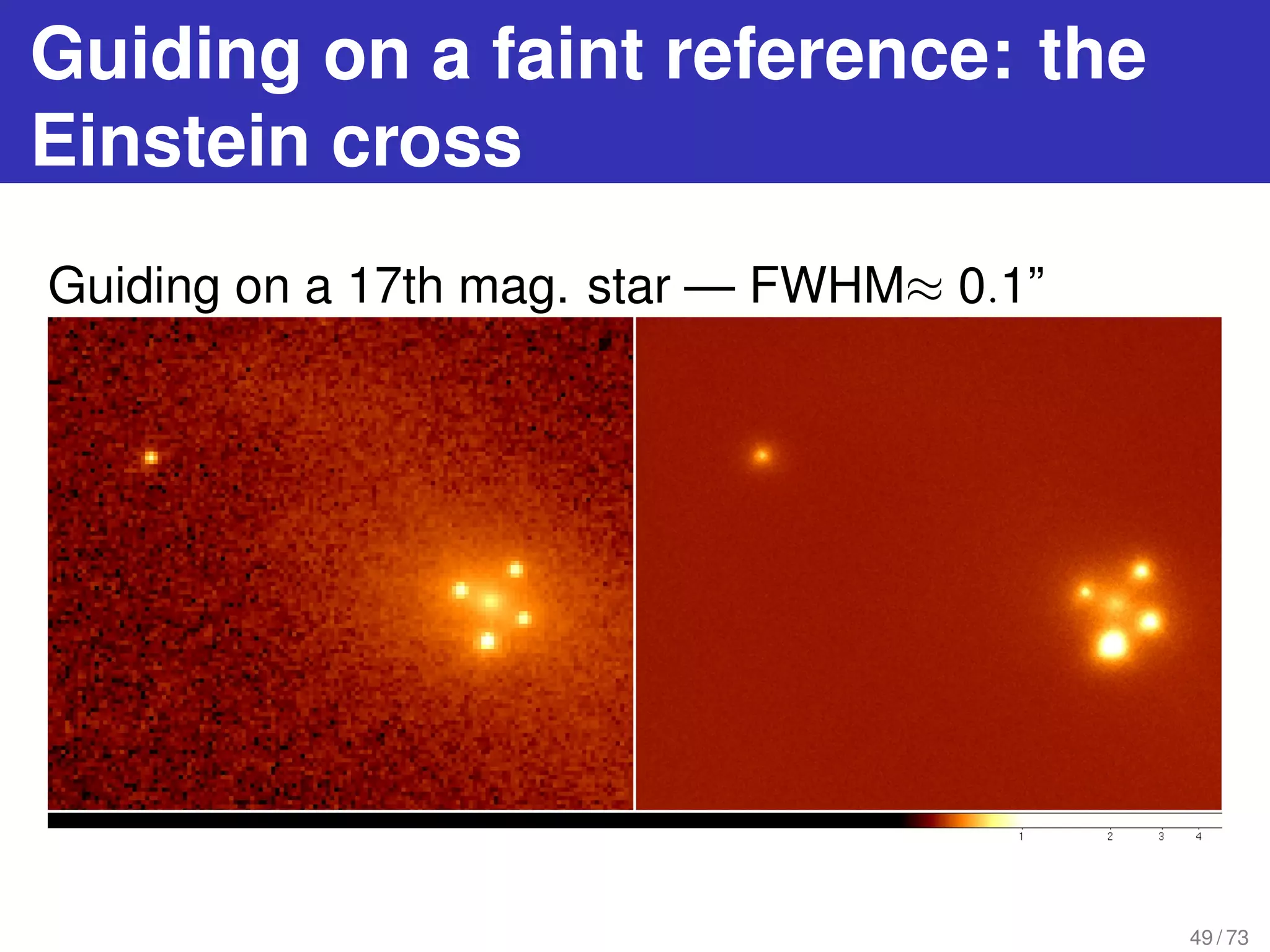
Guiding on a faint reference: the
Einstein cross
Guiding on a 17th mag. star — FWHM≈ 0.1”
49 / 73
Science at the faint limit:
thresholding
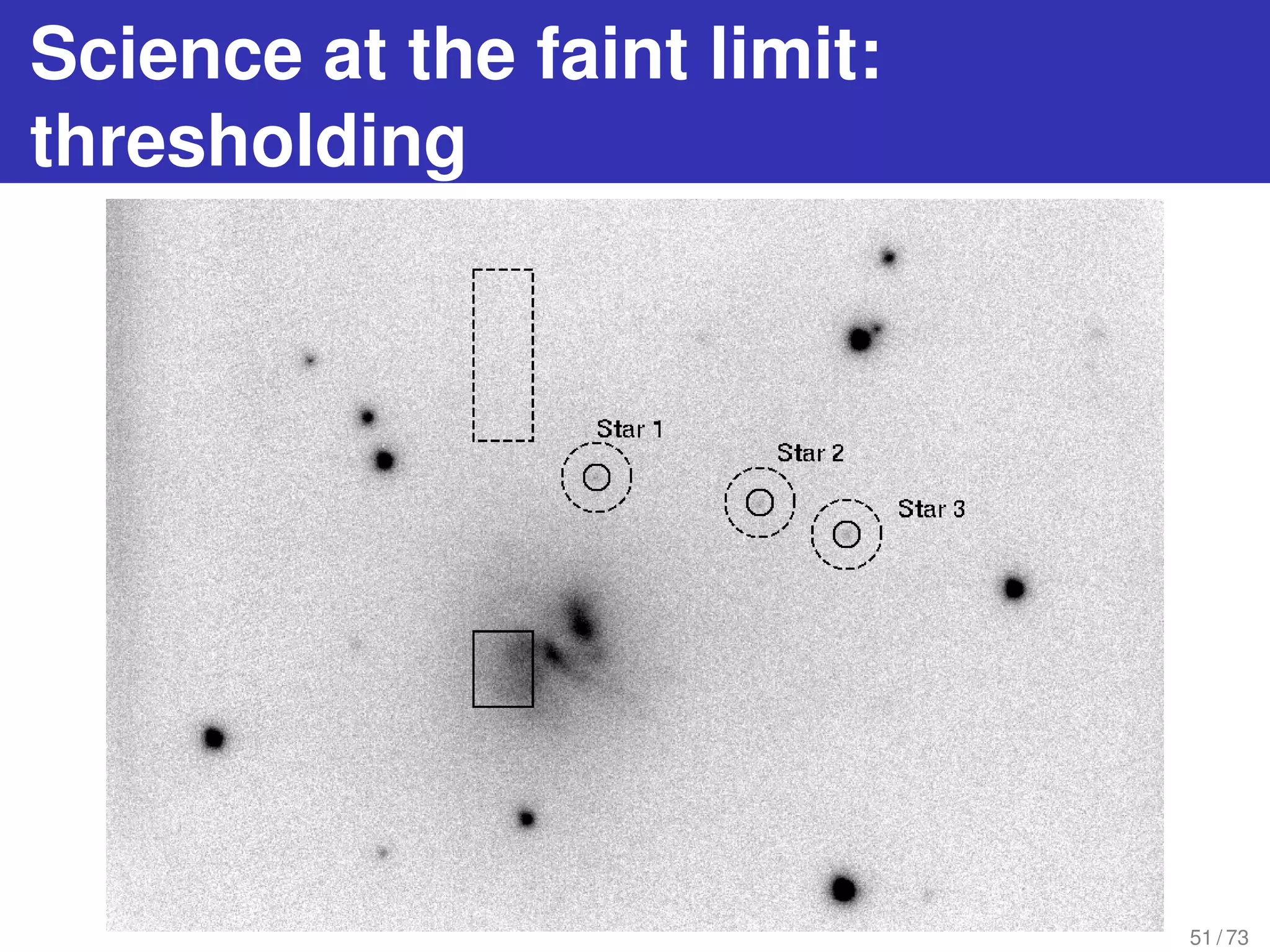
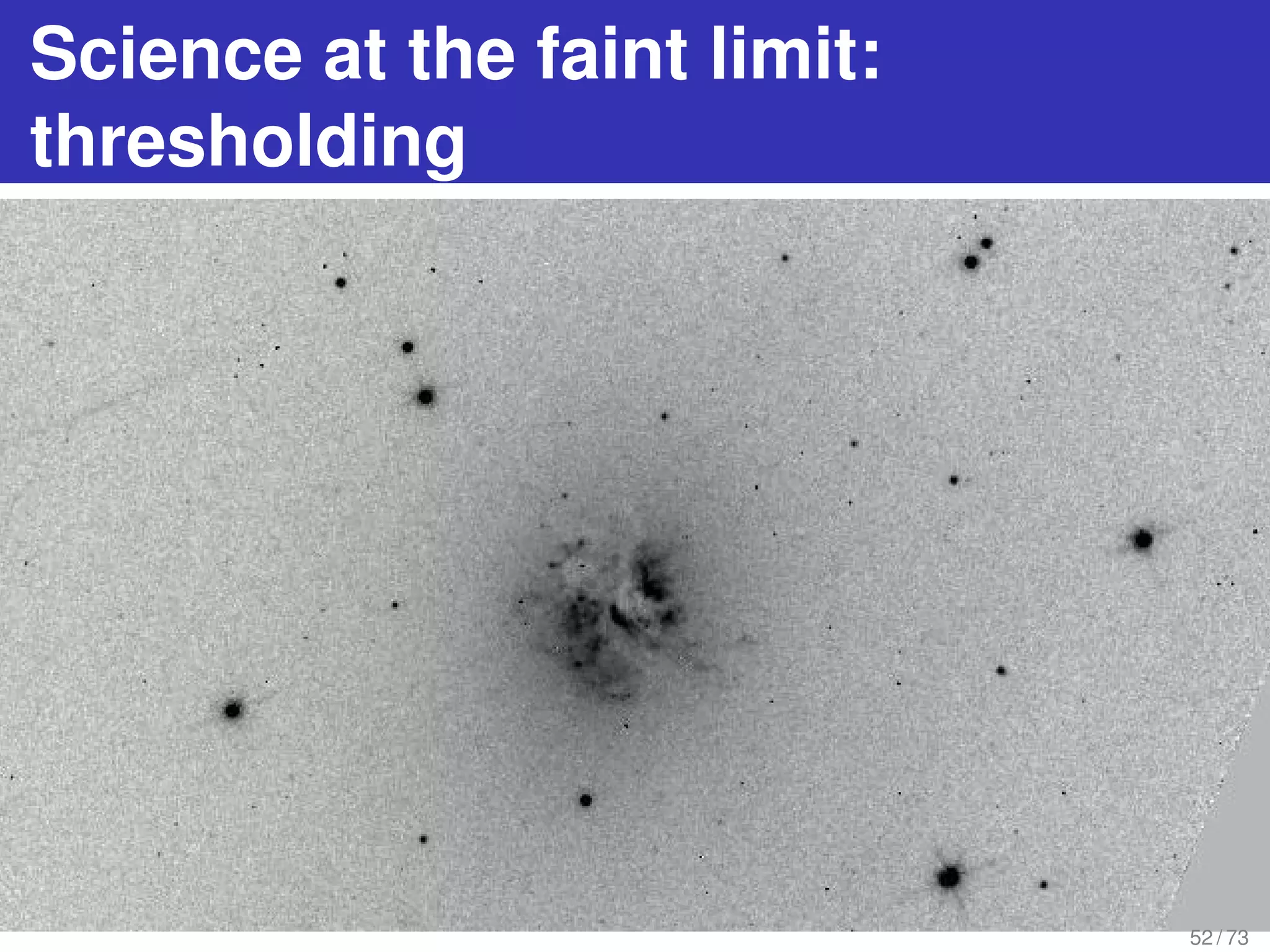
Read out noise still 0.1 electrons.
Faint limit around 23rd magnitude on a 2.5m
telescope (good seeing)
Thresholding eliminates read noise
But for now we are limited by CIC
50 / 73
Science at the faint limit:
thresholding
51 / 73
Science at the faint limit:
thresholding
52 / 73
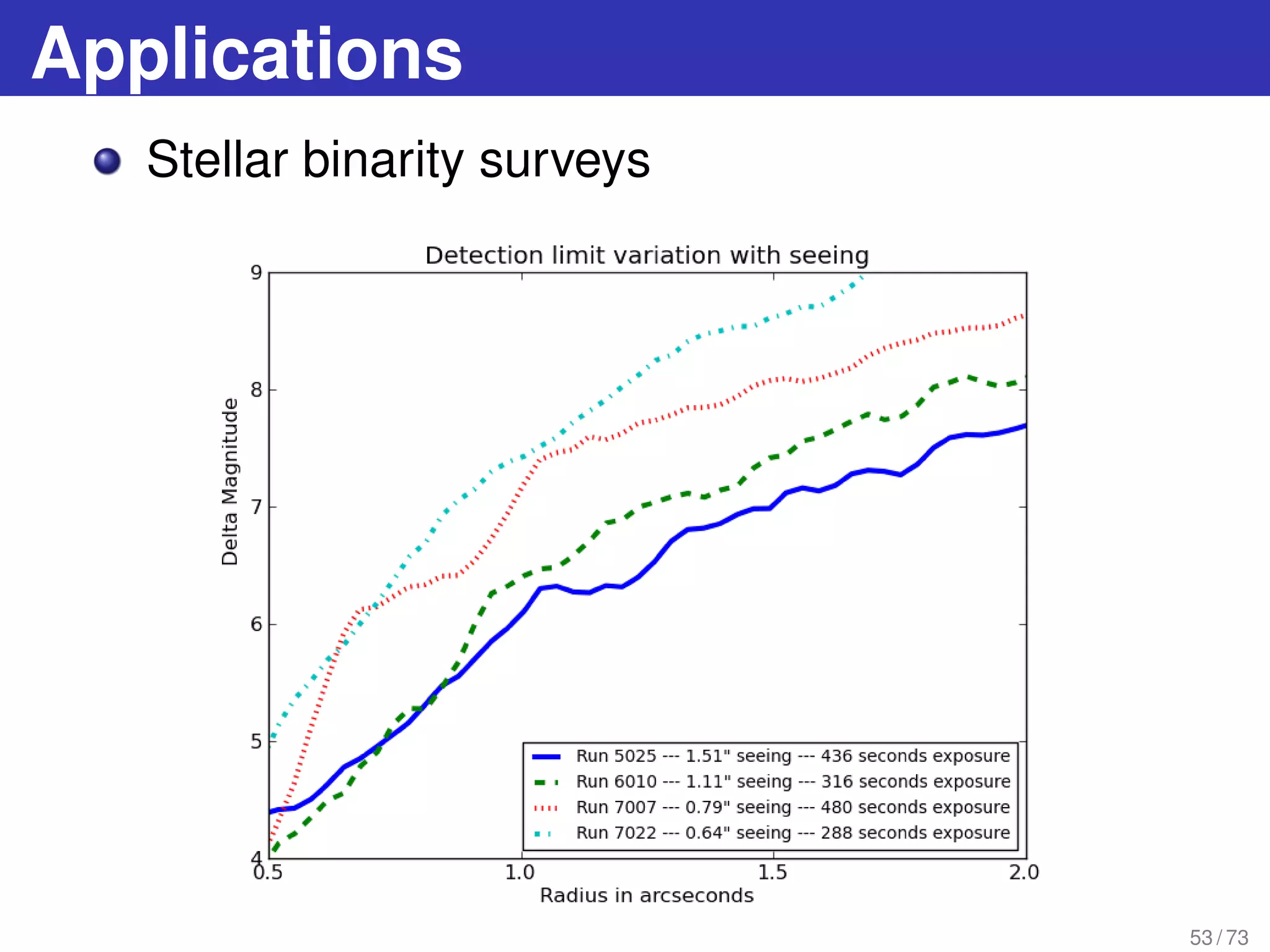
Applications
Stellar binarity surveys
53 / 73
Applications
High resolution surveys (e.g. microlensing in
crowded field)
54 / 73
Applications
High resolution surveys (e.g. microlensing in
crowded field)
Cheap high resolution follow-up (stellar transits,
etc)
55 / 73
Applications
High resolution surveys (e.g. microlensing in
crowded field)
Cheap high resolution follow-up (stellar transits,
etc)
Planetary imaging
56 / 73
Applications
High resolution surveys (e.g. microlensing in
crowded field)
Cheap high resolution follow-up (stellar transits,
etc)
Planetary imaging
Potentially better faint limits that conventional
imagers in future? (esp. for bright sky)
57 / 73
Applications
High resolution surveys (e.g. microlensing in
crowded field)
Cheap high resolution follow-up (stellar transits,
etc)
Planetary imaging
Potentially better faint limits that conventional
imagers in future? (esp. for bright sky)
But still limited to smaller telescopes.
58 / 73
Outline
1 Atmospheric effects
2 High spatial resolution astronomy
3 Adaptive optics
4 Lucky imaging
5 Lucky imaging + AO
59 / 73
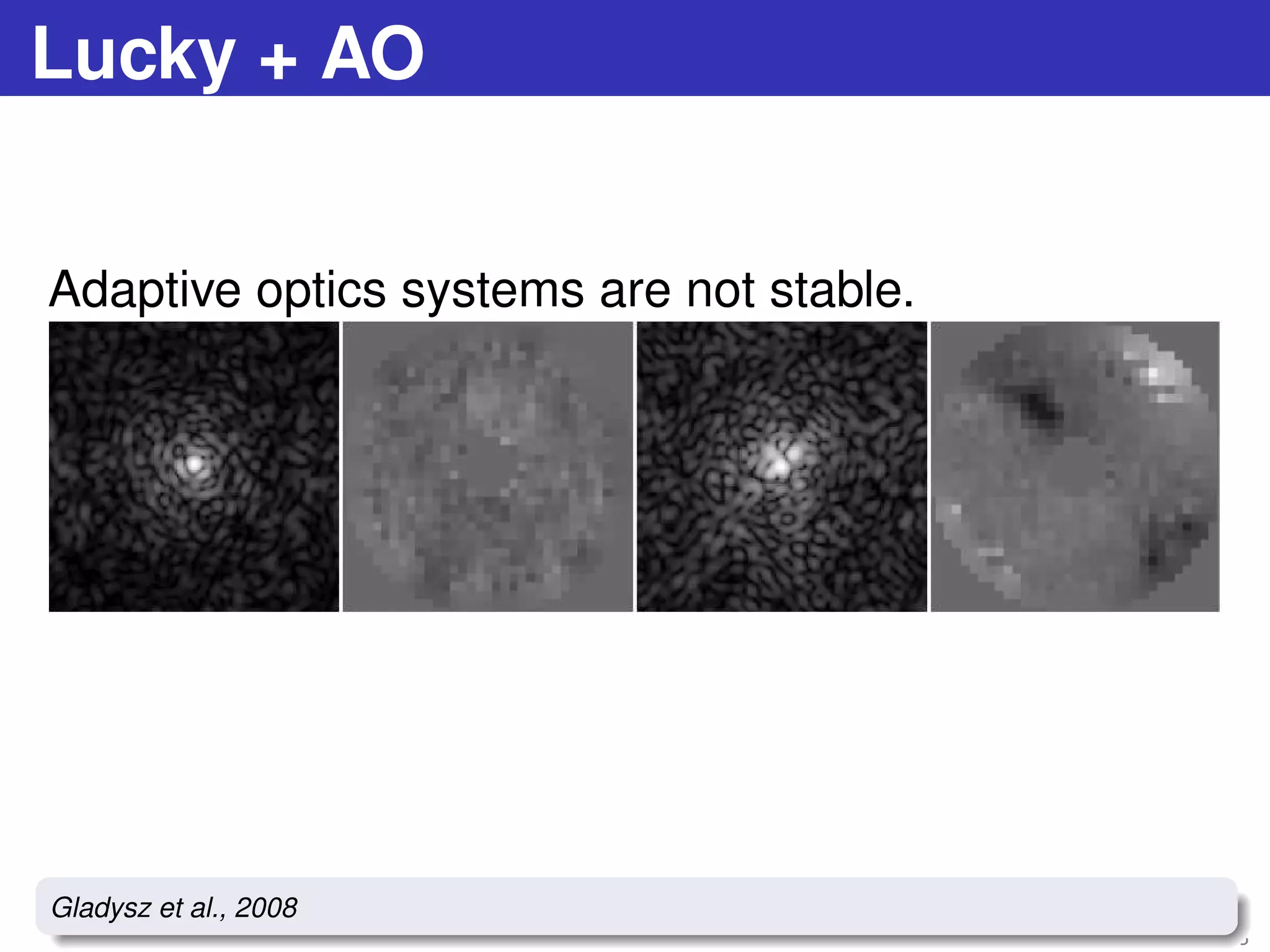
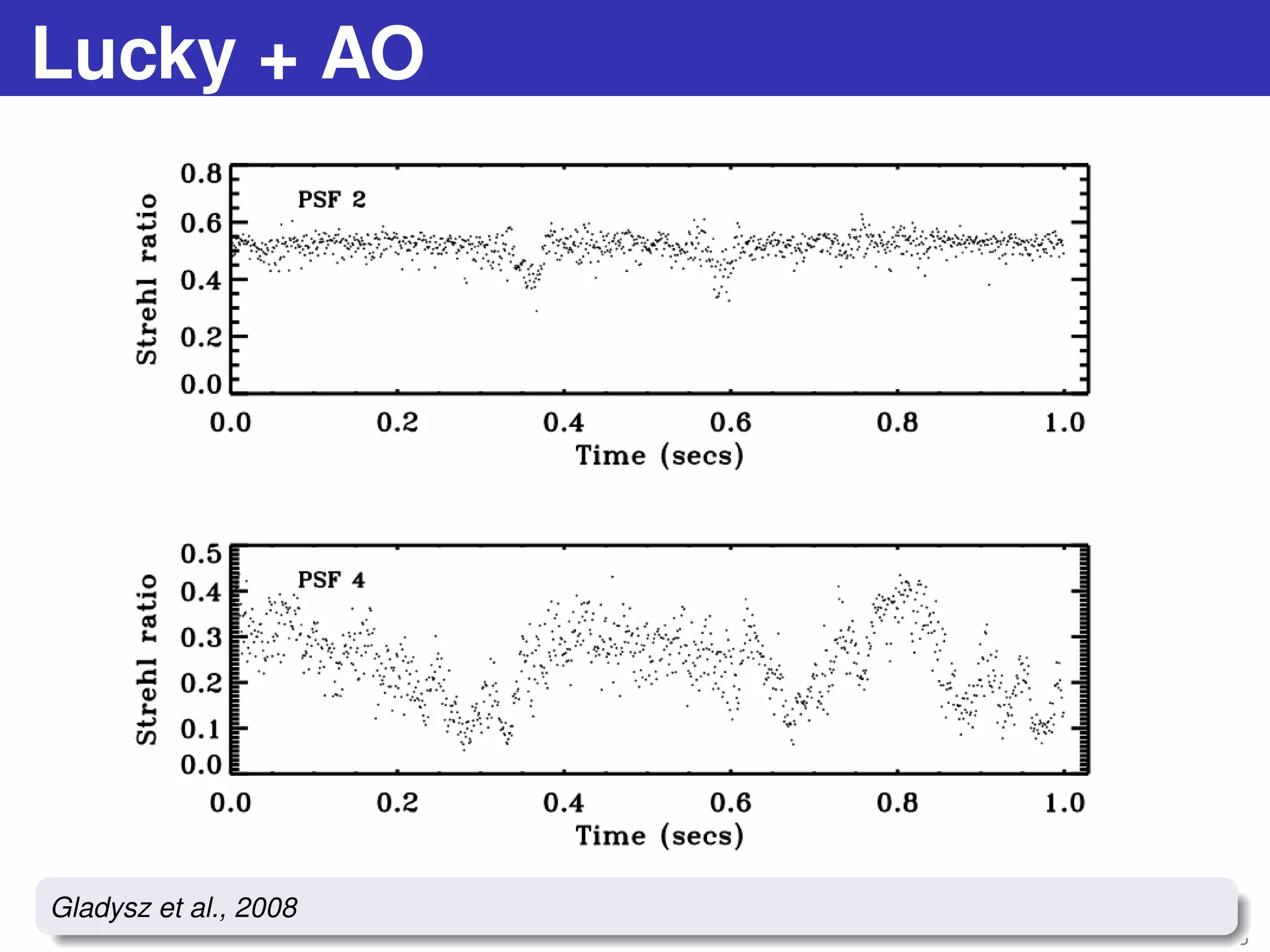
Lucky + AO
Adaptive optics systems are not stable.
60 / 73
Gladysz et al., 2008
Lucky + AO
61 / 73
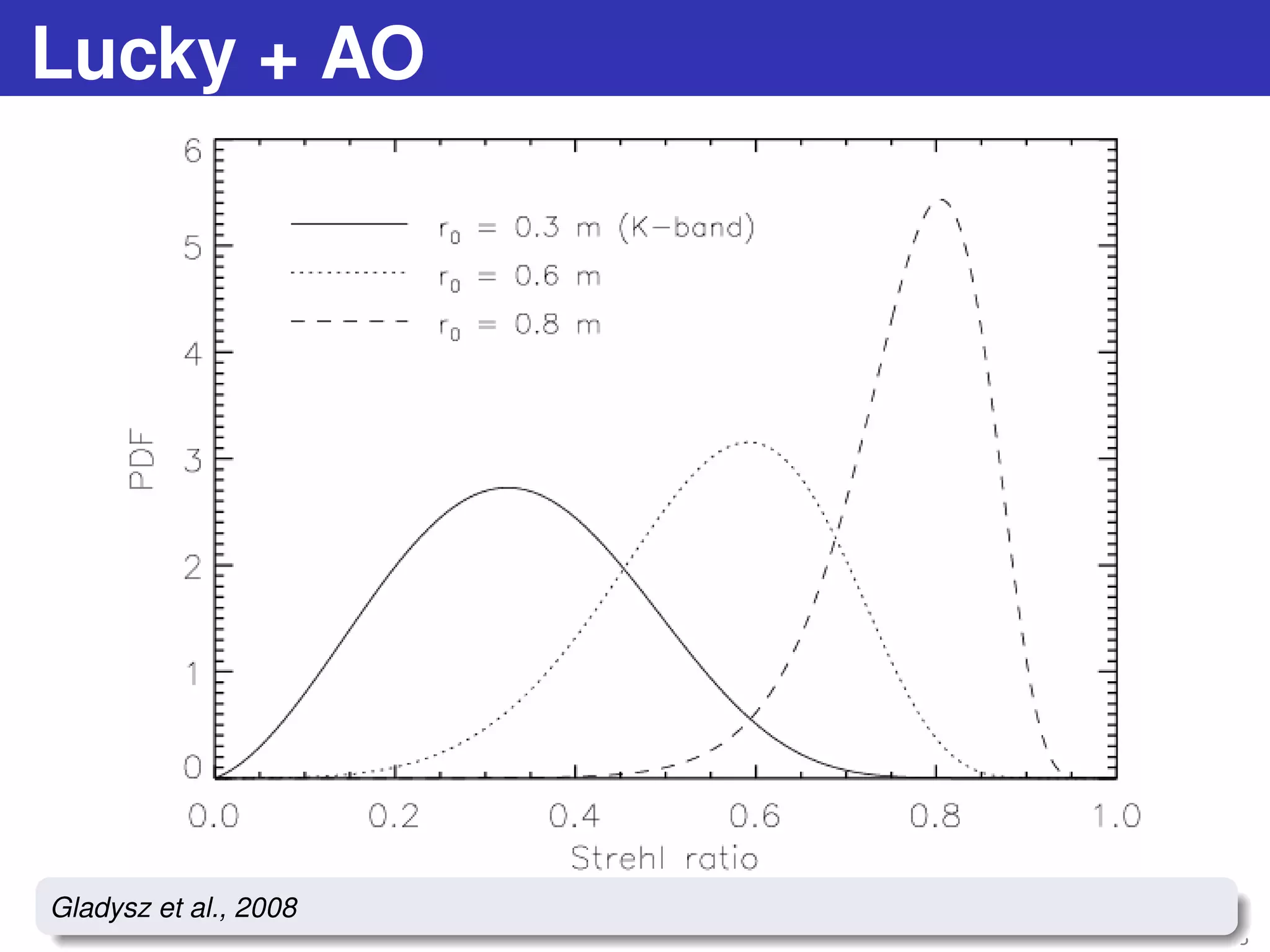
Gladysz et al., 2008
Lucky + AO
62 / 73
Gladysz et al., 2008
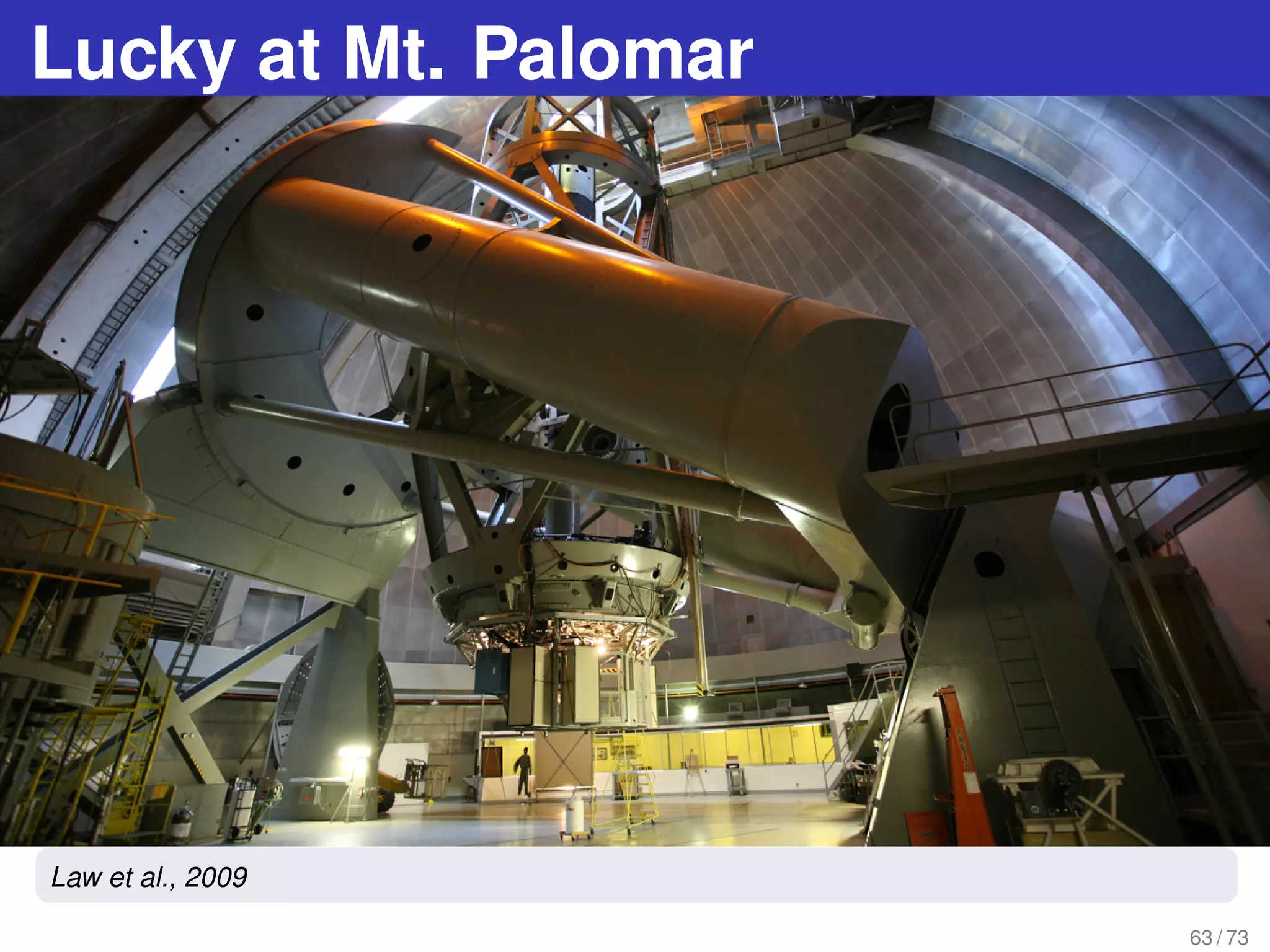
Lucky at Mt. Palomar
63 / 73
Law et al., 2009
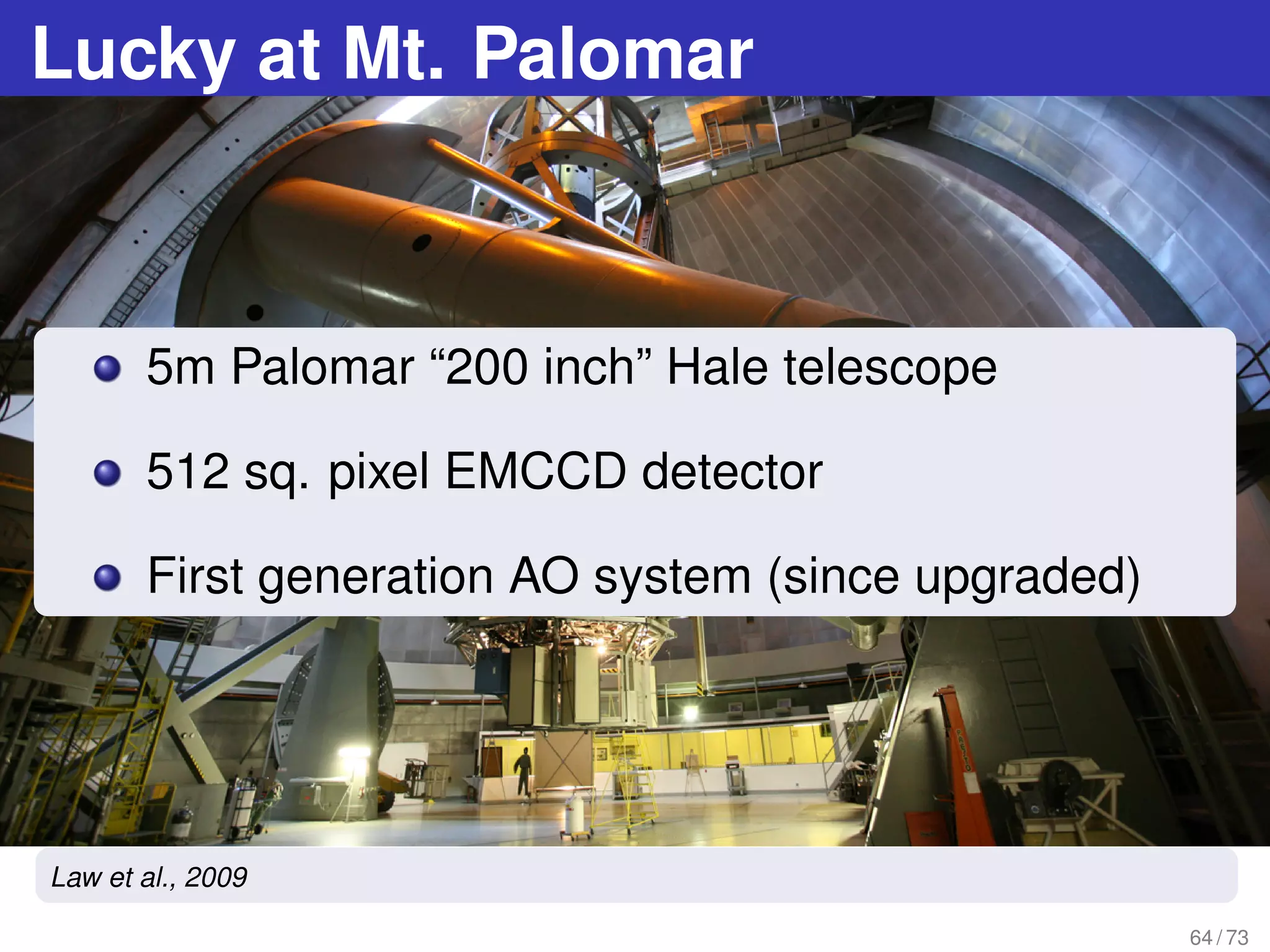
Lucky at Mt. Palomar
5m Palomar “200 inch” Hale telescope
512 sq. pixel EMCCD detector
First generation AO system (since upgraded)
64 / 73
Law et al., 2009
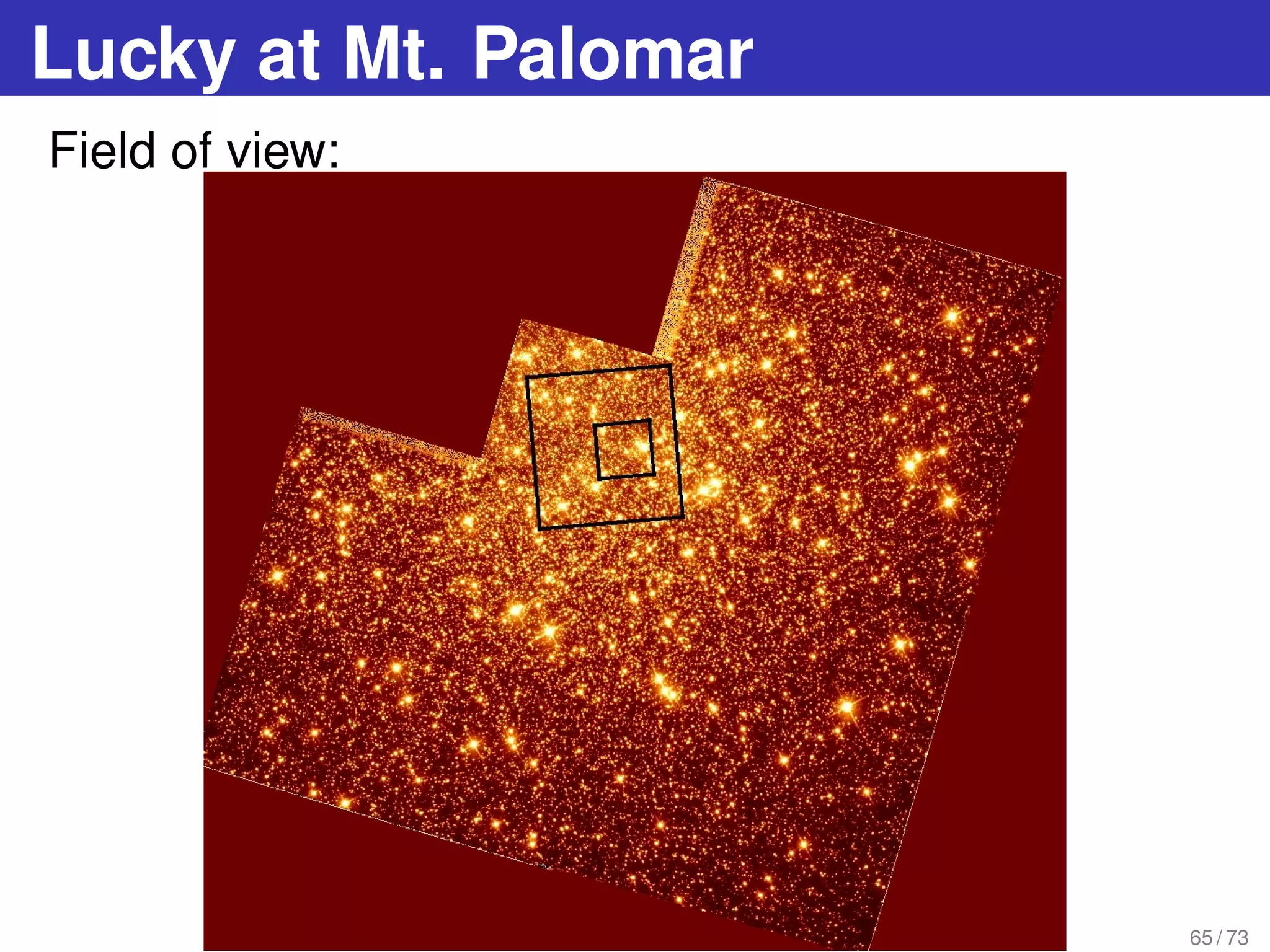
Lucky at Mt. Palomar
Field of view:
65 / 73
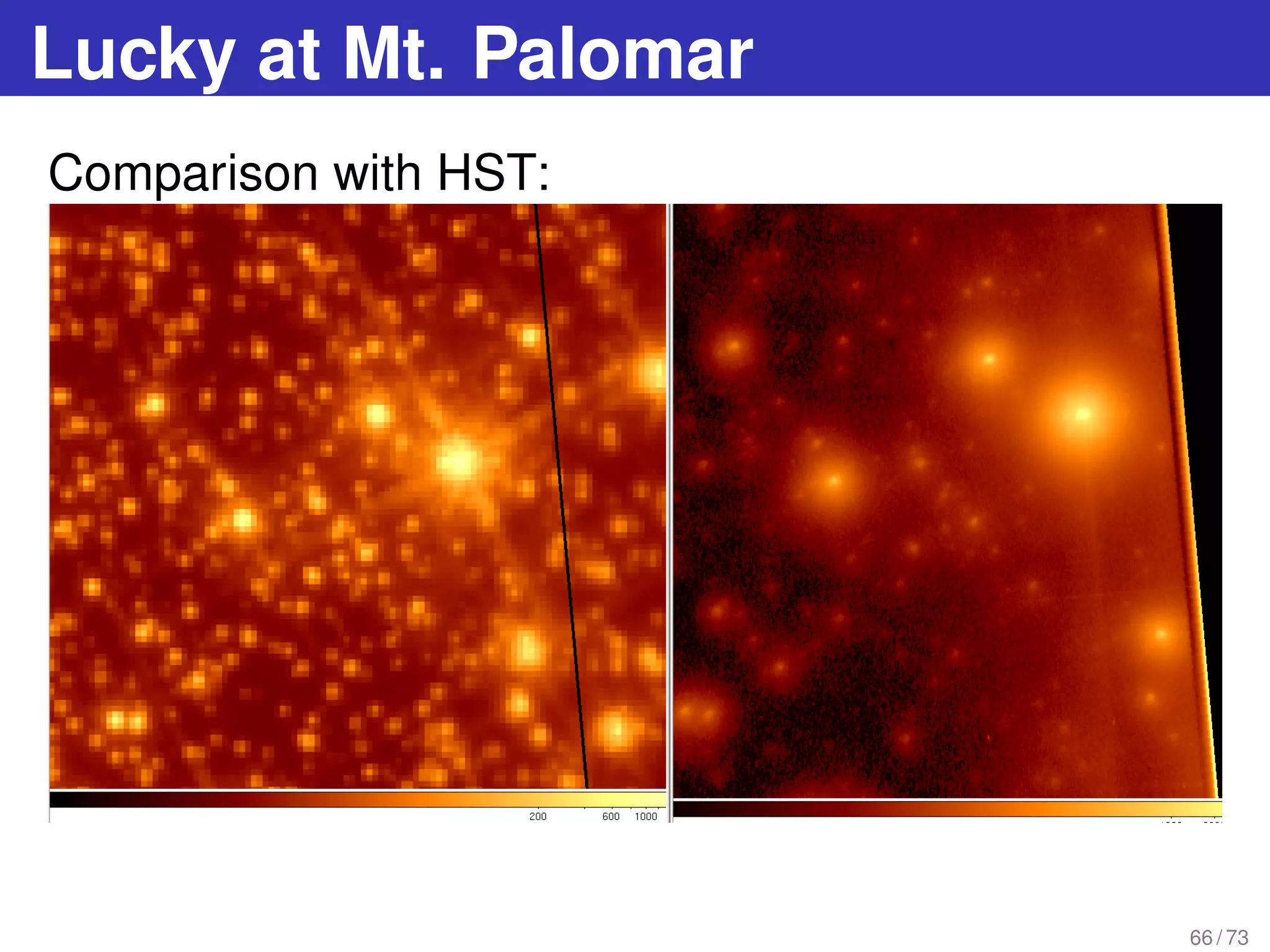
Lucky at Mt. Palomar
Comparison with HST:
66 / 73
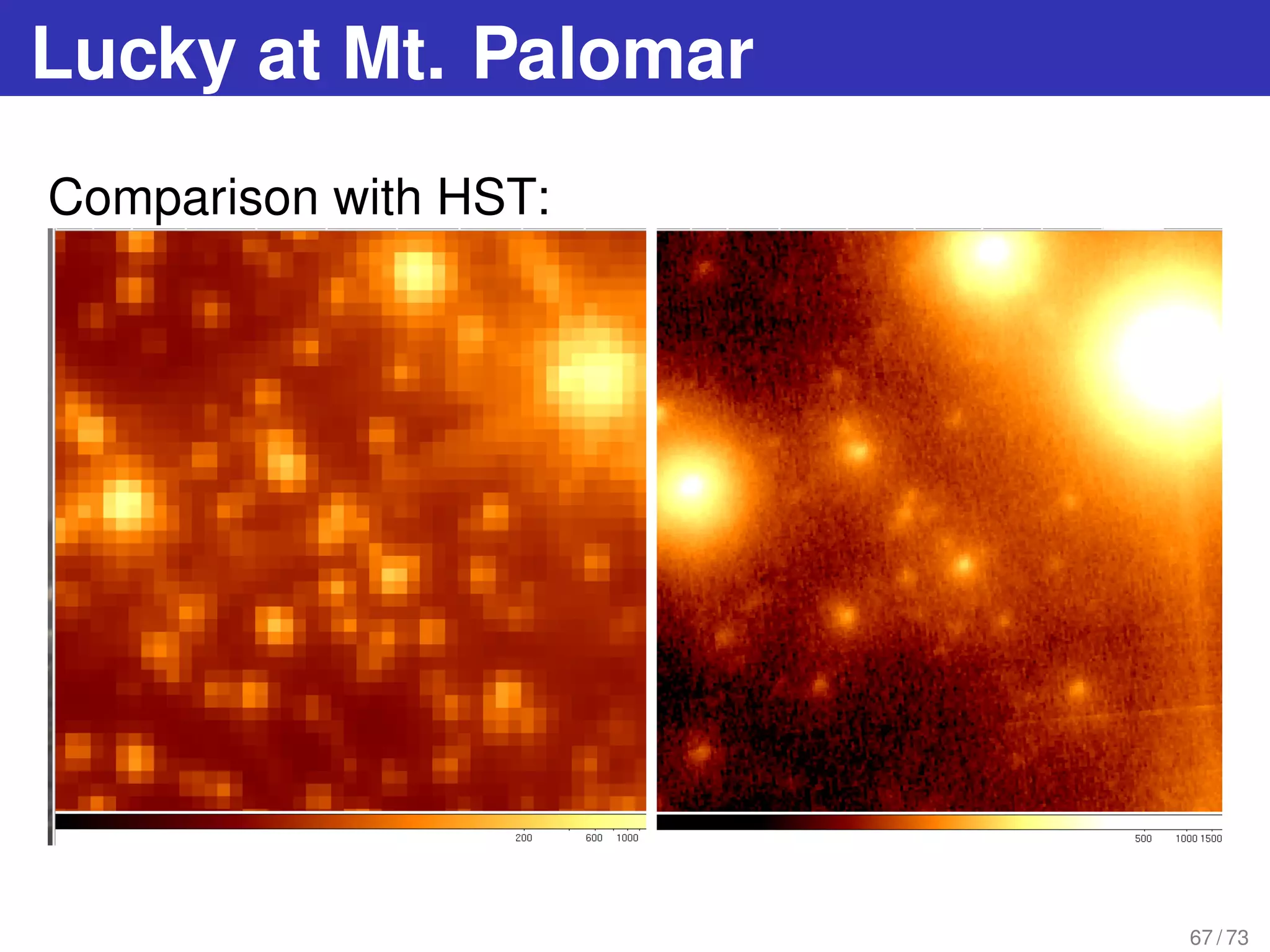
Lucky at Mt. Palomar
Comparison with HST:
67 / 73
Lucky + AO: Applications
Probing binarity in GC cores
68 / 73
Lucky + AO: Applications
Probing binarity in GC cores
Exoplanet direct imaging (See e.g Gladysz
2010)
69 / 73
Lucky + AO: Applications
Probing binarity in GC cores
Exoplanet direct imaging (See e.g Gladysz
2010)
Resolving close stars (Kervella 2009)
70 / 73
Lucky + AO: Applications
Probing binarity in GC cores
Exoplanet direct imaging (See e.g Gladysz
2010)
Resolving close stars (Kervella 2009)
Cheap visible wavelength AO on 4m class
telescopes
71 / 73
Lucky + AO: Applications
Probing binarity in GC cores
Exoplanet direct imaging (See e.g Gladysz
2010)
Resolving close stars (Kervella 2009)
Cheap visible wavelength AO on 4m class
telescopes
Expanding AO sky coverage
72 / 73
Summary
Standard lucky imaging can now go wide and
faint
This gives HST class capabilities at very low
cost
EMCCD’s are pretty good and still improving
AO astronomers should consider fast imaging to
get the most from their systems
73 / 73

Lucky imaging - Life in the visible after HST

  • 1.
    Lucky Imaging Life inthe visible after HST Tim Staley Southampton Seminar Series February 2012 WWW: timstaley.co.uk 1 / 73
  • 2.
    Outline 1 Atmospheric effects 2High spatial resolution astronomy 3 Adaptive optics 4 Lucky imaging 5 Lucky imaging + AO 2 / 73
  • 3.
    Outline 1 Atmospheric effects 2High spatial resolution astronomy 3 Adaptive optics 4 Lucky imaging 5 Lucky imaging + AO 3 / 73
  • 4.
  • 5.
  • 6.
  • 7.
  • 8.
  • 9.
    Wavefront perturbations Perturbed wavefronts: Resolution∝ λ r0 (long exposure on a large telescope) 9 / 73
  • 10.
    10 / 73GOODSNorth, Subaru @ 0.8” seeing Hubble UDF
  • 11.
    Outline 1 Atmospheric effects 2High spatial resolution astronomy 3 Adaptive optics 4 Lucky imaging 5 Lucky imaging + AO 11 / 73
  • 12.
  • 13.
  • 14.
    Exoplanets Keck II -AO using angular differential imaging 14 / 73 HR8799 — Marois et al., 2010
  • 15.
    Globular clusters 15 /73 HST mosaic of M53 (spot the blue stragglers!)
  • 16.
  • 17.
    The cost ofspace astronomy HST: ≈ $2 billion at launch (1990) $9.6 billion lifetime cost, including servicing missions 17 / 73 Image: ESA Source: NY Times: “Refurbishments Complete, Astronauts Let Go of Hubble”
  • 18.
    Ground based astronomy VLT: $330Me to build $16.9 Me annual running costs ‘Expensive’ is relative 18 / 73 Image: ESA Source: www.eso.org
  • 19.
    Outline 1 Atmospheric effects 2High spatial resolution astronomy 3 Adaptive optics 4 Lucky imaging 5 Lucky imaging + AO 19 / 73
  • 20.
    AO: The basicidea 20 / 73
  • 21.
    Guide stars andsky coverage Isoplanatic patch = area for which perturbations roughly the same Require rmag ≤ 10 star within 5” – 40”, depending on observation wavelength and atmospheric conditions 21 / 73 See e.g. Racine, 2006
  • 22.
    Laser guide stars 22/ 73 Image: G. Hudepohl / ESO
  • 23.
    Laser guide stars 23/ 73 Image: R. Tyson - An introduction to AO (2000)
  • 24.
    Laser guide stars Stillrequire a tip-tilt NGS of rmag ≤ 14 within ≈ 40” of science target. Good quality sky coverage ≈ 10% at 30◦ galactic latitude. (Strehl ≥ 0.3, J band) 24 / 73 Davies et al., 2008 Ellerbroek and Tyler, 1998
  • 25.
    (Strehl?) The ratio ofpeak intensity compared to a perfect telescope (0 to 1) HST Strehl near 1, but suffers pixellation effects. AO Strehl usually varies from around 0.2 – 0.6 Seeing “Strehl” depends on the telescope, but is typically ≈ 0.01 on medium size telescopes in the visible. 25 / 73
  • 26.
    Outline 1 Atmospheric effects 2High spatial resolution astronomy 3 Adaptive optics 4 Lucky imaging 5 Lucky imaging + AO 26 / 73
  • 27.
    Seeing isn’t stable Howoften will we get a ‘good’ frame? 27 / 73
  • 28.
    Fried’s probabilities Probability ofa lucky exposure (near diffraction limited): P ≈ 5.6 exp − 0.1557(D/r0)2 28 / 73 Fried, 1978
  • 29.
    Fried’s probabilities D/r0 Probability 20.986 ± 0.006 3 0.765 ± 0.005 4 0.334 ± 0.014 5 (9.38 ± 0.33) × 10−2 6 (1.915 ± 0.084) × 10−2 7 (2.87 ± 0.57) × 10−3 10 (1.07 ± 0.48) × 10−6 15 (3.40 ± 0.59) × 10−15 29 / 73 Fried, 1978
  • 30.
    How to takeadvantage of this? Cross-correlate speckle image with an Airy psf model Cross-correlation values provide a proxy for Strehl Cross-correlation positions give a good estimate of brightest speckle Select desired frames, then shift and add. 30 / 73
  • 31.
  • 32.
    Early tests 2.5m NordicOptical Telescope 512 sq. pixel detector 185Hz frame rate 810nm observing wavelength Faint limit at 6th magnitude 32 / 73
  • 33.
    Early tests Seeing width≈ 0.4” 33 / 73 Baldwin et al., 2001
  • 34.
    Early tests ζ Bootis,Seeing width ≈ 0.8” 34 / 73 Baldwin et al., 2001
  • 35.
    Fast imaging withEMCCD’s 35 / 73 Cost: Around £15K
  • 36.
    Fast imaging withEMCCD’s Conventional CCD: SNR= M√ M+σ2 N EMCCD: SNR= M√ 2M+(σN /gA)2 36 / 73
  • 37.
    Fast imaging withEMCCD’s Calibration: 37 / 73
  • 38.
    Fast imaging withEMCCD’s Calibration: 38 / 73
  • 39.
    Fast imaging withEMCCD’s Calibration: 39 / 73
  • 40.
    Fast imaging withEMCCD’s Limited pixel size, 1K2 Can only get 30 sq. arcseconds Nyquist sampled on 2.5m telescope. Readout electronics are a bottleneck on the frame rate 40 / 73
  • 41.
    2009 — LuckyCamgoes wide field 41 / 73
  • 42.
    2009 — LuckyCamgoes wide field 42 / 73
  • 43.
    2009 — LuckyCamgoes wide field 43 / 73
  • 44.
    2009 — LuckyCamgoes wide field 44 / 73
  • 45.
    2009 — LuckyCamgoes wide field 45 / 73
  • 46.
    Wide fields ofview: M13 120 x 30 arcsecond FoV @ 33mas per pixel Challenging data storage and processing requirements Astrometric calibration is non-trivial 46 / 73
  • 47.
    Wide fields ofview: M13 Zoom — 6.7 arcseconds across this FoV Conventional imaging 50% frame selection 47 / 73
  • 48.
    Wide fields ofview: M13 0 10 20 30 40 50 60 Distance from guide star in arcseconds 100 200 300 400 500 FWHMinmilliarcseconds 10% selection 100% selection Seeing FWHM 48 / 73
  • 49.
    Guiding on afaint reference: the Einstein cross Guiding on a 17th mag. star — FWHM≈ 0.1” 49 / 73
  • 50.
    Science at thefaint limit: thresholding Read out noise still 0.1 electrons. Faint limit around 23rd magnitude on a 2.5m telescope (good seeing) Thresholding eliminates read noise But for now we are limited by CIC 50 / 73
  • 51.
    Science at thefaint limit: thresholding 51 / 73
  • 52.
    Science at thefaint limit: thresholding 52 / 73
  • 53.
  • 54.
    Applications High resolution surveys(e.g. microlensing in crowded field) 54 / 73
  • 55.
    Applications High resolution surveys(e.g. microlensing in crowded field) Cheap high resolution follow-up (stellar transits, etc) 55 / 73
  • 56.
    Applications High resolution surveys(e.g. microlensing in crowded field) Cheap high resolution follow-up (stellar transits, etc) Planetary imaging 56 / 73
  • 57.
    Applications High resolution surveys(e.g. microlensing in crowded field) Cheap high resolution follow-up (stellar transits, etc) Planetary imaging Potentially better faint limits that conventional imagers in future? (esp. for bright sky) 57 / 73
  • 58.
    Applications High resolution surveys(e.g. microlensing in crowded field) Cheap high resolution follow-up (stellar transits, etc) Planetary imaging Potentially better faint limits that conventional imagers in future? (esp. for bright sky) But still limited to smaller telescopes. 58 / 73
  • 59.
    Outline 1 Atmospheric effects 2High spatial resolution astronomy 3 Adaptive optics 4 Lucky imaging 5 Lucky imaging + AO 59 / 73
  • 60.
    Lucky + AO Adaptiveoptics systems are not stable. 60 / 73 Gladysz et al., 2008
  • 61.
    Lucky + AO 61/ 73 Gladysz et al., 2008
  • 62.
    Lucky + AO 62/ 73 Gladysz et al., 2008
  • 63.
    Lucky at Mt.Palomar 63 / 73 Law et al., 2009
  • 64.
    Lucky at Mt.Palomar 5m Palomar “200 inch” Hale telescope 512 sq. pixel EMCCD detector First generation AO system (since upgraded) 64 / 73 Law et al., 2009
  • 65.
    Lucky at Mt.Palomar Field of view: 65 / 73
  • 66.
    Lucky at Mt.Palomar Comparison with HST: 66 / 73
  • 67.
    Lucky at Mt.Palomar Comparison with HST: 67 / 73
  • 68.
    Lucky + AO:Applications Probing binarity in GC cores 68 / 73
  • 69.
    Lucky + AO:Applications Probing binarity in GC cores Exoplanet direct imaging (See e.g Gladysz 2010) 69 / 73
  • 70.
    Lucky + AO:Applications Probing binarity in GC cores Exoplanet direct imaging (See e.g Gladysz 2010) Resolving close stars (Kervella 2009) 70 / 73
  • 71.
    Lucky + AO:Applications Probing binarity in GC cores Exoplanet direct imaging (See e.g Gladysz 2010) Resolving close stars (Kervella 2009) Cheap visible wavelength AO on 4m class telescopes 71 / 73
  • 72.
    Lucky + AO:Applications Probing binarity in GC cores Exoplanet direct imaging (See e.g Gladysz 2010) Resolving close stars (Kervella 2009) Cheap visible wavelength AO on 4m class telescopes Expanding AO sky coverage 72 / 73
  • 73.
    Summary Standard lucky imagingcan now go wide and faint This gives HST class capabilities at very low cost EMCCD’s are pretty good and still improving AO astronomers should consider fast imaging to get the most from their systems 73 / 73