TELESCOPES
TELESCOPE
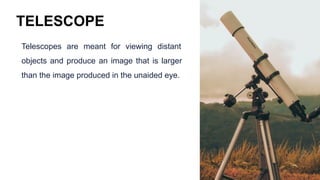
Telescopes are meant for viewing distant
objects and produce an image that is larger
than the image produced in the unaided eye.
BRIEF HISTORY OF
TELESCOPES
BRIEF HISTORY OF TELESCOPES
1 1350-1450
Invention of convex and concave lenses lays the groundwork for telescopes..
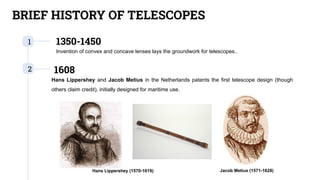
2 1608
Hans Lippershey and Jacob Metius in the Netherlands patents the first telescope design (though
others claim credit), initially designed for maritime use.
Hans Lippershey (1570-1619) Jacob Metius (1571-1628)
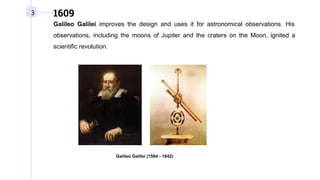
3 1609
Galileo Galilei improves the design and uses it for astronomical observations. His
observations, including the moons of Jupiter and the craters on the Moon, ignited a
scientific revolution.
Galileo Galilei (1564 - 1642)
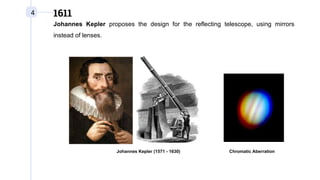
4 1611
Johannes Kepler proposes the design for the reflecting telescope, using mirrors
instead of lenses.
Johannes Kepler (1571 - 1630) Chromatic Aberration
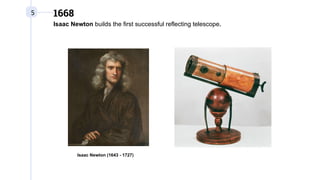
5 1668
Isaac Newton builds the first successful reflecting telescope.
Isaac Newton (1643 - 1727)
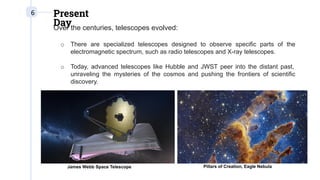
6 Present
Day
Over the centuries, telescopes evolved:
o There are specialized telescopes designed to observe specific parts of the
electromagnetic spectrum, such as radio telescopes and X-ray telescopes.
o Today, advanced telescopes like Hubble and JWST peer into the distant past,
unraveling the mysteries of the cosmos and pushing the frontiers of scientific
discovery.
James Webb Space Telescope Pillars of Creation, Eagle Nebula
REFRACTING VS REFLECTING
TELESCOPES
REFRACTING TELESCOPES
REFRACTI
NG
TELESCOPE
S
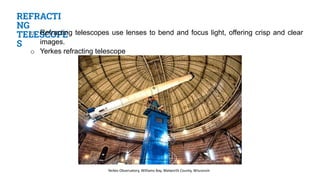
o Refracting telescopes use lenses to bend and focus light, offering crisp and clear
images.
o Yerkes refracting telescope
Yerkes Observatory, Williams Bay, Walworth County, Wisconsin
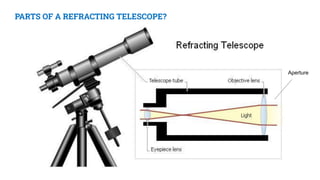
PARTS OF A REFRACTING TELESCOPE?
Aperture
HOW DOES IT WORK?
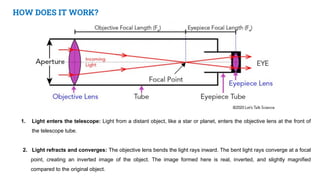
1. Light enters the telescope: Light from a distant object, like a star or planet, enters the objective lens at the front of
the telescope tube.
2. Light refracts and converges: The objective lens bends the light rays inward. The bent light rays converge at a focal
point, creating an inverted image of the object. The image formed here is real, inverted, and slightly magnified
compared to the original object.
HOW DOES IT WORK?
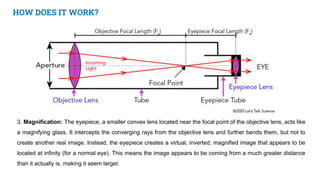
3. Magnification: The eyepiece, a smaller convex lens located near the focal point of the objective lens, acts like
a magnifying glass. It intercepts the converging rays from the objective lens and further bends them, but not to
create another real image. Instead, the eyepiece creates a virtual, inverted, magnified image that appears to be
located at infinity (for a normal eye). This means the image appears to be coming from a much greater distance
than it actually is, making it seem larger.
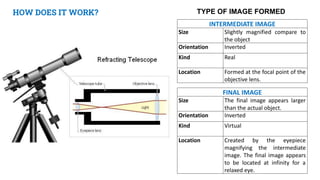
TYPE OF IMAGE FORMED
HOW DOES IT WORK?
FINAL IMAGE
Size The final image appears larger
than the actual object.
Orientation Inverted
Kind Virtual
Location Created by the eyepiece
magnifying the intermediate
image. The final image appears
to be located at infinity for a
relaxed eye.
INTERMEDIATE IMAGE
Size Slightly magnified compare to
the object
Orientation Inverted
Kind Real
Location Formed at the focal point of the
objective lens.
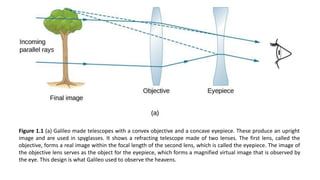
Figure 1.1 (a) Galileo made telescopes with a convex objective and a concave eyepiece. These produce an upright
image and are used in spyglasses. It shows a refracting telescope made of two lenses. The first lens, called the
objective, forms a real image within the focal length of the second lens, which is called the eyepiece. The image of
the objective lens serves as the object for the eyepiece, which forms a magnified virtual image that is observed by
the eye. This design is what Galileo used to observe the heavens.
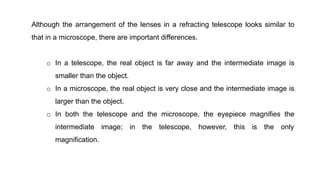
Although the arrangement of the lenses in a refracting telescope looks similar to
that in a microscope, there are important differences.
o In a telescope, the real object is far away and the intermediate image is
smaller than the object.
o In a microscope, the real object is very close and the intermediate image is
larger than the object.
o In both the telescope and the microscope, the eyepiece magnifies the
intermediate image; in the telescope, however, this is the only
magnification.
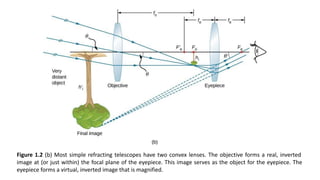
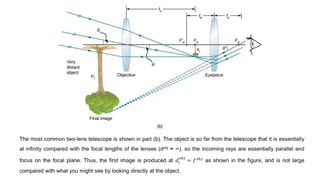
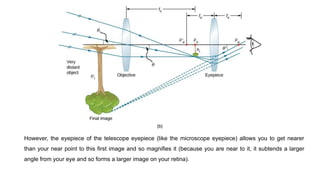
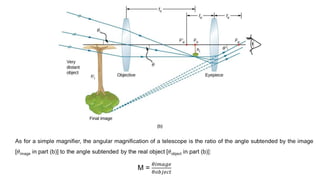
Figure 1.2 (b) Most simple refracting telescopes have two convex lenses. The objective forms a real, inverted
image at (or just within) the focal plane of the eyepiece. This image serves as the object for the eyepiece. The
eyepiece forms a virtual, inverted image that is magnified.
However, the eyepiece of the telescope eyepiece (like the microscope eyepiece) allows you to get nearer
than your near point to this first image and so magnifies it (because you are near to it, it subtends a larger
angle from your eye and so forms a larger image on your retina).
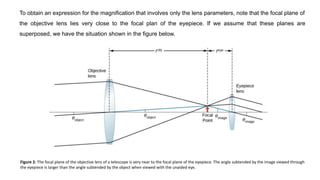
To obtain an expression for the magnification that involves only the lens parameters, note that the focal plane of
the objective lens lies very close to the focal plan of the eyepiece. If we assume that these planes are
superposed, we have the situation shown in the figure below.
Figure 2: The focal plane of the objective lens of a telescope is very near to the focal plane of the eyepiece. The angle subtended by the image viewed through
the eyepiece is larger than the angle subtended by the object when viewed with the unaided eye.
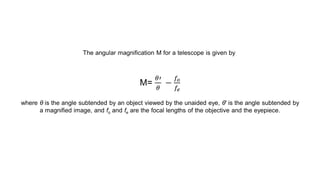
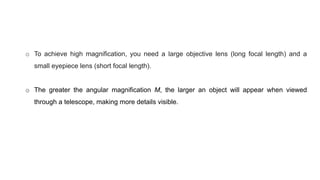
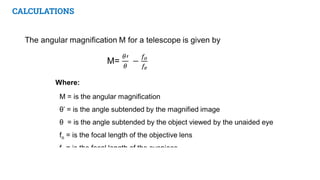
o To achieve high magnification, you need a large objective lens (long focal length) and a
small eyepiece lens (short focal length).
o The greater the angular magnification M, the larger an object will appear when viewed
through a telescope, making more details visible.
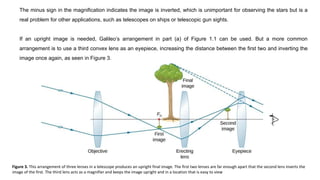
The minus sign in the magnification indicates the image is inverted, which is unimportant for observing the stars but is a
real problem for other applications, such as telescopes on ships or telescopic gun sights.
If an upright image is needed, Galileo’s arrangement in part (a) of Figure 1.1 can be used. But a more common
arrangement is to use a third convex lens as an eyepiece, increasing the distance between the first two and inverting the
image once again, as seen in Figure 3.
Figure 3. This arrangement of three lenses in a telescope produces an upright final image. The first two lenses are far enough apart that the second lens inverts the
image of the first. The third lens acts as a magnifier and keeps the image upright and in a location that is easy to view
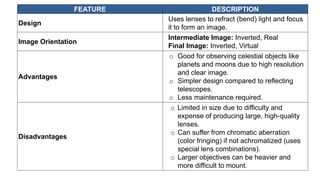
FEATURE DESCRIPTION
Design
Uses lenses to refract (bend) light and focus
it to form an image.
Image Orientation
Intermediate Image: Inverted, Real
Final Image: Inverted, Virtual
Advantages
o Good for observing celestial objects like
planets and moons due to high resolution
and clear image.
o Simpler design compared to reflecting
telescopes.
o Less maintenance required.
Disadvantages
o Limited in size due to difficulty and
expense of producing large, high-quality
lenses.
o Can suffer from chromatic aberration
(color fringing) if not achromatized (uses
special lens combinations).
o Larger objectives can be heavier and
more difficult to mount.
CALCULATIONS
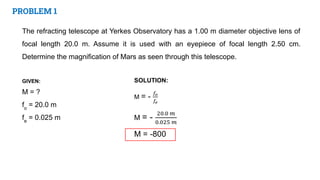
PROBLEM 1
The refracting telescope at Yerkes Observatory has a 1.00 m diameter objective lens of
focal length 20.0 m. Assume it is used with an eyepiece of focal length 2.50 cm.
Determine the magnification of Mars as seen through this telescope.
GIVEN:
M = ?
fo
= 20.0 m
fe
= 0.025 m
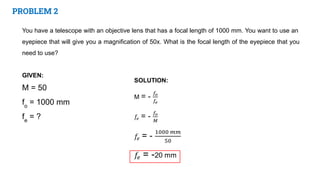
PROBLEM 2
You have a telescope with an objective lens that has a focal length of 1000 mm. You want to use an
eyepiece that will give you a magnification of 50x. What is the focal length of the eyepiece that you
need to use?
GIVEN:
M = 50
fo
= 1000 mm
fe
= ?
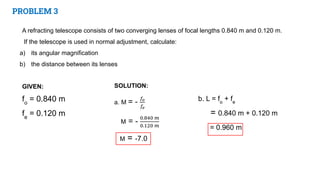
PROBLEM 3
A refracting telescope consists of two converging lenses of focal lengths 0.840 m and 0.120 m.
If the telescope is used in normal adjustment, calculate:
a) its angular magnification
b) the distance between its lenses
GIVEN:
fo
= 0.840 m
fe
= 0.120 m
b. L = fo
+ fe
= 0.840 m + 0.120 m
= 0.960 m
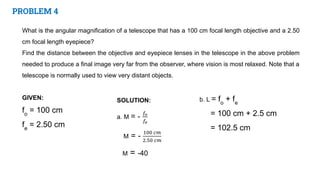
PROBLEM 4
What is the angular magnification of a telescope that has a 100 cm focal length objective and a 2.50
cm focal length eyepiece?
Find the distance between the objective and eyepiece lenses in the telescope in the above problem
needed to produce a final image very far from the observer, where vision is most relaxed. Note that a
telescope is normally used to view very distant objects.
GIVEN:
fo
= 100 cm
fe
= 2.50 cm
b. L = fo
+ fe
= 100 cm + 2.5 cm
= 102.5 cm
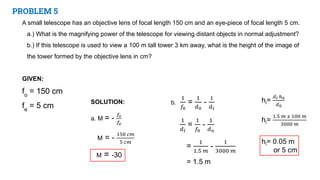
PROBLEM 5
A small telescope has an objective lens of focal length 150 cm and an eye-piece of focal length 5 cm.
a.) What is the magnifying power of the telescope for viewing distant objects in normal adjustment?
b.) If this telescope is used to view a 100 m tall tower 3 km away, what is the height of the image of
the tower formed by the objective lens in cm?
GIVEN:
fo
= 150 cm
fe
= 5 cm
REFLECTING TELESCOPES
REFLECTIN
G
TELESCOPE
S
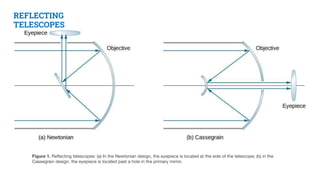
o Reflecting telescopes use mirrors to gather and focus light, providing high-resolution
views.
o Reflectors have two mirrors.
― The primary mirror is the big curved mirror at the back of the tube that begins to
focus the light.
― The secondary mirror is the smaller mirror at the front of the tube. It redirects the
light towards your eye.
o Two types:
― Newtonian design: Diagonal mirror reflects light to side for eyepiece viewing
(common in amateur telescopes).
― Cassegrain design: Convex mirror reflects light back through a hole in the main
mirror to the eyepiece (used in major telescopes like Hubble).
REFLECTING
TELESCOPES
Figure 1. Reflecting telescopes: (a) In the Newtonian design, the eyepiece is located at the side of the telescope; (b) in the
Cassegrain design, the eyepiece is located past a hole in the primary mirror.
PARTS OF A NEWTONIAN REFLECTING
TELESCOPE
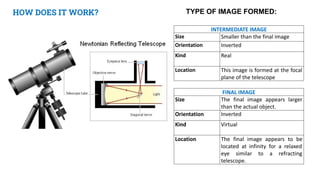
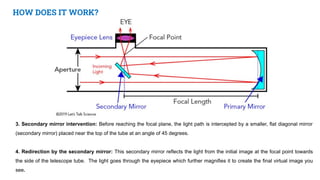
HOW DOES IT WORK?
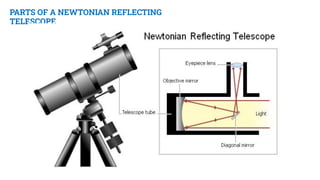
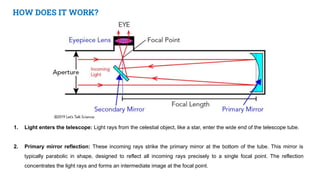
1. Light enters the telescope: Light rays from the celestial object, like a star, enter the wide end of the telescope tube.
2. Primary mirror reflection: These incoming rays strike the primary mirror at the bottom of the tube. This mirror is
typically parabolic in shape, designed to reflect all incoming rays precisely to a single focal point. The reflection
concentrates the light rays and forms an intermediate image at the focal point.
HOW DOES IT WORK?
3. Secondary mirror intervention: Before reaching the focal plane, the light path is intercepted by a smaller, flat diagonal mirror
(secondary mirror) placed near the top of the tube at an angle of 45 degrees.
4. Redirection by the secondary mirror: This secondary mirror reflects the light from the initial image at the focal point towards
the side of the telescope tube. The light goes through the eyepiece which further magnifies it to create the final virtual image you
see.
TYPE OF IMAGE FORMED:
HOW DOES IT WORK?
FINAL IMAGE
Size The final image appears larger
than the actual object.
Orientation Inverted
Kind Virtual
Location The final image appears to be
located at infinity for a relaxed
eye similar to a refracting
telescope.
INTERMEDIATE IMAGE
Size Smaller than the final image
Orientation Inverted
Kind Real
Location This image is formed at the focal
plane of the telescope
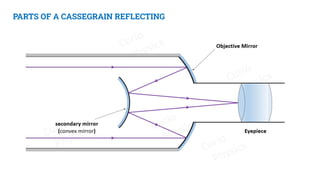
PARTS OF A CASSEGRAIN REFLECTING
TELESCOPE
HOW DOES IT WORK?
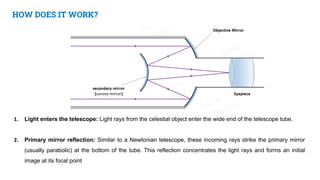
1. Light enters the telescope: Light rays from the celestial object enter the wide end of the telescope tube.
2. Primary mirror reflection: Similar to a Newtonian telescope, these incoming rays strike the primary mirror
(usually parabolic) at the bottom of the tube. This reflection concentrates the light rays and forms an initial
image at its focal point
HOW DOES IT WORK?
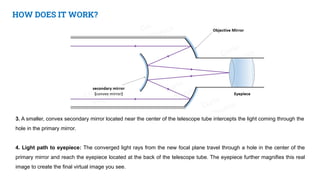
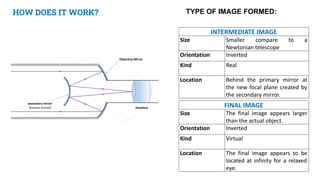
3. A smaller, convex secondary mirror located near the center of the telescope tube intercepts the light coming through the
hole in the primary mirror.
4. Light path to eyepiece: The converged light rays from the new focal plane travel through a hole in the center of the
primary mirror and reach the eyepiece located at the back of the telescope tube. The eyepiece further magnifies this real
image to create the final virtual image you see.
TYPE OF IMAGE FORMED:
HOW DOES IT WORK?
FINAL IMAGE
Size The final image appears larger
than the actual object.
Orientation Inverted
Kind Virtual
Location The final image appears to be
located at infinity for a relaxed
eye.
INTERMEDIATE IMAGE
Size Smaller compare to a
Newtonian telescope
Orientation Inverted
Kind Real
Location Behind the primary mirror at
the new focal plane created by
the secondary mirror.
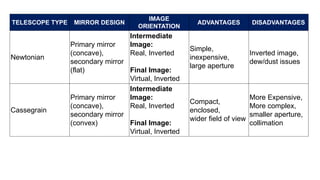
TELESCOPE TYPE MIRROR DESIGN
IMAGE
ORIENTATION
ADVANTAGES DISADVANTAGES
Newtonian
Primary mirror
(concave),
secondary mirror
(flat)
Intermediate
Image:
Real, Inverted
Final Image:
Virtual, Inverted
Simple,
inexpensive,
large aperture
Inverted image,
dew/dust issues
Cassegrain
Primary mirror
(concave),
secondary mirror
(convex)
Intermediate
Image:
Real, Inverted
Final Image:
Virtual, Inverted
Compact,
enclosed,
wider field of view
More Expensive,
More complex,
smaller aperture,
collimation
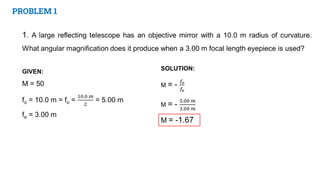
PROBLEM 1
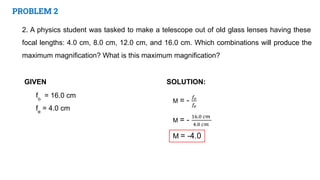
PROBLEM 2
2. A physics student was tasked to make a telescope out of old glass lenses having these
focal lengths: 4.0 cm, 8.0 cm, 12.0 cm, and 16.0 cm. Which combinations will produce the
maximum magnification? What is this maximum magnification?
GIVEN SOLUTION:
fo
= 16.0 cm
fe
= 4.0 cm
Quiz
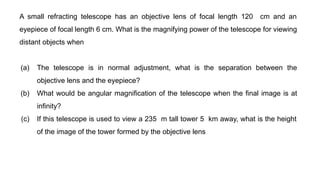
A small refracting telescope has an objective lens of focal length 120 cm and an
eyepiece of focal length 6 cm. What is the magnifying power of the telescope for viewing
distant objects when
(a) The telescope is in normal adjustment, what is the separation between the
objective lens and the eyepiece?
(b) What would be angular magnification of the telescope when the final image is at
infinity?
(c) If this telescope is used to view a 235 m tall tower 5 km away, what is the height
of the image of the tower formed by the objective lens
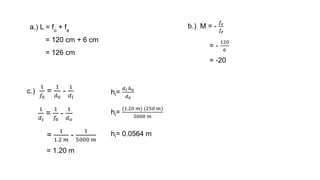
a.) L = fo
+ fe
= 120 cm + 6 cm
= 126 cm
END OF DISCUSSION
REFERENCES
[1] GmbH, N. (n.d.). Magnification.
https://www.astroshop.eu/magazine/information/telescope-information/the-right-telescop
e/magnification/i,1063
[2] Ling, S. J., Sanny, J., & Moebs, W. (n.d.). 2.8 microscopes and telescopes - university physics
volume 3. OpenStax.
https://openstax.org/books/university-physics-volume-3/pages/2-8-microscopes-and-telesc
opes
[3] Refracting telescopes. Refracting Telescopes - an overview | ScienceDirect Topics. (n.d.).
https://www.sciencedirect.com/topics/physics-and-astronomy/refracting-telescopes
[4] Reflecting telescopes. Las Cumbres Observatory. (n.d.-b).
https://lco.global/spacebook/telescopes/reflecting-telescopes/
[5] Encyclopædia Britannica, inc. (n.d.). Cassegrain reflector. Encyclopædia Britannica.
REFERENCES
[6] Optical telescopes | let’s talk science. (n.d.).
https://letstalkscience.ca/educational-resources/backgrounders/optical-telescopes
[7] YouTube. (2014a, January 26). Refracting telescope example. YouTube.
https://www.youtube.com/watch?v=aGbdfn8qj0Y
[8] How to calculate telescope magnification. YouTube. (2016, November 18).
https://youtu.be/IVqJLY5pJuI
[9] A cosmic journey: A history of scientific cosmology. Niels Bohr Library & Archives. (n.d.).
https://history.aip.org/exhibits/cosmology/tools/tools-first-telescopes.htm

TELESCOPES (Reflecting and Refracting) - Physics

  • 1.
  • 2.
    TELESCOPE Telescopes are meantfor viewing distant objects and produce an image that is larger than the image produced in the unaided eye.
  • 3.
  • 4.
    BRIEF HISTORY OFTELESCOPES 1 1350-1450 Invention of convex and concave lenses lays the groundwork for telescopes.. 2 1608 Hans Lippershey and Jacob Metius in the Netherlands patents the first telescope design (though others claim credit), initially designed for maritime use. Hans Lippershey (1570-1619) Jacob Metius (1571-1628)
  • 5.
    3 1609 Galileo Galileiimproves the design and uses it for astronomical observations. His observations, including the moons of Jupiter and the craters on the Moon, ignited a scientific revolution. Galileo Galilei (1564 - 1642)
  • 6.
    4 1611 Johannes Keplerproposes the design for the reflecting telescope, using mirrors instead of lenses. Johannes Kepler (1571 - 1630) Chromatic Aberration
  • 7.
    5 1668 Isaac Newtonbuilds the first successful reflecting telescope. Isaac Newton (1643 - 1727)
  • 8.
    6 Present Day Over thecenturies, telescopes evolved: o There are specialized telescopes designed to observe specific parts of the electromagnetic spectrum, such as radio telescopes and X-ray telescopes. o Today, advanced telescopes like Hubble and JWST peer into the distant past, unraveling the mysteries of the cosmos and pushing the frontiers of scientific discovery. James Webb Space Telescope Pillars of Creation, Eagle Nebula
  • 9.
  • 10.
  • 11.
    REFRACTI NG TELESCOPE S o Refracting telescopesuse lenses to bend and focus light, offering crisp and clear images. o Yerkes refracting telescope Yerkes Observatory, Williams Bay, Walworth County, Wisconsin
  • 12.
    PARTS OF AREFRACTING TELESCOPE? Aperture
  • 13.
    HOW DOES ITWORK? 1. Light enters the telescope: Light from a distant object, like a star or planet, enters the objective lens at the front of the telescope tube. 2. Light refracts and converges: The objective lens bends the light rays inward. The bent light rays converge at a focal point, creating an inverted image of the object. The image formed here is real, inverted, and slightly magnified compared to the original object.
  • 14.
    HOW DOES ITWORK? 3. Magnification: The eyepiece, a smaller convex lens located near the focal point of the objective lens, acts like a magnifying glass. It intercepts the converging rays from the objective lens and further bends them, but not to create another real image. Instead, the eyepiece creates a virtual, inverted, magnified image that appears to be located at infinity (for a normal eye). This means the image appears to be coming from a much greater distance than it actually is, making it seem larger.
  • 15.
    TYPE OF IMAGEFORMED HOW DOES IT WORK? FINAL IMAGE Size The final image appears larger than the actual object. Orientation Inverted Kind Virtual Location Created by the eyepiece magnifying the intermediate image. The final image appears to be located at infinity for a relaxed eye. INTERMEDIATE IMAGE Size Slightly magnified compare to the object Orientation Inverted Kind Real Location Formed at the focal point of the objective lens.
  • 16.
    Figure 1.1 (a)Galileo made telescopes with a convex objective and a concave eyepiece. These produce an upright image and are used in spyglasses. It shows a refracting telescope made of two lenses. The first lens, called the objective, forms a real image within the focal length of the second lens, which is called the eyepiece. The image of the objective lens serves as the object for the eyepiece, which forms a magnified virtual image that is observed by the eye. This design is what Galileo used to observe the heavens.
  • 17.
    Although the arrangementof the lenses in a refracting telescope looks similar to that in a microscope, there are important differences. o In a telescope, the real object is far away and the intermediate image is smaller than the object. o In a microscope, the real object is very close and the intermediate image is larger than the object. o In both the telescope and the microscope, the eyepiece magnifies the intermediate image; in the telescope, however, this is the only magnification.
  • 18.
    Figure 1.2 (b)Most simple refracting telescopes have two convex lenses. The objective forms a real, inverted image at (or just within) the focal plane of the eyepiece. This image serves as the object for the eyepiece. The eyepiece forms a virtual, inverted image that is magnified.
  • 20.
    However, the eyepieceof the telescope eyepiece (like the microscope eyepiece) allows you to get nearer than your near point to this first image and so magnifies it (because you are near to it, it subtends a larger angle from your eye and so forms a larger image on your retina).
  • 22.
    To obtain anexpression for the magnification that involves only the lens parameters, note that the focal plane of the objective lens lies very close to the focal plan of the eyepiece. If we assume that these planes are superposed, we have the situation shown in the figure below. Figure 2: The focal plane of the objective lens of a telescope is very near to the focal plane of the eyepiece. The angle subtended by the image viewed through the eyepiece is larger than the angle subtended by the object when viewed with the unaided eye.
  • 24.
    o To achievehigh magnification, you need a large objective lens (long focal length) and a small eyepiece lens (short focal length). o The greater the angular magnification M, the larger an object will appear when viewed through a telescope, making more details visible.
  • 25.
    The minus signin the magnification indicates the image is inverted, which is unimportant for observing the stars but is a real problem for other applications, such as telescopes on ships or telescopic gun sights. If an upright image is needed, Galileo’s arrangement in part (a) of Figure 1.1 can be used. But a more common arrangement is to use a third convex lens as an eyepiece, increasing the distance between the first two and inverting the image once again, as seen in Figure 3. Figure 3. This arrangement of three lenses in a telescope produces an upright final image. The first two lenses are far enough apart that the second lens inverts the image of the first. The third lens acts as a magnifier and keeps the image upright and in a location that is easy to view
  • 26.
    FEATURE DESCRIPTION Design Uses lensesto refract (bend) light and focus it to form an image. Image Orientation Intermediate Image: Inverted, Real Final Image: Inverted, Virtual Advantages o Good for observing celestial objects like planets and moons due to high resolution and clear image. o Simpler design compared to reflecting telescopes. o Less maintenance required. Disadvantages o Limited in size due to difficulty and expense of producing large, high-quality lenses. o Can suffer from chromatic aberration (color fringing) if not achromatized (uses special lens combinations). o Larger objectives can be heavier and more difficult to mount.
  • 27.
  • 28.
    PROBLEM 1 The refractingtelescope at Yerkes Observatory has a 1.00 m diameter objective lens of focal length 20.0 m. Assume it is used with an eyepiece of focal length 2.50 cm. Determine the magnification of Mars as seen through this telescope. GIVEN: M = ? fo = 20.0 m fe = 0.025 m
  • 29.
    PROBLEM 2 You havea telescope with an objective lens that has a focal length of 1000 mm. You want to use an eyepiece that will give you a magnification of 50x. What is the focal length of the eyepiece that you need to use? GIVEN: M = 50 fo = 1000 mm fe = ?
  • 30.
    PROBLEM 3 A refractingtelescope consists of two converging lenses of focal lengths 0.840 m and 0.120 m. If the telescope is used in normal adjustment, calculate: a) its angular magnification b) the distance between its lenses GIVEN: fo = 0.840 m fe = 0.120 m b. L = fo + fe = 0.840 m + 0.120 m = 0.960 m
  • 31.
    PROBLEM 4 What isthe angular magnification of a telescope that has a 100 cm focal length objective and a 2.50 cm focal length eyepiece? Find the distance between the objective and eyepiece lenses in the telescope in the above problem needed to produce a final image very far from the observer, where vision is most relaxed. Note that a telescope is normally used to view very distant objects. GIVEN: fo = 100 cm fe = 2.50 cm b. L = fo + fe = 100 cm + 2.5 cm = 102.5 cm
  • 32.
    PROBLEM 5 A smalltelescope has an objective lens of focal length 150 cm and an eye-piece of focal length 5 cm. a.) What is the magnifying power of the telescope for viewing distant objects in normal adjustment? b.) If this telescope is used to view a 100 m tall tower 3 km away, what is the height of the image of the tower formed by the objective lens in cm? GIVEN: fo = 150 cm fe = 5 cm
  • 33.
  • 34.
    REFLECTIN G TELESCOPE S o Reflecting telescopesuse mirrors to gather and focus light, providing high-resolution views. o Reflectors have two mirrors. ― The primary mirror is the big curved mirror at the back of the tube that begins to focus the light. ― The secondary mirror is the smaller mirror at the front of the tube. It redirects the light towards your eye. o Two types: ― Newtonian design: Diagonal mirror reflects light to side for eyepiece viewing (common in amateur telescopes). ― Cassegrain design: Convex mirror reflects light back through a hole in the main mirror to the eyepiece (used in major telescopes like Hubble).
  • 35.
    REFLECTING TELESCOPES Figure 1. Reflectingtelescopes: (a) In the Newtonian design, the eyepiece is located at the side of the telescope; (b) in the Cassegrain design, the eyepiece is located past a hole in the primary mirror.
  • 36.
    PARTS OF ANEWTONIAN REFLECTING TELESCOPE
  • 37.
    HOW DOES ITWORK? 1. Light enters the telescope: Light rays from the celestial object, like a star, enter the wide end of the telescope tube. 2. Primary mirror reflection: These incoming rays strike the primary mirror at the bottom of the tube. This mirror is typically parabolic in shape, designed to reflect all incoming rays precisely to a single focal point. The reflection concentrates the light rays and forms an intermediate image at the focal point.
  • 38.
    HOW DOES ITWORK? 3. Secondary mirror intervention: Before reaching the focal plane, the light path is intercepted by a smaller, flat diagonal mirror (secondary mirror) placed near the top of the tube at an angle of 45 degrees. 4. Redirection by the secondary mirror: This secondary mirror reflects the light from the initial image at the focal point towards the side of the telescope tube. The light goes through the eyepiece which further magnifies it to create the final virtual image you see.
  • 39.
    TYPE OF IMAGEFORMED: HOW DOES IT WORK? FINAL IMAGE Size The final image appears larger than the actual object. Orientation Inverted Kind Virtual Location The final image appears to be located at infinity for a relaxed eye similar to a refracting telescope. INTERMEDIATE IMAGE Size Smaller than the final image Orientation Inverted Kind Real Location This image is formed at the focal plane of the telescope
  • 40.
    PARTS OF ACASSEGRAIN REFLECTING TELESCOPE
  • 41.
    HOW DOES ITWORK? 1. Light enters the telescope: Light rays from the celestial object enter the wide end of the telescope tube. 2. Primary mirror reflection: Similar to a Newtonian telescope, these incoming rays strike the primary mirror (usually parabolic) at the bottom of the tube. This reflection concentrates the light rays and forms an initial image at its focal point
  • 42.
    HOW DOES ITWORK? 3. A smaller, convex secondary mirror located near the center of the telescope tube intercepts the light coming through the hole in the primary mirror. 4. Light path to eyepiece: The converged light rays from the new focal plane travel through a hole in the center of the primary mirror and reach the eyepiece located at the back of the telescope tube. The eyepiece further magnifies this real image to create the final virtual image you see.
  • 43.
    TYPE OF IMAGEFORMED: HOW DOES IT WORK? FINAL IMAGE Size The final image appears larger than the actual object. Orientation Inverted Kind Virtual Location The final image appears to be located at infinity for a relaxed eye. INTERMEDIATE IMAGE Size Smaller compare to a Newtonian telescope Orientation Inverted Kind Real Location Behind the primary mirror at the new focal plane created by the secondary mirror.
  • 44.
    TELESCOPE TYPE MIRRORDESIGN IMAGE ORIENTATION ADVANTAGES DISADVANTAGES Newtonian Primary mirror (concave), secondary mirror (flat) Intermediate Image: Real, Inverted Final Image: Virtual, Inverted Simple, inexpensive, large aperture Inverted image, dew/dust issues Cassegrain Primary mirror (concave), secondary mirror (convex) Intermediate Image: Real, Inverted Final Image: Virtual, Inverted Compact, enclosed, wider field of view More Expensive, More complex, smaller aperture, collimation
  • 45.
  • 46.
    PROBLEM 2 2. Aphysics student was tasked to make a telescope out of old glass lenses having these focal lengths: 4.0 cm, 8.0 cm, 12.0 cm, and 16.0 cm. Which combinations will produce the maximum magnification? What is this maximum magnification? GIVEN SOLUTION: fo = 16.0 cm fe = 4.0 cm
  • 47.
  • 48.
    A small refractingtelescope has an objective lens of focal length 120 cm and an eyepiece of focal length 6 cm. What is the magnifying power of the telescope for viewing distant objects when (a) The telescope is in normal adjustment, what is the separation between the objective lens and the eyepiece? (b) What would be angular magnification of the telescope when the final image is at infinity? (c) If this telescope is used to view a 235 m tall tower 5 km away, what is the height of the image of the tower formed by the objective lens
  • 49.
    a.) L =fo + fe = 120 cm + 6 cm = 126 cm
  • 50.
  • 51.
    REFERENCES [1] GmbH, N.(n.d.). Magnification. https://www.astroshop.eu/magazine/information/telescope-information/the-right-telescop e/magnification/i,1063 [2] Ling, S. J., Sanny, J., & Moebs, W. (n.d.). 2.8 microscopes and telescopes - university physics volume 3. OpenStax. https://openstax.org/books/university-physics-volume-3/pages/2-8-microscopes-and-telesc opes [3] Refracting telescopes. Refracting Telescopes - an overview | ScienceDirect Topics. (n.d.). https://www.sciencedirect.com/topics/physics-and-astronomy/refracting-telescopes [4] Reflecting telescopes. Las Cumbres Observatory. (n.d.-b). https://lco.global/spacebook/telescopes/reflecting-telescopes/ [5] Encyclopædia Britannica, inc. (n.d.). Cassegrain reflector. Encyclopædia Britannica.
  • 52.
    REFERENCES [6] Optical telescopes| let’s talk science. (n.d.). https://letstalkscience.ca/educational-resources/backgrounders/optical-telescopes [7] YouTube. (2014a, January 26). Refracting telescope example. YouTube. https://www.youtube.com/watch?v=aGbdfn8qj0Y [8] How to calculate telescope magnification. YouTube. (2016, November 18). https://youtu.be/IVqJLY5pJuI [9] A cosmic journey: A history of scientific cosmology. Niels Bohr Library & Archives. (n.d.). https://history.aip.org/exhibits/cosmology/tools/tools-first-telescopes.htm