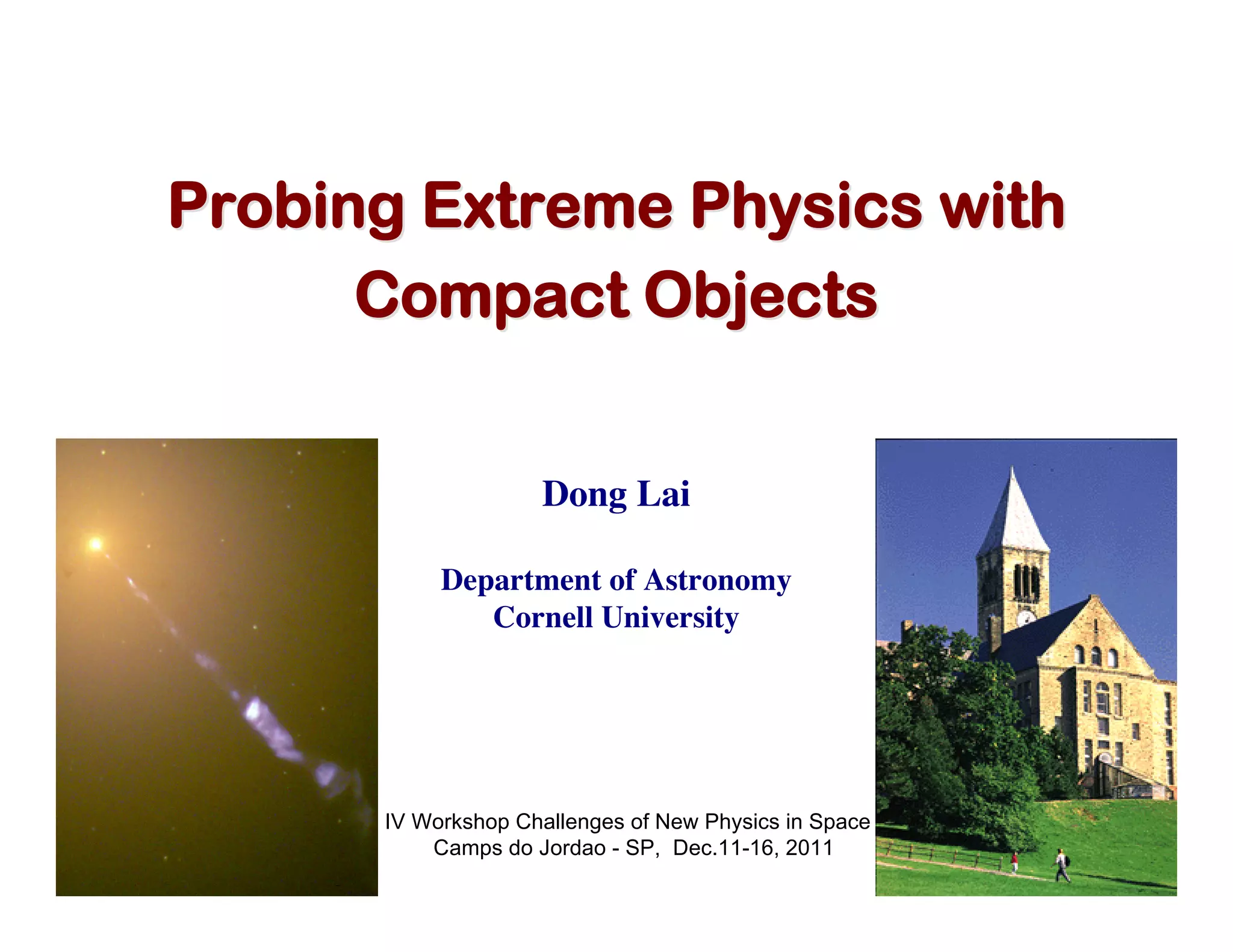
Probing Extreme Physics withProbing Extreme Physics with
Compact ObjectsCompact Objects
Dong Lai
Department of Astronomy
Cornell University
IV Workshop Challenges of New Physics in Space
Camps do Jordao - SP, Dec.11-16, 2011
“Extremes” in Astrophysics:
• Most energetic particles: 1020 eV
• Most energetic photons: 1014 eV
• Highest temperature: Big Bang
• Highest density: neutron stars
• Strongest magnet: magnetars
• Strongest gravity: black holes
•
•
“Extremes” in Astrophysics:
• Most energetic particles: 1020 eV
• Most energetic photons: 1014 eV
• Highest temperature: Big Bang
• Highest density: neutron stars
• Strongest magnet: magnetars
• Strongest gravity: black holes
•
•
Focus of my lectures:
Compact Objects (White Dwarfs, Neutron Stars and Black Holes)
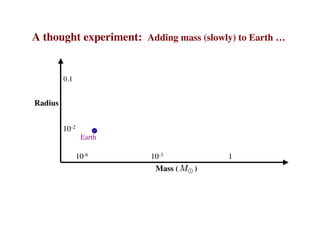
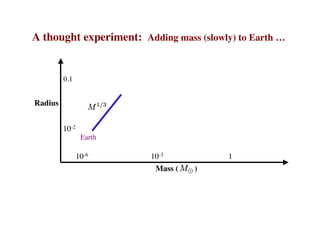
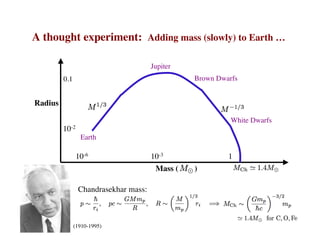
A thought experiment: Adding mass (slowly) to Earth …
Mass ( )
Radius
Earth
10-6 10-3 1
10-2
0.1
A thought experiment: Adding mass (slowly) to Earth …
Mass ( )
Radius
Earth
10-6 10-3 1
10-2
0.1
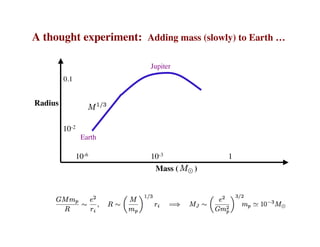
A thought experiment: Adding mass (slowly) to Earth …
Mass ( )
Radius
Earth
Jupiter
10-6 10-3 1
10-2
0.1
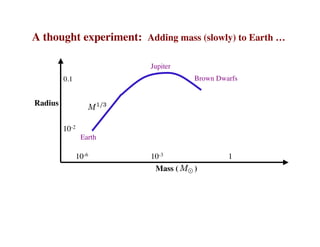
A thought experiment: Adding mass (slowly) to Earth …
Mass ( )
Radius
Earth
Jupiter
10-6 10-3 1
Brown Dwarfs
10-2
0.1
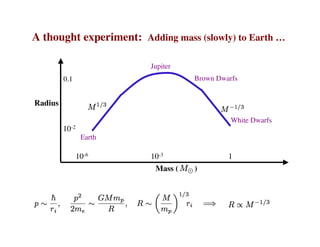
A thought experiment: Adding mass (slowly) to Earth …
Mass ( )
Radius
Earth
Jupiter
White Dwarfs
10-6 10-3 1
Brown Dwarfs
10-2
0.1
A thought experiment: Adding mass (slowly) to Earth …
Mass ( )
Radius
Earth
Jupiter
White Dwarfs
10-6 10-3 1
Brown Dwarfs
10-2
0.1
Chandrasekhar mass:
(1910-1995)
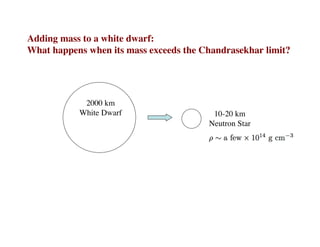
Adding mass to a white dwarf:
What happens when its mass exceeds the Chandrasekhar limit?
2000 km
White Dwarf 10-20 km
Neutron Star
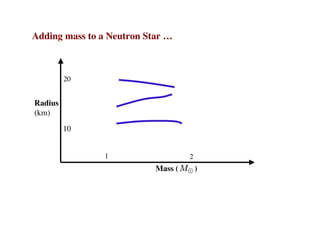
Adding mass to a Neutron Star …
Mass ( )
Radius
(km)
1 2
10
20
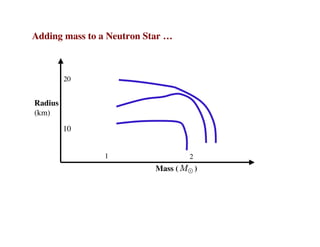
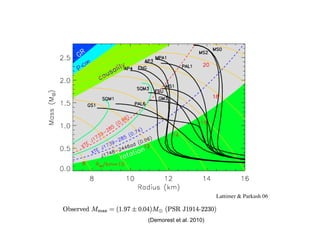
Adding mass to a Neutron Star …
Mass ( )
Radius
(km)
1 2
10
20
Lattimer & Parkash 06
(Demorest et al. 2010)
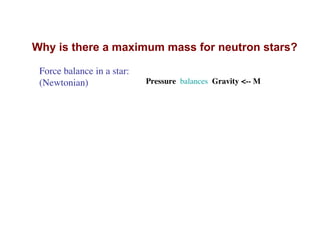
Why is there a maximum mass for neutron stars?
Force balance in a star:
(Newtonian) Pressure balances Gravity <-- M
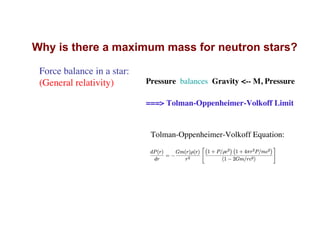
Why is there a maximum mass for neutron stars?
Tolman-Oppenheimer-Volkoff Equation:
Force balance in a star:
(General relativity) Pressure balances Gravity <-- M, Pressure
===> Tolman-Oppenheimer-Volkoff Limit
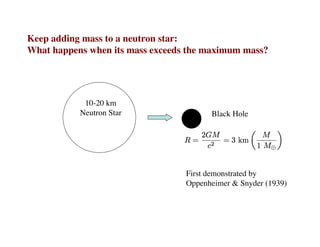
Keep adding mass to a neutron star:
What happens when its mass exceeds the maximum mass?
10-20 km
Neutron Star Black Hole
First demonstrated by
Oppenheimer & Snyder (1939)
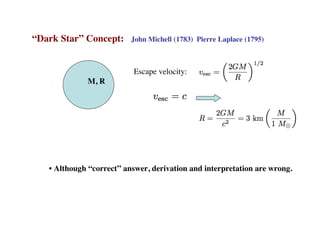
“Dark Star” Concept: John Michell (1783) Pierre Laplace (1795)
M, R
Escape velocity:
• Although “correct” answer, derivation and interpretation are wrong.
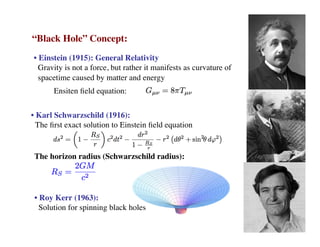
“Black Hole” Concept:
• Einstein (1915): General Relativity
Gravity is not a force, but rather it manifests as curvature of
spacetime caused by matter and energy
• Karl Schwarzschild (1916):
The first exact solution to Einstein field equation
The horizon radius (Schwarzschild radius):
Ensiten field equation:
• Roy Kerr (1963):
Solution for spinning black holes
Formation of Compact Objects in Astrophysics
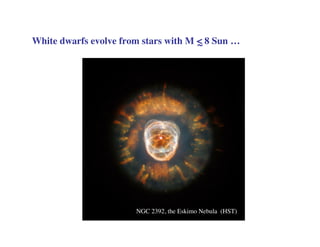
White dwarfs evolve from stars with M < 8 Sun …~
NGC 2392, the Eskimo Nebula (HST)
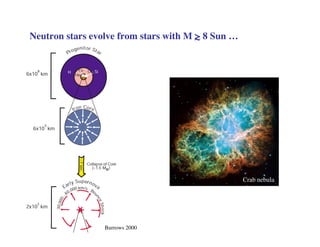
Neutron stars evolve from stars with M > 8 Sun …~
Burrows 2000
Crab nebula
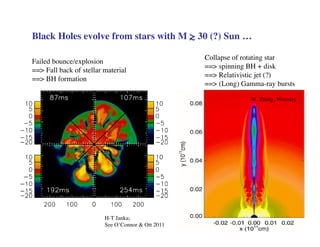
Black Holes evolve from stars with M > 30 (?) Sun …~
W. Zhang, Woosley
H-T Janka;
See O’Connor & Ott 2011
Failed bounce/explosion
==> Fall back of stellar material
==> BH formation
Collapse of rotating star
==> spinning BH + disk
==> Relativistic jet (?)
==> (Long) Gamma-ray bursts
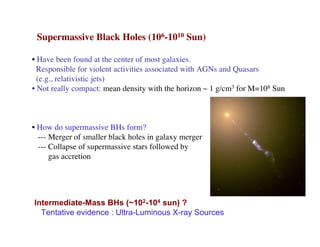
Supermassive Black Holes (106-1010 Sun)
• Have been found at the center of most galaxies.
Responsible for violent activities associated with AGNs and Quasars
(e.g., relativistic jets)
• Not really compact: mean density with the horizon ~ 1 g/cm3 for M=108 Sun
• How do supermassive BHs form?
--- Merger of smaller black holes in galaxy merger
--- Collapse of supermassive stars followed by
gas accretion
M87
Intermediate-Mass BHs (~102-104 sun) ?
Tentative evidence : Ultra-Luminous X-ray Sources
Compact Objects Research Today…
• Have become a “routine” subject of research
• Associated with extreme phenomena in the universe (e.g. SNe, GRBs)
• Interested in not just the objects themselves, but also how they
interact/influence their surroundings
• Used as
--- an astronomy tool (e.g., expansion rate of the Universe, GWs)
--- a tool to probe physics under extreme conditions
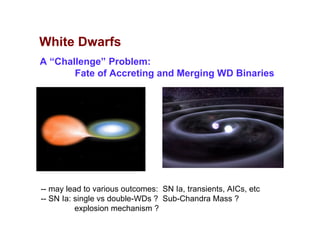
White Dwarfs
A “Challenge” Problem:
Fate of Accreting and Merging WD Binaries
-- may lead to various outcomes: SN Ia, transients, AICs, etc
-- SN Ia: single vs double-WDs ? Sub-Chandra Mass ?
explosion mechanism ?
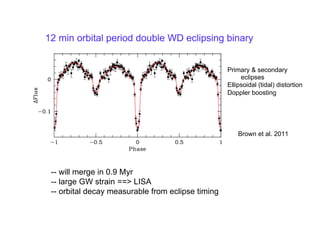
12 min orbital period double WD eclipsing binary
Brown et al. 2011
-- will merge in 0.9 Myr
-- large GW strain ==> LISA
-- orbital decay measurable from eclipse timing
Primary & secondary
eclipses
Ellipsoidal (tidal) distortion
Doppler boosting
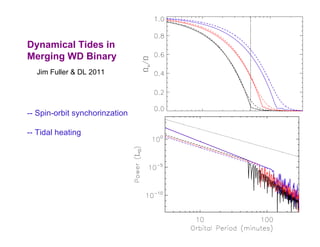
Dynamical Tides in
Merging WD Binary
-- Spin-orbit synchorinzation
-- Tidal heating
Jim Fuller & DL 2011
Neutron Stars:
Different Observational Manifestations
-- Isolated NSs
-- Accreting NSs
-- Merging NSs
Isolated Neutron Stars
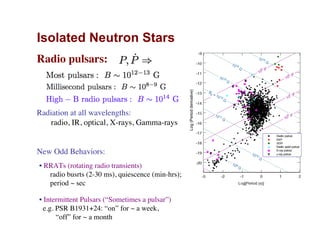
Radio pulsars:
• Intermittent Pulsars (“Sometimes a pulsar”)
e.g. PSR B1931+24: “on” for ~ a week,
“off” for ~ a month
New Odd Behaviors:
• RRATs (rotating radio transients)
radio busrts (2-30 ms), quiescence (min-hrs);
period ~ sec
Radiation at all wavelengths:
radio, IR, optical, X-rays, Gamma-rays
Magnetars
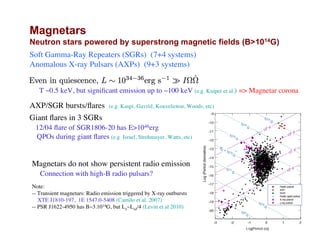
Neutron stars powered by superstrong magnetic fields (B>1014G)
Soft Gamma-Ray Repeaters (SGRs) (7+4 systems)
Anomalous X-ray Pulsars (AXPs) (9+3 systems)
AXP/SGR bursts/flares (e.g. Kaspi, Gavriil, Kouveliotou, Woods, etc)
Giant flares in 3 SGRs
12/04 flare of SGR1806-20 has E>1046erg
QPOs during giant flares (e.g Israel, Strohmayer, Watts, etc)
Magnetars do not show persistent radio emission
Connection with high-B radio pulsars?
T ~0.5 keV, but significant emission up to ~100 keV (e.g. Kuiper et al.) => Magnetar corona
Note:
-- Transient magnetars: Radio emission triggered by X-ray outbursts
XTE J1810-197, 1E 1547.0-5408 (Camilo et al. 2007)
-- PSR J1622-4950 has B~3.1014G, but Lx~Lsd/4 (Levin et al 2010)
Thermally Emitting Isolated NSs
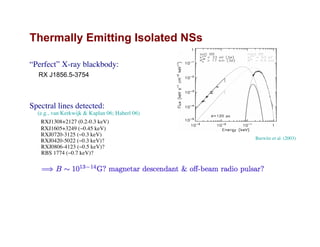
Burwitz et al. (2003)
“Perfect” X-ray blackbody:
RX J1856.5-3754
Spectral lines detected:
(e.g., van Kerkwijk & Kaplan 06; Haberl 06)
RXJ1308+2127 (0.2-0.3 keV)
RXJ1605+3249 (~0.45 keV)
RXJ0720-3125 (~0.3 keV)
RXJ0420-5022 (~0.3 keV)?
RXJ0806-4123 (~0.5 keV)?
RBS 1774 (~0.7 keV)?
Central Compact Objects (CCOs) in SNRs
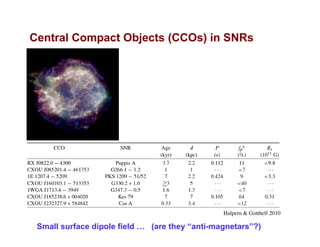
CCO in Cas A
Halpern & Gotthelf 2010
Small surface dipole field … (are they “anti-magnetars”?)
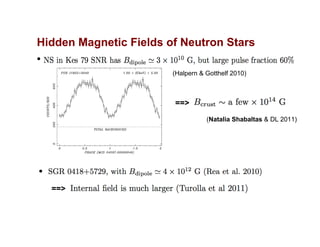
Hidden Magnetic Fields of Neutron Stars
(Natalia Shabaltas & DL 2011)
(Halpern & Gotthelf 2010)
==>
•
•
==>
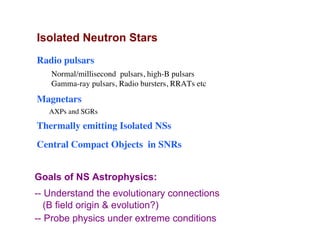
Isolated Neutron Stars
Radio pulsars
Magnetars
AXPs and SGRs
Thermally emitting Isolated NSs
Central Compact Objects in SNRs
Normal/millisecond pulsars, high-B pulsars
Gamma-ray pulsars, Radio bursters, RRATs etc
Goals of NS Astrophysics:
-- Understand the evolutionary connections
(B field origin & evolution?)
-- Probe physics under extreme conditions
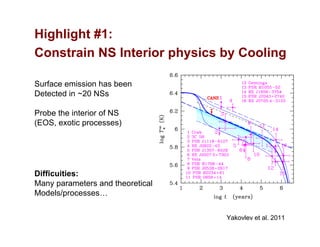
Highlight #1:
Constrain NS Interior physics by Cooling
Yakovlev et al. 2011
Surface emission has been
Detected in ~20 NSs
Probe the interior of NS
(EOS, exotic processes)
Difficuities:
Many parameters and theoretical
Models/processes…
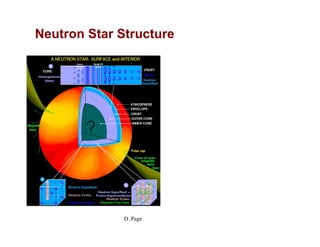
Neutron Star Structure
D. Page
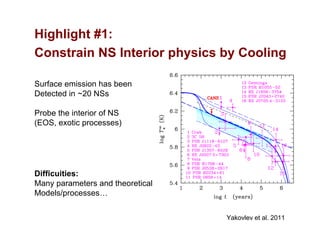
Highlight #1:
Constrain NS Interior physics by Cooling
Yakovlev et al. 2011
Surface emission has been
Detected in ~20 NSs
Probe the interior of NS
(EOS, exotic processes)
Difficuities:
Many parameters and theoretical
Models/processes…
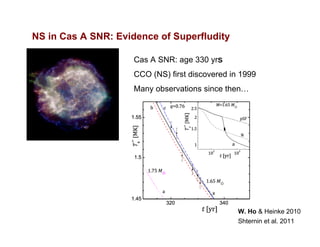
NS in Cas A SNR: Evidence of Superfludity
Cas A SNR: age 330 yrs
CCO (NS) first discovered in 1999
Many observations since then…
Shternin et al. 2011
W. Ho & Heinke 2010
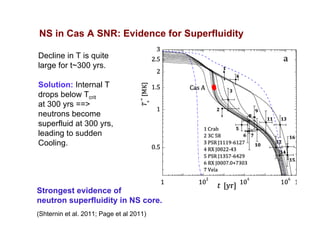
Decline in T is quite
large for t~300 yrs.
Solution: Internal T
drops below Tcrit
at 300 yrs ==>
neutrons become
superfluid at 300 yrs,
leading to sudden
Cooling.
Strongest evidence of
neutron superfluidity in NS core.
(Shternin et al. 2011; Page et al 2011)
NS in Cas A SNR: Evidence for Superfluidity
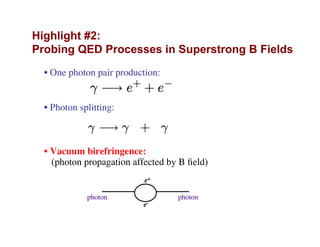
Highlight #2:
Probing QED Processes in Superstrong B Fields
• One photon pair production:
• Photon splitting:
• Vacuum birefringence:
(photon propagation affected by B field)
e+
e-
photon photon
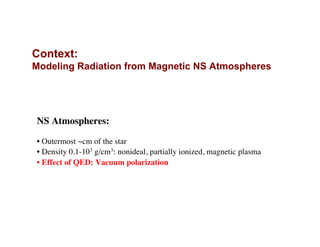
Context:
Modeling Radiation from Magnetic NS Atmospheres
NS Atmospheres:
• Outermost ~cm of the star
• Density 0.1-103 g/cm3: nonideal, partially ionized, magnetic plasma
• Effect of QED: Vacuum polarization
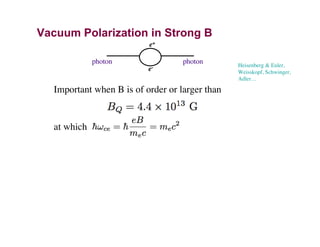
Vacuum Polarization in Strong B
e+
e-
photon photon Heisenberg & Euler,
Weisskopf, Schwinger,
Adler…
Important when B is of order or larger than
at which
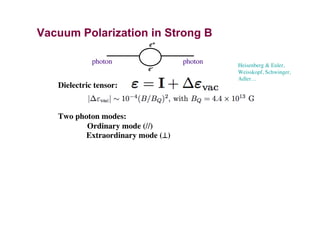
Vacuum Polarization in Strong B
e+
e-
photon photon
Dielectric tensor:
Two photon modes:
Ordinary mode (//)
Extraordinary mode (⊥)
Heisenberg & Euler,
Weisskopf, Schwinger,
Adler…
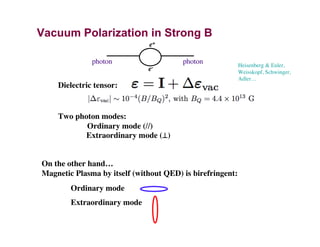
Vacuum Polarization in Strong B
e+
e-
photon photon
Dielectric tensor:
Two photon modes:
Ordinary mode (//)
Extraordinary mode (⊥)
On the other hand…
Magnetic Plasma by itself (without QED) is birefringent:
Ordinary mode
Extraordinary mode
Heisenberg & Euler,
Weisskopf, Schwinger,
Adler…
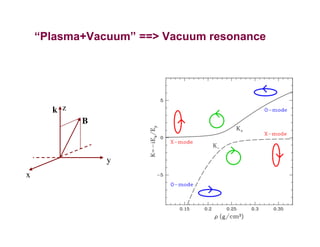
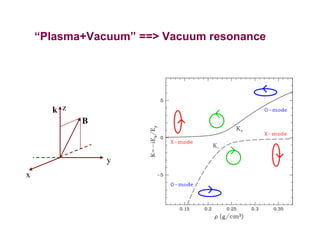
B=1013 G, E=5 keV, θB=45o
“Plasma+Vacuum” ==> Vacuum resonance
x
y
zk
B
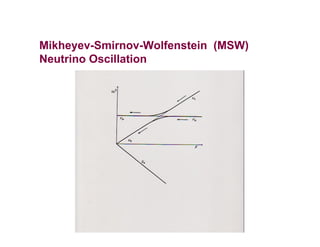
Mikheyev-Smirnov-Wolfenstein (MSW)
Neutrino Oscillation
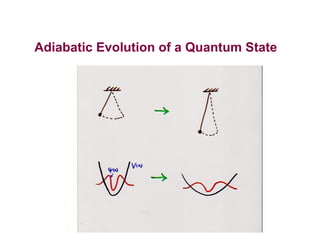
Adiabatic Evolution of a Quantum State
B=1013 G, E=5 keV, θB=45o
“Plasma+Vacuum” ==> Vacuum resonance
x
y
zk
B
Why do we care?
The two photon modes have very different opacities
=> Mode conversion can affect radiative transfer significantly
=> Spectrum and polarization signal from the NS
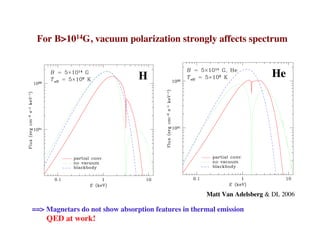
Matt Van Adelsberg & DL 2006
H He
For B>1014G, vacuum polarization strongly affects spectrum
==> Magnetars do not show absorption features in thermal emission
QED at work!
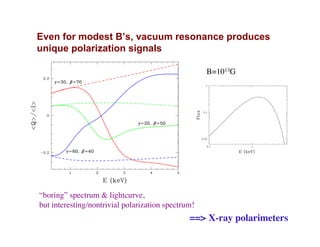
Even for modest B’s, vacuum resonance produces
unique polarization signals
B=1013G
==> X-ray polarimeters
“boring” spectrum & lightcurve,
but interesting/nontrivial polarization spectrum!
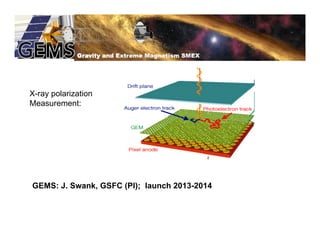
X-ray polarization
Measurement:
GEMS: J. Swank, GSFC (PI); launch 2013-2014
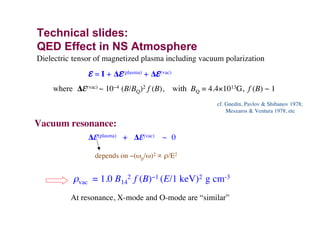
Technical slides:
QED Effect in NS Atmosphere
cf. Gnedin, Pavlov & Shibanov 1978;
Meszaros & Ventura 1978, etc
Dielectric tensor of magnetized plasma including vacuum polarization
ε = I + ∆ε(plasma) + ∆ε(vac)
where ∆ε(vac) ~ 10−4 (B/BQ)2 f (B), with BQ = 4.4×10¹³G, f (B) ~ 1
Vacuum resonance:
∆ε(plasma) + ∆ε(vac) ~ 0
depends on −(ωp/ω)2 ∝ ρ/E2
ρvac = 1.0 B14
2 f (B)−1 (E/1 keV)2 g cm-3
At resonance, X-mode and O-mode are “similar”
Adiabatic Condition:
In general, nonadiabatic “jump” probability
Pjump = exp [− (π/2) (E /Ead)3]
(Landau-Zener formula)
⏐n1 − n2⏐ > ( ⋅⋅⋅ ) ⏐dρ/dr⏐~
E > Ead = 2.5 ( tanθB )2/3 keV~
!
1cm
H
"
#
$
%
&
'
1/ 3
Photons with E > 2 keV, mode conversion
Photons with E < 2 keV, no mode conversion
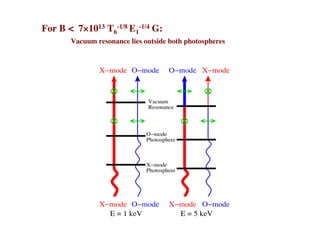
For B < 7×10¹³ T6
-1/8 E1
-1/4 G:
Vacuum resonance lies outside both photospheres
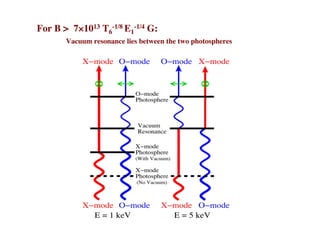
For B > 7×10¹³ T6
-1/8 E1
-1/4 G:
Vacuum resonance lies between the two photospheres
!
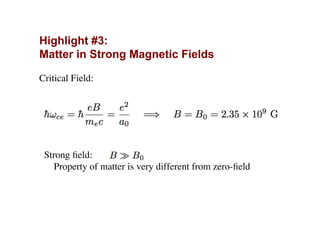
Highlight #3:
Matter in Strong Magnetic Fields
Critical Field:
Strong field:
Property of matter is very different from zero-field
.
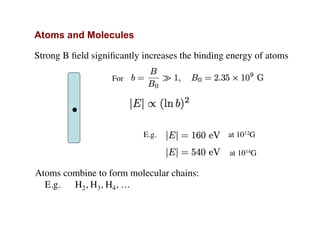
Strong B field significantly increases the binding energy of atoms
For
E.g. at 1012G
at 1014G
Atoms combine to form molecular chains:
E.g. H2, H3, H4, …
Atoms and Molecules
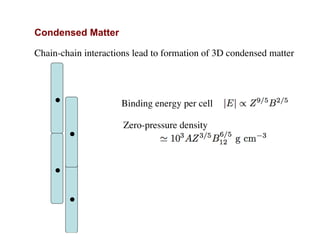
Chain-chain interactions lead to formation of 3D condensed matter
.
.
.
.
Binding energy per cell
Zero-pressure density
Condensed Matter
Cohesive energy of condensed matter:
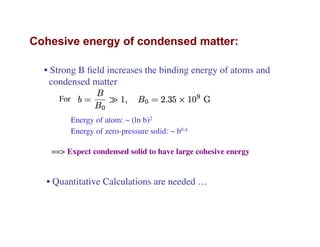
• Strong B field increases the binding energy of atoms and
condensed matter
Energy of atom: ~ (ln b)2
Energy of zero-pressure solid: ~ b0.4
==> Expect condensed solid to have large cohesive energy
• Quantitative Calculations are needed …
For
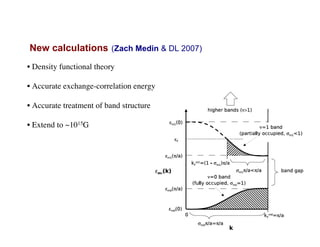
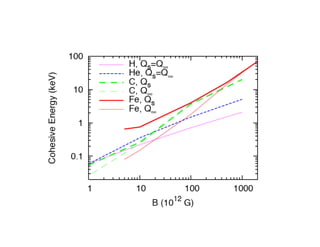
New calculations (Zach Medin & DL 2007)
• Density functional theory
• Accurate exchange-correlation energy
• Accurate treatment of band structure
• Extend to ~1015G
Implications…
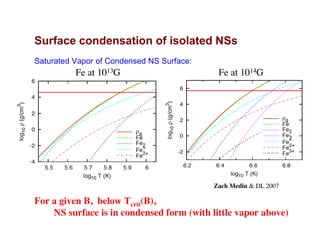
Surface condensation of isolated NSs
Saturated Vapor of Condensed NS Surface:
Fe at 1013G Fe at 1014G
For a given B, below Tcrit(B),
NS surface is in condensed form (with little vapor above)
Zach Medin & DL 2007
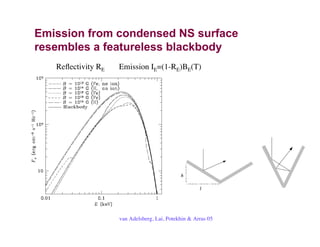
Emission from condensed NS surface
resembles a featureless blackbody
van Adelsberg, Lai, Potekhin & Arras 05
Reflectivity RE Emission IE=(1-RE)BE(T)
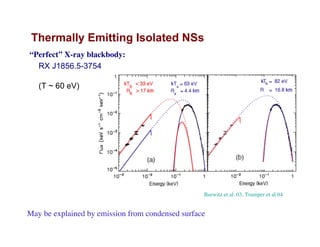
Thermally Emitting Isolated NSs
Burwitz et al. 03, Trumper et al 04
“Perfect” X-ray blackbody:
RX J1856.5-3754
(T ~ 60 eV)
May be explained by emission from condensed surface
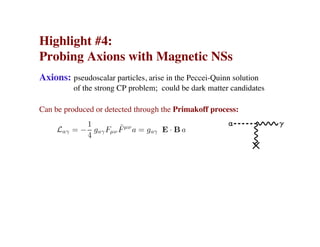
Highlight #4:
Probing Axions with Magnetic NSs
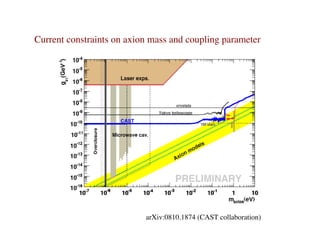
Axions: pseudoscalar particles, arise in the Peccei-Quinn solution
of the strong CP problem; could be dark matter candidates
Can be produced or detected through the Primakoff process:
arXiv:0810.1874 (CAST collaboration)
Current constraints on axion mass and coupling parameter
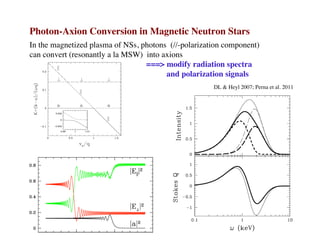
Photon-Axion Conversion in Magnetic Neutron Stars
In the magnetized plasma of NSs, photons (//-polarization component)
can convert (resonantly a la MSW) into axions
===> modify radiation spectra
and polarization signals
DL & Heyl 2007; Perna et al. 2011
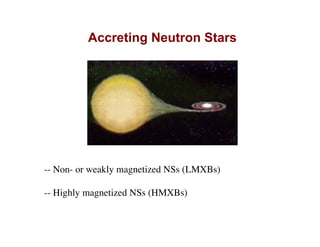
Accreting Neutron Stars
-- Non- or weakly magnetized NSs (LMXBs)
-- Highly magnetized NSs (HMXBs)
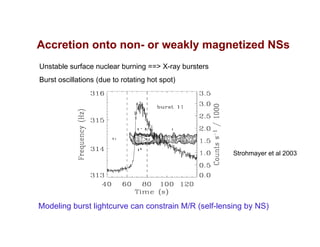
Accretion onto non- or weakly magnetized NSs
Unstable surface nuclear burning ==> X-ray bursters
Burst oscillations (due to rotating hot spot)
Strohmayer et al 2003
Modeling burst lightcurve can constrain M/R (self-lensing by NS)
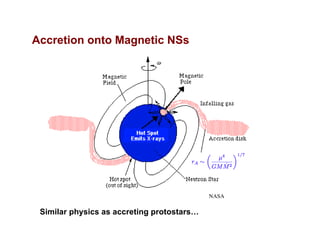
Accretion onto Magnetic NSs
NASA
Similar physics as accreting protostars…
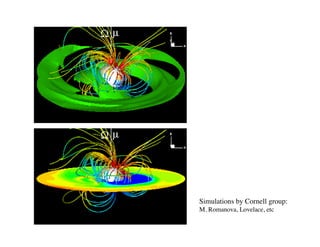
Simulations by Cornell group:
M. Romanova, Lovelace, etc
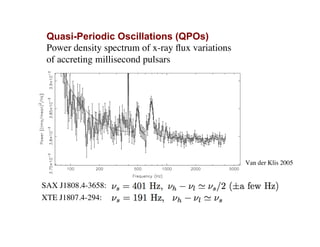
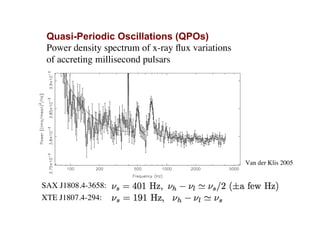
Van der Klis 2005
Quasi-Periodic Oscillations (QPOs)
Power density spectrum of x-ray flux variations
of accreting millisecond pulsars
SAX J1808.4-3658:
XTE J1807.4-294:
A possible (promising) model:
A misaligned rotating dipole magnetic field can excite
bending waves in disk, which can modulate X-ray flux.
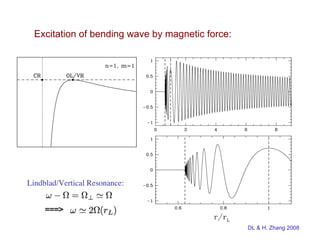
Excitation of bending wave by magnetic force:
DL & H. Zhang 2008
Lindblad/Vertical Resonance:
===>
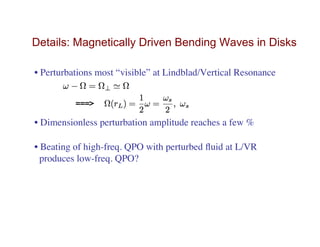
Details: Magnetically Driven Bending Waves in Disks
• Perturbations most “visible” at Lindblad/Vertical Resonance
• Dimensionless perturbation amplitude reaches a few %
• Beating of high-freq. QPO with perturbed fluid at L/VR
produces low-freq. QPO?
===>
Van der Klis 2005
Quasi-Periodic Oscillations (QPOs)
Power density spectrum of x-ray flux variations
of accreting millisecond pulsars
SAX J1808.4-3658:
XTE J1807.4-294:
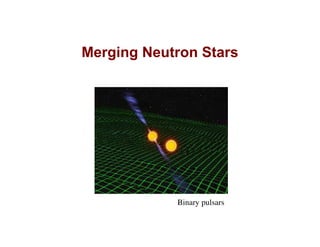
Merging Neutron Stars
Binary pulsars
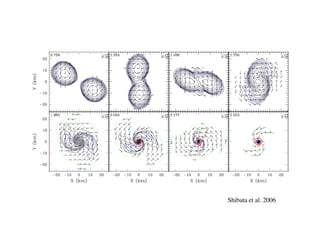
Shibata et al. 2006
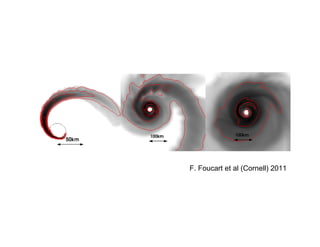
F. Foucart et al (Cornell) 2011
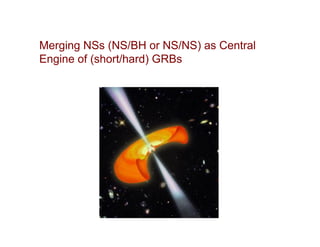
Merging NSs (NS/BH or NS/NS) as Central
Engine of (short/hard) GRBs
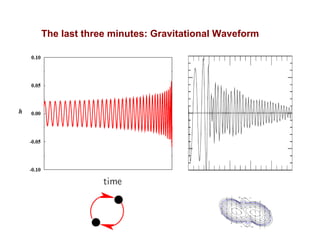
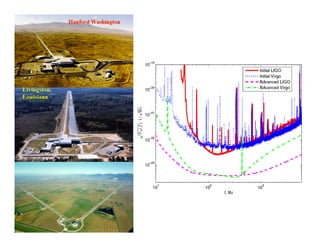
The last three minutes: Gravitational Waveform
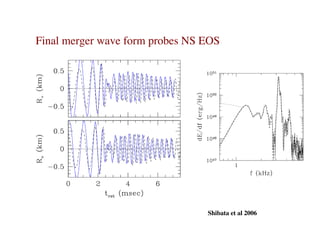
Final merger wave form probes NS EOS
Shibata et al 2006
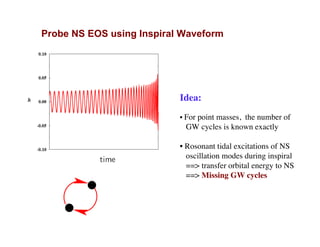
Probe NS EOS using Inspiral Waveform
Idea:
• For point masses, the number of
GW cycles is known exactly
• Rosonant tidal excitations of NS
oscillation modes during inspiral
==> transfer orbital energy to NS
==> Missing GW cycles
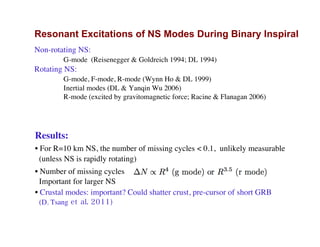
Resonant Excitations of NS Modes During Binary Inspiral
Non-rotating NS:
G-mode (Reisenegger & Goldreich 1994; DL 1994)
Rotating NS:
G-mode, F-mode, R-mode (Wynn Ho & DL 1999)
Inertial modes (DL & Yanqin Wu 2006)
R-mode (excited by gravitomagnetic force; Racine & Flanagan 2006)
Results:
• For R=10 km NS, the number of missing cycles < 0.1, unlikely measurable
(unless NS is rapidly rotating)
• Number of missing cycles
Important for larger NS
• Crustal modes: important? Could shatter crust, pre-cursor of short GRB
(D. Tsang et al. 2011)
Summary
• Compact Objects present a rich set of astrophysics/physics problems:
Ideal laboratory for probing physics under extreme conditions
• Diverse observational manifestations:
* Binary WDs
* Isolated NSs (powered by rotation, magnetic fields, or internal heats)
Effects of magnetic fields: crust, surface, matter in strong B,
magnetosphere processes
* Accreting NSs (powered from outside): QPOs, disk warping,
precession, wave excitations
* Merging NSs: Possible central enegine of short GRBs; primary
sources of gravitational waves; tidal effect; probe of NS EOS
Probing Extreme Physics With Compact Objcts

Probing Extreme Physics With Compact Objcts

  • 1.
    Probing Extreme PhysicswithProbing Extreme Physics with Compact ObjectsCompact Objects Dong Lai Department of Astronomy Cornell University IV Workshop Challenges of New Physics in Space Camps do Jordao - SP, Dec.11-16, 2011
  • 2.
    “Extremes” in Astrophysics: •Most energetic particles: 1020 eV • Most energetic photons: 1014 eV • Highest temperature: Big Bang • Highest density: neutron stars • Strongest magnet: magnetars • Strongest gravity: black holes • •
  • 3.
    “Extremes” in Astrophysics: •Most energetic particles: 1020 eV • Most energetic photons: 1014 eV • Highest temperature: Big Bang • Highest density: neutron stars • Strongest magnet: magnetars • Strongest gravity: black holes • • Focus of my lectures: Compact Objects (White Dwarfs, Neutron Stars and Black Holes)
  • 4.
    A thought experiment:Adding mass (slowly) to Earth … Mass ( ) Radius Earth 10-6 10-3 1 10-2 0.1
  • 5.
    A thought experiment:Adding mass (slowly) to Earth … Mass ( ) Radius Earth 10-6 10-3 1 10-2 0.1
  • 6.
    A thought experiment:Adding mass (slowly) to Earth … Mass ( ) Radius Earth Jupiter 10-6 10-3 1 10-2 0.1
  • 7.
    A thought experiment:Adding mass (slowly) to Earth … Mass ( ) Radius Earth Jupiter 10-6 10-3 1 Brown Dwarfs 10-2 0.1
  • 8.
    A thought experiment:Adding mass (slowly) to Earth … Mass ( ) Radius Earth Jupiter White Dwarfs 10-6 10-3 1 Brown Dwarfs 10-2 0.1
  • 9.
    A thought experiment:Adding mass (slowly) to Earth … Mass ( ) Radius Earth Jupiter White Dwarfs 10-6 10-3 1 Brown Dwarfs 10-2 0.1 Chandrasekhar mass: (1910-1995)
  • 10.
    Adding mass toa white dwarf: What happens when its mass exceeds the Chandrasekhar limit? 2000 km White Dwarf 10-20 km Neutron Star
  • 11.
    Adding mass toa Neutron Star … Mass ( ) Radius (km) 1 2 10 20
  • 12.
    Adding mass toa Neutron Star … Mass ( ) Radius (km) 1 2 10 20
  • 13.
    Lattimer & Parkash06 (Demorest et al. 2010)
  • 14.
    Why is therea maximum mass for neutron stars? Force balance in a star: (Newtonian) Pressure balances Gravity <-- M
  • 15.
    Why is therea maximum mass for neutron stars? Tolman-Oppenheimer-Volkoff Equation: Force balance in a star: (General relativity) Pressure balances Gravity <-- M, Pressure ===> Tolman-Oppenheimer-Volkoff Limit
  • 16.
    Keep adding massto a neutron star: What happens when its mass exceeds the maximum mass? 10-20 km Neutron Star Black Hole First demonstrated by Oppenheimer & Snyder (1939)
  • 17.
    “Dark Star” Concept:John Michell (1783) Pierre Laplace (1795) M, R Escape velocity: • Although “correct” answer, derivation and interpretation are wrong.
  • 18.
    “Black Hole” Concept: •Einstein (1915): General Relativity Gravity is not a force, but rather it manifests as curvature of spacetime caused by matter and energy • Karl Schwarzschild (1916): The first exact solution to Einstein field equation The horizon radius (Schwarzschild radius): Ensiten field equation: • Roy Kerr (1963): Solution for spinning black holes
  • 19.
    Formation of CompactObjects in Astrophysics
  • 20.
    White dwarfs evolvefrom stars with M < 8 Sun …~ NGC 2392, the Eskimo Nebula (HST)
  • 21.
    Neutron stars evolvefrom stars with M > 8 Sun …~ Burrows 2000 Crab nebula
  • 22.
    Black Holes evolvefrom stars with M > 30 (?) Sun …~ W. Zhang, Woosley H-T Janka; See O’Connor & Ott 2011 Failed bounce/explosion ==> Fall back of stellar material ==> BH formation Collapse of rotating star ==> spinning BH + disk ==> Relativistic jet (?) ==> (Long) Gamma-ray bursts
  • 23.
    Supermassive Black Holes(106-1010 Sun) • Have been found at the center of most galaxies. Responsible for violent activities associated with AGNs and Quasars (e.g., relativistic jets) • Not really compact: mean density with the horizon ~ 1 g/cm3 for M=108 Sun • How do supermassive BHs form? --- Merger of smaller black holes in galaxy merger --- Collapse of supermassive stars followed by gas accretion M87 Intermediate-Mass BHs (~102-104 sun) ? Tentative evidence : Ultra-Luminous X-ray Sources
  • 24.
    Compact Objects ResearchToday… • Have become a “routine” subject of research • Associated with extreme phenomena in the universe (e.g. SNe, GRBs) • Interested in not just the objects themselves, but also how they interact/influence their surroundings • Used as --- an astronomy tool (e.g., expansion rate of the Universe, GWs) --- a tool to probe physics under extreme conditions
  • 26.
    White Dwarfs A “Challenge”Problem: Fate of Accreting and Merging WD Binaries -- may lead to various outcomes: SN Ia, transients, AICs, etc -- SN Ia: single vs double-WDs ? Sub-Chandra Mass ? explosion mechanism ?
  • 27.
    12 min orbitalperiod double WD eclipsing binary Brown et al. 2011 -- will merge in 0.9 Myr -- large GW strain ==> LISA -- orbital decay measurable from eclipse timing Primary & secondary eclipses Ellipsoidal (tidal) distortion Doppler boosting
  • 28.
    Dynamical Tides in MergingWD Binary -- Spin-orbit synchorinzation -- Tidal heating Jim Fuller & DL 2011
  • 30.
    Neutron Stars: Different ObservationalManifestations -- Isolated NSs -- Accreting NSs -- Merging NSs
  • 31.
    Isolated Neutron Stars Radiopulsars: • Intermittent Pulsars (“Sometimes a pulsar”) e.g. PSR B1931+24: “on” for ~ a week, “off” for ~ a month New Odd Behaviors: • RRATs (rotating radio transients) radio busrts (2-30 ms), quiescence (min-hrs); period ~ sec Radiation at all wavelengths: radio, IR, optical, X-rays, Gamma-rays
  • 32.
    Magnetars Neutron stars poweredby superstrong magnetic fields (B>1014G) Soft Gamma-Ray Repeaters (SGRs) (7+4 systems) Anomalous X-ray Pulsars (AXPs) (9+3 systems) AXP/SGR bursts/flares (e.g. Kaspi, Gavriil, Kouveliotou, Woods, etc) Giant flares in 3 SGRs 12/04 flare of SGR1806-20 has E>1046erg QPOs during giant flares (e.g Israel, Strohmayer, Watts, etc) Magnetars do not show persistent radio emission Connection with high-B radio pulsars? T ~0.5 keV, but significant emission up to ~100 keV (e.g. Kuiper et al.) => Magnetar corona Note: -- Transient magnetars: Radio emission triggered by X-ray outbursts XTE J1810-197, 1E 1547.0-5408 (Camilo et al. 2007) -- PSR J1622-4950 has B~3.1014G, but Lx~Lsd/4 (Levin et al 2010)
  • 33.
    Thermally Emitting IsolatedNSs Burwitz et al. (2003) “Perfect” X-ray blackbody: RX J1856.5-3754 Spectral lines detected: (e.g., van Kerkwijk & Kaplan 06; Haberl 06) RXJ1308+2127 (0.2-0.3 keV) RXJ1605+3249 (~0.45 keV) RXJ0720-3125 (~0.3 keV) RXJ0420-5022 (~0.3 keV)? RXJ0806-4123 (~0.5 keV)? RBS 1774 (~0.7 keV)?
  • 34.
    Central Compact Objects(CCOs) in SNRs CCO in Cas A Halpern & Gotthelf 2010 Small surface dipole field … (are they “anti-magnetars”?)
  • 35.
    Hidden Magnetic Fieldsof Neutron Stars (Natalia Shabaltas & DL 2011) (Halpern & Gotthelf 2010) ==> • • ==>
  • 36.
    Isolated Neutron Stars Radiopulsars Magnetars AXPs and SGRs Thermally emitting Isolated NSs Central Compact Objects in SNRs Normal/millisecond pulsars, high-B pulsars Gamma-ray pulsars, Radio bursters, RRATs etc Goals of NS Astrophysics: -- Understand the evolutionary connections (B field origin & evolution?) -- Probe physics under extreme conditions
  • 37.
    Highlight #1: Constrain NSInterior physics by Cooling Yakovlev et al. 2011 Surface emission has been Detected in ~20 NSs Probe the interior of NS (EOS, exotic processes) Difficuities: Many parameters and theoretical Models/processes…
  • 38.
  • 39.
    Highlight #1: Constrain NSInterior physics by Cooling Yakovlev et al. 2011 Surface emission has been Detected in ~20 NSs Probe the interior of NS (EOS, exotic processes) Difficuities: Many parameters and theoretical Models/processes…
  • 40.
    NS in CasA SNR: Evidence of Superfludity Cas A SNR: age 330 yrs CCO (NS) first discovered in 1999 Many observations since then… Shternin et al. 2011 W. Ho & Heinke 2010
  • 41.
    Decline in Tis quite large for t~300 yrs. Solution: Internal T drops below Tcrit at 300 yrs ==> neutrons become superfluid at 300 yrs, leading to sudden Cooling. Strongest evidence of neutron superfluidity in NS core. (Shternin et al. 2011; Page et al 2011) NS in Cas A SNR: Evidence for Superfluidity
  • 42.
    Highlight #2: Probing QEDProcesses in Superstrong B Fields • One photon pair production: • Photon splitting: • Vacuum birefringence: (photon propagation affected by B field) e+ e- photon photon
  • 43.
    Context: Modeling Radiation fromMagnetic NS Atmospheres NS Atmospheres: • Outermost ~cm of the star • Density 0.1-103 g/cm3: nonideal, partially ionized, magnetic plasma • Effect of QED: Vacuum polarization
  • 44.
    Vacuum Polarization inStrong B e+ e- photon photon Heisenberg & Euler, Weisskopf, Schwinger, Adler… Important when B is of order or larger than at which
  • 45.
    Vacuum Polarization inStrong B e+ e- photon photon Dielectric tensor: Two photon modes: Ordinary mode (//) Extraordinary mode (⊥) Heisenberg & Euler, Weisskopf, Schwinger, Adler…
  • 46.
    Vacuum Polarization inStrong B e+ e- photon photon Dielectric tensor: Two photon modes: Ordinary mode (//) Extraordinary mode (⊥) On the other hand… Magnetic Plasma by itself (without QED) is birefringent: Ordinary mode Extraordinary mode Heisenberg & Euler, Weisskopf, Schwinger, Adler…
  • 47.
    B=1013 G, E=5keV, θB=45o “Plasma+Vacuum” ==> Vacuum resonance x y zk B
  • 48.
  • 49.
    Adiabatic Evolution ofa Quantum State
  • 50.
    B=1013 G, E=5keV, θB=45o “Plasma+Vacuum” ==> Vacuum resonance x y zk B
  • 51.
    Why do wecare? The two photon modes have very different opacities => Mode conversion can affect radiative transfer significantly => Spectrum and polarization signal from the NS
  • 52.
    Matt Van Adelsberg& DL 2006 H He For B>1014G, vacuum polarization strongly affects spectrum ==> Magnetars do not show absorption features in thermal emission QED at work!
  • 53.
    Even for modestB’s, vacuum resonance produces unique polarization signals B=1013G ==> X-ray polarimeters “boring” spectrum & lightcurve, but interesting/nontrivial polarization spectrum!
  • 54.
    X-ray polarization Measurement: GEMS: J.Swank, GSFC (PI); launch 2013-2014
  • 55.
    Technical slides: QED Effectin NS Atmosphere cf. Gnedin, Pavlov & Shibanov 1978; Meszaros & Ventura 1978, etc Dielectric tensor of magnetized plasma including vacuum polarization ε = I + ∆ε(plasma) + ∆ε(vac) where ∆ε(vac) ~ 10−4 (B/BQ)2 f (B), with BQ = 4.4×10¹³G, f (B) ~ 1 Vacuum resonance: ∆ε(plasma) + ∆ε(vac) ~ 0 depends on −(ωp/ω)2 ∝ ρ/E2 ρvac = 1.0 B14 2 f (B)−1 (E/1 keV)2 g cm-3 At resonance, X-mode and O-mode are “similar”
  • 56.
    Adiabatic Condition: In general,nonadiabatic “jump” probability Pjump = exp [− (π/2) (E /Ead)3] (Landau-Zener formula) ⏐n1 − n2⏐ > ( ⋅⋅⋅ ) ⏐dρ/dr⏐~ E > Ead = 2.5 ( tanθB )2/3 keV~ ! 1cm H " # $ % & ' 1/ 3 Photons with E > 2 keV, mode conversion Photons with E < 2 keV, no mode conversion
  • 57.
    For B <7×10¹³ T6 -1/8 E1 -1/4 G: Vacuum resonance lies outside both photospheres
  • 58.
    For B >7×10¹³ T6 -1/8 E1 -1/4 G: Vacuum resonance lies between the two photospheres
  • 59.
    ! Highlight #3: Matter inStrong Magnetic Fields Critical Field: Strong field: Property of matter is very different from zero-field
  • 60.
    . Strong B fieldsignificantly increases the binding energy of atoms For E.g. at 1012G at 1014G Atoms combine to form molecular chains: E.g. H2, H3, H4, … Atoms and Molecules
  • 61.
    Chain-chain interactions leadto formation of 3D condensed matter . . . . Binding energy per cell Zero-pressure density Condensed Matter
  • 62.
    Cohesive energy ofcondensed matter: • Strong B field increases the binding energy of atoms and condensed matter Energy of atom: ~ (ln b)2 Energy of zero-pressure solid: ~ b0.4 ==> Expect condensed solid to have large cohesive energy • Quantitative Calculations are needed … For
  • 63.
    New calculations (ZachMedin & DL 2007) • Density functional theory • Accurate exchange-correlation energy • Accurate treatment of band structure • Extend to ~1015G
  • 65.
  • 66.
    Surface condensation ofisolated NSs Saturated Vapor of Condensed NS Surface: Fe at 1013G Fe at 1014G For a given B, below Tcrit(B), NS surface is in condensed form (with little vapor above) Zach Medin & DL 2007
  • 67.
    Emission from condensedNS surface resembles a featureless blackbody van Adelsberg, Lai, Potekhin & Arras 05 Reflectivity RE Emission IE=(1-RE)BE(T)
  • 68.
    Thermally Emitting IsolatedNSs Burwitz et al. 03, Trumper et al 04 “Perfect” X-ray blackbody: RX J1856.5-3754 (T ~ 60 eV) May be explained by emission from condensed surface
  • 69.
    Highlight #4: Probing Axionswith Magnetic NSs Axions: pseudoscalar particles, arise in the Peccei-Quinn solution of the strong CP problem; could be dark matter candidates Can be produced or detected through the Primakoff process:
  • 70.
    arXiv:0810.1874 (CAST collaboration) Currentconstraints on axion mass and coupling parameter
  • 71.
    Photon-Axion Conversion inMagnetic Neutron Stars In the magnetized plasma of NSs, photons (//-polarization component) can convert (resonantly a la MSW) into axions ===> modify radiation spectra and polarization signals DL & Heyl 2007; Perna et al. 2011
  • 73.
    Accreting Neutron Stars --Non- or weakly magnetized NSs (LMXBs) -- Highly magnetized NSs (HMXBs)
  • 74.
    Accretion onto non-or weakly magnetized NSs Unstable surface nuclear burning ==> X-ray bursters Burst oscillations (due to rotating hot spot) Strohmayer et al 2003 Modeling burst lightcurve can constrain M/R (self-lensing by NS)
  • 75.
    Accretion onto MagneticNSs NASA Similar physics as accreting protostars…
  • 76.
    Simulations by Cornellgroup: M. Romanova, Lovelace, etc
  • 77.
    Van der Klis2005 Quasi-Periodic Oscillations (QPOs) Power density spectrum of x-ray flux variations of accreting millisecond pulsars SAX J1808.4-3658: XTE J1807.4-294:
  • 78.
    A possible (promising)model: A misaligned rotating dipole magnetic field can excite bending waves in disk, which can modulate X-ray flux.
  • 79.
    Excitation of bendingwave by magnetic force: DL & H. Zhang 2008 Lindblad/Vertical Resonance: ===>
  • 80.
    Details: Magnetically DrivenBending Waves in Disks • Perturbations most “visible” at Lindblad/Vertical Resonance • Dimensionless perturbation amplitude reaches a few % • Beating of high-freq. QPO with perturbed fluid at L/VR produces low-freq. QPO? ===>
  • 81.
    Van der Klis2005 Quasi-Periodic Oscillations (QPOs) Power density spectrum of x-ray flux variations of accreting millisecond pulsars SAX J1808.4-3658: XTE J1807.4-294:
  • 83.
  • 84.
  • 85.
    F. Foucart etal (Cornell) 2011
  • 86.
    Merging NSs (NS/BHor NS/NS) as Central Engine of (short/hard) GRBs
  • 87.
    The last threeminutes: Gravitational Waveform
  • 89.
    Final merger waveform probes NS EOS Shibata et al 2006
  • 90.
    Probe NS EOSusing Inspiral Waveform Idea: • For point masses, the number of GW cycles is known exactly • Rosonant tidal excitations of NS oscillation modes during inspiral ==> transfer orbital energy to NS ==> Missing GW cycles
  • 91.
    Resonant Excitations ofNS Modes During Binary Inspiral Non-rotating NS: G-mode (Reisenegger & Goldreich 1994; DL 1994) Rotating NS: G-mode, F-mode, R-mode (Wynn Ho & DL 1999) Inertial modes (DL & Yanqin Wu 2006) R-mode (excited by gravitomagnetic force; Racine & Flanagan 2006) Results: • For R=10 km NS, the number of missing cycles < 0.1, unlikely measurable (unless NS is rapidly rotating) • Number of missing cycles Important for larger NS • Crustal modes: important? Could shatter crust, pre-cursor of short GRB (D. Tsang et al. 2011)
  • 92.
    Summary • Compact Objectspresent a rich set of astrophysics/physics problems: Ideal laboratory for probing physics under extreme conditions • Diverse observational manifestations: * Binary WDs * Isolated NSs (powered by rotation, magnetic fields, or internal heats) Effects of magnetic fields: crust, surface, matter in strong B, magnetosphere processes * Accreting NSs (powered from outside): QPOs, disk warping, precession, wave excitations * Merging NSs: Possible central enegine of short GRBs; primary sources of gravitational waves; tidal effect; probe of NS EOS