The document summarizes the history of telescopes from Galileo to Hubble. It discusses the goals and types of refracting telescopes using lenses, reflecting telescopes using mirrors, and catadioptric telescopes using both lenses and mirrors. It covers important figures like Galileo, Newton, and developments like resolving chromatic aberration and creating parabolic mirrors to reduce spherical aberration. Large modern telescopes are also highlighted, such as the Keck observatory's segmented mirrors.
In this document
Powered by AI
Overview of telescopes from Galileo to Hubble and the Pewaukee Astronomy Club.
Definition of a telescope, its origins, and meaning from Greek words.
Main objectives include gathering light, presenting accurate images, and magnification.
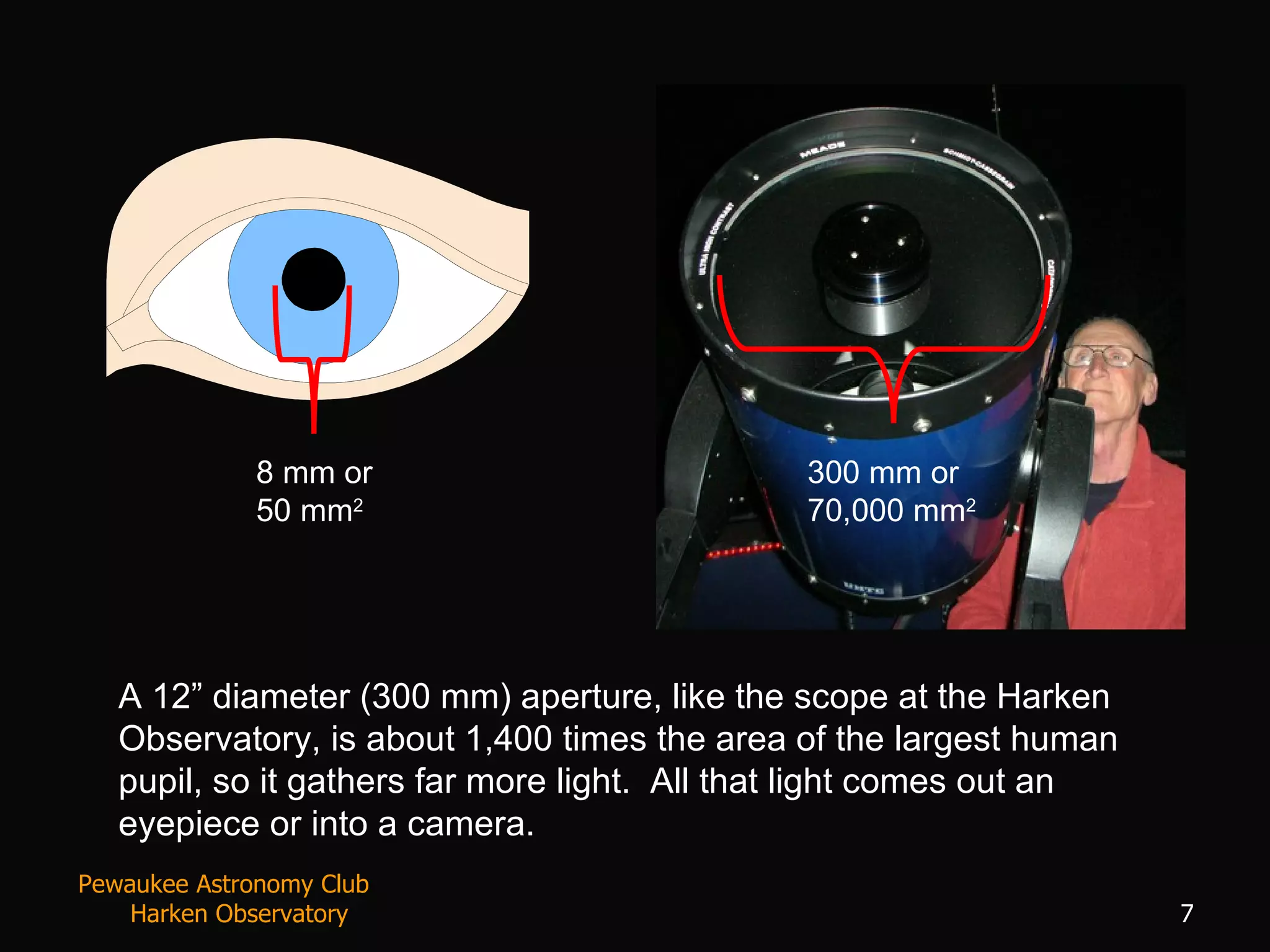
Importance of aperture size in telescopes to gather light efficiently and comparison to human pupil.
Issues in image accuracy like chromatic and spherical aberration.
Magnification limits in astronomy; most useful range is between 50x and 500x.
Development of refractor telescopes and Galileo's role in their publicity and fabrication. Information about the surviving telescopes made by Galileo and their reproduction.
Basic components of telescopes, including eyepiece and focal lengths.
Explanation of chromatic aberration and how different colors are focused.
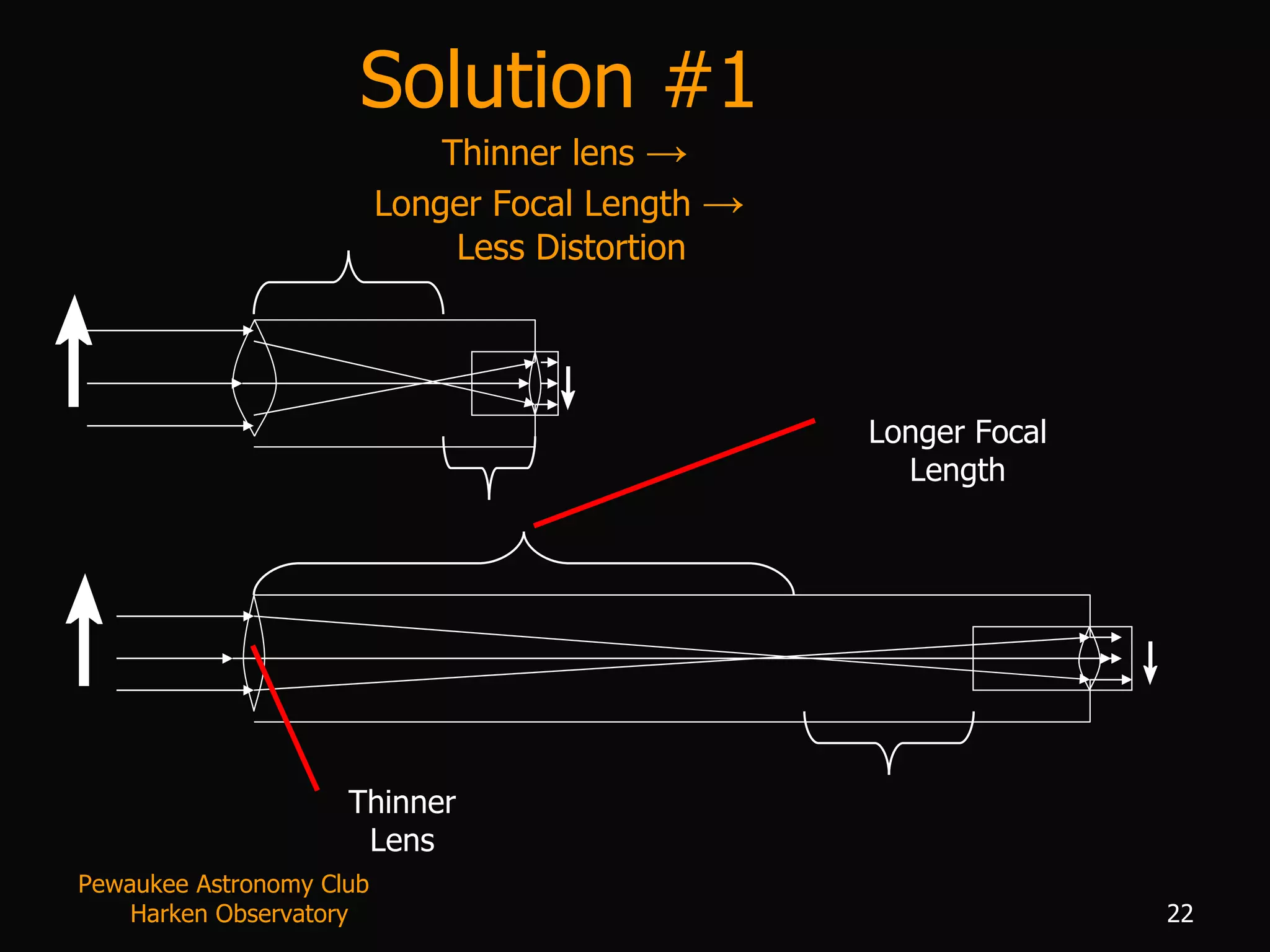
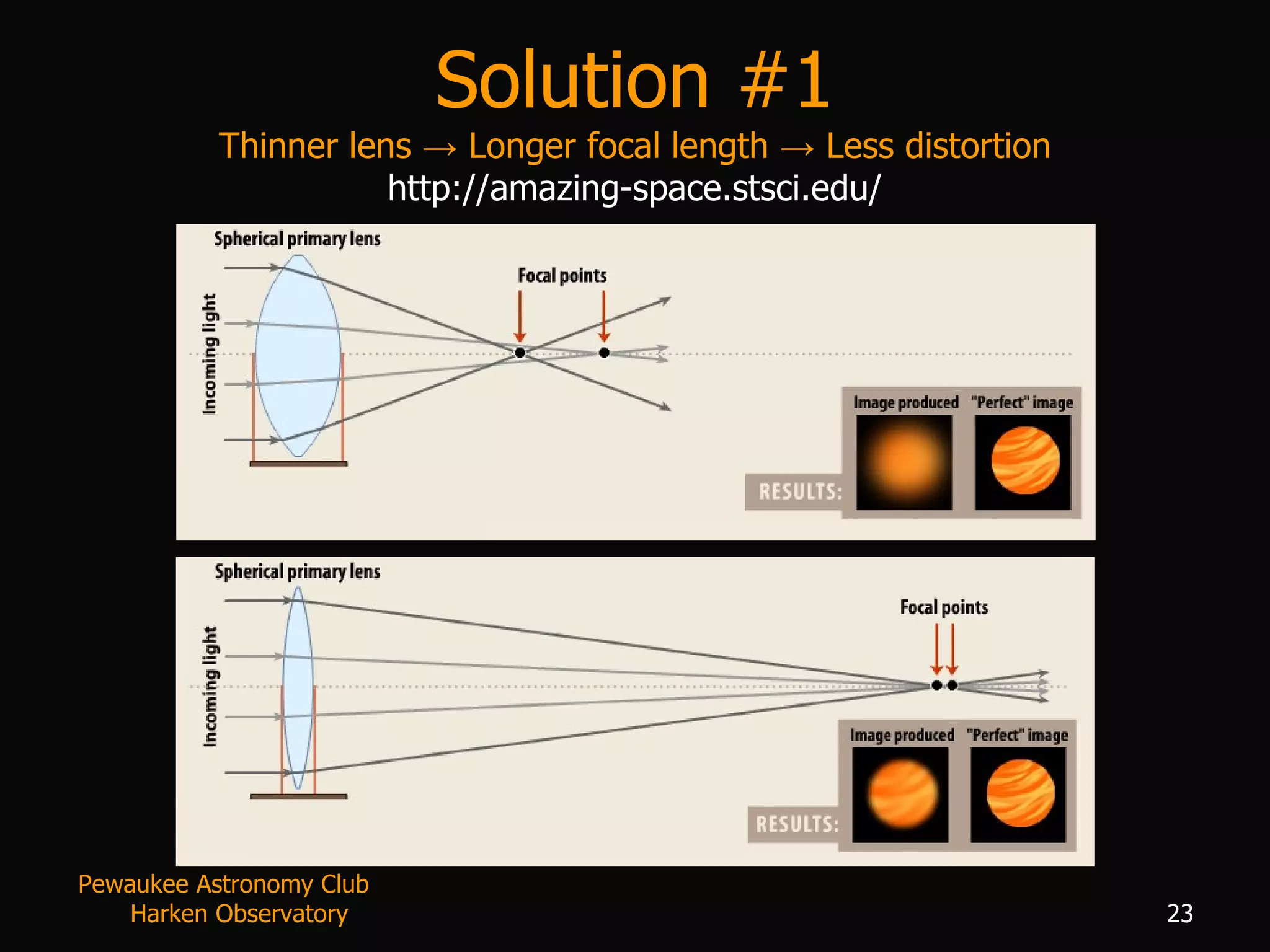
Strategies like using thinner lenses to reduce optical distortion.
Evolution of telescope sizes from the 17th century, emphasizing Johannes Hevelius' telescope.
Explains the concept of focal ratios and how they influence image quality.
Introduction of achromatic lenses and their advantages in reducing chromatic error.
Common focus problems that arise in optical systems and their implications.
Different eyepiece types and their associated parameters affecting viewing experience.
Discussion of the Yerkes Observatory and challenges with large refractor tubes.
Brief summary of the qualities and advantages of refractor telescopes.
Introduction of reflector telescopes by Isaac Newton as a solution to lens limitations.
Fundamental structure and design aspects of Newtonian reflector telescopes.
Discussion of spherical aberration and its resolution in reflector telescope designs.
Explanation of off-axis coma aberration and its effects on image quality.
Details on mirror types used in telescopes and implications for calibration.
Summary of reflector telescopes highlighting their benefits and design features.
Catadioptric telescopes combine mirrors and lenses for compact designs.
Discussion on various modern catadioptric designs and the significance of the Hubble.
List of sources and references for more in-depth information on telescopes.
Mission statement and community-focused initiatives of the Harken Astronomical Observatory.
Acknowledgment of contributions and announcement of public engagement opportunities.
Telescopes From Galileoto Hubble Scott A. Berg January 13, 2007 Pewaukee Astronomy Club Harken Observatory - Pewaukee Public Library http://pewaukeeastro.com/ Pewaukee Astronomy Club Harken Observatory
2.
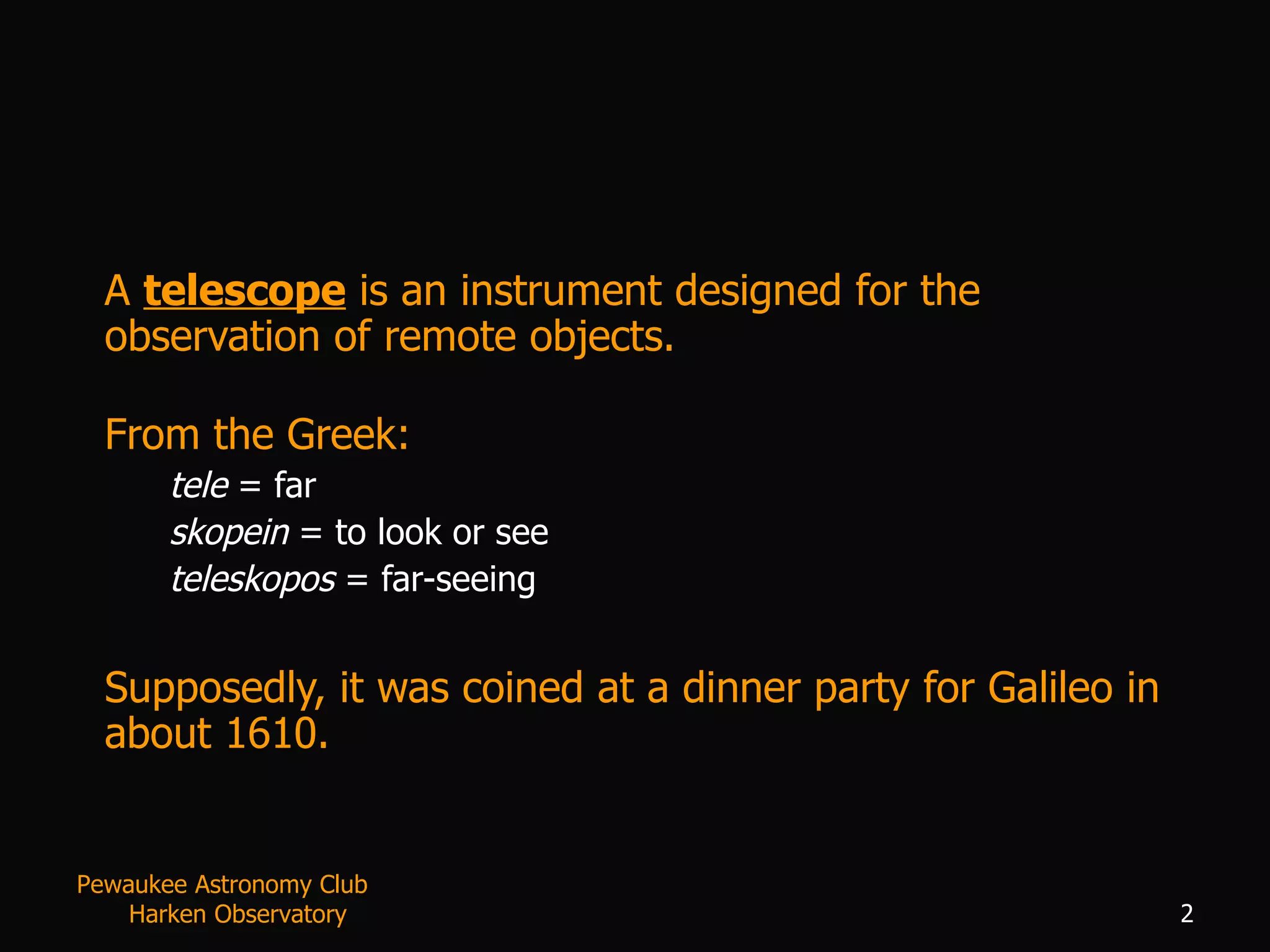
A telescope is an instrument designed for the observation of remote objects. From the Greek: tele = far skopein = to look or see teleskopos = far-seeing Supposedly, it was coined at a dinner party for Galileo in about 1610. Pewaukee Astronomy Club Harken Observatory
3.
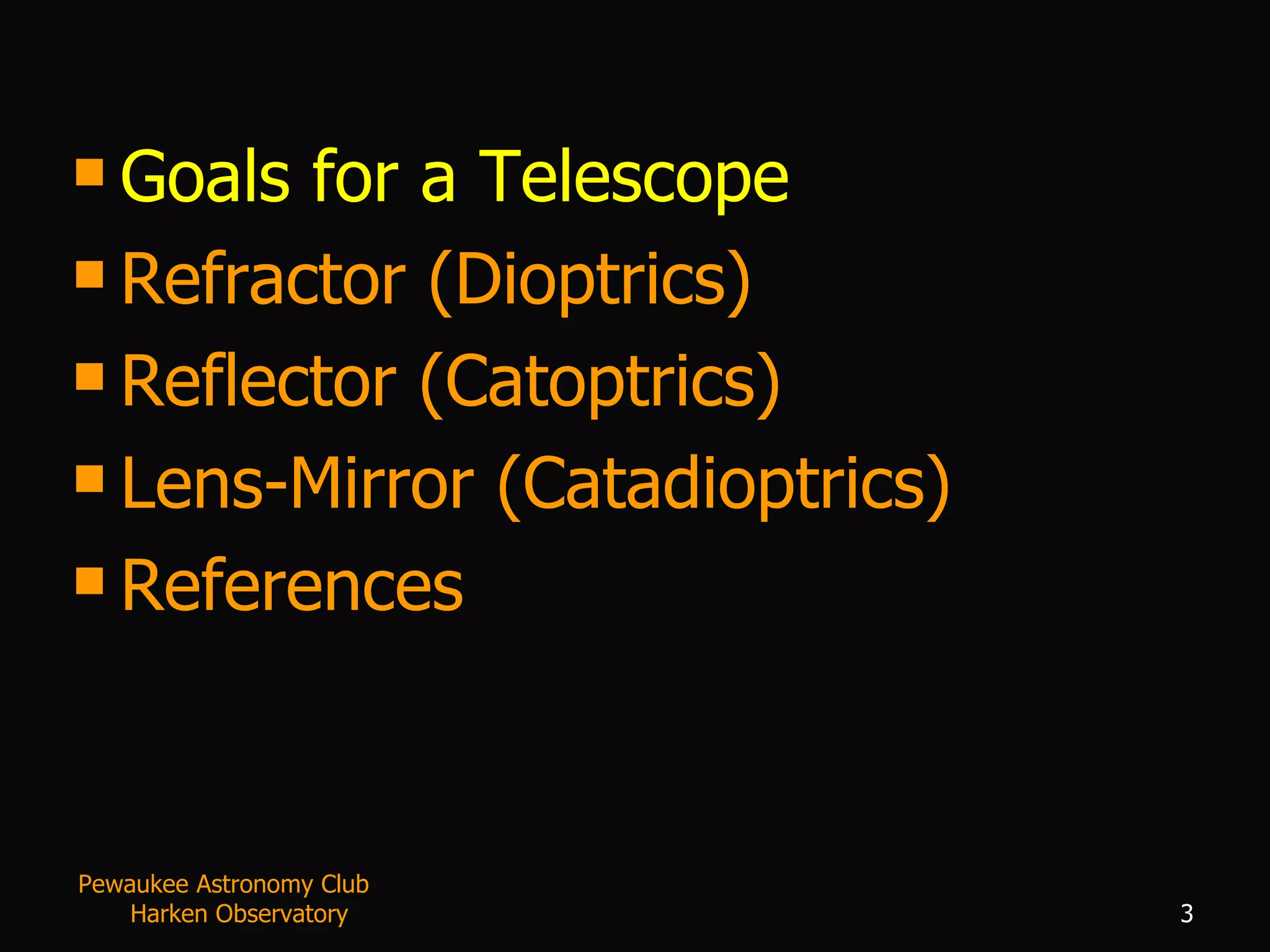
Goals for aTelescope Refractor (Dioptrics) Reflector (Catoptrics) Lens-Mirror (Catadioptrics) References Pewaukee Astronomy Club Harken Observatory
4.
Goals Gather lightto make dim objects bright Accurate presentation of the image Magnify the image Pewaukee Astronomy Club Harken Observatory
5.
1 - GatherLight Astronomical objects are far away and very dim. A telescope gathers light from a large area (aperture) and concentrates it into a small area (eyepiece), making the image brighter. Pewaukee Astronomy Club Harken Observatory
6.
Aperture The sizeof the opening through which light from the object enters the scope Large diameter (>10”) amateur scopes are sometimes called “light buckets” “ Aperture envy” leads to keeping up with the Jones’s Pewaukee Astronomy Club Harken Observatory
7.
8 mm or50 mm 2 300 mm or 70,000 mm 2 A 12” diameter (300 mm) aperture, like the scope at the Harken Observatory, is about 1,400 times the area of the largest human pupil, so it gathers far more light. All that light comes out an eyepiece or into a camera. Pewaukee Astronomy Club Harken Observatory
8.
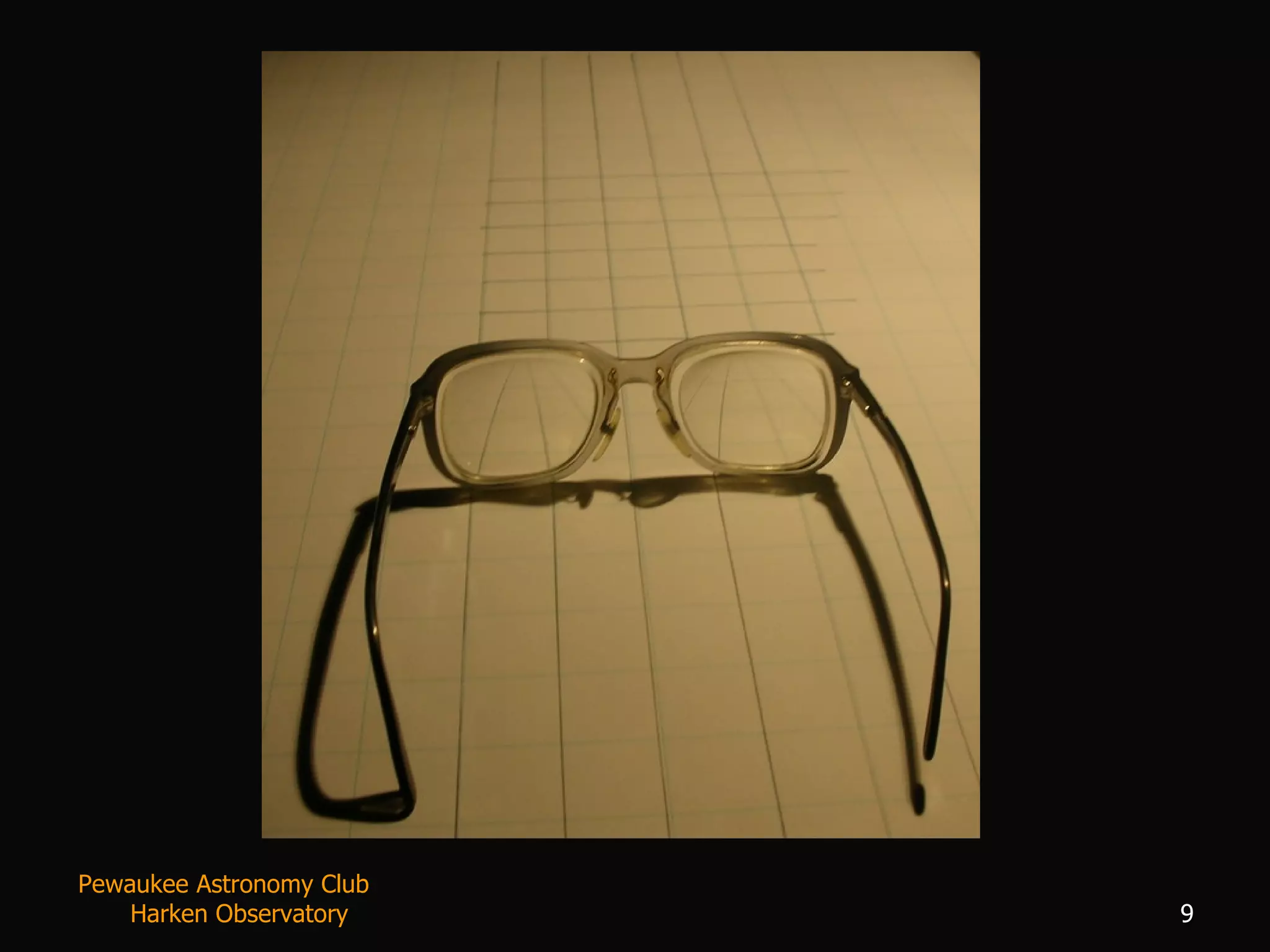
2 - AccurateImage Chr oma tic abe rrat ion – Is what you see the actual color(s) of the target? Spherical aberration – Is what you see really the shape of the target? Many other distortion types Pewaukee Astronomy Club Harken Observatory
3 - MagnifyMost novices think a large astronomical telescope must magnify “millions of times” Most useful astronomy is 50x-500x with much of it around 100x Pewaukee Astronomy Club Harken Observatory
11.
Goals for aTelescope Refractor (Dioptrics) Reflector (Catoptrics) Lens-Mirror (Catadioptrics) References Pewaukee Astronomy Club Harken Observatory
12.
Refractors A refractor scope uses only lenses. Discovered by many people independently in early 1600’s. e.g. Patent applied for by Dutch optician Hans Lippershay (1570-1619) in 1608. Prominent Italian scientist Galileo Galilei (1564-1642) was the first to publish and publicize his version of the telescope in 1610. Pewaukee Astronomy Club Harken Observatory
13.
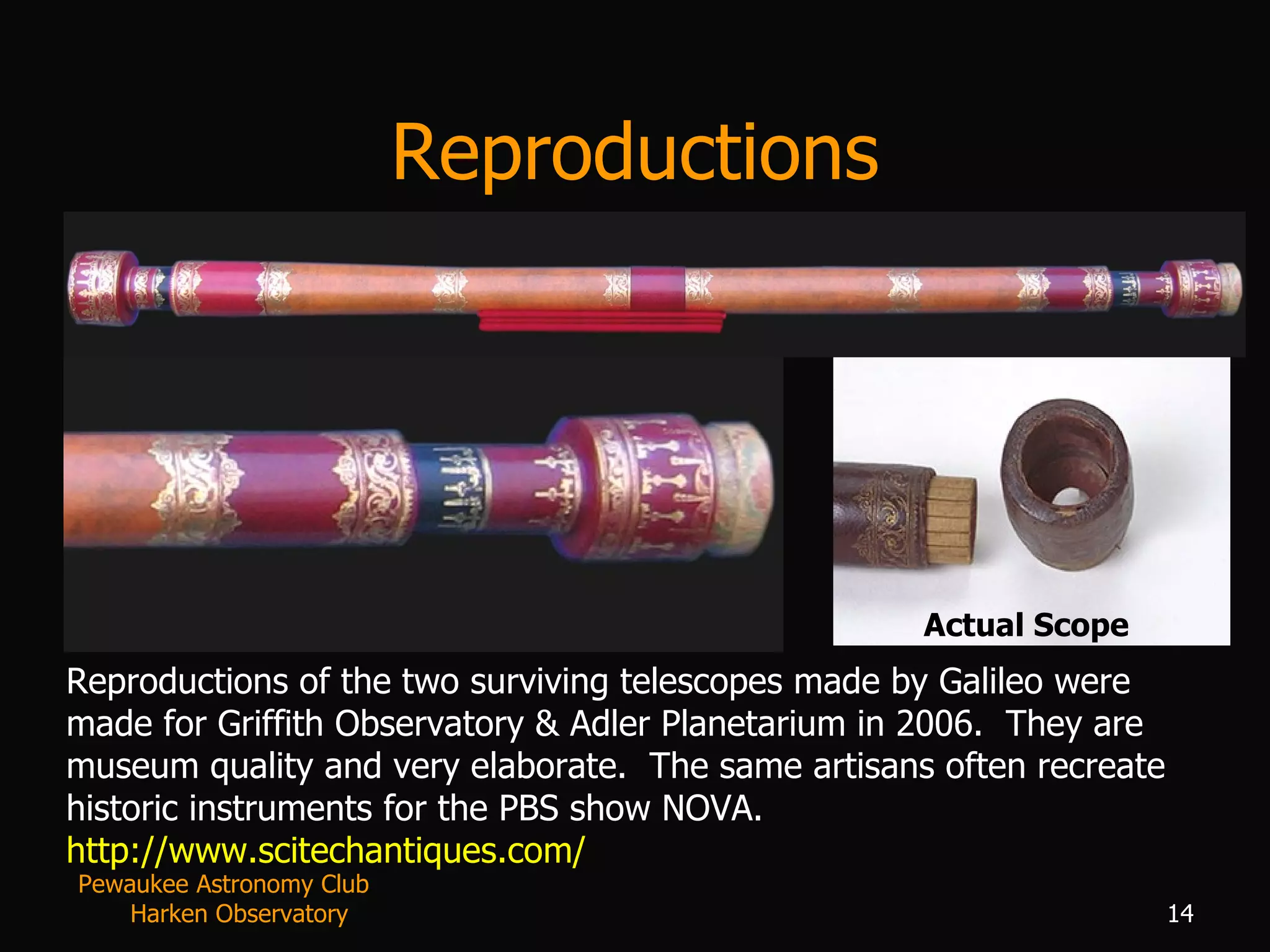
Galileo’s Telescopes Galileobuilt dozens of scopes, but only 2 survive About 3 feet long Aperture: 15mm Power: 14x & 21x Wood, leather, paper Istituto e Museo di Storia della Scienza [IMSS] Institute and Museum of the History of Science Florence, Italy Pewaukee Astronomy Club Harken Observatory
14.
Reproductions Reproductions ofthe two surviving telescopes made by Galileo were made for Griffith Observatory & Adler Planetarium in 2006. They are museum quality and very elaborate. The same artisans often recreate historic instruments for the PBS show NOVA. http://www.scitechantiques.com/ Actual Scope Pewaukee Astronomy Club Harken Observatory
15.
Galileo’s Historical RecordMaking refractors was a profitable business for Galileo. Galileo published astronomical observations, but never a highly detailed cookbook for scope building. Lots of academic debate about details of his scopes. Pewaukee Astronomy Club Harken Observatory
16.
But how welldid Galileo’s telescopes work? Pewaukee Astronomy Club Harken Observatory
17.
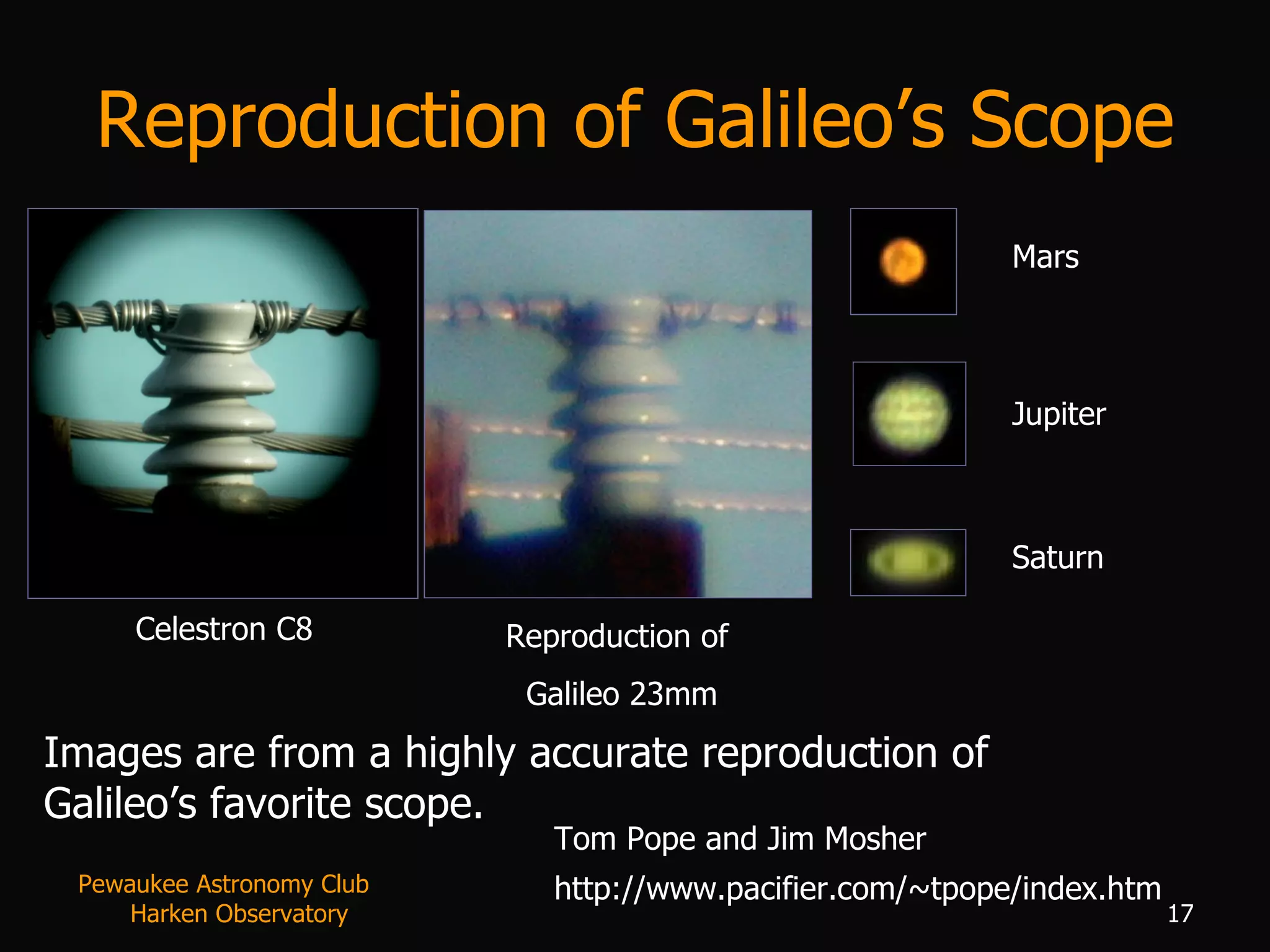
Reproduction of Galileo’sScope Celestron C8 Images are from a highly accurate reproduction of Galileo’s favorite scope. Tom Pope and Jim Mosher http://www.pacifier.com/~tpope/index.htm Pewaukee Astronomy Club Harken Observatory Reproduction of Galileo 23mm Mars Jupiter Saturn
18.
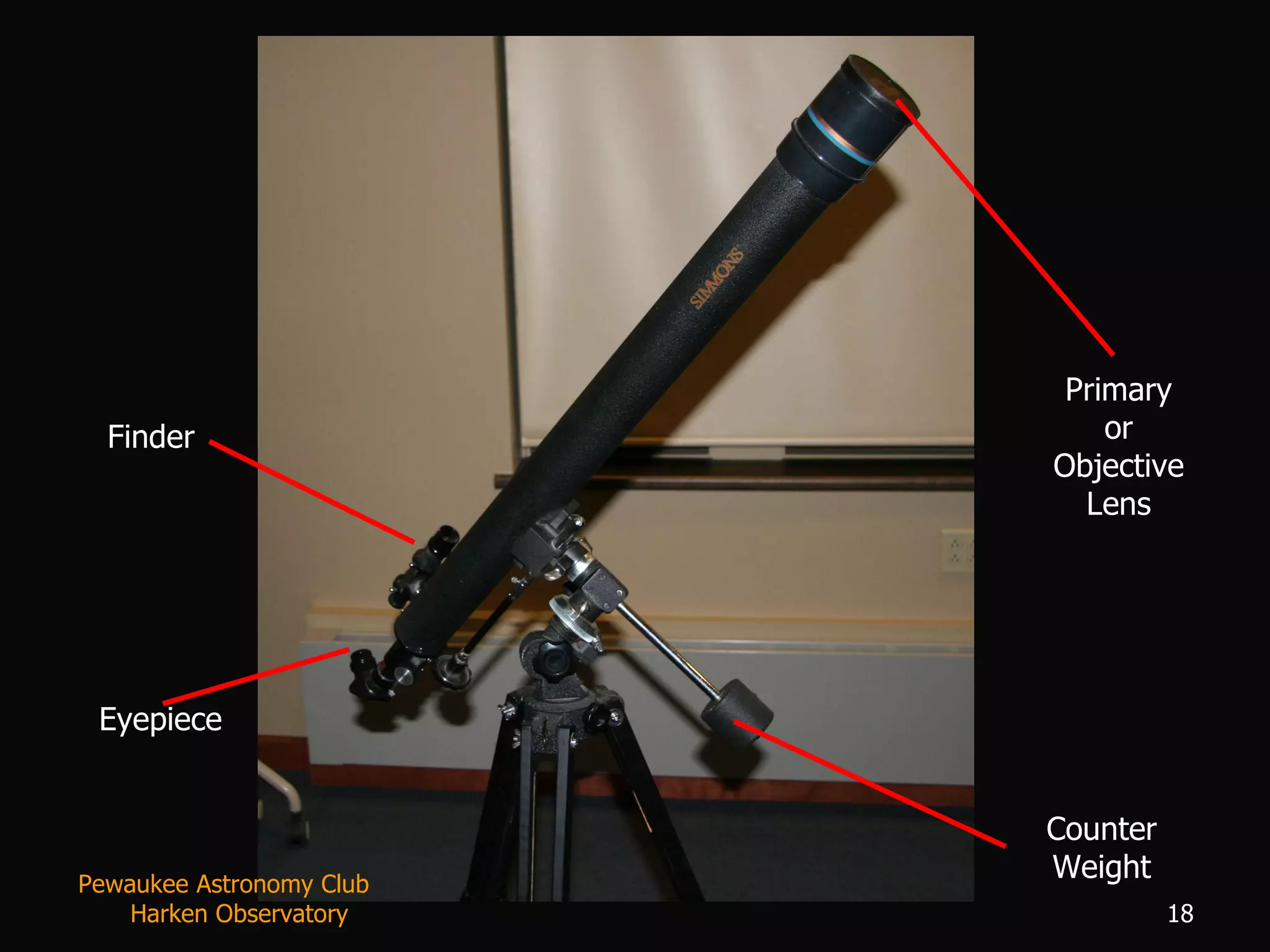
Eyepiece Finder Primaryor Objective Lens Counter Weight Pewaukee Astronomy Club Harken Observatory
19.
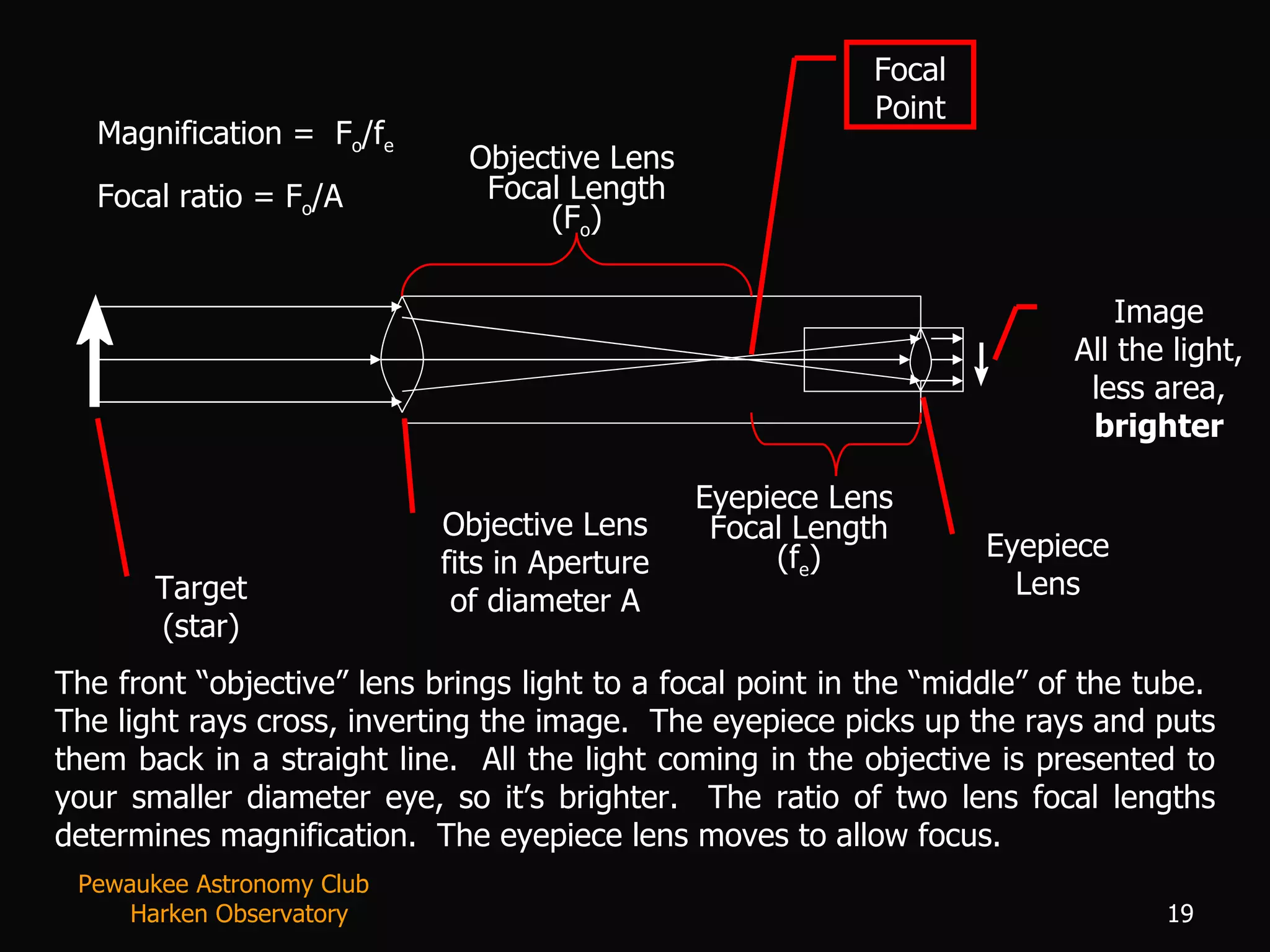
↑ ↑ Target(star) Objective Lens fits in Aperture of diameter A Eyepiece Lens Objective Lens Focal Length (F o ) Eyepiece Lens Focal Length (f e ) Magnification = F o /f e Focal ratio = F o /A The front “objective” lens brings light to a focal point in the “middle” of the tube. The light rays cross, inverting the image. The eyepiece picks up the rays and puts them back in a straight line. All the light coming in the objective is presented to your smaller diameter eye, so it’s brighter. The ratio of two lens focal lengths determines magnification. The eyepiece lens moves to allow focus. Focal Point Image All the light, less area, brighter Pewaukee Astronomy Club Harken Observatory
20.
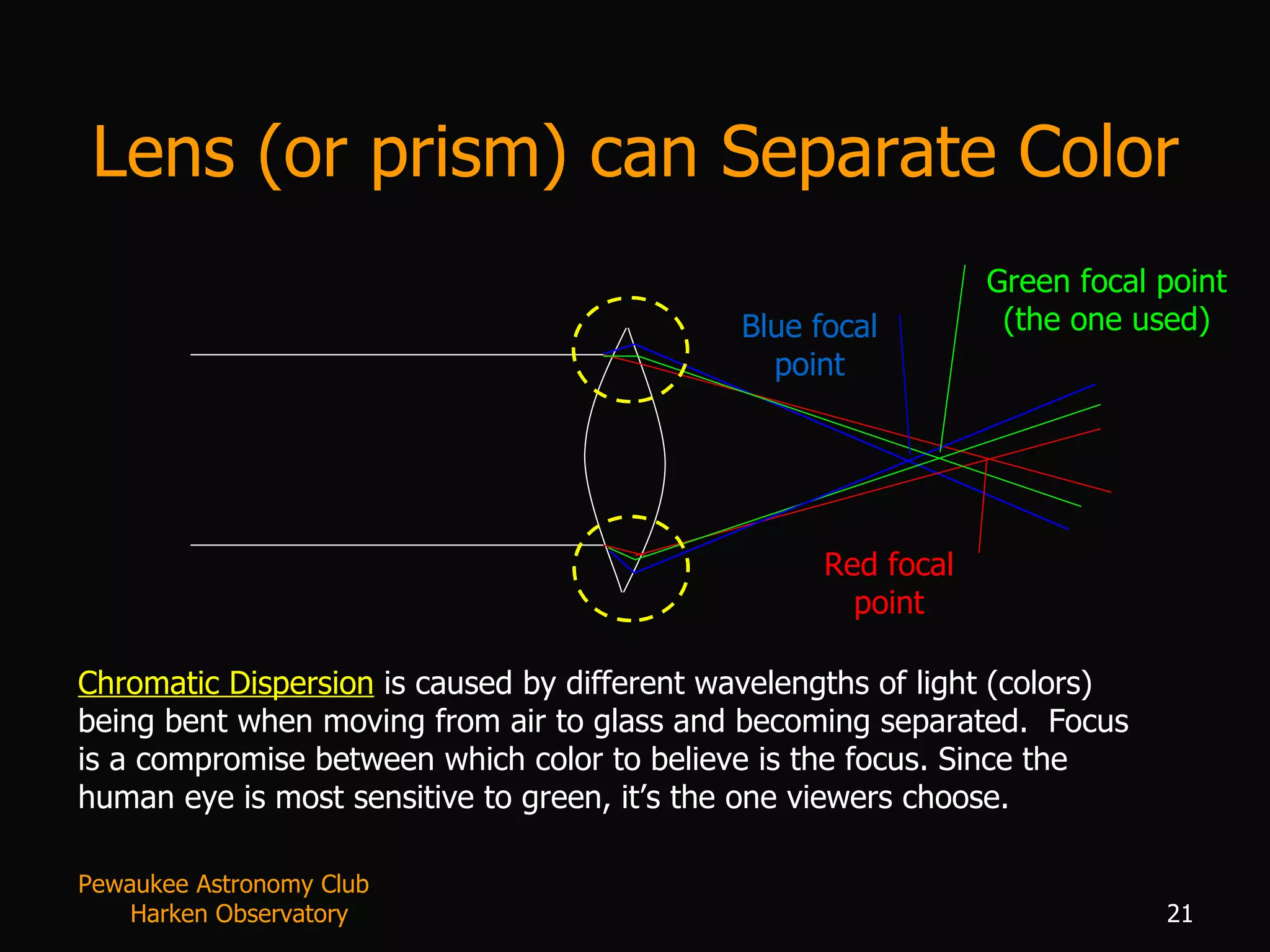
Chr oma tic abe rrat ion This simple type of refractor distorts the color of the image. The previous diagram shows the ideal case of a beam of white light passing through the lens and being bent perfectly. However, blue light bends slightly more than red light. Pewaukee Astronomy Club Harken Observatory
21.
Lens (or prism)can Separate Color Pewaukee Astronomy Club Harken Observatory Blue focal point Red focal point Green focal point (the one used) Chromatic Dispersion is caused by different wavelengths of light (colors) being bent when moving from air to glass and becoming separated. Focus is a compromise between which color to believe is the focus. Since the human eye is most sensitive to green, it’s the one viewers choose.
Solution #1 Thinnerlens -> Longer focal length -> Less distortion http://amazing-space.stsci.edu/ Pewaukee Astronomy Club Harken Observatory
24.
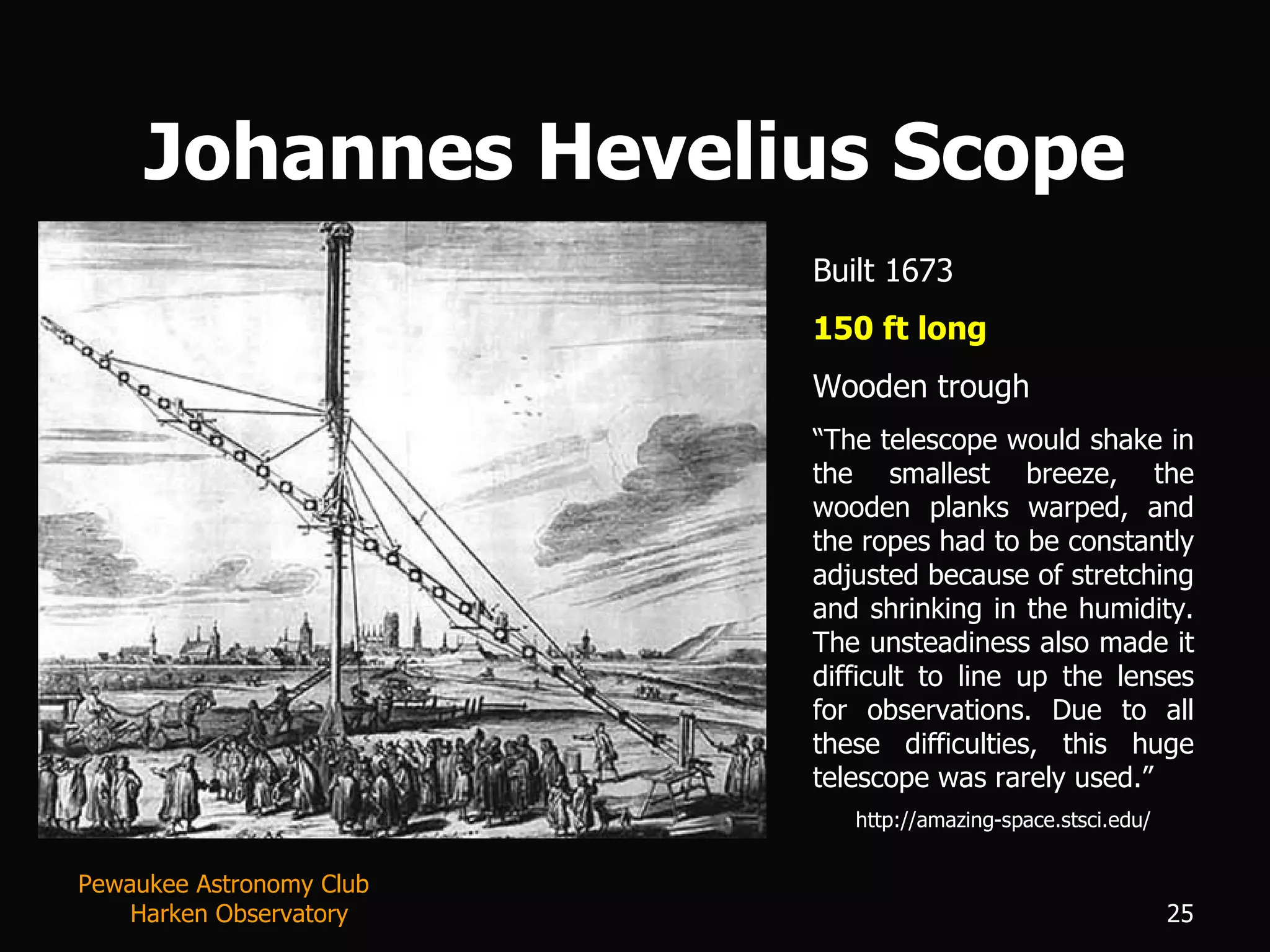
“ Six toeight feet—that was the length of a good astronomical telescope in 1645. Five years later it was 10 to 15 feet. Ten years after that, 25 feet. Ten years after that, 40 to 50 feet. By 1673, [Polish astronomer] Johannes Hevelius had constructed a telescope 150 feet long on the shores of the Baltic Sea....One astronomer cheered the coming day when aerial telescopes would have a focus of 1,000 feet and human spectators could marvel at the antics of the animals on the Moon.” Seeing and Believing: How the Telescope Opened Our Eyes and Minds to the Heavens, by Richard Panek Pewaukee Astronomy Club Harken Observatory
25.
Johannes Hevelius ScopeBuilt 1673 150 ft long Wooden trough “ The telescope would shake in the smallest breeze, the wooden planks warped, and the ropes had to be constantly adjusted because of stretching and shrinking in the humidity. The unsteadiness also made it difficult to line up the lenses for observations. Due to all these difficulties, this huge telescope was rarely used.” http://amazing-space.stsci.edu/ Pewaukee Astronomy Club Harken Observatory
26.
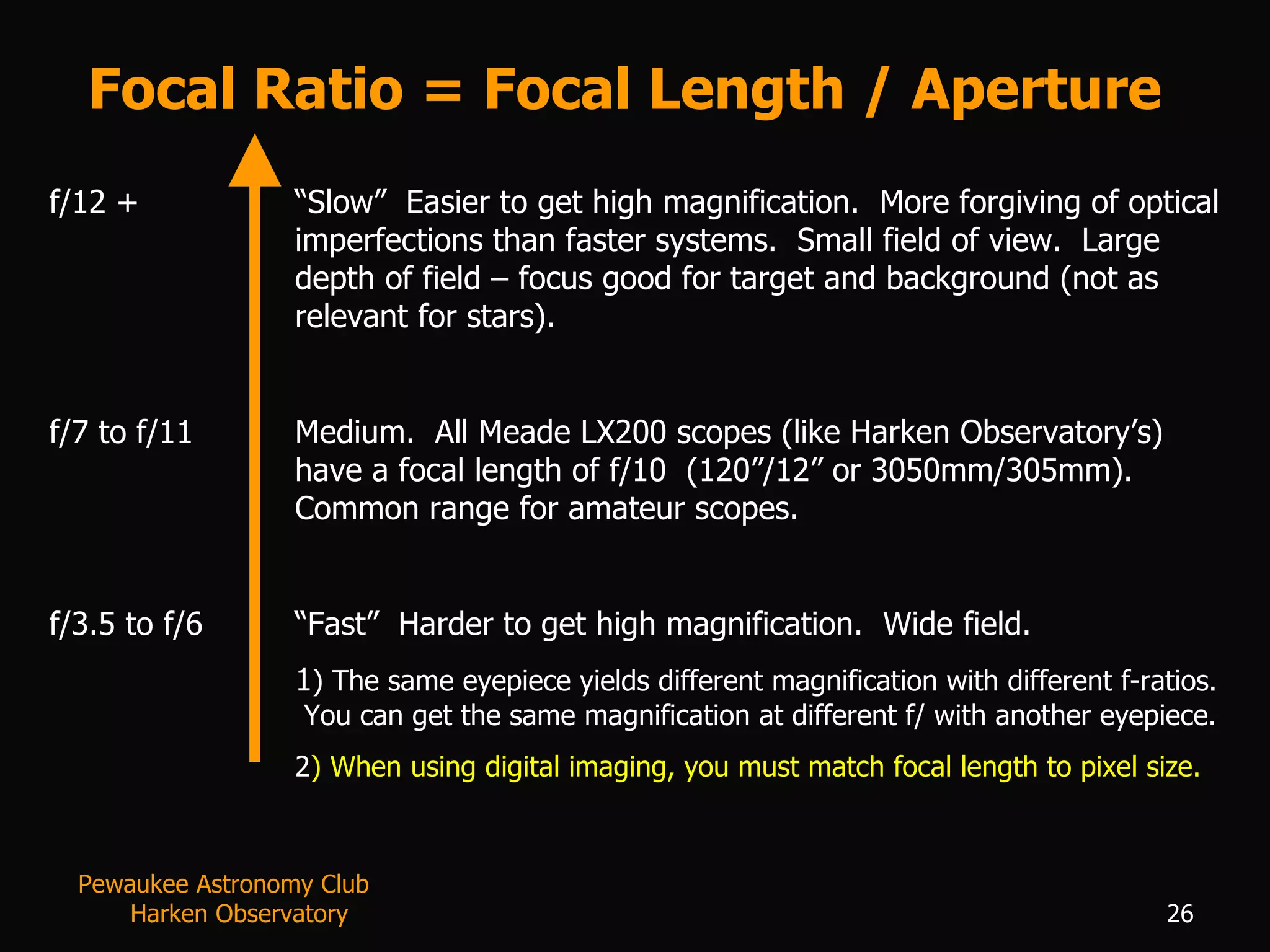
Focal Ratio =Focal Length / Aperture f/12 + “Slow” Easier to get high magnification. More forgiving of optical imperfections than faster systems. Small field of view. Large depth of field – focus good for target and background (not as relevant for stars). f/7 to f/11 Medium. All Meade LX200 scopes (like Harken Observatory’s) have a focal length of f/10 (120”/12” or 3050mm/305mm). Common range for amateur scopes. f/3.5 to f/6 “Fast” Harder to get high magnification. Wide field. 1 ) The same eyepiece yields different magnification with different f-ratios. You can get the same magnification at different f/ with another eyepiece. 2 ) When using digital imaging, you must match focal length to pixel size. Pewaukee Astronomy Club Harken Observatory
27.
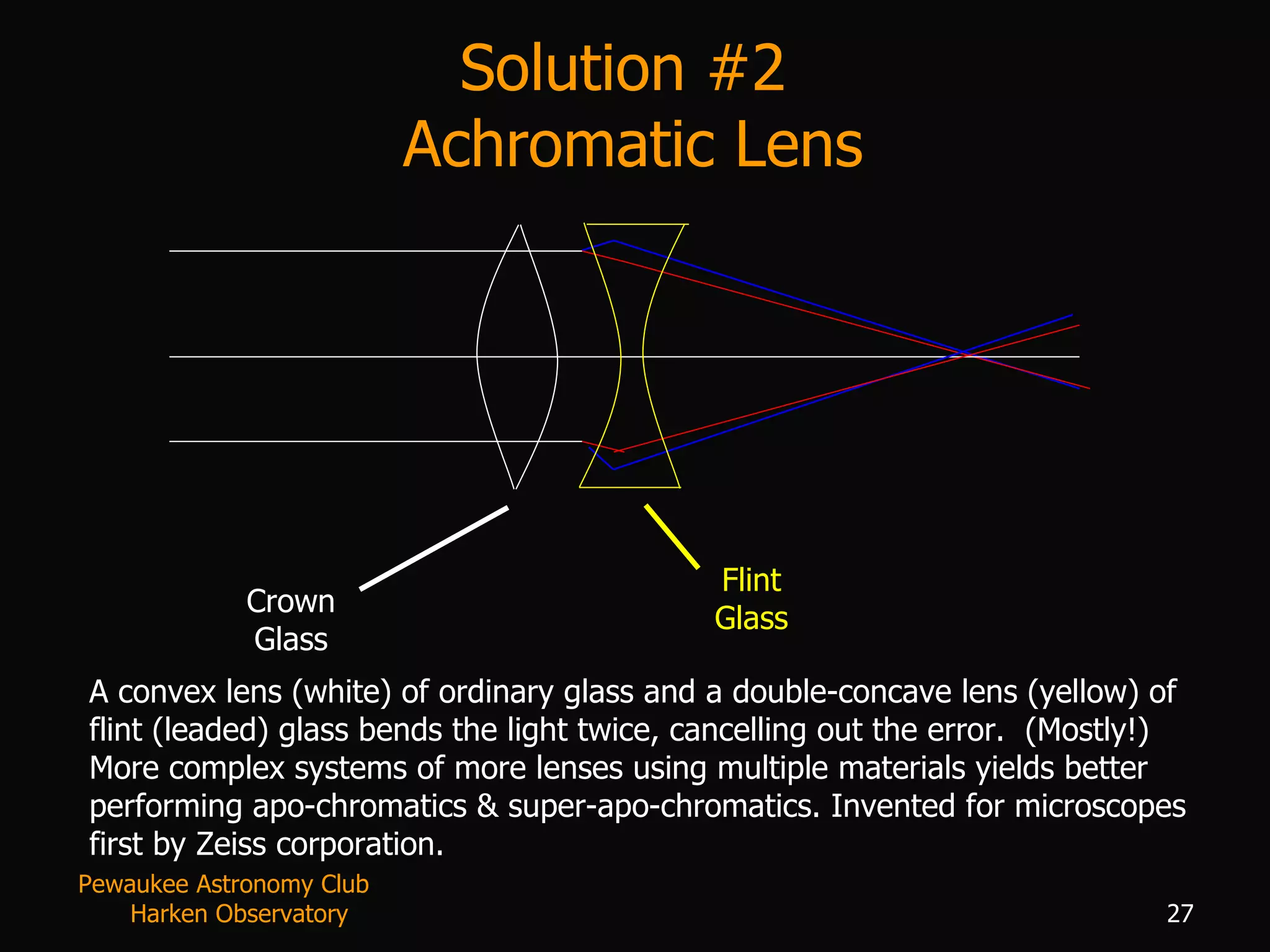
Solution #2 Achromatic Lens A convex lens (white) of ordinary glass and a double-concave lens (yellow) of flint (leaded) glass bends the light twice, cancelling out the error. (Mostly!) More complex systems of more lenses using multiple materials yields better performing apo-chromatics & super-apo-chromatics. Invented for microscopes first by Zeiss corporation. Pewaukee Astronomy Club Harken Observatory Flint Glass Crown Glass
28.
Focus Issues Youwill see this concept again and again. Light from the target does not focus to a precise point. There are many other optical defects including coma, astigmatism and field curvature. Pewaukee Astronomy Club Harken Observatory
29.
Eyepieces Eyepieces comein many designs and may incorporate many lenses (8 or more) of different materials and shapes Many trade-offs: focal length, eye relief, aberrations, expense, diameter, field of view, … Eyepiece types include: Plössl, Huygens, Ramsden, Kellner (or achromatized Ramsden), Orthoscopic (or orthographic) and more CCD imagers are another set of issues Pewaukee Astronomy Club Harken Observatory
30.
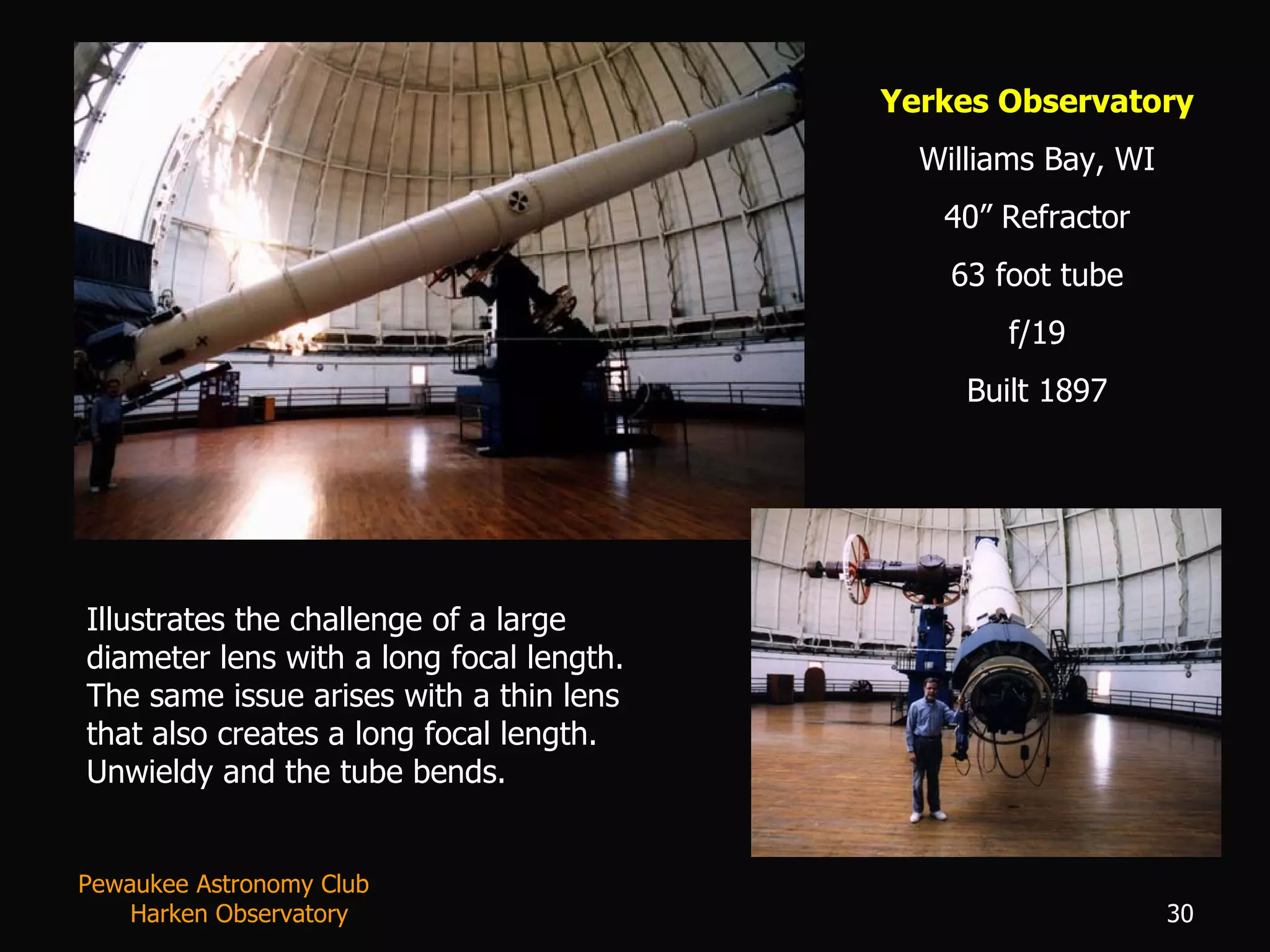
Yerkes Observatory WilliamsBay, WI 40” Refractor 63 foot tube f/19 Built 1897 Illustrates the challenge of a large diameter lens with a long focal length. The same issue arises with a thin lens that also creates a long focal length. Unwieldy and the tube bends. Pewaukee Astronomy Club Harken Observatory
31.
Summary of RefractorsUse only lenses. Produce high contrast images. Perfect for planets, moons, etc. Good ones correct lens issues, making them expensive. Optics are tightly mounted, sealed and stay clean. Scope is usually rugged. Pewaukee Astronomy Club Harken Observatory
32.
Goals for aTelescope Refractor (Dioptrics) Reflector (Catoptrics) Lens-Mirror (Catadioptrics) References Pewaukee Astronomy Club Harken Observatory
33.
Reflector Telescope Lensbased scopes had been around for about 50 years and were limited by size, lens aberration, glass quality, etc. Several people speculated mirrors could bypass the issues – but how? Isaac Newton invented the first real reflector telescope in 1668 Pewaukee Astronomy Club Harken Observatory
34.
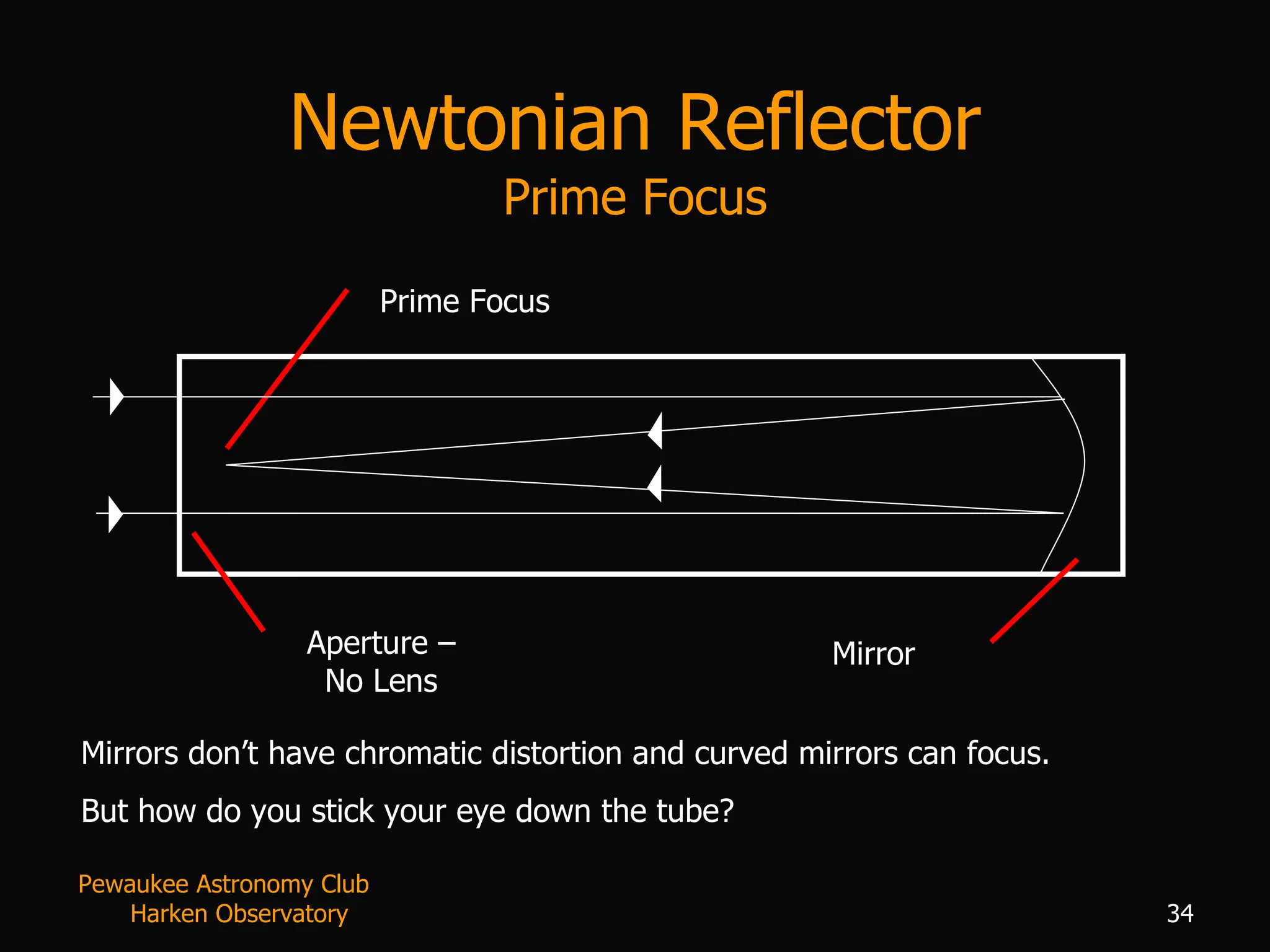
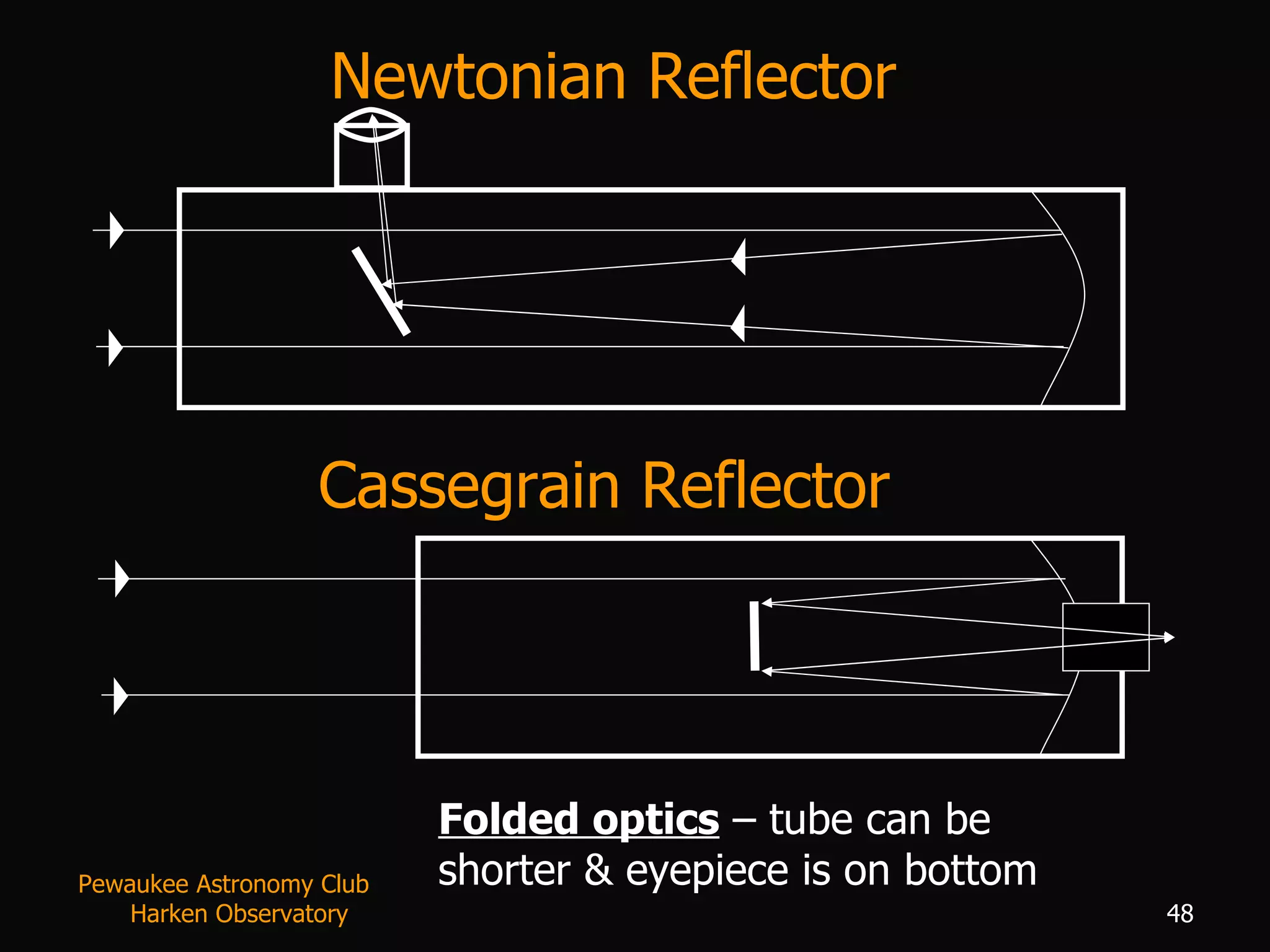
Newtonian Reflector PrimeFocus Aperture – No Lens Mirror Prime Focus Mirrors don’t have chromatic distortion and curved mirrors can focus. But how do you stick your eye down the tube? Pewaukee Astronomy Club Harken Observatory
35.
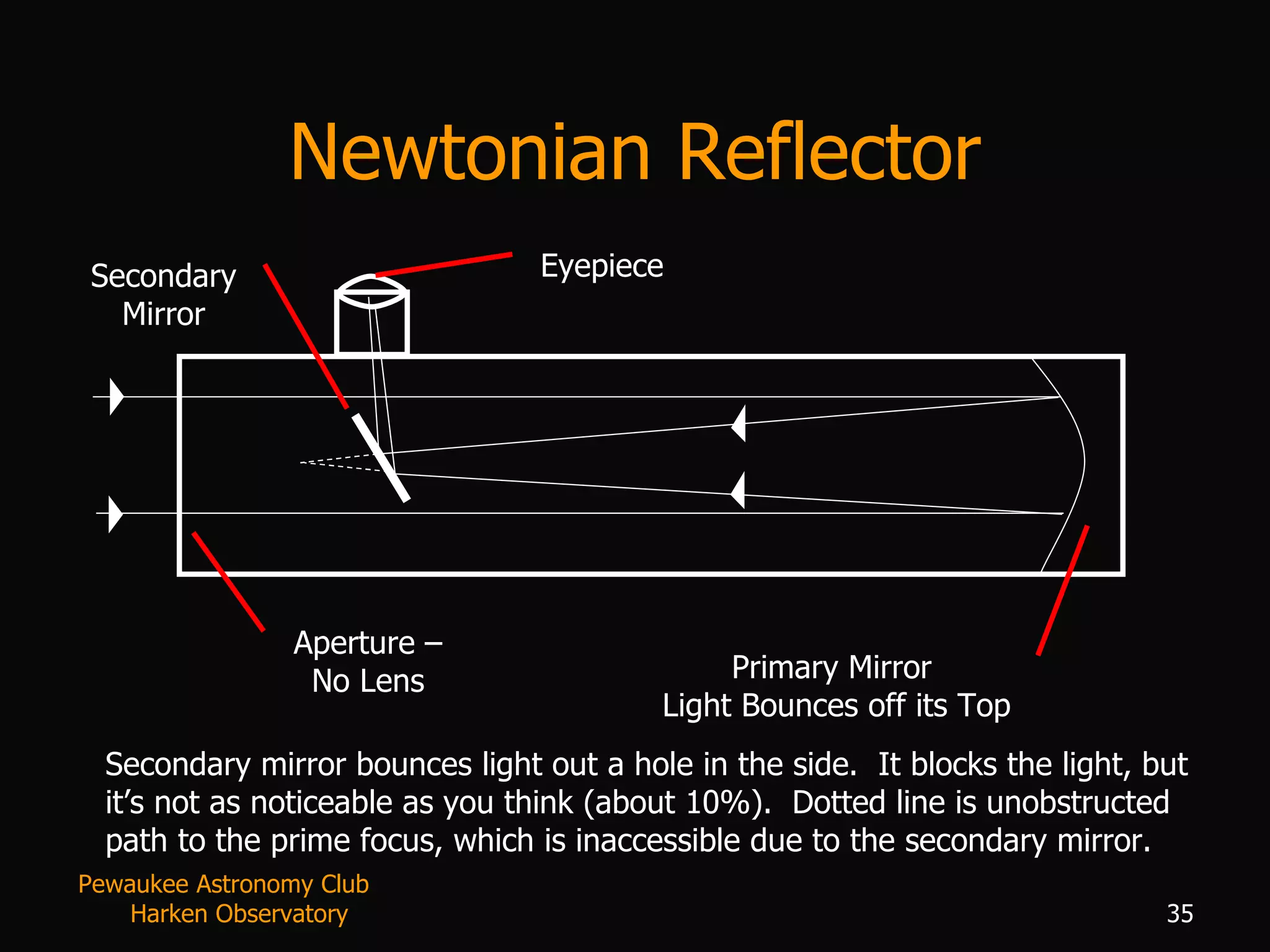
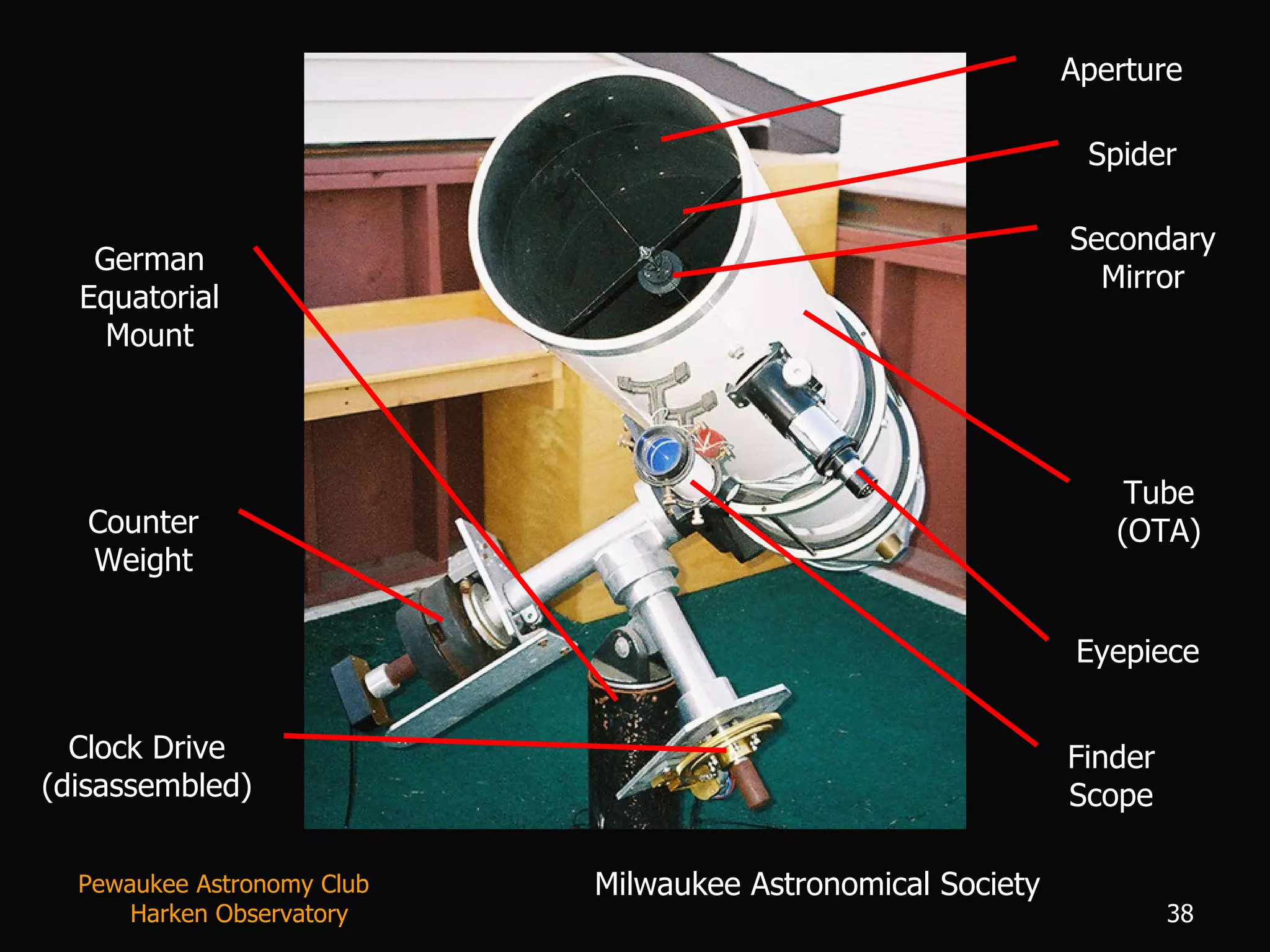
Newtonian Reflector Aperture– No Lens Primary Mirror Light Bounces off its Top Secondary Mirror Eyepiece Secondary mirror bounces light out a hole in the side. It blocks the light, but it’s not as noticeable as you think (about 10%). Dotted line is unobstructed path to the prime focus, which is inaccessible due to the secondary mirror. Pewaukee Astronomy Club Harken Observatory
36.
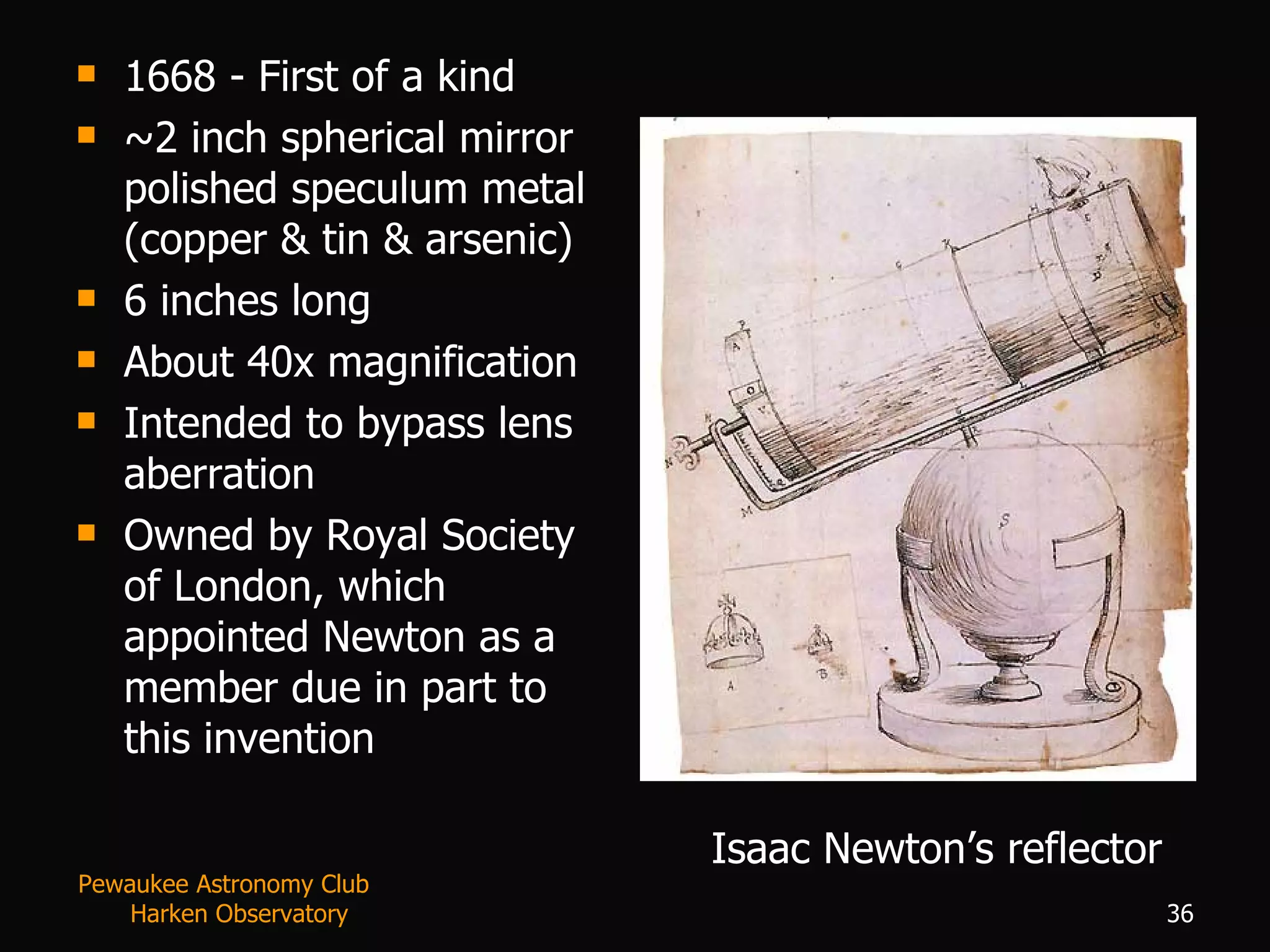
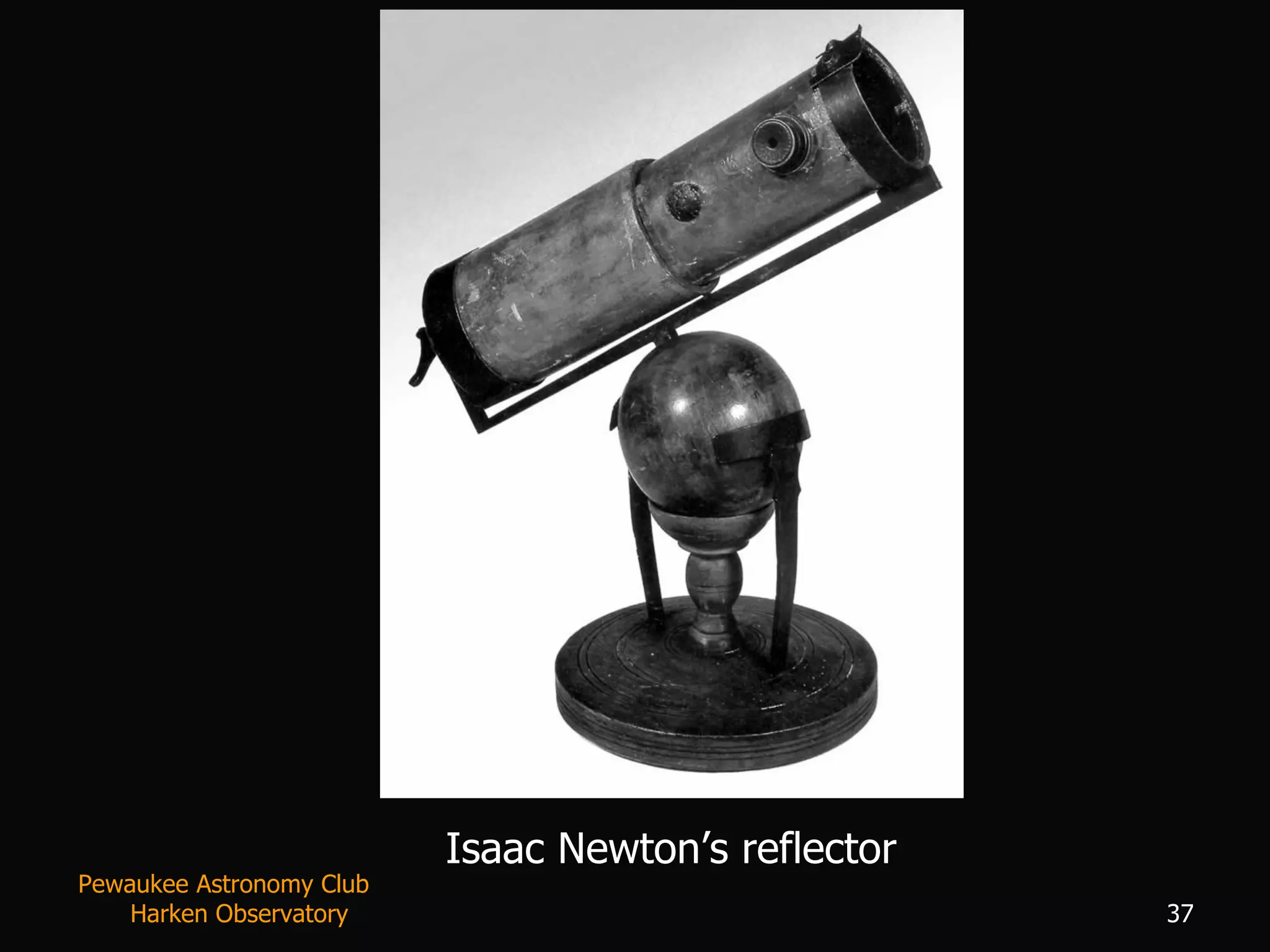
1668 - Firstof a kind ~2 inch spherical mirror polished speculum metal (copper & tin & arsenic) 6 inches long About 40x magnification Intended to bypass lens aberration Owned by Royal Society of London, which appointed Newton as a member due in part to this invention Isaac Newton’s reflector Pewaukee Astronomy Club Harken Observatory
Eyepiece Aperture SpiderFinder Scope German Equatorial Mount Clock Drive (disassembled) Counter Weight Secondary Mirror Tube (OTA) Milwaukee Astronomical Society Pewaukee Astronomy Club Harken Observatory
39.
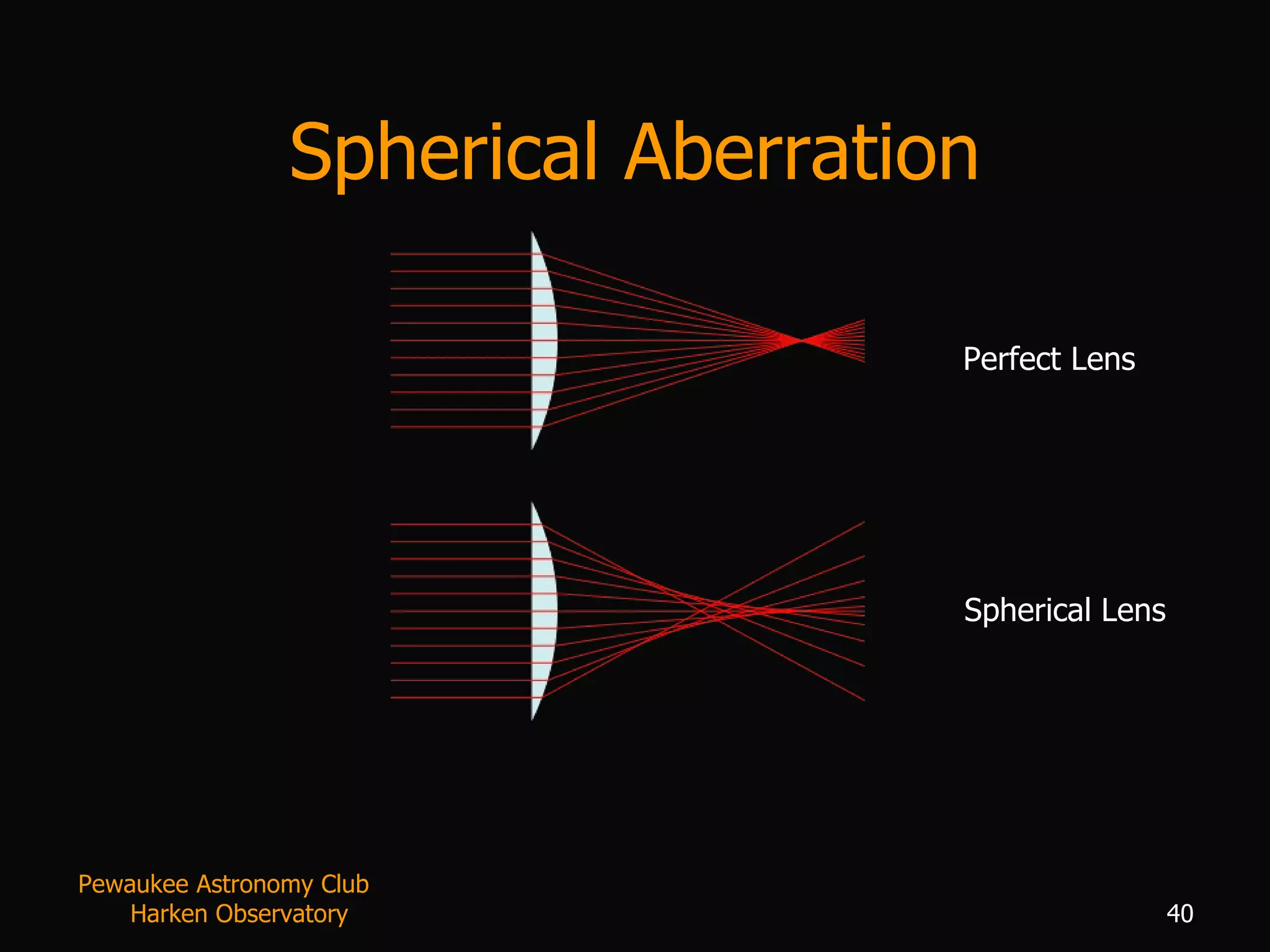
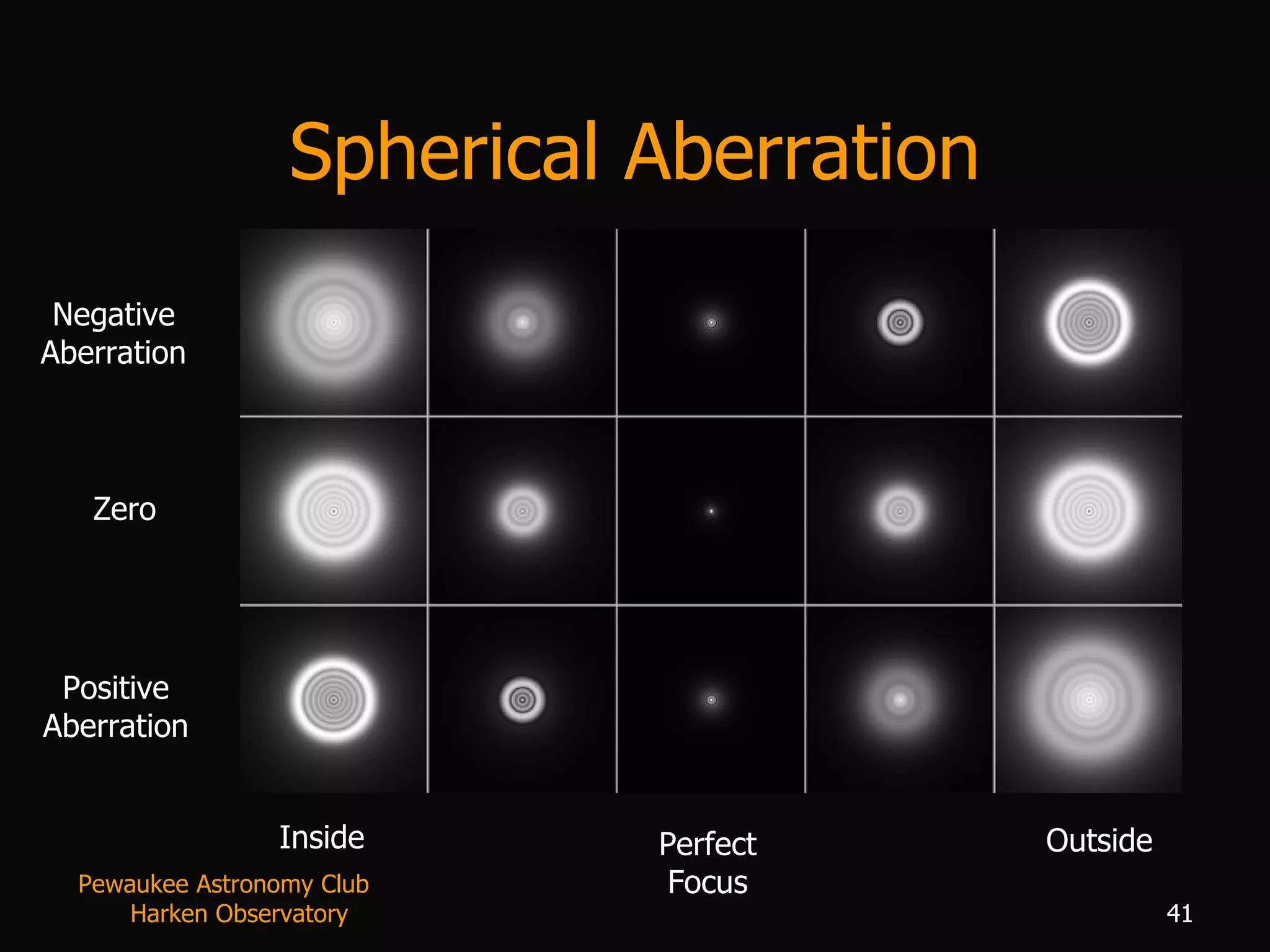
Spherical Aberration Newtonused a mirror shaped like part of a sphere. There was no chromatic aberration since light bounced off the top of the mirror Spherical optics, whether mirrors or lenses , introduce other types of distortion Pewaukee Astronomy Club Harken Observatory
Spherical Aberration PerfectFocus Outside Inside Negative Aberration Zero Positive Aberration Pewaukee Astronomy Club Harken Observatory
42.
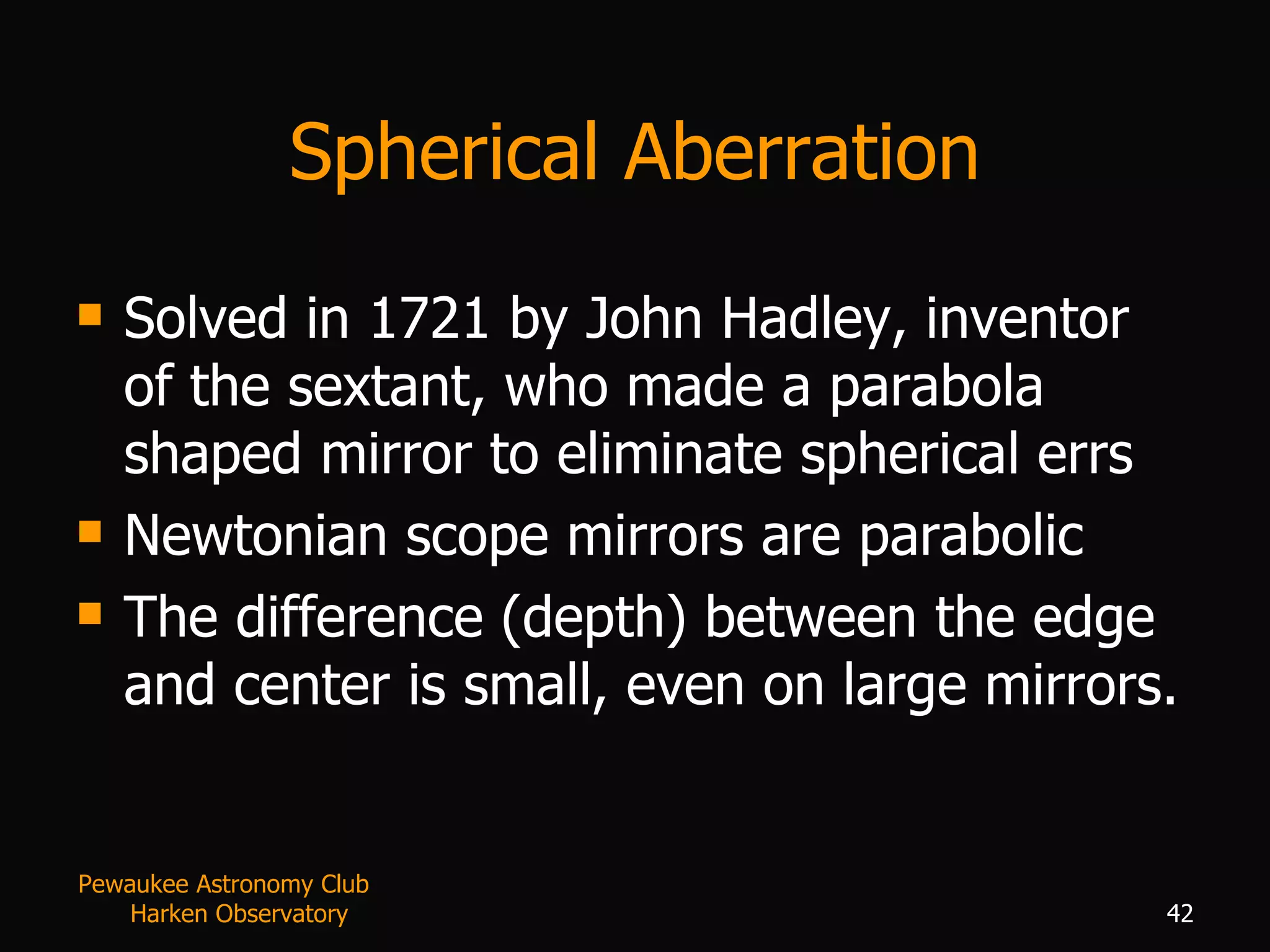
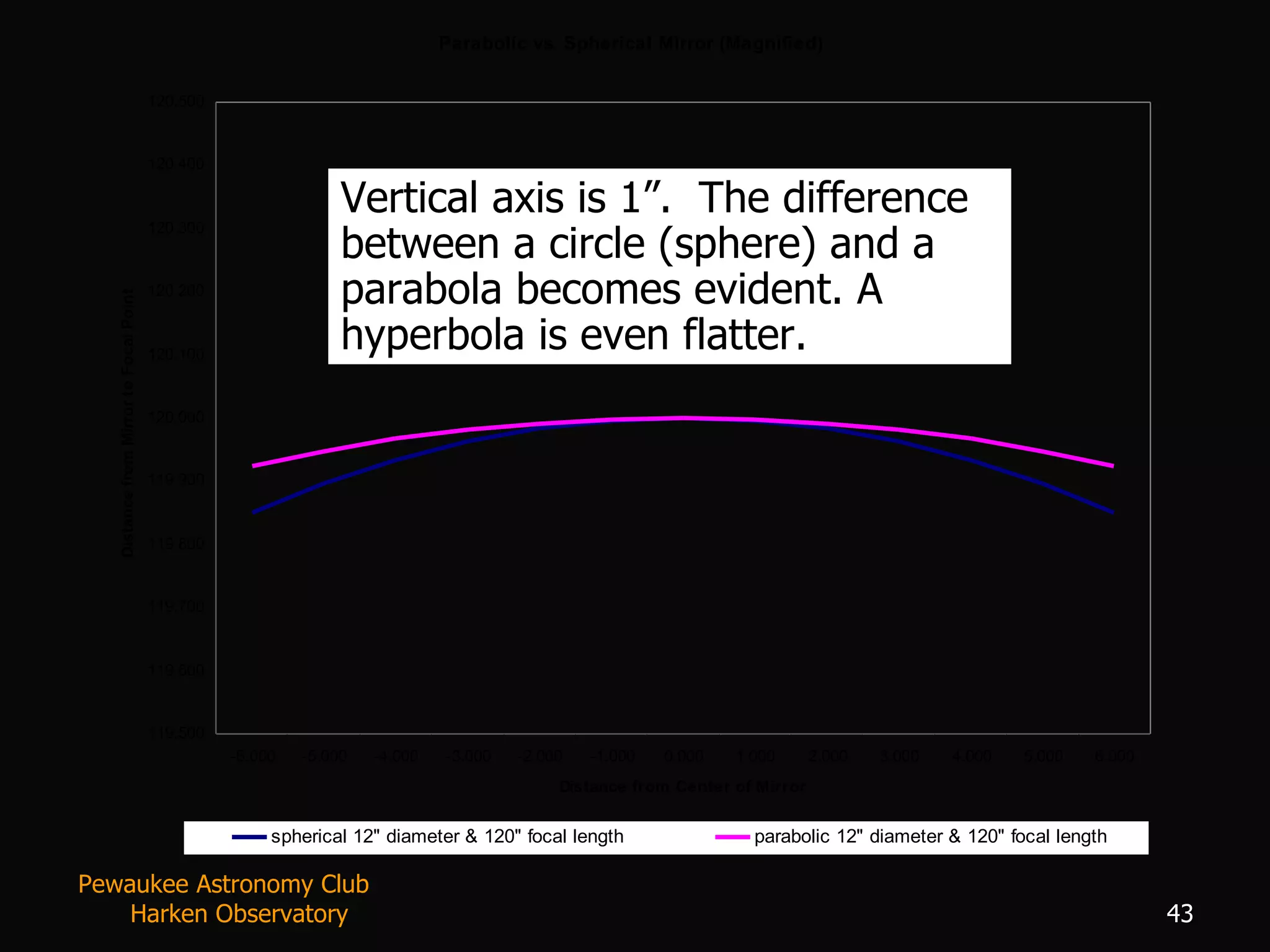
Spherical Aberration Solvedin 1721 by John Hadley, inventor of the sextant, who made a parabola shaped mirror to eliminate spherical errs Newtonian scope mirrors are parabolic The difference (depth) between the edge and center is small, even on large mirrors. Pewaukee Astronomy Club Harken Observatory
43.
Vertical axis is1”. The difference between a circle (sphere) and a parabola becomes evident. A hyperbola is even flatter. Pewaukee Astronomy Club Harken Observatory
44.
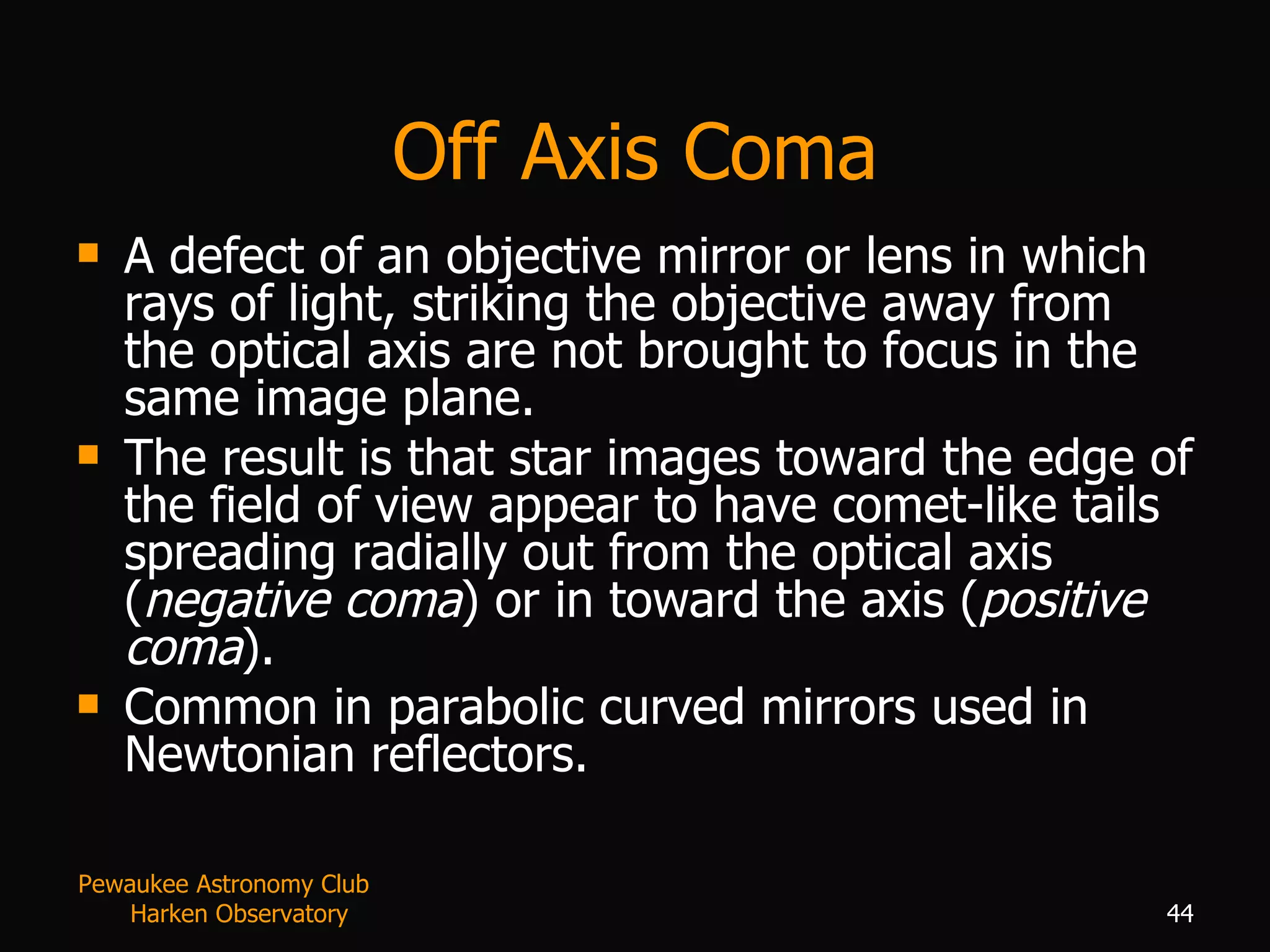
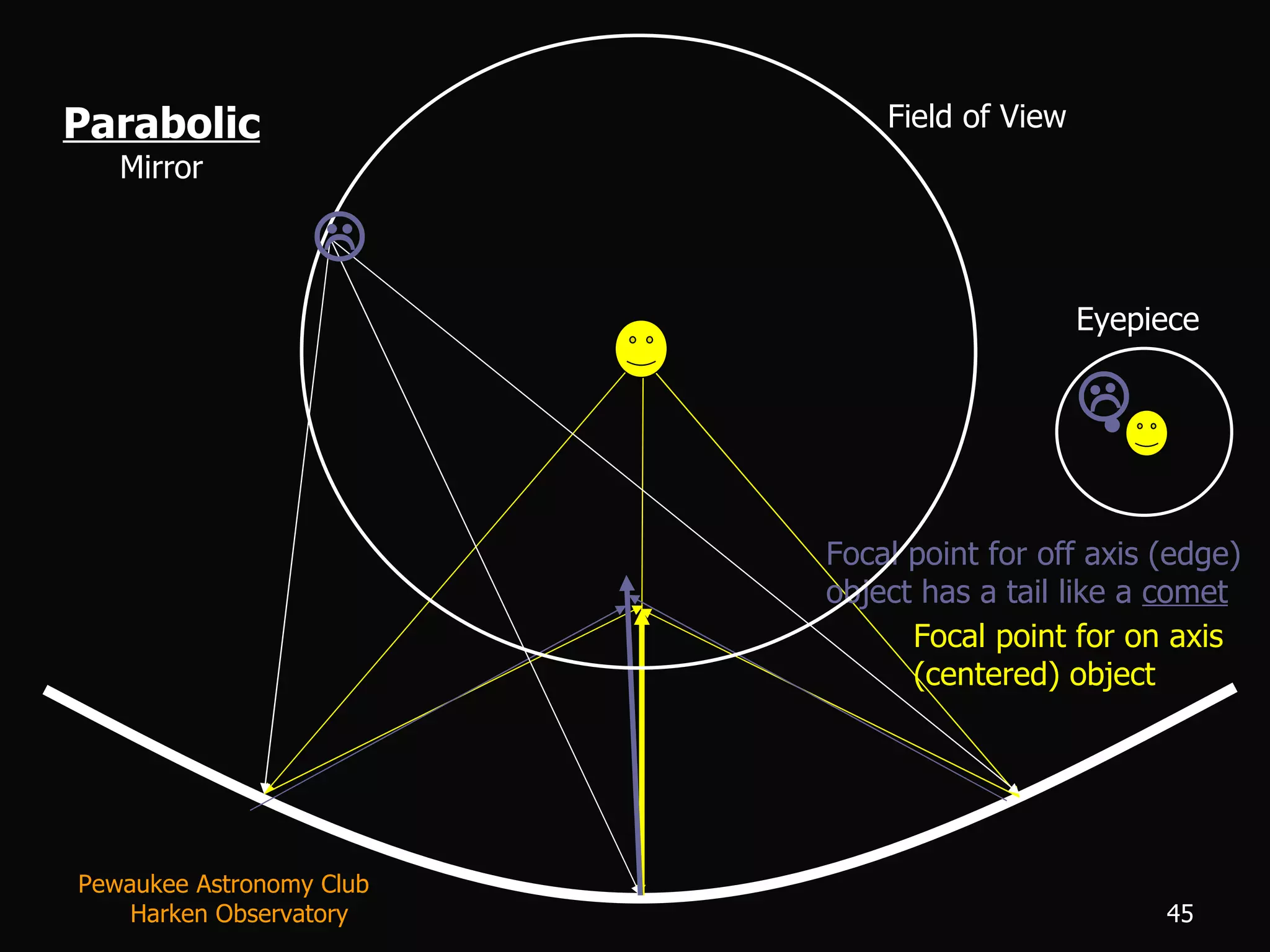
Off Axis ComaA defect of an objective mirror or lens in which rays of light, striking the objective away from the optical axis are not brought to focus in the same image plane. The result is that star images toward the edge of the field of view appear to have comet-like tails spreading radially out from the optical axis ( negative coma ) or in toward the axis ( positive coma ). Common in parabolic curved mirrors used in Newtonian reflectors. Pewaukee Astronomy Club Harken Observatory
45.
Parabolic MirrorFocal point for off axis (edge) object has a tail like a comet Focal point for on axis (centered) object Eyepiece Pewaukee Astronomy Club Harken Observatory Field of View
46.
Mirror Coating Originalscope mirrors were shiny metal. It was hard to make a smooth surface with perfect curvature. Glass mirrors are ground like a lens with very high precision. The reflective coating is on top of the glass, not on the back. It was originally silver. Now everyone uses aluminum. It is easy to scratch, so it rarely gets cleaned. Pewaukee Astronomy Club Harken Observatory
47.
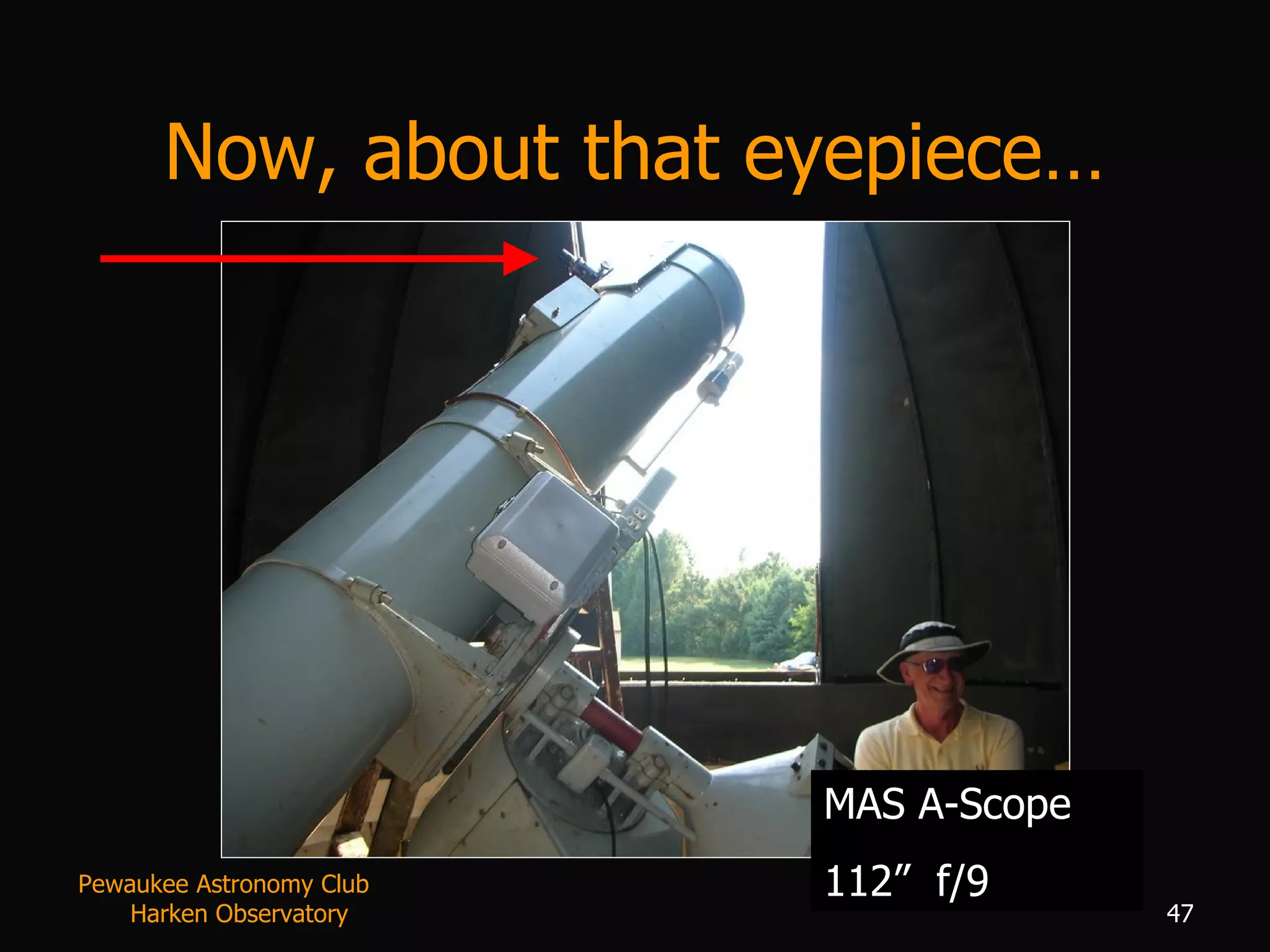
Now, about thateyepiece… MAS A-Scope 112” f/9 Pewaukee Astronomy Club Harken Observatory
48.
Cassegrain Reflector NewtonianReflector Folded optics – tube can be shorter & eyepiece is on bottom Pewaukee Astronomy Club Harken Observatory
49.
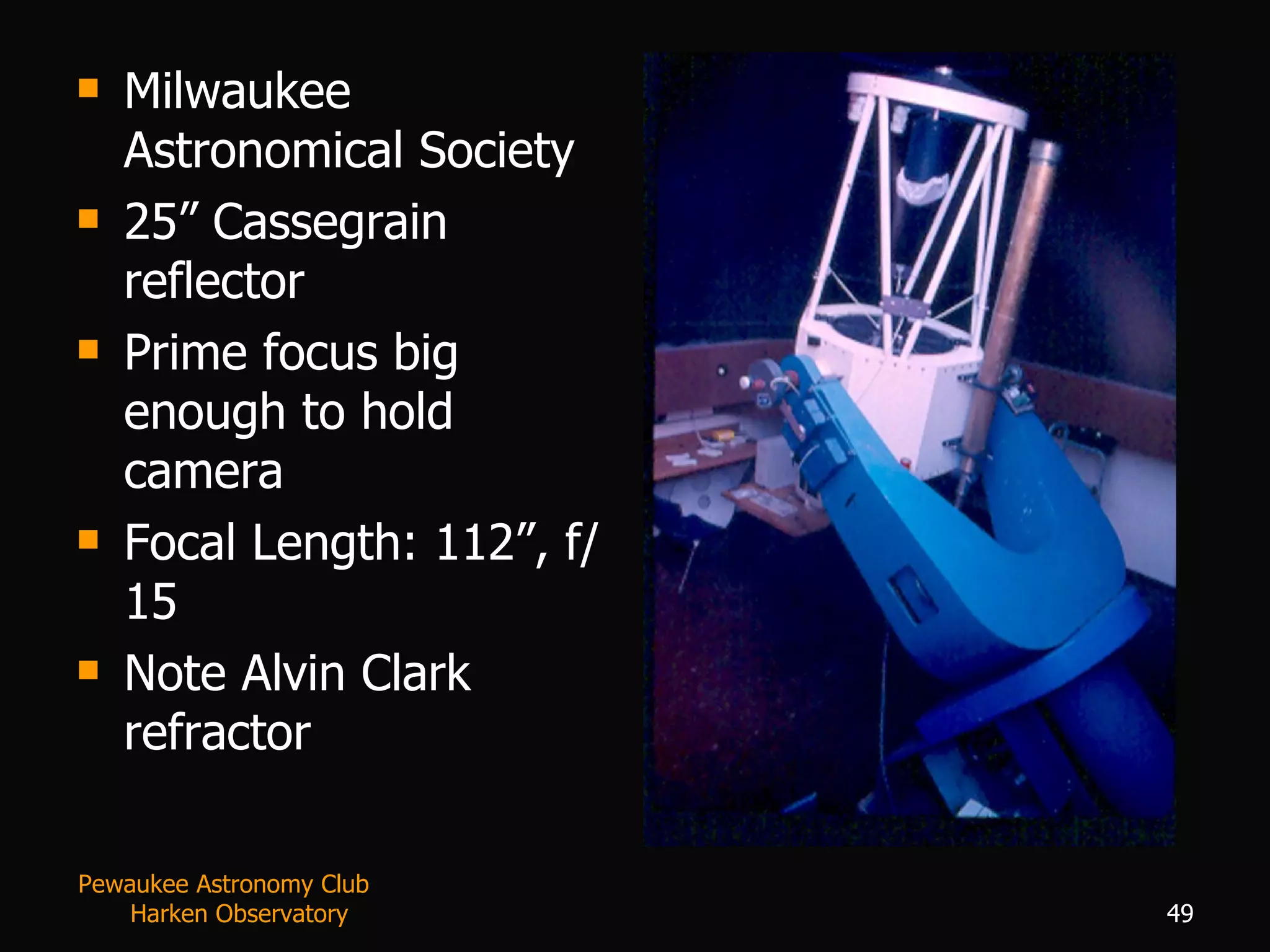
Milwaukee Astronomical Society25” Cassegrain reflector Prime focus big enough to hold camera Focal Length: 112”, f/15 Note Alvin Clark refractor Pewaukee Astronomy Club Harken Observatory
50.
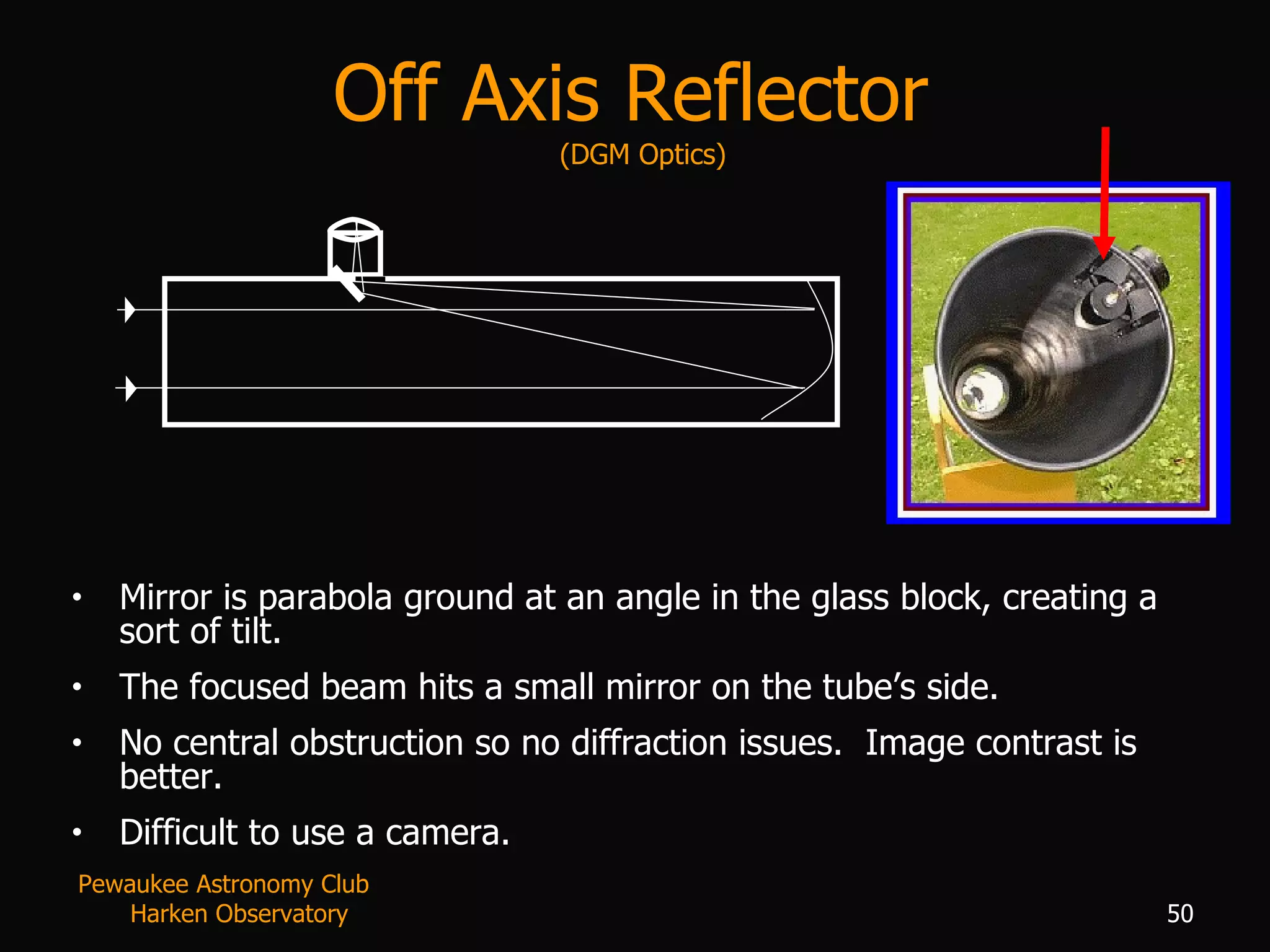
Off Axis Reflector (DGM Optics) Mirror is parabola ground at an angle in the glass block, creating a sort of tilt. The focused beam hits a small mirror on the tube’s side. No central obstruction so no diffraction issues. Image contrast is better. Difficult to use a camera. Pewaukee Astronomy Club Harken Observatory
51.
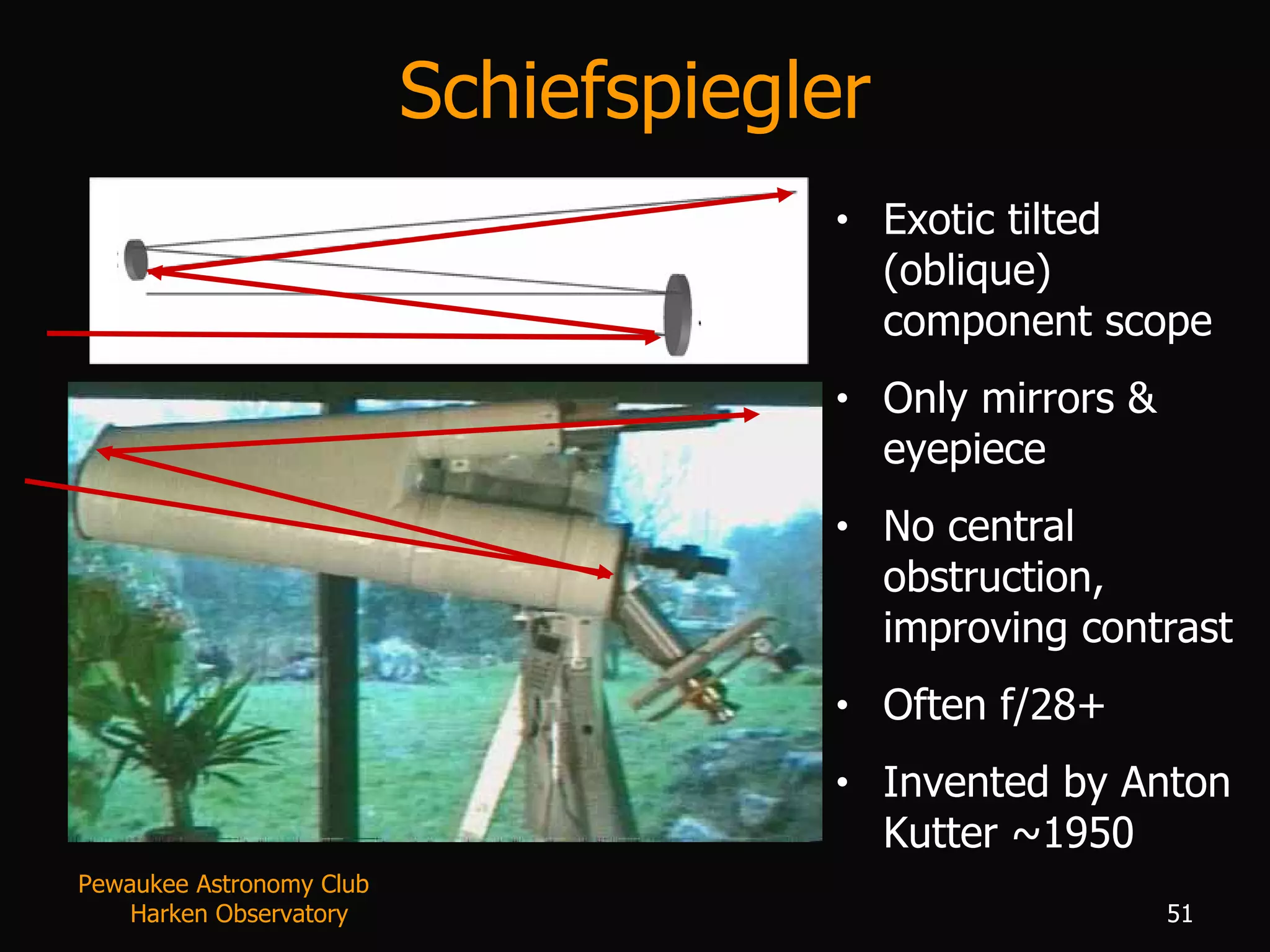
Schiefspiegler Exotic tilted(oblique) component scope Only mirrors & eyepiece No central obstruction, improving contrast Often f/28+ Invented by Anton Kutter ~1950 Pewaukee Astronomy Club Harken Observatory
52.
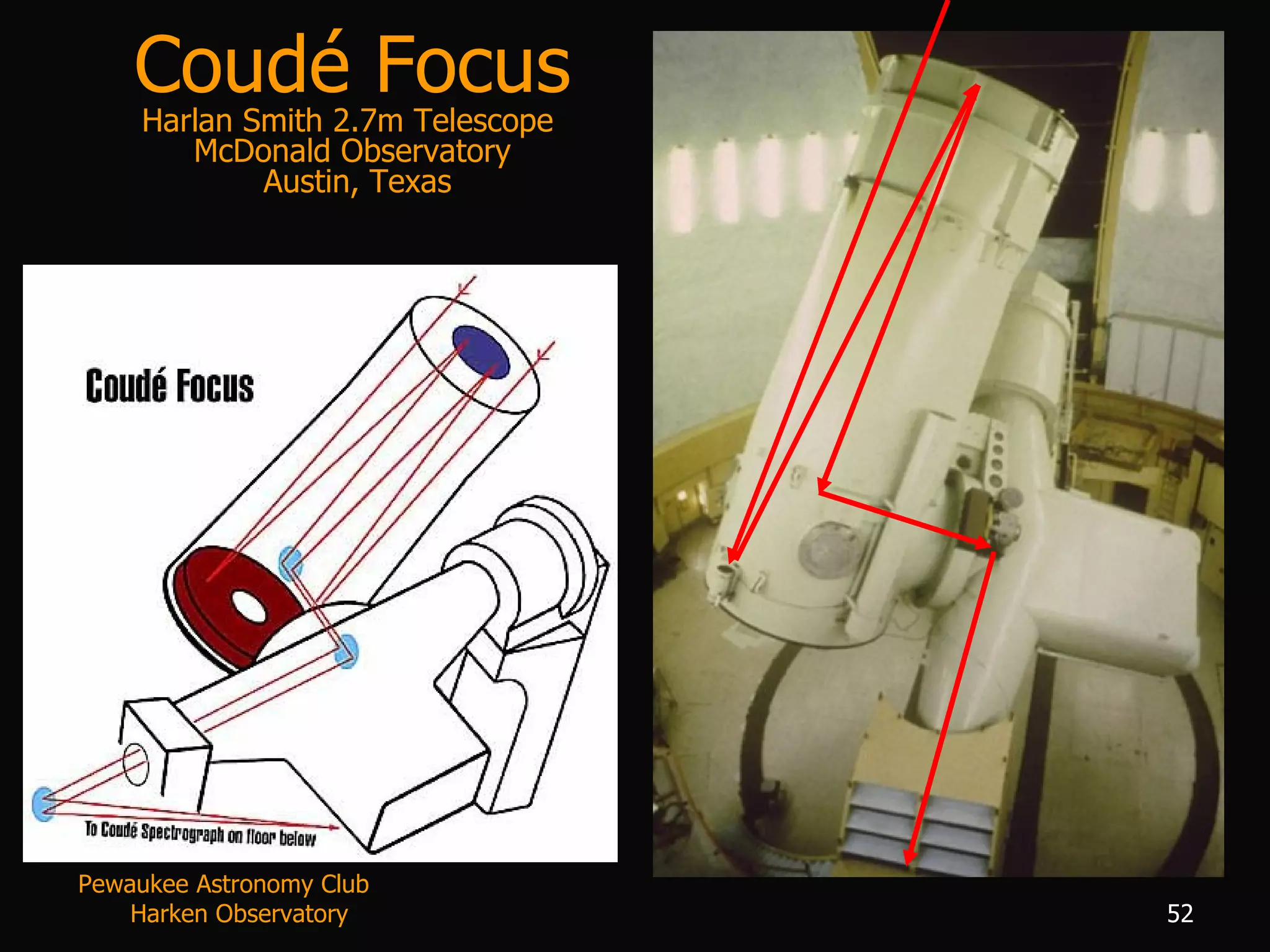
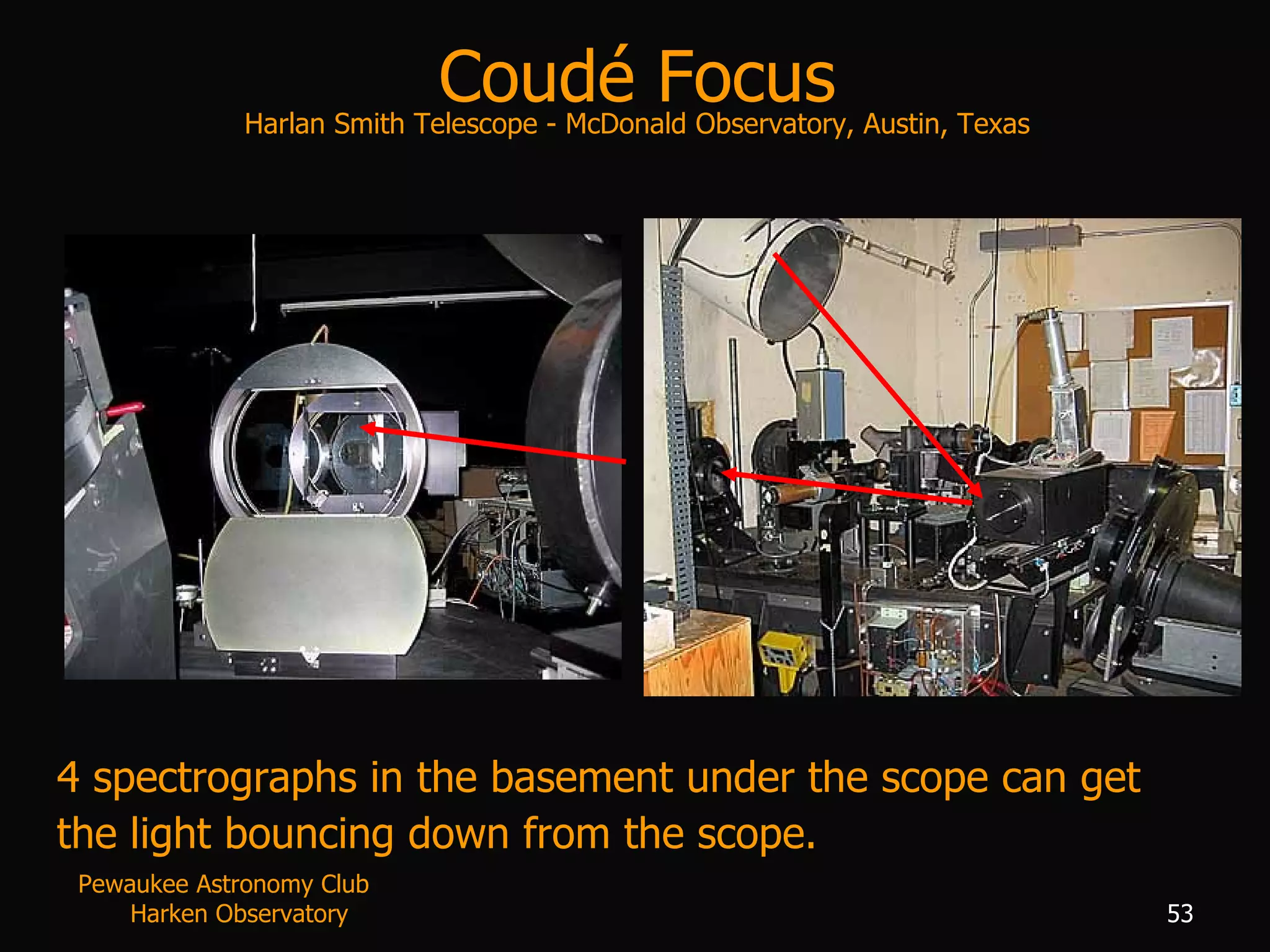
Coud é Focus Harlan Smith 2.7m Telescope McDonald Observatory Austin, Texas Pewaukee Astronomy Club Harken Observatory
53.
Coud é Focus Harlan Smith Telescope - McDonald Observatory, Austin, Texas 4 spectrographs in the basement under the scope can get the light bouncing down from the scope. Pewaukee Astronomy Club Harken Observatory
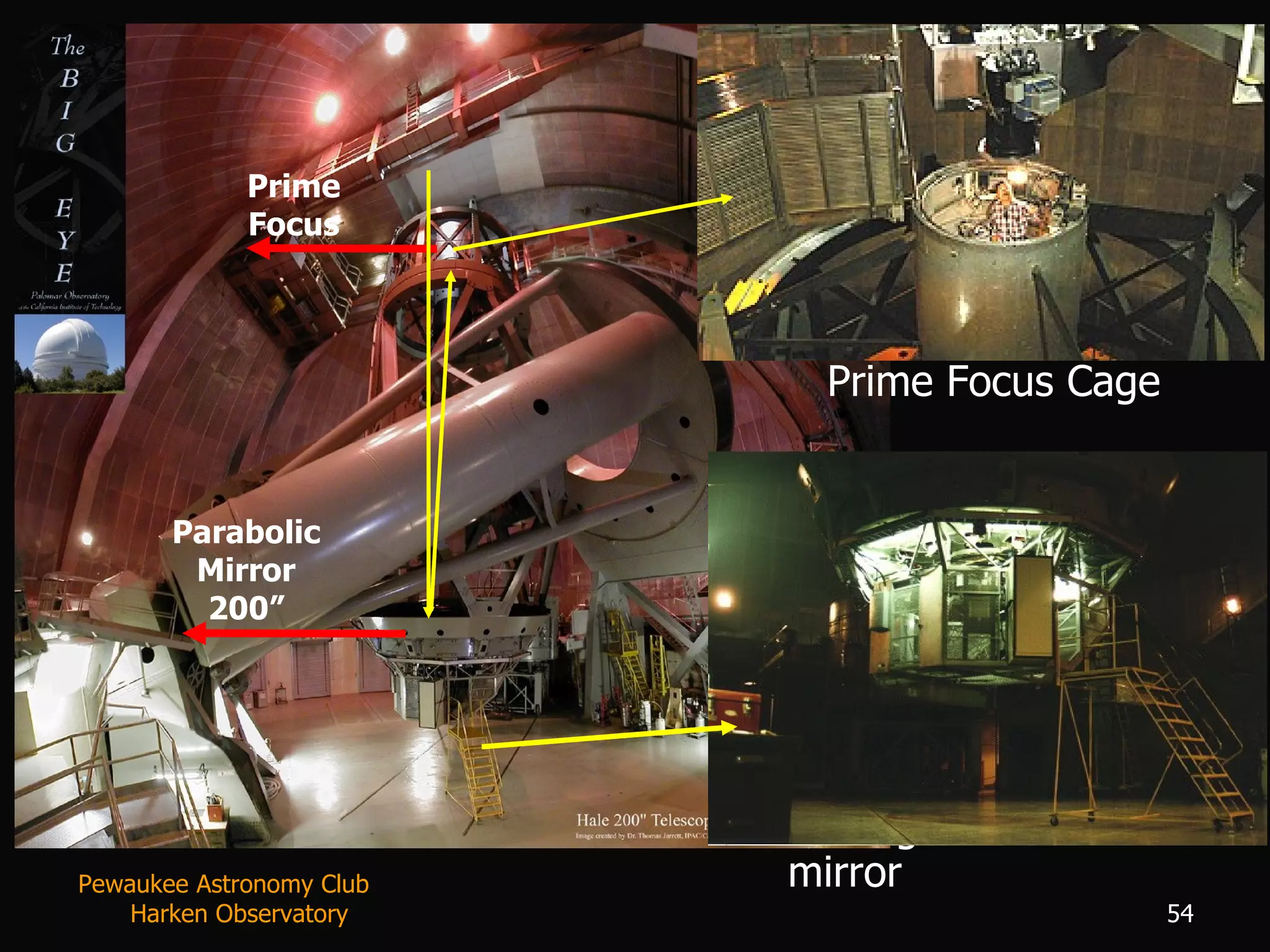
54.
Parabolic Mirror 200”Prime Focus Cassegrain Room below mirror Pewaukee Astronomy Club Harken Observatory Prime Focus Cage
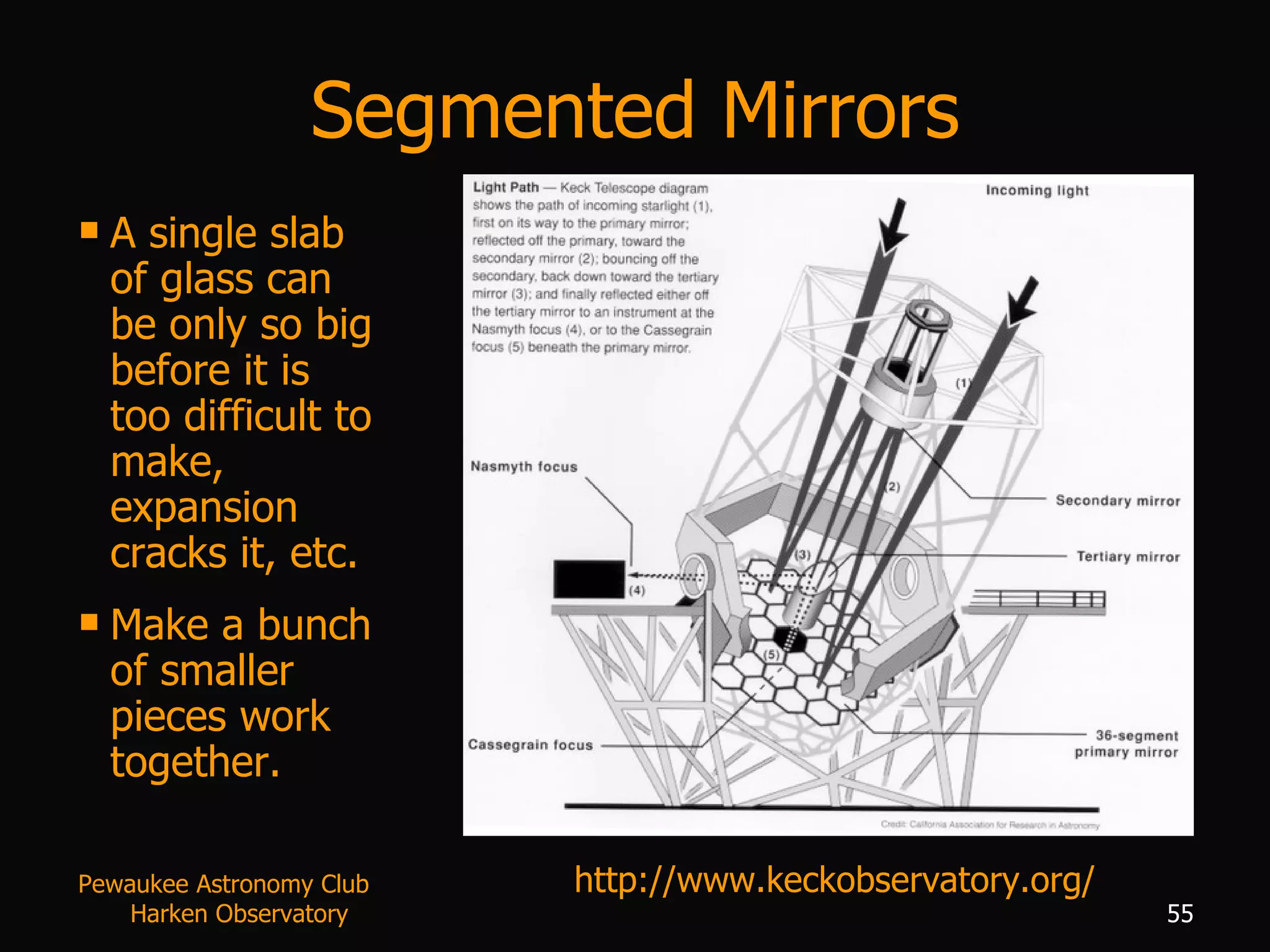
55.
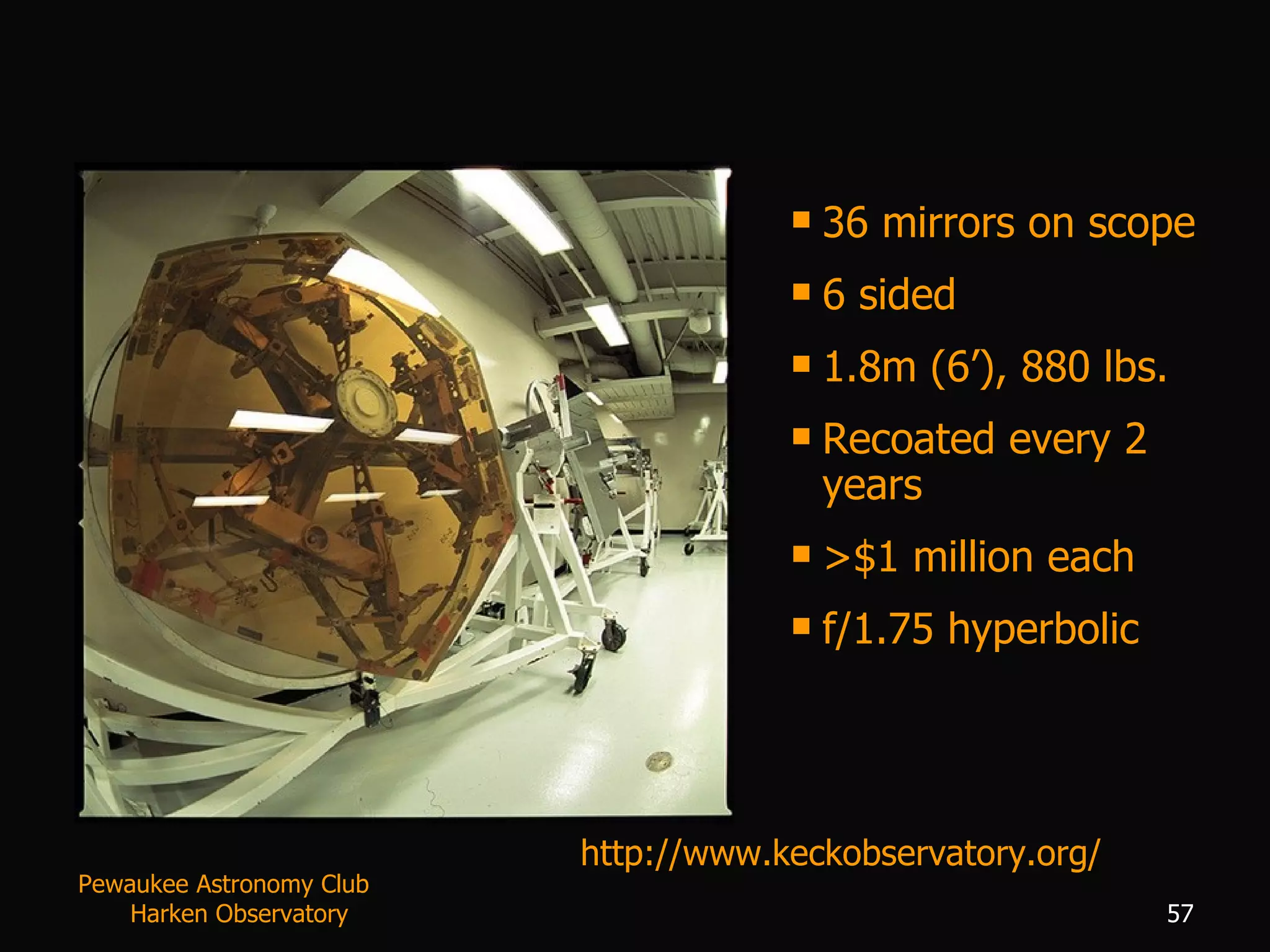
Segmented Mirrors Asingle slab of glass can be only so big before it is too difficult to make, expansion cracks it, etc. Make a bunch of smaller pieces work together. http://www.keckobservatory.org/ Pewaukee Astronomy Club Harken Observatory
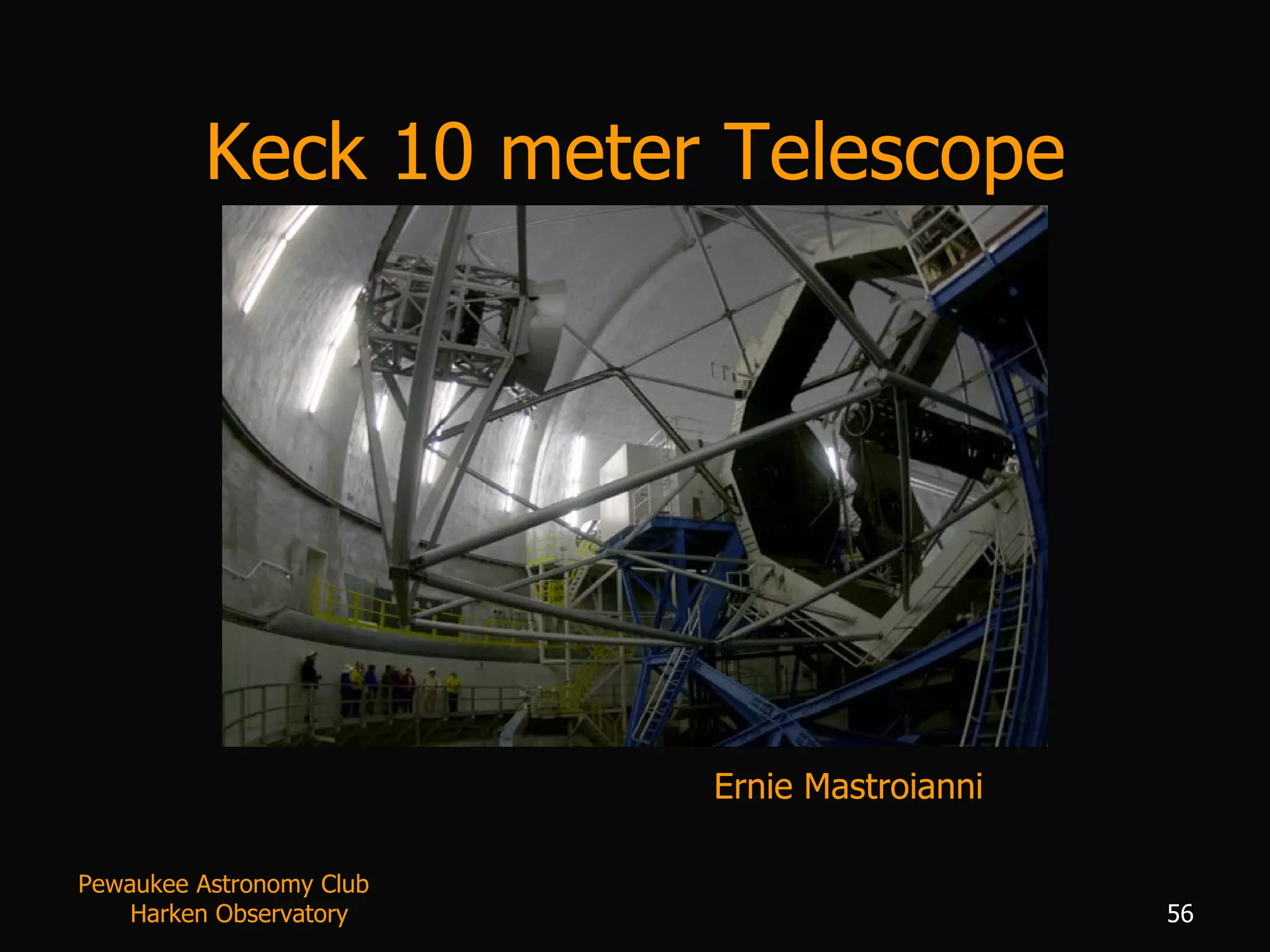
56.
Keck 10 meterTelescope Ernie Mastroianni Pewaukee Astronomy Club Harken Observatory
57.
36 mirrors onscope 6 sided 1.8m (6’), 880 lbs. Recoated every 2 years >$1 million each f/1.75 hyperbolic http://www.keckobservatory.org/ Pewaukee Astronomy Club Harken Observatory
58.
Summary of ReflectorsEasy to make large aperture scopes Newtonian has open aperture, so inside (mirrors) can get dirty Long focal lengths mean long tubes Folded optics can shorten tubes, making scope shorter, lighter, portable Pewaukee Astronomy Club Harken Observatory
59.
Goals for aTelescope Refractor (Dioptrics) Reflector (Catoptrics) Lens-Mirror (Catadioptrics) References Pewaukee Astronomy Club Harken Observatory
60.
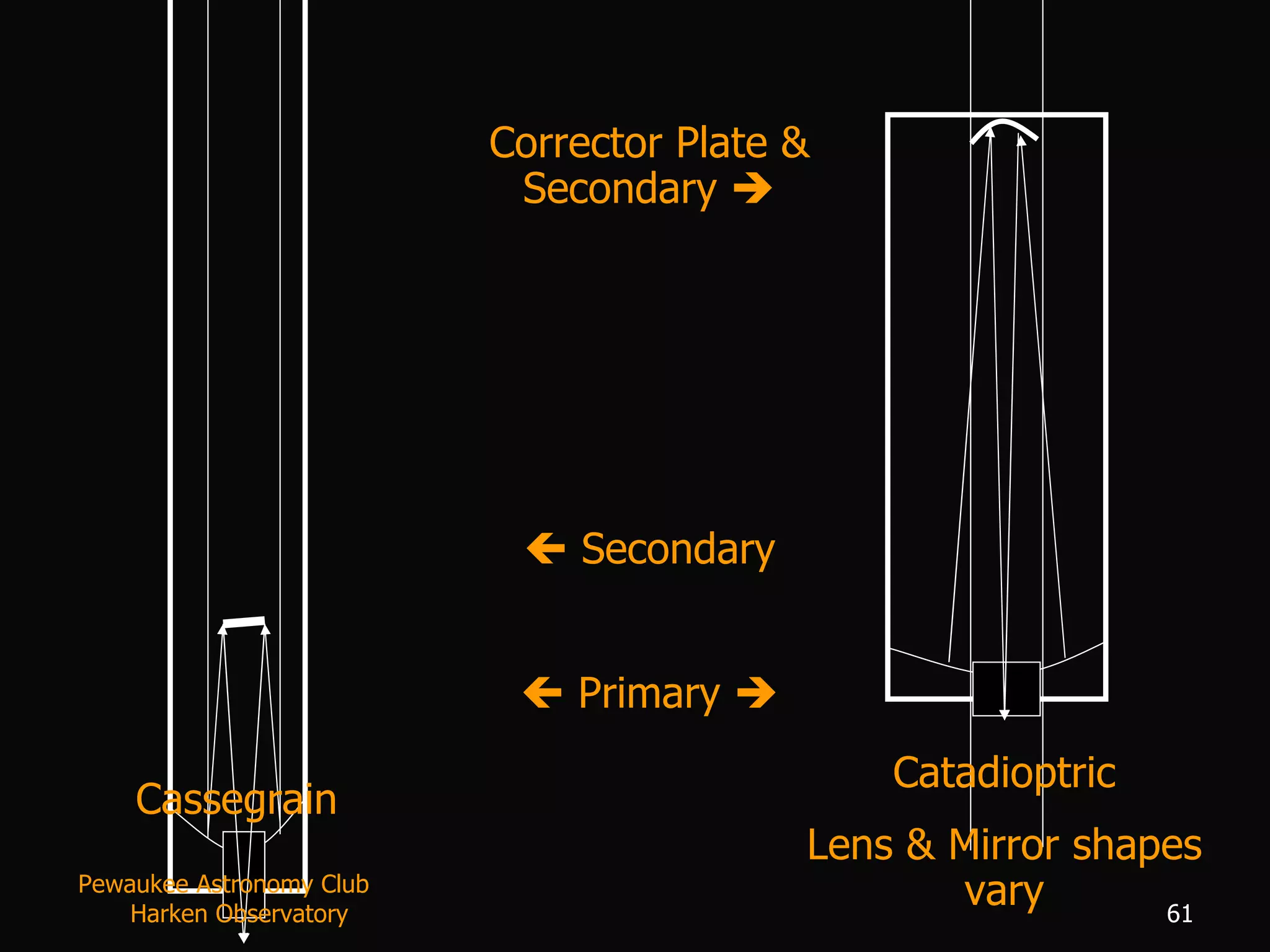
Mirror & LensSystems Catadioptric By combining mirrors and lenses, a scope can be powerful and compact (short tube) Aberration issues can be minimized Mirrors and lenses are usually sealed up in the tube More complexity and expense since they are harder to make (high precision) Pewaukee Astronomy Club Harken Observatory
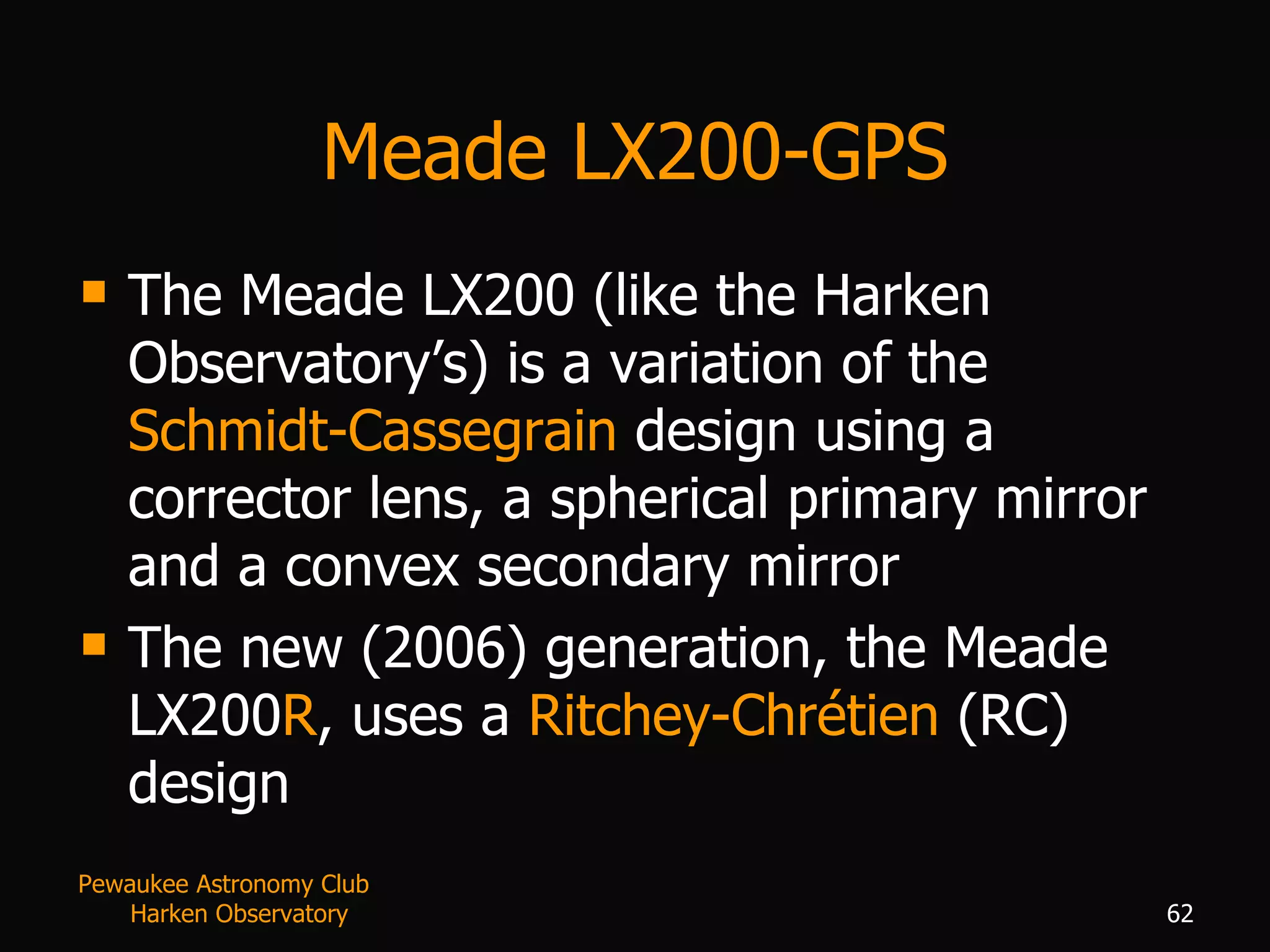
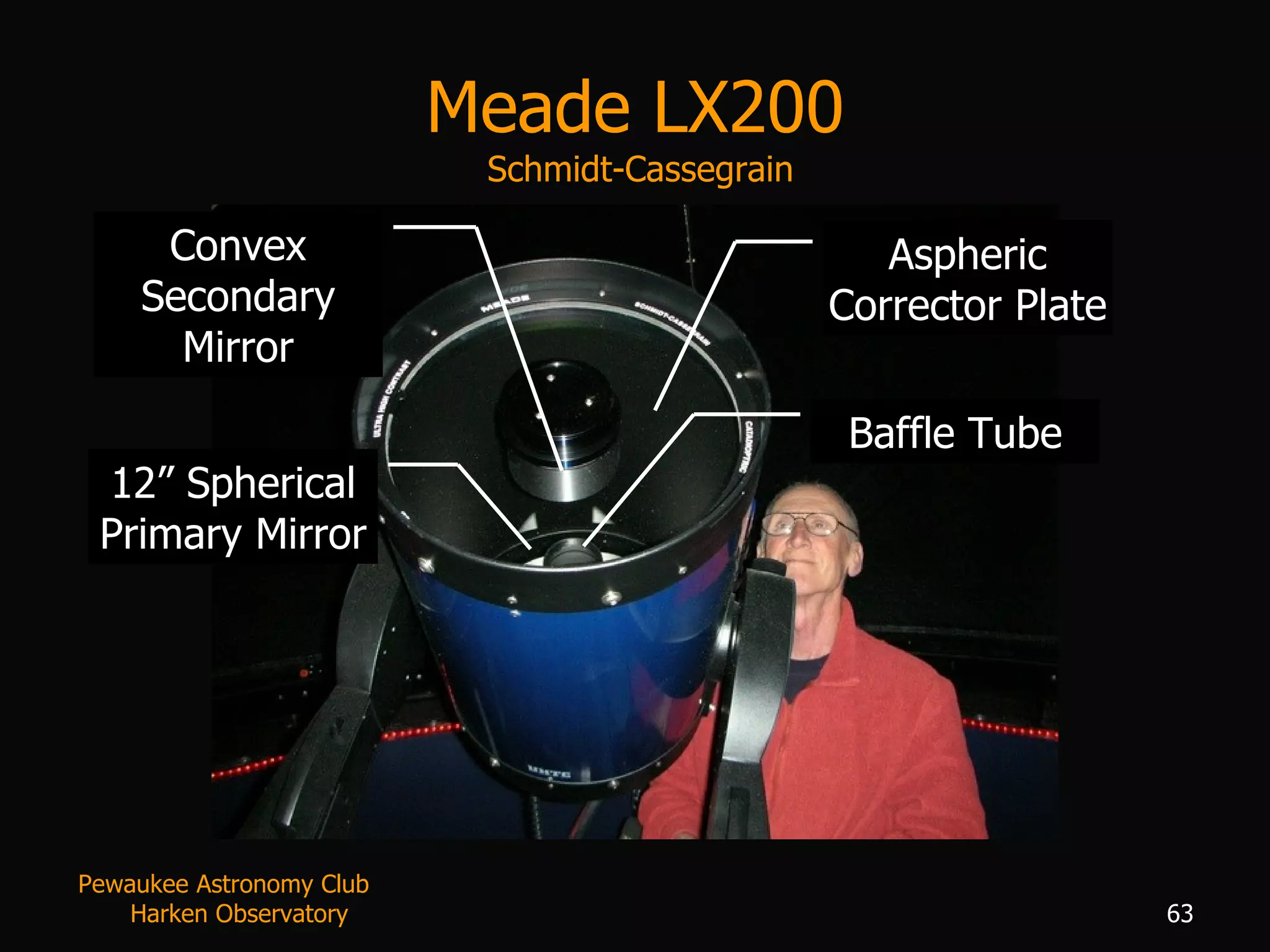
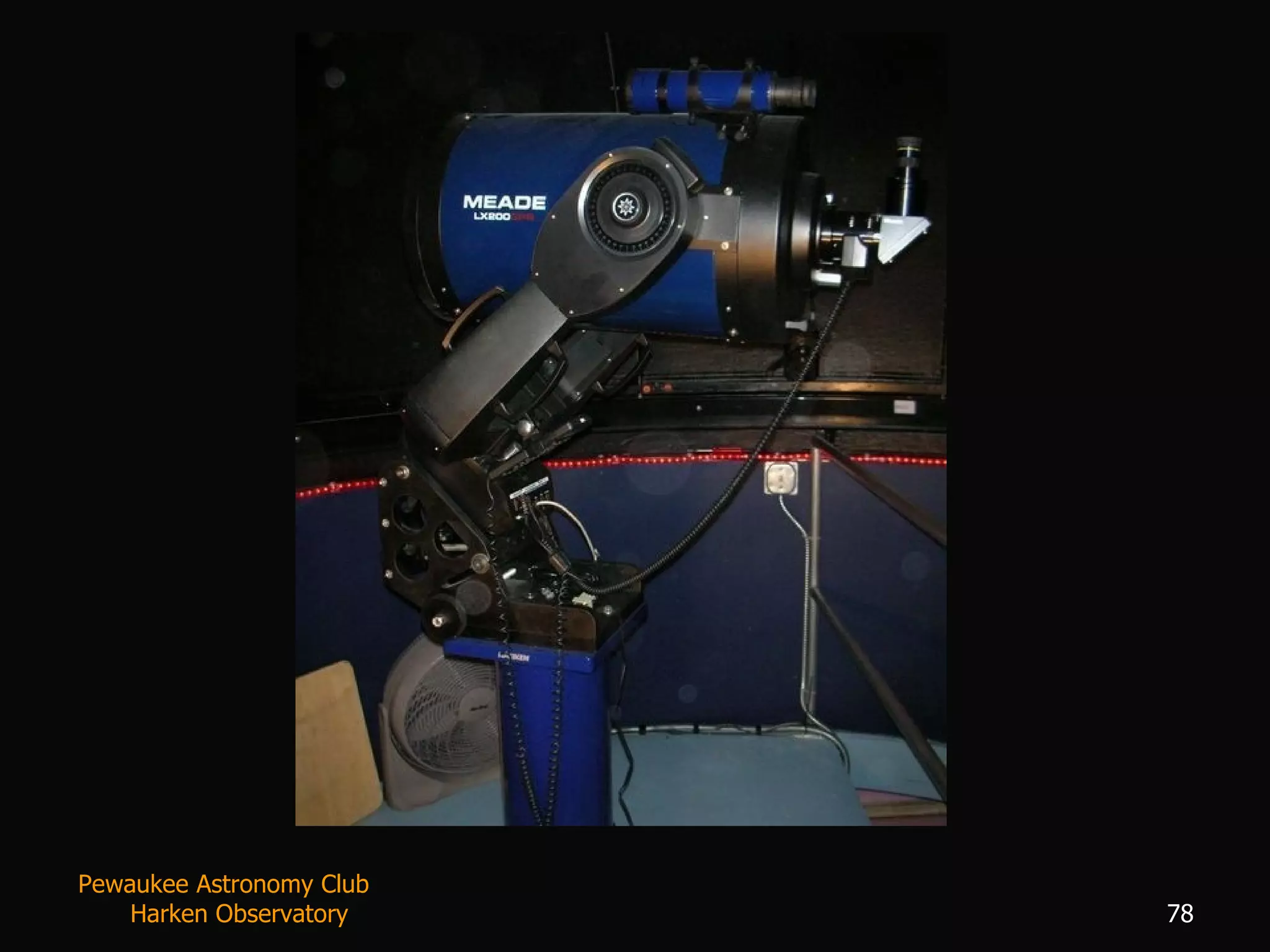
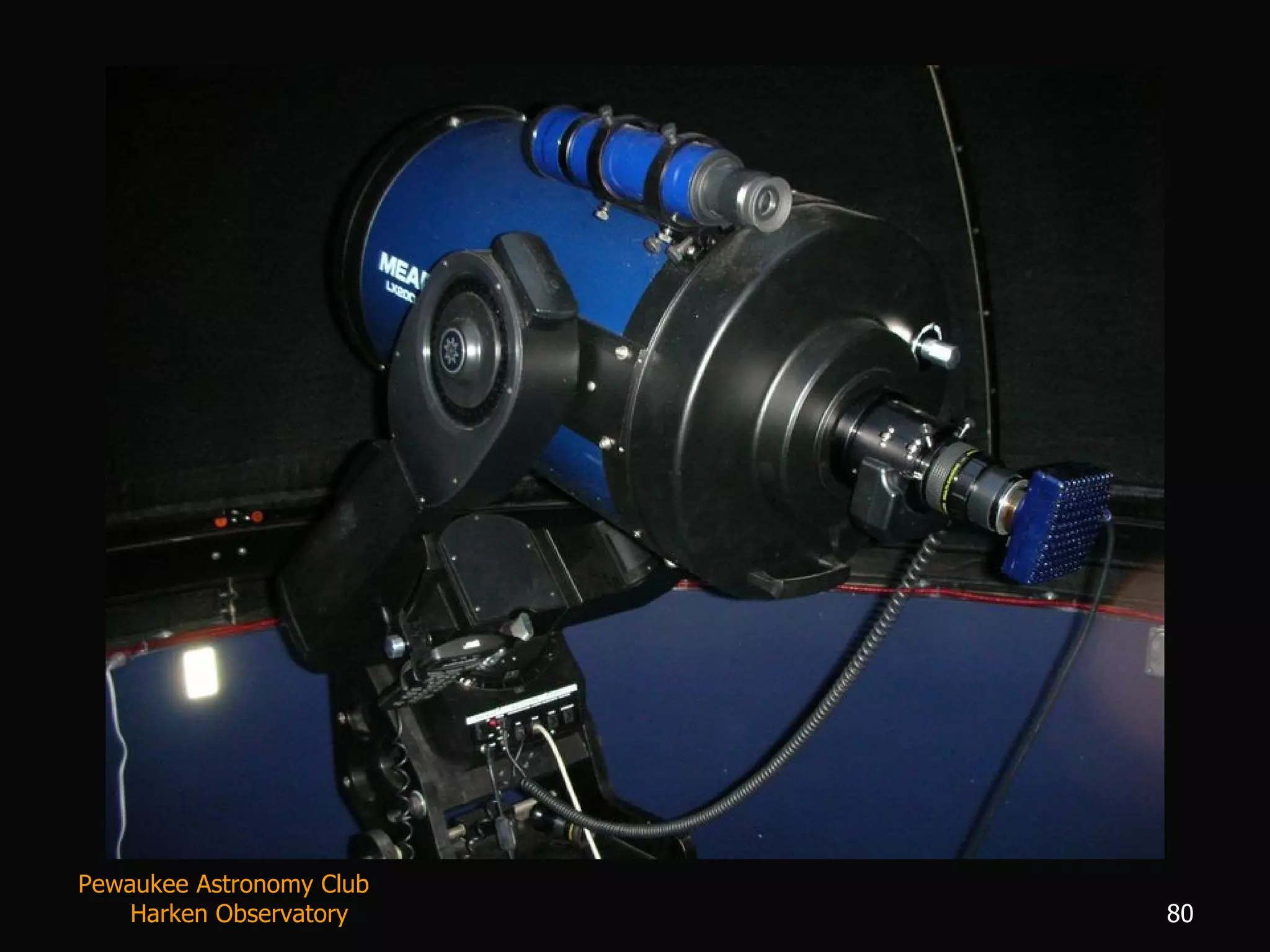
Meade LX200-GPS TheMeade LX200 (like the Harken Observatory’s) is a variation of the Schmidt-Cassegrain design using a corrector lens, a spherical primary mirror and a convex secondary mirror The new (2006) generation, the Meade LX200 R , uses a Ritchey-Chr é tien (RC) design Pewaukee Astronomy Club Harken Observatory
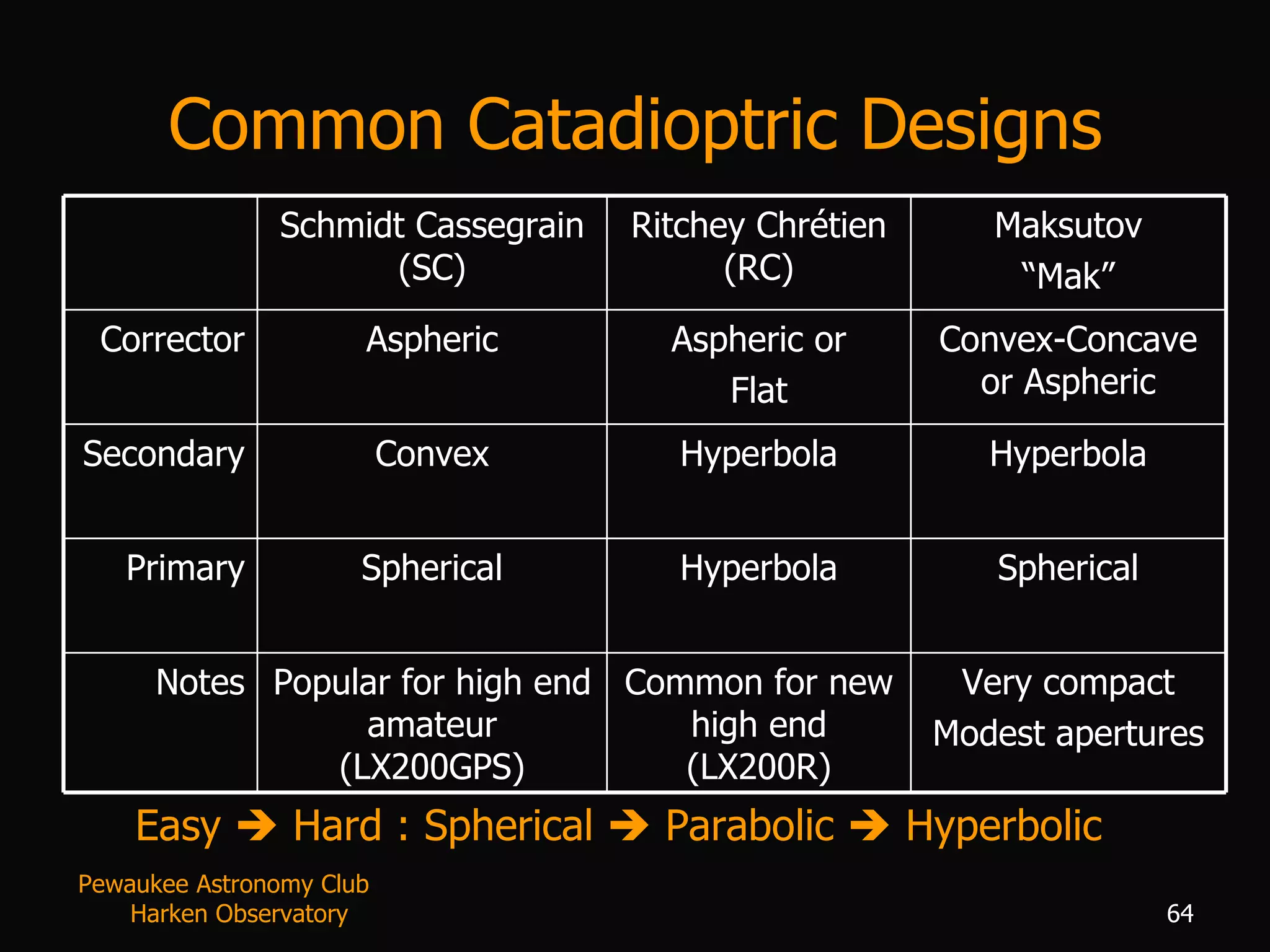
Common Catadioptric DesignsEasy Hard : Spherical Parabolic Hyperbolic Pewaukee Astronomy Club Harken Observatory Schmidt Cassegrain (SC) Ritchey Chr é tien (RC) Maksutov “ Mak” Corrector Aspheric Aspheric or Flat Convex-Concave or Aspheric Secondary Convex Hyperbola Hyperbola Primary Spherical Hyperbola Spherical Notes Popular for high end amateur (LX200GPS) Common for new high end (LX200R) Very compact Modest apertures
65.
Ritchey-Chr é tien(RC) Invented in 1910 by American George Willis Ritchey (1864-1945) and Frenchman Henri Chrétien (1879-1956) Ritchey was a protégé of astronomer George Hale Ritchey strongly advocated RC for the new 200” Mt. Palomar scope, but it was rejected and fired from Hale’s staff Pewaukee Astronomy Club Harken Observatory
66.
Ritchey-Cr é tien(RC) Used in most modern high end scopes Used in Subaru telescope, Chile’s Very Large Telescope, etc. Can have astigmatism and other defects Difficult to grind mirror to this shape, so expensive Pewaukee Astronomy Club Harken Observatory
67.
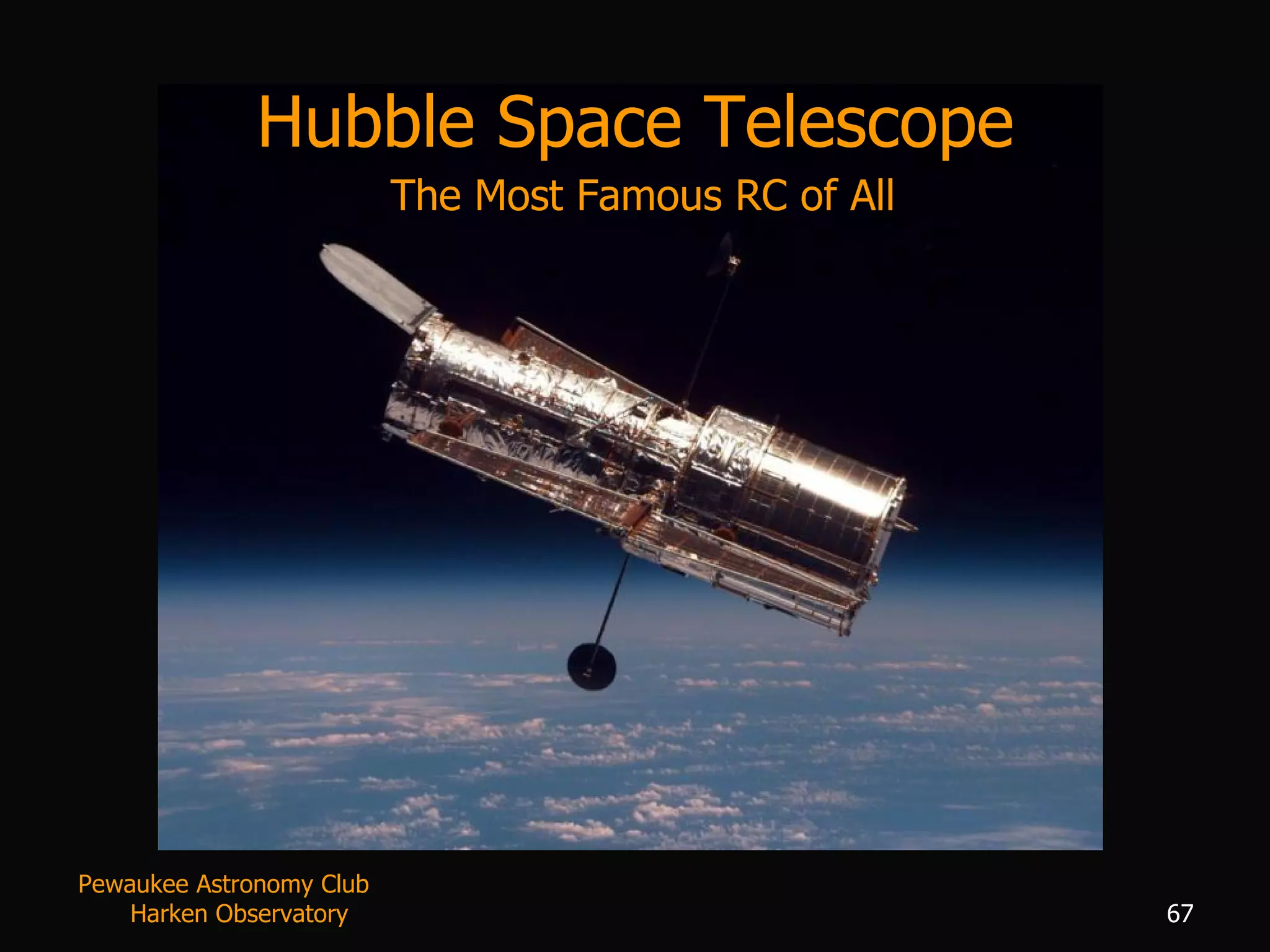
Hubble Space Telescope The Most Famous RC of All Pewaukee Astronomy Club Harken Observatory
68.
Summary of CatadioptricsCombination of lens and mirror. Many variations of shapes for mirrors and lenses Focal length is folded, so optical tube is short tube, making scope portable Complex shapes for optics, so expensive Common for modern high end scopes Pewaukee Astronomy Club Harken Observatory
69.
Goals for aTelescope Refractor (Dioptrics) Reflector (Catoptrics) Lens-Mirror (Catadioptrics) References Pewaukee Astronomy Club Harken Observatory
A word fromour sponsor… Pewaukee Astronomy Club Harken Observatory
73.
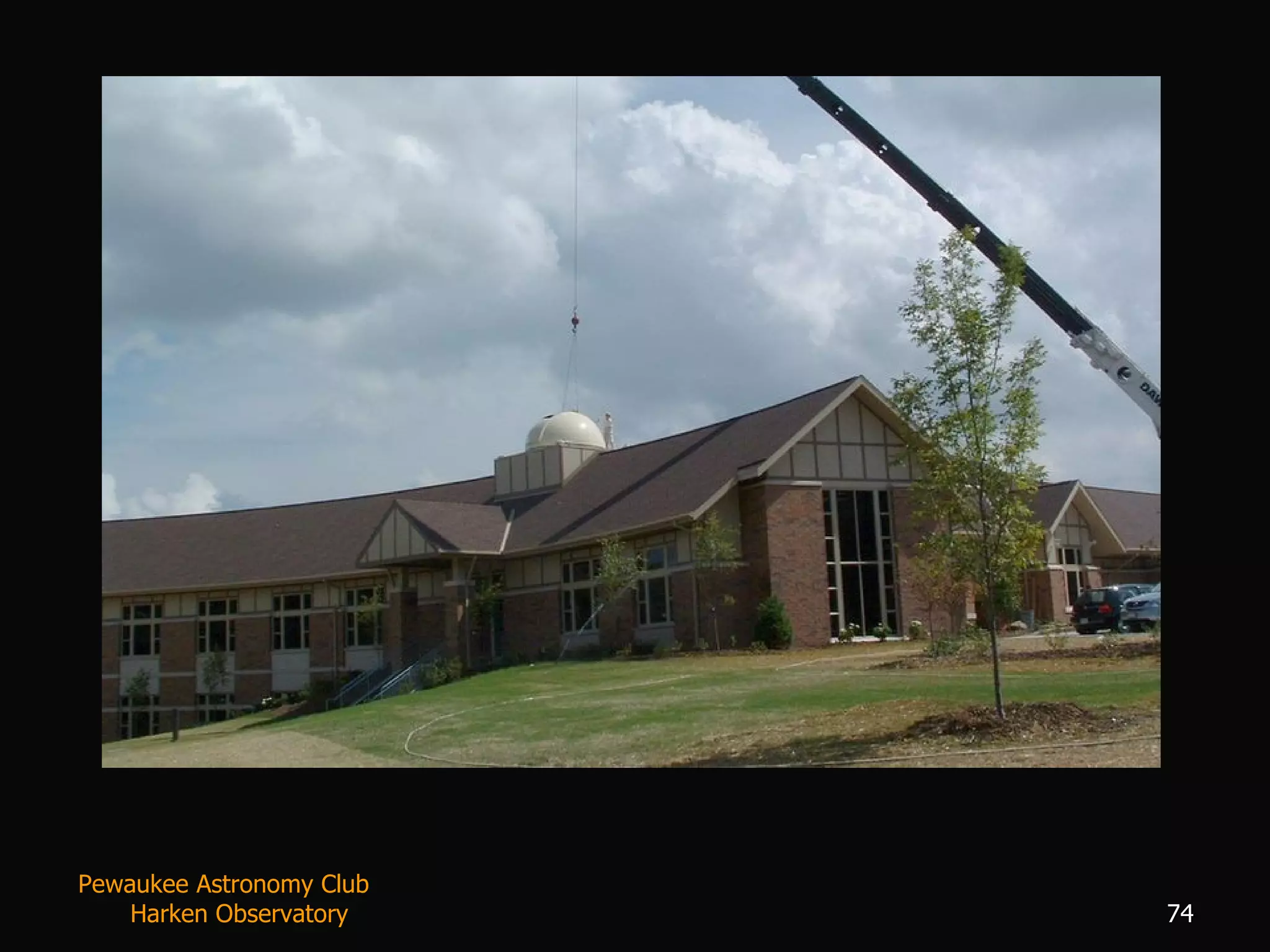
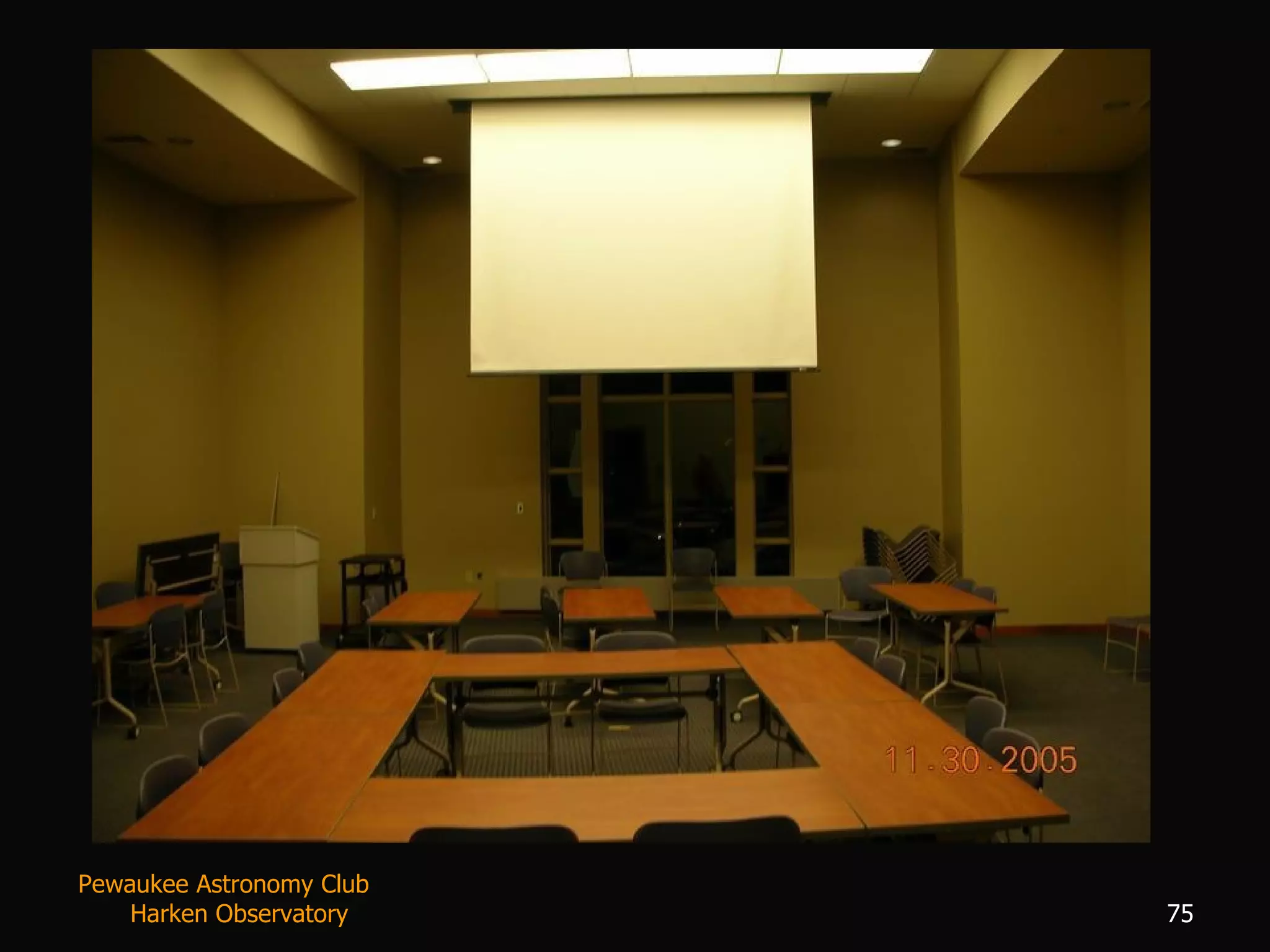
Mission Statement TheHarken Astronomical Observatory provides education and brings the wonders of our incredible universe to families of our community in the friendly and casual environment of our new library. Pewaukee Astronomy Club Harken Observatory
Thank You! Thisis a volunteer group. All equipment is donated. There is no tax funding. Monthly club meetings are the 3 rd Thursday of each month Public presentations and viewing is every Saturday, weather permitting Pewaukee Astronomy Club Harken Observatory
Editor's Notes
#2 Pewaukee Public Library Harken Observatory Written by Scott Berg. First presented by Scott at the Harken Observatory public open house on January 13, 2007.
![Galileo’s Telescopes Galileo built dozens of scopes, but only 2 survive About 3 feet long Aperture: 15mm Power: 14x & 21x Wood, leather, paper Istituto e Museo di Storia della Scienza [IMSS] Institute and Museum of the History of Science Florence, Italy Pewaukee Astronomy Club Harken Observatory](https://image.slidesharecdn.com/HowTelescopesWork-122992788549-phpapp03/75/How-Telescopes-Work-13-2048.jpg)
![“ Six to eight feet—that was the length of a good astronomical telescope in 1645. Five years later it was 10 to 15 feet. Ten years after that, 25 feet. Ten years after that, 40 to 50 feet. By 1673, [Polish astronomer] Johannes Hevelius had constructed a telescope 150 feet long on the shores of the Baltic Sea....One astronomer cheered the coming day when aerial telescopes would have a focus of 1,000 feet and human spectators could marvel at the antics of the animals on the Moon.” Seeing and Believing: How the Telescope Opened Our Eyes and Minds to the Heavens, by Richard Panek Pewaukee Astronomy Club Harken Observatory](https://image.slidesharecdn.com/HowTelescopesWork-122992788549-phpapp03/75/How-Telescopes-Work-24-2048.jpg)