SPINAL AND EPIDURAL
ANAESTHESIA
PRESENTED BY ---- Dr. KHAWER MUNEER
MODERATOR ---- Dr. JAVED IQBAL
OBJECTIVES
2
HAVE A BASIC UNDERSTANDING OF
• Anatomic structure of spine and
vertebra
•Anatomic structure of spinal cord
•Blood supply of spinal cord
•Features of neuraxial blockade
•Indications/ contraindications
•Patient evaluation and preparation
•Techniques
•Local anesthetics and factors effecting
spread
•complications
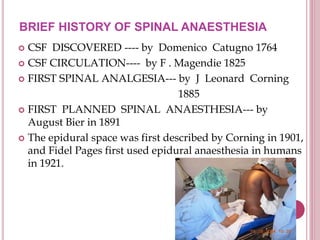
BRIEF HISTORY OF SPINAL ANAESTHESIA
 CSF DISCOVERED ---- by Domenico Catugno 1764
 CSF CIRCULATION---- by F . Magendie 1825
 FIRST SPINAL ANALGESIA--- by J Leonard Corning
1885
 FIRST PLANNED SPINAL ANAESTHESIA--- by
August Bier in 1891
 The epidural space was first described by Corning in 1901,
and Fidel Pages first used epidural anaesthesia in humans
in 1921.
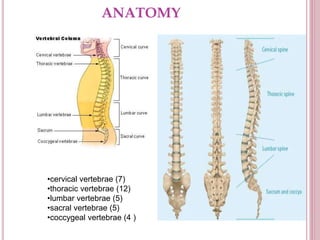
ANATOMY
•cervical vertebrae (7)
•thoracic vertebrae (12)
•lumbar vertebrae (5)
•sacral vertebrae (5)
•coccygeal vertebrae (4 )
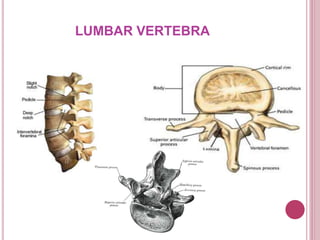
LUMBAR VERTEBRA
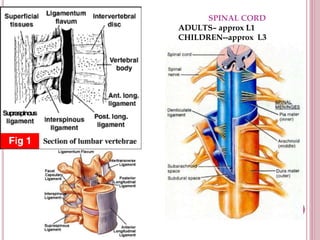
SPINAL CORD
ADULTS– approx L1
CHILDREN--approx L3
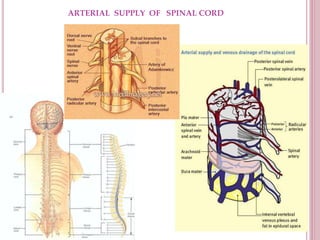
ARTERIAL SUPPLY OF SPINAL CORD
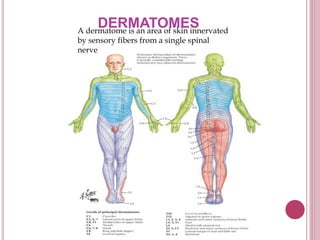
DERMATOMESA dermatome is an area of skin innervated
by sensory fibers from a single spinal
nerve
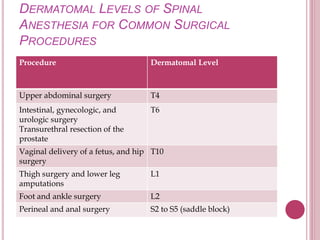
DERMATOMAL LEVELS OF SPINAL
ANESTHESIA FOR COMMON SURGICAL
PROCEDURES
Procedure Dermatomal Level
Upper abdominal surgery T4
Intestinal, gynecologic, and
urologic surgery
Transurethral resection of the
prostate
T6
Vaginal delivery of a fetus, and hip
surgery
T10
Thigh surgery and lower leg
amputations
L1
Foot and ankle surgery L2
Perineal and anal surgery S2 to S5 (saddle block)
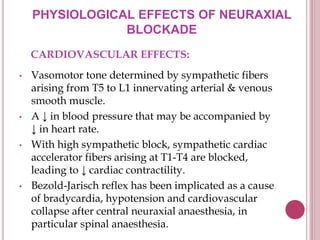
PHYSIOLOGICAL EFFECTS OF NEURAXIAL
BLOCKADE
• Vasomotor tone determined by sympathetic fibers
arising from T5 to L1 innervating arterial & venous
smooth muscle.
• A ↓ in blood pressure that may be accompanied by
↓ in heart rate.
• With high sympathetic block, sympathetic cardiac
accelerator fibers arising at T1-T4 are blocked,
leading to ↓ cardiac contractility.
• Bezold-Jarisch reflex has been implicated as a cause
of bradycardia, hypotension and cardiovascular
collapse after central neuraxial anaesthesia, in
particular spinal anaesthesia.
CARDIOVASCULAR EFFECTS:
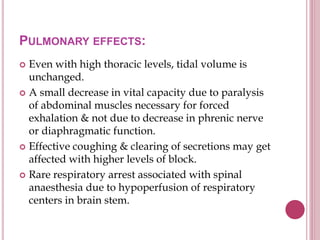
PULMONARY EFFECTS:
 Even with high thoracic levels, tidal volume is
unchanged.
 A small decrease in vital capacity due to paralysis
of abdominal muscles necessary for forced
exhalation & not due to decrease in phrenic nerve
or diaphragmatic function.
 Effective coughing & clearing of secretions may get
affected with higher levels of block.
 Rare respiratory arrest associated with spinal
anaesthesia due to hypoperfusion of respiratory
centers in brain stem.
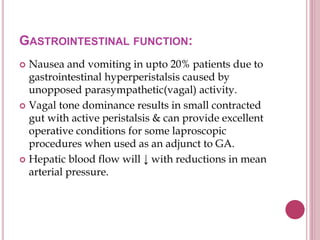
GASTROINTESTINAL FUNCTION:
 Nausea and vomiting in upto 20% patients due to
gastrointestinal hyperperistalsis caused by
unopposed parasympathetic(vagal) activity.
 Vagal tone dominance results in small contracted
gut with active peristalsis & can provide excellent
operative conditions for some laproscopic
procedures when used as an adjunct to GA.
 Hepatic blood flow will ↓ with reductions in mean
arterial pressure.
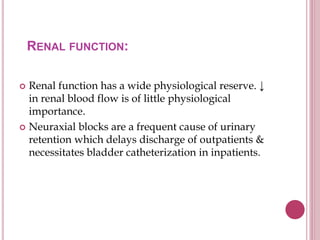
RENAL FUNCTION:
 Renal function has a wide physiological reserve. ↓
in renal blood flow is of little physiological
importance.
 Neuraxial blocks are a frequent cause of urinary
retention which delays discharge of outpatients &
necessitates bladder catheterization in inpatients.
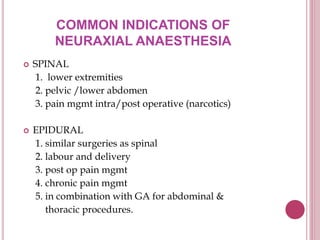
COMMON INDICATIONS OF
NEURAXIAL ANAESTHESIA
 SPINAL
1. lower extremities
2. pelvic /lower abdomen
3. pain mgmt intra/post operative (narcotics)
 EPIDURAL
1. similar surgeries as spinal
2. labour and delivery
3. post op pain mgmt
4. chronic pain mgmt
5. in combination with GA for abdominal &
thoracic procedures.
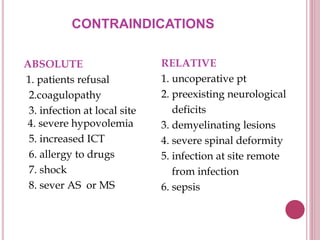
CONTRAINDICATIONS
ABSOLUTE
1. patients refusal
2.coagulopathy
3. infection at local site
4. severe hypovolemia
5. increased ICT
6. allergy to drugs
7. shock
8. sever AS or MS
RELATIVE
1. uncoperative pt
2. preexisting neurological
deficits
3. demyelinating lesions
4. severe spinal deformity
5. infection at site remote
from infection
6. sepsis
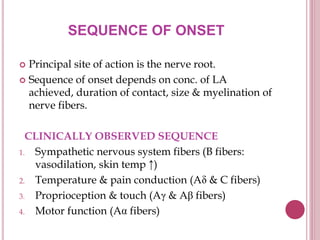
SEQUENCE OF ONSET
 Principal site of action is the nerve root.
 Sequence of onset depends on conc. of LA
achieved, duration of contact, size & myelination of
nerve fibers.
CLINICALLY OBSERVED SEQUENCE
1. Sympathetic nervous system fibers (B fibers:
vasodilation, skin temp ↑)
2. Temperature & pain conduction (A & C fibers)
3. Proprioception & touch (Aγ & Aβ fibers)
4. Motor function (A fibers)
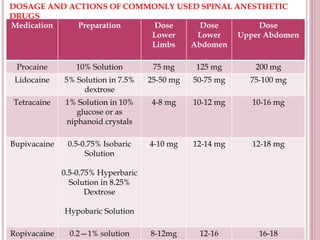
SUMMARY
Medication Preparation Dose
Lower
Limbs
Dose
Lower
Abdomen
Dose
Upper Abdomen
Procaine 10% Solution 75 mg 125 mg 200 mg
Lidocaine 5% Solution in 7.5%
dextrose
25-50 mg 50-75 mg 75-100 mg
Tetracaine 1% Solution in 10%
glucose or as
niphanoid crystals
4-8 mg 10-12 mg 10-16 mg
Bupivacaine 0.5-0.75% Isobaric
Solution
0.5-0.75% Hyperbaric
Solution in 8.25%
Dextrose
Hypobaric Solution
4-10 mg 12-14 mg 12-18 mg
Ropivacaine 0.2—1% solution 8-12mg 12-16 16-18
DOSAGE AND ACTIONS OF COMMONLY USED SPINAL ANESTHETIC
DRUGS
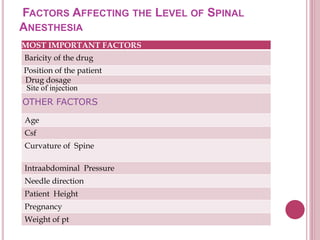
FACTORS AFFECTING THE LEVEL OF SPINAL
ANESTHESIA
MOST IMPORTANT FACTORS
Baricity of the drug
Position of the patient
Drug dosage
Site of injection
OTHER FACTORS
Age
Csf
Curvature of Spine
Intraabdominal Pressure
Needle direction
Patient Height
Pregnancy
Weight of pt
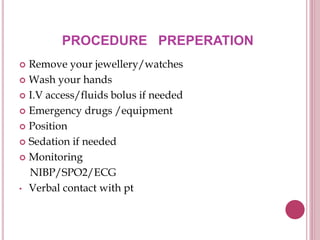
PROCEDURE PREPERATION
 Remove your jewellery/watches
 Wash your hands
 I.V access/fluids bolus if needed
 Emergency drugs /equipment
 Position
 Sedation if needed
 Monitoring
NIBP/SPO2/ECG
• Verbal contact with pt
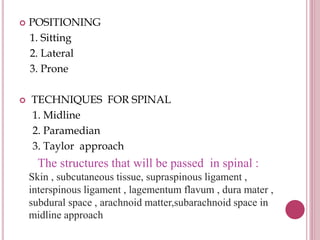
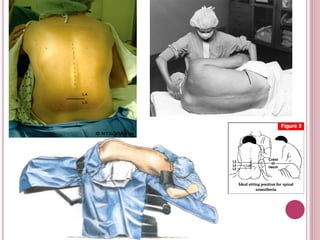
 POSITIONING
1. Sitting
2. Lateral
3. Prone
 TECHNIQUES FOR SPINAL
1. Midline
2. Paramedian
3. Taylor approach
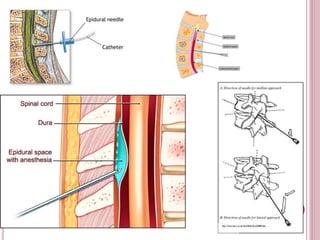
The structures that will be passed in spinal :
Skin , subcutaneous tissue, supraspinous ligament ,
interspinous ligament , lagementum flavum , dura mater ,
subdural space , arachnoid matter,subarachnoid space in
midline approach
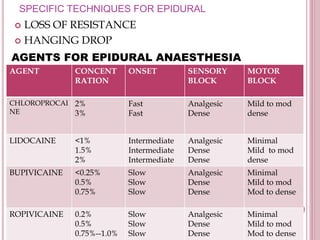
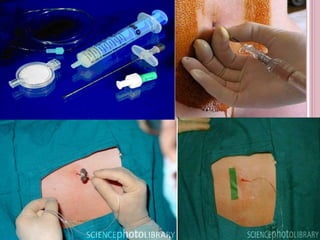
SPECIFIC TECHNIQUES FOR EPIDURAL
 LOSS OF RESISTANCE
 HANGING DROP
AGENTS FOR EPIDURAL ANAESTHESIA
AGENT CONCENT
RATION
ONSET SENSORY
BLOCK
MOTOR
BLOCK
CHLOROPROCAI
NE
2%
3%
Fast
Fast
Analgesic
Dense
Mild to mod
dense
LIDOCAINE <1%
1.5%
2%
Intermediate
Intermediate
Intermediate
Analgesic
Dense
Dense
Minimal
Mild to mod
dense
BUPIVICAINE <0.25%
0.5%
0.75%
Slow
Slow
Slow
Analgesic
Dense
Dense
Minimal
Mild to mod
Mod to dense
ROPIVICAINE 0.2%
0.5%
0.75%--1.0%
Slow
Slow
Slow
Analgesic
Dense
Dense
Minimal
Mild to mod
Mod to dense
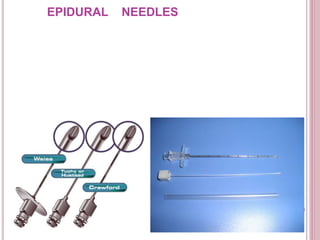
EPIDURAL NEEDLES
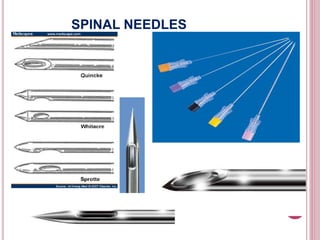
SPINAL NEEDLES
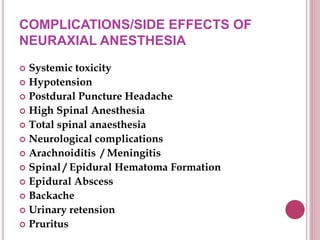
COMPLICATIONS/SIDE EFFECTS OF
NEURAXIAL ANESTHESIA
 Systemic toxicity
 Hypotension
 Postdural Puncture Headache
 High Spinal Anesthesia
 Total spinal anaesthesia
 Neurological complications
 Arachnoiditis / Meningitis
 Spinal / Epidural Hematoma Formation
 Epidural Abscess
 Backache
 Urinary retension
 Pruritus
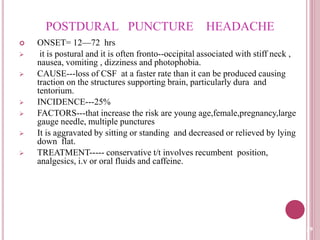
POSTDURAL PUNCTURE HEADACHE
 ONSET= 12—72 hrs
 it is postural and it is often fronto--occipital associated with stiff neck ,
nausea, vomiting , dizziness and photophobia.
 CAUSE---loss of CSF at a faster rate than it can be produced causing
traction on the structures supporting brain, particularly dura and
tentorium.
 INCIDENCE---25%
 FACTORS---that increase the risk are young age,female,pregnancy,large
gauge needle, multiple punctures
 It is aggravated by sitting or standing and decreased or relieved by lying
down flat.
 TREATMENT----- conservative t/t involves recumbent position,
analgesics, i.v or oral fluids and caffeine.
29
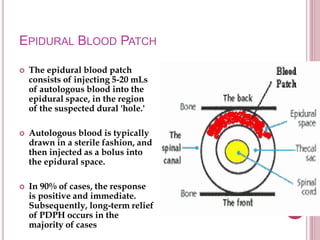
EPIDURAL BLOOD PATCH
 The epidural blood patch
consists of injecting 5-20 mLs
of autologous blood into the
epidural space, in the region
of the suspected dural 'hole.'
 Autologous blood is typically
drawn in a sterile fashion, and
then injected as a bolus into
the epidural space.
 In 90% of cases, the response
is positive and immediate.
Subsequently, long-term relief
of PDPH occurs in the
majority of cases
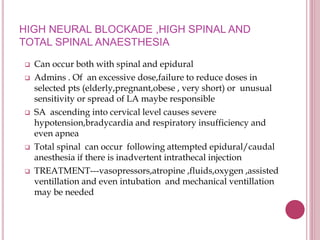
HIGH NEURAL BLOCKADE ,HIGH SPINAL AND
TOTAL SPINAL ANAESTHESIA
 Can occur both with spinal and epidural
 Admins . Of an excessive dose,failure to reduce doses in
selected pts (elderly,pregnant,obese , very short) or unusual
sensitivity or spread of LA maybe responsible
 SA ascending into cervical level causes severe
hypotension,bradycardia and respiratory insufficiency and
even apnea
 Total spinal can occur following attempted epidural/caudal
anesthesia if there is inadvertent intrathecal injection
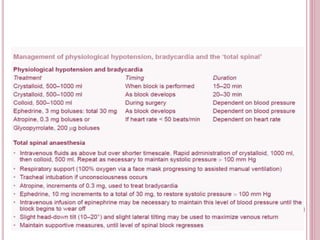
 TREATMENT---vasopressors,atropine ,fluids,oxygen ,assisted
ventillation and even intubation and mechanical ventillation
may be needed
TRANSIENT NEUROLOGICAL SYMPTOMS AND
CAUDA EQUINA SYNDROME
 TNS or transient radicular irritation refers to pain
,dysesthesia or both in the legs or buttocks after
spinal anesthesia, resolving spontaneously within
several days
 Most common with hyperbaric lidocaine and after
surgery in lithotomy position
 CES characterized by bowel and bladder
dysfunction together with evidence of multiple
nerve root injury, assoc with use of continous
spinal catheters and 5% lidocaine
NEURAXIAL BLOCKADE IN SETTING OF ANTICOAGULANTS AND
ANTIPLATELET AGENTS---AMERICAN SOCIETY FOR REGIONAL
ANESTHESIA RECOMMENDATIONS
 Pts taking NSAIDS or receiving subcutaneous unfractioned
heparin for DVT prophylaxsis are not viewed as being at
increased risk of spinal hematoma
 DISCONTINUE---ticlopidine 2 weeks, clopidogrel for 1 week
,abciximab 24 to 48 hrs, eptifibate and tirofiban 4 to 8 hrs
before performing central neuraxial block.
 Pt who are fully anticoagulated or who are receiving
thrombolytic or fibrinolytic theraphy should not receive
central neuraxial block except in very unusual circumstances
where other options are not viable.
 Delay atleast 10 -12 hrs after last dose of LMWH
 Post op t/t with LMWH delay 12hrs after compl of surgery
 Removal of epi ,spi catheters should take place 10—12hrs
after last dose with subs dosing delay for atleast 2hrs.
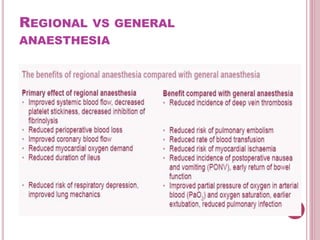
ADVANTAGES OF SPINAL ANESTHESIA (SPA)
1. Cost. The costs associated with SPA are minimal.
2. Patient satisfaction. the majority of patients are very
happy with this technique.
3. Respiratory disease. SPA produces few adverse effects
on the respiratory system as long as unduly high blocks
are avoided.
4. Patent airway. As control of the airway is not
compromised, there is a reduced risk of airway
obstruction or the aspiration of gastric contents.
 5. Diabetic patients. There is little risk of unrecognised
hypoglycaemia in an awake patient.
ADVANTAGES OF SPA CONTD
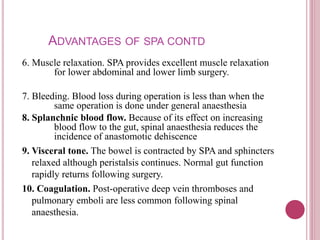
6. Muscle relaxation. SPA provides excellent muscle relaxation
for lower abdominal and lower limb surgery.
7. Bleeding. Blood loss during operation is less than when the
same operation is done under general anaesthesia
8. Splanchnic blood flow. Because of its effect on increasing
blood flow to the gut, spinal anaesthesia reduces the
incidence of anastomotic dehiscence
9. Visceral tone. The bowel is contracted by SPA and sphincters
relaxed although peristalsis continues. Normal gut function
rapidly returns following surgery.
10. Coagulation. Post-operative deep vein thromboses and
pulmonary emboli are less common following spinal
anaesthesia.
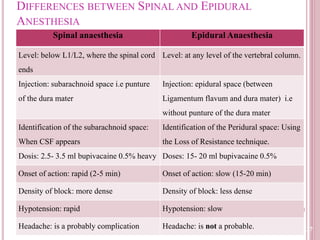
DIFFERENCES BETWEEN SPINAL AND EPIDURAL
ANESTHESIA
Spinal anaesthesia Epidural Anaesthesia
Level: below L1/L2, where the spinal cord
ends
Level: at any level of the vertebral column.
Injection: subarachnoid space i.e punture
of the dura mater
Injection: epidural space (between
Ligamentum flavum and dura mater) i.e
without punture of the dura mater
Identification of the subarachnoid space:
When CSF appears
Identification of the Peridural space: Using
the Loss of Resistance technique.
Dosis: 2.5- 3.5 ml bupivacaine 0.5% heavy Doses: 15- 20 ml bupivacaine 0.5%
Onset of action: rapid (2-5 min) Onset of action: slow (15-20 min)
Density of block: more dense Density of block: less dense
Hypotension: rapid Hypotension: slow
Headache: is a probably complication Headache: is not a probable. 37
REGIONAL VS GENERAL
ANAESTHESIA
 THANK YOU

1229377 634548716590312500

  • 1.
    SPINAL AND EPIDURAL ANAESTHESIA PRESENTEDBY ---- Dr. KHAWER MUNEER MODERATOR ---- Dr. JAVED IQBAL
  • 2.
    OBJECTIVES 2 HAVE A BASICUNDERSTANDING OF • Anatomic structure of spine and vertebra •Anatomic structure of spinal cord •Blood supply of spinal cord •Features of neuraxial blockade •Indications/ contraindications •Patient evaluation and preparation •Techniques •Local anesthetics and factors effecting spread •complications
  • 3.
    BRIEF HISTORY OFSPINAL ANAESTHESIA  CSF DISCOVERED ---- by Domenico Catugno 1764  CSF CIRCULATION---- by F . Magendie 1825  FIRST SPINAL ANALGESIA--- by J Leonard Corning 1885  FIRST PLANNED SPINAL ANAESTHESIA--- by August Bier in 1891  The epidural space was first described by Corning in 1901, and Fidel Pages first used epidural anaesthesia in humans in 1921.
  • 4.
    ANATOMY •cervical vertebrae (7) •thoracicvertebrae (12) •lumbar vertebrae (5) •sacral vertebrae (5) •coccygeal vertebrae (4 )
  • 5.
  • 6.
    SPINAL CORD ADULTS– approxL1 CHILDREN--approx L3
  • 7.
    ARTERIAL SUPPLY OFSPINAL CORD
  • 8.
    DERMATOMESA dermatome isan area of skin innervated by sensory fibers from a single spinal nerve
  • 9.
    DERMATOMAL LEVELS OFSPINAL ANESTHESIA FOR COMMON SURGICAL PROCEDURES Procedure Dermatomal Level Upper abdominal surgery T4 Intestinal, gynecologic, and urologic surgery Transurethral resection of the prostate T6 Vaginal delivery of a fetus, and hip surgery T10 Thigh surgery and lower leg amputations L1 Foot and ankle surgery L2 Perineal and anal surgery S2 to S5 (saddle block)
  • 10.
    PHYSIOLOGICAL EFFECTS OFNEURAXIAL BLOCKADE • Vasomotor tone determined by sympathetic fibers arising from T5 to L1 innervating arterial & venous smooth muscle. • A ↓ in blood pressure that may be accompanied by ↓ in heart rate. • With high sympathetic block, sympathetic cardiac accelerator fibers arising at T1-T4 are blocked, leading to ↓ cardiac contractility. • Bezold-Jarisch reflex has been implicated as a cause of bradycardia, hypotension and cardiovascular collapse after central neuraxial anaesthesia, in particular spinal anaesthesia. CARDIOVASCULAR EFFECTS:
  • 11.
    PULMONARY EFFECTS:  Evenwith high thoracic levels, tidal volume is unchanged.  A small decrease in vital capacity due to paralysis of abdominal muscles necessary for forced exhalation & not due to decrease in phrenic nerve or diaphragmatic function.  Effective coughing & clearing of secretions may get affected with higher levels of block.  Rare respiratory arrest associated with spinal anaesthesia due to hypoperfusion of respiratory centers in brain stem.
  • 12.
    GASTROINTESTINAL FUNCTION:  Nauseaand vomiting in upto 20% patients due to gastrointestinal hyperperistalsis caused by unopposed parasympathetic(vagal) activity.  Vagal tone dominance results in small contracted gut with active peristalsis & can provide excellent operative conditions for some laproscopic procedures when used as an adjunct to GA.  Hepatic blood flow will ↓ with reductions in mean arterial pressure.
  • 13.
    RENAL FUNCTION:  Renalfunction has a wide physiological reserve. ↓ in renal blood flow is of little physiological importance.  Neuraxial blocks are a frequent cause of urinary retention which delays discharge of outpatients & necessitates bladder catheterization in inpatients.
  • 14.
    COMMON INDICATIONS OF NEURAXIALANAESTHESIA  SPINAL 1. lower extremities 2. pelvic /lower abdomen 3. pain mgmt intra/post operative (narcotics)  EPIDURAL 1. similar surgeries as spinal 2. labour and delivery 3. post op pain mgmt 4. chronic pain mgmt 5. in combination with GA for abdominal & thoracic procedures.
  • 15.
    CONTRAINDICATIONS ABSOLUTE 1. patients refusal 2.coagulopathy 3.infection at local site 4. severe hypovolemia 5. increased ICT 6. allergy to drugs 7. shock 8. sever AS or MS RELATIVE 1. uncoperative pt 2. preexisting neurological deficits 3. demyelinating lesions 4. severe spinal deformity 5. infection at site remote from infection 6. sepsis
  • 16.
    SEQUENCE OF ONSET Principal site of action is the nerve root.  Sequence of onset depends on conc. of LA achieved, duration of contact, size & myelination of nerve fibers. CLINICALLY OBSERVED SEQUENCE 1. Sympathetic nervous system fibers (B fibers: vasodilation, skin temp ↑) 2. Temperature & pain conduction (A & C fibers) 3. Proprioception & touch (Aγ & Aβ fibers) 4. Motor function (A fibers)
  • 17.
    SUMMARY Medication Preparation Dose Lower Limbs Dose Lower Abdomen Dose UpperAbdomen Procaine 10% Solution 75 mg 125 mg 200 mg Lidocaine 5% Solution in 7.5% dextrose 25-50 mg 50-75 mg 75-100 mg Tetracaine 1% Solution in 10% glucose or as niphanoid crystals 4-8 mg 10-12 mg 10-16 mg Bupivacaine 0.5-0.75% Isobaric Solution 0.5-0.75% Hyperbaric Solution in 8.25% Dextrose Hypobaric Solution 4-10 mg 12-14 mg 12-18 mg Ropivacaine 0.2—1% solution 8-12mg 12-16 16-18 DOSAGE AND ACTIONS OF COMMONLY USED SPINAL ANESTHETIC DRUGS
  • 18.
    FACTORS AFFECTING THELEVEL OF SPINAL ANESTHESIA MOST IMPORTANT FACTORS Baricity of the drug Position of the patient Drug dosage Site of injection OTHER FACTORS Age Csf Curvature of Spine Intraabdominal Pressure Needle direction Patient Height Pregnancy Weight of pt
  • 19.
    PROCEDURE PREPERATION  Removeyour jewellery/watches  Wash your hands  I.V access/fluids bolus if needed  Emergency drugs /equipment  Position  Sedation if needed  Monitoring NIBP/SPO2/ECG • Verbal contact with pt
  • 20.
     POSITIONING 1. Sitting 2.Lateral 3. Prone  TECHNIQUES FOR SPINAL 1. Midline 2. Paramedian 3. Taylor approach The structures that will be passed in spinal : Skin , subcutaneous tissue, supraspinous ligament , interspinous ligament , lagementum flavum , dura mater , subdural space , arachnoid matter,subarachnoid space in midline approach
  • 21.
    SPECIFIC TECHNIQUES FOREPIDURAL  LOSS OF RESISTANCE  HANGING DROP AGENTS FOR EPIDURAL ANAESTHESIA AGENT CONCENT RATION ONSET SENSORY BLOCK MOTOR BLOCK CHLOROPROCAI NE 2% 3% Fast Fast Analgesic Dense Mild to mod dense LIDOCAINE <1% 1.5% 2% Intermediate Intermediate Intermediate Analgesic Dense Dense Minimal Mild to mod dense BUPIVICAINE <0.25% 0.5% 0.75% Slow Slow Slow Analgesic Dense Dense Minimal Mild to mod Mod to dense ROPIVICAINE 0.2% 0.5% 0.75%--1.0% Slow Slow Slow Analgesic Dense Dense Minimal Mild to mod Mod to dense
  • 25.
  • 26.
  • 27.
    COMPLICATIONS/SIDE EFFECTS OF NEURAXIALANESTHESIA  Systemic toxicity  Hypotension  Postdural Puncture Headache  High Spinal Anesthesia  Total spinal anaesthesia  Neurological complications  Arachnoiditis / Meningitis  Spinal / Epidural Hematoma Formation  Epidural Abscess  Backache  Urinary retension  Pruritus
  • 29.
    POSTDURAL PUNCTURE HEADACHE ONSET= 12—72 hrs  it is postural and it is often fronto--occipital associated with stiff neck , nausea, vomiting , dizziness and photophobia.  CAUSE---loss of CSF at a faster rate than it can be produced causing traction on the structures supporting brain, particularly dura and tentorium.  INCIDENCE---25%  FACTORS---that increase the risk are young age,female,pregnancy,large gauge needle, multiple punctures  It is aggravated by sitting or standing and decreased or relieved by lying down flat.  TREATMENT----- conservative t/t involves recumbent position, analgesics, i.v or oral fluids and caffeine. 29
  • 30.
    EPIDURAL BLOOD PATCH The epidural blood patch consists of injecting 5-20 mLs of autologous blood into the epidural space, in the region of the suspected dural 'hole.'  Autologous blood is typically drawn in a sterile fashion, and then injected as a bolus into the epidural space.  In 90% of cases, the response is positive and immediate. Subsequently, long-term relief of PDPH occurs in the majority of cases
  • 31.
    HIGH NEURAL BLOCKADE,HIGH SPINAL AND TOTAL SPINAL ANAESTHESIA  Can occur both with spinal and epidural  Admins . Of an excessive dose,failure to reduce doses in selected pts (elderly,pregnant,obese , very short) or unusual sensitivity or spread of LA maybe responsible  SA ascending into cervical level causes severe hypotension,bradycardia and respiratory insufficiency and even apnea  Total spinal can occur following attempted epidural/caudal anesthesia if there is inadvertent intrathecal injection  TREATMENT---vasopressors,atropine ,fluids,oxygen ,assisted ventillation and even intubation and mechanical ventillation may be needed
  • 32.
    TRANSIENT NEUROLOGICAL SYMPTOMSAND CAUDA EQUINA SYNDROME  TNS or transient radicular irritation refers to pain ,dysesthesia or both in the legs or buttocks after spinal anesthesia, resolving spontaneously within several days  Most common with hyperbaric lidocaine and after surgery in lithotomy position  CES characterized by bowel and bladder dysfunction together with evidence of multiple nerve root injury, assoc with use of continous spinal catheters and 5% lidocaine
  • 34.
    NEURAXIAL BLOCKADE INSETTING OF ANTICOAGULANTS AND ANTIPLATELET AGENTS---AMERICAN SOCIETY FOR REGIONAL ANESTHESIA RECOMMENDATIONS  Pts taking NSAIDS or receiving subcutaneous unfractioned heparin for DVT prophylaxsis are not viewed as being at increased risk of spinal hematoma  DISCONTINUE---ticlopidine 2 weeks, clopidogrel for 1 week ,abciximab 24 to 48 hrs, eptifibate and tirofiban 4 to 8 hrs before performing central neuraxial block.  Pt who are fully anticoagulated or who are receiving thrombolytic or fibrinolytic theraphy should not receive central neuraxial block except in very unusual circumstances where other options are not viable.  Delay atleast 10 -12 hrs after last dose of LMWH  Post op t/t with LMWH delay 12hrs after compl of surgery  Removal of epi ,spi catheters should take place 10—12hrs after last dose with subs dosing delay for atleast 2hrs.
  • 35.
    ADVANTAGES OF SPINALANESTHESIA (SPA) 1. Cost. The costs associated with SPA are minimal. 2. Patient satisfaction. the majority of patients are very happy with this technique. 3. Respiratory disease. SPA produces few adverse effects on the respiratory system as long as unduly high blocks are avoided. 4. Patent airway. As control of the airway is not compromised, there is a reduced risk of airway obstruction or the aspiration of gastric contents.  5. Diabetic patients. There is little risk of unrecognised hypoglycaemia in an awake patient.
  • 36.
    ADVANTAGES OF SPACONTD 6. Muscle relaxation. SPA provides excellent muscle relaxation for lower abdominal and lower limb surgery. 7. Bleeding. Blood loss during operation is less than when the same operation is done under general anaesthesia 8. Splanchnic blood flow. Because of its effect on increasing blood flow to the gut, spinal anaesthesia reduces the incidence of anastomotic dehiscence 9. Visceral tone. The bowel is contracted by SPA and sphincters relaxed although peristalsis continues. Normal gut function rapidly returns following surgery. 10. Coagulation. Post-operative deep vein thromboses and pulmonary emboli are less common following spinal anaesthesia.
  • 37.
    DIFFERENCES BETWEEN SPINALAND EPIDURAL ANESTHESIA Spinal anaesthesia Epidural Anaesthesia Level: below L1/L2, where the spinal cord ends Level: at any level of the vertebral column. Injection: subarachnoid space i.e punture of the dura mater Injection: epidural space (between Ligamentum flavum and dura mater) i.e without punture of the dura mater Identification of the subarachnoid space: When CSF appears Identification of the Peridural space: Using the Loss of Resistance technique. Dosis: 2.5- 3.5 ml bupivacaine 0.5% heavy Doses: 15- 20 ml bupivacaine 0.5% Onset of action: rapid (2-5 min) Onset of action: slow (15-20 min) Density of block: more dense Density of block: less dense Hypotension: rapid Hypotension: slow Headache: is a probably complication Headache: is not a probable. 37
  • 38.
  • 39.