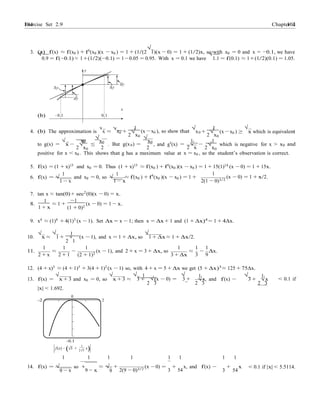
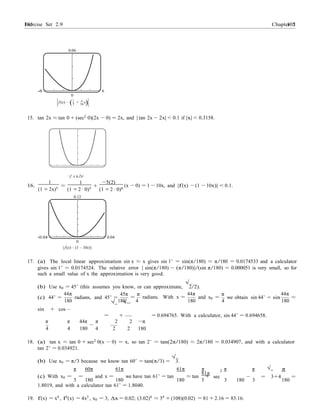
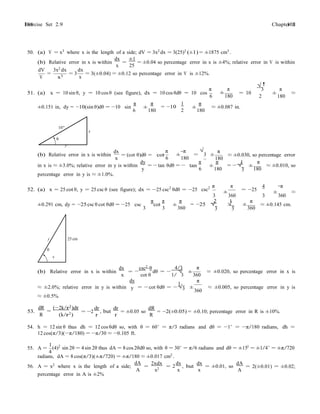
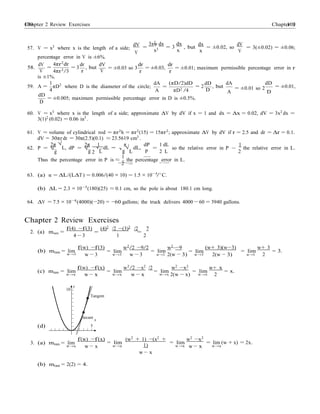
tan ≈
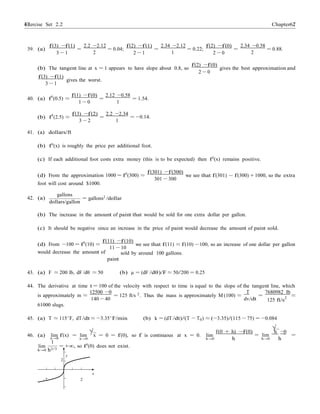
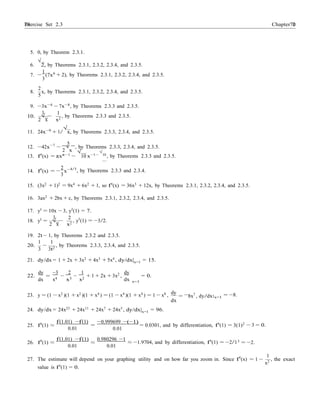
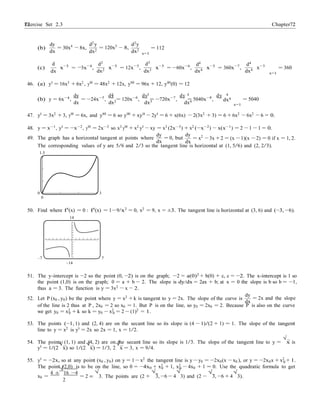
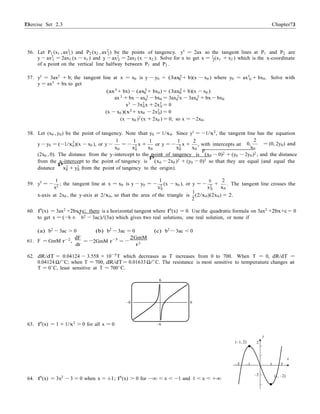
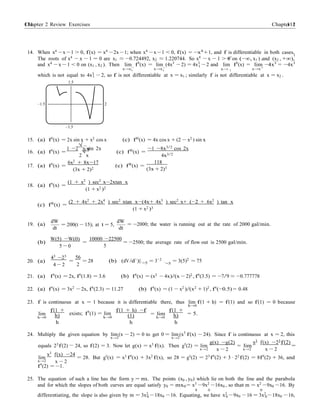
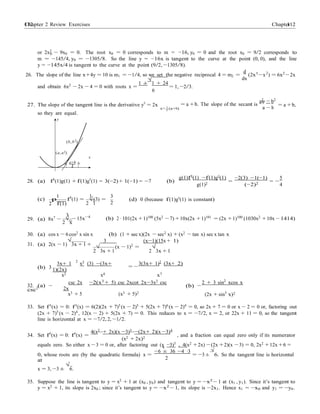
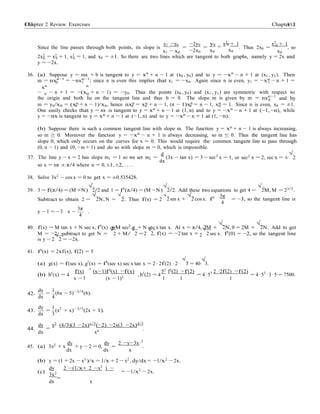
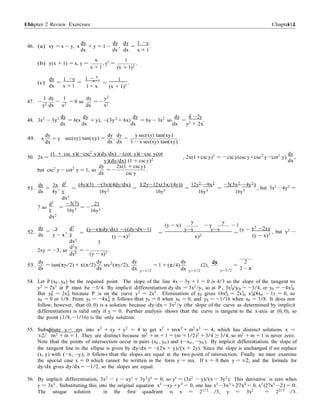
4
3
0
19. True;
23. (a)
0 0
−
end in the curve at
Velocity(m/s)Calculus 10th Edition Anton Solutions Manual
Full clear download (no formatting errors) at:
http://testbanklive.com/download/calculus-10th-edition-anton-solutions-manual/
Calculus 10th Edition Anton Test Bank
Full clear download (no formatting errors) at:
http://testbanklive.com/download/calculus-10th-edition-anton-test-bank/
enta yello
Tw b
hlac
ek
Derivative
Exercise Set 2.1Answers to Odd-Numbered Exercises A7
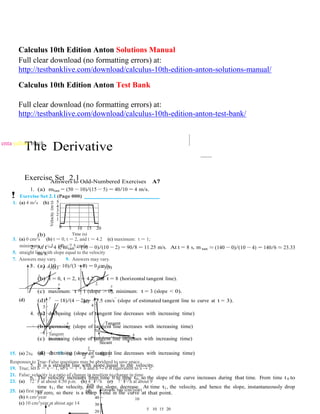
1. (a) mtan = (50 − 10)/(15 − 5) = 40/10 = 4 m/s.
! Exercise Set 2.1 (Page 000)
1. (a) 4 m/s (b) 5
4
3
2
1
0
(b)
5 10 15 20
Time (s)
3. (a) 0 cm/s (b) t = 0, t = 2, and t = 4.2 (c) maximum: t = 1;
minim2u.mA: tt t==34 s(,d)m−7.5 cm(9/s0 − 0)/(10 − 2) = 90/8 = 11.25 m/s. At t = 8 s, m
5. straight limne/ws.ith slope equal to the velocity
tan ≈ (140 − 0)/(10 − 4) = 140/6 ≈ 23.33
7. Answers may vary. 9. Answers may vary.
3y . (a)y =(1f(0x)− 10)/(3 − 0y) = 0ycm= f/(sx.)
(L
b) t = 0, t = 2, t = 4.2, and t = 8 (horizontal tangent line).
x L x
(c) maximum: t = 1 (slope > 0), minimum: t = 3 (slope < 0).
(d) (d)
y
3
− 18)/(4 − 2()d=) −7y.5 cm/s (slope of estimated tangent line to curve at t = 3).
4
4. (a)2 decreasing (slope of tangent line decreases with increasing time)
1
x Tangent
(b) increasing (slope of tangent line increases with increasing time)
−1 Tangent x
(c) i(nx-carxeias)sing (slope of tangent line increases with increasing time)
Secant
1
(slope of tangent line decreases with increasing time)15. (a) 2x0 ((db)) −d2ecr1e7a.si(nag) 1 +
2
√
x
(b) 2
Responses to True–False questions may be abridged to save space.
5. It is a straight line with slope equal to the velocity.
set h = x − 1, so x = 1 + h and h → 0 is equivalent to x→ 1.
21. False; velocity is a ratio of change in position to change in time.
6. The velocity increases from time 0 to time t , so the slope of the curve increases during that time. From time t to
72◦
F at about 4:30 p.m. (b) 4◦
F/h (c) 7◦
F/h at about 9
p.m.time t1, the velocity, and the slope, decrease. At time t1, the velocity, and hence the slope, instantaneously drop
25. (a) first yetaorzero, so there is a s(dh)arp b
Growth rate (cm/year)
that point.
(b) 6 cm/year
(c) 10 cm/yearsat about age 14
40
30
20
10
5 10 15 20
t (yr)
27. (a) 19,200 ft (b) 480 ft/s (c) 66.94
t
ft/s (d) 1440 ft/s
29. (a) 720 ft/min (b) 1t902 tf1t/min
! Exercise Set 2.2 (Page 000)
1. 2, 0, −2, −1
3. (b) 3 (c) 3
5. y
1
597. y = 5x − 16
9. 4x, y = 4x − 2
60 Chapter 2Exercise Set 2.1 60
−
1 1
7.
8.
9.
10.
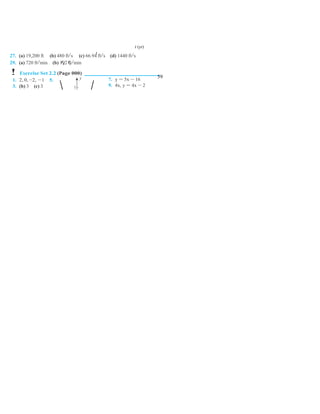
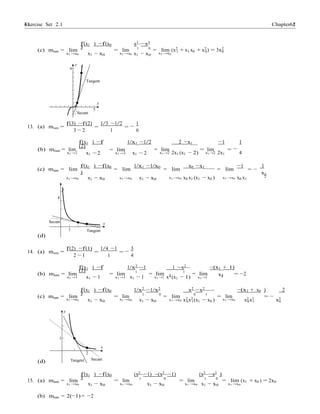
f(1) −f(0) 2
11. (a) msec = = = 2
1 − 0 1
f(x1 ) − f(0) 2x2
−0
(b) mtan = lim
x1 →0 x1 − 0
= lim
x1 →0
1
x1 − 0
= lim 2x1 = 0
x1 →0
f(x1 ) − f(x0 ) 2x2
−2x2
(c) mtan = lim
x1 →x0 x1 − x0
= lim
x1 →x0
1
x1 − x0
0
= lim
x1 →x0
(2x1 + 2x0 ) = 4x0
y
Secant
2
Tangent x
1
(d) The tangent line is the x-axis.
12. (a) msec =
f(2) −f(1)
=
2 − 1
23
13
= 7
1
(b) mtan = lim
f(x1 ) −f
(1)
= lim
x3
−1
= lim
(x1 −1)(x2
+ x1 +
1)
= lim (x2
+ x1 + 1) = 3
x1 →1 x1 − 1 x1→1 x1 − 1 x1 →1 x1 − 1 x1→1
1
61 Chapter 2Exercise Set 2.1 61
−
x
−
1 x
−
0
1
f(x1 ) −f(x0
)
x3
−x3
(c) mtan = lim = lim 1 0
= lim (x2
+ x1 x0 + x2
) = 3x2
x1 →x0 x1 − x0 x1 →x0 x1 − x0 x1 →x0
1 0 0
y
9
Tangent
x
5
Secant
f(3) −f(2) 1/3 −1/2 1
13. (a) msec = =
3 − 2
f(x1 ) −f
(2)
=
1 6
1/x1 −1/2 2 −x1 −1 1
(b) mtan = lim
x1 →2 x1 − 2
= lim
x1 →2 x1 − 2
= lim
x1→2 2x1 (x1 − 2)
= lim =
x1→2 2x1 4
(c) mtan = lim
f(x1 ) −f(x0
)
= lim
1/x1 −1/x0
= lim
x0 −x1
= lim
−1
= −
1
x1 →x0 x1 − x0 x1 →x0 x1 − x0 x1 →x0 x0 x1 (x1 − x0 ) x1 →x0 x0 x1
2
y
4
(d)
Secant
1
x
Tangent
f(2) −f(1) 1/4 −1 3
14. (a) msec = =
2 − 1
f(x1 ) −f
(1)
=
1 4
1/x2 −1 1 −x2 −(x1 + 1)
(b) mtan = lim = lim 1
= lim 1
= lim = −2
x1 →1 x1 − 1 x1 →1 x1 − 1 x1→1 x2
(x1 − 1) x1→1 2
f(x1 ) −f(x0
)
1/x2
−1/x2
x2
−x2 −(x1 + x0 ) 2
(c) mtan = lim = lim 1 0
= lim 0 1
= lim = −
x1 →x0 x1 − x0 x1 →x0 x1 − x0 x1 →x0 x2 x2 (x1 − x0 ) x1 →x0 x2 x2 x3
0 1 0 1 0
y
1
x
2
(d) Tangent Secant
f(x1 ) −f(x0
)
(x2 −1) −(x2 −1) (x2 −x2 )
15. (a) mtan = lim = lim 1 0
= lim 1 0
= lim (x1 + x0 ) = 2x0
x1 →x0 x1 − x0 x1 →x0 x1 − x0 x1 →x0 x1 − x0 x1 →x0
(b) mtan = 2(−1) = −2
62 Chapter 2Exercise Set 2.1 62
0
=
f(x1 ) −f(x0
)
(x2
+ 3x1 + 2) −(x2
+ 3x0 +
2)
(x2
−x2
) + 3(x1 −x0 )
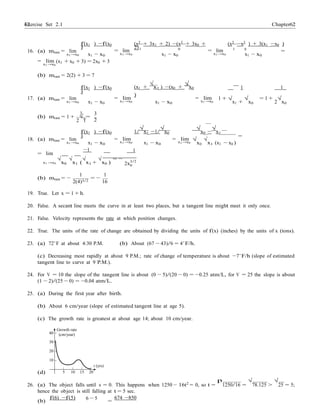
16. (a) mtan = lim
x1 →x0 x1 − x0
= lim 1
x1 →x0
0
x1 − x0
= lim 1
x1 →x0
0
=
x1 − x0
= lim
x1 →x0
(x1 + x0 + 3) = 2x0 + 3
(b) mtan = 2(2) + 3 = 7
f(x1 ) −f(x0
)
(x1 +
√
x1 ) −(x0 +
√
x0
)
1 1
17. (a) mtan = lim
x1 →x0
1
x1 − x0
3
= lim
x1 →x0 x1 − x0
= lim
x1 →x0
1 + √
x1 +
√
x0
= 1 +
2
√
x0
(b) mtan = 1 + √ =
2 1 2
f(x1 ) −f(x0
)
1/
√
x1 −1/
√
x0
√
x0 −
√
x1
18. (a) mtan = lim
x1 →x0 x1 − x0
= limx1 →x0 x1 − x0
= limx1 →x0
√
x0
√
x1 (x1 − x0 )
= lim
−1 1
= −
x1→x0
√
x0
√
x1 (
√
x1 +
√
x0 ) 2x
3/2
1 1
(b) mtan = −
2(4)3/2
= −
16
19. True. Let x = 1 + h.
20. False. A secant line meets the curve in at least two places, but a tangent line might meet it only once.
21. False. Velocity represents the rate at which position changes.
22. True. The units of the rate of change are obtained by dividing the units of f(x) (inches) by the units of x (tons).
23. (a) 72◦
F at about 4:30 P.M. (b) About (67 − 43)/6 = 4◦
F/h.
(c) Decreasing most rapidly at about 9 P.M.; rate of change of temperature is about −7◦
F/h (slope of estimated
tangent line to curve at 9 P.M.).
24. For V = 10 the slope of the tangent line is about (0 − 5)/(20 − 0) = −0.25 atm/L, for V = 25 the slope is about
(1 − 2)/(25 − 0) = −0.04 atm/L.
25. (a) During the first year after birth.
(b) About 6 cm/year (slope of estimated tangent line at age 5).
(c) The growth rate is greatest at about age 14; about 10 cm/year.
Growth rate
40 (cm/year)
30
20
10
(d) 5 10 15 20
t (yrs)
26. (a) The object falls until s = 0. This happens when 1250 − 16t2
= 0, so t =
p
1250/16 =
√
78.125 >
√
25 = 5;
hence the object is still falling at t = 5 sec.
(b)
f(6) −f(5) 6 − 5
=
674 −850
63 Chapter 2Exercise Set 2.1 63
1
= −176.
The
average
velocity is
−176 ft/s.
Exercise Set 2.2 6363 Chapter 2
−
−
(c) vinst = lim
h→0
f(5 + h) −f
(5)
h
= lim
h→0
[1250 −16(5 + h)2
] −
850
h
= lim
h→0
−160h−16h2
h
= lim (−160 − 16h) =
h→0
−160 ft/s.
27. (a) 0.3 · 403
= 19,200 ft (b) vave = 19,200/40 = 480 ft/s
(c) Solve s = 0.3t3
= 1000; t ≈ 14.938 so vave ≈ 1000/14.938 ≈ 66.943 ft/s.
(d) vinst = lim
h→0
0.3(40 + h)3 −0.3 ·403
h
= lim
h→0
0.3(4800h+ 120h2 + h3
)
h
= lim 0.3(4800 + 120h + h2
) = 1440 ft/s
h→0
28. (a) vave =
4.5(12)2
4.5(0)2
= 54 ft/s
12 − 0
4.5t2 −4.5(6)2
4.5(t2 −36) 4.5(t1 + 6)(t1 −6)
(b) vinst = lim
t1 →6
1
t1 − 6
= lim
t1 →6
1
t1 − 6
= lim
t1 →6 t1 − 6
= lim 4.5(t1 + 6) = 54 ft/s
t1 →6
29. (a) vave =
6(4)4
6(2)4
= 720 ft/min
4 − 2
6t4
−6(2)4
6(t4
−16) 6(t2
+ 4)(t2
−4)
(b) vinst = lim 1
= lim 1
= lim 1 1
= lim 6(t2
+ 4)(t1 + 2) = 192 ft/min
t1 →2 t1 − 2 t1 →2 t1 − 2 t1 →2 t1 − 2 t1→2 1
30. See the discussion before Definition 2.1.1.
31. The instantaneous velocity at t = 1 equals the limit as h → 0 of the average velocity during the interval between
t = 1 and t = 1 + h.
Exercise Set 2.2
1. f0(1) = 2.5, f0(3) = 0, f0(5) = −2.5, f0(6) = −1.
2. f0
(4) < f0
(0) < f0
(2) < 0 < f0
(−3).
3. (a) f0
(a) is the slope of the tangent line. (b) f0
(2) = m = 3 (c) The same, f0
(2) = 3.
4. f0
(1) =
2 −(−1)
=
3
1 − (−1) 2
y
x
-1
5.
Exercise Set 2.2 6464 Chapter 2
y
x
6.
7. y − (−1) = 5(x − 3), y = 5x − 16
8. y − 3 = −4(x + 2), y = −4x − 5
f(x+ h) −f(x) 2(x+ h)2
−2x2
4xh+ 2h2
9. f0
(x) = lim
h→0 h
= lim
h→0 h
= lim
h→0 h
= 4x; f0
(1) = 4 so the tangent line is given
by y − 2 = 4(x − 1), y = 4x − 2.
f(x+ h) −f(x) 1/(x+ h)2
−1/x2
x2
−(x+ h)2
−2xh−h2 −2x−h
10. f0
(x) = lim
h→0 h
= lim
h→0 h
= lim
h→0 hx2 (x + h)2
= lim
h→0 hx2 (x + h)2 = lim =
h→0 x2 (x + h)2
2
11. f0(x) = lim
h→0
f(x+ h) −f(x)
h
= lim
h→0
(x+ h)3
−x3
h
= lim (3x2
+ 3xh + h2
) = 3x2
; f0
(0) = 0 so the tangent line is
h→0
given by y − 0 = 0(x − 0), y = 0.
f(x+ h) −f(x) [2(x+ h)3
+ 1] −[2x3
+ 1]
12. f0
(x) = lim
h→0 h
= lim
h→0 h
= lim (6x2
+ 6xh + 2h2
) = 6x2
; f(−1) = 2(−1)3
+
h→0
1 = −1 and f0
(−1) = 6 so the tangent line is given by y + 1 = 6(x + 1), y = 6x + 5.
f(x+ h) −f(x)
√
x+ 1 + h−
√
x+ 1
√
x+ 1 + h−
√
x+ 1
√
x+ 1 + h+
√
x+ 1
13. f0
(x) = lim
h→0 h
h
= lim
h→0 h
1
= lim
h→0 h
√
x + 1 + h +
1
√
x + 1
=
lim √ √ = √ ; f(8) =
√
8 + 1 = 3 and f0(8) = so the tangent line is given by
h→0 h( x + 1 + h + x + 1) 2 x + 1 6
1 1 5
y − 3 =
6
(x − 8), y =
6
x +
3
.
f(x+ h) −f(x)
√
2x+ 2h+ 1 −
√
2x+ 1
√
2x+ 2h+ 1 +
√
2x+ 1
14. f0(x) = lim
h→0
= lim
h h→0
2h
h
√
2x + 2h + 1 +
2 1
√
2x + 1
=
= lim √ √ = lim √ √ = √ ; f(4) =
√
2 · 4 + 1 =
√
9 = 3 and
h→0 h( 2x + 2h + 1 + 2x + 1) h→0 2x + 2h + 1 +
1
2x + 1
1
2x + 1
5
f0
(4) = 1/3 so the tangent line is given by y − 3 =
3
(x − 4), y =
3
x +
3
.
1
1
x−(x+ ∆x)
15. f0
(x) = lim x+ ∆x
−
x = lim
x(x + ∆x)
= lim
−∆x
= lim
1 1
= .
∆x→0 ∆x
1
∆x→0
1
−
∆x ∆x→0 x∆x(x + ∆x)
(x+ 1) −(x+ ∆x+ 1)
∆x→0
−
x(x + ∆x)
−
x2
16. f0
(x) = lim
(x+ ∆x) + 1 x+
1 = lim
(x+ 1)(x + ∆x+ 1)
=
lim
x+ 1 −x−∆x−1
=
∆x→0 ∆x ∆x→0 ∆x ∆x→0 ∆x(x + 1)(x + ∆x + 1)
= lim
−∆x
= lim
−1
= −
1
.
∆x→0 ∆x(x + 1)(x + ∆x + 1) ∆x→0 (x + 1)(x + ∆x + 1) (x + 1)2
17. f0
(x) = lim
∆x→0
(x+ ∆x)2
−(x+ ∆x) −(x2
−x)
∆x
= lim
∆x→0
2x∆x+ (∆x)2
−∆x
∆x
= lim (2x − 1 + ∆x) = 2x − 1.
∆x→0
Exercise Set 2.2 6565 Chapter 2
1
− −
√
=
=
18. f0
(x) = lim
∆x→0
(x+ ∆x)4
−x4
∆x
= lim
∆x→0
4x3
∆x+ 6x2
(∆x)2
+ 4x(∆x)3
+
(∆x)4
=
∆x
= lim (4x3
+ 6x2
∆x + 4x(∆x)2
+ (∆x)3
) = 4x3
.
∆x→0
1 1
√
x+ ∆x
−√
x
√
x−
√
x+ ∆x ψ ψ x−(x+ ∆x)
19. f0
(x) = lim
∆x→0 ∆x
= lim
∆x→0 ∆x x
√
x + ∆x
= lim
∆x→0 ∆x
√
x
√
x + ∆x(
√
x +
√
x + ∆x)
=
= lim √
−1 1
√ = − .
∆x→0
√
x x + ∆x(
√
x + x + ∆x) 2x3/2
1 1
√
x+ ∆x−1
−√
x−1
√
x−1 −
√
x+ ∆x−1
√
x−1 +
√
x+ ∆x−1
20. f0
(x) = lim
∆x→0 ∆x
= lim
∆x→0 ∆x
√
x −
√
x + ∆x − 1
√
x − 1 +
√
x + ∆x − 1
= lim √ √
−∆xψ
√ = lim √ √
−1
√ =
∆x→0 ∆x
1
−
2(x − 1)3/2
x − 1
.
x + ∆x − 1(
√
x − 1 + x + ∆x − 1) ∆x→0 x − 1 x + ∆x − 1(
√
x − 1 + x + ∆x − 1)
21. f0
(t) = lim
h→0
f(t+ h) −f(t)
h
= lim
h→0
[4(t+ h)2
+ (t+ h)] −[4t2
+
t]
h
= lim
h→0
4t2
+ 8th + 4h2
+ t+ h−4t2
−t
h
lim
h→0
8th + 4h2
+ h
h
= lim (8t + 4h + 1) = 8t + 1.
h→0
4 3 4 3 4 3 2 2 3 3
dV
22. = lim
π(r+ h) πr
3 3 = lim
π(r + 3rh+ 3rh + h r)
3 = lim
4
π(3r2
+ 3rh + h2
) = 4πr2
.
dr h→0 h h→0 h h→0 3
23. (a) D (b) F (c) B (d) C (e) A (f ) E
24. f0
(
√
2/2) is the slope of the tangent line to the unit circle at (
√
2/2,
√
2/2). This line is perpendicular to the line
y = x, so its slope is -1.
y
m = –1
x
1
y
y y
x x
1 2
–1
25. (a) (b) (c)
y y y
x x x
26. (a) (b) (c)
Exercise Set 2.2 6666 Chapter 2
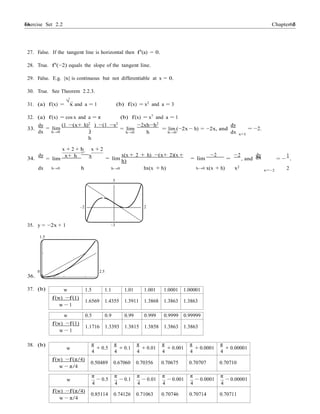
w 1.5 1.1 1.01 1.001 1.0001 1.00001
f(w) −f(1)
w − 1
1.6569 1.4355 1.3911 1.3868 1.3863 1.3863
w
π
+ 0.5
4
π
+ 0.1
4
π
+ 0.01
4
π
+ 0.001
4
π
+ 0.0001
4
π
+ 0.00001
4
f(w) −f(π/4)
w − π/4
0.50489 0.67060 0.70356 0.70675 0.70707 0.70710
w
π
− 0.5
π
− 0.1
π
− 0.01
π
− 0.001
π
− 0.0001
π
− 0.00001
f(w) −f(π/4)
w − π/4
0.85114 0.74126 0.71063 0.70746 0.70714 0.70711
dx
dx
27. False. If the tangent line is horizontal then f0
(a) = 0.
28. True. f0
(−2) equals the slope of the tangent line.
29. False. E.g. |x| is continuous but not differentiable at x = 0.
30. True. See Theorem 2.2.3.
31. (a) f(x) =
√
x and a = 1 (b) f(x) = x2
and a = 3
32. (a) f(x) = cos x and a = π (b) f(x) = x7 and a = 1
33.
dy
= lim
dx h→0
(1 −(x+ h)2
) −(1 −x2
)
h
= lim
h→0
−2xh−h2
h
= lim (−2x − h) = −2x, and
h→0
dy
x=1
= −2.
x + 2 + h x + 2
34.
dy
= lim
x+ h
−
x
= lim
x(x + 2 + h) −(x+ 2)(x +
h) = lim
−2
=
−2
, and
dy 1
= − .
dx h→0 h h→0 hx(x + h) h→0 x(x + h) x2
x=−2 2
5
–2 2
35. y = −2x + 1 –3
1.5
36.
0 2.5
0
37. (b)
w 0.5 0.9 0.99 0.999 0.9999 0.99999
f(w) −f(1)
w − 1
1.1716 1.3393 1.3815 1.3858 1.3863 1.3863
38. (b)
4 4 4 4 4 4
Exercise Set 2.2 6767 Chapter 2
≈
−
39. (a)
f(3) −f(1)
3 − 1
=
2.2 −2.12
2
= 0.04;
f(2) −f(1)
2 − 1
=
2.34 −2.12
1
= 0.22;
f(2) −f(0)
2 − 0
=
2.34 −0.58
2
= 0.88.
(b) The tangent line at x = 1 appears to have slope about 0.8, so
f(3) −f(1)
gives the worst.
3 − 1
f(2) −f(0)
2 − 0
gives the best approximation and
f(1) −f(0) 2.12 −0.58
40. (a) f0
(0.5) ≈ =
1 − 0
= 1.54.
1
f(3) −f(2) 2.2 −2.34
(b) f0
(2.5) ≈ =
3 − 2 1
= −0.14.
41. (a) dollars/ft
(b) f0(x) is roughly the price per additional foot.
(c) If each additional foot costs extra money (this is to be expected) then f0
(x) remains positive.
f(301) −f(300)
(d) From the approximation 1000 = f0
(300) ≈
foot will cost around $1000.
301 −
we see that f(301) f(300) + 1000, so the extra
300
42. (a)
gallons
dollars/gallon
= gallons2
/dollar
(b) The increase in the amount of paint that would be sold for one extra dollar per gallon.
(c) It should be negative since an increase in the price of paint would decrease the amount of paint sold.
f(11) −f(10)
(d) From −100 = f0
(10) ≈
would decrease the amount of
we see that f(11) ≈ f(10) −100, so an increase of one dollar per gallon
11 − 10
sold by around 100 gallons.
paint
43. (a) F ≈ 200 lb, dF /dθ ≈ 50 (b) µ = (dF /dθ)/F ≈ 50/200 = 0.25
44. The derivative at time t = 100 of the velocity with respect to time is equal to the slope of the tangent line, which
12500 −0 2 T 7680982 lb
is approximately m ≈
61000 slugs.
= 125 ft/s . Thus the mass is approximately M (100) ≈ =
140 − 40 dv/dt 125 ft/s
2
≈
45. (a) T ≈ 115◦
F, dT/dt ≈ −3.35◦
F/min (b) k = (dT /dt)/(T − T0) ≈ (−3.35)/(115 − 75) = −0.084
√3
46. (a) lim f(x) = lim
√3
x = 0 = f(0), so f is continuous at x = 0. lim
f(0 + h) −f(0) h 0
= lim =
lim
x→0
1
x→0
= +∞, so f0
(0) does not exist.
h→0 h h→0 h
h→0 h2/3
y
2
x
–2 2
Exercise Set 2.2 6868 Chapter 2
f(2 + h) −f(2) hψ −
0
x 0
=
=
2/3
(b) lim f(x) = lim (x − 2)2/3
= 0 = f(2) so f is continuous at x = 2. lim = lim =
lim
x→2
1
x→2
which does not exist so f0
(2) does not exist.
h→0 h h→0 h
h→0 h1/3
y
5
x
2
47. lim
x→1−
f(x) = lim
x→1+
f(x) = f(1), so f is continuous at x = 1. lim
h→0−
f(1 + h) −f
(1)
h
= lim
h→0−
[(1 + h)2
+ 1] −
2
h
lim (2 + h) = 2; lim
f(1 + h) −f
(1) = lim
2(1 + h) −
2 = lim 2 = 2, so f0
(1) = 2.
h→0− h→0+ h
y
h→0+ h h→0+
5
x
–3 3
48. lim
x→1−
f(x) = lim
x→1+
f(x) = f(1) so f is continuous at x = 1. lim
h→0−
f(1 + h) −f
(1)
h
= lim
h→0−
[(1 + h)2
+ 2] −
3
h
lim (2 + h) = 2; lim
f(1 + h) −f
(1) = lim
[(1 + h) + 2]
−3 = lim 1 = 1, so f0
(1) does not exist.
h→0−
y
h→0+ h h→0+ h h→0+
5
x
–3 3
49. Since −|x| ≤ x sin(1/x) ≤ |x| it follows by the Squeezing Theorem (Theorem 1.6.4) that lim x sin(1/x) = 0. The
→
derivative cannot exist: consider
f(x) −f(0)
x
= sin(1/x). This function oscillates between −1 and +1 and does
not tend to any number as x tends to zero.
y
x
50. For continuity, compare with ±x2
to establish that the limit is zero. The difference quotient is x sin(1/x) and (see
Exercise 49) this has a limit of zero at the origin.
Exercise Set 2.3 6969 Chapter 2
51. Let = f0 f(x) −f(x0 )
2
2
− 0 0 | − 0|
y
x
| (x0)/2|. Then there exists δ > 0 such that if 0 < |x − x0| < δ, then − f0
(x0 ) < . Since
f(x) −f(x0 )
x − x0
f0
(x0 ) > 0 and = f0
(x0 )/2 it follows that
x = x2 > x0 then f(x2 ) > f(x0 ).
x − x0
> > 0. If x = x1 < x0 then f(x1 ) < f(x0 ) and if
52. g0
(x1 ) = lim
h→0
g(x1 + h) −g(x1
)
h
= lim
h→0
f(m(x1 + h) + b) − f(mx1 + b)
h
= m lim
h→0
f(x0 + mh) −f(x0
)
mh
= mf 0
(x0 ).
53. (a) Let = |m|/2. Since m = 0, > 0. Since f(0) = f0
(0) = 0 we know there exists δ > 0 such that
f(0 + h) −f(0)
< whenever 0 < |h| < δ. It follows that |f(h)| < 1
|hm| for 0 < |h| < δ. Replace h with x to
h 2
get the result.
(b) For 0 < |x| < δ, |f(x)| < 1
|mx|. Moreover |mx| = |mx − f(x) + f(x)| ≤ |f(x) − mx| + |f(x)|, which yields
|f(x) − mx| ≥ |mx| − |f(x)| > 1
|mx| > |f(x)|, i.e. |f(x) − mx| > |f(x)|.
(c) If any straight line y = mx + b is to approximate the curve y = f (x) for small values of x, then b = 0 since
f (0) = 0. The inequality |f (x) − mx| > |f (x)| can also be interpreted as |f (x) − mx| > |f (x) − 0|, i.e. the line
y = 0 is a better approximation than is y = mx.
54. Let g(x) = f(x) −[f(x0 ) +f0
(x0 )(x −x0 )] and h(x) = f(x) −[f(x0 ) +m(x −x0 )]; note that h(x) −g(x) = (f0
(x0 ) −
m)(x x ). If m = f0
(x ) then there exists δ > 0 such that if 0 < x x < δ then
f(x) −f(x0 )
− f0
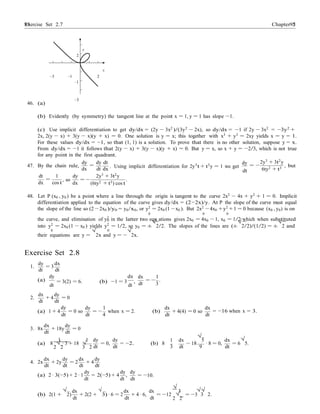
(x0 ) <
x − x0
1 1
2
|f0
(x0 ) − m|. Multiplying by |x − x0 | gives |g(x)| <
2
|h(x) − g(x)|. Hence 2|g(x)| < |h(x) + (−g(x))| ≤
|h(x)| + |g(x)|, so |g(x)| < |h(x)|. In words, f(x) is closer to f(x0 ) +f0
(x0 )(x − x0 ) than it is to f(x0 ) + m(x − x0 ).
So the tangent line gives a better approximation to f(x) than any other line through (x0 , f(x0 )). Clearly any line
not passing through that point gives an even worse approximation for x near x0 , so the tangent line gives the best
linear approximation.
55. See discussion around Definition 2.2.2.
56. See Theorem 2.2.3.
Exercise Set 2.3
1. 28x6
, by Theorems 2.3.2 and 2.3.4.
2. −36x11, by Theorems 2.3.2 and 2.3.4.
3. 24x7
+ 2, by Theorems 2.3.1, 2.3.2, 2.3.4, and 2.3.5.
4. 2x3
, by Theorems 2.3.1, 2.3.2, 2.3.4, and 2.3.5.
Exercise Set 2.3 7070 Chapter 2
2
√
x
dx
=
− |
5. 0, by Theorem 2.3.1.
6.
√
2, by Theorems 2.3.1, 2.3.2, 2.3.4, and 2.3.5.
1 6
7. −
3
(7x
2
+ 2), by Theorems 2.3.1, 2.3.2, 2.3.4, and 2.3.5.
8. x, by Theorems 2.3.1, 2.3.2, 2.3.4, and 2.3.5.
5
9. −3x−4
− 7x−8
, by Theorems 2.3.3 and 2.3.5.
10.
1
√ −
1
, by Theorems 2.3.3 and 2.3.5.
2 x x2
11. 24x−9
+ 1/
√
x, by Theorems 2.3.3, 2.3.4, and 2.3.5.
12. −42x−7
−
5
, by Theorems 2.3.3, 2.3.4, and 2.3.5.
13. f0
(x) = πxπ−1
−
√
10 x−1−
√
10
, by Theorems 2.3.3 and 2.3.5.
2
14. f0
(x) = −
3
x−4/3
, by Theorems 2.3.3 and 2.3.4.
15. (3x2 + 1)2 = 9x4 + 6x2 + 1, so f0(x) = 36x3 + 12x, by Theorems 2.3.1, 2.3.2, 2.3.4, and 2.3.5.
16. 3ax2
+ 2bx + c, by Theorems 2.3.1, 2.3.2, 2.3.4, and 2.3.5.
17. y0 = 10x − 3, y0(1) = 7.
18. y0 =
1
√ −
2
, y0
(1) = −3/2.
2 x x2
19. 2t − 1, by Theorems 2.3.2 and 2.3.5.
20.
1 1
3
−
3t2
, by Theorems 2.3.3, 2.3.4, and 2.3.5.
21. dy/dx = 1 + 2x + 3x2
+ 4x3
+ 5x4
, dy/dx|x=1 = 15.
22.
dy −3 2
dx x4
−
x3
1
−
x2
+ 1 + 2x + 3x2
,
dy
x=1
= 0.
23. y = (1 − x2 )(1 + x2 )(1 + x4 ) = (1 − x4 )(1 + x4 ) = 1 − x8 ,
24. dy/dx = 24x23 + 24x11 + 24x7 + 24x5 , dy/dx|x=1 = 96.
dy
= 8x7
, dy/dx
dx
x=1
= −8.
25. f0
(1) ≈
f(1.01) −f(1)
=
0.01
−0.999699 −(−1)
= 0.0301, and by differentiation, f0
(1) = 3(1)2
0.01
− 3 = 0.
f(1.01) −f(1) 0.980296 −1 326. f0
(1) ≈
0.01
≈
0.01
≈ −1.9704, and by differentiation, f0
(1) = −2/1 = −2.
1
27. The estimate will depend on your graphing utility and on how far you zoom in. Since f0
(x) = 1 −
x2
, the exact
value is f0
(1) = 0.
Exercise Set 2.3 7171 Chapter 2
x=2
dr
d
28. The estimate will depend on your graphing utility and on how far you zoom in. Since f0(x) =
1
√ + 2, the exact
2 x
value is f0
(1) = 5/2.
29. 32t, by Theorems 2.3.2 and 2.3.4.
30. 2π, by Theorems 2.3.2 and 2.3.4.
31. 3πr2
, by Theorems 2.3.2 and 2.3.4.
32. −2α−2
+ 1, by Theorems 2.3.2, 2.3.4, and 2.3.5.
33. True. By Theorems 2.3.4 and 2.3.5,
d
dx
[f(x) − 8g(x)] = f0
(x) − 8g0
(x); substitute x = 2 to get the result.
34. True.
d
[ax3
+ bx2
+ cx + d] = 3ax2
+ 2bx + c.
dx
d
35. False. [4f(x) + x3
]
dx x=2
= (4f0
(x) + 3x2
) = 4f0
(2) + 3 · 22
= 32
36. False. f(x) = x6
− x3
so f0
(x) = 6x5
− 3x2
and f00
(x) = 30x4
− 6x, which is not equal to 2x(4x3
− 1) = 8x4
− 2x.
37. (a)
dV
= 4πr2
(b)
dr
dV
r=5
= 4π(5)2
= 100π
38.
d λλ0 + λ6
=
dλ 2 − λ0
1
2 − λ0
(λλ0 + λ6
) =
dλ
1
2 − λ0
(λ0 + 6λ5
) =
λ0 + 6λ5
.
2 − λ0
39. y − 2 = 5(x + 3), y = 5x + 17.
40. y + 2 = −(x − 2), y = −x.
41. (a) dy/dx = 21x2
− 10x + 1, d2
y/dx2
= 42x − 10 (b) dy/dx = 24x − 2, d2
y/dx2
= 24
(c) dy/dx = −1/x2
, d2
y/dx2
= 2/x3
(d) dy/dx = 175x4
− 48x2
− 3, d2
y/dx2
= 700x3
− 96x
42. (a) y0
= 28x6
− 15x2
+ 2, y00
= 168x5
− 30x (b) y0
= 3, y00
= 0
(c) y0
=
2
5x2
, y00
= −
4
5x3
(d) y0
= 8x3
+ 9x2
− 10, y00
= 24x2
+ 18x
43. (a) y0
= −5x−6
+ 5x4
, y00
= 30x−7
+ 20x3
, y000
= −210x−8
+ 60x2
(b) y = x−1
, y0
= −x−2
, y00
= 2x−3
, y000
= −6x−4
(c) y0 = 3ax2 + b, y00 = 6ax, y000 = 6a
44. (a) dy/dx = 10x − 4, d2
y/dx2
= 10, d3
y/dx3
= 0
(b) dy/dx = −6x−3
− 4x−2
+ 1, d2
y/dx2
= 18x−4
+ 8x−3
, d3
y/dx3
= −72x−5
− 24x−4
(c) dy/dx = 4ax3
+ 2bx, d2
y/dx2
= 12ax2
+ 2b, d3
y/dx3
= 24ax
45. (a) f0
(x) = 6x, f00
(x) = 6, f000
(x) = 0, f000
(2) = 0
Exercise Set 2.3 7272 Chapter 2
dx2
dx4
0
±
−
−
dx
(b)
dy
= 30x4
8x,
dx
d
d2
y
dx2
= 120x3
− 8,
d2
d2
y
x=1
d3
= 112
d4
d4
(c) x−3
= 3x−4
,
dx dx2 x−3
= 12x−5
,
dx3 x−3
= −60x−6
,
dx4 x−3
= 360x−7
,
dx4
x−3
x=1
= 360
46. (a) y0
= 16x3
+ 6x2
, y00
= 48x2
+ 12x, y000
= 96x + 12, y000
(0) = 12
2 3 4 4
(b) y = 6x−4
,
dy
= −24x−5
,
dy
= 120x−6
,
dy
= −720x−7
,
dy
= 5040x−8
,
dy
= 5040
dx dx2 dx3 dx4
x=1
47. y0
= 3x2
+ 3, y00
= 6x, and y000
= 6 so y000
+ xy00
− 2y0
= 6 + x(6x) − 2(3x2
+ 3) = 6 + 6x2
− 6x2
− 6 = 0.
48. y = x−1
, y0
= −x−2
, y00
= 2x−3
so x3
y00
+ x2
y0
− xy = x3
(2x−3
) + x2
(−x−2
) − x(x−1
) = 2 − 1 − 1 = 0.
49. The graph has a horizontal tangent at points where
dy
= 0, but
dx
dy
= x2
− 3x + 2 = (x −1)(x −2) = 0 if x = 1, 2.
The corresponding values of y are 5/6 and 2/3 so the tangent line is horizontal at (1, 5/6) and (2, 2/3).
1.5
0 3
0
50. Find where f0
(x) = 0 : f0
(x) = 1−9/x2
= 0, x2
= 9, x = ±3. The tangent line is horizontal at (3, 6) and (−3, −6).
14
–7 7
–14
51. The y-intercept is −2 so the point (0, −2) is on the graph; −2 = a(0)2
+ b(0) + c, c = −2. The x-intercept is 1 so
the point (1,0) is on the graph; 0 = a + b − 2. The slope is dy/dx = 2ax + b; at x = 0 the slope is b so b = −1,
thus a = 3. The function is y = 3x2
− x − 2.
52. Let P (x0 , y0) be the point where y = x2
+ k is tangent to y = 2x. The slope of the curve is
dy
= 2x and the slope
dx
of the line is 2 thus at P , 2x0 = 2 so x0 = 1. But P is on the line, so y0 = 2x0 = 2. Because P is also on the curve
we get y0 = x2
+ k so k = y0 − x2
= 2 − (1)2
= 1.0 0
53. The points (−1, 1) and (2, 4) are on the secant line so its slope is (4 − 1)/(2 + 1) = 1. The slope of the tangent
line to y = x2 is y0 = 2x so 2x = 1, x = 1/2.
54. The points (1, 1) and (4, 2) are on the secant line so its slope is 1/3. The slope of the tangent line to y =
√
x is
y0
= 1/(2
√
x) so 1/(2
√
x) = 1/3, 2
√
x = 3, x = 9/4.
55. y0 = −2x, so at any point (x0 , y0) on y = 1 − x2 the tangent line is y − y0 = −2x0(x − x0 ), or y = −2x0x + x2 + 1.
The point (2,0) is to be on the line, so 0 = −4x0 + x2
+ 1, x2
− 4x0 + 1 = 0. Use the quadratic formula to get
4 ±
√
16 −4 √
0 0
√ √ √ √
x0 = = 2 3. The points are (2 +
2
3, −6 − 4 3) and (2 − 3, −6 + 4 3).
Exercise Set 2.3 7373 Chapter 2
0
x x
− −
1
0 0
56. Let P1 (x1 , ax2
) and P2 (x2 , ax2
) be the points of tangency. y0
= 2ax so the tangent lines at P1 and P2 are1 2
y − ax2
= 2ax1 (x − x1 ) and y − ax2
= 2ax2 (x − x2 ). Solve for x to get x = 1
(x1 + x2 ) which is the x-coordinate1 2 2
of a point on the vertical line halfway between P1 and P2 .
57. y0
= 3ax2
+ b; the tangent line at x = x0 is y − y0 = (3ax2
+ b)(x − x0 ) where y0 = ax3
+ bx0. Solve with
y = ax3
+ bx to get
0 0
(ax3 + bx) − (ax3 + bx0) = (3ax2 + b)(x − x0 )0 0
3 3 2 3ax + bx − ax0 − bx0 = 3ax0 x − 3ax0 + bx − bx0
x3
− 3x2
x + 2x3
= 00 0
(x − x0 )(x2
+ xx0 − 2x2
) = 0
(x − x0 )2
(x + 2x0 ) = 0, so x = −2x0.
58. Let (x0 , y0) be the point of tangency. Note that y0 = 1/x0. Since y0 = −1/x2, the tangent line has the equation
y − y0 = (−1/x2
)(x − x0 ), or y −
1 1
= − x +
1
or y = − x +
2
, with intercepts at
2
0, = (0, 2y0) and0
x0
2 x0
2 x0 x0
(2x0 , 0). The distance from the y-intercept to the point of tangency is
p
(x0 − 0)2 + (y0 − 2y0)2 , and the distance
from the x-intercept to the point of tangency is
p
(x0 − 2x0 )2 + (y0 − 0)2 so that they are equal (and equal the
distance
p
x2 + y2 from the point of tangency to the origin).0 0
1 1 x 2
59. y0
= −
x2
; the tangent line at x = x0 is y − y0 = −
x2
(x − x0 ), or y = −
x2
+
x
. The tangent line crosses the
0 0 0
1
x-axis at 2x0 , the y-axis at 2/x0, so that the area of the triangle is
2
(2/x0)(2x0) = 2.
60. f0
(x) = 3ax2
+2bx+c; there is a horizontal tangent where f0
(x) = 0. Use the quadratic formula on 3ax2
+2bx+c = 0
to get x = (−b ±
√
b2 − 3ac)/(3a) which gives two real solutions, one real solution, or none if
(a) b2
− 3ac > 0 (b) b2
− 3ac = 0 (c) b2
− 3ac < 0
61. F = GmM r−2,
dF
dr
= 2GmM r−3
=
2GmM
r3
62. dR/dT = 0.04124 − 3.558 × 10⁻⁵T which decreases as T increases from 0 to 700. When T = 0, dR/dT =
0.04124 Ω/◦
C; when T = 700, dR/dT = 0.01633 Ω/◦
C. The resistance is most sensitive to temperature changes at
T = 0◦
C, least sensitive at T = 700◦
C.
6
–6 6
63. f0
(x) = 1 + 1/x2
> 0 for all x = 0 –6
y
(–1, 2) 2
x
–2 –1 1 2
64. f0
(x) = 3x2
− 3 = 0 when x = ±1; f0
(x) > 0 for −∞ < x < −1 and 1 < x < +∞
–2 (1, –2)
Exercise Set 2.3 7474 Chapter 2
x
xn+1
xn+2
2
65. f is continuous at 1 because lim f(x) = lim f(x) = f(1); also lim f0
(x) = lim (2x +1) = 3 and lim f0
(x) =
x→1− x→1+ x→1− x→1− x→1+
lim
x→1+
3 = 3 so f is differentiable at 1, and the derivative equals 3.
y
3
x
-1 1
66. f is not continuous at x = 9 because lim
x→9−
f(x) = −63 and lim
x→9+
f(x) = 3. f cannot be differentiable at x = 9,
for if it were, then f would also be continuous, which it is not.
f(x) −f(1)
67. f is continuous at 1 because lim
x→1−
f(x) = lim
x→1+
f(x) = f(1). Also, lim
x−>1−
x − 1
equals the derivative of x2
at
f(x) −f(1) √ 1 1
x = 1, namely 2x|x=1 = 2, while lim
x−>1+ x − 1
equals the derivative of x at x = 1, namely √ = .
x=1 2
Since these are not equal, f is not differentiable at x = 1.
68. f is continuous at 1/2 because lim
x→1/2−
f(x) = lim
x→1/2+
f(x) = f(1/2); also lim
x→1/2−
f0
(x) = lim
x→1/2−
3x2
= 3/4 and
lim
x→1/2+
f0
(x) = lim
x→1/2+
3x/2 = 3/4 so f0(1/2) = 3/4, and f is differentiable at x = 1/2.
69. (a) f(x) = 3x − 2 if x ≥ 2/3, f(x) = −3x + 2 if x < 2/3 so f is differentiable everywhere except perhaps at
2/3. f is continuous at 2/3, also lim
x→2/3−
f0
(x) = lim
x→2/3−
(−3) = −3 and lim
x→2/3+
f0
(x) = lim
x→2/3+
(3) = 3 so f is not
differentiable at x = 2/3.
(b) f(x) = x2
− 4 if |x| ≥ 2, f(x) = −x2
+ 4 if |x| < 2 so f is differentiable everywhere except perhaps at ±2.
f is continuous at −2 and 2, also lim f0
(x) = lim (−2x) = −4 and lim f0
(x) = lim (2x) = 4 so f is not
x→2− x→2− x→2+ x→2+
differentiable at x = 2. Similarly, f is not differentiable at x = −2.
70. (a) f0
(x) = −(1)x−2
, f00
(x) = (2 · 1)x−3
, f000
(x) = −(3 · 2 · 1)x−4
; f(n)
(x) = (−1)n n(n −1)(n −2) ···1
(b) f0
(x) = −2x−3
, f00
(x) = (3 · 2)x−4
, f000
(x) = −(4 · 3 · 2)x−5
; f(n)
(x) = (−1)n (n+ 1)(n)(n−1) ···2
71. (a)
d2
d d d d d d d2
dx2
[cf(x)] =
dx
[cf(x)] =
dx dx
c [f(x)] = c
dx dx
[f(x)]
dx
= c [f(x)]
dx2
d2
d d d d d d2
d2
dx2
[f(x) + g(x)] =
dx
[f(x) + g(x)] =
dx dx
[f(x)] + [g(x)]
dx dx
= [f(x)] + [g(x)]
dx2 dx2
(b) Yes, by repeated application of the procedure illustrated in part (a).
f0
(w) −f0
(2)
72. lim
w→2 w − 2
= f00
(2); f0
(x) = 8x7
− 2, f00(x) = 56x6 , so f00(2) = 56(26 ) = 3584.
73. (a) f0
(x) = nxn−1
, f00
(x) = n(n − 1)xn−2
, f000
(x) = n(n − 1)(n − 2)xn−3
, . . ., f(n)
(x) = n(n − 1)(n − 2) · · · 1
(b) From part (a), f(k)
(x) = k(k − 1)(k − 2) · · · 1 so f(k+1)
(x) = 0 thus f(n)
(x) = 0 if n > k.
(c) From parts (a) and (b), f(n)(x) = ann(n − 1)(n − 2) · · · 1.
Exercise Set 2.4 7575 Chapter 2
0
·
74. (a) If a function is differentiable at a point then it is continuous at that point, thus f0 is continuous on (a, b) and
consequently so is f.
(b) f and all its derivatives up to f(n−1)(x) are continuous on (a, b).
75. Let g(x) = xn
, f(x) = (mx + b)n
. Use Exercise 52 in Section 2.2, but with f and g permuted. If x0 = mx1 + b
then Exercise 52 says that f is differentiable at x1 and f0
(x1 ) = mg0
(x0 ). Since g0
(x0 ) = nxn−1
, the result follows.
76. f(x) = 4x2
+ 12x + 9 so f0
(x) = 8x + 12 = 2 · 2(2x + 3), as predicted by Exercise 75.
77. f(x) = 27x3
− 27x2
+ 9x − 1 so f0
(x) = 81x2
− 54x + 9 = 3 · 3(3x − 1)2
, as predicted by Exercise 75.
78. f(x) = (x − 1)−1 so f0(x) = (−1) · 1(x − 1)−2 = −1/(x − 1)2 .
79. f(x) = 3(2x + 1)−2
so f0
(x) = 3(−2)2(2x + 1)−3
= −12/(2x + 1)3
.
x+ 1 −1
80. f(x) =
x + 1
= 1 − (x + 1)−1
, and f0(x) = −(−1)(x + 1)−2 = 1/(x + 1)2 .
81. f(x) =
2x2
+ 4x + 2 + 1
(x + 1)2
= 2 + (x + 1)−2
, so f0
(x) = −2(x + 1)−3
= −2/(x + 1)3
.
82. (a) If n = 0 then f(x) = x0 = 1 so f0(x) = 0 by Theorem 2.3.1. This equals 0x0−1, so the Extended Power Rule
holds in this case.
(b) f0
(x) = lim
h→0
f(x+ h) −f(x)
h
= lim
h→0
1/(x+ h)m
−1/xm
h
= lim
h→0
xm
−(x+ h)m
hxm(x + h)m
=
= lim
h→0
(x+ h)m
−xm
h
· lim
h→0
1
−
xm(x + h)m
=
d
(xm
)
dx
1
−
x2m
= mxm−1
·
1
−
x2m
= −mx−m−1
= nxn−1
.
Exercise Set 2.4
1. (a) f(x) = 2x2
+ x − 1, f0
(x) = 4x + 1 (b) f0
(x) = (x + 1) · (2) + (2x − 1) · (1) = 4x + 1
2. (a) f(x) = 3x4 + 5x2 − 2, f0(x) = 12x3 + 10x (b) f0(x) = (3x2 − 1) · (2x) + (x2 + 2) · (6x) = 12x3 + 10x
3. (a) f(x) = x4
− 1, f0
(x) = 4x3
(b) f0
(x) = (x2
+ 1) · (2x) + (x2
− 1) · (2x) = 4x3
4. (a) f(x) = x3
+ 1, f0
(x) = 3x2
(b) f0
(x) = (x + 1)(2x − 1) + (x2
− x + 1) · (1) = 3x2
5. f0
(x) = (3x2
+ 6)
d
2x
1
+ 2x
1 d
(3x2
+ 6) = (3x2
+ 6)(2) + 2x
1
(6x) = 18x2 3
x + 12
dx
−
4
−
4 dx
−
4
−
2
6. f0
(x) = (2 − x − 3x3
)
d
(7 + x5
) + (7 + x5
)
d
(2 − x − 3x3
) = (2 − x − 3x3
)(5x4
) + (7 + x5
)(−1 − 9x2
) =
dx dx
−24x7
− 6x5
+ 10x4
− 63x2
− 7
7. f0
(x) = (x3
+ 7x2
− 8)
d
(2x−3
+ x−4
) + (2x−3
+ x−4
)
d
(x3
+ 7x2
− 8) = (x3
+ 7x2
− 8)(−6x−4
− 4x−5
)+
dx dx
+(2x−3
+ x−4
)(3x2
+ 14x) = −15x−2
− 14x−3
+ 48x−4
+ 32x−5
8. f0
(x) = (x−1
+ x−2
)
d
(3x3
+ 27) + (3x3
+ 27)
d
(x−1
+ x−2
) = (x−1
+ x−2
)(9x2
) + (3x3
+ 27)(−x−2
− 2x−3
) =
dx dx
3 + 6x − 27x−2
− 54x−3
9. f0
(x) = 1 · (x2
+ 2x + 4) + (x − 2) · (2x + 2) = 3x2
Exercise Set 2.4 7676 Chapter 2
2
, so
dx
dx
=
2
=
= = − −
10. f0
(x) = (2x + 1)(x2
− x) + (x2
+ x)(2x − 1) = 4x3
− 2x
(x2
+ 1) d
(3x+ 4) −(3x+ 4) d
(x2
+
1)
(x2
+ 1) ·3 −(3x+ 4) ·2x −3x2
−8x+ 3
11. f0
(x) = dx dx
(x2 + 1)2
(x2 + 1)2
=
(x2 + 1)2
(x4
+ x+ 1) d
(x−2) −(x−2) d
(x4
+ x+
1)
(x4
+ x+ 1) ·1 −(x−2) ·(4x3
+ 1) −3x4
+ 8x3
+ 3
12. f0
(x) = dx dx
(x4 + x + 1)2 =
(x4 + x + 1)2
=
(x4 + x + 1)2
(3x−4) d
(x2
) −x2 d
(3x−4) (3x−4) ·2x−x2 ·3 3x2 −8x
13. f0
(x) = dx dx
(3x − 4)2 =
(3x − 4)2 =
(3x − 4)2
(3x−4) d
(2x2
+ 5) −(2x2
+ 5) d
(3x−
4)
(3x−4) ·4x−(2x2
+ 5) ·3 6x2
−16x−15
14. f0
(x) = dx dx
=
(3x − 4)2
(3x − 4)2
=
(3x − 4)2
15. f(x) =
2x3/2
+ x−2x1/2
−1
x + 3
, so
(x+ 3) d
(2x3/2
+ x−2x1/2
−1) −(2x3/2
+ x−2x1/2
−1) d
(x+ 3)
f0
(x) = dx
(x + 3)2
dx
=
(x+ 3) ·(3x1/2
+ 1 −x−1/2
) −(2x3/2
+ x−2x1/2
−1) ·1
=
(x + 3)2
=
x3/2 + 10x1/2 + 4 −
3x−1/2
(x + 3)2
3/2 1/2
16. f(x) =
−2x −x+ 4x + 2
x + 3x
(x2 + 3x) d
(−2x3/2 −x+ 4x1/2 + 2) −(−2x3/2 −x+ 4x1/2 + 2) d
(x2 + 3x)
f0
(x) = dx
(x2 + 3x)2
dx
=
(x2
+ 3x) ·(−3x1/2
−1 + 2x−1/2
) −(−2x3/2
−x+ 4x1/2
+ 2) ·(2x+ 3)
=
(x2 + 3x)2
=
x5/2
+ x2
−9x3/2
−4x−6x1/2
−6
=
(x2 + 3x)2
17. This could be computed by two applications of the product rule, but it’s simpler to expand f(x): f(x) = 14x +
21 + 7x−1
+ 2x−2
+ 3x−3
+ x−4
, so f0
(x) = 14 − 7x−2
− 4x−3
− 9x−4
− 4x−5
.
18. This could be computed by two applications of the product rule, but it’s simpler to expand f(x): f(x) = −6x7
−
4x6
+ 16x5
− 3x−2
− 2x−3
+ 8x−4
, so f0
(x) = −42x6
− 24x5
+ 80x4
+ 6x−3
+ 6x−4
− 32x−5
.
19. In general,
d
g(x)2
= 2g(x)g0
(x) and
dx
d
g(x)3
=
dx
d
g(x)2
g(x) = g(x)2
g0
(x) + g(x)
d
dx dx
g(x)2
= g(x)2
g0
(x) +
g(x) · 2g(x)g0
(x) = 3g(x)2
g0
(x).
Letting g(x) = x7
+ 2x − 3, we have f0
(x) = 3(x7
+ 2x − 3)2
(7x6
+ 2).
20. In general,
4g(x)3
g0
(x)
d
g(x)2
= 2g(x)g0
(x), so
dx
d
g(x)4
=
dx
d h
dx
g(x)2 2
i
= 2g(x)2
·
d
g(x)2
dx
= 2g(x)2
· 2g(x)g0
(x) =
Letting g(x) = x2
+ 1, we have f0
(x) = 4(x2
+ 1)3
· 2x = 8x(x2
+ 1)3
.
21.
dy
=
(x+ 3) ·2 −(2x−1) ·1
dx (x + 3)
7
(x + 3)2
, so
dy 7
= .
x=1 16
22.
dy (x2
−5) ·4 −(4x+ 1) ·(2x)
dx (x2 − 5)2
−4x2
−2x−20
(x2 − 5)2
, so
dy 26 13
= = .
x=1 16 8
Exercise Set 2.4 7777 Chapter 2
dx
dx
= =
23.
dy 3x+ 2 d
= x−5
+ 1 + x−5
+ 1
d 3x+ 2
=
3x+ 2
−5x−6
+ x−5
+ 1
x(3) −(3x+ 2)(1)
=
dx x dx dx x x x2
3x+ 2
x
−5x−6
+ x−5
+ 1
2
−
x2
; so
dy
x=1
= 5(−5) + 2(−2) = −29.
24.
dy
= (2x7
− x2
)
d x−1
+
x−1 d
(2x7
− x2
) = (2x7
− x2
)
(x+ 1)(1) −(x−1)(1)
+
dx dx x + 1 x + 1 dx (x + 1)2
+
x−1
x + 1
(14x6 − 2x) = (2x7 − x2 ) ·
2
(x + 1)2
+
x−1
x + 1
(14x6
− 2x); so
dy
x=1
2
= (2 − 1)
4
1
+ 0(14 − 2) =
2
.
25. f0
(x) =
(x2
+ 1) ·1 −x·2x
(x2 + 1)2
=
1 −x2
(x2 + 1)2
, so f0
(1) = 0.
26. f0
(x) =
(x2
+ 1) ·2x−(x2
−1) ·2x
(x2 + 1)2
=
4x
(x2 + 1)2
, so f0
(1) = 1.
27. (a) g0
(x) =
√
xf0
(x) +
1
f(x), g0
(4) = (2)(−5) +
1
(3) = −37/4.
2
√
x 4
(b) g0
(x) =
xf0(x) −f(x)
x2
, g0
(4) =
(4)(−5) −3
16
= −23/16.
28. (a) g0
(x) = 6x − 5f0
(x), g0
(3) = 6(3) − 5(4) = −2.
(b) g0
(x) =
2f(x) −(2x+ 1)f0
(x)
f2(x)
, g0
(3) =
2(−2) −7(4)
(−2)2
= −8.
29. (a) F 0
(x) = 5f0
(x) + 2g0
(x), F 0
(2) = 5(4) + 2(−5) = 10.
(b) F 0
(x) = f0
(x) − 3g0
(x), F 0
(2) = 4 − 3(−5) = 19.
(c) F 0
(x) = f(x)g0
(x) + g(x)f0
(x), F 0
(2) = (−1)(−5) + (1)(4) = 9.
(d) F 0
(x) = [g(x)f0
(x) − f(x)g0
(x)]/g2
(x), F 0
(2) = [(1)(4) − (−1)(−5)]/(1)2
= −1.
30. (a) F 0
(x) = 6f0
(x) − 5g0
(x), F 0
(π) = 6(−1) − 5(2) = −16.
(b) F 0(x) = f(x) + g(x) + x(f0(x) + g0(x)), F 0(π) = 10 − 3 + π(−1 + 2) = 7 + π.
(c) F 0
(x) = 2f(x)g0
(x) + 2f0
(x)g(x) = 2(20) + 2(3) = 46.
(d) F 0
(x) =
(4 + g(x))f0
(x) −f(x)g0
(x) (4 + g(x))2 =
(4 −3)(−1) −10(2)
(4 − 3)2
= −21.
31.
dy 2x(x + 2) −(x2
−1) dy
dx
=
(x + 2)2
,
dx
= 0 if x2
+ 4x + 1 = 0. By the quadratic formula, x =
−4 ±
√
16 −4
2
√
= −2 ± 3.
The tangent line is horizontal at x = −2 ±
√
3.
32.
dy 2x(x −1) −(x2
+ 1)
dx (x − 1)2
x2
−2x−1
(x − 1)2 . The tangent line is horizontal when it has slope 0, i.e. x2
− 2x − 1 = 0
which, by the quadratic formula, has solutions x =
x = 1 ±
√
2.
2 ±
√
4 + 4
2
= 1 ±
√
2, the tangent line is horizontal when
Exercise Set 2.4 7878 Chapter 2
x=x
0
− 0 − 0 0
0
33. The tangent line is parallel to the line y = x when it has slope 1.
dy 2x(x + 1) −(x2
+
1)
dx
=
(x + 1)2
x2
+ 2x−1
=
(x + 1)2
= 1
if x2
+ 2x − 1 = (x + 1)2
, which reduces to −1 = +1, impossible. Thus the tangent line is never parallel to the
line y = x.
x + 2 + 1 1
34. The tangent line is perpendicular to the line y = x when the tangent line has slope −1. y = = 1+ ,
x + 2 x + 2
hence
dy
dx
= −
1
(x + 2)2 = −1 when (x +2)2
= 1, x2
+4x +3 = 0, (x +1)(x +3) = 0, x = −1, −3. Thus the tangent
line is perpendicular to the line y = x at the points (−1, 2), (−3, 0).
35. Fix x0 . The slope of the tangent line to the curve y =
1 dy
at the point (x0 , 1/(x0 + 4)) is given by =
x + 4 dx
−1 −1 −(x−x0 )
(x + 4)2
0
=
(x0 + 4)2
. The tangent line to the curve at (x0 , y0) thus has the equation y − y0 =
(x0 + 4)2
,
−1
and this line passes through the origin if its constant term y0 − x0
(x + 4)2
is zero. Then
1
=
x0 + 4
−x0
(x0 + 4)2 , so
x0 + 4 = −x0, x0 = −2.
36. y =
2x+ 5
=
x + 2
2x+ 4 +
1
x + 2
= 2 +
1
1
x + 2
dy
, and hence
dx =
−1
(x + 2)2
1
, thus the tangent line at the point (x0 , y0)
is given by y y =
−
(x x ) , where y = 2 +
(x0 + 2)2 x0 + 2
. If this line is to pass through (0, 2), then
−1
2 − y0 =
(x + 2)2
(−x0),
−1
=
x0 + 2
x0
(x0 + 2)2 , −x0 − 2 = x0 , so x0 = −1.
37. (a) Their tangent lines at the intersection point must be perpendicular.
(b) They intersect when
1 1
=
x 2 − x
1
, x = 2 − x, x = 1, y = 1. The first curve has derivative y = −
x2
1
, so the
slope when x = 1 is −1. Second curve has derivative y =
(2 − x)2
so the slope when x = 1 is 1. Since the two
slopes are negative reciprocals of each other, the tangent lines are perpendicular at the point (1, 1).
38. The curves intersect when a/(x − 1) = x2 − 2x + 1, or (x − 1)3 = a, x = 1 + a1/3. They are perpendicular when
their slopes are negative reciprocals of each other, i.e.
−a
(2x − 2) = −1, which has the solution x = 2a + 1.
(x − 1)2
Solve x = 1 + a1/3
= 2a + 1, 2a2/3
= 1, a = 2−3/2
. Thus the curves intersect and are perpendicular at the point
(2a + 1, 1/2) provided a = 2−3/2
.
39. F 0
(x) = xf0
(x) + f(x), F 00
(x) = xf00
(x) + f0
(x) + f0
(x) = xf00
(x) + 2f0
(x).
40. (a) F 000(x) = xf000(x) + 3f00(x).
(b) Assume that F (n)
(x) = xf(n)
(x) + nf(n−1)
(x) for some n (for instance n = 3, as in part (a)). Then
F (n+1)(x) = xf(n+1)(x) + (1 + n)f(n)(x) = xf(n+1)(x) + (n + 1)f(n)(x), which is an inductive proof.
41. R0
(p) = p · f0
(p) + f(p) · 1 = f(p) + pf 0
(p), so R0
(120) = 9000 + 120 · (−60) = 1800. Increasing the price by a small
amount ∆p dollars would increase the revenue by about 1800∆p dollars.
42. R0
(p) = p · f0
(p) + f(p) · 1 = f(p) + pf 0
(p), so R0
(120) = 9000 + 120 · (−80) = −600. Increasing the price by a
small amount ∆p dollars would decrease the revenue by about 600∆p dollars.
1
43. f(x) =
xn so f0
(x) =
xn·(0) −1 ·(nxn−1)
x2n
n
= −
xn+1
= −nx−n−1
.
Exercise Set 2.5 7979 Chapter 2
−
=
.
Exercise Set 2.5
1. f0
(x) = −4 sin x + 2 cos x
2. f0(x) =
−10
+ cos x
x3
3. f0
(x) = 4x2
sin x − 8x cos x
4. f0
(x) = 4 sin x cos x
5. f0
(x) =
sin x(5 + sin x) −cos x(5 −cos
x)
(5 + sin x)2
=
1 + 5(sin x−cos
x) (5 + sin x)2
6. f0
(x) =
(x2
+ sin x) cos x−sin x(2x + cos
x) (x2 + sin x)2
x2
cos x−2xsin x
=
(x2 + sin x)2
7. f0
(x) = sec x tan x −
√
2 sec2
x
8. f0
(x) = (x2
+ 1) sec x tan x + (sec x)(2x) = (x2
+ 1) sec x tan x + 2x sec x
9. f0
(x) = −4 csc x cot x + csc2
x
10. f0(x) = − sin x − csc x + x csc x cot x
11. f0
(x) = sec x(sec2
x) + (tan x)(sec x tan x) = sec3
x + sec x tan2
x
12. f0
(x) = (csc x)(− csc2
x) + (cot x)(− csc x cot x) = − csc3
x − csc x cot2
x
13. f0
(x) =
(1 + csc x)(−csc2
x) −cot x(0 −csc xcot
x) (1 + csc x)2
csc x(−csc x−csc2
x+ cot2
x)
=
(1 + csc x)2
, but 1 + cot2
x = csc2
x
(identity), thus cot2 x − csc2 x = −1, so f0
(x) =
csc x(−csc x−1)
(1 + csc x)2
csc x
= .
1 + csc x
14. f0
(x) =
(1 + tan x)(sec xtan x) −(sec x)(sec2
x) (1 + tan x)2
sec xtan x+ sec xtan2
x−sec3
x
=
(1 + tan x)2
=
sec x(tan x+ tan2
x−sec2
x)
=
(1 + tan x)2 =
sec x(tan x−1)
(1 + tan x)2
15. f(x) = sin2
x + cos2
x = 1 (identity), so f0
(x) = 0.
16. f0
(x) = 2 sec x tan x sec x − 2 tan x sec2
x =
f0(x) = 0.
2 sin x
cos3 x
sin x
− 2
cos3 x
= 0; also, f(x) = sec2
x − tan2
x = 1 (identity), so
17. f(x) =
tan x
1 + x tan x
(because sin x sec x = (sin x)(1/ cos x) = tan x), so
f0
(x) =
(1 + xtan x)(sec2
x) −tan x[x(sec2
x) + (tan
x)(1)] (1 + x tan x)2
sec2
x−tan2
x
=
(1 + x tan x)2
=
1
(1 + x tan x)2 (because sec2
x −
tan2
x = 1).
18. f(x) =
(x2
+ 1) cot x
3 − cot x
(because cos x csc x = (cos x)(1/ sin x) = cot x), so
f0(x) =
(3 −cot x)[2xcot x−(x2 + 1) csc2 x] −(x2 + 1) cot xcsc2
x
(3 − cot x)2
6xcot x−2xcot2 x−3(x2 + 1) csc2 x
(3 − cot x)2
Exercise Set 2.5 8080 Chapter 2
19. dy/dx = −x sin x + cos x, d2
y/dx2
= −x cos x − sin x − sin x = −xcos x − 2 sin x
20. dy/dx = − csc x cot x, d2
y/dx2
= −[(csc x)(− csc2
x) + (cot x)(− csc x cot x)] = csc3
x + csc x cot2
x
21. dy/dx = x(cos x) + (sin x)(1) − 3(− sin x) = x cos x + 4 sin x,
d2
y/dx2
= x(− sin x) + (cos x)(1) + 4 cos x = −x sin x + 5 cos x
22. dy/dx = x2
(− sin x) + (cos x)(2x) + 4 cos x = −x2
sin x + 2x cos x + 4 cos x,
d2
y/dx2
= −[x2
(cos x) + (sin x)(2x)] + 2[x(− sin x) + cos x] − 4 sin x = (2 − x2
) cos x − 4(x + 1) sin x
23. dy/dx = (sin x)(− sin x) + (cos x)(cos x) = cos2
x − sin2
x,
d2
y/dx2
= (cos x)(− sin x) + (cos x)(− sin x) − [(sin x)(cos x) + (sin x)(cos x)] = −4 sin x cos x
24. dy/dx = sec2
x, d2
y/dx2
= 2 sec2
x tan x
25. Let f(x) = tan x, then f0
(x) = sec2
x.
(a) f(0) = 0 and f0
(0) = 1, so y − 0 = (1)(x − 0), y = x.
(b) f
π
= 1 and f0 π
= 2, so y − 1 = 2 x −
π
, y = 2x −
π
+ 1.
4 4 4 2
(c) f −
π
= −1 and f0
−
π
= 2, so y + 1 = 2 x +
π
, y = 2x +
π
− 1.
4 4 4 2
26. Let f(x) = sin x, then f0
(x) = cos x.
(a) f(0) = 0 and f0
(0) = 1, so y − 0 = (1)(x − 0), y = x.
(b) f(π) = 0 and f0(π) = −1, so y − 0 = (−1)(x − π), y = −x + π.
(c) f
π
=
1
and f0 π
=
1
, so y −
1
=
1
x −
π
, y =
1
x −
πψψ
+
1
.
4
√
2 4
√
2
√
2
√
2 4
√
2 4
√
2
√
2
27. (a) If y = x sin x then y0
= sin x + x cos x and y00
= 2 cos x − x sin x so y00
+ y = 2 cos x.
(b) Differentiate the result of part (a) twice more to get y(4)
+ y00
= −2 cos x.
28. (a) If y = cos x then y0
= − sin x and y00
= − cos x, so y00
+ y = (− cos x) +(cos x) = 0; if y = sin x then y0
= cos x
and y00 = − sin x so y00 + y = (− sin x) + (sin x) = 0.
(b) y0 = A cos x − B sin x, y00 = −Asin x − B cos x, so y00 + y = (−A sin x − B cos x) + (A sin x + B cos x) = 0.
29. (a) f0
(x) = cos x = 0 at x = ±π/2, ±3π/2.
(b) f0(x) = 1 − sin x = 0 at x = −3π/2, π/2.
(c) f0(x) = sec2 x ≥ 1 always, so no horizontal tangent line.
(d) f0
(x) = sec x tan x = 0 when sin x = 0, x = ±2π, ±π, 0.
Exercise Set 2.5 8181 Chapter 2
h 0 h
0.5
0 2c
30. (a) -0.5
(b) y = sin x cos x = (1/2) sin 2x and y0
= cos 2x. So y0
= 0 when 2x = (2n + 1)π/2 for n = 0, 1, 2, 3 or
x = π/4, 3π/4, 5π/4, 7π/4.
31. x = 10 sin θ, dx/dθ = 10 cos θ; if θ = 60◦, then dx/dθ = 10(1/2) = 5 ft/rad = π/36 ft/deg ≈ 0.087 ft/deg.
√ √
32. s = 3800 csc θ, ds/dθ = −3800 csc θ cot θ; if θ = 30◦
, then ds/dθ = −3800(2)(
√
3) = −7600
ft/deg ≈ −230 ft/deg.
3 ft/rad = −380 3π/9
33. D = 50 tan θ, dD/dθ = 50 sec2
θ; if θ = 45◦
, then dD/dθ = 50(
√
2)2
= 100 m/rad = 5π/9 m/deg ≈ 1.75 m/deg.
34. (a) From the right triangle shown, sin θ = r/(r + h) so r + h = r csc θ, h = r(csc θ − 1).
(b) dh/dθ = −r csc θ cot θ; if θ = 30◦
, then dh/dθ = −6378(2)(
√
3) ≈ −22, 094 km/rad ≈ −386 km/deg.
35. False. g0(x) = f(x) cos x + f0(x) sin x
36. True, if f(x) is continuous at x = 0, then g0
(0) = lim
g(h) −g(0)
= lim
f(h) sin
h
= lim f(h) · lim
sin h
=
f(0) · 1 = f(0).
h→0 h h→0 h h→0 h→0 h
37. True. f(x) =
sin x
cos x
= tan x, so f0
(x) = sec2
x.
d
38. False. g0
(x) = f(x) ·
dx
(sec x) +f0
(x) sec x = f(x) sec x tan x +f0
(x) sec x, so g0(0) = f(0) sec 0 tan 0+f0(0) sec 0 =
f(h) sec h−f(0)
8 · 1 · 0 + (−2) · 1 = −2. The second equality given in the problem is wrong: lim
→
= −2 but
lim
h→0
d4
8(sec h−1)
h
= 0.
d4k
d87
d3
d4·21
d3
39.
dx4
sin x = sin x, so
dx4k
sin x = sin x;
dx87
sin x =
dx3 dx4·21
sin x =
dx3
sin x = − cos x.
40.
d100
dx100
cos x =
d4k
dx4k
cos x = cos x.
41. f0(x) = − sin x, f00(x) = − cos x, f000(x) = sin x, and f(4) (x) = cos x with higher order derivatives repeating this
pattern, so f(n)(x) = sin x for n = 3, 7, 11, . . .
42. f(x) = sin x, f0
(x) = cos x, f00
(x) = − sin x, f000
(x) = − cos x, f(4)
(x) = sin x, and the right-hand sides continue
with a period of 4, so that f(n)
(x) = sin x when n = 4k for some k.
43. (a) all x (b) all x (c) x = π/2 + nπ, n = 0, ±1, ±2, . . .
(d) x = nπ, n = 0, ±1, ±2, . . . (e) x = π/2 + nπ, n = 0, ±1, ±2, . . . (f ) x = nπ, n = 0, ±1, ±2, . . .
(g) x = (2n + 1)π, n = 0, ±1, ±2, . . . (h) x = nπ/2, n = 0, ±1, ±2, . . . (i) all x
Exercise Set 2.5 8282 Chapter 2
−
=
44. (a)
d
[cos x] = lim
dx h→0
cos(x+ h) −cos x
h
= lim
h→0
cos xcos h−sin xsin h−cos x
=
h
= lim
h→0
cos x
cos h−1
h
− sin x
sin h
h
= (cos x)(0) − (sin x)(1) = − sin x.
(b)
d
[cot x] =
dx
d hcos x i
=
dx sin x
sin x(−sin x) −cos x(cos
x)
sin2
x
−sin2
x−cos2
x
=
sin2
x
=
−1
sin2
x
= − csc2
x.
(c)
d
[sec x] =
dx
d 1
=
dx cos x
0 ·cos x−(1)(−sin x)
cos2 x
sin
x
=
cos2 x
= sec x tan x.
(d)
d
[csc x] =
dx
d 1
=
dx sin x
(sin x)(0) −(1)(cos x)
sin2
x
cos
x
= −
sin2
x
= − csc x cot x.
d sin w−sin x 2 sin w−x
cosw+x
sin w−x
w+ x
45. sin x = lim
dx w→x w − x
= lim
w→x
2
w − x
2
= lim
w→x
2
w−x
2
cos
2
= 1 · cos x = cos x.
d cos w−cos x −2 sin( w−x
) sin(w+x
)
w+ x sin( w−x
)
46. [cos x] = lim
dx w→x w − x
= lim
w→x
2
w − x
2 = lim sin
w→x
lim
2 w→x
2
w−x
2
= − sin x.
47. (a) lim
h→0
tan h
h
= lim
h→0
sin h
cos h
h
= lim
h→0
sin h
h
=
cos h
1
= 1.
1
(b)
d
[tan x] = lim
dx h→0
tan(x+ h) −tan x
h
= lim
h→0
tan x + tan h
1 −tan xtan h
−tan x
h
tan h
= lim
h→0
tan x+ tan h−tan x+ tan2
xtan
h h(1 − tan x tan h)
tan h
lim
tan h(1 + tan2 x)
= lim
tan h sec2 x lim
= sec2
x lim h = sec2
x h→0 h = sec2
x.
h→0 h(1 − tan x tan h)
48. lim
tan(x+ y) −tan y
h→0 h(1 − tan x tan h)
= lim
tan(y + h) −tan y
=
h→0 1 − tan x tan h
d
(tan y) = sec2
y.
lim (1 − tan x tan h)
h→0
x→0 x h→0 h dy
sin h π cos h−1
49. By Exercises 49 and 50 of Section 1.6, we have lim
h→0 h
=
180
and lim
h→0 h
= 0. Therefore:
(a)
π
d
[sin x] = lim
dx h→0
sin(x + h) −sin x
h
= sin x lim
h→0
cos h−1
h
+ cos x lim
h→0
sin
h h
= (sin x)(0) + (cos x)(π/180) =
180
(b)
cos x.
d
[cos x] = lim
cos(x+ h) −cos x
= lim
cos xcos h−sin xsin h−cos x
= cos x lim
cos h−1
−sin x lim
sin h
=
dx
π
h→0
π
h h→0 h h→0 h h→0 h
0 · cos x −
180
· sin x = −
180
sin x.
50. If f is periodic, then so is f0
. Proof: Suppose f(x+p) = f(x) for all x. Then f0
(x+p) = lim
h→0
f(x+ p+ h) −f(x+ p)
=
h
lim
h→0
f(x+ h) −f(x)
h
= f0
(x). However, f0
may be periodic even if f is not. For example, f(x) = x + sin x is not
periodic, but f0
(x) = 1 + cos x has period 2π.
Exercise Set 2.6
Exercise Set 2.5 8383 Chapter 2
1. (f ◦ g)0
(x) = f0
(g(x))g0
(x), so (f ◦ g)0
(0) = f0
(g(0))g0
(0) = f0
(0)(3) = (2)(3) = 6.
Exercise Set 2.6 8383 Chapter 2
2
√
x
dx
− − −
4
dx
− −
2
.
2. (f ◦ g)0
(2) = f0
(g(2))g0
(2) = 5(−3) = −15.
3. (a) (f ◦ g)(x) = f(g(x)) = (2x − 3)5
and (f ◦ g)0
(x) = f0
(g(x))g0
(x) = 5(2x − 3)4
(2) = 10(2x − 3)4
.
(b) (g ◦ f)(x) = g(f(x)) = 2x5
− 3 and (g ◦ f)0
(x) = g0
(f(x))f0
(x) = 2(5x4
) = 10x4
.
4. (a) (f ◦ g)(x) = 5
√
4 + cos x and (f ◦ g)0
(x) = f0
(g(x))g0
(x) =
5
√ (− sin x).
2 4 + cos x
(b) (g ◦ f)(x) = 4 + cos(5
√
x) and (g ◦ f)0
(x) = g0
(f(x))f0
(x) = − sin(5
√
x)
5
.
5. (a) F 0
(x) = f0
(g(x))g0
(x), F 0
(3) = f0
(g(3))g0
(3) = −1(7) = −7.
(b) G0
(x) = g0
(f(x))f0
(x), G0
(3) = g0
(f(3))f0
(3) = 4(−2) = −8.
6. (a) F 0
(x) = f0
(g(x))g0
(x), F 0
(−1) = f0
(g(−1))g0
(−1) = f0
(2)(−3) = (4)(−3) = −12.
(b) G0
(x) = g0
(f(x))f0
(x), G0
(−1) = g0
(f(−1))f0
(−1) = −5(3) = −15.
7. f0
(x) = 37(x3
+ 2x)36 d
(x3
+ 2x) = 37(x3
+ 2x)36
(3x2
+ 2).
dx
8. f0
(x) = 6(3x2
+ 2x − 1)5 d
(3x2
+ 2x − 1) = 6(3x2
+ 2x − 1)5
(6x + 2) = 12(3x2
+ 2x − 1)5
(3x + 1).
9. f0
(x) = −2 x3 7
x
−3
d
dx
x3 7
x
= −2 x3 7
x
−3
3x2
+
7
.
x2
10. f(x) = (x5
− x + 1)−9
, f0
(x) = −9(x5
− x + 1)−10 d
(x5
− x + 1) = −9(x5
− x + 1)−10
(5x4
− 1) =
−9(5x −1)
.
dx (x5 − x + 1)10
11. f(x) = 4(3x2
− 2x + 1)−3
, f0
(x) = −12(3x2
− 2x + 1)−4 d
(3x2
− 2x + 1) = −12(3x2
− 2x + 1)−4
(6x − 2) =
24(1 −3x)
.
(3x2 − 2x + 1)4
1
d
3x2 −2
12. f0
(x) = √
x3 − 2x + 5 dx
(x3
− 2x + 5) =
2
√
x3 − 2x + 5
1 d √
√
3
13. f0
(x) = p (4 + 3x) = p .
2 4 +
√
3x dx 4
√
x 4 +
√
3x
1 √ −2/3 1 1 1
14. f0
(x) = 12 + x
3
·
2
√
x
=
6(12 +
√
x)2/3
√
x
.
15. f0
(x) = cos(1/x2
)
d
(1/x2
) = −
2
cos(1/x2
).
dx x3
16. f0
(x) = sec2
√
x
d √
x = sec2
√
x
1
.
dx 2
√
x
17. f0
(x) = 20 cos4
x
d
(cos x) = 20 cos4
x( sin x) = 20 cos4
x sin x.
dx
18. f0
(x) = 4 + 20(sin3
x)
d
(sin x) = 4 + 20 sin3
x cos x.
dx
Exercise Set 2.6 8484 Chapter 2
− q
−
−
dx
dx
1 1
2
−
√ √
19. f0
(x) = 2 cos(3
√
x)
d
[cos(3
√
x)] = −2 cos(3
√
x) sin(3
√
x)
d
(3
√
x) = −
3 cos(3 x) sin(3 x)
.
dx dx
√
x
20. f0
(x) = 4 tan3
(x3
)
d
[tan(x3
)] = 4 tan3
(x3
) sec2
(x3
)
d
(x3
) = 12x2
tan3
(x3
) sec2
(x3
).
dx dx
21. f0
(x) = 4 sec(x7
)
d
[sec(x7
)] = 4 sec(x7
) sec(x7
) tan(x7
)
d
(x7
) = 28x6
sec2
(x7
) tan(x7
).
22. f0
(x) = 3 cos2
dx
x d
cos
x
= 3 cos2
dx
x
− sin
x (x+ 1)(1) −x(1)
=
x + 1 dx x + 1 x + 1 x + 1 (x + 1)2
3 x x
2
sin .= −
(x + 1)2
cos
x + 1 x + 1
23. f0
(x) =
1 d
p [cos(5x)] = −
5 sin(5x)
p .
2 cos(5x) dx 2 cos(5x)
1
d
2 3 −8 sin(4x) cos(4x)
24. f0
(x) = q
3x − sin2
(4x)
[3x sin (4x)] =
dx
.
2 3x − sin2
(4x)
25. f0(x) = 3 x + csc(x3
+ 3)
−4 d
dx
x + csc(x3
+ 3) =
= −3 x + csc(x3
+ 3)
−4
1 csc(x3
+ 3) cot(x3
+ 3)
d
(x3
+ 3) =
dx
= −3 x + csc(x3
+ 3)
−4
1 − 3x2
csc(x3
+ 3) cot(x3
+ 3) .
26. f0
(x) = −4 x4
− sec(4x2
− 2)
−5 d
x4
− sec(4x2
− 2) =
= −4 x4
− sec(4x2
− 2)
−5
4x3
− sec(4x2
− 2) tan(4x2
− 2)
d
(4x2
− 2) =
= −16x x4
− sec(4x2
− 2)
−5
x2
− 2 sec(4x2
− 2) tan(4x2
− 2) .
27. dy
= x3
(2 sin 5x)
d
dx dx
(sin 5x) + 3x2
sin2
5x = 10x3
sin 5x cos 5x + 3x2
sin2
5x.
28.
dy
=
√
x 3 tan2
(
√
x) sec2
(
√
x)
1
√ + √ tan3
(
√
x) =
3
tan2
(
√
x) sec2
(
√
x) + √ tan3
(
√
x).
dx 2 x 2 x 2 2 x
29.
dy
= x5
sec
1
tan
1 d 1
+ sec
1
(5x4
) = x5
sec
1
tan
1 1
− + 5x4
sec
1
=
dx x
1
x dx
1
x x
1
x x x2 x
= −x3
sec tan
x x
+ 5x4
sec .
x
30.
dy
=
sec(3x+ 1) cos x−3 sin xsec(3x+ 1) tan(3x+
1)
dx sec2(3x + 1)
= cos x cos(3x + 1) − 3 sin x sin(3x + 1).
31.
dy d
dx
= − sin(cos x)
dx
(cos x) = − sin(cos x)(− sin x) = sin(cos x) sin x.
32.
dy d
= cos(tan 3x)
dx dx
(tan 3x) = 3 sec2
3x cos(tan 3x).
33. dy
= 3 cos2
(sin 2x)
d
dx dx
[cos(sin 2x)] = 3 cos2
(sin 2x)[− sin(sin 2x)]
d
(sin 2x) = 6 cos2
(sin 2x) sin(sin 2x) cos 2x.
dx
Exercise Set 2.6 8585 Chapter 2
d
d
4 d
=
− −
.
=
= =
−
− −
dx
34.
dy (1 −cot x2
)(−2xcsc x2
cot x2
) −(1 + csc x2
)(2x
csc2
x2
)
dx (1 − cot x2 )2
= −2x csc x2 1 + cot x2
+ csc
x2
(1 − cot x2 )2
, since csc2
x2
=
1 + cot2
x2
.
35.
dy
= (5x + 8)7 d
(1 −
√
x)6
+ (1 −
√
x)6 d
(5x + 8)7
= 6(5x + 8)7
(1 −
√
x)5 −1
√ + 7 · 5(1 −
√
x)6
(5x + 8)6
=
dx
−3 7
dx
√ 5
dx 2 x
√ 6 6√
x
(5x + 8) (1 − x) + 35(1 − x) (5x + 8) .
36. dy
= (x2
+ x)5
sin8
x + (sin8
x)
d
dx dx dx
(x2
+ x)5
= 8(x2
+ x)5
sin7
x cos x + 5(sin8
x)(x2
+ x)4
(2x + 1).
37.
dy x 5
2
d
= 3
x−5 x 5
2
= 3 ·
11
=
33(x−5)2
dx 2x + 1 dx 2x + 1 2x + 1 (2x + 1)2 (2x + 1)4
dy
38. = 17
1 + x2 16
d
1 + x2
= 17
1 + x2 16
(1 −x2
)(2x) −(1 + x2
)(−2x) = 17
1 + x2 16
4x
=
dx 1 − x2 dx 1 − x2 1 − x2 (1 − x2 )2 1 − x2 (1 − x2 )2
68x(1 + x2
)16
.
(1 − x2 )18
39.
dy (4x2
−1)8
(3)(2x + 3)2
(2) −(2x+ 3)3
(8)(4x2
−1)7
(8x)
dx (4x2 − 1)16
2(2x+ 3)2 (4x2 −1)7 [3(4x2 −1) −32x(2x +
3)] (4x2 − 1)16
2(2x + 3)2
(52x2
+ 96x + 3)
.
(4x2 − 1)9
40. dy
= 12[1 + sin3
(x5
)]11
[1 + sin3
(x5
)] = 12[1 + sin3
(x5
)]11
3 sin2
(x5
)
d
dx dx dx
sin(x5
) =
= 180x4
[1 + sin3
(x5
)]11
sin2
(x5
) cos(x5
).
41.
dy
= 5 x sin 2x + tan4
(x7
) x sin 2x tan4
(x7
) =
dx dx
= 5 x sin 2x + tan4
(x7
)
4
x cos 2x
d
(2x) + sin 2x + 4 tan3
(x7
)
d
tan(x7
) =
dx dx
= 5 x sin 2x + tan4
(x7
)
4
2x cos 2x + sin 2x + 28x6
tan3
(x7
) sec2
(x7
) .
42.
dy
= 4 tan3
dx
(7 −x)
√
3x2 + 5
!
2 +
x3 + sin x
sec2 (7 −x)
√
3x2 + 5
!
2 +
x3 + sin x
√
3x2 + 5 (7 −x)x (7 −x)
√
3x2 + 5 (3x2
+ cos x)
!
× −
x3 + sin x
+ 3√
3x2 + 5 (x3 + sin x)
−
(x3 + sin x)2
43.
dy dy
dx
= cos 3x −3x sin 3x; if x = π then
dx
= −1 and y = −π, so the equation of the tangent line is y+π = −(x−π),
or y = −x.
dy
44.
dx = 3x2
cos(1 + x3
); if x = 3 then y = sin 26,
dy
dx
= 27 cos 26, so the equation of the tangent line is
y + sin 26 = 27(cos 26)(x + 3), or y = 27(cos 26)x + 81 cos 26 − sin 26.
45.
dy
= −3 sec3
(π/2 − x) tan(π/2 − x); if x = −π/2 then
dy
dx
= 0, y = −1, so the equation of the tangent line is
y + 1 = 0, or y = −1
Exercise Set 2.6 8686 Chapter 2
−
1
1
2
1
−
2
−
dω
dy
46. = 3
dx
1
2
x 1 +
x
1
; if x = 2 then y =
x2
27 dy
,
8 dx
9 5
= 3 =
4 4
135
16
, so the equation of the tangent line is
y − 27/8 = (135/16)(x − 2), or y =
135 27
x .
16 2
dy d dy √ √ √
47. = sec2
(4x2
)
(4x2
) = 8x sec2
(4x2
), =
8
π sec2
(4π) = 8 π. When x = π, y = tan(4π) = 0, so
dx dx dx x=
√
π
the equation of the tangent line is y = 8
√
π(x −
√
π) = 8
√
πx − 8π.
48. dy
= 12 cot3
x
d
dx dx
cot x = −12 cot3
x csc2
x,
dy
dx x=π/4
= −24. When x = π/4, y = 3, so the equation of the
tangent line is y − 3 = −24(x − π/4), or y = −24x + 3 + 6π.
49.
dy
= 2x
p
5 − x2 +
x2
√ (−2x),
dy
= 4 − 1/2 = 7/2. When x = 1, y = 2, so the equation of the tangent
dx 2 5 − x2 dx x=1
7 3
line is y − 2 = (7/2)(x − 1), or y =
2
x −
2
.
50.
dy 1
= √ −
dx 1 − x2
x
(1 − x2
)3/2
(−2x),
dy
dx x=0
= 1. When x = 0, y = 0, so the equation of the tangent line is y = x.
51.
dy
dx
= x(− sin(5x))
d d
dx
(5x) + cos(5x) − 2 sin x
dx
(sin x) = −5x sin(5x) + cos(5x) − 2 sin x cos x =
= −5x sin(5x) + cos(5x) − sin(2x),
d2
y d d d
dx2
= −5x cos(5x)
dx
(5x) − 5 sin(5x) − sin(5x)
dx
(5x) − cos(2x)
dx
(2x) = −25x cos(5x) − 10 sin(5x) − 2 cos(2x).
52.
dy
= cos(3x2
)
d
dx dx
(3x2
) = 6x cos(3x2
),
d2
y
dx2
= 6x(− sin(3x2
))
d
(3x2
) + 6 cos(3x2
) = 36x2
sin(3x2
) + 6 cos(3x2
).
dx
53.
dy
=
(1 −x) + (1 +
x)
dx (1 − x)2
2
=
(1 − x)2 = 2(1 − x)−2
and
d2
y
dx2
= −2(2)(−1)(1 − x)−3
= 4(1 − x)−3
.
dy 1 d 1 1 1 1
54. = x sec2
+ tan = − sec2
+ tan ,
dx x dx x x x x x
d2
y 2 1 d 1 1 2 1 d 1 2 2 1
dx2
= −
x
sec
x
sec
dx x
+ sec
x2 + sec
x x dx
= sec
x x3 tan .
x x
55. y = cot3
(π − θ) = − cot3
θ so dy/dx = 3 cot2
θ csc2
θ.
au + b
5
ad−bc
56. 6
cu + d (cu + d)2
.
57.
d
[a cos2
πω + b sin2
πω] = −2πa cos πω sin πω + 2πb sin πω cos πω = π(b − a)(2 sin πω cos πω) = π(b − a) sin 2πω.
58. 2 csc2
(π/3 − y) cot(π/3 − y).
2
–2 2
59. (a) –2
Exercise Set 2.6 8787 Chapter 2
2
–2 2
(c) f0
(x) = x √
−x
+
p
4 − x2 =
4 −2x
. –6
4 − x2
√
4 − x2
(d) f(1) =
√
3 and f0
(1) =
2
so the tangent line has the equation y −
√
3 =
2
(x − 1).√
3
√
3
3
0 2
0
0.5
^ 6
60. (a) 0
1.2
^ 6
(c) f0
(x) = 2x cos(x2
) cos x − sin x sin(x2
). –1.2
(d) f(1) = sin 1 cos 1 and f0
(1) = 2 cos2
1 − sin2
1, so the tangent line has the equation
y − sin 1 cos 1 = (2 cos2
1 − sin2
1)(x − 1).
0.8
^ 6
0
61. False.
d
[
√
y ] =
1
dy
√
f0
(x)
= p .
dx 2 y dx 2 f(x)
62. False. dy/dx = f0
(u)g0
(x) = f0
(g(x)) g0
(x).
63. False. dy/dx = − sin[g(x)] g0
(x).
Exercise Set 2.6 8888 Chapter 2
p
2
d 5
x 0
d
−
−
64. True. Let u = 3x3 and v = sin u, so y = v3. Then
dy
=
dy dv du
= 3v2
·(cos u) ·9x2
= 3 sin2
(3x3
)·cos(3x3
)·9x2
=
27x2
sin2
(3x3
) cos(3x3
).
dx dv du dx
65. (a) dy/dt = −Aω sin ωt, d2
y/dt2
= −Aω2
cos ωt = −ω2
y
(b) One complete oscillation occurs when ωt increases over an interval of length 2π, or if t increases over an
interval of length 2π/ω.
(c) f = 1/T
(d) Amplitude = 0.6 cm, T = 2π/15 s/oscillation, f = 15/(2π) oscillations/s.
66. dy/dt = 3A cos 3t, d2
y/dt2
= −9A sin 3t, so −9A sin 3t + 2A sin 3t = 4 sin 3t, −7A sin 3t = 4 sin 3t, −7A = 4, and
A = −4/7
67. By the chain rule,
d h i
x + f(x) =
1 + f0
(x)
p . From the graph, f(x) =
4 11
x + 5 for x < 0, so f(−1) = ,
dx 2 x + f(x) 3 3
√
4 d hp i 7/3 7 6
f0
(−1) =
3
, and
dx
x + f(x) =
x=−1 2
p
8/3
=
24
.
68. 2 sin(π/6) = 1, so we can assume f(x) = −5
x + 5. Thus for sufficiently small values of |x − π/6| we have
[f(2 sin x)] = f0
(2 sin x) 2 sin x = − 2 cos x
5
√
3
= − 2 = −
5√
3.
dx x=π/6 dx x=π/6 2 x=π/6 2 2 2
69. (a) p ≈ 10 lb/in2
, dp/dh ≈ −2 lb/in2
/mi. (b)
dp dp dh
=
dt dh dt
≈ (−2)(0.3) = −0.6 lb/in2
/s.
70. (a) F =
45
dF
,
cos θ + 0.3 sin θ dθ
=
45(−sin θ+ 0.3 cos
θ) (cos θ + 0.3 sin
θ)2
; if θ = 30◦, then dF /dθ ≈ 10.5 lb/rad ≈ 0.18 lb/deg.
(b)
dF dF dθ
=
dt dθ dt
≈ (0.18)(−0.5) = −0.09 lb/s.
71. With u = sin x,
d
dx
(| sin x|) =
d
dx
(|u|) =
d du
du
(|u|)
dx
d
=
du
(|u|) cos x =
cos x, u > 0
− cos x, u < 0
cos x, sin x > 0
=
− cos x, sin x < 0
cos x, 0 < x < π
=
− cos x, −π < x < 0
72.
d
(cos x) =
dx
d
dx
[sin(π/2 − x)] = − cos(π/2 − x) = − sin x.
73. (a) For x = 0, |f(x)| ≤ |x|, and lim |x| = 0, so by the Squeezing Theorem, lim f(x) = 0.
x→0
(b) If f0
(0) were to exist, then the limit (as x approaches 0)
doesn’t.
f(x) −f(0)
x − 0
x→0
= sin(1/x) would have to exist, but it
(c) For x = 0, f0
(x) = x cos
1 1
x
−
x2
1
+ sin
x
1 1
= cos
x x
1
+ sin .
x
(d) If x =
1
2πn
for an integer n = 0, then f0
(x) = −2πn cos(2πn) + sin(2πn) = −2πn. This approaches +∞ as
n → −∞, so there are points x arbitrarily close to 0 where f0
(x) becomes arbitrarily large. Hence lim f0
(x) does
→
not exist.
Exercise Set 2.6 8989 Chapter 2
x 0
74. (a) −x2
≤ x2
sin(1/x) ≤ x2
, so by the Squeezing Theorem lim f(x) = 0.
→
(b) f0
(0) = lim
x→0
f(x) −f(0)
x − 0
= lim x sin(1/x) = 0 by Exercise 73, part (a).
x→0
(c) For x = 0, f0
(x) = 2x sin(1/x) + x2
cos(1/x)(−1/x2
) = 2x sin(1/x) − cos(1/x).
(d) If f0
(x) were continuous at x = 0 then so would cos(1/x) = 2x sin(1/x) − f0
(x) be, since 2x sin(1/x) is
continuous there. But cos(1/x) oscillates at x = 0.
75. (a) g0
(x) = 3[f(x)]2
f0
(x), g0
(2) = 3[f(2)]2
f0
(2) = 3(1)2
(7) = 21.
(b) h0
(x) = f0
(x3
)(3x2
), h0
(2) = f0
(8)(12) = (−3)(12) = −36.
76. F 0
(x) = f0
(g(x))g0
(x) =
p
3(x2 − 1) + 4 · 2x = 2x
√
3x2 + 1.
√
77. F 0
(x) = f0
(g(x))g0
(x) = f0
(
√
3x − 1)
3 3x−1
√ =
3
1
√ = .
2 3x − 1 (3x − 1) + 1 2 3x − 1 2x
78.
d
[f(x2
)] = f0
(x2
)(2x), thus f0(x2 )(2x) = x2 so f0(x2 ) = x/2 if x = 0.
dx
79.
d d
[f(3x)] = f0
(3x)
dx dx
2
(3x) = 3f0
(3x) = 6x, so f0(3x) = 2x. Let u = 3x to get f0(u) = u;
3
d 2 [f
(x)] = f0
(x) = x.
dx 3
d d
80. (a) If f(−x) = f(x), then
dx
[f(−x)] =
dx
[f(x)], f0(−x)(−1) = f0(x), f0(−x) = −f0(x) so f0 is odd.
d d
(b) If f(−x) = −f(x), then
dx
[f(−x)] = −
dx
[f(x)], f0
(−x)(−1) = −f0
(x), f0
(−x) = f0
(x) so f0
is even.
81. For an even function, the graph is symmetric about the y-axis; the slope of the tangent line at (a, f (a)) is the
negative of the slope of the tangent line at (−a, f (−a)). For an odd function, the graph is symmetric about the
origin; the slope of the tangent line at (a, f(a)) is the same as the slope of the tangent line at (−a, f(−a)).
y
f(x) y
f(x)
f'(x)
x
x
f'(x)
82.
dy dy du dv dw
= .
dx du dv dw dx
83.
d
[f(g(h(x)))] =
dx
d
[f(g(u))], u = h(x),
dx
d du
[f(g(u))]
du dx
du
= f0
(g(u))g0
(u)
dx
= f0
(g(h(x)))g0
(h(x))h0
(x).
84. g0
(x) = f0 π
− x ·
d π
− x = −f0 π
− x , so g0
is the negative of the co-function of f0
.
2 dx 2 2
The derivatives of sin x, tan x, and sec x are cos x, sec2
x, and sec x tan x, respectively. The negatives of the
co-functions of these are − sin x, − csc2
x, and − csc x cot x, which are the derivatives of cos x, cot x, and csc x,
respectively.
Exercise Set 2.6 9090 Chapter 2
−
−
2 −
−
= −
3
− − = .
Exercise Set 2.7
dy dy 6x2
−y−1
1. (a) 1 + y + x
dx
6x2
= 0, = .
dx x
(b) y =
2 + 2x3
−
x x
2
+ 2x2
1,
x
dy 2
dx
= −
x2
+ 4x.
(c) From part (a),
dy
= 6x −
1 1 1
− y = 6x − −
1 2
+ 2x2
− 1
2
= 4x − .
dx x x x x x x2
1 dy dy √
2. (a) y−1/2
2 dx
− cos x = 0 or
dx
= 2 y cos x.
(b) y = (2 + sin x)2
= 4 + 4 sin x + sin2
x so
dy
= 4 cos x + 2 sin x cos x.
dx
dy √
(c) From part (a), = 2
dx
y cos x = 2 cos x(2 + sin x) = 4 cos x + 2 sin x cos x.
dy
3. 2x + 2y
dx
= 0 so
dy x
dx
= −
y
.
2 2 2 2
4. 3x2
+ 3y2 dy
= 3y2
+ 6xy
dy
,
dy
=
3y −3x y x
= .
dx dx dx 3y2 − 6xy y2 − 2xy
5. x2 dy
+ 2xy + 3x(3y2
)
dy
+ 3y3
− 1 = 0, (x2
+ 9xy2
)
dy
= 1 − 2xy − 3y3
, so
dy
=
1 −2xy−3y
.
dx dx dx dx x2 + 9xy2
2 2
6. x3
(2y)
dy
+ 3x2
y2
− 5x2 dy
− 10xy + 1 = 0, (2x3
y − 5x2
)
dy
= 10xy − 3x2
y2
− 1, so
dy
=
10xy−3xy −1
.
dx
1 dy
dx dx
dy y3/2
dx 2x3 y − 5x2
dx7. −
2x3/2
−
2y3/2
= 0, so
dx
= −
x3/2
.
8. 2x =
(x−y)(1 + dy/dx) −(x+ y)(1 −dy/dx)
(x − y)2 , 2x(x y)2
= 2y + 2x
dy
dx
, so
dy x(x −y)2 + y
dx x
2 2 2
9. cos(x2
y2
) x2
(2y)
dy
+ 2xy2 dy 1 2xy cos(x y)
= 1, so = .
dx dx 2x2 y cos(x2 y2)
2 2
10. −sin(xy2
) y2
+ 2xy
dy dy dy y sin(xy)
= , so = − .
dx dx dx 2xy sin(xy2 ) + 1
2 2 2 2 2
11. 3 tan2
(xy2
+ y) sec2
(xy2
+ y)
dy dy
2xy + y +
dy 1 3y tan (xy + y) sec (xy + y)
= 1, so = .
dx dx dx 3(2xy + 1) tan2
(xy2 + y) sec2(xy2 + y)
12.
(1 + sec y)[3xy2
(dy/dx) + y3
] −xy3
(sec ytan
y)(dy/dx) (1 + sec y)2
= 4y3 dy
, multiply through by (1 + sec y)2
and solve for
dx
dy
to get
dx
dy y(1 + sec y)
= .
dx 4y(1 + sec y)2 − 3x(1 + sec y) + xy sec y tan y
dy
2
dy dy 2x dy
2
d2
y
d2
y
3 dx
−2 2(3y2
−2x2
) 8
13. 4x − 6y
dx
= 0,
dx
=
3y
, 4 − 6
dx
− 6y
dx2
= 0, so
dx2
= −
3y
=
9y3
= −
9y3
.
Exercise Set 2.7 9191 Chapter 2
√
√
− −
− −
2
=
−
3
14.
dy x2
dx
= −
y2
,
d2
y
dx2
y2
(2x) −x2
(2ydy/dx)
= −
y4
2xy2
−2x2
y(−x2
/y2
)
= −
y4
2x(y3
+ x3
)
= −
y5
, but x3
+ y3
= 1, so
d2
y 2x
dx2
= −
y5
.
15.
dy y
dx
= −
x
,
d2
y
dx2
=
x(dy/dx) −y(1)
x2 =
x(−y/x) −y
x2
2y
=
x2
.
dy
16. y + x
dx
dy
+ 2y
dx
= 0,
dy
dx
= −
y dy
, 2
x + 2y dx
d2
y
+ x
dx2
dy
2
+ 2
dx
+ 2y
d2
y
dx2
= 0,
d2
y
dx2
2y(x + y)
=
(x + 2y)3
.
17.
dy
= (1 + cos y)−1
,
dx
d2
y
dx2 = (1 + cos y)−2
( sin y)
dy
dx
sin y
=
(1 + cos y)3
.
18.
dy cos y
= ,
dx 1 + x sin y
d2
y
dx2
=
(1 + xsin y)(−sin y)(dy/dx) −(cos y)[(xcos y)(dy/dx) +
sin y] (1 + x sin y)
2 sin ycos y+ (xcos y)(2 sin2
y+ cos2
y)
2
−
(1 + x sin y)3
, but x cos y = y, 2 sin y cos y = sin 2y, and sin
y +
cos2
y = 1, so
d2
y
dx2
= −
sin 2y + y(sin2
y + 1)
(1 + x sin y)3
.
19. By implicit differentiation, 2x + 2y(dy/dx) = 0,
dy
dx
= −
x
; at (1/2,
√
3/2),
y
dy √ √
dx
= − 3/3; at (1/2, − 3/2),
dy dy −x 1/2 √
= +
√
3/3. Directly, at the upper point y =
√
1 x2 ,
dx dx
= √
1 − x2
= −p
3/4
= −1/ 3 and at the lower
point y = −
√
1 − x2 ,
dy
= √
x
= +1/ 3.
dx 1 − x2
20. If y2
− x + 1 = 0, then y =
√
x − 1 goes through the point (10, 3) so dy/dx = 1/(2
√
x − 1). By implicit
differentiation dy/dx= 1/(2y). In both cases, dy/dx|(10,3) = 1/6. Similarly y = −
so dy/dx = −1/(2
√
x − 1) = −1/6 which yields dy/dx = 1/(2y) = −1/6.
21. False; x = y2
defines two functions y = ±
√
x. See Definition 2.7.1.
22. True.
23. False; the equation is equivalent to x2
= y2
which is satisfied by y = |x|.
24. True.
25. xm
x−m
= 1, x−m d
(xm
) − mx−m−1
xm
= 0,
d
(xm
) = xm
(mx−m−1
)xm
= mxm−1
.
x − 1 goes through (10, −3)
dx dx
26. xm
= (xr
)n
, mxm−1
= n(xr
)n−1 d
(xr
),
d
(xr
) =
m
xm−1
(xr
)1−n
= rxr−1
.
dx dx n
27. 4x3
+ 4y3 dy
= 0, so
dy
= −
x 1
= − ≈ −0.1312.
dx dx y3 153/4
28. 3y2 dy
+ x2 dy
+ 2xy + 2x − 6y
dy
= 0, so
dy
= −2x
y+ 1
= 0 at x = 0.
dx dx dx dx 3y2 + x2 − 6y
2 2
Exercise Set 2.7 9292 Chapter 2
29. 4(x2
+ y2
)
dy
2x + 2y = 25
dy
2x − 2y
dy x[25 −4(x + y)] dy
, = ; at (3, 1) = −9/13.
dx dx dx y[25 + 4(x2 + y2)] dx
Exercise Set 2.7 9393 Chapter 2
2
2
2
−
2 1/3 √
30. x−1/3
+ y−1/3 dy dy y
= 0, = − =
√
3 at (−1, 3 3).
3 dx dx x1/3
31. 4a3 da
− 4t3
= 6 a2
+ 2at
da da da 2tψ3
+ 3a2
, solve for to get = .
dt
1 du 1
dt dt
du
√
u
dt 2a3 − 6at
32. u−1/2
+
2 dv
v−1/2
= 0, so
2 dv
= − √
v
.
33. 2a2
ω
dω
+ 2b2
λ = 0, so
dω
= −
bλ
.
dλ dλ a2 ω
dx
34. 1 = (cos x)
dy
, so
dx 1
=
dy cos x
= sec x.
dy
35. 2x + x
dx
dy
dy
+ y + 2y
dx
dy
= 0. Substitute y = −2x to obtain −3x
dx
= 0. Since x = ±1 at the indicated points,
= 0 there.
dx
36. (a) The equation and the point (1, 1) are both symmetric in x and y (if you interchange the two variables you get
the same equation and the same point). Therefore the outcome ”horizontal tangent at (1, 1)” could be replaced
by ”vertical tangent at (1, 1)”, and these cannot both be the case.
dy
(b) Implicit differentiation yields =
2x−y
, which is zero only if y = 2x; coupled with the equation x2
− xy +
dx x − 2y √ √ √
y2
= 1 we obtain x2
− 2x2
+ 4x2
= 1, or 3x2
= 1, x = (
√
3/3, 2 3/3) and (− 3/3, −2 3/3).
y
2
x
–4 4
–2
37. (a)
(b) Implicit differentiation of the curve yields (4y3
+ 2y)
dy
= 2x − 1, so
dy
= 0 only if x = 1/2 but y4
+ y2
≥ 0
so x = 1/2 is impossible.
dx dx
p
2 2
(c) x2
− x − (y4
+ y2
) = 0, so by the Quadratic Formula, x =
−1 ± (2y + 1)
= 1 + y2
or −y2
, and we have
the two parabolas x = −y2
, x = 1 + y2
.
38. By implicit differentiation, 2y(2y2
+ 1)
dy
= 2x − 1,
dx
=
2y(2y + 1)
= 0 only if 2y(2y2
+ 1) = 0, which can only
dx dy 2x − 1
hold if y = 0. From y4
+ y2
= x(x − 1), if y = 0 then x = 0 or 1, and so (0, 0) and (1, 0) are the two points where
the tangent is vertical.
39. The point (1,1) is on the graph, so 1 + a = b. The slope of the tangent line at (1,1) is −4/3; use implicit
differentiation to get
5/4.
dy
dx
= −
2xy
x2 + 2ay
so at (1,1), −
2
1 + 2a
4
= , 1 +2a = 3/2, a = 1/4 and hence b = 1 + 1/4 =
3
Exercise Set 2.7 9494 Chapter 2
−
40. The slope of the line x +2y −2 = 0 is m1 = −1/2, so the line perpendicular has slope m = 2 (negative reciprocal).
The slope of the curve y3
= 2x2
can be obtained by implicit differentiation: 3y2 dy
dx
dy
= 4x,
dx
4x
= . Set
3y2
dy
= 2;
dx
4x
3y2 = 2, x = (3/2)y2
. Use this in the equation of the curve: y3
= 2x2
= 2((3/2)y2
)2
= (9/2)y4
, y =
2/9, x =
3 2
2
2
= .
2 9 27
41. Solve the simultaneous equations y = x, x2
−xy +y2
= 4 to get x2
−x2
+x2
= 4, x = ±2, y = x = ±2, so the points
dy y−2x dy
of intersection are (2, 2) and (−2, −2). By implicit differentiation,
dx
=
2y − x
. When x = y = 2,
dx
= −1; when
dy
x = y = −2,
dx
= −1; the slopes are equal.
42. Suppose a2
−2ab +b2
= 4. Then (−a)2
−2(−a)(−b)+(−b)2
= a2
−2ab +b2
= 4 so if P (a, b) lies on C then so does
dy y−2x dy b−2a
Q(−a, −b). By implicit differentiation (see Exercise 41),
dx
=
2y − x
. When x = a, y = b then
dx
=
2b − a
, and
dy b−2a
when x = −a, y = −b, then
dx
=
2b − a
, so the slopes at P and Q are equal.
43. We shall find when the curves intersect and check that the slopes are negative reciprocals. For the intersection
1
solve the simultaneous equations x2
+ (y − c)2
= c2
and (x − k)2
+ y2
= k2
to obtain cy = kx = (x2
+ y2
). Thus
2
x2
+ y2
= cy + kx, or y2
− cy = −x2
+ kx, and
y−c
x =
x−k
y
. Differentiating the two families yields (black)
dy
dx
= −
x
y − c
, and (gray)
dy
dx
= −
x−k
y
. But it was proven that these quantities are negative reciprocals of each
other.
dy
44. Differentiating, we get the equations (black) x
y
dx
dy
+ y = 0 and (gray) 2x − 2y
dxx
= 0. The first says the (black)
slope is −
x
and the second says the (gray) slope is
y
, and these are negative reciprocals of each other.
y
2
x
–3 –1 2
–1
–3
45. (a)
(b) x ≈ 0.84
(c) Use implicit differentiation to get dy/dx = (2y − 3x2
)/(3y2
− 2x), so dy/dx = 0 if y = (3/2)x2
. Substitute
this into x3
− 2xy + y3
= 0 to obtain 27x6
− 16x3
= 0, x3
= 16/27, x = 24/3
/3 and hence y = 25/3
/3.
Exercise Set 2.7 9595 Chapter 2
0
−
y
2
x
–3 –1 2
–1
–3
46. (a)
(b) Evidently (by symmetry) the tangent line at the point x = 1, y = 1 has slope −1.
(c) Use implicit differentiation to get dy/dx = (2y − 3x2
)/(3y2
− 2x), so dy/dx = −1 if 2y − 3x2
= −3y2
+
2x, 2(y − x) + 3(y − x)(y + x) = 0. One solution is y = x; this together with x3
+ y3
= 2xy yields x = y = 1.
For these values dy/dx = −1, so that (1, 1) is a solution. To prove that there is no other solution, suppose y = x.
From dy/dx = −1 it follows that 2(y − x) + 3(y − x)(y + x) = 0. But y = x, so x + y = −2/3, which is not true
for any point in the first quadrant.
47. By the chain rule,
dy dy dt
=
dx dt dx . Using implicit differentiation for 2y3
t + t3
y = 1 we get
dy
dt
2y3
+ 3t2
y
= −
6ty2 + t3 , but
dt 1
=
dx cos t
, so
dy
dx
= −
2y3
+ 3t2
y
(6ty2 + t3) cos t
.
48. Let P (x0 , y0 ) be a point where a line through the origin is tangent to the curve 2x2
− 4x + y2
+ 1 = 0. Implicit
differentiation applied to the equation of the curve gives dy/dx = (2−2x)/y. At P the slope of the curve must equal
the slope of the line so (2 −2x0 )/y0 = y0/x0, or y2
= 2x0 (1 −x0 ). But 2x2
−4x0 +y2
+1 = 0 because (x0 , y0) is on
0 0 0
the curve, and elimination of y2
in the latter two equ ations gives 2x0 = 4x0 − 1, x0 = 1/2 which when substituted
into y2
= 2x0 (1 − x0 ) yields y2
= 1/2, so y0 = ±
√
2/2. The slopes of the lines are (±
√
2/2)/(1/2) = ±
√
2 and
0 0
their equations are y =
√
2x and y = −
√
2x.
Exercise Set 2.8
dy dx
1. = 3
dt dt
(a)
dy dx
dt
= 3(2) = 6. (b) −1 = 3
dt
,
dx 1
dt
= −
3
.
dx dy
2. + 4 = 0
dt dt
dy dy 1 dx dx
(a) 1 + 4
dt
= 0 so
dt
= −
4
when x = 2. (b) + 4(4) = 0 so
dt dt
= −16 when x = 3.
dx
3. 8x
dt
dy
+ 18y = 0
dt
1 1 dy dy 1 dx
√
5 dx √
(a) 8 √ · 3 + 18 √ = 0, = −2. (b) 8 − 18 · 8 = 0, = 6 5.
2 2 3 2 dt dt 3 dt 9 dt
dx
4. 2x
dt
dy
+ 2y
dt
dx dy
= 2 + 4
dt dt
dy dy dy
(a) 2 · 3(−5) + 2 · 1
dt
= 2(−5) + 4
dt
, = 10.
dt
√
√√
(b) 2(1 +
√
2)
dx
+ 2(2 +
√
3) · 6 = 2
dx
+ 4 · 6,
dx
= −12
3
= −3 3 2.
dt dt dt 2
√
2
Exercise Set 2.8 9595 Chapter 2
dt dt dt
dt dt dt
dx
dt
dt
= −
√
= −
5. (b) A = x2
.
(c)
dA dx
= 2x .
dt dt
(d) Find
dA
x=3
given that
dx
x=3
= 2. From part (c),
dA
x=3
= 2(3)(2) = 12 ft2
/min.
6. (b) A = πr2
.
(c)
dA dr
= 2πr .
dt dt
dA dr dA
(d) Find
r=5
given that
r=5
= 2. From part (c),
r=5
= 2π(5)(2) = 20π cm2
/s.
7. (a) V = πr2
h, so
dV
= π r2 dh
+ 2rh
dr
.
(b) Find
dV
dt h=6,
r=10
dt
given that
dt
dh
dt h=6,
r=10
dt
= 1 and
dr
dt h=6,
r=10
= −1. From part (a),
dV
dt h=6,
r=10
= π[102
(1)+2(10)(6)(−1)] =
−20π in3
/s; the volume is decreasing.
8. (a) `2
= x2
+ y2
, so
d`
=
1
x
dx
+ y
dy
.
d`
dt ` dt dt
dx 1 dy 1
(b) Find
dt x=3,
given that =
dt 2
and
dt
= − . From part (a) and the fact that ` = 5 when x = 3 and y = 4,
4
d`
dt x=3,
y=4
1 1 1
3 + 4
5 2 4
1
= ft/s; the diagonal is increasing.
10
y=4
y dθ
dy dx
x − y 2
9. (a) tan θ = , so sec2
θ = dt dt ,
dθ
=
cos θ dy dx
x − y .
(b) Find
x
dθ
dt
given that
x2
dx
dt
= 1 and
x2
dy
dt dt
1 π
= − . When x = 2 and y = 2, tan θ = 2/2 = 1 so θ =
dt x=2,
y=2
dt x=2,
y=2
dt x=2, 4 4
y=2
π
and cos θ = cos
4
1
= √. Thus from part (a),
2
dθ
dt x=2,
y=2
(1/
22
2)2
1
2 −
4
− 2(1)
5
= rad/s; θ is decreasing.
16
10. Find
dz
dt x=1,
y=2
given that
dx
dt x=1,
y=2
= −2 and
dy
dt x=1,
y=2
= 3.
dz
= 2x3
y
dy
dt dt
+ 3x2
y2
,
dt
dz
dt x=1,
y=2
= (4)(3) + (12)(−2) =
−12 units/s; z is decreasing.
11. Let A be the area swept out, and θ the angle through which the minute hand has rotated. Find
dA
given that
dt
dθ π
=
dt 30
rad/min; A =
1
r2
θ = 8θ, so
2
dA dθ 4π
= 8 =
dt dt 15
in2
/min.
dA dr
12. Let r be the radius and A the area enclosed by the ripple. We want
t=10
given that = 3. We know that
dt
A = πr2
, so
dA
= 2πr
dr
. Because r is increasing at the constant rate of 3 ft/s, it follows that r = 30 ft after 10
seconds so
dt
dA
t=10
dt
= 2π(30)(3) = 180π ft2
/s.
Exercise Set 2.8 9696 Chapter 2
dt
dt
√
dt
dD
dt
dt
dr
dt
dt
dt
dt
dt
dt
dt
dt
− ≈
−
− −
−
−
13. Find
dr
given that
dA
= 6. From A = πr2
we get
dA dr
= 2πr
dr
so =
1 dA
. If A = 9 then πr2
= 9,
A=9
r = 3/
√
π so
dr
A=9
dt
1
=
2π(3/ π)
(6) = 1/
√
dt
π mi/h.
dt dt 2πr dt
14. The volume V of a sphere of radius r is given by V =
4
πr3
or, because r =
3
D
where D is the diameter,
2
4
V = π
3
D
3
=
2
1
πD3
. We want
6
dD
r=1
dV
given that
dt
= 3. From V =
1
πD3
we get
dV
6 dt
=
1
πD2
,
2 dt
dD 2 dV
dt
=
πD2 dt
, so
dD
=
r=1
2
π(2)2
3
(3) =
2π
ft/min.
15. Find
dV
r=9
given that
dr
dt
= −15. From V =
4
πr3
we get
dV
3 dt
= 4πr2
so
dt
dV
r=9
= 4π(9)2
(−15) = −4860π.
Air must be removed at the rate of 4860π cm3
/min.
16. Let x and y be the distances shown in the diagram. We want to find
dy
y=8
dx
given that
dt
= 5. From x2 +y2 = 172
dx
we get 2x
dt
dy
+ 2y
dt
dy
= 0, so
dt
x dx
=
y dt
. When y = 8, x2
+ 82
= 172
, x2
= 289 − 64 = 225, x = 15 so
dy 15 75
y=8
= −
8
(5) = −
8
ft/s; the top of the ladder is moving down the wall at a rate of 75/8 ft/s.
y
17
x
17. Find
dx
y=5
dy
given that
dt
dx
= 2. From x2 +y2 = 132 we get 2x
dt
dy
+2y
dt
dx
= 0 so
dt
y dy
=
x dt
. Use x2
+y2
= 169
to find that x = 12 when y = 5 so
dx
y=5
5 5
=
12
(−2) =
6
ft/s.
y
13
x
18. Let θ be the acute angle, and x the distance of the bottom of the plank from the wall. Find
dθ
x=2
given
that
dθ
dx 1
=
x=2 2
1 dx
x
ft/s. The variables θ and x are related by the equation cos θ =
10
dθ
so − sin θ
dt
1 dx
= ,
10 dt
dt
= −
10 sin θ dt
. When x = 2, the top of the plank is
√
102 − 22 =
√
96 ft above the ground so sin θ =
√
96/10
and
dθ
x=2
1
= √
96
1
−
2
=
1
√ 0.051 rad/s.
2 96
Exercise Set 2.8 9797 Chapter 2
dt
dt
dt dt dt
π
−
19. Let x denote the distance from first base and y the distance from home plate. Then x2 +602 = y2 and 2x
dx
= 2y
dy
.
√ dy x dx 50 125
dt dt
When x = 50 then y = 10 61 so = = √ (25) = √ ft/s.
dt y dt 10 61 61
x
y First
20. Find
dx
dt
Home
given that
dy
dt
= 2000. From x2
+52
= y2
we get 2x
dx
dt
dy
= 2y
dt
dx
so =
dt
y dy
x dt
. Use x2
+25 = y2
x=4 x=4 √
to find that y =
√
41 when x = 4 so
dx
x=4
41 √
= (2000) = 500
4
41 mi/h.
Rocket
y x
Radar
station
21. Find
dy
dt
5 mi
given that
dx
dt
= 880. From y2 = x2 + 30002 we get 2y
dy
dt
dx dy x
= 2x so =
dt dt y
dx
. If
dt
x=4000
x = 4000, then y = 5000 so
Rocket
x=4000
dy
=
x=4000
4000
5000
(880) = 704 ft/s.
y
x
Camera
3000 ft
22. Find
dx
φ=π/4
given that
dφ
φ=π/4
dx
= 0.2. But x = 3000 tan φ so
dt
= 3000(sec2
φ)
dφ
,
dt
dx
φ=π/4
= 3000 sec2
(0.2) =
4
1200 ft/s.
23. (a) If x denotes the altitude, then r −x = 3960, the radius of the Earth. θ = 0 at perigee, so r = 4995/1.12 ≈ 4460;
the altitude is x = 4460 − 3960 = 500 miles. θ = π at apogee, so r = 4995/0.88 ≈ 5676; the altitude is
x = 5676 − 3960 = 1716 miles.
(b) If θ = 120◦
, then r = 4995/0.94 ≈ 5314; the altitude is 5314 − 3960 = 1354 miles. The rate of change of the
altitude is given by
dx dr
=
dt dt
dr dθ
=
dθ dt
4995(0.12 sin θ)
=
(1 + 0.12 cos θ)2
dθ
. Use θ = 120◦
and dθ/dt = 2.7◦
/min = (2.7)(π/180)
dt
rad/min to get dr/dt ≈ 27.7 mi/min.
dx
24. (a) Let x be the horizontal distance shown in the figure. Then x = 4000 cot θ and
dt = 4000 csc2
θ
dθ
dt
, so
dθ sin2
θ dx
= − . Use θ = 30◦ and dx/dt = 300 mi/h = 300(5280/3600) ft/s = 440 ft/s to get dθ/dt =
dt 4000 dt
Exercise Set 2.8 9898 Chapter 2
dt
dh
dt
dt
dh
dt
dt
dh dt
dt
dh
dt
−0.0275 rad/s ≈ −1.6◦
/s; θ is decreasing at the rate of 1.6◦
/s.
(b) Let y be the distance between the observation point and the aircraft. Then y = 4000 csc θ so dy/dt =
−4000(csc θ cot θ)(dθ/dt). Use θ = 30◦
and dθ/dt = −0.0275 rad/s to get dy/dt ≈ 381 ft/s.
25. Find
dh
h=16
dV
given that
dt
= 20. The volume of water in the tank at a depth h is V =
1
πr2
h. Use similar
3
r
triangles (see figure) to get =
h
10
so r =
24
5
h thus V =
12
1 5
2
π h h =
3 12
25
432
πh3
,
dV
dt
25
=
144
πh2
;
dh
=
dt dt
144 dV dh 144 9
25πh2 ,
dt h=16
= (20) = ft/min.
25π(16)2 20π
10
r
24
h
26. Find
dh
h=6
dV
given that
dt
= 8. V =
1
πr2
h, but r =
3
1
h so V =
2
1 h
2
π h =
3 2
1
πh3
,
dV
12 dt
=
1
πh2
,
4 dt
dh 4 dV
dt
=
πh2 dt
,
dh
=
h=6
4
π(6)2
8
(8) =
9π
ft/min.
h
r
27. Find
1
dV
h=10
dh
given that
dt
= 5. V =
1
πr2
h, but r =
3
1
h so V =
2
1 h
2
π h =
3 2
1
πh3
,
dV
12 dt
=
1
πh2
,
4 dt
dV
=
h=10
π(10)2
(5) = 125π ft3
/min.
4
h
r
28. Let r and h be as shown in the figure. If C is the circumference of the base, then we want to find
dC
h=8
given
dV
that
dt
= 10. It is given that r =
1 dC
h, thus C = 2πr = πh so
2 dt
dh
= π . Use V =
dt
1
πr2
h =
3
1
πh3
to get
12
dV 1
= πh2
, so
dh
=
4 dV
. Substitution of
dh dC
into
dC 4
gives =
dV dC
so
4 5
= (10) =
dt 4 dt dt πh2 dt dt dt dt h2 dt h=8 64 8
Exercise Set 2.8 9999 Chapter 2
dt
√
69 when y = 125 so
dt
−
−
ft/min.
h
r
29. With s and h as shown in the figure, we want to find
dh
given that
dt
ds 1
= 500. From the figure, h = s sin 30◦
= s
dt 2
dh
so =
1 ds 1
= (500) = 250 mi/h.
dt 2 dt 2
s
h
30°
Ground
30. Find
dx
y=125
given that
dy dx
= 20. From x2 + 102 = y2 we get 2x
dt dt
dy
= 2y
dt
dx
so =
dt
y dy
x dt
. Use x2
+ 100 = y2
to find that x =
√
15, 525 = 15
dx
dt
125
= √ (
−20) =
500
− √ . The boat is approaching
the dock at the rate of
500
√ ft/min.
y=125 15 69 3 69
Pulley
y
10
3 69
x Boat
dy
31. Find
dt
given that
dx
y=125
dx
= 12. From x2
+ 102
= y2
we get 2x
dt
dy
= 2y
dt
dy
so =
dt
x dx
y dt
. Use x2 + 100 = y2
√ √
to find that x =
p
15, 525 = 15
√
69 when y = 125 so
dy
=
15 69
(−12) = −
36 69
. The rope must be pulled at
the rate of
Pulley
10
36
√
69
25
y
ft/min.
dt 125 25
x Boat
32. (a) Let x and y be as shown in the figure. It is required to find
dx
, given that
dt
dy
dt
= −3. By similar triangles,
x x + y
=
6 18
, 18x = 6x + 6y, 12x = 6y, x =
1
y, so
2
dx 1 dy
=
dt 2 dt
1 3
=
2
(−3) = −
2
ft/s.
Exercise Set 2.8 10010
0
Chapter 2
dt dt
z =
√
20 = 2
√
5 so
dz
√
dt
=
Light
18
Man
Shadow
6
x y
(b) The tip of the shadow is z = x + y feet from the street light, thus the rate at which it is moving is given by
dz dx
=
dt dt
dy
+ . In part (a) we found that
dt
dx 3
dt
= −
2
when
dy
dt
= −3 so
dz
dt
= (−3/2) + (−3) = −9/2 ft/s; the tip
of the shadow is moving at the rate of 9/2 ft/s toward the street light.
33. Find
dx
θ=π/4
dθ 2π π
given that = =
dt 10 5
rad/s. Then x = 4 tan θ (see figure) so
dx
= 4 sec2
θ
dθ
,
dt dt
dx
=
θ=π/4
4 sec2 π π
= 8π/5 km/s.
4 5
x
4 θ
Ship
34. If x, y, and z are as shown in the figure, then we want
dz
dt x=2,
y=4
given that
dx
dt
= −600 and
dy
dt x=2,
y=4
= −1200.
But z2
= x2
+ y2
so 2z
dz
= 2x
dx
+ 2y
dy
,
dz
=
1
x
dx
+ y
dy
. When x = 2 and y = 4, z2
= 22
+ 42
=
20,
dt dt dt dt z dt dt
dt x=2,
1
= √ [2(−600) + 4(−1200)] =
3000
− √ =
√
−600 5 mi/h; the distance between missile
2 5 5y=4
and aircraft is decreasing at the rate of 600 5 mi/h.
P x Aircraft
y
z
Missile
35. We wish to find
dz
dt x=2,
y=4
dx
given
dt
= −600 and
dy
dt x=2,
y=4
= −1200 (see figure). From the law of cosines, z2
=
dz
x2 + y2 − 2xy cos 120◦ = x2 + y2 − 2xy(−1/2) = x2 + y2 + xy, so 2z
dx
= 2x
dt
dy
+ 2y
dt
dy dx dz
+ x + y , =
dt dt dt
1 dx
(2x + y)
2z dt
+ (2y + x)
dy
dt
. When x = 2 and y = 4, z2
= 22
+ 42
+ (2)(4) = 28, so z =
√
28 = 2
√
7, thus
dz
dt x=2,
1 4200
√ [(2(2) + 4)(−600) + (2(4) + 2)(−1200)] = − √
√
= −600 7 mi/h; the distance between missile
y=4
2(2 7) 7
Exercise Set 2.8 10110
1
Chapter 2
2
3xy2 dy
+ y3 dx
=
16
y
dy
,
dy
=
y dx
, so
dy
− 2
dt dt
−
dt
− = 2. = , so
dt
dt dt
dt dt
;
P
=
−
√
and aircraft is decreasing at the rate of 600 7 mi/h.
P x Aircraft
120º
y
z
Missile
36. (a) Let P be the point on the helicopter’s path that lies directly above the car’s path. Let x, y, and z be the
distances shown in the first figure. Find
dz
dt x=2,
given that
dx dy
dt
= −75 and
dt
= 100. In order to find an equation
y=0
relating x, y, and z, first draw the line segment that joins the point P to the car, as shown in the second
figure. Because triangle OP C is a right triangle, it follows that P C has length
p
x2 + (1/2)2; but triangle H P C isalso a
right triangle so z2
=
p
x2 + (1/2)2
2
+y2
= x2
+y2
+1/4 and 2z
dz
= 2x
dx
+2y
dy
+0,
dz
=
1
x
dx
+ y
dy
.
dt dt dt dt z dt dt
Now, when x = 2 and y = 0, z2 = (2)2 + (0)2 + 1/4 = 17/4, z =
√
17/2 so
dz
dt x=2,
y=0
1
= √ [2(
( 17/2)
−75) + 0(100)] =
√
−300/ 17 mi/h.
North
1
mi P1
mi2
y x
y
Car x C
West East
O
z z
Helicopter H
(b) Decreasing, because
dy
dz
< 0.
dt
dx 8 8
37. (a) We want
dt x=1,
y=2
given that
dt x=1,
y=2
= 6. For convenience, first rewrite the equation as xy3
= + y2
then
5 5
3
2 3
(6) = −60/7 units/s.
dt dt 5 dt dt
dy
16 dt
y 3xy
5
dt x=1,
y=2
16
(2) 3(1)22
5
(b) Falling, because
dx
< 0.
dt
dy dx dy dx 2y dy
38. Find
(2,5)
given that
(2,5)
= 2. Square and rearrange to get x3
= y2
17, so 3x2
= 2y ,
dt dt dt
=
3x2 dt
,
dx 5 5
=
(2,5)
(2) = units/s.
6 3
39. The coordinates of P are (x, 2x), so the distance between P and the point (3, 0) is D =
p
(x − 3)2 + (2x − 0)2 =
√
5x2 6x + 9. Find
dD dx
given that
dD 5x−3 dx dD
− √
12
= (−2) = −4
units/s.
x=3 x=3
dt 5x2 − 6x + 9 dt
x=3
√
36
40. (a) Let D be the distance between P and (2, 0). Find
dD
x=3
given that
dx
x=3
= 4. D =
p
(x − 2)2 + y2 =
p
(x − 2)2 + x =
√
x2 − 3x + 4, so
dD
=
2x−3 dx dD √
Exercise Set 2.8 10210
2
Chapter 2
x=3 3
= √ 4 = 3 units/s.dt 2 x2 − 3x + 4 dt dt 2 4
Exercise Set 2.8 10310
3
Chapter 2
dt dt
dt
dt
dt
dt
dh
−
dr
−
−
− −
(b) Let θ be the angle of inclination. Find
dθ
x=3
given that
dx
x=3
= 4. tan θ =
y
=
x − 2
√
x
x − 2
, so
sec2
θ
dθ
= −
x + 2
√
dx dθ
, = − cos2
θ
x + 2
√
dx 1
. When x = 3, D = 2 so cos θ =
dθ
and =
dt 2
1 5
x(x − 2)2 dt dt
5
2 x(x − 2)2 dt 2 x=3
√(4) = − √ rad/s.−
4 2 3 2 3
dx dy
41. Solve = 3
dt dt given y = x/(x2
+1). Then y(x2
+1) = x. Differentiating with respect to x, (x2
+1)
dy
dx
+y(2x) = 1.
dy
But
dx
dy/dt
=
dx/dt
=
1
so (x2
+1)
1
3 3
+2xy = 1, x2
+1+6xy = 3, x2
+1+6x2
/(x2
+1) = 3, (x2
+1)2
+6x2
−3x2
−3 =
0, x4
+ 5x2
− 2 = 0. By the quadratic formula applied to x2
we obtain x2
= (−5 ±
√
25 + 8)/2. The minus sign is
spurious since x2
cannot be negative, so x2
= (−5 +
√
33)/2, and x = ±
q
(−5 +
√
33)/2.
42. 32x
dx dy
+18y
dt dt
dy
= 0; if
dt
dx dx
= = 0, then (32x +18y)
dt dt
= 0, 32x +18y = 0, y = −
16
x, so 16x2
+9
9
256
81
x2
= 144,
400
9
x2
= 144, x2
=
81
25
, x = ±
9
. If x =
5
9
5
, then y = −
16 9
9 5
16
=
5
. Similarly, if x = −
9
, then y =
5
16
. The
5
points are
9
5
, −
16
5
and
9
−
5
,
16
.
5
43. Find
dS
given that
ds 1 1
= −2. From +
1
= we get −
1 ds
−
1 dS
= 0, so
s=10
dS S2
ds
s=10
1 1 1
s S 6
dS
s2 dt S2 dt
225
dt
= −
s2 dt
. If s = 10, then +
10 S
= which gives S = 15. So
6 s=10
=
100
(−2) = 4.5 cm/s.
The image is moving away from the lens.
44. Suppose that the reservoir has height H and that the radius at the top is R. At any instant of time let h and
dh
r be the corresponding dimensions of the cone of water (see figure). We want to show that
dV
is constant and
dt
independent of H and R, given that
dt
= −kA where V is the volume of water, A is the area of a circle of radius
1
r, and k is a positive constant. The volume of a cone of radius r and height h is V = πr2
h. By similar triangles
3
r R
= , r =
h H
R
h thus V =
H
1 R
2
π
3 H
h3
, so
dV
dt
R
2
= π
H
h2
. But it is given that
dV
dt dt
= −kA or, because
A = πr2
= π
R
2
H
h2
,
dV
dt
= −kπ
R
2
H
h2
, which when substituted into the previous equation for
dV
dt
gives
R
2
R
2
2 2 dh dh
−kπ
H
h = π
H
h , and
dt
= k.
dt
R
r
H
h
dr
45. Let r be the radius, V the volume, and A the surface area of a sphere. Show that
dt
is a constant given
dV
that
dt
dV
= −kA, where k is a positive constant. Because V =
dV
4
πr3
,
dV
3 dt
= 4πr2
. But it is given that
dt
dV
= kA or, because A = 4πr2
,
dt
= 4πr2
k which when substituted into the previous equation for
dt
gives
dt
Exercise Set 2.9 103103 Chapter 2
4
r
2
h
dh
dt
dt
1
3
r
h
4
− 0
1
− 0
−4πr2
k = 4πr2 dr
, and
dr
= −k.
dt dt
46. Let x be the distance between the tips of the minute and hour hands, and α and β the angles shown in the
dα 2π
figure. Because the minute hand makes one revolution in 60 minutes, =
dt 60
= π/30 rad/min; the hour
dβ
hand makes one revolution in 12 hours (720 minutes), thus
dt
2π
=
720
= π/360 rad/min. We want to find
dx
dt α=2π,
dα
given that
dt
dβ
= π/30 and
dt
= π/360. Using the law of cosines on the triangle shown in the
β=3π/2
dx
figure, x2
= 32
+ 42
− 2(3)(4) cos(α − β) = 25 − 24 cos(α − β), so 2x = 0 + 24 sin(α − β)
dα
dt
dβ
−
dt
,
dx 12 dα
=
dβ
− sin(α − β). When α = 2π and β = 3π/2, x2
= 25 − 24 cos(2π − 3π/2) = 25, x = 5; so
dt
dx
x dt
12
=
dt
(π/30 − π/360) sin(2π − 3π/2) =
11π
in/min.
dt α=2π, 5 150
β=3π/2
4
x
3 "
!
47. Extend sides of cup to complete the cone and let V0 be the volume of the portion added, then (see figure)
V = πr2
h V where = =
12
1
so r =
3
1
h and V =
3
1 h
2
π
3 3
h − V0 = πh3
V ,
dV
27 dt
=
1
πh2
,
9 dt
dh 9 dV
dt
=
πh2 dt
,
dh
=
h=9
9
π(9)2
20
(20) =
9π
cm/s.
6
6
Exercise Set 2.9
1. (a) f(x) ≈ f(1) + f0
(1)(x − 1) = 1 + 3(x − 1).
(b) f(1 + ∆x) ≈ f(1) + f0
(1)∆x = 1 + 3∆x.
(c) From part (a), (1.02)3
≈ 1 + 3(0.02) = 1.06. From part (b), (1.02)3
≈ 1 + 3(0.02) = 1.06.
2. (a) f(x) ≈ f(2) + f0
(2)(x − 2) = 1/2 + (−1/22
)(x − 2) = (1/2) − (1/4)(x − 2).
(b) f(2 + ∆x) ≈ f(2) + f0
(2)∆x = 1/2 − (1/4)∆x.
(c) From part (a), 1/2.05 ≈ 0.5 − 0.25(0.05) = 0.4875, and from part (b), 1/2.05 ≈ 0.5 − 0.25(0.05) = 0.4875.
Exercise Set 2.9 104104 Chapter 2
√ √
0
1
2
√
1
2 3
√
9
3. (a) f(x) ≈ f(x0 ) + f0
(x0 )(x − x0 ) = 1 + (1/(2
√
1)(x − 0) = 1 + (1/2)x, so with x0 = 0 and x = −0.1, we have√
0.9 = f(−0.1) ≈ 1+(1/2)(−0.1) = 1−0.05 = 0.95. With x = 0.1 we have
√
1.1 = f(0.1) ≈ 1+(1/2)(0.1) = 1.05.
y
dy
∆y ∆y
dy
(b) –0.1
x
0.1
4. (b) The approximation is x ≈ x0 +
1
√ (x −x0 ), so show that
√
x +
1
√ (x −x0 ) ≥
√
x which is equivalent
√
x0
2 x0
√
x0
2 x0
to g(x) =
√
x −
xψ
≤ . But g(x ) =
1 1
, and g0
(x) = − which is negative for x > x and
2
√
x0 2
0
2 2
√
x 2
√
x0
0
positive for x < x0 . This shows that g has a maximum value at x = x0 , so the student’s observation is correct.
5. f(x) = (1 + x)15
and x0 = 0. Thus (1 + x)15
≈ f(x0 ) + f0
(x0 )(x − x0 ) = 1 + 15(1)14
(x − 0) = 1 + 15x.
1
6. f(x) = √
−
1
and x0 = 0, so √ ≈ f(x0 ) + f0
(x0 )(x − x0 ) = 1 +
x 1 − x
1
2(1 − 0)3/2
(x − 0) = 1 + x/2.
7. tan x ≈ tan(0) + sec2
(0)(x − 0) = x.
1
8.
1 + x
≈ 1 +
−1
(1 + 0)2
(x − 0) = 1 − x.
9. x4
≈ (1)4
+ 4(1)3
(x − 1). Set ∆x = x − 1; then x = ∆x + 1 and (1 + ∆x)4
= 1 + 4∆x.
10.
√
x ≈
√
1 +
1
(x − 1), and x = 1 + ∆x, so
√
1 + ∆x ≈ 1 + ∆x/2.
11.
1
2 + x
≈
1
2 + 1
−
1
(2 + 1)2
(x − 1), and 2 + x = 3 + ∆x, so
1
3 + ∆x
≈
1 1
3
−
9
∆x.
12. (4 + x)3
≈ (4 + 1)3
+ 3(4 + 1)2
(x − 1) so, with 4 + x = 5 + ∆x we get (5 + ∆x)3
≈ 125 + 75∆x.
1 1 √ 1
13. f(x) =
√
x + 3 and x0 = 0, so
√
x + 3 ≈
√
3 +
√
√(x − 0) = 3 + √x, and f(x) − 3 + √x < 0.1 if
|x| < 1.692.
0
2 3 2 3 2 3
-2 2
-0.1
|f(x) – ( 3 +
1
x)|
1 1 1 1 1 1 1 1
14. f(x) = √
−
so
x 9 − x
≈ √
9
+
2(9 − 0)3/2
(x − 0) =
3
+
54
x, and f(x) − + x
3 54
< 0.1 if |x| < 5.5114.
Exercise Set 2.9 105105 Chapter 2
0.06
-6 6
0
|f (x) – (1
+ 1
x)|3 54
15. tan 2x ≈ tan 0 + (sec2
0)(2x − 0) = 2x, and | tan 2x − 2x| < 0.1 if |x| < 0.3158.
f x n2x
16.
1
(1 + 2x)5
≈
1
+
(1 + 2 · 0)5
0.12
−5(2)
(1 + 2 · 0)6
(x − 0) = 1 − 10x, and |f(x) − (1 − 10x)| < 0.1.
-0.04 0.04
0
| f(x) – (1 – 10x)|
17. (a) The local linear approximation sin x ≈ x gives sin 1◦
= sin(π/180) ≈ π/180 = 0.0174533 and a calculator
gives sin 1◦ = 0.0174524. The relative error | sin(π/180) − (π/180)|/(sin π/180) = 0.000051 is very small, so for
such a small value of x the approximation is very good.
(b) Use x0 = 45◦
(this assumes you know, or can approximate,
√
2/2).
(c) 44◦
=
44π
radians, and 45◦
=
45π π
= radians. With x =
44π π
and x0 = we obtain sin 44◦
= sin
44π
≈
180 √ 18√0 4 180 4 180
sin + cos
= + = 0.694765. With a calculator, sin 44◦
= 0.694658.
π π 44π π
4 4 180
−
4
2 2 −π
2 2 180
18. (a) tan x ≈ tan 0 + sec2
0(x − 0) = x, so tan 2◦
= tan(2π/180) ≈ 2π/180 = 0.034907, and with a calculator
tan 2◦
= 0.034921.
(b) Use x0 = π/3 because we know tan 60◦ = tan(π/3) =
√
3.
π 60π 61π 61π π 2 π
61π
π √ π
(c) With x0 =
3
=
180
and x =
180
we have tan 61◦
= tan
180
≈ tan
3
+
1.8019, and with a calculator tan 61◦ = 1.8040.
sec
3 180
−
3
= 3+4 =
180
19. f(x) = x4
, f0
(x) = 4x3
, x0 = 3, ∆x = 0.02; (3.02)4
≈ 34
+ (108)(0.02) = 81 + 2.16 = 83.16.
Exercise Set 2.9 106106 Chapter 2
√
√
√ ≈
3
20. f(x) = x3
, f0
(x) = 3x2
, x0 = 2, ∆x = −0.03; (1.97)3
≈ 23
+ (12)(−0.03) = 8 − 0.36 = 7.64.
21. f(x) =
√
x, f0
(x) =
1
,
x
= 64, ∆x = 1;
√
65 ≈
√
64 +
1
(1) = 8 +
1
= 8.0625.
2
√
x
0
16 16
22. f(x) =
√
x, f0
(x) =
1
, x
2 x
0
23. f(x) =
√
x, f0
(x) =
1
, x
2 x
0
24. f(x) =
√
x, f0
(x) =
1
, x
2 x
0
√ √ 1
= 25, ∆x = −1; 24 ≈ 25 +
10
(−1) = 5 − 0.1 = 4.9.
√ √ 1
= 81, ∆x = −0.1; 80.9 ≈ 81 +
18
(−0.1) ≈ 8.9944.
= 36, ∆x = 0.03;
√
36.03
√
36 +
1
(0.03) = 6 + 0.0025 = 6.0025.
12
25. f(x) = sin x, f0
(x) = cos x, x0 = 0, ∆x = 0.1; sin 0.1 ≈ sin 0 + (cos 0)(0.1) = 0.1.
26. f(x) = tan x, f0
(x) = sec2
x, x0 = 0, ∆x = 0.2; tan 0.2 ≈ tan 0 + (sec2
0)(0.2) = 0.2.
1 π
√
3 π
27. f(x) = cos x, f0
(x) = − sin x, x0 = π/6, ∆x = π/180; cos 31◦
≈ cos 30◦
+ −
2 180
=
2
−
360
≈ 0.8573.
28. (a) Let f(x) = (1 + x)k
and x0 = 0. Then (1 + x)k
≈ 1k
+ k(1)k−1
(x − 0) = 1 + kx. Set k = 37 and x = 0.001 to
obtain (1.001)37 ≈ 1.037.
(b) With a calculator (1.001)37
= 1.03767.
29.
(c) It is the linear term of the expansion.
√3
8.24 = 81/3
√3
1.03 ≈ 2(1 + 1
0.03) ≈ 2.02, and 4.083/2
= 43/2
1.023/2
= 8(1 + 0.02(3/2)) = 8.24.
30. 6◦
= π/30 radians; h = 500 tan(π/30) ≈ 500[tan 0 + (sec2
0)
π
30
] = 500π/30 ≈ 52.36 ft.
31. (a) dy = (−1/x2)dx = (−1)(−0.5) = 0.5 and ∆y = 1/(x + ∆x) − 1/x = 1/(1 − 0.5) − 1/1 = 2 − 1 = 1.
y
2
∆y = 1
dy= 0.5
1
(b)
x
0.5 1
32. (a) dy = (1/2
√
x)dx = (1/(2·3))(−1) = −1/6 ≈ −0.167 and ∆y =
√
x + ∆x−
√
x =
p
9 + (−1)−
√
9 =
√
8−3 ≈
−0.172.
(b)
Exercise Set 2.9 107107 Chapter 2
− −
−
−
−
= −
=
33. dy = 3x2 dx; ∆y = (x + ∆x)3
− x3
= x3
+ 3x2
∆x + 3x(∆x)2
+ (∆x)3
− x3
= 3x2
∆x + 3x(∆x)2
+ (∆x)3
.
34. dy = 8dx; ∆y = [8(x + ∆x) − 4] − [8x − 4] = 8∆x.
35. dy = (2x −2)dx; ∆y = [(x+∆x)2
−2(x +∆x)+1]−[x2
−2x+1] = x2
+2x ∆x+(∆x)2
−2x−2∆x +1−x2
+2x−1 =
2x ∆x + (∆x)2 − 2∆x.
36. dy = cos x dx; ∆y = sin(x + ∆x) − sin x.
37. (a) dy = (12x2 − 14x)dx.
(b) dy = x d(cos x) + cos x dx = x(− sin x)dx + cos xdx = (−x sin x + cos x)dx.
38. (a) dy = (−1/x2
)dx.
(b) dy = 5 sec2 x dx.
√ x 2 −3x
39. (a) dy = 1 − x −
2
√
1 x
dx =
2
√
1 − x
dx.
(b) dy = −17(1 + x)−18
dx.
(x3
1)d(1) (1)d(x3
1)
40. (a) dy =
(x3 − 1)2
(x3
−1)(0) −(1)3x2
dx
(x3 − 1)2
3x2
=
(x3 − 1)2 dx.
(b) dy =
(2 −x)(−3x2)dx−(1 −x3 )(−1)dx
(2 − x)2
2x3
−6x2
+
1 (2 − x)2
dx.
41. False; dy = (dy/dx)dx.
42. True.
43. False; they are equal whenever the function is linear.
44. False; if f0
(x0 ) = 0 then the approximation is constant.
45. dy =
3
2
√
3x 2
dx, x = 2, dx = 0.03; ∆y ≈ dy =
x
3
(0.03) = 0.0225.
4
46. dy = √
x2 + 8
dx, x = 1, dx = −0.03; ∆y ≈ dy = (1/3)(−0.03) = −0.01.
47. dy =
1 −x2
(x2 + 1)2
dx, x = 2, dx = −0.04; ∆y ≈ dy =
3
−
25
(−0.04) = 0.0048.
48. dy =
4x
√
8x + 1
+
√
8x + 1 dx, x = 3, dx = 0.05; ∆y ≈ dy = (37/5)(0.05) = 0.37.
49. (a) A = x2
where x is the length of a side; dA = 2x dx = 2(10)(±0.1) = ±2 ft2
.
(b) Relative error in x is within
dx
=
±0.1
x 10
= ±0.01 so percentage error in x is ±1%; relative error in A is within
dA 2x dx dx
A
=
x2
= 2
x
= 2(±0.01) = ±0.02 so percentage error in A is ±2%.
Exercise Set 2.9 108108 Chapter 2
= 3 ±
y
y 3
−
4
50. (a) V = x3
where x is the length of a side; dV = 3x2
dx = 3(25)2
(±1) = ±1875 cm3
.
(b) Relative error in x is within
dx
=
±1
x 25
= ±0.04 so percentage error in x is ±4%; relative error in V is within
dV 3x2 dx
V
=
x3
dx
= 3
x
= 3(±0.04) = ±0.12 so percentage error in V is ±12%.
√!
51. (a) x = 10 sin θ, y = 10 cos θ (see figure), dx = 10 cos θdθ = 10 cos
π π
= 10
3
±
π
≈
π π
6
1 π
±
180 2 180
±0.151 in, dy = −10(sin θ)dθ = −10 sin
6
±
180
= −10
2
±
180
≈ ±0.087 in.
10″
x
θ
y
(b) Relative error in x is within
dx
= (cot θ)dθ = cot
x
π π √
6
±
180
π
180
≈ ±0.030, so percentage error
dy π π 1 π
in x is ≈ ±3.0%; relative error in y is within
percentage error in y is ≈ ±1.0%.
= − tan θdθ = − tan
6
±
180
= −√
3
±
180
≈ ±0.010, so
52. (a) x = 25 cot θ, y = 25 csc θ (see figure); dx = −25 csc2
θdθ = −25 csc2 π π
= −25
4 π
± ≈
3
±
360 3 360
π π π 2 1 π
±0.291 cm, dy = −25 csc θ cot θdθ = −25 csc
3
cot
3
±
360
= −25 √
3
√
3
±
360
≈ ±0.145 cm.
y 25 cm
θ
x
dx csc2
θ 4/3 π
(b) Relative error in x is within
x
=
cot θ
dy
dθ = − √
1/ 3
1
±
360
π
≈ ±0.020, so percentage error in x is
≈ ±2.0%; relative error in y is within
≈ ±0.5%.
= − cot θdθ = −√ ±
360
≈ ±0.005, so percentage error in y is
53.
dR (−2k/r3
)dr
R
=
(k/r2)
dr
= −2
r
, but
dr
r
= ±0.05 so
dR
R
= −2(±0.05) = ±0.10; percentage error in R is ±10%.
54. h = 12 sin θ thus dh = 12 cos θdθ so, with θ = 60◦ = π/3 radians and dθ = −1◦ = −π/180 radians, dh =
12 cos(π/3)(−π/180) = −π/30 ≈ −0.105 ft.
1
55. A = (4)2
sin 2θ = 4 sin 2θ thus dA = 8 cos 2θdθ so, with θ = 30◦
= π/6 radians and dθ = ±150
= ±1/4◦
= ±π/720
radians, dA = 8 cos(π/3)(±π/720) = ±π/180 ≈ ±0.017 cm2
.
56. A = x2 where x is the length of a side;
dA 2xdx
=
dx dx
= 2 , but
dA
= ±0.01, so = 2(±0.01) = ±0.02;
percentage error in A is ±2%
A x2 x x A
Chapter 2 Review Exercises 109109 Chapter 2
√ √ ≈
57. V = x3
where x is the length of a side;
dV
V
3xψ2
dx dx
= = 3
x3 x
dx
, but
x
dV
= ±0.02, so
V
= 3(±0.02) = ±0.06;
percentage error in V is ±6%.
dV
58.
V
4πr2
dr
=
4πr3/3
dr dV
= 3 , but
r V
dr
= ±0.03 so 3
r
= ±0.03,
dr
r
= ±0.01; maximum permissible percentage error in r
is ±1%.
59. A =
dD
1
πD2
where D is the diameter of the circle;
4
dA (πD/2)dD
A
=
πD2 /4
dD
= 2 , but
D
dA dD
A
= ±0.01 so 2
D
= ±0.01,
D
= ±0.005; maximum permissible percentage error in D is ±0.5%.
60. V = x3 where x is the length of a side; approximate ∆V by dV if x = 1 and dx = ∆x = 0.02, dV = 3x2 dx =
3(1)2
(0.02) = 0.06 in3
.
61. V = volume of cylindrical rod = πr2
h = πr2
(15) = 15πr2
; approximate ∆V by dV if r = 2.5 and dr = ∆r = 0.1.
dV = 30πr dr = 30π(2.5)(0.1) ≈ 23.5619 cm3 .
2π √ 2π 1 π dP 1 dL 1
62. P = √
g
L, dP = √
g 2
dL = √ dL,
L g L
1
= so the relative error in P the relative error in L.
P 2 L 2
Thus the percentage error in P is ≈
2
the percentage error in L.
63. (a) α = ∆L/(L∆T) = 0.006/(40 × 10) = 1.5 × 10⁻⁵
/◦
C.
(b) ∆L = 2.3 × 10⁻⁵(180)(25) ≈ 0.1 cm, so the pole is about 180.1 cm long.
64. ∆V = 7.5 × 10⁻⁴
(4000)(−20) = −60 gallons; the truck delivers 4000 − 60 = 3940 gallons.
Chapter 2 Review Exercises
f(4) −f(3) (4)2
/2 −(3)2
/2 7
2. (a) msec = =
4 − 3
f(w) −f(3)
=
1 2
w2
/2 −9/2 w2
−9 (w+ 3)(w−3) w+ 3
(b) mtan = lim
w→3 w − 3
= lim
w→3 w − 3
= lim
w→3 2(w − 3)
= lim
w→3 2(w − 3)
= lim
w→3 2
= 3.
(c) mtan = lim
f(w) −f(x)
= lim
w2
/2 −x2
/2
= lim
w2
−x2
= lim
w+ x
= x.
w→x w − x w→x w − x w→x 2(w − x) w→x 2
y
10
Tangent
(d)
3. (a) mtan = lim
w→x
Secant
x
5
f(w) −f(x)
w − x
= lim
w→x
(w2
+ 1) −(x2
+
1)
w − x
= lim
w→x
w2
−x2
w − x
= lim (w + x) = 2x.
w→x
(b) mtan = 2(2) = 4.
Chapter 2 Review Exercises 110110 Chapter 2
−
1
d
=
4. To average 60 mi/h one would have to complete the trip in two hours. At 50 mi/h, 100 miles are completed after
two hours. Thus time is up, and the speed for the remaining 20 miles would have to be infinite.
5. vinst = lim
h→0
3(h+ 1)2.5
+ 580h−3
10h
1
= 58 +
10
3x2.5
dx x=1
= 58 +
1
(2.5)(3)(1)1.5
= 58.75 ft/s.
10
2500
6. 164 ft/s
7. (a) vave =
1 20
0
[3(3)2
+ 3] [3(1)2
+ 1]
= 13 mi/h.
3 − 1
(b) vinst = lim
t1 →1
(3t2
+ t1) −4
t1 − 1
= lim
t1 →1
(3t1 + 4)(t1 −1)
t1 − 1
= lim (3t1 + 4) = 7 mi/h.
t1 →1
dy
p
9 −4(x+ h) −
√
9 −4x 9 −4(x+ h) −(9 −4x)
9. (a) = lim
dx h→0 h
= lim
h→0 h(
p
9 − 4(x + h) +
√
9 − 4x)
= lim
−4hψ ψ
=
−4
=
−2
.
h→0 h(
p
9 − 4(x + h) +
√
9 − 4x) 2
√
9 − 4x
√
9 − 4x
x + h x
(b)
dy
= lim x+ h+ 1
−
x+ 1 = lim
(x+ h)(x + 1) −x(x + h+ 1)
= lim
h
=
1
.
dx h→0 h h→0 h(x + h + 1)(x + 1) h→0 h(x + h + 1)(x + 1) (x + 1)2
10. f(x) is continuous and differentiable at any x = 1, so we consider x = 1.
(a) lim (x2
− 1) = lim k(x − 1) = 0 = f(1), so any value of k gives continuity at x = 1.
x→1− x→1+
(b) lim
x→1−
f0
(x) = lim
x→1−
2x = 2, and lim
x→1+
f0
(x) = lim
x→1+
k = k, so only if k = 2 is f(x) differentiable at x = 1.
11. (a) x = −2, −1, 1, 3 (b) (−∞, −2), (−1, 1), (3, +∞) (c) (−2, −1), (1, 3)
(d) g00
(x) = f00
(x) sin x + 2f0
(x) cos x − f(x) sin x; g00
(0) = 2f0
(0) cos 0 = 2(2)(1) = 4
y
1
x
12.
10 −2.2
13. (a) The slope of the tangent line ≈
2050 − 1950
= 0.078 billion, so in 2000 the world population was increasing
at the rate of about 78 million per year.
(b)
dN/dt
N
≈
0.078
6
= 0.013 = 1.3 %/year
Chapter 2 Review Exercises 111111 Chapter 2
1
1
1 1
x 1
1
`=5
−
+
56
2
14. When x4
−x −1 > 0, f(x) = x4
−2x −1; when x4
−x −1 < 0, f(x) = −x4
+1, and f is differentiable in both cases.
The roots of x4 − x − 1 = 0 are x1 ≈ −0.724492, x2 ≈ 1.220744. So x4 − x − 1 > 0 on (−∞, x1 ) and (x2 , +∞),
and x4 − x − 1 < 0 on (x1 , x2 ). Then lim f0
(x) = lim (4x3
− 2) = 4x3
− 2 and lim f0
(x) = lim −4x3
= −4x3
x→x−
x→x−
x→ 1 x→x+
which is not equal to 4x3
− 2, so f is not differentiable at x = x1 ; similarly f is not differentiable at x = x2 .
1.5
–1.5 2
–1.5
15. (a) f0
(x) = 2x sin x + x2
cos x (c) f00
(x) = 4x cos x + (2 − x2
) sin x
16. (a) f0
(x) =
1 −2
√
x ψsin 2x
√ (c) f00
(x) =
−1 −8x3/2
cos 2x
2 x 4x3/2
17. (a) f0
(x) =
6x2 + 8x−17
(3x + 2)2
(c) f00
(x) =
118
(3x + 2)3
18. (a) f0
(x) =
(c) f00(x) =
(1 + x2
) sec2
x−2xtan x
(1 + x2 )2
(2 + 4x2
+ 2x4
) sec2
xtan x−(4x+ 4x3
) sec2
x+ (−2 + 6x2
) tan x
(1 + x2 )3
19. (a)
dW dW
dt
= 200(t − 15); at t = 5,
dt
= −2000; the water is running out at the rate of 2000 gal/min.
(b)
W(5) −W(0)
5 − 0
=
10000 −22500
5
= −2500; the average rate of flow out is 2500 gal/min.
20. (a)
43
−23
4 − 2
= = 28 (b) (dV/d`)|`=5 = 3`2 = 3(5)2
= 75
21. (a) f0
(x) = 2x, f0
(1.8) = 3.6 (b) f0
(x) = (x2
− 4x)/(x − 2)2
, f0
(3.5) = −7/9 ≈ −0.777778
22. (a) f0(x) = 3x2 − 2x, f0(2.3) = 11.27 (b) f0(x) = (1 − x2 )/(x2 + 1)2 , f0(−0.5) = 0.48
23. f is continuous at x = 1 because it is differentiable there, thus lim f(1 + h) = f(1) and so f(1) = 0 because
h→0
lim
h→0
f(1 +
h)
h
exists; f0
(1) = lim
h→0
f(1 + h) −f
(1)
h
= lim
h→0
f(1 +
h)
h
= 5.
24. Multiply the given equation by lim (x − 2) = 0 to get 0 = lim (x3
f(x) − 24). Since f is continuous at x = 2, this
x→2 x→2
g(x) −g(2) x3
f(x) −23
f(2)
equals 23
f(2) 24, so f(2) = 3. Now let g(x) = x3
f(x). Then g0
(2) = lim
x→2 x − 2
= lim
x→2
=
x − 2
lim
x→2
x3
f(x) −24
x − 2
= 28. But g0
(x) = x3
f0
(x) + 3x2
f(x), so 28 = g0
(2) = 23
f0
(2) + 3 · 22
f(2) = 8f0
(2) + 36, and
f0
(2) = −1.
25. The equation of such a line has the form y = mx. The points (x0 , y0) which lie on both the line and the parabola
and for which the slopes of both curves are equal satisfy y0 = mx0 = x3
−9x2
−16x0 , so that m = x2
−9x0 −16. By
0 0 0
differentiating, the slope is also given by m = 3x2
−18x0 −16. Equating, we have x2
−9x0 −16 = 3x2
−18x0 −16,0 0 0
Chapter 2 Review Exercises 112112 Chapter 2
0
2
2
−
3
(x 1)2
=
√
2
or 2x2
− 9x0 = 0. The root x0 = 0 corresponds to m = −16, y0 = 0 and the root x0 = 9/2 corresponds to
m = −145/4, y0 = −1305/8. So the line y = −16x is tangent to the curve at the point (0, 0), and the line
y = −145x/4 is tangent to the curve at the point (9/2, −1305/8).
d 3
26. The slope of the line x+4y = 10 is m1 = −1/4, so we set the negative reciprocal 4 = m2 =
dx
(2x
1 ±
√
1 + 24
−x ) = 6x2
−2x
and obtain 6x2
− 2x − 4 = 0 with roots x =
6
= 1, −2/3.
27. The slope of the tangent line is the derivative y0
= 2x
x= 1 (a+b)
aψ2
b2
= a +b. The slope of the secant is
a − b
= a +b,
so they are equal.
y
(b, b2)
(a, a2)
x
a a+b b
2
g(1)f0(1) −f(1)g0(1) −2(3) −1(−1) 5
28. (a) f0
(1)g(1) + f(1)g0
(1) = 3(−2) + 1(−1) = −7 (b)
g(1)2
=
(−2)2
= −
4
(c)
1
p f0
(1) =
1 3
√(3) = (d) 0 (because f(1)g0
(1) is constant)
2 f(1) 2 1 2
29. (a) 8x7
− √ − 15x−4
(b) 2 ·101(2x +1)100
(5x2
−7) +10x(2x +1)101
= (2x +1)100
(1030x2
+10x − 1414)
2 x
30. (a) cos x − 6 cos2
x sin x (b) (1 + sec x)(2x − sec2
x) + (x2
− tan x) sec x tan x
31. (a) 2(x − 1)
√
3x + 1 +
3 (x−1)(15x + 1)
√ −
2 3x + 1 2
√
3x + 1
(b) 3
3x+ 1
2
x2 (3) −(3x+
1)(2x)
3(3x+ 1)2
(3x+ 2)
= −
x2 x4 x7
32. (a) −
csc2
csc 2x −2(x3
+ 5) csc 2xcot 2x−3x2
csc
2x
(b) −
2 + 3 sin2
xcos x
x3 + 5 (x3 + 5)2
(2x + sin3
x)2
33. Set f 0
(x) = 0: f 0
(x) = 6(2)(2x + 7)5
(x − 2)5
+ 5(2x + 7)6
(x − 2)4
= 0, so 2x + 7 = 0 or x − 2 = 0 or, factoring out
(2x + 7)5
(x − 2)4
, 12(x − 2) + 5(2x + 7) = 0. This reduces to x = −7/2, x = 2, or 22x + 11 = 0, so the tangent
line is horizontal at x = −7/2, 2, −1/2.
4(x2
+ 2x)(x −3)3
−(2x+ 2)(x −3)4
34. Set f0
(x) = 0: f0
(x) =
(x2 + 2x)2
, and a fraction can equal zero only if its numerator
equals zero. So either x −3 = 0 or, after factoring out (x −3)3
, 4(x2
+2x) −(2x +2)(x −3) = 0, 2x2
+12x +6 =
0, whose roots are (by the quadratic formula) x =
−6 ± 36 −4 ·3
= −3 ±
√
6. So the tangent line is horizontal
at
x = 3, −3 ±
√
6.
35. Suppose the line is tangent to y = x2
+ 1 at (x0 , y0) and tangent to y = −x2
− 1 at (x1 , y1). Since it’s tangent to
y = x2
+ 1, its slope is 2x0 ; since it’s tangent to y = −x2
− 1, its slope is −2x1. Hence x1 = −x0 and y1 = −y0.
Chapter 2 Review Exercises 113113 Chapter 2
0 0
0
√
2− 2
2
−
2
=
Since the line passes through both points, its slope is
y1 −y0
x1 − x0
=
−2y0
−2x0
=
y0
x0
x2
+ 1
=
x0
. Thus 2x0 =
x2
+ 1
x0
, so
2x2
= x2
+ 1, x2
= 1, and x0 = ±1. So there are two lines which are tangent to both graphs, namely y = 2x and0 0 0
y = −2x.
36. (a) Suppose y = mx + b is tangent to y = xn
+ n − 1 at (x0 , y0) and to y = −xn
− n + 1 at (x1 , y1). Then
m = nxn−1
= −nxn−1
; since n is even this implies that x1 = −x0. Again since n is even, y1 = −xn − n + 1 =0 1 1
xn n
− 0 − n + 1 = −(x0 + n − 1) = −y0. Thus the points (x0 , y0) and (x1 , y1) are symmetric with respect to
the origin and both lie on the tangent line and thus b = 0. The slope m is given by m = nxn−1
and by
m = y0/x0 = (xn
+ n − 1)/x0, hence nxn
= xn
+ n − 1, (n − 1)xn
= n − 1, xn
= 1. Since n is even, x0 = ±1.0 0 0 0 0
One easily checks that y = nx is tangent to y = xn
+ n − 1 at (1, n) and to y = −xn
− n + 1 at (−1, −n), while
y = −nx is tangent to y = xn
+ n − 1 at (−1, n) and to y = −xn
− n + 1 at (1, −n).
(b) Suppose there is such a common tangent line with slope m. The function y = xn + n − 1 is always increasing,
so m ≥ 0. Moreover the function y = −xn
− n + 1 is always decreasing, so m ≤ 0. Thus the tangent line has
slope 0, which only occurs on the curves for x = 0. This would require the common tangent line to pass through
(0, n − 1) and (0, −n + 1) and do so with slope m = 0, which is impossible.
d 2
37. The line y − x = 2 has slope m1 = 1 so we set m2 =
dx
(3x − tan x) = 3 − sec
so x = nπ ± π/4 where n = 0, ±1, ±2, . . . .
38. Solve 3x2
− cos x = 0 to get x = ±0.535428.
x = 1, or sec2 x = 2, sec x = ±
√
39. 3 = f(π/4) = (M +N)
√
2/2 and 1 = f0
(π/4) = (M −N)
√
2/2. Add these two equations to get 4 =
√
2M, M = 23/2
.
Subtract to obtain 2 =
√
2N, N =
√
2. Thus f(x) = 2 2 sin x +
√ 3π
2 cos x. f0 =
4
−3, so the tangent line is
y − 1 = −3
3π
x .
4
40. f(x) = M tan x + N sec x, f0
(x) =ψM sec2
x + N sec x tan x. At x = π/4, 2M +
√
2N, 0 = 2M +
√
2N. Add to get
M = 2, subtract to get N =
√
2 + M/
√
2 =
√
√ 2, f(x) = −2 tan x +
√
2 sec x. f0
(0) = −2, so the tangent line
is y − 2 2 = −2x.
41. f0
(x) = 2xf(x), f(2) = 5
√
(a) g(x) = f(sec x), g0
(x) = f0
(sec x) sec x tan x = 2 · 2f(2) · 2 ·
√
3 = 40 3.
(b) h0
(x) = 4
f(x)
3
(x−1)f0
(x) −f(x)
, h0
(2) = 4
53
f0
(2) −f(2)
= 4·53 2 ·2f(2) −f(2)
= 4·53
·3·5 = 7500.
42.
dy 1
=
dx 4
x − 1
(6x − 5)−3/4
(6).
(x − 1)2 1 1 1
43.
dy 1
=
dx 3
(x2
+ x)−2/3
(2x + 1).
44.
dy x2
(4/3)(3 −2x)1/3
(−2) −2x(3 −2x)4/3
dx
=
x4
.
45. (a) 3x2
+ x
dy
+ y − 2 = 0,
dy
=
2 −y−3x
.
dx dx x
(b) y = (1 + 2x − x3 )/x = 1/x + 2 − x2 , dy/dx = −1/x2 − 2x.
(c)
dy 2 −(1/x+ 2 −x2
) −
3x2
dx x
= −1/x2
− 2x.
Chapter 2 Review Exercises 114114 Chapter 2
x+1
2
dx dx
dx
0
− −
dy dy dy 1 −y
46. (a) xy = x − y, x
dx
+ y = 1 −
dx
, = .
dx x + 1
(b) y(x + 1) = x, y =
x
x + 1
, y0
=
1
(x + 1)2
.
(c)
dy
=
1 −y
=
dx x + 1
1 − x
1 + x
1
=
(x + 1)2
.
1 dy 1 dy y2
47. −
y2 dx
−
x2
= 0 so
dx
= −
x2
.
48. 3x2
− 3y2 dy
= 6(x
dy
+ y), −(3y2
+ 6x)
dy
= 6y − 3x2
so
dy
=
x −2y
.
dx dx dx dx y2 + 2x
49.
dy
x + y
dx
sec(xy) tan(xy) =
dy dy
,
dx dx
y sec(xy) tan(xy)
= .
1 − x sec(xy) tan(xy)
50. 2x =
(1 + csc y)(−csc2
y)(dy/dx) −(cot y)(−csc ycot
y)(dy/dx) (1 + csc y)2
, 2x(1+csc y)2
= csc y(csc y+csc2
y cot2
y)
dy
,
dx
but csc2 y − cot2 y = 1, so
dy
dx
= −
2x(1 + csc y)
.
csc y
51.
dy 3x
= ,
dx 4y
d2
y
dx2
=
(4y)(3) −(3x)(4dy/dx)
16y2 =
12y−12x(3x/(4y))
16y2
12y2
−9x2
=
16y3
−3(3x2
−4y2
)
=
16y3
, but 3x2
−4y2
=
7 so
d2
y
dx2
=
−3(7)
16y3
21
= −
16y3
.
y
(y − x)
y
− y − 1
52.
dy y
= ,
dx y − x
d2
y
dx2
d2 y
=
(y−x)(dy/dx) −y(dy/dx−1)
(y − x)2
3
=
y−x y−x
=
(y −
x)2
y2
−2xy
(y − x)3
, but y2 −
2xy = −3, so
dx2
= −
(y − x)3
.
53.
dy dy
= tan(πy/2) + x(π/2)
dx dx
sec2
(πy/2),
dy
y=1/2
= 1 + (π/4)
dy
y=1/2
(2),
dy
=
y=1/2
2
.
2 − π
54. Let P (x0 , y0) be the required point. The slope of the line 4x − 3y + 1 = 0 is 4/3 so the slope of the tangent to
y2
= 2x3
at P must be −3/4. By implicit differentiation dy/dx = 3x2
/y, so at P , 3x2
/y0 = −3/4, or y0 = −4x2
.0 0
But y2
= 2x3
because P is on the curve y2
= 2x3
. Elimination of y0 gives 16x4
= 2x3
, x3
(8x0 − 1) = 0, so0 0 0 0 0
x0 = 0 or 1/8. From y0 = −4x2
it follows that y0 = 0 when x0 = 0, and y0 = −1/16 when x0 = 1/8. It does not
follow, however, that (0, 0) is a solution because dy/dx = 3x2
/y (the slope of the curve as determined by implicit
differentiation) is valid only if y = 0. Further analysis shows that the curve is tangent to the x-axis at (0, 0), so
the point (1/8, −1/16) is the only solution.
55. Substitute y = mx into x2
+ xy + y2
= 4 to get x2
+ mx2
+ m2
x2
= 4, which has distinct solutions x =
±2/
√
m2 + m + 1. They are distinct because m2
+ m + 1 = (m + 1/2)2
+ 3/4 ≥ 3/4, so m2
+ m + 1 is never zero.
Note that the points of intersection occur in pairs (x0 , y0 ) and (−x0 , −y0 ). By implicit differentiation, the slope of
the tangent line to the ellipse is given by dy/dx = −(2x + y)/(x + 2y). Since the slope is unchanged if we replace
(x, y) with (−x, −y), it follows that the slopes are equal at the two point of intersection. Finally we must examine
the special case x = 0 which cannot be written in the form y = mx. If x = 0 then y = ±2, and the formula for
dy/dx gives dy/dx = −1/2, so the slopes are equal.
56. By implicit differentiation, 3x2
− y − xy0
+ 3y2
y0
= 0, so y0
= (3x2
− y)/(x − 3y2
). This derivative is zero when
y = 3x2
. Substituting this into the original equation x3
−xy +y3
= 0, one has x3
−3x3
+27x6
= 0, x3
(27x3
−2) = 0.
The unique solution in the first quadrant is x = 21/3
/3, y = 3x2
= 22/3
/3.
Chapter 2 Making Connections 115115 Chapter 2
x=1
− /z 2
180
0
57. By implicit differentiation, 3x2
− y − xy0
+ 3y2
y0
= 0, so y0
= (3x2
− y)/(x − 3y2
). This derivative exists except when
x = 3y2
. Substituting this into the original equation x3
− xy + y3
= 0, one has 27y6
−3y3
+ y3
= 0, y3
(27y3
−2) = 0.
The unique solution in the first quadrant is y = 21/3
/3, x = 3y2
= 22/3
/3
58. By implicit differentiation, dy/dx = k/(2y) so the slope of the tangent to y2
= kx at (x0 , y0) is k/(2y0) if y0 = 0.
k 2 2
The tangent line in this case is y − y0 =
2y
(x − x0 ), or 2y0y − 2y0 = kx − kx0 . But y0 = kx0 because (x0 , y0)
is on the curve y2
= kx, so the equation of the tangent line becomes 2y0y − 2kx0 = kx − kx0 which gives
y0y = k(x + x0 )/2. If y0 = 0, then x0 = 0; the graph of y2
= kx has a vertical tangent at (0, 0) so its equation is
x = 0, but y0y = k(x + x0 )/2 gives the same result when x0 = y0 = 0.
59. The boom is pulled in at the rate of 5 m/min, so the circumference C = 2rπ is changing at this rate, which means
that
dr dC
=
dt dt
1
·
2π
= −5/(2π). A = πr2
and
dr
dt
= −5/(2π), so
dA dA dr
=
dt dr dt
= 2πr(−5/2π) = −250, so the area
is shrinking at a rate of 250 m2
/min.
60. Find
dθ
dt y=1
dz
given
dt
dy
= a and
dt
= −b. From the figure sin θ = y/z; when x = y = 1, z =
√
2. So θ = sin−1
(y/z)
and
dθ 1
dt
= p
1 y2 2
1 dy
z dt
y dz
−
z2 dt
a
= −b − √ when x = y = 1.
y z
θ
x
61. (a) ∆x = 1.5 − 2 = −0.5; dy =
−1
∆x =
−1
(−0.5) = 0.5; and ∆y =
1
−
1
= 2 − 1 = 1.
(x − 1)2 (2 − 1)2 (1.5 − 1) (2 − 1)
(b) ∆x = 0 − (−π/4) = π/4; dy = sec2(−π/4) (π/4) = π/2; and ∆y = tan 0 − tan(−π/4) = 1.
(c) ∆x = 3 − 0 = 3; dy = √
−x
=
−0
(3) = 0; and ∆y =
√
25 − 32 −
√
25 − 02 = 4 − 5 = −1.
62. cot 46◦
= cot
46π
180
; let x0 =
25 − x2
π
and x =
4
p
25 − (0)2
46π
. Then
180
π 2 π π 46π π
cot 46◦ = cot x ≈ cot
4
− csc
4
x −
4
= 1 − 2
180
−
4
= 0.9651; with a calculator, cot 46◦
= 0.9657.
63. (a) h = 115 tan φ, dh = 115 sec2
φ dφ; with φ = 51◦
=
51
π radians and dφ = ±0.5◦
= ±0.5
π
radians,
180 180
h ± dh = 115(1.2349) ± 2.5340 = 142.0135 ± 2.5340, so the height lies between 139.48 m and 144.55 m.
5
(b) If |dh| ≤ 5 then |dφ| ≤
115
cos2 51
π ≈ 0.017 radian, or |dφ| ≤ 0.98◦
.
Chapter 2 Making Connections
1. (a) By property (ii), f(0) = f(0 + 0) = f(0)f(0), so f(0) = 0 or 1. By property (iii), f(0) = 0, so f(0) = 1.
(b) By property (ii), f(x) = f
x
+
x
= f
x 2
0. If f(x) = 0, then 1 = f(0) = f(x +( x)) = f(x)f( x) =
2 2 2
≥ − −
0 · f(−x) = 0, a contradiction. Hence f(x) > 0.
Chapter 2 Making Connections 116116 Chapter 2
i
n
2
=
(c) f0
(x) = lim
h→0
f(x)f0(0) = f(x)
f(x+ h) −f(x)
h
= lim
h→0
f(x)f(h) −f(x)
h
= lim f(x)
h→0
f(h) −1
h
= f(x) lim
h→0
f(h) −f(0)
=
h
d
2. (a) By the chain rule and Exercise 1(c), y0
= f0
(2x) ·
dx
(2x) = f(2x) · 2 = 2y.
d
(b) By the chain rule and Exercise 1(c), y0
= f0
(kx) ·
dx
(kx) = kf0
(kx) = kf(kx).
(c) By the product rule and Exercise 1(c), y0
= f(x)g0
(x) + g(x)f0
(x) = f(x)g(x) + g(x)f(x) = 2f(x)g(x) = 2y,
so k = 2.
(d) By the quotient rule and Exercise 1(c), h0
(x) =
g(x)f0(x) −f(x)g0(x)
g(x)2
=
g(x)f(x) −f(x)g(x)
g(x)2
= 0. As we
will see in Theorem 3.1.2(c), this implies that h(x) is a constant. Since h(0) = f(0)/g(0) = 1/1 = 1 by Exercise
1(a), h(x) = 1 for all x, so f(x) = g(x).
3. (a) For brevity, we omit the “(x)” throughout.
d dh d dg df
(f · g · h)0
=
dx
[(f · g) · h] = (f · g) ·
dx
+ h ·
dx
(f · g) = f · g · h0
+ h ·
= f0
· g · h + f · g0
· h + f · g · h0
f ·
dx
+ g ·
dx
d dk d
(b) (f · g · h · k)0
=
dx
[(f · g · h) · k] = (f · g · h) ·
dx
+ k ·
dx
(f · g · h)
= f · g · h · k0
+ k · (f0
· g · h + f · g0
· h + f · g · h0
) = f0
· g · h · k + f · g0
· h · k + f · g · h0
· k + f · g · h · k0
(c) Theorem: If n ≥ 1 and f1, · · · , fn are differentiable functions of x, then
n
(f1 · f2 · · · · · fn)0
=
X
f1 · · · · · fi−1 · f0
· fi+1 · · · · · fn.
i=1
Proof: For n = 1 the statement is obviously true: f0
= f0
. If the statement is true for n − 1, then1 1
d
(f1 · f2 · · · · · fn)0
=
dx
[(f1 · f2 · · · · · fn−1) · fn] = (f1 · f2 · · · · · fn−1) · f0
+ fn · (f1 · f2 · · · · · fn−1)0
n−1 n
= f1 · f2 · · · · · fn−1 · f0
+ fn ·
X
f1 · · · · · fi−1 · f0
· fi+1 · · · · · fn−1 =
X
f1 · · · · · fi−1 · f0
· fi+1 · · · · · fnn i
i=1
i
i=1
so the statement is true for n. By induction, it’s true for all n.
g·f0
−f·g0
f·h0
4. (a) [(f/g)/h]0
=
h·(f/g)0
−(f/g) ·h0
h2
h· g2 − g
=
h2
=
f0
·g·h−f·g0
·h−f·g·h0
g2h2
(g·h) ·f0
−f·(g·h)0
f0
·g·h−f·(g·h0
+ h·g0
)
(b) [(f/g)/h]0
= [f/(g · h)]0
=
f0·g·h−f·g0·h−f·g·h0
(g · h)2
=
g2h2
=
=
g2h2
f0
·g h·g0
−g·h0
(c) [f/(g/h)]0
=
(g/h) ·f0
−f·(g/h)0
(g/h)2
= h
−f· h2
(g/h)
f0
·g·h−f·g0
·h+ f·g·h0
g2
(d) [f/(g/h)]0
= [(f · h)/g]0
=
f0
·g·h−f·g0
·h+ f·g·h0
g·(f·h)0
−(f·h) ·g0
g2
=
g·(f·h0
+ h·f0
) −f·g0
·h
g2
=
=
g2
Chapter 2 Making Connections 117117 Chapter 2
− −
2
.
2
.
5. (a) By the chain rule,
d
[g(x)]−1
= [g(x)]−2
g0
(x) =
dx
g0
(x)
[g(x)]2
. By the product rule,
d
h0
(x) = f(x).
dx [g(x)]−1
+ [g(x)]−1
.
d
dx
[f(x)] = −
f(x)g0
(x)
[g(x)]2
f0
(x)
+
g(x) =
g(x)f0
(x) −f(x)g0
(x) [g(x)]
(b) By the product rule, f0
(x) =
d
[h(x)g(x)] = h(x)g0
(x) + g(x)h0
(x). So
dx
h0
(x) =
1
g(x)
[f0
(x) − h(x)g0
(x)] =
1
g(x)
f0
(x) −
f(x)
g(x)
g0
(x) =
g(x)f0
(x) −f(x)g0
(x) [g(x)]
Chapter 2 Making Connections 118118 Chapter 2
Calculus 10th Edition Anton Solutions Manual
Full clear download (no formatting errors) at:
http://testbanklive.com/download/calculus-10th-edition-anton-solutions-manual/
Calculus 10th Edition Anton Test Bank
Full clear download (no formatting errors) at:
http://testbanklive.com/download/calculus-10th-edition-anton-test-bank/
People also search:
calculus 10th edition pdf
anton calculus pdf
howard anton calculus 10th edition solution pdf
calculus late transcendentals combined with wiley plus set
calculus multivariable version
calculus by howard anton pdf free download
calculus anton bivens davis 10th edition solutions pdf
calculus anton pdf download

Calculus 10th edition anton solutions manual

  • 1.
    tan ≈ 4 3 0 19. True; 23.(a) 0 0 − end in the curve at Velocity(m/s)Calculus 10th Edition Anton Solutions Manual Full clear download (no formatting errors) at: http://testbanklive.com/download/calculus-10th-edition-anton-solutions-manual/ Calculus 10th Edition Anton Test Bank Full clear download (no formatting errors) at: http://testbanklive.com/download/calculus-10th-edition-anton-test-bank/ enta yello Tw b hlac ek Derivative Exercise Set 2.1Answers to Odd-Numbered Exercises A7 1. (a) mtan = (50 − 10)/(15 − 5) = 40/10 = 4 m/s. ! Exercise Set 2.1 (Page 000) 1. (a) 4 m/s (b) 5 4 3 2 1 0 (b) 5 10 15 20 Time (s) 3. (a) 0 cm/s (b) t = 0, t = 2, and t = 4.2 (c) maximum: t = 1; minim2u.mA: tt t==34 s(,d)m−7.5 cm(9/s0 − 0)/(10 − 2) = 90/8 = 11.25 m/s. At t = 8 s, m 5. straight limne/ws.ith slope equal to the velocity tan ≈ (140 − 0)/(10 − 4) = 140/6 ≈ 23.33 7. Answers may vary. 9. Answers may vary. 3y . (a)y =(1f(0x)− 10)/(3 − 0y) = 0ycm= f/(sx.) (L b) t = 0, t = 2, t = 4.2, and t = 8 (horizontal tangent line). x L x (c) maximum: t = 1 (slope > 0), minimum: t = 3 (slope < 0). (d) (d) y 3 − 18)/(4 − 2()d=) −7y.5 cm/s (slope of estimated tangent line to curve at t = 3). 4 4. (a)2 decreasing (slope of tangent line decreases with increasing time) 1 x Tangent (b) increasing (slope of tangent line increases with increasing time) −1 Tangent x (c) i(nx-carxeias)sing (slope of tangent line increases with increasing time) Secant 1 (slope of tangent line decreases with increasing time)15. (a) 2x0 ((db)) −d2ecr1e7a.si(nag) 1 + 2 √ x (b) 2 Responses to True–False questions may be abridged to save space. 5. It is a straight line with slope equal to the velocity. set h = x − 1, so x = 1 + h and h → 0 is equivalent to x→ 1. 21. False; velocity is a ratio of change in position to change in time. 6. The velocity increases from time 0 to time t , so the slope of the curve increases during that time. From time t to 72◦ F at about 4:30 p.m. (b) 4◦ F/h (c) 7◦ F/h at about 9 p.m.time t1, the velocity, and the slope, decrease. At time t1, the velocity, and hence the slope, instantaneously drop 25. (a) first yetaorzero, so there is a s(dh)arp b Growth rate (cm/year) that point. (b) 6 cm/year (c) 10 cm/yearsat about age 14 40 30 20 10 5 10 15 20
  • 2.
    t (yr) 27. (a)19,200 ft (b) 480 ft/s (c) 66.94 t ft/s (d) 1440 ft/s 29. (a) 720 ft/min (b) 1t902 tf1t/min ! Exercise Set 2.2 (Page 000) 1. 2, 0, −2, −1 3. (b) 3 (c) 3 5. y 1 597. y = 5x − 16 9. 4x, y = 4x − 2
  • 3.
    60 Chapter 2ExerciseSet 2.1 60 − 1 1 7. 8. 9. 10. f(1) −f(0) 2 11. (a) msec = = = 2 1 − 0 1 f(x1 ) − f(0) 2x2 −0 (b) mtan = lim x1 →0 x1 − 0 = lim x1 →0 1 x1 − 0 = lim 2x1 = 0 x1 →0 f(x1 ) − f(x0 ) 2x2 −2x2 (c) mtan = lim x1 →x0 x1 − x0 = lim x1 →x0 1 x1 − x0 0 = lim x1 →x0 (2x1 + 2x0 ) = 4x0 y Secant 2 Tangent x 1 (d) The tangent line is the x-axis. 12. (a) msec = f(2) −f(1) = 2 − 1 23 13 = 7 1 (b) mtan = lim f(x1 ) −f (1) = lim x3 −1 = lim (x1 −1)(x2 + x1 + 1) = lim (x2 + x1 + 1) = 3 x1 →1 x1 − 1 x1→1 x1 − 1 x1 →1 x1 − 1 x1→1 1
  • 4.
    61 Chapter 2ExerciseSet 2.1 61 − x − 1 x − 0 1 f(x1 ) −f(x0 ) x3 −x3 (c) mtan = lim = lim 1 0 = lim (x2 + x1 x0 + x2 ) = 3x2 x1 →x0 x1 − x0 x1 →x0 x1 − x0 x1 →x0 1 0 0 y 9 Tangent x 5 Secant f(3) −f(2) 1/3 −1/2 1 13. (a) msec = = 3 − 2 f(x1 ) −f (2) = 1 6 1/x1 −1/2 2 −x1 −1 1 (b) mtan = lim x1 →2 x1 − 2 = lim x1 →2 x1 − 2 = lim x1→2 2x1 (x1 − 2) = lim = x1→2 2x1 4 (c) mtan = lim f(x1 ) −f(x0 ) = lim 1/x1 −1/x0 = lim x0 −x1 = lim −1 = − 1 x1 →x0 x1 − x0 x1 →x0 x1 − x0 x1 →x0 x0 x1 (x1 − x0 ) x1 →x0 x0 x1 2 y 4 (d) Secant 1 x Tangent f(2) −f(1) 1/4 −1 3 14. (a) msec = = 2 − 1 f(x1 ) −f (1) = 1 4 1/x2 −1 1 −x2 −(x1 + 1) (b) mtan = lim = lim 1 = lim 1 = lim = −2 x1 →1 x1 − 1 x1 →1 x1 − 1 x1→1 x2 (x1 − 1) x1→1 2 f(x1 ) −f(x0 ) 1/x2 −1/x2 x2 −x2 −(x1 + x0 ) 2 (c) mtan = lim = lim 1 0 = lim 0 1 = lim = − x1 →x0 x1 − x0 x1 →x0 x1 − x0 x1 →x0 x2 x2 (x1 − x0 ) x1 →x0 x2 x2 x3 0 1 0 1 0 y 1 x 2 (d) Tangent Secant f(x1 ) −f(x0 ) (x2 −1) −(x2 −1) (x2 −x2 ) 15. (a) mtan = lim = lim 1 0 = lim 1 0 = lim (x1 + x0 ) = 2x0 x1 →x0 x1 − x0 x1 →x0 x1 − x0 x1 →x0 x1 − x0 x1 →x0 (b) mtan = 2(−1) = −2
  • 5.
    62 Chapter 2ExerciseSet 2.1 62 0 = f(x1 ) −f(x0 ) (x2 + 3x1 + 2) −(x2 + 3x0 + 2) (x2 −x2 ) + 3(x1 −x0 ) 16. (a) mtan = lim x1 →x0 x1 − x0 = lim 1 x1 →x0 0 x1 − x0 = lim 1 x1 →x0 0 = x1 − x0 = lim x1 →x0 (x1 + x0 + 3) = 2x0 + 3 (b) mtan = 2(2) + 3 = 7 f(x1 ) −f(x0 ) (x1 + √ x1 ) −(x0 + √ x0 ) 1 1 17. (a) mtan = lim x1 →x0 1 x1 − x0 3 = lim x1 →x0 x1 − x0 = lim x1 →x0 1 + √ x1 + √ x0 = 1 + 2 √ x0 (b) mtan = 1 + √ = 2 1 2 f(x1 ) −f(x0 ) 1/ √ x1 −1/ √ x0 √ x0 − √ x1 18. (a) mtan = lim x1 →x0 x1 − x0 = limx1 →x0 x1 − x0 = limx1 →x0 √ x0 √ x1 (x1 − x0 ) = lim −1 1 = − x1→x0 √ x0 √ x1 ( √ x1 + √ x0 ) 2x 3/2 1 1 (b) mtan = − 2(4)3/2 = − 16 19. True. Let x = 1 + h. 20. False. A secant line meets the curve in at least two places, but a tangent line might meet it only once. 21. False. Velocity represents the rate at which position changes. 22. True. The units of the rate of change are obtained by dividing the units of f(x) (inches) by the units of x (tons). 23. (a) 72◦ F at about 4:30 P.M. (b) About (67 − 43)/6 = 4◦ F/h. (c) Decreasing most rapidly at about 9 P.M.; rate of change of temperature is about −7◦ F/h (slope of estimated tangent line to curve at 9 P.M.). 24. For V = 10 the slope of the tangent line is about (0 − 5)/(20 − 0) = −0.25 atm/L, for V = 25 the slope is about (1 − 2)/(25 − 0) = −0.04 atm/L. 25. (a) During the first year after birth. (b) About 6 cm/year (slope of estimated tangent line at age 5). (c) The growth rate is greatest at about age 14; about 10 cm/year. Growth rate 40 (cm/year) 30 20 10 (d) 5 10 15 20 t (yrs) 26. (a) The object falls until s = 0. This happens when 1250 − 16t2 = 0, so t = p 1250/16 = √ 78.125 > √ 25 = 5; hence the object is still falling at t = 5 sec. (b) f(6) −f(5) 6 − 5 = 674 −850
  • 6.
    63 Chapter 2ExerciseSet 2.1 63 1 = −176. The average velocity is −176 ft/s.
  • 7.
    Exercise Set 2.26363 Chapter 2 − − (c) vinst = lim h→0 f(5 + h) −f (5) h = lim h→0 [1250 −16(5 + h)2 ] − 850 h = lim h→0 −160h−16h2 h = lim (−160 − 16h) = h→0 −160 ft/s. 27. (a) 0.3 · 403 = 19,200 ft (b) vave = 19,200/40 = 480 ft/s (c) Solve s = 0.3t3 = 1000; t ≈ 14.938 so vave ≈ 1000/14.938 ≈ 66.943 ft/s. (d) vinst = lim h→0 0.3(40 + h)3 −0.3 ·403 h = lim h→0 0.3(4800h+ 120h2 + h3 ) h = lim 0.3(4800 + 120h + h2 ) = 1440 ft/s h→0 28. (a) vave = 4.5(12)2 4.5(0)2 = 54 ft/s 12 − 0 4.5t2 −4.5(6)2 4.5(t2 −36) 4.5(t1 + 6)(t1 −6) (b) vinst = lim t1 →6 1 t1 − 6 = lim t1 →6 1 t1 − 6 = lim t1 →6 t1 − 6 = lim 4.5(t1 + 6) = 54 ft/s t1 →6 29. (a) vave = 6(4)4 6(2)4 = 720 ft/min 4 − 2 6t4 −6(2)4 6(t4 −16) 6(t2 + 4)(t2 −4) (b) vinst = lim 1 = lim 1 = lim 1 1 = lim 6(t2 + 4)(t1 + 2) = 192 ft/min t1 →2 t1 − 2 t1 →2 t1 − 2 t1 →2 t1 − 2 t1→2 1 30. See the discussion before Definition 2.1.1. 31. The instantaneous velocity at t = 1 equals the limit as h → 0 of the average velocity during the interval between t = 1 and t = 1 + h. Exercise Set 2.2 1. f0(1) = 2.5, f0(3) = 0, f0(5) = −2.5, f0(6) = −1. 2. f0 (4) < f0 (0) < f0 (2) < 0 < f0 (−3). 3. (a) f0 (a) is the slope of the tangent line. (b) f0 (2) = m = 3 (c) The same, f0 (2) = 3. 4. f0 (1) = 2 −(−1) = 3 1 − (−1) 2 y x -1 5.
  • 8.
    Exercise Set 2.26464 Chapter 2 y x 6. 7. y − (−1) = 5(x − 3), y = 5x − 16 8. y − 3 = −4(x + 2), y = −4x − 5 f(x+ h) −f(x) 2(x+ h)2 −2x2 4xh+ 2h2 9. f0 (x) = lim h→0 h = lim h→0 h = lim h→0 h = 4x; f0 (1) = 4 so the tangent line is given by y − 2 = 4(x − 1), y = 4x − 2. f(x+ h) −f(x) 1/(x+ h)2 −1/x2 x2 −(x+ h)2 −2xh−h2 −2x−h 10. f0 (x) = lim h→0 h = lim h→0 h = lim h→0 hx2 (x + h)2 = lim h→0 hx2 (x + h)2 = lim = h→0 x2 (x + h)2 2 11. f0(x) = lim h→0 f(x+ h) −f(x) h = lim h→0 (x+ h)3 −x3 h = lim (3x2 + 3xh + h2 ) = 3x2 ; f0 (0) = 0 so the tangent line is h→0 given by y − 0 = 0(x − 0), y = 0. f(x+ h) −f(x) [2(x+ h)3 + 1] −[2x3 + 1] 12. f0 (x) = lim h→0 h = lim h→0 h = lim (6x2 + 6xh + 2h2 ) = 6x2 ; f(−1) = 2(−1)3 + h→0 1 = −1 and f0 (−1) = 6 so the tangent line is given by y + 1 = 6(x + 1), y = 6x + 5. f(x+ h) −f(x) √ x+ 1 + h− √ x+ 1 √ x+ 1 + h− √ x+ 1 √ x+ 1 + h+ √ x+ 1 13. f0 (x) = lim h→0 h h = lim h→0 h 1 = lim h→0 h √ x + 1 + h + 1 √ x + 1 = lim √ √ = √ ; f(8) = √ 8 + 1 = 3 and f0(8) = so the tangent line is given by h→0 h( x + 1 + h + x + 1) 2 x + 1 6 1 1 5 y − 3 = 6 (x − 8), y = 6 x + 3 . f(x+ h) −f(x) √ 2x+ 2h+ 1 − √ 2x+ 1 √ 2x+ 2h+ 1 + √ 2x+ 1 14. f0(x) = lim h→0 = lim h h→0 2h h √ 2x + 2h + 1 + 2 1 √ 2x + 1 = = lim √ √ = lim √ √ = √ ; f(4) = √ 2 · 4 + 1 = √ 9 = 3 and h→0 h( 2x + 2h + 1 + 2x + 1) h→0 2x + 2h + 1 + 1 2x + 1 1 2x + 1 5 f0 (4) = 1/3 so the tangent line is given by y − 3 = 3 (x − 4), y = 3 x + 3 . 1 1 x−(x+ ∆x) 15. f0 (x) = lim x+ ∆x − x = lim x(x + ∆x) = lim −∆x = lim 1 1 = . ∆x→0 ∆x 1 ∆x→0 1 − ∆x ∆x→0 x∆x(x + ∆x) (x+ 1) −(x+ ∆x+ 1) ∆x→0 − x(x + ∆x) − x2 16. f0 (x) = lim (x+ ∆x) + 1 x+ 1 = lim (x+ 1)(x + ∆x+ 1) = lim x+ 1 −x−∆x−1 = ∆x→0 ∆x ∆x→0 ∆x ∆x→0 ∆x(x + 1)(x + ∆x + 1) = lim −∆x = lim −1 = − 1 . ∆x→0 ∆x(x + 1)(x + ∆x + 1) ∆x→0 (x + 1)(x + ∆x + 1) (x + 1)2 17. f0 (x) = lim ∆x→0 (x+ ∆x)2 −(x+ ∆x) −(x2 −x) ∆x = lim ∆x→0 2x∆x+ (∆x)2 −∆x ∆x = lim (2x − 1 + ∆x) = 2x − 1. ∆x→0
  • 9.
    Exercise Set 2.26565 Chapter 2 1 − − √ = = 18. f0 (x) = lim ∆x→0 (x+ ∆x)4 −x4 ∆x = lim ∆x→0 4x3 ∆x+ 6x2 (∆x)2 + 4x(∆x)3 + (∆x)4 = ∆x = lim (4x3 + 6x2 ∆x + 4x(∆x)2 + (∆x)3 ) = 4x3 . ∆x→0 1 1 √ x+ ∆x −√ x √ x− √ x+ ∆x ψ ψ x−(x+ ∆x) 19. f0 (x) = lim ∆x→0 ∆x = lim ∆x→0 ∆x x √ x + ∆x = lim ∆x→0 ∆x √ x √ x + ∆x( √ x + √ x + ∆x) = = lim √ −1 1 √ = − . ∆x→0 √ x x + ∆x( √ x + x + ∆x) 2x3/2 1 1 √ x+ ∆x−1 −√ x−1 √ x−1 − √ x+ ∆x−1 √ x−1 + √ x+ ∆x−1 20. f0 (x) = lim ∆x→0 ∆x = lim ∆x→0 ∆x √ x − √ x + ∆x − 1 √ x − 1 + √ x + ∆x − 1 = lim √ √ −∆xψ √ = lim √ √ −1 √ = ∆x→0 ∆x 1 − 2(x − 1)3/2 x − 1 . x + ∆x − 1( √ x − 1 + x + ∆x − 1) ∆x→0 x − 1 x + ∆x − 1( √ x − 1 + x + ∆x − 1) 21. f0 (t) = lim h→0 f(t+ h) −f(t) h = lim h→0 [4(t+ h)2 + (t+ h)] −[4t2 + t] h = lim h→0 4t2 + 8th + 4h2 + t+ h−4t2 −t h lim h→0 8th + 4h2 + h h = lim (8t + 4h + 1) = 8t + 1. h→0 4 3 4 3 4 3 2 2 3 3 dV 22. = lim π(r+ h) πr 3 3 = lim π(r + 3rh+ 3rh + h r) 3 = lim 4 π(3r2 + 3rh + h2 ) = 4πr2 . dr h→0 h h→0 h h→0 3 23. (a) D (b) F (c) B (d) C (e) A (f ) E 24. f0 ( √ 2/2) is the slope of the tangent line to the unit circle at ( √ 2/2, √ 2/2). This line is perpendicular to the line y = x, so its slope is -1. y m = –1 x 1 y y y x x 1 2 –1 25. (a) (b) (c) y y y x x x 26. (a) (b) (c)
  • 10.
    Exercise Set 2.26666 Chapter 2 w 1.5 1.1 1.01 1.001 1.0001 1.00001 f(w) −f(1) w − 1 1.6569 1.4355 1.3911 1.3868 1.3863 1.3863 w π + 0.5 4 π + 0.1 4 π + 0.01 4 π + 0.001 4 π + 0.0001 4 π + 0.00001 4 f(w) −f(π/4) w − π/4 0.50489 0.67060 0.70356 0.70675 0.70707 0.70710 w π − 0.5 π − 0.1 π − 0.01 π − 0.001 π − 0.0001 π − 0.00001 f(w) −f(π/4) w − π/4 0.85114 0.74126 0.71063 0.70746 0.70714 0.70711 dx dx 27. False. If the tangent line is horizontal then f0 (a) = 0. 28. True. f0 (−2) equals the slope of the tangent line. 29. False. E.g. |x| is continuous but not differentiable at x = 0. 30. True. See Theorem 2.2.3. 31. (a) f(x) = √ x and a = 1 (b) f(x) = x2 and a = 3 32. (a) f(x) = cos x and a = π (b) f(x) = x7 and a = 1 33. dy = lim dx h→0 (1 −(x+ h)2 ) −(1 −x2 ) h = lim h→0 −2xh−h2 h = lim (−2x − h) = −2x, and h→0 dy x=1 = −2. x + 2 + h x + 2 34. dy = lim x+ h − x = lim x(x + 2 + h) −(x+ 2)(x + h) = lim −2 = −2 , and dy 1 = − . dx h→0 h h→0 hx(x + h) h→0 x(x + h) x2 x=−2 2 5 –2 2 35. y = −2x + 1 –3 1.5 36. 0 2.5 0 37. (b) w 0.5 0.9 0.99 0.999 0.9999 0.99999 f(w) −f(1) w − 1 1.1716 1.3393 1.3815 1.3858 1.3863 1.3863 38. (b) 4 4 4 4 4 4
  • 11.
    Exercise Set 2.26767 Chapter 2 ≈ − 39. (a) f(3) −f(1) 3 − 1 = 2.2 −2.12 2 = 0.04; f(2) −f(1) 2 − 1 = 2.34 −2.12 1 = 0.22; f(2) −f(0) 2 − 0 = 2.34 −0.58 2 = 0.88. (b) The tangent line at x = 1 appears to have slope about 0.8, so f(3) −f(1) gives the worst. 3 − 1 f(2) −f(0) 2 − 0 gives the best approximation and f(1) −f(0) 2.12 −0.58 40. (a) f0 (0.5) ≈ = 1 − 0 = 1.54. 1 f(3) −f(2) 2.2 −2.34 (b) f0 (2.5) ≈ = 3 − 2 1 = −0.14. 41. (a) dollars/ft (b) f0(x) is roughly the price per additional foot. (c) If each additional foot costs extra money (this is to be expected) then f0 (x) remains positive. f(301) −f(300) (d) From the approximation 1000 = f0 (300) ≈ foot will cost around $1000. 301 − we see that f(301) f(300) + 1000, so the extra 300 42. (a) gallons dollars/gallon = gallons2 /dollar (b) The increase in the amount of paint that would be sold for one extra dollar per gallon. (c) It should be negative since an increase in the price of paint would decrease the amount of paint sold. f(11) −f(10) (d) From −100 = f0 (10) ≈ would decrease the amount of we see that f(11) ≈ f(10) −100, so an increase of one dollar per gallon 11 − 10 sold by around 100 gallons. paint 43. (a) F ≈ 200 lb, dF /dθ ≈ 50 (b) µ = (dF /dθ)/F ≈ 50/200 = 0.25 44. The derivative at time t = 100 of the velocity with respect to time is equal to the slope of the tangent line, which 12500 −0 2 T 7680982 lb is approximately m ≈ 61000 slugs. = 125 ft/s . Thus the mass is approximately M (100) ≈ = 140 − 40 dv/dt 125 ft/s 2 ≈ 45. (a) T ≈ 115◦ F, dT/dt ≈ −3.35◦ F/min (b) k = (dT /dt)/(T − T0) ≈ (−3.35)/(115 − 75) = −0.084 √3 46. (a) lim f(x) = lim √3 x = 0 = f(0), so f is continuous at x = 0. lim f(0 + h) −f(0) h 0 = lim = lim x→0 1 x→0 = +∞, so f0 (0) does not exist. h→0 h h→0 h h→0 h2/3 y 2 x –2 2
  • 12.
    Exercise Set 2.26868 Chapter 2 f(2 + h) −f(2) hψ − 0 x 0 = = 2/3 (b) lim f(x) = lim (x − 2)2/3 = 0 = f(2) so f is continuous at x = 2. lim = lim = lim x→2 1 x→2 which does not exist so f0 (2) does not exist. h→0 h h→0 h h→0 h1/3 y 5 x 2 47. lim x→1− f(x) = lim x→1+ f(x) = f(1), so f is continuous at x = 1. lim h→0− f(1 + h) −f (1) h = lim h→0− [(1 + h)2 + 1] − 2 h lim (2 + h) = 2; lim f(1 + h) −f (1) = lim 2(1 + h) − 2 = lim 2 = 2, so f0 (1) = 2. h→0− h→0+ h y h→0+ h h→0+ 5 x –3 3 48. lim x→1− f(x) = lim x→1+ f(x) = f(1) so f is continuous at x = 1. lim h→0− f(1 + h) −f (1) h = lim h→0− [(1 + h)2 + 2] − 3 h lim (2 + h) = 2; lim f(1 + h) −f (1) = lim [(1 + h) + 2] −3 = lim 1 = 1, so f0 (1) does not exist. h→0− y h→0+ h h→0+ h h→0+ 5 x –3 3 49. Since −|x| ≤ x sin(1/x) ≤ |x| it follows by the Squeezing Theorem (Theorem 1.6.4) that lim x sin(1/x) = 0. The → derivative cannot exist: consider f(x) −f(0) x = sin(1/x). This function oscillates between −1 and +1 and does not tend to any number as x tends to zero. y x 50. For continuity, compare with ±x2 to establish that the limit is zero. The difference quotient is x sin(1/x) and (see Exercise 49) this has a limit of zero at the origin.
  • 13.
    Exercise Set 2.36969 Chapter 2 51. Let = f0 f(x) −f(x0 ) 2 2 − 0 0 | − 0| y x | (x0)/2|. Then there exists δ > 0 such that if 0 < |x − x0| < δ, then − f0 (x0 ) < . Since f(x) −f(x0 ) x − x0 f0 (x0 ) > 0 and = f0 (x0 )/2 it follows that x = x2 > x0 then f(x2 ) > f(x0 ). x − x0 > > 0. If x = x1 < x0 then f(x1 ) < f(x0 ) and if 52. g0 (x1 ) = lim h→0 g(x1 + h) −g(x1 ) h = lim h→0 f(m(x1 + h) + b) − f(mx1 + b) h = m lim h→0 f(x0 + mh) −f(x0 ) mh = mf 0 (x0 ). 53. (a) Let = |m|/2. Since m = 0, > 0. Since f(0) = f0 (0) = 0 we know there exists δ > 0 such that f(0 + h) −f(0) < whenever 0 < |h| < δ. It follows that |f(h)| < 1 |hm| for 0 < |h| < δ. Replace h with x to h 2 get the result. (b) For 0 < |x| < δ, |f(x)| < 1 |mx|. Moreover |mx| = |mx − f(x) + f(x)| ≤ |f(x) − mx| + |f(x)|, which yields |f(x) − mx| ≥ |mx| − |f(x)| > 1 |mx| > |f(x)|, i.e. |f(x) − mx| > |f(x)|. (c) If any straight line y = mx + b is to approximate the curve y = f (x) for small values of x, then b = 0 since f (0) = 0. The inequality |f (x) − mx| > |f (x)| can also be interpreted as |f (x) − mx| > |f (x) − 0|, i.e. the line y = 0 is a better approximation than is y = mx. 54. Let g(x) = f(x) −[f(x0 ) +f0 (x0 )(x −x0 )] and h(x) = f(x) −[f(x0 ) +m(x −x0 )]; note that h(x) −g(x) = (f0 (x0 ) − m)(x x ). If m = f0 (x ) then there exists δ > 0 such that if 0 < x x < δ then f(x) −f(x0 ) − f0 (x0 ) < x − x0 1 1 2 |f0 (x0 ) − m|. Multiplying by |x − x0 | gives |g(x)| < 2 |h(x) − g(x)|. Hence 2|g(x)| < |h(x) + (−g(x))| ≤ |h(x)| + |g(x)|, so |g(x)| < |h(x)|. In words, f(x) is closer to f(x0 ) +f0 (x0 )(x − x0 ) than it is to f(x0 ) + m(x − x0 ). So the tangent line gives a better approximation to f(x) than any other line through (x0 , f(x0 )). Clearly any line not passing through that point gives an even worse approximation for x near x0 , so the tangent line gives the best linear approximation. 55. See discussion around Definition 2.2.2. 56. See Theorem 2.2.3. Exercise Set 2.3 1. 28x6 , by Theorems 2.3.2 and 2.3.4. 2. −36x11, by Theorems 2.3.2 and 2.3.4. 3. 24x7 + 2, by Theorems 2.3.1, 2.3.2, 2.3.4, and 2.3.5. 4. 2x3 , by Theorems 2.3.1, 2.3.2, 2.3.4, and 2.3.5.
  • 14.
    Exercise Set 2.37070 Chapter 2 2 √ x dx = − | 5. 0, by Theorem 2.3.1. 6. √ 2, by Theorems 2.3.1, 2.3.2, 2.3.4, and 2.3.5. 1 6 7. − 3 (7x 2 + 2), by Theorems 2.3.1, 2.3.2, 2.3.4, and 2.3.5. 8. x, by Theorems 2.3.1, 2.3.2, 2.3.4, and 2.3.5. 5 9. −3x−4 − 7x−8 , by Theorems 2.3.3 and 2.3.5. 10. 1 √ − 1 , by Theorems 2.3.3 and 2.3.5. 2 x x2 11. 24x−9 + 1/ √ x, by Theorems 2.3.3, 2.3.4, and 2.3.5. 12. −42x−7 − 5 , by Theorems 2.3.3, 2.3.4, and 2.3.5. 13. f0 (x) = πxπ−1 − √ 10 x−1− √ 10 , by Theorems 2.3.3 and 2.3.5. 2 14. f0 (x) = − 3 x−4/3 , by Theorems 2.3.3 and 2.3.4. 15. (3x2 + 1)2 = 9x4 + 6x2 + 1, so f0(x) = 36x3 + 12x, by Theorems 2.3.1, 2.3.2, 2.3.4, and 2.3.5. 16. 3ax2 + 2bx + c, by Theorems 2.3.1, 2.3.2, 2.3.4, and 2.3.5. 17. y0 = 10x − 3, y0(1) = 7. 18. y0 = 1 √ − 2 , y0 (1) = −3/2. 2 x x2 19. 2t − 1, by Theorems 2.3.2 and 2.3.5. 20. 1 1 3 − 3t2 , by Theorems 2.3.3, 2.3.4, and 2.3.5. 21. dy/dx = 1 + 2x + 3x2 + 4x3 + 5x4 , dy/dx|x=1 = 15. 22. dy −3 2 dx x4 − x3 1 − x2 + 1 + 2x + 3x2 , dy x=1 = 0. 23. y = (1 − x2 )(1 + x2 )(1 + x4 ) = (1 − x4 )(1 + x4 ) = 1 − x8 , 24. dy/dx = 24x23 + 24x11 + 24x7 + 24x5 , dy/dx|x=1 = 96. dy = 8x7 , dy/dx dx x=1 = −8. 25. f0 (1) ≈ f(1.01) −f(1) = 0.01 −0.999699 −(−1) = 0.0301, and by differentiation, f0 (1) = 3(1)2 0.01 − 3 = 0. f(1.01) −f(1) 0.980296 −1 326. f0 (1) ≈ 0.01 ≈ 0.01 ≈ −1.9704, and by differentiation, f0 (1) = −2/1 = −2. 1 27. The estimate will depend on your graphing utility and on how far you zoom in. Since f0 (x) = 1 − x2 , the exact value is f0 (1) = 0.
  • 15.
    Exercise Set 2.37171 Chapter 2 x=2 dr d 28. The estimate will depend on your graphing utility and on how far you zoom in. Since f0(x) = 1 √ + 2, the exact 2 x value is f0 (1) = 5/2. 29. 32t, by Theorems 2.3.2 and 2.3.4. 30. 2π, by Theorems 2.3.2 and 2.3.4. 31. 3πr2 , by Theorems 2.3.2 and 2.3.4. 32. −2α−2 + 1, by Theorems 2.3.2, 2.3.4, and 2.3.5. 33. True. By Theorems 2.3.4 and 2.3.5, d dx [f(x) − 8g(x)] = f0 (x) − 8g0 (x); substitute x = 2 to get the result. 34. True. d [ax3 + bx2 + cx + d] = 3ax2 + 2bx + c. dx d 35. False. [4f(x) + x3 ] dx x=2 = (4f0 (x) + 3x2 ) = 4f0 (2) + 3 · 22 = 32 36. False. f(x) = x6 − x3 so f0 (x) = 6x5 − 3x2 and f00 (x) = 30x4 − 6x, which is not equal to 2x(4x3 − 1) = 8x4 − 2x. 37. (a) dV = 4πr2 (b) dr dV r=5 = 4π(5)2 = 100π 38. d λλ0 + λ6 = dλ 2 − λ0 1 2 − λ0 (λλ0 + λ6 ) = dλ 1 2 − λ0 (λ0 + 6λ5 ) = λ0 + 6λ5 . 2 − λ0 39. y − 2 = 5(x + 3), y = 5x + 17. 40. y + 2 = −(x − 2), y = −x. 41. (a) dy/dx = 21x2 − 10x + 1, d2 y/dx2 = 42x − 10 (b) dy/dx = 24x − 2, d2 y/dx2 = 24 (c) dy/dx = −1/x2 , d2 y/dx2 = 2/x3 (d) dy/dx = 175x4 − 48x2 − 3, d2 y/dx2 = 700x3 − 96x 42. (a) y0 = 28x6 − 15x2 + 2, y00 = 168x5 − 30x (b) y0 = 3, y00 = 0 (c) y0 = 2 5x2 , y00 = − 4 5x3 (d) y0 = 8x3 + 9x2 − 10, y00 = 24x2 + 18x 43. (a) y0 = −5x−6 + 5x4 , y00 = 30x−7 + 20x3 , y000 = −210x−8 + 60x2 (b) y = x−1 , y0 = −x−2 , y00 = 2x−3 , y000 = −6x−4 (c) y0 = 3ax2 + b, y00 = 6ax, y000 = 6a 44. (a) dy/dx = 10x − 4, d2 y/dx2 = 10, d3 y/dx3 = 0 (b) dy/dx = −6x−3 − 4x−2 + 1, d2 y/dx2 = 18x−4 + 8x−3 , d3 y/dx3 = −72x−5 − 24x−4 (c) dy/dx = 4ax3 + 2bx, d2 y/dx2 = 12ax2 + 2b, d3 y/dx3 = 24ax 45. (a) f0 (x) = 6x, f00 (x) = 6, f000 (x) = 0, f000 (2) = 0
  • 16.
    Exercise Set 2.37272 Chapter 2 dx2 dx4 0 ± − − dx (b) dy = 30x4 8x, dx d d2 y dx2 = 120x3 − 8, d2 d2 y x=1 d3 = 112 d4 d4 (c) x−3 = 3x−4 , dx dx2 x−3 = 12x−5 , dx3 x−3 = −60x−6 , dx4 x−3 = 360x−7 , dx4 x−3 x=1 = 360 46. (a) y0 = 16x3 + 6x2 , y00 = 48x2 + 12x, y000 = 96x + 12, y000 (0) = 12 2 3 4 4 (b) y = 6x−4 , dy = −24x−5 , dy = 120x−6 , dy = −720x−7 , dy = 5040x−8 , dy = 5040 dx dx2 dx3 dx4 x=1 47. y0 = 3x2 + 3, y00 = 6x, and y000 = 6 so y000 + xy00 − 2y0 = 6 + x(6x) − 2(3x2 + 3) = 6 + 6x2 − 6x2 − 6 = 0. 48. y = x−1 , y0 = −x−2 , y00 = 2x−3 so x3 y00 + x2 y0 − xy = x3 (2x−3 ) + x2 (−x−2 ) − x(x−1 ) = 2 − 1 − 1 = 0. 49. The graph has a horizontal tangent at points where dy = 0, but dx dy = x2 − 3x + 2 = (x −1)(x −2) = 0 if x = 1, 2. The corresponding values of y are 5/6 and 2/3 so the tangent line is horizontal at (1, 5/6) and (2, 2/3). 1.5 0 3 0 50. Find where f0 (x) = 0 : f0 (x) = 1−9/x2 = 0, x2 = 9, x = ±3. The tangent line is horizontal at (3, 6) and (−3, −6). 14 –7 7 –14 51. The y-intercept is −2 so the point (0, −2) is on the graph; −2 = a(0)2 + b(0) + c, c = −2. The x-intercept is 1 so the point (1,0) is on the graph; 0 = a + b − 2. The slope is dy/dx = 2ax + b; at x = 0 the slope is b so b = −1, thus a = 3. The function is y = 3x2 − x − 2. 52. Let P (x0 , y0) be the point where y = x2 + k is tangent to y = 2x. The slope of the curve is dy = 2x and the slope dx of the line is 2 thus at P , 2x0 = 2 so x0 = 1. But P is on the line, so y0 = 2x0 = 2. Because P is also on the curve we get y0 = x2 + k so k = y0 − x2 = 2 − (1)2 = 1.0 0 53. The points (−1, 1) and (2, 4) are on the secant line so its slope is (4 − 1)/(2 + 1) = 1. The slope of the tangent line to y = x2 is y0 = 2x so 2x = 1, x = 1/2. 54. The points (1, 1) and (4, 2) are on the secant line so its slope is 1/3. The slope of the tangent line to y = √ x is y0 = 1/(2 √ x) so 1/(2 √ x) = 1/3, 2 √ x = 3, x = 9/4. 55. y0 = −2x, so at any point (x0 , y0) on y = 1 − x2 the tangent line is y − y0 = −2x0(x − x0 ), or y = −2x0x + x2 + 1. The point (2,0) is to be on the line, so 0 = −4x0 + x2 + 1, x2 − 4x0 + 1 = 0. Use the quadratic formula to get 4 ± √ 16 −4 √ 0 0 √ √ √ √ x0 = = 2 3. The points are (2 + 2 3, −6 − 4 3) and (2 − 3, −6 + 4 3).
  • 17.
    Exercise Set 2.37373 Chapter 2 0 x x − − 1 0 0 56. Let P1 (x1 , ax2 ) and P2 (x2 , ax2 ) be the points of tangency. y0 = 2ax so the tangent lines at P1 and P2 are1 2 y − ax2 = 2ax1 (x − x1 ) and y − ax2 = 2ax2 (x − x2 ). Solve for x to get x = 1 (x1 + x2 ) which is the x-coordinate1 2 2 of a point on the vertical line halfway between P1 and P2 . 57. y0 = 3ax2 + b; the tangent line at x = x0 is y − y0 = (3ax2 + b)(x − x0 ) where y0 = ax3 + bx0. Solve with y = ax3 + bx to get 0 0 (ax3 + bx) − (ax3 + bx0) = (3ax2 + b)(x − x0 )0 0 3 3 2 3ax + bx − ax0 − bx0 = 3ax0 x − 3ax0 + bx − bx0 x3 − 3x2 x + 2x3 = 00 0 (x − x0 )(x2 + xx0 − 2x2 ) = 0 (x − x0 )2 (x + 2x0 ) = 0, so x = −2x0. 58. Let (x0 , y0) be the point of tangency. Note that y0 = 1/x0. Since y0 = −1/x2, the tangent line has the equation y − y0 = (−1/x2 )(x − x0 ), or y − 1 1 = − x + 1 or y = − x + 2 , with intercepts at 2 0, = (0, 2y0) and0 x0 2 x0 2 x0 x0 (2x0 , 0). The distance from the y-intercept to the point of tangency is p (x0 − 0)2 + (y0 − 2y0)2 , and the distance from the x-intercept to the point of tangency is p (x0 − 2x0 )2 + (y0 − 0)2 so that they are equal (and equal the distance p x2 + y2 from the point of tangency to the origin).0 0 1 1 x 2 59. y0 = − x2 ; the tangent line at x = x0 is y − y0 = − x2 (x − x0 ), or y = − x2 + x . The tangent line crosses the 0 0 0 1 x-axis at 2x0 , the y-axis at 2/x0, so that the area of the triangle is 2 (2/x0)(2x0) = 2. 60. f0 (x) = 3ax2 +2bx+c; there is a horizontal tangent where f0 (x) = 0. Use the quadratic formula on 3ax2 +2bx+c = 0 to get x = (−b ± √ b2 − 3ac)/(3a) which gives two real solutions, one real solution, or none if (a) b2 − 3ac > 0 (b) b2 − 3ac = 0 (c) b2 − 3ac < 0 61. F = GmM r−2, dF dr = 2GmM r−3 = 2GmM r3 62. dR/dT = 0.04124 − 3.558 × 10⁻⁵T which decreases as T increases from 0 to 700. When T = 0, dR/dT = 0.04124 Ω/◦ C; when T = 700, dR/dT = 0.01633 Ω/◦ C. The resistance is most sensitive to temperature changes at T = 0◦ C, least sensitive at T = 700◦ C. 6 –6 6 63. f0 (x) = 1 + 1/x2 > 0 for all x = 0 –6 y (–1, 2) 2 x –2 –1 1 2 64. f0 (x) = 3x2 − 3 = 0 when x = ±1; f0 (x) > 0 for −∞ < x < −1 and 1 < x < +∞ –2 (1, –2)
  • 18.
    Exercise Set 2.37474 Chapter 2 x xn+1 xn+2 2 65. f is continuous at 1 because lim f(x) = lim f(x) = f(1); also lim f0 (x) = lim (2x +1) = 3 and lim f0 (x) = x→1− x→1+ x→1− x→1− x→1+ lim x→1+ 3 = 3 so f is differentiable at 1, and the derivative equals 3. y 3 x -1 1 66. f is not continuous at x = 9 because lim x→9− f(x) = −63 and lim x→9+ f(x) = 3. f cannot be differentiable at x = 9, for if it were, then f would also be continuous, which it is not. f(x) −f(1) 67. f is continuous at 1 because lim x→1− f(x) = lim x→1+ f(x) = f(1). Also, lim x−>1− x − 1 equals the derivative of x2 at f(x) −f(1) √ 1 1 x = 1, namely 2x|x=1 = 2, while lim x−>1+ x − 1 equals the derivative of x at x = 1, namely √ = . x=1 2 Since these are not equal, f is not differentiable at x = 1. 68. f is continuous at 1/2 because lim x→1/2− f(x) = lim x→1/2+ f(x) = f(1/2); also lim x→1/2− f0 (x) = lim x→1/2− 3x2 = 3/4 and lim x→1/2+ f0 (x) = lim x→1/2+ 3x/2 = 3/4 so f0(1/2) = 3/4, and f is differentiable at x = 1/2. 69. (a) f(x) = 3x − 2 if x ≥ 2/3, f(x) = −3x + 2 if x < 2/3 so f is differentiable everywhere except perhaps at 2/3. f is continuous at 2/3, also lim x→2/3− f0 (x) = lim x→2/3− (−3) = −3 and lim x→2/3+ f0 (x) = lim x→2/3+ (3) = 3 so f is not differentiable at x = 2/3. (b) f(x) = x2 − 4 if |x| ≥ 2, f(x) = −x2 + 4 if |x| < 2 so f is differentiable everywhere except perhaps at ±2. f is continuous at −2 and 2, also lim f0 (x) = lim (−2x) = −4 and lim f0 (x) = lim (2x) = 4 so f is not x→2− x→2− x→2+ x→2+ differentiable at x = 2. Similarly, f is not differentiable at x = −2. 70. (a) f0 (x) = −(1)x−2 , f00 (x) = (2 · 1)x−3 , f000 (x) = −(3 · 2 · 1)x−4 ; f(n) (x) = (−1)n n(n −1)(n −2) ···1 (b) f0 (x) = −2x−3 , f00 (x) = (3 · 2)x−4 , f000 (x) = −(4 · 3 · 2)x−5 ; f(n) (x) = (−1)n (n+ 1)(n)(n−1) ···2 71. (a) d2 d d d d d d d2 dx2 [cf(x)] = dx [cf(x)] = dx dx c [f(x)] = c dx dx [f(x)] dx = c [f(x)] dx2 d2 d d d d d d2 d2 dx2 [f(x) + g(x)] = dx [f(x) + g(x)] = dx dx [f(x)] + [g(x)] dx dx = [f(x)] + [g(x)] dx2 dx2 (b) Yes, by repeated application of the procedure illustrated in part (a). f0 (w) −f0 (2) 72. lim w→2 w − 2 = f00 (2); f0 (x) = 8x7 − 2, f00(x) = 56x6 , so f00(2) = 56(26 ) = 3584. 73. (a) f0 (x) = nxn−1 , f00 (x) = n(n − 1)xn−2 , f000 (x) = n(n − 1)(n − 2)xn−3 , . . ., f(n) (x) = n(n − 1)(n − 2) · · · 1 (b) From part (a), f(k) (x) = k(k − 1)(k − 2) · · · 1 so f(k+1) (x) = 0 thus f(n) (x) = 0 if n > k. (c) From parts (a) and (b), f(n)(x) = ann(n − 1)(n − 2) · · · 1.
  • 19.
    Exercise Set 2.47575 Chapter 2 0 · 74. (a) If a function is differentiable at a point then it is continuous at that point, thus f0 is continuous on (a, b) and consequently so is f. (b) f and all its derivatives up to f(n−1)(x) are continuous on (a, b). 75. Let g(x) = xn , f(x) = (mx + b)n . Use Exercise 52 in Section 2.2, but with f and g permuted. If x0 = mx1 + b then Exercise 52 says that f is differentiable at x1 and f0 (x1 ) = mg0 (x0 ). Since g0 (x0 ) = nxn−1 , the result follows. 76. f(x) = 4x2 + 12x + 9 so f0 (x) = 8x + 12 = 2 · 2(2x + 3), as predicted by Exercise 75. 77. f(x) = 27x3 − 27x2 + 9x − 1 so f0 (x) = 81x2 − 54x + 9 = 3 · 3(3x − 1)2 , as predicted by Exercise 75. 78. f(x) = (x − 1)−1 so f0(x) = (−1) · 1(x − 1)−2 = −1/(x − 1)2 . 79. f(x) = 3(2x + 1)−2 so f0 (x) = 3(−2)2(2x + 1)−3 = −12/(2x + 1)3 . x+ 1 −1 80. f(x) = x + 1 = 1 − (x + 1)−1 , and f0(x) = −(−1)(x + 1)−2 = 1/(x + 1)2 . 81. f(x) = 2x2 + 4x + 2 + 1 (x + 1)2 = 2 + (x + 1)−2 , so f0 (x) = −2(x + 1)−3 = −2/(x + 1)3 . 82. (a) If n = 0 then f(x) = x0 = 1 so f0(x) = 0 by Theorem 2.3.1. This equals 0x0−1, so the Extended Power Rule holds in this case. (b) f0 (x) = lim h→0 f(x+ h) −f(x) h = lim h→0 1/(x+ h)m −1/xm h = lim h→0 xm −(x+ h)m hxm(x + h)m = = lim h→0 (x+ h)m −xm h · lim h→0 1 − xm(x + h)m = d (xm ) dx 1 − x2m = mxm−1 · 1 − x2m = −mx−m−1 = nxn−1 . Exercise Set 2.4 1. (a) f(x) = 2x2 + x − 1, f0 (x) = 4x + 1 (b) f0 (x) = (x + 1) · (2) + (2x − 1) · (1) = 4x + 1 2. (a) f(x) = 3x4 + 5x2 − 2, f0(x) = 12x3 + 10x (b) f0(x) = (3x2 − 1) · (2x) + (x2 + 2) · (6x) = 12x3 + 10x 3. (a) f(x) = x4 − 1, f0 (x) = 4x3 (b) f0 (x) = (x2 + 1) · (2x) + (x2 − 1) · (2x) = 4x3 4. (a) f(x) = x3 + 1, f0 (x) = 3x2 (b) f0 (x) = (x + 1)(2x − 1) + (x2 − x + 1) · (1) = 3x2 5. f0 (x) = (3x2 + 6) d 2x 1 + 2x 1 d (3x2 + 6) = (3x2 + 6)(2) + 2x 1 (6x) = 18x2 3 x + 12 dx − 4 − 4 dx − 4 − 2 6. f0 (x) = (2 − x − 3x3 ) d (7 + x5 ) + (7 + x5 ) d (2 − x − 3x3 ) = (2 − x − 3x3 )(5x4 ) + (7 + x5 )(−1 − 9x2 ) = dx dx −24x7 − 6x5 + 10x4 − 63x2 − 7 7. f0 (x) = (x3 + 7x2 − 8) d (2x−3 + x−4 ) + (2x−3 + x−4 ) d (x3 + 7x2 − 8) = (x3 + 7x2 − 8)(−6x−4 − 4x−5 )+ dx dx +(2x−3 + x−4 )(3x2 + 14x) = −15x−2 − 14x−3 + 48x−4 + 32x−5 8. f0 (x) = (x−1 + x−2 ) d (3x3 + 27) + (3x3 + 27) d (x−1 + x−2 ) = (x−1 + x−2 )(9x2 ) + (3x3 + 27)(−x−2 − 2x−3 ) = dx dx 3 + 6x − 27x−2 − 54x−3 9. f0 (x) = 1 · (x2 + 2x + 4) + (x − 2) · (2x + 2) = 3x2
  • 20.
    Exercise Set 2.47676 Chapter 2 2 , so dx dx = 2 = = = − − 10. f0 (x) = (2x + 1)(x2 − x) + (x2 + x)(2x − 1) = 4x3 − 2x (x2 + 1) d (3x+ 4) −(3x+ 4) d (x2 + 1) (x2 + 1) ·3 −(3x+ 4) ·2x −3x2 −8x+ 3 11. f0 (x) = dx dx (x2 + 1)2 (x2 + 1)2 = (x2 + 1)2 (x4 + x+ 1) d (x−2) −(x−2) d (x4 + x+ 1) (x4 + x+ 1) ·1 −(x−2) ·(4x3 + 1) −3x4 + 8x3 + 3 12. f0 (x) = dx dx (x4 + x + 1)2 = (x4 + x + 1)2 = (x4 + x + 1)2 (3x−4) d (x2 ) −x2 d (3x−4) (3x−4) ·2x−x2 ·3 3x2 −8x 13. f0 (x) = dx dx (3x − 4)2 = (3x − 4)2 = (3x − 4)2 (3x−4) d (2x2 + 5) −(2x2 + 5) d (3x− 4) (3x−4) ·4x−(2x2 + 5) ·3 6x2 −16x−15 14. f0 (x) = dx dx = (3x − 4)2 (3x − 4)2 = (3x − 4)2 15. f(x) = 2x3/2 + x−2x1/2 −1 x + 3 , so (x+ 3) d (2x3/2 + x−2x1/2 −1) −(2x3/2 + x−2x1/2 −1) d (x+ 3) f0 (x) = dx (x + 3)2 dx = (x+ 3) ·(3x1/2 + 1 −x−1/2 ) −(2x3/2 + x−2x1/2 −1) ·1 = (x + 3)2 = x3/2 + 10x1/2 + 4 − 3x−1/2 (x + 3)2 3/2 1/2 16. f(x) = −2x −x+ 4x + 2 x + 3x (x2 + 3x) d (−2x3/2 −x+ 4x1/2 + 2) −(−2x3/2 −x+ 4x1/2 + 2) d (x2 + 3x) f0 (x) = dx (x2 + 3x)2 dx = (x2 + 3x) ·(−3x1/2 −1 + 2x−1/2 ) −(−2x3/2 −x+ 4x1/2 + 2) ·(2x+ 3) = (x2 + 3x)2 = x5/2 + x2 −9x3/2 −4x−6x1/2 −6 = (x2 + 3x)2 17. This could be computed by two applications of the product rule, but it’s simpler to expand f(x): f(x) = 14x + 21 + 7x−1 + 2x−2 + 3x−3 + x−4 , so f0 (x) = 14 − 7x−2 − 4x−3 − 9x−4 − 4x−5 . 18. This could be computed by two applications of the product rule, but it’s simpler to expand f(x): f(x) = −6x7 − 4x6 + 16x5 − 3x−2 − 2x−3 + 8x−4 , so f0 (x) = −42x6 − 24x5 + 80x4 + 6x−3 + 6x−4 − 32x−5 . 19. In general, d g(x)2 = 2g(x)g0 (x) and dx d g(x)3 = dx d g(x)2 g(x) = g(x)2 g0 (x) + g(x) d dx dx g(x)2 = g(x)2 g0 (x) + g(x) · 2g(x)g0 (x) = 3g(x)2 g0 (x). Letting g(x) = x7 + 2x − 3, we have f0 (x) = 3(x7 + 2x − 3)2 (7x6 + 2). 20. In general, 4g(x)3 g0 (x) d g(x)2 = 2g(x)g0 (x), so dx d g(x)4 = dx d h dx g(x)2 2 i = 2g(x)2 · d g(x)2 dx = 2g(x)2 · 2g(x)g0 (x) = Letting g(x) = x2 + 1, we have f0 (x) = 4(x2 + 1)3 · 2x = 8x(x2 + 1)3 . 21. dy = (x+ 3) ·2 −(2x−1) ·1 dx (x + 3) 7 (x + 3)2 , so dy 7 = . x=1 16 22. dy (x2 −5) ·4 −(4x+ 1) ·(2x) dx (x2 − 5)2 −4x2 −2x−20 (x2 − 5)2 , so dy 26 13 = = . x=1 16 8
  • 21.
    Exercise Set 2.47777 Chapter 2 dx dx = = 23. dy 3x+ 2 d = x−5 + 1 + x−5 + 1 d 3x+ 2 = 3x+ 2 −5x−6 + x−5 + 1 x(3) −(3x+ 2)(1) = dx x dx dx x x x2 3x+ 2 x −5x−6 + x−5 + 1 2 − x2 ; so dy x=1 = 5(−5) + 2(−2) = −29. 24. dy = (2x7 − x2 ) d x−1 + x−1 d (2x7 − x2 ) = (2x7 − x2 ) (x+ 1)(1) −(x−1)(1) + dx dx x + 1 x + 1 dx (x + 1)2 + x−1 x + 1 (14x6 − 2x) = (2x7 − x2 ) · 2 (x + 1)2 + x−1 x + 1 (14x6 − 2x); so dy x=1 2 = (2 − 1) 4 1 + 0(14 − 2) = 2 . 25. f0 (x) = (x2 + 1) ·1 −x·2x (x2 + 1)2 = 1 −x2 (x2 + 1)2 , so f0 (1) = 0. 26. f0 (x) = (x2 + 1) ·2x−(x2 −1) ·2x (x2 + 1)2 = 4x (x2 + 1)2 , so f0 (1) = 1. 27. (a) g0 (x) = √ xf0 (x) + 1 f(x), g0 (4) = (2)(−5) + 1 (3) = −37/4. 2 √ x 4 (b) g0 (x) = xf0(x) −f(x) x2 , g0 (4) = (4)(−5) −3 16 = −23/16. 28. (a) g0 (x) = 6x − 5f0 (x), g0 (3) = 6(3) − 5(4) = −2. (b) g0 (x) = 2f(x) −(2x+ 1)f0 (x) f2(x) , g0 (3) = 2(−2) −7(4) (−2)2 = −8. 29. (a) F 0 (x) = 5f0 (x) + 2g0 (x), F 0 (2) = 5(4) + 2(−5) = 10. (b) F 0 (x) = f0 (x) − 3g0 (x), F 0 (2) = 4 − 3(−5) = 19. (c) F 0 (x) = f(x)g0 (x) + g(x)f0 (x), F 0 (2) = (−1)(−5) + (1)(4) = 9. (d) F 0 (x) = [g(x)f0 (x) − f(x)g0 (x)]/g2 (x), F 0 (2) = [(1)(4) − (−1)(−5)]/(1)2 = −1. 30. (a) F 0 (x) = 6f0 (x) − 5g0 (x), F 0 (π) = 6(−1) − 5(2) = −16. (b) F 0(x) = f(x) + g(x) + x(f0(x) + g0(x)), F 0(π) = 10 − 3 + π(−1 + 2) = 7 + π. (c) F 0 (x) = 2f(x)g0 (x) + 2f0 (x)g(x) = 2(20) + 2(3) = 46. (d) F 0 (x) = (4 + g(x))f0 (x) −f(x)g0 (x) (4 + g(x))2 = (4 −3)(−1) −10(2) (4 − 3)2 = −21. 31. dy 2x(x + 2) −(x2 −1) dy dx = (x + 2)2 , dx = 0 if x2 + 4x + 1 = 0. By the quadratic formula, x = −4 ± √ 16 −4 2 √ = −2 ± 3. The tangent line is horizontal at x = −2 ± √ 3. 32. dy 2x(x −1) −(x2 + 1) dx (x − 1)2 x2 −2x−1 (x − 1)2 . The tangent line is horizontal when it has slope 0, i.e. x2 − 2x − 1 = 0 which, by the quadratic formula, has solutions x = x = 1 ± √ 2. 2 ± √ 4 + 4 2 = 1 ± √ 2, the tangent line is horizontal when
  • 22.
    Exercise Set 2.47878 Chapter 2 x=x 0 − 0 − 0 0 0 33. The tangent line is parallel to the line y = x when it has slope 1. dy 2x(x + 1) −(x2 + 1) dx = (x + 1)2 x2 + 2x−1 = (x + 1)2 = 1 if x2 + 2x − 1 = (x + 1)2 , which reduces to −1 = +1, impossible. Thus the tangent line is never parallel to the line y = x. x + 2 + 1 1 34. The tangent line is perpendicular to the line y = x when the tangent line has slope −1. y = = 1+ , x + 2 x + 2 hence dy dx = − 1 (x + 2)2 = −1 when (x +2)2 = 1, x2 +4x +3 = 0, (x +1)(x +3) = 0, x = −1, −3. Thus the tangent line is perpendicular to the line y = x at the points (−1, 2), (−3, 0). 35. Fix x0 . The slope of the tangent line to the curve y = 1 dy at the point (x0 , 1/(x0 + 4)) is given by = x + 4 dx −1 −1 −(x−x0 ) (x + 4)2 0 = (x0 + 4)2 . The tangent line to the curve at (x0 , y0) thus has the equation y − y0 = (x0 + 4)2 , −1 and this line passes through the origin if its constant term y0 − x0 (x + 4)2 is zero. Then 1 = x0 + 4 −x0 (x0 + 4)2 , so x0 + 4 = −x0, x0 = −2. 36. y = 2x+ 5 = x + 2 2x+ 4 + 1 x + 2 = 2 + 1 1 x + 2 dy , and hence dx = −1 (x + 2)2 1 , thus the tangent line at the point (x0 , y0) is given by y y = − (x x ) , where y = 2 + (x0 + 2)2 x0 + 2 . If this line is to pass through (0, 2), then −1 2 − y0 = (x + 2)2 (−x0), −1 = x0 + 2 x0 (x0 + 2)2 , −x0 − 2 = x0 , so x0 = −1. 37. (a) Their tangent lines at the intersection point must be perpendicular. (b) They intersect when 1 1 = x 2 − x 1 , x = 2 − x, x = 1, y = 1. The first curve has derivative y = − x2 1 , so the slope when x = 1 is −1. Second curve has derivative y = (2 − x)2 so the slope when x = 1 is 1. Since the two slopes are negative reciprocals of each other, the tangent lines are perpendicular at the point (1, 1). 38. The curves intersect when a/(x − 1) = x2 − 2x + 1, or (x − 1)3 = a, x = 1 + a1/3. They are perpendicular when their slopes are negative reciprocals of each other, i.e. −a (2x − 2) = −1, which has the solution x = 2a + 1. (x − 1)2 Solve x = 1 + a1/3 = 2a + 1, 2a2/3 = 1, a = 2−3/2 . Thus the curves intersect and are perpendicular at the point (2a + 1, 1/2) provided a = 2−3/2 . 39. F 0 (x) = xf0 (x) + f(x), F 00 (x) = xf00 (x) + f0 (x) + f0 (x) = xf00 (x) + 2f0 (x). 40. (a) F 000(x) = xf000(x) + 3f00(x). (b) Assume that F (n) (x) = xf(n) (x) + nf(n−1) (x) for some n (for instance n = 3, as in part (a)). Then F (n+1)(x) = xf(n+1)(x) + (1 + n)f(n)(x) = xf(n+1)(x) + (n + 1)f(n)(x), which is an inductive proof. 41. R0 (p) = p · f0 (p) + f(p) · 1 = f(p) + pf 0 (p), so R0 (120) = 9000 + 120 · (−60) = 1800. Increasing the price by a small amount ∆p dollars would increase the revenue by about 1800∆p dollars. 42. R0 (p) = p · f0 (p) + f(p) · 1 = f(p) + pf 0 (p), so R0 (120) = 9000 + 120 · (−80) = −600. Increasing the price by a small amount ∆p dollars would decrease the revenue by about 600∆p dollars. 1 43. f(x) = xn so f0 (x) = xn·(0) −1 ·(nxn−1) x2n n = − xn+1 = −nx−n−1 .
  • 23.
    Exercise Set 2.57979 Chapter 2 − = . Exercise Set 2.5 1. f0 (x) = −4 sin x + 2 cos x 2. f0(x) = −10 + cos x x3 3. f0 (x) = 4x2 sin x − 8x cos x 4. f0 (x) = 4 sin x cos x 5. f0 (x) = sin x(5 + sin x) −cos x(5 −cos x) (5 + sin x)2 = 1 + 5(sin x−cos x) (5 + sin x)2 6. f0 (x) = (x2 + sin x) cos x−sin x(2x + cos x) (x2 + sin x)2 x2 cos x−2xsin x = (x2 + sin x)2 7. f0 (x) = sec x tan x − √ 2 sec2 x 8. f0 (x) = (x2 + 1) sec x tan x + (sec x)(2x) = (x2 + 1) sec x tan x + 2x sec x 9. f0 (x) = −4 csc x cot x + csc2 x 10. f0(x) = − sin x − csc x + x csc x cot x 11. f0 (x) = sec x(sec2 x) + (tan x)(sec x tan x) = sec3 x + sec x tan2 x 12. f0 (x) = (csc x)(− csc2 x) + (cot x)(− csc x cot x) = − csc3 x − csc x cot2 x 13. f0 (x) = (1 + csc x)(−csc2 x) −cot x(0 −csc xcot x) (1 + csc x)2 csc x(−csc x−csc2 x+ cot2 x) = (1 + csc x)2 , but 1 + cot2 x = csc2 x (identity), thus cot2 x − csc2 x = −1, so f0 (x) = csc x(−csc x−1) (1 + csc x)2 csc x = . 1 + csc x 14. f0 (x) = (1 + tan x)(sec xtan x) −(sec x)(sec2 x) (1 + tan x)2 sec xtan x+ sec xtan2 x−sec3 x = (1 + tan x)2 = sec x(tan x+ tan2 x−sec2 x) = (1 + tan x)2 = sec x(tan x−1) (1 + tan x)2 15. f(x) = sin2 x + cos2 x = 1 (identity), so f0 (x) = 0. 16. f0 (x) = 2 sec x tan x sec x − 2 tan x sec2 x = f0(x) = 0. 2 sin x cos3 x sin x − 2 cos3 x = 0; also, f(x) = sec2 x − tan2 x = 1 (identity), so 17. f(x) = tan x 1 + x tan x (because sin x sec x = (sin x)(1/ cos x) = tan x), so f0 (x) = (1 + xtan x)(sec2 x) −tan x[x(sec2 x) + (tan x)(1)] (1 + x tan x)2 sec2 x−tan2 x = (1 + x tan x)2 = 1 (1 + x tan x)2 (because sec2 x − tan2 x = 1). 18. f(x) = (x2 + 1) cot x 3 − cot x (because cos x csc x = (cos x)(1/ sin x) = cot x), so f0(x) = (3 −cot x)[2xcot x−(x2 + 1) csc2 x] −(x2 + 1) cot xcsc2 x (3 − cot x)2 6xcot x−2xcot2 x−3(x2 + 1) csc2 x (3 − cot x)2
  • 24.
    Exercise Set 2.58080 Chapter 2 19. dy/dx = −x sin x + cos x, d2 y/dx2 = −x cos x − sin x − sin x = −xcos x − 2 sin x 20. dy/dx = − csc x cot x, d2 y/dx2 = −[(csc x)(− csc2 x) + (cot x)(− csc x cot x)] = csc3 x + csc x cot2 x 21. dy/dx = x(cos x) + (sin x)(1) − 3(− sin x) = x cos x + 4 sin x, d2 y/dx2 = x(− sin x) + (cos x)(1) + 4 cos x = −x sin x + 5 cos x 22. dy/dx = x2 (− sin x) + (cos x)(2x) + 4 cos x = −x2 sin x + 2x cos x + 4 cos x, d2 y/dx2 = −[x2 (cos x) + (sin x)(2x)] + 2[x(− sin x) + cos x] − 4 sin x = (2 − x2 ) cos x − 4(x + 1) sin x 23. dy/dx = (sin x)(− sin x) + (cos x)(cos x) = cos2 x − sin2 x, d2 y/dx2 = (cos x)(− sin x) + (cos x)(− sin x) − [(sin x)(cos x) + (sin x)(cos x)] = −4 sin x cos x 24. dy/dx = sec2 x, d2 y/dx2 = 2 sec2 x tan x 25. Let f(x) = tan x, then f0 (x) = sec2 x. (a) f(0) = 0 and f0 (0) = 1, so y − 0 = (1)(x − 0), y = x. (b) f π = 1 and f0 π = 2, so y − 1 = 2 x − π , y = 2x − π + 1. 4 4 4 2 (c) f − π = −1 and f0 − π = 2, so y + 1 = 2 x + π , y = 2x + π − 1. 4 4 4 2 26. Let f(x) = sin x, then f0 (x) = cos x. (a) f(0) = 0 and f0 (0) = 1, so y − 0 = (1)(x − 0), y = x. (b) f(π) = 0 and f0(π) = −1, so y − 0 = (−1)(x − π), y = −x + π. (c) f π = 1 and f0 π = 1 , so y − 1 = 1 x − π , y = 1 x − πψψ + 1 . 4 √ 2 4 √ 2 √ 2 √ 2 4 √ 2 4 √ 2 √ 2 27. (a) If y = x sin x then y0 = sin x + x cos x and y00 = 2 cos x − x sin x so y00 + y = 2 cos x. (b) Differentiate the result of part (a) twice more to get y(4) + y00 = −2 cos x. 28. (a) If y = cos x then y0 = − sin x and y00 = − cos x, so y00 + y = (− cos x) +(cos x) = 0; if y = sin x then y0 = cos x and y00 = − sin x so y00 + y = (− sin x) + (sin x) = 0. (b) y0 = A cos x − B sin x, y00 = −Asin x − B cos x, so y00 + y = (−A sin x − B cos x) + (A sin x + B cos x) = 0. 29. (a) f0 (x) = cos x = 0 at x = ±π/2, ±3π/2. (b) f0(x) = 1 − sin x = 0 at x = −3π/2, π/2. (c) f0(x) = sec2 x ≥ 1 always, so no horizontal tangent line. (d) f0 (x) = sec x tan x = 0 when sin x = 0, x = ±2π, ±π, 0.
  • 25.
    Exercise Set 2.58181 Chapter 2 h 0 h 0.5 0 2c 30. (a) -0.5 (b) y = sin x cos x = (1/2) sin 2x and y0 = cos 2x. So y0 = 0 when 2x = (2n + 1)π/2 for n = 0, 1, 2, 3 or x = π/4, 3π/4, 5π/4, 7π/4. 31. x = 10 sin θ, dx/dθ = 10 cos θ; if θ = 60◦, then dx/dθ = 10(1/2) = 5 ft/rad = π/36 ft/deg ≈ 0.087 ft/deg. √ √ 32. s = 3800 csc θ, ds/dθ = −3800 csc θ cot θ; if θ = 30◦ , then ds/dθ = −3800(2)( √ 3) = −7600 ft/deg ≈ −230 ft/deg. 3 ft/rad = −380 3π/9 33. D = 50 tan θ, dD/dθ = 50 sec2 θ; if θ = 45◦ , then dD/dθ = 50( √ 2)2 = 100 m/rad = 5π/9 m/deg ≈ 1.75 m/deg. 34. (a) From the right triangle shown, sin θ = r/(r + h) so r + h = r csc θ, h = r(csc θ − 1). (b) dh/dθ = −r csc θ cot θ; if θ = 30◦ , then dh/dθ = −6378(2)( √ 3) ≈ −22, 094 km/rad ≈ −386 km/deg. 35. False. g0(x) = f(x) cos x + f0(x) sin x 36. True, if f(x) is continuous at x = 0, then g0 (0) = lim g(h) −g(0) = lim f(h) sin h = lim f(h) · lim sin h = f(0) · 1 = f(0). h→0 h h→0 h h→0 h→0 h 37. True. f(x) = sin x cos x = tan x, so f0 (x) = sec2 x. d 38. False. g0 (x) = f(x) · dx (sec x) +f0 (x) sec x = f(x) sec x tan x +f0 (x) sec x, so g0(0) = f(0) sec 0 tan 0+f0(0) sec 0 = f(h) sec h−f(0) 8 · 1 · 0 + (−2) · 1 = −2. The second equality given in the problem is wrong: lim → = −2 but lim h→0 d4 8(sec h−1) h = 0. d4k d87 d3 d4·21 d3 39. dx4 sin x = sin x, so dx4k sin x = sin x; dx87 sin x = dx3 dx4·21 sin x = dx3 sin x = − cos x. 40. d100 dx100 cos x = d4k dx4k cos x = cos x. 41. f0(x) = − sin x, f00(x) = − cos x, f000(x) = sin x, and f(4) (x) = cos x with higher order derivatives repeating this pattern, so f(n)(x) = sin x for n = 3, 7, 11, . . . 42. f(x) = sin x, f0 (x) = cos x, f00 (x) = − sin x, f000 (x) = − cos x, f(4) (x) = sin x, and the right-hand sides continue with a period of 4, so that f(n) (x) = sin x when n = 4k for some k. 43. (a) all x (b) all x (c) x = π/2 + nπ, n = 0, ±1, ±2, . . . (d) x = nπ, n = 0, ±1, ±2, . . . (e) x = π/2 + nπ, n = 0, ±1, ±2, . . . (f ) x = nπ, n = 0, ±1, ±2, . . . (g) x = (2n + 1)π, n = 0, ±1, ±2, . . . (h) x = nπ/2, n = 0, ±1, ±2, . . . (i) all x
  • 26.
    Exercise Set 2.58282 Chapter 2 − = 44. (a) d [cos x] = lim dx h→0 cos(x+ h) −cos x h = lim h→0 cos xcos h−sin xsin h−cos x = h = lim h→0 cos x cos h−1 h − sin x sin h h = (cos x)(0) − (sin x)(1) = − sin x. (b) d [cot x] = dx d hcos x i = dx sin x sin x(−sin x) −cos x(cos x) sin2 x −sin2 x−cos2 x = sin2 x = −1 sin2 x = − csc2 x. (c) d [sec x] = dx d 1 = dx cos x 0 ·cos x−(1)(−sin x) cos2 x sin x = cos2 x = sec x tan x. (d) d [csc x] = dx d 1 = dx sin x (sin x)(0) −(1)(cos x) sin2 x cos x = − sin2 x = − csc x cot x. d sin w−sin x 2 sin w−x cosw+x sin w−x w+ x 45. sin x = lim dx w→x w − x = lim w→x 2 w − x 2 = lim w→x 2 w−x 2 cos 2 = 1 · cos x = cos x. d cos w−cos x −2 sin( w−x ) sin(w+x ) w+ x sin( w−x ) 46. [cos x] = lim dx w→x w − x = lim w→x 2 w − x 2 = lim sin w→x lim 2 w→x 2 w−x 2 = − sin x. 47. (a) lim h→0 tan h h = lim h→0 sin h cos h h = lim h→0 sin h h = cos h 1 = 1. 1 (b) d [tan x] = lim dx h→0 tan(x+ h) −tan x h = lim h→0 tan x + tan h 1 −tan xtan h −tan x h tan h = lim h→0 tan x+ tan h−tan x+ tan2 xtan h h(1 − tan x tan h) tan h lim tan h(1 + tan2 x) = lim tan h sec2 x lim = sec2 x lim h = sec2 x h→0 h = sec2 x. h→0 h(1 − tan x tan h) 48. lim tan(x+ y) −tan y h→0 h(1 − tan x tan h) = lim tan(y + h) −tan y = h→0 1 − tan x tan h d (tan y) = sec2 y. lim (1 − tan x tan h) h→0 x→0 x h→0 h dy sin h π cos h−1 49. By Exercises 49 and 50 of Section 1.6, we have lim h→0 h = 180 and lim h→0 h = 0. Therefore: (a) π d [sin x] = lim dx h→0 sin(x + h) −sin x h = sin x lim h→0 cos h−1 h + cos x lim h→0 sin h h = (sin x)(0) + (cos x)(π/180) = 180 (b) cos x. d [cos x] = lim cos(x+ h) −cos x = lim cos xcos h−sin xsin h−cos x = cos x lim cos h−1 −sin x lim sin h = dx π h→0 π h h→0 h h→0 h h→0 h 0 · cos x − 180 · sin x = − 180 sin x. 50. If f is periodic, then so is f0 . Proof: Suppose f(x+p) = f(x) for all x. Then f0 (x+p) = lim h→0 f(x+ p+ h) −f(x+ p) = h lim h→0 f(x+ h) −f(x) h = f0 (x). However, f0 may be periodic even if f is not. For example, f(x) = x + sin x is not periodic, but f0 (x) = 1 + cos x has period 2π. Exercise Set 2.6
  • 27.
    Exercise Set 2.58383 Chapter 2 1. (f ◦ g)0 (x) = f0 (g(x))g0 (x), so (f ◦ g)0 (0) = f0 (g(0))g0 (0) = f0 (0)(3) = (2)(3) = 6.
  • 28.
    Exercise Set 2.68383 Chapter 2 2 √ x dx − − − 4 dx − − 2 . 2. (f ◦ g)0 (2) = f0 (g(2))g0 (2) = 5(−3) = −15. 3. (a) (f ◦ g)(x) = f(g(x)) = (2x − 3)5 and (f ◦ g)0 (x) = f0 (g(x))g0 (x) = 5(2x − 3)4 (2) = 10(2x − 3)4 . (b) (g ◦ f)(x) = g(f(x)) = 2x5 − 3 and (g ◦ f)0 (x) = g0 (f(x))f0 (x) = 2(5x4 ) = 10x4 . 4. (a) (f ◦ g)(x) = 5 √ 4 + cos x and (f ◦ g)0 (x) = f0 (g(x))g0 (x) = 5 √ (− sin x). 2 4 + cos x (b) (g ◦ f)(x) = 4 + cos(5 √ x) and (g ◦ f)0 (x) = g0 (f(x))f0 (x) = − sin(5 √ x) 5 . 5. (a) F 0 (x) = f0 (g(x))g0 (x), F 0 (3) = f0 (g(3))g0 (3) = −1(7) = −7. (b) G0 (x) = g0 (f(x))f0 (x), G0 (3) = g0 (f(3))f0 (3) = 4(−2) = −8. 6. (a) F 0 (x) = f0 (g(x))g0 (x), F 0 (−1) = f0 (g(−1))g0 (−1) = f0 (2)(−3) = (4)(−3) = −12. (b) G0 (x) = g0 (f(x))f0 (x), G0 (−1) = g0 (f(−1))f0 (−1) = −5(3) = −15. 7. f0 (x) = 37(x3 + 2x)36 d (x3 + 2x) = 37(x3 + 2x)36 (3x2 + 2). dx 8. f0 (x) = 6(3x2 + 2x − 1)5 d (3x2 + 2x − 1) = 6(3x2 + 2x − 1)5 (6x + 2) = 12(3x2 + 2x − 1)5 (3x + 1). 9. f0 (x) = −2 x3 7 x −3 d dx x3 7 x = −2 x3 7 x −3 3x2 + 7 . x2 10. f(x) = (x5 − x + 1)−9 , f0 (x) = −9(x5 − x + 1)−10 d (x5 − x + 1) = −9(x5 − x + 1)−10 (5x4 − 1) = −9(5x −1) . dx (x5 − x + 1)10 11. f(x) = 4(3x2 − 2x + 1)−3 , f0 (x) = −12(3x2 − 2x + 1)−4 d (3x2 − 2x + 1) = −12(3x2 − 2x + 1)−4 (6x − 2) = 24(1 −3x) . (3x2 − 2x + 1)4 1 d 3x2 −2 12. f0 (x) = √ x3 − 2x + 5 dx (x3 − 2x + 5) = 2 √ x3 − 2x + 5 1 d √ √ 3 13. f0 (x) = p (4 + 3x) = p . 2 4 + √ 3x dx 4 √ x 4 + √ 3x 1 √ −2/3 1 1 1 14. f0 (x) = 12 + x 3 · 2 √ x = 6(12 + √ x)2/3 √ x . 15. f0 (x) = cos(1/x2 ) d (1/x2 ) = − 2 cos(1/x2 ). dx x3 16. f0 (x) = sec2 √ x d √ x = sec2 √ x 1 . dx 2 √ x 17. f0 (x) = 20 cos4 x d (cos x) = 20 cos4 x( sin x) = 20 cos4 x sin x. dx 18. f0 (x) = 4 + 20(sin3 x) d (sin x) = 4 + 20 sin3 x cos x. dx
  • 29.
    Exercise Set 2.68484 Chapter 2 − q − − dx dx 1 1 2 − √ √ 19. f0 (x) = 2 cos(3 √ x) d [cos(3 √ x)] = −2 cos(3 √ x) sin(3 √ x) d (3 √ x) = − 3 cos(3 x) sin(3 x) . dx dx √ x 20. f0 (x) = 4 tan3 (x3 ) d [tan(x3 )] = 4 tan3 (x3 ) sec2 (x3 ) d (x3 ) = 12x2 tan3 (x3 ) sec2 (x3 ). dx dx 21. f0 (x) = 4 sec(x7 ) d [sec(x7 )] = 4 sec(x7 ) sec(x7 ) tan(x7 ) d (x7 ) = 28x6 sec2 (x7 ) tan(x7 ). 22. f0 (x) = 3 cos2 dx x d cos x = 3 cos2 dx x − sin x (x+ 1)(1) −x(1) = x + 1 dx x + 1 x + 1 x + 1 (x + 1)2 3 x x 2 sin .= − (x + 1)2 cos x + 1 x + 1 23. f0 (x) = 1 d p [cos(5x)] = − 5 sin(5x) p . 2 cos(5x) dx 2 cos(5x) 1 d 2 3 −8 sin(4x) cos(4x) 24. f0 (x) = q 3x − sin2 (4x) [3x sin (4x)] = dx . 2 3x − sin2 (4x) 25. f0(x) = 3 x + csc(x3 + 3) −4 d dx x + csc(x3 + 3) = = −3 x + csc(x3 + 3) −4 1 csc(x3 + 3) cot(x3 + 3) d (x3 + 3) = dx = −3 x + csc(x3 + 3) −4 1 − 3x2 csc(x3 + 3) cot(x3 + 3) . 26. f0 (x) = −4 x4 − sec(4x2 − 2) −5 d x4 − sec(4x2 − 2) = = −4 x4 − sec(4x2 − 2) −5 4x3 − sec(4x2 − 2) tan(4x2 − 2) d (4x2 − 2) = = −16x x4 − sec(4x2 − 2) −5 x2 − 2 sec(4x2 − 2) tan(4x2 − 2) . 27. dy = x3 (2 sin 5x) d dx dx (sin 5x) + 3x2 sin2 5x = 10x3 sin 5x cos 5x + 3x2 sin2 5x. 28. dy = √ x 3 tan2 ( √ x) sec2 ( √ x) 1 √ + √ tan3 ( √ x) = 3 tan2 ( √ x) sec2 ( √ x) + √ tan3 ( √ x). dx 2 x 2 x 2 2 x 29. dy = x5 sec 1 tan 1 d 1 + sec 1 (5x4 ) = x5 sec 1 tan 1 1 − + 5x4 sec 1 = dx x 1 x dx 1 x x 1 x x x2 x = −x3 sec tan x x + 5x4 sec . x 30. dy = sec(3x+ 1) cos x−3 sin xsec(3x+ 1) tan(3x+ 1) dx sec2(3x + 1) = cos x cos(3x + 1) − 3 sin x sin(3x + 1). 31. dy d dx = − sin(cos x) dx (cos x) = − sin(cos x)(− sin x) = sin(cos x) sin x. 32. dy d = cos(tan 3x) dx dx (tan 3x) = 3 sec2 3x cos(tan 3x). 33. dy = 3 cos2 (sin 2x) d dx dx [cos(sin 2x)] = 3 cos2 (sin 2x)[− sin(sin 2x)] d (sin 2x) = 6 cos2 (sin 2x) sin(sin 2x) cos 2x. dx
  • 30.
    Exercise Set 2.68585 Chapter 2 d d 4 d = − − . = = = − − − dx 34. dy (1 −cot x2 )(−2xcsc x2 cot x2 ) −(1 + csc x2 )(2x csc2 x2 ) dx (1 − cot x2 )2 = −2x csc x2 1 + cot x2 + csc x2 (1 − cot x2 )2 , since csc2 x2 = 1 + cot2 x2 . 35. dy = (5x + 8)7 d (1 − √ x)6 + (1 − √ x)6 d (5x + 8)7 = 6(5x + 8)7 (1 − √ x)5 −1 √ + 7 · 5(1 − √ x)6 (5x + 8)6 = dx −3 7 dx √ 5 dx 2 x √ 6 6√ x (5x + 8) (1 − x) + 35(1 − x) (5x + 8) . 36. dy = (x2 + x)5 sin8 x + (sin8 x) d dx dx dx (x2 + x)5 = 8(x2 + x)5 sin7 x cos x + 5(sin8 x)(x2 + x)4 (2x + 1). 37. dy x 5 2 d = 3 x−5 x 5 2 = 3 · 11 = 33(x−5)2 dx 2x + 1 dx 2x + 1 2x + 1 (2x + 1)2 (2x + 1)4 dy 38. = 17 1 + x2 16 d 1 + x2 = 17 1 + x2 16 (1 −x2 )(2x) −(1 + x2 )(−2x) = 17 1 + x2 16 4x = dx 1 − x2 dx 1 − x2 1 − x2 (1 − x2 )2 1 − x2 (1 − x2 )2 68x(1 + x2 )16 . (1 − x2 )18 39. dy (4x2 −1)8 (3)(2x + 3)2 (2) −(2x+ 3)3 (8)(4x2 −1)7 (8x) dx (4x2 − 1)16 2(2x+ 3)2 (4x2 −1)7 [3(4x2 −1) −32x(2x + 3)] (4x2 − 1)16 2(2x + 3)2 (52x2 + 96x + 3) . (4x2 − 1)9 40. dy = 12[1 + sin3 (x5 )]11 [1 + sin3 (x5 )] = 12[1 + sin3 (x5 )]11 3 sin2 (x5 ) d dx dx dx sin(x5 ) = = 180x4 [1 + sin3 (x5 )]11 sin2 (x5 ) cos(x5 ). 41. dy = 5 x sin 2x + tan4 (x7 ) x sin 2x tan4 (x7 ) = dx dx = 5 x sin 2x + tan4 (x7 ) 4 x cos 2x d (2x) + sin 2x + 4 tan3 (x7 ) d tan(x7 ) = dx dx = 5 x sin 2x + tan4 (x7 ) 4 2x cos 2x + sin 2x + 28x6 tan3 (x7 ) sec2 (x7 ) . 42. dy = 4 tan3 dx (7 −x) √ 3x2 + 5 ! 2 + x3 + sin x sec2 (7 −x) √ 3x2 + 5 ! 2 + x3 + sin x √ 3x2 + 5 (7 −x)x (7 −x) √ 3x2 + 5 (3x2 + cos x) ! × − x3 + sin x + 3√ 3x2 + 5 (x3 + sin x) − (x3 + sin x)2 43. dy dy dx = cos 3x −3x sin 3x; if x = π then dx = −1 and y = −π, so the equation of the tangent line is y+π = −(x−π), or y = −x. dy 44. dx = 3x2 cos(1 + x3 ); if x = 3 then y = sin 26, dy dx = 27 cos 26, so the equation of the tangent line is y + sin 26 = 27(cos 26)(x + 3), or y = 27(cos 26)x + 81 cos 26 − sin 26. 45. dy = −3 sec3 (π/2 − x) tan(π/2 − x); if x = −π/2 then dy dx = 0, y = −1, so the equation of the tangent line is y + 1 = 0, or y = −1
  • 31.
    Exercise Set 2.68686 Chapter 2 − 1 1 2 1 − 2 − dω dy 46. = 3 dx 1 2 x 1 + x 1 ; if x = 2 then y = x2 27 dy , 8 dx 9 5 = 3 = 4 4 135 16 , so the equation of the tangent line is y − 27/8 = (135/16)(x − 2), or y = 135 27 x . 16 2 dy d dy √ √ √ 47. = sec2 (4x2 ) (4x2 ) = 8x sec2 (4x2 ), = 8 π sec2 (4π) = 8 π. When x = π, y = tan(4π) = 0, so dx dx dx x= √ π the equation of the tangent line is y = 8 √ π(x − √ π) = 8 √ πx − 8π. 48. dy = 12 cot3 x d dx dx cot x = −12 cot3 x csc2 x, dy dx x=π/4 = −24. When x = π/4, y = 3, so the equation of the tangent line is y − 3 = −24(x − π/4), or y = −24x + 3 + 6π. 49. dy = 2x p 5 − x2 + x2 √ (−2x), dy = 4 − 1/2 = 7/2. When x = 1, y = 2, so the equation of the tangent dx 2 5 − x2 dx x=1 7 3 line is y − 2 = (7/2)(x − 1), or y = 2 x − 2 . 50. dy 1 = √ − dx 1 − x2 x (1 − x2 )3/2 (−2x), dy dx x=0 = 1. When x = 0, y = 0, so the equation of the tangent line is y = x. 51. dy dx = x(− sin(5x)) d d dx (5x) + cos(5x) − 2 sin x dx (sin x) = −5x sin(5x) + cos(5x) − 2 sin x cos x = = −5x sin(5x) + cos(5x) − sin(2x), d2 y d d d dx2 = −5x cos(5x) dx (5x) − 5 sin(5x) − sin(5x) dx (5x) − cos(2x) dx (2x) = −25x cos(5x) − 10 sin(5x) − 2 cos(2x). 52. dy = cos(3x2 ) d dx dx (3x2 ) = 6x cos(3x2 ), d2 y dx2 = 6x(− sin(3x2 )) d (3x2 ) + 6 cos(3x2 ) = 36x2 sin(3x2 ) + 6 cos(3x2 ). dx 53. dy = (1 −x) + (1 + x) dx (1 − x)2 2 = (1 − x)2 = 2(1 − x)−2 and d2 y dx2 = −2(2)(−1)(1 − x)−3 = 4(1 − x)−3 . dy 1 d 1 1 1 1 54. = x sec2 + tan = − sec2 + tan , dx x dx x x x x x d2 y 2 1 d 1 1 2 1 d 1 2 2 1 dx2 = − x sec x sec dx x + sec x2 + sec x x dx = sec x x3 tan . x x 55. y = cot3 (π − θ) = − cot3 θ so dy/dx = 3 cot2 θ csc2 θ. au + b 5 ad−bc 56. 6 cu + d (cu + d)2 . 57. d [a cos2 πω + b sin2 πω] = −2πa cos πω sin πω + 2πb sin πω cos πω = π(b − a)(2 sin πω cos πω) = π(b − a) sin 2πω. 58. 2 csc2 (π/3 − y) cot(π/3 − y). 2 –2 2 59. (a) –2
  • 32.
    Exercise Set 2.68787 Chapter 2 2 –2 2 (c) f0 (x) = x √ −x + p 4 − x2 = 4 −2x . –6 4 − x2 √ 4 − x2 (d) f(1) = √ 3 and f0 (1) = 2 so the tangent line has the equation y − √ 3 = 2 (x − 1).√ 3 √ 3 3 0 2 0 0.5 ^ 6 60. (a) 0 1.2 ^ 6 (c) f0 (x) = 2x cos(x2 ) cos x − sin x sin(x2 ). –1.2 (d) f(1) = sin 1 cos 1 and f0 (1) = 2 cos2 1 − sin2 1, so the tangent line has the equation y − sin 1 cos 1 = (2 cos2 1 − sin2 1)(x − 1). 0.8 ^ 6 0 61. False. d [ √ y ] = 1 dy √ f0 (x) = p . dx 2 y dx 2 f(x) 62. False. dy/dx = f0 (u)g0 (x) = f0 (g(x)) g0 (x). 63. False. dy/dx = − sin[g(x)] g0 (x).
  • 33.
    Exercise Set 2.68888 Chapter 2 p 2 d 5 x 0 d − − 64. True. Let u = 3x3 and v = sin u, so y = v3. Then dy = dy dv du = 3v2 ·(cos u) ·9x2 = 3 sin2 (3x3 )·cos(3x3 )·9x2 = 27x2 sin2 (3x3 ) cos(3x3 ). dx dv du dx 65. (a) dy/dt = −Aω sin ωt, d2 y/dt2 = −Aω2 cos ωt = −ω2 y (b) One complete oscillation occurs when ωt increases over an interval of length 2π, or if t increases over an interval of length 2π/ω. (c) f = 1/T (d) Amplitude = 0.6 cm, T = 2π/15 s/oscillation, f = 15/(2π) oscillations/s. 66. dy/dt = 3A cos 3t, d2 y/dt2 = −9A sin 3t, so −9A sin 3t + 2A sin 3t = 4 sin 3t, −7A sin 3t = 4 sin 3t, −7A = 4, and A = −4/7 67. By the chain rule, d h i x + f(x) = 1 + f0 (x) p . From the graph, f(x) = 4 11 x + 5 for x < 0, so f(−1) = , dx 2 x + f(x) 3 3 √ 4 d hp i 7/3 7 6 f0 (−1) = 3 , and dx x + f(x) = x=−1 2 p 8/3 = 24 . 68. 2 sin(π/6) = 1, so we can assume f(x) = −5 x + 5. Thus for sufficiently small values of |x − π/6| we have [f(2 sin x)] = f0 (2 sin x) 2 sin x = − 2 cos x 5 √ 3 = − 2 = − 5√ 3. dx x=π/6 dx x=π/6 2 x=π/6 2 2 2 69. (a) p ≈ 10 lb/in2 , dp/dh ≈ −2 lb/in2 /mi. (b) dp dp dh = dt dh dt ≈ (−2)(0.3) = −0.6 lb/in2 /s. 70. (a) F = 45 dF , cos θ + 0.3 sin θ dθ = 45(−sin θ+ 0.3 cos θ) (cos θ + 0.3 sin θ)2 ; if θ = 30◦, then dF /dθ ≈ 10.5 lb/rad ≈ 0.18 lb/deg. (b) dF dF dθ = dt dθ dt ≈ (0.18)(−0.5) = −0.09 lb/s. 71. With u = sin x, d dx (| sin x|) = d dx (|u|) = d du du (|u|) dx d = du (|u|) cos x = cos x, u > 0 − cos x, u < 0 cos x, sin x > 0 = − cos x, sin x < 0 cos x, 0 < x < π = − cos x, −π < x < 0 72. d (cos x) = dx d dx [sin(π/2 − x)] = − cos(π/2 − x) = − sin x. 73. (a) For x = 0, |f(x)| ≤ |x|, and lim |x| = 0, so by the Squeezing Theorem, lim f(x) = 0. x→0 (b) If f0 (0) were to exist, then the limit (as x approaches 0) doesn’t. f(x) −f(0) x − 0 x→0 = sin(1/x) would have to exist, but it (c) For x = 0, f0 (x) = x cos 1 1 x − x2 1 + sin x 1 1 = cos x x 1 + sin . x (d) If x = 1 2πn for an integer n = 0, then f0 (x) = −2πn cos(2πn) + sin(2πn) = −2πn. This approaches +∞ as n → −∞, so there are points x arbitrarily close to 0 where f0 (x) becomes arbitrarily large. Hence lim f0 (x) does → not exist.
  • 34.
    Exercise Set 2.68989 Chapter 2 x 0 74. (a) −x2 ≤ x2 sin(1/x) ≤ x2 , so by the Squeezing Theorem lim f(x) = 0. → (b) f0 (0) = lim x→0 f(x) −f(0) x − 0 = lim x sin(1/x) = 0 by Exercise 73, part (a). x→0 (c) For x = 0, f0 (x) = 2x sin(1/x) + x2 cos(1/x)(−1/x2 ) = 2x sin(1/x) − cos(1/x). (d) If f0 (x) were continuous at x = 0 then so would cos(1/x) = 2x sin(1/x) − f0 (x) be, since 2x sin(1/x) is continuous there. But cos(1/x) oscillates at x = 0. 75. (a) g0 (x) = 3[f(x)]2 f0 (x), g0 (2) = 3[f(2)]2 f0 (2) = 3(1)2 (7) = 21. (b) h0 (x) = f0 (x3 )(3x2 ), h0 (2) = f0 (8)(12) = (−3)(12) = −36. 76. F 0 (x) = f0 (g(x))g0 (x) = p 3(x2 − 1) + 4 · 2x = 2x √ 3x2 + 1. √ 77. F 0 (x) = f0 (g(x))g0 (x) = f0 ( √ 3x − 1) 3 3x−1 √ = 3 1 √ = . 2 3x − 1 (3x − 1) + 1 2 3x − 1 2x 78. d [f(x2 )] = f0 (x2 )(2x), thus f0(x2 )(2x) = x2 so f0(x2 ) = x/2 if x = 0. dx 79. d d [f(3x)] = f0 (3x) dx dx 2 (3x) = 3f0 (3x) = 6x, so f0(3x) = 2x. Let u = 3x to get f0(u) = u; 3 d 2 [f (x)] = f0 (x) = x. dx 3 d d 80. (a) If f(−x) = f(x), then dx [f(−x)] = dx [f(x)], f0(−x)(−1) = f0(x), f0(−x) = −f0(x) so f0 is odd. d d (b) If f(−x) = −f(x), then dx [f(−x)] = − dx [f(x)], f0 (−x)(−1) = −f0 (x), f0 (−x) = f0 (x) so f0 is even. 81. For an even function, the graph is symmetric about the y-axis; the slope of the tangent line at (a, f (a)) is the negative of the slope of the tangent line at (−a, f (−a)). For an odd function, the graph is symmetric about the origin; the slope of the tangent line at (a, f(a)) is the same as the slope of the tangent line at (−a, f(−a)). y f(x) y f(x) f'(x) x x f'(x) 82. dy dy du dv dw = . dx du dv dw dx 83. d [f(g(h(x)))] = dx d [f(g(u))], u = h(x), dx d du [f(g(u))] du dx du = f0 (g(u))g0 (u) dx = f0 (g(h(x)))g0 (h(x))h0 (x). 84. g0 (x) = f0 π − x · d π − x = −f0 π − x , so g0 is the negative of the co-function of f0 . 2 dx 2 2 The derivatives of sin x, tan x, and sec x are cos x, sec2 x, and sec x tan x, respectively. The negatives of the co-functions of these are − sin x, − csc2 x, and − csc x cot x, which are the derivatives of cos x, cot x, and csc x, respectively.
  • 35.
    Exercise Set 2.69090 Chapter 2 − − 2 − − = − 3 − − = . Exercise Set 2.7 dy dy 6x2 −y−1 1. (a) 1 + y + x dx 6x2 = 0, = . dx x (b) y = 2 + 2x3 − x x 2 + 2x2 1, x dy 2 dx = − x2 + 4x. (c) From part (a), dy = 6x − 1 1 1 − y = 6x − − 1 2 + 2x2 − 1 2 = 4x − . dx x x x x x x2 1 dy dy √ 2. (a) y−1/2 2 dx − cos x = 0 or dx = 2 y cos x. (b) y = (2 + sin x)2 = 4 + 4 sin x + sin2 x so dy = 4 cos x + 2 sin x cos x. dx dy √ (c) From part (a), = 2 dx y cos x = 2 cos x(2 + sin x) = 4 cos x + 2 sin x cos x. dy 3. 2x + 2y dx = 0 so dy x dx = − y . 2 2 2 2 4. 3x2 + 3y2 dy = 3y2 + 6xy dy , dy = 3y −3x y x = . dx dx dx 3y2 − 6xy y2 − 2xy 5. x2 dy + 2xy + 3x(3y2 ) dy + 3y3 − 1 = 0, (x2 + 9xy2 ) dy = 1 − 2xy − 3y3 , so dy = 1 −2xy−3y . dx dx dx dx x2 + 9xy2 2 2 6. x3 (2y) dy + 3x2 y2 − 5x2 dy − 10xy + 1 = 0, (2x3 y − 5x2 ) dy = 10xy − 3x2 y2 − 1, so dy = 10xy−3xy −1 . dx 1 dy dx dx dy y3/2 dx 2x3 y − 5x2 dx7. − 2x3/2 − 2y3/2 = 0, so dx = − x3/2 . 8. 2x = (x−y)(1 + dy/dx) −(x+ y)(1 −dy/dx) (x − y)2 , 2x(x y)2 = 2y + 2x dy dx , so dy x(x −y)2 + y dx x 2 2 2 9. cos(x2 y2 ) x2 (2y) dy + 2xy2 dy 1 2xy cos(x y) = 1, so = . dx dx 2x2 y cos(x2 y2) 2 2 10. −sin(xy2 ) y2 + 2xy dy dy dy y sin(xy) = , so = − . dx dx dx 2xy sin(xy2 ) + 1 2 2 2 2 2 11. 3 tan2 (xy2 + y) sec2 (xy2 + y) dy dy 2xy + y + dy 1 3y tan (xy + y) sec (xy + y) = 1, so = . dx dx dx 3(2xy + 1) tan2 (xy2 + y) sec2(xy2 + y) 12. (1 + sec y)[3xy2 (dy/dx) + y3 ] −xy3 (sec ytan y)(dy/dx) (1 + sec y)2 = 4y3 dy , multiply through by (1 + sec y)2 and solve for dx dy to get dx dy y(1 + sec y) = . dx 4y(1 + sec y)2 − 3x(1 + sec y) + xy sec y tan y dy 2 dy dy 2x dy 2 d2 y d2 y 3 dx −2 2(3y2 −2x2 ) 8 13. 4x − 6y dx = 0, dx = 3y , 4 − 6 dx − 6y dx2 = 0, so dx2 = − 3y = 9y3 = − 9y3 .
  • 36.
    Exercise Set 2.79191 Chapter 2 √ √ − − − − 2 = − 3 14. dy x2 dx = − y2 , d2 y dx2 y2 (2x) −x2 (2ydy/dx) = − y4 2xy2 −2x2 y(−x2 /y2 ) = − y4 2x(y3 + x3 ) = − y5 , but x3 + y3 = 1, so d2 y 2x dx2 = − y5 . 15. dy y dx = − x , d2 y dx2 = x(dy/dx) −y(1) x2 = x(−y/x) −y x2 2y = x2 . dy 16. y + x dx dy + 2y dx = 0, dy dx = − y dy , 2 x + 2y dx d2 y + x dx2 dy 2 + 2 dx + 2y d2 y dx2 = 0, d2 y dx2 2y(x + y) = (x + 2y)3 . 17. dy = (1 + cos y)−1 , dx d2 y dx2 = (1 + cos y)−2 ( sin y) dy dx sin y = (1 + cos y)3 . 18. dy cos y = , dx 1 + x sin y d2 y dx2 = (1 + xsin y)(−sin y)(dy/dx) −(cos y)[(xcos y)(dy/dx) + sin y] (1 + x sin y) 2 sin ycos y+ (xcos y)(2 sin2 y+ cos2 y) 2 − (1 + x sin y)3 , but x cos y = y, 2 sin y cos y = sin 2y, and sin y + cos2 y = 1, so d2 y dx2 = − sin 2y + y(sin2 y + 1) (1 + x sin y)3 . 19. By implicit differentiation, 2x + 2y(dy/dx) = 0, dy dx = − x ; at (1/2, √ 3/2), y dy √ √ dx = − 3/3; at (1/2, − 3/2), dy dy −x 1/2 √ = + √ 3/3. Directly, at the upper point y = √ 1 x2 , dx dx = √ 1 − x2 = −p 3/4 = −1/ 3 and at the lower point y = − √ 1 − x2 , dy = √ x = +1/ 3. dx 1 − x2 20. If y2 − x + 1 = 0, then y = √ x − 1 goes through the point (10, 3) so dy/dx = 1/(2 √ x − 1). By implicit differentiation dy/dx= 1/(2y). In both cases, dy/dx|(10,3) = 1/6. Similarly y = − so dy/dx = −1/(2 √ x − 1) = −1/6 which yields dy/dx = 1/(2y) = −1/6. 21. False; x = y2 defines two functions y = ± √ x. See Definition 2.7.1. 22. True. 23. False; the equation is equivalent to x2 = y2 which is satisfied by y = |x|. 24. True. 25. xm x−m = 1, x−m d (xm ) − mx−m−1 xm = 0, d (xm ) = xm (mx−m−1 )xm = mxm−1 . x − 1 goes through (10, −3) dx dx 26. xm = (xr )n , mxm−1 = n(xr )n−1 d (xr ), d (xr ) = m xm−1 (xr )1−n = rxr−1 . dx dx n 27. 4x3 + 4y3 dy = 0, so dy = − x 1 = − ≈ −0.1312. dx dx y3 153/4 28. 3y2 dy + x2 dy + 2xy + 2x − 6y dy = 0, so dy = −2x y+ 1 = 0 at x = 0. dx dx dx dx 3y2 + x2 − 6y 2 2
  • 37.
    Exercise Set 2.79292 Chapter 2 29. 4(x2 + y2 ) dy 2x + 2y = 25 dy 2x − 2y dy x[25 −4(x + y)] dy , = ; at (3, 1) = −9/13. dx dx dx y[25 + 4(x2 + y2)] dx
  • 38.
    Exercise Set 2.79393 Chapter 2 2 2 2 − 2 1/3 √ 30. x−1/3 + y−1/3 dy dy y = 0, = − = √ 3 at (−1, 3 3). 3 dx dx x1/3 31. 4a3 da − 4t3 = 6 a2 + 2at da da da 2tψ3 + 3a2 , solve for to get = . dt 1 du 1 dt dt du √ u dt 2a3 − 6at 32. u−1/2 + 2 dv v−1/2 = 0, so 2 dv = − √ v . 33. 2a2 ω dω + 2b2 λ = 0, so dω = − bλ . dλ dλ a2 ω dx 34. 1 = (cos x) dy , so dx 1 = dy cos x = sec x. dy 35. 2x + x dx dy dy + y + 2y dx dy = 0. Substitute y = −2x to obtain −3x dx = 0. Since x = ±1 at the indicated points, = 0 there. dx 36. (a) The equation and the point (1, 1) are both symmetric in x and y (if you interchange the two variables you get the same equation and the same point). Therefore the outcome ”horizontal tangent at (1, 1)” could be replaced by ”vertical tangent at (1, 1)”, and these cannot both be the case. dy (b) Implicit differentiation yields = 2x−y , which is zero only if y = 2x; coupled with the equation x2 − xy + dx x − 2y √ √ √ y2 = 1 we obtain x2 − 2x2 + 4x2 = 1, or 3x2 = 1, x = ( √ 3/3, 2 3/3) and (− 3/3, −2 3/3). y 2 x –4 4 –2 37. (a) (b) Implicit differentiation of the curve yields (4y3 + 2y) dy = 2x − 1, so dy = 0 only if x = 1/2 but y4 + y2 ≥ 0 so x = 1/2 is impossible. dx dx p 2 2 (c) x2 − x − (y4 + y2 ) = 0, so by the Quadratic Formula, x = −1 ± (2y + 1) = 1 + y2 or −y2 , and we have the two parabolas x = −y2 , x = 1 + y2 . 38. By implicit differentiation, 2y(2y2 + 1) dy = 2x − 1, dx = 2y(2y + 1) = 0 only if 2y(2y2 + 1) = 0, which can only dx dy 2x − 1 hold if y = 0. From y4 + y2 = x(x − 1), if y = 0 then x = 0 or 1, and so (0, 0) and (1, 0) are the two points where the tangent is vertical. 39. The point (1,1) is on the graph, so 1 + a = b. The slope of the tangent line at (1,1) is −4/3; use implicit differentiation to get 5/4. dy dx = − 2xy x2 + 2ay so at (1,1), − 2 1 + 2a 4 = , 1 +2a = 3/2, a = 1/4 and hence b = 1 + 1/4 = 3
  • 39.
    Exercise Set 2.79494 Chapter 2 − 40. The slope of the line x +2y −2 = 0 is m1 = −1/2, so the line perpendicular has slope m = 2 (negative reciprocal). The slope of the curve y3 = 2x2 can be obtained by implicit differentiation: 3y2 dy dx dy = 4x, dx 4x = . Set 3y2 dy = 2; dx 4x 3y2 = 2, x = (3/2)y2 . Use this in the equation of the curve: y3 = 2x2 = 2((3/2)y2 )2 = (9/2)y4 , y = 2/9, x = 3 2 2 2 = . 2 9 27 41. Solve the simultaneous equations y = x, x2 −xy +y2 = 4 to get x2 −x2 +x2 = 4, x = ±2, y = x = ±2, so the points dy y−2x dy of intersection are (2, 2) and (−2, −2). By implicit differentiation, dx = 2y − x . When x = y = 2, dx = −1; when dy x = y = −2, dx = −1; the slopes are equal. 42. Suppose a2 −2ab +b2 = 4. Then (−a)2 −2(−a)(−b)+(−b)2 = a2 −2ab +b2 = 4 so if P (a, b) lies on C then so does dy y−2x dy b−2a Q(−a, −b). By implicit differentiation (see Exercise 41), dx = 2y − x . When x = a, y = b then dx = 2b − a , and dy b−2a when x = −a, y = −b, then dx = 2b − a , so the slopes at P and Q are equal. 43. We shall find when the curves intersect and check that the slopes are negative reciprocals. For the intersection 1 solve the simultaneous equations x2 + (y − c)2 = c2 and (x − k)2 + y2 = k2 to obtain cy = kx = (x2 + y2 ). Thus 2 x2 + y2 = cy + kx, or y2 − cy = −x2 + kx, and y−c x = x−k y . Differentiating the two families yields (black) dy dx = − x y − c , and (gray) dy dx = − x−k y . But it was proven that these quantities are negative reciprocals of each other. dy 44. Differentiating, we get the equations (black) x y dx dy + y = 0 and (gray) 2x − 2y dxx = 0. The first says the (black) slope is − x and the second says the (gray) slope is y , and these are negative reciprocals of each other. y 2 x –3 –1 2 –1 –3 45. (a) (b) x ≈ 0.84 (c) Use implicit differentiation to get dy/dx = (2y − 3x2 )/(3y2 − 2x), so dy/dx = 0 if y = (3/2)x2 . Substitute this into x3 − 2xy + y3 = 0 to obtain 27x6 − 16x3 = 0, x3 = 16/27, x = 24/3 /3 and hence y = 25/3 /3.
  • 40.
    Exercise Set 2.79595 Chapter 2 0 − y 2 x –3 –1 2 –1 –3 46. (a) (b) Evidently (by symmetry) the tangent line at the point x = 1, y = 1 has slope −1. (c) Use implicit differentiation to get dy/dx = (2y − 3x2 )/(3y2 − 2x), so dy/dx = −1 if 2y − 3x2 = −3y2 + 2x, 2(y − x) + 3(y − x)(y + x) = 0. One solution is y = x; this together with x3 + y3 = 2xy yields x = y = 1. For these values dy/dx = −1, so that (1, 1) is a solution. To prove that there is no other solution, suppose y = x. From dy/dx = −1 it follows that 2(y − x) + 3(y − x)(y + x) = 0. But y = x, so x + y = −2/3, which is not true for any point in the first quadrant. 47. By the chain rule, dy dy dt = dx dt dx . Using implicit differentiation for 2y3 t + t3 y = 1 we get dy dt 2y3 + 3t2 y = − 6ty2 + t3 , but dt 1 = dx cos t , so dy dx = − 2y3 + 3t2 y (6ty2 + t3) cos t . 48. Let P (x0 , y0 ) be a point where a line through the origin is tangent to the curve 2x2 − 4x + y2 + 1 = 0. Implicit differentiation applied to the equation of the curve gives dy/dx = (2−2x)/y. At P the slope of the curve must equal the slope of the line so (2 −2x0 )/y0 = y0/x0, or y2 = 2x0 (1 −x0 ). But 2x2 −4x0 +y2 +1 = 0 because (x0 , y0) is on 0 0 0 the curve, and elimination of y2 in the latter two equ ations gives 2x0 = 4x0 − 1, x0 = 1/2 which when substituted into y2 = 2x0 (1 − x0 ) yields y2 = 1/2, so y0 = ± √ 2/2. The slopes of the lines are (± √ 2/2)/(1/2) = ± √ 2 and 0 0 their equations are y = √ 2x and y = − √ 2x. Exercise Set 2.8 dy dx 1. = 3 dt dt (a) dy dx dt = 3(2) = 6. (b) −1 = 3 dt , dx 1 dt = − 3 . dx dy 2. + 4 = 0 dt dt dy dy 1 dx dx (a) 1 + 4 dt = 0 so dt = − 4 when x = 2. (b) + 4(4) = 0 so dt dt = −16 when x = 3. dx 3. 8x dt dy + 18y = 0 dt 1 1 dy dy 1 dx √ 5 dx √ (a) 8 √ · 3 + 18 √ = 0, = −2. (b) 8 − 18 · 8 = 0, = 6 5. 2 2 3 2 dt dt 3 dt 9 dt dx 4. 2x dt dy + 2y dt dx dy = 2 + 4 dt dt dy dy dy (a) 2 · 3(−5) + 2 · 1 dt = 2(−5) + 4 dt , = 10. dt √ √√ (b) 2(1 + √ 2) dx + 2(2 + √ 3) · 6 = 2 dx + 4 · 6, dx = −12 3 = −3 3 2. dt dt dt 2 √ 2
  • 41.
    Exercise Set 2.89595 Chapter 2 dt dt dt dt dt dt dx dt dt = − √ = − 5. (b) A = x2 . (c) dA dx = 2x . dt dt (d) Find dA x=3 given that dx x=3 = 2. From part (c), dA x=3 = 2(3)(2) = 12 ft2 /min. 6. (b) A = πr2 . (c) dA dr = 2πr . dt dt dA dr dA (d) Find r=5 given that r=5 = 2. From part (c), r=5 = 2π(5)(2) = 20π cm2 /s. 7. (a) V = πr2 h, so dV = π r2 dh + 2rh dr . (b) Find dV dt h=6, r=10 dt given that dt dh dt h=6, r=10 dt = 1 and dr dt h=6, r=10 = −1. From part (a), dV dt h=6, r=10 = π[102 (1)+2(10)(6)(−1)] = −20π in3 /s; the volume is decreasing. 8. (a) `2 = x2 + y2 , so d` = 1 x dx + y dy . d` dt ` dt dt dx 1 dy 1 (b) Find dt x=3, given that = dt 2 and dt = − . From part (a) and the fact that ` = 5 when x = 3 and y = 4, 4 d` dt x=3, y=4 1 1 1 3 + 4 5 2 4 1 = ft/s; the diagonal is increasing. 10 y=4 y dθ dy dx x − y 2 9. (a) tan θ = , so sec2 θ = dt dt , dθ = cos θ dy dx x − y . (b) Find x dθ dt given that x2 dx dt = 1 and x2 dy dt dt 1 π = − . When x = 2 and y = 2, tan θ = 2/2 = 1 so θ = dt x=2, y=2 dt x=2, y=2 dt x=2, 4 4 y=2 π and cos θ = cos 4 1 = √. Thus from part (a), 2 dθ dt x=2, y=2 (1/ 22 2)2 1 2 − 4 − 2(1) 5 = rad/s; θ is decreasing. 16 10. Find dz dt x=1, y=2 given that dx dt x=1, y=2 = −2 and dy dt x=1, y=2 = 3. dz = 2x3 y dy dt dt + 3x2 y2 , dt dz dt x=1, y=2 = (4)(3) + (12)(−2) = −12 units/s; z is decreasing. 11. Let A be the area swept out, and θ the angle through which the minute hand has rotated. Find dA given that dt dθ π = dt 30 rad/min; A = 1 r2 θ = 8θ, so 2 dA dθ 4π = 8 = dt dt 15 in2 /min. dA dr 12. Let r be the radius and A the area enclosed by the ripple. We want t=10 given that = 3. We know that dt A = πr2 , so dA = 2πr dr . Because r is increasing at the constant rate of 3 ft/s, it follows that r = 30 ft after 10 seconds so dt dA t=10 dt = 2π(30)(3) = 180π ft2 /s.
  • 42.
    Exercise Set 2.89696 Chapter 2 dt dt √ dt dD dt dt dr dt dt dt dt dt dt dt dt − ≈ − − − − − 13. Find dr given that dA = 6. From A = πr2 we get dA dr = 2πr dr so = 1 dA . If A = 9 then πr2 = 9, A=9 r = 3/ √ π so dr A=9 dt 1 = 2π(3/ π) (6) = 1/ √ dt π mi/h. dt dt 2πr dt 14. The volume V of a sphere of radius r is given by V = 4 πr3 or, because r = 3 D where D is the diameter, 2 4 V = π 3 D 3 = 2 1 πD3 . We want 6 dD r=1 dV given that dt = 3. From V = 1 πD3 we get dV 6 dt = 1 πD2 , 2 dt dD 2 dV dt = πD2 dt , so dD = r=1 2 π(2)2 3 (3) = 2π ft/min. 15. Find dV r=9 given that dr dt = −15. From V = 4 πr3 we get dV 3 dt = 4πr2 so dt dV r=9 = 4π(9)2 (−15) = −4860π. Air must be removed at the rate of 4860π cm3 /min. 16. Let x and y be the distances shown in the diagram. We want to find dy y=8 dx given that dt = 5. From x2 +y2 = 172 dx we get 2x dt dy + 2y dt dy = 0, so dt x dx = y dt . When y = 8, x2 + 82 = 172 , x2 = 289 − 64 = 225, x = 15 so dy 15 75 y=8 = − 8 (5) = − 8 ft/s; the top of the ladder is moving down the wall at a rate of 75/8 ft/s. y 17 x 17. Find dx y=5 dy given that dt dx = 2. From x2 +y2 = 132 we get 2x dt dy +2y dt dx = 0 so dt y dy = x dt . Use x2 +y2 = 169 to find that x = 12 when y = 5 so dx y=5 5 5 = 12 (−2) = 6 ft/s. y 13 x 18. Let θ be the acute angle, and x the distance of the bottom of the plank from the wall. Find dθ x=2 given that dθ dx 1 = x=2 2 1 dx x ft/s. The variables θ and x are related by the equation cos θ = 10 dθ so − sin θ dt 1 dx = , 10 dt dt = − 10 sin θ dt . When x = 2, the top of the plank is √ 102 − 22 = √ 96 ft above the ground so sin θ = √ 96/10 and dθ x=2 1 = √ 96 1 − 2 = 1 √ 0.051 rad/s. 2 96
  • 43.
    Exercise Set 2.89797 Chapter 2 dt dt dt dt dt π − 19. Let x denote the distance from first base and y the distance from home plate. Then x2 +602 = y2 and 2x dx = 2y dy . √ dy x dx 50 125 dt dt When x = 50 then y = 10 61 so = = √ (25) = √ ft/s. dt y dt 10 61 61 x y First 20. Find dx dt Home given that dy dt = 2000. From x2 +52 = y2 we get 2x dx dt dy = 2y dt dx so = dt y dy x dt . Use x2 +25 = y2 x=4 x=4 √ to find that y = √ 41 when x = 4 so dx x=4 41 √ = (2000) = 500 4 41 mi/h. Rocket y x Radar station 21. Find dy dt 5 mi given that dx dt = 880. From y2 = x2 + 30002 we get 2y dy dt dx dy x = 2x so = dt dt y dx . If dt x=4000 x = 4000, then y = 5000 so Rocket x=4000 dy = x=4000 4000 5000 (880) = 704 ft/s. y x Camera 3000 ft 22. Find dx φ=π/4 given that dφ φ=π/4 dx = 0.2. But x = 3000 tan φ so dt = 3000(sec2 φ) dφ , dt dx φ=π/4 = 3000 sec2 (0.2) = 4 1200 ft/s. 23. (a) If x denotes the altitude, then r −x = 3960, the radius of the Earth. θ = 0 at perigee, so r = 4995/1.12 ≈ 4460; the altitude is x = 4460 − 3960 = 500 miles. θ = π at apogee, so r = 4995/0.88 ≈ 5676; the altitude is x = 5676 − 3960 = 1716 miles. (b) If θ = 120◦ , then r = 4995/0.94 ≈ 5314; the altitude is 5314 − 3960 = 1354 miles. The rate of change of the altitude is given by dx dr = dt dt dr dθ = dθ dt 4995(0.12 sin θ) = (1 + 0.12 cos θ)2 dθ . Use θ = 120◦ and dθ/dt = 2.7◦ /min = (2.7)(π/180) dt rad/min to get dr/dt ≈ 27.7 mi/min. dx 24. (a) Let x be the horizontal distance shown in the figure. Then x = 4000 cot θ and dt = 4000 csc2 θ dθ dt , so dθ sin2 θ dx = − . Use θ = 30◦ and dx/dt = 300 mi/h = 300(5280/3600) ft/s = 440 ft/s to get dθ/dt = dt 4000 dt
  • 44.
    Exercise Set 2.89898 Chapter 2 dt dh dt dt dh dt dt dh dt dt dh dt −0.0275 rad/s ≈ −1.6◦ /s; θ is decreasing at the rate of 1.6◦ /s. (b) Let y be the distance between the observation point and the aircraft. Then y = 4000 csc θ so dy/dt = −4000(csc θ cot θ)(dθ/dt). Use θ = 30◦ and dθ/dt = −0.0275 rad/s to get dy/dt ≈ 381 ft/s. 25. Find dh h=16 dV given that dt = 20. The volume of water in the tank at a depth h is V = 1 πr2 h. Use similar 3 r triangles (see figure) to get = h 10 so r = 24 5 h thus V = 12 1 5 2 π h h = 3 12 25 432 πh3 , dV dt 25 = 144 πh2 ; dh = dt dt 144 dV dh 144 9 25πh2 , dt h=16 = (20) = ft/min. 25π(16)2 20π 10 r 24 h 26. Find dh h=6 dV given that dt = 8. V = 1 πr2 h, but r = 3 1 h so V = 2 1 h 2 π h = 3 2 1 πh3 , dV 12 dt = 1 πh2 , 4 dt dh 4 dV dt = πh2 dt , dh = h=6 4 π(6)2 8 (8) = 9π ft/min. h r 27. Find 1 dV h=10 dh given that dt = 5. V = 1 πr2 h, but r = 3 1 h so V = 2 1 h 2 π h = 3 2 1 πh3 , dV 12 dt = 1 πh2 , 4 dt dV = h=10 π(10)2 (5) = 125π ft3 /min. 4 h r 28. Let r and h be as shown in the figure. If C is the circumference of the base, then we want to find dC h=8 given dV that dt = 10. It is given that r = 1 dC h, thus C = 2πr = πh so 2 dt dh = π . Use V = dt 1 πr2 h = 3 1 πh3 to get 12 dV 1 = πh2 , so dh = 4 dV . Substitution of dh dC into dC 4 gives = dV dC so 4 5 = (10) = dt 4 dt dt πh2 dt dt dt dt h2 dt h=8 64 8
  • 45.
    Exercise Set 2.89999 Chapter 2 dt √ 69 when y = 125 so dt − − ft/min. h r 29. With s and h as shown in the figure, we want to find dh given that dt ds 1 = 500. From the figure, h = s sin 30◦ = s dt 2 dh so = 1 ds 1 = (500) = 250 mi/h. dt 2 dt 2 s h 30° Ground 30. Find dx y=125 given that dy dx = 20. From x2 + 102 = y2 we get 2x dt dt dy = 2y dt dx so = dt y dy x dt . Use x2 + 100 = y2 to find that x = √ 15, 525 = 15 dx dt 125 = √ ( −20) = 500 − √ . The boat is approaching the dock at the rate of 500 √ ft/min. y=125 15 69 3 69 Pulley y 10 3 69 x Boat dy 31. Find dt given that dx y=125 dx = 12. From x2 + 102 = y2 we get 2x dt dy = 2y dt dy so = dt x dx y dt . Use x2 + 100 = y2 √ √ to find that x = p 15, 525 = 15 √ 69 when y = 125 so dy = 15 69 (−12) = − 36 69 . The rope must be pulled at the rate of Pulley 10 36 √ 69 25 y ft/min. dt 125 25 x Boat 32. (a) Let x and y be as shown in the figure. It is required to find dx , given that dt dy dt = −3. By similar triangles, x x + y = 6 18 , 18x = 6x + 6y, 12x = 6y, x = 1 y, so 2 dx 1 dy = dt 2 dt 1 3 = 2 (−3) = − 2 ft/s.
  • 46.
    Exercise Set 2.810010 0 Chapter 2 dt dt z = √ 20 = 2 √ 5 so dz √ dt = Light 18 Man Shadow 6 x y (b) The tip of the shadow is z = x + y feet from the street light, thus the rate at which it is moving is given by dz dx = dt dt dy + . In part (a) we found that dt dx 3 dt = − 2 when dy dt = −3 so dz dt = (−3/2) + (−3) = −9/2 ft/s; the tip of the shadow is moving at the rate of 9/2 ft/s toward the street light. 33. Find dx θ=π/4 dθ 2π π given that = = dt 10 5 rad/s. Then x = 4 tan θ (see figure) so dx = 4 sec2 θ dθ , dt dt dx = θ=π/4 4 sec2 π π = 8π/5 km/s. 4 5 x 4 θ Ship 34. If x, y, and z are as shown in the figure, then we want dz dt x=2, y=4 given that dx dt = −600 and dy dt x=2, y=4 = −1200. But z2 = x2 + y2 so 2z dz = 2x dx + 2y dy , dz = 1 x dx + y dy . When x = 2 and y = 4, z2 = 22 + 42 = 20, dt dt dt dt z dt dt dt x=2, 1 = √ [2(−600) + 4(−1200)] = 3000 − √ = √ −600 5 mi/h; the distance between missile 2 5 5y=4 and aircraft is decreasing at the rate of 600 5 mi/h. P x Aircraft y z Missile 35. We wish to find dz dt x=2, y=4 dx given dt = −600 and dy dt x=2, y=4 = −1200 (see figure). From the law of cosines, z2 = dz x2 + y2 − 2xy cos 120◦ = x2 + y2 − 2xy(−1/2) = x2 + y2 + xy, so 2z dx = 2x dt dy + 2y dt dy dx dz + x + y , = dt dt dt 1 dx (2x + y) 2z dt + (2y + x) dy dt . When x = 2 and y = 4, z2 = 22 + 42 + (2)(4) = 28, so z = √ 28 = 2 √ 7, thus dz dt x=2, 1 4200 √ [(2(2) + 4)(−600) + (2(4) + 2)(−1200)] = − √ √ = −600 7 mi/h; the distance between missile y=4 2(2 7) 7
  • 47.
    Exercise Set 2.810110 1 Chapter 2 2 3xy2 dy + y3 dx = 16 y dy , dy = y dx , so dy − 2 dt dt − dt − = 2. = , so dt dt dt dt dt ; P = − √ and aircraft is decreasing at the rate of 600 7 mi/h. P x Aircraft 120º y z Missile 36. (a) Let P be the point on the helicopter’s path that lies directly above the car’s path. Let x, y, and z be the distances shown in the first figure. Find dz dt x=2, given that dx dy dt = −75 and dt = 100. In order to find an equation y=0 relating x, y, and z, first draw the line segment that joins the point P to the car, as shown in the second figure. Because triangle OP C is a right triangle, it follows that P C has length p x2 + (1/2)2; but triangle H P C isalso a right triangle so z2 = p x2 + (1/2)2 2 +y2 = x2 +y2 +1/4 and 2z dz = 2x dx +2y dy +0, dz = 1 x dx + y dy . dt dt dt dt z dt dt Now, when x = 2 and y = 0, z2 = (2)2 + (0)2 + 1/4 = 17/4, z = √ 17/2 so dz dt x=2, y=0 1 = √ [2( ( 17/2) −75) + 0(100)] = √ −300/ 17 mi/h. North 1 mi P1 mi2 y x y Car x C West East O z z Helicopter H (b) Decreasing, because dy dz < 0. dt dx 8 8 37. (a) We want dt x=1, y=2 given that dt x=1, y=2 = 6. For convenience, first rewrite the equation as xy3 = + y2 then 5 5 3 2 3 (6) = −60/7 units/s. dt dt 5 dt dt dy 16 dt y 3xy 5 dt x=1, y=2 16 (2) 3(1)22 5 (b) Falling, because dx < 0. dt dy dx dy dx 2y dy 38. Find (2,5) given that (2,5) = 2. Square and rearrange to get x3 = y2 17, so 3x2 = 2y , dt dt dt = 3x2 dt , dx 5 5 = (2,5) (2) = units/s. 6 3 39. The coordinates of P are (x, 2x), so the distance between P and the point (3, 0) is D = p (x − 3)2 + (2x − 0)2 = √ 5x2 6x + 9. Find dD dx given that dD 5x−3 dx dD − √ 12 = (−2) = −4 units/s. x=3 x=3 dt 5x2 − 6x + 9 dt x=3 √ 36 40. (a) Let D be the distance between P and (2, 0). Find dD x=3 given that dx x=3 = 4. D = p (x − 2)2 + y2 = p (x − 2)2 + x = √ x2 − 3x + 4, so dD = 2x−3 dx dD √
  • 48.
    Exercise Set 2.810210 2 Chapter 2 x=3 3 = √ 4 = 3 units/s.dt 2 x2 − 3x + 4 dt dt 2 4
  • 49.
    Exercise Set 2.810310 3 Chapter 2 dt dt dt dt dt dt dh − dr − − − − (b) Let θ be the angle of inclination. Find dθ x=3 given that dx x=3 = 4. tan θ = y = x − 2 √ x x − 2 , so sec2 θ dθ = − x + 2 √ dx dθ , = − cos2 θ x + 2 √ dx 1 . When x = 3, D = 2 so cos θ = dθ and = dt 2 1 5 x(x − 2)2 dt dt 5 2 x(x − 2)2 dt 2 x=3 √(4) = − √ rad/s.− 4 2 3 2 3 dx dy 41. Solve = 3 dt dt given y = x/(x2 +1). Then y(x2 +1) = x. Differentiating with respect to x, (x2 +1) dy dx +y(2x) = 1. dy But dx dy/dt = dx/dt = 1 so (x2 +1) 1 3 3 +2xy = 1, x2 +1+6xy = 3, x2 +1+6x2 /(x2 +1) = 3, (x2 +1)2 +6x2 −3x2 −3 = 0, x4 + 5x2 − 2 = 0. By the quadratic formula applied to x2 we obtain x2 = (−5 ± √ 25 + 8)/2. The minus sign is spurious since x2 cannot be negative, so x2 = (−5 + √ 33)/2, and x = ± q (−5 + √ 33)/2. 42. 32x dx dy +18y dt dt dy = 0; if dt dx dx = = 0, then (32x +18y) dt dt = 0, 32x +18y = 0, y = − 16 x, so 16x2 +9 9 256 81 x2 = 144, 400 9 x2 = 144, x2 = 81 25 , x = ± 9 . If x = 5 9 5 , then y = − 16 9 9 5 16 = 5 . Similarly, if x = − 9 , then y = 5 16 . The 5 points are 9 5 , − 16 5 and 9 − 5 , 16 . 5 43. Find dS given that ds 1 1 = −2. From + 1 = we get − 1 ds − 1 dS = 0, so s=10 dS S2 ds s=10 1 1 1 s S 6 dS s2 dt S2 dt 225 dt = − s2 dt . If s = 10, then + 10 S = which gives S = 15. So 6 s=10 = 100 (−2) = 4.5 cm/s. The image is moving away from the lens. 44. Suppose that the reservoir has height H and that the radius at the top is R. At any instant of time let h and dh r be the corresponding dimensions of the cone of water (see figure). We want to show that dV is constant and dt independent of H and R, given that dt = −kA where V is the volume of water, A is the area of a circle of radius 1 r, and k is a positive constant. The volume of a cone of radius r and height h is V = πr2 h. By similar triangles 3 r R = , r = h H R h thus V = H 1 R 2 π 3 H h3 , so dV dt R 2 = π H h2 . But it is given that dV dt dt = −kA or, because A = πr2 = π R 2 H h2 , dV dt = −kπ R 2 H h2 , which when substituted into the previous equation for dV dt gives R 2 R 2 2 2 dh dh −kπ H h = π H h , and dt = k. dt R r H h dr 45. Let r be the radius, V the volume, and A the surface area of a sphere. Show that dt is a constant given dV that dt dV = −kA, where k is a positive constant. Because V = dV 4 πr3 , dV 3 dt = 4πr2 . But it is given that dt dV = kA or, because A = 4πr2 , dt = 4πr2 k which when substituted into the previous equation for dt gives dt
  • 50.
    Exercise Set 2.9103103 Chapter 2 4 r 2 h dh dt dt 1 3 r h 4 − 0 1 − 0 −4πr2 k = 4πr2 dr , and dr = −k. dt dt 46. Let x be the distance between the tips of the minute and hour hands, and α and β the angles shown in the dα 2π figure. Because the minute hand makes one revolution in 60 minutes, = dt 60 = π/30 rad/min; the hour dβ hand makes one revolution in 12 hours (720 minutes), thus dt 2π = 720 = π/360 rad/min. We want to find dx dt α=2π, dα given that dt dβ = π/30 and dt = π/360. Using the law of cosines on the triangle shown in the β=3π/2 dx figure, x2 = 32 + 42 − 2(3)(4) cos(α − β) = 25 − 24 cos(α − β), so 2x = 0 + 24 sin(α − β) dα dt dβ − dt , dx 12 dα = dβ − sin(α − β). When α = 2π and β = 3π/2, x2 = 25 − 24 cos(2π − 3π/2) = 25, x = 5; so dt dx x dt 12 = dt (π/30 − π/360) sin(2π − 3π/2) = 11π in/min. dt α=2π, 5 150 β=3π/2 4 x 3 " ! 47. Extend sides of cup to complete the cone and let V0 be the volume of the portion added, then (see figure) V = πr2 h V where = = 12 1 so r = 3 1 h and V = 3 1 h 2 π 3 3 h − V0 = πh3 V , dV 27 dt = 1 πh2 , 9 dt dh 9 dV dt = πh2 dt , dh = h=9 9 π(9)2 20 (20) = 9π cm/s. 6 6 Exercise Set 2.9 1. (a) f(x) ≈ f(1) + f0 (1)(x − 1) = 1 + 3(x − 1). (b) f(1 + ∆x) ≈ f(1) + f0 (1)∆x = 1 + 3∆x. (c) From part (a), (1.02)3 ≈ 1 + 3(0.02) = 1.06. From part (b), (1.02)3 ≈ 1 + 3(0.02) = 1.06. 2. (a) f(x) ≈ f(2) + f0 (2)(x − 2) = 1/2 + (−1/22 )(x − 2) = (1/2) − (1/4)(x − 2). (b) f(2 + ∆x) ≈ f(2) + f0 (2)∆x = 1/2 − (1/4)∆x. (c) From part (a), 1/2.05 ≈ 0.5 − 0.25(0.05) = 0.4875, and from part (b), 1/2.05 ≈ 0.5 − 0.25(0.05) = 0.4875.
  • 51.
    Exercise Set 2.9104104 Chapter 2 √ √ 0 1 2 √ 1 2 3 √ 9 3. (a) f(x) ≈ f(x0 ) + f0 (x0 )(x − x0 ) = 1 + (1/(2 √ 1)(x − 0) = 1 + (1/2)x, so with x0 = 0 and x = −0.1, we have√ 0.9 = f(−0.1) ≈ 1+(1/2)(−0.1) = 1−0.05 = 0.95. With x = 0.1 we have √ 1.1 = f(0.1) ≈ 1+(1/2)(0.1) = 1.05. y dy ∆y ∆y dy (b) –0.1 x 0.1 4. (b) The approximation is x ≈ x0 + 1 √ (x −x0 ), so show that √ x + 1 √ (x −x0 ) ≥ √ x which is equivalent √ x0 2 x0 √ x0 2 x0 to g(x) = √ x − xψ ≤ . But g(x ) = 1 1 , and g0 (x) = − which is negative for x > x and 2 √ x0 2 0 2 2 √ x 2 √ x0 0 positive for x < x0 . This shows that g has a maximum value at x = x0 , so the student’s observation is correct. 5. f(x) = (1 + x)15 and x0 = 0. Thus (1 + x)15 ≈ f(x0 ) + f0 (x0 )(x − x0 ) = 1 + 15(1)14 (x − 0) = 1 + 15x. 1 6. f(x) = √ − 1 and x0 = 0, so √ ≈ f(x0 ) + f0 (x0 )(x − x0 ) = 1 + x 1 − x 1 2(1 − 0)3/2 (x − 0) = 1 + x/2. 7. tan x ≈ tan(0) + sec2 (0)(x − 0) = x. 1 8. 1 + x ≈ 1 + −1 (1 + 0)2 (x − 0) = 1 − x. 9. x4 ≈ (1)4 + 4(1)3 (x − 1). Set ∆x = x − 1; then x = ∆x + 1 and (1 + ∆x)4 = 1 + 4∆x. 10. √ x ≈ √ 1 + 1 (x − 1), and x = 1 + ∆x, so √ 1 + ∆x ≈ 1 + ∆x/2. 11. 1 2 + x ≈ 1 2 + 1 − 1 (2 + 1)2 (x − 1), and 2 + x = 3 + ∆x, so 1 3 + ∆x ≈ 1 1 3 − 9 ∆x. 12. (4 + x)3 ≈ (4 + 1)3 + 3(4 + 1)2 (x − 1) so, with 4 + x = 5 + ∆x we get (5 + ∆x)3 ≈ 125 + 75∆x. 1 1 √ 1 13. f(x) = √ x + 3 and x0 = 0, so √ x + 3 ≈ √ 3 + √ √(x − 0) = 3 + √x, and f(x) − 3 + √x < 0.1 if |x| < 1.692. 0 2 3 2 3 2 3 -2 2 -0.1 |f(x) – ( 3 + 1 x)| 1 1 1 1 1 1 1 1 14. f(x) = √ − so x 9 − x ≈ √ 9 + 2(9 − 0)3/2 (x − 0) = 3 + 54 x, and f(x) − + x 3 54 < 0.1 if |x| < 5.5114.
  • 52.
    Exercise Set 2.9105105 Chapter 2 0.06 -6 6 0 |f (x) – (1 + 1 x)|3 54 15. tan 2x ≈ tan 0 + (sec2 0)(2x − 0) = 2x, and | tan 2x − 2x| < 0.1 if |x| < 0.3158. f x n2x 16. 1 (1 + 2x)5 ≈ 1 + (1 + 2 · 0)5 0.12 −5(2) (1 + 2 · 0)6 (x − 0) = 1 − 10x, and |f(x) − (1 − 10x)| < 0.1. -0.04 0.04 0 | f(x) – (1 – 10x)| 17. (a) The local linear approximation sin x ≈ x gives sin 1◦ = sin(π/180) ≈ π/180 = 0.0174533 and a calculator gives sin 1◦ = 0.0174524. The relative error | sin(π/180) − (π/180)|/(sin π/180) = 0.000051 is very small, so for such a small value of x the approximation is very good. (b) Use x0 = 45◦ (this assumes you know, or can approximate, √ 2/2). (c) 44◦ = 44π radians, and 45◦ = 45π π = radians. With x = 44π π and x0 = we obtain sin 44◦ = sin 44π ≈ 180 √ 18√0 4 180 4 180 sin + cos = + = 0.694765. With a calculator, sin 44◦ = 0.694658. π π 44π π 4 4 180 − 4 2 2 −π 2 2 180 18. (a) tan x ≈ tan 0 + sec2 0(x − 0) = x, so tan 2◦ = tan(2π/180) ≈ 2π/180 = 0.034907, and with a calculator tan 2◦ = 0.034921. (b) Use x0 = π/3 because we know tan 60◦ = tan(π/3) = √ 3. π 60π 61π 61π π 2 π 61π π √ π (c) With x0 = 3 = 180 and x = 180 we have tan 61◦ = tan 180 ≈ tan 3 + 1.8019, and with a calculator tan 61◦ = 1.8040. sec 3 180 − 3 = 3+4 = 180 19. f(x) = x4 , f0 (x) = 4x3 , x0 = 3, ∆x = 0.02; (3.02)4 ≈ 34 + (108)(0.02) = 81 + 2.16 = 83.16.
  • 53.
    Exercise Set 2.9106106 Chapter 2 √ √ √ ≈ 3 20. f(x) = x3 , f0 (x) = 3x2 , x0 = 2, ∆x = −0.03; (1.97)3 ≈ 23 + (12)(−0.03) = 8 − 0.36 = 7.64. 21. f(x) = √ x, f0 (x) = 1 , x = 64, ∆x = 1; √ 65 ≈ √ 64 + 1 (1) = 8 + 1 = 8.0625. 2 √ x 0 16 16 22. f(x) = √ x, f0 (x) = 1 , x 2 x 0 23. f(x) = √ x, f0 (x) = 1 , x 2 x 0 24. f(x) = √ x, f0 (x) = 1 , x 2 x 0 √ √ 1 = 25, ∆x = −1; 24 ≈ 25 + 10 (−1) = 5 − 0.1 = 4.9. √ √ 1 = 81, ∆x = −0.1; 80.9 ≈ 81 + 18 (−0.1) ≈ 8.9944. = 36, ∆x = 0.03; √ 36.03 √ 36 + 1 (0.03) = 6 + 0.0025 = 6.0025. 12 25. f(x) = sin x, f0 (x) = cos x, x0 = 0, ∆x = 0.1; sin 0.1 ≈ sin 0 + (cos 0)(0.1) = 0.1. 26. f(x) = tan x, f0 (x) = sec2 x, x0 = 0, ∆x = 0.2; tan 0.2 ≈ tan 0 + (sec2 0)(0.2) = 0.2. 1 π √ 3 π 27. f(x) = cos x, f0 (x) = − sin x, x0 = π/6, ∆x = π/180; cos 31◦ ≈ cos 30◦ + − 2 180 = 2 − 360 ≈ 0.8573. 28. (a) Let f(x) = (1 + x)k and x0 = 0. Then (1 + x)k ≈ 1k + k(1)k−1 (x − 0) = 1 + kx. Set k = 37 and x = 0.001 to obtain (1.001)37 ≈ 1.037. (b) With a calculator (1.001)37 = 1.03767. 29. (c) It is the linear term of the expansion. √3 8.24 = 81/3 √3 1.03 ≈ 2(1 + 1 0.03) ≈ 2.02, and 4.083/2 = 43/2 1.023/2 = 8(1 + 0.02(3/2)) = 8.24. 30. 6◦ = π/30 radians; h = 500 tan(π/30) ≈ 500[tan 0 + (sec2 0) π 30 ] = 500π/30 ≈ 52.36 ft. 31. (a) dy = (−1/x2)dx = (−1)(−0.5) = 0.5 and ∆y = 1/(x + ∆x) − 1/x = 1/(1 − 0.5) − 1/1 = 2 − 1 = 1. y 2 ∆y = 1 dy= 0.5 1 (b) x 0.5 1 32. (a) dy = (1/2 √ x)dx = (1/(2·3))(−1) = −1/6 ≈ −0.167 and ∆y = √ x + ∆x− √ x = p 9 + (−1)− √ 9 = √ 8−3 ≈ −0.172. (b)
  • 54.
    Exercise Set 2.9107107 Chapter 2 − − − − − = − = 33. dy = 3x2 dx; ∆y = (x + ∆x)3 − x3 = x3 + 3x2 ∆x + 3x(∆x)2 + (∆x)3 − x3 = 3x2 ∆x + 3x(∆x)2 + (∆x)3 . 34. dy = 8dx; ∆y = [8(x + ∆x) − 4] − [8x − 4] = 8∆x. 35. dy = (2x −2)dx; ∆y = [(x+∆x)2 −2(x +∆x)+1]−[x2 −2x+1] = x2 +2x ∆x+(∆x)2 −2x−2∆x +1−x2 +2x−1 = 2x ∆x + (∆x)2 − 2∆x. 36. dy = cos x dx; ∆y = sin(x + ∆x) − sin x. 37. (a) dy = (12x2 − 14x)dx. (b) dy = x d(cos x) + cos x dx = x(− sin x)dx + cos xdx = (−x sin x + cos x)dx. 38. (a) dy = (−1/x2 )dx. (b) dy = 5 sec2 x dx. √ x 2 −3x 39. (a) dy = 1 − x − 2 √ 1 x dx = 2 √ 1 − x dx. (b) dy = −17(1 + x)−18 dx. (x3 1)d(1) (1)d(x3 1) 40. (a) dy = (x3 − 1)2 (x3 −1)(0) −(1)3x2 dx (x3 − 1)2 3x2 = (x3 − 1)2 dx. (b) dy = (2 −x)(−3x2)dx−(1 −x3 )(−1)dx (2 − x)2 2x3 −6x2 + 1 (2 − x)2 dx. 41. False; dy = (dy/dx)dx. 42. True. 43. False; they are equal whenever the function is linear. 44. False; if f0 (x0 ) = 0 then the approximation is constant. 45. dy = 3 2 √ 3x 2 dx, x = 2, dx = 0.03; ∆y ≈ dy = x 3 (0.03) = 0.0225. 4 46. dy = √ x2 + 8 dx, x = 1, dx = −0.03; ∆y ≈ dy = (1/3)(−0.03) = −0.01. 47. dy = 1 −x2 (x2 + 1)2 dx, x = 2, dx = −0.04; ∆y ≈ dy = 3 − 25 (−0.04) = 0.0048. 48. dy = 4x √ 8x + 1 + √ 8x + 1 dx, x = 3, dx = 0.05; ∆y ≈ dy = (37/5)(0.05) = 0.37. 49. (a) A = x2 where x is the length of a side; dA = 2x dx = 2(10)(±0.1) = ±2 ft2 . (b) Relative error in x is within dx = ±0.1 x 10 = ±0.01 so percentage error in x is ±1%; relative error in A is within dA 2x dx dx A = x2 = 2 x = 2(±0.01) = ±0.02 so percentage error in A is ±2%.
  • 55.
    Exercise Set 2.9108108 Chapter 2 = 3 ± y y 3 − 4 50. (a) V = x3 where x is the length of a side; dV = 3x2 dx = 3(25)2 (±1) = ±1875 cm3 . (b) Relative error in x is within dx = ±1 x 25 = ±0.04 so percentage error in x is ±4%; relative error in V is within dV 3x2 dx V = x3 dx = 3 x = 3(±0.04) = ±0.12 so percentage error in V is ±12%. √! 51. (a) x = 10 sin θ, y = 10 cos θ (see figure), dx = 10 cos θdθ = 10 cos π π = 10 3 ± π ≈ π π 6 1 π ± 180 2 180 ±0.151 in, dy = −10(sin θ)dθ = −10 sin 6 ± 180 = −10 2 ± 180 ≈ ±0.087 in. 10″ x θ y (b) Relative error in x is within dx = (cot θ)dθ = cot x π π √ 6 ± 180 π 180 ≈ ±0.030, so percentage error dy π π 1 π in x is ≈ ±3.0%; relative error in y is within percentage error in y is ≈ ±1.0%. = − tan θdθ = − tan 6 ± 180 = −√ 3 ± 180 ≈ ±0.010, so 52. (a) x = 25 cot θ, y = 25 csc θ (see figure); dx = −25 csc2 θdθ = −25 csc2 π π = −25 4 π ± ≈ 3 ± 360 3 360 π π π 2 1 π ±0.291 cm, dy = −25 csc θ cot θdθ = −25 csc 3 cot 3 ± 360 = −25 √ 3 √ 3 ± 360 ≈ ±0.145 cm. y 25 cm θ x dx csc2 θ 4/3 π (b) Relative error in x is within x = cot θ dy dθ = − √ 1/ 3 1 ± 360 π ≈ ±0.020, so percentage error in x is ≈ ±2.0%; relative error in y is within ≈ ±0.5%. = − cot θdθ = −√ ± 360 ≈ ±0.005, so percentage error in y is 53. dR (−2k/r3 )dr R = (k/r2) dr = −2 r , but dr r = ±0.05 so dR R = −2(±0.05) = ±0.10; percentage error in R is ±10%. 54. h = 12 sin θ thus dh = 12 cos θdθ so, with θ = 60◦ = π/3 radians and dθ = −1◦ = −π/180 radians, dh = 12 cos(π/3)(−π/180) = −π/30 ≈ −0.105 ft. 1 55. A = (4)2 sin 2θ = 4 sin 2θ thus dA = 8 cos 2θdθ so, with θ = 30◦ = π/6 radians and dθ = ±150 = ±1/4◦ = ±π/720 radians, dA = 8 cos(π/3)(±π/720) = ±π/180 ≈ ±0.017 cm2 . 56. A = x2 where x is the length of a side; dA 2xdx = dx dx = 2 , but dA = ±0.01, so = 2(±0.01) = ±0.02; percentage error in A is ±2% A x2 x x A
  • 56.
    Chapter 2 ReviewExercises 109109 Chapter 2 √ √ ≈ 57. V = x3 where x is the length of a side; dV V 3xψ2 dx dx = = 3 x3 x dx , but x dV = ±0.02, so V = 3(±0.02) = ±0.06; percentage error in V is ±6%. dV 58. V 4πr2 dr = 4πr3/3 dr dV = 3 , but r V dr = ±0.03 so 3 r = ±0.03, dr r = ±0.01; maximum permissible percentage error in r is ±1%. 59. A = dD 1 πD2 where D is the diameter of the circle; 4 dA (πD/2)dD A = πD2 /4 dD = 2 , but D dA dD A = ±0.01 so 2 D = ±0.01, D = ±0.005; maximum permissible percentage error in D is ±0.5%. 60. V = x3 where x is the length of a side; approximate ∆V by dV if x = 1 and dx = ∆x = 0.02, dV = 3x2 dx = 3(1)2 (0.02) = 0.06 in3 . 61. V = volume of cylindrical rod = πr2 h = πr2 (15) = 15πr2 ; approximate ∆V by dV if r = 2.5 and dr = ∆r = 0.1. dV = 30πr dr = 30π(2.5)(0.1) ≈ 23.5619 cm3 . 2π √ 2π 1 π dP 1 dL 1 62. P = √ g L, dP = √ g 2 dL = √ dL, L g L 1 = so the relative error in P the relative error in L. P 2 L 2 Thus the percentage error in P is ≈ 2 the percentage error in L. 63. (a) α = ∆L/(L∆T) = 0.006/(40 × 10) = 1.5 × 10⁻⁵ /◦ C. (b) ∆L = 2.3 × 10⁻⁵(180)(25) ≈ 0.1 cm, so the pole is about 180.1 cm long. 64. ∆V = 7.5 × 10⁻⁴ (4000)(−20) = −60 gallons; the truck delivers 4000 − 60 = 3940 gallons. Chapter 2 Review Exercises f(4) −f(3) (4)2 /2 −(3)2 /2 7 2. (a) msec = = 4 − 3 f(w) −f(3) = 1 2 w2 /2 −9/2 w2 −9 (w+ 3)(w−3) w+ 3 (b) mtan = lim w→3 w − 3 = lim w→3 w − 3 = lim w→3 2(w − 3) = lim w→3 2(w − 3) = lim w→3 2 = 3. (c) mtan = lim f(w) −f(x) = lim w2 /2 −x2 /2 = lim w2 −x2 = lim w+ x = x. w→x w − x w→x w − x w→x 2(w − x) w→x 2 y 10 Tangent (d) 3. (a) mtan = lim w→x Secant x 5 f(w) −f(x) w − x = lim w→x (w2 + 1) −(x2 + 1) w − x = lim w→x w2 −x2 w − x = lim (w + x) = 2x. w→x (b) mtan = 2(2) = 4.
  • 57.
    Chapter 2 ReviewExercises 110110 Chapter 2 − 1 d = 4. To average 60 mi/h one would have to complete the trip in two hours. At 50 mi/h, 100 miles are completed after two hours. Thus time is up, and the speed for the remaining 20 miles would have to be infinite. 5. vinst = lim h→0 3(h+ 1)2.5 + 580h−3 10h 1 = 58 + 10 3x2.5 dx x=1 = 58 + 1 (2.5)(3)(1)1.5 = 58.75 ft/s. 10 2500 6. 164 ft/s 7. (a) vave = 1 20 0 [3(3)2 + 3] [3(1)2 + 1] = 13 mi/h. 3 − 1 (b) vinst = lim t1 →1 (3t2 + t1) −4 t1 − 1 = lim t1 →1 (3t1 + 4)(t1 −1) t1 − 1 = lim (3t1 + 4) = 7 mi/h. t1 →1 dy p 9 −4(x+ h) − √ 9 −4x 9 −4(x+ h) −(9 −4x) 9. (a) = lim dx h→0 h = lim h→0 h( p 9 − 4(x + h) + √ 9 − 4x) = lim −4hψ ψ = −4 = −2 . h→0 h( p 9 − 4(x + h) + √ 9 − 4x) 2 √ 9 − 4x √ 9 − 4x x + h x (b) dy = lim x+ h+ 1 − x+ 1 = lim (x+ h)(x + 1) −x(x + h+ 1) = lim h = 1 . dx h→0 h h→0 h(x + h + 1)(x + 1) h→0 h(x + h + 1)(x + 1) (x + 1)2 10. f(x) is continuous and differentiable at any x = 1, so we consider x = 1. (a) lim (x2 − 1) = lim k(x − 1) = 0 = f(1), so any value of k gives continuity at x = 1. x→1− x→1+ (b) lim x→1− f0 (x) = lim x→1− 2x = 2, and lim x→1+ f0 (x) = lim x→1+ k = k, so only if k = 2 is f(x) differentiable at x = 1. 11. (a) x = −2, −1, 1, 3 (b) (−∞, −2), (−1, 1), (3, +∞) (c) (−2, −1), (1, 3) (d) g00 (x) = f00 (x) sin x + 2f0 (x) cos x − f(x) sin x; g00 (0) = 2f0 (0) cos 0 = 2(2)(1) = 4 y 1 x 12. 10 −2.2 13. (a) The slope of the tangent line ≈ 2050 − 1950 = 0.078 billion, so in 2000 the world population was increasing at the rate of about 78 million per year. (b) dN/dt N ≈ 0.078 6 = 0.013 = 1.3 %/year
  • 58.
    Chapter 2 ReviewExercises 111111 Chapter 2 1 1 1 1 x 1 1 `=5 − + 56 2 14. When x4 −x −1 > 0, f(x) = x4 −2x −1; when x4 −x −1 < 0, f(x) = −x4 +1, and f is differentiable in both cases. The roots of x4 − x − 1 = 0 are x1 ≈ −0.724492, x2 ≈ 1.220744. So x4 − x − 1 > 0 on (−∞, x1 ) and (x2 , +∞), and x4 − x − 1 < 0 on (x1 , x2 ). Then lim f0 (x) = lim (4x3 − 2) = 4x3 − 2 and lim f0 (x) = lim −4x3 = −4x3 x→x− x→x− x→ 1 x→x+ which is not equal to 4x3 − 2, so f is not differentiable at x = x1 ; similarly f is not differentiable at x = x2 . 1.5 –1.5 2 –1.5 15. (a) f0 (x) = 2x sin x + x2 cos x (c) f00 (x) = 4x cos x + (2 − x2 ) sin x 16. (a) f0 (x) = 1 −2 √ x ψsin 2x √ (c) f00 (x) = −1 −8x3/2 cos 2x 2 x 4x3/2 17. (a) f0 (x) = 6x2 + 8x−17 (3x + 2)2 (c) f00 (x) = 118 (3x + 2)3 18. (a) f0 (x) = (c) f00(x) = (1 + x2 ) sec2 x−2xtan x (1 + x2 )2 (2 + 4x2 + 2x4 ) sec2 xtan x−(4x+ 4x3 ) sec2 x+ (−2 + 6x2 ) tan x (1 + x2 )3 19. (a) dW dW dt = 200(t − 15); at t = 5, dt = −2000; the water is running out at the rate of 2000 gal/min. (b) W(5) −W(0) 5 − 0 = 10000 −22500 5 = −2500; the average rate of flow out is 2500 gal/min. 20. (a) 43 −23 4 − 2 = = 28 (b) (dV/d`)|`=5 = 3`2 = 3(5)2 = 75 21. (a) f0 (x) = 2x, f0 (1.8) = 3.6 (b) f0 (x) = (x2 − 4x)/(x − 2)2 , f0 (3.5) = −7/9 ≈ −0.777778 22. (a) f0(x) = 3x2 − 2x, f0(2.3) = 11.27 (b) f0(x) = (1 − x2 )/(x2 + 1)2 , f0(−0.5) = 0.48 23. f is continuous at x = 1 because it is differentiable there, thus lim f(1 + h) = f(1) and so f(1) = 0 because h→0 lim h→0 f(1 + h) h exists; f0 (1) = lim h→0 f(1 + h) −f (1) h = lim h→0 f(1 + h) h = 5. 24. Multiply the given equation by lim (x − 2) = 0 to get 0 = lim (x3 f(x) − 24). Since f is continuous at x = 2, this x→2 x→2 g(x) −g(2) x3 f(x) −23 f(2) equals 23 f(2) 24, so f(2) = 3. Now let g(x) = x3 f(x). Then g0 (2) = lim x→2 x − 2 = lim x→2 = x − 2 lim x→2 x3 f(x) −24 x − 2 = 28. But g0 (x) = x3 f0 (x) + 3x2 f(x), so 28 = g0 (2) = 23 f0 (2) + 3 · 22 f(2) = 8f0 (2) + 36, and f0 (2) = −1. 25. The equation of such a line has the form y = mx. The points (x0 , y0) which lie on both the line and the parabola and for which the slopes of both curves are equal satisfy y0 = mx0 = x3 −9x2 −16x0 , so that m = x2 −9x0 −16. By 0 0 0 differentiating, the slope is also given by m = 3x2 −18x0 −16. Equating, we have x2 −9x0 −16 = 3x2 −18x0 −16,0 0 0
  • 59.
    Chapter 2 ReviewExercises 112112 Chapter 2 0 2 2 − 3 (x 1)2 = √ 2 or 2x2 − 9x0 = 0. The root x0 = 0 corresponds to m = −16, y0 = 0 and the root x0 = 9/2 corresponds to m = −145/4, y0 = −1305/8. So the line y = −16x is tangent to the curve at the point (0, 0), and the line y = −145x/4 is tangent to the curve at the point (9/2, −1305/8). d 3 26. The slope of the line x+4y = 10 is m1 = −1/4, so we set the negative reciprocal 4 = m2 = dx (2x 1 ± √ 1 + 24 −x ) = 6x2 −2x and obtain 6x2 − 2x − 4 = 0 with roots x = 6 = 1, −2/3. 27. The slope of the tangent line is the derivative y0 = 2x x= 1 (a+b) aψ2 b2 = a +b. The slope of the secant is a − b = a +b, so they are equal. y (b, b2) (a, a2) x a a+b b 2 g(1)f0(1) −f(1)g0(1) −2(3) −1(−1) 5 28. (a) f0 (1)g(1) + f(1)g0 (1) = 3(−2) + 1(−1) = −7 (b) g(1)2 = (−2)2 = − 4 (c) 1 p f0 (1) = 1 3 √(3) = (d) 0 (because f(1)g0 (1) is constant) 2 f(1) 2 1 2 29. (a) 8x7 − √ − 15x−4 (b) 2 ·101(2x +1)100 (5x2 −7) +10x(2x +1)101 = (2x +1)100 (1030x2 +10x − 1414) 2 x 30. (a) cos x − 6 cos2 x sin x (b) (1 + sec x)(2x − sec2 x) + (x2 − tan x) sec x tan x 31. (a) 2(x − 1) √ 3x + 1 + 3 (x−1)(15x + 1) √ − 2 3x + 1 2 √ 3x + 1 (b) 3 3x+ 1 2 x2 (3) −(3x+ 1)(2x) 3(3x+ 1)2 (3x+ 2) = − x2 x4 x7 32. (a) − csc2 csc 2x −2(x3 + 5) csc 2xcot 2x−3x2 csc 2x (b) − 2 + 3 sin2 xcos x x3 + 5 (x3 + 5)2 (2x + sin3 x)2 33. Set f 0 (x) = 0: f 0 (x) = 6(2)(2x + 7)5 (x − 2)5 + 5(2x + 7)6 (x − 2)4 = 0, so 2x + 7 = 0 or x − 2 = 0 or, factoring out (2x + 7)5 (x − 2)4 , 12(x − 2) + 5(2x + 7) = 0. This reduces to x = −7/2, x = 2, or 22x + 11 = 0, so the tangent line is horizontal at x = −7/2, 2, −1/2. 4(x2 + 2x)(x −3)3 −(2x+ 2)(x −3)4 34. Set f0 (x) = 0: f0 (x) = (x2 + 2x)2 , and a fraction can equal zero only if its numerator equals zero. So either x −3 = 0 or, after factoring out (x −3)3 , 4(x2 +2x) −(2x +2)(x −3) = 0, 2x2 +12x +6 = 0, whose roots are (by the quadratic formula) x = −6 ± 36 −4 ·3 = −3 ± √ 6. So the tangent line is horizontal at x = 3, −3 ± √ 6. 35. Suppose the line is tangent to y = x2 + 1 at (x0 , y0) and tangent to y = −x2 − 1 at (x1 , y1). Since it’s tangent to y = x2 + 1, its slope is 2x0 ; since it’s tangent to y = −x2 − 1, its slope is −2x1. Hence x1 = −x0 and y1 = −y0.
  • 60.
    Chapter 2 ReviewExercises 113113 Chapter 2 0 0 0 √ 2− 2 2 − 2 = Since the line passes through both points, its slope is y1 −y0 x1 − x0 = −2y0 −2x0 = y0 x0 x2 + 1 = x0 . Thus 2x0 = x2 + 1 x0 , so 2x2 = x2 + 1, x2 = 1, and x0 = ±1. So there are two lines which are tangent to both graphs, namely y = 2x and0 0 0 y = −2x. 36. (a) Suppose y = mx + b is tangent to y = xn + n − 1 at (x0 , y0) and to y = −xn − n + 1 at (x1 , y1). Then m = nxn−1 = −nxn−1 ; since n is even this implies that x1 = −x0. Again since n is even, y1 = −xn − n + 1 =0 1 1 xn n − 0 − n + 1 = −(x0 + n − 1) = −y0. Thus the points (x0 , y0) and (x1 , y1) are symmetric with respect to the origin and both lie on the tangent line and thus b = 0. The slope m is given by m = nxn−1 and by m = y0/x0 = (xn + n − 1)/x0, hence nxn = xn + n − 1, (n − 1)xn = n − 1, xn = 1. Since n is even, x0 = ±1.0 0 0 0 0 One easily checks that y = nx is tangent to y = xn + n − 1 at (1, n) and to y = −xn − n + 1 at (−1, −n), while y = −nx is tangent to y = xn + n − 1 at (−1, n) and to y = −xn − n + 1 at (1, −n). (b) Suppose there is such a common tangent line with slope m. The function y = xn + n − 1 is always increasing, so m ≥ 0. Moreover the function y = −xn − n + 1 is always decreasing, so m ≤ 0. Thus the tangent line has slope 0, which only occurs on the curves for x = 0. This would require the common tangent line to pass through (0, n − 1) and (0, −n + 1) and do so with slope m = 0, which is impossible. d 2 37. The line y − x = 2 has slope m1 = 1 so we set m2 = dx (3x − tan x) = 3 − sec so x = nπ ± π/4 where n = 0, ±1, ±2, . . . . 38. Solve 3x2 − cos x = 0 to get x = ±0.535428. x = 1, or sec2 x = 2, sec x = ± √ 39. 3 = f(π/4) = (M +N) √ 2/2 and 1 = f0 (π/4) = (M −N) √ 2/2. Add these two equations to get 4 = √ 2M, M = 23/2 . Subtract to obtain 2 = √ 2N, N = √ 2. Thus f(x) = 2 2 sin x + √ 3π 2 cos x. f0 = 4 −3, so the tangent line is y − 1 = −3 3π x . 4 40. f(x) = M tan x + N sec x, f0 (x) =ψM sec2 x + N sec x tan x. At x = π/4, 2M + √ 2N, 0 = 2M + √ 2N. Add to get M = 2, subtract to get N = √ 2 + M/ √ 2 = √ √ 2, f(x) = −2 tan x + √ 2 sec x. f0 (0) = −2, so the tangent line is y − 2 2 = −2x. 41. f0 (x) = 2xf(x), f(2) = 5 √ (a) g(x) = f(sec x), g0 (x) = f0 (sec x) sec x tan x = 2 · 2f(2) · 2 · √ 3 = 40 3. (b) h0 (x) = 4 f(x) 3 (x−1)f0 (x) −f(x) , h0 (2) = 4 53 f0 (2) −f(2) = 4·53 2 ·2f(2) −f(2) = 4·53 ·3·5 = 7500. 42. dy 1 = dx 4 x − 1 (6x − 5)−3/4 (6). (x − 1)2 1 1 1 43. dy 1 = dx 3 (x2 + x)−2/3 (2x + 1). 44. dy x2 (4/3)(3 −2x)1/3 (−2) −2x(3 −2x)4/3 dx = x4 . 45. (a) 3x2 + x dy + y − 2 = 0, dy = 2 −y−3x . dx dx x (b) y = (1 + 2x − x3 )/x = 1/x + 2 − x2 , dy/dx = −1/x2 − 2x. (c) dy 2 −(1/x+ 2 −x2 ) − 3x2 dx x = −1/x2 − 2x.
  • 61.
    Chapter 2 ReviewExercises 114114 Chapter 2 x+1 2 dx dx dx 0 − − dy dy dy 1 −y 46. (a) xy = x − y, x dx + y = 1 − dx , = . dx x + 1 (b) y(x + 1) = x, y = x x + 1 , y0 = 1 (x + 1)2 . (c) dy = 1 −y = dx x + 1 1 − x 1 + x 1 = (x + 1)2 . 1 dy 1 dy y2 47. − y2 dx − x2 = 0 so dx = − x2 . 48. 3x2 − 3y2 dy = 6(x dy + y), −(3y2 + 6x) dy = 6y − 3x2 so dy = x −2y . dx dx dx dx y2 + 2x 49. dy x + y dx sec(xy) tan(xy) = dy dy , dx dx y sec(xy) tan(xy) = . 1 − x sec(xy) tan(xy) 50. 2x = (1 + csc y)(−csc2 y)(dy/dx) −(cot y)(−csc ycot y)(dy/dx) (1 + csc y)2 , 2x(1+csc y)2 = csc y(csc y+csc2 y cot2 y) dy , dx but csc2 y − cot2 y = 1, so dy dx = − 2x(1 + csc y) . csc y 51. dy 3x = , dx 4y d2 y dx2 = (4y)(3) −(3x)(4dy/dx) 16y2 = 12y−12x(3x/(4y)) 16y2 12y2 −9x2 = 16y3 −3(3x2 −4y2 ) = 16y3 , but 3x2 −4y2 = 7 so d2 y dx2 = −3(7) 16y3 21 = − 16y3 . y (y − x) y − y − 1 52. dy y = , dx y − x d2 y dx2 d2 y = (y−x)(dy/dx) −y(dy/dx−1) (y − x)2 3 = y−x y−x = (y − x)2 y2 −2xy (y − x)3 , but y2 − 2xy = −3, so dx2 = − (y − x)3 . 53. dy dy = tan(πy/2) + x(π/2) dx dx sec2 (πy/2), dy y=1/2 = 1 + (π/4) dy y=1/2 (2), dy = y=1/2 2 . 2 − π 54. Let P (x0 , y0) be the required point. The slope of the line 4x − 3y + 1 = 0 is 4/3 so the slope of the tangent to y2 = 2x3 at P must be −3/4. By implicit differentiation dy/dx = 3x2 /y, so at P , 3x2 /y0 = −3/4, or y0 = −4x2 .0 0 But y2 = 2x3 because P is on the curve y2 = 2x3 . Elimination of y0 gives 16x4 = 2x3 , x3 (8x0 − 1) = 0, so0 0 0 0 0 x0 = 0 or 1/8. From y0 = −4x2 it follows that y0 = 0 when x0 = 0, and y0 = −1/16 when x0 = 1/8. It does not follow, however, that (0, 0) is a solution because dy/dx = 3x2 /y (the slope of the curve as determined by implicit differentiation) is valid only if y = 0. Further analysis shows that the curve is tangent to the x-axis at (0, 0), so the point (1/8, −1/16) is the only solution. 55. Substitute y = mx into x2 + xy + y2 = 4 to get x2 + mx2 + m2 x2 = 4, which has distinct solutions x = ±2/ √ m2 + m + 1. They are distinct because m2 + m + 1 = (m + 1/2)2 + 3/4 ≥ 3/4, so m2 + m + 1 is never zero. Note that the points of intersection occur in pairs (x0 , y0 ) and (−x0 , −y0 ). By implicit differentiation, the slope of the tangent line to the ellipse is given by dy/dx = −(2x + y)/(x + 2y). Since the slope is unchanged if we replace (x, y) with (−x, −y), it follows that the slopes are equal at the two point of intersection. Finally we must examine the special case x = 0 which cannot be written in the form y = mx. If x = 0 then y = ±2, and the formula for dy/dx gives dy/dx = −1/2, so the slopes are equal. 56. By implicit differentiation, 3x2 − y − xy0 + 3y2 y0 = 0, so y0 = (3x2 − y)/(x − 3y2 ). This derivative is zero when y = 3x2 . Substituting this into the original equation x3 −xy +y3 = 0, one has x3 −3x3 +27x6 = 0, x3 (27x3 −2) = 0. The unique solution in the first quadrant is x = 21/3 /3, y = 3x2 = 22/3 /3.
  • 62.
    Chapter 2 MakingConnections 115115 Chapter 2 x=1 − /z 2 180 0 57. By implicit differentiation, 3x2 − y − xy0 + 3y2 y0 = 0, so y0 = (3x2 − y)/(x − 3y2 ). This derivative exists except when x = 3y2 . Substituting this into the original equation x3 − xy + y3 = 0, one has 27y6 −3y3 + y3 = 0, y3 (27y3 −2) = 0. The unique solution in the first quadrant is y = 21/3 /3, x = 3y2 = 22/3 /3 58. By implicit differentiation, dy/dx = k/(2y) so the slope of the tangent to y2 = kx at (x0 , y0) is k/(2y0) if y0 = 0. k 2 2 The tangent line in this case is y − y0 = 2y (x − x0 ), or 2y0y − 2y0 = kx − kx0 . But y0 = kx0 because (x0 , y0) is on the curve y2 = kx, so the equation of the tangent line becomes 2y0y − 2kx0 = kx − kx0 which gives y0y = k(x + x0 )/2. If y0 = 0, then x0 = 0; the graph of y2 = kx has a vertical tangent at (0, 0) so its equation is x = 0, but y0y = k(x + x0 )/2 gives the same result when x0 = y0 = 0. 59. The boom is pulled in at the rate of 5 m/min, so the circumference C = 2rπ is changing at this rate, which means that dr dC = dt dt 1 · 2π = −5/(2π). A = πr2 and dr dt = −5/(2π), so dA dA dr = dt dr dt = 2πr(−5/2π) = −250, so the area is shrinking at a rate of 250 m2 /min. 60. Find dθ dt y=1 dz given dt dy = a and dt = −b. From the figure sin θ = y/z; when x = y = 1, z = √ 2. So θ = sin−1 (y/z) and dθ 1 dt = p 1 y2 2 1 dy z dt y dz − z2 dt a = −b − √ when x = y = 1. y z θ x 61. (a) ∆x = 1.5 − 2 = −0.5; dy = −1 ∆x = −1 (−0.5) = 0.5; and ∆y = 1 − 1 = 2 − 1 = 1. (x − 1)2 (2 − 1)2 (1.5 − 1) (2 − 1) (b) ∆x = 0 − (−π/4) = π/4; dy = sec2(−π/4) (π/4) = π/2; and ∆y = tan 0 − tan(−π/4) = 1. (c) ∆x = 3 − 0 = 3; dy = √ −x = −0 (3) = 0; and ∆y = √ 25 − 32 − √ 25 − 02 = 4 − 5 = −1. 62. cot 46◦ = cot 46π 180 ; let x0 = 25 − x2 π and x = 4 p 25 − (0)2 46π . Then 180 π 2 π π 46π π cot 46◦ = cot x ≈ cot 4 − csc 4 x − 4 = 1 − 2 180 − 4 = 0.9651; with a calculator, cot 46◦ = 0.9657. 63. (a) h = 115 tan φ, dh = 115 sec2 φ dφ; with φ = 51◦ = 51 π radians and dφ = ±0.5◦ = ±0.5 π radians, 180 180 h ± dh = 115(1.2349) ± 2.5340 = 142.0135 ± 2.5340, so the height lies between 139.48 m and 144.55 m. 5 (b) If |dh| ≤ 5 then |dφ| ≤ 115 cos2 51 π ≈ 0.017 radian, or |dφ| ≤ 0.98◦ . Chapter 2 Making Connections 1. (a) By property (ii), f(0) = f(0 + 0) = f(0)f(0), so f(0) = 0 or 1. By property (iii), f(0) = 0, so f(0) = 1. (b) By property (ii), f(x) = f x + x = f x 2 0. If f(x) = 0, then 1 = f(0) = f(x +( x)) = f(x)f( x) = 2 2 2 ≥ − − 0 · f(−x) = 0, a contradiction. Hence f(x) > 0.
  • 63.
    Chapter 2 MakingConnections 116116 Chapter 2 i n 2 = (c) f0 (x) = lim h→0 f(x)f0(0) = f(x) f(x+ h) −f(x) h = lim h→0 f(x)f(h) −f(x) h = lim f(x) h→0 f(h) −1 h = f(x) lim h→0 f(h) −f(0) = h d 2. (a) By the chain rule and Exercise 1(c), y0 = f0 (2x) · dx (2x) = f(2x) · 2 = 2y. d (b) By the chain rule and Exercise 1(c), y0 = f0 (kx) · dx (kx) = kf0 (kx) = kf(kx). (c) By the product rule and Exercise 1(c), y0 = f(x)g0 (x) + g(x)f0 (x) = f(x)g(x) + g(x)f(x) = 2f(x)g(x) = 2y, so k = 2. (d) By the quotient rule and Exercise 1(c), h0 (x) = g(x)f0(x) −f(x)g0(x) g(x)2 = g(x)f(x) −f(x)g(x) g(x)2 = 0. As we will see in Theorem 3.1.2(c), this implies that h(x) is a constant. Since h(0) = f(0)/g(0) = 1/1 = 1 by Exercise 1(a), h(x) = 1 for all x, so f(x) = g(x). 3. (a) For brevity, we omit the “(x)” throughout. d dh d dg df (f · g · h)0 = dx [(f · g) · h] = (f · g) · dx + h · dx (f · g) = f · g · h0 + h · = f0 · g · h + f · g0 · h + f · g · h0 f · dx + g · dx d dk d (b) (f · g · h · k)0 = dx [(f · g · h) · k] = (f · g · h) · dx + k · dx (f · g · h) = f · g · h · k0 + k · (f0 · g · h + f · g0 · h + f · g · h0 ) = f0 · g · h · k + f · g0 · h · k + f · g · h0 · k + f · g · h · k0 (c) Theorem: If n ≥ 1 and f1, · · · , fn are differentiable functions of x, then n (f1 · f2 · · · · · fn)0 = X f1 · · · · · fi−1 · f0 · fi+1 · · · · · fn. i=1 Proof: For n = 1 the statement is obviously true: f0 = f0 . If the statement is true for n − 1, then1 1 d (f1 · f2 · · · · · fn)0 = dx [(f1 · f2 · · · · · fn−1) · fn] = (f1 · f2 · · · · · fn−1) · f0 + fn · (f1 · f2 · · · · · fn−1)0 n−1 n = f1 · f2 · · · · · fn−1 · f0 + fn · X f1 · · · · · fi−1 · f0 · fi+1 · · · · · fn−1 = X f1 · · · · · fi−1 · f0 · fi+1 · · · · · fnn i i=1 i i=1 so the statement is true for n. By induction, it’s true for all n. g·f0 −f·g0 f·h0 4. (a) [(f/g)/h]0 = h·(f/g)0 −(f/g) ·h0 h2 h· g2 − g = h2 = f0 ·g·h−f·g0 ·h−f·g·h0 g2h2 (g·h) ·f0 −f·(g·h)0 f0 ·g·h−f·(g·h0 + h·g0 ) (b) [(f/g)/h]0 = [f/(g · h)]0 = f0·g·h−f·g0·h−f·g·h0 (g · h)2 = g2h2 = = g2h2 f0 ·g h·g0 −g·h0 (c) [f/(g/h)]0 = (g/h) ·f0 −f·(g/h)0 (g/h)2 = h −f· h2 (g/h) f0 ·g·h−f·g0 ·h+ f·g·h0 g2 (d) [f/(g/h)]0 = [(f · h)/g]0 = f0 ·g·h−f·g0 ·h+ f·g·h0 g·(f·h)0 −(f·h) ·g0 g2 = g·(f·h0 + h·f0 ) −f·g0 ·h g2 = = g2
  • 64.
    Chapter 2 MakingConnections 117117 Chapter 2 − − 2 . 2 . 5. (a) By the chain rule, d [g(x)]−1 = [g(x)]−2 g0 (x) = dx g0 (x) [g(x)]2 . By the product rule, d h0 (x) = f(x). dx [g(x)]−1 + [g(x)]−1 . d dx [f(x)] = − f(x)g0 (x) [g(x)]2 f0 (x) + g(x) = g(x)f0 (x) −f(x)g0 (x) [g(x)] (b) By the product rule, f0 (x) = d [h(x)g(x)] = h(x)g0 (x) + g(x)h0 (x). So dx h0 (x) = 1 g(x) [f0 (x) − h(x)g0 (x)] = 1 g(x) f0 (x) − f(x) g(x) g0 (x) = g(x)f0 (x) −f(x)g0 (x) [g(x)]
  • 65.
    Chapter 2 MakingConnections 118118 Chapter 2 Calculus 10th Edition Anton Solutions Manual Full clear download (no formatting errors) at: http://testbanklive.com/download/calculus-10th-edition-anton-solutions-manual/ Calculus 10th Edition Anton Test Bank Full clear download (no formatting errors) at: http://testbanklive.com/download/calculus-10th-edition-anton-test-bank/ People also search: calculus 10th edition pdf anton calculus pdf howard anton calculus 10th edition solution pdf calculus late transcendentals combined with wiley plus set calculus multivariable version calculus by howard anton pdf free download calculus anton bivens davis 10th edition solutions pdf calculus anton pdf download