LOGO
Presented by
Cheryl Belford
Cape Peninsula University of Technology
A narrative of open
pedagogy using open
educational
resources
Çontext (1/2)
October to December 2017
Student protests (#feesmustfall)
resulted in institutional closure
Learning was in contravention of #FMF
Students expressed a desire for
continued learning off Campus
 Technological resources were limited
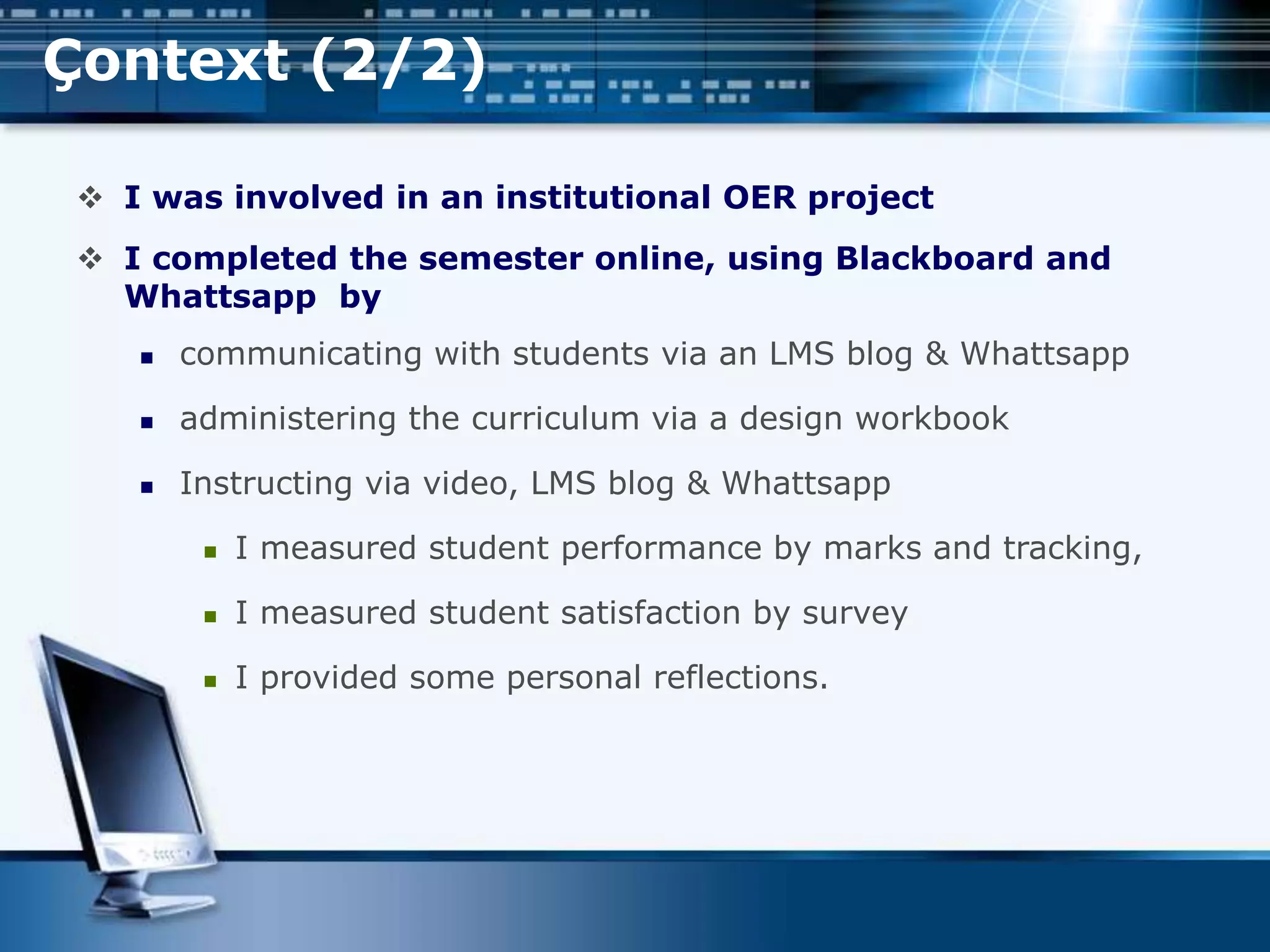
Çontext (2/2)
 I was involved in an institutional OER project
 I completed the semester online, using Blackboard and
Whattsapp by
 communicating with students via an LMS blog & Whattsapp
 administering the curriculum via a design workbook
 Instructing via video, LMS blog & Whattsapp
 I measured student performance by marks and tracking,
 I measured student satisfaction by survey
 I provided some personal reflections.
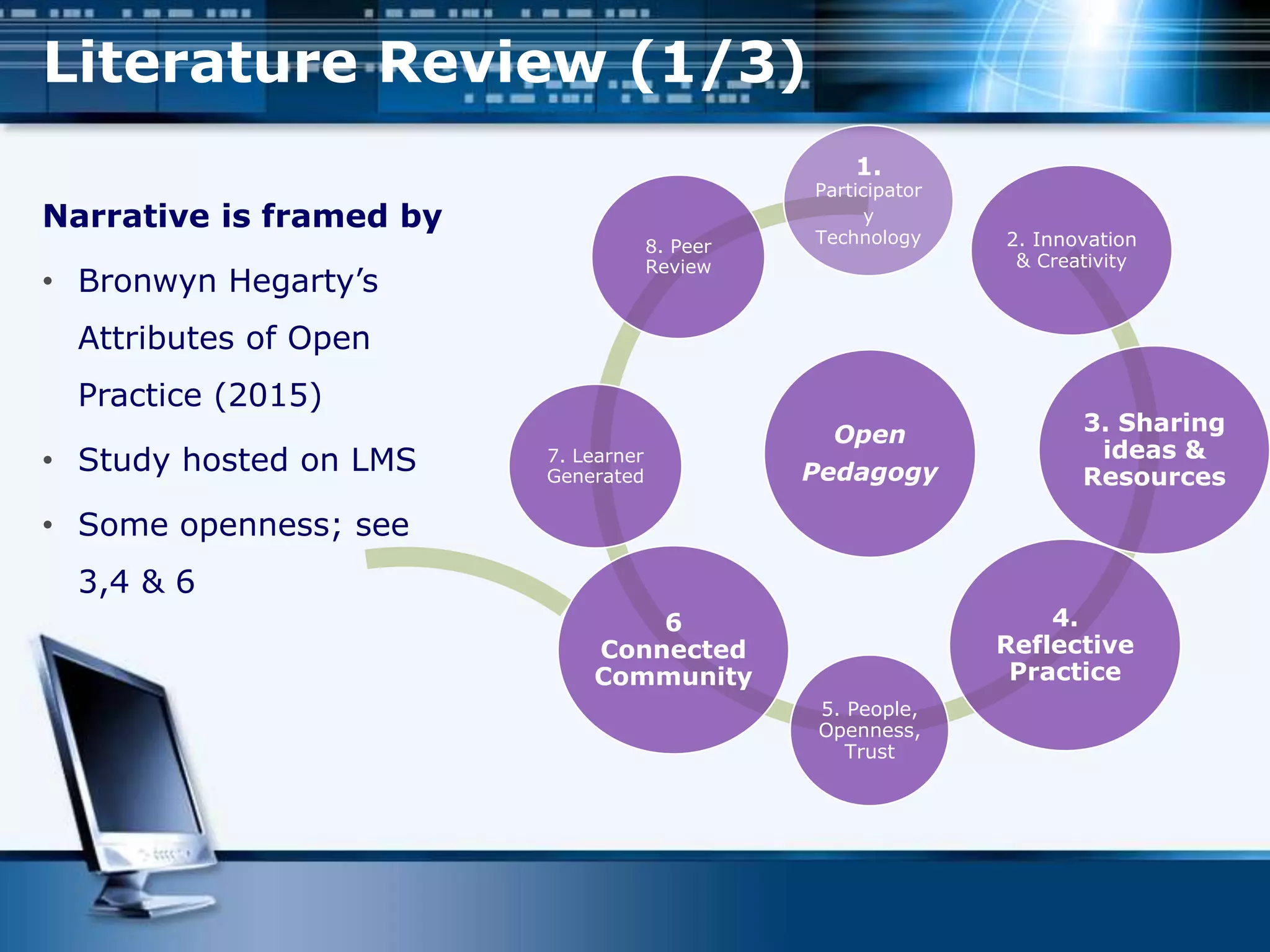
Open
Pedagogy
1.
Participator
y
Technology 2. Innovation
& Creativity
3. Sharing
ideas &
Resources
4.
Reflective
Practice
5. People,
Openness,
Trust
6
Connected
Community
7. Learner
Generated
8. Peer
Review
Narrative is framed by
• Bronwyn Hegarty’s
Attributes of Open
Practice (2015)
• Study hosted on LMS
• Some openness; see
3,4 & 6
Literature Review (1/3)
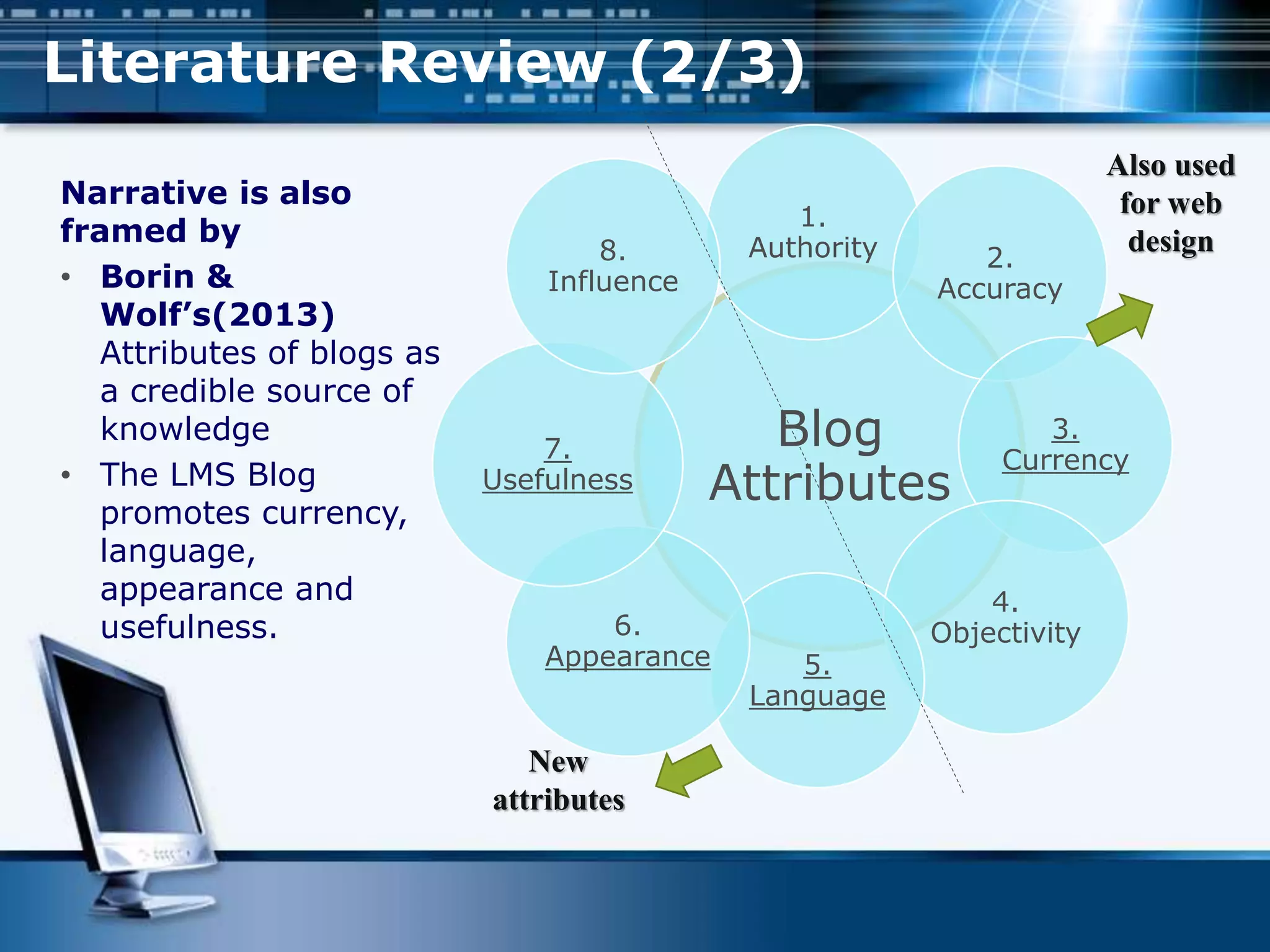
Narrative is also
framed by
• Borin &
Wolf’s(2013)
Attributes of blogs as
a credible source of
knowledge
• The LMS Blog
promotes currency,
language,
appearance and
usefulness.
Blog
Attributes
1.
Authority 2.
Accuracy
3.
Currency
4.
Objectivity
5.
Language
6.
Appearance
7.
Usefulness
8.
Influence
Also used
for web
design
New
attributes
Literature Review (2/3)
1. Instructional
design and delivery,
2. Assessment and
feedback/
instructor roles,
3. Student roles
and responsibilities
4. Management and
support systems
5. Levels of
Satisfaction
6. Benefits/
Drawbacks
7 Effectiveness 8. Access
9. Communication
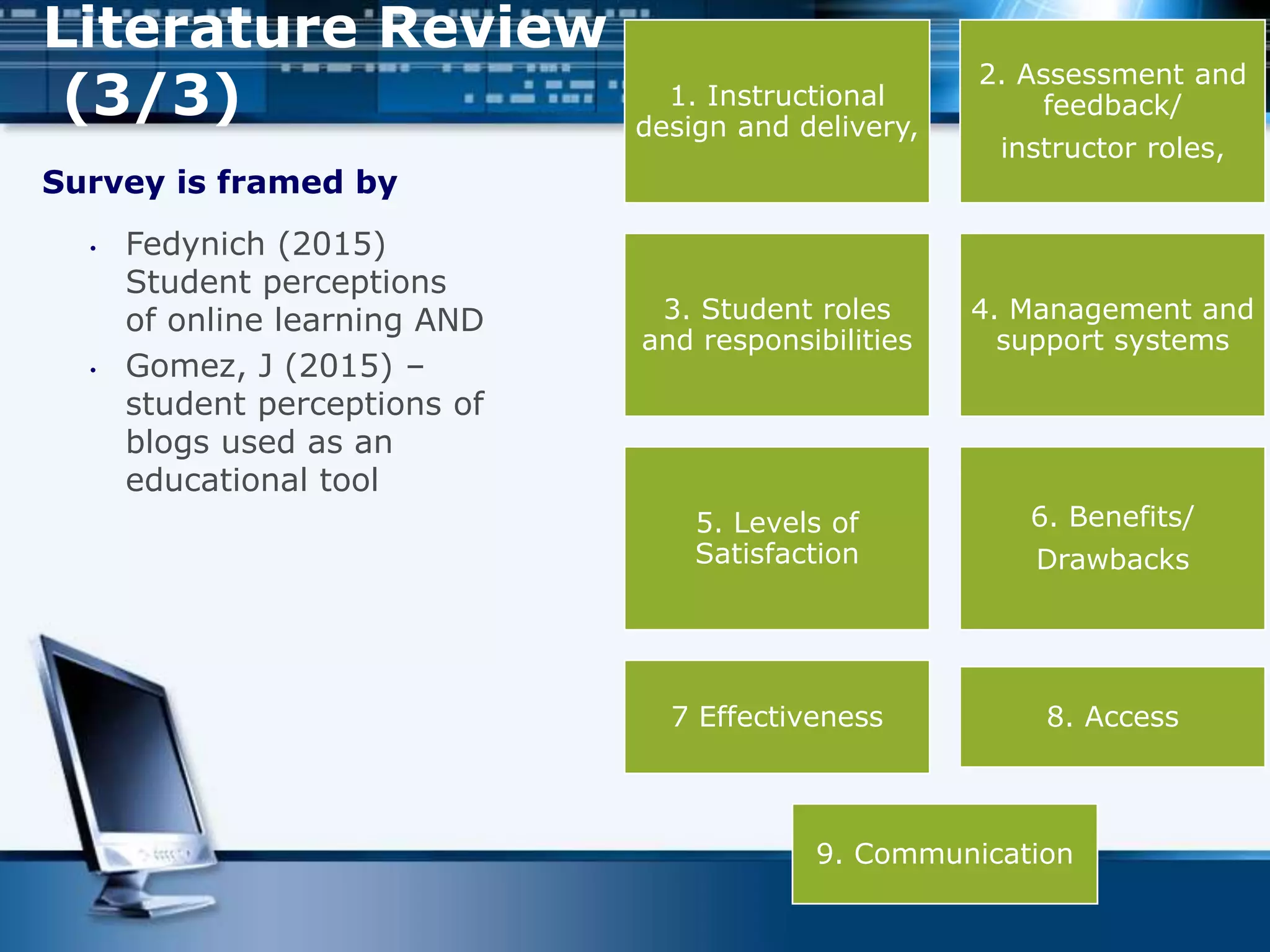
Survey is framed by
• Fedynich (2015)
Student perceptions
of online learning AND
• Gomez, J (2015) –
student perceptions of
blogs used as an
educational tool
Literature Review
(3/3)
Methodology
Quantitive
 Student Marks
 Student tracking
 Survey (levels of satisfaction)
Qualitative.
 Survey (thematic analysis)
 & self reflection
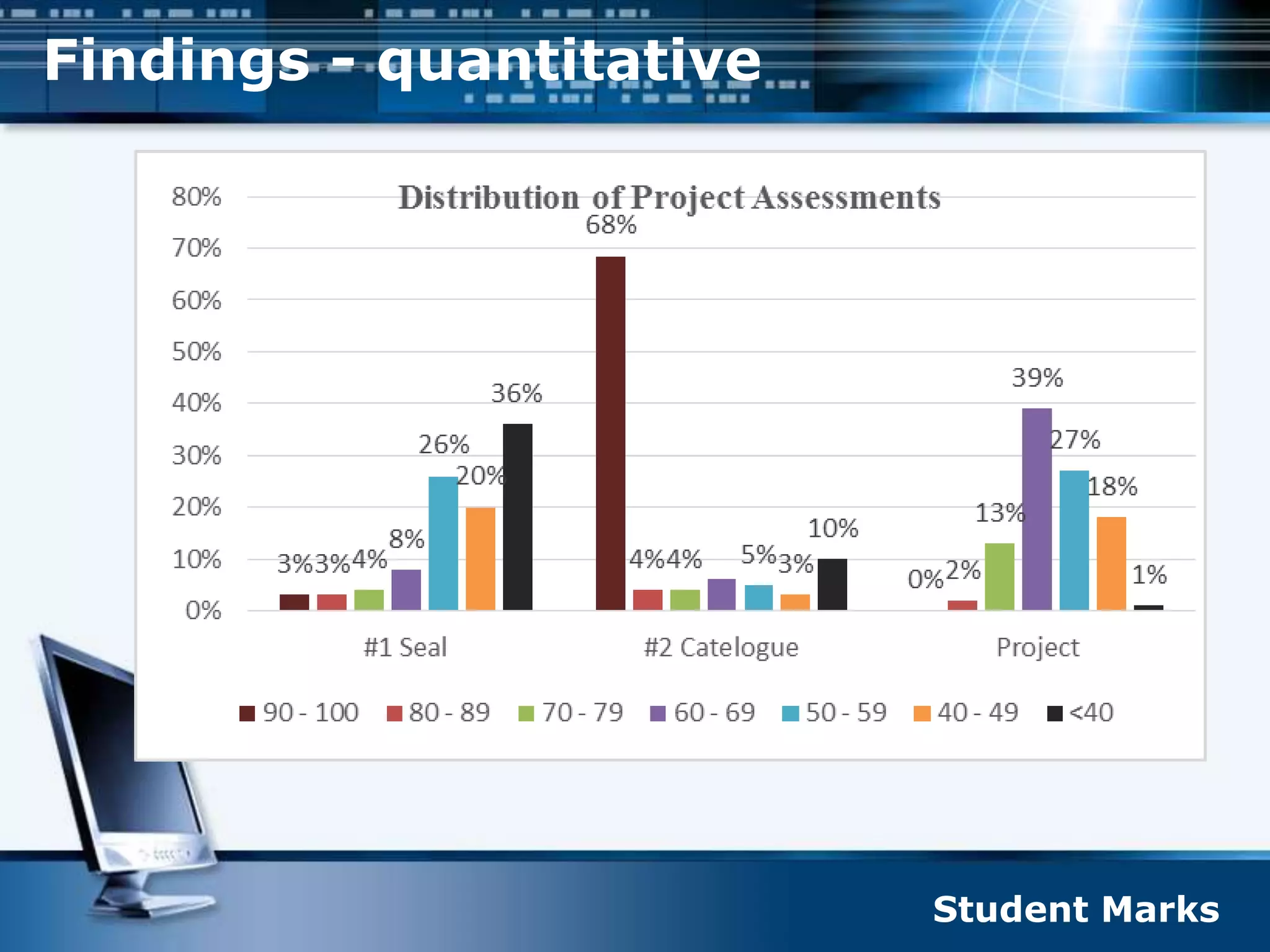
Findings - quantitative
Student Marks
Findings - quantitative
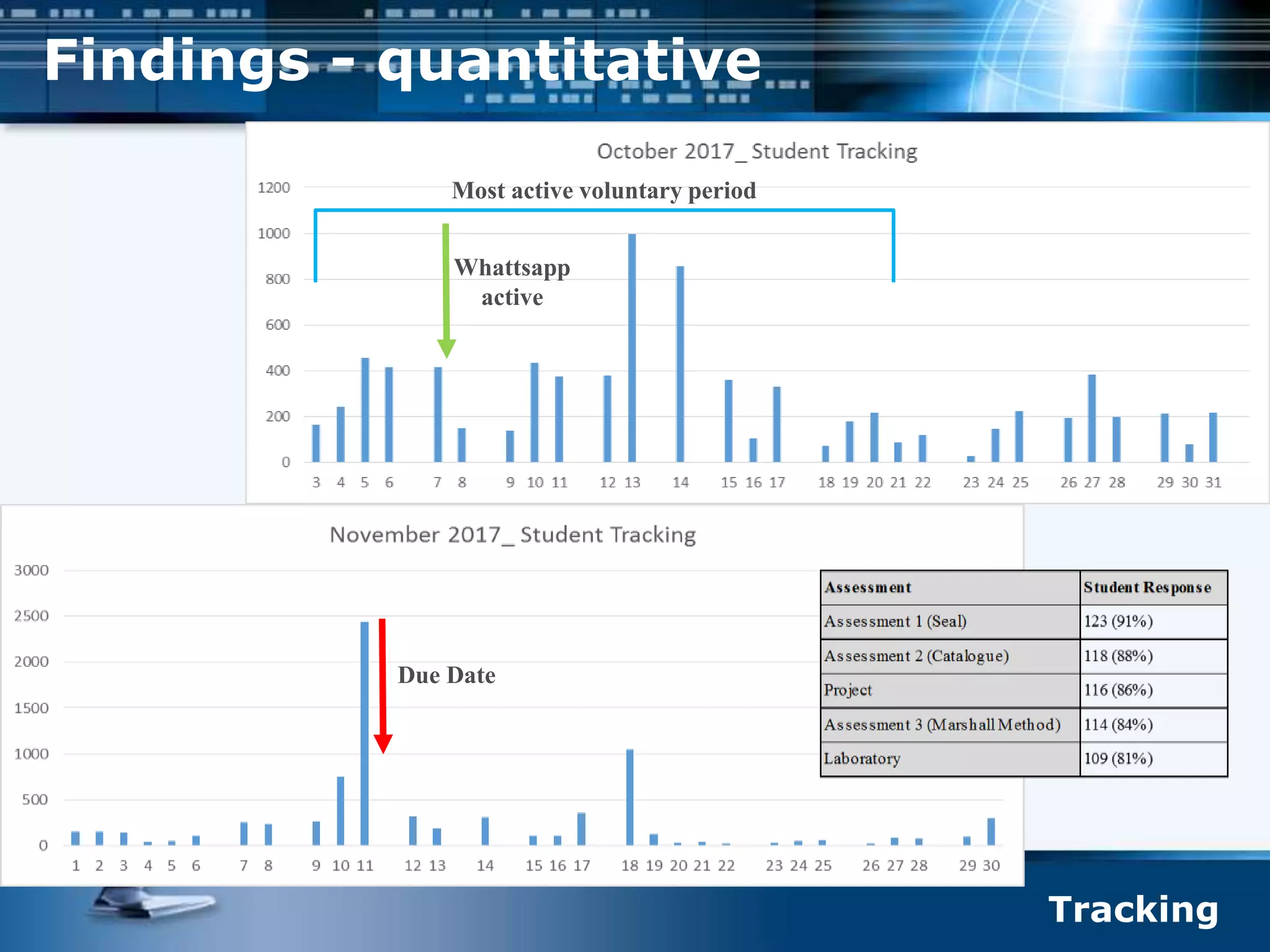
Tracking
Most active voluntary period
Due Date
Whattsapp
active
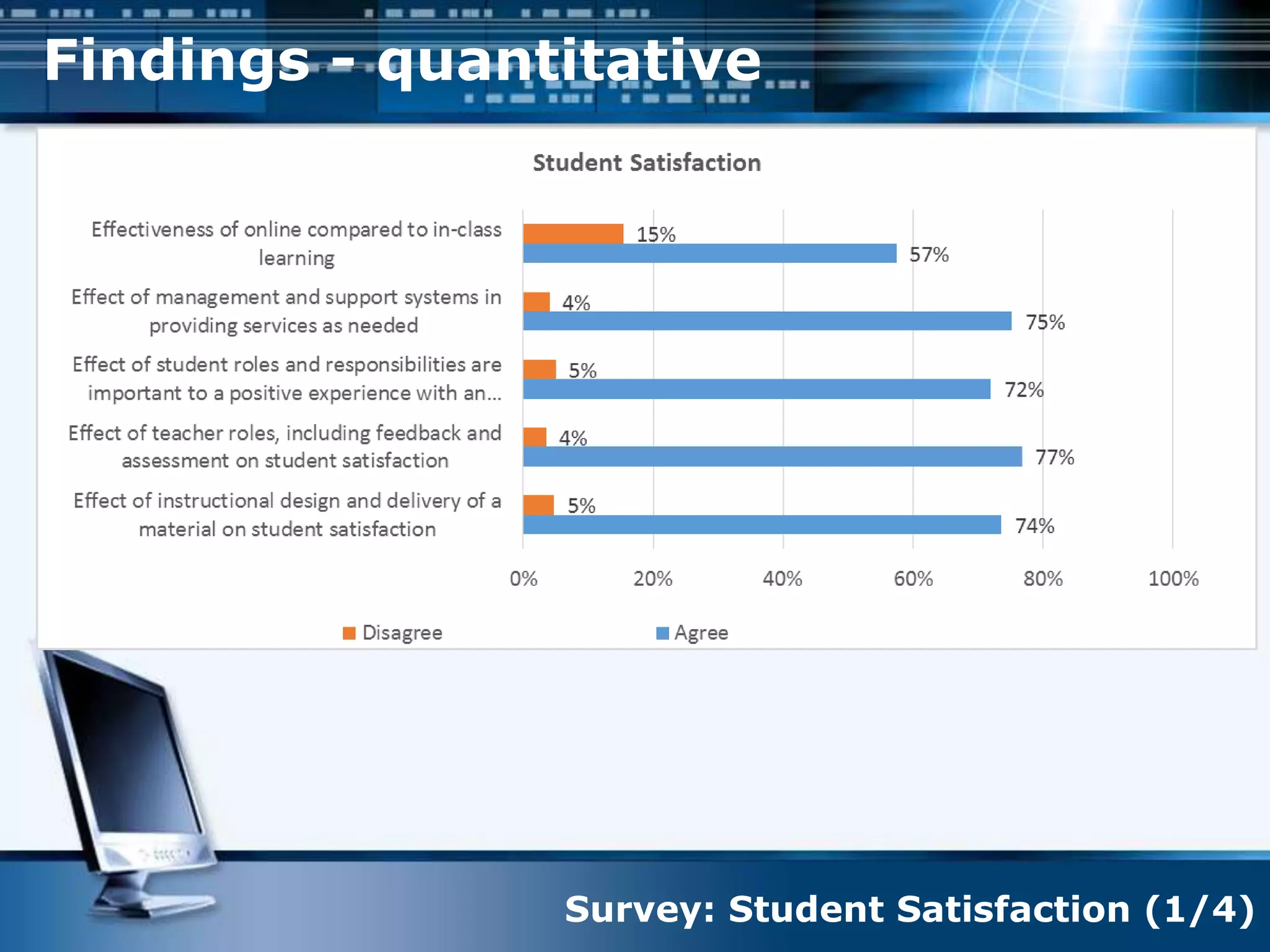
Survey: Student Satisfaction (1/4)
Findings - quantitative
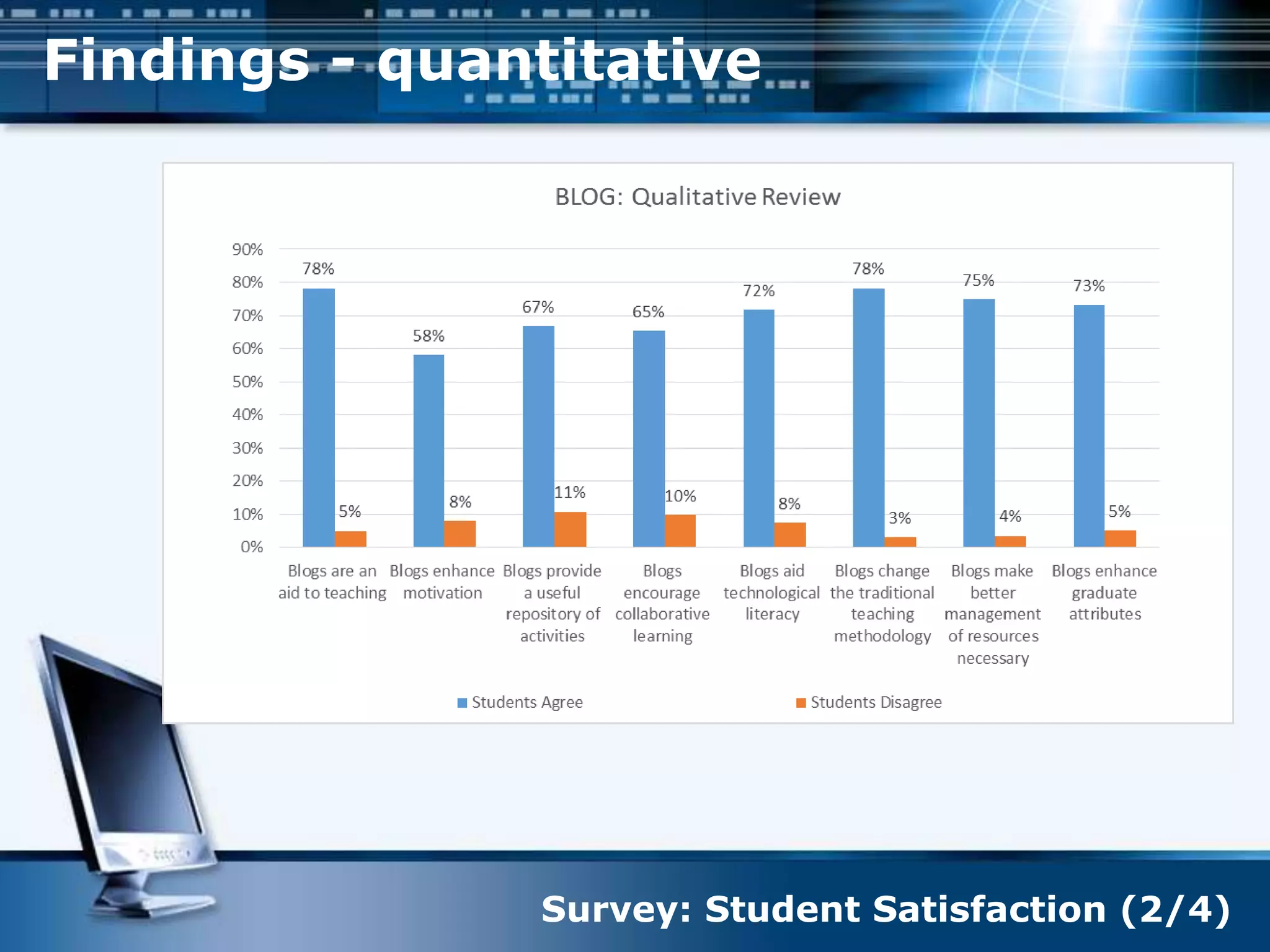
Survey: Student Satisfaction (2/4)
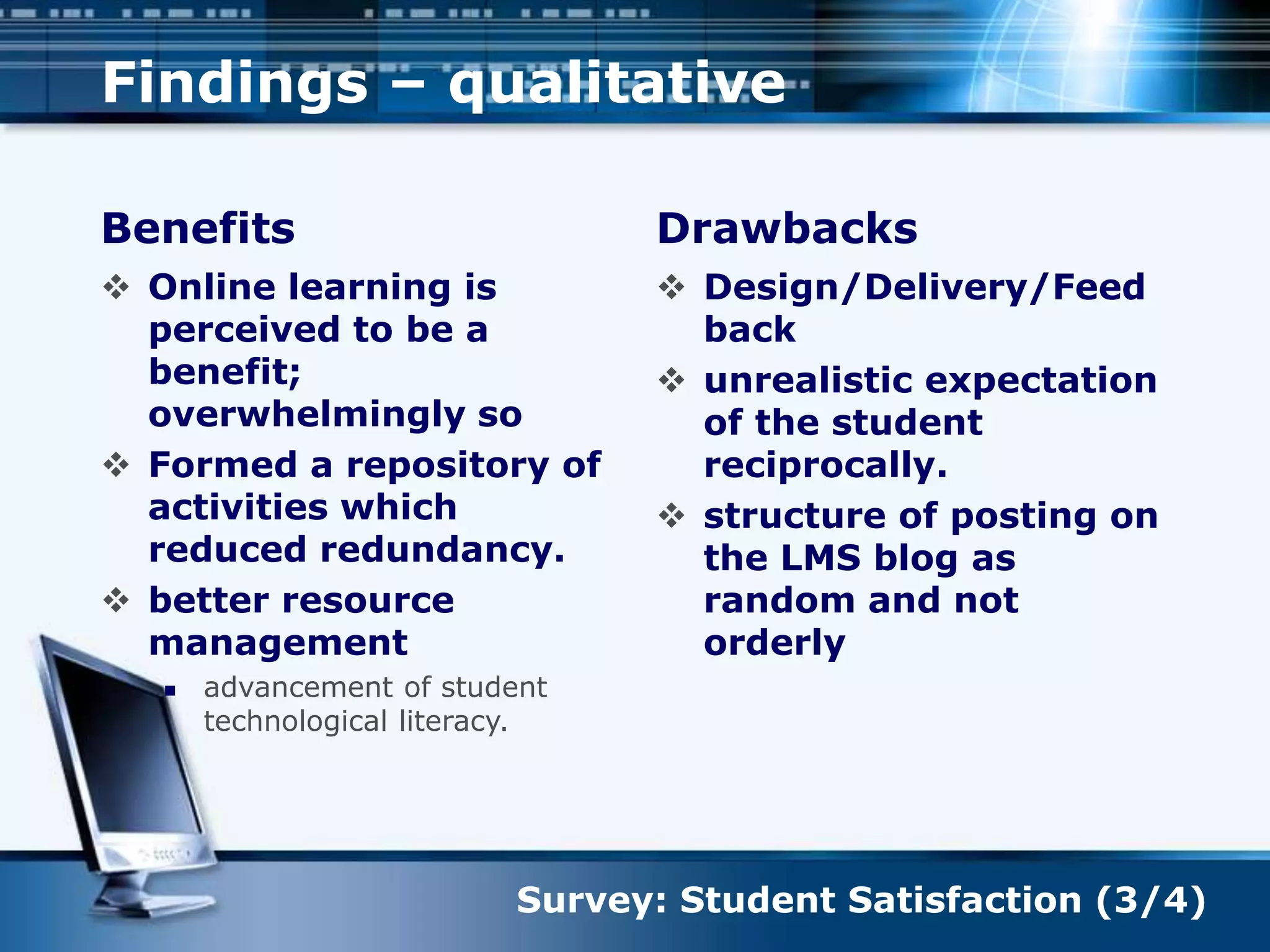
Findings – qualitative
Benefits
 Online learning is
perceived to be a
benefit;
overwhelmingly so
 Formed a repository of
activities which
reduced redundancy.
 better resource
management
 advancement of student
technological literacy.
Drawbacks
 Design/Delivery/Feed
back
 unrealistic expectation
of the student
reciprocally.
 structure of posting on
the LMS blog as
random and not
orderly
Survey: Student Satisfaction (3/4)
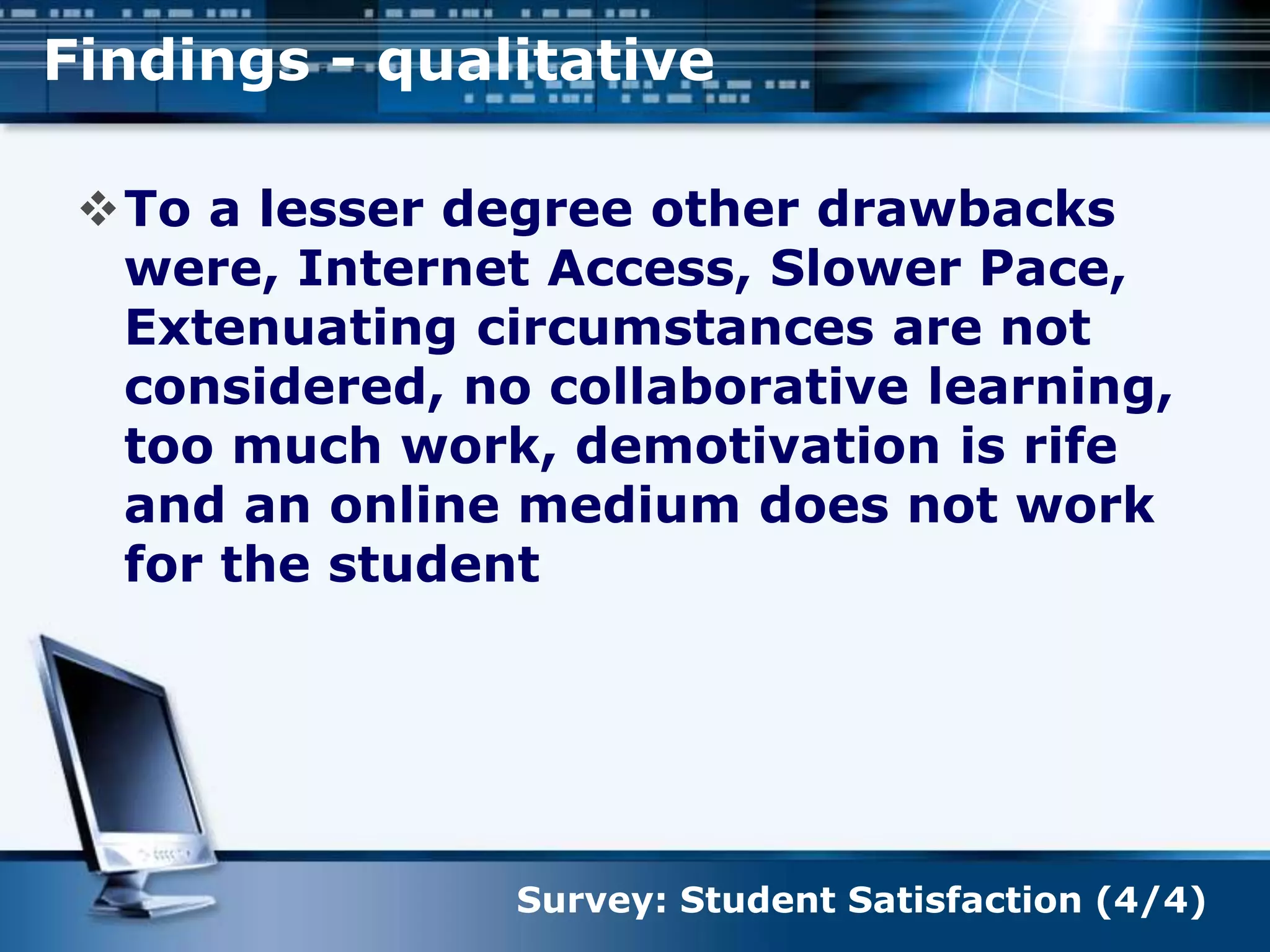
To a lesser degree other drawbacks
were, Internet Access, Slower Pace,
Extenuating circumstances are not
considered, no collaborative learning,
too much work, demotivation is rife
and an online medium does not work
for the student
Findings - qualitative
Survey: Student Satisfaction (4/4)
Findings - Qualitative
Student
 Can become active in
their own learning,
thus more
opportunities needed
 As a result, they are
more technologically
savvy
 Graduate attributes
enhanced
Instructor
 Common
misconceptions can be
addressed with clarity
in material – peer
review needed
 In some areas there is
a misalignment
between instruction,
practice and
assessment –
considered reflective
practice needed here
Authors Reflections
Conclusion
 Openness needs to increase (e.g. YouTube
platform, collaborative community)to be
recognised as a fully open pedagogy and to
become a credible source of knowledge
 a very high student response rate and
subsequent achievement is evidence of the
instructor’s role as being of vital importance
to the students’ performance
 Blogs favor educational settings as they
encourage active learning among
students and help establish communities
of learning
Conclusion
 Students favor clarity and organisation of
material and assessments supported by
online instruction
 Students contributions include refinement of
the open educational resources on more
accessible platforms It is interesting that
students should note the need for student
self-discipline.
Acknowledgements
I would like to thank all the
 students (2016) for completing the student
perceptions survey.
 The guidance of Dr Daniela Gachago, Cape
Peninsula University of Technology, who
provided insight and expertise that greatly
assisted the research.
 And thank the members of the CPUT OER
group who shared their pearls of wisdom with
me during the course of this research,

A narrative of open pedagogy using open educational resources

  • 1.
    LOGO Presented by Cheryl Belford CapePeninsula University of Technology A narrative of open pedagogy using open educational resources
  • 2.
    Çontext (1/2) October toDecember 2017 Student protests (#feesmustfall) resulted in institutional closure Learning was in contravention of #FMF Students expressed a desire for continued learning off Campus  Technological resources were limited
  • 3.
    Çontext (2/2)  Iwas involved in an institutional OER project  I completed the semester online, using Blackboard and Whattsapp by  communicating with students via an LMS blog & Whattsapp  administering the curriculum via a design workbook  Instructing via video, LMS blog & Whattsapp  I measured student performance by marks and tracking,  I measured student satisfaction by survey  I provided some personal reflections.
  • 4.
    Open Pedagogy 1. Participator y Technology 2. Innovation &Creativity 3. Sharing ideas & Resources 4. Reflective Practice 5. People, Openness, Trust 6 Connected Community 7. Learner Generated 8. Peer Review Narrative is framed by • Bronwyn Hegarty’s Attributes of Open Practice (2015) • Study hosted on LMS • Some openness; see 3,4 & 6 Literature Review (1/3)
  • 5.
    Narrative is also framedby • Borin & Wolf’s(2013) Attributes of blogs as a credible source of knowledge • The LMS Blog promotes currency, language, appearance and usefulness. Blog Attributes 1. Authority 2. Accuracy 3. Currency 4. Objectivity 5. Language 6. Appearance 7. Usefulness 8. Influence Also used for web design New attributes Literature Review (2/3)
  • 6.
    1. Instructional design anddelivery, 2. Assessment and feedback/ instructor roles, 3. Student roles and responsibilities 4. Management and support systems 5. Levels of Satisfaction 6. Benefits/ Drawbacks 7 Effectiveness 8. Access 9. Communication Survey is framed by • Fedynich (2015) Student perceptions of online learning AND • Gomez, J (2015) – student perceptions of blogs used as an educational tool Literature Review (3/3)
  • 7.
    Methodology Quantitive  Student Marks Student tracking  Survey (levels of satisfaction) Qualitative.  Survey (thematic analysis)  & self reflection
  • 8.
  • 9.
    Findings - quantitative Tracking Mostactive voluntary period Due Date Whattsapp active
  • 10.
    Survey: Student Satisfaction(1/4) Findings - quantitative
  • 11.
    Findings - quantitative Survey:Student Satisfaction (2/4)
  • 12.
    Findings – qualitative Benefits Online learning is perceived to be a benefit; overwhelmingly so  Formed a repository of activities which reduced redundancy.  better resource management  advancement of student technological literacy. Drawbacks  Design/Delivery/Feed back  unrealistic expectation of the student reciprocally.  structure of posting on the LMS blog as random and not orderly Survey: Student Satisfaction (3/4)
  • 13.
    To a lesserdegree other drawbacks were, Internet Access, Slower Pace, Extenuating circumstances are not considered, no collaborative learning, too much work, demotivation is rife and an online medium does not work for the student Findings - qualitative Survey: Student Satisfaction (4/4)
  • 14.
    Findings - Qualitative Student Can become active in their own learning, thus more opportunities needed  As a result, they are more technologically savvy  Graduate attributes enhanced Instructor  Common misconceptions can be addressed with clarity in material – peer review needed  In some areas there is a misalignment between instruction, practice and assessment – considered reflective practice needed here Authors Reflections
  • 15.
    Conclusion  Openness needsto increase (e.g. YouTube platform, collaborative community)to be recognised as a fully open pedagogy and to become a credible source of knowledge  a very high student response rate and subsequent achievement is evidence of the instructor’s role as being of vital importance to the students’ performance  Blogs favor educational settings as they encourage active learning among students and help establish communities of learning
  • 16.
    Conclusion  Students favorclarity and organisation of material and assessments supported by online instruction  Students contributions include refinement of the open educational resources on more accessible platforms It is interesting that students should note the need for student self-discipline.
  • 17.
    Acknowledgements I would liketo thank all the  students (2016) for completing the student perceptions survey.  The guidance of Dr Daniela Gachago, Cape Peninsula University of Technology, who provided insight and expertise that greatly assisted the research.  And thank the members of the CPUT OER group who shared their pearls of wisdom with me during the course of this research,

Editor's Notes

  • #5 The study was framed by Bronwyn Hegarty’s Attributes of Open Practice through the use of OERs. There were many attributes not fully met as my pedagogy was hosted on a Learner Management System. However there is some evidence of open practice despite LMS and #FMF; namely sharing of resources, reflective practice and connected community. Students used the open resources. They queried the material as they had access to the reference material in their course notes. In response Open material was reissued. My LMS blogging and Whattsapp presence coaxed students toward taking control of their own learning. It is in this context that there is evidence of some reflective practice demonstrated by reissuing of resources. There was some trust in the resources in that students used it but questioned it as they had access to its reference documents. Further openness was explored in that resources were adapted and circulated on Whattsapp. This demonstrates some connected community. The LMS platform restricts flexible licencing and there is little opportunity for innovation and peer review. This study did not allow for leaner generated material. In 2017 there OER will move to a YouTube platform where more open attributes should become evident.
  • #6 This Slide The LMS Blog promotes 4 attributes of open practice; those being Currency as it is possible to post regularly Language as it is easy to explain in a rational manner Appearance as the blog appears somewhat professional And Usefulness as it serves as a source for this narrative In 2017 the blog will be hosted on an external platform. It is more likely to reflect more attributes of open pedagogy such as more identifiable users with credentials, references to other credible blogs and maybe even opposing viewpoints
  • #7 Student opinion is one of the ways to inform myself of the quality of this online experience. The guidance provided by Fedynich (2015) and Gomez (2015) helped to construct a student satisfaction survey which addressed 9 topic areas, namely Instructional design and delivery, 2. Assessment and feedback/instructor roles, 3. Student roles and responsibilities, 4. Management and support systems, 5. Levels of Satisfaction, 6. Benefits/, Drawbacks, 7 Effectiveness , 8. Access and 9. Communication. The survey was constructed using Likert Scale with 8 of 9 areas analysed quantatively. Benefits and Drawbacks were thematically analysed for qualitative purposes
  • #8 The study is designed on 5 outputs. The quantitative analysis is informed by Student marks during #FMF. student tracking is presented to indicate the patterns of activity during #FMF. Data from the survey is presented per Likert Scale in 8 of the 9 topic areas. Findings will range from satisfactory to non satisfactory. The qualitative analysis is fed by 2 sets of data. The first is the thematic analysis of the benefits and drawbacks as measured in the survey. Also I provide some reflections throughout the study.
  • #9 Student achievement reflects a varied success rate per assessment type. In Assessment #1, the most common result is indicated as students who did not complete the assessment successfully. It can be interpreted as many students being unable to execute the correct process quite early on in the calculation thus generating the incorrect recommendation. This section of work had been taught extensively in class and a limited OER was offered with one BB assessment. It is significantly that more than 40% of students were successful in this assessment with about 10% achieving well. One could conclude that the face to face class offering was effective to some degree. It could have also been that many students started late with their revision of Assessment 1 content and missed out upon the class conversations which would have supplemented a higher achievement. Conversely Assessment 2 indicates a high number (60%) of students achieving success. This result could be attributed to significant communication on the blog and a second attempt on Blackboard which reinforced the learning objective.. The project assessed the students understanding of design calculations whereby all of the design information is placed in the design brief with no particular grouping of the information toward either design calculation #1 or #2. In reality, students would be presented with all design information in one context, whereby they would have to sift through and group the relevant information to the specific design, namely design calculation #1 or #2, hence the reference to a mixed context in the Project. Students were required demonstrate their ability in their application of this assessment; directly acquiring the learning objectives with a measurable outcome. The distribution of the project is most similar to assessment #1, somewhat boosted by the higher competence of assessment #2. Much of the errors of assessment #1 were carried over into the project. Students can with ease demonstrate recall and relevant knowledge to a specific context as seen by the high pass rate. There is a limit of higher levels of success; attributed to limited demonstration of selective recall of subject knowledge for a particular context out of many possible contexts, application of unfamiliar problems and critical analysis taking into account the subject knowledge and procedures. Although feedback was provided to the students individually and holistically, the final test performance reflected similarly as this graphic TO FINDINGS The instructor could address these latter challenges with multiple examples of assessment #1 (more OER) and more exposure toward the merged context of the project. It is very important that comprehensive feedback be given adequately ahead of the final test to address any challenges in the student’s understanding here and that the instructor encourage discussion thereon online and not wait for prompting by the student.
  • #10 During the 3 months of #FMF, October and November were the more active months. October indicates the most activity in the first 3 weeks. This can be attributed to use of Whattsapp. This level of activity is supported by activity on the LMS Blog. After this 3 week period there was few new questions on the LMS Blog, and it functioned as a repository. Predictably there was a spike in run up to the due date. However a larger number of students had submitted consistently over the month of October that near the due date in mid November. Collectively during #FMF the student response rate was in excess of 80% for all assessments. The OER material in this context was PowerPoint videos. This lent well to a pdf copy with a supporting audio clip which was circulated on whattsapp. The student then only needed to upload their work, thereby limiting their data consumption. SADLY the survey was already active thus the Whattsapp intervention could not be measured. However the tracking intervention did influence the early response by students.
  • #11 An initial sluggish response to the survey motivated an addition of 0.5% toward their final grade. The following observations are made from the survey…. Students were satisfied in all areas however as much as 15% of respondents indicated that online learning as opposed to in class learning was not effective. In slightly more detail these respondents did not find online learning convenient, easily communicative, offering an increased sense of community and promoting student participation. It is my opinion that although Whattsapp was an effective communication tool, the online material is not best viewed on a cellphone, computers/laptops are still preferred for enhanced viewing AND there are students who need the reassurance of face to face learning to perform.
  • #12 It is significant to note that 15 to 20% of respondents disagreed that online learning as opposed to meeting regularly in a class room setting did not offers convenience 18% disagree meets individual learning needs. 20% disagree offers increased sense of community with the instructor and fellow students. 16% disagree promotes greater student participation and interaction 14% disagree