Chapter 11 Review Clickers
The Cosmic Perspective
Seventh Edition
© 2014 Pearson Education, Inc.
Jovian Planet
Systems
Chapter 11
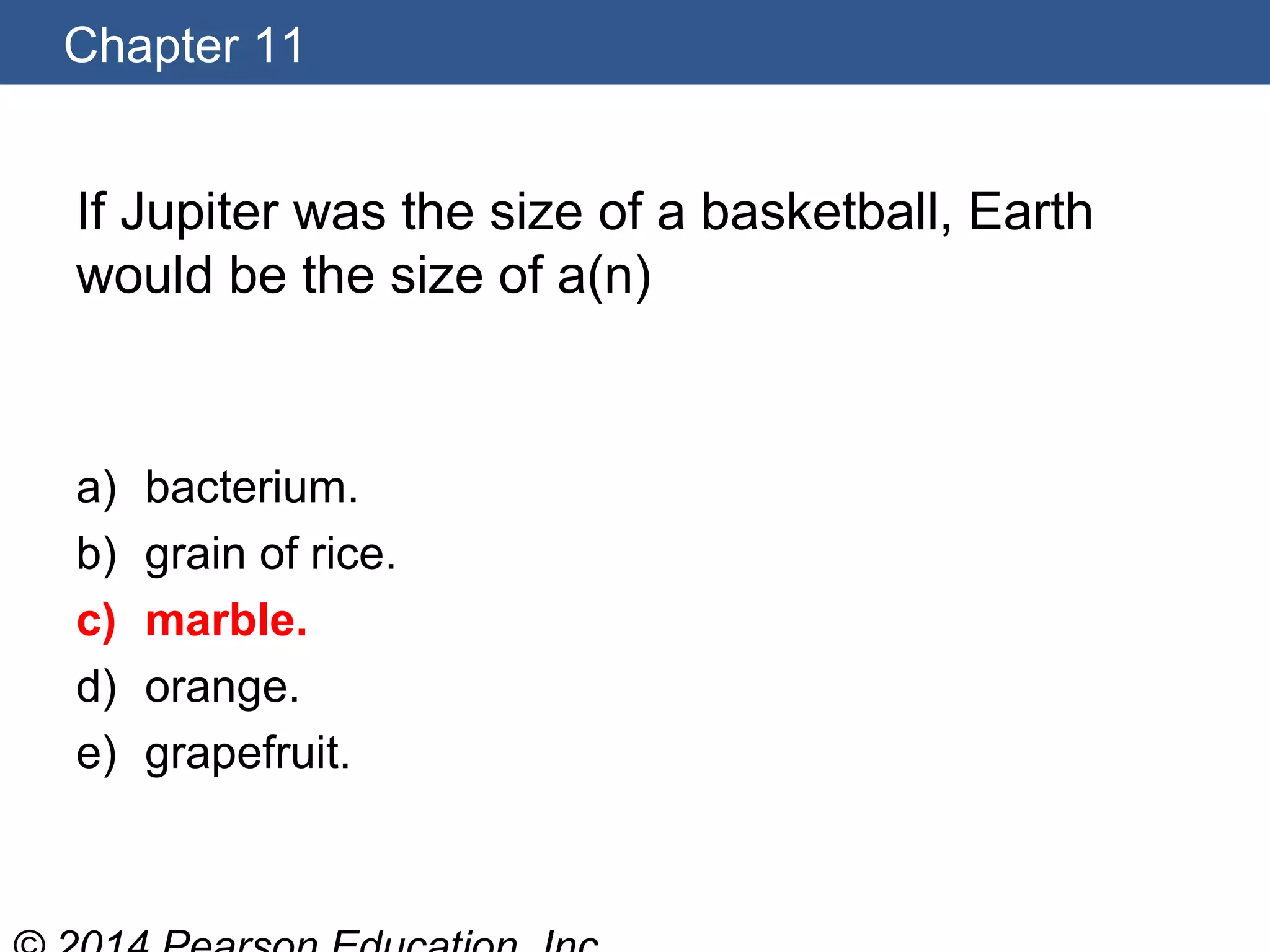
If Jupiter was the size of a basketball, Earth
would be the size of a(n)
a) bacterium.
b) grain of rice.
c) marble.
d) orange.
e) grapefruit.
Chapter 11
If Jupiter was the size of a basketball, Earth
would be the size of a(n)
a) bacterium.
b) grain of rice.
c) marble.
d) orange.
e) grapefruit.
Chapter 11
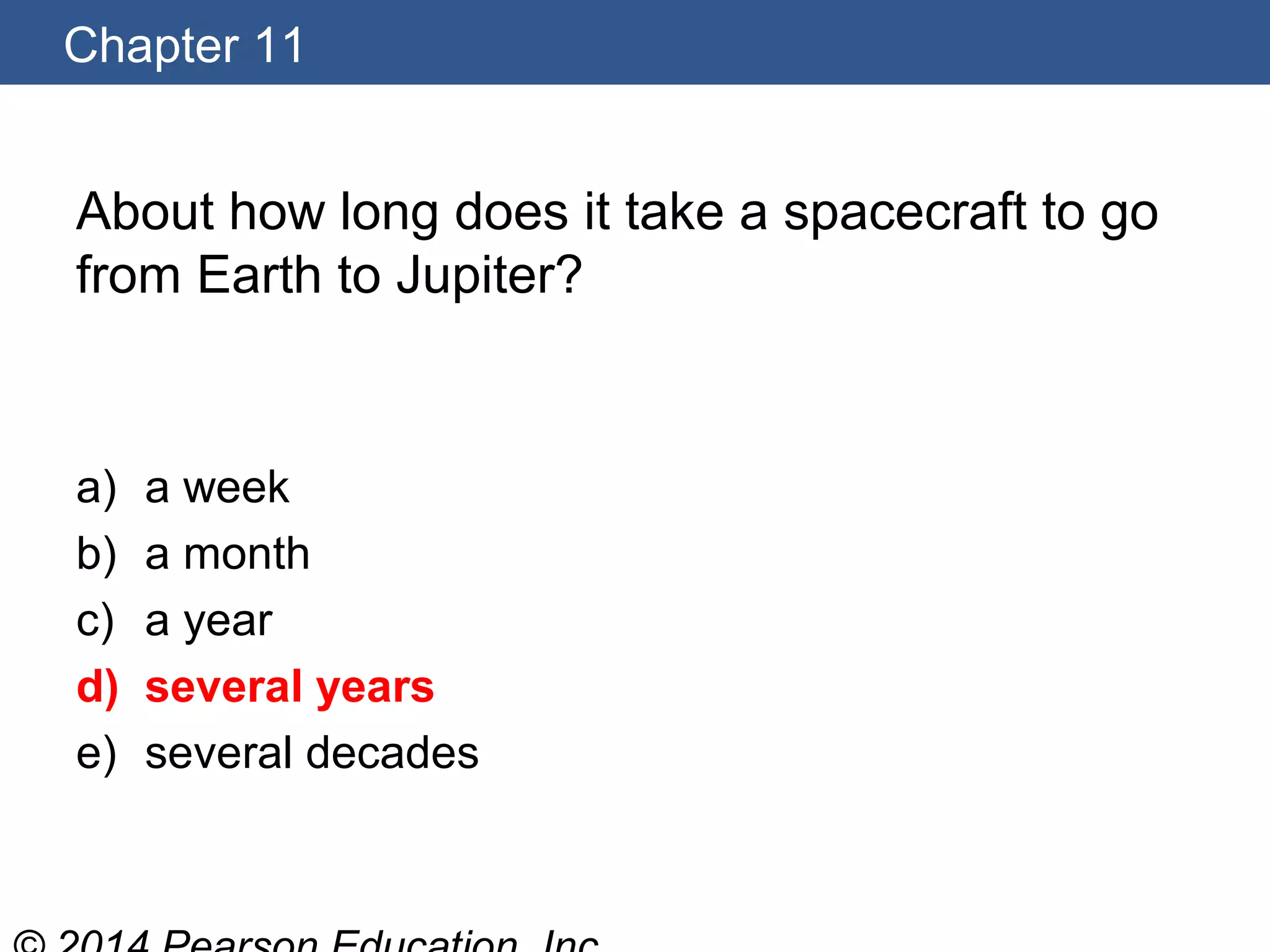
About how long does it take a spacecraft to go
from Earth to Jupiter?
a) a week
b) a month
c) a year
d) several years
e) several decades
Chapter 11
About how long does it take a spacecraft to go
from Earth to Jupiter?
a) a week
b) a month
c) a year
d) several years
e) several decades
Chapter 11
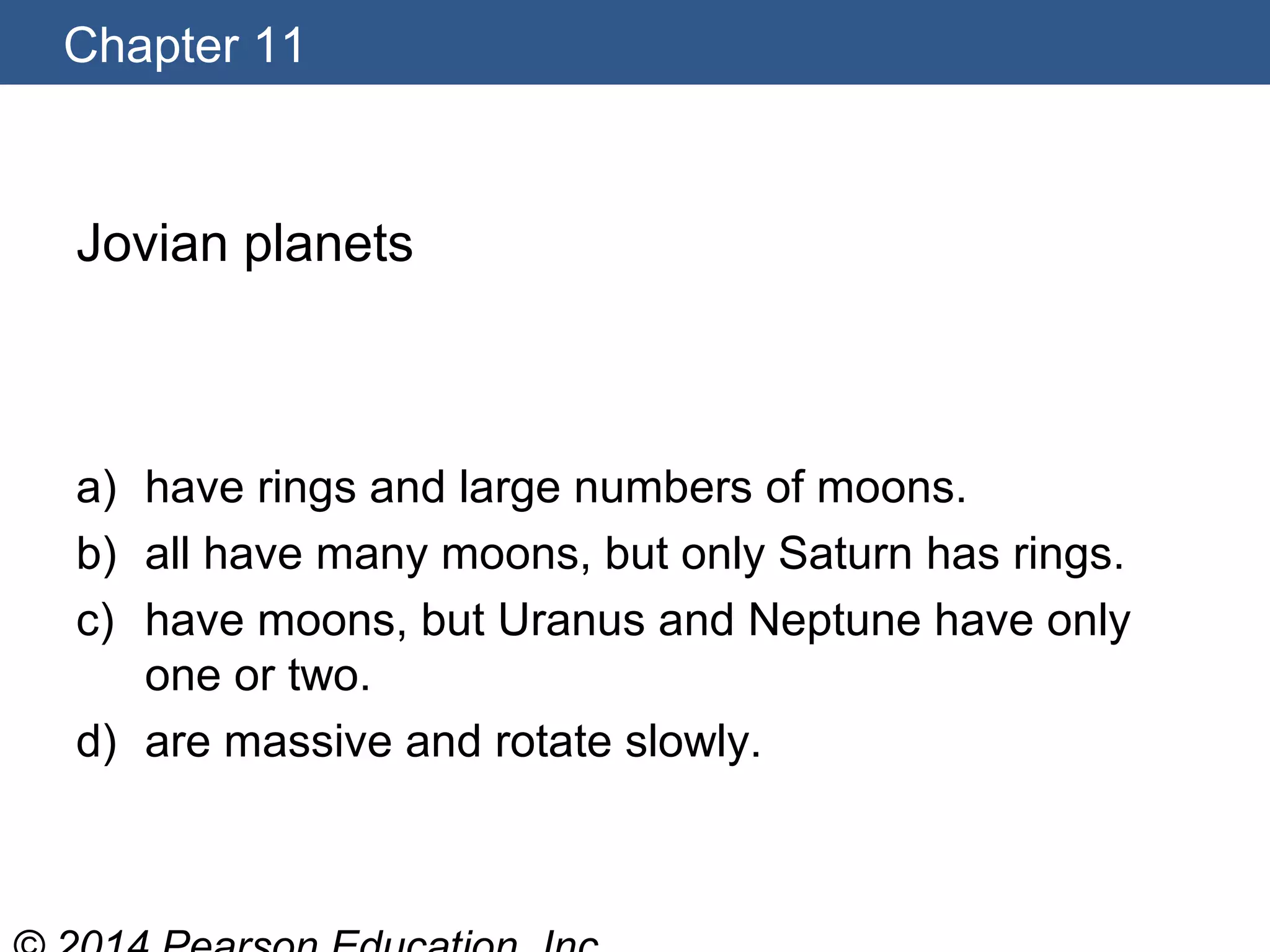
Jovian planets
a) have rings and large numbers of moons.
b) all have many moons, but only Saturn has rings.
c) have moons, but Uranus and Neptune have only
one or two.
d) are massive and rotate slowly.
Chapter 11
Jovian planets
a) have rings and large numbers of moons.
b) all have many moons, but only Saturn has rings.
c) have moons, but Uranus and Neptune have only
one or two.
d) are massive and rotate slowly.
Chapter 11
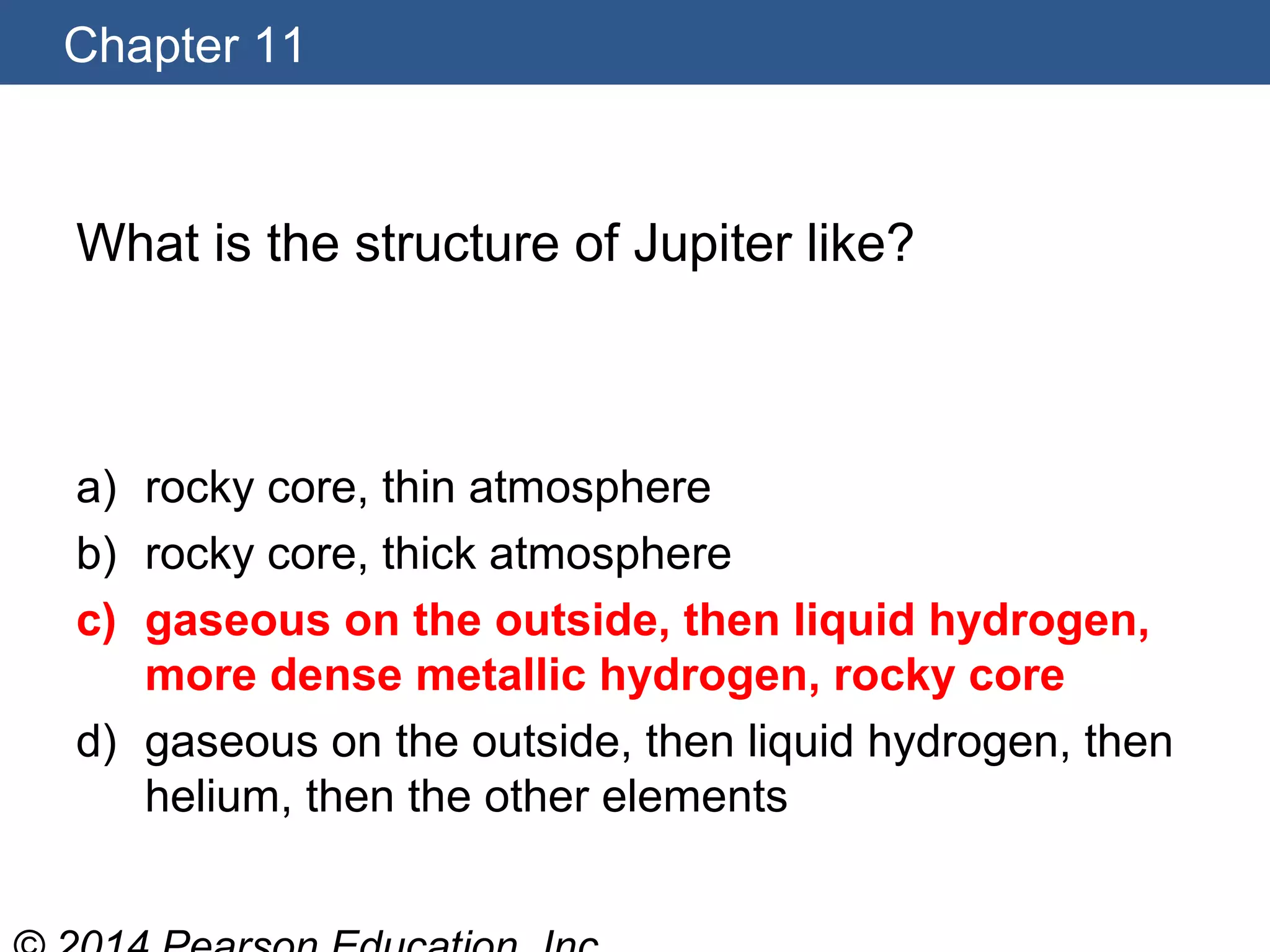
What is the structure of Jupiter like?
a) rocky core, thin atmosphere
b) rocky core, thick atmosphere
c) gaseous on the outside, then liquid hydrogen, more
dense metallic hydrogen, rocky core
d) gaseous on the outside, then liquid hydrogen, then
helium, then the other elements
Chapter 11
What is the structure of Jupiter like?
a) rocky core, thin atmosphere
b) rocky core, thick atmosphere
c) gaseous on the outside, then liquid hydrogen,
more dense metallic hydrogen, rocky core
d) gaseous on the outside, then liquid hydrogen, then
helium, then the other elements
Chapter 11
What are the most common elements in the
atmospheres of the jovian planets?
a) water
b) hydrogen and helium
c) oxygen and nitrogen
d) oxygen and carbon
e) none of the above
Chapter 11
What are the most common elements in the
atmospheres of the jovian planets?
a) water
b) hydrogen and helium
c) oxygen and nitrogen
d) oxygen and carbon
e) none of the above
Chapter 11
What are the most common hydrogen
compounds in the atmospheres of the
jovian planets?
a) water (H2O), methane (CH4), ammonia (NH3)
b) water and carbon dioxide (CO2)
c) water and carbon monoxide (CO)
d) sulfur dioxide (SO2) and propane (C3H8)
e) none of the above
Chapter 11
What are the most common hydrogen
compounds in the atmospheres of the
jovian planets?
a) water (H2O), methane (CH4), ammonia (NH3)
b) water and carbon dioxide (CO2)
c) water and carbon monoxide (CO)
d) sulfur dioxide (SO2) and propane (C3H8)
e) none of the above
Chapter 11
Since there are a lot of flammable gases on
Jupiter, such as methane and propane,
if you lit a match, would Jupiter burn?
a) yes
b) no
Chapter 11
Since there are a lot of flammable gases on
Jupiter, such as methane and propane,
if you lit a match, would Jupiter burn?
a) yes
b) no
Chapter 11
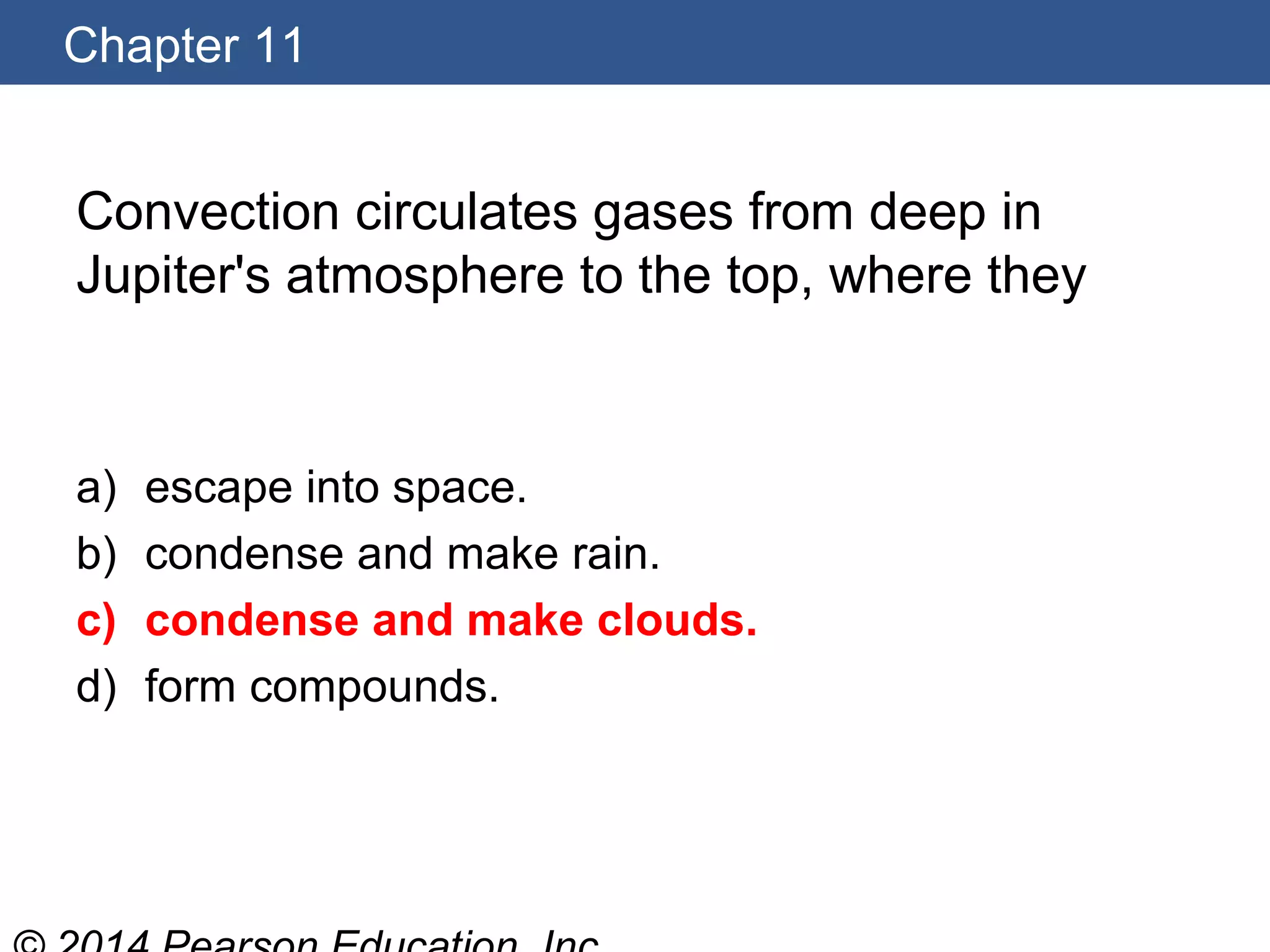
Convection circulates gases from deep in
Jupiter's atmosphere to the top, where they
a) escape into space.
b) condense and make rain.
c) condense and make clouds.
d) form compounds.
Chapter 11
Convection circulates gases from deep in
Jupiter's atmosphere to the top, where they
a) escape into space.
b) condense and make rain.
c) condense and make clouds.
d) form compounds.
Chapter 11
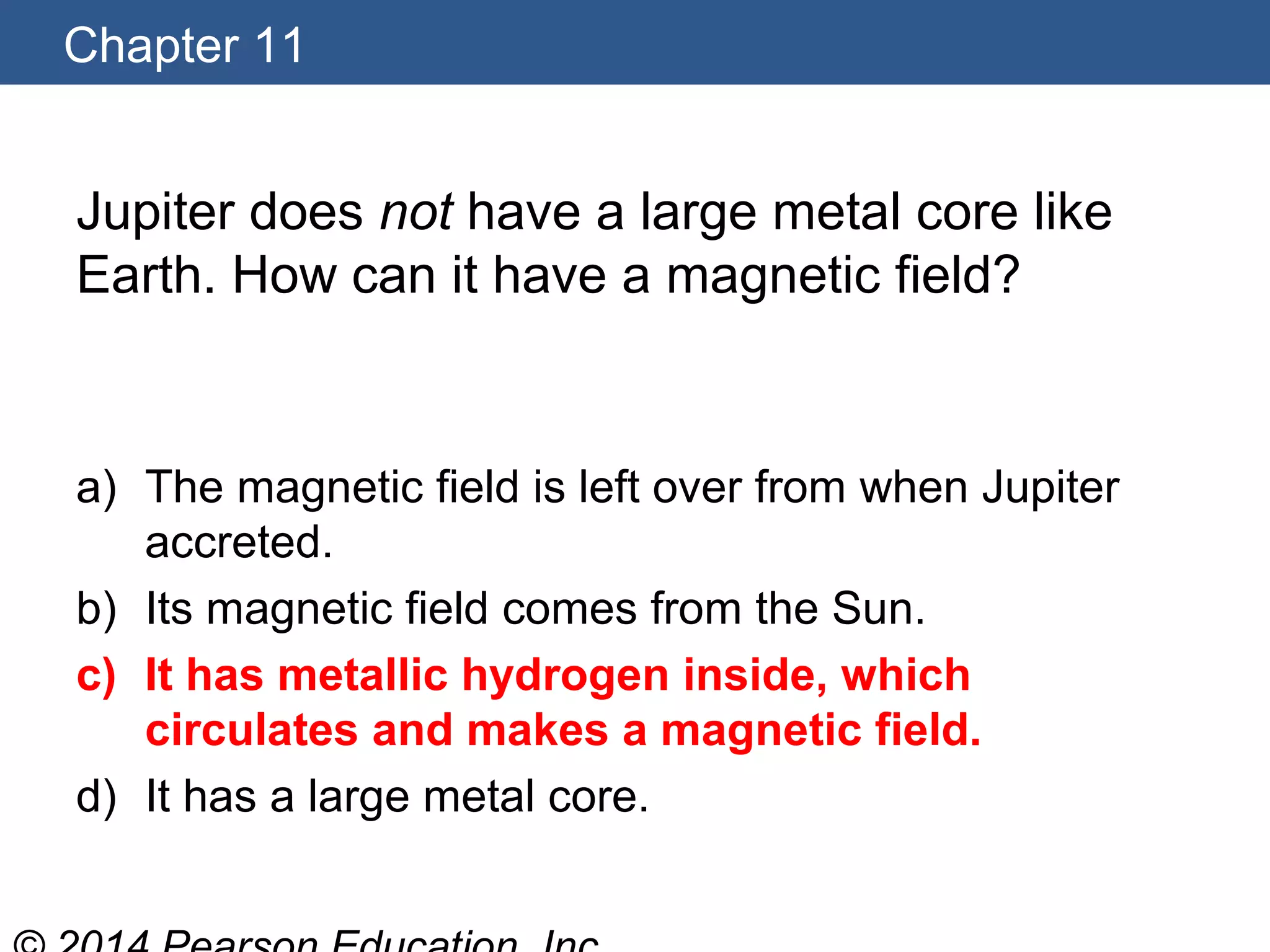
Jupiter does not have a large metal core like
Earth. How can it have a magnetic field?
a) The magnetic field is left over from when Jupiter
accreted.
b) Its magnetic field comes from the Sun.
c) It has metallic hydrogen inside, which circulates
and makes a magnetic field.
d) It has a large metal core.
Chapter 11
Jupiter does not have a large metal core like
Earth. How can it have a magnetic field?
a) The magnetic field is left over from when Jupiter
accreted.
b) Its magnetic field comes from the Sun.
c) It has metallic hydrogen inside, which
circulates and makes a magnetic field.
d) It has a large metal core.
Chapter 11
Auroras
a) are found on Earth.
b) are found on Jupiter.
c) indicate the presence of a magnetic field.
d) occur when particles in the solar wind hit a planet.
e) all of the above
Chapter 11
Auroras
a) are found on Earth.
b) are found on Jupiter.
c) indicate the presence of a magnetic field.
d) occur when particles in the solar wind hit a planet.
e) all of the above
Chapter 11
What's the weather usually like on Jupiter?
a) high speed, low density clouds
b) low speed, high density clouds
c) winds of hundreds of miles per hour, thick clouds
d) clear and very cold
Chapter 11
What's the weather usually like on Jupiter?
a) high speed, low density clouds
b) low speed, high density clouds
c) winds of hundreds of miles per hour, thick clouds
d) clear and very cold
Chapter 11
Jupiter is about three times as massive as
Saturn, but only slightly larger. Why?
a) It is made of denser material.
b) It is made of less dense material.
c) Adding mass increases gravity and compresses
gasses.
d) They are made of different gasses.
e) none of the above
Chapter 11
Jupiter is about three times as massive as
Saturn, but only slightly larger. Why?
a) It is made of denser material.
b) It is made of less dense material.
c) Adding mass increases gravity and
compresses gasses.
d) They are made of different gasses.
e) none of the above
Chapter 11
Looking at a Jovian planet in different
wavelengths of light allows us to
a) see different kinds of clouds.
b) see to different depths in the atmosphere.
c) see layers of different temperatures.
d) all of the above
e) A and B
Chapter 11
Looking at a Jovian planet in different
wavelengths of light allows us to
a) see different kinds of clouds.
b) see to different depths in the atmosphere.
c) see layers of different temperatures.
d) all of the above
e) A and B
Chapter 11
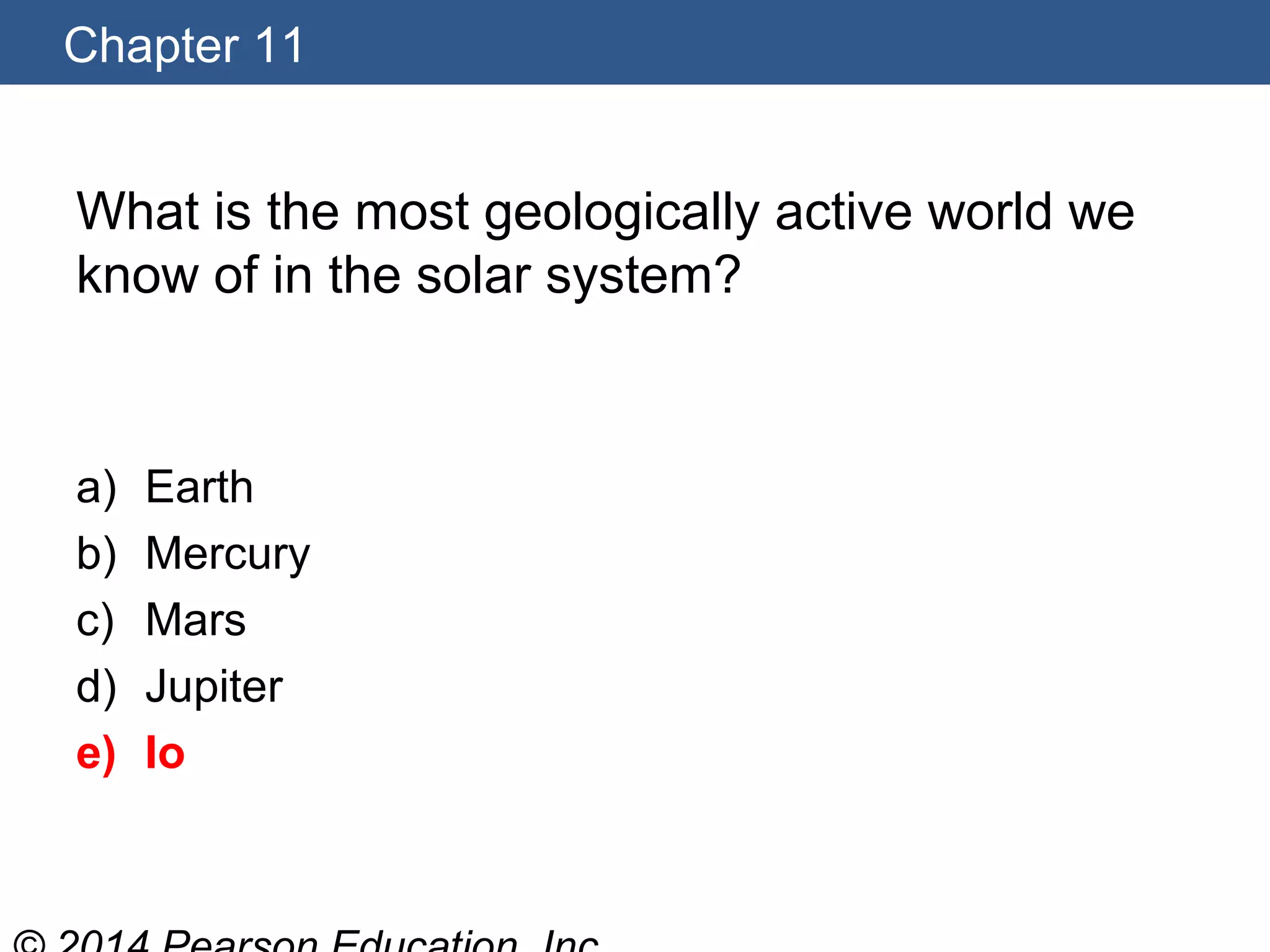
What is the most geologically active world we
know of in the solar system?
a) Earth
b) Mercury
c) Mars
d) Jupiter
e) Io
Chapter 11
What is the most geologically active world we
know of in the solar system?
a) Earth
b) Mercury
c) Mars
d) Jupiter
e) Io
Chapter 11
How does Io get heated by Jupiter?
a) auroras
b) ultraviolet radiation
c) infrared radiation
d) tidal heating
Chapter 11
How does Io get heated by Jupiter?
a) auroras
b) ultraviolet radiation
c) infrared radiation
d) tidal heating
Chapter 11
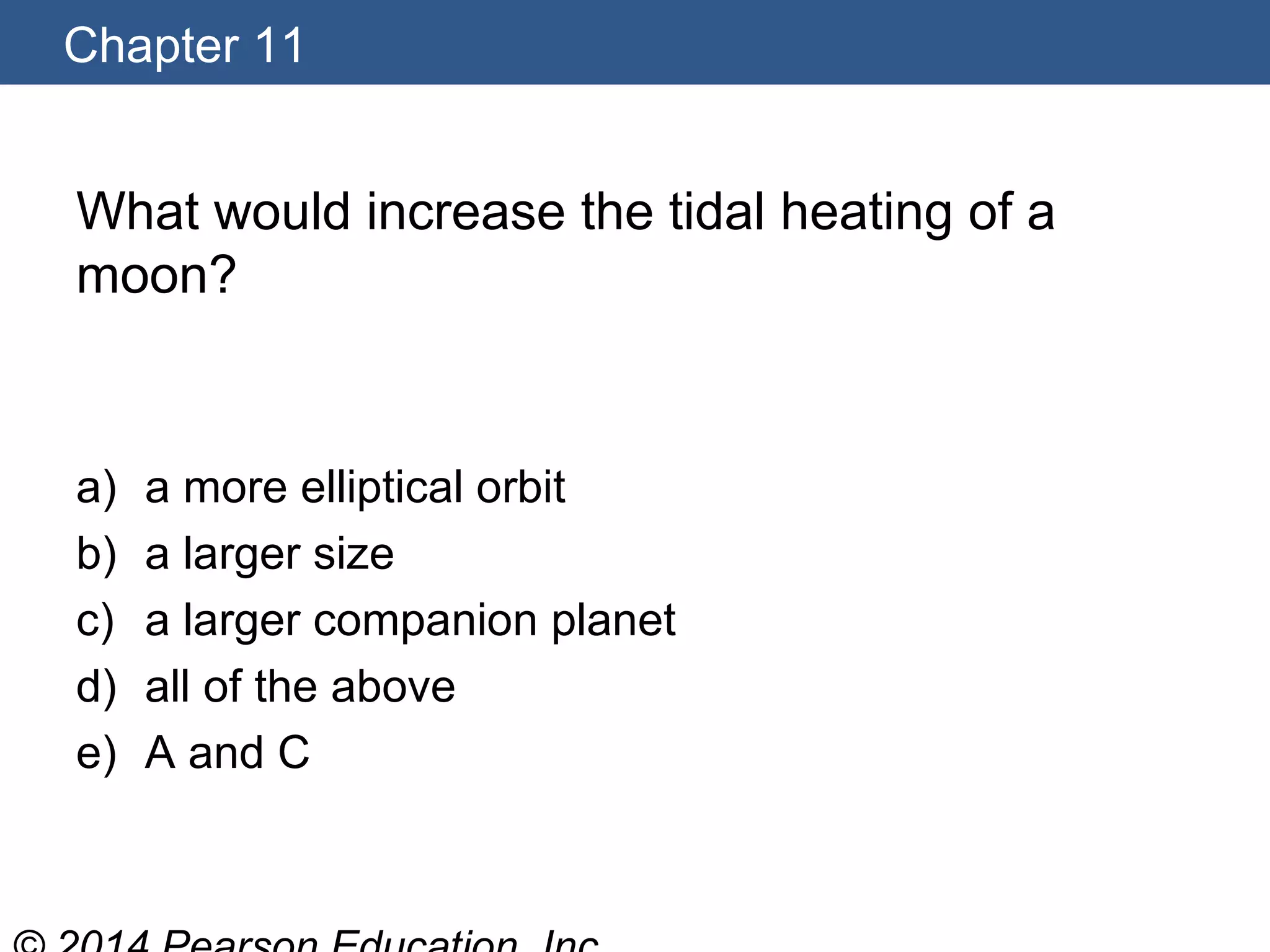
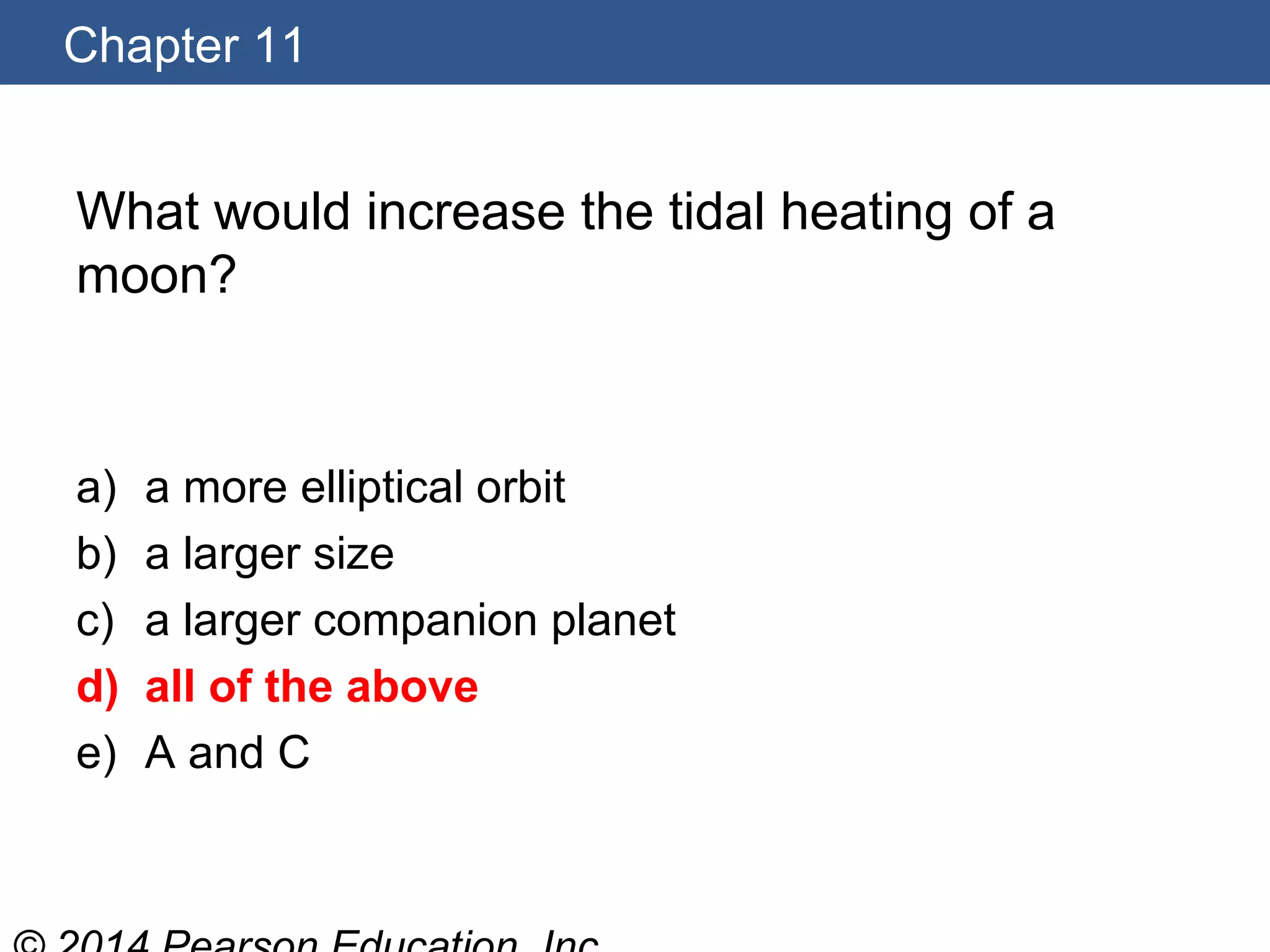
What would increase the tidal heating of a
moon?
a) a more elliptical orbit
b) a larger size
c) a larger companion planet
d) all of the above
e) A and C
Chapter 11
What would increase the tidal heating of a
moon?
a) a more elliptical orbit
b) a larger size
c) a larger companion planet
d) all of the above
e) A and C
Chapter 11
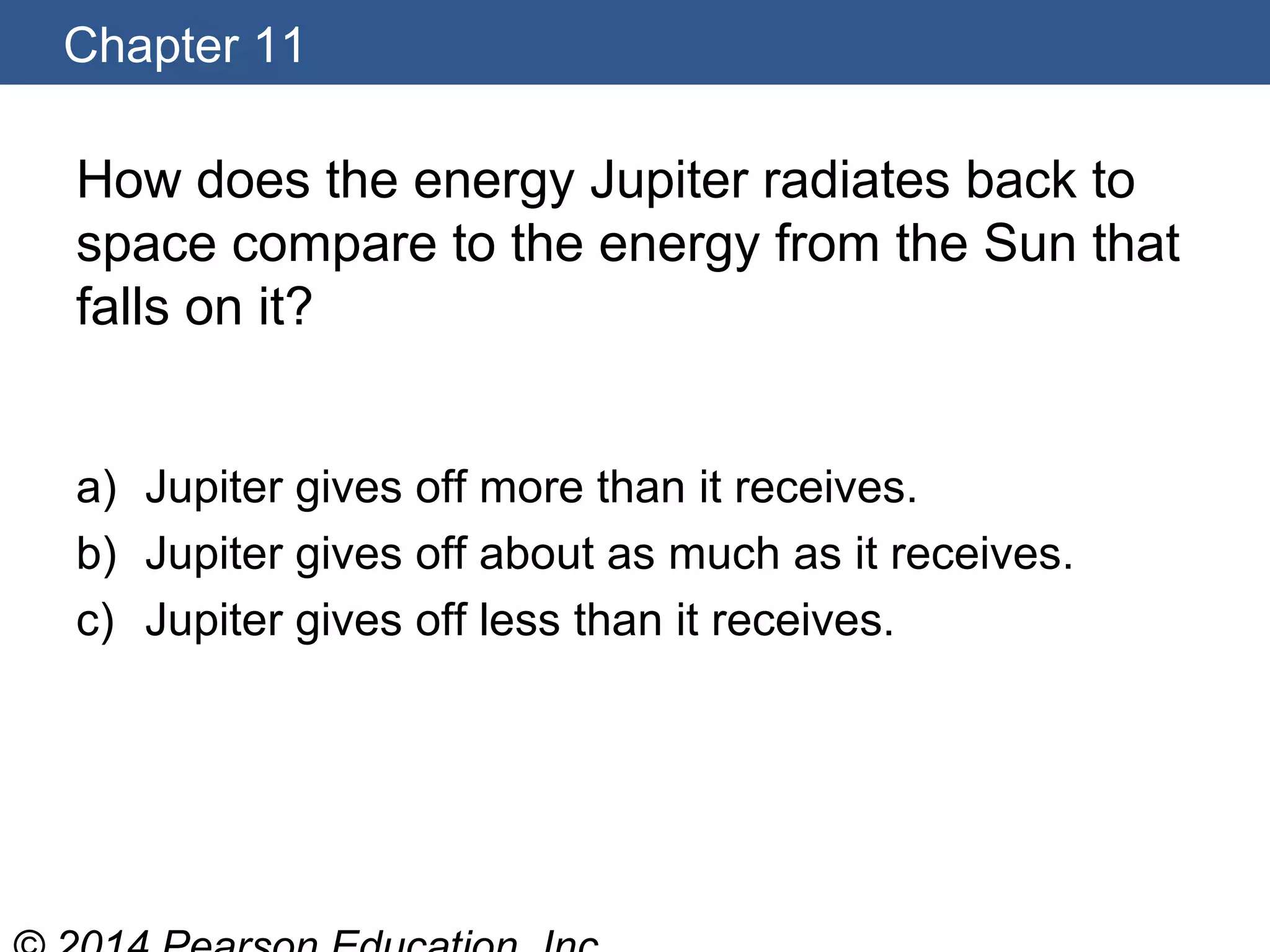
How does the energy Jupiter radiates back to
space compare to the energy from the Sun that
falls on it?
a) Jupiter gives off more than it receives.
b) Jupiter gives off about as much as it receives.
c) Jupiter gives off less than it receives.
Chapter 11
How does the energy Jupiter radiates back to
space compare to the energy from the Sun that
falls on it?
a) Jupiter gives off more than it receives.
b) Jupiter gives off about as much as it receives.
c) Jupiter gives off less than it receives.
Chapter 11
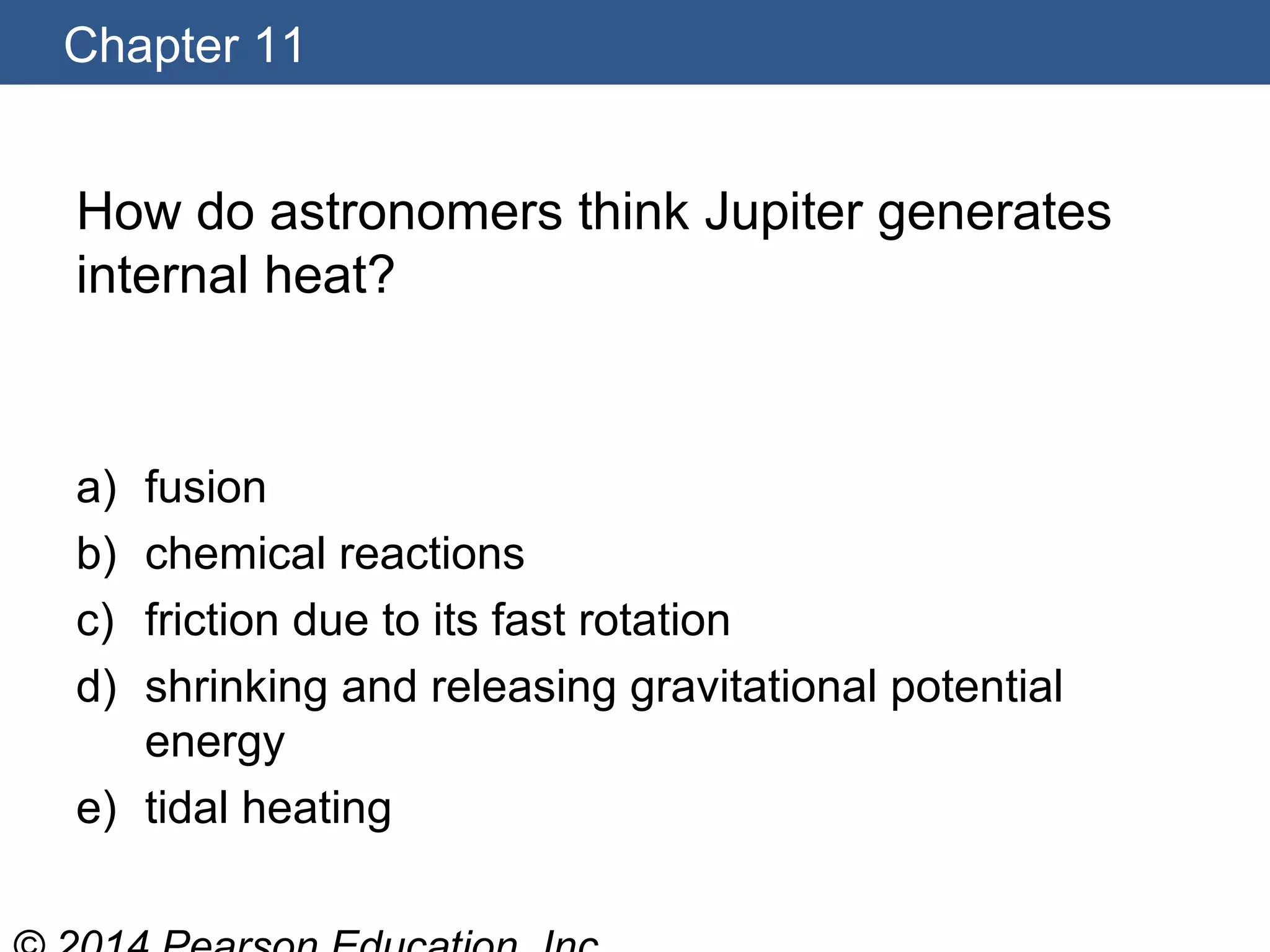
How do astronomers think Jupiter generates
internal heat?
a) fusion
b) chemical reactions
c) friction due to its fast rotation
d) shrinking and releasing gravitational potential
energy
e) tidal heating
Chapter 11
How do astronomers think Jupiter generates
internal heat?
a) fusion
b) chemical reactions
c) friction due to its fast rotation
d) shrinking and releasing gravitational potential
energy
e) tidal heating
Chapter 11
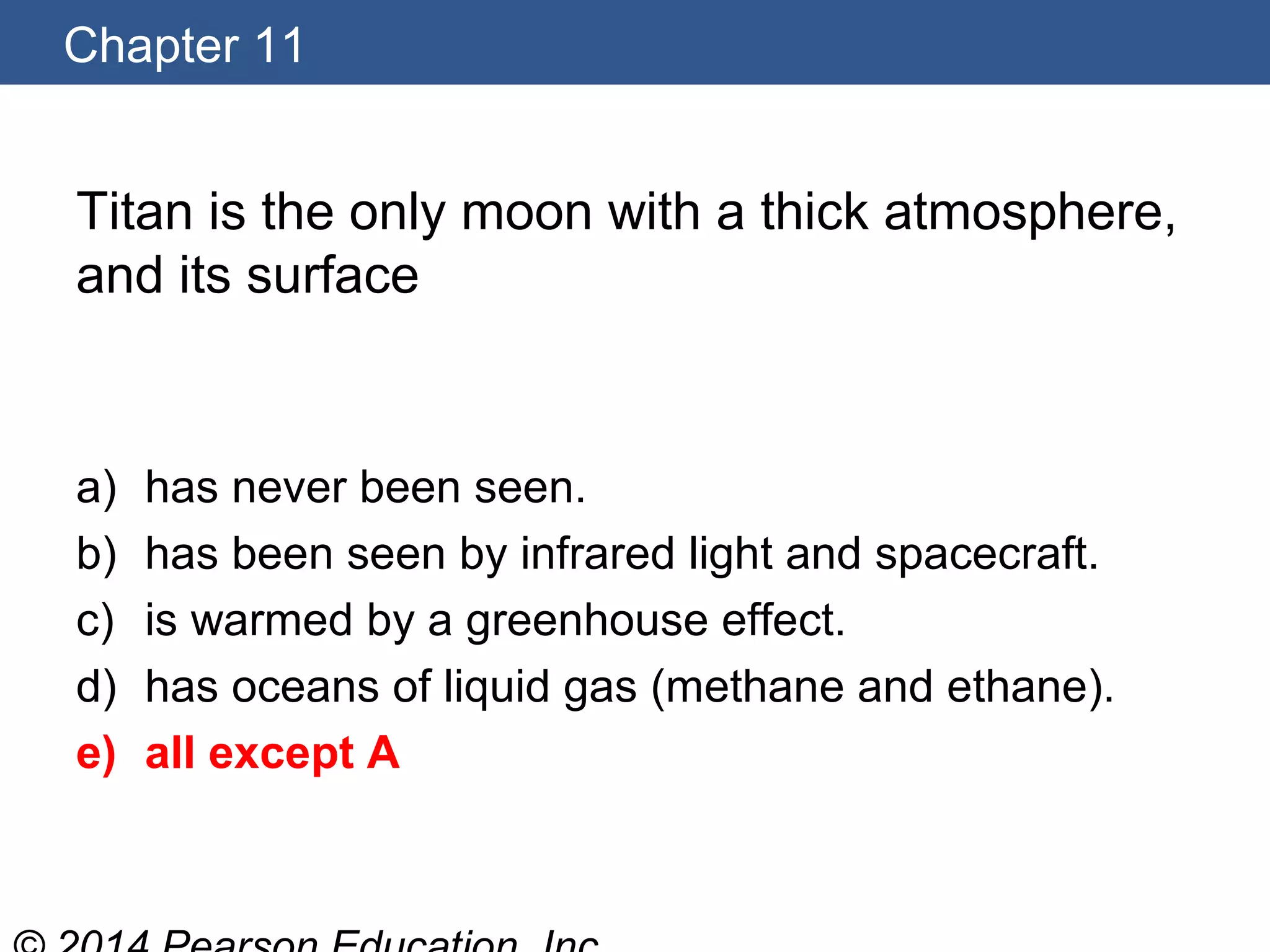
Titan is the only moon with a thick atmosphere,
and its surface
a) has never been seen.
b) has been seen by infrared light and spacecraft.
c) is warmed by a greenhouse effect.
d) has oceans of liquid gas (methane and ethane).
e) all except A
Chapter 11
Titan is the only moon with a thick atmosphere,
and its surface
a) has never been seen.
b) has been seen by infrared light and spacecraft.
c) is warmed by a greenhouse effect.
d) has oceans of liquid gas (methane and ethane).
e) all except A
Chapter 11
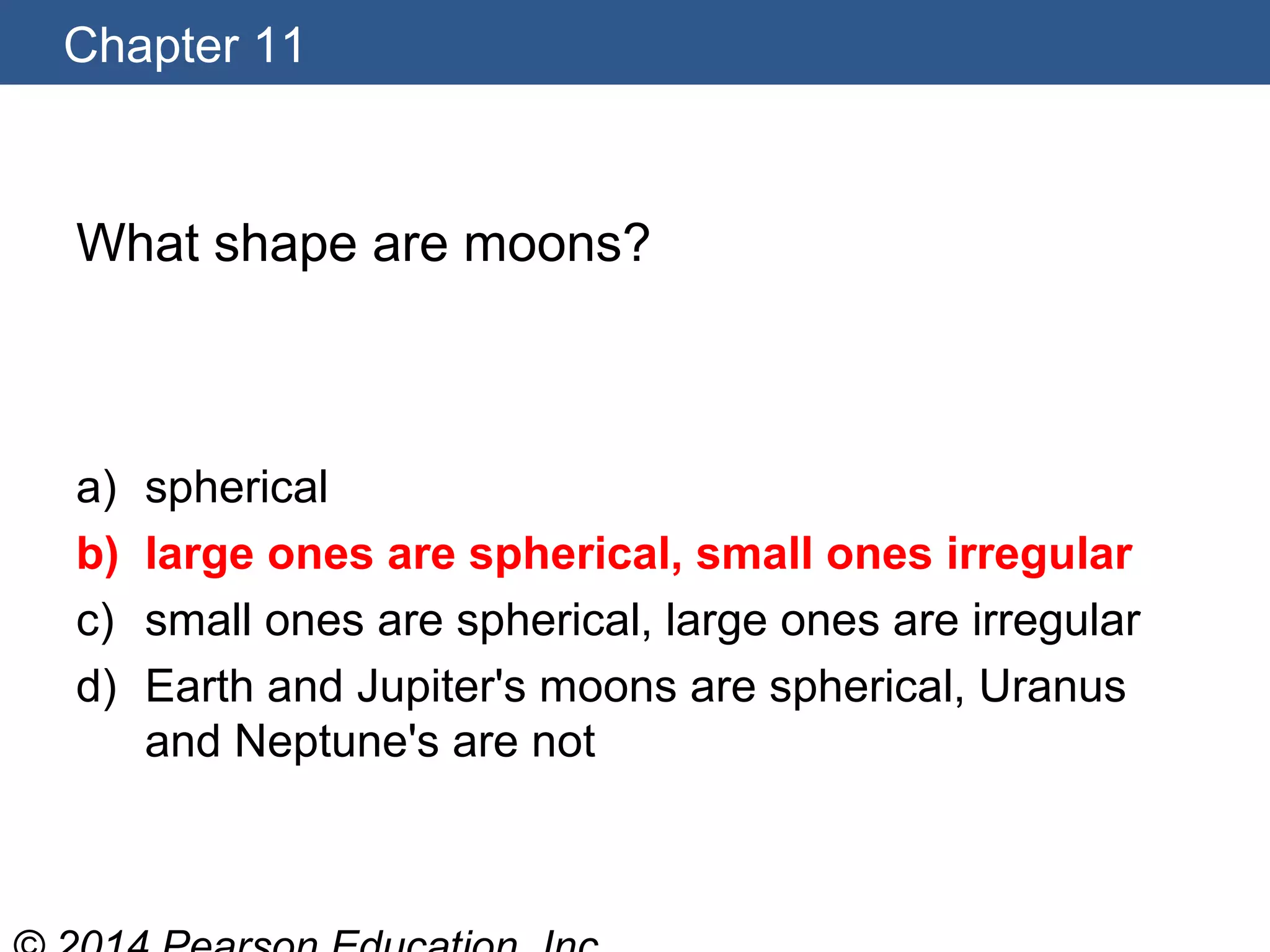
What shape are moons?
a) spherical
b) large ones are spherical, small ones irregular
c) small ones are spherical, large ones are irregular
d) Earth and Jupiter's moons are spherical, Uranus
and Neptune's are not
Chapter 11
What shape are moons?
a) spherical
b) large ones are spherical, small ones irregular
c) small ones are spherical, large ones are irregular
d) Earth and Jupiter's moons are spherical, Uranus
and Neptune's are not
Chapter 11
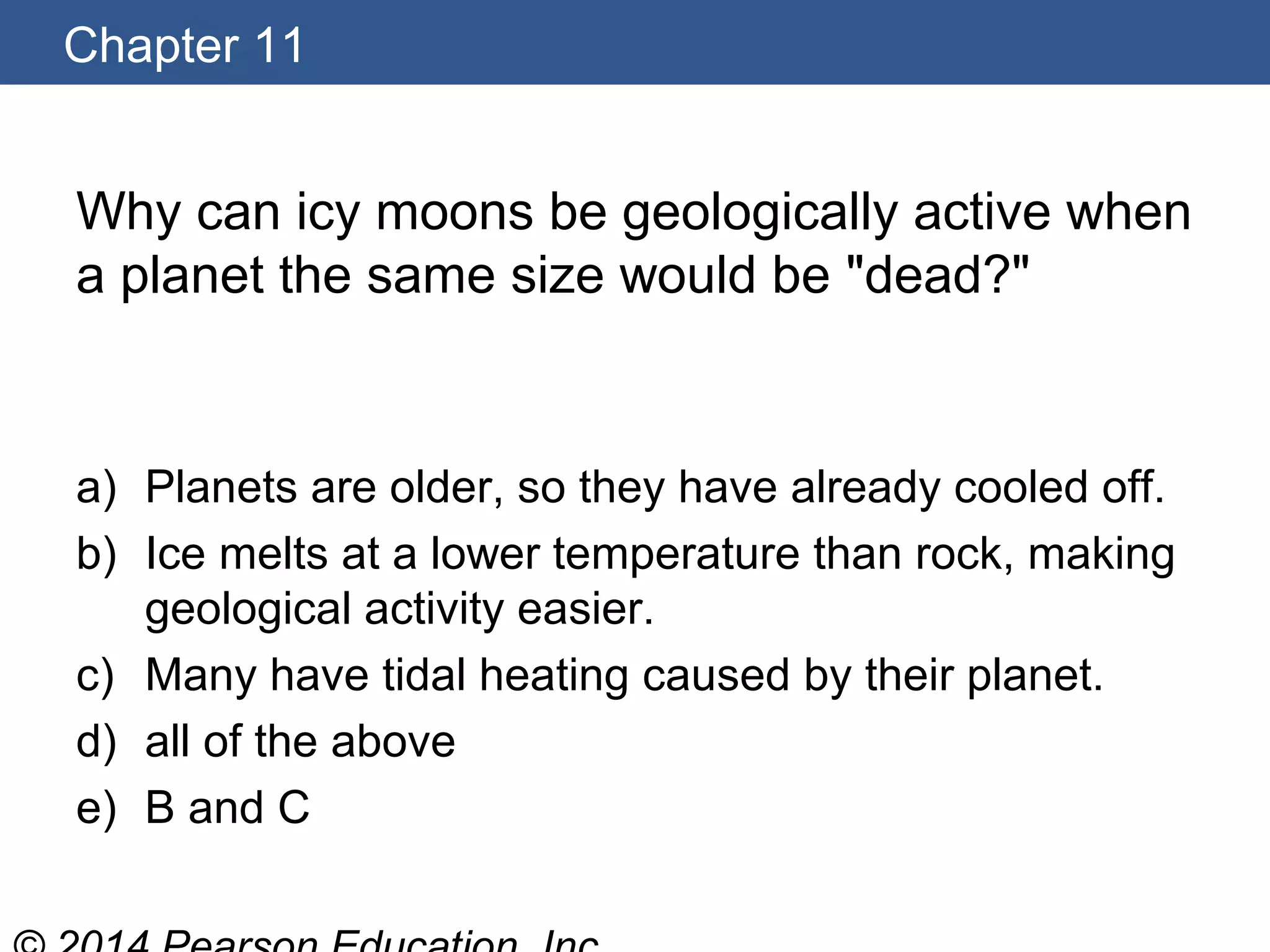
Why can icy moons be geologically active when
a planet the same size would be "dead?"
a) Planets are older, so they have already cooled off.
b) Ice melts at a lower temperature than rock, making
geological activity easier.
c) Many have tidal heating caused by their planet.
d) all of the above
e) B and C
Chapter 11
Why can icy moons be geologically active when
a planet the same size would be "dead?"
a) Planets are older, so they have already cooled off.
b) Ice melts at a lower temperature than rock, making
geological activity easier.
c) Many have tidal heating caused by their planet.
d) all of the above
e) B and C
Chapter 11
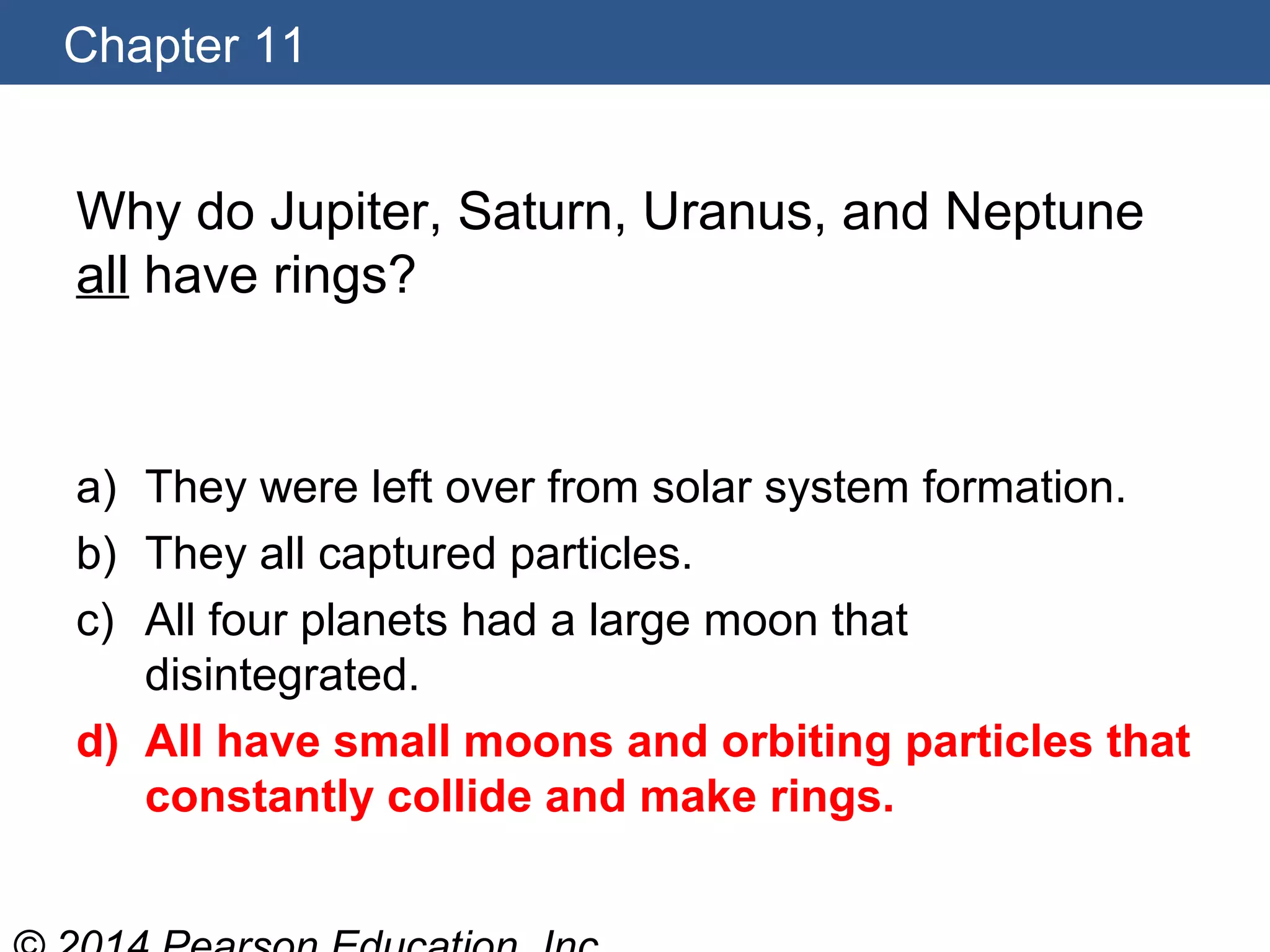
Why do Jupiter, Saturn, Uranus, and Neptune
all have rings?
a) They were left over from solar system formation.
b) They all captured particles.
c) All four planets had a large moon that
disintegrated.
d) All have small moons and orbiting particles that
constantly collide and make rings.
Chapter 11
Why do Jupiter, Saturn, Uranus, and Neptune
all have rings?
a) They were left over from solar system formation.
b) They all captured particles.
c) All four planets had a large moon that
disintegrated.
d) All have small moons and orbiting particles that
constantly collide and make rings.
Chapter 11
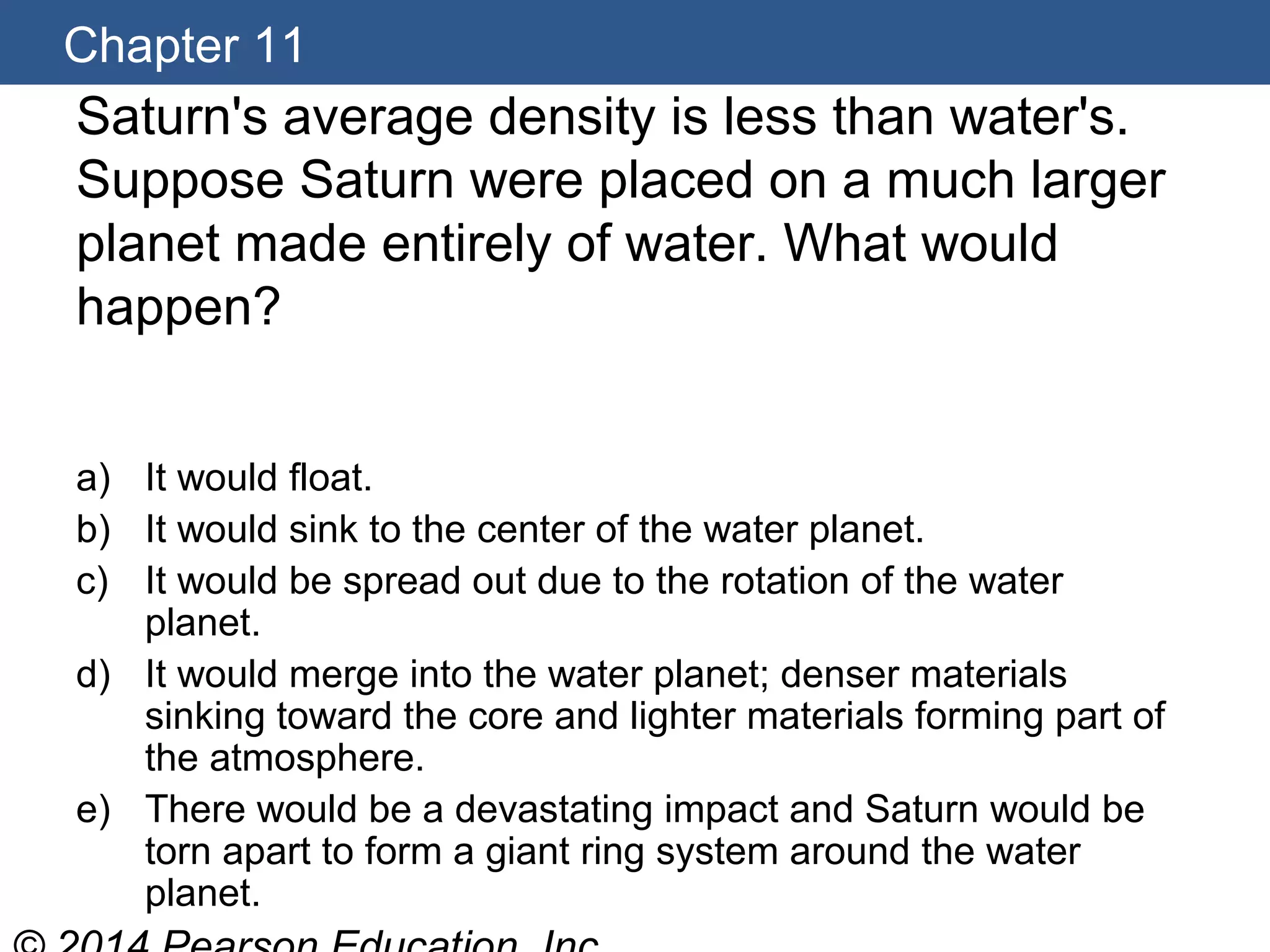
Saturn's average density is less than water's.
Suppose Saturn were placed on a much larger
planet made entirely of water. What would
happen?
a) It would float.
b) It would sink to the center of the water planet.
c) It would be spread out due to the rotation of the water
planet.
d) It would merge into the water planet; denser materials
sinking toward the core and lighter materials forming part of
the atmosphere.
e) There would be a devastating impact and Saturn would be
torn apart to form a giant ring system around the water
planet.
Chapter 11
Saturn's average density is less than water's.
Suppose Saturn were placed on a much larger
planet made entirely of water. What would
happen?
a) It would float.
b) It would sink to the center of the water planet.
c) It would be spread out due to the rotation of the water
planet.
d) It would merge into the water planet; denser materials
sinking toward the core and lighter materials forming
part of the atmosphere.
e) There would be a devastating impact and Saturn would be
torn apart to form a giant ring system around the water
planet.
Chapter 11
Surprising discovery? - Saturn's core is
pockmarked with impact craters and dotted
with volcanoes erupting basaltic lava.
a) Plausible. Saturn's moons also show impact craters and
volcanoes.
b) Plausible. Saturn's atmosphere originated from the
volatiles in impactors that were released via volcanic activity.
c) Implausible. No impactors would survive the immense pressures
at the depth of Saturn's core.
d) Implausible. Any large impactor approaching Saturn would be broken
up by tidal forces.
e) Implausible. Saturn's high rotation would prevent an impactor
from reaching its core.
Chapter 11
Surprising discovery? - Saturn's core is
pockmarked with impact craters and dotted
with volcanoes erupting basaltic lava.
a) Plausible. Saturn's moons also show impact craters and
volcanoes.
b) Plausible. Saturn's atmosphere originated from the
volatiles in impactors that were released via volcanic activity.
c) Implausible. No impactors would survive the immense pressures
at the depth of Saturn's core.
d) Implausible. Any large impactor approaching Saturn would be broken
up by tidal forces.
e) Implausible. Saturn's high rotation would prevent an impactor
from reaching its core.
Chapter 11
Surprising discovery? - A jovian planet in
another star system is found to have a moon
as big as Mars.
a) Plausible. There is no reason why jovian planets cannot
have such large moons.
b) Plausible. Jupiter itself has several moons as large as Mars.
c) Plausible. Astronomers have already found large planets and
moons around other star systems.
d) Implausible. Any moon that was as large as Mars would be
torn apart by tidal forces.
e) Implausible. Any moon that was as large as Mars would be
called a planet it its own right.
Chapter 11
Surprising discovery? - A jovian planet in
another star system is found to have a moon
as big as Mars.
a) Plausible. There is no reason why jovian planets cannot
have such large moons.
b) Plausible. Jupiter itself has several moons as large as Mars.
c) Plausible. Astronomers have already found large planets and
moons around other star systems.
d) Implausible. Any moon that was as large as Mars would be
torn apart by tidal forces.
e) Implausible. Any moon that was as large as Mars would be
called a planet it its own right.
Chapter 11
Surprising discovery? - A new moon is found
orbiting Neptune in its equatorial plane and in
the same direction as Neptune rotates, but its
made almost entirely of metals such as iron
and nickel.
a) Plausible. At these large distances from the Sun, the moon
could have a high metal content.
b) Plausible. The moon could be a captured asteroid.
c) Plausible. The moon could be a captured Oort cloud object.
d) Implausible. Solid objects at those distances are largely
icy and rocky.
e) Implausible. Such a dense object would not last long
before falling into Neptune.
Chapter 11
Surprising discovery? - A new moon is found
orbiting Neptune in its equatorial plane and in
the same direction as Neptune rotates, but its
made almost entirely of metals such as iron
and nickel.
a) Plausible. At these large distances from the Sun, the moon
could have a high metal content.
b) Plausible. The moon could be a captured asteroid.
c) Plausible. The moon could be a captured Oort cloud object.
d) Implausible. Solid objects at those distances are largely
icy and rocky.
e) Implausible. Such a dense object would not last long
before falling into Neptune.

11 review clickers

  • 1.
    Chapter 11 ReviewClickers The Cosmic Perspective Seventh Edition © 2014 Pearson Education, Inc. Jovian Planet Systems
  • 2.
    Chapter 11 If Jupiterwas the size of a basketball, Earth would be the size of a(n) a) bacterium. b) grain of rice. c) marble. d) orange. e) grapefruit.
  • 3.
    Chapter 11 If Jupiterwas the size of a basketball, Earth would be the size of a(n) a) bacterium. b) grain of rice. c) marble. d) orange. e) grapefruit.
  • 4.
    Chapter 11 About howlong does it take a spacecraft to go from Earth to Jupiter? a) a week b) a month c) a year d) several years e) several decades
  • 5.
    Chapter 11 About howlong does it take a spacecraft to go from Earth to Jupiter? a) a week b) a month c) a year d) several years e) several decades
  • 6.
    Chapter 11 Jovian planets a)have rings and large numbers of moons. b) all have many moons, but only Saturn has rings. c) have moons, but Uranus and Neptune have only one or two. d) are massive and rotate slowly.
  • 7.
    Chapter 11 Jovian planets a)have rings and large numbers of moons. b) all have many moons, but only Saturn has rings. c) have moons, but Uranus and Neptune have only one or two. d) are massive and rotate slowly.
  • 8.
    Chapter 11 What isthe structure of Jupiter like? a) rocky core, thin atmosphere b) rocky core, thick atmosphere c) gaseous on the outside, then liquid hydrogen, more dense metallic hydrogen, rocky core d) gaseous on the outside, then liquid hydrogen, then helium, then the other elements
  • 9.
    Chapter 11 What isthe structure of Jupiter like? a) rocky core, thin atmosphere b) rocky core, thick atmosphere c) gaseous on the outside, then liquid hydrogen, more dense metallic hydrogen, rocky core d) gaseous on the outside, then liquid hydrogen, then helium, then the other elements
  • 10.
    Chapter 11 What arethe most common elements in the atmospheres of the jovian planets? a) water b) hydrogen and helium c) oxygen and nitrogen d) oxygen and carbon e) none of the above
  • 11.
    Chapter 11 What arethe most common elements in the atmospheres of the jovian planets? a) water b) hydrogen and helium c) oxygen and nitrogen d) oxygen and carbon e) none of the above
  • 12.
    Chapter 11 What arethe most common hydrogen compounds in the atmospheres of the jovian planets? a) water (H2O), methane (CH4), ammonia (NH3) b) water and carbon dioxide (CO2) c) water and carbon monoxide (CO) d) sulfur dioxide (SO2) and propane (C3H8) e) none of the above
  • 13.
    Chapter 11 What arethe most common hydrogen compounds in the atmospheres of the jovian planets? a) water (H2O), methane (CH4), ammonia (NH3) b) water and carbon dioxide (CO2) c) water and carbon monoxide (CO) d) sulfur dioxide (SO2) and propane (C3H8) e) none of the above
  • 14.
    Chapter 11 Since thereare a lot of flammable gases on Jupiter, such as methane and propane, if you lit a match, would Jupiter burn? a) yes b) no
  • 15.
    Chapter 11 Since thereare a lot of flammable gases on Jupiter, such as methane and propane, if you lit a match, would Jupiter burn? a) yes b) no
  • 16.
    Chapter 11 Convection circulatesgases from deep in Jupiter's atmosphere to the top, where they a) escape into space. b) condense and make rain. c) condense and make clouds. d) form compounds.
  • 17.
    Chapter 11 Convection circulatesgases from deep in Jupiter's atmosphere to the top, where they a) escape into space. b) condense and make rain. c) condense and make clouds. d) form compounds.
  • 18.
    Chapter 11 Jupiter doesnot have a large metal core like Earth. How can it have a magnetic field? a) The magnetic field is left over from when Jupiter accreted. b) Its magnetic field comes from the Sun. c) It has metallic hydrogen inside, which circulates and makes a magnetic field. d) It has a large metal core.
  • 19.
    Chapter 11 Jupiter doesnot have a large metal core like Earth. How can it have a magnetic field? a) The magnetic field is left over from when Jupiter accreted. b) Its magnetic field comes from the Sun. c) It has metallic hydrogen inside, which circulates and makes a magnetic field. d) It has a large metal core.
  • 20.
    Chapter 11 Auroras a) arefound on Earth. b) are found on Jupiter. c) indicate the presence of a magnetic field. d) occur when particles in the solar wind hit a planet. e) all of the above
  • 21.
    Chapter 11 Auroras a) arefound on Earth. b) are found on Jupiter. c) indicate the presence of a magnetic field. d) occur when particles in the solar wind hit a planet. e) all of the above
  • 22.
    Chapter 11 What's theweather usually like on Jupiter? a) high speed, low density clouds b) low speed, high density clouds c) winds of hundreds of miles per hour, thick clouds d) clear and very cold
  • 23.
    Chapter 11 What's theweather usually like on Jupiter? a) high speed, low density clouds b) low speed, high density clouds c) winds of hundreds of miles per hour, thick clouds d) clear and very cold
  • 24.
    Chapter 11 Jupiter isabout three times as massive as Saturn, but only slightly larger. Why? a) It is made of denser material. b) It is made of less dense material. c) Adding mass increases gravity and compresses gasses. d) They are made of different gasses. e) none of the above
  • 25.
    Chapter 11 Jupiter isabout three times as massive as Saturn, but only slightly larger. Why? a) It is made of denser material. b) It is made of less dense material. c) Adding mass increases gravity and compresses gasses. d) They are made of different gasses. e) none of the above
  • 26.
    Chapter 11 Looking ata Jovian planet in different wavelengths of light allows us to a) see different kinds of clouds. b) see to different depths in the atmosphere. c) see layers of different temperatures. d) all of the above e) A and B
  • 27.
    Chapter 11 Looking ata Jovian planet in different wavelengths of light allows us to a) see different kinds of clouds. b) see to different depths in the atmosphere. c) see layers of different temperatures. d) all of the above e) A and B
  • 28.
    Chapter 11 What isthe most geologically active world we know of in the solar system? a) Earth b) Mercury c) Mars d) Jupiter e) Io
  • 29.
    Chapter 11 What isthe most geologically active world we know of in the solar system? a) Earth b) Mercury c) Mars d) Jupiter e) Io
  • 30.
    Chapter 11 How doesIo get heated by Jupiter? a) auroras b) ultraviolet radiation c) infrared radiation d) tidal heating
  • 31.
    Chapter 11 How doesIo get heated by Jupiter? a) auroras b) ultraviolet radiation c) infrared radiation d) tidal heating
  • 32.
    Chapter 11 What wouldincrease the tidal heating of a moon? a) a more elliptical orbit b) a larger size c) a larger companion planet d) all of the above e) A and C
  • 33.
    Chapter 11 What wouldincrease the tidal heating of a moon? a) a more elliptical orbit b) a larger size c) a larger companion planet d) all of the above e) A and C
  • 34.
    Chapter 11 How doesthe energy Jupiter radiates back to space compare to the energy from the Sun that falls on it? a) Jupiter gives off more than it receives. b) Jupiter gives off about as much as it receives. c) Jupiter gives off less than it receives.
  • 35.
    Chapter 11 How doesthe energy Jupiter radiates back to space compare to the energy from the Sun that falls on it? a) Jupiter gives off more than it receives. b) Jupiter gives off about as much as it receives. c) Jupiter gives off less than it receives.
  • 36.
    Chapter 11 How doastronomers think Jupiter generates internal heat? a) fusion b) chemical reactions c) friction due to its fast rotation d) shrinking and releasing gravitational potential energy e) tidal heating
  • 37.
    Chapter 11 How doastronomers think Jupiter generates internal heat? a) fusion b) chemical reactions c) friction due to its fast rotation d) shrinking and releasing gravitational potential energy e) tidal heating
  • 38.
    Chapter 11 Titan isthe only moon with a thick atmosphere, and its surface a) has never been seen. b) has been seen by infrared light and spacecraft. c) is warmed by a greenhouse effect. d) has oceans of liquid gas (methane and ethane). e) all except A
  • 39.
    Chapter 11 Titan isthe only moon with a thick atmosphere, and its surface a) has never been seen. b) has been seen by infrared light and spacecraft. c) is warmed by a greenhouse effect. d) has oceans of liquid gas (methane and ethane). e) all except A
  • 40.
    Chapter 11 What shapeare moons? a) spherical b) large ones are spherical, small ones irregular c) small ones are spherical, large ones are irregular d) Earth and Jupiter's moons are spherical, Uranus and Neptune's are not
  • 41.
    Chapter 11 What shapeare moons? a) spherical b) large ones are spherical, small ones irregular c) small ones are spherical, large ones are irregular d) Earth and Jupiter's moons are spherical, Uranus and Neptune's are not
  • 42.
    Chapter 11 Why canicy moons be geologically active when a planet the same size would be "dead?" a) Planets are older, so they have already cooled off. b) Ice melts at a lower temperature than rock, making geological activity easier. c) Many have tidal heating caused by their planet. d) all of the above e) B and C
  • 43.
    Chapter 11 Why canicy moons be geologically active when a planet the same size would be "dead?" a) Planets are older, so they have already cooled off. b) Ice melts at a lower temperature than rock, making geological activity easier. c) Many have tidal heating caused by their planet. d) all of the above e) B and C
  • 44.
    Chapter 11 Why doJupiter, Saturn, Uranus, and Neptune all have rings? a) They were left over from solar system formation. b) They all captured particles. c) All four planets had a large moon that disintegrated. d) All have small moons and orbiting particles that constantly collide and make rings.
  • 45.
    Chapter 11 Why doJupiter, Saturn, Uranus, and Neptune all have rings? a) They were left over from solar system formation. b) They all captured particles. c) All four planets had a large moon that disintegrated. d) All have small moons and orbiting particles that constantly collide and make rings.
  • 46.
    Chapter 11 Saturn's averagedensity is less than water's. Suppose Saturn were placed on a much larger planet made entirely of water. What would happen? a) It would float. b) It would sink to the center of the water planet. c) It would be spread out due to the rotation of the water planet. d) It would merge into the water planet; denser materials sinking toward the core and lighter materials forming part of the atmosphere. e) There would be a devastating impact and Saturn would be torn apart to form a giant ring system around the water planet.
  • 47.
    Chapter 11 Saturn's averagedensity is less than water's. Suppose Saturn were placed on a much larger planet made entirely of water. What would happen? a) It would float. b) It would sink to the center of the water planet. c) It would be spread out due to the rotation of the water planet. d) It would merge into the water planet; denser materials sinking toward the core and lighter materials forming part of the atmosphere. e) There would be a devastating impact and Saturn would be torn apart to form a giant ring system around the water planet.
  • 48.
    Chapter 11 Surprising discovery?- Saturn's core is pockmarked with impact craters and dotted with volcanoes erupting basaltic lava. a) Plausible. Saturn's moons also show impact craters and volcanoes. b) Plausible. Saturn's atmosphere originated from the volatiles in impactors that were released via volcanic activity. c) Implausible. No impactors would survive the immense pressures at the depth of Saturn's core. d) Implausible. Any large impactor approaching Saturn would be broken up by tidal forces. e) Implausible. Saturn's high rotation would prevent an impactor from reaching its core.
  • 49.
    Chapter 11 Surprising discovery?- Saturn's core is pockmarked with impact craters and dotted with volcanoes erupting basaltic lava. a) Plausible. Saturn's moons also show impact craters and volcanoes. b) Plausible. Saturn's atmosphere originated from the volatiles in impactors that were released via volcanic activity. c) Implausible. No impactors would survive the immense pressures at the depth of Saturn's core. d) Implausible. Any large impactor approaching Saturn would be broken up by tidal forces. e) Implausible. Saturn's high rotation would prevent an impactor from reaching its core.
  • 50.
    Chapter 11 Surprising discovery?- A jovian planet in another star system is found to have a moon as big as Mars. a) Plausible. There is no reason why jovian planets cannot have such large moons. b) Plausible. Jupiter itself has several moons as large as Mars. c) Plausible. Astronomers have already found large planets and moons around other star systems. d) Implausible. Any moon that was as large as Mars would be torn apart by tidal forces. e) Implausible. Any moon that was as large as Mars would be called a planet it its own right.
  • 51.
    Chapter 11 Surprising discovery?- A jovian planet in another star system is found to have a moon as big as Mars. a) Plausible. There is no reason why jovian planets cannot have such large moons. b) Plausible. Jupiter itself has several moons as large as Mars. c) Plausible. Astronomers have already found large planets and moons around other star systems. d) Implausible. Any moon that was as large as Mars would be torn apart by tidal forces. e) Implausible. Any moon that was as large as Mars would be called a planet it its own right.
  • 52.
    Chapter 11 Surprising discovery?- A new moon is found orbiting Neptune in its equatorial plane and in the same direction as Neptune rotates, but its made almost entirely of metals such as iron and nickel. a) Plausible. At these large distances from the Sun, the moon could have a high metal content. b) Plausible. The moon could be a captured asteroid. c) Plausible. The moon could be a captured Oort cloud object. d) Implausible. Solid objects at those distances are largely icy and rocky. e) Implausible. Such a dense object would not last long before falling into Neptune.
  • 53.
    Chapter 11 Surprising discovery?- A new moon is found orbiting Neptune in its equatorial plane and in the same direction as Neptune rotates, but its made almost entirely of metals such as iron and nickel. a) Plausible. At these large distances from the Sun, the moon could have a high metal content. b) Plausible. The moon could be a captured asteroid. c) Plausible. The moon could be a captured Oort cloud object. d) Implausible. Solid objects at those distances are largely icy and rocky. e) Implausible. Such a dense object would not last long before falling into Neptune.

Editor's Notes

  • #3 Answer: c) marble.
  • #4 Answer: c) marble.
  • #5 Answer: d) several years
  • #6 Answer: d) several years
  • #7 Answer: a) have rings and large numbers of moons.
  • #8 Answer: a) have rings and large numbers of moons.
  • #9 Answer: c) gaseous on the outside, then liquid hydrogen, more dense metallic hydrogen, rocky core
  • #10 Answer: c) gaseous on the outside, then liquid hydrogen, more dense metallic hydrogen, rocky core
  • #11 Answer: b) hydrogen and helium
  • #12 Answer: b) hydrogen and helium
  • #13 Answer: a) water (H2O), methane (CH4), ammonia (NH3)
  • #14 Answer: a) water (H2O), methane (CH4), ammonia (NH3)
  • #15 Answer: b) no
  • #16 Answer: b) no
  • #17 Answer: c) condense and make clouds.
  • #18 Answer: c) condense and make clouds.
  • #19 Answer: c) It has metallic hydrogen inside, which circulates and makes a magnetic field.
  • #20 Answer: c) It has metallic hydrogen inside, which circulates and makes a magnetic field.
  • #21 Answer: e) all of the above
  • #22 Answer: e) all of the above
  • #23 Answer: c) winds of hundreds of miles per hour, thick clouds
  • #24 Answer: c) winds of hundreds of miles per hour, thick clouds
  • #25 Answer: c) Adding mass increases gravity and compresses gasses.
  • #26 Answer: c) Adding mass increases gravity and compresses gasses.
  • #27 Answer: d) all of the above
  • #28 Answer: d) all of the above
  • #29 Answer: e) Io
  • #30 Answer: e) Io
  • #31 Answer: d) tidal heating
  • #32 Answer: d) tidal heating
  • #33 Answer: d) all of the above
  • #34 Answer: d) all of the above
  • #35 Answer: a) Jupiter gives off more than it receives.
  • #36 Answer: a) Jupiter gives off more than it receives.
  • #37 Answer: d) shrinking and releasing gravitational potential energy
  • #38 Answer: d) shrinking and releasing gravitational potential energy
  • #39 Answer: e) all except A
  • #40 Answer: e) all except A
  • #41 Answer: b) large ones are spherical, small ones irregular
  • #42 Answer: b) large ones are spherical, small ones irregular
  • #43 Answer: e) B and C
  • #44 Answer: e) B and C
  • #45 Answer: d) All have small moons and orbiting particles that constantly collide and make rings.
  • #46 Answer: d) All have small moons and orbiting particles that constantly collide and make rings.
  • #47 Answer: d) It would merge into the water planet; denser materials sinking toward the core and lighter materials forming part of the atmosphere.
  • #48 Answer: d) It would merge into the water planet; denser materials sinking toward the core and lighter materials forming part of the atmosphere.
  • #49 Answer: c) Implausible. No impactors would survive the immense pressures at the depth of Saturn's core.
  • #50 Answer: c) Implausible. No impactors would survive the immense pressures at the depth of Saturn's core.
  • #51 Answer: a) Plausible. There is no reason why jovian planets cannot have such large moons.
  • #52 Answer: a) Plausible. There is no reason why jovian planets cannot have such large moons.
  • #53 Answer: d) Implausible. Solid objects at those distances are largely icy and rocky.
  • #54 Answer: d) Implausible. Solid objects at those distances are largely icy and rocky.