The Big Bang Theory
By Marina García, Jade Turner and
Marina Pascual 4º ESO B
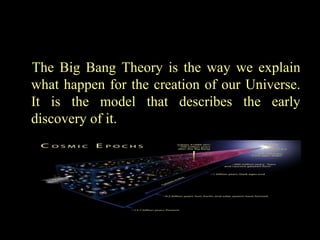
The Big Bang Theory is the way we explain
what happen for the creation of our Universe.
It is the model that describes the early
discovery of it.
It occurred approximately 13,7 billion years
ago. And the Universe was extremely hot and
dense. There are many hypothesis surrounding
the Big Bang Theory, one of these is that
people tend to imagine a giant explosion, but
however it was not, it is a continuous
expansion.
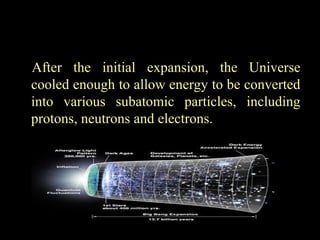
After the initial expansion, the Universe
cooled enough to allow energy to be converted
into various subatomic particles, including
protons, neutrons and electrons.
The majority of atoms that were produced by
Big Bang Theory are hydrogen, helium and
traces of lithium.
Giant clouds of these primordial elements later
coalesced through gravity to form stars and
galaxies, and the heavier elements were
synthesized either within stars or during
supernovae.
Astronomers combine mathematical models
with observations to develop workable
theories of how the Universe came to be.
According to many experts, space did not exist
before the Big Bang.
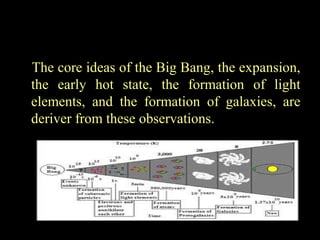
The core ideas of the Big Bang, the expansion,
the early hot state, the formation of light
elements, and the formation of galaxies, are
deriver from these observations.
The mathematical support of the Big Bang
Theory includes Albert Einstein’s Theory of
Relativity along with standard theories of
fundamental particles.
What happened:
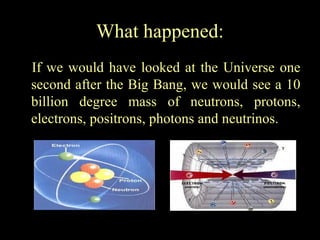
If we would have looked at the Universe one
second after the Big Bang, we would see a 10
billion degree mass of neutrons, protons,
electrons, positrons, photons and neutrinos.
What happened:
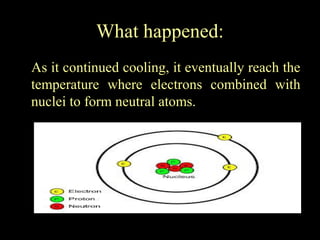
Then, as time went on, we would see the
Universe cooling down, the neutrons decaying
into protons and electrons, or combining with
protons to make an isotope of hydrogen.
What happened:
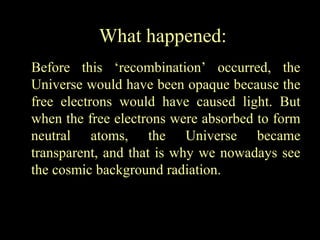
As it continued cooling, it eventually reach the
temperature where electrons combined with
nuclei to form neutral atoms.
What happened:
Before this ‘recombination’ occurred, the
Universe would have been opaque because the
free electrons would have caused light. But
when the free electrons were absorbed to form
neutral atoms, the Universe became
transparent, and that is why we nowadays see
the cosmic background radiation.
Evidence for the Theory:
1. We are sure that the universe had a beginning.
2. Galaxies appear to be moving away from us at
speeds proportional to their distance; this is called
‘Hubble’s Law’
3. If the universe was initially very hot, we should be
able to find some remnant of the heat (Cosmic
Microwave Background radiation).
4. The abundance of light elements, hydrogen and
helium found in the observable universe.
We do not know where it came from, why it is
here, or even where it is. All we really know is
that we are inside of it and at one time it did
not exist and neither did we.
One of the goals has long been to decide
whether the Universe will expand forever, or
whether it will someday stop, turn around, and
collapse in a ‘Big Crunch’.

The big bang theory (1)

  • 1.
    The Big BangTheory By Marina García, Jade Turner and Marina Pascual 4º ESO B
  • 2.
    The Big BangTheory is the way we explain what happen for the creation of our Universe. It is the model that describes the early discovery of it.
  • 3.
    It occurred approximately13,7 billion years ago. And the Universe was extremely hot and dense. There are many hypothesis surrounding the Big Bang Theory, one of these is that people tend to imagine a giant explosion, but however it was not, it is a continuous expansion.
  • 4.
    After the initialexpansion, the Universe cooled enough to allow energy to be converted into various subatomic particles, including protons, neutrons and electrons.
  • 5.
    The majority ofatoms that were produced by Big Bang Theory are hydrogen, helium and traces of lithium. Giant clouds of these primordial elements later coalesced through gravity to form stars and galaxies, and the heavier elements were synthesized either within stars or during supernovae.
  • 6.
    Astronomers combine mathematicalmodels with observations to develop workable theories of how the Universe came to be. According to many experts, space did not exist before the Big Bang.
  • 7.
    The core ideasof the Big Bang, the expansion, the early hot state, the formation of light elements, and the formation of galaxies, are deriver from these observations.
  • 8.
    The mathematical supportof the Big Bang Theory includes Albert Einstein’s Theory of Relativity along with standard theories of fundamental particles.
  • 9.
    What happened: If wewould have looked at the Universe one second after the Big Bang, we would see a 10 billion degree mass of neutrons, protons, electrons, positrons, photons and neutrinos.
  • 10.
    What happened: Then, astime went on, we would see the Universe cooling down, the neutrons decaying into protons and electrons, or combining with protons to make an isotope of hydrogen.
  • 11.
    What happened: As itcontinued cooling, it eventually reach the temperature where electrons combined with nuclei to form neutral atoms.
  • 12.
    What happened: Before this‘recombination’ occurred, the Universe would have been opaque because the free electrons would have caused light. But when the free electrons were absorbed to form neutral atoms, the Universe became transparent, and that is why we nowadays see the cosmic background radiation.
  • 13.
    Evidence for theTheory: 1. We are sure that the universe had a beginning. 2. Galaxies appear to be moving away from us at speeds proportional to their distance; this is called ‘Hubble’s Law’ 3. If the universe was initially very hot, we should be able to find some remnant of the heat (Cosmic Microwave Background radiation). 4. The abundance of light elements, hydrogen and helium found in the observable universe.
  • 14.
    We do notknow where it came from, why it is here, or even where it is. All we really know is that we are inside of it and at one time it did not exist and neither did we. One of the goals has long been to decide whether the Universe will expand forever, or whether it will someday stop, turn around, and collapse in a ‘Big Crunch’.