Clicker Questions
Chapter 28:
Reflection and
Refraction
© 2015 Pearson Education, Inc.
Light takes the path from one point to another
that is
a) quickest.
b) shortest.
c) closest to a straight line.
d) None of these.
© 2015 Pearson Education, Inc.
Light takes the path from one point to another
that is
a) quickest.
b) shortest.
c) closest to a straight line.
d) None of these.
Comment:
Light takes the path of least time, which, said another
way, is the quickest.
© 2015 Pearson Education, Inc.
When light meets a polished reflecting surface
a) all of it reflects.
b) it partly reflects.
c) most is absorbed.
d) it refracts, not reflects.
© 2015 Pearson Education, Inc.
When light meets a polished reflecting surface
a) all of it reflects.
b) it partly reflects.
c) most is absorbed.
d) it refracts, not reflects.
Comment:
Fortune and fame await the discoverer of a surface
that reflects all incident light!
© 2015 Pearson Education, Inc.
Your reflected image in a plane mirror is as far
behind the mirror as
a) half your height.
b) half your distance from the mirror.
c) your distance from the mirror.
d) twice your distance from the mirror.
© 2015 Pearson Education, Inc.
Your reflected image in a plane mirror is as far
behind the mirror as
a) half your height.
b) half your distance from the mirror.
c) your distance from the mirror.
d) twice your distance from the mirror.
© 2015 Pearson Education, Inc.
To see your full-height image in a wall mirror,
the minimum height of the mirror should be
a) at least one-quarter your height.
b) half your height.
c) the same as your height.
d) dependent on your distance in front of the mirror.
© 2015 Pearson Education, Inc.
To see your full-height image in a wall mirror,
the minimum height of the mirror should be
a) at least one-quarter your height.
b) half your height.
c) the same as your height.
d) dependent on your distance in front of the mirror.
© 2015 Pearson Education, Inc.
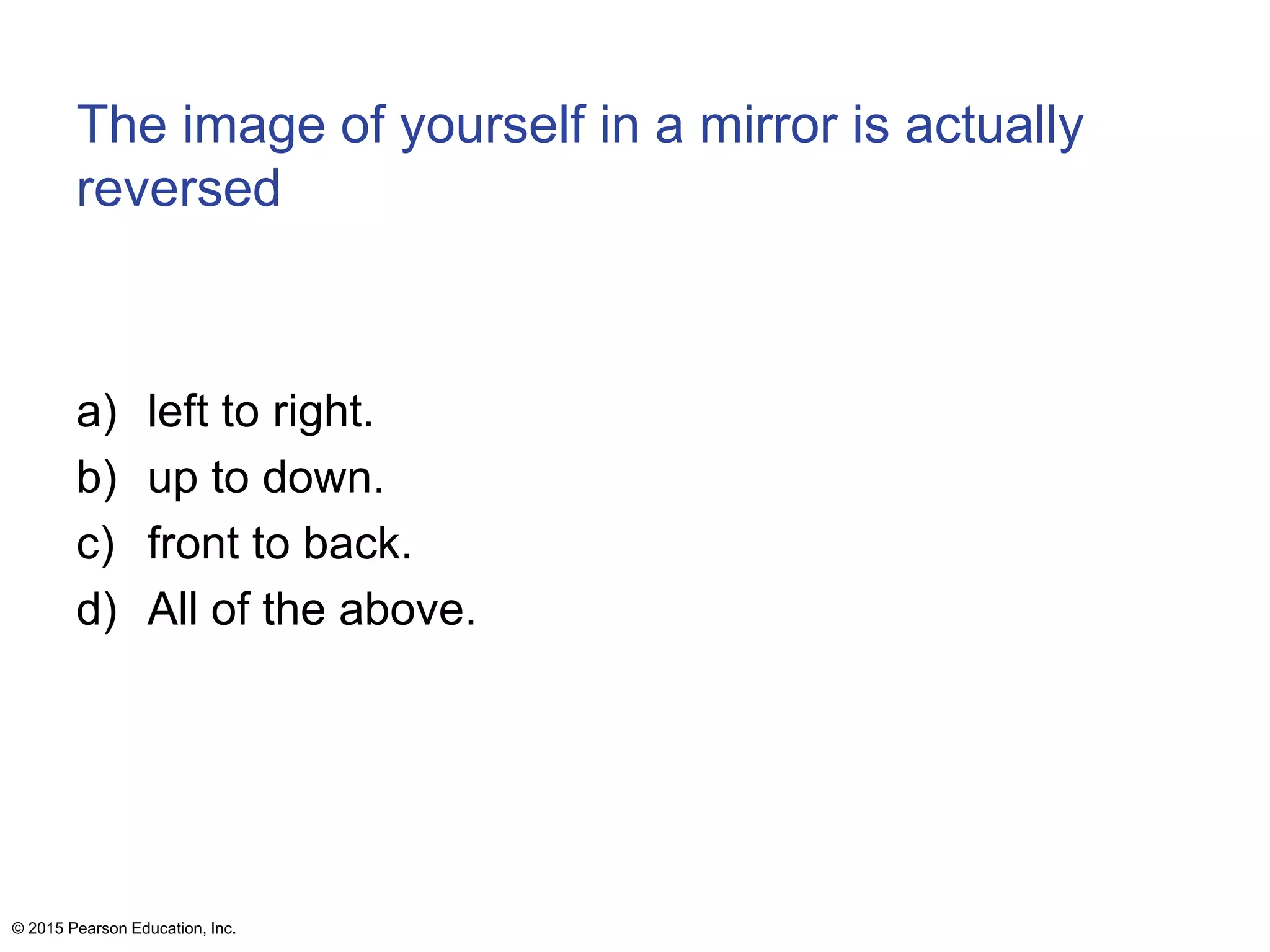
The image of yourself in a mirror is actually
reversed
a) left to right.
b) up to down.
c) front to back.
d) All of the above.
© 2015 Pearson Education, Inc.
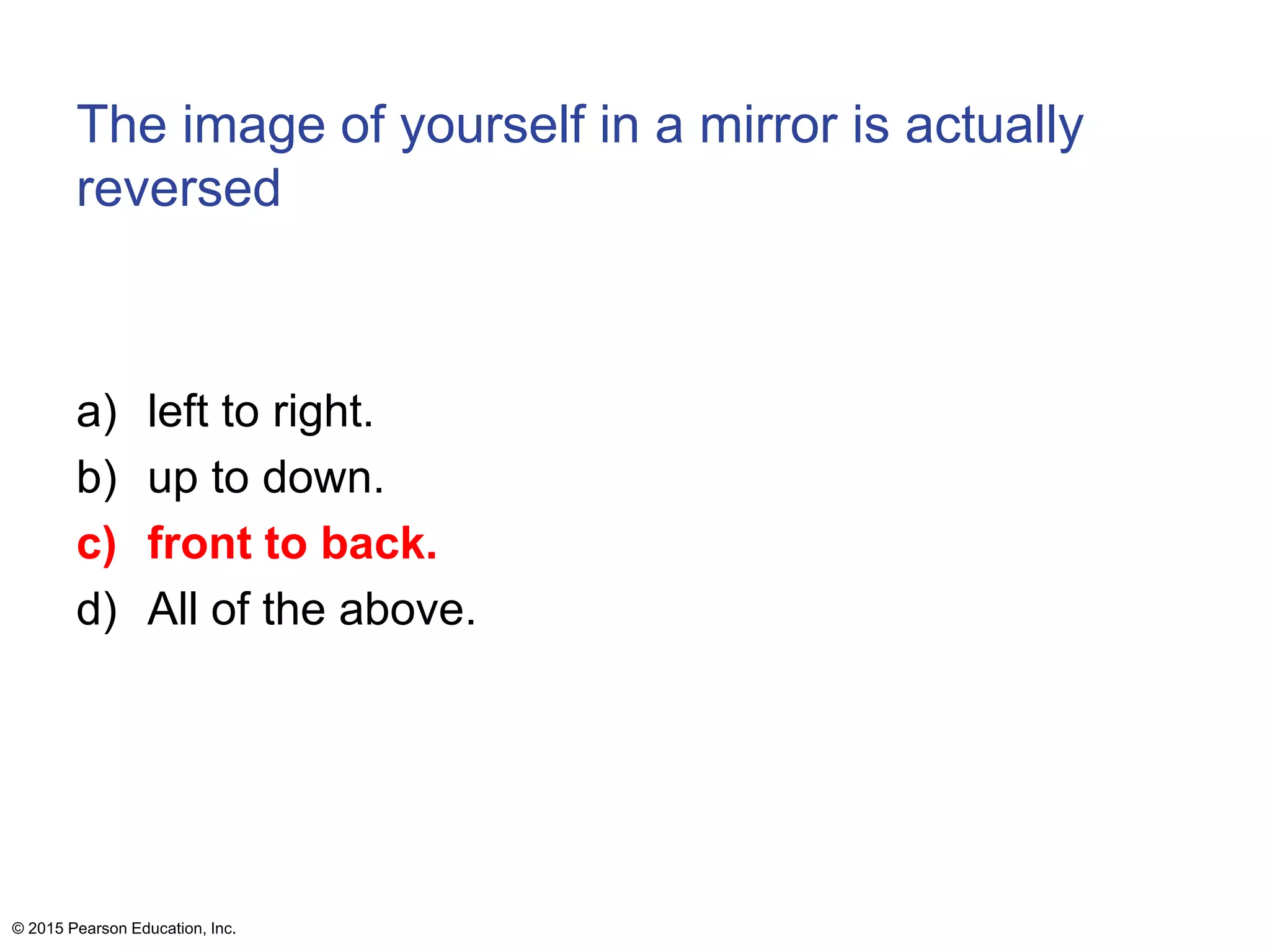
The image of yourself in a mirror is actually
reversed
a) left to right.
b) up to down.
c) front to back.
d) All of the above.
© 2015 Pearson Education, Inc.
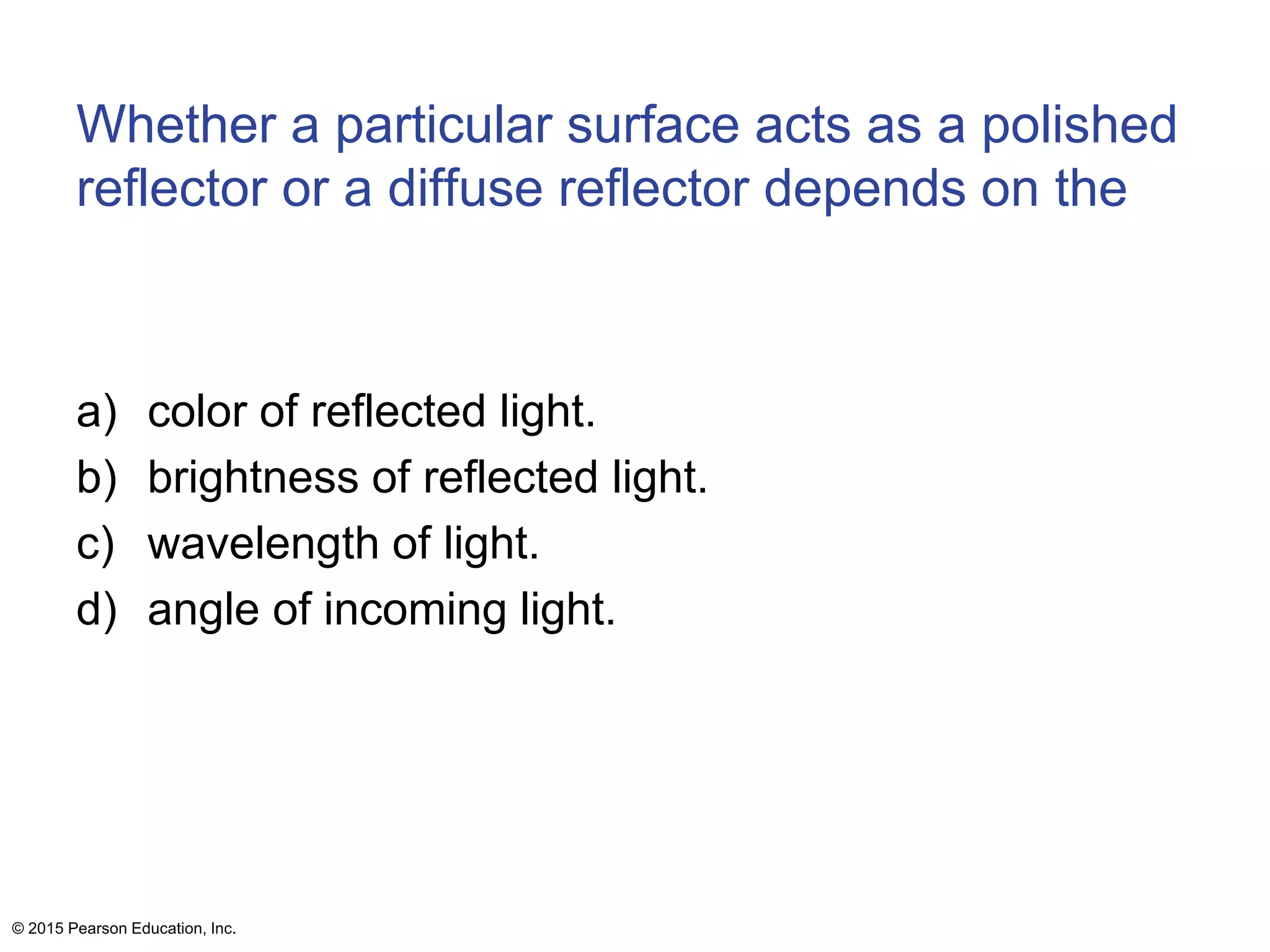
Whether a particular surface acts as a polished
reflector or a diffuse reflector depends on the
a) color of reflected light.
b) brightness of reflected light.
c) wavelength of light.
d) angle of incoming light.
© 2015 Pearson Education, Inc.
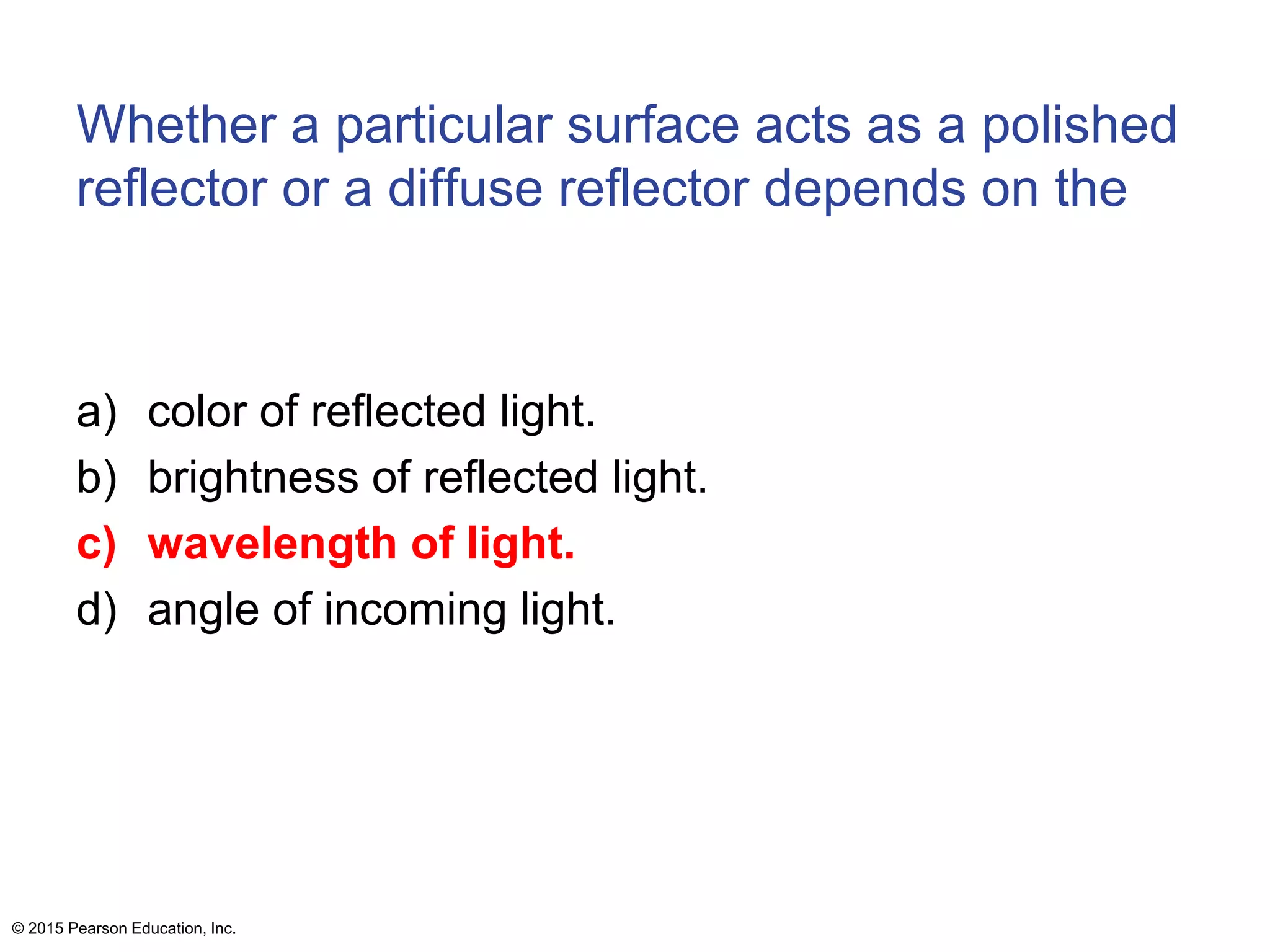
Whether a particular surface acts as a polished
reflector or a diffuse reflector depends on the
a) color of reflected light.
b) brightness of reflected light.
c) wavelength of light.
d) angle of incoming light.
© 2015 Pearson Education, Inc.
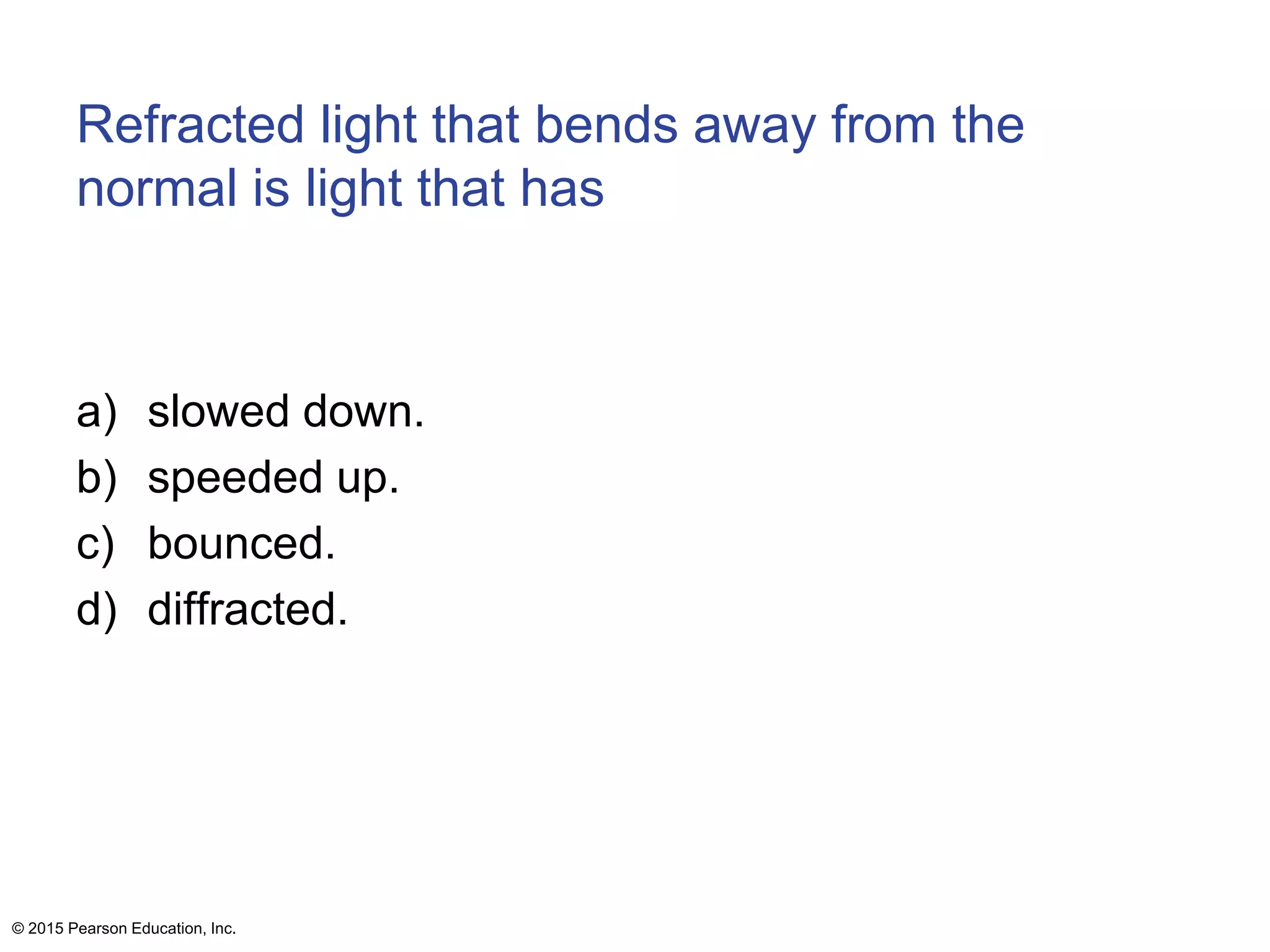
Refracted light that bends away from the
normal is light that has
a) slowed down.
b) speeded up.
c) bounced.
d) diffracted.
© 2015 Pearson Education, Inc.
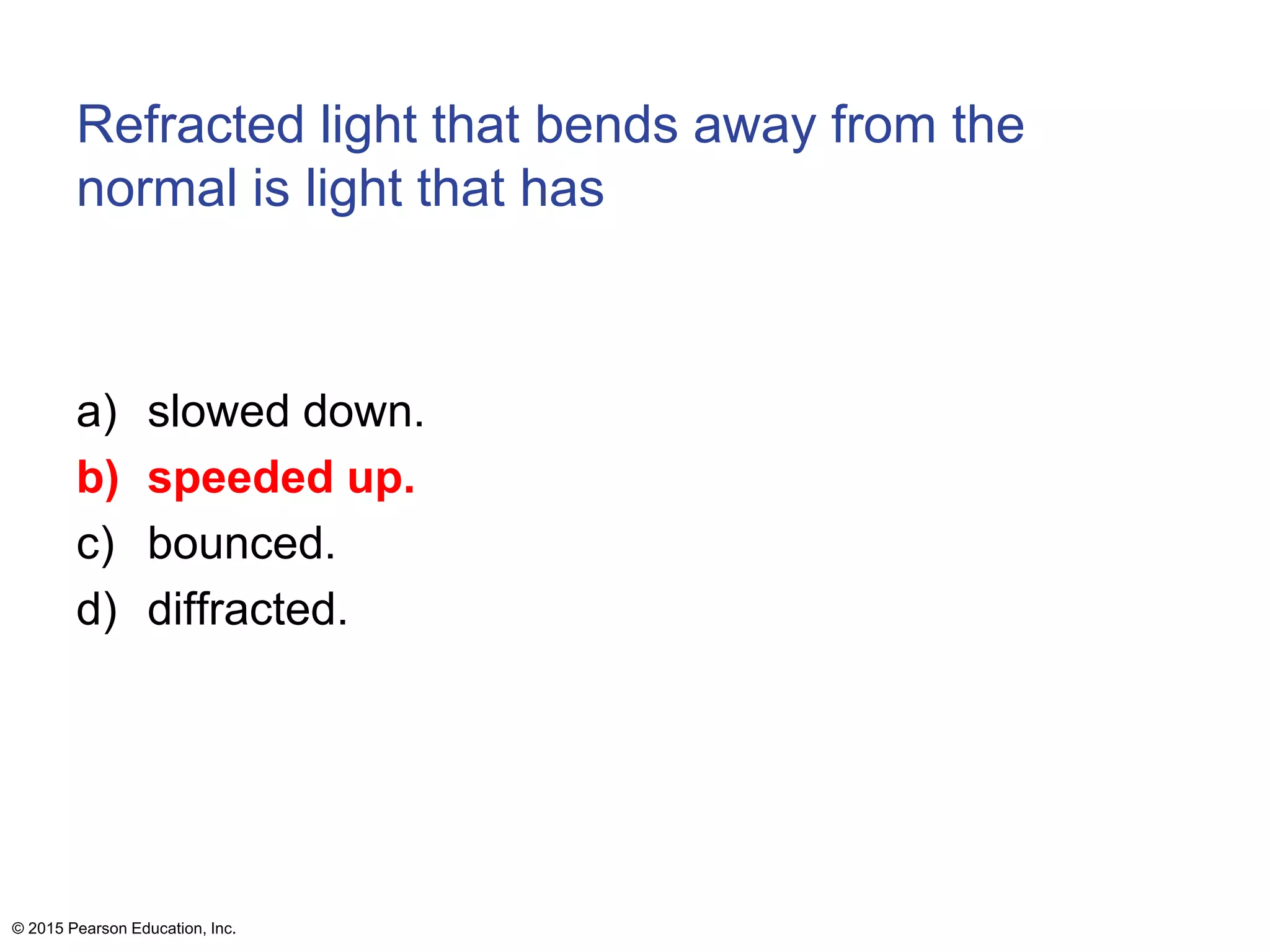
Refracted light that bends away from the
normal is light that has
a) slowed down.
b) speeded up.
c) bounced.
d) diffracted.
© 2015 Pearson Education, Inc.
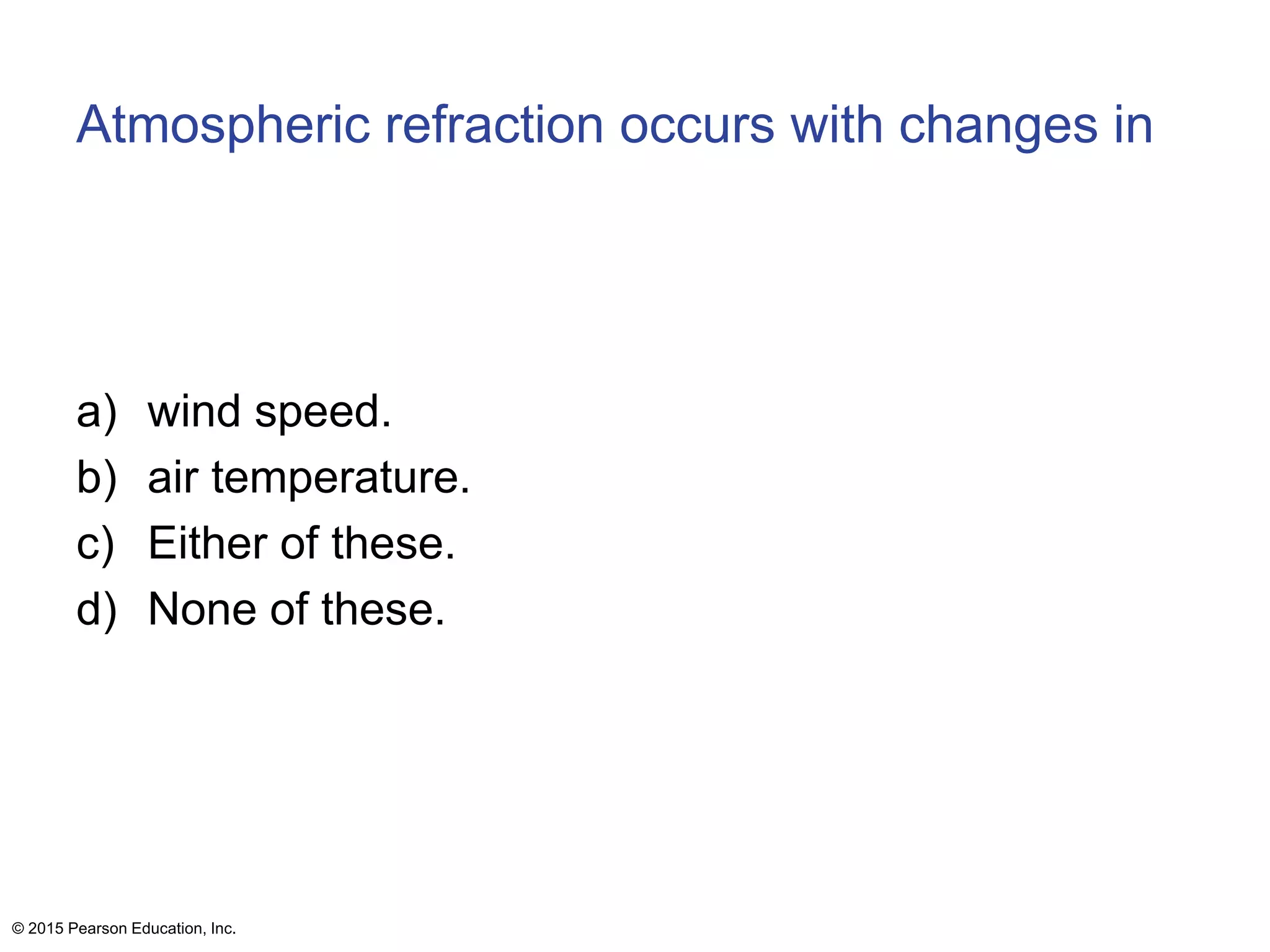
Atmospheric refraction occurs with changes in
a) wind speed.
b) air temperature.
c) Either of these.
d) None of these.
© 2015 Pearson Education, Inc.
Atmospheric refraction occurs with changes in
a) wind speed.
b) air temperature.
c) Either of these.
d) None of these.
Comment:
Interestingly, sound refraction does depend on wind
speeds.
© 2015 Pearson Education, Inc.
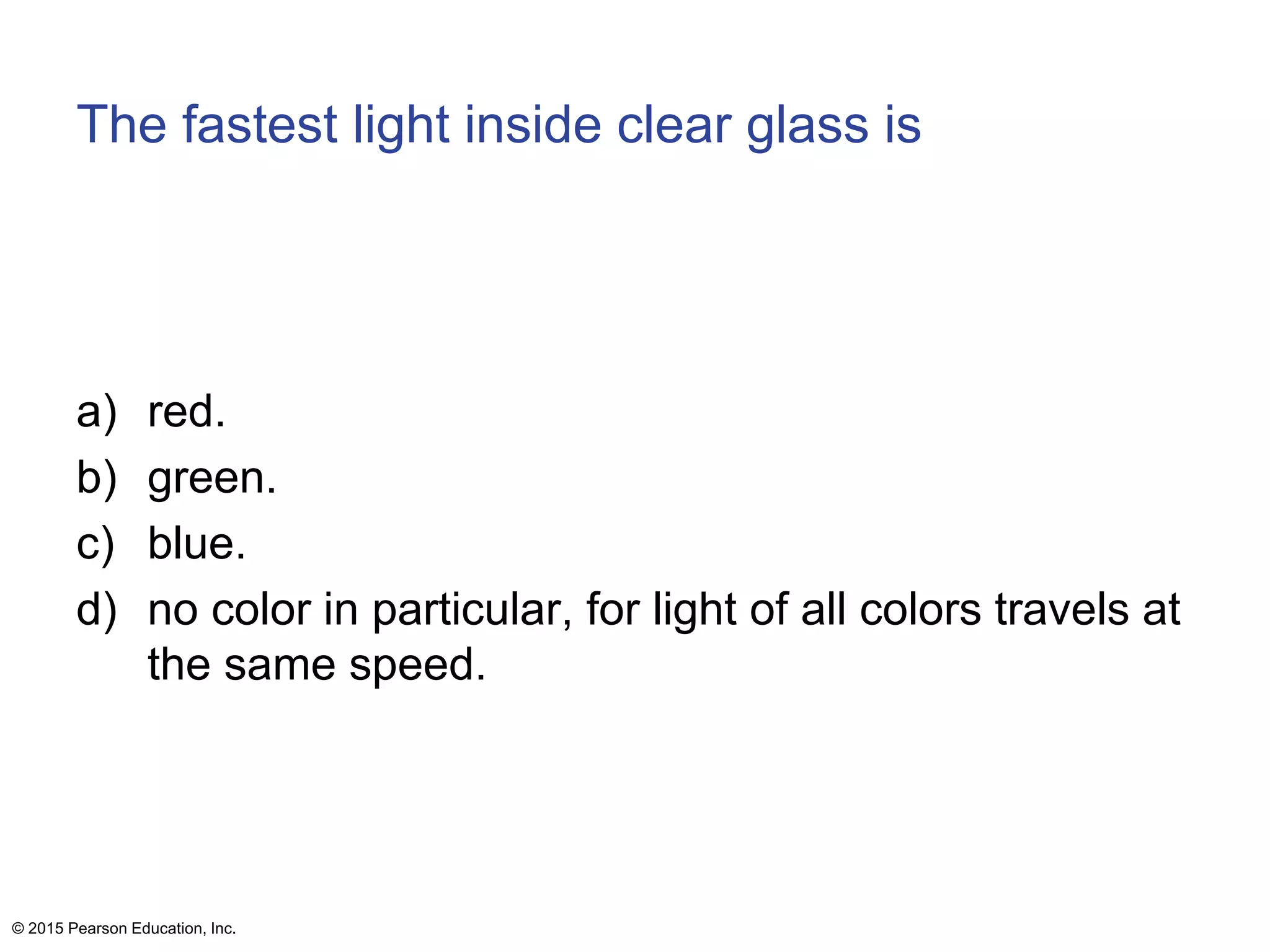
The fastest light inside clear glass is
a) red.
b) green.
c) blue.
d) no color in particular, for light of all colors travels at
the same speed.
© 2015 Pearson Education, Inc.
The fastest light inside clear glass is
a) red.
b) green.
c) blue.
d) no color in particular, for light of all colors travels at
the same speed.
© 2015 Pearson Education, Inc.
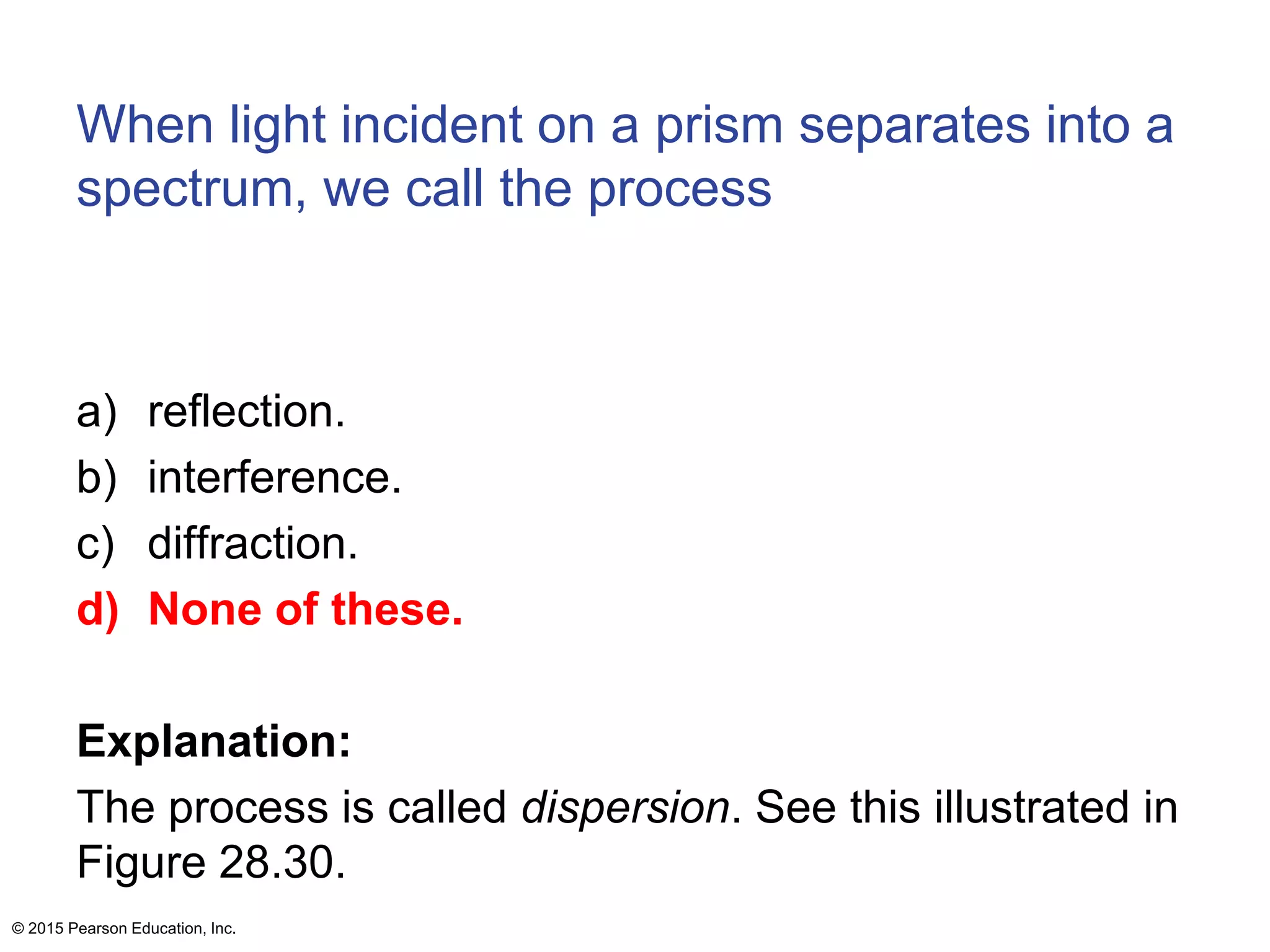
When light incident on a prism separates into a
spectrum, we call the process
a) reflection.
b) interference.
c) diffraction.
d) None of these.
© 2015 Pearson Education, Inc.
When light incident on a prism separates into a
spectrum, we call the process
a) reflection.
b) interference.
c) diffraction.
d) None of these.
Explanation:
The process is called dispersion. See this illustrated in
Figure 28.30.
© 2015 Pearson Education, Inc.
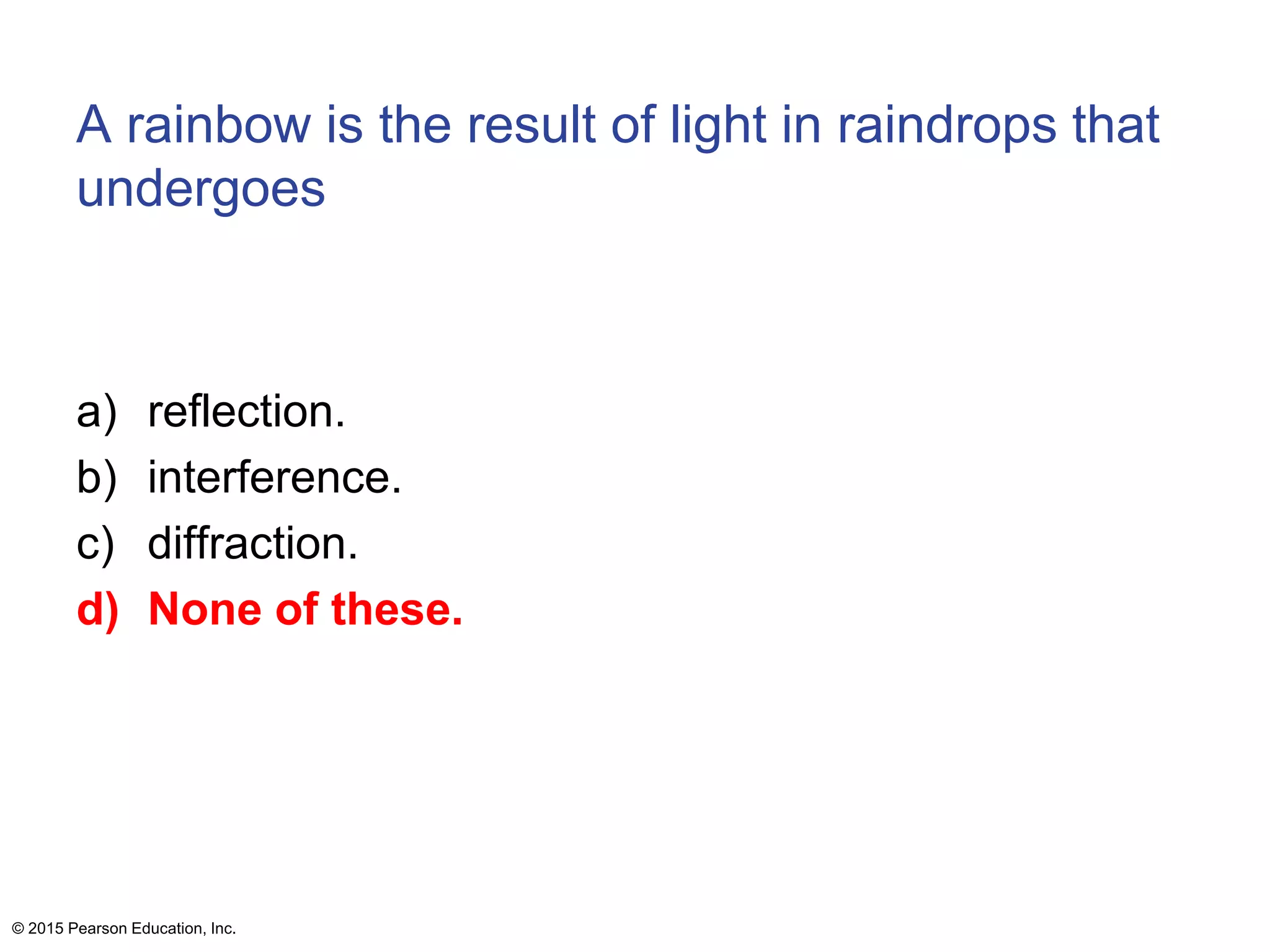
A rainbow is the result of light in raindrops that
undergoes
a) reflection.
b) interference.
c) diffraction.
d) None of these.
© 2015 Pearson Education, Inc.
A rainbow is the result of light in raindrops that
undergoes
a) reflection.
b) interference.
c) diffraction.
d) None of these.
© 2015 Pearson Education, Inc.
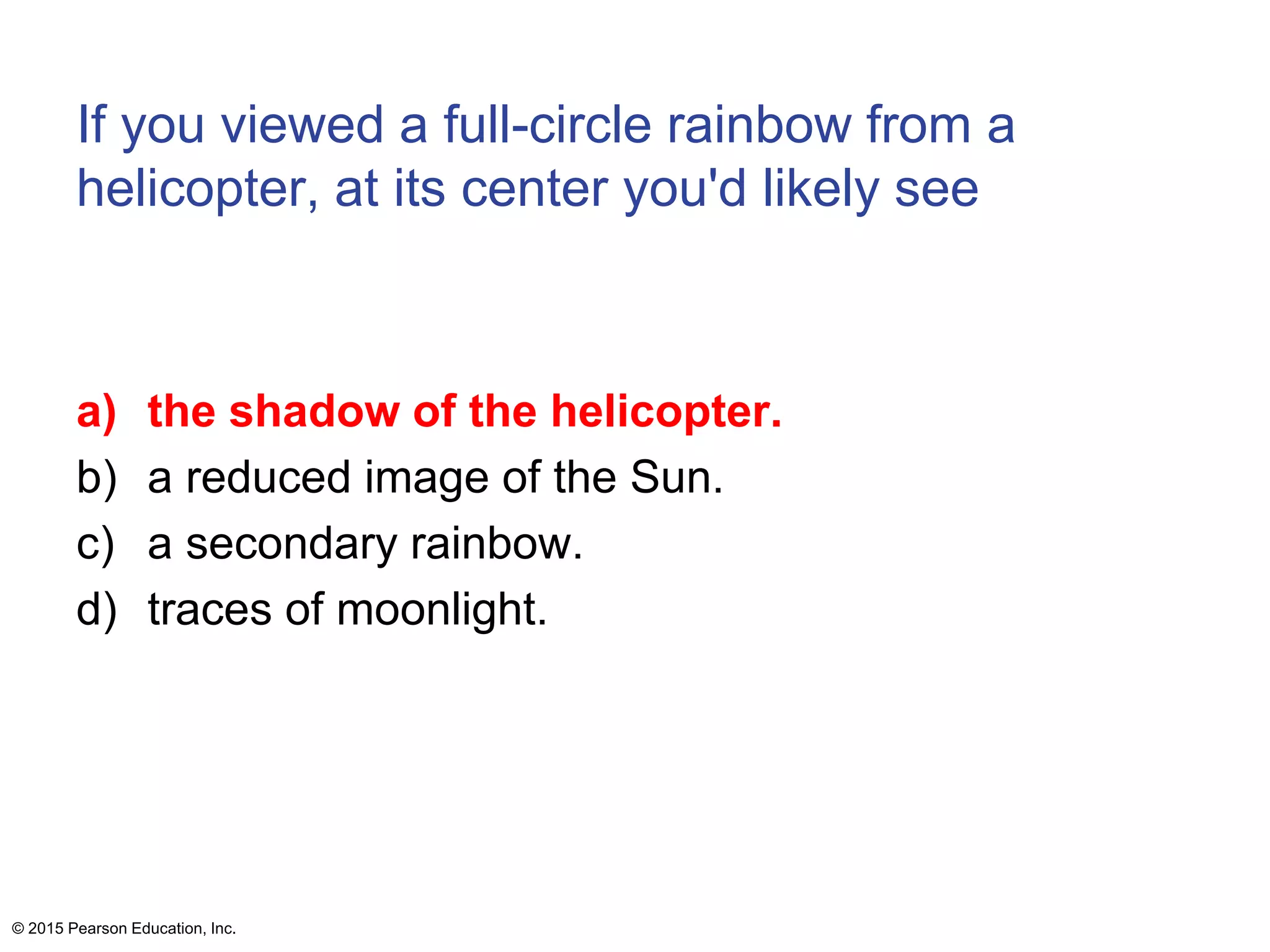
If you viewed a full-circle rainbow from a
helicopter, at its center you'd likely see
a) the shadow of the helicopter.
b) a reduced image of the Sun.
c) a secondary rainbow.
d) traces of moonlight.
© 2015 Pearson Education, Inc.
If you viewed a full-circle rainbow from a
helicopter, at its center you'd likely see
a) the shadow of the helicopter.
b) a reduced image of the Sun.
c) a secondary rainbow.
d) traces of moonlight.
© 2015 Pearson Education, Inc.
The critical angle in total internal reflection
occurs when incident light on a surface is
a) refracted at 90º to the normal.
b) reflected at 90º to the normal.
c) at maximum diffraction.
d) totally absorbed.
© 2015 Pearson Education, Inc.
The critical angle in total internal reflection
occurs when incident light on a surface is
a) refracted at 90º to the normal.
b) reflected at 90º to the normal.
c) at maximum diffraction.
d) totally absorbed.
Explanation:
When the light refracts at right angles to the normal, none
crosses the surface and maximum light is reflected back into the
medium. (This question is a curve buster for many students.)
© 2015 Pearson Education, Inc.
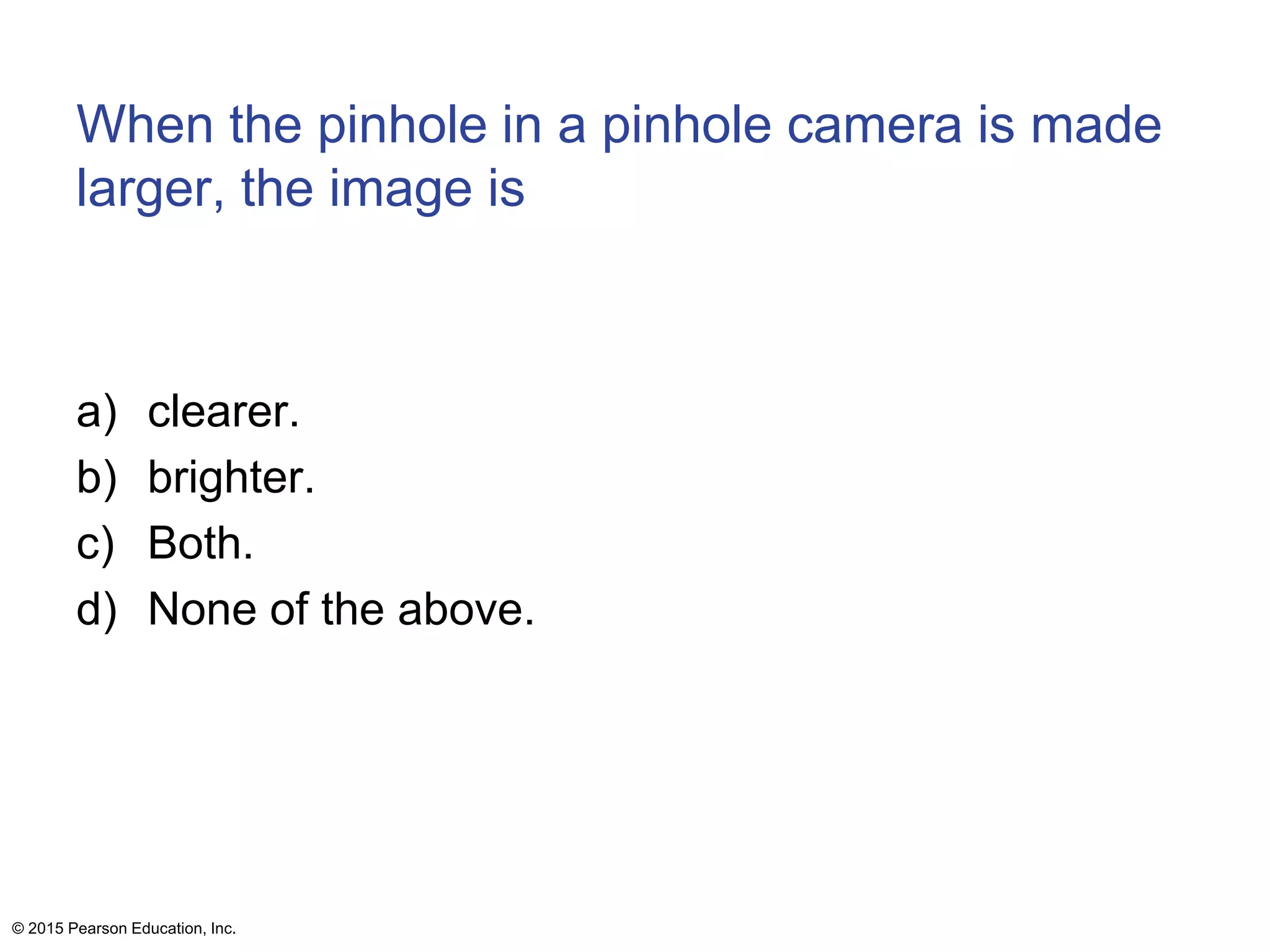
When the pinhole in a pinhole camera is made
larger, the image is
a) clearer.
b) brighter.
c) Both.
d) None of the above.
© 2015 Pearson Education, Inc.
When the pinhole in a pinhole camera is made
larger, the image is
a) clearer.
b) brighter.
c) Both.
d) None of the above.
© 2015 Pearson Education, Inc.
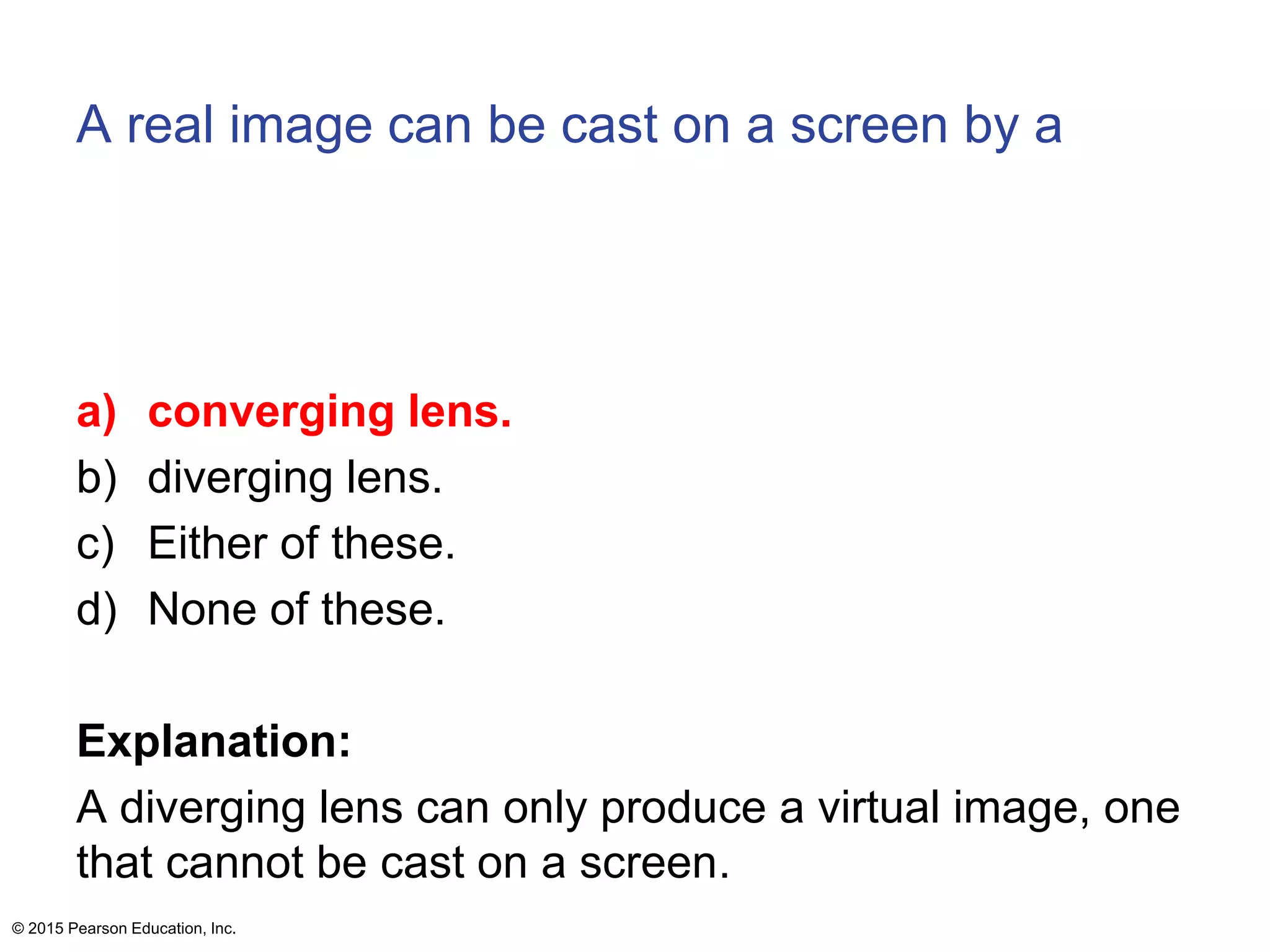
A real image can be cast on a screen by a
a) converging lens.
b) diverging lens.
c) Either of these.
d) None of these.
© 2015 Pearson Education, Inc.
A real image can be cast on a screen by a
a) converging lens.
b) diverging lens.
c) Either of these.
d) None of these.
Explanation:
A diverging lens can only produce a virtual image, one
that cannot be cast on a screen.
© 2015 Pearson Education, Inc.
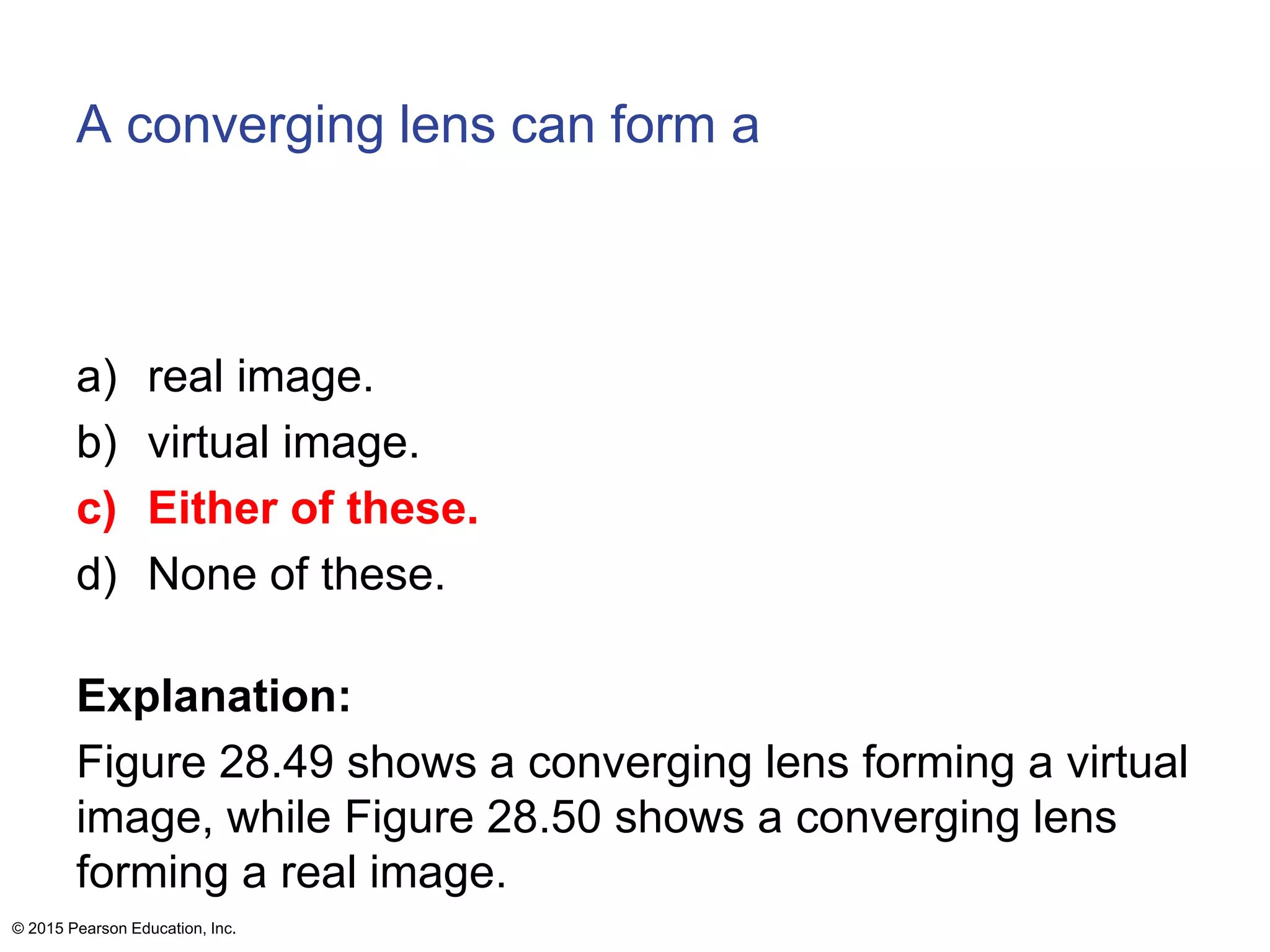
A converging lens can form a
a) real image.
b) virtual image.
c) Either of these.
d) None of these.
© 2015 Pearson Education, Inc.
A converging lens can form a
a) real image.
b) virtual image.
c) Either of these.
d) None of these.
Explanation:
Figure 28.49 shows a converging lens forming a virtual
image, while Figure 28.50 shows a converging lens
forming a real image.
© 2015 Pearson Education, Inc.
The amount of light entering a camera or your
eye is regulated by
a) a photosensitive surface or retina.
b) a diaphragm.
c) an eyepiece.
d) a pair of lenses.
© 2015 Pearson Education, Inc.
The amount of light entering a camera or your
eye is regulated by
a) a photosensitive surface or retina.
b) a diaphragm.
c) an eyepiece.
d) a pair of lenses.
© 2015 Pearson Education, Inc.
The glasses of a nearsighted person are
usually thicker at the
a) middle.
b) edges.
c) Either of these.
d) None of these.
© 2015 Pearson Education, Inc.
The glasses of a nearsighted person are
usually thicker at the
a) middle.
b) edges.
c) Either of these.
d) None of these.
© 2015 Pearson Education, Inc.
Eyeglasses correct for light distortions called
a) spherical aberrations.
b) chromatic aberrations.
c) Either of these.
d) None of these.
© 2015 Pearson Education, Inc.
Eyeglasses correct for light distortions called
a) spherical aberrations.
b) chromatic aberrations.
c) Either of these.
d) None of these.
© 2015 Pearson Education, Inc.

28 clicker questions

  • 1.
    Clicker Questions Chapter 28: Reflectionand Refraction © 2015 Pearson Education, Inc.
  • 2.
    Light takes thepath from one point to another that is a) quickest. b) shortest. c) closest to a straight line. d) None of these. © 2015 Pearson Education, Inc.
  • 3.
    Light takes thepath from one point to another that is a) quickest. b) shortest. c) closest to a straight line. d) None of these. Comment: Light takes the path of least time, which, said another way, is the quickest. © 2015 Pearson Education, Inc.
  • 4.
    When light meetsa polished reflecting surface a) all of it reflects. b) it partly reflects. c) most is absorbed. d) it refracts, not reflects. © 2015 Pearson Education, Inc.
  • 5.
    When light meetsa polished reflecting surface a) all of it reflects. b) it partly reflects. c) most is absorbed. d) it refracts, not reflects. Comment: Fortune and fame await the discoverer of a surface that reflects all incident light! © 2015 Pearson Education, Inc.
  • 6.
    Your reflected imagein a plane mirror is as far behind the mirror as a) half your height. b) half your distance from the mirror. c) your distance from the mirror. d) twice your distance from the mirror. © 2015 Pearson Education, Inc.
  • 7.
    Your reflected imagein a plane mirror is as far behind the mirror as a) half your height. b) half your distance from the mirror. c) your distance from the mirror. d) twice your distance from the mirror. © 2015 Pearson Education, Inc.
  • 8.
    To see yourfull-height image in a wall mirror, the minimum height of the mirror should be a) at least one-quarter your height. b) half your height. c) the same as your height. d) dependent on your distance in front of the mirror. © 2015 Pearson Education, Inc.
  • 9.
    To see yourfull-height image in a wall mirror, the minimum height of the mirror should be a) at least one-quarter your height. b) half your height. c) the same as your height. d) dependent on your distance in front of the mirror. © 2015 Pearson Education, Inc.
  • 10.
    The image ofyourself in a mirror is actually reversed a) left to right. b) up to down. c) front to back. d) All of the above. © 2015 Pearson Education, Inc.
  • 11.
    The image ofyourself in a mirror is actually reversed a) left to right. b) up to down. c) front to back. d) All of the above. © 2015 Pearson Education, Inc.
  • 12.
    Whether a particularsurface acts as a polished reflector or a diffuse reflector depends on the a) color of reflected light. b) brightness of reflected light. c) wavelength of light. d) angle of incoming light. © 2015 Pearson Education, Inc.
  • 13.
    Whether a particularsurface acts as a polished reflector or a diffuse reflector depends on the a) color of reflected light. b) brightness of reflected light. c) wavelength of light. d) angle of incoming light. © 2015 Pearson Education, Inc.
  • 14.
    Refracted light thatbends away from the normal is light that has a) slowed down. b) speeded up. c) bounced. d) diffracted. © 2015 Pearson Education, Inc.
  • 15.
    Refracted light thatbends away from the normal is light that has a) slowed down. b) speeded up. c) bounced. d) diffracted. © 2015 Pearson Education, Inc.
  • 16.
    Atmospheric refraction occurswith changes in a) wind speed. b) air temperature. c) Either of these. d) None of these. © 2015 Pearson Education, Inc.
  • 17.
    Atmospheric refraction occurswith changes in a) wind speed. b) air temperature. c) Either of these. d) None of these. Comment: Interestingly, sound refraction does depend on wind speeds. © 2015 Pearson Education, Inc.
  • 18.
    The fastest lightinside clear glass is a) red. b) green. c) blue. d) no color in particular, for light of all colors travels at the same speed. © 2015 Pearson Education, Inc.
  • 19.
    The fastest lightinside clear glass is a) red. b) green. c) blue. d) no color in particular, for light of all colors travels at the same speed. © 2015 Pearson Education, Inc.
  • 20.
    When light incidenton a prism separates into a spectrum, we call the process a) reflection. b) interference. c) diffraction. d) None of these. © 2015 Pearson Education, Inc.
  • 21.
    When light incidenton a prism separates into a spectrum, we call the process a) reflection. b) interference. c) diffraction. d) None of these. Explanation: The process is called dispersion. See this illustrated in Figure 28.30. © 2015 Pearson Education, Inc.
  • 22.
    A rainbow isthe result of light in raindrops that undergoes a) reflection. b) interference. c) diffraction. d) None of these. © 2015 Pearson Education, Inc.
  • 23.
    A rainbow isthe result of light in raindrops that undergoes a) reflection. b) interference. c) diffraction. d) None of these. © 2015 Pearson Education, Inc.
  • 24.
    If you vieweda full-circle rainbow from a helicopter, at its center you'd likely see a) the shadow of the helicopter. b) a reduced image of the Sun. c) a secondary rainbow. d) traces of moonlight. © 2015 Pearson Education, Inc.
  • 25.
    If you vieweda full-circle rainbow from a helicopter, at its center you'd likely see a) the shadow of the helicopter. b) a reduced image of the Sun. c) a secondary rainbow. d) traces of moonlight. © 2015 Pearson Education, Inc.
  • 26.
    The critical anglein total internal reflection occurs when incident light on a surface is a) refracted at 90º to the normal. b) reflected at 90º to the normal. c) at maximum diffraction. d) totally absorbed. © 2015 Pearson Education, Inc.
  • 27.
    The critical anglein total internal reflection occurs when incident light on a surface is a) refracted at 90º to the normal. b) reflected at 90º to the normal. c) at maximum diffraction. d) totally absorbed. Explanation: When the light refracts at right angles to the normal, none crosses the surface and maximum light is reflected back into the medium. (This question is a curve buster for many students.) © 2015 Pearson Education, Inc.
  • 28.
    When the pinholein a pinhole camera is made larger, the image is a) clearer. b) brighter. c) Both. d) None of the above. © 2015 Pearson Education, Inc.
  • 29.
    When the pinholein a pinhole camera is made larger, the image is a) clearer. b) brighter. c) Both. d) None of the above. © 2015 Pearson Education, Inc.
  • 30.
    A real imagecan be cast on a screen by a a) converging lens. b) diverging lens. c) Either of these. d) None of these. © 2015 Pearson Education, Inc.
  • 31.
    A real imagecan be cast on a screen by a a) converging lens. b) diverging lens. c) Either of these. d) None of these. Explanation: A diverging lens can only produce a virtual image, one that cannot be cast on a screen. © 2015 Pearson Education, Inc.
  • 32.
    A converging lenscan form a a) real image. b) virtual image. c) Either of these. d) None of these. © 2015 Pearson Education, Inc.
  • 33.
    A converging lenscan form a a) real image. b) virtual image. c) Either of these. d) None of these. Explanation: Figure 28.49 shows a converging lens forming a virtual image, while Figure 28.50 shows a converging lens forming a real image. © 2015 Pearson Education, Inc.
  • 34.
    The amount oflight entering a camera or your eye is regulated by a) a photosensitive surface or retina. b) a diaphragm. c) an eyepiece. d) a pair of lenses. © 2015 Pearson Education, Inc.
  • 35.
    The amount oflight entering a camera or your eye is regulated by a) a photosensitive surface or retina. b) a diaphragm. c) an eyepiece. d) a pair of lenses. © 2015 Pearson Education, Inc.
  • 36.
    The glasses ofa nearsighted person are usually thicker at the a) middle. b) edges. c) Either of these. d) None of these. © 2015 Pearson Education, Inc.
  • 37.
    The glasses ofa nearsighted person are usually thicker at the a) middle. b) edges. c) Either of these. d) None of these. © 2015 Pearson Education, Inc.
  • 38.
    Eyeglasses correct forlight distortions called a) spherical aberrations. b) chromatic aberrations. c) Either of these. d) None of these. © 2015 Pearson Education, Inc.
  • 39.
    Eyeglasses correct forlight distortions called a) spherical aberrations. b) chromatic aberrations. c) Either of these. d) None of these. © 2015 Pearson Education, Inc.