UNIT 1.2 – DAILY
SHEET 1
Articles of Confederation
Learning Objective


What weaknesses of the Articles of
Confederation had a detrimental effect on
the “public good” of the United States?
Do Now (Academic Vocabulary)
Ratify: Sign or give formal consent to (a
treaty, contract, or agreement), making it
officially valid.
 Amend: make minor changes in (a text) in
order to make it fairer, more accurate, or
more up-to-date.

Articles of Confederation




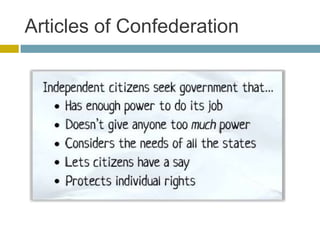
Independent Citizens Seek Awesome
Government
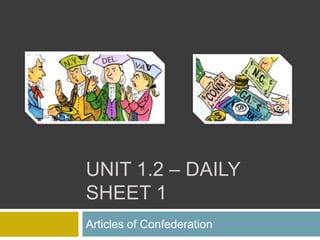
When the colonists gained their independence
from the British after the Revolutionary
War, the Americans were faced with a
problem: What kind of government should
they have? They’d lived for years under
British rule, and they had lots of complaints.
Now they would create a government from
scratch, and they had a few requirements.
Articles of Confederation
Independent Citizens Seek Awesome (WEAK) Government
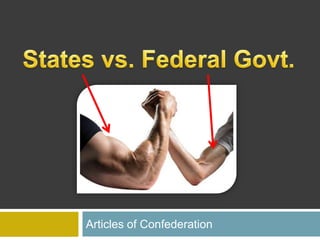
 Heavy-handed British rule left the newly independent
Americans feeling nervous. Basically, they wanted a govt.
that couldn’t do much. They started by writing the Articles of
Confederation. A confederation is a group of individuals
united together for a purpose—in this case, the 13 states that
had been British colonies before the war. The Articles of
Confederation explained how the 13 states would be
governed as one nation.






Each state was independent and had its own government.
Each state would send representatives to the ―Congress of the
Confederation,‖ a lawmaking body.
Congress was the only branch of government. (No president or
courts.)
In Congress, each state got 1 vote.
Articles of Confederation
A Rocky Start
 Pros:
 The Articles of Confederation had qualities that citizens liked.
Because they didn’t set up a very strong government, states got to
keep their power and independence. There was no powerful
government telling them what to do. Citizens also wanted
protection, and the Articles gave Congress the power to create a
military to protect all the states.



Cons:
However, there were problems. For one thing, the Articles did not
give Congress the power to enforce laws. Congress also had no
power to collect taxes to pay for the military. And in order to change
the Articles, every single state had to agree to the changes. Thus,
citizens felt the govt., wasn't working.
Articles of Confederation
Lots of Differences
 With 13 different states, there was no easy solution. Here’s
why:






States had different needs. i.e. some states depended on fishing,
others grew crops.
States had different sizes. Some states had many people; others
had few.
People had different opinions. Some people feared a central
government, while others thought a central government was
necessary.

That last one was especially troublesome. Many people
feared they would lose their freedom if a central government
had too much power. Others were tired of the weak
government created under the Articles of Confederation and
felt like nothing would ever get done if nobody was in charge.
Articles of Confederation
Compromise?
 States decided to put aside some differences and come
together to try to solve the problem of forming another
government.
 New idea: Instead of a government with just 1 branch,
Congress, why not create a government with 3 branches?
 The new govt. could have a legislative branch (to make laws),
an executive branch led by a president (to carry out laws),
and a judicial branch with courts (to interpret laws).
 It sounded good, but one major sticking point kept it from
moving forward: How many votes would each state get in the
Congress?
Articles of Confederation
Voting in Congress: Yes, It’s a Big Deal
 Why? Because some states have a large population and
some have a small population.
 Under the Articles of Confederation, each state got one vote
no matter how many people it had.
 That meant people in large states had less influence in
Congress. Naturally, large states thought this wasn’t fair.
They thought they should get more votes because they had
more people.
 Small states, however, thought it was a pretty good deal.
Even though they were small, they had the same amount of
power and influence as large states. They wanted to keep a
one-vote-per-state system.
Articles of Confederation
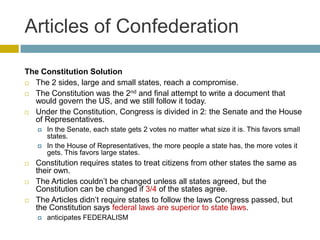
The Constitution Solution
 The 2 sides, large and small states, reach a compromise.
 The Constitution was the 2nd and final attempt to write a document that
would govern the US, and we still follow it today.
 Under the Constitution, Congress is divided in 2: the Senate and the House
of Representatives.








In the Senate, each state gets 2 votes no matter what size it is. This favors small
states.
In the House of Representatives, the more people a state has, the more votes it
gets. This favors large states.

Constitution requires states to treat citizens from other states the same as
their own.
The Articles couldn’t be changed unless all states agreed, but the
Constitution can be changed if 3/4 of the states agree.
The Articles didn’t require states to follow the laws Congress passed, but
the Constitution says federal laws are superior to state laws.


anticipates FEDERALISM
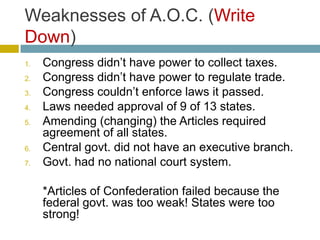
Weaknesses of A.O.C. (Write
Down)
1.
2.
3.
4.
5.

6.
7.

Congress didn’t have power to collect taxes.
Congress didn’t have power to regulate trade.
Congress couldn’t enforce laws it passed.
Laws needed approval of 9 of 13 states.
Amending (changing) the Articles required
agreement of all states.
Central govt. did not have an executive branch.
Govt. had no national court system.

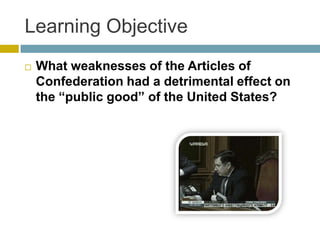
*Articles of Confederation failed because the
federal govt. was too weak! States were too
strong!
Articles of Confederation (Write
Down)








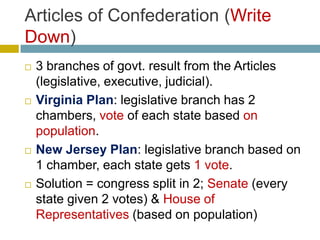
3 branches of govt. result from the Articles
(legislative, executive, judicial).
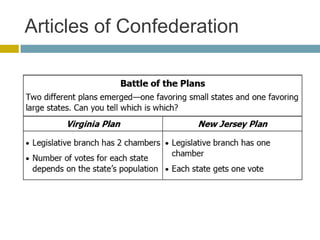
Virginia Plan: legislative branch has 2
chambers, vote of each state based on
population.
New Jersey Plan: legislative branch based on
1 chamber, each state gets 1 vote.
Solution = congress split in 2; Senate (every
state given 2 votes) & House of
Representatives (based on population)
Exit Ticket


Would you favor strong central government or
a weak central government? Explain.

1.2 day 1 freedom vs. security

  • 1.
    UNIT 1.2 –DAILY SHEET 1 Articles of Confederation
  • 2.
  • 3.
    Learning Objective  What weaknessesof the Articles of Confederation had a detrimental effect on the “public good” of the United States?
  • 4.
    Do Now (AcademicVocabulary) Ratify: Sign or give formal consent to (a treaty, contract, or agreement), making it officially valid.  Amend: make minor changes in (a text) in order to make it fairer, more accurate, or more up-to-date. 
  • 5.
    Articles of Confederation   IndependentCitizens Seek Awesome Government When the colonists gained their independence from the British after the Revolutionary War, the Americans were faced with a problem: What kind of government should they have? They’d lived for years under British rule, and they had lots of complaints. Now they would create a government from scratch, and they had a few requirements.
  • 6.
  • 7.
    Articles of Confederation IndependentCitizens Seek Awesome (WEAK) Government  Heavy-handed British rule left the newly independent Americans feeling nervous. Basically, they wanted a govt. that couldn’t do much. They started by writing the Articles of Confederation. A confederation is a group of individuals united together for a purpose—in this case, the 13 states that had been British colonies before the war. The Articles of Confederation explained how the 13 states would be governed as one nation.     Each state was independent and had its own government. Each state would send representatives to the ―Congress of the Confederation,‖ a lawmaking body. Congress was the only branch of government. (No president or courts.) In Congress, each state got 1 vote.
  • 8.
    Articles of Confederation ARocky Start  Pros:  The Articles of Confederation had qualities that citizens liked. Because they didn’t set up a very strong government, states got to keep their power and independence. There was no powerful government telling them what to do. Citizens also wanted protection, and the Articles gave Congress the power to create a military to protect all the states.   Cons: However, there were problems. For one thing, the Articles did not give Congress the power to enforce laws. Congress also had no power to collect taxes to pay for the military. And in order to change the Articles, every single state had to agree to the changes. Thus, citizens felt the govt., wasn't working.
  • 9.
    Articles of Confederation Lotsof Differences  With 13 different states, there was no easy solution. Here’s why:     States had different needs. i.e. some states depended on fishing, others grew crops. States had different sizes. Some states had many people; others had few. People had different opinions. Some people feared a central government, while others thought a central government was necessary. That last one was especially troublesome. Many people feared they would lose their freedom if a central government had too much power. Others were tired of the weak government created under the Articles of Confederation and felt like nothing would ever get done if nobody was in charge.
  • 10.
    Articles of Confederation Compromise? States decided to put aside some differences and come together to try to solve the problem of forming another government.  New idea: Instead of a government with just 1 branch, Congress, why not create a government with 3 branches?  The new govt. could have a legislative branch (to make laws), an executive branch led by a president (to carry out laws), and a judicial branch with courts (to interpret laws).  It sounded good, but one major sticking point kept it from moving forward: How many votes would each state get in the Congress?
  • 11.
    Articles of Confederation Votingin Congress: Yes, It’s a Big Deal  Why? Because some states have a large population and some have a small population.  Under the Articles of Confederation, each state got one vote no matter how many people it had.  That meant people in large states had less influence in Congress. Naturally, large states thought this wasn’t fair. They thought they should get more votes because they had more people.  Small states, however, thought it was a pretty good deal. Even though they were small, they had the same amount of power and influence as large states. They wanted to keep a one-vote-per-state system.
  • 12.
  • 13.
    Articles of Confederation TheConstitution Solution  The 2 sides, large and small states, reach a compromise.  The Constitution was the 2nd and final attempt to write a document that would govern the US, and we still follow it today.  Under the Constitution, Congress is divided in 2: the Senate and the House of Representatives.      In the Senate, each state gets 2 votes no matter what size it is. This favors small states. In the House of Representatives, the more people a state has, the more votes it gets. This favors large states. Constitution requires states to treat citizens from other states the same as their own. The Articles couldn’t be changed unless all states agreed, but the Constitution can be changed if 3/4 of the states agree. The Articles didn’t require states to follow the laws Congress passed, but the Constitution says federal laws are superior to state laws.  anticipates FEDERALISM
  • 14.
    Weaknesses of A.O.C.(Write Down) 1. 2. 3. 4. 5. 6. 7. Congress didn’t have power to collect taxes. Congress didn’t have power to regulate trade. Congress couldn’t enforce laws it passed. Laws needed approval of 9 of 13 states. Amending (changing) the Articles required agreement of all states. Central govt. did not have an executive branch. Govt. had no national court system. *Articles of Confederation failed because the federal govt. was too weak! States were too strong!
  • 15.
    Articles of Confederation(Write Down)     3 branches of govt. result from the Articles (legislative, executive, judicial). Virginia Plan: legislative branch has 2 chambers, vote of each state based on population. New Jersey Plan: legislative branch based on 1 chamber, each state gets 1 vote. Solution = congress split in 2; Senate (every state given 2 votes) & House of Representatives (based on population)
  • 16.
    Exit Ticket  Would youfavor strong central government or a weak central government? Explain.