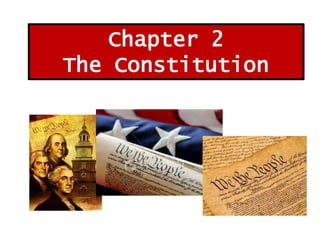






Chapter 2
The Constitution
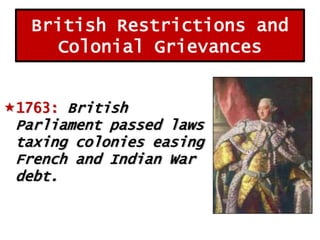
British Restrictions and
Colonial Grievances
1763: British

Parliament passed laws
taxing colonies easing
French and Indian War
debt.
Two taxes were Sugar and Stamp Act

Colonists respond.
Boycott English goods.
Stamp Act repealed!
Victory fostered hope and unity
among colonists.
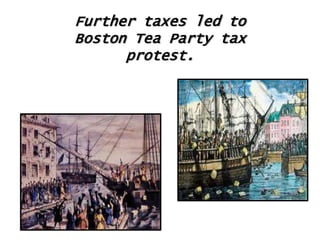
Further taxes led to
Boston Tea Party tax
protest.
Thomas Paine wrote “Common Sense”
(Jan 1776)

 500,000



copies sold
1/6 of American population at time
Key to changing direction of debate
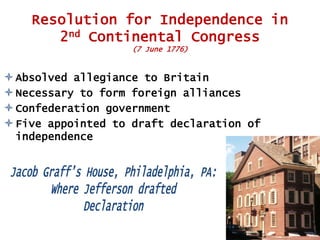
Resolution for Independence in
2nd Continental Congress
(7 June 1776)

 Absolved allegiance to Britain
 Necessary to form foreign alliances
 Confederation government
 Five appointed to draft declaration of
independence
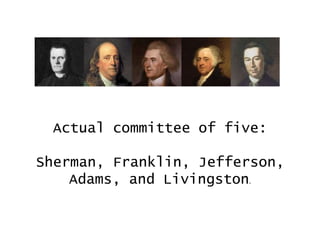
Actual committee of five:
Sherman, Franklin, Jefferson,
Adams, and Livingston.
Resolution for independence
adopted on 2 July 1776
John Adams letter to his wife,
Abigail
“July, 1776, will be the most memorable epoch
in history of America. I am apt to believe
that it will be celebrated by succeeding
generations as the great anniversary Festival.
It ought to be commemorated, as the Day of
Deliverance, by solemn acts of devotion to God
Almighty. It ought to be solemnized with pomp
and parade, with shows, games, sports, guns,
bells, bonfires and illuminations, from one
end of this continent to the other, from this
time forward forever.”
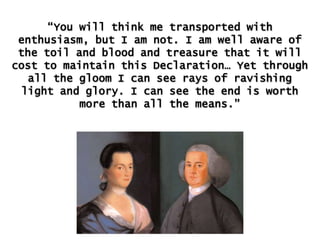
“You will think me transported with
enthusiasm, but I am not. I am well aware of
the toil and blood and treasure that it will
cost to maintain this Declaration… Yet through
all the gloom I can see rays of ravishing
light and glory. I can see the end is worth
more than all the means.”
The Declaration of Independence

Preamble

 Laws of Nature & of Nature’s God
 Endowed by Creator…

 Right to abolish destructive

government & replace with new
government

 Written to provide evidence to
world
The Declaration of Independence

Dissolved political
connection with Britain

Full power to act
independently

Pledged unity under God

Pledged their lives,
fortunes, and sacred honor
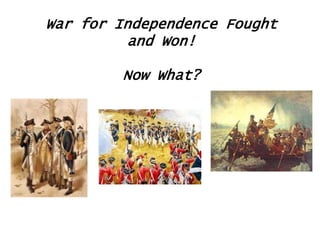
War for Independence Fought
and Won!
Now What?
ARTICLES OF
CONFEDERATION
Official title: Articles of
Confederation & Perpetual Union
Nation’s first Constitution
Approved by Congress November 1777
Ratified by final state March 1781
• Reaction To King George III

and centralized power
• Didn’t Work

• Federal Government Too Weak
• States Too Strong
Weaknesses of
Confederation
 No separate executive branch
 No direct power of taxation by Congress
 No court system to settle state
disputes
 Little respect for national
government

 Loss of unity & union among states

 Economic chaos (Shays' Rebellion)
 Called to deal with weaknesses of
Articles of Confederation

 Only 5 states attended
 Some wanted to completely abolish
articles for a new constitution
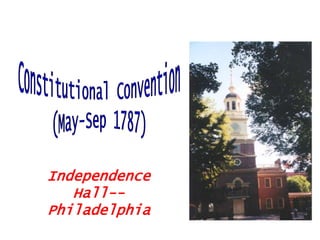
Independence
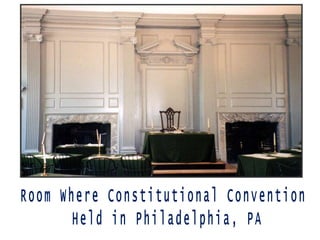
Hall-Philadelphia
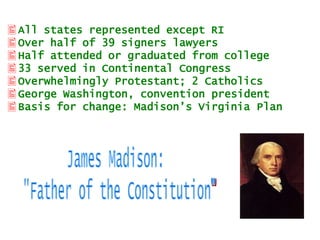
All states represented except RI
Over half of 39 signers lawyers
Half attended or graduated from college
33 served in Continental Congress
Overwhelmingly Protestant; 2 Catholics
George Washington, convention president
Basis for change: Madison’s Virginia Plan
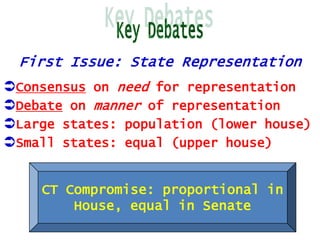
First Issue: State Representation
Consensus on need for representation
Debate on manner of representation
Large states: population (lower house)
Small states: equal (upper house)
CT Compromise: proportional in
House, equal in Senate
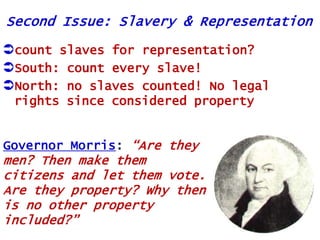
Second Issue: Slavery & Representation
count slaves for representation?
South: count every slave!
North: no slaves counted! No legal
rights since considered property

Governor Morris: “Are they

men? Then make them
citizens and let them vote.
Are they property? Why then
is no other property
included?”
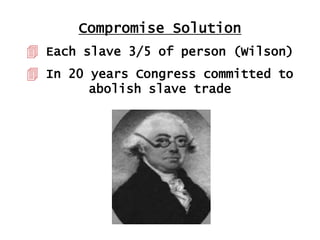
Compromise Solution
 Each slave 3/5 of person (Wilson)
 In 20 years Congress committed to
abolish slave trade
Purpose of convention:
~ Set up framework for government
~ policy decisions made later
NO DEBATE NEEDED HERE!
RIGHTS ALL FOUNDERS AGREED SHOULD BE
IN NEW CONSTITUTION…

 Right to Writ of Habeas Corpus

 Protection Against Ex-post Facto
Law
 Protection Against Bills of
Attainder
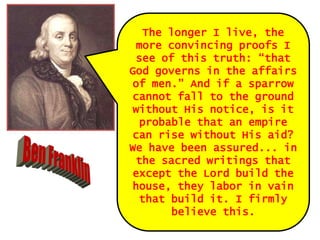
The longer I live, the
more convincing proofs I
see of this truth: “that
God governs in the affairs
of men.” And if a sparrow
cannot fall to the ground
without His notice, is it
probable that an empire
can rise without His aid?
We have been assured... in
the sacred writings that
except the Lord build the
house, they labor in vain
that build it. I firmly
believe this.
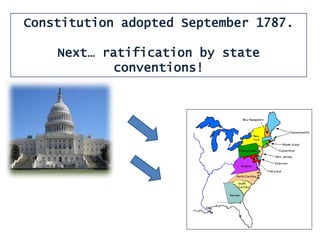
Constitution adopted September 1787.
Next… ratification by state
conventions!
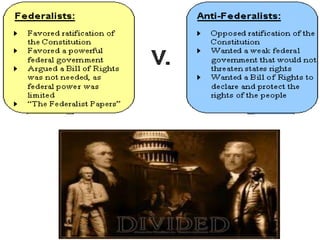
The Federalist Papers
 Arguments favoring ratification
 Best explanation of ideas
expressed in Constitution

 Originally series of 85 newspaper
articles in NY
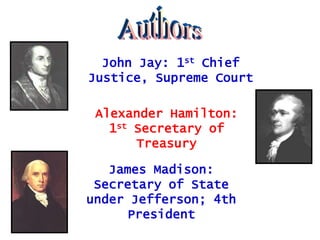
John Jay: 1st Chief
Justice, Supreme Court
Alexander Hamilton:
1st Secretary of
Treasury
James Madison:
Secretary of State
under Jefferson; 4th
President
Message of Papers
 Advantages of union

 Disadvantages of disunion
 Defects of Articles
 Highlight key points in
proposed Constitution
NATURAL RIGHTS IN THE DECLARATION
OF INDEPENDENCE AND AMERICAN
CONSTITUTION?
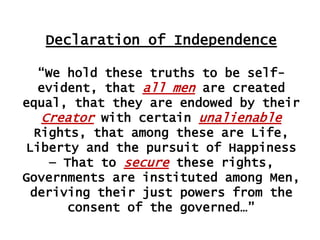
Declaration of Independence
“We hold these truths to be selfevident, that all men are created
equal, that they are endowed by their
Creator with certain unalienable
Rights, that among these are Life,
Liberty and the pursuit of Happiness
— That to secure these rights,
Governments are instituted among Men,
deriving their just powers from the
consent of the governed…”
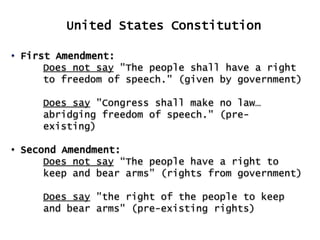
United States Constitution
• First Amendment:
Does not say "The people shall have a right
to freedom of speech." (given by government)
Does say "Congress shall make no law…
abridging freedom of speech." (preexisting)
• Second Amendment:
Does not say “The people have a right to
keep and bear arms” (rights from government)
Does say "the right of the people to keep
and bear arms" (pre-existing rights)
End of Lesson One
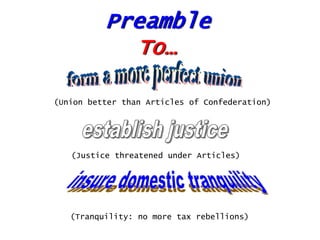
Preamble
To…
(Union better than Articles of Confederation)

(Justice threatened under Articles)

(Tranquility: no more tax rebellions)
(Defense inadequate under Articles)

(General Welfare distinguished from group welfare; laws
that benefit everyone)

(Desire to write a document that could stand
the test of time)
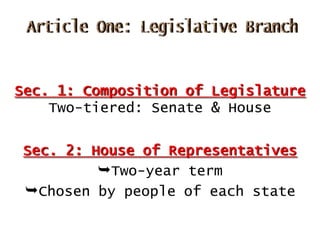
Sec. 1: Composition of Legislature
Two-tiered: Senate & House
Sec. 2: House of Representatives
Two-year term
Chosen by people of each state
Qualifications for representative
• 25 years of age
• U.S. citizen for 7 years
• Resident of state
Representatives & direct taxes

apportioned among states according
to population

Census every 10 years to determine
representation

Granted power of impeachment
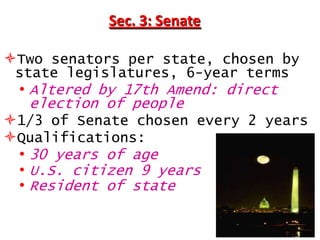
Sec. 3: Senate
Two senators per state, chosen by
state legislatures, 6-year terms

• Altered by 17th Amend: direct
election of people
1/3 of Senate chosen every 2 years
Qualifications:
• 30 years of age
• U.S. citizen 9 years
• Resident of state
• V.P., President of Senate
Votes in case of tie
• Tribunal for impeachment proceedings

 Chief Justice presides over
presidential impeachment
 2/3 vote for impeachment
 Penalties: removal from office;
disqualification for other offices
 Convicted party still liable to
courts
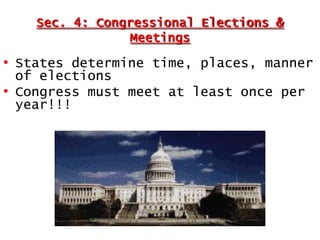
Sec. 4: Congressional Elections &
Meetings

• States determine time, places, manner
of elections
• Congress must meet at least once per
year!!!
Sec. 6: Privileges & Restrictions
Legislators paid out of U.S.
treasury
Freedom from arrest while in
session
No prosecution for speeches on
floor
Sec. 7: Legislation

Laws must be approved by President
President’s veto overridden by 2/3
vote each house

Bills not acted upon by President
in 10 days becomes law
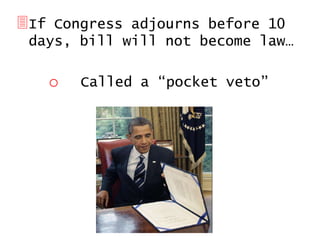
If Congress adjourns before 10
days, bill will not become law…

o

Called a “pocket veto”
Sec. 8: The Taxing Power
Congressional Authority to
Collect Taxes for 3 General
Purposes
Pay debts
Provide for common defense
Provide for general welfare of
United States
[Taxes must] be equally & fairly
applied to all. To take from one,
because it is thought that his own
industry & that of his fathers has
acquired too much, in order to spare
[give] to others, who . . . have not
exercised equal industry & skill, is to
violate arbitrarily the first principle
of association, “the guarantee to
every one of a free exercise of his
industry, & the fruits acquired by
it.”
The Story of the
Little Red Hen
Sec. 9: Protection of Rights of
Citizens

Prohibition of slave trade in 1808
Writ of Habeas corpus not to be
suspended except in case of war
No bill of attainder
Britain: legal judgment on

individual resulting in death.
Does not allow descendants to
inherit land.

America: legislative process

bringing accusations & punishment
without trial by jury & due
process
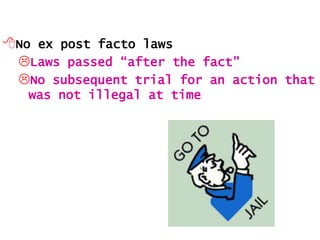
No ex post facto laws
Laws passed “after the fact”
No subsequent trial for an action that
was not illegal at time
Sec. 10: Restrictions on States
Cannot…

…enter treaties with foreign
governments
…coin money, print paper money

No bills of attainder, ex post
facto laws, or grant titles of
nobility
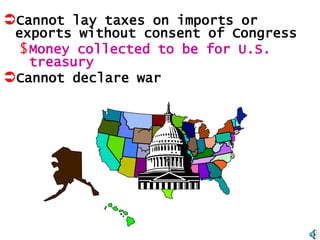
Cannot lay taxes on imports or

exports without consent of Congress
$ Money collected to be for U.S.
treasury
Cannot declare war
“Now more than ever before, the people are
responsible for the character of their
Congress. If that body be ignorant,
reckless and corrupt, it is because the

people tolerate ignorance, recklessness and
corruption. If it be intelligent, brave and
pure, it is because the people demand these
high qualities to represent them in the
national legislature. If the next centennial
does not find us a great nation... it will be
because those who represent the enterprise,
the culture, and the morality of the nation
do not aid in controlling the political
forces.”
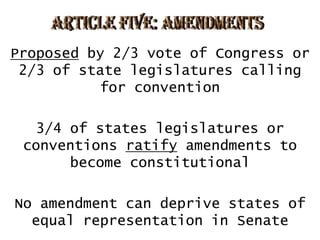
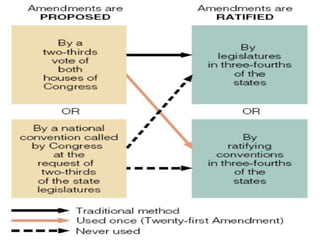
Proposed by 2/3 vote of Congress or
2/3 of state legislatures calling
for convention
3/4 of states legislatures or
conventions ratify amendments to
become constitutional
No amendment can deprive states of
equal representation in Senate
WHO HAVE WE NOT MENTIONED IN
THIS PROCESS?

Madonna?
Lady Gaga?
Spice Girls?
Jay Z?

Or….?
The President

No power to sign amendments
No power to veto amendments

Can politically support or oppose
Other Ways to Change
Constitution not Mentioned
in Constitution
Informal Amendment
Judiciary Review

Popular Amendment
Amendment Process…
Now government could possibly cope
with new and unforeseen problems.
Any Constitutional change should be
taken on with extreme caution.
If process is rigorous, there will
be ample time to consider merits of
change.
Attempts to Amend
Constitution
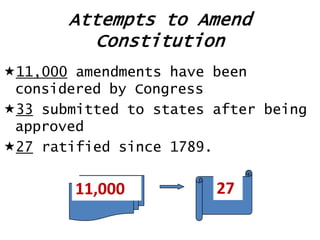
11,000 amendments have been
considered by Congress
33 submitted to states after being
approved
27 ratified since 1789.

11,000

27
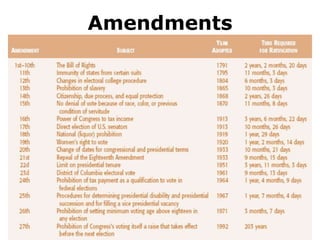
Amendments
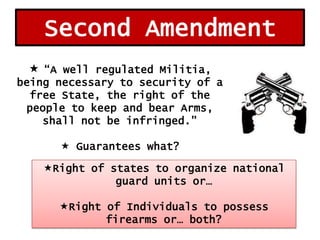
Second Amendment
 “A well regulated Militia,
being necessary to security of a
free State, the right of the
people to keep and bear Arms,
shall not be infringed.”
 Guarantees what?
Right of states to organize national
guard units or…
Right of Individuals to possess
firearms or… both?
The Battle of Athens:
Restoring the Rule of Law
Uploaded on Dec 27, 2011: Battle of
Athens was an armed rebellion led by
WWII veterans and citizens in Athens and
Etowah, Tennessee, against tyrannical
local government in August 1946. (13:32)

http://www.youtube.com/watch?feature=play
er_embedded&v=U5ut6yPrObw#!
Freedom of Religion

Separation of Church and State
• Where is term found?
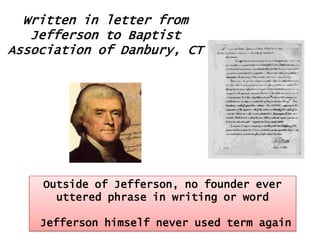
Written in letter from
Jefferson to Baptist
Association of Danbury, CT

Outside of Jefferson, no founder ever
uttered phrase in writing or word
Jefferson himself never used term again
What Did Jefferson Really Mean?
No National Church: that’s it!

 Did not even disestablish state
churches!
 Connecticut’s State Church
(Congregationalist) disestablished in
1818…

 …sixteen years after Jefferson’s 1802
letter
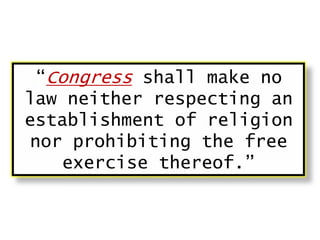
“Congress shall make no
law neither respecting an
establishment of religion
nor prohibiting the free
exercise thereof.”
o To be supreme law of land
o State laws cannot contradict
Constitution

o No religious test required to hold
office
Nine states must approve
Constitution for it to go into
effect
Constitution ratified
in 1788; Washington
unanimously elected
by electoral college
& took office in 1789
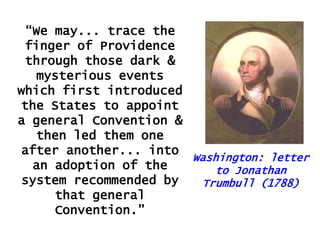
“We may... trace the
finger of Providence
through those dark &
mysterious events
which first introduced
the States to appoint
a general Convention &
then led them one
after another... into
Washington: letter
an adoption of the
to Jonathan
system recommended by
Trumbull (1788)
that general
Convention.”

2 constitution 2 classes

  • 1.
  • 2.
    British Restrictions and ColonialGrievances 1763: British Parliament passed laws taxing colonies easing French and Indian War debt.
  • 3.
    Two taxes wereSugar and Stamp Act Colonists respond. Boycott English goods. Stamp Act repealed! Victory fostered hope and unity among colonists.
  • 4.
    Further taxes ledto Boston Tea Party tax protest.
  • 5.
    Thomas Paine wrote“Common Sense” (Jan 1776)  500,000   copies sold 1/6 of American population at time Key to changing direction of debate
  • 6.
    Resolution for Independencein 2nd Continental Congress (7 June 1776)  Absolved allegiance to Britain  Necessary to form foreign alliances  Confederation government  Five appointed to draft declaration of independence
  • 7.
    Actual committee offive: Sherman, Franklin, Jefferson, Adams, and Livingston.
  • 8.
  • 9.
    John Adams letterto his wife, Abigail “July, 1776, will be the most memorable epoch in history of America. I am apt to believe that it will be celebrated by succeeding generations as the great anniversary Festival. It ought to be commemorated, as the Day of Deliverance, by solemn acts of devotion to God Almighty. It ought to be solemnized with pomp and parade, with shows, games, sports, guns, bells, bonfires and illuminations, from one end of this continent to the other, from this time forward forever.”
  • 10.
    “You will thinkme transported with enthusiasm, but I am not. I am well aware of the toil and blood and treasure that it will cost to maintain this Declaration… Yet through all the gloom I can see rays of ravishing light and glory. I can see the end is worth more than all the means.”
  • 13.
    The Declaration ofIndependence Preamble  Laws of Nature & of Nature’s God  Endowed by Creator…  Right to abolish destructive government & replace with new government  Written to provide evidence to world
  • 14.
    The Declaration ofIndependence Dissolved political connection with Britain Full power to act independently Pledged unity under God Pledged their lives, fortunes, and sacred honor
  • 18.
    War for IndependenceFought and Won! Now What?
  • 19.
    ARTICLES OF CONFEDERATION Official title:Articles of Confederation & Perpetual Union Nation’s first Constitution Approved by Congress November 1777 Ratified by final state March 1781
  • 20.
    • Reaction ToKing George III and centralized power • Didn’t Work • Federal Government Too Weak • States Too Strong
  • 21.
    Weaknesses of Confederation  Noseparate executive branch  No direct power of taxation by Congress  No court system to settle state disputes
  • 22.
     Little respectfor national government  Loss of unity & union among states  Economic chaos (Shays' Rebellion)
  • 23.
     Called todeal with weaknesses of Articles of Confederation  Only 5 states attended  Some wanted to completely abolish articles for a new constitution
  • 24.
  • 25.
    All states representedexcept RI Over half of 39 signers lawyers Half attended or graduated from college 33 served in Continental Congress Overwhelmingly Protestant; 2 Catholics George Washington, convention president Basis for change: Madison’s Virginia Plan
  • 27.
    First Issue: StateRepresentation Consensus on need for representation Debate on manner of representation Large states: population (lower house) Small states: equal (upper house) CT Compromise: proportional in House, equal in Senate
  • 28.
    Second Issue: Slavery& Representation count slaves for representation? South: count every slave! North: no slaves counted! No legal rights since considered property Governor Morris: “Are they men? Then make them citizens and let them vote. Are they property? Why then is no other property included?”
  • 29.
    Compromise Solution  Eachslave 3/5 of person (Wilson)  In 20 years Congress committed to abolish slave trade
  • 30.
    Purpose of convention: ~Set up framework for government ~ policy decisions made later
  • 31.
    NO DEBATE NEEDEDHERE! RIGHTS ALL FOUNDERS AGREED SHOULD BE IN NEW CONSTITUTION…  Right to Writ of Habeas Corpus  Protection Against Ex-post Facto Law  Protection Against Bills of Attainder
  • 32.
    The longer Ilive, the more convincing proofs I see of this truth: “that God governs in the affairs of men.” And if a sparrow cannot fall to the ground without His notice, is it probable that an empire can rise without His aid? We have been assured... in the sacred writings that except the Lord build the house, they labor in vain that build it. I firmly believe this.
  • 34.
    Constitution adopted September1787. Next… ratification by state conventions!
  • 35.
    The Federalist Papers Arguments favoring ratification  Best explanation of ideas expressed in Constitution  Originally series of 85 newspaper articles in NY
  • 36.
    John Jay: 1stChief Justice, Supreme Court Alexander Hamilton: 1st Secretary of Treasury James Madison: Secretary of State under Jefferson; 4th President
  • 37.
    Message of Papers Advantages of union  Disadvantages of disunion  Defects of Articles  Highlight key points in proposed Constitution
  • 38.
    NATURAL RIGHTS INTHE DECLARATION OF INDEPENDENCE AND AMERICAN CONSTITUTION?
  • 39.
    Declaration of Independence “Wehold these truths to be selfevident, that all men are created equal, that they are endowed by their Creator with certain unalienable Rights, that among these are Life, Liberty and the pursuit of Happiness — That to secure these rights, Governments are instituted among Men, deriving their just powers from the consent of the governed…”
  • 40.
    United States Constitution •First Amendment: Does not say "The people shall have a right to freedom of speech." (given by government) Does say "Congress shall make no law… abridging freedom of speech." (preexisting) • Second Amendment: Does not say “The people have a right to keep and bear arms” (rights from government) Does say "the right of the people to keep and bear arms" (pre-existing rights)
  • 41.
  • 43.
    Preamble To… (Union better thanArticles of Confederation) (Justice threatened under Articles) (Tranquility: no more tax rebellions)
  • 44.
    (Defense inadequate underArticles) (General Welfare distinguished from group welfare; laws that benefit everyone) (Desire to write a document that could stand the test of time)
  • 45.
    Sec. 1: Compositionof Legislature Two-tiered: Senate & House Sec. 2: House of Representatives Two-year term Chosen by people of each state
  • 48.
    Qualifications for representative •25 years of age • U.S. citizen for 7 years • Resident of state Representatives & direct taxes apportioned among states according to population Census every 10 years to determine representation Granted power of impeachment
  • 49.
    Sec. 3: Senate Twosenators per state, chosen by state legislatures, 6-year terms • Altered by 17th Amend: direct election of people 1/3 of Senate chosen every 2 years Qualifications: • 30 years of age • U.S. citizen 9 years • Resident of state
  • 50.
    • V.P., Presidentof Senate Votes in case of tie • Tribunal for impeachment proceedings  Chief Justice presides over presidential impeachment  2/3 vote for impeachment  Penalties: removal from office; disqualification for other offices  Convicted party still liable to courts
  • 51.
    Sec. 4: CongressionalElections & Meetings • States determine time, places, manner of elections • Congress must meet at least once per year!!!
  • 53.
    Sec. 6: Privileges& Restrictions Legislators paid out of U.S. treasury Freedom from arrest while in session No prosecution for speeches on floor
  • 54.
    Sec. 7: Legislation Lawsmust be approved by President President’s veto overridden by 2/3 vote each house Bills not acted upon by President in 10 days becomes law
  • 55.
    If Congress adjournsbefore 10 days, bill will not become law… o Called a “pocket veto”
  • 56.
    Sec. 8: TheTaxing Power Congressional Authority to Collect Taxes for 3 General Purposes Pay debts Provide for common defense Provide for general welfare of United States
  • 57.
    [Taxes must] beequally & fairly applied to all. To take from one, because it is thought that his own industry & that of his fathers has acquired too much, in order to spare [give] to others, who . . . have not exercised equal industry & skill, is to violate arbitrarily the first principle of association, “the guarantee to every one of a free exercise of his industry, & the fruits acquired by it.”
  • 58.
    The Story ofthe Little Red Hen
  • 59.
    Sec. 9: Protectionof Rights of Citizens Prohibition of slave trade in 1808 Writ of Habeas corpus not to be suspended except in case of war No bill of attainder
  • 60.
    Britain: legal judgmenton individual resulting in death. Does not allow descendants to inherit land. America: legislative process bringing accusations & punishment without trial by jury & due process
  • 61.
    No ex postfacto laws Laws passed “after the fact” No subsequent trial for an action that was not illegal at time
  • 62.
    Sec. 10: Restrictionson States Cannot… …enter treaties with foreign governments …coin money, print paper money No bills of attainder, ex post facto laws, or grant titles of nobility
  • 63.
    Cannot lay taxeson imports or exports without consent of Congress $ Money collected to be for U.S. treasury Cannot declare war
  • 64.
    “Now more thanever before, the people are responsible for the character of their Congress. If that body be ignorant, reckless and corrupt, it is because the people tolerate ignorance, recklessness and corruption. If it be intelligent, brave and pure, it is because the people demand these high qualities to represent them in the national legislature. If the next centennial does not find us a great nation... it will be because those who represent the enterprise, the culture, and the morality of the nation do not aid in controlling the political forces.”
  • 65.
    Proposed by 2/3vote of Congress or 2/3 of state legislatures calling for convention 3/4 of states legislatures or conventions ratify amendments to become constitutional No amendment can deprive states of equal representation in Senate
  • 67.
    WHO HAVE WENOT MENTIONED IN THIS PROCESS? Madonna? Lady Gaga? Spice Girls? Jay Z? Or….?
  • 68.
    The President No powerto sign amendments No power to veto amendments Can politically support or oppose
  • 69.
    Other Ways toChange Constitution not Mentioned in Constitution Informal Amendment Judiciary Review Popular Amendment
  • 70.
    Amendment Process… Now governmentcould possibly cope with new and unforeseen problems. Any Constitutional change should be taken on with extreme caution. If process is rigorous, there will be ample time to consider merits of change.
  • 71.
    Attempts to Amend Constitution 11,000amendments have been considered by Congress 33 submitted to states after being approved 27 ratified since 1789. 11,000 27
  • 72.
  • 73.
    Second Amendment  “Awell regulated Militia, being necessary to security of a free State, the right of the people to keep and bear Arms, shall not be infringed.”  Guarantees what? Right of states to organize national guard units or… Right of Individuals to possess firearms or… both?
  • 74.
    The Battle ofAthens: Restoring the Rule of Law Uploaded on Dec 27, 2011: Battle of Athens was an armed rebellion led by WWII veterans and citizens in Athens and Etowah, Tennessee, against tyrannical local government in August 1946. (13:32) http://www.youtube.com/watch?feature=play er_embedded&v=U5ut6yPrObw#!
  • 75.
    Freedom of Religion Separationof Church and State • Where is term found?
  • 76.
    Written in letterfrom Jefferson to Baptist Association of Danbury, CT Outside of Jefferson, no founder ever uttered phrase in writing or word Jefferson himself never used term again
  • 77.
    What Did JeffersonReally Mean? No National Church: that’s it!  Did not even disestablish state churches!  Connecticut’s State Church (Congregationalist) disestablished in 1818…  …sixteen years after Jefferson’s 1802 letter
  • 78.
    “Congress shall makeno law neither respecting an establishment of religion nor prohibiting the free exercise thereof.”
  • 79.
    o To besupreme law of land o State laws cannot contradict Constitution o No religious test required to hold office
  • 80.
    Nine states mustapprove Constitution for it to go into effect Constitution ratified in 1788; Washington unanimously elected by electoral college & took office in 1789
  • 81.
    “We may... tracethe finger of Providence through those dark & mysterious events which first introduced the States to appoint a general Convention & then led them one after another... into Washington: letter an adoption of the to Jonathan system recommended by Trumbull (1788) that general Convention.”

Editor's Notes

  • #32 Bill of Attainder: A law that declares a person, without a trial, guilty of a crime.
  • #74 Supreme Court, District of Columbia v. Heller (2008): 5 to 4 decision struck down D.C.’s ban on private possession of handguns. Scalia’s majorityopinion