Unit 1.3 The Articles of the
Constitution Pt.2
DAILY SHEET 3
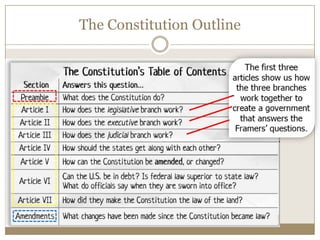
The Constitution Outline
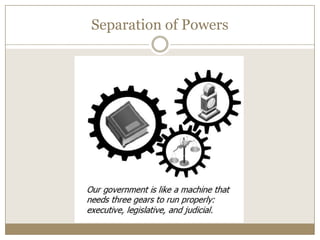
Separation of Powers
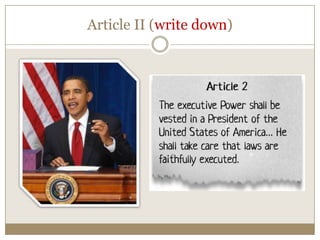
Article II (write down)
Article II
Creating the President
 Article II describes the job of the executive branch.
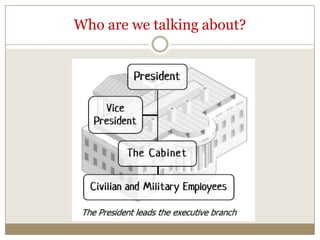
The president heads the branch, which includes the
vice president, the cabinet, and many civilian and
military employees. Article II also says who qualifies
to be the president, how he or she is selected
(Electoral College), what powers the office has, and
what happens if a president misbehaves!
Who are we talking about?
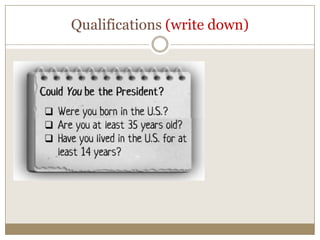
Qualifications (write down)
Article II (write down)
 Powers of the Executive Branch:









Act as commander-in-chief of armed forces and National Guard
Maintain a cabinet of advisors who run the 14 executive departments
like the State Department and the Treasury
Grant pardons in all federal criminal offenses, and reprieves
(postpone punishments like executions)
Negotiate treaties w/ other countries
Appoint ambassadors, Supreme Court/federal court judges, and
Cabinet members
Make a State of the Union Address to Congress
Represent the US when dealing with foreign countries
Make sure that laws are carried out (executed)
G8 Summit
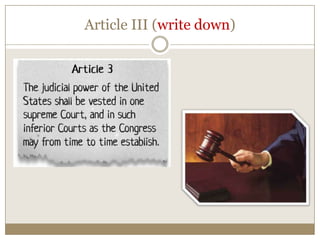
Article III (write down)
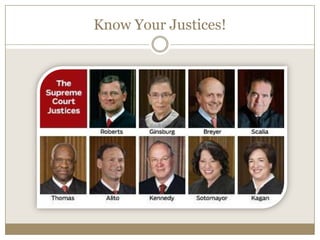
Know Your Justices!
Article III
Creating the Courts: Here Come the Judges!
 Article III creates the judicial branch. This is the shortest of the first
three articles and includes the fewest details.
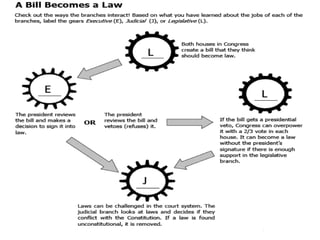
 The judicial branch has the job of interpreting laws to decide what
they mean (and decide if they are unconstitutional).
 The Supreme Court is the only court that is established in Article
III. All of the other federal courts are created by Congress.
 Federal judges are appointed and given terms that last until they
retire, die, or are removed for bad behavior (this is an example of
independent judiciary).
 Article III gives directions about what kinds of cases the Supreme
Court and federal courts can hear. It also guarantees trial by jury in
criminal court and explains what treason is.
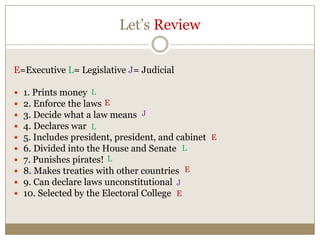
Let’s Review
E=Executive L= Legislative J= Judicial











1. Prints money L
2. Enforce the laws E
3. Decide what a law means J
4. Declares war L
5. Includes president, president, and cabinet E
6. Divided into the House and Senate L
7. Punishes pirates! L
8. Makes treaties with other countries E
9. Can declare laws unconstitutional J
10. Selected by the Electoral College E
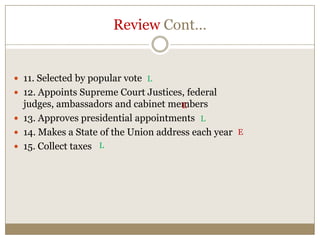
Review Cont…

 11. Selected by popular vote L
 12. Appoints Supreme Court Justices, federal

judges, ambassadors and cabinet members
E
 13. Approves presidential appointments L
 14. Makes a State of the Union address each year E
 15. Collect taxes L

Unit 1.3 day 3 constitution articles pt.2 (daily sheet 3)

  • 1.
    Unit 1.3 TheArticles of the Constitution Pt.2 DAILY SHEET 3
  • 2.
  • 3.
  • 4.
  • 5.
    Article II Creating thePresident  Article II describes the job of the executive branch. The president heads the branch, which includes the vice president, the cabinet, and many civilian and military employees. Article II also says who qualifies to be the president, how he or she is selected (Electoral College), what powers the office has, and what happens if a president misbehaves!
  • 6.
    Who are wetalking about?
  • 7.
  • 8.
    Article II (writedown)  Powers of the Executive Branch:         Act as commander-in-chief of armed forces and National Guard Maintain a cabinet of advisors who run the 14 executive departments like the State Department and the Treasury Grant pardons in all federal criminal offenses, and reprieves (postpone punishments like executions) Negotiate treaties w/ other countries Appoint ambassadors, Supreme Court/federal court judges, and Cabinet members Make a State of the Union Address to Congress Represent the US when dealing with foreign countries Make sure that laws are carried out (executed)
  • 9.
  • 10.
  • 11.
  • 12.
    Article III Creating theCourts: Here Come the Judges!  Article III creates the judicial branch. This is the shortest of the first three articles and includes the fewest details.  The judicial branch has the job of interpreting laws to decide what they mean (and decide if they are unconstitutional).  The Supreme Court is the only court that is established in Article III. All of the other federal courts are created by Congress.  Federal judges are appointed and given terms that last until they retire, die, or are removed for bad behavior (this is an example of independent judiciary).  Article III gives directions about what kinds of cases the Supreme Court and federal courts can hear. It also guarantees trial by jury in criminal court and explains what treason is.
  • 14.
    Let’s Review E=Executive L=Legislative J= Judicial           1. Prints money L 2. Enforce the laws E 3. Decide what a law means J 4. Declares war L 5. Includes president, president, and cabinet E 6. Divided into the House and Senate L 7. Punishes pirates! L 8. Makes treaties with other countries E 9. Can declare laws unconstitutional J 10. Selected by the Electoral College E
  • 15.
    Review Cont…  11.Selected by popular vote L  12. Appoints Supreme Court Justices, federal judges, ambassadors and cabinet members E  13. Approves presidential appointments L  14. Makes a State of the Union address each year E  15. Collect taxes L