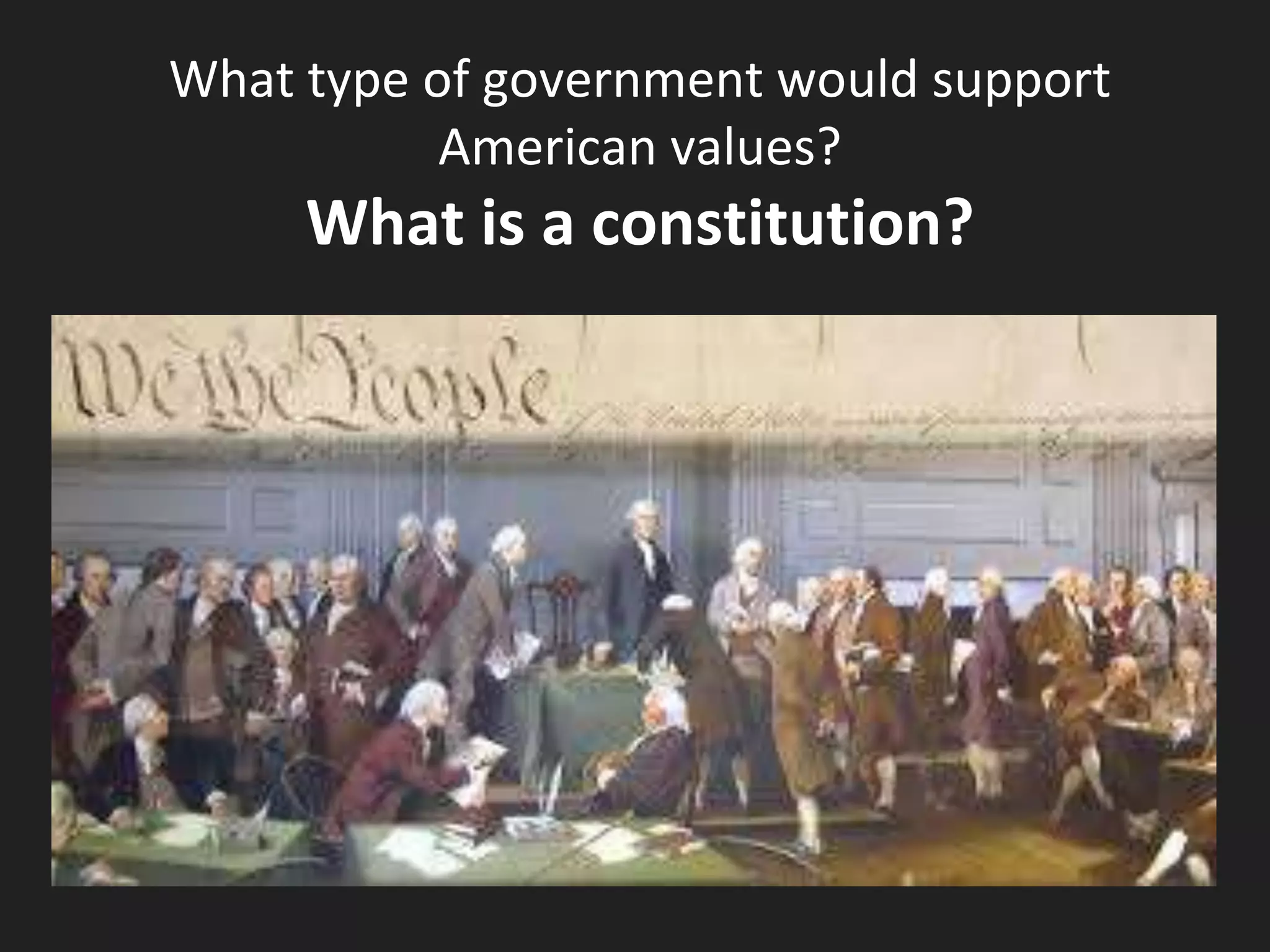
What type of government would support
American values?
What is a constitution?
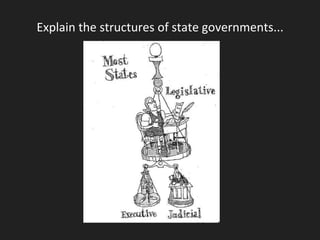
Explain the structures of state governments...
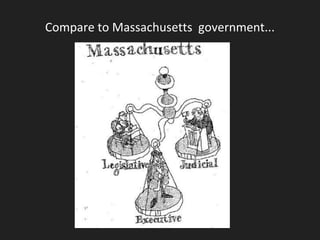
Compare to Massachusetts government...
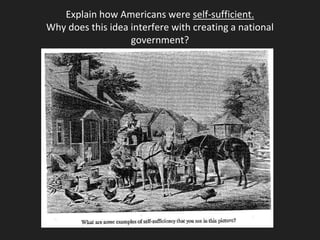
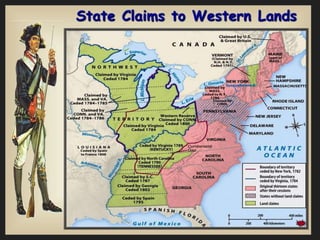
Explain how Americans were self-sufficient.
Why does this idea interfere with creating a national
government?
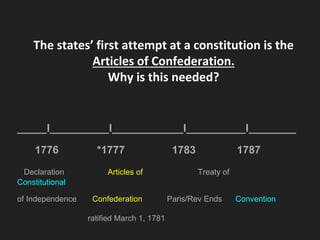
The states’ first attempt at a constitution is the
Articles of Confederation.
Why is this needed?
_____I__________I____________I__________I________
1776 *1777 1783 1787
Declaration Articles of Treaty of
Constitutional
of Independence Confederation Paris/Rev Ends Convention
ratified March 1, 1781
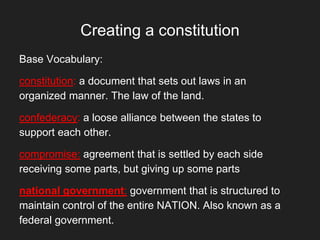
Creating a constitution
Base Vocabulary:
constitution: a document that sets out laws in an
organized manner. The law of the land.
confederacy: a loose alliance between the states to
support each other.
compromise: agreement that is settled by each side
receiving some parts, but giving up some parts
national government: government that is structured to
maintain control of the entire NATION. Also known as a
federal government.
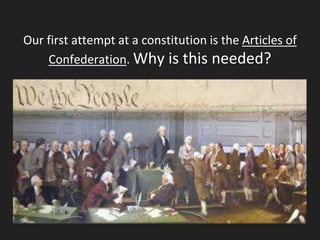
Our first attempt at a constitution is the Articles of
Confederation. Why is this needed?
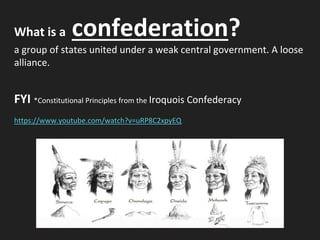
What is a confederation?
a group of states united under a weak central government. A loose
alliance.
FYI *Constitutional Principles from the Iroquois Confederacy
https://www.youtube.com/watch?v=uRP8C2xpyEQ
The United States first attempt at a constitution is the
Articles of Confederation.
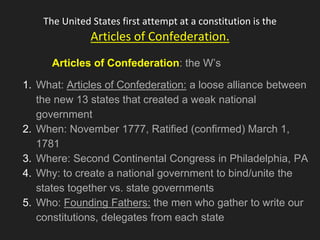
Articles of Confederation: the W’s
1. What: Articles of Confederation: a loose alliance between
the new 13 states that created a weak national
government
2. When: November 1777, Ratified (confirmed) March 1,
1781
3. Where: Second Continental Congress in Philadelphia, PA
4. Why: to create a national government to bind/unite the
states together vs. state governments
5. Who: Founding Fathers: the men who gather to write our
constitutions, delegates from each state
Articles of
Confederation
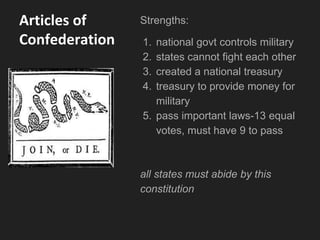
Strengths:
1. national govt controls military
2. states cannot fight each other
3. created a national treasury
4. treasury to provide money for
military
5. pass important laws-13 equal
votes, must have 9 to pass
all states must abide by this
constitution
Articles of
Confederation
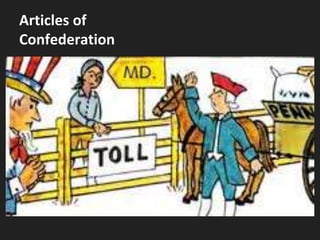
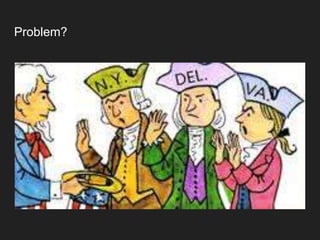
Problem?
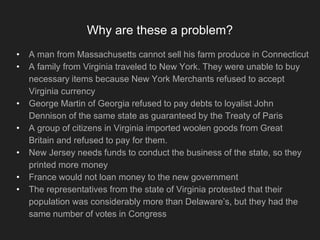
Why are these a problem?
• A man from Massachusetts cannot sell his farm produce in Connecticut
• A family from Virginia traveled to New York. They were unable to buy
necessary items because New York Merchants refused to accept
Virginia currency
• George Martin of Georgia refused to pay debts to loyalist John
Dennison of the same state as guaranteed by the Treaty of Paris
• A group of citizens in Virginia imported woolen goods from Great
Britain and refused to pay for them.
• New Jersey needs funds to conduct the business of the state, so they
printed more money
• France would not loan money to the new government
• The representatives from the state of Virginia protested that their
population was considerably more than Delaware’s, but they had the
same number of votes in Congress
Articles of
Confederation
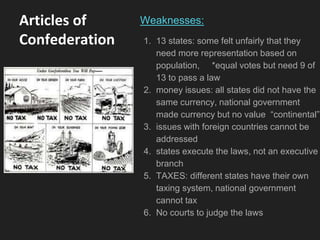
Weaknesses:
1. 13 states: some felt unfairly that they
need more representation based on
population, *equal votes but need 9 of
13 to pass a law
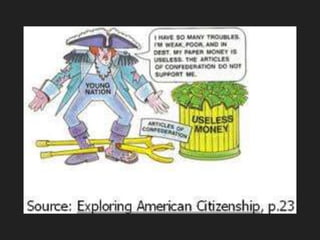
2. money issues: all states did not have the
same currency, national government
made currency but no value “continental”
3. issues with foreign countries cannot be
addressed
4. states execute the laws, not an executive
branch
5. TAXES: different states have their own
taxing system, national government
cannot tax
6. No courts to judge the laws
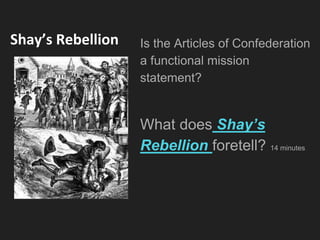
Shay’s Rebellion Is the Articles of Confederation
a functional mission
statement?
What does Shay’s
Rebellion foretell? 14 minutes
Cause and Effect
States have too
much power…..
National
government
does not have
enough
power….
In 1787, a revision of the Articles of
Confederation were needed…..
WHY?
mission: an important task assigned
to a group of people to accomplish
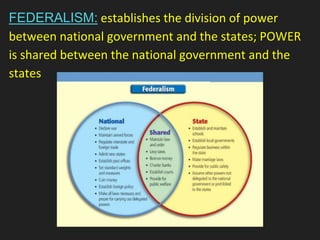
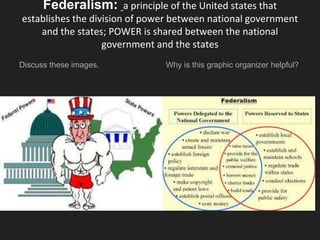
FEDERALISM: establishes the division of power
between national government and the states; POWER
is shared between the national government and the
states
Burning Issues at the convention…..
Should slavery be legal in any of the
United States?
Burning Issues at the convention…..
Who should be allowed to vote in
general elections?
Burning Issues at the convention…..
Should the amount of people in your
state matter when in representation?
Burning Issues at the convention…..
Should the Constitution allow the
slave trade to continue?
Burning Issues at the convention…..
Should free Northern states be required
to return runaway slaves to the South?
Burning Issues at the convention…..
Should US government bonds (money)
be paid back in full? All? Some?
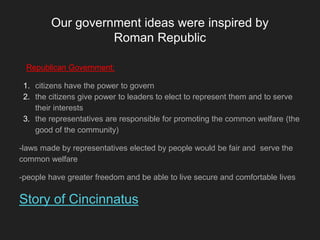
Our government ideas were inspired by
Roman Republic
Republican Government:
1. citizens have the power to govern
2. the citizens give power to leaders to elect to represent them and to serve
their interests
3. the representatives are responsible for promoting the common welfare (the
good of the community)
-laws made by representatives elected by people would be fair and serve the
common welfare
-people have greater freedom and be able to live secure and comfortable lives
Story of Cincinnatus
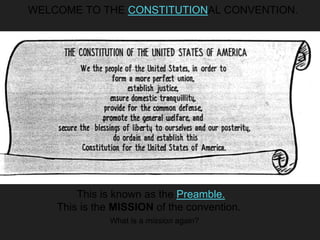
WELCOME TO THE CONSTITUTIONAL CONVENTION.
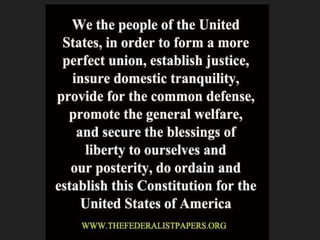
This is known as the Preamble.
This is the MISSION of the convention.
What is a mission again?
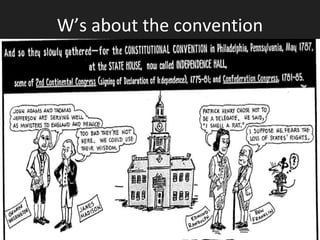
W’s about the convention
What is a Constitutional government?
What is the purpose of a government?
How is it organized?
How does the government go about its business?
How are rules made?
How are people picked to serve?
Who is considered a citizen?
What rights and responsibilities are citizens supposed to have?
Are citizens supposed to have control over their government?
● The person or group ruling has LIMITS…..
Constitutional
Convention
A. Time period: summer, 1787
B. Location: Philadelphia, Pennsylvania
C. Key Vocabulary:
• constitution: a document that sets
out the laws and principles
• delegate: an elected official who
represents a state
• compromise: a settlement in which
each side gives up some its
demands in order to reach an
agreement
• Federalism******
Extras for
Understanding
Federalism: a principle of the United states that
establishes the division of power between national government
and the states; POWER is shared between the national
government and the states
Discuss these images. Why is this graphic organizer helpful?
What makes a great leader?
Brainstorm……….Extras for
Understanding
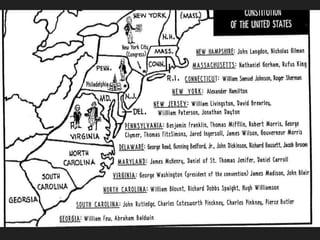
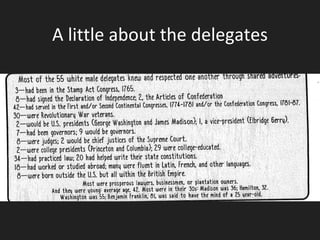
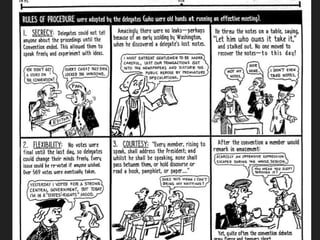
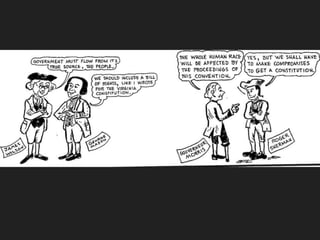
A little about the delegates
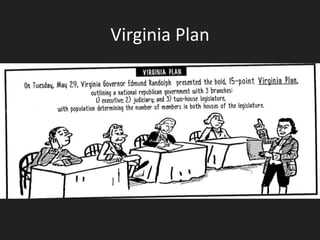
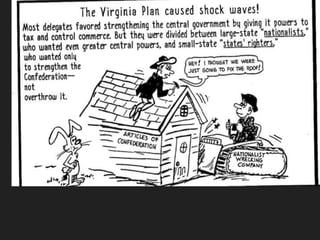
Virginia Plan
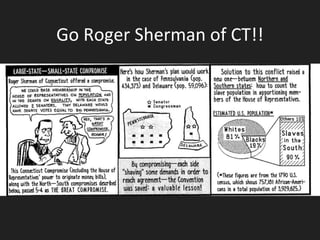
Go Roger Sherman of CT!!
Constitutional Convention:
HOW to resolve issues?
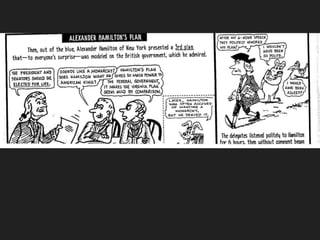
6. Possible plans to resolve issues
– Virginia Plan
• Written by
• Ideas included
Cont.
6. Possible plans to resolve issues (HOW)
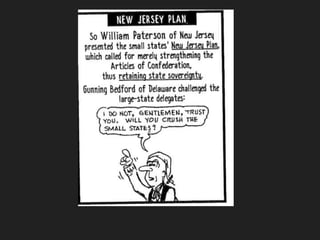
– New Jersey Plan
• Written by
• Ideas included
*** Great Compromise:
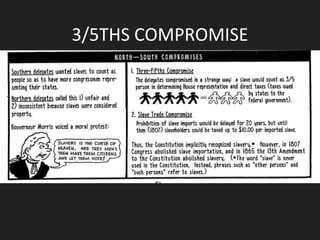
3/5THS COMPROMISE
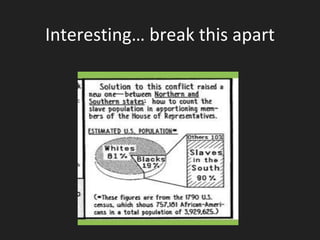
Interesting… break this apart
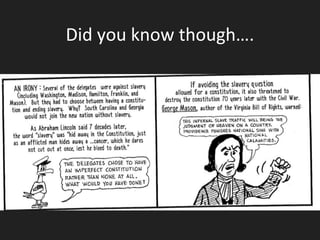
Did you know though….
Cont….
7.. Slavery Issue and Population
**** 3/5ths Compromise:
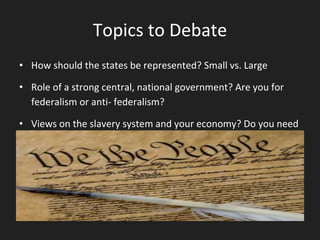
Topics to Debate
• How should the states be represented? Small vs. Large
• Role of a strong central, national government? Are you for
federalism or anti- federalism?
• Views on the slavery system and your economy? Do you need
the workforce? Should they be counted as citizens?
Constitutional Convention
1787
Please sign in...
Break Into Northern and Southern
States and discuss
• Size
• Economy
• Your state’s voice and
concerns
• Should you be allies?
• Will you support the
Constitution?
What about individual rights?
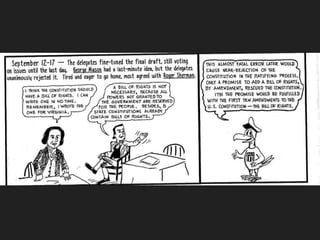
7.. After the Constitution was drafted, George
Mason brought to the attention of the fathers that
individual, natural rights did not appear in this
document. As an addition, they added the first ten
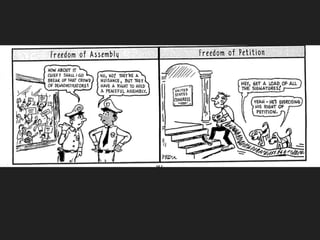
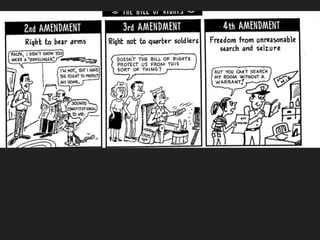
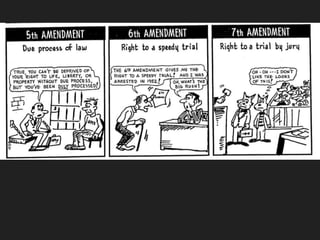
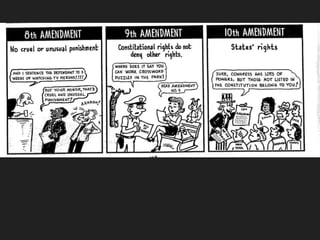
amendments:
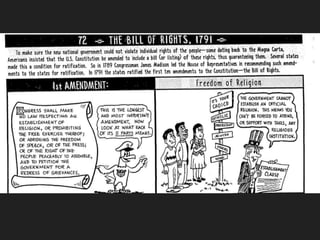
**** Bill of Rights:
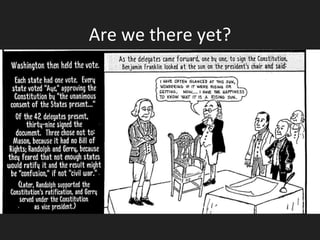
Are we there yet?
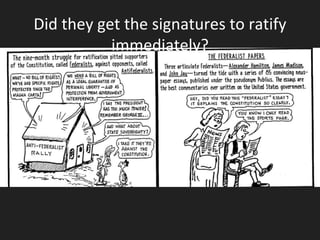
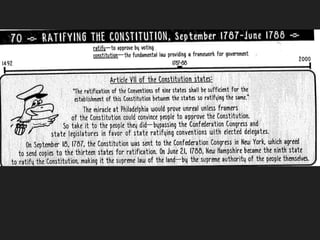
Did they get the signatures to ratify
immediately?
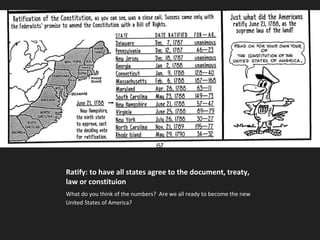
Ratify: to have all states agree to the document, treaty,
law or constituion
What do you think of the numbers? Are we all ready to become the new
United States of America?
Who Really Won?
Using a copy of the Constitution, figure out what was decided at the convention.
1. Should slavery be legal in any of the United States?
(Article I, Clause I)
2. Should the slave trade be continued? (Article I, Section 9,
Clause 1)
3. Who should be allowed to vote?
4. Should Northerners be forced to return runaway slaves to
their owners? (Article IV, Section 2, Clause 3)
What social groups won the real
Constitutional Convention?

Constitutional Convention 2018

  • 1.
    What type ofgovernment would support American values? What is a constitution?
  • 2.
    Explain the structuresof state governments...
  • 3.
  • 4.
    Explain how Americanswere self-sufficient. Why does this idea interfere with creating a national government?
  • 5.
    The states’ firstattempt at a constitution is the Articles of Confederation. Why is this needed? _____I__________I____________I__________I________ 1776 *1777 1783 1787 Declaration Articles of Treaty of Constitutional of Independence Confederation Paris/Rev Ends Convention ratified March 1, 1781
  • 6.
    Creating a constitution BaseVocabulary: constitution: a document that sets out laws in an organized manner. The law of the land. confederacy: a loose alliance between the states to support each other. compromise: agreement that is settled by each side receiving some parts, but giving up some parts national government: government that is structured to maintain control of the entire NATION. Also known as a federal government.
  • 8.
    Our first attemptat a constitution is the Articles of Confederation. Why is this needed?
  • 9.
    What is aconfederation? a group of states united under a weak central government. A loose alliance. FYI *Constitutional Principles from the Iroquois Confederacy https://www.youtube.com/watch?v=uRP8C2xpyEQ
  • 10.
    The United Statesfirst attempt at a constitution is the Articles of Confederation. Articles of Confederation: the W’s 1. What: Articles of Confederation: a loose alliance between the new 13 states that created a weak national government 2. When: November 1777, Ratified (confirmed) March 1, 1781 3. Where: Second Continental Congress in Philadelphia, PA 4. Why: to create a national government to bind/unite the states together vs. state governments 5. Who: Founding Fathers: the men who gather to write our constitutions, delegates from each state
  • 11.
    Articles of Confederation Strengths: 1. nationalgovt controls military 2. states cannot fight each other 3. created a national treasury 4. treasury to provide money for military 5. pass important laws-13 equal votes, must have 9 to pass all states must abide by this constitution
  • 12.
  • 13.
  • 16.
    Why are thesea problem? • A man from Massachusetts cannot sell his farm produce in Connecticut • A family from Virginia traveled to New York. They were unable to buy necessary items because New York Merchants refused to accept Virginia currency • George Martin of Georgia refused to pay debts to loyalist John Dennison of the same state as guaranteed by the Treaty of Paris • A group of citizens in Virginia imported woolen goods from Great Britain and refused to pay for them. • New Jersey needs funds to conduct the business of the state, so they printed more money • France would not loan money to the new government • The representatives from the state of Virginia protested that their population was considerably more than Delaware’s, but they had the same number of votes in Congress
  • 18.
    Articles of Confederation Weaknesses: 1. 13states: some felt unfairly that they need more representation based on population, *equal votes but need 9 of 13 to pass a law 2. money issues: all states did not have the same currency, national government made currency but no value “continental” 3. issues with foreign countries cannot be addressed 4. states execute the laws, not an executive branch 5. TAXES: different states have their own taxing system, national government cannot tax 6. No courts to judge the laws
  • 19.
    Shay’s Rebellion Isthe Articles of Confederation a functional mission statement? What does Shay’s Rebellion foretell? 14 minutes
  • 20.
    Cause and Effect Stateshave too much power….. National government does not have enough power….
  • 21.
    In 1787, arevision of the Articles of Confederation were needed….. WHY? mission: an important task assigned to a group of people to accomplish
  • 22.
    FEDERALISM: establishes thedivision of power between national government and the states; POWER is shared between the national government and the states
  • 23.
    Burning Issues atthe convention….. Should slavery be legal in any of the United States?
  • 24.
    Burning Issues atthe convention….. Who should be allowed to vote in general elections?
  • 25.
    Burning Issues atthe convention….. Should the amount of people in your state matter when in representation?
  • 26.
    Burning Issues atthe convention….. Should the Constitution allow the slave trade to continue?
  • 27.
    Burning Issues atthe convention….. Should free Northern states be required to return runaway slaves to the South?
  • 28.
    Burning Issues atthe convention….. Should US government bonds (money) be paid back in full? All? Some?
  • 29.
    Our government ideaswere inspired by Roman Republic Republican Government: 1. citizens have the power to govern 2. the citizens give power to leaders to elect to represent them and to serve their interests 3. the representatives are responsible for promoting the common welfare (the good of the community) -laws made by representatives elected by people would be fair and serve the common welfare -people have greater freedom and be able to live secure and comfortable lives Story of Cincinnatus
  • 30.
    WELCOME TO THECONSTITUTIONAL CONVENTION. This is known as the Preamble. This is the MISSION of the convention. What is a mission again?
  • 31.
    W’s about theconvention
  • 32.
    What is aConstitutional government? What is the purpose of a government? How is it organized? How does the government go about its business? How are rules made? How are people picked to serve? Who is considered a citizen? What rights and responsibilities are citizens supposed to have? Are citizens supposed to have control over their government? ● The person or group ruling has LIMITS…..
  • 33.
    Constitutional Convention A. Time period:summer, 1787 B. Location: Philadelphia, Pennsylvania C. Key Vocabulary: • constitution: a document that sets out the laws and principles • delegate: an elected official who represents a state • compromise: a settlement in which each side gives up some its demands in order to reach an agreement • Federalism****** Extras for Understanding
  • 34.
    Federalism: a principleof the United states that establishes the division of power between national government and the states; POWER is shared between the national government and the states Discuss these images. Why is this graphic organizer helpful?
  • 35.
    What makes agreat leader? Brainstorm……….Extras for Understanding
  • 37.
    A little aboutthe delegates
  • 39.
  • 43.
  • 45.
    Constitutional Convention: HOW toresolve issues? 6. Possible plans to resolve issues – Virginia Plan • Written by • Ideas included
  • 46.
    Cont. 6. Possible plansto resolve issues (HOW) – New Jersey Plan • Written by • Ideas included *** Great Compromise:
  • 47.
  • 48.
  • 49.
    Did you knowthough….
  • 50.
    Cont…. 7.. Slavery Issueand Population **** 3/5ths Compromise:
  • 51.
    Topics to Debate •How should the states be represented? Small vs. Large • Role of a strong central, national government? Are you for federalism or anti- federalism? • Views on the slavery system and your economy? Do you need the workforce? Should they be counted as citizens?
  • 52.
  • 55.
    Break Into Northernand Southern States and discuss • Size • Economy • Your state’s voice and concerns • Should you be allies? • Will you support the Constitution?
  • 56.
    What about individualrights? 7.. After the Constitution was drafted, George Mason brought to the attention of the fathers that individual, natural rights did not appear in this document. As an addition, they added the first ten amendments: **** Bill of Rights:
  • 60.
  • 70.
    Did they getthe signatures to ratify immediately?
  • 72.
    Ratify: to haveall states agree to the document, treaty, law or constituion What do you think of the numbers? Are we all ready to become the new United States of America?
  • 76.
    Who Really Won? Usinga copy of the Constitution, figure out what was decided at the convention. 1. Should slavery be legal in any of the United States? (Article I, Clause I) 2. Should the slave trade be continued? (Article I, Section 9, Clause 1) 3. Who should be allowed to vote? 4. Should Northerners be forced to return runaway slaves to their owners? (Article IV, Section 2, Clause 3) What social groups won the real Constitutional Convention?