The Constitutional
Convention
Essential Question
How did leaders reshape the government with at the
Constitutional Convention?
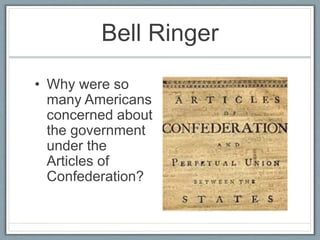
Bell Ringer
• Why were so
many Americans
concerned about
the government
under the
Articles of
Confederation?
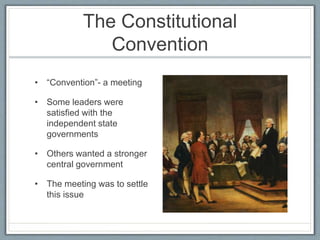
The Constitutional
Convention
• “Convention”- a meeting
• Some leaders were
satisfied with the
independent state
governments
• Others wanted a stronger
central government
• The meeting was to settle
this issue
Checkpoint
• What was the major issue at the Constitutional
Convention?
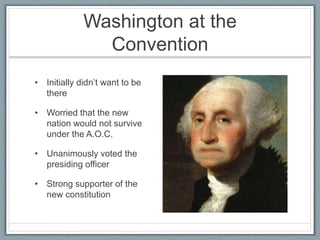
Washington at the
Convention
• Initially didn’t want to be
there
• Worried that the new
nation would not survive
under the A.O.C.
• Unanimously voted the
presiding officer
• Strong supporter of the
new constitution
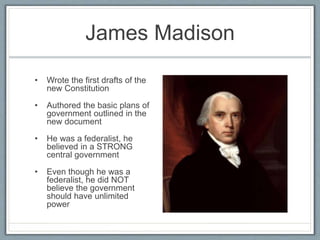
James Madison
• Wrote the first drafts of the
new Constitution
• Authored the basic plans of
government outlined in the
new document
• He was a federalist, he
believed in a STRONG
central government
• Even though he was a
federalist, he did NOT
believe the government
should have unlimited
power
Checkpoint
• Who is considered the “father of the Constitution?
• Washington and Madison were both “federalists.”
What does this mean?
The Virginia Plan vs. The
New Jersey Plan
• The Virginia Plan
(Edmund Randolph)
• Called for a two-house
legislature with
proportional representation
(based on population)
• The New Jersey Plan
(William Paterson)
• Called for a one-house
legislature with each state
having a single vote
Both Plans:
- Were federal systems with three branches
- Gave the government more power than it had under the Articles of
Confederation
Checkpoint
• Which plan involved creating a two-house
(bicameral) legislature based on the population of
the state?
• Which plan involved creating a one house
legislature with every state having a single vote?
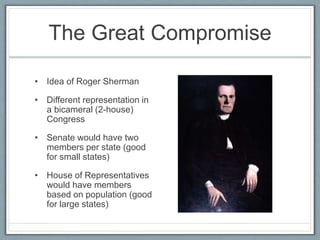
The Great Compromise
• Idea of Roger Sherman
• Different representation in
a bicameral (2-house)
Congress
• Senate would have two
members per state (good
for small states)
• House of Representatives
would have members
based on population (good
for large states)
Checkpoint
• Under the Great Compromise, how many
representatives would each state have in the
Senate?
• Under the Great Compromise, representation in
the House of Representatives is based on what?
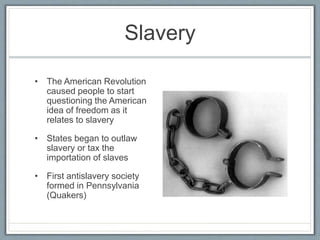
Slavery
• The American Revolution
caused people to start
questioning the American
idea of freedom as it
relates to slavery
• States began to outlaw
slavery or tax the
importation of slaves
• First antislavery society
formed in Pennsylvania
(Quakers)
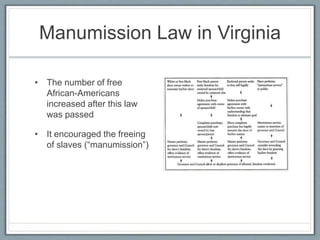
Manumission Law in Virginia
• The number of free
African-Americans
increased after this law
was passed
• It encouraged the freeing
of slaves (“manumission”)
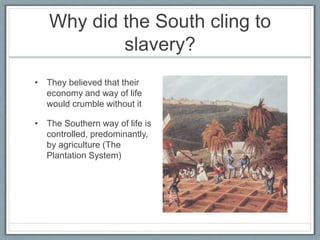
Why did the South cling to
slavery?
• They believed that their
economy and way of life
would crumble without it
• The Southern way of life is
controlled, predominantly,
by agriculture (The
Plantation System)
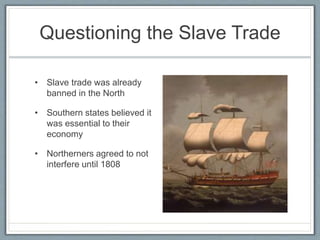
Questioning the Slave Trade
• Slave trade was already
banned in the North
• Southern states believed it
was essential to their
economy
• Northerners agreed to not
interfere until 1808
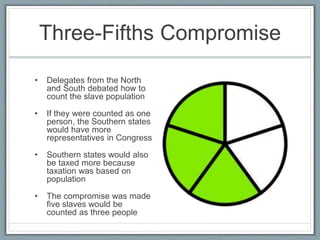
Three-Fifths Compromise
• Delegates from the North
and South debated how to
count the slave population
• If they were counted as one
person, the Southern states
would have more
representatives in Congress
• Southern states would also
be taxed more because
taxation was based on
population
• The compromise was made
five slaves would be
counted as three people
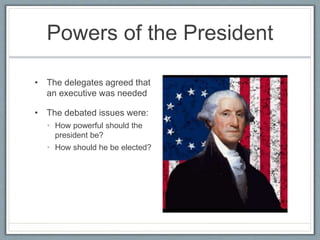
Powers of the President
• The delegates agreed that
an executive was needed
• The debated issues were:
• How powerful should the
president be?
• How should he be elected?
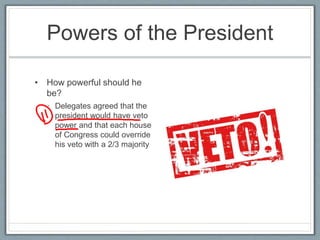
Powers of the President
• How powerful should he
be?
• Delegates agreed that the
president would have veto
power and that each house
of Congress could override
his veto with a 2/3 majority
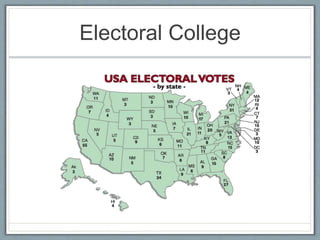
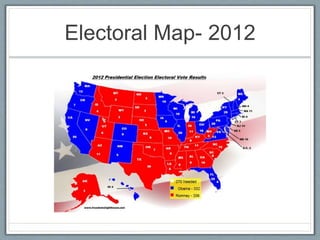
How to elect a president?
• Some delegates believed
that he should simply be
elected by popular vote
• Others disagreed because
they did not trust the
decision making skills of the
“common man”
• The final decision was that
the president would be
chosen by a number of
“electors” in his state
• This would become known
as the Electoral College
Electoral College
Electoral Map- 2012
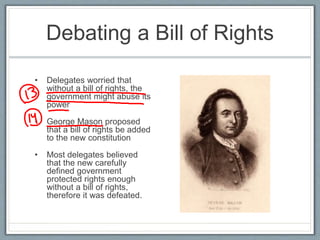
Debating a Bill of Rights
• Delegates worried that
without a bill of rights, the
government might abuse its
power
• George Mason proposed
that a bill of rights be added
to the new constitution
• Most delegates believed
that the new carefully
defined government
protected rights enough
without a bill of rights,
therefore it was defeated.
Approving the Constitution
• Approved on September
17, 1787
• Some delegates refused to
sign due to the lack of a
bill of rights
• The approved draft went to
the states for approval
• Only 9 of the 13 states
would have to approve the
new constitution

Constitutional convention

  • 1.
    The Constitutional Convention Essential Question Howdid leaders reshape the government with at the Constitutional Convention?
  • 2.
    Bell Ringer • Whywere so many Americans concerned about the government under the Articles of Confederation?
  • 3.
    The Constitutional Convention • “Convention”-a meeting • Some leaders were satisfied with the independent state governments • Others wanted a stronger central government • The meeting was to settle this issue
  • 4.
    Checkpoint • What wasthe major issue at the Constitutional Convention?
  • 5.
    Washington at the Convention •Initially didn’t want to be there • Worried that the new nation would not survive under the A.O.C. • Unanimously voted the presiding officer • Strong supporter of the new constitution
  • 6.
    James Madison • Wrotethe first drafts of the new Constitution • Authored the basic plans of government outlined in the new document • He was a federalist, he believed in a STRONG central government • Even though he was a federalist, he did NOT believe the government should have unlimited power
  • 7.
    Checkpoint • Who isconsidered the “father of the Constitution? • Washington and Madison were both “federalists.” What does this mean?
  • 8.
    The Virginia Planvs. The New Jersey Plan • The Virginia Plan (Edmund Randolph) • Called for a two-house legislature with proportional representation (based on population) • The New Jersey Plan (William Paterson) • Called for a one-house legislature with each state having a single vote Both Plans: - Were federal systems with three branches - Gave the government more power than it had under the Articles of Confederation
  • 9.
    Checkpoint • Which planinvolved creating a two-house (bicameral) legislature based on the population of the state? • Which plan involved creating a one house legislature with every state having a single vote?
  • 10.
    The Great Compromise •Idea of Roger Sherman • Different representation in a bicameral (2-house) Congress • Senate would have two members per state (good for small states) • House of Representatives would have members based on population (good for large states)
  • 11.
    Checkpoint • Under theGreat Compromise, how many representatives would each state have in the Senate? • Under the Great Compromise, representation in the House of Representatives is based on what?
  • 12.
    Slavery • The AmericanRevolution caused people to start questioning the American idea of freedom as it relates to slavery • States began to outlaw slavery or tax the importation of slaves • First antislavery society formed in Pennsylvania (Quakers)
  • 13.
    Manumission Law inVirginia • The number of free African-Americans increased after this law was passed • It encouraged the freeing of slaves (“manumission”)
  • 14.
    Why did theSouth cling to slavery? • They believed that their economy and way of life would crumble without it • The Southern way of life is controlled, predominantly, by agriculture (The Plantation System)
  • 15.
    Questioning the SlaveTrade • Slave trade was already banned in the North • Southern states believed it was essential to their economy • Northerners agreed to not interfere until 1808
  • 16.
    Three-Fifths Compromise • Delegatesfrom the North and South debated how to count the slave population • If they were counted as one person, the Southern states would have more representatives in Congress • Southern states would also be taxed more because taxation was based on population • The compromise was made five slaves would be counted as three people
  • 17.
    Powers of thePresident • The delegates agreed that an executive was needed • The debated issues were: • How powerful should the president be? • How should he be elected?
  • 18.
    Powers of thePresident • How powerful should he be? • Delegates agreed that the president would have veto power and that each house of Congress could override his veto with a 2/3 majority
  • 19.
    How to electa president? • Some delegates believed that he should simply be elected by popular vote • Others disagreed because they did not trust the decision making skills of the “common man” • The final decision was that the president would be chosen by a number of “electors” in his state • This would become known as the Electoral College
  • 20.
  • 21.
  • 22.
    Debating a Billof Rights • Delegates worried that without a bill of rights, the government might abuse its power • George Mason proposed that a bill of rights be added to the new constitution • Most delegates believed that the new carefully defined government protected rights enough without a bill of rights, therefore it was defeated.
  • 23.
    Approving the Constitution •Approved on September 17, 1787 • Some delegates refused to sign due to the lack of a bill of rights • The approved draft went to the states for approval • Only 9 of the 13 states would have to approve the new constitution